


Policy elites often envision and justify foreign aid as a way to promote socioeconomic development and political liberalization. Foreign aid, for instance, may accelerate political liberalization via the development channel and/or may be employed as a “carrot” to promote democratic governance. In line with these beliefs, foreign aid agencies frequently “reward” countries on the path of democratization.Footnote 1 Scholars have long found this view of foreign aid to be overly optimistic. Arguments by Bauer (Reference Bauer1972) and Friedman (Reference Friedman1958) defend the notion that foreign aid represents slack resources that a government can use at its discretion, leading to neither development nor liberalization, but rather to extending patronage networks to stay in power. These arguments thus generate the prediction that foreign aid should extend the political tenure of governments in autocracies.
Scholarly skepticism about foreign aid flows has led to an academic championing of workers’ remittances as a conduit for political liberalization that has been embraced by policymakers. Although a number of studies have documented the effects of aggregate remittances in the international political economy (Leblang Reference Leblang2010; Singer Reference Singer2010), a few scholars have posited that greater household income (achieved via remittances) can empower individuals politically and engender political reform.Footnote 2 For instance, qualitative evidence (primarily from Latin America, and in particular Mexico) suggests that remittance recipients may be better able to politically coordinate (de la Garza and Hazan Reference de la Garza and Hazan2003) and to demonstrate discontent (“exit”) and break away from the clientelist grips of a dominant party (Diaz-Cayeros, Magaloni, and Weingast Reference Diaz-Cayeros, Magaloni and Weingast2003). Indeed, building on these notions, President Barack Obama (Reference Obama2009), in a memorandum promoting human rights and democracy in Cuba declared that “increasing the flow of remittances and information to the Cuban people” are “measures that decrease dependency of the Cuban people on Castro regime” constituting a “means to encourage positive change in Cuba.” The idea is that remittances, unlike foreign aid, cannot be directed by governments in receiving countries as they are received by households. Greater household financial security should, in theory, create the necessary conditions for liberalization and reform (e.g., Boix and Stokes Reference Boix and Stokes2003; Lipset Reference Lipset1959).
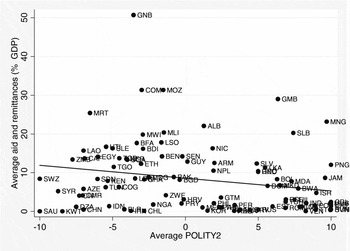
This article argues that scholars should be as skeptical about remittances as they are about foreign aid. Using a formal model and empirical testing, this article demonstrates that the combination of aid and remittance inflows can empower governments in autocracies to survive longer. The link between the effects of foreign aid and remittances on government survival hinges on the fact that these inflows of money constitute forms of unearned foreign income that a government can potentially exploit for nefarious purposes.Footnote 3 For governments, these external rents can be substantial. Globally, flows of aid and remittances have grown nearly fourfold (in real terms) in the past 30 years, from around $55 billion in 1974 to over $210 billion by 2004. For many countries these inflows can be quite large. Figure 1 plots the period (1974–2004) average of each country's aggregate inflows of aid and remittances against its POLITY score. Although the typical country receives aid and remittance inflows equal to about 8.5% of GDP, many countries are highly dependent on these foreign income flows. For instance, Albania, Guinea-Bissau, Gambia, and Mongolia receive aid and remittances exceeding one-fifth of their economic output (GDP). The composition of aid and remittances also differs across countries, with some countries receiving higher remittance inflows than aid receipts. For example, on the average, aggregate remittances exceed aid receipts in Albania, Egypt, El Salvador, and Pakistan. Moreover, unearned foreign income inflows are seemingly correlated with a country's quality of governance. The fitted line in Figure 1 shows a negative correlation between a country's unearned income inflows and its POLITY score. This potentially endogenous relationship is directly tackled in the empirics.
Unearned Income Inflows by POLITY Score

The classification of foreign aid and remittances as unearned foreign income is tied to a large theoretical and empirical literature linking the sources of government revenue, in particular unearned government income, to the quality of political institutions and governance (e.g., Bueno de Mesquita et al. Reference Bueno de Mesquita, Siverson and Morrow2003; Mahdavy Reference Mahdavy1970; Morrison Reference Morrison2009; Ross Reference Ross2001). For instance, foreign aid has been viewed as a source of unearned income and the link between foreign aid and government survival has been studied extensively (e.g., Bueno de Mesquita and Smith Reference Bueno de Mesquita and Smith2009; Dunning Reference Dunning2004; Kono and Montinola Reference Kono and Montinola2009; Smith Reference Smith2008; Wright Reference Wright2009). Building on these studies, Bueno de Mesquita and Smith (Reference Bueno de Mesquita and Smith2010) posit that “free resources” (e.g., oil rents, foreign aid) can prolong the tenure of leaders in small–winning coalition settings (i.e., autocracies). These studies, including Bueno de Mesquita and Smith (Reference Bueno de Mesquita and Smith2010), however, have yet to formally establish whether unearned household income, such as remittances, may also extend the duration of incumbent governments. In part this is because scholars have yet to theorize how remittances that do not go directly to a government may be incorporated into a government's strategies for political survival.
To fill this gap, this article presents a parsimonious model demonstrating that the combination of unearned household and government income can prolong an authoritarian government's time in power. This is achieved via two channels. In the first, governments direct some foreign aid to finance patronage goods (income effect). In the second, governments respond to shocks in unearned and largely untaxable household income (i.e., remittances) by diverting expenditures from the provision of welfare goods in favor of patronage goods (substitution effect). Finally, these two effects are magnified in more authoritarian-leaning polities. The model's key prediction is that a government's probability of survival is increasing in the interaction of a country's level of institutionalized autocracy with its receipts of unearned foreign income.
To empirically substantiate these theoretical predictions, I employ duration models of government turnover and a novel natural experiment of oil price–driven aid and remittances flows to mitigate concerns stemming primarily from reverse causality (endogeneity).Footnote 4 The baseline results show that neither aid nor remittances alone significantly reduce the probability of government turnover in autocracies. In part because of more stringent econometric specifications employed in this article, this weaker finding with respect to foreign aid contrasts with those argued by Bueno de Mesquita and Smith (Reference Bueno de Mesquita and Smith2010) that foreign aid extends the tenure of autocratic leaders (e.g., by reducing revolutionary threats).Footnote 5 In contrast, the baseline results presented in this article demonstrate that the combination of aid and remittance inflows received in more autocratic polities reduces the likelihood that governments will be ousted from power, experience incidents of major political discontent, and undergo regime collapse. The instrumental variables results (arising from the natural experiment) corroborate the baseline result that unearned foreign income received in more autocratic countries reduces the likelihood of government turnover. Finally, I provide case study evidence from Jordan and cross-national analysis substantiating the underlying causal mechanisms. Specifically, I show that governments in autocracies channel aid and remittances to finance patronage (e.g., government wage compensation) by reducing their expenditures on welfare goods (e.g., government subsidies and transfers).
One of the central insights of the formal model and the supporting empirical analysis is that the quality of political institutions and governance mediates the impact of unearned foreign income on government survival. Specifically, unearned foreign income received in more authoritarian polities helps finance government patronage and raises the prospects for government survival. By extending the longevity of authoritarian rule, remittances in conjunction with foreign aid thus hinder political liberalization and potential socioeconomic welfare gains.
The rest of the article is structured as follows. The first section discusses the existing literature relating foreign aid and remittances to government survival and the role of patronage in autocracies. The next section presents a model tying unearned government and unearned household income to a government's prospect of political survival and derives testable implications. The following section discusses the baseline estimation strategy and the natural experimental design. The results are presented thereafter. The last section concludes.
EXISTING LITERATURE
Foreign Aid, Remittances, and Government Survival
Foreign aid is often envisioned as promoting socioeconomic development. Yet scholars have long recognized that foreign aid can extend the lives of inept and corrupt governments (Bauer Reference Bauer1972; Friedman Reference Friedman1958). These arguments center on the notion that foreign aid represents slack resources that a government can use as its discretion. For governments that tend to be less politically accountable to their populations, aid can have adverse effects on human development (Knack Reference Knack2003) and is likely to be wasted on nonproductive activities that will help the government stay in power (e.g., Bueno de Mesquita and Smith Reference Bueno de Mesquita and Smith2009, Reference Bueno de Mesquita and Smith2010; Kono and Montinola Reference Kono and Montinola2009; Smith Reference Smith2008). These arguments thus generate the prediction that foreign aid should extend the political tenure of governments in autocracies.
The empirical evidence evaluating this claim, however, is mixed. For instance, although foreign aid may have helped the dictorial rule of Jean-Claude Duvalier, Ferdinand Marcos, and Mobutu Sese Seko (all three received substantial aid and remained in office over 15 years), other dictators, such as Valentine Strasser of Sierra Leone, received more aid than any of them and lasted only 4 years. Several cross-country studies find that donors strategically disburse aid (e.g., Alesina and Dollar Reference Alesina and Dollar2000), frequently to autocratic governments from which donors can “buy” policy concessions (e.g., Bueno de Mesquita and Smith Reference Bueno de Mesquita and Smith2009). Of course, a recipient government will only grant these concessions if the concession (and any ramifications from it) does not threaten its political survival. Moreover, building on their earlier work, Bueno de Mesquita and Smith (Reference Bueno de Mesquita and Smith2010) argue that autocratic leaders with access to “free resources” such as foreign aid or natural resource rents are best equipped to survive revolutionary threats, avoid the occurrence of these threats in the first place, and thus remain in power longer.
This conclusion has not gone undisputed, however (e.g., Knack Reference Knack2004; Wright Reference Wright2009). For instance, in a cross-country study, Wright (Reference Wright2009) documents that foreign aid (primarily from Western donors) can foster democratization in authoritarian regimes. Meanwhile, Kono and Montinola (Reference Kono and Montinola2009) argue that foreign aid can extend government survival in both autocracies and democracies, but over different time horizons. They show that in the long run, continued aid helps autocrats more than democrats because the former can stockpile this aid for use against future negative shocks. However, because large stocks of aid reduce the marginal impact of current aid, aid helps democrats more than autocrats.
In contrast to the literature on the effect of foreign aid on government survival, evidence for the link between workers’ remittances and government stability is virtually nonexistent. Unlike aid, which goes directly to a government's coffers, remittances are received by households and tend to be poorly tracked and thus untaxed by the government (Chami et al. Reference Chami, Barajas, Cosimano, Fullenkamp, Gapen and Montiel2008; de Luna Martinez Reference de Luna Martinez2005).Footnote 6 Most country and cross-country studies find that households spend their remittance income on consumer and durable goods, as well as investments in health care and education (e.g., Chami et al. Reference Chami, Barajas, Cosimano, Fullenkamp, Gapen and Montiel2008; Yang Reference Yang2005).
Although much of the existing literature has evaluated the household economic decisions associated with remittance income, a few qualitative studies, limited primarily to Mexico, suggest that remittances may affect governance in nascent (“hybrid”) democracies via two potential channels: political mobilization and electoral support. For instance, the advent of hometown associations that aggregate individual remittances at the village level to fund local public goods and infrastructure projects (e.g., roads, schools, health facilities) have also helped individuals mobilize politically (de la Garza and Hazan Reference de la Garza and Hazan2003). Via the electoral channel, Diaz-Cayeros, Magaloni, and Weingast (Reference Diaz-Cayeros, Magaloni and Weingast2003) argue that international migration (and by extension, remittances) helped reduce the support for the PRI in Mexico (in the mid-1990s) by offering citizens a viable exit option. They argue that remittances made it possible for citizens to weather reductions in patronage after withdrawing support from the PRI. Diaz-Cayeros, Magaloni, and Weingast, however, do not provide direct econometric evidence that remittance income hurt the PRI at the polls. Nevertheless, given that remittances can potentially empower political mobilization, it is curious that no studies to date have examined whether remittances can impact government survival in a broader cross-national context.
Patronage Politics in Autocracies
Both foreign aid and remittances represent financial transfers that governments and households can use in a variety of ways. For instance, a government that receives $100 million in foreign aid can invest the aid in public infrastructure projects, can pay down government debt, and/or can steal some of it. Similarly, households that receive remittances may save it, may choose to invest these funds in their children's health and education, or may just consume it on goods and services. Depending on how households spend their remittances, governments may strategically change their behavior in response.
The potential fungibility of foreign aid and remittances allows actors, in particular the government, to engage in certain behavior that would not be possible in the absence of these funds. To stay in office, all governments supply welfare goods to the masses and targeted transfers in the form of patronage. However, the distribution of welfare goods relative to patronage goods supplied by the government tends to differ by regime type. For instance, in their theory of democratization, Acemoglu and Robinson (Reference Acemoglu and Robinson2006) argue that a country democratizes as a credible commitment to future redistribution. By design, governments in democracies will therefore spend a larger fraction of their revenue on the provision of public goods. Similarly, Bueno de Mesquita et al.’s (Reference Bueno de Mesquita, Siverson and Morrow2003) selectorate theory posits that given their political institutional constraints, democratic governments tend to provide a greater share of welfare goods than their authoritarian counterparts. Doing so better ensures the political survival of democratic governments.Footnote 7 This trade-off between patronage goods and welfare goods will enter the government's utility function.Footnote 8 Specifically, governments in autocracies will place greater weight on expenditures for patronage (compared to democracies) in their utility functions.Footnote 9
Patronage politics also underlies existing theories linking unearned government income to government survival. For example, theories of the natural resource curse and the rentier state posit that government revenue emanating from the extraction of rents from natural resources such as oil can expand its revenue base. Consequently, these governments tend to be less accountable to their populations, because they are less reliant on their populations for revenue (e.g., Mahdavy Reference Mahdavy1970; Morrison Reference Morrison2009; Ross Reference Ross2001). Similarly, extensions of the selectorate model of political survival generate the prediction that unearned government income (including foreign aid) can prolong a government's rule by expanding the provision of rents to members in the government's “winning coalition” and can worsen aggregate welfare in authoritarian countries (Bueno de Mesquita and Smith Reference Bueno de Mesquita and Smith2009, Reference Bueno de Mesquita and Smith2010; Smith Reference Smith2008). These models, however, have yet to formally demonstrate whether unearned household income can also extend a government's time in power. To address this gap in the theoretical literature, I formalize a channel through which the combination of unearned household and unearned government income can prolong a government's prospects of political survival.
MODEL
Players and Preferences
There are two actors in the model: a representative household and government. For simplicity, there are two goods in the model. One is a private good that must be purchased by the household, and the other good could be provided by the government or purchased by the household (e.g., education and health services). The funding of this latter welfare good does not affect the good's marginal utility. This means the quality of this welfare good is the same whether it is provided by the government or by the household, although households would prefer the government to supply these goods. These types of welfare goods, for instance, include basic health care goods such as drugs or vaccines.Footnote 10 They do not include welfare goods that require substantial fixed costs, such as the construction of a hospital or school, which a government can finance but which is prohibitively expensive for a household to fund.
Households have Cobb–Douglas utility over these two types of goods,

where c is the representative household's consumption of the private good, p is the household's consumption of the welfare good, and g is the government's provision of that good. The parameter λ is the weight households place on private goods relative to welfare goods (0<λ<1). Households finance their expenditures subject to the budget constraint

where y is the household's income, t is the tax rate, and R is remittances. R is untaxed by the government.
Governments also care about private goods (patronage goods) and welfare goods, but do so in relation to their main objective of staying in power. They do this by redistributing economic and/or political rents to key individuals (e.g., party supporters, business elites, military officials) and groups (e.g., organized labor, the majority of the voting population) in return for their political support. The distribution of rents can be in the form of welfare (e.g., subsidies and transfers to the general public) and patronage goods (e.g., compensation to government employees).
The importance of providing patronage goods (s) relative to welfare goods (g) is captured by α in the government's survival function,

where 0<α<1 and s stands for whatever the government keeps for its own consumption. Given these parameters, the government chooses s to maximize its survivor function subject to its budget constraint,

where t is the tax rate, y is income, and ω is unearned government income (e.g., foreign aid).
Equilibrium
I model the interaction between the household and government as a one-shot Stackelberg game where the government moves first. Solving for the equilibrium requires backward induction. The household's provision of welfare goods is given by maximizing its utility function (with respect to p) subject to its budget constraint. The household's optimal provision of welfare goods is

The first-order condition given by Equation (5) shows that the household's optimal expenditure on welfare goods is increasing in total household income, which is composed of after-tax income and remittances and is decreasing in the government's provision of the welfare good.Footnote 11 This means that if the government increases its provision of the welfare good, the household will reduce its expenditures on that good. Because the household allocates its budget between p and c, if household expenditures on the welfare good rise, then expenditures on private goods must decline (and vice versa).
In the first stage of the game, the government incorporates the household's optimal provision of welfare goods into its survival function. After this substitution, the government's optimal provision of welfare goods is determined by maximizing its survival function (with respect to g) subject to its budget constraint. The government's optimal provision of welfare goods is given by

Equation (6) demonstrates that the government's optimal provision of welfare goods is increasing in income and unearned government income ω and decreasing in unearned household income R. Whatever the government does not spend on welfare goods can be used in the provision of patronage goods. Dividing through by income, in equilibrium, the government allocates to itself
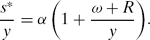
Equation (7) clearly demonstrates that the government's optimal expenditure on its patronage goods is increasing in both unearned household and government income (as a share of aggregate income).
Deriving Testable Implications
Given the incentives to engage in patronage in autocracies, these governments will place greater weight on expenditures toward patronage goods (compared to democracies) in their survival function. This means α is higher in autocracies than in democracies (where values of α closer to 1 correspond to more autocratic politics). Based on this interpretation, Equation (6) implies that the “substitution effect” associated with remittances (i.e., αR) is magnified in countries with more autocratic politics. Governments in countries with more autocratic politics will therefore tend to reduce their provisions of welfare goods the most. Equation (6) also shows that some fraction of aid, (1 − α)ω, is spent on welfare goods and the rest goes to the provision of patronage goods. For instance, in more autocratic polities a smaller fraction of aid is spent on welfare goods, because α is larger (i.e., closer to 1). Consequently, a larger share of aid is spent on patronage in more autocratic polities. This constitutes an “income effect.”
These two effects free resources for the government to increase expenditures on patronage. Equation (7) demonstrates that the government's optimal expenditure on its patronage goods is increasing in autocracy, remittances, and foreign aid. Moreover, the overall effect is magnified by the government's underlying level of institutionalized autocracy, i.e.,  . Because s* represents expenditures on patronage that reward the government's key supporters, Equation (7) clearly demonstrates that the government's prospect of survival is increasing in the interactive effect of autocracy and unearned foreign income. This central hypothesis is tested.
RESEARCH DESIGN
Baseline Model of Government Turnover
To model the probability of government survival, I estimate a fixed-effects probit model that accounts for temporal dependence. This estimation strategy allows for consistent estimates, even if the true shape of the hazard is unknown, and can incorporate observed and unobserved heterogeneity across time and within countries (i.e., country and year fixed effects) (Carter and Signorino Reference Carter and Signorino2010). Specifically, I estimate specifications of the form

where the dependent variable, Turnoverit, is a binary variable equal to 1 if the ruling government in country i is ousted from office in year t, and zero if the government remains in office. For instance, a year in which an incumbent government is removed via a coup, revolution, or electoral outcome is coded as 1. Ait is an increasing measure of each country's level of institutionalized autocracy and Fit is unearned foreign income. The independent variables of interest are unearned foreign income (Fit), which is the sum of foreign aid (% of GDP) and workers’ remittances (% of GDP) and its interaction with a country's institutionalized autocracy score (i.e., Fit × Ait). The comparative statics given by Equation (7) implies that unearned foreign income received in more autocratic countries reduces the prospects of government turnover. This means the coefficient on the interaction term (β3) should be negative.
Xit is a set of demographic (population size), economic (GDP per capita, growth in GDP per capita), and political (indicator for finite term, incidence of civil war, incidence of political discontent) variables. The measures of discontent (e.g., outbreak of riots, antigovernment protests) will account for potential movements in political activism associated with migration flows (e.g., “brain drain”). κit are government spell duration dummies that will account for how long a government has been in power (Beck, Katz, and Tucker Reference Beck, Katz and Tucker1998).Footnote 12Di and Dt are dummies for each country and calendar year. The inclusion of country dummies accounts for time-invariant country-specific factors that may affect a government's longevity. For instance, these dummies will account for a country's ethnic fractionalization, colonial history, legal system, and geographic location/proximity. The inclusion of country fixed effects means the estimated effects will account for within-country variation in the dependent variable. Year fixed effects account for global shocks (e.g., oil price shocks) as well as global trends that may affect the outcome variables, such as the “third wave” of democratization in the last quarter of the twentieth century and the end of the Cold War, which changed the delivery of Western aid disbursements (Dunning Reference Dunning2004). The inclusion of these fixed effects accounts for unobserved country-specific and temporal factors that are likely to influence government survival. Most existing studies (e.g., Bueno de Mesquita and Smith Reference Bueno de Mesquita and Smith2010) do not account for such a rich array of unobserved factors. Finally, eit is a stochastic error term. To account for potential serial correlation within each government spell, I conservatively cluster the standard errors by government.
Natural Experiment
A concern with the baseline econometric specification is the potentially endogenous relationship between governance (regime type) and aid and remittance inflows. These relationships may be countervailing. For instance, aid donors may reward recipients that are democratizing or may instead prop up corrupt governments (e.g., Bueno de Mesquita and Smith Reference Bueno de Mesquita and Smith2009). Similarly, inferior socioeconomic conditions (which are correlated with regime type) are likely to affect outward migration and remittance inflows. Thus, the possibility that a country's underlying quality of government influences its aid and remittances inflows may (in potentially offsetting ways) bias the baseline estimates. One method of addressing these concerns with endogeneity is to identify an instrumental variable for both foreign aid and remittances inflows (Sovey and Greene Reference Sovey and Green2011).
I use exogenous variation in the world price of oil to construct an instrument for aid and remittance flows emanating primarily from the Persian Gulf to poor, non–oil producing and predominantly authoritarian-leaning Muslim countries.Footnote 13 Two stylized facts make this an attractive instrumentation strategy.
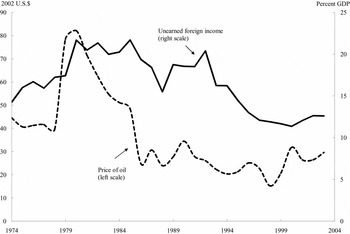
The first is that inflows of foreign aid and workers’ remittances to poor, non–oil producing Muslim countries (hereafter, the treatment group) track the price of oil. As Figure 2 shows, as the price of oil began to rise in 1974, aid and remittance inflows to poor, non–oil producing Muslim countries rose sharply. This level of unearned foreign income remained high through the early 1980s, and then began to fall as the price of oil tanked. There are two additional increases in unearned foreign income. The first coincides with the Gulf War in 1990, after which oil prices fell again, along with unearned foreign income originating from the Persian Gulf. The second spike coincides with the demand-driven surge in oil prices since 2001.Footnote 14 The movement of world oil prices is unlikely to be affected by the internal economic and political conditions in poor, non–oil producing aid and remittance recipients. Thus oil prices constitute a plausible exogenous source of variation in aid and remittance inflows.
Price of Oil and Aid and Remittances (% GDP) in Poor, Non–oil Producing Muslim Countries

The second stylized fact is that a large share of unearned foreign income received by the treatment group of countries has emanated from oil producers in the Persian Gulf. For largely historic and religious reasons, Gulf oil producers have tended to send aid to and import labor from predominantly poor non–oil producing Muslim countries in North Africa, the Middle East, and South Asia (Hunter Reference Hunter1984; Neumayer Reference Neumayer2003; Werker, Ahmed, and Cohen Reference Werker, Ahmed and Cohen2009). These two stylized facts underlie the construction of the instrument. Specifically, I interact the price of oil with whether a country is non–oil producing and Muslim as an instrument for unearned foreign income (the sum of aid and remittance inflows). The reduced-form two-stage regression setup is therefore
First Stage: Fit=α+βMUSLIMi×p(oil)t+γXit+ρλit+δDi+κDt+εit
Second Stage: TURNOVERit=a+b×Fit+c×Xit+d×λit+f×Di+g×Dt+uit,
where Fit is unearned foreign income (% GDP), MUSLIM i is equal to 1 if at least 70% of country i’s population identifies with the Islamic faith, Xit is a set of time-varying covariates (described earlier), λit is a cubic polynomial of government duration time (t, t 2, t 3), and Di and Dt are continent and year fixed effects, respectively.Footnote 15 The first stage is estimated with OLS. I use probit to estimate the second stage. The standard errors in the first and second stage regressions are conservatively clustered by government. Moreover, because the two equations are estimated jointly, the errors in the second stage take into account the estimation error in the first stage.
In the second stage regression, the coefficient on unearned foreign income will measure the “average treatment effect” for a group of poor, non–oil producing Muslim countries that tend to have autocratic-leaning politics.Footnote 16 Over the sample period, the average POLITY score for the treatment group is −2.4, which falls far below the standard +6 threshold for democratic governance. Thus, the IV estimate will gauge the impact of unearned foreign income on political stability in authoritarian-leaning countries. This represents a clean test of the formal model's key prediction. Finally, the instrumental variable results are generalizable, if the countries in the control and treatment groups do not differ on pretreatment observable characteristics. For instance, at the start of the treatment period, the typical non–oil producing Muslim country and non-Muslim country did not differ on average income, autocracy, population, or inflows of unearned foreign income.Footnote 17
Data
Dependent Variable. The primary measure of political survival is the “years in office” variable from the Database of Political Institutions (Beck et al. Reference Beck, Clarke, Groff, Keefer and Walsh2006). This variable tracks the number of years a leader (or governing party) has been in political office. I code a binary variable,“turnover,” with a value of 1 if the ruling government is ousted from power, and zero otherwise. The second measure of political survival is a binary variable, “regime collapse,” which is adapted from the institutional “durability” variable in the POLITY database of political regimes, characteristics, and transitions (Marshall and Jaggers Reference Marshall and Jaggers2006). Regime collapse is coded with a value of 1 if a country's POLITY score changes by more than three index points (in any direction) from the previous year, and zero otherwise. Regime collapse is not a direct measure of a particular leader or party's tenure in power, but measures the rigidity of the country's underlying political institutions.
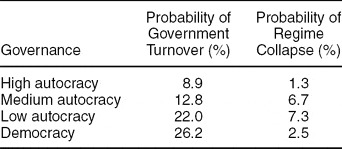
Table 1 describes the variation in government turnover and regime collapse with the quality of governance. As expected, the probability of government turnover is increasing in a country's degree of democratic governance. In any given year, governments in countries with highly autocratic politics face a 9% probability of losing power. The probability of government turnover is nearly three times higher (26%) in democratic countries. In contrast the relationship between the quality of governance and regime collapse is nonmonotonic, but exhibits an inverted-U shape. Countries with highly autocratic and highly democratic politics are relatively stable with a 3% chance of underdoing a regime collapse. Countries with an intermediate degree of autocratic governance are more than twice as likely of experiencing a regime collapse in any given year.
Government Stability and the Quality of Governance

Notes: Probabilities calculated for a sample of poor aid- and remittance-receiving countries (baseline estimating sample). “Governance” is based on the POLITY score: −10 to −6 (high autocracy), −5 to 0 (medium autocracy), 1 to 5 (low autocracy), 6 to 10 (democracy).
Independent Variables. The key independent variables are unearned foreign income (Fit) and its interaction with a country's level of institutionalized autocracy (Ait). Unearned foreign income (% GDP) is the sum of official development assistance (% GDP) and workers’ remittance (% GDP). Ait is a continuous and increasing measure of each country's level of institutionalized autocracy. This variable is equal to the inverse of a country's adjusted POLITY score. This adjusted score rescales the POLITY index (−10 to +10) by adding +11, so that the adjusted scale lies on a 1-to-21 scale, where a value less than 18 falls under the conventional cutoff for classification as an authoritarian regime.Footnote 18 Because Ait inverts this adjusted POLITY index, Ait therefore lies on a [0,1] interval, where higher values correspond to more autocratic governance. For the estimating sample, 60% of government–year observations qualify as exhibiting autocratic governance.
In addition to unearned foreign income, variables measuring economic and demographic conditions the incidence of civil war (at least 25 battle deaths), and domestic discontent are likely to affect government survival. The measure of domestic discontent is bifurcated into two indicator variables for low and high levels of discontent. If a country experiences a riot and/or antigovernment strike (in a given year), the dummy for low domestic discontent is coded as 1, and zero otherwise. The threshold of high political discontent is higher. If a country experiences an attempted or successful assassination attempt, revolution, and/or government crisis (in a given year), the dummy for high domestic discontent is coded as 1, and zero otherwise.Footnote 19 The primary source for the economic and demographic data is the World Development Indicators (World Bank 2005). Measures of political discontent are from the Cross-national Time Series Archive (Banks Reference Banks2005).
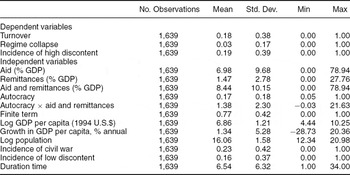
There are 97 countries in the estimating sample, over the period 1975–2004. Table 2 provides summary statistics for all the variables (evaluated for the estimating sample from the baseline probit model). There is wide variation in inflows of unearned foreign income. Although the typical country in the sample receives aid and remittances equal to about 8.4% of GDP, over one-third of the sample receives inflows of unearned foreign income exceeding 18% of GDP. Over the sample period, aid inflows tend to exceed remittance inflows for most countries, although the reverse is true in some states (e.g., Egypt, El Salvador). The typical country is poor, with real GDP per capita (1995 US$) totaling around $950. In any given year, around 16% of countries experience outbreaks of low discontent, with nearly 25% of the sample engaged in civil war. With respect to political institutions, around 77% of leaders face finite terms, even though the typical country is autocratic. On average, governments last about 6.5 years, with a minimum of 1 year in office and a maximum of up to 34 years.
Summary Statistics

Notes: Summary statistics for variables are generated from the sample of observations from the model of government turnover (Table 3). Autocracy is the inverse of the POLITY index (rescaled on a 1 to 21 index).
RESULTS
Baseline Results
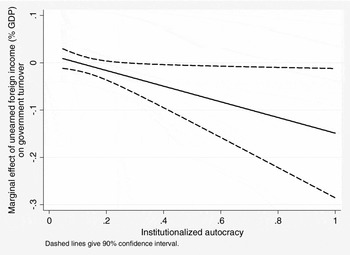
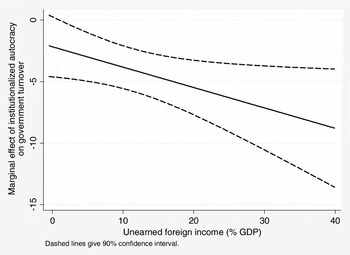
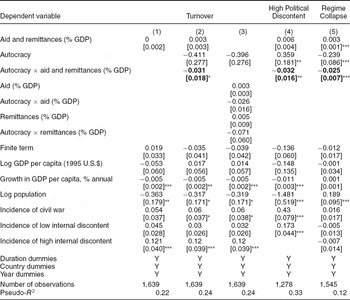
Table 3 presents robust evidence from the baseline regression model that remittances, in conjunction with aid inflows, reduce the likelihood of government turnover in more autocratic polities.Footnote 20 The table reports the marginal effects of the demographic, economic, and political covariates evaluated at their sample means. The direct effect of unearned foreign income has no effect on government turnover (column 1). However, taking into account a country's level of institutionalized autocracy and its interaction with unearned foreign income (column 2) provides evidence confirming the formal model's key prediction (given by Equation (7)). As expected, the coefficient on autocracy is negative. This is consistent with the trend in Table 1 that governments in more autocratic polities are less likely to be ousted from power. The coefficient on the interaction term is −0.03, which is statistically significant (p-value = .07) and substantively meaningful. For instance, a one–standard deviation increase in the interactive effect corresponds to a 2% lower probability of government turnover, which is equivalent to a 10% reduction in the relative probability of government turnover. The total marginal effect of autocracy on government turnover is negative over the entire range of unearned foreign income. The marginal effect associated with unearned foreign is also meaningful. For a one–standard deviation increase in unearned foreign income (= 10.15% of GDP), moving from a highly democratic country (e.g., Costa Rica) to a highly autocratic country (e.g., Swaziland) represents a 30% reduction in the likelihood of government turnover. Figures 3 and 4 graphically demonstrate these marginal effects.
Marginal Effect of Unearned Foreign Income on Government Turnover

Marginal Effect of Autocracy on Government Turnover

Unearned Foreign Income and Political Stability

Notes: Estimation via probit. Standard errors clustered by government reported in brackets. Coefficient estimates are marginal effects, calculated at the means of each covariate.
*Significant at 10%; **significant at 5%; ***significant at 1%.
Figure 3 graphs the marginal effect of unearned foreign income inflows as a function of autocracy. At low levels of autocracy (i.e., below 0.2), unearned foreign income exhibits a weak effect on the likelihood of government turnover. At increasingly high levels of autocracy (i.e., 0.2 and above), unearned foreign income lowers the probability of government turnover. Figure 4 shows the marginal effect of autocracy as a function of unearned foreign income. The figure demonstrates that additional unearned foreign income increasingly reduces the probability of government turnover. At moderate levels of unearned foreign income (i.e., greater than 4% of GDP) and in particular at the mean value (8.4% GDP), the effect is statistically distinguishable from zero (because the confidence interval does not cross zero).
The effects are driven by the combination of aid and remittances inflows. As separate inflows, neither aid nor remittances that are received in autocracies generate a statistically significant reduction in the probability of government turnover. The sole effect of foreign aid and its interaction with autocracy does not exhibit a significant effect on government turnover (column 3). This weak finding is consistent with Bueno de Mesquita and Smith's (Reference Bueno de Mesquita and Smith2010, Table 1, Model 4) results that the interaction of aid with a country's quality of political institutions (i.e., coalition size) does not affect political survival. Also, in this specification, the sole effect of remittances and its interaction with autocracy is not driving the key finding either (column 3). Indeed, a t-test evaluating whether the coefficients are significant from each other reveals that they are not different. This justifies their aggregation (Morrison Reference Morrison2009). Thus, it is the combined interactive effect of aid and remittances that reduces the probability of government turnover.
Across these three specifications, the control variables have the expected effects on government turnover. The negative and statistically significant coefficient on GDP per capita growth suggests that governments tend to fare well in countries experiencing economic growth. Governments in richer countries (as measured by log GDP per capita) tend to experience greater turnover. This is unsurprising because richer countries tend to have more democratic institutions, where government leaders face finite terms and frequent elections. Incidents of political instability tend to accelerate a government's removal from office. Episodes of civil war and low internal discontent are positively correlated with government turnover. The outbreak of high levels of discontent in the form of an attempted or successful assassination, revolution, and/or government crisis has a statistically significant impact in removing a government from power.
The core finding that aid and remittances lower the probability of government turnover in more autocratic countries is robust to a number of specification checks (outliers, omitted variables, exclusion of fixed effects). For example, excluding observations from countries that receive large inflows of unearned foreign income (e.g., Comoros, Mozambique) does not alter the main finding.Footnote 21 Moreover, including possible omitted variables such as trade flows or oil revenues, which could have an independent effect on governnance (e.g., Ades and Di Tella Reference Ades and Di Tella1999; Ross Reference Ross2001), does not change the main finding.Footnote 22 Finally, the inclusion of a rich set of country and year fixed effects raises potential concerns over bias and inconsistency due to incidental parameters (Chamberlain Reference Chamberlain1980). To address these worries, I estimate specifications that exclude the country fixed effects only, year fixed effects only, and both country and year fixed effects. Across these alternate specifications, the main finding still holds.
Additional Measures of Political Stability
If unearned foreign income reduces the likelihood of government turnover in more autocratic countries, then these foreign income flows should also diminish alternate types of political instability. For instance, governments in more autocratic-leaning polities can also channel unearned foreign income to dampen the incidence of severe political discontent and prevent the collapse of the country's underlying political institutions. Columns (4) and (5) in Table 3 present the marginal effect of unearned foreign income on binary variables for high political discontent (column 4) and regime collapse (column 5). In both models, the main effect of unearned foreign income is small (and only significant for regime collapse).Footnote 23 In contrast, greater institutionalized autocracy has contrasting effects on major discontent and regime collapse. Autocracy has a highly robust positive (= 0.359) effect on expressions of major discontent. This effect is not surprising, as oppressive practices under these regimes and limited opportunities to express discontent through nonviolent means (e.g., petitioning locally elected government officials) will tend to drive individuals to more extreme measures of resistance. Conversely, although autocratic institutions tend to foster high levels of political discontent, these political institutions tend to be quite durable. The large, negative, and statistically significant effect of autocracy on regime collapse demonstrates this stabilizing effect (column 5).
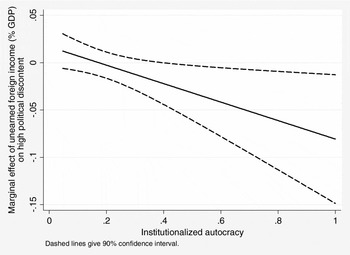
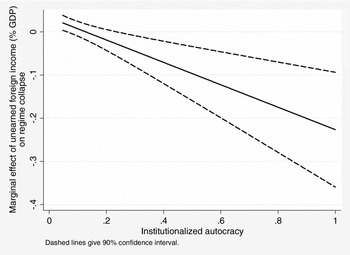
Although autocracy has divergent effects on the incidence of discontent and regime collapse, the interaction of unearned foreign income and autocracy lowers the probability of high levels of both discontent and regime collapse. For a one–percentage point increase in unearned foreign income, for example, moving from Costa Rica (with the lowest possible autocracy score) to Swaziland (with the highest possible autocracy score) reduces the likelihood of regime collapse by 20%. To visualize these effects, Figures 5 and 6 graph the marginal effect of unearned foreign income (as a function of autocracy) on the likelihood of severe discontent and regime collapse, respectively. As the figures clearly demonstrate, unearned foreign income received in increasingly more autocratic countries lowers the probability of major discontent and regime failure. These interactive effects, however, are weaker than those associated with government turnover. The dampening effects of unearned foreign income on major discontent and regime collapse tend to occur in countries with moderate and higher levels of autocracy.
Marginal Effect of Unearned Foreign Income on High Political Discontent

Marginal Effect of Unearned Foreign Income on Regime Collapse

Instrumental Variable Results
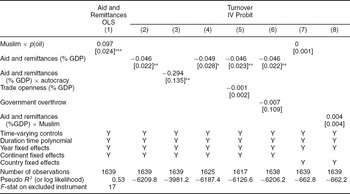
First Stage Results. As noted earlier, the baseline findings are likely to be plagued by concerns associated with endogeneity, a worry that is mitigated with a valid instrumental variable (IV) approach. However, to make valid inferences from such a strategy, the instrumental variable should be a strong predictor of the potentially endogenous regressor. Column (1) in Table 4 reports the results of the first stage regression specification describing the effect of oil prices on the amount of unearned foreign income (% of GDP) received by non–oil producing Muslim countries. The coefficient estimate of 0.10 implies that a $10 increase in the world price of oil raises inflows of unearned foreign income by 1% of GDP. This coefficient is significant at the 1% level. Moreover, the F-test on the instrument of 17 easily exceeds the conservative threshold for weak instruments of 10 suggested by Staiger and Stock (Reference Staiger and Stock1997). This powerful instrument means that the IV results can be interpreted as causal.
Instrumental Variable Results

Notes: Standard errors, clustered by government reported in brackets. Time-varying controls include log GDP per capita (1995 U.S.$), GDP per capita growth (% annual), and indicator variables for finite-term, incidence of low and high internal discontent. Duration time splines are duration time, duration time squared, and duration time cubed. Column (1) is the first-stage OLS model, where the dependent variable is aid and remittances (% GDP). Columns (2) to (6) report the second stage IV estimates for unearned foreign income. The model in column (3) instruments for the interaction of unearned foreign income with a country's institutionalized autocracy score. The model in column (4) excludes observations from countries with aid and remittances exceeding 30% of GDP. The model in column (5) controls for trade openness (i.e., sum of exports and imports as a share of GDP). The model in column (6) controls for government overthrow. This is a dummy variable for whether an attempt to overthrow the government was made by nongovernmental groups in the current and/or previous year.
*Significant at 10%; **significant at 5%; ***significant at 1%.
Second Stage Results. Armed with this strong instrument, Table 4 provides strong evidence that instrumented unearned foreign income reduces the probability of government turnover. Instrumented aid and remittances exhibits a negative and highly statistically effect on the likelihood of government turnover (column 2).Footnote 24 This coefficient estimate is slightly larger than the probit results reported in Table 3, suggesting that the previous results were biased downward. This downward bias is likely attributable to measurement error, in particular for remittances, which tend to be under-reported (e.g., de Luna Martinez Reference de Luna Martinez2005). An alternative political interpretation for the downward bias is that aid flows often prop up governments when they are unstable. Thus the bias is likely to understate the effectiveness of propping up these governments. As discussed earlier, the instrumental variables strategy gauges the impact of unearned foreign income on government turnover for countries in the treatment group, which tend to be authoritarian-leaning. Thus, the negative coefficient estimate provides additional evidence that unearned foreign income reduces the probability that an authoritarian government will be ousted from office. More directly, instrumenting for the interaction of autocracy with unearned foreign income also reduces the probability of government turnover (column 3).Footnote 25 This coefficient estimate captures the heterogeneous effect of unearned foreign income in autocracies (at varying degrees) on government turnover.
These results are robust to potential outliers as well as potential violations of the exclusion restriction. Certain countries in the treatment group receive large amounts of oil price–driven inflows of unearned foreign income. For instance, between 1975 and 2004, flows of unearned foreign income into Comoros averaged over 30% of GDP annually. Instrumented aid and remittances continue to reduce the probability of government turnover in models that exclude observations from countries with aid and remittances exceeding 30% of GDP (column 4).
An additional concern pertains to whether the exclusion principle is satisfied: Higher oil prices affect political longevity through aid and remittances only. There are three competing channels through which higher oil prices could affect political stability in the treatment group. The first is that higher oil prices incited antigovernment protests.Footnote 26 This channel is directly accounted for, because every model controls for the incidences of low internal discontent, such as outbreaks of antigovernment demonstrations and strikes.
The second channel is the effect of outward migration on political activism in the home country. In the context of migration to the Persian Gulf, these workers tend to be low-skilled and thus likely to be associated with populist movements in their home countries (as opposed to “brain drain,” which might characterize migration to Western Europe and North America).Footnote 27 Again, the inclusion of measures of political discontent will account for these effects.
The third channel is the effect of a country's trade flows (which may covary with oil prices) on governance. For instance, higher oil prices can affect the price of inputs in domestic production and/or the final price of exports. Controlling for a country's total trade (sum of imports and exports as a share of GDP) does not alter the main finding (column 5).
The final channel is through the exporting of politics from influential oil producers. Three oil producers were active in the 1970s and 1980s in the domestic affairs of other countries: Iran, Libya, and Saudi Arabia. Following the Islamic Revolution in 1979, Ayatollah Khomeini actively sought to spread the revolution by funding and training armed groups in other countries. Mu'ammar Qadhafi used Libya's oil windfall to fund violent antigovernment movements in a host of countries, including rebels in southern Sudan from 1975 to 1985, the Polisario movement in Morocco, an aborted coup in Gambia in 1981, and struggles in Chad, Somalia, and Zaire (Lemarchand 1999). Finally, the rise of Saudi Wahhabism and its support for Islamist movements in other countries may have been influential in government crackdowns in many poor Muslim countries. I am unaware of data measuring the extent (and nature) of external financing of antigovernment movements. Indeed, although it is impossible to rule out the effect of extremism funded by Gulf oil windfalls, the models in Table 4 do control for measures of low and high levels of political discontent (e.g., attempted assassinations, revolutions), which are likely to be the result of “exported” extremism. Moreover, controlling for additional forms of internal instability such as attempts at government overthrow does not change the effect of instrumented unearned foreign income on government turnover (column 6).
Perhaps the most troublesome concern is whether the direct effect of oil prices (in the treatment group) or a country's religion affects the likelihood of government turnover. With respect to the former, the specification in column (7) shows that the direct effect of the instrumental variable has no effect on government turnover. With respect to the latter, the principal worry is that unearned foreign income received in Muslim countries is systematically different from unearned foreign income received in non-Muslim countries. If this is the case, then a country's religiosity, not exogenous variation in oil prices, is driving the effect. To evaluate whether this is the case, I estimate the baseline probit model with the interaction of whether a country is Muslim and its receipts of unearned foreign income (plus the constitutive terms and standard control variables). In this specification (column 8), the coefficient on the interaction term is slightly above zero (0.004) but statistically nonsignificant. This null finding suggests that whether a country is Muslim does not have a differential effect on unearned foreign income's effect on the likelihood of government turnover.
MECHANISM
The results thus far demonstrate the reduced-form relationship between unearned foreign income, autocracy, and government survival. But does this operate via a government's reduction in welfare goods provision in favor of higher government patronage? According to the formal model, there are two channels through which unearned foreign income funds patronage and raises the prospect of government survival. A fraction of aid finances patronage (an income effect), and remittances permit the government to divert expenditures from the provision of welfare goods to patronage (a substitution effect). Moreover, these effects are magnified in more autocratic polities. To evaluate the mechanisms, I examine how aid and remittances inflows track the allocation of government expenditures on welfare and patronage goods provisions.
Remittances and Government Patronage
Although a number of studies argue that foreign aid can finance patronage and extend the duration of nondemocratic governments (e.g., Bueno de Mesquita and Smith Reference Bueno de Mesquita and Smith2010; Knack Reference Knack2004; Kono and Montinola Reference Kono and Montinola2009), no country studies, to my knowledge, have linked remittance inflows to government patronage. Indeed, a key insight of this article is that remittances can finance patronage and extend the duration of an autocratic government via a substitution effect between a government's provision of welfare goods in favor of patronage.
Identifying whether remittance inflows can influence a government's spending decisions independent of aid inflows is difficult, because most countries receive both aid and remittance inflows, aid is received by governments, and in most instances aid receipts tend to exceed aggregate remittance inflows. Recent trends in government spending and the composition of aid and remittance inflows in Jordan, however, offer a novel opportunity to test for a substitution effect associated with remittance inflows. First, Jordan has high-quality government expenditure data. Second, aid and remittance inflows compose the most significant source of Jordan's foreign income (Peters and Moore Reference Peters and Moore2009). These facts, coupled with the fact that remittances inflows have increasingly surpassed aid receipts since the 1990s, provide a clean lens to determine whether remittances can sustain government patronage, even as aid receipts decline. In contrast, other autocratic countries do not provide a clean test of the substitution mechanism. For instance, despite declining aid and remittance inflows into Egypt since the 1990s, the ability of the Mubarak regime to generate rents from oil production and relatively protectionist policies is likely to have sustained the regime's patronage network and prolonged its time in office.Footnote 28
Remittances and Patronage in Jordan. Since the Kingdom's inception, the Hashemite rulers of Jordan have remained in power by constructing a series of patronage institutions—usually at the expense of economic development—to hold together a highly disparate coalition of business elites and Transjordanian tribes (Brynen Reference Brynen1992; Peters and Moore Reference Peters and Moore2009). Although foreign aid has been a staple source of external assistance to Jordan's monarchy since the collapse of the Ottoman Empire, increasingly “indirect” external rents in form of remittances inflows have enabled the government to finance policies to win the support of coalition members. As Peters and Moore (Reference Peters and Moore2009) note, “authoritarian regimes adapt as different sources of external rent decrease or increase, seeking out new sources of external rent and devising new ways to deliver it to coalition members” (258). Indeed, through periods of abrupt demographic change and intense political violence (both domestically and regionally), Peters and Moore argue that Jordan's “monarchy, in concert with geopolitically motivated donors, has met these demands by modifying old distributional mechanisms and institutionalizing new venues to take advantage of the international system's provision of economic rents” (257). One such observable channel is the reduction of welfare provision and the maintenance (and expansion) of government compensation to coalition members (many of whom work for the government) in response to remittance inflows.
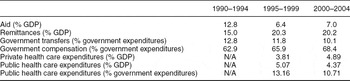
Although it is notoriously difficult to observe government patronage objectively and consistently across developing countries, patronage is likely to be highly correlated with a government's compensation of employees. In autocratic regimes, a large portion of these workers are likely to be within the government's “inner circle.” Indeed, in times of political crisis, autocrats often increase public sector wages to shore up support for the regime. For instance, in an effort to quell the 2011 uprising against his regime, President Mubarak of Egypt attempted (unsuccessfully) to win public sector support by increasing government wages. Thus, higher government employee compensation provides an objective and observable measure of government patronage. Table 5 presents evidence that despite declining aid receipts, higher inflows of remittances may permit a government to sustain and in fact shift its expenditures from welfare payments to government patronage.
Aid, Remittances, and Government Expenditures in Jordan, 1990–2004

Notes: Data from the World Bank World Development Indicators. Average values for each subperiod. Health care expenditures data prior to 1994 are unavailable.
Between 1990 and 1994, remittances to Jordan averaged 15% of GDP. Over this period, government employee compensation and welfare payments composed 63% and 13% of the government's expenditures respectively. Over the next decade, remittances rose by five percentage points to around 20% of GDP. During this decade, the government's share of expenditures on patronage rose by five percentage points, whereas welfare transfers declined by almost three percentage points. Moreover, analyzing a particular type of substitutable welfare good (health care expenditures) illustrates a similar pattern. The bottom three rows of Table 5 show that higher remittances inflows from the mid-1990s onward contributed to greater spending by households on health care, whereas the government decreased its own expenditures.Footnote 29 In fact, the share of the government's budget devoted to health care spending declined over this period. On balance, these trends together suggest that at the margin, the maintenance and shift in government expenditures from welfare provision to patronage in Jordan is likely to have been driven by rising remittance inflows rather than aid flows. This is supportive of a substitution effect between higher remittances inflows and reduced government welfare provision.
Remittances and Patronage beyond Jordan. The reallocation of expenditures from welfare payments to increased government patronage in response to higher remittance inflows is not unique to Jordan, nor is its high level of aggregate remittance inflows. In countries that receive remittances less than 2% of GDP, government's on average allocate 27% and 38% of their budget to employee compensation and government transfers, respectively. As remittance inflows rise, governments tend to allocate a greater share of their budget to employee compensation. In countries that receive moderate inflows of remittances (between 2% and 4% of GDP), for instance, governments allocate 30% of their expenditures to employee compensation and 26% to government transfers. In countries that receive inflows of remittances exceeding 4% of GDP, around 33% of government expenditures are spent on patronage and 31% are transferred to the population. These cross-national trends suggest that rising remittance inflows are negatively correlated with a government's allocation of budgetary spending to the provision of welfare goods.Footnote 30
Unearned Foreign Income and Welfare Goods Provision
The income and substitution effects associated with aid and remittance inflows, respectively, allow governments in autocracies to reduce their provision of welfare goods and spend more on patronage. To identify the combined effects of aid and remittances on welfare goods provision in more autocratic polities, I rearrange the government's optimal provision of welfare goods given by Equation (6):

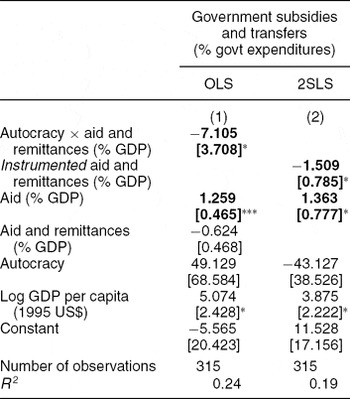
This equation shows that a government's welfare good provision is increasing in the government's receipt of aid receipts (i.e., ω), but that some fraction of aid and remittances is siphoned away (i.e, −α(ω+R)). Because α is an increasing measure of autocracy, the fraction diverted is larger in more autocratic polities. To test these effects, I model this structural relationship. Specifically, I regress government transfers (% expenditures) on aid, total unearned foreign income (and its interaction with autocracy), and average income. This dependent variable measures the government's allocation of its budget to the provision of welfare to the public. It includes transfer and subsidy payments that are not directly targeted at any particular group. To my knowledge, this variable best captures the provision of government welfare in a consistent manner for a large number of developing countries and over an extended period of time (1990–2004).
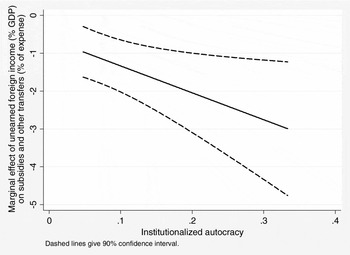
Table 6 provides strong evidence supporting the relationship between aid, unearned foreign income, and autocracy given by Equation (8). Controlling for a country's underlying level of autocracy and average income, the effect of aid raises a government's provision of welfare goods. The interaction of autocracy and unearned foreign income has a negative (= −7.11) and statistically significant effect on a government's allocation of welfare. This negative effect implies that unearned foreign income received in more autocratic polities has a greater effect in reducing a government's share of expenditures on welfare payments.Footnote 31 This is clearly demonstrated in Figure 7, which graphs the marginal effect of unearned foreign income (as a function of autocracy) on a government's welfare payments. This figure shows the interactive effect to be robust, but at a slightly lower level of statistical significance (i.e., with p-values less than or equal to .10). Over the entire range of autocracy, unearned foreign income inflows lower government welfare payments. Finally, instrumented unearned foreign income has a negative and significant effect on welfare goods provision (column 2). This provides additional evidence that unearned foreign income (received in the treatment group of autocratic non–oil producing Muslim countries) reduces government welfare payments. These results provide highly plausible evidence that unearned foreign income flows received in more autocratic countries reduce a government's expenditure on welfare goods and thus frees resources to finance government patronage.
Marginal Effect of Unearned Foreign Income on Government Subsidies and Transfers

The Effects of Aid and Remittances on Government Welfare Goods Provision

Notes: Robust standard errors, clustered by government reported in brackets. In column (2), aid and remittances (%GDP) is instrumented with Muslim × p (oil).
*Significant at 10%; **significant at 5%; ***significant at 1%.
CONCLUSION
Since the 1970s, the number of autocracies worldwide has gradually fallen. Many scholars posit that cross-border flows of trade and money (as a critical component of economic globalization) have played an influential role in this democratic transition by strengthening the incentives for economic and political liberalization. Even those scholars who identify a minimal “pro-democracy” effect rarely (if ever) find a negative relationship between international economic openness and democratization (Milner and Mukherjee Reference Milner and Mukherjee2009). This sentiment has percolated to the views of prominent policymakers. This article presents a model and strong empirical evidence to counter this proposition.
In this article, I evaluate the impact of a large subset of international capital flows, namely unearned foreign income in the form of foreign aid and workers’ remittances, on a government's prospect of political survival. The mechanisms by which unearned foreign income, in particular remittance income, might affect government survival are not obvious. Thus, I present a parsimonious model formalizing a channel through which both foreign aid and remittances can permit governments in more autocratic polities to divert resources to finance strategies/policies that prolong their time in office. These predictions are substantiated with a battery of empirical tests, including an innovative natural experiment, for a sample of 97 countries over the period 1975–2004.
These findings are similar to the effects associated with the so-called “resource curse” prevalent in many oil-rich states. In fact, this article's empirical findings tying unearned foreign income to political survival may be viewed as a form of “transferred” resource curse. That said, the theory and empirical analysis in this article provide fertile ground for future research. The formal model shows that unearned foreign income can increase private government consumption in the form of patronage, which a government can use to ensure its political survival. Indeed, the empirical findings demonstrate such a macro level effect between unearned foreign income and political survival. This macro effect should be unpacked. For instance, future research should identify particular micro strategies (policies) that are affected by unearned foreign income. In related work, Ahmed (Reference Ahmed2010a, Reference Ahmed2010b) examines the relationship between unearned foreign income and two specific strategies of political survival in autocracies: government corruption and repression. Those papers, coupled with the findings in this article, suggest that domestic political institutions (and the incentives they generate for governments) mediate the impact of aid and remittance inflows on the quality of governance and the endurance of governments in autocracies.



Comments
No Comments have been published for this article.