


Introduction
Cantopop, the name given to the genre of popular songs whose lyrics are written in standard modern Chinese but sung in Cantonese, was once a major contributor to the music world in East Asia.Footnote 1 From the mid-1970s, Hong Kong popular music as a whole became strongly identified with Cantopop. Its rise came about as the result of the huge growth in local audiences in Hong Kong in the 1970s; by the end of that decade, Cantopop had become a highly profitable industry with a rapidly expanding market. In the 1980s it expanded further into a multi-media industry, becoming so popular that it began to attract non-Cantonese speakers. Throughout that decade, superstars such as Leslie Cheung, Alan Tam and Anita Mui surpassed the achievements of their predecessors by developing Cantopop into a multi-media business that straddled the borders of neighbouring regions. They staged hundreds of concerts in the newly built Hong Kong Coliseum, with a seating capacity of over 10,000.Footnote 2 Cantopop helped Hong Kong establish a leading role in the multi-billion dollar business of popular culture and its idols: ‘in its heyday in the 1970s and 1980s, Cantopop defined the look, feel and – with its lush, ultra-refined production values – even the sound of Chinese cool’ (Burpee Reference Burpee1996). Cantopop had a significant impact on Chinese popular music in general, and a profound influence on the music made in East Asian Chinese-speaking countries such as Taiwan, Singapore and mainland China itself. It also remained popular among Chinese diasporic communities, many of which are dominated by Hong Kong emigrants who left the Colony when it reverted to Chinese sovereignty in 1997. Hong Kong artists still perform regularly in North American cities such as Toronto, Vancouver and Las Vegas, European cities such as London and Amsterdam, and also in Australia, as part of their regular world tours. Their target audience is made up of both first- and second-generation Hong Kong emigrants.
As noted in Baseline Study on Hong Kong's Creative Industries, conducted by the University of Hong Kong for the Central Policy Unit of the Government of Hong Kong Special Administrative Region in 2003:
the music industry in Hong Kong is dominated by Cantopop in production and sales. It constitutes a major part of the entertainment business of the territory in terms of employment and contribution to GDP. It is also a major part of the popular cultural phenomenon of Hong Kong, which has significant influence in the region and also a large market in every community overseas. (Hong Kong Central Policy Unit 2003, p. 114)
However, in the mid-1990s, according to statistics produced by the International Federation of the Phonographic Industry (IFPI) (Hong Kong Group), sales of Cantopop dropped by more than half, from HK$1.853 billion in 1995 to HK$0.916 billion in 1998 (Wong Reference Wong and Wong2003, p. 169). Worse still, the deaths of Cantopop superstars Leslie Cheung and Anita Mui, and of the lyric masters James Wong and Richard Lam, seemed to symbolise the end of a glorious era. Over the past decade or so, diminishing Cantopop record sales have led record companies and artists to shift focus towards the Mandapop (Mandarin popular songs) market in Taiwan and mainland China. Production of these albums now outpaces that of Cantopop. During this time, record sales dropped from HK$17 billion in 1997 to HK$0.56 billion in 2006 (Hong Kong Heritage Museum 2007, p. 13). It is thus not surprising that James Wong, the ‘godfather’ of Cantopop, set 1997 as the end boundary for the timeline of Cantopop in his doctoral thesis, The Rise and Decline of Cantopop 1949–1997 (Wong Reference Wong and Wong2003).
The fall of Cantopop was arguably the consequence of a combination of a bad economy and the advent of piracy and file sharing. Nevertheless, when we consider the rapid recovery of Mandapop, such explanations are perhaps less helpful. After the Asian financial crisis, Mandapop faced similar problems to Cantopop but rapidly bounced back and reclaimed its lost turf, gaining even more ground in the Hong Kong market. The IFPI (Hong Kong Group), among others, cites illegal downloading or file sharing as the key reason for the drastic drop in record sales, as is evident in their marketing campaigns (IFPI 2005). The work of Oberholzer-Gee and Strumpf (Reference Oberholzer-Gee and Strumpf2007), however, demonstrates empirically that the effect of file sharing on album sales was statistically indistinguishable from zero. While their study is not unproblematic, one does need to look at the issue from a different perspective. In addition to explanations based on piracy and file sharing, there are clearly other reasons behind Cantopop's steady loss of popularity. This paper therefore examines Cantopop in the light of the use of covers, arguing that its decline has been a result of its loss of hybridity. The Original Songs Campaign launched by Commercial Radio of Hong Kong (CRHK) in 1995, under which no cover versions of popular songs were allowed to be played on its market-leading Channel 2 station, unexpectedly aggravated this problem. We also argue that Cantopop was unable to rehabilitate itself in the new millennium because the industry was and remains unfavourable towards creativity and hybridity.
Hybridisation in Hong Kong
The reason Cantopop reached its apex in the 1980s was its increased diversity. Before then, it was necessary to differentiate Cantopop itself from the marketing economy that was selling it. As is convincingly argued by Appadurai (Reference Appadurai, Appadurai, Korom and Mills1991, p. 474), when music, television and other media make an impact on traditional forms such as epic and folklore, new hybrid styles will come to the fore. In this sense, popular media means much more than commercialisation alone and hybrid products have the potential to inspire an emergent culture.
Hong Kong culture has long been famous for its hybridity. In City Between Worlds: My Hong Kong, among the features of the city, L. Lee (Reference Lee2008) most savours the cha tsan ting (tea restaurant) as a culinary symbol of Hong Kong's blend of Chinese and Western identity: ‘as a small, wealthy, then-British colonial protectorate cum Chinese semi-autonomous region, Hong Kong has the mixture of economic wealth and cultural eclecticism that fosters hybrid media forms’ (Kraidy Reference Kraidy2005, p. 8). Cantopop has been one of the biggest representatives of Hong Kong's hybrid media. While it orchestrated a spectacle of consumerism, it was not entirely standardised; although it was unabashedly commercial, it was also vigorously hybridised. As Witzleben (Reference Witzleben1999, p. 241) rightly points out, Cantopop is ‘a unique and often bewildering mixture of Chinese, other Asian and Western elements’. If we change ‘mixture’ to ‘hybrid’, this becomes an even more accurate description of Cantopop in its heyday: from the mid-1970s to the mid-1990s it generated not only cultural mixtures but also a form of hybridisation that could point towards a new cosmopolitanism (Bhabha Reference Bhabha1994). When Rey Chow (Reference Chow1998, pp. 165–7) discusses the emergent community of Hong Kong, for instance, she uses the Cantopop song ‘Queen's Road East’ to illustrate the creative self-writing that exemplifies Hong Kong's in-between-ness (that is, between China and the West) and hybridity.
Not unlike Hong Kong itself, which is constantly assimilating different cultures, Cantopop's renditions of Euro-American, Japanese, Mandarin and even Korean songs made it a vibrant hybrid of different music cultures. In the 1980s Cantopop was able to promote linguistic/cultural hybridisation on the one hand, and foster connections between various kinds of music (such as the mainstream and the underground/indie scene) on the other. A healthy pop scene needs both types of cross-fertilisation. The emergence of city folk and band songs in the 1980s, among other cultural productions, proves that discursive space was available to non-mainstream artists. The healthy co-existence of mainstream and non-mainstream popular songs and their vibrant creative interaction effectively inspired the hybridisation as well as the creativity of Cantopop.
In terms of language, Cantonese serves as an everyday ‘low’ language when compared with English as the auxiliary ‘high’ language (Pennington Reference Pennington1994). After the 1997 reversion to China, Cantonese became doubly marginalised and tends now to be considered inferior to Mandarin. Cantopop lyricists have been successful, however, in introducing the restricted use of Cantonese in their lyrics, generating a unique hybridised style mixing Cantonese with standard Chinese (Wong Reference Wong and Wong2003, pp. 132–4). This typical hybrid language style has provided the people of Hong Kong with an interesting sense of belonging over the past 30 years or so, articulating, together with other media such as film and television, a typical kind of Hong Kong cultural identity (Parker Reference Parker1995, p. 152).
Cover versions have also played an important role in the hybridisation of Hong Kong popular music. Its melodies are composed outside Hong Kong, being mainly imported from Japan, Korea, Taiwan or the Euroamerican countries. The lyrics are rewritten locally, and the arrangement may also be reworked, although sometimes the record company uses the original one. The use of cover versions has been a common practice in Hong Kong since the 1970s. The effective hybridisation of Western music and local lyrics is best exemplified by Sam Hui's cover versions of Elvis Presley's hits. Hui, a Cantopop legend, used colloquial Cantonese lyrics to match Presley's rock and roll, famously hybridising a unique genre which successfully changed Cantopop's status from a marginalised to a mainstream form of popular music. One of the reasons for using cover versions in Hong Kong's rapidly growing music industry was the hunger to repeat the successful formula of those mega-hits whose popularity had been proven. Cover versions were also used to fill in the gaps in the production process, when local companies found it hard to cope with the speed of producing mega-hits. Record companies have long used covers as a quick and easy way to produce profitable popular music. As noted by one informant to this paper who worked for over 15 years in A&R,Footnote 3 record companies picked cover versions according to their popularity in local markets. If a song had topped the charts in its local market, a cover version would be very likely to enjoy similar success in Hong Kong. Another important factor was the ability to keep production costs to a minimum. A company in Hong Kong producing cover versions would only have to pay a copyright fee to the original composer/publisher and a fee for rewriting the lyrics. Hong Kong lyricists received a fixed fee rather than a share of future royalties for cover versions. When compared to locally composed songs, cover versions were cheaper and quicker to produce and publicise; therefore they slowly overtook local productions in Hong Kong.
Later in the 1980s, the success of superstars such as Leslie Cheung, Alan Tam and Anita Mui was a result, at least partly, of the spread of Japanese and Korean cover versions. At that time the popular music markets in Taiwan and the mainland were relatively closed, giving Cantopop plenty of space to develop. Up to the mid-1990s, cover versions were still exerting a great influence on Cantopop. For example, 10 out of the 12 tracks on Jacky Cheung's Overthrow of Love, released in 1992 and arguably the best-selling Cantopop album in history (with more than 400,000 copies sold in Hong Kong alone), were cover versions whose melodies had originally been composed in Japan, Taiwan and America, with the lyrics rewritten in Chinese. A brief examination of the annual popular music awards in Hong Kong up until the mid-1990s also shows the influence of cover versions in the development of Cantopop. Both the music industry and the media regard such awards as important indicators of the popularity and success of a song in Asia. In Hong Kong the mass media present annual awards to honour notable songs composed, written and broadcast throughout the year. As an example, Table 1 presents the winners of the Radio Television Hong Kong (RTHK) Ten Gold Songs Award in 1992. It is apparent from the list that cover versions were heavily used in the Hong Kong music industry of the time, with seven out of the 10 songs having been originally released in Japan. This suggests the local audience was comfortable with the dominance of foreign music in their local market.
Winners of the 1992 RTHK Ten Gold Songs Award.
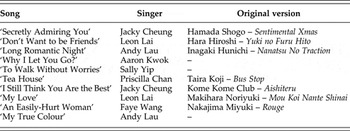
These songs had all originally been sung by Japanese popular artists earlier that year. Cover versions were popular not only with record companies but also with the audience, which raises the issue of audience recognition. In Hong Kong the audience's major concern was whether or not the songs were easy to listen to; they did not pay much attention to matters such as the identity of the composers or arrangers. Lyricists have long played an important role in Chinese popular music, as contributors to a long literary tradition; listeners therefore were less interested in who the composers were, or whether they were foreign or local. This kind of listening habit changed the priorities of the Hong Kong audience. They began to consider Japanese cover versions as their local ‘Hong Kong music’, as long as the songs were sung in Cantonese. The best example is Jacky Cheung's cover version of ‘Every Day I Loved You More’, which won the Best Gold Song Award of the 1990s presented by the RTHK, a government-funded broadcasting institution.
In summary, the music industry used cover versions primarily to optimise production and earn bigger profits in the expanding market of the 1970s and early 1980s. Hybridisation might have been merely an unexpected side product of this, but in the end it was the key element of the success of Cantopop in its heyday.
The best of times, the worst of times
The decline of Cantopop in sales terms started in the mid-1990s (when the market dropped from HK$1.853 billion in 1995 to HK$0.916 billion in 1998). Wong (Reference Wong and Wong2003, p. 168), however, traces this decline further back to the early 1990s when the swift development of global media had a very significant impact on the Cantopop industry, later affecting its operations considerably. The globalisation of the media landscape in the early 1990s created a market environment which was more favourable to the swift development of Mandapop, leading to the eventual downfall of Cantopop in the late 1990s.Footnote 4
The opening line of A Tale of Two Cities perfectly describes the Hong Kong music industry in the early- to mid-1990s, when Cantopop's hybridisation began to diminish owing to changes in market conditions and the operations of the music industry. It was the best of times in the sense that Cantopop further expanded its market share in Asia and worldwide, and its stars continued to be trendsetters for popular culture across Chinese communities. The rise of the ‘four heavenly kings’ – Andy Lau, Jacky Cheung, Leon Lai and Aaron Kwok – who dominated the market not just locally but in almost all Chinese communities worldwide, helped Cantopop develop into a transnational business venture. Their success was not limited to the realm of popular music; they also crossed over to wider audiences through concerts, movies and, most importantly, commercials in pursuit of artistic recognition as well as financial gain.
However, it was also the worst of times, in the sense that the new media landscape and market conditions had an adverse impact on hybridisation. Music was no longer the central concern of these multi-media stars. Advertising is hardly new in a commercial society like Hong Kong, but when Cantopop developed into a multi-media transnational business the scale of its production had to expand. To be profitable, mass production must be accompanied by mass consumption, which can be facilitated by the strategies of commodity fetishism and consumption. Thus, the music industry began to rely upon idol worship much more than in the 1980s. While mass consumption and fetishism is part of celebrity culture everywhere, its effect on the Cantopop industry in the mid-1990s was particularly damaging because its market had already started to shrink from its peak in 1995. This made it more difficult for non-mainstream singers to survive. In the times of the four heavenly kings, other Hong Kong singers such as Karen Mok and Alex To, known for styles of music that were not popular in Hong Kong, left for the Taiwanese market to develop their careers further. It was thus inevitable that some of the Hong Kong audience began to turn to the expanding Mandapop market to seek out more diversified popular music. These developments fashioned the stereotypical impression of Cantopop in the 1990s: ‘the sentimental lyrics, the melancholic melody, and the banality of romance’ (Erni Reference Erni1998, pp. 60–61).
The situation would not have been so bad had it not arisen at the dawn of the age of the global media. Hong Kong, though a cosmopolitan city, had previously been notorious for its small number of media outlets, with only two television and three radio stations (all of which were free). At the time, these channels had a stranglehold on what audiences saw and heard. In the early 1990s, however, the scene changed with the advent of cable and satellite television and the resulting rapid expansion of media channels. In terms of music, the channels provided by these new media outlets were mostly Mandarin-speaking, as the Mandarin market is considerably larger. The new channels did provide Hong Kong audiences with the chance to listen to Mandapop from Taiwan, Singapore, Malaysia and mainland China, but this seemed to have an adverse effect on Cantopop. In this particular context, the Hong Kong music industry faced an irreversible structural change, but it took some time for it to realise this. The situation at first facilitated the success of the Cantopop kings in Asia, but later exposed standardised Cantopop products to harsh competition from Mandapop. Moreover, the music industry had to work closely with the media to maintain the star system, and record companies had to spend vast sums of money on marketing and buying time on television and radio channels. When the costs of production rose, album sales could no longer guarantee a good return on this investment. In short, record sales were no longer the main source of income and the music industry became increasingly commercially dependent on media it did not itself control (Frith Reference Frith, Frith, Straw and Street2001, p. 44). As other forms of media began to dominate the operation of the music industry, record companies directed most of their resources to the big stars, such as the four heavenly kings. As a result, the cross-genre hybridity of Cantopop started to diminish, which had a harmful impact on its later development.
The localisation campaign
The sudden drop in sales of Cantopop, interestingly enough, coincided with the return of Hong Kong to Chinese sovereignty in 1997. This raised the question of whether political uncertainty had overshadowed the economy and hence influenced music sales. To answer this we need to examine closely the local context of the mid-1990s, mainly the ‘localisation’ movement advocated by CRHK and its impact on the music industry. As the number of radio channels in Hong Kong is surprisingly low, radio stations had considerable influence over record companies, which struggled to get their products into the limited space available. Thus, the CRHK's ‘Original Songs Campaign’, launched in 1995, had a significant impact on the local music industry. This campaign addressed the problem of who actually makes the music. In the late-transitional period, shortly before Hong Kong's reversion to China in 1997, local identity became a very hot topic. It was in this special context that CRHK introduced the localisation campaign to promote a local consciousness. In the end, however, it actually had a damaging and unforeseen effect on the local music industry. The campaign failed to provide more discursive space for diversified local productions as the increased airtime was mostly occupied by the big stars. Accordingly, it did not contribute to the hybridisation of Cantopop; on the contrary, the lack of high quality local productions forced many listeners to turn away from the genre altogether.
With one of the most popular radio stations actively encouraging the production of local songs over cover versions, the latter were no longer eligible to enter the radio charts. Record companies therefore had to rethink their extensive use of cover versions. Gradually, the use of cover versions in the Hong Kong music market diminished, and music that was ‘plugged’, that is, heavily promoted, was produced locally. The swift change this brought about can be seen from the winners of the RTHK Gold Songs Award in 1995 in Table 2.
Winners of the 1995 RTHK Ten Gold Songs Award.
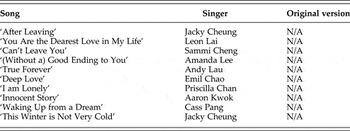
Table 2 shows that all 10 of the 1995 Gold Songs were original compositions. Compared with the results of the 1992 award (see Table 1), this was a sharp and sudden decrease in the use of cover versions. Whether this ‘success’ was a result of localisation is hard to say, but it was certain that the campaign had had a profound influence on the local soundscape, and one which later turned out to be much more negative than positive. We will now examine this in light of the local industry, media, talent pool and government policy.
Although piracy and illegal downloading/file sharing did contribute to the downfall of Cantopop sales figures, they were not the only factors contributing to its decline. In reality, CDs, cassette tapes and eventually the mp3 all had adverse effects on sales figures. However, record companies were already aware of these problems and had begun to shift their revenue-generating focus from selling music to operating as an all-round media business. They achieved this by signing so-called ‘360 Contracts’ with artists, such as those offered by Gold Label, in order to generate as much revenue and profit as possible. The label Gold Typhoon was established in 2008 after the Hong Kong music and entertainment company Gold Label took over EMI China (Time Out 2008). The deal included all EMI businesses in Hong Kong, Taiwan and mainland China except for those dealing with the publication of non-Chinese regional music. This reverse takeover of an international company by a local one demonstrated a change in the means of generating revenue (Economist 2007).
Meanwhile, the diminishing use of covers had impacted heavily on the revenue of music publishers, which are part of the record companies. Cover versions can increase income fivefold compared to original music. Firstly, profit is generated by sales and royalties in the country where the music is originally composed. Secondly, additional income is generated by the sale of the copyright overseas. Thirdly, the cover version itself generates copyrights and royalties. Fourthly, the sales of the original version on compilation albums and via broadcasting in the country in which the song is being covered also provide additional income. Finally, performance rights are generated in both countries. International publishing companies enjoyed huge success with the use of copyrighted music overseas, and Hong Kong became established as their major revenue-generating branch because of the widespread use of cover versions.
When profits dropped, music companies became more conservative. Instead of using different tactics, they tended to play it safe by focusing their resources on the target audience. Lachlan Rutherford, a Senior Vice-President of Warner Music South East Asia, confessed that his company had had no choice but to channel its investment into its top-ranking artists (Tsang and Campbell Reference Tsang and Campbell1999). As the target audience of Cantopop became limited to teenagers only, it inevitably became more and more homogeneous. In short, the shrinking of the Cantopop market on the one hand and the rapid rise of the Mandapop market on the other forced Cantopop to become less hybridised in terms of music styles, lyrics and target audience.
The inherent problems of the Cantopop industry can be demonstrated by measuring it against the benchmarks in Richard Caves' theory of creative industries (Caves Reference Caves2000, pp. 2–9). According to Caves, having a truly ‘differentiated’ product is the key factor for a successful creative industry. In the face of the shrinking market and national identity in the run-up to the 1997 transition, the Cantopop industry did nothing except direct its resources into already-successful formulae and promote local consciousness; it did not have a long-term policy. The companies failed to see that the future of Cantopop depended on a reform of the operational logic of an industry that had placed most, if not all, of its emphasis solely on idol worship (Chu Reference Chu and Wong2009, p. 461). According to this argument, the operational logic of the popular music industry was unfavourable to creativity and hence one of the main reasons for the decline of Cantopop.
Another major problem was the lack of local musical talent. As mentioned above, the Hong Kong government lacked a long-term plan for the nurturing of local creative talent. As a result, the local talent pool could not meet the sudden demand for locally produced music, which later had a significant impact on the market. For years, cover versions had dominated the Hong Kong music market and local production had been suppressed as a consequence. Local musicians had had difficulty in finding creative jobs in the industry, and many had been forced to take on side jobs as performers or to work in other music-related positions. The change in the number of people working full-time in the music industry over this period speaks volumes. During one of the authors' work experience with Big Bang Music Limited in 1997, only three out of 12 in-house composers worked full-time in the industry. Many people who were passionate about music and wanted to contribute to the industry had difficulties getting started: there were not enough open auditions through which new and enthusiastic talent could begin the process of becoming fully fledged musicians, and outsiders viewed the Cantopop industry as a closed one.
Due to the lack of open positions in the music industry, there was not enough training for those keen to join; hence, when the localisation campaign began to have an impact on record companies, production systems had difficulty coping with the rising demand. This directly affected the quality of production in the Hong Kong music industry, as the gap left by cover versions, in terms of both quantity and quality, could not be filled by local performers (Leung 2007, p. 194). The extra space created by the localisation campaign was mostly occupied by mainstream stars, and thus the mass productions of the heavenly kings and queens continued to dominate the market. While a select few local musicians, such as Anthony Wong, were hailed as creative stars by the Hong Kong music industry, the media began to pass comment on the relatively low quality of purely local productions. In reality, this was a result of the overwhelmingly commercial demands of the industry. Karaoke-style songs were preferred and hence local musicians wrote exclusively for this genre, with their music styles becoming almost indistinguishable. The mere fact that karaoke style was the dominant genre is not in itself the problem; we would instead stress that the primary issue was the reduction of space available for non-mainstream talent to flourish. This, in turn, had an adverse effect on the hybridisation of Cantopop.
Some might see this transition, from predominantly covers of foreign music to the use of local music, as a strengthening of local identity, coinciding perfectly with the Handover of 1997; yet the localisation campaign can also be seen less as an attempt at constructing a local identity than as a marketing gimmick to raise the profile of Commercial Radio of Hong Kong (Chu Reference Chu and Wong2009, pp. 453–9). Although music can be a way for an industry to make money and remain culturally significant – and other music industries (such as Taiwan and Korea) have proved to be more capable at this – the problem here is that other governments have taken an active role in using cultural and broadcasting policies to enhance the development of local popular music. In other words, these governments have treated popular music as an important creative industry sector. In Hong Kong, however, the government has generally paid only lip service to the idea of fostering popular music locally.
According to Simon Frith (Reference Frith, Frith, Straw and Street2001, p. 27): ‘Popular music culture isn't the effect of a popular music industry; rather, the music industry is an aspect of popular music culture.’ Unfortunately, Brand Hong Kong (2007), the promotion programme which seeks to package Hong Kong as ‘Asia's World City’ and distinguish it from mainland Chinese cities, uses the term ‘industry’ to define ‘culture’. The programme has tried to highlight ‘Hong Kong's existing strengths in areas such as financial services, trade, tourism, transport, communications, and as a regional hub for international business and a major city in China’. It is most unfortunate that the operational logic of this campaign has come to dominate the Hong Kong government's attitude toward the local music industry, which has been essentially handcuffed by its enduring obsession with how to brand local culture and sell it to the global market. The campaign also launched the Entertainment Expo Hong Kong in 2005, bringing together key events in Hong Kong's entertainment calendar for film, TV, digital entertainment, music and other cutting-edge media. The Hong Kong Music Fair is the key event for popular music, but as the government's emphasis was on financing and networking, rather than actually producing music, the event had little to do with inspiring creativity and hybridisation.
With hindsight, we can conclude that if the localisation campaign were planned as a way to resist the swift rise of Mandapop, it was painfully misconceived. Indeed, it has proved to be a failure. The localisation campaign might have had a positive effect if there had been other, related policies in place such as education for local musicians. It could have been an admirable attempt to avert the shrinking of the Cantopop market, which in the end proved inevitable. But without long-term planning and relevant policies, it could not provide the discursive space required for local musicians to develop their creativity. Contrary to what the campaign promised at the outset, it neither nurtured local talent nor enhanced the diversity of popular music genres. To make things worse, it came at a point when Cantopop was already facing a crisis brought forth by the transformation of the Chinese popular music industry. In the new millennium, the swift rise of China and its cultural industries has created an unfavourable environment for the hybridisation of Cantopop.
The rise of Mandapop
Before 1997, Hong Kong had been trying hard to identify ways in which it could retain autonomy after its return to Chinese sovereignty. The identity constructed by Hong Kong people has tended to be in opposition to mainland Chinese, and if one compares the Hong Kong and Chinese economies, it is easy to understand why Hong Kong people tried to avoid being labelled as mainland Chinese in the 1990s. The construction of a Hong Kong identity highlighted Hong Kong's role as a meeting-point for the cultures of East and West. For example, the establishment of the radio station FM104, broadcasting in both Chinese and English, symbolised the prominence of Hong Kong as a place which was able to combine both cultures.Footnote 5 However, such an international orientation did not enhance the environment within which local cultures would develop. Worse yet, the rise of China's economy brought about a fundamental change. When Hong Kong people started conducting business in mainland China, they realised that the economic difference had swiftly lessened, and many subsequently attempted to create another identity. The fact that Beijing is in power does not automatically mean that there is less room for cultural variety; the problem is that after 1997, Hong Kong witnessed a dramatic change in its attitude toward its motherland. The economic downturn in 1998 and 1999 shattered Hong Kong's myth of economic success, putting its people in dire straits in the aftermath of the Asian financial crisis. Many Hong Kong people willingly turned to their motherland, not because of the Hong Kong government's edification of national consciousness, but because of China's surprisingly swift economic growth in the new millennium.
‘The turning point is Hong Kong's political transition, which not only bears the political significance of a return of sovereignty to China but also reflects Hong Kong's ever-increasing dependence upon the Chinese market’ (Fung Reference Fung2007). As Hong Kong has come to rely more and more on the mainland Chinese market, it has become more mainland-oriented, with an adverse effect on cultural variety. Shortly after 1997, according to a survey conducted by Lau Siu-kai, Head of the Central Policy Unit of the Hong Kong Special Administrative Region, a new identity of ‘Hong Kong Chinese’ surfaced (Lau Reference Lau1997), evincing the growing importance of ‘Chineseness’ in the formation of local identity. When national identity and Chineseness became an important dimension in Hong Kong's education system, the social status of Mandarin rose to an unprecedented height. In this context, Cantopop has come to be seen as a musical genre of a subordinate dialect.
In the age of globalisation, Cantopop faces another problem apart from the rising status of Mandarin. The rise of China and its power in the first decade of the new millennium (Chu Reference Chu2008, pp. 200–204) contributed to Hong Kong's increasing dependence on the mainland market, which corrupted its sense of ‘in-between-ness’. Wong (Reference Wong and Wong2003) stresses that the achievement of Cantopop is similar to Hong Kong's legendary economic success, in that it is the result of a closed political environment on the mainland and in Taiwan. Taiwan, and subsequently the mainland, turned from Cantopop to its chief competitors. Instant stardom is no longer the monopoly of Hong Kong's pop industry; Mandapop singers have encroached into the Hong Kong market. Jay Chou, David Tao, Jolin Tsai and F4 have overtaken the four heavenly kings and Sammi Cheng in terms of commercial viability. ‘While Cantopop marches on in Hong Kong, Chinese pop has moved elsewhere, on to Mandarin singer/songwriters, Taiwanese folk artists, Beijing rockers, Singapore balladeers’ (Burpee Reference Burpee1996). In the new media landscape, Taipei has replaced Hong Kong as ‘the nerve center of Chinese pop’ (S. Lee Reference Lee2002). If we consider the late-1980s the golden age of Cantopop, the new millennium must belong to Mandapop.
With the emergence of a national popular music culture in China, Mandapop will become more and more important in the shaping of its identity. In the newly globalised Chinese music industry, Mandapop seems to have much brighter prospects than Cantopop, as Mandarin is more widely used in Chinese communities. To court these enormous markets, record companies and Cantopop singers have proactively turned to Mandapop. Since the early 1990s, for instance, Hong Kong musicians had been trying to break into the Taiwanese market by producing Mandapop, which also came to be seen as a way into the enormous mainland market. Unfortunately, at that time it was still difficult to properly record and broadcast Hong Kong Cantopop through official mainland media channels. One of the problems was that Hong Kong music companies still used cover versions in productions targeted at the Mandarin market. In other words, Hong Kong singers would produce Mandapop cover versions of their Cantopop songs. In albums targeted at the Cantonese market, for example, the last couple of tracks are often Mandarin cover versions. While this approach was inexpensive, its effectiveness was short lived, since advanced communication technology enabled the audience to know quickly whether songs were originals or cover versions. Although Hong Kong singers turning to Mandapop would, in a sense, make Hong Kong popular music more hybridised, in terms of Cantopop per se this would further worsen the lack of a creative space.
With the rising emphasis on creativity in the 21st century, the audience now prefers original music to cover versions. In this context, cover versions can no longer be used as extensively as before.Footnote 6 Moreover, in the last decade, few if any Cantopop singers have been able to break into Taiwan, let alone the mainland Chinese market. Therefore, we maintain that other than those established Cantopop singers such as Eason Chan or an exceptional new singer such as Khalil Fong, very few Hong Kong musicians will make a significant impact on the Mandapop market. Accordingly, Hong Kong singers turning to Mandapop cannot themselves revitalise the Hong Kong entertainment industry.
To conclude, we would argue that there are several reasons why the Chinese population has gently turned its back on Hong Kong music. After the recession in 1997, the economy has not recovered to the level of its boom in the 1980s and 1990s. The localisation campaign did not create a new space in which Cantopop could increase its diversity. In the face of the shrinking market, music companies did not invest in rising stars, and subsequently fewer and fewer young musicians have joined the industry. Only a handful of new stars have been able to survive; many have left the industry altogether and taken up related jobs such as acting or modelling to sustain their entertainment careers. Meanwhile, newcomers have not joined the industry as fully fledged musicians. Often poorly trained, they have simply used their music career as a stepping stone into the wider entertainment industry. Releasing records has been seen as merely a means to increased media exposure, which would then bring about further opportunities such as performing at private functions and establishing themselves as multitalented artists. The lack of dedicated creative talents in the mainstream market has led many listeners to turn to Mandapop, which has become much more diverse than Cantopop. A vicious circle has thus appeared. As the market has shrunk, Cantopop has lost its sense of diversity as well as its hybridity, which has in turn caused more listeners to turn to other popular genres.
Cantopop has now been overtaken by Mandapop as the trendsetter of pan-Chinese popular cultures. In its heyday, from the 1980s until the early 1990s, Cantopop was hybridised, although it was highly commercial and had begun to cross borders. Cantopop was able to blend the global and the local into a significantly ‘glocal’ culture, as Bhabha (Reference Bhabha, Garcia-Moreno and Pfeiffer1996) implies with his concept of ‘vernacular cosmopolitanism’. Before the mid-1990s, Hong Kong Cantopop had achieved remarkable success; however, in the 1990s, the globalisation of the Chinese media changed the ecology of Chinese popular music industries, and the Cantopop industry failed to respond effectively. After 1997, as Mandarin has become the lingua franca of Hong Kong and other Chinese communities, Mandapop has become more and more popular. The shrinking of the Cantopop market on the one hand and the rapid expansion of the Mandapop market on the other has forced Cantopop to become less hybridised in terms of music styles, lyrics and target audience. In short, the loss of hybridity is the major reason for the decline of the Hong Kong music industry. It has been caused by the rise of the economic, political and cultural influence of Mandarin-speaking mainland China and the lack of competence in the industry to deal with the resulting shifts in the media landscape.



