One of the things about Hofmannsthal which every student has to know is that, while still in his teens, he wrote a certain amount of high-class lyric poetry, and that then something seems to have gone wrong, as a result of which he hung up his singing-robes behind the kitchen door and turned to writing plays and libretti instead.Footnote 1
The above assessment, dating from nearly 50 years ago, gently mocks what even then had become a shop-worn refrain for anyone addressing the early career of Hugo von Hofmannsthal (1874–1929). The ‘something’ that ‘seems to have gone wrong’ led, the standard account goes, to the banishment of Hofmannsthal the precocious poet at the turn of the century, leaving in his place Hofmannsthal the jittery, insecure dramatist.Footnote 2 The change most clearly manifested itself in what remains, apart from the Strauss collaborations, Hofmannsthal's best-known work: ‘Ein Brief’ (1902).Footnote 3 While many of Hofmannsthal's important plays and the vast majority of his essays and correspondence remain untranslated, ‘Ein Brief’ has been rendered into English numerous times, usually as ‘A Letter’ or the ‘Chandos Letter’.Footnote 4 This second designation places the work within the broader context of Hofmannsthal's career. Although barely ten pages long, the Chandos Letter serves a double function as synecdoche: on the one hand as an expression and a key piece of evidence of the ‘Chandos crisis’ and the poet's scepticism towards language; and, on the other, as an articulation of a whole fin-de-siècle generation's uncertainty at being cast adrift in modernity's choppy waters.Footnote 5
The Letter has proven resilient in continuing to shoulder such bold extrapolations, and I follow a long tradition in using it as a key to Hofmannsthal's often confusing career, as a convenient marker of his ‘language crisis’, his apparent renunciation of poetry and turn to the stage – specifically the operatic stage.Footnote 6 This short work also marks the start of an openly self-conscious negotiation of the demands of modernity: a negotiation, which, I argue, culminated in Die Frau ohne Schatten (1917), Hofmannsthal's fourth operatic collaboration with Richard Strauss and the primary focus of this article.Footnote 7 My argument begins with a diagnosis of the condition that brought about Hofmannsthal's ‘Chandos Crisis’ as a state of artistic melancholy, which I go on to link with Walter Benjamin's theory of allegory. I move beyond ‘allegorical’ interpretations of Die Frau ohne Schatten as an extended metaphor of collaboration in order to explore the opera in terms of Benjamin's idea of allegory – as a fractured series of emblems, whose sombre power as referents is more arcane and unstable than that of the clear, bright symbol.Footnote 8 I then pit Chandos's essentially positive view of allegory against Benjamin's negative one to provide critical tools with which to approach the opera's final resolution. Finally, I further problematise the opera's conclusion through reference to Strauss's own philosophy of creation – expressed in the contemporaneous Eine Alpensinfonie (1915).
Vanishing subjects: the fin-de-siècle melancholy of the artist
The Chandos Letter dates from summer 1902 and is an imaginary epistle, dated 22 August 1603, from Lord Chandos to Sir Francis Bacon – the latter pushed into service as a representative of a complacent belief in empirical certainty.Footnote 9 It expresses the writer's loss of confidence in the power of words, expressed within a much further-reaching malaise. The Letter was therefore more a retrospective appraisal of a major unease regarding the aestheticist project which had been pervading Hofmannsthal's work for the best part of ten years than the result of a flash of inspiration that drove him abruptly to abandon lyric poetry.Footnote 10 The questioning of long-held certainties is articulated as vehement revulsion towards the automatic employment of linguistic tropes, while the possibility of coherent knowledge of both the self and of history – represented in Chandos's planned magnum opus, Nosce teipsum – is dismissed as illusory. The orthodoxy that perpetuates a long-held appreciation of the civilised world's great artefacts dissolves in Chandos's mind, replaced by a series of revelations that result from the observation of everyday objects.
A watering-can, a barrow abandoned in a field, a dog in the sun, a humble churchyard, a cripple, a little farmhouse – any of these might become the receptacle for my revelation. Each of these objects, and a thousand others like them which the indifferent eye normally glosses over as self-evident, can for me, at any moment and without my having the slightest power to induce it, suddenly assume a sublime and deeply moving character which words seem to me utterly inadequate to express.Footnote 11
Chandos continues with a diagnosis of the uncertainty that would become a refrain throughout the early years of the twentieth century. ‘Just as I had once looked at a patch of skin on my little finger under a magnifying glass and found it resembled a pitted, furrowed field’, he explains, ‘I now went about scrutinising people and their actions. I was no longer able to observe them with the simplifying gaze of habit.’ He goes on to describe his new way of viewing the world: ‘I broke everything down into its constituent parts, those parts into further parts, and could no longer encompass anything under a single concept’.Footnote 12 Chandos now finds beauty in the objects that lie loosely around, but longs to see them cohere once more:
For me the mysteries of faith have condensed into a sublime allegory which arches over the meadows of my life like a luminous rainbow, ever at a constant distance, ever ready to recede should it occur to me to hurry over and try to wrap myself in the hem of its raiment.Footnote 13
This glimpse of the ‘sublime allegory’ projects Chandos's ultimate optimism: the malaise can be overcome; the emblems of allegory can be united in a moment of quasi-religious revelation.
The identification of Chandos with Hofmannsthal has been a natural interpretative step, Chandos thus joining a long line of self-portraits in Hofmannsthal's early lyric dramas. Hofmannsthal scholarship has, though, set out to problematise readings that attempt to establish straightforward equivalence; indeed, over half a century ago Richard Alewyn cautioned against such a reading of Hofmannsthal's early lyric drama, Der Tor und der Tod (1892).Footnote 14 It is easy, when one strips away the historical disguise, to establish more general links between Chandos as disillusioned creature of privilege and the prince-like artist of the fin de siècle. Many in Hofmannsthal's circle were, in Hans-Albrecht Koch's phrase, allowed to live a life as a ‘professional son’.Footnote 15 Their positions were built on foundations laid by a tranche of upper-middle-class Jewish fathers, who had achieved considerable material wealth and used it to fund their sons' artistic endeavours. But this background placed an unusual burden on Hofmannsthal's generation – a burden borne of entitlement. Hofmannsthal even suggested acerbically that all he and his ‘late-born’ contemporaries (‘die Spätgeborenen’) had inherited from their fathers and grandfathers was ‘pretty furniture and over-refined nerves’.Footnote 16
In artistic terms, this inheritance translated into a wealth of technical ability: such skills stood in opposition to a paralysis brought about by a new awareness of the artist's place within history.Footnote 17 Thomas A. Kovach is right to argue that the Chandos Letter is primarily a work of fiction because it articulates the ‘language crisis’ in such supremely elegant prose.Footnote 18 But to do so misses the point that the crisis lay not in purely technical, mimetic skill, but in a state of creative emergency in which all certainties regarding the employment of that skill had been eroded – a condition that Judith Ryan, writing more broadly about Hofmannsthal and his contemporaries, has put down to ‘[t]he vanishing subject’.Footnote 19
More specifically, the rich autobiographical vein running through Hofmannsthal's work (and a strong hermeneutic tradition prone to tapping it), encourages us to draw a link between Chandos, the imperial couple at the centre of Die Frau ohne Schatten and the profusion of melancholic, princely characters who populated many of Hofmannsthal's early lyric dramas and short stories. They all, to varying degrees, bear the burden of the same ‘exceptionality’: the trait which, according to Hermann Broch, meant that the young Hofmannsthal himself ‘gave way to seclusion’. Loris's becoming a poet was, in other words, a necessary by-product of his precocity.Footnote 20 The seclusion of an aesthetic life, represented for Hofmannsthal in the figure of the high-priest of literary elitism, the poet Stefan George, was now deemed to be insufficient.Footnote 21
Towards the end of his letter, Chandos hints in a famous passage that his solution might lie in a new language. However,
the language in which it might perhaps be granted me not only to write but to think is neither Latin nor English nor Italian nor Spanish, but a language of which I do not know one word, a language in which mute things speak to me, and in which one day, in my grave, I shall perhaps answer for myself before an unknown judge.Footnote 22
This phrase ‘language in which mute things speak to me’ has, of course, been interpreted as referring to music. For all the quiet polemic of the Chandos Letter, then, in it Hofmannsthal echoes eighteenth-century philosophers' rhetoric in praise of gesture and music as, in Mary Ann Smart's phrase, ‘a corrective to the stultified modes of speech’ – modes of speech more recently interpreted as perpetuating a defunct patriarchy.Footnote 23 Yet Die Frau differs in several important respects from Hofmannsthal's pre-Chandos explorations of melancholic seclusion and expressive failure. It does so most obviously, of course, in its medium. But the medium is also the message: Chandos's optimistic vision, framed as a ‘sublime’ allegory, was to be realised in opera's alliance of music and words.
Walter Benjamin's melancholy and allegory
Expressive failure and the inadequacy of language form an important part of the work of many theorists of modernity, but, unlike Hofmannsthal, Walter Benjamin's examination of it in Ursprung des deutschen Trauerspiels (1928) revels in pessimism, disavowing any hope of recapturing lost certainties. As such, it explores the interpretative challenges posed by a specific early Baroque form of allegory, characterising it as the ‘mode of the melancholic’Footnote 24 against the bright symbol of the German Romantics.
The Trauerspiel book is notoriously complex, its essential ideas doubly difficult to extract through a typically Benjaminian mosaic of quotation and because of the obscure nature of its ostensible subject matter. Its application to opera studies is rare, moreover, due in part to Benjamin's own reluctance to address the medium.Footnote 25 It set out to force a reassessment of allegory, a mode denigrated by the German Romantics as a poor emulation of classical tragedy. Yet Trauerspiel dealt with history, its protagonists burdened with the weight of rank; tragedy dealt with myth, where ‘the tragic stature of the dramatis personae does not derive from rank – the absolute monarchy – but from the pre-historic epoch of their existence – the past age of heroes’.Footnote 26 The melancholy so prevalent among the rulers of the Trauerspiel resulted from their relationship to history, as well as the ‘antithesis between the power of the ruler and his capacity to rule’.Footnote 27 The second part of the book then grows out of the belief that ‘the only entertainment the melancholic permits himself … is the allegory’.Footnote 28
The historical dimension of the Trauerspiel is of less concern here than the fact that Benjamin presents allegory, in Charles Rosen's phrase, as a ‘corrective to art’. ‘By its discontinuity of image and meaning’, Rosen goes on to explain, ‘it rejects the false appearance of artistic unity, the fusion of meaning in the symbol, and presents itself as a fragment, a ruin.’Footnote 29 Benjamin went on to argue that to embrace allegory was to renounce the symbol's illusory power to force the ‘beautiful … to merge seamlessly with the divine’.Footnote 30 Doing so would reveal the greater beauty of the fractured ruin:
Whereas in the symbol the transfigured face of nature in the light of redemption appears fleetingly with the transfiguration of decline, in allegory the observer is confronted with the facies hippocratica of history as a petrified, primordial landscape. Everything about history that, from the very beginning, has been untimely, sorrowful, unsuccessful is expressed in a face – or rather in a death's head.Footnote 31
The nature of allegory as Benjamin understood it was expressed, in an eminently graspable metaphor, in another famous passage:
In its fully developed, baroque form allegory brings with it its own court; the profusion of emblems is grouped around a figural centre, which, as opposed to the approximate descriptions of concepts, allegories do not lack. The emblems seem to be arranged in an arbitrary way: The confused ‘court’ – the title of a Spanish Trauerspiel – could be considered as the model of allegory. Things are assembled according to their significance; indifference to their existence would allow them to be dispersed again. The disorder of the allegorical scenery presents the opposite of the elegant boudoir. In the dialectic of this form of expression the fanaticism of the process of collection is balanced by the slackness with which the objects are arranged.Footnote 32
Such a metaphor powerfully suggests many artistic parallels, specifically the breakdown of apparently coherent, reliable systems of communication. Or, as John Deathridge has interpreted it, it demonstrates how, ‘[i]n the wider context of Benjamin's theory of melancholy, the allegorical technique becomes part and parcel of the view that life is an illusion that, when dissipated, reveals nothing’.Footnote 33 While the ostensible focus of Benjamin's study was the Trauerspiel, however, the book has clear relevance for early-twentieth-century modernism. The fin de siècle had brought with it its own fragmentation and confusion; a similarly crippling awareness of history resulted in a new artistic melancholy.Footnote 34
Re-reading the Chandos Letter in this light reveals a striking similarity between Chandos's new mode of perception and Benjamin's description of allegory.Footnote 35 Chandos complains of losing the ‘simplifying gaze of habit’, of no longer being able to ‘encompass anything under a single concept’; he now perceives objects – ‘A watering-can, a barrow abandoned in a field, a dog in the sun, a humble churchyard, a cripple, a little farmhouse’ – in such a way that, akin to The Confused Court, each unexpectedly acquires and sheds significance. It will be recalled that one passage is particularly important in this regard: that in which Chandos wrote hopefully of a ‘sublime allegory which arches over the meadows of my life like a luminous rainbow, ever at a constant distance’. Chandos, one might suggest, suffers under the same illusion as the German Romantics: that allegory can reveal something more than the death's head. To illustrate this misapprehension, Benjamin quotes the following statement from Winckelmann's Versuch einer Allegorie: ‘The best and most perfect allegory of one or of several concepts is comprised of one single figure, or should be thought of as such’. This, Benjamin concludes, ‘is the voice of the will to symbolic totality’.Footnote 36 Our reading of Benjamin might lead us to believe that the elusive, sublime allegory Chandos longs to recapture is no such thing: it is the symbol of the Romantics.
Die Frau ohne Schatten as allegory
It is the Romantic symbol – in the sense of Benjamin's later critique – that Hofmannsthal attempted to reconstitute in Die Frau ohne Schatten, at the conclusion of the work that he conceived as the summation of his collaboration with Strauss. This partnership had begun, after a false start at the very beginning of the century, when Strauss adapted Hofmannsthal's first completed post-Chandos play, Elektra (1903), for the operatic stage.Footnote 37Der Rosenkavalier (1910), Ariadne auf Naxos (1912 and 1916) and the ballet Josephslegende (1914) followed. Their fourth opera was to call on the practical experience Hofmannsthal had accumulated over the previous joint projects. Indeed, some of the delays in its composition were self-imposed: the ‘chief joint work’ was not, for Hofmannsthal, something to be rushed.Footnote 38 The opera mixes elements pilfered from an enormously broad array of sources.Footnote 39 The librettist took inspiration from 1001 Nights, Carlo Gozzi and many others; he set out to emulate Mozart's Die Zauberflöte, Goethe's Faust II and his own attempts at opera (including, significantly, a fragmentary continuation of Die Zauberflöte) and Wagner – the importance of the latter too often underestimated.Footnote 40 Such was the richness of the material that he also felt the need to develop his ideas further in a prose version of the Stoff (written between 1913 and 1919). This Erzählung is counted among Hofmannsthal's finest works, and was first privileged ahead of the opera by the librettist himself.Footnote 41 Its existence for Strauss scholarship, however, seems to serve as evidence that Hofmannsthal was unable to master his recalcitrant Phantasie as it spiralled out of control across the generic boundary.
The libretto was described after the work's 1919 première by Julius Korngold as the opera's ‘Schattenseite’ (its ‘shadowy side’).Footnote 42 Indeed, it has traditionally been seen as a burden that some have been too quick to jettison in an attempt, particularly in Anglo-American scholarship, to disavow the opera's difficulty. Die Frau's position at the head of the so-called ‘marriage operas’ (it would be followed by Intermezzo (1923) and Die aegyptische Helena (1928)) has led one recent writer to conclude straightforwardly that its ultimate message ‘is that marriage remains incomplete for as long as it does not result in parenthood’.Footnote 43 Bryan Gilliam has suggested, meanwhile, that ‘Die Frau ohne Schatten – despite its fairy-tale setting, magical transformations, singing unborn children – is an opera about the search for humanity, explored on multiple levels’.Footnote 44 And the fairy-tale story of the shadowless Empress of the spirit kingdom (soprano) can indeed seem straightforward in the retelling.
The shadow represents fertility and humanity in one; as explained in an opening confrontation between the Nurse (mezzo-soprano) and the Spirit Messenger (baritone), the Empress must cast one within three days otherwise the Emperor (tenor) will turn to stone. The ultimatum is introduced early on with the words ‘Er wird zu stein’ (He turns to stone), intoned against one of the opera's most pervasive musical motifs. The Empress therefore descends to earth with the Nurse to barter a shadow from the discontented Wife (soprano) of Barak, the Dyer (bass-baritone). The Wife is willing to renounce motherhood in return for a glittering phantasmagoria conjured up by the Nurse: a mirror, jewels, slaves and all manner of luxury alien to her squalid existence. The Empress gradually realises the effect this will have on Barak, however, and in a tense Act III scene renounces her claim to the Wife's shadow. In so doing she shows herself to have learnt human sympathy and gains a shadow of her own. The Emperor is saved from his stony fate, Barak and his Wife are reunited and, in the grandest of final ensembles, they all join together, along with a chorus of Unborn Children, in joyous celebration.
Yet, like all fairy-tales, Die Frau ohne Schatten invites the sort of close reading that immediately clouds so seemingly straightforward a narrative. Questions surface regarding the characters' motivations, particularly that of the Empress's mysterious father, the Spirit King Keikobad, who dictates much of the action in a state of mute absence.Footnote 45 The enticement to allegorical interpretation is further sweetened by evidence that Hofmannsthal loosely based Barak's un-named Wife on Strauss's notoriously brittle-tempered wife, Pauline, with the inevitable corollary that the Dyer Barak has been understood to represent the composer himself.Footnote 46 The appeal of these characters – he warm-hearted, long-suffering and reassuringly diatonic; she the harridan-with-a-heart – to a Strauss literature that until relatively recently has been grounded primarily in biography and anecdote is obvious.
A further corollary, however, suggests that the elusive Hofmannsthal should be identified with the infertile Empress and, to a lesser extent, the unsympathetic Emperor. These are stilted, enigmatic characters, two sides of an androgynous coin, whose appeal is far less obvious; but Michael P. Steinberg builds on a suggestion by Hans Mayer to note in passing that
It may not be entirely whimsical to suggest that the descent from the imperial realm to the dyer's very earthly household might be taken as a reference to Hofmannsthal's professional descent into collaboration with the tone-poet (i.e., colourist) Richard Strauss.Footnote 47
The nature of several of Hofmannsthal's sources also encourages a straightforwardly allegorical interpretation,Footnote 48 while, in ‘Ad me Ipsum’, Hofmannsthal noted, ‘Die Frau ohne Schatten: triumph of the allomatic. Allegory of the social’, and drew parallels with his early lyric dramas, and, by extension, with Lord Chandos.Footnote 49
The Emperor fits less easily within such readings, however, and is portrayed in stiffly conventional terms in the opera. His scenes involve minimum interaction and are awash with archaic musical tropes or topics of amorousness and heroism: thrusting horn-calls; Italianate cantilena; bold cadences topped with high notes; assertions, particularly in his early Act I appearance, of the semiotically loaded keys of E and E-flat (E-flat traditionally represents hunting and heroism, while in Strauss's oeuvre E carries with it specific erotic connotations: it is the key of the tone poem Don Juan and, as Gilliam puts it, represents for the composer ‘Dionysian, passionate or even erotic sensations in music’).Footnote 50 There is clearly benefit in exploring his strange, formalised nature within the terms of an extended metaphor of aesthetic creation, as well as the intriguing interpretative possibilities offered up by Hofmannsthal's gendered double portrait of (artistic) impotence – of what Mayer called the ‘egocentric life of the artist’.Footnote 51 But my own principal concern in this study is the Empress: as Hofmannsthal was quick to remind Strauss, ‘she – not the other one [i.e., the Dyer's Wife] – is the woman without a shadow’.Footnote 52 Beyond the irony that Die Frau – the most troubled and trying of Strauss and Hofmannsthal's joint works – might allegorise collaboration itself, what can be gained from placing Die Frau ohne Schatten firmly within the context of Hofmannsthal's language scepticism, within a context of fin-de-siècle melancholy that he hoped to cure through collaboration? Is it possible to read in the opera a rupture in the status quo that forces the Empress to engage with Benjaminian allegory, to face up to ‘the facies hippocratica of history as petrified, primordial landscape’? Finally, is it the patriarchal Übermächte (higher powers) – her father Keikobad, or, perhaps, Strauss and Hofmannsthal – that attempt to return the genie of modernity forcibly, unconvincingly into the bottle?
Melancholic Empress, mechanical Falcon
To answer such questions, it is necessary first to explore the means by which the melancholy state of the imperial couple is both established and overcome in musical and dramatic terms. In dramatic terms, their condition can be put down to the infertile impasse reached in the Empress and Emperor's relationship: the Empress is characterised purely as passive object to her husband's dual role as ‘hunter and lover’ – or even, for Franz Werfel, as ‘rapist’.Footnote 53 Together the couple embodies the uncertainty, which, according to Jacques Le Rider, created at the fin de siècle ‘the illusion of egocentricity and individualism which poisons human and social relations, as well as the split between subject and object which condemns the individual to misery’.Footnote 54 Indeed, Freud, in a 1917 essay, saw a similarly deficient relationship between subject to object as central to melancholy:
The melancholic displays something else besides which is lacking in mourning – an extraordinary diminution of his self-regard, an impoverishment of his ego on a grand scale. In mourning it is the world which has become poor and empty; in melancholia it is the ego itself.Footnote 55
This state of melancholy finds clear expression in the ‘gap’ between the animal and spirit aspects that Hofmannsthal, in an important early letter to Strauss, saw in the Empress. Here he referred to ‘the threefold nature of the Empress: part animal, part human and part spirit’, pointing out that ‘only the animal and spirit aspects are apparent in [her first] scene … the humanity is missing’.Footnote 56
Hofmannsthal's extensive notes, furthermore, reveal the Empress's and Emperor's backgrounds to be marked by depression and tragedy.Footnote 57 The contents of these notes were discarded from both the opera and Hofmannsthal's prose working-out of the Stoff. However, these psychological chippings bear important traces of the sort of trauma that contributes to the classic Freudian cause of a particular strain of melancholia: ‘One feels justified in maintaining the belief that a loss … has occurred, but one cannot see clearly what it is that has been lost, and it is all the more reasonable to suppose that the patient cannot consciously perceive what he has lost either’.Footnote 58 Such melancholy results in a ‘lack’ and a commensurate, but vague ‘loss’.Footnote 59 The sharp focus of mourning, then, that Carolyn Abbate has argued bolsters Elektra's subjective power in Strauss and Hofmannsthal's first opera, is contrasted here with the Empress's diffuse melancholy, which manifests itself in subjective weakness.Footnote 60 At her first appearance, she has only limited ability to forge her musical surroundings, and even lacks the Emperor's ability to effect short-lived change through the ineffective machismo of role-assertion. Yet, if we adopt a Benjaminian orientation, we might note that the Empress's melancholy permits her one entertainment: a striking form of musical allegory, which only she can interpret.
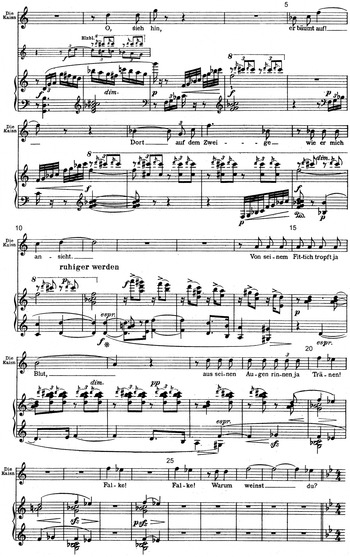
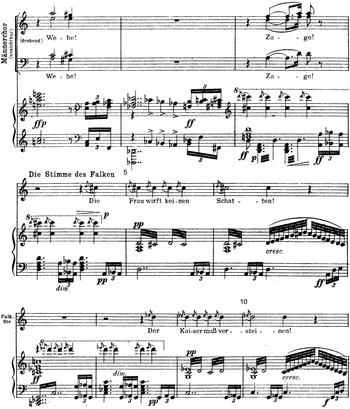
This allegorical mode in Die Frau ohne Schatten is presented in its most concentrated form by one motif in particular: that of the Emperor's Falcon (in Ex. 1, the bird joins the Empress at her first appearance (Act I scene 1), its cry heard in the high winds from bar 2). This motif – little more than a repeated acciaccatura drop of a semitone, usually d′′′ to c♯′′′ – was one of the earliest to appear in Strauss's pre-sketch planning.Footnote 61 It straddles functions of imitation and representation, while being predisposed to striking musical fixity. The bird itself, meanwhile, holds a strange place within the opera's spiritual cosmos: it is representative and agent of both nature and Keikobad's unnatural realm; and even, according to the Erzählung, an avian incarnation of one of the Unborn Children.Footnote 62 It helped the Emperor capture the Empress (caught, in gazelle form, during the Emperor's hunt) and therefore played an essential role in her seduction. But it was during this seduction – in the ‘drunkenness of the first hour’ (‘der Trunkenheit der ersten Stunde’) – that the Emperor grew angry when it dared to flap at the Empress's eyes, throwing his dagger and injuring the bird. Its confrontation with the Empress marks the first time it has been seen since that ‘first hour’ of intoxication, and it is significant that it has failed to respond to the Emperor's entreaties to return, showing itself instead to the Empress.
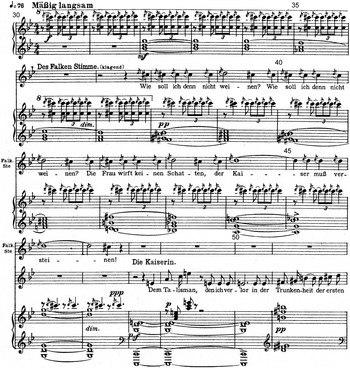
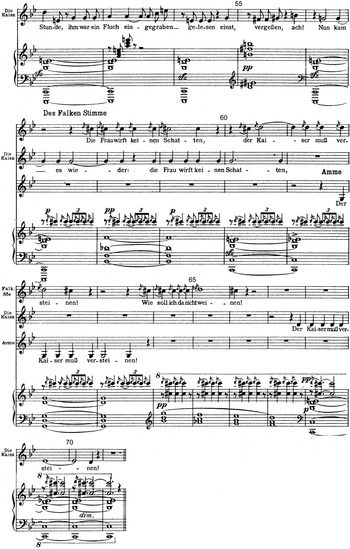
The Empress's confrontation with the Falcon in Act I scene 1 (vocal score pp. 29–32)


Analyses intent on the kind of all-encompassing leitmotivic exegesis handed down from traditional Wagner studies have attempted to fix meaning to Die Frau's extensive leitmotivic vocabulary; but the Falcon's motif does not represent a straightforward catch. Several writers have betrayed discomfort at its fixity, attempting to coax it into more flexible life within a system of Wagnerian thematic manipulation, or instil it with reassuring narrative immanence.Footnote 63 Yet it is exactly the motif's obstinate refusal to be included within such a system – its resistance to the power of interpretations seeking to impose a symbolic totality – that makes it readable in allegorical terms.Footnote 64 Further, the presentation of the motif in the confrontation with the Empress is made all the more striking by the fact that at its initial appearance, in the preceding aria for the Emperor, it appears safely mediated through a narrative lens. There its motifs – a swiftly ascending cluster of F, G, B-flat and C representing the swoosh of its wings, as well as the biting acciaccatura of its cry – appear simply as part of Strauss's descriptive palette.Footnote 65
The Emperor's first appearance is followed directly by the Empress's scene, where the bird arrives in apparently unmediated form; it has escaped from the past tense of the Emperor's narrative and returns to the action, becoming in all senses present. It appears, indeed, on several levels: as a physical phenomenon (depending on the realisation on stage, directly viewed by the audience or via the Empress's own experience of it); as a simple mimetic phenomenon in the orchestra, its motifs appearing in raw, aurally grating form; and as a soprano voice, heard in a moment of Siegfried-like revelation by the Empress (and, of course, by an audience privy to her revelation). It is less important here, however, to discuss these aspects of the bird's appearances in theoretical terms, even though this scene presents a disorientating rupture in operatic dimensions (most obviously between purely accompanying and diegetic levels). Rather, I wish to examine the distillation and fixing of the Falcon's motifs as a result of Empress's melancholic mode of perception, which in turn demands from her an act of allegorical interpretation.
At the Empress's unassertive arrival, she shows herself still to be enslaved to the past, to the same vague ‘drunkenness of the first hour’ as her husband; she longs to regain her gift of transformation – to relive her capture, her subjugation as wife. This moment, irretrievably lost, can clearly be associated with loss of virginity and innocence; but it is also a great deal more psychologically complex than that, as the easy slippage between narratives of the hunt and the seduction have already made clear in the Emperor's aria. Her first words express her desire to use her transformative gift to blend once more into nature – if not in reality, then at least in the realm of dreams.

At the mention of the ‘light body of a bird’ the Empress's vocal line indulges in its own faltering imitation of birdsong: a passage of delicate fioritura in this lyric-dramatic role, which often proves problematic for singers. The fallibility of the human voice in performance conspires to undermine the desired objectivity of Strauss's carefully crafted vocal line. Yet the effect neatly shows the inadequacy of what remains of the mimetic ability that her present state denies her.
It is too easy to see the loss of her transformative gift – bestowed on her, significantly, by her father – as an incidental by-product of her becoming half human through union with the Emperor. Indeed, the Empress celebrates her move from paternal to marital subjugation whilst lamenting this very loss. Nevertheless, in an opera that ultimately condemns its womenfolk to lives of obeisant child-bearing, positing the restoration of a not-so-enlightened Enlightenment patriarchy, as Gail Finney has argued, her new state provides a surprising hermeneutic opportunity.Footnote 66 In being relieved of the gift, the Empress is liberated from woman's bonds to mimesis, which, Mary Ann Smart has suggested (following the writings of the feminist philosopher Lucie Irigaray), is ‘tainted, the very act of representing nature in an artistic text inescapably and inherently patriarchal’. This is because it has its origins in ‘the Freudian assumption that a girl child is nothing more than a secondhand, castrated, mirror-image of the properly equipped male’.Footnote 67 The Empress's newfound freedom, moreover, is what allows her to begin to ‘read’ her allegorical surroundings. What in Act I starts as a somewhat cagey, passive act of negotiation, becomes in Act II a more productive act of interpretation. As the opera progresses, she begins to revel in what Smart calls
defeat of syntax and teleology, and their replacement by some more embodied and crisis-ridden discourse, [which] is conventionally taken as the creed of écriture féminine, the feminist prose style that eschews logical argument as patriarchal and substitutes a more ‘feminine’ mode of free association and linguistic excess.Footnote 68
Let us now return to some of the more remarkable features of Example 1, and examine how it gradually demonstrates the Empress's nascent ability to read her surroundings. The confrontation with the Falcon, much of which the Empress spends in a state of trance-like observance, carries traces still of her longing to recapture her mimetic gift, whilst also coinciding with the Falcon's ossification into musical fixity. At the start of the extract, after the Empress has noticed the lost Falcon, the bird is contextualised in the same series of motifs that earlier captured its physical urgency. In bars 1–2, rushing semiquavers describe its swooping flight path, topped in bar 2 by its cry. An accelerated version of the wing-flap idea is heard in bars 3, 5–6 and 8; started by the cellos, it is scored with much greater detail than the piano reduction can convey: the violins and violas launch up in an ascending semiquaver-quintuplet group with tremolos, the harp and flutter-tonguing flutes add demisemiquavers. In the space of a dotted crotchet, the motif sweeps up three octaves from f to a minim f″, which is then crowned by the bird's cry, for once almost celebratory, heard fortissimo in the piccolo, first oboe and E-flat clarinet.
The Empress invites the audience to track the bird's movements (‘O, sieh hin’ (Oh, look there)), which she then describes, relieving the stage director of a considerable scenic burden: ‘er bäumt auf! Dort auf dem Zweige wie er mich ansieht’ (he rears up! There on the twig, how he looks at me).Footnote 69 As she utters this last phrase, the cry begins to slow (bars 9–10), its off-beat pairs of quaver triplets replaced by single quavers on syncopated crotchet beats. Strauss's marking indicates that things should become calmer (‘ruhiger werden’). From the second beat of bar 11 we hear a motif marked espressivo, played in octaves by the horns. The flapping wings are quietened by the grief conveyed in the bird's wounded glance, and a drooping, descending idea accompanies the motif (bars 12–14). This motif (designated ‘Der Blick des wunden Falken' (The glance of the wounded Falcon) by Specht) is familiar from the Emperor's scene, where it accompanies his reminiscence of wounding the Falcon (‘und sein Blut tropfte nieder’ (and his blood dropped down)).Footnote 70 The Empress's own observation – ‘Von seinem Fittich tropft ja Blut’ (Blood is dropping from his wing) – echoes her husband's recollection but is not banished to a narrative past.
The cry, however, returns with residual vibrancy, this time softening from piano to pianissimo, in bars 16–17. The Empress further observes that ‘aus seinen Augen rinnen ja Tränen’ (tears are flowing from its eyes), at which point even this residual cry disappears (there is a final pair of squawks on the E-flat clarinet alone in bars 18–19), to be replaced by a falling major second applied to the words ‘Tränen’, ‘Falke’, ‘Weinst du’ (tears, Falcon, you cry). All life seems to have drained from the bird, which has now become just a static signifier of grief, as Strauss toys with the falling second, the traditional musical sign of lament. With the key change at bar 30, the bird reappears as automaton, its cry a lifeless, mechanical echo now weighed down as lament.
The Voice augments the Falcon's rhythm to crotchets (from bar 37), while the acciaccatura, inevitably slowed by the human voice's relative lack of agility, begins to resemble more closely the traditional appoggiatura of the lament. Beside Hofmannsthal's ‘Klagend’ (lamenting) direction, the music layers one musical trope over another, the Voice's own line adding a further appoggiatura with the minim Ds on ‘weinen’ (cry) at bars 39 and 41. The whole passage is gently accompanied by harmonically ambiguous descending chords, leading from and back to G minor, against which the instrumental Falcon's cry grates insistently while the Voice, in bars 46–7, augments the rhythm further and harmonises on D, before slipping back down again to a dissonant C-sharp. As Schlötterer notes, the motif, having ‘hardened unyieldingly, as if naturally frozen, onto C-sharp, does not fit in with its tonal environment, here G minor, at all (Tritone!)’.Footnote 71
At bar 48, the Empress remembers the mysterious Talisman:

The orchestra accompanies these words with gently juxtaposed chords: C major with added second held for three bars (bars 48–51), gently spiced with A minor on harp harmonics and celesta (bar 48), which shadow the harmonic outlines of the Empress's vocal line. In bar 51 this chord seems to be presented in a lightly distorted mirror image, spreading upwards in six solo violins and harp from d′ held across in the violas. These two chords, already heard at a point of similar reminiscence during the Emperor's own aria, here take on a character even closer to that of the two chords that accompany Ariadne's first mournful outbursts in Strauss and Hofmannsthal's previous opera.Footnote 72 They precede (and pervade) the specific work of mourning in the aria ‘Ein Schönes war’; here it accompanies a numb recollection brought about by the Falcon's words. Ariadne's focused mourning is replaced by something more akin to diffuse, objectless melancholy, which manifests itself in ‘impoverishment of the ego’.
Yet it is exactly this state that apparently allows the Empress to interpret the significance of the bird's different utterances: she listens from bar 30 first to the Falcon's instrumental cry then its ‘voice’, which opens her memory (bar 48) to recall the curse engraved on the talisman (bar 59). As Benjamin puts it, ‘If an object becomes allegorical under the gaze of melancholy, if melancholy causes life to flow out of it and it remains behind dead, but eternally secure, then it is exposed to the allegorist, it is unconditionally in his power’.Footnote 73 When the scene concludes, the Empress has understood the curse as revealed to her by the bird, as well as its significance; she resolves to descend to the human world with the Nurse to find the shadow.
‘Trial and resolution
Having sought to establish what might tentatively be called Strauss's allegorical mode in the Empress's Act I scene, in the remainder of this essay I will provide a brief discussion of two pivotal scenes in Act II for the Emperor and Empress, contrasting each character's engagement with allegorical musical material, before discussing the opera's conclusion. Hofmannsthal perceived his three acts as follows: ‘the first as exposition, the middle one to tie the knot, and now the third to act as finale [Ausklang]’.Footnote 74 Earlier he had explained that ‘Act 2b and Act 2d may really be [seen as] nothing but lyrical effusions (as points of repose between the constantly progressing action on earth in 2a, 2c, 2e)’.Footnote 75 The scenes for the Emperor and Empress are defined, then, by a lack of action.
Despite this, however, the Emperor continues his attempts to assert himself through action. During his scene in Act II (scene 2) he waits for the return of his wife to the falconer's lodge; detecting traces of humans on her, he resolves to kill her. He contemplates various means of doing so, dismissing each because of the role it played in her seduction. Throughout the scene he is confronted by the same fixed Falcon cry featured in Example 1. He addresses the bird and receives only the same insistent, dumb response, which he is consistently unable to interpret. His scene concludes with a recourse to the amorous cantilena of the ‘Emperor's Love’ theme (as Specht designates it), which had been numbly ‘sung’ by the cellos at the opening of the scene.Footnote 76 Now it provides the melody for the Emperor to sing his entreaty to the Falcon:

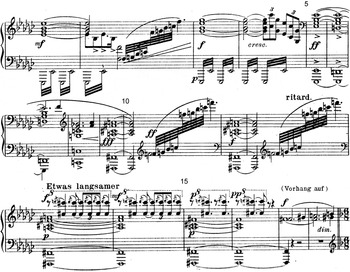
This passage leads, via further development, to the final bars of the orchestral epilogue and transition reproduced in Example 2. Here the Emperor's increasingly futile attempts at assertion have resulted in failure, his active roles confounded by the formal straitjacket imposed by his ‘truly musical’ character, as Hofmannsthal phrased it, which can only express emotion through his cantilena.Footnote 77 He disappears off stage, the curtain falls, and a thunderous iteration of the ‘Er wird zu Stein’ motif (traced in the bass in bars 5–9 of Ex. 2) makes clear his fate. It brings the scene to a close, leading from E-flat minor to the facies hippocratica of F-sharp minor. The Falcon's wing-beat, in bars 10 and 12, is first forced to grate against this new tonal area. But in bars 13–16 the bird's cry – fixed, implacable, but finally harmonised against the F-sharp minor triad – hovers as if in triumph, proclaiming itself forte against the piano background of the other instruments.Footnote 78
The conclusion to the Emperor's Act II scene (vocal score p. 191)

In contrast to the Emperor's impatient desire for action, the Empress's Act II scene, the fourth out of the act's five, takes her passivity to extreme lengths. Benjamin's assertion, furthermore, that ‘bad dreams come from the spleen, but prophetic bad dreams are also the prerogative of the melancholic’, suggests that this scene might be interpreted as the zenith of the Empress's melancholia, her own prophetic bad dream as allegory.Footnote 79 Building on her experience in Act I, though, she is again able to interpret information presented to her: musical material similarly becomes ossified into fixity, under her melancholic gaze. To describe the scene as a monologue is to imply a reliance on verbal communication that is misleading, however. Hofmannsthal gives his composer detailed directions of the stage action, of how the wall of the Empress's bedroom dissolves to reveal her vision of the Emperor being led by the Falcon into a mountain cave where he is to turn to stone. But, in over 250 bars of music (including 68 between the points in the score when the curtain drops and reopens to reveal the Empress in her bed chamber) the composer sets a total of just nineteen words, including nine that are simply a reprise of the Falcon's curse: ‘Die Frau wirft keinen Schatten, / der Kaiser muß versteinen’.
As before, the Empress's thought processes are portrayed as essentially passive, and the lengthy orchestral introduction is interpretable as a musical depiction of melancholic asymbolia. Against the Empress's occasional vocal outbursts, the orchestra is left to portray her state of mind as a ‘confused court’, where leitmotivic props are arranged loosely, providing less a sense of narrative impulse than one of scattered associations. Yet another new motif gradually creeps in – one perhaps again emblematic of Strauss's allegorical technique. As the scene approaches its point of highest tension the process of judgement takes on a Baroque ceremonial character, and a motif previously associated primarily with Barak reappears as the trombone's call to judgement, introduced, against the Falcon's cry, in the upbeat to the bar 4 of Example 3.
The Empress's call to judgement in Act II scene 4 (vocal score pp. 238–9)

The motif's etymology has been noted in passing by Norman Del Mar, but is not picked up on by other commentators. It is based on a musical idea that started in the first act as an accompaniment to Barak's dutiful carrying out of his daily activities: Specht designates it ‘Die Gewöhnlichkeit’ (Habit), developed almost immediately into ‘Baraks Edelsinn im Gewöhnlichen’ (Barak's nobility in the everyday), a slight variant with a lyrical extension. It is developed into a simple motif (f′–g′–f′ quavers rising to a b♭′ minim) some 25 bars into Act II scene 3 (at reh. 97). ‘Seemingly innocent here’, Del Mar remarks, ‘the violin's counterpoint to the cello melody later transpires to be the great majestic motif of the trials, a motif which becomes nothing short of momentous and with which ultimately the whole opera is to end’.Footnote 80 It is perhaps surprising that no other analysis expands on Del Mar's observation, since it offers the possibility of loosely linking Barak with the trials, either as having to undergo them himself or by reflecting his importance in the trial of the Empress.
Del Mar's interpretation is far from unreasonable, although it is difficult to argue that this motivic link is apparent without recourse to the score. Yet my concern is more with the significance of such a transformation in allegorical terms. As such, the manner by which a symphonically pliant motif accompanying Barak about his daily business becomes the rigid, stern calls to judgement on the trombones is all the more remarkable. As an escapee from the melodically flexible world of Barak and the humans, it reaches the final stage of its symphonic transformation only to become fixed under the Empress's melancholic gaze in her second-act monologue.Footnote 81 It becomes interpretable at once as a call to judgement whilst, like the Falcon's cry, further existing on a diegetic level (at reh. 89 in Act III, a moment of heroic revelation, surrounded by further trombone calls, the Empress tells the nurse: ‘A law rises from our deeds! From our hearts calls the trombone that summons us’ (‘Aus unsern Taten steigt ein Gericht! Aus unsern Herzen ruft die Posaune, die uns lädt’)). It is a shift into the ceremonial that, although not reflected in Hofmannsthal's stage directions, would remain prominent in Act III, bringing us all the closer to the world of Faust II as Hofmannsthal had interpreted it – as ‘a chain of festival and ceremony, it is all ceremony and liturgy, it is, taken as a whole, the festival of all festivals and, since it at every step postulates music, the opera of all operas’.Footnote 82 In her Act II scene, however, the Empress's new mode of perception allows her to freeze musical material into fixed meaning, as she had done with the Falcon's motif. Here she realises the importance of her call to judgement as musical material, which elsewhere is a model of symphonic malleability, becomes rigidly fixed.
Confronted with this musical representation of implacable force within an increasingly ceremonial context, the Empress begins to take on the mantle of the martyr, from whom a sacrifice will inevitably be demanded. In passing, one might also note that she seems increasingly to embody elements from the different character types Benjamin would later describe as central to Trauerspiel, perhaps above all that of the stoic, chaste princesses typically cultivated to defend against the state of emergency in the personal rather than political sphere.Footnote 83 At the same time, with the Emperor playing a secondary role to his wife in the opera, the ‘flaming beacons’ Hofmannsthal saw as marking out the Empress's path to humanity seem to take on the character of the stations of the cross.Footnote 84
Nun will ich Jubeln?
Sacrifice is indeed what happens with the Empress's renunciation of the Wife's shadow at the moment of highest tension in Act III. She resorts famously to speech at the climax of the scene – much of it often cut in performance – against an orchestral accompaniment again awash with familiar motifs. ‘Unearthly voices’ repeat the Falcon's curse (basses bolstered by low brass), Barak and his Wife cry out in despair and the Guardian of the Threshold entreats her to drink the Water of Life. But the Empress brings all the tension to an end with a simple ‘Ich will nicht!’. Having faced up to the petrified Emperor, an act of renunciation allows all dramatic tensions surrounding the characters to fall harmlessly away. Benjamin's ‘stations of the cross’ now do indeed become Hofmannsthal's flaming beacons, lighting the path away from allegory to the reconstituted symbol.
The opera's resolution is usually described as problematic at best, at worst a bloated failure; and there is plenty of circumstantial evidence pointing to reasons why. Chief among these is the fact that, along with delays brought about by the outbreak of war and Hofmannsthal's difficulty with his material, the third act had to be put on hold so that Strauss could devote himself to the second version of Ariadne auf Naxos (1916), in particular to its new prologue cast in a conversational style. Hofmannsthal complained that he felt ‘something oppressive and gloomy’Footnote 85 hanging over him when thinking of the third act of Die Frau in relation to the Ariadne prologue. In an oft-quoted letter dated 28 June 1916, Strauss seems to confirm this interpretation, concluding famously:
Characters like the Emperor and Empress, and also the Nurse, can't be filled with red corpuscles in the same way as a Marschallin, an Octavian, or an Ochs. No matter how I rack my brain – and I'm toiling really hard, sifting and sifting – my heart's only half in it, and once the head has to do the major part of the work you get a breath of academic chill (what my wife very rightly calls ‘note-spinning’ [musizieren]) which no bellows can ever kindle into a real fire. Well, I have now sketched out the whole end of the opera (the quartet and the choruses) and it's got verve and a great upward sweep [Schwung und große Steigerung] – but my wife finds it cold and missed the heart-touching flame-kindling melodic texture of the Rosenkavalier trio. I'm willing to believe her, and I keep probing and searching – but believe me:
I shall make every effort to shape Act 3 in line with your intentions, but let's make up our minds that Frau ohne Schatten shall be the last romantic opera.Footnote 86
Rather than just having difficulties with the return to a serious ‘style’, Strauss was ill-disposed to the characters in question and the nature of their eventual triumph. In part, in other words, it was the structure of the opera itself that was to blame.
The libretto was based, Koch has argued, on the inherently musical characteristics of ‘Steigerung’ (intensification) and ‘Wiederholung’ (repetition).Footnote 87 In Acts I and II these characteristics created beneficial friction to propel the narrative forward. This structure, however, leads to formal symphonic implications in the finale which Strauss's music for Emperor and Empress, with its tendency towards allegorical fragmentation, has been trying to resist. As a result, the work is driven forward increasingly by mere formal imperative ahead of dramatic necessity. This was to be apotheosis as ‘the result of a process’, as Adorno wrote of certain Mahler symphonies. The finale of Die Frau belongs with these movements in Mahler: ‘they cannot deliver what they postulate. They are supposed to present solutions, obstacles overcome, and are not allowed to repeat, still less to surpass the preceding tensions.’Footnote 88
Part of the reason for Strauss's dissatisfaction with the conclusion of Die Frau might be found in the contemporaneous Eine Alpensinfonie (1915). The complicated genesis of the Alpensinfonie goes as far back as the turn of the twentieth century and has been meticulously charted by Rainer Bayreuther.Footnote 89 Its very earliest version was to portray the Künstlertragödie (Artist's Tragedy) of the life of the painter Karl Stauffer, whose biography bears several striking resemblances to Nietzsche's.Footnote 90 Strauss took up the plan again around 1910 and was spurred on anew on hearing of Gustav Mahler's death. A well-known diary entry concludes with the following resolution: ‘I intend to call my Alpine Symphony “Anti-Christ”, since it involves moral purification through one's own effort, liberation through work and the adoration of eternal, glorious Nature’.Footnote 91
The sketchbooks give different titles to what was to be the fourth movement: ‘Befreiung in der Natur’ (liberation in nature) and ‘Befreiung durch die Arbeit: das künstlerische Schaffen. Fuge’ (liberation through work: artistic creation. Fugue).Footnote 92 This is the key to unravelling the symphony in the version we know it today. For while it on one level depicts a straightforward narrative – a climb up and down a mountain with the usual hazards, sights and sensations – there are also important passages where the pictorial makes way for moments of metaphysical revelation. This happens first in the section marked ‘Vision’, after the summit is reached; then ‘Elegie’ before the storm; while between ‘Sonnenuntegang’ (Sunset) and ‘Nacht’ (Night) Strauss seems to be abandoning himself to the purely musical in the ‘Ausklang’.
If, then, Eine Alpensinfonie and Die Frau both represent musings on the challenges of modernity, they significantly posit very different solutions, perhaps most neatly summed up in Strauss's ‘Liberation through work’ and Hofmannsthal's favourite couplet from Goethe's Die Geheimnisse, which, having been in the librettist's mind from the opera's early gestation, was brought into service to prepare Strauss for the composition of Act III: ‘a couple of lines from Goethe describes the innermost content: Von dem Gesetz, das alle Wesen bindet, / Befreit der Mensch sich, der sich überwindet’ (From the law that binds all beings, / Frees the human whosoever overcomes themselves).Footnote 93 And it is tempting, in the light of Strauss's own intellectual biography, to characterise these solutions as respectively Nietzschean and Schopenhauerian. The Alpensinfonie at first suggests a largely passive relationship to nature as a source of inspiration against which the composer can test his descriptive skill. But it also traces, as Strauss's diary entry and plans seem to make clear, a narrative of artistic trial and overcoming to be interpreted with the context of Nietzsche's engagements with nature as Strauss apparently understood them. As Charles Youmans has suggested, the symphony's climactic central encounter with nature, in this case the summit of the mountain itself, marks a moment of revelation where nature temporarily ‘represents not unfathomable objectivity but a healthy focus for religious impulses’.Footnote 94 The subsequent angst experienced in the ‘Elegie’, and the resignation of the ‘Ausklang’ reflects an essential awareness of the transitoriness of that revelation. This is ‘the Nietzschean reality’, Youmans explains, ‘that any redemption must eternally renew itself by starting from scratch’.Footnote 95 Artistic melancholy might only be overcome, therefore, by constant striving, which in turn can only promise temporary respite from crippling uncertainty.
In Hofmannsthal, and particularly in Die Frau ohne Schatten, this recurring challenge is replaced by permanent transformation, or Verwandlung, a concept which Gilliam has examined with relation to Ariadne auf Naxos and the later opera Daphne (1936–7, composed to a text by Joseph Gregor). In his self-analysing ‘Ad me ipsum’, Hofmannsthal described this transformation specifically as ‘allomatic’, writing, as we have seen, that the work represented the ‘Triumph des Allomatischen. Allegorie des Sozialen’.Footnote 96 The word allomatic has exercised Hofmannsthal scholarship to an extent that is, as Benjamin Bennett has noted, quite out of proportion with the frequency of its appearances in his writing.Footnote 97 Gilliam is perhaps wise to follow Richard Alewyn and Judith Ryan when discussing Ariadne's transformation, in seeing the word allomatic as essentially a synonym for mutual.Footnote 98 The fine semantic layers Bennett peels away in his more nuanced interpretation of the term are of less use here than the common ground that suggests that the allomatic process is essentially a passive one, even if it is different from a mutual one, and realised, significantly, in a social context in Die Frau as opposed to in isolation in Ariadne.Footnote 99 If, as I believe we should, we take the Alpensinfonie to be the nearest thing we have to an artistic manifesto from Strauss in the 1910s, then it is possible to see the idea of ‘Befreiung durch die Arbeit’ that informed it from its earliest gestation as anathema to the allomatic solution, however one chooses to interpret it.Footnote 100
But how might this translate into the terms used by Benjamin for diagnosing modernity? And how might it be linked back to the solution posited in Lord Chandos's Letter? Hofmannsthal and Strauss's strategy for the expository Act I scenes for the Empress and the Emperor was more than simply to present the characters and the premise for the opera's action. Through the methods my analysis has shown, their position as protagonists in an aesthetic allegory led to them embodying the various approaches to artistic production: the Emperor as the formal, the generic and the conventional; the Empress taking initially unengaged delight in creation as l'art pour l'art before negotiating and reading surroundings defined by allegorical fragmentation.
When it came to the very ending of the work, Hofmannsthal seems to have believed that he had recaptured some of the music of his pre-Chandos poetry, with Strauss needing only to trace his music over that already implied in the libretto: ‘The act will delight you; it is wholly music, meets music all the way [‘er ist völlig Musik, Musik ohne Widerstand’], and at the same time is rich and varied and brief’.Footnote 101 Ultimately, however, responsibility was passed on to Strauss for ratifying an optimistic manifesto for cultural regeneration in which, as an acutely self-aware modern musician, he was unable to believe. It was a situation exacerbated by the additional burden of expectation of Die Frau as a sort of ‘official magnum opus’.
Having painstakingly staged the dilemmas of modern artistic uncertainty in the Emperor and Empress, the composer could only dutifully play his part in staging what he saw as an illusory resolution. With the Emperor's return to life, and the Empress's procurement of her own shadow, there is something perfunctory in the gesture of gradually reintroducing thirds into a texture, as Schlötterer has noted, that was characterised by the fourths and seconds of the shadow motifs.Footnote 102 Such a moment, moreover, tries to turn back the clock on recent developments in music, most notably in the emancipation of the interval of the fourth, such as, for example, in Schoenberg's Chamber Symphony No. 1, which Strauss seems likely to have known.Footnote 103 The inevitable return to C major gives Hofmannsthal what he wanted, but similarly that key's promise of a return to nature seems no more than token. Barak's ‘Nun will ich jubeln’ is characterised by strenuous leaps to e′, emphasising, through vocal hard work, the third of the C major scale. He is the embodiment of ‘Befreiung durch die Arbeit’, but remains resolutely outside the sphere of the imperial couple, and as such Strauss felt himself no more able to re-create the symbolic whole in his music than Hofmannsthal is in his poetry.
Finally, the apotheosis brings about a betrayal of one of Strauss's most potent allegorical motifs. The ‘Er wird zu stein’ motif, the promise of whose modulation has up until now led only to the facies hippocratica of F-sharp minor and E-flat minor, now leads – admittedly in one of Strauss's most viscerally exciting harmonic coups – in the final quartet to a 6–4 chord in C major (reh. 266). Before the resolution we are whisked through a series of unexpected modulations, as if the symbol, saved from the jaws of allegory, is impatient to demonstrate its flexibility. Although Strauss tries to weigh down the subsequent C major climax (from reh. 227) with clashing chromatic counterpoint, this melts away before the judgement motif, now obeisant and flexible, is pushed into service as one of the many elements that accompany the final chorus of the Unborn Children. Chandos's sublime allegory – Benjamin's symbol by any other name – has been reconstituted in the final Verwandlung. Or has it? Ultimately, opera had failed in this particular role after all, and, as Jean-Yves Masson has suggested, it was the Erzählung that succeeded in overcoming Chandos's crisis:
The Erzählung concerned itself entirely, after all, with producing a poem, and with passing from an incomprehensible enigma, from cryptic writing containing a message of unhappiness, to a discourse that embraces the totality of existence.Footnote 104
Comparison between the final bars of the opera, with its unrealistic scenic demands for shadows to form golden bridges across an abyss, and the leisurely portrayal of such phenomena in Hofmannsthal's prose version backs up such an interpretation. Finally, however, in the Erzählung the Empress seems to witness Chandos's ‘sublime allegory’, as its final sentences make clear:
The Empress lay in [the Emperor's] arms, her moist glance turned upward. She did not see the falcon in the blazing vault of heaven, but a song reached her from that height. Soft sounds, gentle words mysteriously found their way from that great height to her … She barely dared to grasp what she had heard, or to interpret it. She did not know that the words of the curse had been erased from the talisman at her breast long before and replaced with symbols and verses which praised the eternal mystery of the chain of being that links all things on earth.Footnote 105
Hofmannsthal's allegory of idealised collaboration had presupposed music's obeisance. Strauss did indeed obey – to a degree; and Hofmannsthal caricatured Strauss's sturdy work ethic in Barak's easy elision of ‘Jubeln’ (rejoicing) and ‘Schaffen’ (creation) as he launches the final quartet. Ironically, however, while this work ethic had brought the project to completion in the face of adversity, it was founded on a philosophy which was unable to endorse the untroubled optimism of its conclusion.
Ultimately, it is the prose Erzählung, then, that can be seen to transcend the prosaic and approach the poetic in its description of the happy conclusion, while the opera's retreat to formally determined affirmation rings hollow. More significantly for the Strauss–Hofmannsthal collaboration as a whole, the librettist had discarded music as he concentrated on his prose reworking of Die Frau ohne Schatten, finished around the time of the opera's première but actively uncoupled from the operatic project that had spawned it.Footnote 106 During the 1920s Hofmannsthal became increasingly involved in the political sphere, in which he increasingly found validity for his work. In a further irony, then, one might suggest that music, so essential in Die Frau ohne Schatten, served as a catalyst for Hofmannsthal's own escape from the purely aesthetic sphere. Music, that is to say, helped to stage an allegory of social engagement, which eventually underlined, as far as the librettist was concerned, its obsolescence. History, furthermore, had played its role: Hofmannsthal's post-war activities began, increasingly, to focus on the question of Austrian identity in a post-Habsburg era – conservative political unity replaced aesthetic totality as a primary goal.
His collaboration with Strauss continued with Die Aegyptische Helena (1928) and Arabella (1933), with Strauss left to complete the latter after Hofmannsthal's death in 1929. But, as Hofmannsthal's introductory essay to Helena makes clear, music was pushed to the periphery.Footnote 107 Several years after Die Frau ohne Schatten, Hofmannsthal read Benjamin's Trauerspiel, and his engagement with the book came to a head with the final version of Der Turm (1927), celebrated by Benjamin as ‘a Trauerspiel in its purest, canonic form’ in a letter to the older man.Footnote 108 The dream of Chandos's ‘sublime allegory’ as opera, however, was over.