1. Introduction
The phonetic realization of ‘Second Occurrence Focus’ (SOF) is related to the question of the interface between LF and PF in grammar. In this paper, we investigate the question of whether and how SOF is realized phonetically in German. Our experiment provides novel data, in that the phonetic realization of SOF expressions is examined in two different phonological environments: in the postnuclear area, which all previous studies have looked at, and in the prenuclear area. It will be shown that prenuclear SOF has a different phonetic realization from postnuclear SOF.
After an overview of the theoretical issues involved in SOF and a discussion of the problems that it presents for the model of grammar in the next section, the experiments are discussed in sections 3 to 5. In sections 3 and 4, the production experiment is addressed, and in section 5, the perception experiment. A discussion follows in section 6, and a conclusion in section 7.
2. Theoretical background
The phenomenon of second occurrence focus (SOF) was first described by Partee (Reference Partee, Bosch and van der Sandt1999: 215–216) in the following terms:
If only is a focus-sensitive operator (i.e. needs an intonationally prominent element in its scope), then the two occurrences of only eats vegetables in [(1)] should have the same analysis. However, if there is no phonological reflex of focus in the second occurrence of vegetables, then this leads to the notion of ‘phonologically invisible focus’. The notion of inaudible foci at best would force the recognition of a multiplicity of different notions of ‘focus’ and at worst might lead to a fundamentally incoherent notion of focus.
- (1)
(a) Everyone already knew that Mary only eats [vegetables]F.
(b) If even [Paul]F knew that Mary only eats [vegetables]SOF, then he should have suggested a different restaurant.
Partee indirectly assumes an obligatory phonetic realization of focus. If there are foci without accents, no coherent notion of focus can be obtained. As Krifka (Reference Krifka, Kamp and Partee2004: 190) puts it (his Hypothesis I): ‘If an operator is analyzed as focus-sensitive (i.e. associated with a focus) in one type of use, it must be analyzed as focus-sensitive (associated with a focus) in all types of use’. Association with focus, an expression coined by Jackendoff (Reference Jackendoff1972), means explicitly that certain expressions have a focus in their syntactic domain, where focus is specified by a syntactic feature F, which in turn is realized by intonational prominence. The conclusion one must draw from Partee's comment is that if there is no phonological correlate of a SOF, then there is also no focus.
Following Rooth (Reference Rooth1992, Reference Rooth, Bosch and van der Sandt1999), researchers such as Bartels (Reference Bartels, Kamp and Partee2004), von Fintel (Reference Fintel, Kamp and Partee2004), Krifka (Reference Krifka, Kamp and Partee2004), and Beaver et al. (Reference Beaver, Clark, Flemming, Jaeger and Wolters2007) distinguish (though not necessarily with the same terminology) between two types of theories of focus: ‘weak’ grammaticized theories of focus, which require both a syntactic focus-marking F and a phonological (and phonetic) realization of focus, and ‘strong’ theories of focus, in which the relationship between focus and grammar is looser and resolution of focus is pragmatic. In the latter view, the quantificational domains of some operators may be restricted contextually or situationally. This model predicts that focus can be left phonetically unrealized, since focus does not need to be grammatically marked. All the authors assume that the phonetic realization of focus is crucial for deciding between the semantic theories. Krifka (Reference Krifka, Kamp and Partee2004) accepts Partee's claim that SOF is ‘inaudible’, but other authors, like Rooth (Reference Rooth, Galloway and Spence1996), Bartels (Reference Bartels, Kamp and Partee2004) and Beaver et al. (Reference Beaver, Clark, Flemming, Jaeger and Wolters2007), answer Partee's challenge by showing that SOF is indeed phonetically realized. The different opinions correlate with different views about strong and weak interpretations of focus.
Rooth, Bartels and Beaver et al. have conducted experiments to investigate whether SOF expressions are realized phonetically. Examples of the experimental material used by Beaver et al. to show the phonetic realization of SOF appear in (2) and (3).
- (2)
(a) Both Sid and his accomplices should have been named in this morning's court session.
(b) But the defendant only named [Sid]F in court today.
(c) Even [the state prosecutor]F only named [Sid]SOF in court today.
- (3)
(a) Defense and Prosecution had agreed to implicate Sid both in court and on television.
(b) Still, the defense attorney only named Sid [in court]F today.
(c) Even [the state prosecutor]F only named Sid [in court]SOF today.
In the above examples, the areas of interest are the first and the second postverbal phrases (NP Sid and PP in court) of the last sentence in a discourse (=(c)). The (a) sentence first introduces a context in which both phrases are new. Then the (b) sentence introduces a context in which one of the phrases is a first occurrence focus (FOF) – Sid in (2), and in court in (3) – and the other phrase is in the background. In (c), the FOF in (b) is now a SOF and the other phrase is still part of the background. The SOF effect is obtained by realizing the new focus in (c) (the state prosecutor) with a nuclear pitch accent, and by simply repeating the postverbal phrases. But, since one of them is still in the restrictor of the ‘old’ focus operator only, it is also focused. The phonetic realization of this focus, however, is much more subtle than that of the FOF in the (b) examples, and hence raises the question formulated by Partee. The researchers mentioned above (Rooth Reference Rooth, Galloway and Spence1996, Bartels Reference Bartels, Kamp and Partee2004, Beaver et al. Reference Beaver, Clark, Flemming, Jaeger and Wolters2007) all find some phonetic correlates of such focus, though no pitch accent.
In the remainder of this section, we first address the question of the phonetic correlates of SOF. The second question has to do with the relevance of the phonetic facts for the model of grammar, and more specifically, whether it is correct to base a semantic theory on the presence or absence of phonetic correlates of SOF.
2.1 Phonetic correlates of SOF
Rooth (Reference Rooth, Galloway and Spence1996), Bartels (Reference Bartels, Kamp and Partee2004), Jaeger (Reference Jaeger2004) and Beaver et al. (Reference Beaver, Clark, Flemming, Jaeger and Wolters2007) examine phonetic properties of SOF expressions, and find no increase or only a very slight increase in pitch on the SOF as compared to the counterparts in the minimal pair examples. They find instead other phonetic correlates, like a small increase in duration (an average of 6 ms in Beaver et al.). On the basis of such results, all the authors conclude that the prominence on SOF is different from a plain pitch accent. Rooth (Reference Rooth, Galloway and Spence1996, Reference Rooth, Zimmermann and Féry2009) calls it a ‘metrical accent’, and Beaver et al. a ‘phrasal stress’, which differs formally from a pitch accent. According to them, focus is marked both by phrasal stress and by a nuclear pitch accent, whereas SOF is marked only by phrasal stress.
In an utterance like (2c), the SOF Sid is a focus by virtue of being associated with a focus operator, but, crucially, it is embedded in a larger expression which is itself discourse-given, and which is usually realized on a lower pitch than discourse-new material (cf. Sugahara Reference Sugahara2003, Ishihara Reference Ishihara, Ishihara, Schmitz and Schwarz2004 for similar claims for Japanese). Furthermore, SOF typically appears in a postnuclear area, because it very often follows the FOF, which obligatorily attracts the nuclear pitch accent. That is, SOF typically appears in an environment where no pitch accent can be placed due to postnuclear deaccenting. As a result, SOF expressions are usually realized with a compressed or deaccented pitch contour. The question which all the above-mentioned experiments on SOF have explicitly or implicitly attempted to answer is whether the phonetic correlates of focus associated with a focus operator can be detected in such an environment, where pitch realization is generally suppressed regardless of information-structural status. This is of course an important question to answer, because this is exactly where the debate came from.
In this study, we approach this question differently: we examine phonetic realizations of both pre- and postnuclear SOF and compare them, both with each other and with FOF and non-focus expressions. This approach allows us to examine pure phonetic effects of focus that are not affected or overridden by additional effects such as postnuclear deaccenting. We will claim first that the phonetic correlates of SOF result from the combination of being focused and being given, and second that such effects vary according to the position of the SOF in the sentence. We will show that in prenuclear position, there is pitch prominence on SOF as compared to its non-focused counterpart. Our experiment was conducted with German data, but we expect our general conclusions to be valid for English as well, since those aspects of intonation which bear on SOF are similar in both languages.
There are also a few other pieces of evidence showing that SOF is phonologically marked. Rooth (Reference Rooth, Galloway and Spence1996), Krifka (Reference Krifka, Kamp and Partee2004), and von Fintel (Reference Fintel, Kamp and Partee2004) mention the absence of weak pronouns in a SOF location as another important clue for the special status of these items.Footnote 2 Second Occurrence Focus on a pronoun blocks cliticization. Compare the data in (4). The sentences in (4b) and (4c) are SOF. As shown in (4c) the cliticized rendition of the pronoun is not possible in this context. This set of data is relevant for the discussion of whether SOF is accented or not, despite the absence of pitch accent, and seems to indicate that it is.
(4) Pronouns
(a) Mary's boyfriend only likes her.
(b) Even her boss only likes her.
(c) #Even her boss only likser.
As discussed most forcefully by Rooth (Reference Rooth, Kamp and Partee2004, Reference Rooth, Zimmermann and Féry2009), SOF sentences need to be considered in their context. They involve two foci embedded in each other where First Occurrence Focus (FOF) has wider scope than SOF (see also Büring Reference Büring2006 for this observation). Rooth (Reference Rooth, Kamp and Partee2004: 480) shows, with sentences like those in (5), that SOF is not just a matter of lexical parallelism, involving repeated phonetic material. In (5B), new material (younger candidates) represents SOF use of a constituent which was introduced as FOF in (5A) but formulated in different words (Susan and Harold). The point is important because it eliminates analyses relying on the mere copying of phonetic material.
- (5)
A: The provost and the dean aren't taking any candidates other than Susan and Harold seriously.
B: Even the [chairman]F is only considering [younger]SOF candidates.
2.2 Phonetic realization of SOF and postnuclearity
It is important to pin down the phonetic and phonological correlates of SOF, since the argument over its being accented or not has been crucial in the debate about the best interpretation of focus. To achieve this goal, it is also important to take into consideration additional phonological factors that may be involved in the realization of SOF expressions. As we demonstrate in this section, pre- and postnuclearity is one such factor.
The accent status of SOF has been considered a major point of debate for deciding between weak and strong theories of semantic focus. In weak versions, only is a focus operator (in the same way as even, also or some adverbs), and as such it is expected to be associated with an element bearing an accent. If there is no accent on the element over which it takes scope, two solutions are possible. The first is to claim that only has at least two interpretations, one associated with focus and the other not. This is the worst case, which no researcher has been willing to defend (see Partee's comment above). The other interpretation implies giving up the obligatory association of accent with focus, and endorsing the view that the association is optional. In this latter solution, the domain of quantification is based on pragmatic reasoning, letting contextual factors play a role. A sentence like (6), for example, does not mean that there is no sunshine anywhere on earth, but is to be understood as a comment on a contextually given place in which the speaker is located, or about which she has some knowledge. In other words, the restrictor of the quantifier no sunshine is further restricted by the context of utterance.
(6) There is no sunshine.
The ‘strong’ theory of focus, on the other hand, assumes that focus operators are like quantifiers and that their domain can be restricted by context and only by context. Rooth shows with the help of examples like (7) that the domain of only can be fixed by the context variable of the preceding expression. As a result, accents on elements in the scope of a focus operator may be absent. In (7), rice in the main clause is expected to be focused because it is associated with only. Thus it should have an accent. But instead, an accent is present on eat because of the contrast with grow. The explanation for the absence of an accent on rice is that the domain of quantification is pragmatically driven. This happens entirely without the help of focus. The context of grow rice and the context of eat rice are anaphorically related, and mutually define an environment for each other. Rooth (Reference Rooth, Kamp and Partee2004) assumes that there is no focus on rice, and takes this as evidence that focus-sensitive effects are optional, arguing for the strong theory of focus.
(7) People who [grow]F rice usually only [eat]F rice.
It should be noted, however, that the phonetic marking of focus can be masked by independent phonetic/phonological effects, as Rooth (Reference Rooth, Zimmermann and Féry2009) recognizes. The discussion regarding the strong/weak theories of focus is based on a tacit assumption that focus is always phonetically marked. Given this assumption, if no phonetic marking is found on a phrase, it must be treated as a non-focused element. Association with focus, or lack thereof, is judged based on the existence/absence of phonetic marking (in most cases, pitch accent) on the phrase that is in the quantificational domain of the focus operator.
Under Rooth's (Reference Rooth, Kamp and Partee2004) assumption about the absence of accent on rice, if this noun is expanded with a relative clause like that absorbs a lot of water, as in (7′), the entire complex noun phrase should be deaccented in both clauses, since the anaphoric effect on context which he postulates should be observed in the larger NP as well. This does not seem to be true though, since the first occurrence of water is preferably accented.
(7′) People who [grow]F rice that absorbs a lot of water usually only [eat]F rice that absorbs a lot of water.
In our opinion, there is an alternative explanation for the absence of accent on rice in a sentence like (7), as also in sentences (2) and (3), an explanation which has nothing to do with contextual or anaphoric quantification. Rice could be deaccented on prosodic grounds (see Féry & Samek-Lodovici Reference Féry and Samek-Lodovici2006 for such an explanation). In (7), an accent on rice would compete with the adjacent accent on eat, and the latter accent wins because it has an additional contrast value that rice does not have. Furthermore, the SOF expressions in (2) could be deaccented because they are found in a postnuclear environment, in which no pitch accent can be realized. We find that deaccenting, or at least a strong reduction of pitch accents, is a consequence of postnuclearity, a phonological effect that is independent of the focus or non-focus status of SOF – an effect compatible with Rooth's and Beaver et al.'s results. But we also find that SOF expressions do have an accent when they are prenuclear. As soon as SOF expressions are in a phonological environment where they can be accented, they are accented. This is demonstrated in the next section.
3. Production experiment
3.1 Stimuli and hypotheses
In order to distinguish phonetic correlates of SOF from other factors such as postnuclear deaccenting, we investigated realizations of SOF in prenuclear as well as postnuclear position in our material.
Six expressions, underlined in (8), were chosen as the target expressions. Three of these, (8a–c), were inserted in the subject position, and three, (8d–f), in object position. Henceforth we will call the former group the ‘subject set’ and the latter the ‘object set’. Three different focus operators were used in our stimuli: nur ‘only’, auch ‘also’ and sogar ‘even’, as shown in (8).
(8) Stimulus expressions (see appendix for all conditions)
(a) Nur Peter hat eine Krawatte getragen.only Peter has a tie worn‘Only Peter wore a tie.’
(b) Auch Melina hat beim Aufbau mitgeholfen.also Melina has at.the set-up helped‘Melina, too, helped set up.’
(c) Sogar Monika hat Mailand geliebt.even Monika has Milan loved‘Even Monika loved Milan.’
(d) Eva hat nur ihren Bruder eingeladen.Eva has only her brother invited‘Eva only invited her brother.’
(e) Ingo hat auch einen Jaguar gekauft.Ingo has also a Jaguar bought‘Ingo also bought a Jaguar.’
(f) Michael hat sogar ein Lied gesungen.Michael has even a song sung‘Michael even sang a song.’
Each expression was inserted in five different contexts, as illustrated in (9): (9a) FOF, (9b) prenuclear SOF, (9c) postnuclear SOF, (9d) prenuclear Non-Focus, and (9e) postnuclear Non-Focus context. Thanks to the V2 property of German, we can place SOF and Non-Focus expressions in different locations, either sentence-initially (prefield) or sentence-medially (middle field). When SOF and Non-Focus are in sentence-initial position, they are followed by a nuclear pitch accent in the middle field. We call these ‘prenuclear SOF’ and ‘prenuclear Non-Focus’, respectively. When they are in sentence-medial position, they are preceded by a nuclear accent in the sentence-initial position, hence becoming the ‘postnuclear SOF/Non-Focus’. The SOF interpretation is evoked by providing the FOF sentence (9a) as a context, as shown in (9b) and (9c). In the Non-Focus conditions, (9d) and (9e), the target words have already been mentioned in the preceding wh-questions, and no focus operator is involved.
(9) Contexts for one sentence of the subject set ((1a–e) in the appendix)
(a) FOF
Die meisten unserer Kollegen waren beim Betriebsausflug lässig angezogen.the most our colleagues were at.the staff.outing casually dressed‘Most of our colleagues were dressed casually at the staff outing.’Nur Peter hat eine Krawatte getragen.only Peter has a tie worn‘Only Peter wore a tie.’
(b) SOF: Prenuclear
Die meisten unserer Kollegen waren beim Betriebsausflug lässig angezogen. Nur Peter hat eine Krawatte getragen.
Nur Peter hat sogar einen Anzug getragen.only Peter has even a suit wore‘Only Peter even wore a suit.’
(c) SOF: Postnuclear
Die meisten unserer Kollegen waren beim Betriebsausflug lässig angezogen. Nur Peter hat eine Krawatte getragen.
Sogar einen Anzug hat nur Peter getragen.
(d) Non-Focus: Prenuclear
Wen hat Peter geküsst?who.acc has Peter kissed‘Who did Peter kiss?’Peter hat Maria geküsst.‘Peter kissed Maria.’
(e) Non-Focus: Postnuclear
Wen hat Peter geküsst?
Maria hat Peter geküsst.
As for the FOF context, the (a) sentences in the subject set ((1a)–(3a) in the appendix) contain FOF expressions in sentence-initial position, while those in the object set ((4a)–(6a) in the appendix) contain FOF expressions in sentence-medial position. One of the sentence-medial FOF examples (i.e. the (a) examples in the object set) is given in (10).
(10) FOF context for one of the object sets ((4a) in the appendix)
Viele Frauen haben mehrere Verwandte zum Dorffest eingeladen.many women have several relatives to.the village.fair invited‘Many women invited several relatives to the village fair.’Aber Eva hat nur ihren Bruder eingeladen.but Eva has only her brother invited‘But Eva only invited her brother.’
In sum, our material has six different conditions, with two factors being manipulated: position in the sentence (pre- and postnuclear, or sentence-initial and medial) and focus type (FOF, SOF, Non-Focus). Since our design is not a complete 2×3 factorial design (because the subject set lacks postnuclear FOF data, and the object set lacks prenuclear FOF data), we needed to separate the data set into two groups when comparing the FOF conditions with the others.
With this material, we will examine the following two hypotheses, in (11). First, we expect to find a three-way difference in prominence between FOF, SOF, and Non-Focus, FOF being the most prominent and Non-Focus the least (Hypothesis 1). Second, we also expect different prominence realizations according to location in the sentence, the sentence-initial expressions being more prominent than their sentence-medial counterparts (Hypothesis 2). This is expected to hold for FOF, SOF and Non-Focus. We use the term ‘sentence-initial/medial’ (instead of pre-/postnuclear) to cover all the three focus conditions (FOF/SOF/Non-Focus) in terms of sentence position. (Note that FOF always attracts the nuclear accent of the sentence and hence never appears pre- or postnuclearly.) We use the term ‘prominence’ as a cover term for pitch and duration.
(11) Hypotheses
(a) Hypothesis 1: FOF words are more prominent than SOF words, which are themselves more prominent than Non-Focus words.
(b) Hypothesis 2: Sentence-initial words are more prominent than sentence-medial ones.
3.2 Recordings
Recordings were made in a sound-proof booth on a DAT recorder. A short set of instructions familiarized the subjects with the procedure and had them practice with a few examples. The contexts and target sentences were presented in a PowerPoint presentation, in a series of two slides per stimulus. On the first slide, the context was presented both acoustically and visually, and the target sentence appeared on the second slide. The informant read the sentences aloud as naturally as possible. The experiment was self-paced and speakers were instructed to repeat a sentence if they felt that they had made a mistake.
The 30 sentences used for this experiment were part of a larger production experiment, including 200 sentences altogether. Each context was organized in one block for each of the six sentences. The blocks were separated from each other by 17 or 20 other sentences.
Our speakers were 29 female students at the University of Potsdam. They were reimbursed for their time. They were monolingual speakers of German in their twenties, coming from the northern area of Germany.Footnote 3
3.3 Measurements
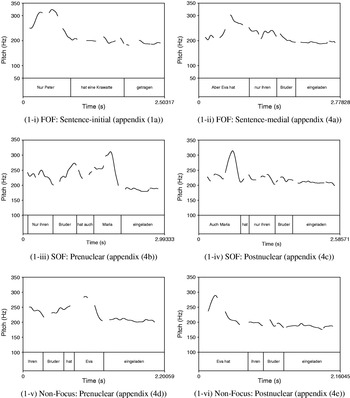
The recordings were analyzed using the acoustic speech analysis software Praat© (Boersma & Weenink Reference Boersma and David1994–Reference Boersma and David2009. The sound waves were manually divided into labeled sub-strings with the help of spectrograms. The target was either taken as a single domain of measurement or split in two, depending on whether or not there was an article (or possessive) preceding the target noun. In (12a) only one domain was defined, whereas in (12b) two were needed. The measurement had to be performed on the article (or possessive) separately because in many cases, the falling nuclear accent started on the syllable preceding the accented syllable, a phenomenon called ‘early peak’. This is well documented in the literature on German intonation (Kohler Reference Kohler, Kingston and Beckman1990), and it is visible in figure 1-ii below.
- (12)
(a) Nur # Peter # hat sogar einen Anzug getragen.
‘Only Peter even wore a suit.’
(b) Auch Maria hat nur # ihren # Bruder # eingeladen.
‘Also Maria only invited her brother.’
Two values were measured: first, the highest peak of the domain defined by the target noun (plus preceding article or possessive if present), and second, the duration of the target noun (not including the article or possessive). The values were assigned by a script in Praat, and the authors manually verified all the sentences. In approximately 30% of the cases, changes were necessary because of microprosodic distortions in the pitch tracks (especially in the nouns Peter and Monika). Statistical analyses were done using the statistical computing environment R.

4. Results
Figure 1 illustrates examples of realizations for the six contexts: (i) sentence-initial FOF, (ii) sentence-medial FOF, (iii) prenuclear SOF, (iv) postnuclear SOF, (v) prenuclear Non-Focus, and (vi) postnuclear Non-Focus. From these pitch tracks one can see that sentence-initial/medial FOF (i.e. nuclear elements) (i, ii) and as prenuclear SOF/Non-Focus (iii, v) preserve accents of the target expression (Peter, Bruder), but that this is not true for postnuclear SOF/Non-Focus (iv, vi).
The speakers were extremely consistent in their renditions of the sentences, with only very little variation in phrasing and height of pitch accents, so that we can propose a unified prosodic structure for our sentences, as illustrated in (13). The preverbal argument was phrased individually in its own prosodic phrase (p-phrase), and carried a rising bitonal tone if it hosted a prenuclear accent (13b, c, e), or a falling bitonal tone if it hosted the nuclear accent (13a, d, f). The trailing tone was at the same time the boundary tone of the p-phrase. The VP also formed its own p-phrase and always ended with the low boundary tone of the intonation phrase which comprised the entire sentence. The argument contained in the VP formed its own p-phrase, and carried a bitonal falling tone when it hosted the nuclear accent, and no tone otherwise. We assume that phrasing is dependent on the syntax, and can be recursive, while the height of individual accents is determined by information structure (see Féry & Ishihara Reference Féry, Ishihara, Zimmermann and Féry2009 for a more detailed version of this model).
(13) H*LP LI
(a) [[Nur Peter]P [hat [eine Krawatte]P getragen]P]I
L*HP H*LP LI
(b) [[Aber Eva]P [hat [nur ihren Bruder]P eingeladen]P]I
L*HP H*LP LI
(c) [[Nur ihren Bruder]P [hat [auch Maria]P eingeladen]P]I
H*LP LI
(d) [[Auch Maria]P [hat [nur ihren Bruder]P eingeladen]P]I
L*HP H*LP LI
(e) [[Ihren Bruder]P [hat [Eva]P eingeladen]P]I
H*LP LI
(f) [[Eva]P [hat [ihren Bruder]P eingeladen]P]I
4.1 Pitch (F0)
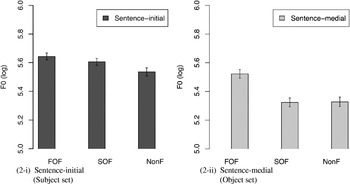
Let us first consider Hypothesis 1, the claim that FOF is more prominent than SOF, which is itself more prominent than Non-Focus (FOF>SOF>Non-Focus). As mentioned in section 3.1, only the subject set has a sentence-initial FOF item, while only the object set has a sentence-medial FOF item. Therefore, comparison of the FOF conditions with SOF/Non-Focus is done by using the subject set data for sentence-initial FOF, and the object set data for sentence-medial FOF. Figures 2-i and 2-ii show the mean highest log-transformed F0 of the target expression in sentence-initial contexts (the subject set data) and in sentence-medial contexts (the object set data), respectively.Footnote 4 Both sentence-initially (figure 2-i) and sentence-medially (figure 2-ii), FOF is realized significantly higher than SOF (sentence-initial: two-sided t-test, t(166)=2.1382, p<.05; sentence-medial: t(166)=9.1975, p<.001).Footnote 5 Note, however, that the difference between FOF and SOF is much larger sentence-medially.
Mean log-transformed F0 for FOF/SOF/Non-Focus in sentence-initial/medial conditions (with 95% Confidence Interval).

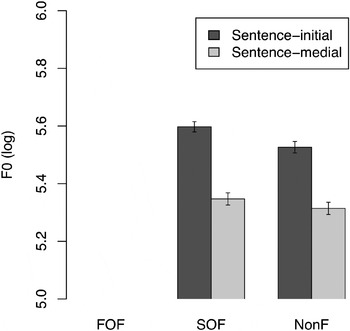
SOF and Non-Focus can be compared using the entire data set, that is, data from the subject and the object sets together, as displayed in figure 3. The difference between SOF and Non-Focus is statistically significant both sentence-initially and medially (sentence-initial: t(334)=5.2528, p<.001; sentence-medial: t(334)=2.1601, p<.05).Footnote 6 This means that Hypothesis 1 is confirmed both sentence-initially and medially. However, the clear difference in realization between sentence-initial and sentence-medial SOF still needs to be explained, because the very low realization of SOF in medial position lies at the very origin of the debate over SOF. This will be taken up in section 6.
Mean log-transformed F0 for SOF/Non-Focus in sentence-initial/medial conditions (with 95% CI).

In the next step, Hypothesis 2 (sentence-initial>sentence-medial) is examined for the SOF and Non-Focus contexts, using the entire data set, as shown in figure 3. We see that Hypothesis 2 is confirmed: in SOF and Non-Focus conditions, sentence-initial expressions are realized higher than their sentence-medial counterparts. Both for the SOF and the Non-Focus contexts, the mean difference between pre- and postnuclear conditions is statistically significant (SOF: t(320.263)=18.0173, p<.001; Non-Focus: t(334)=14.372, p<.001). The two FOF conditions cannot be compared statistically since they involve different sentences. However, a glance at the values of FOF in sentence-initial and sentence-medial position in figure 2 suggests that sentence-initial FOF is realized higher than sentence-medial FOF.
In sum, we have found the following for pitch:
(14) Summary for pitch
(a) Hypothesis 1 (focus type)
• In a sentence-initial/prenuclear position, the focus type hierarchy (FOF>SOF>Non-Focus) was established for pitch.
• In a sentence-medial/postnuclear position, the contrast between SOF and Non Focus is radically reduced.
(b) Hypothesis 2 (sentence position)
• Prenuclear SOF/Non-Focus is realized higher than postnuclear SOF/Non Focus.
• Sentence-initial FOF is expected to be realized higher than sentence-medial FOF.
4.2 Duration
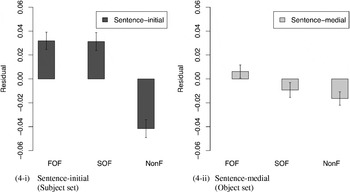
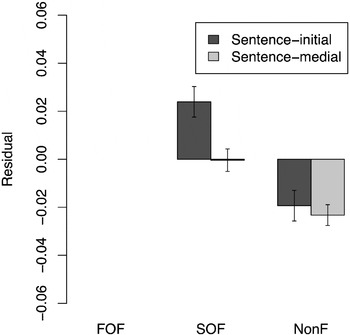
In order to make the durations of the target expressions comparable to each other, we performed a regression analysis to factor out the effect of the differing word lengths in the target expressions. Figures 4-i and 4-ii show the mean residual durations of the target expressions in sentence-initial contexts (obtained from the subject set) and in sentence-medial contexts (obtained from the object set), respectively. A higher residual value indicates longer duration (i.e. negative values indicate shorter duration than positive ones).
Mean residual duration for FOF/SOF/Non-Focus in sentence-initial/medial contexts (with 95% CI).

Let us first consider the result in terms of Hypothesis 1 (i.e. FOF>SOF>Non-Focus hierarchy). Sentence-initially, there is no significant difference between FOF and SOF (t(166)=0.1175, p=.9066), while the difference between them is significant sentence-medially (t(166)=3.704, p<.001). Not surprisingly, the difference between FOF and Non-Focus is significant both sentence-initially and sentence-medially. The difference in duration between SOF and Non-Focus, which is analyzed based on a comparison involving all data (shown in figure 5), is significant both sentence-initially and medially (sentence-initial: t(334)=9.4808, p<.001; sentence-medial: t(334)=7.0647, p<.001). In sum, the lack of significant difference between sentence-initial FOF and SOF requires an explanation. Otherwise, Hypothesis 1 holds for duration.
Mean residual duration for SOF/Non-Focus in sentence-initial/medial contexts (with 95% CI).

Consider next the results of Hypothesis 2 (sentence-initial>sentence-medial) for duration. Figure 5 shows the mean residual duration of SOF and Non-Focus obtained from the entire data set. Once again, the FOF data cannot be compared as they consist of different sentences. The contrast is significant in the SOF conditions (t(307.259)=6.0713, p<.001), but not in the Non-Focus conditions (t(294.307)=1.0052, p=.3156).
In sum, we have found the following for duration:
(15) Summary for duration
(a) Hypothesis 1 (focus type):
• Sentence-initially, no significant difference between FOF and SOF could be found, but they are both longer than Non-Focus.
• Sentence-medially, there is a significant difference between FOF and SOF, as well as between SOF and Non-Focus.
(b) Hypothesis 2 (sentence position):
• SOF is longer sentence-initially than sentence-medially.
• Non-Focus does not show any difference between the positions.
5. Perception experiment
A perception experiment bearing on the acceptability of our context–target pairs was conducted in order to verify whether the sentences with SOF (and thus having two focus operators) are accepted by German native speakers.Footnote 7
5.1 Method
Thirty-six students at the University of Potsdam participated in the experiment on acceptability judgment. The sentences in (8), in the contexts exemplified in (9b–e), were pre-recorded in the accent structure shown in figure 1. One native speaker spoke the context sentences, and another the target sentences. The context–target pairs were then inserted into a perception experiment containing a large number of fillers, run with an adapted version of Doug Rhodes' program Linger, which randomized the order of presentation of the sentences for each participant. The sentences were presented acoustically only, over headphones. Each participant had eight sentences to rate, two versions of each sentence, in a Latin Square design. Altogether, four different sets of sentences were presented. The aim of this experiment was to compare the acceptability of the SOF sentences with straightforwardly well-formed sentences. We chose to compare them with the non-focus versions of the same sentences, instead of with the FOF versions, since the existence of pairs of sentences in both prenuclear and sentence-medial positions in both target and control sets allowed a symmetrical design of the experiment. Participants were asked to rate the sentences for acceptability on a scale from 1 (best) to 7 (worst).
5.2 Results
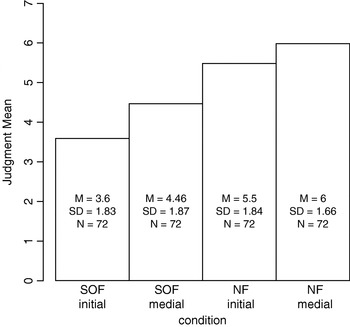
The results are displayed in figure 6. As expected, the Non-Focus sentences got very high ratings (5.5 and 6) and can thus serve as a point of comparison.Footnote 8 As for the SOF sentences, both of them got scores above 3.5, an indication that they are accepted by German speakers, even though their markedness may render them difficult to process. The postnuclear version was rated higher (4.5) than the prenuclear one (3.6). We assume that the presence of two focus operators in a single sentence renders the semantic processing rather difficult, and that a side effect of this increase in processing effort is a reduction in acceptability (see for instance Fanselow & Frisch Reference Fanselow, Frisch, Fanselow, Féry, Vogel and Schlesewsky2005 for this effect).
Mean judgment ratings on a scale of 1 (completely ungrammatical) to 7 (perfectly grammatical).

6. Discussion
6.1 Interpretation of the experimental results
Hypothesis 1 claims that the focus hierarchy FOF>SOF>Non-Focus is realized by means of the phonetic correlates of pitch and duration. Hypothesis 2 expects both pitch and duration to have a greater effect sentence-initially than sentence-medially. The experimental results generally support these hypotheses, despite cases where the expected differences were not found. These cases are explained below.
Beaver et al. (Reference Beaver, Clark, Flemming, Jaeger and Wolters2007) find that duration is a more reliable cue for SOF than pitch in the postnuclear position. We find that pitch is reliable prenuclearly, since pitch height in a SOF expression is lower than in a FOF expression but higher than in a Non-Focus one. Postnuclearly, on the other hand, pitch can be considered as less reliable, as the difference found was minimal. This observation is in line with Rooth's and Beaver et al.'s results. Additionally, we find that, prenuclearly, duration contrasts only focused items with non-focused ones – the former are longer than the latter – but does not distinguish between FOF and SOF. Postnuclearly, however, we again find the FOF>SOF>Non-Focus hierarchy. We also find an effect of duration depending on position in the sentence. Early focused items are longer than late ones. This result does not apply for Non-Focus. Clearly, a new interpretation is needed.
As shown in the results, pitch and duration were realized differently in our target expressions, but both covaried with information structure as well as with phonology. We thus propose to formally distinguish two types of effects that affect the realization of FOF/SOF/Non-Focus: information-structure-driven effects on the one hand, and purely phonological effects on the other hand. The information-structure-driven effects yield the focus type hierarchy in Hypothesis 1, both in sentence-initial and medial contexts. However, phonological effects, some of which yield the effects related to the sentence position hierarchy in Hypothesis 2, partly interfere with the realization of the information-structure-driven effects, and suppress or overwrite them in certain contexts.
The information-structural effects are summed up in (16).
(16) Information-structure-driven effects
(a) Focus boosts prominence (higher pitch/longer duration).
(b) Givenness weakens prominence (lower pitch/shorter duration).
In effect, information-structure-driven effects create the FOF>SOF>Non-Focus hierarchy. Focused material (FOF/SOF) is realized with higher pitch and longer duration than Non-Focus. Given material (SOF/Non-Focus), in contrast, gets a weaker prominence. FOF, being only focus, is the most prominent of all conditions, and Non-Focus, being only given, is the least prominent. SOF, being both focused and given, is subject to both effects. As a result, it is realized more prominently than Non-Focus, but less so than FOF.
In addition to these effects, pitch and duration are also affected by purely phonological factors:
(17) Phonologically driven effects
(a) Downstep decreases the height of non-initial accents.
(b) Postnuclear deaccenting suppresses postnuclear accents.
(c) Final lengthening in phonological phrases increases duration.
These factors can counteract or enhance the information-structure-related effects in different contexts, creating more variety in the phonetic realization than we would expect if only information-structure-driven effects were at play. The next two subsections discuss how information-structure-driven effects and phonologically driven effects interact in pitch and duration realization.
6.2 Pitch
If we think of sentences with a neutral focus structure (in which the whole sentence is presentational or ‘all-new’) as having a default pitch contour, we can draw an idealized tonal top line of registers like the one in (18), see Féry & Ishihara (Reference Féry, Ishihara, Zimmermann and Féry2009) for a detailed presentation of our model. In the course of a sentence, accents are downstepped relative to immediately preceding ones (see Pierrehumbert Reference Pierrehumbert1980 for English, Féry & Kügler Reference Féry and Kügler2008 for German); pitch accent later in the sentence is thus realized lower than a sentence-initial pitch accent. Accordingly, sentence-initial FOF is expected to be realized higher than sentence-medial FOF, because the latter is not the first accented element in its sentence and is therefore subject to downstep (see figure 2).
In the illustrations below, the continuous thick line (hereafter the ‘top line’) shows the highest value of the default intonation contour, i.e. the default level of high accentual peaks. Note that the accents in the illustrations can be realized as either a rise (LH) or a fall (HL). The only important point is the presence of an accentual H, which is involved in downstep.
(18) Downstep on non-initial pitch accents (=(17a)): neutral sentence (i.e. containing neither focus nor given material)


Considering the pitch configuration (18) as the default case, we can now show the effect of narrow focus on pitch as a raising of the top line; see (16a). In (19), this is illustrated for a sentence-initial accent. The continuous thick line shows the same value as in (18), but now the high tone of a focus accent is higher than in a sentence without narrow focus, as indicated by the thin line. Such a configuration was visible in figure 1-i above with a sentence-initial FOF, where there is an early narrow focus.
Top line raising because of narrow focus can also take place sentence-medially, as shown in (20). Such a configuration arose in our data in sentences with sentence-medial FOF (see figure 1-ii). The second accent was still clearly lower relative to the first one, under the influence of downstep. Notice that our data do not contain neutral sentences such as illustrated in (18), so that we cannot ourselves actually demonstrate the raising. But we rely on other studies of German which establish the raising effect of narrow focus on a late accent (see Uhmann Reference Uhmann1991, Féry & Kügler Reference Féry and Kügler2008 among others).
Counteracting the raising effect of focus, a lowering effect due to givenness (16b) is also identifiable, as in (21), which illustrates a prenuclear Non-Focus (cf. figure 1-v).
A prenuclear SOF is lower than a sentence-initial FOF because it is influenced simultaneously, and in inverse ways, by both the raising factor shown in (19) and the lowering effect shown in (21). But it is higher than a prenuclear Non-Focus, which is only affected by the lowering factor. (22) illustrates a prenuclear SOF (cf. figure 1-iii).
(22) Sentence-initial raising due to focus (=(16a)) and countervailing lowering due to givenness (=(16b)); see figure 1-iii: prenuclear SOF
If the early accent is raised due to focus and bears the nuclear pitch accent, a potential late accent will be suppressed due to postnuclear deaccenting (see (17b)).Footnote 9 This is illustrated in (23). The ‘NO’ sign means that neither raising nor lowering is possible in this context. In our examples, the late accent is suppressed when the nuclear accent is in sentence-initial position, i.e. sentence-initial FOF (figure 1-i), sentence-medial/postnuclear SOF (figure 1-iv), or sentence-medial/postnuclear Non-Focus (figure 1-vi).
(23) Postnuclear deaccenting after nuclear raising (cf. figure 1-i, iv, vi)
Prenuclear accents, in contrast, are not suppressed, and may be realized in different ways: without change (as in figure 1-ii: first phrase in the sentence-medial FOF condition, cf. (20)), only lowered (as in figure 1-v: sentence-initial/prenuclear Non-Focus, cf. (21)), or both raised and lowered (as in figure 1-iii: sentence-initial/prenuclear SOF, cf. (22)).
In sum, as far as pitch is concerned, we have discussed two information-structure-driven effects on pitch: F0-raising due to focus (16a) and F0-lowering due to givenness (16b). These effects are both fully realized in sentence-initial context. As a result, we observed a three-way contrast among FOF/SOF/Non-Focus: FOF is subject to F0-raising, SOF to both raising and lowering, and Non-Focus to lowering only.
In sentence-medial context, phonologically driven effects can affect the realization as well. Downstep (17a) lowers non-initial pitch accents. As a result, a sentence-medial FOF is realized lower than a sentence-initial one, although both bear a nuclear pitch accent. Postnuclear deaccenting (17b) prohibits pitch accentuation after a nuclear pitch accent. This effect neutralizes any information-structure-driven effects in postnuclear context. Hence postnuclear SOF and Non-Focus show only a minimal difference.
6.3 Duration
We saw that for duration, the FOF>SOF>Non-Focus hierarchy was observed sentence-medially, but that FOF and SOF showed no significant difference sentence-initially. The best candidate for the source of this contrast appears to be prosodic phrasing and concomitant final lengthening.
As proposed for pitch, the effects on duration can be separated into information-structure-driven (16a–b) and phonologically driven ones (17c).
(16) Information-structure-driven effects
(a) Focus boosts prominence (higher pitch/longer duration).
(b) Givenness weakens prominence (lower pitch/shorter duration).
(17) Phonologically driven effects (duration)
(a) Final lengthening in phonological phrases increases duration.
The information-structure-driven effects amount to an increased duration for focused items, and a decreased duration for given items. We saw in the results for duration in section 4.2 that both FOF and SOF have a longer duration than a corresponding Non-Focus. A difference between FOF and SOF is only observed sentence-medially. Since SOF is at the same time focused and given, the absence of difference between FOF and SOF in sentence-initial position must be explained by phonologically driven effects (phonological phrasing), the other source of difference in duration.
As was illustrated in (13), a sentence-initial constituent forms its own prosodic phrase (p-phrase), but an argument and a following participle are united into a single phrase. As a result, the duration of the sentence-initial material is partially due to the focus effect, and partially to phrase-final lengthening. It appears that this phrase-final lengthening masks the givenness effect (shortening) expected on SOF, so that we do not find any significant difference in the sentence-initial position between FOF and SOF.
Sentence-medially, where FOF, SOF, and Non-Focus are all followed by the verb, focused material in the sentence-medial position is included into a larger prosodic phrase (cf. figures 1-ii, 1-iv). In this case, we do not expect a final-lengthening effect to the same extent as in preverbal position. As a result, the information-structure-driven effects can be fully observed: FOF is lengthened by focus, while SOF is simultaneously lengthened by focus and shortened by givenness.
As for Non-Focus phrases, they are shortened due to givenness (cf. figures 1-v, 1-vi). There is no difference between the two sentence positions.
In sum, duration is affected by both focus and phonological phrasing. First, FOF is typically longer than Non-Focus, due to the effect of focus on FOF and givenness on Non-Focus. Second, SOF, which is both focused, like FOF, and given, like Non-Focus, is also subject to an additional phrasing effect. If SOF is phrase-final, it is as long as FOF because of the phrase-final lengthening, while phrase-internally, it is longer than Non-Focus but shorter than FOF.
6.4 Implications
In this last subsection, we return to the question of the relevance of phonological and phonetic cues for semantic interpretation. Our study contributes to a series of studies which show the importance of considering the phonological and tonal system of a language when designing experiments and when assessing experimental results in relation to information structure.
In view of the data obtained, we are justified in claiming that FOF is phonologically and phonetically more prominent than SOF, which is in turn more prominent than Non-Focus. Though the effects of this hierarchy on the two correlates examined, pitch and duration, were not parallel, this is due to independent properties of the intonational system of German, namely postnuclear deaccenting, downstep, and phrasing.
SOF expressions are realized by phonetic means appropriate to the positions in which they occur, and these are different in pre- and postnuclear locations. Fine-grained differences between accents are realized by pitch and duration, but only prenuclearly in German.
In view of the relevance of SOF for the theory of focus, we can now give a clear answer to the question of whether SOF triggers phonological prominence. The answer is positive, and confirms Beaver et al.'s findings: this prominence is less than a FOF accent, but more than a Non-Focus accent. It is only when independent phonological factors block pitch prominence that no accent can be realized. But this is independent of the intrinsic prominence of SOF.
Returning briefly to the remarks in section 2, on semantic theories based on the phonetic presence of accents, our results are compatible with both a strong and a weak version of focus theories. Recall that the weak version requires physical correlates of focus because it assumes the focus to be grammaticalized, both syntactically and phonologically. The strong theory of focus, on the other hand, predicts that focus can be dissociated from accent, since it is triggered by contextual considerations. Common sense leads us to prefer a weak theory, since it is more constrained and relies on only a single focusing device. A further important conclusion of our experiments is that SOF must be interpreted in the phonology as arising both from the effects of focus (pitch raising, longer duration) and from the effects of givenness (pitch lowering, shorter duration).
7. Conclusion
In this paper Second Occurrence Focus was investigated for German. This phenomenon had previously been looked at exclusively from the point of view of its implications for theories of focus. Weak theories of focus, which require (pitch) accents on elements associated with a focus operator, have been thought to be jeopardized if SOF is realized without any prominence. Strong theories of focus, which propose that focus is modulated by contextual effects, cannot explain why SOF can be accented at all, since an accent is not necessary in order for the SOF to be correctly interpreted. In this paper, we have tackled the issue from a different angle and discussed the phenomenon from the point of view of phonology.
The results of our experiments in German, which bear on the phonetic correlates of first occurrence focus (FOF), second occurrence focus (SOF) and unfocused (Non-Focus) expressions, both in sentence-initial/prenuclear and sentence-medial/postnuclear contexts, indicate that it is crucial to keep issues of semantic theories and the phonological realization of accents apart. Prenuclear SOF expressions are realized with pitch accents, albeit weaker than those accompanying FOF, but stronger than on Non-Focus expressions. In a postnuclear context, SOF has a longer duration than Non-Focus, but the difference in height between pitch accents is much less than in prenuclear position. We concluded that this difference is due to phonological factors only. This conclusion should have implications for the way that phonological experiments bearing on other parts of grammar are designed.
8. Appendix
8.1 Stimuli
In the examples below, underline is used to highlight the target words or expressions.
(a) FOF
(1a) Die meisten unserer Kollegen waren beim Betriebsausflug lässig angezogen.
‘Most of our colleagues were dressed casually at the staff outing.’
Nur Peter hat eine Krawatte getragen.
‘Only Peter wore a tie.’
(2a) Die Fleissigsten haben bei der Theateraufführung etwas beigetragen.
‘The most hard-working people helped with the theater performance.’
Auch Melina hat beim Aufbau mitgeholfen.
‘Melina, too, helped set up.’
(3a) Die Reisegesellschaft war von Italien ganz begeistert.
‘The tourist group was very enthusiastic about Italy.’
Sogar Monika hat Mailand geliebt.
‘Even Monika loved Milan.’
(4a) Viele Frauen haben mehrere Verwandte zum Dorffest eingeladen.
‘Many women invited several relatives to the village fair.’
Aber Eva hat nur ihren Bruder eingeladen.
‘But Eva only invited her brother.’
(5a) Meine Brüder sammeln Autos, vor allem Mercedes und BMWs.
‘My brothers collect cars – mainly Mercedes and BMWs.’
Ingo hat auch einen Jaguar gekauft.
‘Ingo also bought a Jaguar.’
(6a) Bei der Weihnachtsparty waren alle guter Laune.
‘At the Christmas party, everybody was in a good mood.’
Michael hat sogar ein Lied gesungen.
‘Michael even sang a song.’
(b) SOF: Prenuclear
(1b) Die meisten unserer Kollegen waren beim Betriebsausflug lässig angezogen. Nur Peter hat eine Krawatte getragen.
‘Most of our colleagues were dressed casually at the staff outing. Only Peter wore a tie.’
Nur Peter hat sogar einen Anzug getragen.
‘Only Peter even wore a suit.’
(2b) Die Fleissigsten haben bei der Theateraufführung etwas beigetragen. Auch Melina hat beim Aufbau mitgeholfen.
‘The most hard-working people helped with the theater performance. Melina, too, helped set up.’
Auch Melina hat sogar beim Getränkenverkauf geholfen.
‘Melina, too, even helped sell drinks.’
(3b) Die Reisegesellschaft war von Italien ganz begeistert. Sogar Monika hat Mailand geliebt.
‘The tourist group was very enthusiastic about Italy. Even Monika loved Milan.’
Sogar Monika hat auch Venedig geliebt.
‘Even Monika also loved Venice.’
(4b) Viele Frauen haben mehrere Verwandte zum Dorffest eingeladen. Aber Eva hat nur ihren Bruder eingeladen.
‘Many women invited several relatives to the village fair. But Eva only invited her brother.’
Nur ihren Bruder hat auch Maria eingeladen.
‘Also Maria only invited her brother.’
(5b) Meine Brüder sammeln Autos, vor allem Mercedes und BMWs. Ingo hat auch einen Jaguar gekauft.
‘My brothers collect cars – mainly Mercedes and BMWs. Ingo also bought a Jaguar.’
Auch einen Jaguar hat sogar Markus gekauft.
‘Even Markus also bought a Jaguar.’
(6b) Bei der Weihnachtsparty waren alle guter Laune. Michael hat sogar ein Lied gesungen.
‘At the Christmas party, everybody was in a good mood. Michael even sang a song.’
Sogar ein Lied hat auch Waldemar gesungen.
‘Also Waldemar even sang a song.’
(c) SOF: Postnuclear
(1c) Die meisten unserer Kollegen waren beim Betriebsausflug lässig angezogen. Nur Peter hat eine Krawatte getragen.
‘Most of our colleagues were dressed casually at the staff outing. Only Peter wore a tie.’
Sogar einen Anzug hat nur Peter getragen.
‘Only Peter even wore a suit.’
(2c) Die Fleissigsten haben bei der Theateraufführung etwas beigetragen. Auch Melina hat beim Aufbau mitgeholfen.
‘The most hard-working people helped with the theater performance. Melina, too, helped set up.’
Sogar beim Getränkenverkauf hat auch Melina geholfen.
‘Melina, too, even helped sell drinks.’
(3c) Die Reisegesellschaft war von Italien ganz begeistert. Sogar Monika hat Mailand geliebt.
‘The tourist group was very enthusiastic about Italy. Even Monika loved Milan.’
Auch Venedig hat sogar Monika geliebt.
‘Even Monika also loved Venice.’
(4c) Viele Frauen haben mehrere Verwandte zum Dorffest eingeladen. Aber Eva hat nur ihren Bruder eingeladen.
‘Many women invited several relatives to the village fair. But Eva only invited her brother.’
Auch Maria hat nur ihren Bruder eingeladen.
‘Also Maria only invited her brother.’
(5c) Meine Brüder sammeln Autos, vor allem Mercedes und BMWs. Ingo hat auch einen Jaguar gekauft.
‘My brothers collect cars – mainly Mercedes and BMWs. Ingo also bought a Jaguar.’
Sogar Markus hat auch einen Jaguar gekauft.
‘Even Markus also bought a Jaguar.’
(6c) Bei der Weihnachtsparty waren alle guter Laune. Michael hat sogar ein Lied gesungen.
‘At the Christmas party, everybody was in a good mood. Michael even sang a song.’
Auch Waldemar hat sogar ein Lied gesungen.
‘Also Waldemar even sang a song.’
(d) Non-Focus: Prenuclear
(1d) Wen hat Peter geküsst?
‘Who did Peter kiss?’
Peter hat Maria geküsst.
‘Peter kissed Maria.’
(2d) Was hat Melina gesehen?
‘What did Melina see?’
Melina hat einen Unfall gesehen.
‘Melina saw an accident.’
(3d) Wen hat Monika eingeladen?
‘Who did Monika invite?’
Monika hat ihren Vater eingeladen.
‘Monika invited her father.’
(4d) Wer hat ihren Bruder eingeladen?
‘Who invited her brother?’
Ihren Bruder hat Eva eingeladen.
‘Eva invited her brother.’
(5d) Wer hat einen Jaguar gekauft?
‘Who bought a Jaguar?’
Einen Jaguar hat der Lehrer gekauft.
‘The teacher bought a Jaguar.’
(6d) Wer hat ein Lied gesungen?
‘Who sang a song?’
Ein Lied hat der Knabenchor gesungen.
‘The boys’ choir sang a song.'
(e) Non-Focus: Postnuclear
(1e) Wen hat Peter geküsst?
‘Who did Peter kiss?’
Maria hat Peter geküsst.
‘Peter kissed Maria.’
(2e) Was hat Melina gesehen?
‘What did Melina see?’
Einen Unfall hat Melina gesehen.
‘Melina saw an accident.’
(3e) Wen hat Monika eingeladen?
‘Who did Monika invite?’
Ihren Vater hat Monika eingeladen.
‘Monika invited her father.’
(4e) Wer hat ihren Bruder eingeladen?
‘Who invited her brother?’
Eva hat ihren Bruder eingeladen.
‘Eva invited her brother.’
(5e) Wer hat einen Jaguar gekauft?
‘Who bought a Jaguar?’
Der Lehrer hat einen Jaguar gekauft.
‘The teacher bought a Jaguar.’
(6e) Wer hat ein Lied gesungen?
‘Who sang a song?’
Der Knabenchor hat ein Lied gesungen.
‘The boys’ choir sang a song.'