Introduction
Anxiety disorders are notoriously co-morbid with major depressive disorder (MDD), with a 12-month co-morbidity estimate of 57% and lifetime co-morbidity estimates between 67% and 81% (Judd et al. Reference Judd, Akiskal, Maser, Zeller, Endicott, Coryell, Paulus, Kunovac, Leon, Mueller, Rice and Keller1998a; Kessler et al. Reference Kessler, DuPont, Berglund and Wittchen1999; Brown et al. Reference Brown, Campbell, Lehman, Grisham and Mancill2001). The co-occurrence of anxiety and depressive disorders is associated with more severe clinical correlates than is anxiety disorder alone. For instance, anxious individuals with co-morbid depression are twice as likely to seek treatment compared with anxious individuals without co-morbid depression (Judd et al. Reference Judd, Kessler, Paulus, Zeller, Wittchen and Kunovac1998b), experience worse social and occupational functioning (Judd et al. Reference Judd, Akiskal, Maser, Zeller, Endicott, Coryell, Paulus, Kunovac, Leon, Mueller, Rice and Keller1998a) and are more likely to have a severe course of disorder (Judd et al. Reference Judd, Akiskal, Maser, Zeller, Endicott, Coryell, Paulus, Kunovac, Leon, Mueller, Rice and Keller1998a; Gaynes et al. Reference Gaynes, Magruder, Burns, Wagner, Yarnall and Broadhead1999; Kessler et al. Reference Kessler, DuPont, Berglund and Wittchen1999; Bruce et al. Reference Bruce, Machan, Dyck and Keller2001).
Given that anxiety disorders are frequently accompanied by depressive disorders, it is important to clarify how this co-morbidity influences major domains of functioning. Clarifying how co-morbidity influences emotional functioning is particularly important because of the centrality of this domain to human adaptation. Further, it is unclear how co-morbidity should influence emotion: anxiety is often associated with heightened emotional reactivity (Morgan et al. Reference Morgan, Grillon, Southwick and Charney1996; Kumari et al. Reference Kumari, Kaviani, Raven, Gray and Checkley2001; Larsen et al. Reference Larsen, Norton and Walker2002; Griffin, Reference Griffin2008), while depression is often associated with flat or blunted emotional reactivity (Bylsma et al. Reference Bylsma, Morris and Rottenberg2008). Since co-morbidity can refer to lifetime (sequential) co-occurrence of disorders, as well as concurrent diagnoses, a related issue is whether lifetime history of depression influences emotional reactivity in anxiety disorders in the same way that a concurrent depressive episode does.
We examined some of these issues by comparing emotional reactivity of anxious individuals with and without concurrent depressive disorders, using an archival dataset from a multi-disciplinary project on risk factors for childhood-onset depression. This dataset contained information on young adults with well-documented diagnoses of anxiety and/or depression (and controls), who were assessed via an emotion-modulated startle (EMS) paradigm. Before presenting the study design, we review EMS findings on individuals with various forms of psychopathology, including anxiety or depressive disorders.
The EMS paradigm
The startle response is increasingly well understood in human and non-human animals (Koch & Schnitzler, Reference Koch and Schnitzler1997). In its most basic form, the startle response is an obligatory defensive reflex to an aversive stimulus (e.g. very loud sound) and involves a cascade of evolutionarily adaptive behaviors designed to protect the organism from harm, such as blinking of the eyes and drawing in of the shoulders (Landis & Hunt, Reference Landis and Hunt1939). In humans, the startle response is often quantified by the magnitude of the eye blink in response to the startle probe.
The EMS paradigm is an established means of measuring reactivity to emotional stimuli. The paradigm capitalizes upon the fact that the magnitude of the startle response is influenced by the affective state of the organism. For example, exposing subjects to affectively valenced pictures reliably modulates startle magnitudes (Bradley et al. Reference Bradley, Cuthbert and Lang1990; Bradley & Lang, Reference Bradley and Lang2000; Larson et al. Reference Larson, Ruffalo, Nietert and Davidson2000). Specifically, during picture viewing, when startle probes are presented ‘late’, from 3 to 6 s after picture onset, a greater startle response is elicited if the subject is viewing unpleasant pictures (e.g. snakes) than if the subject is viewing pleasant (e.g. families) or neutral pictures (e.g. garden tools). Thus, relative to neutral pictures, the negative emotion state elicited by unpleasant pictures potentiates the startle response while the positive emotion state elicited by pleasant pictures attenuates the startle response. This linear pattern of EMS can be conceptualized as normative emotion reactivity to affective stimuli and is thought to be mediated by activity within the amygdala and nucleus reticularis pontis caudalis (Davis et al. Reference Davis, Gendelman, Tischler and Gendelman1982; Davis, Reference Davis1989; Lang et al. Reference Lang, Bradley and Cuthbert1990; Pissiota et al. Reference Pissiota, Frans, Michelgård, Appel, Långström, Flaten and Fredrikson2003).
EMS paradigm in psychopathology research
The EMS paradigm has been used to explore disorder-specific patterns of atypical emotional responding in several forms of psychopathology. For instance, a lack of startle potentiation during unpleasant picture viewing characterizes schizophrenic patients, who also display overall deficient habituation to the acoustic startle probe (Schlenker et al. Reference Schlenker, Cohen and Hopmann1995; Taiminen et al. Reference Taiminen, Jaakelainen, Ilonen, Meyer, Karlsson, Lauerma, Leinonen, Wallenius, Kaljonen and Salokangas2000; Hazlett et al. Reference Hazlett, Dawson, Schell and Nuechterlein2007). Compared with controls, incarcerated psychopaths display an abnormal startle modulation pattern, generally showing equivalent startle responses for unpleasant and pleasant stimuli and heightened responding to neutral stimuli (Patrick et al. Reference Patrick, Bradley and Lang1993). Patients with borderline personality disorder show heightened potentiation to unpleasant stimuli compared with healthy controls (Herpertz et al. Reference Herpertz, Kunert, Schwenger and Sass1999), mirroring increased negative affectivity associated with this condition (for a review see Putnam & Silk, Reference Putnam and Silk2005; Rosenthal et al. Reference Rosenthal, Gratz, Kosson, Cheavens, Lejuez and Lynch2008).
Emotion modulated startle in anxiety disorders
Among individuals with anxiety disorders, evidence for exaggerated startle responding has been found during baseline conditions (i.e. no stimulus) or during exposure to unpleasant affective stimuli. For instance, compared to healthy controls, potentiated startle responses have been found at baseline, or during unpleasant stimuli, in obsessive compulsive disorder (Kumari et al. Reference Kumari, Kaviani, Raven, Gray and Checkley2001; Buhlmann et al. Reference Buhlmann, Wilhelm, Deckersbach, Rauch, Pitman and Orr2007), panic disorder (Grillon et al. Reference Grillon, Ameli, Goddard, Woods and Davis1994; Larsen et al. Reference Larsen, Norton and Walker2002), post traumatic stress disorder (PTSD; Morgan et al. Reference Morgan, Grillon, Southwick and Charney1996; Elsesser et al. Reference Elsesser, Sartory and Tackenberg2004; Griffin, Reference Griffin2008) and among individuals with specific phobias (Lang et al. Reference Lang, McTeague, Cuthbert and Rothbaum2005b) and social phobias (McTeague et al. Reference McTeague, Lang, Laplante, Cutherbert, Strauss and Bradley2009). Exaggerated startle at baseline or during unpleasant conditions has also been found in anxious 4- to 8-year-olds and in children at risk for developing anxiety disorders (Grillon et al. Reference Grillon, Dierker and Merikangas1998, Waters et al. Reference Waters, Craske, Bergman, Naliboff, Negoro and Ornitz2008a, Reference Waters, Neumann, Henry, Craske and Ornitzb). However, other studies have failed to find exaggerated baseline startle responding in PTSD (Ross et al. Reference Ross, Ball, Cohen, Silver, Morrison and Dinge1989; Lipschitz et al. Reference Lipschitz, Mayes, Rasmusson, Anyan, Billingslea, Gueorguieva and Southwick2005) and in older adults with panic disorder (Grillon et al. Reference Grillon, Ameli, Goddard, Woods and Davis1994).
Importantly, studies specifically of EMS (i.e. designs that include unpleasant, neutral and pleasant stimuli) in anxiety disorders are far less common. Furthermore, studies of EMS in anxiety disorders have usually examined startle during emotional imagery rather than picture viewing. Unfortunately, these imagery studies have yielded equivocal results (Lang et al. Reference Lang, McTeague, Cuthbert, Treat, Bootzin and Baker2007; McTeague et al. Reference McTeague, Lang, Laplante, Cutherbert, Strauss and Bradley2009). In fact, some have even reported blunted EMS in anxiety disorders (Cuthbert et al. Reference Cuthbert, Lang and Strauss2003; Lang et al. 2005 a; Larson et al. Reference Larson, Nitschke and Davidson2007; Melzig et al. Reference Melzig, Weike, Zimmermann and Hamm2007) rather than the predicted exaggerated startle response. Possibly, this unexpected blunted EMS pattern in anxiety disorders could reflect the effects of co-morbid mood disorders. Consistent with this conjecture, Lang and colleagues (Lang et al. Reference Lang, McTeague, Cuthbert and Rothbaum2005b) analyzed startle responding of individuals with a variety of anxiety disorders during visualization of aurally presented threatening scenes (e.g. threatening animals, social performance). Post-hoc analyses revealed a pattern of decreasing reactivity across the anxiety disorder spectrum, such that those individuals with the highest rates of co-morbid depression exhibited the most attenuated startle responses. These results suggest the need to formally test the idea that anxious individuals with current co-morbid depression may exhibit decreased startle magnitudes in the context of negatively-valenced stimuli.
EMS in depressive disorders
With some consistency, depressed out-patients fail to exhibit EMS (Dichter et al. Reference Dichter, Tomarken, Shelton and Sutton2004; Dichter & Tomarken, Reference Dichter and Tomarken2008), displaying a lack of potentiated startle during exposure to unpleasant pictures and/or a lack of attenuated startle during exposure to pleasant pictures. This blunted pattern of emotional responding is consistent with the idea that MDD is characterized by emotion context insensitivity (Rottenberg et al. Reference Rottenberg, Gross and Gotlib2005) or emotional responding that is insensitive to valence. A lack of EMS has been documented at various levels of depressed mood, e.g. severe depression (Allen et al. Reference Allen, Trinder and Brennan1999; Kaviani et al. Reference Kaviani, Gray, Checkley, Wilson and Kumari2004) and non-clinical depression (Mneimne et al. Reference Mneimne, McDermut and Powers2008). Additionally, in a subset of participants from the same archival dataset used in the current study, Forbes and colleagues found that compared with healthy controls and less chronically depressed individuals, those unipolar and bipolar individuals with the most chronic depression history displayed blunted EMS (Forbes et al. Reference Forbes, Miller, Cohn, Fox and Kovacs2005). Taken together, results from studies of anxiety and depression raise the possibility that EMS in anxiety disorders without co-morbid depressive disorders differs strikingly from EMS in anxious-depressed individuals.
Current study
The current study had several goals. First, prior studies of the effect of anxiety-depression co-morbidity on EMS have used emotional imagery and compared only neutral and negative stimulus conditions (Lang et al. Reference Lang, McTeague, Cuthbert and Rothbaum2005b, Reference Lang, McTeague, Cuthbert, Treat, Bootzin and Baker2007; McTeague et al. Reference McTeague, Lang, Laplante, Cutherbert, Strauss and Bradley2009). Our first goal was to replicate and extend this body of work by using affectively valenced picture stimuli and by including a pleasant stimulus contrast condition. Our second goal was to test two hypotheses suggested by the literature, namely that: (a) individuals with anxiety disorders will display exaggerated startle responding during unpleasant stimuli as compared with controls; (b) individuals with co-morbid anxiety-depressive disorders (unlike anxious individuals and controls) will exhibit blunted EMS. Finally, it is important to note that one challenge in studying anxiety and depressive disorders is their heterogeneous presentation, including age at first onset (e.g. Salzar et al. Reference Salzar, Pincus, Hoyer, Kreische, Leichsenring and Leibeing2008). Our sample of participants with well-characterized juvenile-onset anxiety and/or depression allowed us to constrain some of this heterogeneity.
Method
Participants
We used archival data from a larger, prospective, multi-disciplinary program project on childhood-onset mood disorders, which enrolled young adults with such diagnoses, their adult siblings (irrespective of clinical status) and never ill community-based controls. Participants were recruited from multiple sources, including a prior longitudinal study of childhood-onset depression (Kovacs et al. Reference Kovacs, Feinberg, Crouse-Novak, Paulauskas and Finkelstein1984a, Reference Kovacs, Feinberg, Crouse-Novak, Paulauskas, Pollock and Finkelsteinb), outpatient mental health settings, other previous research studies of children and from the community. Data analyses focused on 151 adult participants (110 females) comprising three groups: those who met DSM-IV criteria (APA, 1994) for a diagnosis of at least one current anxiety disorder, but no current major depressive episode (Anx, n=31); those who met diagnostic criteria for both a current anxiety disorder and a current major depressive episode (Anx-Dep, n=24); a healthy comparison group who had no history of any major psychiatric illness (Control, n=96). Altogether, seven individuals were originally recruited as adult siblings of target cases in the original study (five Anx and two Anx-Dep; χ2=0.74, p>0.39), but none of the participants in this report was related to another.
Group assignments were based on current diagnoses, derived from standardized clinical interviews such as the Structured Clinical Interview for the Diagnosis of DSM-IV Axis I Disorders (SCID; First et al. Reference First, Spitzer, Gibbon and Williams2002), which was modified to include assessment of selected childhood disorders (for example, separation anxiety disorder). The SCID was administered upon study entry by professional and experienced master's level clinicians and involved a direct interview with the subject about him/herself and a separate interview about the subject with a ‘second informant’ (typically the mother). On those occasions where diagnostic interviews did not occur in tandem with the startle session, the subsequent SCID assessments served to ascertain diagnostic status at the time of the startle session.
The key requirement for enrollment in the program project was first onset of affective disorder during childhood. For individuals who had participated in a longitudinal study of depression during their childhood, research records were available verifying the onset dates of mood disorders. For the rest of the participants, childhood-onset of mood disorder was verified based on pediatric psychiatric, psychological and/or school records indicative of affective symptoms and impaired functioning (see Miller et al. Reference Miller, Fox, Cohn, Forbes, Sherill and Kovacs2002, Perez-Edgar et al. Reference Perez-Edgar, Fox, Cohn and Kovacs2006 for details of recruitment and diagnostic assessments in the program project).
The two disordered groups (Anx and Anx-Dep) that we selected from the archival data were similar in that all individuals had a history of juvenile-onset anxiety or depressive disorder, operationally defined here as onset of the disorder before age 18 years. χ2 analyses indicated no differences between Anx and Anx-Dep groups on the type of juvenile-onset disorder (all p's>0.05). In the Anx group, 22 (71%) had a juvenile-onset anxiety disorder, 27 (87%) had juvenile-onset MDD and nine (29%) had juvenile-onset dysthymic disorder. In the Anx-Dep group, 19 (79%) had a juvenile-onset anxiety disorder, 22 (92%) had juvenile-onset MDD and 12 (24%) had juvenile-onset dysthymic disorder. As is common for individuals with childhood onset depression (Kovacs, Reference Kovacs1996), 10 (42%) of the Anx-Dep group and 13 (42%) of the Anx group went on to experience at least one bipolar episode (either mania, hypomania or mixed). However, no participants were experiencing a manic or hypomanic episode at the time of the startle procedure. Furthermore, there were no significant interaction effects of lifetime bipolar spectrum diagnosis on startle magnitude, and within-group analyses that omitted these individuals failed to alter our results.
Sample characteristics
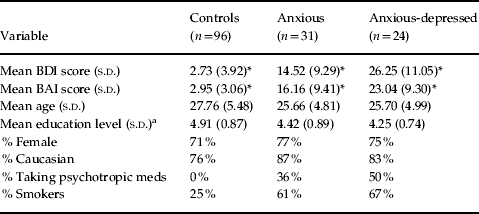
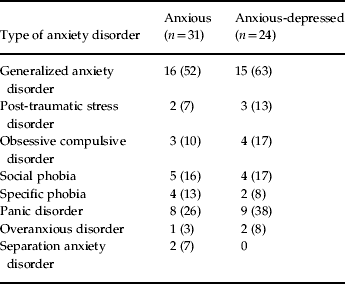
As can be seen in Table 1, the subject groups were demographically similar to one another and only differed on education level [F(2, 148)=7.79, p<0.01]. Results of follow-up tests revealed that Controls had significantly more education than did the two clinical groups (p's<0.05), with 73% of Controls having completed at least some schooling beyond high school compared with 35% and 38% of Anx and Anx-Dep groups, respectively. Likewise, there were group differences in occupation levels [F(2, 148)=4.36, p<0.05]. Follow-up tests revealed that the Anx-Dep group differed only from the Controls such that Anx-Dep were more likely to be unemployed (75%) and less likely to have higher paying skill-oriented occupations (e.g. technician, small business owner). The two anxiety groups did not differ in terms of types of anxiety diagnoses (Cramer's V=0.17, p>0.05; see Table 2) or in terms of mean number of additional co-morbid anxiety disorders [F(1, 54)=1.31, p>0.05].
Group demographic and clinical characteristics

BDI, Beck Depression Inventory; BAI, Beck Anxiety Inventory.
a Education was based on a 1–7 scale with 4 representing graduation from high school or General Educational Development and five representing some college education.
* p<0.001 for all groups.
Rates of anxiety disorders (%) in anxious and anxious-depressed groups

Controls were less likely to smoke than the Anx group (χ2=13.78, p<0.01) and the Anx-Dep group (χ2=15.00, p<0.01), which did not differ from one another (p>0.05). No group differences existed in the amount of reported alcohol or marijuana use (p's>0.05). As expected, groups differed in psychotropic medication usage (Cramer's V=0.57, p<0.01), with no Controls taking psychotropic medications compared with the Anx (35%) and Anx-Dep (50%) groups; however, the clinical groups did not differ from one another. To check that our startle results did not reflect medication effects, we repeated all analyses in the unmedicated subsample and all significant results were unchanged, despite the greatly reduced sample size.
Experimental paradigm
Procedures have been detailed elsewhere (Forbes et al. Reference Forbes, Miller, Cohn, Fox and Kovacs2005) and are thus described briefly. Consistent with standard startle procedures, participants viewed a quasi-randomized series of 12 pleasant (e.g. ice cream cone), 12 neutral (e.g. rolling pin) and 12 unpleasant (e.g. mutilated face) digitized pictures – based on standardized normative ratings – from the International Affective Picture System (IAPS; Lang et al. Reference Lang, Bradley and Cuthbert1999).Footnote 1 Footnote † Pictures were presented on a 21-inch computer screen placed 5 feet from the participant. Each picture was passively viewed for 6 s, during which time a startle probe (50 ms burst of 100 dB with instantaneous rise time) was delivered binaurally through EAR-3A earphones (Aearo Company, USA). Startle probes were presented 3, 4 or 5 s post-picture onset, which is the startle probe time most closely associated with EMS (Bradley et al. Reference Bradley, Cuthbert and Lang1990; Bradley & Lang, Reference Bradley and Lang2000). Inter-trial intervals (ITIs) of 9.5, 11.5 or 13.5 s occurred randomly between pictures to prevent participants from habituating to stimulus timing. Four probes were presented during ITIs (two after pleasant pictures and two after unpleasant pictures). Additionally, two habituation probes were presented before the first picture. Following the startle procedure, participants viewed the pictures a second time and rated each in terms of affective valence (on a scale of 1 to 9, where 1=extremely unpleasant and 9=extremely pleasant) and arousal (on a scale of 1 to 9, where 1=extremely unarousing and 9=extremely arousing) using the self-assessment manikin, a validated, pictorial rating system (Bradley & Lang, Reference Bradley and Lang1994).
Physiological recording and data quantification
EMS procedures were consistent with recommended guidelines for startle methodology (Fridlund & Cacioppo, Reference Fridlund and Cacioppo1986). Startle blink magnitude was measured with two 6 mm electrodes placed 1 cm apart beneath the right eye and impedances were measured as <20 kΩ before and after the startle procedure. Electromyographic (EMG) signals were collected and quantified using equipment and software from James Long Company (USA). Bioamplifier settings were for band pass filtering with half power cut-off frequencies of 1 and 1000 Hz (12 dB/octave roll-off) and gain was set for 5000. Data were digitized continuously at 512 Hz. EMG data were processed offline using established methodology (Schmidt et al. Reference Schmidt, Fox and Long1998; Jankel et al. Reference Jankel, Keener-Miller, Cohn and Monaco1999). The spectral band of 80–240 Hz was focused on to maximize the EMG signal:noise ratio. Fourier analyses were used to quantify the power of each successive 32 ms epoch for this band. The software identified peak EMG magnitude occurring 180 ms post startle probe onset. In total, 3% of trials were rejected because of blinks occurring within 200 ms prior to startle probes. Within-participant startle magnitude T scores were created to standardize startle magnitudes for between-subjects comparisons. Mean T scores were computed for pleasant, neutral and unpleasant picture conditions.
Data analysis
Omnibus repeated measures analyses of variance (ANOVA) were conducted separately for picture ratings and startle magnitude with group as the between-subjects factor and picture valence (pleasant, neutral, unpleasant) as the within-subjects factor. A significant group×valence interaction was followed up with between-group tests in order to test our hypothesis that startle magnitudes for Anx individuals would be greater during unpleasant pictures compared with the responses of Anx-Dep individuals and Controls during unpleasant pictures. To test our second prediction that Anx-Dep individuals would deviate from the typical linear pattern of startle modulation, we tested for a group×linear trend and followed up significant results with within-group linear contrasts of affective conditions for each diagnostic group. Prior to testing, α levels were set at 0.05. Tests were two-tailed unless otherwise stated. Testing for homogeneity of variance was completed prior to all analyses. Variance was homogenous across groups except where noted. Unequal variance was controlled by using a Huyhn–Feldt correction (Huynh & Feldt, Reference Huynh and Feldt1976).
Results
Demographic and group characteristics
Age and ethnicity were unrelated to all dependent variables and were not considered further. Sex was related only to objective ratings of picture arousal (males rated pleasant pictures as more arousing than did women, p<0.05) and interacted with diagnostic group in analyses [F(1, 143)=5.02, p<0.01]. Therefore, sex was included as a covariate in repeated-measures analyses of objective ratings of picture arousal. As expected, Beck Anxiety Inventory and Beck Depression Inventory scores differed significantly between groups (p's <0.001), with Anx-Dep individuals reporting the highest levels of anxiety and depressive symptoms, followed by Anx individuals and then Controls.
Subjective picture ratings
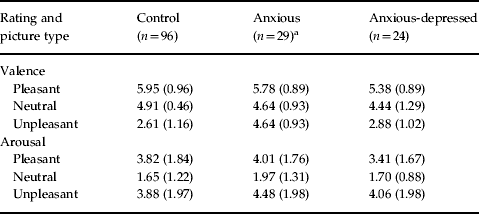
Table 3 presents groups’ affective ratings of picture stimuli. Huynh–Feldt-adjusted values were used to account for inequality of variance and Greenhouse–Geisser adjusted values were used to account for sphericity of arousal ratings. A group×valence interaction was found for valence ratings [F(2, 145)=3.40, p<0.05] but not for arousal ratings (p>0.65). A follow-up ANOVA indicated significant group differences in valence ratings for pleasant [F(2, 145)=3.42, p<0.05] and neutral [F(2, 145)=4.49, p<0.05] pictures, but not for unpleasant pictures (p>0.05). Pairwise comparisons indicated that Controls rated pleasant and neutral pictures as significantly more pleasant than did Anx-Dep individuals (p's<0.05).
Subjects' ratings of stimulus picture valence and arousal

Values are shown as mean (s.d.).
Ratings were on a 9-point Likert-type scale.
a Data were missing for two anxious participants due to time constraints.
Startle modulation
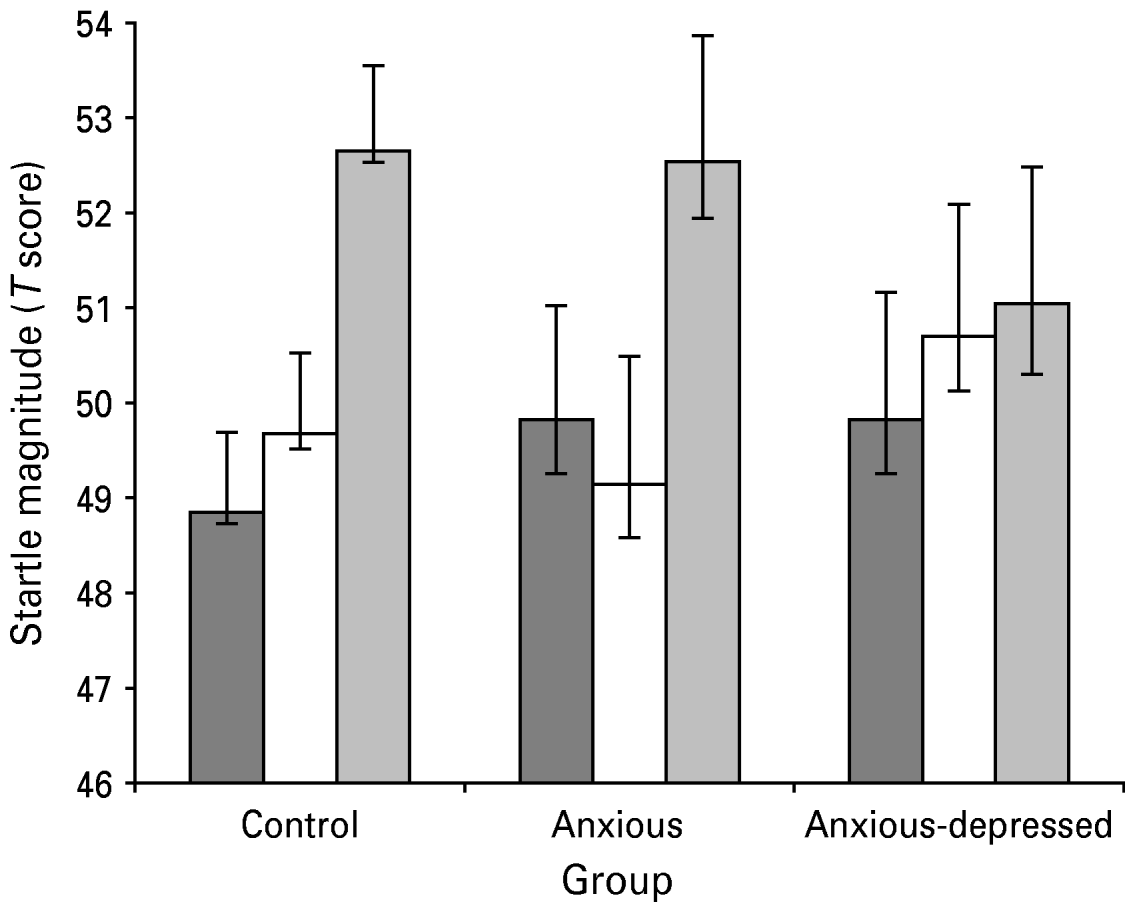
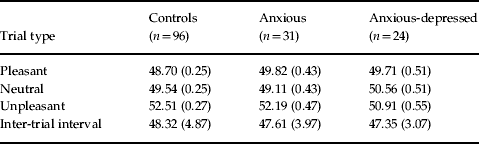
Initial analyses of startle data indicated that groups did not differ on mean raw startle magnitudes (p's>0.60) or on mean ITI startle magnitude T scores (p>0.50; Table 4). The omnibus repeated-measures ANOVA revealed a significant group×valence interaction (see Fig. 1) [F(4, 148)=3.22, p<0.05], indicating that group moderated the valence effect for startle. However, results from follow-up analyses were inconsistent with our first hypothesis (that the Anx group would have greater startle magnitude during the unpleasant picture condition compared with Controls and Anx-Dep individuals). Specifically, in the unpleasant picture condition there were no significant between-group differences in startle magnitude (all p's>0.05).Footnote 2
Emotion-modulated startle responses. Mean standardized startle magnitudes during pleasant ( ), neutral (□), and unpleasant (
 ) pictures for controls, anxious individuals, and anxious individuals with a concurrent depressive episode. Bars indicate confidence intervals.

Mean standardized startle magnitudes in T scores (s.d.) by diagnostic group

Consistent with our second hypothesis, however, the within-group linear trend effect was significant [F(2, 148)=3.52, p<0.05]. To better understand the form of this interaction, within-group contrasts were conducted. As expected, within Controls the linear EMS effect was significant [F(1, 95)=75.04, p<0.001], such that startle magnitudes increased from pleasant to unpleasant pictures. Likewise, within the Anx group the linear effect was significant [F(1, 32)=13.58, p<0.01], with Anx individuals displaying the same linear EMS pattern as Controls. In both the Anx and Control groups, startle responses during pleasant stimuli did not differ significantly from startle responses during neutral stimuli (p=1.00). Therefore, Anx individuals and Controls did not exhibit attenuated startle responses during exposure to pleasant stimuli. Importantly, unlike individuals in the Control and Anx groups, those individuals in the Anx-Dep group did not exhibit a linear EMS pattern (p>0.25). In fact, startle responses of Anx-Dep individuals did not differ across any of the picture viewing conditions (p's>0.77). In sum, Controls and Anx individuals displayed normative linear EMS, while Anx-Dep individuals displayed blunted EMS.
Discussion
Extant data suggest that depressive and anxiety disorders each may be associated with distinct patterns of emotional responding (Ladouceur et al. Reference Ladouceur, Dahl, Williamson, Birmaher, Ryan and Casey2005; Kaplan et al. Reference Kaplan, Erickson, Luckenbaugh, Weiland-Fiedler, Geraci, Sahakian, Charney, Drevets and Neumeister2006), with depressive disorders involving overall blunting of emotional reactivity (Allen et al. Reference Allen, Trinder and Brennan1999; Dichter et al. Reference Dichter, Tomarken, Shelton and Sutton2004; Kaviani et al. Reference Kaviani, Gray, Checkley, Wilson and Kumari2004; Dichter & Tomarken, Reference Dichter and Tomarken2008; Mneimne et al. Reference Mneimne, McDermut and Powers2008) and anxiety disorders often involving exaggerated emotional reactivity (Morgan et al. Reference Morgan, Grillon, Southwick and Charney1996; Kumari et al. Reference Kumari, Kaviani, Raven, Gray and Checkley2001; Larsen et al. Reference Larsen, Norton and Walker2002; Griffin, Reference Griffin2008). Importantly, it is unclear whether and how diagnostic co-morbidity may alter patterns of emotional reactivity. To address this question, we contrasted EMS responses in individuals with an anxiety disorder but no depression, individuals with concurrent anxiety and depressive disorders and healthy controls. We hypothesized that: (1) anxious individuals would exhibit greater startle magnitudes during unpleasant picture stimuli than would controls and anxious-depressed individuals; (2) anxious-depressed individuals would display blunted EMS compared with control and anxious groups. Contrary to our first hypothesis, startle responses occurring in the context of unpleasant picture viewing did not differ between anxious individuals and controls or anxious-depressed individuals. However, in line with our second hypothesis, the pattern of startle responding differentiated cases with co-morbid anxiety and depression from controls and anxious individuals without a depressive episode. Whereas controls and anxious individuals displayed the expected pattern of linear EMS, anxious-depressed individuals exhibited blunted EMS. Until now, there has been little investigation of how emotional functioning in anxiety may change as a result of developing co-morbid depressive episodes. Given that anxiety disorders more often precede depressive disorders (e.g. Merikangas et al. Reference Merikangas, Zhang, Avenevoli, Acharyya, Neuenschwander and Angst2003) than the converse, it is possible that the onset of a co-occurring depressive episode may reverse the previously exaggerated emotional responding of an anxious person. Longitudinal designs are needed to test this idea.
Our findings are strengthened by the use of a unique archival dataset that allowed us to compare groups with similarly extensive clinical histories. Moreover, anxious and anxious-depressed groups were equivalent in terms of the types of anxiety disorders that participants had, demographic features, recreational drug use and caffeine use. Although groups differed on psychotropic medication usage, results were replicated in an unmedicated subsample. These similarities between psychiatrically diagnosed groups allow us to conclude with greater confidence than was possible in prior analyses (Lang et al. Reference Lang, McTeague, Cuthbert and Rothbaum2005b; Melzig et al. Reference Melzig, Weike, Zimmermann and Hamm2007; McTeague et al. Reference McTeague, Lang, Laplante, Cutherbert, Strauss and Bradley2009) that concurrent depressive co-morbidity among anxious-depressed individuals is responsible for blunted EMS. Thus, emotional reactivity in the context of contemporaneous anxiety and depressive disorders may more closely resemble the pattern typical in depression (see Bylsma et al. Reference Bylsma, Morris and Rottenberg2008) than the exaggerated responses often associated with anxiety (Grillon et al. Reference Grillon, Ameli, Goddard, Woods and Davis1994; Morgan et al. Reference Morgan, Grillon, Southwick and Charney1996; Kumari et al. Reference Kumari, Kaviani, Raven, Gray and Checkley2001; Larsen et al. Reference Larsen, Norton and Walker2002; Elsesser et al. Reference Elsesser, Sartory and Tackenberg2004; Buhlmann et al. Reference Buhlmann, Wilhelm, Deckersbach, Rauch, Pitman and Orr2007; Melzig et al. Reference Melzig, Weike, Zimmermann and Hamm2007; Griffin, Reference Griffin2008).
One puzzling aspect of our findings involves the lack of exaggerated startle responding during unpleasant pictures in anxious individuals relative to healthy controls. Additionally, ITI analyses revealed no baseline differences in startle responding across groups. Lack of exaggerated baseline startle responses is not unprecedented in anxious samples (Elsesser et al. Reference Elsesser, Sartory and Tackenberg2004, Lang et al. Reference Lang, McTeague, Cuthbert and Rothbaum2005b; Griffin, Reference Griffin2008) and may reflect the fact that our data derived from a study of people who had experienced childhood-onset depression. Indeed, the vast majority (87%) of anxious individuals had histories of earlier depressive disorders. Given that co-occurring depression blunts emotional reactivity in anxious individuals, it may well be that past depression may also constrain startle reactivity in anxious persons (Lewinsohn et al. Reference Lewinsohn, Steinmetz, Larson and Franklin1981; Shahar et al. Reference Shahar, Scotti, Rudd and Joiner2008). To test this idea, it would be useful in future EMS designs to include anxious individuals who are both positive and negative for a prior history of depression.
Limitations
The current findings should be interpreted in light of our study's limitations. First, sample cells differed slightly in size. However, variance of startle data within each sample cell was equivalent and samples sizes of clinical groups were comparable with sample sizes in previous EMS studies with findings of blunted EMS (e.g. Allen et al. Reference Allen, Trinder and Brennan1999). Furthermore, the body of consistent findings from EMS studies (Lang et al. Reference Lang, McTeague, Cuthbert and Rothbaum2005b; Melzig et al. Reference Melzig, Weike, Zimmermann and Hamm2007; McTeague et al. Reference McTeague, Lang, Laplante, Cutherbert, Strauss and Bradley2009), as well as in other areas of emotional functioning (Bradley et al. Reference Bradley, Mogg, Millar and White1995; Ladouceur et al. Reference Ladouceur, Dahl, Williamson, Birmaher, Ryan and Casey2005), lend support to our findings of blunted emotional reactivity in anxious-depressed individuals. Second, anxiety disorders were similarly heterogeneous across the two clinical groups. However, due to the small numbers of each anxiety disorder, it was not possible to examine whether particular anxiety disorders display different types of startle modulation.
We used an archival dataset from a project designed to understand childhood-onset mood disorders; therefore, results may not generalize to individuals who develop psychopathology after age 18. Furthermore, because juvenile-onset depression often signals increased risk of bipolar illness, the original study sample included individuals who went on to develop bipolar depression. Although we found no polarity effects, caution is warranted because our study was under-powered to detect such effects. Finally, our archival sample did not yield sufficient numbers of individuals who were currently in a depressive disorder without a co-morbid anxiety disorder; such a group would have been useful for purposes of comparison.
Summary
In the current study, anxious individuals with concurrent depression, unlike anxious individuals without a concurrent depressive episode, failed to show the normative pattern of EMS. This lack of emotion-modulation in anxious-depressed individuals occurred even in the presence of higher levels of anxiety. Our focal comparison of anxious and anxious-depressed individuals extends prior findings that were largely post hoc in nature. Our findings also suggest that depression history should be considered when interpreting functional differences between ‘anxious arousal’ and ‘anxious apprehension’ anxiety disorders.
Finally, given the centrality of emotion as a domain of functioning, demonstration that co-morbidity influences this domain has implications for future treatment research. Specifically, the results suggest that the presence of depression in combination with an anxiety disorder results in a deficit in defensive responding during threatening stimuli, despite higher levels of anxiety. Therefore, specific therapies targeted at reducing defensive responding in anxious individuals (e.g. exposure-based therapy; Barlow et al. Reference Barlow, Craske, Cerny and Klosko1989) may not be optimal for individuals with co-morbid anxiety and depression. This possibility warrants consideration in future research.
Acknowledgments
These archival data were collected as part of NIMH Program Project P01 MH56193 awarded to Maria Kovacs as the overall PI, with Nathan Fox PI and Jeffrey Cohn Co-PI of the Psychophysiology study of the Program Project. This research was also supported by MH77669 to Jonathan Rottenberg. The NIMH had no further role in study design, in the collection, analysis and interpretation of data, in the writing of the report and in the decision to submit the paper for publication.
Declaration of Interest
None.