Since the US Department of Homeland Security deemed disaster preparedness a national imperative, numerous government, nonprofit, and relief organizations have endeavored to educate and prepare the American public for disasters. After the 9/11 terrorist attacks and a number of large, devastating hurricanes and tornados, organizations responsible for disaster planning routinely began publishing detailed instructions describing how to mitigate, prepare for disasters, obtain safe shelter, cope with adverse events, and initiate the recovery process. Specifically, the US Centers for Disease Control and Prevention developed a comprehensive approach to responding to crisis through communication methods intended to reduce risk and ensure public safety guided by the crisis and emergency risk communication (CERC) model.1
However, in spite of the growing number of well-considered messages and programs delivered by traditional mass media as well as newer social media outlets (ie, social networks, smartphones, instant messaging), government officials and researchers consistently report that, in general, people remain complacent and poorly prepared for disasters.Reference Light2–4 First responders, program evaluators, and media reports also confirm that people are inadequately prepared, and they question why so few seek and use available services pre- and post-events. The answer to these questions may be related to a critical component that is currently poorly studied by researchers and consistently overlooked by professionals communicating with the public: disaster literacy. We define disaster literacy as an individual's capacity to read, understand, and use information to make informed decisions and follow instructions in the context of mitigating, preparing, responding, and recovering from a disaster. We review the literature on vulnerable adult populations and literacy, propose a disaster literacy model, and offer suggestions for incorporating disaster literacy strategies into planning and response communications.
Vulnerable Adult Populations
Although considerable scientific effort has focused on examining the consequences of disasters, comparatively little attention has been devoted to developing and evaluating methods for enhancing disaster preparedness and recovery efforts of vulnerable, community-dwelling adults. Vulnerable adults are at increased risk for adverse outcomes during and after disasters due to a constellation of factors that include sensory, mobility, and cognitive impairment; physical decline; and medical illness.Reference Rothman and Brown5 In addition to physical conditions, social isolation, limited financial resources, low education, and low literacy negatively affect vulnerable adults’ ability to remain safe during and after disasters.Reference Altevogt, Pope, Hill and Shine6–9
Inadequate disaster preparation further compromises the ability of vulnerable adults to independently obtain food, water, electricity, or access standard medical care post-disaster, which can result in previously managed chronic health conditions cascading into significant medical problems that require hospitalization or result in death.Reference Rothman and Brown5, Reference Brown, Rothman and Norris10–12 Older adults are particularly vulnerable, with the media and national and international governments reporting that a disproportionate number of older adults die during disasters.Reference Burton and Breen13–Reference Wells16 For example, although they represented only 15% of the population, 71% of those who died during Hurricane Katrina were 60 years and older, and 47% were 75 years and older.12 It is clear from these finding that new and innovative approaches need to be developed and evaluated to better reach vulnerable subgroups of our population.
Literacy
The US Department of Health and Human Services reports that demographics play a significant role in literacy.Reference Rudd, Anderson, Oppenheimer and Nath17 Groups demographically identified as having a higher rate of low literacy include people with fewer years of education, lower cognitive ability, compromised health status, advanced age, or low financial status. Also at risk of low literacy are non-native English speakers, certain racial or ethnic groups from the US South or Northeast, females, or those who have been incarcerated. The Federal Interagency Forum on Aging reports that basic health literacy skills are lower for older Americans than for younger age groups, with 39% of people aged 65 years or older having below average health literacy skills.18 Consistent with other national reports, the most recent US national assessment of adult literacy survey disclosed that 46% of adults who rated their health as poor and 49% who lacked a high school diploma or the equivalent functioned with less than basic health literacy skills. Adults aged 65 years and older had lower health literacy scores than all other age groups surveyed, with only 3% of those surveyed scoring within the proficient range.Reference Kutner, Jin and Paulsen19
Health Literacy and Development of a Disaster Literacy Model
In marked contrast with health literacy and its well-recognized importance in determining health risks and outcomes, disaster literacy has yet to be recognized for its role in influencing health and safety. Throughout the years, the general literacy concept has evolved to include financial, tax, insurance, network, digital, information, media, ecological, and other disciplines.Reference Baker, Parker and Williams20–Reference Shapiro and Hughes30 Addressing the different types of literacy in the general population has gained increased attention in the context of health education and public health. However, research is significantly lagging in guiding the development and evaluation of disaster preparedness and recovery educational materials (eg, brochures, pamphlets, decision aids, and videos). Moreover, while the literature examining the effectiveness of emergency risk communications has largely kept pace with research conducted on health risk communication during the past 2 decades, the same cannot be said about the evolution of the field of disaster literacy relative to health literacy.
The 9/11 terrorists attacks and Hurricane Katrina spurred the study of emergency risk communications, that is, how information is communicated to the masses about the threat as well as steps for immediate protection of people and property. At that time, local, state, and national agencies allocated resources to develop, evaluate, and refine risk communications, prompting the proliferation of research in this area.31–Reference Savoia, Lin and Viswanath33 Yet, ensuring the safety of vulnerable populations also requires research into disaster literacy. The likelihood of large-scale disasters in the future makes addressing and improving disaster literacy for the general population and, in particular, those who are most vulnerable, a pressing public health concern. Fortunately, lessons from health literacy can be used to inform the development and advancement of the field of disaster literacy.
Since 1974, when health literacy was first conceptualized, increasing the health literacy skills of Americans has become an established goal of the Healthy People 2020 initiative.34, Reference Simonds35 Research conducted in medical settings consistently demonstrates that race or ethnicity, education, and lower socioeconomic status adversely affect the ability of adults to read, understand, and act on traditional written materials (eg, consent forms, insurance information, health care instructions).Reference Berkman, Sheridan, Donahue, Halpern and Crotty36, Reference Von Wagner, Steptoe, Wolf and Wordle37 Health literacy research demonstrates that people who lack necessary skills to obtain, understand, and appropriately use basic health care information are unable to effectively manage their care. Those with low health literacy experience worse health outcomes,Reference Saha38, 39 increased hospitalization rates,Reference Baker, Gazmararian and Williams40 and higher health care costsReference Koh, Berwick and Clancy41 than their health-literate counterparts.Reference Abel42, Reference Sentell and Halpin43 In addition, older adults with low health literacy have increased mortality.44 It is possible that people with low disaster literacy also experience similar negative consequences when trying to manage their preparedness and recovery activities.
Although identifying, communicating, and remediating risk is a critical part of the health literacy initiative, it is only a small component of what has been done to advance the field. To address these issues in the field of health literacy, several factors are evaluated: (1) the abilities of individuals in the situation to understand and use health care information to make well-informed health care choices (eg, discharge plan, treatment plan, health recommendations); (2) the setting in which the demands are made (eg, hospital and clinic); and (3) the messages or content and materials being used to exchange health information. As with health literacy, these 3 elements also need to be clearly identified and addressed when responding to disaster literacy needs of diverse populations.
Difficulties associated with disaster preparation and access to services can arise from an institutional top-down design and implementation of programs in which the needs, wants, abilities, and resources of the target audience are not fully considered.Reference Veil, Littlefield and Rowan3, Reference Altevogt, Pope, Hill and Shine6, Reference Brown, Haley and Bryant45, Reference Kayman and Ablorh-Odjidja46 It is notable that most disaster programs and communication materials are not pilot tested before dissemination. Timelines, budgets, and program priorities typically do not include resources to formally evaluate whether the information was understood and whether the desired outcomes (ie, increased preparedness or ability to access services) can be achieved by the target audience.Reference Kayman and Ablorh-Odjidja46, Reference Brodie, Weltzien, Altman, Blendon and Benson47 Our recent review of a national and state guide, Just in Case, from the Administration on Aging,48 and Disaster Preparedness Guide for Elders from the Florida Department of Elder Affairs,49 revealed that the publications were comprehensive and accurate but required a high school to college reading level to understand the dense and sometimes complex text.
The mismatch between the literacy demands of existing print materials and the literacy skills of many adults limits their ability to understand and effectively use potentially life-saving preparedness information. Moreover, evidence-based practices for effectively disseminating messages (eg, print, oral, and video) to vulnerable populations in diverse settings are currently lacking.Reference Brown, Haley and Bryant45 Little is known about optimal methods for reaching those who are most in need of information or services post-disaster. At present, only a few studies have examined existing disaster preparedness or recovery materials for readability levels, understandability of content, acceptability of format, and the ability of community-dwelling, vulnerable adults to act on the information presented.Reference Tanner, Friedman, Barr and Koskan50–Reference Friedman, Tanwar, Yoho and Richter54
Disaster Literacy Model
Our definition of disaster literacy is adapted from 2 widely accepted definitions of health literacy. The US Department of Health and Human Services and the Joint Committee on National Health Education Standards define health literacy as the “degree to which individuals have the capacity to obtain, process, and understand basic health information and services needed to make appropriate health decisions”34 and “the capacity of individuals to obtain, interpret, and understand basic health information and services and the competence to use such information and services in ways which enhance health.”55
Because the study of disaster literacy is clearly in its early stages of development, we draw on approaches used in health literacy research to inform the development of a disaster literacy model. Using Nutbeam’s conceptualization of health literacy,Reference Nutbeam56 we propose a disaster literacy model in which knowledge and skills are positioned along a continuum. On the disaster literacy continuum, skills progress from basic (ie, basic reading and comprehension) to functional (ie, ability to follow disaster preparedness, response, and recovery messages) to communicative or interactive disaster literacy (ie, advanced skills involved in help seeking and managing disaster-related experiences), and then ultimately to critical disaster literacy (ie, capacity to analyze disaster-related information, be empowered to address barriers, and take personal control to remain safe, cope with, and recover from disasters).
These 4 levels of disaster literacy can theoretically be placed on a continuum that ranges from ineffective to marginal and effective disaster literacy skills. We also offer integrated concepts, originally proposed by Paasche-Orlow and Wolf,Reference Paasche-Orlow and Wolf57 that defined literacy in the context of patient internal predisposing and situational factors (eg, education, social support, vision, motivation, and knowledge) and situational external factors (eg, support technologies, mass media, education, and resources) that have an impact on disaster literacy and associated outcomes. Our proposed model for disaster literacy is illustrated in the Figure.
Disaster Literacy Model.

The usefulness and uniqueness of our proposed disaster literacy model complements existing models such as CERC, in that it addresses the individual’s ability to access, understand, and respond to such communications. The focus is on progressively moving from basic disaster literacy to greater autonomy and engagement in critical disaster preparedness and recovery activities. Targeted disaster education and training optimize preparedness and should facilitate movement from one level on the continuum to the next, taking into account at each step the specific knowledge required to prepare for, survive, and recover from a disaster. However, while doing so, predisposing and situational factors need to be recognized as influential and potentially confounding in determining outcomes.
The proposed disaster literacy model is similar to the stages of change modelReference Prochaska and DiClemente58 in that both target behavioral change, with distinct steps on a continuum. However, the stages of change model is more applicable to people who are generally aware of the harm their behavior causes but still find it difficult to change (eg, smoking and overeating). The disaster literacy model includes 4 levels of literacy by which people are increasingly enabled to exert greater control and personal responsibility along with increased awareness of factors that shape their efforts, including the context in which they are functioning. As with the Paasche-Orlow and Wolf Reference Paasche-Orlow and Wolf57 conceptualization, the disaster literacy model focuses on a person’s understanding of the different spheres of disaster mitigation, preparation, response, and recovery, each of which operates according to different rules, guidelines, and customs. These spheres include, but are not limited to, (1) the state and local emergency operations systems responsible for delivering warnings and mobilizing recovery efforts; (2) the varied commercial and nonprofit service providers that people rely on before and after a disaster, such as transportation, emergency shelter, medical and mental health, water and electric utilities; and (3) the resources and factors that influence a person’s own inclination and ability to deal with a disaster, such as support services, the media, and other sources of information.
Each of these realms is interrelated yet operates within separate contexts, requiring different approaches and skill sets. For instance, it is important for vulnerable people to contact local emergency officials to let them know of their location before a disaster. It is still necessary, however, for people to work with commercial or nonprofit providers to obtain the help and services they may need in a disaster. Most importantly, to develop an appropriate disaster plan, people must possess a basic understanding of their own needs, resources, and vulnerabilities.
Applying the Disaster Literacy Model
Drawing from health literacy efforts, well-designed educational materials have been found to have a positive effect on the readers’ knowledge acquisition, behaviors, and use of resources.44, Reference Baker, Gazmararian, Sudano and Patterson59 Those who undertake the task of developing educational content for disaster preparedness or response must consider multiple factors, including media type and design elements. Considering these factors and making appropriate choices given the needs of the intended audience can determine whether materials are accessible, understandable, and usable.Reference Chou, Hunt, Beckjord, Moser and Hesse60
Selecting Media Type
When creating educational materials, developers are faced with options for media type, including print (eg, brochures, pamphlets, and posters) or multimedia (eg, film, audio recordings, and websites). Advantages of print materials include being less expensive than other media types (ie, film, audio recordings, and websites) that require more resources and technological proficiency (eg, videocassette recorders, digital video discs, and computers).61 In addition, if a loss of power occurs during a disaster, it is still possible to access printed information. Advantages of multimedia include wide distribution (the potential number of people who could access the information). In addition, delivery is not as dependent on the literacy of the intended audience as with print options.
Printed materials and other media types such as public service announcements, web-based content, and social media have immense potential for improving the disaster literacy of vulnerable adults. However, it is critical to select the media type that is most appropriate for relaying the message to the target audience.Reference Brown, Haley and Bryant45, 61 To optimize the use of diverse media types for specific audiences, it is critical to evaluate the media access and appropriateness of using the selected media type. Comparative effectiveness research is needed to determine the appropriate format of materials in the context of accessibility, ease of use, and usefulness.
Advantages of Including Pictographs in Educational Materials
When developing educational materials, pictographs or simple drawings of figures demonstrating explicit, detailed actions are an effective way to communicate health care instructions to adults with low-literacy skills.Reference Austin, Matlock, Dunn, Kesler and Brown62–Reference Mayer70 These findings are consistent with the cognitive theory of multimedia learning, which posits that people understand instructions better when they receive words and corresponding visual aids together rather than text alone.Reference Mayer70
Research shows that pictographs have a distinct advantage over other types of visual formats (ie, illustrations and photographs) that show people of a specific age, gender, culture, and race or ethnicity; the neutral presentation of a pictograph enables people of varied backgrounds to believe that the material applies to them.Reference Houts, Witmer, Tringali, Tringali, Bucher and Localio67, Reference Choi71, Reference Zeng-Treitler, Kim and Hunter72 Not only are pictographs equally appropriate for different ethnicities, languages, ages, and genders, they are reported to be an effective way to lessen cognitive demand (ie, the load on working memory), reduce attention to irrelevant details in illustrations and photographs, enhance active participation in learning, deepen understanding of the information, result in better performance and adherence to the instructions, and improve recall of information.61, Reference Michielutte, Dignan and Schroeder63–Reference Houts, Doak and Loscalzo66, Reference Mayer70, Reference Zeng-Treitler, Kim and Hunter72, Reference Lujan and Acevedo73 Integrating pictographs with disaster preparedness and response information has potential for improving the disaster literacy of at-risk adults, as they can be used to represent functions and services provided within each of the contexts represented in the disaster literacy model.
Criteria for Developing Disaster Education Materials
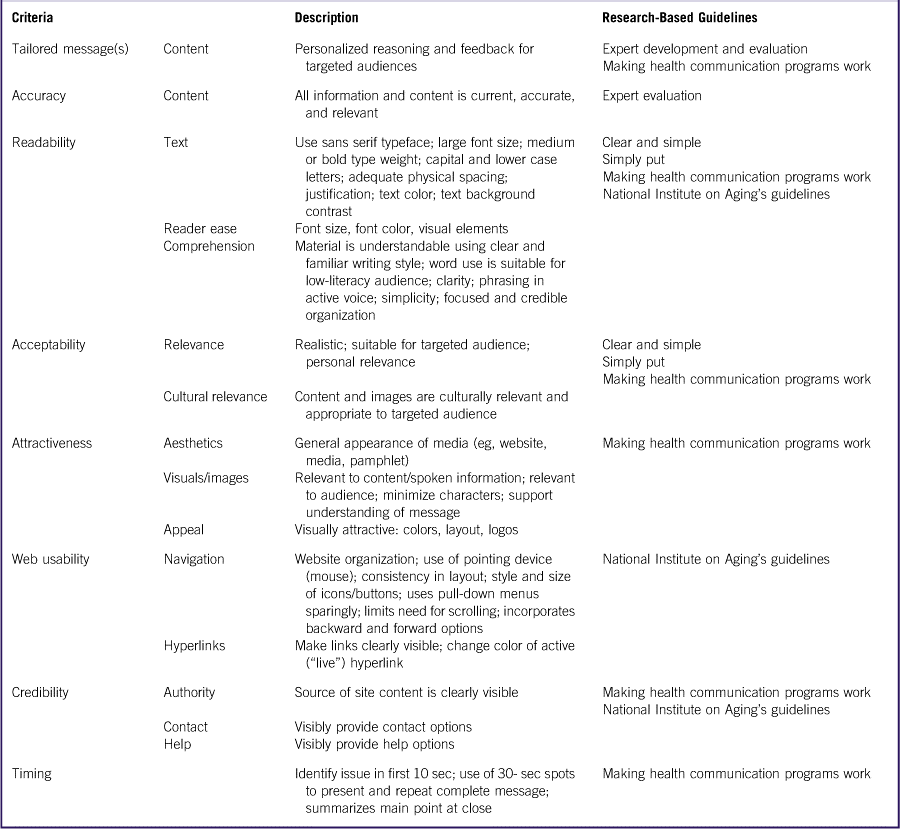
Once a media type is selected, content design and evaluation by the targeted audience is necessary. Objective criteria have been developed to guide content design and evaluation to determine if materials are appropriate for the targeted audience.74–Reference Brown, Lindenberger and Bryant76 For example, the National Institute on Aging has developed website guidelines to meet the specific needs of older adults.74 Criteria for current best practices in developing and evaluating multiple types of media (ie, newspaper, radio, flyers, and television) are presented in the Table.
Criteria for Evaluating Communication Materials
As noted, a critical step that is often overlooked or not undertaken due to financial or time constraints is pilot testing the message and media type (ie, newspaper, radio, flyers, and television) before their widespread dissemination. Typically, pilot testing involves showing a mock-up of the intended message to a small group of the target audience to solicit its feedback. Usually, target audience members respond to a series of questions to determine if the message was understood, what the message meant, what was confusing, and the perceived facilitators and barriers to acting on the message.Reference Brown, Lindenberger and Bryant76 Criteria shown in the Table can also guide pilot testing aimed at getting feedback about elements of the design and presentation of the disaster preparedness or recovery information being evaluated. It is critical that feedback is provided by a representative sample of the intended audience. This feedback allows for refinements to both message and media type to meet the specific needs of subpopulations.
Best practice dictates that the media type (eg, print, film, audio recordings, and websites), message, and point of contact for materials, such as disaster literacy communication, should be informed by empirical evidence. Previous research suggests that appropriate media type and message type can change according to the nature of the content (eg, preparedness, acute, and recovery) and context (eg, future, immediate, severity, and locality).Reference Frank, Pindyck and Donahue77–Reference Weiss79 Research and evaluation that pilot tests the message (ie, content), media type, and context are critical to meet and enhance the disaster literacy needs of vulnerable adults.
Implications for Practice
A recent Institute of Medicine document defined the term health-literate organization as an organization that supports patients as they navigate, understand, and use information and services to take care of their health.Reference Brach, Keller and Hernandez80 We too recommend that government agencies, relief organizations, and other entities responsible for public health and safety at all phases of a disaster approach people with the assumption that they are at risk of not understanding information relevant to engaging in recommended activities. We propose that disaster-literate organizations should support and facilitate access to information and services as well as collect data that measure peoples’ knowledge, skills, and attitudes that can be used to guide refinements to improve quality of and access to programs.
Moreover, disaster literacy self-assessment tools need to be developed, validated, and used to assess changes over time and to learn if initiatives succeeded in making people more informed and engaged. Our proposed disaster literacy model provides a comprehensive and practical framework for organizations to use in developing, disseminating, and evaluating communication materials to help people make informed proactive decisions, understand the consequences of their actions, and increase engagement with existing disaster programs and systems.
The disaster literacy model and research-based criteria for developing and evaluating communication materials can be applied in tandem with comparative effectiveness research evaluations to determine the impact of disaster preparedness and response communication efforts to advance the science of best practices for disaster preparedness (see the Figure).
The following examples detail what could be included in educational materials to build successive levels of disaster literacy according to our proposed model. Vulnerable adults at level 1 of the continuum, basic literacy, are able to read and comprehend instructions but have a limited capacity to follow those instructions. Ideally, written information should be at a sixth-grade reading level or lower. The goal of educational materials for this population is to persuade and enable them to follow disaster preparation, response, and recovery messages.
In addition to pictographs and simplified text, another technique for enhancing understanding and response is linking new information with a familiar reference, with the familiar reference presented first.Reference Doak, Doak, Friedell and Mead81 For example, “Contact your home health agency for information about the state special needs registry” versus “For information about the state special needs registry, contact your home health agency.”
Functional literacy, level 2, involves the ability to both comprehend and follow recommendations and instructions, although individuals at this level generally lack the ability to act independently to seek additional information or manage their disaster-related experiences. This ability to move beyond simply following instructions is important in a disaster because events are often unpredictable and may require an individualized response.
According to Nutbeam, enabling individuals to move to the next level of communicative/interactive literacy, level 3, involves improving their motivation and self-confidence to be proactive.Reference Nutbeam82 This objective can be accomplished through clear, direct references to familiar sources of additional information or assistance. In addition, the tone of a message can make a difference, with older adults in particular. Research indicates that older adults are more likely to respond to a positive message about the benefits of proactively preparing for an event compared to a negative message concerning the harm they might suffer through inaction.Reference Löckenhoff and Carstensen83
Critical literacy, level 4, involves the further step of taking personal control of one’s circumstances and addressing broader social and environmental barriers to safety. For disaster literacy, reaching this ultimate level involves understanding the social and environmental aspects that are at risk and the resources required to remain safe and to recover. Key to this is conveying the knowledge to vulnerable adults about how state and local emergency operations systems work.
These agencies provide critical information concerning who is at risk and what to do before, during, and after a disaster. Although it is important for vulnerable adults to appropriately use offered services, it is equally important for them to understand their personal responsibility during each phase of a disaster. In most instances, agencies do not provide services beyond basic and temporary shelter and should not be considered the answer to all their disaster needs.
Efforts to develop literacy levels 3 and 4 are important for disaster literacy in light of the responsibility that people bear to act on disaster-related messages to promote self-care. Vulnerable people have learned this through experience with disasters such as Hurricane Katrina. Materials aimed at developing these higher levels of disaster literacy could include brief narratives or testimonials of how people have organized in disadvantaged neighborhoods to help the more vulnerable among them prepare for and recover from such an event.Reference Weiss79 This approach builds both individual and community resilience.
At every level building disaster literacy in vulnerable populations requires the use of clear, direct, and consistent messages. Considering the limited literacy of some vulnerable adults, these messages should be conveyed using short paragraphs, ample white space, and other techniques to reduce cognitive demands, as recommended in the Table. It is imperative that efforts to meet individuals’ disaster literacy needs are evaluated using comparative effectiveness research to (1) determine effects of remedial efforts using best practices (ie, criteria for developing and evaluating communication materials) and (2) advance the science of disaster preparedness and recovery.
Summary
Recent high profile disasters in the United States have revealed serious gaps in the ability of existing systems to provide an adequate response in preparing, responding, and facilitating recovery of vulnerable adults. In general, many existing endeavors and programs are not reaching the people they were intended to serve. In spite of a growing number of well thought-out government and nonprofit disaster preparedness programs, the literature cited here underscores the ineffectiveness of the current disaster communications paradigm for vulnerable populations. Although the number of websites, media campaigns, and publications describing steps to ensure personal safety has grown considerably within the past decade, there has been no commensurate improvement in morbidity and mortality rates for vulnerable populations post-disaster.Reference Aldrich and Benson84 Existing public health efforts are not effectively tailored to vulnerable adults, particularly considering the varied contexts of the tasks they must accomplish to mitigate, prepare for, survive, and recover from a disaster. This gap is unfortunate as the popular media, government reports, and research studies consistently report that morbidity and mortality, loss of possessions, prolonged recovery periods, and enduring psychological sequelae are negative outcomes closely associated with inadequate disaster preparedness.Reference Rothman and Brown5, Reference O'Brien11–Reference Duggan, Deeny, Spelman and Vitale14, Reference Elmore and Brown85–Reference Baker87
Problems with current guidelines include content that is not adequately tailored and effectively disseminated to at-risk audiences. Improving outcomes relies on the person’s engagement in activities at each disaster phase: mitigation, preparedness, response, and recovery. It is vital that effective materials are developed that educate and enable vulnerable subgroups to take part in mitigation and preparedness activities before an event occurs and engage in endeavors that enhance likelihood of survival and speed recovery post-event. Our disaster literacy model can be used with other risk and communication models such as CERC1 to guide the development of educational materials that meet the needs of vulnerable subgroups and help them progress to higher disaster literacy levels.