Introduction
In his treatise On Architecture (second half of the first century BCE), Vitruvius emphasized the need for a mathematical education of the architect, particularly in the fields of arithmetic, geometry, and astronomy (Vitruvius [Reference Granger1931] 1970, I.1.4). The fact that Vitruvius devoted an entire book to the subject of astronomy and time-keeping illustrates the significant role this scientific discipline must have played in architectural education and by extension in the art of architecture. Although it is not clear what influence Vitruvius' writings had on architectural practice, On Architecture provides evidence for a thorough architectural education and the existence of architectural principles during the imperial age (Brown Reference Brown1963; Koch Reference Koch1951; Kruft Reference Kruft, Taylor, Callander and Wood1994; Plommer Reference Plommer1973). This tradition seems to have been preserved until late antique Byzantium. Glanville Downey was the first to demonstrate persuasively that the early Byzantine architect, who was known as mechanikos, met the terms of the Vitruvian ideal (Downey Reference Downey1946–48, Reference Downey1948; Meek Reference Meek1952; Schibille Reference Schibille2009). It seems then that the early Byzantine architect that is the mechanikos, underwent a comprehensive liberal arts education and it can furthermore be assumed that he was acquainted with the mathematical sciences according to the standards of his time (Schibille Reference Schibille2009).
There can be no doubt that a building of the scale and complexity of Hagia Sophia in Constantinople relied on substantial conceptual planning and design. Architectural drawings are known from as early as the twenty-sixth century BCE (Kleinbauer Reference Kleinbauer, Chiat and Reyerson1988) and the architectural structure of Hagia Sophia itself testifies to underlying geometric and arithmetic principles (Hoffmann and Theocharis Reference Hoffmann and Theocharis2002; Pantelic Reference Pantelic1999; Svenshon and Stichel Reference Svenshon and Stichel2006). Geometry and arithmetic seem to have played a considerable part in the architectural planning stage in antiquity and have frequently served as explanatory models specifically for the design of Hagia Sophia (Cutler Reference Cutler1966; Downey Reference Downey1946–48; Hoffmann and Theocharis Reference Hoffmann and Theocharis2002; Kostof Reference Kostof and Kostof1977; Meek Reference Meek1952; Pantelic Reference Pantelic1999; Petronotis Reference Petronotis1983; Svenshon and Stichel Reference Svenshon and Stichel2006). This shows that elaborate conceptual work must have preceded the actual building process of the Great Church. Given that construction of the Justianic edifice commenced only a month after its predecessor had burnt down suggests furthermore that planning had been well under way by that time.
Although the implications of geometry and arithmetic for the architectural design of Hagia Sophia have been recognized and readily accepted in the past, the relevance of the remaining mathematical disciplines has been widely ignored. It is the aim of this paper to demonstrate that the astronomical and optical sciences were equally implemented in the layout and design of the church of Hagia Sophia in Constantinople. This study rests on the premise that the mechanikoi of Hagia Sophia, Anthemios of Tralles and Isidoros of Miletus, were thoroughly educated and familiar with the ancient writings on the various mathematical disciplines (Schibille Reference Schibille2009). It thus evaluates the late antique scientific standards in astronomy and optics and it addresses the question of their relevance for the architectural profession. More specifically, it looks at the astronomical tools that were available to the architects and the prevailing ideas of the physical nature of light and vision in early Byzantium and to what extent these concepts are reflected in the design of the sixth-century church of Hagia Sophia. I argue that light and visual effects played a decisive role in the choice of the building's orientation and interior decoration so as to augment the symbolic significance of the ecclesiastical space. Hagia Sophia is chosen as a case study for the simple reason that it provides a unique set of circumstances with substantial biographical evidence about the two architects in addition to a well preserved ecclesiastical building. The original sixth-century structure of Hagia Sophia can be reconstructed with some certainty and can thus serve as material evidence to show how astronomical and optical principles were applied in its design. Nonetheless, the church of Hagia Sophia is taken to be representative of a more general early Byzantine attitude towards the art of architecture, for the building is a product of its time and cultural context and thus reflects sixth-century expectations and knowledge. My ultimate objective is to show that early Byzantine architecture was “scientific building” (Pont Reference Pont2005), meaning that it was founded on mathematical parameters and that concepts of light and vision were intrinsic to the underlying principles of its architectural design. This identification of an architectural rationale implies that the architects of early Byzantine (imperial) commissions might have indeed followed predetermined programmatic designs, which in turn has consequences for the conceptual history of late antique architecture.
Initially, I will show that mathematical astronomy was appreciated and thus pursued in late antique Byzantium because of its practical utility as well as its epistemic value. By means of Ptolemaic formulae I will try to reproduce how computations of late antique spherical astronomy could have been used to determine the orientation of Hagia Sophia. The intention was to make the most efficient use of natural daylight and to generate the best possible overall illumination of the sacred interior (Schibille Reference Schibille and Draper2005). The conscious use of light in a late antique architectural context needs to be evaluated within the framework of late antique concepts of optics and catoptrics because light had not yet been recognized as the object of vision, but only as a secondary element that facilitated vision. In order to argue that light was indeed deliberately implemented as a constitutive and aesthetic component in the design of the church of Hagia Sophia, it has to be established that the sixth-century architects had the interest and the means to do so. A large number of architectural and decorative features of the building suggest that optical phenomena were indeed taken into account. The intentional implementation of astronomical and optical parameters in the architectural design of Hagia Sophia illustrates clearly that the Greco-Roman scientific tradition was sustained at least as late as sixth-century Byzantium.Footnote 1 These findings therefore have wider implications for the history of science and the late antique world in more general terms.
Astronomy in Late Antiquity and Hagia Sophia
In contrast to the Latin west, astronomical studies flourished particularly in Athens and Alexandria in the fifth and sixth centuries, and close relations seem to have been cultivated with Constantinople, where the tradition of astronomy was transferred to at the beginning of the seventh century (Pedersen Reference Pedersen and Lindberg1978; Pingree Reference Pingree1973). Part of the reason that astronomical knowledge survived in Byzantium after the collapse of the Roman Empire was its practical relevance for navigation, geography, time-reckoning, and calendaric purposes (Neugebauer Reference Neugebauer1945). However, mathematical astronomy (as distinct from cosmology, mythology, and astrology) was appreciated also for its epistemic value. Inherited from classical antiquity was the Platonic idea that astronomy, when studied in its mathematical abstractness, had the potential to reveal absolute truth that can be “apprehended only by reason and thought.” Plato explicitly remarked that mere observation of the heavens is useless, if not deceptive, and that only astronomy pursued by means of mathematical problems “as in the study of geometry” had any moral and epistemic value (Plato [Reference Fowler1930] 1963, 529A-530C). An epistemic capacity of astronomical studies is similarly exemplified in the preface to Ptolemy's Almagest (138–161 CE), one of the most influential antique treatises on mathematical astronomy. Following the Aristotelian division of theoretical philosophy into physics, mathematics, and theology, Ptolemy exclaimed that “only mathematics [including theoretical astronomy] provide sure and unshakeable knowledge . . . For that alone is devoted to the investigation of the eternally unchanging” (Ptolemy Reference Toomer1984, I.1). Mathematics itself can be “eternal and unchanging (which is the proper attribute of knowledge)” and “help theology along its way” (ibid., I.1). According to Ptolemy, mathematics has the capacity not only to furnish knowledge about nature, but also to reveal divine (true) qualities and beauty, found in the constancy, order, and symmetry of things. Ptolemy's notion of mathematical theories is thus evocative of the traditional Platonic favoritism of theory over practice.
This partiality that favored theory over practice undergoes changes in the late antique period. An example can be found in Proclus' fifth-century commentary on Euclid's Elements. At first, Proclus defended the intellectual value of the mathematical sciences against those in favor of empirical sciences. His argument was that mathematics should not be measured against human utility, but against its capacity to lead the mind away from sensible things to the essence of being, beauty and truth itself, that is intelligible only by the mind (Proclus [Reference Taylor1788] 2006, 113–116). “We should admire its [mathematics'] immateriality, and the good which it contains, considered by itself alone” (ibid., 119). This principle was also applicable to astronomy, for Proclus clearly disagreed with those who thought that nautical astronomy was more useful than general astronomy removed from any direct practical application (ibid., 117). Later in the same text, however, he declared that geometry is endowed with great intellectual merits, “but when it touches upon matter, it produces itself a multitude of sciences; such as geodaesia, mechanics, and perspective: by which it procures the greatest benefit to the life of mortals” (ibid., 119). The practical utility for the common good was increasingly emphasized in late antique writings and seems to have been an essential criterion for the continued pursuit of a discipline or profession throughout late antiquity and into the Byzantine middle ages.
For Vitruvius, the merits of mathematical astronomy lay in its capacity to teach us “the east, the west, the south and the north; also the order of the heavens, the equinox, the solstice, the course of the planets” (Vitruvius [Reference Granger1931] 1970, I.1.10). The knowledge gained from studying astronomy and related phenomena were to be employed in the design of an edifice to ensure a suitable degree of illumination and temperature regulation of architectural spaces in relation to their functions (ibid., I.2.7; VI.4; VI.6.6). The essential element to be considered before venturing into a building campaign was therefore the geographical location, which in turn determined the climate, that is to say the course and intensity of the sun (ibid., VI.1.1). The appropriate orientation of a temple, according to Vitruvius, was toward the western regions of the sky, meaning in practical terms that the entrance was from the west so that the worshiper would face the eastern heaven when sacrificing (ibid., IV.V.1). Two texts from the late fourth or early fifth century CE agreed with Vitruvius in that they prescribed an eastern orientation for Christian churches. The first, the Constitutiones Apostolorum, a collection of ecclesiastical laws that is believed to date from around 375 CE, recommended that the church should be turned to the east and that the pastophoria should be placed in the east. The second document, the Testamentum Domini, originally composed in Greek in the fourth or fifth century, specified that the presbytery and the altar should be placed in the eastern end of the nave and that all places ought to be lit “both for type and for reading” (Kleinbauer Reference Kleinbauer, Chiat and Reyerson1988, 72; Mango [Reference Mango1972] 1986, 24–25).
At first sight, the Vitruvian and early Christian recommendation that cult buildings should ideally be oriented towards the east seems to make detailed astronomical calculations obsolete. To acknowledge this ideal, however, does not imply the redundancy of astronomy for architectural designs. Vitruvius repeatedly emphasized the need for appropriate illumination, i.e. illumination that fitted the function and use of the space, and the Testamentum Domini also mentioned lighting suitable for reading and writing. More importantly still, the longitudinal axis of Hagia Sophia deviates from a straight east-west direction and is tilted by approximately 33.5° south of east (equals 123.5° clockwise from north).Footnote 2 Following this line of thought, I will now explore the possible influence of late antique spherical astronomy on the orientation of the church of Hagia Sophia and I will argue that the edifice was deliberately oriented towards the sunrise on the shortest day as determined by means of ancient, possibly Ptolemaic, calculations. The function of the sacred interior of the church of Hagia Sophia was one of symbolic significance and its purpose was to elevate the faithful to those higher things Plato had defined as perceptible only by the mind and not the senses (Burnyeat Reference Burnyeat2005; Plato [Reference Fowler1930] 1963, 529A; Russell Reference Russell1989). Natural light was the very medium that accommodated this epistemological or, more appropriately, religious elevation and the intention therefore was to guarantee the greatest possible exploitation of natural daylight throughout the day and the seasons (Schibille Reference Schibille and Draper2005). The question to be addressed is what astronomical tools the architects had at their disposal in late antiquity and how exactly they could calculate the sunrise on a specific day in the sixth century.
The astronomical tradition throughout late antiquity and the middle ages was distinctly Ptolemaic. Ptolemy's Almagest (Mαθηματικὴ Σύνταξις) and Handy Tables were of decisive significance for subsequent mathematical astronomy. Composed during the reign of the Roman emperor Antoninus and published after 150 CE, the Almagest had become the standard textbook on astronomy by the time Pappos and Theon of Alexandria wrote their commentaries during the fourth century (Ptolemy Reference Toomer1984, 1–3). The vast number of commentaries on almost all of Ptolemy's treatises exemplifies the significance and endurance of Ptolemy's work well into the Byzantine middle ages as well as into the Islamic period (Pingree Reference Pingree1973).Footnote 3 The use of Ptolemy's Handy Tables for finding the positions of the planets at a given date is well attested for the sixth- and seventh-century Byzantine east.Footnote 4 An unbroken line of the astronomical tradition can be traced into the sixth century, from Proclos and his pupil Ammonius to Olympiodoros, Simplicius, Damascius, Philoponus, and Eutocius, the most noteworthy scholars of the early Byzantine period (Drecker Reference Drecker1928; Jones Reference Jones and Walker1996; Thion Reference Thion1981; Vogel Reference Vogel and Hussey1967).Footnote 5 Eutocius of Ascalon (early sixth century) provides a direct link to the architects of Hagia Sophia, Anthemios and Isidoros. While Isidoros was probably Eutocius' teacher and the editor of some of his works, Eutocius dedicated his commentary on the Conics of Apollonius, to his “dear friend” Anthemios (Cameron Reference Cameron1990; Neugebauer Reference Neugebauer1975, 1038, 1042).Footnote 6 Based on this tradition of astronomical studies and commentaries, it seems safe to assume that Anthemios and Isidoros were acquainted with the basic concepts of Ptolemy's spherical astronomy and possibly other contemporary astronomical deliberations, including Menelaos' theorems, for which Ptolemy provided a mathematical proof (Ptolemy Reference Toomer1984, 1.10).
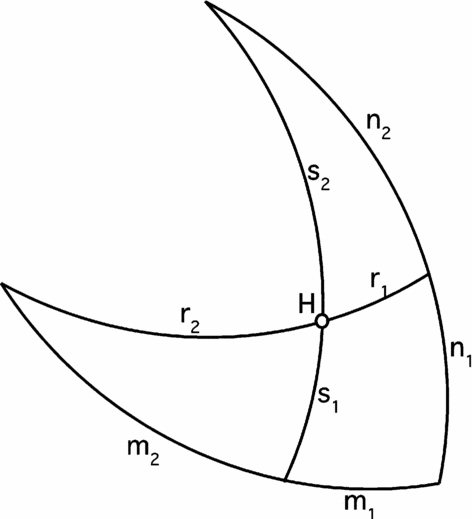
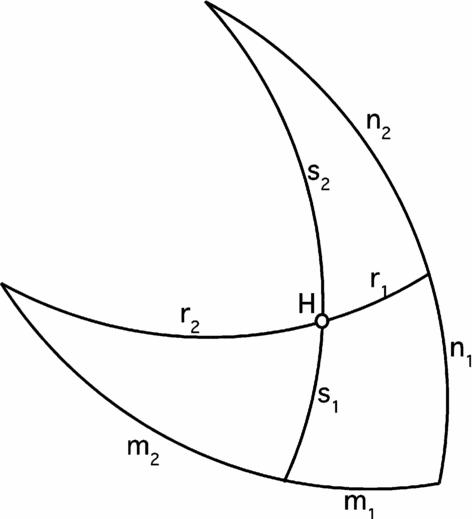
Ptolemy had developed a practical model of the solar motion as seen by observers at different times of the year and at different geographical locations (Neugebauer Reference Neugebauer1975, 34–39; Pedersen Reference Pedersen1974, 101–104; Ptolemy Reference Toomer1984, I.12, II.2). After having introduced the trigonometric propositions and the Table of Chords, Ptolemy proceeded to discuss ways to calculate the rising times of the sun, first at sphaera recta (i.e. at the terrestrial equator) then at sphaera obliqua (i.e. any other terrestrial latitude). The ortive amplitude of the sun – the angular distance of the point of sunrise from east along the horizon – can be calculated using Menelaos' Theorem I, provided the geographical latitude (and thus the length of the natural day) and the obliquity of the ecliptic (ε) are known (fig. 1).Footnote 7
Menelaos' Configuration, where m = m1 + m2; n = n1 + n2; r = r1 + r2; s = s1 + s2.
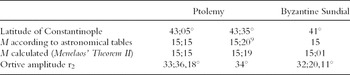
Ptolemy illustrated the method of calculating the amplitude of the sun at the winter solstice on the basis of Rhodes (latitude φ = 36°) (Ptolemy Reference Toomer1984, II.2). For the purpose of this paper, the position of the sun during sunrise on the winter solstice in Constantinople can simply be calculated using the respective values for the length of daylight according to the geographical latitude of Constantinople (the modern value is 41;01°). One is, however, faced with the problem that in late antiquity the latitude of Constantinople was a matter of dispute (see table 1). Different versions of the Handy Tables give 43;35° and 43;05° and Ptolemy's Geographia quotes again 43;05°.Footnote 8 According to Berggren and Jones, these erroneous values continued to be used in Byzantium until the eleventh century, when Arabic advances in astronomy and geography helped to amend some ancient data (Berggren and Jones Reference Berggren and Jones2000, 29 n. 37). Then again, a Byzantine portable sundial (Science Museum, London), dating presumably to the late fifth or the first half of the sixth century CE, offers an alternative. The sundial lists sixteen towns or provinces together with their latitudes. Constantinople is placed at the top of the list with a latitude of 41°, the same value that is given on the probably contemporary Aphrodisias dial (De Solla Price Reference De Solla Price1969; Field and Wright Reference Field and Wright1985).
M = longest day in equinoctial hours; r2 = amplitude of the sun during sunrise at the winter solstice in Constantinople by Menelaos' Theorem I and Ptolemy's procedure, Almagest II, 2.

Ptolemy associated the parallel through Constantinople (43.05°) with a maximum length of daylight of 15¼ hours (M = 15;15) and a minimum length of 8¾ hours (Stückelberger and Grasshoff Reference Stückelberger and Grasshoff2006, 3.11.5, 8.11.7; Neugebauer Reference Neugebauer1975, 980 n. 11, 983 n. 33). The ratio between longest and shortest day for the latitude of 41° would have been approximately 15 hours to 9 hours (table 1).Footnote 10 The lengths of daylight on the longest day to a given latitude can also be calculated using Menelaos' Theorem II (see fig. 1) (Ptolemy, II.3):

First, the difference between the shortest (or longest) day and the equinoctial day (2m2) has to be calculated, where m corresponds to a 90° arc of the equator, n represents a 90° arc of the meridian, n2 is the geographical latitude and s1 is the declination of the sun. At winter solstice the declination of the sun is s1 = ε. Ptolemy assumed the value of ε = 23;51,20° (modern value is 23;40,50°) (Ptolemy Reference Toomer1984, I.12). Hence we can find for n2 = 43;05° (sexagesimal system):

The difference between the longest (or shortest) day and the equinoctial day at the geographical latitude of 43;05° is thus 3¾ hours, which amounts to a length of 15¾ equinoctial hours for the longest day of the year. These values match those given in Ptolemy's astronomical tables (table 1). Assuming a geographical latitude for Constantinople of 43;05° and the longest day thus being 15¾ equinoctial hours, the rising amplitude (ortive amplitude) of the sun at the winter solstice in Constantinople can be calculated by means of Menelaos' Theorem I (fig. 1):
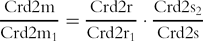
Let H be the position of the sun on the ecliptic rising just above the horizon, n represents a 90° arc of the meridian, r is a 90° arc of the eastern half of the horizon and m likewise a 90° arc of the eastern half of the equator; m1 corresponds to the time between sunrise and noon, hence half the length of the natural day and m2 is half the difference between the longest or shortest day and the equinoctial day. s1 is the declination of the sun and r2 is the amplitude to be determined (Neugebauer Reference Neugebauer1975, 37; Pedersen Reference Pedersen1974, 101–102; Ptolemy Reference Toomer1984, I.10 and II.2). For M = 15¾ we can thus calculate:

According to Menelaos' and/or Ptolemy's procedure and a geographical latitude of 43;05°, the sun rises about 33;36° (or 33.6° in the decimal system) south of east on the winter solstice in Constantinople.Footnote 12 This value is virtually identical with the orientation of the church of Hagia Sophia at 33;30° (or 33.5° in the decimal system). At the same time, this value differs from the real ortive amplitude of the sun on the winter solstice in 532 CE, the year construction on the Justianic edifice began, by approximately 2°. Calculated by means of modern computer programs and taking into account the variations that occur over time (i.e. nutation and planetary precession), the sun would have actually risen at an azimuth of 121.55° from north or 31.55° south of east (Schibille Reference Schibille and Draper2005). This deviation is significant enough to exclude observation of the actual sunrise on the winter solstice as an explanation for the building's orientation. Rather, the close match of Hagia Sophia's orientation with the ortive amplitude of the sun at winter solstice calculated using ancient formulae and tools seems to support the hypothesis that the sixth-century architects employed astronomical calculations for the layout of the church. If this interpretation is accepted, it would have fundamental implications for our knowledge about the expertise of the late antique architects and their working methods. The use of the inaccurate value of 43° for the latitude of Constantinople would furthermore indicate that the Ptolemaic latitudes were still employed in the first half of the sixth century despite the fact that some sundials provide evidence that the more exact 41° had been adopted by the late fifth or early sixth century. This is consistent with the existence of Ptolemy's writings in the sixth and seventh centuries in Byzantium.
The alternative explanation for the orientation of Hagia Sophia is that Anthemios and Isidoros simply followed the orientation of the previous building on the site and that the orientation of 33;30° derives from either the original fourth-century edifice or its early fifth-century replacement.Footnote 13 This interpretation would reconcile the seemingly contradictory data provided by late antique sundials. As Field and Wright observed the somewhat earlier extant sundials comply with the Ptolemaic latitudes and only the Byzantine dials from the fifth/sixth centuries show the value of 41° (De Solla Price Reference De Solla Price1969; Field and Wright Reference Field and Wright1985). Hence, during the construction of the fourth and fifth century church buildings only the value of 43° for the latitude of Constantinople seems to have been in circulation. This second interpretation accommodates therefore the various pieces of evidence.
The bottom line of these findings is that it seems very likely that the church of Hagia Sophia was deliberately oriented towards the sunrise on the winter solstice and that the point of sunrise was determined by means of astronomical calculations probably in the fourth century, possibly (again) in the sixth century. The tools for these calculations were readily available from Ptolemy's and possibly other writings and most certainly accessible to a learned architect in late antiquity. Even if the second reading of the data is accepted as more likely, I nonetheless maintain that Anthemios and Isidoros made a conscious decision in the sixth century to follow the orientation of the previous edifice that had proven advantageous. After all, the foundations of the old building were not reused as far as we can tell and the topography did not pose any limitations either (Schibille Reference Schibille and Draper2005). It has been suggested in the past that the orientation of the church of Hagia Sophia simply fitted within the overall grid of this part of the city, particularly the palace and the hippodrome. However, the central axis and the wings of the hippodrome, for instance, are not even in alignment with each other but deviate by about 2.5° (Mamboury Reference Mamboury1936, 272; Mango Reference Mango1959, 37, 52). I would thus contend that the close correspondence between the calculated value for the ortive amplitude of the sun at the winter solstice using Menalaos' theorem (33.6°) and the actual orientation of Hagia Sophia's longitudinal axis (33.5°) makes the use of astronomical computations highly likely.
It has previously been shown that as a result of this particular orientation, the sun stands in the elongation of the church axis between 7.45 am (winter solstice) and 10.30 am (summer solstice) on each day of the year, reaching its highest altitude at 63.5° (Schibille Reference Schibille and Draper2005). Hence, the best possible illumination of the sanctuary during the morning hours is ascertained throughout the year. It is moreover the orientation in combination with the dome structure and the fenestration of the sixth-century building that generated an efficacious illumination of the sacred interior. Particularly decisive for the lighting and spatial impression are the four semicircular exedras topped by small fenestrated semi-domes that open the central space diagonally. As a result, the windows of the eastern semi-domes (exedras, apse) consecutively admit direct sunlight during the morning hours. During the afternoon, the building is illuminated from the south through the extensively fenestrated south tympanum and the exterior walls of the south gallery and aisle. Depending on the season, the individual spaces are lit by light coming in at different levels, meaning while in the summer months the light from the south tympanum reaches the floor level of the naos, in winter the south tympanum windows supply the north gallery with direct sunlight due to the lower altitude of the sun. The architectural structure, aided by the unfolding of reflective surfaces that were adorned with mosaic and marble revetment created an abundance of light that was emphasized also in the sixth-century ekphraseis of Procopius and Paulus Silentarius (Procopius [Reference Dewing1940] 1996, I.1.29–30; Silentiarios Reference Silentiarios and Veh1977, 612–615).
Optics in Late Antiquity and Hagia Sophia
The question whether light and visual effects were consciously employed by mechanikoi such as Anthemios and Isidoros in an architectural design needs to be considered in the context of the ancient concept of light and vision. There are fundamental differences between our modern understanding of optics and the ancient concept of it. Ancient optics were not concerned with the physics of light. Light, in fact, was not given the central role it has now; the determinant was rather considered to be the visual ray that was believed to emanate from the center of the eye.Footnote 14 Since ancient optical treatises usually dealt with the geometry of the visual ray instead of the light ray, the analogy between the two is essential for the reconstruction of the ancient understanding of light.
The Optics of Damianos of Larissa (possibly sixth century CE) explained this analogy by proclaiming that vision is nothing else than a form of light, a statement that renders his treatise an important and exemplary text.Footnote 15 Damianos unambiguously associated the properties of the visual ray with those of the sun (Schöne Reference Schöne1897, 4–5).Footnote 16 Both rays travel linearly at great velocity over a great distance, they both can pass through the same substances, such as water, glass, or other transparent materials and both types of rays are reflected from surfaces under the same angle. If either of the two rays are reflected by or pass through a colored substance, everything will appear tinted with this particular color. The laws of reflection and refraction apply to the visual ray as well as to light rays (Schöne Reference Schöne1897, 14–23). This shows that by the time Damianos composed his work, it had been established that light, in parallel to the characteristics of the visual ray, was subject to geometric and physical principles that could be illustrated theoretically and manipulated practically. Another point of interest is that Damianos' notion of the nature of light evidently derived from previous studies on optics and catoptrics.Footnote 17 His writings thus provide insight into the ancient optical traditions by alluding to and borrowing from numerous ancient sources, including the pseudo-Euclidean Catoptrics, Ptolemy's Optics, Heron's Catoptrics and most certainly Theon's recession of Euclid's Optics. In so doing, Damianos' eclectic account confirms the availability of these ancient treatises in the sixth century (Knorr Reference Knorr1985, 89–96).
Euclid's Optics and the pseudo-Euclidean Catoptrics were two of the most influential works on the subject and had a lasting effect on the development of the theories of light and geometrical optics. Euclid's Optics contains the earliest known articulation of the two fundamental assumptions that sight is effected by means of rays and that these radiate in a rectilinear fashion from the eye (Jones Reference Jones1994; Knorr Reference Knorr1985; Ronchi Reference Ronchi1970, 15–24). One of the manuscripts of the Optics (Vatican Codex Ms. Vat. Gr. 204), dating from the tenth century, is preceded by an anonymous preface that summarizes part of a lecture on the postulates of the visual ray theory. Attributed to Theon of Alexandria, this lecture maintains that Euclid based his conclusions about the behavior of light on actual observations of shadows and beams of light (Jones Reference Jones1994, 49–51; Knorr Reference Knorr1985, 28–43; Mansfeld Reference Mansfeld1998, 57–59; Ronchi Reference Ronchi1970, 19–20). Whether or not Euclid's postulates had indeed some experimental foundation, this statement suggests that the parallels between the visual ray emitted from the eye and the light ray propagating from a light source was recognized by the fourth century CE (if the attribution to Theon is accepted).
Some important principles concerning the practical application of light were developed by Heron. His Catoptrics is devoted to the orderly arrangement of mirrors to produce visual effects. These visual effects, Heron claimed, served entertainment purposes, but above all could be used to satisfy some essential needs (opportunitates necessaries) (Heron 1900, 318–321; Mansfeld Reference Mansfeld1998, 52–53). Heron furthermore recognized that the shortest possible path of reflection is always the one that subtends equal angles with respect to the surface of reflection, no matter whether it is a plane or curved surface from which the ray is reflected (Heron 1900, 324–330; Smith Reference Smith1994, 123).Footnote 18 Part of the explanation for the shortest path theory is the infinite velocity of the visual ray. Since the visual rays travel at high speed, evidenced by the instantaneous effectiveness of vision, they move along the shortest possible paths without diversion or break (Heron 1900, 320–323). Ultimately, Heron's theory of the physical process of visual radiation is not so different from the Euclidean ray concept in that the visual rays travel in straight lines along minimal paths and that they are reflected at equal angles to the reflective surface (Smith Reference Smith1994, 123–125). Heron's Catoptrics nonetheless exemplifies an interest in using light and visual effects by exploiting the physical nature of the ray – be it visual or light ray.
While the Euclidean Optics and Heron's Catoptrics can be considered mostly mathematical, Ptolemy's Optics is an analysis of a multi-stage process of perception in time and space, allowing for physiological and psychological factors as well (Knorr Reference Knorr1985; Mansfeld Reference Mansfeld1998, 58–60; Smith Reference Smith1994, Reference Smith1998). Ptolemy's writings are particularly informative as regards the role of light and color for the process of vision. In book two of his Optics, the need for either intrinsic or external illumination for an object to become visible is recognized. Light was nonetheless conceived of as a secondary necessity, even though it produced a clearer sight (Smith Reference Smith1996, II.4–5, 18–19). For Ptolemy, the primary object of sight was color, while all other qualities were perceived secondarily through the mediation of illuminated colored surfaces. More specifically, Ptolemy stated that “the visual faculty apprehends shapes and dimensions by means of the boundaries of coloured objects” (ibid., II.6–7). It is the boundary of a color that we perceive and from which we then deduce the shape and dimensions of an object. It follows that objects are seen more clearly when set against a contrasting color, for if two adjacent objects are too similar in color they are not easily distinguishable (ibid., II.21; 1999, 40–42). Colors and contrasts could furthermore be employed for artistic purposes to achieve visual illusions. In accordance with Ptolemy's theory that those objects that are brighter seem closer, painters traditionally applied “weak and tenuous colours to render things that they want to represent as distant” (ibid., II.124; 1999). Even the apparent shape of an object could be influenced by the color applied to the surface (ibid., II.127). In this way Ptolemy synthesized ancient concepts of the use of coloring techniques to achieve pictorial depths and perspective that had been used by painters since the fifth or fourth century BCE (Bruno Reference Bruno1977). Ptolemy's principles of clarity of vision are furthermore reminiscent of Plato's concept of beauty, according to whom pure, unadulterated colors and clear, contrast-rich outlines constituted beauty (Bruno Reference Bruno1977, 32–35; Plato [Reference Fowler1925] 2006, 51A-53B).
The ancient mathematical corpus, including these fundamental understandings of vision and light, had been transmitted into the early Byzantine period through the commentaries of late antique scholars like Pappos, Theon, and Eutocius. That the architects of Hagia Sophia were familiar with the ancient mathematical literature is attested by Isidoros' editorial work and his position as a teacher of mathematics (notably to Eutocius) and Anthemios' own writings on burning mirrors (Cameron Reference Cameron1990; Huxley Reference Huxley1959; Knorr Reference Knorr1994). Anthemios seems to have enjoyed a considerable reputation as a mathematician during his lifetime and his writings were known amongst late medieval mathematicians of both the Arab and the western worlds (Cameron Reference Cameron1990, 104–105; Huxley Reference Huxley1959, 1–3; MacDonald Reference MacDonald and Kostof1977, 53).Footnote 19 Fragments of his studies on burning mirrors have been preserved in a treatise called περì παραδóξων μηχανηάτων (Huxley Reference Huxley1959). Here, Anthemios devised methods for arranging mirrors to reflect light to a specific point. He stated that “it is required to cause a ray of the sun to fall in a given position, without moving away at any hour or season” (ibid., 6, 44).Footnote 20 The ultimate purpose was to accomplish combustion using sunlight reflected from several mirrors (ibid., 12–15, 47).Footnote 21 From these fragments two conclusions can be drawn. Firstly, some of Anthemios' observations suggest an empirical grounding and the use of models. Secondly, Anthemios was interested in optical and astronomical phenomena and the properties of light, particularly the ability to direct and reflect light to a given point independent of the position of the light source. This is where Anthemios might have shared common ground with Isidoros, who was allegedly responsible for the invention of a special compass for the drawing of parabolas; it is the concave parabolic curve that has the property of reflecting all incoming rays to a specific point on the axis.Footnote 22 It is thus evident that both architects had substantial knowledge of geometrical constructions related to optics and their interest seems to have been the practical application of this expertise (Bellosta Reference Bellosta2002). This practical approach to mechanical problems seems to comply with the development of architecture as an increasingly practical profession (Schibille Reference Schibille2009). Precisely for this reason I propose that Anthemios and Isidoros employed these mathematical principles and methods in the architectural design of the church of Hagia Sophia in Constantinople.
Several architectural and decorative features of the Great Church bear witness to exactly such optical considerations. The orientation of the edifice in conjunction with the extensive fenestration and a daringly shallow dome structure generated an exceptionally luminous interior. The original dome structure was significantly shallower than the present dome, possibly following the curvature equal to the quadrant of a circle (Schibille Reference Schibille and Draper2005 and references cited therein). Light reflected from the windowsills and soffits would have created a less shadowy and much brighter dome shell and would have thus most certainly contributed to a more luminous impression. The peculiarly shallow profile eventually proved to be structurally unsafe, indicating that optical decisions may have played a decisive role over structural safety in the choice of its design. An adequate level of luminance was required at any one time for symbolic as well as aesthetic purposes. The available natural light was furthermore assisted through an elaborate system of artificial lighting as well as highly reflective surfaces.
That the architects displayed an interest in the exploitation of visual effects is further attested by the contrast-rich interior and the choice of colors in the mosaic decoration. An inference can be drawn from the interior decoration, because the architect was in charge of the entire building program, including the supervision of the craftsmen responsible for the mosaics (Schibille Reference Schibille2009). Consistent with the Ptolemaic concept of clear vision and color as the object and determinant of sight, the sixth-century mosaics are distinguished by a preference for unmixed colors and the careful combination of colors. Attention was paid especially to color contrasts in order to set apart individual motifs from either the background or one another. Characteristic, for instance, is that the ornamental borders in the aisles and in some of the original window decorations are regularly separated from the gold ground by a silver trim (Mango and Hawkins Reference Mango and Hawkins1965, 127, 132–136; idem 1972, 8, 21; Underwood and Hawkins Reference Underwood and Hawkins1961, 201). In the sixth-century mosaics of the inner narthex the geometric motifs are outlined in red, once again enhancing the separation of the designs from their background. Without this red demarcation, particularly the silver stars would hardly be discernable from below. The stylized floral designs in the aisles, on the other hand, appear as simple black or dark blue line drawings that depend on clear shapes and contrasts. All of these techniques facilitate visual distinction and clarity of perception, while pronouncing the two-dimensionality of the mosaic surface. The colors and materials of the tesserae clearly affect the mosaic's capacity to interact with light. The type of light, the direction and color temperature of the illumination in turn decisively influence the perception of the mosaics (Zányi et al. Reference Zányi, Schroer, Mudge and Chalmers2007). The careful planning and placing of colors is therefore indispensable for the creation of the desired effects.
The repertoire of the original sixth-century mosaics is limited in both motifs and colors, consisting of mainly geometric configurations. The surfaces appear as unified designs and not as two visually separate strata with a background and a foreground, but as one evenly spread luminous geometric carpet (Kitzinger Reference Kitzinger1965; Mango and Hawkins Reference Mango and Hawkins1972, 34). The endlessly repeating patterns thus heighten the sense of infinity within the building and its spatial impact as well as its luminosity. Light is unevenly reflected from the surfaces and generates a homogeneous effect of a vibrant and scintillating membrane that lines the entire interior of the building. Glass is generally more reflective than the other materials available at the time and was almost exclusively used for the sixth-century mosaics. Furthermore, metallic tesserae were often inclined at strategic places (Mango and Hawkins Reference Mango and Hawkins1965, 127, 132–136; Reference Mango1972, 8, 21; Underwood and Hawkins Reference Underwood and Hawkins1961, 201). For instance, in the west windows of the inner narthex, the gold tesserae in the northern window reveals are set in slight inclination from top to bottom, while the gold ground in the southern reveals is set in plane with the outline of the crosses (Whittemore Reference Whittemore1933, 11–13). This observation is significant insofar as the northern reveals catch direct sunlight during afternoon hours, which would thus be reflected from the inclined tesserae downward and would make the mosaic surface appear more brilliant.
In light of this material evidence, there cannot be any doubt that the sixth-century architectural structure and interior decoration of Hagia Sophia exhibits a preoccupation with optical phenomena, both with respect to vision and with respect to light and illumination. As such it not only provides insights into the mathematical expertise of the two architects, Anthemios and Isidoros, and by extension into their comprehensive education, but also into the practical application of this knowledge in the architectural design of a major church building in early Byzantium.
Conclusion
Architecture in sixth-century Byzantium was understood as scientific building, based on mathematical parameters that provided the underlying principles for the fundamental structural requirements (Mainstone Reference Mainstone1990). Astronomical and optical considerations played an equally important role for the aesthetic content of the architectural design. Hagia Sophia was built in a mere six years (early 532 – late 537 CE) and it can be assumed that it was not created ex nihilio but that detailed plans had previously been drawn up. Part of the preconceived design seems to have been symbolic references that were closely associated with the phenomenon of light and vision. As I have shown, there is ample evidence that some of the most important and complex astronomical and optical writings from classical antiquity were known and reproduced in commentaries throughout the late antique period in the Byzantine east and that the architects of Hagia Sophia were thoroughly conversant with these.
The application of these concepts manifests itself in the overall impression of Hagia Sophia's sixth-century interior that is shaped by an abundance of light and the unfolding of richly decorated and reflective surfaces. From an aesthetic point of view, Hagia Sophia's luminosity and visual appearance of lavish colorful and brilliant ornaments reflects early Byzantine theories of beauty and symbolizes absolute divine values. Late antique astronomical and optical concepts provided the theoretical tool to realize this vision of divine illumination. Hagia Sophia is certainly an exceptional case study, but I would contend that such a scientific approach to architectural construction and aesthetic was more widespread in early Byzantium than has been realized. The aesthetics and ideology of light that is embodied in the architecture of Hagia Sophia and made possible as a result of the scientific expertise of its architects is representative of a general early Byzantine perception of light and color. Further research into the concept of aesthetics in early Byzantium will help us to better understand the motives underlying Byzantine art and architecture.
Acknowledgments
This paper was written during a Getty Research Fellowship. My thanks also go to Liz James, Christian G. Specht, and Gabriel K. Wolfenstein for their helpful comments on the manuscript.
 . The mathematics underlying Menelaos' Theorems are the ratios in a plane triangle: