Introduction
The timing of sleep and circadian rhythms shifts progressively later during adolescence, conflicting with the early schedules imposed by high school, and resulting in circadian misalignment (Crowley, Wolfson, Tarokh, & Carskadon, Reference Crowley, Wolfson, Tarokh and Carskadon2018). Circadian misalignment – i.e. mismatch between the behavioral sleep-wake schedule and the timing of the circadian clock – results in insomnia, sleep loss, daytime sleepiness, and other daytime impairments. Specifically, misalignment may increase the risk for mood and substance use problems, perhaps via effects on reward function and impulse control.
Evidence linking circadian misalignment to mood disturbance and substance abuse is mostly observational and cross-sectional. Circadian alignment is typically operationalized as the phase angle, or interval, between a circadian marker (e.g. the dim light melatonin onset [DLMO]) and the timing of sleep (e.g. the midpoint of the sleep period). In adults, both short and long DLMO-sleep phase angles correlate with depression severity (Emens et al., Reference Emens, Yuhas, Rough, Kochar, Peters and Lewy2009; Hasler, Buysse, Kupfer, & Germain, Reference Hasler, Buysse, Kupfer and Germain2010b; Swanson et al., Reference Swanson, Burgess, Huntley, Bertram, Mooney, Zollars and Arnedt2017). In adolescents, shorter phase angles correlate with greater symptoms of substance use disorder (SUD) (Hasler, Bootzin, Cousins, Fridel, & Wenk, Reference Hasler, Bootzin, Cousins, Fridel and Wenk2008a) and greater weekend alcohol use (Hasler, Bruce, Scharf, Ngari, & Clark, Reference Hasler, Bruce, Scharf, Ngari and Clark2019). Individuals with later circadian phase (i.e. evening ‘chronotypes’), in particular, have shorter DLMO-sleep phase angles due to early sleep-wake schedules imposed by school or work. Insufficient sleep on school/work nights and large weekday-weekend differences in sleep-wake timing (i.e. social jet lag) often result (Mongrain, Lavoie, Selmaoui, Paquet, & Dumont, Reference Mongrain, Lavoie, Selmaoui, Paquet and Dumont2004; Paine & Gander, Reference Paine and Gander2016; Wittmann, Dinich, Merrow, & Roenneberg, Reference Wittmann, Dinich, Merrow and Roenneberg2006).
Associations between circadian misalignment and mood and substance use problems may occur via an altered function of neural circuitry underlying reward processing and impulse control (Hasler & Clark, Reference Hasler and Clark2013; Logan et al., Reference Logan, Hasler, Forbes, Franzen, Torregrossa, Huang and McClung2018). Evidence from animal models and human neuroimaging studies shows circadian modulation of reward circuitry (Byrne, Hughes, Rossell, Johnson, & Murray, Reference Byrne, Hughes, Rossell, Johnson and Murray2017; Logan et al., Reference Logan, Hasler, Forbes, Franzen, Torregrossa, Huang and McClung2018), supporting this hypothesis. Indeed, our two prior studies suggest an altered neural response to reward among adolescents with evening chronotype (Hasler, Sitnick, Shaw, & Forbes, Reference Hasler, Sitnick, Shaw and Forbes2013) or social let lag (Hasler et al., Reference Hasler, Dahl, Holm, Jakubcak, Ryan, Silk and Forbes2012), consistently indicating reduced medial prefrontal cortex (mPFC) activation in response to monetary reward. We found divergent evidence for higher or lower ventral striatal (VS) activation in response to monetary reward, which we speculate may reflect developmental differences in the two samples. However, a paucity of experimental studies precludes the determination of causality.
Circadian misalignment may also worsen impulse control. A preference for ‘eveningness’ (Caci et al., Reference Caci, Mattei, Baylé, Nadalet, Dossios, Robert and Boyer2005; Kang et al., Reference Kang, Park, Sohn, Kim, Namkoong and Kim2015; Russo, Leone, Penolazzi, & Natale, Reference Russo, Leone, Penolazzi and Natale2012) and later circadian phase (Bullock et al., Reference Bullock, Murray, Anderson, Cooper-O'Neill, Gooley, Cain and Lockley2017) are associated with greater self-reported impulsivity. Also, sleep loss broadly impairs executive function (Horne, Reference Horne1993; Nilsson et al., Reference Nilsson, Söderström, Karlsson, Lekander, Åkerstedt, Lindroth and Axelsson2005). However, no published studies have experimentally probed whether circadian misalignment impacts impulse control or its neural correlates. Furthermore, prior studies examining circadian factors have primarily employed self-report measures of impulse control rather than behavioral or neuroimaging tasks.
We tested whether experimentally-imposed circadian misalignment alters the neural response to monetary reward and/or response inhibition. We hypothesized that circadian misalignment would lead to reduced response to monetary reward across the mPFC and VS, consistent with our prior findings on circadian misalignment (social jet lag) in a healthy adolescent sample (Hasler et al., Reference Hasler, Dahl, Holm, Jakubcak, Ryan, Silk and Forbes2012). We also hypothesized that circadian misalignment would lead to reduced activation of the right inferior frontal gyrus (rIFG) during response inhibition, reflecting impaired impulse control (Bari & Robbins, Reference Bari and Robbins2013). We accounted for individual differences in a circadian phase that could confound interpretation. Given that effects of circadian misalignment likely stem from both adverse circadian phase and sleep loss/disturbances, we also conducted secondary analyses accounting for (1) total sleep during the manipulation night preceding the fMRI scans, and (2) waking vigilant attention at times proximal to the fMRI scans.
Methods
Participants
We analyzed data from 25 healthy adolescents (13 females). Participants were 13–17 years old (mean = 15.39 ± 1.17); right-handed; free of major medical, psychiatric, and/or sleep disorders; and reported habitual sleep duration of 6–12 h and habitual bedtime of 8 PM–2 AM. Participants were excluded for alcohol use (⩾1 standard drink per month), any illicit drug use, and/or daily tobacco use. Finally, participants were excluded for any history of head injury with loss of consciousness and for MRI-incompatible conditions including claustrophobia; current pregnancy; and metal-containing medical or cosmetic implants/devices. Inclusion/exclusion criteria were assessed with self-reported screening questionnaires and in-person interviews, including the Kiddie SADS-Present and Lifetime Version (K-SADS-PL: Kaufman, Birmaher, Brent, Rao, & Ryan, Reference Kaufman, Birmaher, Brent, Rao and Ryan1996), a locally developed structured interview for sleep disorders based on DSM-IV and the International Classification of Sleep Disorders, 3rd edition (AASM, 2014) and the Lifetime Drinking and Drug Use History (Koenig, Jacob, & Haber, Reference Koenig, Jacob and Haber2009). A breathalyzer and urine drug screen were administered at the start of each overnight visit to confirm that participants were alcohol- and drug-free. A pregnancy test was administered prior to each fMRI scan to confirm that female participants were not pregnant.
The protocol was approved by the University of Pittsburgh Institutional Review Board. The authors assert that all procedures contributing to this work comply with the ethical standards of the relevant national and institutional committees on human experimentation and with the Helsinki Declaration of 1975, as revised in 2008.
Participants were recruited via flyers and Internet postings, referrals from other ongoing studies, and the research registry of the University of Pittsburgh Clinical and Translational Science Institute. Written informed consent was obtained from a parent of each participant, and participants provided assent. All participants were compensated.
Thirty-six adolescents provided consent/assent. Of these, 5 were unable to participate due to scheduling difficulties, 4 withdrew at baseline, and 1 was excluded due to a past substance use disorder. One of the 26 participants who completed the main study protocol was excluded from analyses for excessive movement during fMRI scans (i.e. >20% of volumes with movement >3 standard deviation (s.d.) from the participant's mean, >0.5 mm scan-to-scan translation, or >0.01° of scan-to-scan rotation.) All of the remaining 25 participants had at least one good quality scan.
Protocol
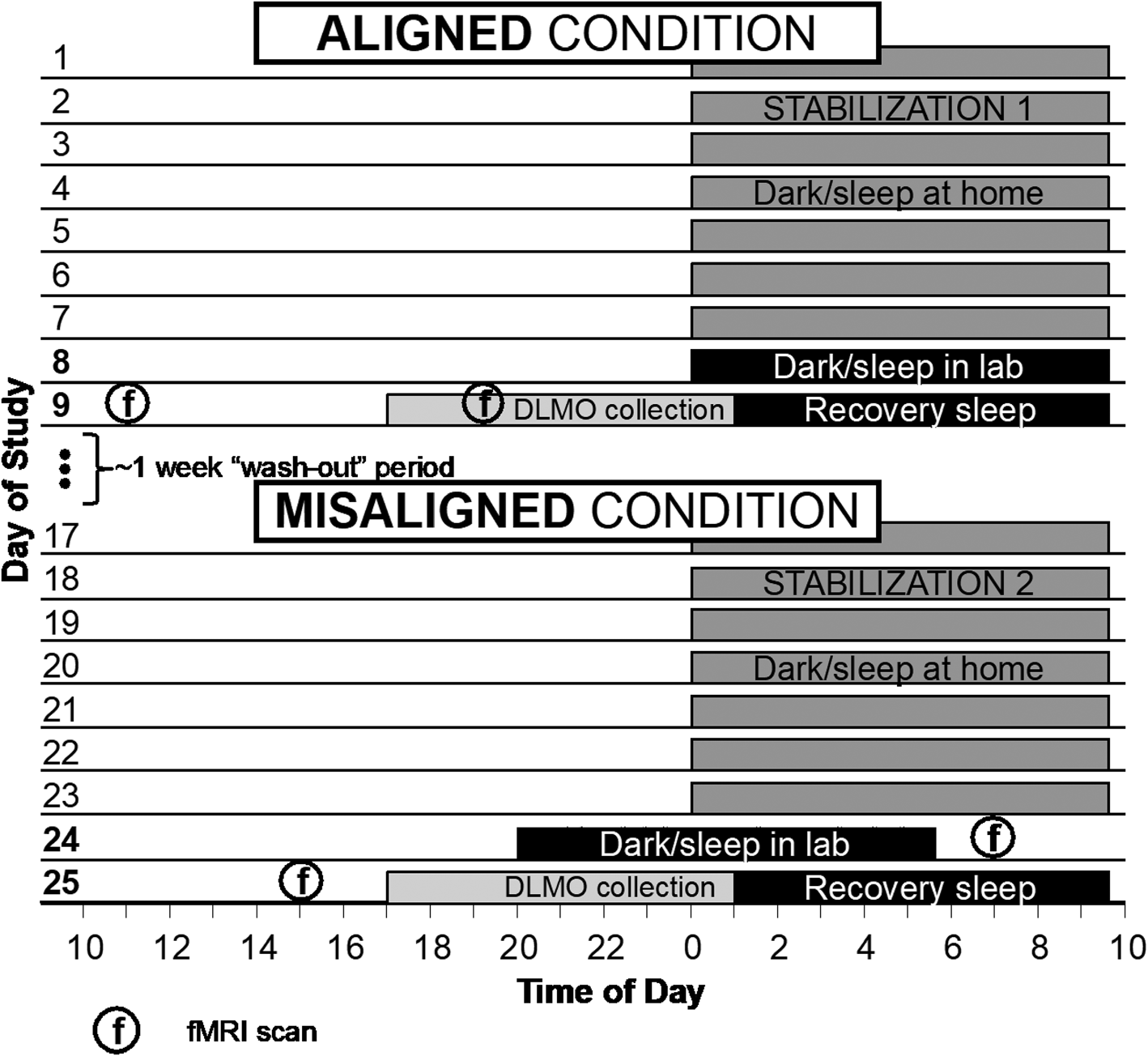
Figure 1 Data collection was conducted solely during the summer to avoid conflicts with school schedules. Participants were randomized to one of two condition orders using a within-person cross-over design: aligned–misaligned, or misaligned–aligned. The order was counterbalanced across participants, with 1 week to ‘wash out’ in-between conditions. Each condition began with a 7-day stabilized sleep-wake schedule at home, with a bedtime of 0000, wake time of 0930, and lights off during this period. This schedule minimizes between-participant differences in sleep/circadian history by aligning with typical adolescent sleep timing preferences (Crowley et al., Reference Crowley, Wolfson, Tarokh and Carskadon2018), and provides a 9.5-h sleep opportunity consistent with the estimated sleep need in this age group (Crowley et al., Reference Crowley, Wolfson, Tarokh and Carskadon2018; Short, Weber, Reynolds, Coussens, & Carskadon, Reference Short, Weber, Reynolds, Coussens and Carskadon2018). Adherence to sleep-wake and light-dark schedules during the stabilization period was monitored via wrist actigraphs with light sensors (Philips Spectrum Classics). Participants were informed that compensation was contingent upon maintaining sleep-wake times within 1 h of the prescribed schedule.
Overall study design. The protocol employed a within-person cross-over design that randomized participants to one of two condition orders: Aligned first and misaligned second, or misaligned first and aligned second. The order of the aligned and misaligned conditions was counterbalanced across participants, with 1 week to ‘wash out’ in-between conditions. The card-guessing task (monetary reward) was administered only at the morning fMRI scans, while the go/no-go task (response inhibition) was administered at all four scans.

Following each 7-day stabilization period, participants had a 2-night lab visit. The sleep-wake manipulation occurred during night 1 of each visit. For the aligned condition, participants remained on the 0000–0930 schedule. For the misaligned condition, the dark and sleep schedule was advanced by 4 h to 2000–0530. The misaligned schedule is intended to simulate the mismatch between adolescents' (presumably delayed) circadian timing and the early start times of secondary education during the week.
A circadian phase assessment was conducted during the evening of Night 2, followed by an overnight ‘recovery’ sleep opportunity. Across both nights in both conditions, light levels were maintained at <5 lux during sleep periods (Sper Scientific Light Meter 840006). Participants were not permitted to use their phones or other devices once in bed.
Participants completed four functional magnetic resonance imaging (fMRI) scans one in the morning (AM) and one in the afternoon/evening (PM) of each of the two sleep lab visits. The AM and PM scans occurred 1.5- and 9.5-hours post-waking, corresponding to 1100 and 1900 in the aligned condition and 0700 and 1500 in the misaligned condition. Scan timing was selected based on prior evidence of daily and circadian rhythms in reward function (Hasler, Mehl, Bootzin, & Vazire, Reference Hasler, Mehl, Bootzin and Vazire2008b; Murray et al., Reference Murray, Nicholas, Kleiman, Dwyer, Carrington, Allen and Trinder2009): the AM scan was scheduled near the nadir, and the PM scan scheduled near the peak of the predicted rhythm in reward motivation. By scheduling fMRI scans at consistent times since awakening, we also partially controlled for a homeostatic sleep drive, which also contributes to time-of-day differences in reward function (Murray et al., Reference Murray, Nicholas, Kleiman, Dwyer, Carrington, Allen and Trinder2009).
Measures
Depression and anxiety
Baseline depression and anxiety symptoms were assessed with the Mood and Feelings Questionnaire-Long Version (MFQ-Long; Ancold & Stephen, Reference Ancold and Stephen1995) and Screen for Child Anxiety Related Disorders-Child Version (SCARED-Child; Birmaher et al., Reference Birmaher, Brent, Chiappetta, Bridge, Monga and Baugher1999). Scores >27 on the MFQ-Long indicate likely depression. Scores ⩾25 on the SCARED-Child may indicate the presence of an anxiety disorder.
Sleep–wake behavior
Sleep diaries and wrist actigraphy were used to assess sleep–wake behavior throughout the protocol. Participants completed sleep diaries each morning via smartphone, with items assessing naps, sleep onset latency, number and duration of awakenings, total sleep time (TST), total time in bed (TIB), and quality of sleep, consistent with published recommendations (Carney et al., Reference Carney, Buysse, Ancoli-Israel, Edinger, Krystal, Lichstein and Morin2012).
Participants wore wrist actigraphs (Spectrum ‘Classic'; Philips-Respironics) on their non-dominant wrist throughout the study protocol. They were instructed to press an event marker on the actigraph each night at ‘lights out’ and each morning at ‘out-of-bed’ times. Event markers were used to set the rest interval for analyses, supplemented by diary data. Data were collected in 1-min epochs and analyzed using the medium sensitivity setting in the Actiware 6.0 software.
Diary and actigraphy outcomes included sleep onset and offset, TIB, TST, and sleep efficiency (% of the time in bed spent asleep; TIB/TST × 100).
Circadian phase
The circadian phase was assessed via salivary Dim Light Melatonin Onset (DLMO; Benloucif et al., Reference Benloucif, Burgess, Klerman, Lewy, Middleton, Murphy and Revell2008) during the second evening of each Aligned and Misaligned study visit. Saliva samples were collected in Salivettes (Sarstedt, Newton, NC) under dim light conditions (<15 lux at any angle of gaze) every half-hour from 1800–0100. Dim light conditions began at 1730 and were confirmed using a light meter. DLMO was calculated as the interpolated clock time when salivary melatonin levels (pg/ml) exceeded the mean of three consecutive baseline samples plus twice the standard deviation of those samples (Voultsios, Kennaway, & Dawson, Reference Voultsios, Kennaway and Dawson1997). Expanded details regarding DLMO collection are provided in the Supplementary material.
Affect
Momentary affect was assessed with the positive affect and negative affect schedule (PANAS; Watson, Clark, & Tellegen, Reference Watson, Clark and Tellegen1988), administered electronically via participants' smartphones six times daily, beginning at the scheduled rise time (0930 and 0530 for aligned and misaligned conditions) and ending 10 min prior to the scheduled bedtime (1950 and 2350 for aligned and misaligned conditions). The remaining four assessments were distributed semi-randomly in between (mean interval 3.2 h). We averaged the first two assessments of positive affect during each visit, which bookended the fMRI reward task. Mean (±s.d.) affect assessment times were 1045 (±57 min) and 0715 (±54 min) for aligned and misaligned visits, respectively.
Alertness
Alertness was evaluated using a variant of the Psychomotor Vigilance Task (PVT), the gold-standard in assessing vigilant attention in the context of sleep loss (Dorrian, Rogers, & Dinges, Reference Dorrian, Rogers, Dinges and Kushida2005). We shortened the standard 10-min version of the PVT to 5 min (PVT-5) to reduce participant fatigue and burden; the 10-min PVT and PVT-5 provide comparable outcomes (Roach, Dawson, & Lamond, Reference Roach, Dawson and Lamond2006). The PVT-5 was delivered via E-Prime (Psychology Software Tools, Pittsburgh, PA) and consisted of 48 trials of a simple visual reaction time task. Responses were recorded via a Serial Response Box (Psychology Software Tools, Pittsburgh, PA) to ensure an accurate and precise assessment of reaction times. A primary outcome is a number of lapses, defined as reaction times >500 ms or a failure to respond. We administered the PVT-5 four times during each condition, at waketime and 3-h intervals afterward. We averaged the first two PVT-5 assessments (which bookended the morning scan) as an objective measure of morning alertness (meantime: 1130 aligned; 0630 misaligned), and we used the fourth PVT-5 assessment as a measure of afternoon alertness (1830 aligned; 1430 misaligned).
fMRI tasks
Given concerns over habituation to reward tasks during test-retest intervals of less than 2 weeks (Hasler, Forbes, & Franzen, Reference Hasler, Forbes and Franzen2014; Plichta et al., Reference Plichta, Schwarz, Grimm, Morgen, Mier, Haddad and Meyer-Lindenberg2012), we only administered the Card Guessing Task during the AM scans.
fMRI card-guessing task
We employed a slow event-related fMRI card-guessing paradigm designed to examine the neural reactivity to anticipation and receipt of monetary reward and loss (Hasler et al., Reference Hasler, Sitnick, Shaw and Forbes2013). Trials were presented in a pseudorandom order with predetermined outcomes. Each 20-s trial consisted of a 4-s decision phase; a 6-s anticipation period; a 1-s outcome period; and a 9-s interstimulus interval. In reward trials, participants were told they would win $5 if their guess was correct and there would be no change in earnings if their guess was incorrect. In loss trials, participants were told they would lose $1 if their guess was incorrect and there would be no change in earnings if their guess was correct. Twenty-four trials were presented in one run, with 12 reward-anticipation and 12 loss-anticipation trials. A balanced number of win-outcome and no-change outcome trials were included within reward-anticipation trials. Outcome probabilities were fixed trial-wise to ensure an identical win/loss time series modeling and pattern of outcome experiences for every participant. Participants were unaware of the fixed outcome probabilities in the paradigm and were led to believe their performance would determine the net monetary gain. Each participant was given $25 in earnings.
Data analyses focused on anticipation and outcome phases of the reward trials, based on evidence that circadian preference is more strongly related to reward, appetitive motivation, and positive affect than to negative affect processes (Hasler, Allen, Sbarra, Bootzin, & Bernert, Reference Hasler, Allen, Sbarra, Bootzin and Bernert2010a). Consistent with our prior work (e.g. Hasler et al., Reference Hasler, Dahl, Holm, Jakubcak, Ryan, Silk and Forbes2012; Hasler et al., Reference Hasler, Sitnick, Shaw and Forbes2013), we focused on reward anticipation>baseline and reward win>baseline contrasts; baseline consisted of the last 3 s of the interstimulus interval.
fMRI go/no-go task
A variant of the go/no-go paradigm (Casey et al., Reference Casey, Trainor, Orendi, Schubert, Nystrom, Giedd and Cohen1997) was used to probe response inhibition. Participants were shown a continuous series of 120 letters and instructed to respond to any letter except ‘V,’ which occurred in 25% of trials overall. The task included two conditions: Block A (‘go’ condition) had 20 targets, and Block B (‘no-go’ condition) had 10 targets and 10 non-targets. Within each 30-s block, targets are presented in a pseudo-randomized order, and a 20-s rest block followed each round. Stimulus presentation duration was 0.5 s and the inter-stimulus interval was 1.5 s. Participants were not given feedback on their performance. The contrast of interest was no-go>rest, which captures the neural correlates of active response inhibition. Behavioral outcomes included reaction time during the go condition and accuracy during the no-go condition.
Neuroimaging preprocessing and analysis
Neuroimaging data were preprocessed and analyzed using SPM12 (Ashburner et al., Reference Ashburner, Barnes, Chen, Daunizeau, Flandin, Friston and Moran2014) and the Artifact Detection Toolbox (ART; http://www.nitrc.org/projects/artifact_detect/). We used the rex toolbox (https://web.mit.edu/swg/software.htm) to extract mean activations (p = 1.0) across all voxels from a priori regions of interest (ROIs): bilateral VS and mPRC for the Card Guessing Task, and the rIFG for the go/no-go Task (Fig. S1). We converted all extracted mean activations to z-scores in order to enhance interpretability.
Full details about task presentation, neuroimaging preprocessing, ROI creation/extraction, and analysis are provided in the Supplementary material.
Statistical analyses
All analyses were conducted in SPSS 25 (IBM Corp., 2017). In preliminary analyses, we examined the effects of the circadian alignment manipulation on actigraphy-based sleep during the first night in the lab using paired t tests.
We tested primary hypotheses regarding circadian alignment effects on fMRI measures of monetary reward (2 AM scans) and response inhibition (2 AM scans, 2 PM scans) using linear mixed-effects models. In Model 1 (primary hypotheses), we regressed each repeatedly measured fMRI outcome on fixed effects of condition (aligned v. misaligned), scan visit (first or second), scan order (aligned–misaligned or misaligned–aligned), gender, scanner, and DLMO. In Model 1 for response inhibition, we also included time-of-day (AM or PM). In Model 2, we added actigraphy-based TST from the night before the scan to account for differences in TST due to aligned v. misaligned condition; these analyses better isolate the circadian effects of misalignment. In Model 3, we added the number of lapses on the PVT near the time of scanning to account for variations in alertness.
All models included participant ID as a random effect to account for nesting within participants, used restricted maximum likelihood (REML), and based degrees of freedom on Satterthwaite to reduce Type-I error (Luke, Reference Luke2017). We also calculated estimated marginal means within each model to plot effects of condition (Figs 2–4). go/no-go behavioral outcomes, self-reported positive affect, and PVT-5 scores were analyzed using similar models.
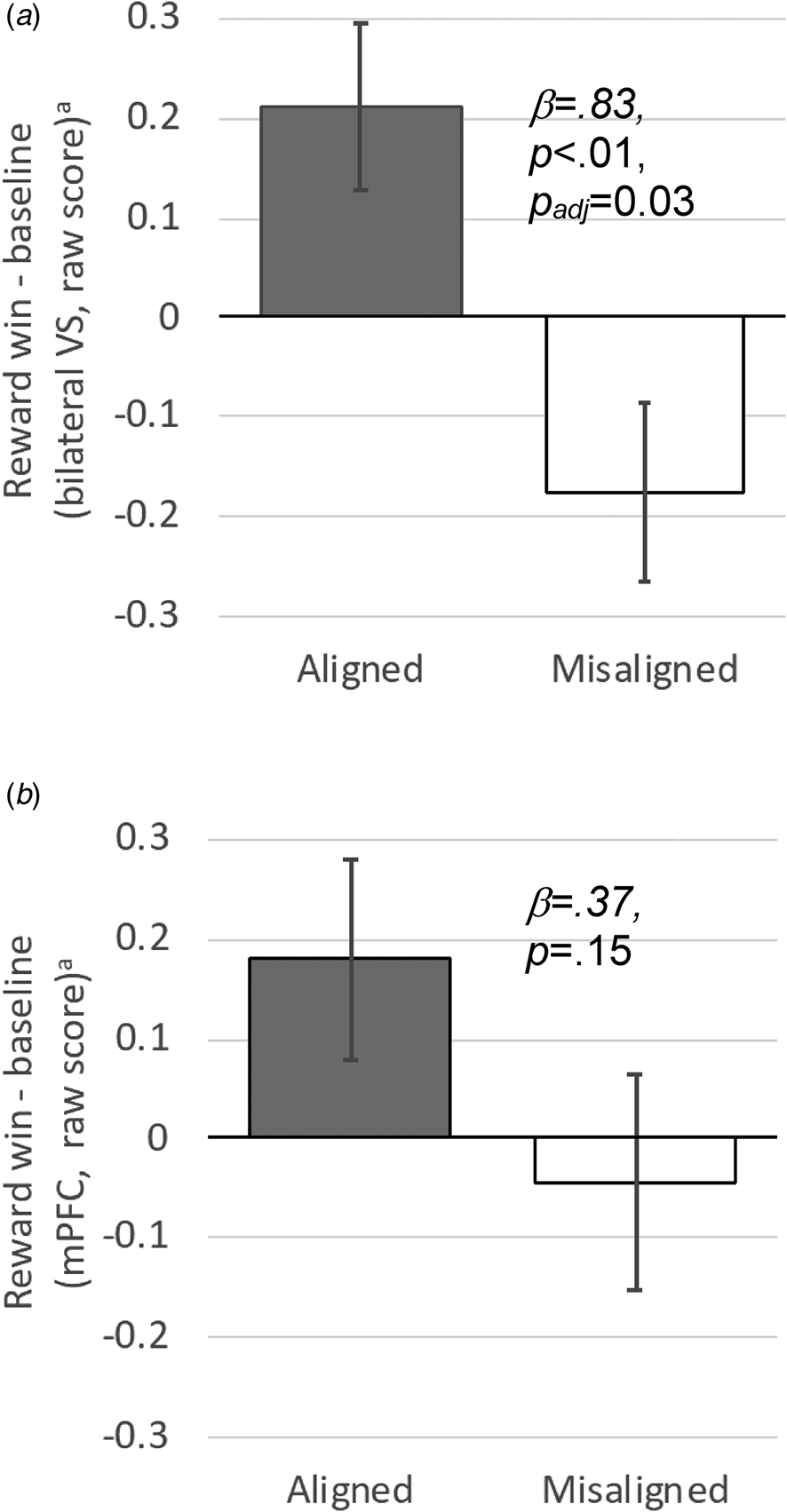
(a) and (b). Greater activation in the bilateral ventral striatum (VS) during reward win (v. baseline) in the aligned (A) morning scan compared to the misaligned (M) morning scan (a). Activation in the medial prefrontal cortex (mPFC) showed a similar direction of effect but was not statistically significant (b). Linear mixed-effects model also accounted for sex, scanner, scan visit (first v. second), scan order (aligned first v. misaligned first), DLMO, and prior night's total sleep time. Graphs depict estimated marginal means that account for these covariates, plotted as raw scores with error bars based on standard errors.

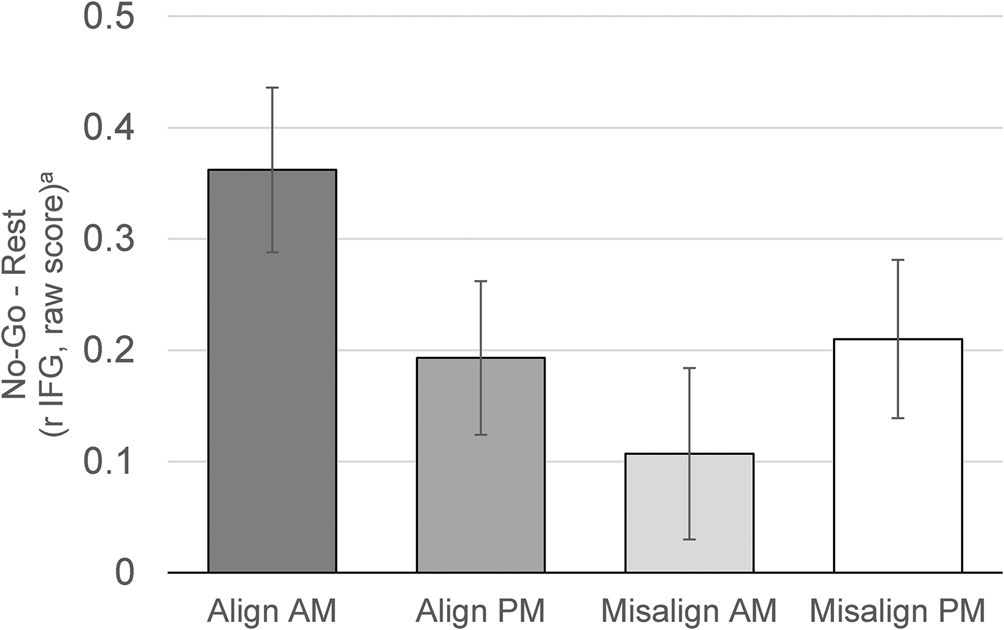
Activation in the right inferior frontal gyrus (rIFG) during no-go blocks (v. rest block) in the four scans (aligned morning, aligned afternoon, misaligned morning, and misaligned afternoon). While no overall differences were found based on condition (aligned v. misaligned) or time-of-day (morning v. afternoon), a condition X time-of-day interaction was significant in a linear mixed-effects model that also accounted for sex, scanner, scan visit (first v. second), scan order (aligned first v. misaligned first), and DLMO. Graphs depict estimated marginal means that account for these covariates, plotted as raw scores with error bars based on standard errors.

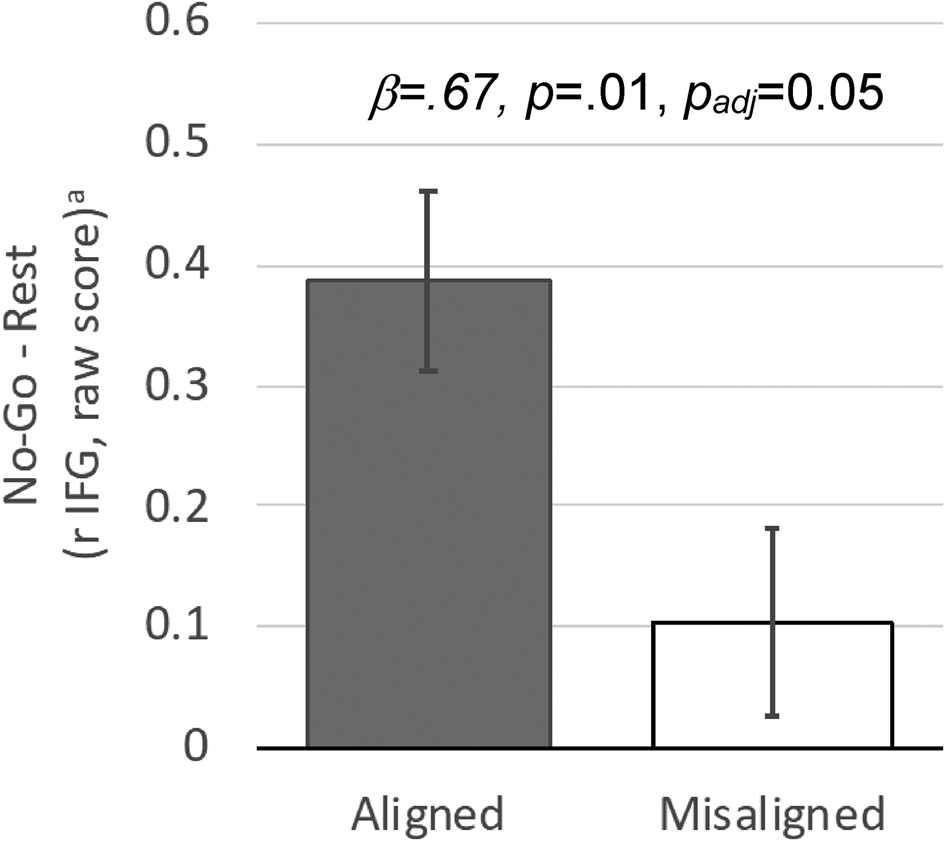
Greater predicted activation in the right inferior frontal gyrus (IFG) during no-go blocks (v. rest block) in the aligned morning scan compared to the misaligned morning scan (a). Linear mixed-effects model also accounted for sex, scanner, scan visit (first v. second), scan order (aligned first v. misaligned first), and DLMO. Graphs depict estimated marginal means that account for these covariates, plotted as raw scores with error bars based on standard errors.

We provide adjusted p values to account for multiple comparisons of primary analyses (Cao & Zhang, Reference Cao and Zhang2014), using a Bonferroni adjustment (padj) for four primary outcomes within each task (i.e. reward: 2 conditions [anticipation, win] × 2 ROIs = 4 outcomes; go/no-go: 4 conditions × 1 ROI = 4 outcomes). However, given the innovative nature of the study and relatively small sample sizes, we focused on effect sizes with 95% confidence intervals, contextualized based on our expected detectable effect sizes (d = 0.60–0.70 before and after correction for multiple comparisons; see power analysis in Supplementary material).
Results
Sample descriptive
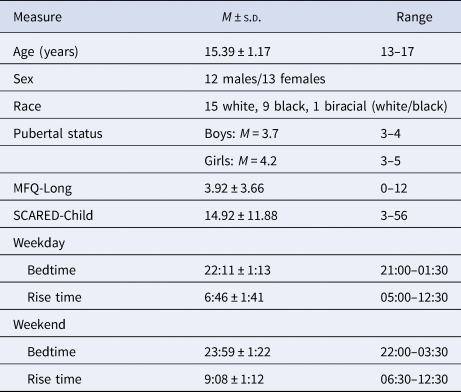
In Table 1, the baseline data were consistent with a healthy sample without clinically significant symptoms of depressive or anxiety. The mean self-reported sleep schedule on weekends at baseline was ~0000–0900.
Demographics and clinical summary

Note: MFQ-Long = Mood and Feelings Questionnaire-Long Version (Ancold & Stephen, Reference Ancold and Stephen1995); SCARED-Child = Screen for Child Anxiety Related Disorders – Child version (Birmaher et al., Reference Birmaher, Brent, Chiappetta, Bridge, Monga and Baugher1999).
Manipulation checks of sleep and alertness
From online Supplementary Tables S1 and S2, we found no mean differences in actigraphy-based sleep parameters across each stabilization week preceding the aligned and misaligned visits. In contrast, sleep significantly differed on aligned and misaligned nights in the lab. During the misaligned night, sleep timing was earlier (lights out, sleep onset, sleep offset, out-of-bed), sleep was more disturbed (longer wake after sleep onset, lower sleep efficiency), and TST was shorter.
For vigilance (mean lapses on the PVT-5), we did not observe an effect of condition (aligned v. misaligned), time-of-day (AM v. PM), or interaction between time-of-day and condition when all four timepoints were included. However, for the morning assessments alone, more mean lapses were observed during the misaligned condition (B = −2.13, p = 0.020) relative to the aligned condition.
Effects of misalignment on neural response to monetary reward
We observed lower bilateral VS responses to reward anticipation during the misaligned relative to aligned visit (β = 0.69; 95% CI 0.09, 1.28; p = 0.026, padj = 0.104; online Supplementary Table S3). This effect remained after accounting for the prior night's TST (β = 0.79; 95% CI 0.15, 1.44; p = 0.018; padj = 0.072) or current vigilance (PVT; (β = 0.87; 95% CI 0.15, 1.58; p = 0.021; padj = 0.084). However, these moderate-to-large effects did not survive multiple comparison corrections.
The mPFC response to reward anticipation was not different during misaligned and aligned schedules (β = 0.43; 95% CI −0.08, 0.93; p = 0.093; padj = 0.372; online Supplementary Table S4), either in Model 1, or after accounting for the prior night's TST (β = 0.40; 95% CI −0.22, 1.02; p = 0.192) or current vigilance (PVT; β = 0.17; 95% CI −0.39, 0.74; p = 0.519). These small effects were not detectable with our sample size.
Bilateral VS response to reward win was not different during aligned relative to misaligned schedules (β = 0.54; 95% CI −0.08, 1.16; p = 0.086; padj = 0.344; online Supplementary Table S5) in Model 1. We observed a large effect after accounting for the prior night's TST (β = 0.83; 95% CI 0.25, 1.41; p = 0.008; padj = 0.032; Fig. 2a). The same effect after accounting for current vigilance was moderate (PVT; β = 0.73; 95% CI 0.01, 1.45; p = 0.048; padj = 0.192) but did not survive multiple comparison correction.
We did not observe statistically significant effects of misalignment on the mPFC response to reward win, and effect sizes were small, regardless of covariates (online Supplementary Table S6, Fig 2b). Self-reported positive affect on the morning of the lab visit also did not differ as a function of aligned v. misaligned condition (B = −0.05, p = 0.968; estimated marginal means of PA: 19.48 (aligned) and 20.72 (misaligned).
Effects of misalignment on neural response to response inhibition
We did not observe an overall effect of misalignment or time-of-day on the rIFG response during response inhibition (Fig. 3), but we did observe an interaction between condition (aligned v. misaligned) and time-of-day (AM v. PM) (online Supplementary Table S7; β = 0.64; 95% CI 0.11, 1.18; p = 0.019; padj = 0.076). This interaction reflects a higher rIFG response during the aligned-AM scan than during the misaligned-AM scan.
To further interpret this interaction, we restricted analyses to AM scans only and found higher rIFG activation during response inhibition for the aligned-AM scan compared to the misaligned-AM scan (Fig. 4, online Supplementary Table S8; β = 0.67; 95% CI 0.16–1.18; p = 0.013; padj = 0.052). These effects were large after accounting for the prior night's TST (β = 0.86; 95% CI 0.22–1.50; p = 0.012; padj = 0.048) and current vigilance (PVT; β = 0.87; 95% CI 0.21,1.52; p = 0.012; padj = 0.048), and survived multiple comparisons correction.
There were no apparent effects of misalignment or time-of-day on reaction time or accuracy for the go/no-go task.
Discussion
Consistent with predictions, we found preliminary evidence that imposing circadian misalignment on healthy adolescents altered their neural response during receipt of rewards and during response inhibition in the morning. Specifically, we observed reduced bilateral VS responses to reward outcome and reduced right IFG response during response inhibition following experimentally imposed circadian misalignment, in both cases only after accounting for confounding effects of the prior night's sleep or vigilance proximal to the scan. Similar findings were observed for bilateral VS responses to reward anticipation but did not survive correction for multiple comparisons. We did not find effects of misalignment on mPFC responses to monetary reward, neural responses during response inhibition, self-reported positive affect, or behavioral indicators related to response inhibition. These findings provide the first experimental evidence that circadian misalignment analogous to that resulting from school schedules has measurable impacts on healthy adolescents' reward processing and inhibition of prepotent responses.
The effect of misalignment on reward-related brain function was strongest for bilateral VS during the reward outcome phase after accounting for confounding effects of TST on the prior night. A moderate-to-large effect was also observed for bilateral VS during reward anticipation. This effect was undiminished by less sleep on the prior night or lower vigilance during testing but did not survive multiple comparisons correction. The effects of early school start times are often conceptualized as being driven by insufficient sleep (e.g. Minges & Redeker, Reference Minges and Redeker2016), but our findings suggest that the adverse circadian phase may independently contribute to an impact on reward-related processes. The effects of misalignment on mPFC response to reward were small, suggesting that acute misalignment may have a relatively larger impact on bottom-up v. top-down reward processing. The effects on VS response during anticipation and receipt were of similar magnitude, contrasting with prior suggestions of relatively greater circadian modulation of wanting or motivational processes v. liking or consummatory processes (Byrne & Murray, Reference Byrne and Murray2017). Our findings are broadly consistent with animal studies showing that that striatal dopamine transmission is directly modulated by sleep-wake state (Alonso, Pino, Kortagere, Torres, & Espana, Reference Alonso, Pino, Kortagere, Torres and Espana2021), and that genetic circadian disruption in the mesolimbic system alters dopamine neurotransmission and reward processing (Parekh & McClung, Reference Parekh and McClung2016).
Previously, we reported that greater social jet lag (a proxy for circadian misalignment) was associated with lower mPFC and striatal reactivity to reward anticipation and outcome, with the strongest effects for mPFC response during outcome in healthy 10–13 year-olds (Hasler et al., Reference Hasler, Dahl, Holm, Jakubcak, Ryan, Silk and Forbes2012). The decreased neural response to reward associated with misalignment parallels the present findings, although here we found stronger effects in the striatum. Similarly, we previously reported that evening-type late adolescent (18–22 year-old) males exhibited lower mPFC responses (during reward anticipation), but higher striatal responses (during reward win), compared to morning-types (Hasler et al., Reference Hasler, Sitnick, Shaw and Forbes2013). Presumably, the evening-types were more subject to misalignment; consistent with this explanation, evening-type individuals also reported worse sleep quality and longer sleep onset latency. We speculate that the divergent responses (higher v. lower VS) may be explained by developmental effects and differences between an experimental manipulation v. self-reported chronotype. The lower VS response to reward that we observed may help bridge findings linking circadian misalignment to depression (Emens et al., Reference Emens, Yuhas, Rough, Kochar, Peters and Lewy2009; Hasler et al., Reference Hasler, Buysse, Kupfer and Germain2010b; Swanson et al., Reference Swanson, Burgess, Huntley, Bertram, Mooney, Zollars and Arnedt2017), and findings linking a lower VS response to reward with an increased incidence of major depressive disorder (Forbes & Dahl, Reference Forbes and Dahl2012). Furthermore, in rodent models, disrupting rhythms specifically in the VS, environmental circadian disruptions (repeated phase advances or delays), and genetic disruptions to the circadian system all lead to increased depressive-like behaviors (Landgraf, Long, & Welsh, Reference Landgraf, Long and Welsh2016b; Landgraf et al., Reference Landgraf, Long, Proulx, Barandas, Malinow and Welsh2016a; Prendergast, Onishi, Patel, & Stevenson, Reference Prendergast, Onishi, Patel and Stevenson2014).
We also observed an effect of circadian misalignment on the rIFG activation during response inhibition, but only during the morning scans. Although there is some debate about the mechanistic role of the rIFG (Hampshire, Chamberlain, Monti, Duncan, & Owen, Reference Hampshire, Chamberlain, Monti, Duncan and Owen2010), an intact rIFG appears to be necessary for response inhibition (Aron, Fletcher, Bullmore, Sahakian, & Robbins, Reference Aron, Fletcher, Bullmore, Sahakian and Robbins2003; Chikazoe, Konishi, Asari, Jimura, & Miyashita, Reference Chikazoe, Konishi, Asari, Jimura and Miyashita2007). The effect size of misalignment's impact on the rIFG response was higher after accounting for prior nights' sleep and concurrent vigilance. A lower rIFG response during no-go in healthy early−mid adolescents was associated with a transition to heavy alcohol use (Norman et al., Reference Norman, Pulido, Squeglia, Spadoni, Paulus and Tapert2011). Furthermore, although we tried to separate the effects of sleep deprivation from those of the adverse circadian phase, abundant evidence indicates that the two factors interact, including with respect to reward-related processes (Murray et al., Reference Murray, Nicholas, Kleiman, Dwyer, Carrington, Allen and Trinder2009). Most germane to the present findings, individual differences in chronotype may influence both sleep deprivation and time-of-day effects on the neural response during response inhibition (Song et al., Reference Song, Feng, Zhao, Xu, Xiao, Zhou and Zheng2018, Reference Song, Feng, Wu, Li, Su, Liu and Zheng2019). Follow-up studies using larger samples could test whether chronotype moderates circadian misalignment and time-of-day effects on neural responses to reward and response inhibition. Notably, while the impact of circadian rhythms on response inhibition is understudied in the animal literature, circadian disruption is associated with impulsivity in rodent models (Balachandran et al., Reference Balachandran, Hatcher, Sieg, Sullivan, Molina, Mahoney and Eubig2020).
We found limited evidence of misalignment effects on self-report and behavioral measures. Our sample of very healthy adolescents may be relatively resilient to circadian misalignment despite repeated exposure during the school year. Likewise, sleep stabilization during the week prior to sleep manipulations may have minimized pre-existing sleep debt or misalignment, and thereby, mitigated any effects of the misalignment manipulation.
The present study has several limitations. Based on our power analysis, the sample size precluded us from detecting small-to-moderate effect sizes; thus with a larger sample, we may have observed more findings to be statistically significant, especially after multiple comparison correction. Although the acute single-night manipulation is not representative of the chronic misalignment experienced by many teens, effects observed with such a manipulation may systematically underestimate the real-world effects of chronic misalignment, including long-term sleep restriction. Next, test–retest reliability of fMRI is of increasing concern, with limited information for go/no-go tasks (Elliott et al., Reference Elliott, Knodt, Ireland, Morris, Poulton, Ramrakha and Hariri2020), although it may be somewhat better for reward tasks repeated over shorter intervals (Kragel, Han, Kraynak, Gianaros, & Wager, Reference Kragel, Han, Kraynak, Gianaros and Wager2020; Plichta et al., Reference Plichta, Schwarz, Grimm, Morgen, Mier, Haddad and Meyer-Lindenberg2012). Finally, although our healthy sample reduced the risk of confounds related to substance use or chronic mental illness, it also limits generalizability. An important next step would be to study the effects of circadian misalignment in at-risk populations to see if it exacerbates neural vulnerability to mood and substance use disorder, consistent with observational studies (Carlisi, Hilbert, Guyer, & Ernst, Reference Carlisi, Hilbert, Guyer and Ernst2017; Soehner et al., Reference Soehner, Bertocci, Manelis, Bebko, Ladouceur, Graur and Axelson2016).
In conclusion, imposing circadian misalignment resulted in altered neural responses to reward and response inhibition, and suggests that the outcomes were not simply driven by insufficient sleep. Further, the direction of these alterations in neural response is consistent with patterns observed in depressed youth and those who develop heavy drinking. Preventing circadian misalignment, whether via individual-level interventions (e.g. using bright light to advance their circadian timing) or policy-level prevention, such as delaying school start times, may reduce patterns of neural activation related to risk for mood and substance use disorders.
Supplementary material
The supplementary material for this article can be found at https://doi.org/10.1017/S0033291721000787.
Financial support
This work was supported by the National Institutes of Health [K01 DA032557 (Hasler); R01 DA044143 (Hasler); K01MH111953 (Soehner)].
Conflicts of interest
No conflicts of interest to disclose.