Implications
This study provides practical and useful information on carcass characteristics and the nutritional quality of longissimus dorsi (LD) from foal meat that are widely consumed in Europe. It will also be useful for nutritionists to describe tables of the food composition.
Introduction
Today, population is more diet conscious, having special concerns about fat and cholesterol, both associated with meat consumption. For the modern consumer, taste and nutritional value are important quality attributes of meat (Webb and O'Neill, Reference Webb and O'Neill2008), with increased expectations in meat and meat products from extensive production systems. This meat is perceived as healthy because of the friendly extensive system that is used on animal production, and the consumer's decision to purchase. This kind of meat is mainly guided by its high intrinsic quality and healthiness, which in the case of meat is largely related to its fat properties and to the absence of chemical residues. On the other hand, extensive foal livestock has always been important in mountain areas from the social, economic and environmental points of view: (i) well adapted to the land; (ii) keeping the ecosystem of pasturages; (iii) protecting the area against fire and erosion; and (iv) finally, maintaining population in rural areas.
Horse meat production in Spain has grown in the recent years, being the fourth largest producer in the UE in 2010 with 6500 tonnes (FAOSTAT, 2010). Although the consumption in Spain is limited, a high percentage is exported to other countries, mainly to Italy (Mercasa, 2011). In 2010, worldwide horse meat production reached 741 000 tonnes. The main producers were Asia, with 45% of worldwide production, followed by Europe (19%), South America (12%), Central America (11%) and North America (6%). The greatest importers of horse meat were Italy, Belgium, Russia and France, and the most important exporters were Argentina, Belgium, Canada and Poland (FAOSTAT, 2010).
The aim of this work was to study the sex effect on carcass characteristics, physico-chemical properties (chemical composition, colour parameters and textural profile), nutritional value (fatty acid and amino acid content) and sensory characteristics of foal meat slaughtered at 15 months of age.
Material and methods
Experimental design and animal management
Twelve foals (six females and six males) of ‘Galician Mountain’ breed were obtained from ‘Monte Cabalar’ (agricultural cooperative of ‘Galician Mountain’ breed) located in a mountain (A Estrada, Pontevedra, Spain) and were used for this study. The majority of the foals were born in the months of April and May 2010. Animals were reared with their mothers on pasture and they kept suckling and grazing until the weaning age of 6 to 7 months. After weaning, foals were fed mainly with ryegrass (Lolium perenne), Ulex europaeus L. and Pteridium aquilinum (L.) Kuhn, receiving complementary grass silage ad libitum when the grass available was limited, especially in the summer and winter time, but they were never given concentrates. All foals were reared with their mothers in an extensive production system in freedom regimen, according to an extensive production system on wood pasture. These animals were slaughtered when they were 15 months old. They were transported to the abattoir (20 km) the day before slaughter. Foals from different groups were not mixed at any time, and stress was minimizing as much as possible. Animals were stunned with a captive bolt and slaughtered and dressed according to current European Union regulations (Council Directive of the European Union 95/221EC), in an accredited abattoir.
Carcass characteristics and sample collection
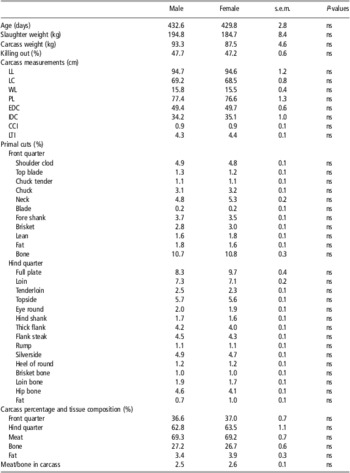
Immediately after slaughter, carcasses were weighed (CW) and chilled at 4°C in a cold chamber for 24 h. The killing-out percentage was calculated as the ratio between CW and slaughter weight. At this point, the left half-carcasses were moved to the research centre pilot plant and the following carcass measurements were made: length of carcass (LC), length of leg (LL), width of leg (WL), internal depth of chest (IDC), external depth of chest (EDC) and perimeter of leg (PL) (Supplementary Figure S1). In addition, carcass compactness index (CCI) = (CW/LC) and hindlimb compactness index (LTI) = (LL/WL) were also calculated. The left half-carcass was dividing in front quarter (FQ) and hind quarter (HQ), and 19 primal cuts were obtained, which are indicated in Supplementary Figure S2 and Table 1. Finally, tissue composition was obtained by the sum of all lean muscle (meat), sum of all bones (bone) and sum of all fat (fat).
Effect of sex on slaughter weight, carcass weight and carcass measurements in foals

s.e.m. = standard error of the mean; ns = not significant; LL = length of leg; LC = length of carcass; WL = width of leg; PL = perimeter of leg; EDC = external depth of chest; IDC = internal depth of chest; CCI = carcass compactness index; LTI = hindlimb compactness index.
The LD muscle was cut into seven 2.5-cm-thick steaks. The first three steaks were used to determine pH, colour, proximate composition and fatty acid and amino acid profile. The fourth and fifth steaks were packed under vacuum conditions (99%) (FRIMAQ, V-900, Lorca, Spain) during 4 days at 4°C. Water-holding capacity (WHC) and texture parameter were obtained after this period. The last ones were used for sensory analysis.
Analytical methods
Reagents
Fatty acid methyl esters standard mixtures and non-adecanoic acid methyl esters were acquired from Supelco Inc. (Bellefonte, PA, USA), and cholesterol standards were supplied by Sigma Chemical Co. (St Louis, MO, USA). Analytical grade and liquid chromatographic grade chemicals were purchased from Merck Biosciences (Darmstadt, Germany). Boron trifluoride (14% solution in methanol) was obtained from Panreac (Castellar del Vallès, Barcelona, Spain). AccQ.Fluor reagent kit (AQC, borate buffer) and AccQ.Tag Eluent A concentrate were acquired from Waters (Milford, MA, USA). Acetonitrile (MeCN), disodium ethylenediaminetetraacetic acid (EDTA), phosphoric acid, sodium acetate trihydrate and sodium azide came from Baker (Phillipsburg, PA, USA), and triethylamine (TEA) was purchased from Aldrich (Milwaukee, WI, USA). Amino acid standards, taurine and hydroxyproline were acquired from Sigma (St. Louis, MO, USA).
Physico-chemical, fatty acid and amino acid profile
pH was measured using a digital pH meter (Thermo Orion 710 A+, Cambridgeshire, UK) equipped with a penetration probe. A portable colorimeter (Konica Minolta CR-600d Osaka, Japan) with pulsed xenon arc lamp, 0° viewing angle geometry and 8 mm aperture size was used to estimate meat colour in the CIELAB space (lightness, L*; redness, a*; yellowness, b* (CIE, 1976)). Haem iron was measured in duplicate following Hornsey (1956) methodology according to this formula (Merck Index, 1989):
 $$ \displaylines{ & {\rm{Haematin}}\,{\rm{(\mu g}}\,{\rm{haematin/g}}\,{\rm{muscle)}}\,{\rm{ = }}\,{\rm{Absorbance}}\times {\rm{342}}{\rm{.44}} \cr & {\rm{Haem}}\,{\rm{iron}}\,{\rm{(mg/100}}\,{\rm{g}}\,{\rm{meat)}}\,{\rm{ = }}\,{\rm{(Haematin}}\times {\rm{8}}{\rm{.82)/100}} $$
Moisture, fat, protein (Kjeldahl N × 6.25) and ash were quantified according to International Organization for Standardization (ISO)-recommended standards 1442:1997 (ISO, 1997), 1443:1973 (ISO, 1973), 937:1978 (ISO, 1978) and 936:1998 (ISO, 1998), respectively.
Steaks were cooked placing vacuum package bags in a water bath with automatic temperature control (JP Selecta, Precisdg, Barcelona, Spain) until they reached 70°C in quore, controlling the heat by thermocouples type K (Comark, PK23M, Vienna Court, UK) connected to a data logger (Comark Dilligence, EVG N3014, Vienna Court, UK). After this stage, samples were cooled in a circulatory water bath set at 18°C for 30 min and cooking loss percentage was recorded. Seven meat pieces of 1 × 1 × 2.5 cm (height × width × length) were removed parallel to the muscle fibre direction and were completely cut using a Warner–Bratzler (WB) shear blade with a triangular slot cutting edge (1-mm-thick). Maximum shear force, shear firmness and total necessary cutting work were obtained. Texture profile analysis (TPA) was measured by compressing to 60% (19.85 cm2 contact surface compression). Force–time curves were recorded at 3.33 mm/s cross-head speed. Hardness (kg), cohesiveness, springiness (mm) and chewiness (kg × mm) were obtained by means of a texture Analyzer (TA.XT.plus of Stable Micro Systems, Vienna Court, UK) and the available computer software (Texture Exponent 32 (version 1.0.0.68), Stable Micro Systems).
The WHC was measured in two ways: cooking loss (CL) and drips loss (DL). CL was evaluated by cooking as described in texture analysis, measuring the difference in weight between cooked and raw samples. To determine DL, an intact meat sample in a variable range of 80 to 100 g and 1.5 cm thick was weighed and put on top of a net, inside of a container, which was closed after filling to avoid evaporation. This container was placed in a refrigerated chamber at 4°C for 48 h and it was weighed again after this period.
The saponification, extraction and simultaneous identification of cholesterol in meat were carried out in normal phase following the procedure described by Prates et al. (Reference Prates, Gonçalves Quaresma, Branquinho Bessa, Andrade Fontes and Mateus Alfaia2006). Intramuscular extraction of lipid from LD, transesterification and determination of fatty acid profile were carried out according to Lorenzo et al. (Reference Lorenzo, Fuciños, Purriños and Franco2010). The hydrolysis of the protein, derivatization and identification of hydrolyzated amino acid were carried out following the procedure described by Franco et al. (Reference Franco, Rois, Vázquez, Purriños, González and Lorenzo2012), with the difference that free amino acids were not separated from constitutive amino acid.
Sensory analysis
The taste panel evaluation was conducted with eight panellists selected from the Meat Technology Centre of Galicia. The panellists were trained during 1 year with the attributes and the scale to be used. During the sensory evaluation, the panellists were situated in a private cabinet illuminated with red light. Water to clean the palates and remove residual flavours was given to the panel at the beginning of the session and in between samples. The sensory evaluation consisted of two sessions: one to visually evaluate the attribute of the fresh foal meat, and a second to evaluate all the sensory attributes of the cooked foal meat. The samples were individually labelled with three-digit random numbers and were served one at a time in random order. To rate the samples, the panellist used nine-point scales having word anchors at the extreme ends.
The fresh foal meat sensory traits were assessed at 24 h postmortem. Before being presented to the panellists, the samples (25-mm-thick) were exposed to air for 30 min at 4°C to allow for complete bloom. Subjective measures for colour (1 = pale pinkish-grey to white; 9 = dark purplish-red) were evaluated. The samples for the cooked foal meat sensory evaluation were cut into segments ∼25 mm thick. The steaks were grilled in a frying pan at internal temperature of 68°C to 70°C, which was measured using a thermometer with a handheld probe (HI-985011, Hanna Instruments, Eibar, Spain). The cooked foal steaks were cut into 10 × 10 × 25 mm3 pieces, placed on white plastic trays covered with aluminium foil and served immediately to each panellist. The cooked foal samples were evaluated for intensity odour (1 = little intensity; 9 = very intensity), intensity rancid (1 = little rancid; 9 = very rancid), abnormal flavour (1 = very weak; 9 = very strong), taste (1 = very unacceptable; 9 = very acceptable), sweetness (1 = little sweet; 9 = very sweet), juiciness (1 = very dry; 9 = very juicy), hardness (1 = very tender; 9 = very tough) and fibrousness (1 = little fibrous; 9 = very fibrous).
Statistical analysis
An ANOVA of one way using SPSS package (2008, SPSS/PC + Statistics, 19.0 SPSS Inc., Chicago, IL, USA) was performed for all variables considered in the study. The least squares mean (LSM) were separated using Duncan's t-test. All statistical tests of LSM were conducted for a significance level α < 0.05. Correlations between variables were determined by correlation analyses using the Pearson's linear correlation coefficient with the above statistical software package mentioned.
Results and discussion
Carcass parameters
Carcass characteristics, commercial cuts and tisular composition of foals are shown in Table 1. No significant differences (P > 0.05) between sexes were found in any trait. Slaughter weight was not significantly (P > 0.05) different between sexes, although higher values were observed in the male group (+10 kg) compared with the female group. As a consequence, this trend affected carcass weight as the carcass weight of the male group was slightly higher compared with the female group. Our results were lesser that those reported by Sarriés and Beriain (Reference Sarriés and Beriain2005) who observed carcass weights at around 275 kg in male and female Burguete foals slaughtered at 16 months of age, and those found by Lanza et al. (Reference Lanza, Landi, Scerra, Galofaro and Pennisi2009) who reported carcass weights ranged between 244 kg for Sanfratelano and 208 kg for Haflinger foals slaughtered at 18 months of age. Obviously, these differences can be attributed because of the type of foal carcasses used in these studies that have been obtained from old animals and/or specialized breeds for meat production.
Killing-out percentage was similar between sexes (around 48%), and this value was lower than that found (around 63%) by Sarriés and Beriain (Reference Sarriés and Beriain2005) in foals of Burguete breed slaughtered at 16 months of age, and smaller than the value observed (around 59% to 60%) by Lanza et al. (Reference Lanza, Landi, Scerra, Galofaro and Pennisi2009) in foals of Italian breed slaughtered at 18 months of age.
The division of the half-carcass in front and hind quarters did not reveal differences because of sex. Hind quarter is the part of the carcass where several of the most valuable primal cuts are located, and, again, percentage of most valued pieces (loin, tenderloin, topside and eye round) was higher in males, although differences were very small and not statistically significant. Franco et al. (Reference Franco, Fernández, Temperán, Garcia and Lorenzo2011a) studied carcass from ‘Galician Mountain’ foals breed assigned to similar production system but slaughtered at 12 months of age. No differences in killing-out percentage or in carcass percentage for front and hind quarter were found.
Regarding CCI, comparison with other studies can be made, but again our figures cannot be easily compared with the data obtained from other breeds. Sarriés and Beriain (Reference Sarriés and Beriain2005) found values of 1.63 in 16-month-old Burguete foals, and Juárez et al. (Reference Juárez, Polvillo, Gómez, Alcalde, Romero and Varela2009) reported levels of 2.4 for foals of Hispano-Breton breed slaughtered at 24 months of age. Foal carcasses are high in meat content in the present study, with 69.25% of mean value, which is slightly higher than that observed by Znamirowska (Reference Znamirowska2005), published for 6- to 10-year-old horses.
Physico-chemical properties
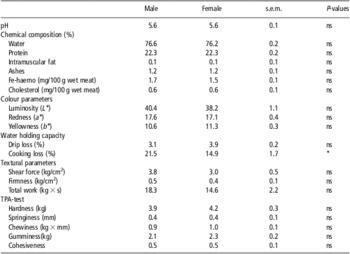
Chemical composition, colour, WHC and textural parameters of LD from foals are shown in Table 2. No significant differences (P > 0.05) between sexes were observed except for cooking loss (P < 0.05), as the male group presented the highest values. Local slaughter practices tended to minimize stress factors. Foal meat acidification process took place in a similar way for both sexes as it is described in the literature (Franco et al., 2011b; Sarriés and Beriain, Reference Sarriés and Beriain2005; Tateo et al., Reference Tateo, De Palo, Ceci and Centoducati2008). Our values of meat pH were similar to those described by Polidori et al. (Reference Polidori, Vincenzetti, Cavallucci and Beghelli2008) in donkey meat and by Sarriés and Beriain (Reference Sarriés and Beriain2005) and Lanza et al. (Reference Lanza, Landi, Scerra, Galofaro and Pennisi2009) in meat from foal of Burguete and Haflinger breed, respectively.
Effect of sex on meat quality from longissimus dorsi of foal meat
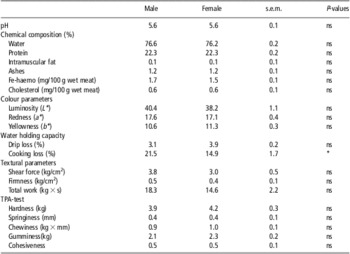
s.e.m. = standard error of the mean; ns = not significant.
*P < 0.05.
The source of variability and sex did not influence the component moisture, protein, intramuscular fat (IMF), ashes and Fe-haemo (P > 0.05, Table 2). Similar values of moisture were obtained in both groups (76.28% v. 76.63%, for female and male groups, respectively, P > 0.05). This result is in disagreement with those reported by Tateo et al. (Reference Tateo, De Palo, Ceci and Centoducati2008) who found higher moisture content in meat foal samples from females than males. Mean values of moisture content observed in the present study (around 76.5%) were higher to those reported for equine meat of 11 to 24 months of age (Sarriés and Beriain, Reference Sarriés and Beriain2005; Tateo et al., Reference Tateo, De Palo, Ceci and Centoducati2008; Juárez et al., Reference Juárez, Polvillo, Gómez, Alcalde, Romero and Varela2009; Lanza et al., Reference Lanza, Landi, Scerra, Galofaro and Pennisi2009), with mean values close to 72%. The IMF content was slightly higher in female than in male (Table 2) as it has been previously established in foal meat by Sarriés and Beriain (Reference Sarriés and Beriain2005), although our values were lower than those reported by other authors in horse meat (Sarriés and Beriain, Reference Sarriés and Beriain2005; Tateo et al., Reference Tateo, De Palo, Ceci and Centoducati2008; Juárez et al., Reference Juárez, Polvillo, Gómez, Alcalde, Romero and Varela2009; Lanza et al., Reference Lanza, Landi, Scerra, Galofaro and Pennisi2009) who found values above 2.5%. The low levels of IMF of animals in the present study might be attributed to the fact that these animals were not fed a concentrate as finishing diet. These low contents of IMF are to be recommended in terms of human consumption to reduce fat intake and they are consistent with a favourable image from a dietetic point of view. The protein content (around 22%) was similar to that described by other authors (Badiani et al., Reference Badiani, Nanni, Gatta, Tolomelli and Manfredini1997; Sarriés and Beriain, Reference Sarriés and Beriain2005) in equine meat. With regard to iron content, foal meat showed a very high bioavailable amount of this element (mean value of 1.68 mg/100 g meat). However, Badiani et al. (Reference Badiani, Nanni, Gatta, Tolomelli and Manfredini1997) and Tateo et al. (Reference Tateo, De Palo, Ceci and Centoducati2008) found iron values higher than the values found in the present work, 3.49 to 4.58 mg in thigh muscles and 3.20 mg in LD muscle, respectively, but this value was comparable with ‘Rubia Gallega’ beef of 18 months of age (1.86 mg/100 g meat) (Varela et al., Reference Varela, Oliete, Moreno, Portela, Monserrat, Carballo and Sánchez2004) and lower than that of Holstein-Friesian cows of 6 years of age (2.86 mg/100 g meat) (Franco et al., Reference Franco, Bispo, González, Vázquez and Moreno2009).
The colorimetric characteristics of this foal meat were not significantly affected by sex, although the males had slightly greater L* and a* values as it was found by Tateo et al. (Reference Tateo, De Palo, Ceci and Centoducati2008). This could arise from the fact, as postulated by Field (Reference Field1971), that bulls had darker meat because of their temperament; bulls may be more easily stressed than steers and therefore are candidates for dark cutters. Our values of L* were higher than those reported by Polidori et al. (Reference Polidori, Vincenzetti, Cavallucci and Beghelli2008), Sarriés and Beriain (Reference Sarriés and Beriain2006) and Tateo et al. (Reference Tateo, De Palo, Ceci and Centoducati2008) who reported L* values below 37, but the findings of the present study were similar to those obtained by Lanza et al. (2009) who found L* values ranging from 38.8 to 40.8.
The WHC, which is measured by drip loss, was not influenced by sex, whereas the cooking loss variable was affected by sex. WHC was greater in female than in male (Table 2) and disagree with the results found by Tateo et al. (Reference Tateo, De Palo, Ceci and Centoducati2008) who reported higher values in male samples. With regard to cooking loss samples from male animals showed significantly higher values than those from female animals (Table 2) and agree with those reported by Tateo et al. (Reference Tateo, De Palo, Ceci and Centoducati2008) in foal meat.
Analysing the textural parameters, differences were not noticeable between sexes. Berry (Reference Berry1993) reported that a consumer was sure of getting the loin steaks of suitable tenderness if the shear force measured by WB test did not exceed 3.9 kg. However, Shackelford et al. (Reference Shackelford, Morgan, Cross and Savell1991) claimed that the shear force threshold value in commercial beef was 4.6 kg, and therefore meat from foal will satisfy consumer requirements.
The cholesterol content did not show significant differences (P > 0.05) between sexes. Our values were similar to those reported by Badiani et al. (Reference Badiani, Nanni, Gatta, Tolomelli and Manfredini1997) who found values of 0.61 mg/100 g in thigh muscle. The mean cholesterol content recorded in this study exceeds the only data that can be found in the literature for horse meat: 40 mg/100 g fresh in the LD of milk-fed foals (Catalano and Quarantelli, Reference Catalano and Quarantelli1979), and 55 mg/100 g in the hind leg muscles of nature horses (Sinclair et al., Reference Sinclair, Slattery and O'Dea1982). On the basis of a daily consumption of a 150 g steak, trimmed of all visible fat, except for IMF, foal meat provides 96 to 90 mg of cholesterol, which represents 32% to 30% of the maximum daily cholesterol recommendations (<300 mg/day) (USDA, 2010).
Intramuscular fatty acid composition
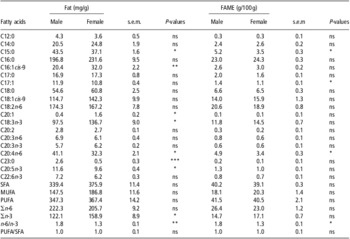
The intramuscular fatty acid composition, expressed both as mg/g fat and percentage is shown in Table 3. No statistically significant differences (P > 0.05) between the sexes were found regarding total saturated fatty acids (SFA), monounsaturated fatty acids (MUFA) and polyunsaturated fatty acids (PUFA). The foal meat fatty acids in this study are predominated by PUFA and their levels were ∼41% of total methyl esters, followed by SFA, ∼39.7% of total methyl esters and finally, MUFA, ∼19.3% of total methyl esters. These results are in agreement with those reported by other authors for foal meat (Jankowska et al., Reference Jankowska, Korzeniowski and Kwiatkowska1996) as PUFAs were the most abundant of fatty acids. Other authors have found SFA (Sarriés et al., Reference Sarriés, Murray, Troy and Beriain2006; Tateo et al., Reference Tateo, De Palo, Ceci and Centoducati2008; Juárez et al., Reference Juárez, Polvillo, Gómez, Alcalde, Romero and Varela2009; Lanza et al., Reference Lanza, Landi, Scerra, Galofaro and Pennisi2009; Lorenzo et al., Reference Lorenzo, Fuciños, Purriños and Franco2010) or MUFA (Badiani et al., Reference Badiani, Nanni, Gatta, Tolomelli and Manfredini1997) as the predominant fatty acids in horse meat.
Effect of sex on the intramuscular fatty acid profile from longissimus dorsi of foal meat
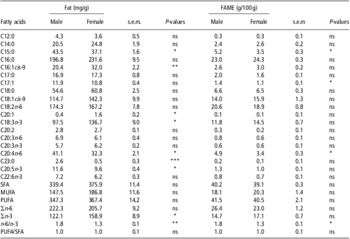
s.e.m. = standard error of the mean; ns = not significant; FAME's = fatty acid methyl esters; SFA = ∑ (C12:0 + C14:0 + C15:0 + C16:0 + C17:0 + C18:0 + C23:0); MUFA = ∑ (C16:1 + C17:1 + C18:1 + C20:1); PUFA = ∑ (C18:2n6 + C18:3n3 + C20:2 + C20:4n6 + C20:3n6 + C22:6n3 + C20:3n3).
***P < 0.001, **P < 0.01, *P < 0.05.
Within the PUFA, the predominant fatty acid was linoleic acid (Table 3), with similar results to those reported by Juárez et al. (Reference Juárez, Polvillo, Gómez, Alcalde, Romero and Varela2009) in 24-month-old Hispano-Bretón breed male foals and by Sarriés et al. (Reference Sarriés, Murray, Troy and Beriain2006) in Burguete breed 24-month-old foals. However, others authors showed levels of ∼20% in Burguete breed slaughtered at 24 months of age (Juárez et al., Reference Juárez, Polvillo, Gómez, Alcalde, Romero and Varela2009), and in Sanfratellano and Haflinger breed slaughtered at 18 months of age (Lanza et al., Reference Lanza, Landi, Scerra, Galofaro and Pennisi2009), whereas results reported by Badiani et al. (Reference Badiani, Nanni, Gatta, Tolomelli and Manfredini1997) showed levels of 12%. The second main PUFA was linolenic acid (C18:3n-3). Forages such as grass and clover contain a high proportion (50% to 75%) of total acids as linolenic acid (Dewhurst et al., Reference Dewhurst, Shingfield, Lee and Scollan2006) and its content in tissues is directly related to the dietary intake of the animal. The greater proportion of C18:3n-3 that is present in foal samples from semi-extensive production system can be attributed to them having only grazed until they were slaughtered. The contents of α-linolenic acid were higher than those reported by Sarriés et al. (Reference Sarriés, Murray, Troy and Beriain2006) who observed values of 0.75% in LD from foals slaughtered at 16 months of age and those found by Badiani et al. (Reference Badiani, Nanni, Gatta, Tolomelli and Manfredini1997) and Tateo et al. (Reference Tateo, De Palo, Ceci and Centoducati2008), who showed levels of 4.92% and 4.53%, respectively.
On the other hand, arachidonic acid (C20:4n-6) levels point out significant differences between sexes (4.92% v. 3.41%; P < 0.05; for male and female, respectively) and agree with those reported by Sarriés et al. (Reference Sarriés, Murray, Troy and Beriain2006) who found higher contents in male than female, although their values were lesser (>2.60%). The levels of C20:5n-3, EPA obtained in our study were also higher than those reported by Sarriés et al. (Reference Sarriés, Murray, Troy and Beriain2006) and Lanza et al. (Reference Lanza, Landi, Scerra, Galofaro and Pennisi2009) who detected values of EPA above 0.50%. Finally, the proportions of C22:6n-3 DHA we found were also higher that those reported by the aforementioned authors, whereas Badiani et al. (Reference Badiani, Nanni, Gatta, Tolomelli and Manfredini1997) and Tateo et al. (Reference Tateo, De Palo, Ceci and Centoducati2008) did not detect linolenic acid n-3 series derivatives in horse meat. It was found from Pearson correlation test that the higher level of PUFA content that was obtained in our study from foal meat samples in freedom-extensive production system had a significant (r = 0.63, P < 0.05) correlation with C20:3n-3 content and it is significantly related (P < 0.05) to C20:4n-6 content (r = 0.65).
Within the SFA, the main fatty acid was palmitic, ∼60% of total intramuscular SFA, followed by C18:0, results in agreement with those reported by other authors for equine meat (Badiani et al., Reference Badiani, Nanni, Gatta, Tolomelli and Manfredini1997; Sarriés et al., Reference Sarriés, Murray, Troy and Beriain2006; Polidori, et al., Reference Polidori, Vincenzetti, Cavallucci and Beghelli2008; Tateo et al., Reference Tateo, De Palo, Ceci and Centoducati2008; Lanza et al., Reference Lanza, Landi, Scerra, Galofaro and Pennisi2009; Lorenzo et al., Reference Lorenzo, Fuciños, Purriños and Franco2010). Finally, within MUFA, oleic was the most abundant one, showing levels of ∼77% of total MUFA. Similar proportion was reported by Juárez et al. (Reference Juárez, Polvillo, Gómez, Alcalde, Romero and Varela2009), but other authors obtained higher levels (86%) (Polidori et al., Reference Polidori, Vincenzetti, Cavallucci and Beghelli2008; Tateo et al., Reference Tateo, De Palo, Ceci and Centoducati2008), although lower proportions were also described (71% to 74%; Sarriés et al., Reference Sarriés, Murray, Troy and Beriain2006; Lanza et al., Reference Lanza, Landi, Scerra, Galofaro and Pennisi2009).
The high level of PUFA that was found in foal meat samples from extensive production system accounted for a favourable PUFA/SFA ratio (1.03), which was higher than the recommended ratio of 0.45 by the British Department of Health (1994). The n-6/n-3 ratio should not exceed 4.0 (British Department of Health, 1994). In our study, this proportion was within the nutritional recommendations for the human diet in both sexes and its value was significantly different between the sexes (Table 3) and significantly correlated (r = −0.91, P < 0.01) with C18:3n-3 content. It is interesting to note that n-6/n-3 values found in our experiment were more favourable than those (8 to 15.6) reported by Sarriés et al. (Reference Sarriés, Murray, Troy and Beriain2006) in foals slaughtered at 16 and 24 months of age, and they were better when compared with values (∼7) reported in a monogastric species as pork (Wood et al., Reference Wood, Enser, Fisher, Nute, Sheard and Richardson2008).
Amino acid composition
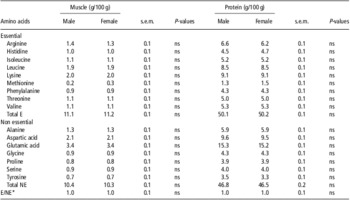
The hydrolyzated amino acid profile of Galician foal, expressed both as g/100 g edible portion and g/100 g protein is shown in Table 4. No statistically significant differences (P > 0.05) in amino acid contents were found between sexes. In the light of the recently revised estimates of the amino acid requirements for adults proposed by the Institute of Medicine and Food and Nutrition Board (2002) and still referring to a 100 g edible portion, foal meat appears to be an excellent source of high biological value proteins because it contains essential amino acids in an appropriate ratio. These amino acids are very important in a diet of poor nutritional quality when the caloric intake is low, or for certain population groups with specific nutritional requirements, such as children, invalids and old people (Reig and Toldrá, Reference Reig and Toldrá1998). The presence of animal proteins in the diet favours the absorption of minerals such as haem iron and trace elements. In this case, protein content in foal samples is about 22 g/100 g. Both male and female had higher essential amino acid percentages (<50%) when compared with the total amino acid contents. Arginine was included between the essential amino acids, as done by Hoffman et al. (Reference Hoffman, Kritzinger and Ferreira2005), because arginine is considered a conditionally essential amino acid (Arienti, Reference Arienti2003).
Effect of sex on the amino acid composition from longissimus dorsi of foal meat
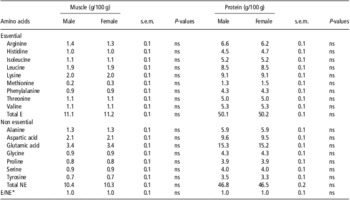
s.e.m. = standard error of the mean; ns = not significant; E/NE* = essential to non-essential amino acid ratio.
The essential amino acids at the highest concentration in Galician foal meat samples were lysine (about 2.04 g/100 g) and leucine (about 1.90 g/100 g). These values were higher than those obtained by Polidori et al. (Reference Polidori, Vincenzetti, Cavallucci and Beghelli2008) who reported values of 1.77 and 1.51 g/100 g for lysine and leucine, respectively, in donkey meat, and they were also higher than those given by Badiani et al. (Reference Badiani, Nanni, Gatta, Tolomelli and Manfredini1997) who showed values of 1.57 and 1.52 g/100 g for lysine and leucine, respectively, in horse meat. Lysine represented about 18.25% of total essential amino acids. The essential amino acid requirement for an adult man weighing 70 kg is about 12.90 g/day (FAO/WHO/UNU, 2007). Our results indicated that 100 g of foal meat covered 15.5% of the daily requirement for essential amino acids.
Glutamic acid, aspartic acid and alanine were the most abundant amino acids found in the non-essential fraction representing a mean value of 15.3%, 9.60% and 5.97% of the protein, respectively, whereas the lowest mean values were found out in tyrosine (3.45%), proline (3.92%) and serine (4.05%). In other red meat; such as lamb, goat and camel (Elgasim and Alkanhal, Reference Elgasim and Alkanhal1991), glutamic and aspartic acid in the non-essential fraction and lysine and leucine in the essential fraction were also the major amino acids.
Some of the amino acids present in foal meat may produce additional benefits for the nervous system (Gaull, Reference Gaull1990), and glutamic acid, which has relevance for metabolic processes, has potential preventive effects for certain diseases (Neu et al., Reference Neu, Shenoy and Chakrabarti1996). A particularly highly essential amino acid/non-essential amino acid ratio (<1%) was also recorded.
Sensory properties
Mean scores given by the panellists for foal meat is shown in Supplementary Figure S3. Sensory traits of LD from foals were not significantly (P > 0.05) influenced by sex. Colour is one of the most critical characteristics that consumers consider when making a decision to purchase meat (Nam et al., Reference Nam, Choi, Jeong and Kim2009). Panellists observed similar scores for foal meat colour (around 5.7). This result was slightly higher than that showed in a previous report (Franco et al., Reference Franco, Rodríguez, Purriños, Crecente, Bermúdez and Lorenzo2011b). According to Risvik (Reference Risvik1994), flavour is of great importance for the overall sensory trait of meat, and the absence of abnormal flavour is thought to be critical for acceptability. Meat flavour difference (5.1 v. 5.9 for male and female, respectively) could be related to the sex or different IMF contents (Table 2). In our study, samples from foal meat showed low values (around 0.4) for this attribute. Huff-Lonergan et al. (Reference Huff-Lonergan, Baas, Malek, Dekkers, Prusa and Rothschild2002) suggested that flavour is positively correlated with tenderness in pork meat, but we did not find any correlation with flavour. On the other hand, juiciness is the amount of perceived juices in the meat during chewing or mastication and thus it is one of the major meat characteristics influencing eating quality (Maltin et al., Reference Maltin, Warkup, Matthews, Grant, Porter and Delday1997). Several studies have reported that juiciness is also negatively correlated with cooking loss (Huff-Lonergan et al., Reference Huff-Lonergan, Baas, Malek, Dekkers, Prusa and Rothschild2002). However, cooking loss was not significantly correlated in this study, which is consistent with results obtained by Brewer et al. (Reference Brewer, Jensen, Sosnicki, Fields, Wilson and McKeith2002).
Among the sensory quality traits, tenderness is the most important factor affecting overall meat acceptability (Maltin et al., Reference Maltin, Warkup, Matthews, Grant, Porter and Delday1997). The tenderness score was positively correlated with cooking loss (r = 0.40, P < 0.05) and WBS (r = 0.43, P < 0.05). According to Tornberg (Reference Tornberg1996), of the instrumental techniques that measure meat tenderness, WBS shows the best correlation with the subjective tenderness scores of sensory panellists; we also found a correlation between WBS and hardness.
Conclusions
The sex effect had no statistical significance on carcass measurements, chemical composition, colour parameters, textural properties, amino acid content and sensory characteristics. On the other hand, there was a significant effect on the intramuscular fatty acid profile of LD muscle. Male foal showed a slightly higher slaughter weight than female foal and this parameter affected carcass weight, which was slightly higher in the male group compared with the female group. If we consider cooking loss, this feature was clearly higher in male animals than in female animals. Finally, foal meat from the female group had better nutritional properties than the male group.
Acknowledgements
The authors are grateful to Xunta de Galicia (The Regional Government) (Project 10MRU004CT) for the financial support. Special thanks to ‘Monte Cabalar’ (A Estrada, Pontevedra) for the foal samples supplied for this research.
Supplementary material
For supplementary material referred to in this article, please visit http://dx.doi.org/10.1017/S1751731113000189