Introduction
Cholesteatoma is a peculiar, locally aggressive lesion of the middle ear characterised by invasive growth as well as the presence of a sac-like accumulation of keratin. The majority of cholesteatomas are acquired, and they are often accompanied by otitis media. Cholesteatoma develops in between one-third to one-half of all patients with active chronic otitis media.Reference Michaels 1
The pathogenesis of cholesteatoma is unclear despite ongoing research. Several theories have been proposed but none has adequately explained the mechanism of the disease. A mechanism of disturbed wound healing has been proposed.Reference Huisman, de Heer, Ten Dijke and Grote 2 – Reference Noli and Miolo 7 Cholesteatomas form due to ingrowth of squamous epithelium into the middle-ear space, with resultant ongoing inflammation and bacterial infection. As cholesteatomas are usually associated with inflammatory reactions in the middle-ear cavity, inflammatory granulation tissue often appears alongside the invading epithelium of active cholesteatomas.Reference Olszewska, Wagner, Bernal-Sprekelsen, Ebmeyer, Dazert and Hildmann 4
It is known that mast cells play an important role in wound healing. Recent studies have reported that mast cells can produce fibroblast and keratinocyte growth factors and angiogenic and matrix remodelling factors.Reference Noli and Miolo 7 , Reference Artuc, Steckelings and Henz 8 Cholesteatoma keratinocytes from the basal and suprabasal epithelial layers demonstrate altered growth control and a hyperproliferative state.Reference Vennix, Kuijpers, Tonnaer, Peters and Ramaekers 9 – Reference Ergün, Zheng and Carlsöö 11 Mast cell granules contain mitogenic mediators including basic fibroblast growth factor and interleukins 6 and 8. Furthermore, tryptase, the major neutral protease of mast cells, in addition to its role in proteolysis and tissue repair, has also been demonstrated to be a mitogen for DNA synthesis in epithelial cells, endothelial cells and fibroblasts.Reference Cairns and Walls 12 – Reference Brown, Jones, Tyler, Ruoss, Hartmann and Caughey 14
The mast cell and stem cell growth factor receptor known as proto-oncogene c-Kit or cluster of differentiation 117 protein (also known as CD117) is a protein that provides a key signal involved in many aspects of mast cell differentiation and function.Reference Valent 15 Genetic investigation of mast cell proliferation has focussed on this protein, which is a member of the tyrosine kinase receptor family.Reference Edling and Hallberg 16 The c-Kit proto-oncogene codes for a 145 to 160 kDa, type III transmembrane tyrosine kinase receptor protein, and plays an important role in the development of c-Kit bearing cells such as mast cells. Several studies have suggested that the cluster of differentiation 117 protein influences the regulation of mast cell proliferation, activation and chemotaxis.Reference Jensen, Metcalfe and Gilfillan 17 – Reference Sharma, Sriram, Saraswathi and Sivapathasundharam 19
Understanding the pathophysiological mechanisms that underlie cholesteatoma pathogenesis is particularly important since this entity has a destructive nature. The present study aimed to investigate the role of cluster of differentiation 117 protein positive mast cells in the formation of human cholesteatoma, in order to aid the development of innovative, targeted therapies.
Materials and methods
This was a retrospective study of 52 patients with chronic otitis media who underwent potentially curative surgery between 2003 and 2010 in the ENT surgery department of İzmir Training and Research Hospital. Patients were divided into three groups. Group one consisted of 22 patients with chronic otitis media and no cholesteatoma, from whom chronic otitis media granulation tissue specimens were taken. Group two consisted of 25 patients with chronic otitis media and cholesteatoma, from whom cholesteatoma matrix specimens were taken. Finally, a control group comprised normal post-auricular skin samples (subepithelial layers were examined) obtained from five patients with chronic otitis media who had undergone middle-ear surgery.
Formalin-fixed, paraffin-embedded tissue specimens were processed for conventional histopathological analysis. A total of 52 samples were evaluated, each selected from an appropriate, representative paraffin block from each patient. Consecutive, five micrometre thick sections were mounted on amino alkyl silane coated glass slides for immunohistochemical analysis. Immunohistochemical procedures were performed using the Bond Polymer Intense Detection system (Leica Microsystems, North Ryde, New South Wales, Australia), according to the manufacturer's instructions except for minor modifications. Sections were automatically deparaffinised using Bond Dewax solution (Leica Microsystems). Reactives were added automatically, and samples were treated with Bond ER solution (Leica Microsystems) as antigen retriever and processed for 30 minutes at 100°C. Endogenous peroxidase was quenched by incubation with hydrogen peroxide for five minutes. Slides were incubated with cluster of differentiation 117 protein polyclonal antibody (Dako, Glostrup, Denmark) at a dilution of 1:400 for 60 minutes. Sections were then treated according to the streptavidin-biotin-peroxidase complex method (Bond Polymer Refine Detection, Leica Microsystems), with diaminobenzidine as a chromogen, and counterstained with haematoxylin. Immunostaining of gastrointestinal stromal tumour sections served as a positive control.
Quantitation of mast cell density
Mast cells were highlighted by immunostaining for cluster of differentiation 117 protein in cholesteatoma matrix, chronic otitis media granulation tissue and normal epithelium.
The density of cluster of differentiation 117 protein positive mast cells was determined by assessing the direct staining intensity, as follows. The three areas containing the most significant numbers of mast cells were identified using low power magnification (×10 and ×20). The mast cells in these three ‘hot spot’ areas of high density were then examined using ×400 high power field magnification (with a ×40 objective) and a 10 × 10 eyepiece grid (covering an area of 0.0625 mm2). The mean number of mast cells in each grid field was used for the analysis.
The mean number of cluster of differentiation 117 protein positive mast cells per mm2 was calculated using the following formula (validated in Sharma and colleagues' study):Reference Sharma, Sriram, Saraswathi and Sivapathasundharam 19

where the area of the ocular grid was 0.0625 mm2.
All mast cell counts and density calculations were performed by a single investigator, to eliminate inter-observer variation. Mast cell counts and density calculations were repeated ‘blind’ two months later, and no discrepant results were found. In this way, all mast cell counts and density calculations were standardised. Standardised mast cell density values are expressed as cells per mm2.
Statistical methods
Statistical analysis was undertaken using Minitab 14 software. The Anderson–Darling normality test was used to assess the normal distribution of the population. Since many of the variables were not normally distributed, a non-parametric statistical method was used. Data were presented as medians with minimum and maximum values. The association between cluster of differentiation 117 protein positive mast cell density and cholesteatoma formation in chronic otitis media was statistically evaluated using the non-parametric Kruskal–Wallis test. When this test produced significant results, the Mann–Whitney U-test was used for pair-wise group comparisons. Because of multiple group comparisons, the threshold of statistical significance was reduced from 0.05 to 0.01, and two-tailed p values of less than 0.01 were considered statistically significant.
Results
This study aimed to determine whether cluster of differentiation 117 protein positive mast cells play a critical role in the formation of cholesteatoma. The number and density of these mast cells were analysed in a total of 52 cases, comprising 22 chronic otitis media patients without cholesteatoma (group one), 25 chronic otitis media patients with cholesteatoma (group two) and five controls.
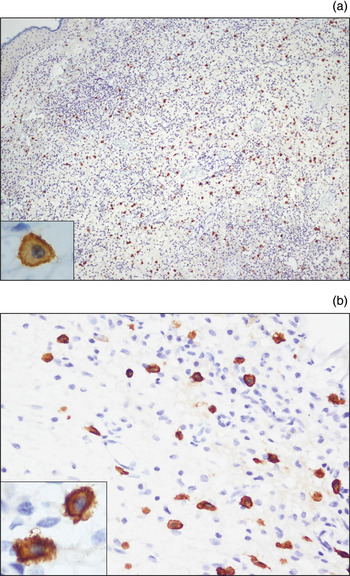
Very few mast cells were detected in the subepithelial areas of the normal post-auricular skin taken from control cases. The number of cluster of differentiation 117 protein positive mast cells was greatly increased in cholesteatoma matrix compared with normal post-auricular skin (p = 0.011) (Figure 1). Group two cases (cholesteatoma matrix) showed a higher mean number of such mast cells per high power field, compared with group one (chronic otitis media granulation tissue).
Photomicrographs showing immunoreaction of cluster of differentiation 117 protein positive mast cells in cholesteatoma matrix from patients with chronic otitis media and cholesteatoma, using avidin–biotin complex method: (a) ×100; (b) ×200 (both insets: ×1000).

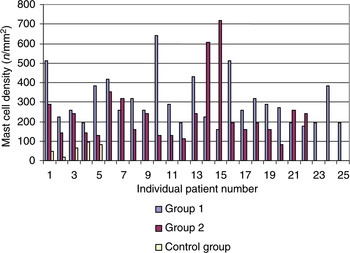
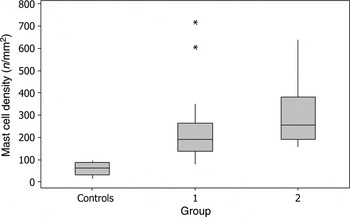
In group one, the density of cluster of differentiation 117 protein positive mast cells was much greater than in the control group, while in group two all patients had a significantly greater density of these mast cells than in the control group (p < 0.01) (Figure 2). The median mast cell density was 192/mm2 (range, 80–720/mm2) in group one, 256/mm2 (range, 160–640/mm2) in group two and 64/mm2 (range, 16–96/mm2) in controls (Figure 3).
Histogram showing density of cluster of differentiation 117 protein stained mast cells within specimens from individual, numbered patients from the three groups. All specimens from the first patients in each group were processed together, then all specimens from the second patients in each group, etc.

Box plot comparison of the density of cluster of differentiation 117 protein positive mast cells in the three groups.

The mast cell density differed significantly between the groups (p = 0.00). Quantitative analysis showed a significantly greater mast cell density in group two compared with both group one and the control group (p < 0.01). Table I compares the mast cell densities of group one, group two and the control group.
CD117 postive mast cell density by group

*Mann–Whitney U-test. Total n = †5, **22 and §25. ‡Controls vs group 1; #group 1 vs group 2. ¥ p = 0.000 for association between CD117-positive mast cell density and cholesteatoma formation in chronic otitis media (Kruskal–Wallis test). CD117 = cluster of differentiation 117 protein
Discussion
Our study findings enable a better understanding of the role of mast cells in cholesteatoma pathogenesis, by supplying evidence of an increase in the density of cluster of differentiation 117 protein positive mast cells in cholesteatoma matrix tissue, compared with chronic otitis media granulation tissue and normal epithelium. To the best of our knowledge, this is the first study to investigate the potential role of these mast cells in cholesteatoma pathogenesis.
Several theories have been proposed to explain the underlying pathogenic mechanism of cholesteatoma.Reference Olszewska, Wagner, Bernal-Sprekelsen, Ebmeyer, Dazert and Hildmann 4 , Reference Louw 20 , Reference Friedland, Eernisse, Erbe, Gupta and Cioffi 21 However, these theories are insufficient to fully answer the question of why and how cholesteatoma occurs. One such theory of cholesteatoma pathogenesis focusses on disturbed wound healing.Reference Huisman, de Heer, Ten Dijke and Grote 2 , Reference Albino, Reed, Bogdany, Sassoon and Parisier 3 , Reference Albino, Parisier and Ars 5 , Reference Albino, Kimmelman and Parisier 6 Wound healing is a protracted, complex process that results from the interplay of different tissue structures and large numbers of infiltrating and resident cells.Reference Li, Dasgeb, Phillips, Li, Chen and Garner 22 , Reference Artuc, Hermes, Steckelings, Grützkau and Henz 23 Huisman et al. have described the role of transforming growth factor β in cholesteatoma patients, and have suggested that wound healing is disturbed in this lesion.Reference Huisman, de Heer, Ten Dijke and Grote 2
Mast cells are associated with the wound healing process, especially in the proliferative (re-epithelialization) and remodelling phases.Reference Albino, Kimmelman and Parisier 6 , Reference Artuc, Hermes, Steckelings, Grützkau and Henz 23 Mast cells are stimulated during early wound healing via a plethora of biologically active mediators (including interleukins 1, 3, 4, 6, 12, 13 and 16, transforming growth factor, granulocyte macrophage colony stimulating factor, chemotactic factors and proteases). These mediators are involved in various wound healing phenomena such as hypervascularisation, hyperproliferation, and migration and invasion of epithelium.Reference Albino, Reed, Bogdany, Sassoon and Parisier 3 , Reference Albino, Parisier and Ars 5 , Reference Albino, Kimmelman and Parisier 6 , Reference Dowdall, Winter, Baird and Bouchier-Hayes 24 , Reference Bujía, Kim, Holly, Sudhoff, Ostos and Kastenbauer 25 After mast cells migrate to a tissue, their accumulation and survival is controlled by the microenvironment and by the local secretion of one or more cytokines (e.g. interleukins 3, 4 and 9, and mast and stem cell growth factor receptor), some of which are produced by cell types found within cholesteatoma or by adjacent granulation tissue.Reference Ergün, Zheng and Carlsöö 11 , Reference Shinoda and Huang 26 – Reference Saarinen, Kalkkinen, Welgus and Kovanen 28 Therefore, elevated concentrations of mast cells may play an important role in the pathogenesis of cholesteatoma. As well as cytokines, mast cells also secrete copious amounts of proteinases such as tryptase, chymase, carboxypeptidase and cathepsin G.
These mast cell proteinases and cytokines perform functions which could affect a number of the clinical features of cholesteatomas. For instance, secretion of various proteinases may support the ability of cholesteatoma to invade and remodel normal tissue by degrading various components of the extracellular matrix.Reference Dabbous, North, Haney, Tipton and Nicolson 29 , Reference Zoog, Itano, Trueblood, Pacheco, Zhou and Zhang 30 Furthermore, tryptase, the major neutral protease of mast cells, in addition to its role in proteolysis and tissue repair, is a mitogen for DNA synthesis in epithelial cells.Reference Albino, Kimmelman and Parisier 6 , Reference Cairns and Walls 12
In the current study, we investigated the possible importance of mast cells in the pathogenesis of cholesteatoma by using immunostaining for cluster of differentiation 117 protein (c-Kit) to identify mast cells within cholesteatoma matrix. In cholesteatoma matrix from patients with chronic otitis media and cholesteatoma (group two), the mean number of mast cells per high power field was greater than in chronic otitis media granulation tissue from patients with chronic otitis media without cholesteatoma (group one). In addition, the density of cluster of differentiation 117 protein positive mast cells was found to be markedly increased in group two specimens, compared with group one and control specimens. These findings suggest that mast cells play a significant role in cholesteatoma formation, and support Albino and colleagues' report of an increased number of mast cells in chronic otitis media tissue from patients both with and without cholesteatoma.Reference Albino, Reed, Bogdany, Sassoon and Parisier 3 Albino et al. demonstrated that these inflammatory cells play a critical role in the maintenance of inflammation as well as the formation of cholesteatoma. Their findings also indicate that mast cells play an important role in the development of one or more aspects of cholesteatoma pathology.Reference Albino, Reed, Bogdany, Sassoon and Parisier 3
Zoog et al. observed that mast cell accumulation close to healing wounds was partially blocked by imatinib mesylate.Reference Zoog, Itano, Trueblood, Pacheco, Zhou and Zhang 30 These authors stated that further studies were needed to investigate the effect of therapy aiming to decrease the number and activity of cluster of differentiation 117 protein positive mast cells within cholesteatoma.
-
• Cluster of differentiation 117 protein positive mast cells were assessed in chronic otitis media patients with and without cholesteatoma, and controls
-
• Mast cell density was far greater in cholesteatoma matrix than in chronic otitis media granulation tissue or normal subepithelial tissue
-
• These mast cells could influence cholesteatoma formation
-
• This influence could be exploited to develop new cholesteatoma treatments
Our results clearly point to the same conclusions. We found that cluster of differentiation 117 protein positive mast cells were more frequent within otitis media granulation tissue, and even more so within cholesteatoma matrix, compared with normal subepithelial tissue. These findings support the theory that cluster of differentiation 117 protein positive mast cells play an important role in cholesteatoma formation. Furthermore, elucidation of the role of cluster of differentiation 117 protein positive mast cells in cholesteatoma pathogenesis might suggest new ways of addressing this disorder, and may lead to the development of new, targeted treatments.
Our study findings indicate that suppression of mast cell function may impede cholesteatoma growth. However, our results should be confirmed in larger patient series. In addition, patients with otitis media and an increased density of cluster of differentiation 117 protein positive mast cells should undergo extended follow up to evaluate the significance of these findings: specifically, are these patients more prone to cholesteatoma formation, and what can be done pharmacologically to alter the disease outcome?
Conclusion
This study assessed the density of cluster of differentiation 117 protein positive mast cells in patients with chronic otitis media with and without cholesteatoma. Mast cell density was much greater in cholesteatoma matrix from patients with chronic otitis media and cholesteatoma, compared with chronic otitis granulation tissue from patients with chronic otitis media alone, and with normal subepithelial tissue from controls (p < 0.01). Thus, we suggest that cluster of differentiation 117 protein positive mast cells could play a role in cholesteatoma formation. Further investigation of the involvement of these mast cells in cholesteatoma pathogenesis may aid the development of new, targeted treatment methods.