I
‘I think nothing…is so likely to do good as government inspectors [whom] I consider as officers of the greatest importance’, declared the penal reformer Elizabeth Fry before a House of Lords inquiry in 1835. ‘They do great good in Ireland’, she insisted, based on her knowledge of and travels through that country, and ‘they would do much good in England’.Footnote 1 The introduction of central-government inspectors of prisons in Britain has been seen as a key Whig achievement of the 1830s, alongside the new factory and poor-law inspectorates. But an Irish prefiguration enacted by a liberal Tory chief secretary, Charles Grant, in the early 1820s has gone unnoticed by scholars. This important British prison-reform act has thus been seen primarily within the context of British, or rather English, politics alone. This article sets out to trace the Irish precedent for this later reforming measure and in the process to consider prison reform in the United Kingdom in the early nineteenth century in a transnational manner, in line with recent scholarship that has stressed the many connections between social reforms in the four nations of the British Isles. Parts I to III of the article analyses Irish and British penal-reform policy from the late eighteenth century to about 1823. Part IV looks at the crucial years between 1823 and 1835 in both countries and offers a new analysis based on detailed examination of parliamentary inquiries and new legislation that shows how developments in the two countries overlapped and how reforms in one jurisdiction affected the other. Part V looks briefly at prison reform in Britain after 1835 and considers some broader implications of the new central-government inspectorate. By exploring the channels through which the exchange of knowledge and ideas occurred both in parliament, and through voluntary penal-reform societies, this article highlights inadequacies with the theory supported by some scholars that Ireland functioned as a laboratory for British social reform at this time. It is instead suggested that a more fluid exchange of ideas occurred in both directions between the two countries.
In the early evolution of the nineteenth-century British prison system, legislation from two years looms large: 1823 and 1835.Footnote 2 The first act – what became known as Peel's Act, however little he contributed to its writing in practice – set up a new local inspection system managed by justices of the peace and required local authorities to send annual reports to the secretary of state on the condition of their prisons. This measure was, as Norman Gash has argued, at its heart prompted by practicalities and not by any wider desire to bring about sweeping or extensive changes.Footnote 3 It called for tangible, and often architectural, changes to existing prisons, but its ambition, scope, and effect were limited. The second law – the Whig government's introduction of a centrally funded prison inspectorate in 1835 – represented instead a change in the philosophy of administration and reflected a shift in the principles then governing penal reform. By its unavoidable encroachment onto the powers of local government, then for the most part controlled by justices of the peace, this second act constituted a key episode in the emergence of nineteenth-century central-government intervention. It also prefigured even greater moves in the decades that followed. As Robert Cooper has argued, the issue of inspection was quite distinct and unique; it was little influenced by, for example, the evangelicalism of Elizabeth Fry or the utilitarianism of the Benthamites, in that it concerned the issue of enforcement. There was little point in making laws about how prisoners should be housed or treated if central government had no powers of enforcement over the local elites who managed these prisons.Footnote 4 Inspection, which could expose failings, produce uniformity of standards, and drive up quality, was an essential new weapon of government at the time.Footnote 5 The existing historiography highlights the natural resistance of local magistrates to ceding power to central government. It also underscores the reluctance of the Tory party to challenge these local authorities in their management of prisons in any meaningful manner.Footnote 6 For Gash, imposing central-government inspectors would have been ‘scarcely practicable’ during Peel's time as home secretary. Few Tory voices saw the benefit in usurping the historic right of local elites to manage their own criminal-justice systems. Characteristically, Peel opted instead for ‘modest and pragmatic alterations’, according to Randall McGowen, leaving more radical measures for a more radical decade.Footnote 7 It was only under the Whig governments of the 1830s that a fundamental shift in British penal policy occurred, and this change precipitated the introduction of inspectors in the 1835 act.Footnote 8
It is necessary to pin down some broader terminological issues at the outset. As Joanna Innes has discussed, terms such as ‘central government’ and ‘local government’ were rarely used in the early nineteenth century.Footnote 9 ‘Social policy’ and ‘social reform’ are equally nebulous terms yet they are evidently crucial to framing the arguments made in this article. There are heuristic reasons for adopting these terms here, despite some reservations. In both Britain and Ireland, central government is here taken to mean parliament and the proactive agencies under its direct remit, such as salaried prison inspectors who provided government with information and attempted to enforce its legislation. Local government is a more heterogeneous grouping but here applies to justices of the peace (particularly in Britain), grand jurors (particularly in Ireland), municipal corporation officials, and the other local bodies who operated and managed their own prisons independent of central government at this time. These prisons included gaols, houses of correction, marshalseas, and bridewells but excluded those prisons directly funded by central government, such as convict penitentiaries and some marshalseas. Also, the term bridewell had differing meanings in both counties; in Britain, it denoted a house of correction for petty offenders, in Ireland, it encompassed all of the smaller provincial prisons in the rural towns and villages where offenders were kept, at least in theory, for a short period before being transferred to a county gaol.Footnote 10
The transnational history of social reform in Britain and Ireland is a relatively recent endeavour but certain areas have been examined such as police and law reform.Footnote 11 Stanley Palmer's Police and protest in England and Ireland, 1780–1850 was a pioneering attempt to interweave the politics of social reform in one key area – policing – but in other respects he reinforced a long-standing historiographical concept that was especially suited to his study but needs to be questioned in other respects.Footnote 12 This is the idea espoused since at least W. L. Burn's 1949 article on land reform that suggested Ireland was a kind of ‘laboratory’ for British social reformers in the nineteenth century where experiments could be carried out before being implemented back home.Footnote 13 For Palmer, the new highly centralized quasi-military police force ‘imposed’ on Ireland by Chief Secretaries Robert Peel, Charles Grant, and Henry Goulburn made the country ‘a police laboratory’.Footnote 14 This argument has some truth to it, without doubt, and few would question Ireland's exceptional law-and-order, economic, and sectarian conundrums.Footnote 15 Contemporary voices are replete with references to how unique Ireland was when compared to England or indeed Scotland. But in a broader sense, the ‘laboratory’ thesis is a reductive and limiting framework, and many Irish historians are sceptical of many of its implications. It denies any possibility of a two-way flow of ideas, and of the mutual benefit to both nations of the exchange, adaption, or re-use of policies devised elsewhere. It implies that social change could be imposed only in a top-down fashion from London cabinet ministers and simplifies the reciprocal links between backbench politicians, philanthropic organizations and private individuals. It diminishes their distinct agency. As Innes has commented in relation to another facet of social reform – the provision of schools – in the years around 1800, public discussion in fact ‘ranged across the British isles in the search of exemplars’ and she argued that its history stands to be enriched by tracing the key interlocutors and their transnational social and professional networks.Footnote 16
The same can be said of prison reform. After 1800, when the two parliaments were united, it might be expected that a new homogeneity in reform legislation would have emerged. However, Innes has shown that this was categorically not the case and the vast majority of new laws remained what she has termed ‘parallel’ as opposed to ‘integrative’ in nature.Footnote 17 The former meant laws for one nation that closely emulated those already in force elsewhere; the latter were the more unusual measures that applied uniformly throughout the United Kingdom. Of course, it was entirely possible to borrow from existing legislation in one jurisdiction long before the Act of Union; Oliver MacDonagh has traced the many intersections in late eighteenth-century prison-reform developments between the parliaments in Westminster and Dublin.Footnote 18 The abolition of the latter in 1800 made this process, at least on paper, more efficient. This article seeks to build on the framework proposed by Innes and provide a detailed transnational look at just one example of ‘parallel’ social-reform legislation in the 1820s and 1830s. The British act that appointed inspectors in 1835 has its own historiography with historians highlighting its links with the other inspectorates established by the Whig government through the Factory Act of 1833 and the New Poor Law Act of 1834.Footnote 19 This argument was likely first proposed by Sidney and Beatrice Webb in their influential, if now largely superseded, English prisons under local government (1922) and held that these two precedents legitimized the extension of the new system of enforcement-by-inspection to the poorly organized and rather unaccountable local prisons in Britain.Footnote 20 Within this framework, there has not been any analysis of liberal Tory policy in Ireland under Chief Secretary Charles Grant in the preceding decade. Furthermore, this focus on exclusively British sources is perhaps puzzling considering there are remarkably few references to either the factory or poor-law inspectors in the many select committee reports and parliamentary debates concerned with penal-reform issues in the twenty years before the seminal 1835 act.Footnote 21 Rather, contemporary voices saw Ireland as the natural source for information about how an inspectorate would work in practice, there having been such an office established since 1786, and a more powerful corps since Grant's reforms in 1822.Footnote 22
II
Ireland became the first country in the Western world to appoint a government-salaried prison inspector in 1786. Sir Jeremiah Fitzpatrick (c. 1740–1810) earned the nickname of ‘the second Howard’ after the British reformer John Howard.Footnote 23 The background to his appointment, his challenges and achievements, and the broader importance of his position, have been analysed at length by MacDonagh.Footnote 24 Despite Howard's international fame, in the 1770s and 1780s the flow of penal-reform ideas moved in both directions across the Irish Sea. On his first tour of Irish gaols in 1775, Howard was surprised to find some reforms he was proposing for English gaols, specifically regarding exercise yards, the prohibition of alcohol, and classification by gender, were already enforced (however intermittently) in Ireland through a 1764 act. Hoping the same for England, he quoted the relevant clauses.Footnote 25 The first act that Howard successfully lobbied for in Britain, in 1774, was a copy of an Irish act passed in 1763.Footnote 26 Two Irish acts in 1778, concerning convict hulks and gaol-fever, were in turn based on comparable English measures of 1776.Footnote 27 Further connections were forged through the ‘Thatched House Society’ for debtors in London, founded in 1773; it quickly gained Dublin and Cork sister organizations, the latter run by a notable Irish prison-reform MP, Henry Sheares. William Eden also made distinguished contributions to penal reform on both sides of the Irish Sea.Footnote 28 Fitzpatrick emulated Howard by both seeing that many new prisons were built throughout Ireland, by visiting English workhouses, and by his writings, An essay on gaol-abuses in 1784, and Thoughts on penitentiaries in 1790, both heavily influenced by Howard's philosophy.Footnote 29 There was thus significant cross-fertilization of prison-reform ideas between both kingdoms long before the Union brought their respective MPs more closely together.
Fitzpatrick's achievement in overseeing the first great rebuilding of Irish gaols was considerable but should not be overstated, and he resigned early in 1793 to take up a position as an inspector in the army.Footnote 30 One of the issues that hampered further reform at this time was the three-year gap between Fitzpatrick's departure in 1793 and the appointment of his successor, the Rev. Forster Archer, a Church of Ireland minister from Cork in 1796. Archer held his position for over twenty-five years, but he has been described by one historian as a ‘commonplace, untrained and unenthusiastic functionary, apparently appointed for political convenience and without any prior knowledge of or interest in gaols’.Footnote 31 Some new prisons in county towns, however, were built during his tenure, including those in Galway, Tralee, and Cork.Footnote 32 Many leant heavily on English precedents for their design and some local authorities employed English architects directly. With Archer's somewhat forced retirement in 1821 came a watershed moment in the history of Irish prison inspection, brought about in no small part by his woeful performance at a House of Commons inquiry in 1819 into the state of the United Kingdom's prisons – the first truly comprehensive investigation since the Act of Union. By this time, thanks in part to the work of the Prison Discipline societies in Dublin and London, increased focus was being placed on the smaller prisons (known in Ireland as bridewells) that dotted the provincial market towns.Footnote 33
The chairman of the inquiry, Charles Bathurst, thoroughly interrogated Archer, highlighting his lack of attention to these bridewells. Over the course of five days in May, Archer was subjected to a barrage of hostile questions, more than any other witness except an Australian on the transportation of convicts.Footnote 34 Archer was asked if his report on Irish prisons was based on visits to them all, or just to some of them, and when he had last visited a dozen or so named prisons. He had to admit that most bridewells were not built in accordance with legal requirements.Footnote 35 His answers cannot have instilled much confidence in his office or in the efficacy of central-government inspection. Whatever Archer's qualifications may have been for the post in the 1790s, the Prison Discipline organizations were now exerting more influence in both London and Dublin, and expectations had markedly increased. In this new environment, Archer's informal manner was deemed unsatisfactory, and the nature of the questioning suggests that members of the Irish administration may have used the opportunity to advance already fermenting plans to have him replaced with a more diligent and committed inspector versed in the new philanthropic rhetoric of administrative efficiency and humanitarian concern.Footnote 36 From the late 1810s, the Association for the Improvement of Prisons and of Prison Discipline in Ireland (AIPPD) maintained regular communication with its more established British near-namesake, the Society for the Improvement of Prison Discipline (SIPD), exchanging ideas about prison plans, regimes, inspection, and legislation.Footnote 37 The appointment of a new Irish chief secretary, Charles Grant, in 1818 added further impetus for change. An evangelical Protestant and a member of the British and Foreign Bible Society, Grant's humanitarian views on prison reform fitted snugly with the evangelical and Quaker leanings of the Prison Discipline societies. In Britain, some of the leading figures of the SIPD were Samuel Hoare and his sister-in-law Elizabeth Fry; in Ireland, the AIPPD was headed by Joseph Pim, a wealthy Quaker, and Henry Joseph Monck Mason, a co-founder of the controversial Irish Society, which sought to promote Protestant evangelical teaching through the Irish language. Grant became the AIPPD's greatest asset when he agreed to be its patron immediately upon its establishment in 1818 and he remained in this role long after he had departed Ireland in 1822.Footnote 38 Though the pro-Catholic Grant's period of office in Ireland has been largely seen by both nineteenth-century critics and later historians as a failure – Lady Gregory, for example, highlighted his many flaws and attributed his few achievements to his successor Henry Goulburn – it was with Grant's evangelical interest in penal reform that a new era of prison inspection was initiated in Ireland.Footnote 39 Archer's piecemeal, forgetful, and otherwise unsatisfactory answers must have made for uncomfortable reading in Dublin Castle, and Grant clearly felt that reform was necessary. Before the committee had even reported, he introduced and had passed his first Irish prisons act – a short measure concerning the appointment of clergymen as chaplains.Footnote 40 Another modest bill that followed in the next year was a precursor to a more extensive and ultimately successful effort in the spring and summer of 1821.Footnote 41 In the meantime, Grant abolished gaol fees in Ireland, following closely the wording of a British act from 1815.Footnote 42 This was cheerfully relayed to British readers in the Third report (1821) of the SIPD and one reviewer noted that ‘in Ireland, poor unhappy Ireland, one has a melancholy satisfaction in learning that a warm interest…is beginning to prevail, principally through the exertions of the [AIPPD] under the patronage of the Right Hon. Charles Grant…[The] act extending the abolition of gaol-fees to that country is of signal importance.’Footnote 43
The May 1821 version of Grant's prisons bill noted that ‘many bridewells and houses for idiots or lunatics do not appear to have been so visited’, and demanded that Archer as inspector general provide a full list of every prison, large and small, in the country.Footnote 44 At the same time, Grant listened attentively to the advice of the AIPPD, expressing his hope to one of its officers that he might ‘perhaps be able to fulfil the wish of the society, & shall on every account have pleasure in so doing’. The AIPPD was in turn heavily influenced by its more established London sister organization and regularly quoted from its reports; it took up campaigning for the same issues – gaol design, education, employment, female prisoners – in Ireland. While the AIPPD informed Grant that they were keen to include provisions for educating and employing prisoners in Ireland, he informed them to return quickly with their views on a much broader range of prison issues.Footnote 45 It was also not the first time Grant leant on the AIPPD: soon after the society was founded, he had asked them to inspect Dublin's new Richmond Penitentiary, and they had returned with an exceptionally detailed and critical appraisal.Footnote 46 In 1821, what Grant had originally described as ‘a very short bill’ grew, with the AIPPD's help, into a much more substantive measure. One of the key changes was the wording of the section that set out the role of government inspectors. Because the work of visiting every prison was deemed ‘too extensive and arduous for the performance of one officer’, the act permitted the appointment of two ‘inspectors-general of prisons’, who were to divide up the country between them and visit every prison at least biennially. Their detailed reports were to be sent to grand juries at each assizes, and every year a national report was to be prepared for Dublin Castle that would be laid before parliament. Heavy penalties were established for inspectors who failed to carry out their duties, and their salaries were to be paid only after their annual reports had been received.Footnote 47 In carrying this prison bill through parliament, Grant established a distinctly modern model of prison inspection, based on clear responsibilities and penalties (‘modern’ was a word that one of the new inspectors himself later used to describe the system).Footnote 48 By also requiring the new inspectors to compile a list of all the smaller prisons, the act hinted that further powers could soon be granted to manage, or even close, notorious local centres of confinement. This possibility soon became reality. By extending the powers of the government inspectors, and by threatening embarrassment to local elites through detailed and elegantly composed reports to be laid before parliament, the authors of the new law shifted the ethos of Irish prison inspection from a voluntary to a programmatic code. A clear signal of the dawning new future appeared when Archer's son Robert failed to succeed his father upon the latter's retirement in late 1821. Dublin Castle officials quickly made clear that Robert Archer would not be recommended, and that Grant had already decided to bring in new blood in order to carve out and consolidate the new powers of central government. ‘I could not recommend you’, William Gregory informed Archer, adding that there were other candidates ‘better qualified for the situation’.Footnote 49
III
In England, Wales, and Scotland, there was no comparable system of central-government inspection in the early 1820s. Throughout the preceding decade, much of parliament's energy had been spent investigating the deplorable condition of London's prisons with no fewer than three separate House of Commons inquiries.Footnote 50 Some light was shone on the provincial prisons in an 1819 investigation, and in the following year, new prison legislation was introduced for England and Wales. The issue of inspection first appeared in a bill of July 1820 to regulate English prisons. There was little new in this measure that proposed ‘visiting justices’ should be appointed to inspect prisons regularly and to report to magistrates at county quarter-sessions. This system of local inspection had been set up back in 1784 and was itself a formalization of something that had been occurring informally for many decades. It had a parallel in Irish legislation of the same year.Footnote 51 However, these local inspectors had little in common with their more powerful government-appointed colleagues in Ireland after 1822 as they were selected internally from justices of the peace, reported to their peers, and had no powers of enforcement.Footnote 52 In 1821, as Grant's bill for Irish prisons was also passing through parliament, substantial and significant revisions were made to this rudimentary system of inspection. A new clause required each prison-keeper to forward a brief annual report to the secretary of state detailing the degree of classification of the different kinds of prisoners, showing the greatest number of prisoners held during the year, and indicating whether any alterations had been made to the prison buildings.Footnote 53 This was a significantly stronger measure than proposed in the earlier bill. Following a debate in a select committee, the bill was further revised so that, in addition to the gaol keeper's annual report (also expanded to some thirty-three questions), the ‘visiting justices’ were also required to send reports every three months. Furthermore, the quarter-sessions chairman was directed to forward to the proper authorities the rules and the architectural plans for each prison.Footnote 54
This move was led by a group of both British and Irish backbench MPs, most notably George Holford, who was intimately involved in the erection of the Millbank Penitentiary at this time, and prominent Irish Whig members such as Thomas Spring Rice and Sir John Newport. George Holford had many connections to Ireland, not least through his marriage to a rector's daughter from County Donegal, and often travelled through the country. He took a special interest in the emerging British prisons bill but did so with a background knowledge of Irish precedents and how these could be adapted in Britain.Footnote 55 For example, the final version of the bill included a provision on dietary regimes that Holford, demonstrating his knowledge of Irish affairs, rightly claimed was ‘taken with little variation’ from an Irish act of 1810.Footnote 56
Peel's Prisons Act of 1823 envisaged a system of voluntary local inspection much less onerous than its centrally structured Irish counterpart, but Holford, in his Thoughts on the criminal prisons of this country (1821), argued that more powers for central government would be desirable, implicitly taking in account what was bring proposed simultaneously for Ireland:
I have also long been convinced, that very great improvement in the state of the English prisons would result from the appointment of a general inspector, (or more than one, if one should be insufficient) who should personally examine the places, in which prisoners are confined, in different parts of the country, and should make written reports concerning them, from time to time, to the secretary of state.
He claimed that central government had a duty to improve even those prisons that operated at some remove from its authority:
It is fit that government should be regularly informed of the state of its prisons…and that it should be considered as responsible for the due execution of the laws upon those subjects. If it be asked, in what manner government could interfere for the correction of abuses, the answer seems to me to be obvious; in the first instance, by advice or admonition on the part of the secretary of state…I know there are those who think that the public is the best inspector, and that the visits of persons whose curiosity or humanity may lead them into gaols, are to do every thing: I do not undervalue the benefits which have arisen, and which will, I hope, still continue to be derived from the inspection of prisons by those who take an interest in that subject, but the greater part of this inspection is given to those gaols where it is least wanted …, especially [those] situated in a remote part of the country. [The observations] of an official inspector, on the contrary, if deemed worthy of attention by the secretary of state, would be communicated by him directly to the chairman of the quarter sessions…in which case the evil complained of would be redressed speedily, and without being made matter of public discussion.Footnote 57
Though the Webbs' long-standing claim that penal reformers ‘would not contemplate’, at this time, ‘the appointment of government inspectors to insist on the law being obeyed’, it is clear from this passage that the concept of central inspection, following the Irish example, was being openly debated and considered, even if Holford found himself in a minority on the issue.Footnote 58 The Rev. Sydney Smith, writing in the Edinburgh Review, has often been quoted as being representative of the seemingly incontrovertible opposition to the idea in these years: ‘We object to the office of prison inspector’, he said, ‘for reasons so very obvious…The prison inspector would, of course, have a good salary…It is equally matter of course that he would be taken from among treasury retainers; and that he would never look at a prison.’Footnote 59 Yet Smyth's liberal scepticism needs to be qualified by what he wrote for the same journal in the following year. In this passage, unremarked upon by other scholars, Smyth inadvertently recognized the benefits of central inspection, and in particular the role that bad publicity could play in forcing change at a local level. This was indeed the most fundamental power that government inspectors possessed:
If any visiting justice dissents from the majority, it should be lawful for him to give a separate report upon the state of the prison…All such reports…, not exceeding a certain length, should be published in the county papers. The chairman's report to the secretary of state should be published in the same manner. The great panacea is publicity; it is this which secures compliance with wise and just laws, more than all the penalties they contain for their own preservation.Footnote 60
In his analysis of British prison inspection in 1971, Giles Playfair highlighted the importance of the ‘great panacea’ of publicity, pointing out that ‘the inspectors were…in a position to influence local prison administration, if only through the weapon of publicity. In effect, they set themselves up as policy-makers.’Footnote 61 If in the 1820s the idea of central-government inspectors was politically unacceptable in England, it cannot be argued that there was no appreciation of the benefits they could offer in terms of efficiency, uniformity of standards, and enforcement. Despite opposition from English municipal corporations, the essential provisions of the 1821 bill eventually reached the statute book in 1823, thanks to some assistance from Peel who felt obliged to complete the work begun by his predecessor, Viscount Sidmouth.Footnote 62 In its final form, the act applied to both England and Wales, but only to large county gaols (all references to smaller prisons and bridewells were removed by a House of Lords amendment) and to a list of seventeen smaller towns, all in England.Footnote 63 Fundamentally, the measure was an exercise in compromise. Peel hoped that new larger and more efficient county gaols would tempt municipal corporations to close their often primitive ‘dungeons’ (as they were often described) and agree to share facilities with their neighbours. In this way, he argued, great improvements could be made without central government interfering, inspecting, and dictating.Footnote 64 In dealing with the problems of Scotland's numerous small prisons, Peel advocated a similar policy of amalgamation and consolidation. In turn, this policy was promoted by Grant in Ireland but later abandoned by his successor on the grounds of local opposition and financial concern.Footnote 65 Similarly, in Britain, local rivalries and disputes often meant that little was actually achieved; advances were delayed until the 1830s, when there was more powerful central-government involvement.Footnote 66 The gaol reports as sent to the secretary of state often provided only minimal detail and tended to claim that local prisons were well built, well managed, and not worthy of added investigation.Footnote 67 Furthermore, smaller prisons remained outside the remit of central government, and abuses within them became scandals without easy solution.
IV
In Ireland, the situation was very different. The uniquely archaic and problematic nature of local government – the grand jury system – necessitated a bolder series of reforms than were either possible or necessary in England. Undoubtedly, it was the exceptionally poor condition of Irish prisons, when compared to those in England but perhaps less so to those in Scotland, that paved the way for such bold reforms at this early stage. Furthermore, the management of prisons was just one of many grand jury functions to come under the spotlight of Westminster reformers at this time.Footnote 68 The two new inspectors that Grant appointed, who assumed their offices in 1822, were both army men: Major James Palmer and Major Benjamin Blake Woodward. Both had previous experience with managing large public institutions in Dublin that catered for the poor and ill: Palmer was governor of the House of Industry, and Woodward a board member of the Westmorland Lock Hospital.Footnote 69 Soon after they accepted their positions in December 1821, Grant left Ireland and was replaced by Goulburn, who, despite not sharing Grant's sympathies on the Catholic issue, did not back down from his predecessor's drive to centralize control over Ireland's prisons and diminish the power of the county grand juries. With the support of the cabinet, and especially his mentor Peel, he encountered little opposition to these reforming measures in parliament, nor indeed in Ireland. As Innes has noted, many Irish MPs were only too happy to see Westminster seek to tackle the ‘condition of Ireland’ question and welcomed, and indeed encouraged, intervention (unlike their Scottish colleagues).Footnote 70 And like in Peel's tenure in the preceding decade, Ireland presented opportunities for more expansive government intervention than would have been politically acceptable in Britain.Footnote 71 Grant had called for a full list of every gaol and bridewell in Ireland, and by mid-1822, this work was complete. Thereafter, Goulburn introduced another measure that extended the power of central government to shut bridewells deemed unsatisfactory, to set up ‘district’ bridewells in place of several smaller ones (an exercise in amalgamation), and to ensure that no prison would be built in Ireland before having its plan and estimated costs approved by government.Footnote 72
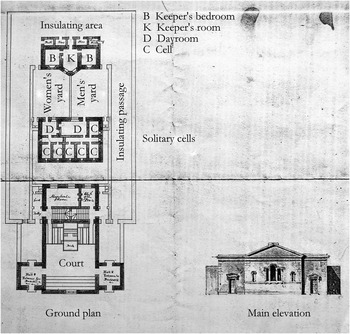
From 1823 onwards, the inspectors forced the closure of many bridewells. They generally warned Irish grand juries one year that their prison was ‘illegal’ and should be ‘abolished’, giving them a chance to improve it, and then the next year, after this had generally failed to happen, they moved to exercise their legal powers.Footnote 73 Of the 136 smaller prisons in Ireland in 1822, 29 were shut over the next decade, and 75 were newly erected or altered to meet the legal requirements for classification – segregation of prisoners by gender, age, and type of crime, by the availability of exercise yards, and so on.Footnote 74 The reform of these smaller prisons was the inspectors' greatest success. By the mid-1820s, with the co-operation of the Cork grand jury, the inspectors had developed in that county what they termed their ‘model’ system for smaller prisons. This model combined the extensive rebuilding of bridewells (with financial assistance from central government) and a new regime of ‘aggressive’ inspection (to quote Palmer). The model also entailed the development of a new scheme of management under what were termed boards of superintendence, where justices of the peace, clergymen, and other members of the local elite took charge of the day-to-day running of bridewells (a system itself modelled on what was then normal in many English counties).Footnote 75 Seven large new bridewells (Figure 1) and half a dozen smaller ones were built in County Cork permitting the classification system to be introduced; through efficient management and co-operation with the county gaol, the cost of running each of these bridewells fell dramatically.Footnote 76 By 1830, Palmer and Woodward were keen to show other Irish counties the benefits of the Cork system, and with statistics, architectural plans, and prose, they made an economic as well as a moral argument for penal reform.Footnote 77 The neighbouring counties of Kerry and Limerick soon followed, even appointing the same architect who had worked in Cork, but it took some time and many negative reports from the inspectors for other counties, such as Tipperary, finally to take action.Footnote 78 When the salaries paid to Palmer and Woodward were debated in the Commons in August 1831, George Dawson suggested that as the ‘objects for which those gentlemen were appointed had long since been accomplished’, their positions should be abolished. Thomas Spring Rice, speaking as secretary to the treasury, replied that it was essential to maintain their employment ‘if it were desired to keep [Irish] prison discipline in the good state in which it now was’.Footnote 79
The standard design for courthouses and bridewells in County Cork (1824), by George Richard Pain, architects who had trained in London with John Nash. This design efficiently combined a quarter-sessions courthouse and a bridewell that closely adhered to the post-1822 Irish regulations for classification, exercise yards, perimeter walls, and inspection. It was widely emulated throughout Ireland and was celebrated by the new prison inspectors as an integral part of their ‘model’ system. Reproduced courtesy of the Irish Architectural Archive, Dublin (Lismore Castle Collection).

In 1832, Palmer boasted that over the previous decade in Ireland there had been ‘a striking instance of a most important object completely accomplished and worthy of the attention of the authorities in other countries’. He also declared that the new bridewells ‘will surpass those of any other country; and why? Because they in Ireland alone form part of a system.’ Palmer's hyperbole was not as unbounded as it might appear: conditions had undoubtedly improved greatly, notorious prisons had been shut and co-operation with local elites had been established. An inter-county rivalry was set going, with the inspectors playing off neighbouring elites against each other and condemning perceived failures in their parliamentary reports (Palmer later described them as documents of ‘public notoriety’). Travelling assize judges who passed from county to county used the reports to make comparisons between what they had seen in the various county towns.Footnote 80 As Sydney Smith had realized in the British context, publicity was a powerful weapon. Concurrently, some Irish counties proposed moving the location of their assizes and building new county gaols. In these cases, Palmer and Woodward were consulted by the Irish privy council as expert witnesses; in this role, they became ‘policy-makers’ (as Playfair has noted of their post-1835 British counterparts), further fortifying and embedding their influential position in the Irish administration.Footnote 81 Palmer played a key role, for example, in the decision to build a new courthouse and county gaol in Nenagh after Tipperary was split into two ridings in 1836.Footnote 82 Yet Mitchel Roth has recently claimed that in the late 1830s ‘Ireland was well behind England in any meaningful prison-reform efforts.’Footnote 83 This criticism does not stand up to a detailed analysis of the real achievements of the new prison inspectors from 1822 onwards. Though there were clearly still problems – most infamously at Dublin's Newgate gaol – the reality was that the introduction of classification throughout Ireland's main county gaols and in its bridewells was so extensive that when the tide turned in favour of the separate system – one cell for one prisoner – in the mid-1830s, Ireland's prison infrastructure was too new to be overhauled once more.Footnote 84 The Irish inspectors could not have known that their colleagues in Britain would later commit themselves to this system, which necessarily demanded the large-scale reconstruction of most prisons, or that by doing so, they would make Ireland's relatively new prisons prematurely out-of-date. When Roth criticizes the achievements of prison reformers in Ireland from the standpoint of the late 1830s, he neglects to acknowledge the inspector-led accomplishments of the previous decade, when no comparable advance was being made in Britain.
By the late 1820s, Ireland's tightly managed and centrally inspected prisons, especially its new network of small bridewells, were without doubt more efficient and in many cases more humane than the many small British prisons that still remained outside central-government control. The contrast was even starker with Scotland, which looked more and more like what Ireland would have been had Charles Grant not come to Ireland nor the AIPPD been founded. ‘It is remarkable what little improvement has taken place’ in Scotland, Palmer commented.Footnote 85 But how did the Irish achievements filter across to Britain and inform penal-reform debates there? The magistrates in Inverness called in 1825 for the introduction throughout Scotland of the central-government model of inspection that they knew existed in Ireland.Footnote 86 Later in 1828, a House of Commons select committee, led by Lord John Russell, Peel, and others, investigated the condition of prisons in England and Wales. Private philanthropic organizations such as the SIPD played a key role at this inquiry. Samuel Hoare, its chairman, was questioned by Russell on the issue of central-government inspection with specific reference to Ireland. ‘Do you not think’, asked Russell, ‘that it would be very expedient to adopt the practice prevalent in Ireland of appointing a general inspector of gaols?’ ‘Highly expedient’, Hoare replied, ‘and the effects in Ireland have been very beneficial; and if the magistracy consented to it here, I have no doubt but that we might have the same beneficial results.’ Pressed as to whether more detailed reports sent to the secretary of state would result in a ‘uniformity’ of prison standards, Hoare was clear that nothing would be as effective as central-government inspection. ‘By the appointment of inspectors’, he said, ‘the end would be attained.’Footnote 87 Acknowledging in their conclusions that there were ‘many small gaols’ where ‘the ancient vice and disorder prevail’, the members of the select committee were of two minds about the introduction of inspectors. Although Stockdale has argued that the committee ‘rejected [Hoare's] suggestion’, this is not borne out by a more nuanced reading of its actual conclusions.Footnote 88 The committee concluded that:
It has been suggested that an inspector of prisons, as in Ireland, should be appointed. It is very questionable, however, whether the authority of the county magistrates should in any degree be superseded. Being on the spot, they are, if they give themselves the trouble, better judges of what is required and what is done than any periodical inspector. If, however, an inspector should be appointed, it would perhaps be advisable at first to send him only to the town and borough gaols which have not been united to the county prisons. According to the last report of the Prison Discipline Society, 140 of these gaols still require to be regulated by law.Footnote 89
Four years later, in 1832, another select committee, this time set up by a Whig government, ploughed the same furrow as part of a wider investigation into crime and punishment. Hoare retreated somewhat from his earlier stance, arguing that British prison inspectors ‘must not by any means interfere with the jurisdiction of the magistrates’, and when asked what powers they should have, he replied, ‘I would give him no authority whatever, but to visit all places of confinement, and to make the report to the magistrates and the Home Office.’Footnote 90 This more limited measure – essentially following Grant's Irish act but leaving out Goulburn's later extra powers – was less likely to offend magistrates. Elizabeth Fry added further weight to the Irish precedent in her testimony, based on her travels through the country and involvement in the establishment of Ladies' Visiting Committees for female prisoners there:
I think it is right to say of the state of the prisons in Ireland that they do credit to the magistrates and to the inspectors, general and local. I should say, take the average, I am not sure whether the principal prisons in Ireland are not better conducted than they are in England; the general inspectors, Major Palmer and Major Woodward, inspect the prisons annually, and there are also local inspectors who visit daily.Footnote 91
This select committee broke new ground by being the first to make a clear and unequivocal recommendation that government inspectors should be appointed throughout Britain:
To insure a due observance of the regulations for the government of gaols, and a general uniformity of discipline, your committee recommend that, in addition to the visiting magistrates, inspectors of prisons be appointed; that these officers be required to visit all the prisons in the kingdom, including those under corporate jurisdictions, at least once a year, and report to the secretary of state for the Home Department, who shall annually lay such reports before parliament.Footnote 92
It is not known if Palmer's book, A treatise on the modern system of government gaols, penitentiaries, and houses of correction…with some observations on the state of prison discipline at home and abroad (Dublin, 1832), was available to the members of the committee, but it is clear that he was keen to publicize his achievements in Ireland to a wider (and presumably British) audience. Cleverly dedicating his book to ‘the lord lieutenants and magistrates of Great Britain’, Palmer observed that ‘the present state of things falls short of rendering the English prisons places of rational punishment and reform’. He detailed the reforms that had been implemented in Ireland and provided an impressive comparative review of penal reform stretching from Russia to Sweden, and from Quebec to Jamaica. He concluded by expressing his wish that ‘Great Britain will be as eminent in her jurisprudence and the moral government of her prisons as she is in the arts and sciences, commerce and manufactures.’Footnote 93
Palmer found a supporter in the House of Lords in 1834, when Lord Wharncliffe drew attention to the Irish system of inspection. ‘It would’, he said, ‘be a good thing to adopt a similar plan in this country.’ Lord Melbourne, the home secretary, agreed and stated that it was government policy to make the necessary changes.Footnote 94 This was clearly a notable shift in policy from the preceding decade, but the measure that the Whig government proposed to introduce was, as previously noted, the same one that had received some support as far back as 1821. This had in turn been backed by many individuals and select committees in the intervening years. Most important, by 1834, the success of the Irish system was evident for all to see, and the Irish inspectors were keen to publicize their work to a wider audience. When the British Prisons Act finally became law in 1835, it was preceded by another exhaustive parliamentary committee, led in the Lords by the duke of Richmond, which teased out the issues one more time.
The recent introduction of new government inspectorates in Britain such as the factory and poor-law inspectors had certainly contributed towards normalizing the concept of prison inspectors in Britain by the mid-1830s.Footnote 95 The reports of the long-running Charity Commission also brought more into the public light the scope of work that could be undertaken by central-government officials.Footnote 96 However, it has been noted that there were precious few references to these precedents in the 1835 House of Lords inquiry that preceded the seminal Prisons Act. Sir Frederick Adair Roe, a London magistrate, alone mentioned factory inspectors. When asked ‘From what class of persons would you select the [prison] inspectors?’, he replied: ‘They must be of a high class of persons…I should say that they should be men of the same class as the factory commissioners.’Footnote 97 In every other case, it was to Ireland that the 1835 gaols committee looked, and Samuel Hoare, William Seymour, Baron Carbery, and Elizabeth Fry all cited the Irish situation when asked about penal reform.Footnote 98 Fry said that ‘I think nothing hardly is so likely to do good…The government inspectors I consider as officers of the greatest importance, and that they do great good in Ireland, and that they would do much good in England.’Footnote 99
Lord Carbery, a Cork landlord and magistrate, had been involved in setting up the Cork model bridewell system in the 1820s, and naturally he drew favourable attention to it in his testimony, as well as to the work of the Irish inspectors.Footnote 100 William Seymour, a Brighton magistrate, observed that he had ‘read attentively for several years all the reports of the prisons in Ireland, and the effect produced by inspectors there convinces me that they will be of the greatest consequence’.Footnote 101 Hoare was still reluctant to grant the new British inspectors powers that might conflict with those of resident magistrates, but when asked about the Irish inspectors, he produced a reassuring letter which he had received from them:
They had heard of this committee and felt extremely interested in the success of its endeavours, and they wrote me an account of what they considered inspectors ought to do. They state, ‘The office in Ireland is, as it should be, limited in power; the province of the inspectors general is, by their personal exertions, to aid the local authorities of counties …; in short, to watch over the whole system of prison discipline. Such an office, without interfering with the local authorities, is a necessary aid to them and in point of fact is constantly referred to in all doubtful cases’.Footnote 102
The inquiry was little more than a rubber-stamping exercise for government policy that had already been decided.Footnote 103 Only Sir Peter Laurie, a Middlesex magistrate, objected in principle to the appointment of inspectors in Britain; he advanced the standard old Tory argument that it would interfere with the power of magistrates. In spite of Richmond's best efforts to convince him otherwise, Laurie stuck to his view that the inspectors would be ‘a political appointment; and it would give great power to the secretary of state, much greater, in my opinion, than ought to be vested in him’.Footnote 104 In the bill that followed that summer, the Whig government proposed that five inspectors be appointed in England and Wales, and two in Scotland.Footnote 105 In the final act, some revisions were made, with the result that five inspectors instead of seven were to take charge of the entirety of Great Britain. A clause was also added that established penalties for deliberately obstructing the work of the new inspectors; predictably, this clause followed closely the wording of a similar provision in an earlier Irish act of 1826.Footnote 106
V
The introduction of government inspectors for British prisons in 1835 was not a panacea for every penal-reform issue. The first inspector appointed for Scotland was Frederic Hill, who later recalled that John Russell had said on meeting him: ‘Mr Hill, I have chosen Scotland as your chief district because there is most work to be done there.’Footnote 107 In terms of penal reform, Scotland was easily the most backward part of the United Kingdom, and Hill's task was formidable. He faced much opposition in his earliest years, but by the late 1830s, the process of centralization and consolidation advocated by Peel in the early 1820s was finally happening, and a series of large new prisons were built on the separate system. As David Smith has suggested, the eventual reformation of the Scottish prisons on the separate penitentiary system in the 1840s became in turn the model for England in the 1860s, just as I have argued that Ireland served as the model for inspection in England thirty years previously.Footnote 108 In England and Wales, the new inspectors were able to report more adeptly on failings in prisons, especially in the smaller ones that had remained outside earlier legislation. Their reports gave central government a new wealth of information and precipitated further intervention, leading, as James Willis has argued, to full central-government ownership, management, and control of prisons in the later nineteenth century.Footnote 109
Yet the effectiveness of the new inspectors should not be overstated, as Tomlinson has pointed out, ‘The local authorities’ autocracy was scarcely destroyed…Criticisms were made that the visits of inspectors…were infrequent and superficial. As for the local authorities being obliged to introduce changes, the difficulty was to persuade them to introduce changes, as the sanctions necessary for enforcement were manifestly lacking.’Footnote 110 Tomlinson later acknowledges, however, that after the first decade of central inspection the ‘worst and most colourful abuses’ of prison discipline had been rectified, just as Palmer and Woodward had drawn attention to the remarkable achievements of their first ten years.Footnote 111 Many of the other new inspectorates introduced by the Whigs in the 1830s proved ineffective, most notably the factory inspectors, who were quickly out-manoeuvred by industrialists and who were woefully understaffed. The poor-law commissioners were similarly few in number and encountered resistance from local elites who sometimes frustrated their work.Footnote 112 But the prison inspectors were a stepping stone if nothing else.Footnote 113 Perhaps the most telling endorsement of the central inspection of prisons came with its emulation in other countries after 1835. Lord Macaulay led a prison-reform committee that considered India's prisons in 1836–8, and following its recommendation that inspectors should be appointed, the first officer took up his post in the North-West Province in 1844. In France, prison inspectors were appointed for the first time in 1838.Footnote 114
The history of British prison reform at this time is greatly enriched by a transnational analysis between the four nations of the British Isles, and especially between England, Scotland, and Ireland. As was apparent to reformers of the time, the nations of the British Isles naturally became models for mutual experiment and advance. While in the 1820s the Inverness gentry were keen to emulate what they knew was happening across the Irish Sea, by the 1860s, the tables had turned and Ireland borrowed heavily from the Scottish General Board of Directors.Footnote 115 Undoubtedly, it was the economic backwardness and political instability of Ireland that made it ripe for the first installation of modern central-government inspection, as planned by Charles Grant in 1821. Yet this was the same system that informed and shaped political debate concerning inspection throughout the rest of the United Kingdom, and that provided a template for its later emulation. This wealth of models, templates, and precedents that were re-used, adapted, or simply discussed by a host of backbench MPs, philanthropic societies, and government officials brings into question the thesis reinforced by Palmer that Ireland was a ‘laboratory’ for testing British social reform. It rather appears that ideas and precedents ebbed and flowed across the Irish Sea at this time and despite the vastly differing social and economic environments of both countries they at different times influenced the other in emerging debates on prison reform. If we regard each of these as experiments in their own right, perhaps we need to consider that there were many laboratories and not just one.
Prison reform is a revealing sub-narrative within wider developments in social reform and the balance of power between central and local government throughout the United Kingdom in the early nineteenth century, and the conclusions presented in this article suggest that similar transnational investigations into other aspects of administrative history at this time would garner new insights that could lead to a broader re-evaluation of the overarching processes of reform in and between the distinct narratives of the four nations.