1. Introduction
Regulations in the food and agriculture sectors abound. In many cases, they are put in place and enforced by governments in order to address societal interests where unregulated markets are not yielding the desired outcome. In some other cases, these measures may be motivated by protectionism or outdated science. Nevertheless, external effects and information asymmetries abound and require intervention, and this paper focuses on those cases.
Many of the regulations address human health issues; others address environmental and animal welfare problems associated with agricultural production. As long as the regulation concerns a non-tradable good (or service), the optimal design of the regulatory measures need not take the interest of foreign parties into account. But non-tradability is the exception rather than the rule and border measures and behind-the-border measures are usually taken to assure that the imported varieties meet domestic requirements. Hence, trade flows may be affected by these regulations. Research on non-tariff measures (NTMs)Footnote 1 looks at regulations other than tariffs that have an impact on international trade.
With increased international integration in the context of lower tariffs and less stringent quotas, trade is becoming a major potential vector of external effects. Imports can carry invasive species, such as pathogens, pests, or weeds, foreign to an economy's ecology. Furthermore, different trade partners may have different food safety standards and institutional capacity to enforce them. This may lead to imports of agri-food products that do not meet domestic requirements. Imperfect and incomplete monitoring of imports at the border compounds the health or environmental risk (Gossner et al., Reference Gossner, Schlundt, Ben Embarek, Hird, Lo-Fo-Wong, Beltran, Teoh and Tritscher2009). In countries with ill-defined property rights, trade may also encourage unsustainable production of some goods for the export market, leading to concerns about the stewardship of global-commons (Chichilnisky, Reference Chichilnisky1994). Governments invoke these issues to apply a wide array of NTMs to address real and perceived domestic concerns.
In a few instances, trade is the direct conduit of significant external effects and it may be an option to directly restrict trade. But often alternative policies tend to be more effective at addressing external effects than blunt trade barriers. Assessing the economic effects of NTMs poses significant challenges as the link between trade, welfare, and policy is tenuous. Many NTMs may restrict trade but can improve welfare in the presence of negative externalities or informational asymmetries. Other measures can expand trade as they enhance demand for a good through better information about the good or by enhancing the good's characteristics (Maertens et al., Reference Maertens, Dries, Dedehouanou, Swinnen and Swinnen2007; Maertens and Swinnen, Reference Maertens and Swinnen2009).
The efficiency costs of NTMs are hence much less evident than the welfare losses associated with tariffs and quantitative trade restrictions. They do not necessarily embody the economic inefficiencies that are associated with classical trade barriers, unless they discriminate between sources of supply; they may, or may not, be the least trade-restrictive policies available to correct market imperfections, and the least trade restrictive policies may fail to maximize welfare, inclusive of the externality. It is therefore not clear a priori that the trade impacts of the concerned regulations are informative on allocative efficiency, or that removal of associated NTMs that affect trade would achieve efficiency gains relative to the welfare level under existing regulations.
Beyond the type of instrument, the level of intervention is also important in the design of NTMs, such as an optimum maximum residue level or the level of stringency of border inspections. In the presence of disease risks, well-designed NTMs may allow for some limited amount of trade, while in the absence of measures, such as strict border inspections or restricting imports to products from a specific country or region within a country, no trade will take place at all (Paarlberg and Lee, Reference Paarlberg and Lee1998; Wilson and Anton, Reference Wilson and Anton2006; Pendell et al., Reference Pendell, Leatherman, Schroeder and Alward2007, among others). These features of NTMs and market imperfections are not well recognized in much of the existing literature, which tends to have a narrow mercantilist focus on foregone trade and trade costs (e.g., Kee et al., Reference Kee, Nicita and Olarreaga2009). These trade effects have been extensively analyzed with the gravity-equation approach. Many gravity analyses tend to be broad in scope (multi commodity/sector, countries, and policies), which allows for a broad-brush investigation of general hypotheses, such as the trade-restricting or expanding effects of NTMs or the impact of harmonization. The gravity equation has also been used to look at specific policy issues, such as the European Union (EU) aflatoxin policy (Otsuki et al., Reference Otsuki, Wilson and Sewadeh2001; Xiong and Beghin, Reference Xiong and Beghinforthcoming).
Beyond the well-established trade-impeding effects of many NTMs, trade-expanding effects also have been identified, often through harmonization and shared standards, in bilateral and other preferential trade agreements, and for some goods and policies (Moenius, Reference Moenius1999, Reference Moenius2006; Fontagné et al., Reference Fontagné, Mimouni and Pasteels2005; Henry de Frahan and Vancauteren, Reference Henry de Frahan and Vancauteren2006; and Disdier et al., Reference Disdier, Fontagné and Mimouni2008). A few studies found an absence of trade effects from NTMs in some sectors (Fontagné et al., Reference Fontagné, Mimouni and Pasteels2005) and for harmonized measures (Czubala et al., Reference Czubala, Shepherd and Wilson2009).
Effects of NTMs have also been studied with partial and general equilibrium simulation models, usually by parameterizing them as tariff-equivalent in the import demand (or export supply) functions.Footnote 2 Consumer valuation of external effects has been neglected in most of these analyses. Even the framework of multilateral trade rules in the World Trade Organization (WTO) tends to focus on effects on trade and producer welfare rather than on effects on consumer welfare, a shortcoming from an economic perspective. Our paper fills that void with a systematic approach to consumer valuation in the economic analysis of NTMs.
The paper develops a unified analytical framework to assess the costs and benefits of NTMs for market stakeholders: domestic consumers, various producers involved in the supply chain, and governments, as well as foreign suppliers, and, wherever relevant, foreign consumers and governments. Trade effects are part of the assessment, as NTMs have an impact on trade as a conduit of the externality, but trade effects are not the sole focus. The analytical framework allows comparison of alternative ways to design measures. It discerns their trade and welfare effects. For example, an import ban (or prohibitive standard) to keep the domestic market free of some undesired product characteristic can be compared to allowing trade under clear identification of the foreign product (e.g., through labeling). This paper mainly focuses on standard-like measures, but the analysis could be extended to other policy instruments, including labels, (Pigouvian) taxes, quarantines, market authorizations, and border inspections that may be chosen to alleviate various market failures.
An important dimension of the framework is its ability to distinguish those consumers (or producers) that are concerned by the negative or positive externality and the product attributes from those that are not concerned. Concerned consumers put a value to avoiding (consuming) the negative (positive) product characteristic. This valuation is a key variable in the cost–benefit assessment of measures that address failures affecting consumers. Estimating this value empirically is a challenge, but recent advances in experimental economics based on laboratory or field contexts are promising (see Lusk and Shogren, Reference Lusk and Shogren2007, for a survey on valuations regarding products' safety and quality). On the production side, the value of avoiding a failure is directly related to the value of the production loss that can occur if the failure remains unabated.
We illustrate the approach with an application to shrimp trade and the consumer valuation of information pertaining to food safety characteristics related to antibiotics in shrimps elicited in economic experiments. The cost–benefit framework is essentially a modular partial equilibrium model, with demand and supply relationships, that can be calibrated to empirical data and allows the calculation of economic welfare effects.
The welfare-based approach can be used to define optimal non-tariff trade policies, both from a domestic and global point of view. The optimal NTM could turn out to be different from that implied by an international standard, such as those referred to in the WTO agreements on sanitary and phytosanitary (SPS) measures or technical barriers to trade (TBT). In some cases, the welfare-based NTM could recommend policy stringency exceeding or below an international standard. The framework is also useful for sorting out least-trade restrictive interventions among NTMs considered by policy makers and the potential trade-offs (or lack thereof) between welfare and trade. Although we focus on food safety, our approach applies also to environmental externalities and global commons issues and for a host of non-price policy instruments. It is possible that some of these policy menus could be more efficient than a simple standard regime described here, but the message remains that when market imperfections are present, the interface between NTMs, trade, and welfare is more complex that the simple dominant mercantilist message.
The paper is structured as follows. Section 2 discusses the main types of market failures and associated NTM policy instruments. Section 3 presents a modular framework to assess the costs and benefits linked to NTMs. Section 4 illustrates the approach with an application to shrimp trade and NTMs using recent findings in consumer valuation. Section 5 concludes.
2. Market imperfections
Many NTMs attempt to remedy external effects. Externalities occur when some agent's utility or production depends on the choices made by other agents, who do not factor these external effects into their decision making. The associated costs or benefits, associated with the externality are not reflected in market valuations. The external cost or benefit can affect consumers or producers. NTMs can also address the consequences of asymmetric information (one partner in a transaction knows more than the other) or imperfect information (not all consequences can be known). These informational problems can occur on either the consumer or producer side. Finally, some failures are global in the sense of a global-commons problem for a resource perceived as belonging to the (global) community and requiring collective stewardship. There is a trans-boundary or global element in the failure.
Some externalities can affect consumers even though the external effect is independent from their own consumption choices. Consumers' concern about animal welfare is an example. Consumers are concerned about production methods; their welfare is affected regardless of their own decisions whether to consume meat coming from animals produced under conditions they consider inappropriate.Footnote 3
Asymmetric information on health, safety, or nutritional value is an imperfection associated with the purchase or the consumption of the good by a final consumer. The consumer derives a benefit from consuming the good but also bears a cost or benefit not exactly known to him via a health impact creating a wedge between private and social costs of the good. Some attributes, either experience or credence attributes, are unknown or uncertain to the consumer at the time of purchase and may decrease (as in the case of deleterious ingredients) or increase (as in the case of nutritional benefits) the value of the good. The undervaluation of health risks, such as outbreaks of E-coli and salmonella, and presence of chemical residues, such as melamine residues, are recent examples of such social cost. Producers can also face asymmetric information issues in their purchase of inputs, such as animal feed, seeds, or crop protection chemicals.
External effects also arise in production processes and have several sources including trade, such as in the case of foot and mouth disease (FMD). The resulting impact is a decrease in production, because of an increase in the cost of production either by loss of efficiency (farm yields fall) or by trying to abate the external effects (fungicide applications to eliminate some fungus). These occurrences may be non-rival (a whole region is hit by a FMD outbreak) or private (a single livestock producer hit by contamination of feed).
Global commons refer to resources perceived as belonging to the (global) community and requiring collective stewardship. They are open access resources, for which property rights are ill defined, such as unsustainable resource use in forest products and the depletion of fish stocks through over-fishing. Consumers do not need to consume a specific good themselves to suffer the externality. However, consumers may derive benefits from consuming products certified as respecting the commons. Eco-labels and fair trade policies are measures providing perceived benefits to consumers with global-commons concerns.
The analytical treatment of global commons cases will often be closely related to the treatment of externalities affecting consumers. An increasing number of trade frictions between high-income and low-income economies is based on global commons issues, as interest in sustainable practices expands when exporters use environmentally unsustainable practices.
Government can also fail, often by omission to monitor and enforce regulations. The limited institutional capacity sometimes calls for additional interventions, or may necessitate bold policies, such as a ban on trade and wholesale eradication, to combat highly contagious diseases (e.g., FMD). Policy responses can be more cooperative when planned, especially in the North–South context. For example, certification of South exporters by importing countries in the North providing the additional capacity missing in the exporting country (e.g., the EU assisting Latin American meat packers to meet EU food sanitary and phytosanitary standards).
All these market imperfections can be addressed through a wide range of policies, but this paper concentrates on those policies that have a potential impact on international trade flows, singling out NTMs.
3. Cost–benefit framework: a modular approach
This section presents a simplified framework that allows the assessment of economic effects of NTMs designed to address different types of market failures and market imperfections mentioned above. The framework is particularly tailored to our empirical application presented in Section 4. On the consumer side, the approach rests on insights from modern empirical consumer economics; on the producer side, it incorporates insights from epidemiological studies.
The framework is modular, essentially a partial equilibrium model. New elements with detailed side calculations can be attached or removed from the main structure without the necessity to alter the general logic of the approach. The theoretical framework is designed to be applied with empirical data to facilitate a quantitative cost–benefit analysis. Not each and every potential effect is discussed here, as the framework may be easily extended in many directions to analyze particular trade problems. One element not elaborated here, but which can be important in practice, concerns costs related to administration, monitoring, and enforcement.
The framework comprises ‘modules’ for calculation of costs and benefits affecting (a) domestic consumers, (b) domestic producers, (c) domestic government, and (d) foreign producers. For simplicity, foreign consumers and governments are not included here. In addition, the different actors in the supply chain (farmers, processors, retailers, etc.) are collapsed into a single production stage representing supply. These abstractions influence results in many cases, but are maintained here to preserve clarity in exposition. Notably, we abstract from traceability and its incidence on cost. We could add complexity, with market intermediaries assuring traceability between suppliers and consumers. Because of a lack of space, we only focus on market failures affecting consumers.Footnote 4 The market good being analyzed here is assumed to be homogenous and presents a specific characteristic.
We assume that, without regulation, producers offer a good with a specific characteristic (an environmental or safety risk or a specific process of production) that domestic consumers do not want. The regulation therefore protects domestic consumers regarding the specific characteristic conveyed by products.
We focus on a regulation corresponding to a safety standardFootnote 5 that fully eliminates the undesired characteristic, for example a ban on some antibiotics whereby eliminating antibiotic residues in food. For food safety, the standard is the most likely policy instrument compared to a voluntary label signaling a higher level of safety than the level offered by regular products (see van Tongeren et al., Reference van Tongeren, Beghin and Marette2009 for a case with a label). The model discussed below assumes that foreign and domestic producers have different technologies for food safety, which means they are not similarly impacted by the enforcement of a standard (for heterogeneous producers also see Marette and Beghin, Reference Marette and Beghin2010). In the baseline, the domestic firms are assumed to have implemented the standard, so that additional compliance costs fall only on foreign firms. However, the analytical simplification maintained here allows a sharper focus on the implications of regulatory heterogeneity between countries, reflecting differences in what is considered appropriate product characteristics. This assumption is particularly valid for the application to shrimp trade, which is elaborated later.
Supply side
A perfectly competitive industry with price-taking firms is assumed for both domestic and foreign supplies. We abstract from the export or re-export from the domestic country, implying that imports and domestic production are only purchased by domestic consumers.
There are M O domestic firms and M F foreign firms. Firms' cost functions are assumed quadratic in output for tractability purposes. Firms choose output to maximize profits:

where c s, fs are the variable cost parameters.Footnote 6 Profit maximization yields individual firm supply functions, which can be added up to yield industry supply Q. The firms' inverse supplies are expressed as
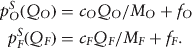
The total inverse supply defined by the sum of foreign and domestic supply is

For the rest of the analysis, we assume that c O>cF and f O>fF; domestic producers incur higher marginal costs than foreign producers. This reflects a situation where domestic production incurs a costly effort to eliminate the specific undesired characteristic that some domestic consumers do not want, while foreign producers do not eliminate the characteristic and do not have to bear these additional costs in the baseline.Footnote 7
If the safety standard is imposed, the inverse supply of foreign producers can be represented as a multiple of the original supply:  with λ>1. Recall that only foreign producers are impacted by the adoption or the reinforcement of the safety standard via a variable cost increase; domestic producers are not impacted since they already offer food products without the specific characteristic. The shift parameter λ of the supply function can be derived from observations of the price increase per unit relative to the baseline scenario. The relative change in the supply curve at the equilibrium is defined by
 , and thus the shift parameter of the supply function after the standard implementation is equal to λ=1+γ .
Demand side
The characterization of preferences largely follows Polinsky and Rogerson (Reference Polinsky and Rogerson1983). For simplification purposes, all consumers are concerned and they unanimously prefer safe food. Demands are derived from quadratic preferences. Demand of each consumer i = {1, …, N} in the importing country is derived from a quasi-linear utility function that consists of the quadratic preference for the market good of interest and an additive numéraire:

where the term  is the immediate satisfaction of consumer i from consuming a quantity q i of the good, and w i is the numéraire good consumed by i. This characterization leads to tractable linear demand curves. For simplicity,
 are the same for the N consumers.Footnote 8 The consumer cannot distinguish between the two goods (foreign versus domestic).
The binary variable S indicates the safety standard policy. Under the absence of the standard with S=0, the per-unit damage r i is linked to the foreign product purchased by the consumer. Only a fraction (Q F/Q), with Q=Q F+Q 0, of the good on the market has the specific characteristic. The perceived damage associated with the consumption of the good with the specific characteristic is denoted r i(Q F/Q)q i.
The effects of information are captured by the term −Ir iqi(Q F/Q). The binary parameter I represents the knowledge regarding the specific characteristic brought by the good. If consumers are unaware of the specific characteristic or if there is an unaccounted externality linked to the specific characteristic, then I=0. Conversely, I=1 means that consumers are aware of the specific characteristic and internalize the externality and reduce their consumption. Creating this awareness can be part of food safety policy packages.
For the rest of the analysis, we consider both situations (I=0 and I=1). First with I=0, the non-internalized damage should be accounted for in the welfare calculations, but does not feed back in to the demand. Second with I=1, consumers internalize the damage and demand is reduced. When the safety standard is implemented (S=1), the damage completely disappears, which makes both alternative situations of consumer awareness (I=0 and I=1) equivalent.
The maximization of the utility function under a budget constraint yields a demand function for each consumer. Aggregate demand for the good is obtained by summing individual demand functions over all N consumers. The associated damage per unit consumed is equal to r(Q F/Q) for the N consumers. With  , the overall (inverse) demand function for all consumers is p(Q,I,r)=a−bQ−I(1−S)r(Q F/Q). The area under the demand curve and above the market price represents the consumer welfare (‘surplus’) from consuming the good. It is the difference between the willingness to pay (WTP) and the price paid over all units consumed.
Parameterization of r is crucial to the empirical assessment. Surveys and laboratory experiments providing information on consumer WTP for a good can be used here. More precisely, r is defined with the relative change in the average consumer WTP. The value of the relative change is computed as follows: δ=[E(WTP Info)−E (WTP NoInfo)]/E(WTP NoInfo) by using the average WTP before and after the revelation of information to the consumers on the specific characteristic that the good may present. Thus, using the relative price variation linked to the damage, internalization is equal to the inverse demand shift defined by [p(Q,1,r)−p (Q,0,r)]/p(Q,0,r)=δ, which leads to r=δ×p(Q,0,r) (see Marette et al., Reference Marette, Roosen, Blanchemanche and Verger2008 for details). Under the absence of the standard (S=0), this value is internalized in the demand when consumers are aware (I=1) or used for the calculation of the cost of ignorance when consumers are unaware (I=0).
Equilibrium
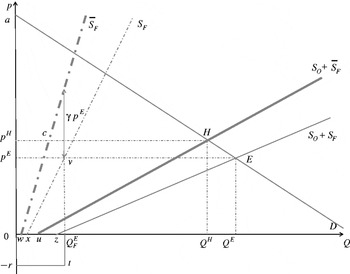
Equilibrium is first presented for the situation where consumers are unaware of the damage when no regulation is implemented. Figure 1 shows domestic demand (D), foreign supply (S F), and total supply (S O+SF) (the domestic supply S O is omitted for clarity). The price, p, is located on the vertical axis and the quantity, Q, is shown along the horizontal axis.
Impact of a standard with unaware consumers (I=0)

Free trade without regulation leads to an equilibrium E. The equilibrium price pE clears the market by equalizing demand and supply with an overall equilibrium quantity QE. Q FE is foreign output and QE−Q FE is domestic output. The profits correspond to area OxvpE for foreign producers and area xvEz for domestic producers. The surplus of domestic consumers corresponds to area pEaE. The foreign products with the characteristic leading to the damage do not influence the demand since I=0. The corresponding cost of ignorance, initially defined by r iQ(Q F/Q)=r iQF in (4) for domestic consumers, is accounted for in the welfare calculations. It is equal to rQ FE represented by the area 0(−r)tQ FE. The cost of ignorance takes into account the non-internalized per-unit damage times the quantity sold by foreign producers. Domestic welfare is the sum of domestic producers' profits and consumer surplus minus the cost of ignorance. International welfare is the sum of domestic welfare and foreign producers' profits.Footnote 9
When a safety standard is adopted or enforced on foreign suppliers, the market allocation is modified as represented in figure 1 with the bold curves  ,
 and the equilibrium point H. Assuming that the stringent regulation increases cost of production for the foreign producers only, supply is reduced relative to the initial equilibrium point v in Figure 1. In other words, from the initial equilibrium quantity, the overall marginal costs increase by γpE for foreign producers. The supply shifts increases the equilibrium price to pH, which reduces consumer surplus: pHaH<pEaE. For domestic consumers, the initial damage (represented by the area 0(−r)tQ FE)) fully disappears once the standard is enforced.Footnote 10 The overall effect of a stricter standard is ambiguous for consumers since it depends on the comparison between the surplus reduction linked to the price and full disappearance of the damage. The effect is also ambiguous for foreign producers since their production decreases for any given price, while the equilibrium price increases. The domestic producers have a higher profit wcHu>xvEz, since their supply curve did not change, while the price is higher. The overall comparison for different agents will be elicited in the next section, which introduces a simple application based on the mechanism depicted in Figure 1.
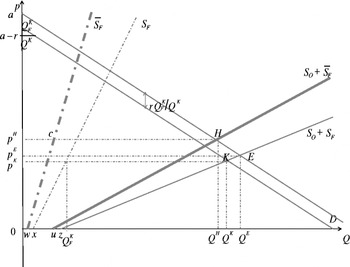
We now turn to the case where consumers are (or become) aware of the damage and internalize it. In this case, the baseline scenario (without standard) changes from the initial equilibrium E in Figure 1 to initial equilibrium K in Figure 2 as demand shifts in with equilibrium (Pk, Qk). Internalizing the damage decreases demand and reduces profits (fewer units sold at a lower price). However, the cost of ignorance disappears as consumers internalize the damage because they are aware of the externality. The equilibrium price pK internalizes the damage in the demand.
Impact of a standard with aware consumers (I=1)

With a standard, demand could be enhanced as consumers would value the increased average quality. The enforcement of the standard leads to the new higher equilibrium H in Figure 2. There are several welfare impacts. Foreign producers can gain from the standard as the equilibrium price increases when the equilibrium shifts from K to H. With aware consumers in the importing country, it may be in the interest of foreign suppliers to have stricter standards enforced. The increase in their costs (from S F to  ) could be fully offset by the higher price received (from P K to P H). In addition, they are likely to sell fewer units which would have a negative impact on profits. Domestic suppliers gain as they receive a higher price and are likely to sell more units because demand is stronger and their cost structure has not changed (same S O) and foreign suppliers now have a higher unit cost.
4. Application with shrimp quality and trade frictions
In this illustration, we simulate the impact of a safety standard eliminating the use of antibiotics in shrimp aquaculture, a widespread problem in many operations. First, some antibiotics used for shrimp production can be toxic (e.g., chloramphenicol) and could cause genetic damages and possibly lead to cancer. This fact directly affects consumers as framed in our previous model. It is recognized by the FAO/WHO/WTO/Codex Alimentarius committee determining drug standards under the SPS agreements (United Nations Food and Agriculture Organization, 2002). Second, intense use of antibiotics leads to antibiotic resistance by some micro-organisms with important consequences for animal and human health (World Health Organization, 2011). This externality is not directly taken into account in the previous model.
Production and trade of shrimp products have seen a significant rise over the last decade globally, and with dominant trade flows from emerging developing countries to OECD countries, especially the EU and the United States (Roheim, Reference Roheim, Aksoy and Beghin2004; Disdier and Marette, Reference Disdier and Marette2010 and Reference Disdier and Marette2012). However, this expansion occurred at some health costs because the quality of seafood imports has been variable. The sanitary quality of seafood production in some developing countries has been subpart through the use of additive substances. To prevent and treat bacterial infections and other pathogens, shrimp producers use a range of pesticides, harmful drugs and antibiotics, which are toxic to human health. We measure the impact of a hypothetical new stringent standard that could be adopted by the EU, aimed at eliminating all antibiotic residues in shrimps.Footnote 11 Testing technology has also evolved and the ability to detect ever smaller residues has been improved (Debaere, Reference Debaere2010). Note that the use of these antibiotics has already been banned inside the EU for many years. Therefore, and consistent with the assumptions in our presented framework, the standard adopted by the EU only affects non-European producers.
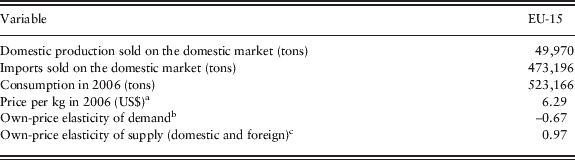
With the initial situation preceding an enforcement of the regulation on foreign suppliers, parameters of the model are calibrated in such a way as to replicate market prices and quantities for the year 2006 in the EU-15 (corresponding to the equilibrium E in Figures 1 and 2) and with consumers assumed to be unaware of the health risk. With the baseline scenario before the enforcement of the standard, it is assumed that only foreign products use antibiotics. With the observed quantity  sold over a period, the average price
 observed over the period, and the direct price elasticity
 obtained from econometric estimates, the calibration leads to estimated values equal to
 ,
 for a demand Q=(a−p)/b; the same method can be used for the supply side. Table 1 details the parameters used for calibrating the baseline scenario with I=0, namely when consumers are not aware of the antibiotics problem.
Values of parameters for the calibrated model of shrimps in 2006
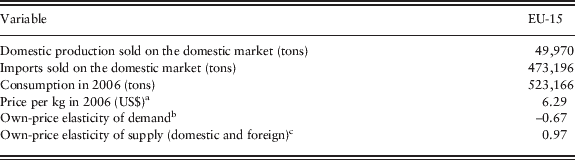
Notes: Quantities and prices for 2006 come from United Nations Food and Agriculture Organization (2009).
a The domestic price was estimated by dividing the average value of imports by the quantity of imports and exports in the EU (United Nations Food and Agriculture Organization, 2009).
b Asche and Bjørndal (Reference Asche and Bjørndal2001) for crustaceans in the EU.
c Dey et al. (Reference Dey, Rodriguez, Briones, Li, Haque, Li, Kumar, Koeshendrajana, Yew, Senaratne, Nissapa, Khiem and Ahmed2004) for the aquaculture of shrimps by taking the average of own-price elasticities of supply over the top five world producers of shrimps in Table 3 (p. 5).
The value of the per-unit damage associated with foreign shrimp, r, defined in Figure 1, is determined by using results from a consumer choice experiment. This experiment was conducted in Paris, France, in multiple one-hour sessions in December 2009. The sample included 160 participants randomly selected by phone based on the quota method and was representative for age groups and socio-economic status for the population of Paris.
A multiple price list was used for eliciting consumers’ WTP (willingness to pay) for a 100 g plastic package of farmed, midsize, shelled, cooked, and refrigerated shrimps. Cooked and refrigerated shrimps are the most common form of shrimp consumption in France. Participants were asked to choose whether or not they would buy the product for prices varying from €0.25 to €4 (US$5) with a 25 cent interval between possible choices (Disdier and Marette, Reference Disdier and Marette2012). Here, we use two of the WTPs elicited during this experiment: a first one before the revelation of any information and a second one after the revelation of information on food safety for shrimps produced in non-European countries. These two WTP estimates allow measuring the marginal impact of information.
Information about the WTP for increased food safety was revealed through responses to the following message: ‘Many bacteriological infections affect shrimp breeding pools. Bad production conditions (bad water quality for example) favor the growth of bacteria. To fight against these bacteria, shrimp producers in some developing countries use antibiotics and other chemical products that are toxic to human health and therefore forbidden in almost all countries. Given the difficulties and the cost of inspection of products, it is likely that some shrimps sold in France were treated with these antibiotics and chemical products toxic to human health.’
The average WTP expressed by participants in the experiment, before the information revelation, is equal to €2.14 for tropical (foreign) shrimp, while the average WTP after the revelation is equal to €1.13. The relative variation in the WTP is therefore equal to (1.13–2.14)/2.14=–0.47. In other words, consumers are willing to pay only about half the original price once they learn about the potential health risk problem associated with shrimp consumption. Using the initial price pE the per-unit damage is equal to r=0.47×pE . With this value, the cost of ignorance is r iQFE when I=0 (see Figure 1) and the internalized per-unit damage is r iQFK/QK when I=1 (see Figure 2).
Eventually, the enforcement of the safety standard would lead shrimp exporters to the EU to avoid antibiotics. The impact of avoiding antibiotics on the supply is determined as follows. Based on an analysis of organic shrimps in Madagascar, Hervieu (Reference Hervieu2009) notes that the switch from non-organic to organic, antibiotic-free shrimps increases the variable cost of production (farm price) from 5€/kg to 8€/kg. We use this change in variable unit cost to estimate the shift of the supply function by setting γ=(8–5)/5=0.6 and is applied to the foreign supply curves presented in Figures 1 and 2. Recall from Figures 1 and 2 that only foreign products lead to the damage for consumers and only foreign producers are impacted by the safety standard getting rid of the damage.
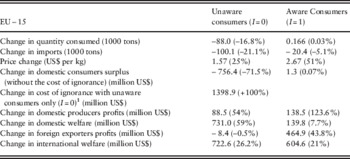
Table 2 presents the impact of the assumed enforcement of the food safety standard using a variety of economic indicators. The first column corresponds to the market adjustment when consumers are unaware of the damage under the absence of the standard as in Figure 1. The second column corresponds to the market adjustment when consumers are aware of the damage (I=1) that would occur if the standard were absent (Figure 1).
Welfare changes for the year 2006 linked to the safety standard enforced at the border

Notes: Relative changes (%) compared to the baseline scenario in parentheses.
1 The value is positive since the cost of ignorance disappears leading to a benefit for consumers.
The results of Table 2 show that, when the standard is implemented, foreign producers decrease their output and domestic producers increase their output (by taking the difference between the first line and the second line for each column), since domestic producers enjoy a better price without suffering the cost increase. Domestic consumers and domestic producers would benefit from a standard eliminating dangerous antibiotics. The change in consumers' surplus (including the cost of ignorance when I=0) is higher when consumers are initially unaware of the damage than when they are aware of the damage, since the cost of ignorance is eliminated by the safety standard with unaware consumers. The change in consumers’ surplus is relatively low with aware consumers since the positive effect linked to the disappearance of the internalized damage is partially offset by the negative effect linked to the price increase.
Foreign producers suffer from the standard only with unaware consumers (I=0) as described in Figure 1. This loss is relatively low in absolute value compared to the gain for domestic producers, since the cost increase for foreign producers is partially outweighed by the benefit of a higher price. Conversely, foreign producers benefit from the standard if consumers are fully aware of the antibiotics problem and of the solution in the form of a strict enforcement of the production standard at the border (I=1); in this case, the increase in consumer demand leads to higher prices and profits even for foreign producers. With I=0, international welfare increases, but there are pronounced distribution effects as foreign producers lose profits. With I=1, the safety standard benefits all foreign and domestic agents. For both cases (I=0 and I=1), the international welfare linked to the regulation increases, while the imports decrease (see the second line of Table 2). It means that considering only trade volumes or values can be insufficient for characterizing a NTM.
This application shows that the enforcement of a food safety standard can be socially preferable to the status-quo situation, both domestically and internationally. The size of the estimated damage that is avoided by enforcing stricter standards at the border is obviously crucial to this result. A second driver is the estimated cost of switching to alternative production methods, in this case antibiotic-free shrimp production. Alternatives must be available, and the additional cost must be low enough to provide incentives to foreign suppliers to switch production methods. Finally, the most beneficial policy package combines enforcement of the standard at the border with generating consumer awareness of the food safety issue.
It should be kept in mind, though, that the numerical magnitudes of the estimated welfare effects presented here depend crucially on the underlying functional forms (linear demand and supply functions) and on the quality of data and parameters.
Many extensions to our illustration can be considered. For instance, an export demand for the EU could be estimated and considered since the EU is a relatively large actor. Gravity results linked to the previous regulation enforcement could be also considered for calibrating changes in trade coming from the related regulation (Disdier and Marette, Reference Disdier and Marette2010). A scenario with a label signaling the country of origin and a high level of safety could be studied (Bureau et al., Reference Bureau, Marette and Schiavina1998).
Non-prohibitive standards where both domestic and foreign firms make costly efforts to comply and consumers are to some extent able to identify the degree of compliance can easily be accommodated. Other extensions include entry and exit of firms in the face of fixed (through additional investments) and variable (through additional activities) compliance costs. If compliance with standards and regulations implies large investments that are sunk once undertaken, economies of scale become an important characteristic of the industry structure (Rau and van Tongeren, Reference Rau and van Tongeren2007, Reference Rau and van Tongeren2009; Maertens and Swinnen, Reference Maertens and Swinnen2009). Sunk investments do not figure in the firms’ optimal pricing decisions and have more indirect effects on market prices through entry and exit of firms. Only firms that are sufficiently productive to ‘jump the hurdle’ of fixed market entry costs will be able to export.
5. Concluding remarks
Efficiency implications of NTMs are much less evident than the welfare losses associated with tariffs and quota. NTMs do not necessarily embody the economic inefficiencies that are associated with classical trade barriers, unless they discriminate between sources of supply. It is therefore not clear a priori that the trade impacts of regulations are inefficient, or that removal of associated NTMs that affect trade would achieve efficiency gains that would exceed the losses from weaker regulation.
The increasing prevalence of NTMs is a permanent reality conditioning trade in agri-food. A systematic assessment of their effects, across countries and products, is much warranted, in particular in view of the rising occurrence of trade frictions about food safety and food quality (Josling et al., Reference Josling, Roberts and Orden2004; Disdier and van Tongeren, Reference Disdier and van Tongeren2010).
This paper contributes to a systematic analysis of economic costs and benefits of NTMs, focusing on the often neglected aspect of consumer benefits from regulations that aim at addressing market failures in the food sector. The proposed methodology is operational for comparing alternative policy choices, such as standards, border inspection policies, and labeling in an international context. The methodology contributes to a more comprehensive welfare analysis of NTMs than that offered by looking at trade effects alone.
The illustrative application to shrimp trade in the face of EU regulations aiming at eliminating consumption of shrimps that contain antibiotics shows that enforcement of such a production standard can be welfare enhancing, both domestically and internationally. The benefits are more widely shared between domestic and foreign players if domestic consumers are made fully aware of the particular health problems and the solutions in the form of a strictly imposed production standard. The clear policy message is that a well-designed policy package combines enforcement of the standard at the border with generating consumer awareness of the food safety issue.
The proposed comparative approach to NTMs allows for the identification of alternative ways to address a given regulatory problem. By systematically enumerating the costs and benefits for all the different economic actors involved, an evidence-based approach can be followed that yields a solid basis for mutual exchange and identification of least-cost solutions.