Introduction
In 1987, the government of China authorised local village elections for village leaders on a trial basis. This move was part of a massive state devolution of responsibility to the local level following the dissolution of communes in the early 1980s. Indeed, national leaders proclaimed these elections as introducing local self-governance in China. In 1998, subsequent national legislation made holding local village elections mandatory for all villages nationwide. Over the past 15 some years, China scholars have intensively studied local village elections to assess the extent to which they represent the emergence of democracy in the People's Republic of China.
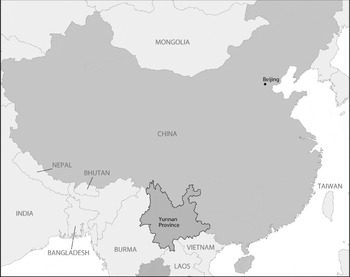
In the official legislation, the 1987 Organic Law of Local Villager Committees, the central government mandated election of villagers' committees to manage village affairs. The law specified that lands and other resources owned by collectives (hamlets) were included in ‘village affairs’, together with other responsibilities such as population control and tax collection. In this article, in place of a focus on emerging democracy, I highlight access and control over natural resources in assessing a case study of a local village election. The case involves lands and minerals overseen by the village committee in Mengsong, a settlement in southern Yunnan, and the relation of the election to resource access in the site of my earlier field research in 1996–97 (see Figure 1).Footnote 1
Map of Yunnan province in China.

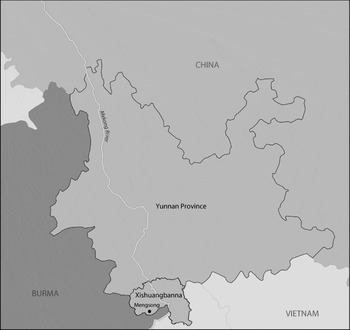
The election in question took place in 2000 in Mengsong village, a cluster of AkhaFootnote 2 (Hani) hamlets located on the ridge separating Yunnan from Burma (see Figure 2). A focus on resource access in Mengsong shows that from 1997 to 2002, from the conclusion of my earlier research until my 2002 return to look at the local village election, forest policies and contractual mining arrangements removed from villagers' management much of the lands, forests, and minerals that a villagers' committee might have overseen. These losses resulted in a 25% drop in household incomes (Sturgeon Reference Sturgeon2007). Additionally, the township government had recommended the new head elected to the village committee, someone who proved to be more amenable than previous village leaders to following township directives. As a result, not only did Mengsong villagers lose substantial lands and resources during this five-year stretch, but the township actually increased its influence over Mengsong governance. Far from devolving decision-making to the local level, the elections and other surrounding events circumscribed much of the arena for decision-making that the village committee and hamlet heads had in the past. Here I trace the relationship between the election and these transformations in resource control, revealing how these dramatic changes were accomplished with hardly a murmur of protest from Mengsong villagers.
Map showing Mengsong village in Southern Yunnan.

The period from 1997 to 2002 saw a recalibration of people of high and low ‘quality’ (suzhi) within Chinese society, with business people and state foresters rising in quality to engage the world economy and to protect China's national environment as the country entered the World Trade Organisation (WTO) in 2001. At the same time, upland shifting cultivators fell in quality, blamed as obstacles to economic growth and as environmental destroyers. Over these five years, characterisations of ethnic minorities, especially upland peoples, grew more uniform and pejorative, institutions of local governance were simplified, and upland farmers lost access to important resources. Narratives about ‘quality’ infused all these activities, signifying a dramatic change in who was qualified to manage resources, run local affairs, and contribute to China as it entered the international arena. In this context, the local village elections in Mengsong saw people of slightly higher ‘quality’ voted into office, even as other policies and development processes removed upland farmers' control over forests, agricultural lands, pastures and local minerals. The discourse of ‘quality’ resulted in Akha farmers being blamed, and blaming themselves, for their own poverty and resource loss, deflecting attention from the political economic processes that caused their dispossession. The emergence of high and low quality people, in turn, suggests what kinds of people will gain and lose out from China's increasing engagement with the WTO.
To map out the essay, a theoretical overview first offers conceptual grounding in the discourse of ‘quality’ and the scholarly analyses of local village elections. Case material from Mengsong in 1996–97 then lays out official characterisations of Akha ‘quality’ at that time as well as the dynamics of local governance and resource access, aspects that are later compared with conditions in 2002. This is followed by an outline of the major national and local events from 1998 to 2002 that signalled a recalibration of people and spaces in response to environmental crises and China's impending WTO entry. The heart of the essay describes how the local village elections transpired in Mengsong, and charts the links between the elections, local governance, resource access and the spatialisation of the discourse of ‘low quality’ people. The essay concludes by showing how the discourse of ‘quality’ knits together the seemingly disparate set of events and processes that brought about huge resource loss for farmers in Mengsong with no significant local protest against this dispossession.
Theoretical Considerations
Suzhi (Quality)
In tracing the recalibration of people of high and low quality, I follow Ann Anagnost, who asserts that the multitude of migrant labourers in China, who are represented as people of low quality, in fact provide the surplus value that fuels China's economic growth. As she writes, ‘The laboring migrant body is the hidden source of wealth production in China's economic ‘takeoff’, even as its lack of value is blamed for holding back China's development’ (Anagnost Reference Anagnost2004: 192). She contrasts this ‘low quality’ with the ‘high quality’ of urban Chinese children, in whom parents invest considerable funds for education, culture and special training.
Concerns about the quality of China's population had first emerged in the early twentieth century, framed at that time by public intellectuals as the need to ‘improve the race’. Prominent elites complained that Western imperialism had led to the ‘degeneracy’ of Chinese people and blamed Western nations for China's failure to achieve the wealth and power it deserved. Indeed, in the 1920s Chinese elites published articles about eugenics, an idea recently arrived from Europe, although policies to improve China's population were not implemented (Anagnost Reference Anagnost1997: 125). Following the 1949 Revolution, Mao Zedong rejected eugenics, calling it an imperialist tool. On the contrary, Mao called for people to have many children, believing that more labour (more hands) would produce more rapid economic growth (Anagnost Reference Anagnost1997: 126).
In the post-Mao era, policy makers in Beijing, influenced by ideas circulating in international development in the late 1970s, began to blame China's ‘excessive population’ (Anagnost Reference Anagnost1997: 117), rather than Western imperialism, for the country's underdevelopment. Discursively, a huge population was linked to problems of ‘chaos’ (luan) and threats to social control. Political elites adopted Taylor's notion of ‘scientific management’, believing that ‘science’ included both technological and moral components. Scientific management would promote ‘human quality (ren de suzhi)’, combat ‘moral degeneration’ and prevent modernisation processes from leading to chaos (Bakken Reference Bakken2000: 38).Footnote 3 A focus on population quality, then, became the basis for political authority during the transition from Maoism to the era under Deng Xiaoping (Anagnost Reference Anagnost1997; Bakken Reference Bakken2000). Policy makers in Beijing saw China's ‘excess of population’ and low population quality as the paramount problems facing China as it entered the period of economic reforms from 1978 onward (Anagnost Reference Anagnost1997; Greenhalgh and Winckler Reference Chan2005).
The particular emphasis on high and low quality people derives from the 1979 one-child policy to limit population growth. In contrast to the Mao Zedong era, when political ideology largely drove state campaigns, the new era of economic reforms under Deng Xiaoping emphasised the four modernisations in agriculture, technology, science and education, operationalised through a discourse of rational planning (Greenhalgh and Winckler Reference Greenhalgh and Winckler2005). In the 1970s, the government birth control slogan was ‘later-longer-fewer’, encouraging later marriage, longer spaces between births and fewer children. In 1980, the notion of ‘quality’ was added to the slogan, highlighting the importance of both the health and education of children (Greenhalgh and Winckler Reference O'Brien and Li2005: 42–43). Couples were to have fewer children of higher quality. High quality children would be educated, especially in science, and as the era of economic reforms progressed into the 1980s, they would also be entrepreneurial (Anagnost Reference Anagnost2004; Greenhalgh and Winkler Reference Greenhalgh and Winckler2005: 43, 94). The policy goal was to achieve a high quality population in a modern China—the scale of concern featured both the individual body and the social body. In a speech in 1991 to commemorate the 70th anniversary of the founding of the Chinese Communist Party (CCP), Premier Jiang Zemin stated that China's highest priority was raising population quality (Anagnost Reference Anagnost1997: 203). People of high quality would be educated, scientific, rational and entrepreneurial—all markers of modernity that took on increasing discursive power as China approached WTO entry in the late 1990s. As China tentatively reached its goals to limit population growth by the early 2000s, the emphasis on the quality of that population intensified, together with the need for ‘“superior” children equipped to compete in the modern world (Greenhalgh and Winckler Reference Greenhalgh and Winckler2005: 44).
With respect to the population as a whole, the notion of quality (suzhi) ‘works ideologically as a regime of representation through which subjects recognise their positions within the larger social order’ (Anagnost Reference Anagnost2004: 192). In Chinese society, the suzhi discourse ‘derives part of its ideological potency through its reinforcement of related systems of valuation already embedded within Chinese development discourse, such as town versus country, developed versus backward, prosperous versus poor’ (Murphy Reference Murphy2004: 3). The social order also includes the valuation of Han versus minority nationality, in this case upland Akha shifting cultivators on China's periphery. The link between high quality people and social stability also signifies that those designated as ‘backward’, ‘rural’ and ‘poor’ are potential sources of chaos. In the 1980s, economic development projects targeted minority farmers to help them ‘catch up’ with their Han neighbours.Footnote 4 In the late 1990s, however, the location of minority shifting cultivators in the national body dropped in status, reflected in the newly-entrenched ‘low quality’ of Akha and other hill peoples in relation to the emerging national project of environmental conservation.
Although official portraits of ethnic minority peoples in China's southwest had for centuries depicted them as different from and inferior to the Han majority (see, for example, Gladney Reference Gladney1991; Harrell Reference Harrell1995; Hostetler Reference Hostetler2001; Sturgeon Reference Sturgeon2005b), and although minority nationalities in Yunnan had officially been described as ‘backward’ since the 1980s when ‘developed’ became the goal, the use of ‘low quality’ in the late 1990s marked a new articulation of the suzhi discourse with environmental concerns.Footnote 5 This shift allowed for an amazingly rapid adjustment of upland minority people's standing in society, as well as the quick central reclamation of forest lands.
Rachel Murphy argues that the suzhi discourse in rural areas also enables the transfer of responsibility for modernisation from the government to the individual as the state retreats from providing social services such as health care and education (Murphy Reference Murphy2004). The suzhi discourse deflects the political challenge of state retreat, as rural people, including those in Mengsong, are now responsible for their own development. As a result, farmers see the need to improve themselves and ‘to regulate their everyday conduct in ways that conform to the common political drift of society’ (Murphy Reference Murphy2004: 19).
I explore here the production of villagers' subjectivities through the suzhi discourse to discover not only how Mengsong farmers ‘conformed to the common political drift’ but also accepted the loss of large areas of land and other local resources within a period of five years, adding a geographic, or spatial dimension to the workings of suzhi. Common assertions about upland people who did not understand the value (or quality) of forests in the face of a national environmental crisis reinforced social hierarchies by explaining why certain kinds of people ‘did not belong’ in certain kinds of spaces (Cresswell Reference Cresswell1996). By contrast, state foresters, those of ‘high quality’, were deemed ‘in place’ in forests, which they now reclaimed as state territory and were believed to manage rationally based on scientific knowledge. Over a short five years, Akha farmers had become ‘out of place’ in the forests and fields surrounding them.
Local Village Elections
Based on the Organic Law of Villagers' Committees of 1987, local village elections were to establish local self-government in selected places and were promoted by high level central government leaders as a step towards democracy (Chan Reference Chan1998: 509; O'Brien and Li Reference O'Brien and Li2000). The push for local village elections was part of the general devolution of decision-making and fiscal responsibility ushered in with the dissolution of communes in 1982 (Goodman Reference Sturgeon2002). As part of this devolution, the Organic Law made village committees responsible for the management of village lands, a task that had previously belonged to the natural village or hamlet level (Oi Reference Oi1989; Oi and Rozelle Reference Oi and Rozelle2000: 515, 532). The law was designed to increase village cadre accountability (O'Brien Reference O'Brien1994: 36) and move towards transparency in village governance and the rule of law, both required by the WTO (Horsley Reference Horsley2001: 52). According to Western scholars, the elections policy reflected central state concern with corruption at county and township levels of government, especially in western China; disaffection of villagers in western China as they become poorer in relation to people in the east; and WTO requirements that China move towards a fair process of governance (O'Brien Reference O'Brien1994; O'Brien and Li Reference O'Brien and Li1999; Unger Reference Unger2000; Horsley Reference Horsley2001). Following direct election of village committees, these committees were supposed to ‘manage their own affairs’, including village lands, in compliance with the laws.
The literature on local village elections in China helps situate them in the 1987 context, when Chinese policy makers were devolving responsibility on a number of fronts, including land management. These election studies do not fully explain the outcomes presented here. Most of these studies come from political scientists and legal scholars who are explicitly or implicitly comparing elections in China with some notion of elections in the West and are looking for what China scholars might call ‘sprouts of democracy’.Footnote 6 This focus on democracy obscures the dynamics in Mengsong, and probably elsewhere.Footnote 7
In this paper, instead of comparing the elections in Mengsong with some notion of democracy from the West, I am comparing diachronically in the same village—that is, dynamics in 2002, when I made two follow-up visits, with dynamics five years earlier in 1996–97. Prior to 1998, Mengsong farmers managed their own land and trees, and local mining was either locally organised or handled in ways that generally benefited Mengsong farmers. By 2002, management of all these resources was dictated from outside Mengsong, and benefit from resources accrued to outside actors and institutions. My concern is to explain how these changes happened, in such a short period of time, without much fuss.
The Case of Mengsong, Yunnan
Prior to the Chinese Revolution of 1949, extensive primary forests surrounded the upland hamlets in Mengsong, located on a ridge at 1600 meters.Footnote 8 Farmers used lower elevation lands at about 1000 meters for shifting cultivation, but at that time customary rules prohibited them from cutting new areas of primary forest. Following the revolution, state cadres in the 1950s and 1960s directed villagers to fell some of the primary forests close to hamlets to plant fruit trees. Based on the labour theory of value, natural forests were thought to have no economic value, since no labour had gone into their growth (Harkness 1998).
In the 1970s, during policies to ‘take grain as the key link’ and to promote regional self-sufficiency in grain, Mengsong farmers opened large tracts of primary forest to extend their shifting cultivation fields, on which they produced grain to feed the increasing numbers of people in the recently established state rubber farms in lowland Xishuangbanna (Gao Lishi, pers. comm., 1996). By the late 1980s, forest cover in Mengsong was about the same as in the 1960s, but much of what had been primary forest had shifted to secondary growth (Xu Reference Jianchu1990).
In sum, in the period from the founding of the People's Republic up to the dismantling of communes in the early 1980s, forest and agricultural policies accounted for much of the reduction in forest quality and quantity in Mengsong (Sturgeon Reference Sturgeon2005b). This background provides the context for the next section, which relates not only the changes between 1982 and 1997, but also highlights important dynamics as of 1997, including the official narratives circulating at that time about Akha and their forest management, and the state of play for the organisation of local governance, access to land and trees and local mining. These are the dynamics that I compare with Mengsong affairs in 2002.
Mengsong in 1997—Localised Control and Management of Natural Resources
Narratives About Akha
In 1997, there was more than one narrative circulating about minority nationalities in Xishuangbanna prefecture where Mengsong is located. At times administrators in township and county offices, the levels of state administration just above the village, would make broad-brush claims about the ‘backwardness’ of all minority nationalities, especially the upland groups who were all thought to ‘eat the mountains’, a disparaging comment about shifting cultivation, a source of ‘chaos’ in Xishuangbanna. At other times, however, officials in the same forestry, agriculture and planning offices, in focusing on Akha, would say the Akha were the ‘most developed’ among the hill peoples. When asked, these officials would say this meant that Akha sent their children to school, participated in markets and were willing to try new crop varieties. These statements were always in the same words, as if this was the current ‘take’ on Akha. In other words, Akha sought to be educated, entrepreneurial and scientific—all characteristics of ‘people of high quality’ in the national evaluation. The suzhi discourse had already been in circulation for more than 15 years at that point, but the general tenor of conversations with township and county officials was that Akha and other upland groups needed to be ‘improved’ and that some groups, such as Akha, participated willingly in this project, contributing to social harmony.
In relation to forests, township and county foresters were somewhat ambivalent about Akha forest management. But the policy directives from the early 1980s had all been implemented, meaning that in 1984, as part of decollectivisation from communes, areas of forest were devolved to hamlets and households. In the time since 1984, foresters had attempted to control farmers' forest use through requiring new fees and permits to cut trees, imposing a timber cut limit in each area, and allowing villagers to hold ‘wasteland auctions’ to enable entrepreneurs to buy long-term contracts to land to be kept in forest.Footnote 9 None of these measures worked as intended, although they produced numerous conflicts at the local level (cf. Grinspoon 2001). If somewhat reluctantly, as of 1996, state foresters concurred with administrators in planning and agriculture departments that Akha were ‘willing to improve’ under state tutelage.
GovernanceFootnote 10
In 1993, the township government appointed Akheu as the head of Mengsong in an emergency measure when the old village head suddenly died. Appointing a head was unusual. Beginning in 1982, as part of the process of devolution and economic reform, villagers had elected the village head from a slate of candidates drawn up by the township. Following his appointment in 1993, Akheu enjoyed township support from 1993 to 1998, even as he proved to be remarkably corrupt (Sturgeon Reference Sturgeon2005b, Reference Sturgeon and Solinger2005c). As natural resources such as tin and ‘wastelands’ in Mengsong became commodities in growing markets, he found ways to control access to these resources and to funnel the profits to himself.
Also beginning in 1982, hamlets had elected hamlet heads from candidates not pre-selected by the township, reportedly using ballots in elections that took place every three years. During my 1996–97 research, hamlet heads were busily visiting state administrators in township, county and even prefecture offices to protest what they saw as the village head's corruption (Sturgeon Reference Sturgeon2004, Reference Sturgeon2005b). In 1998, their relentless protests finally helped to bring Akheu down. In 2002, Mengsong villagers and township officials shied away from any explicit description of what took place, saying only that Akheu and three other village officials, including the party secretary, were removed from office for ‘financial impropriety’. In my experience in the 1990s, hamlet heads were smart and active in promoting hamlet projects, traveling to numerous line agencies in Xishuangbanna to find funding for them.
In Mengsong as a whole there were then two levels of governance: the village of Mengsong, of which Akheu was the appointed head, and eleven elected hamlet heads. Both levels participated actively in Mengsong affairs and most conflicts at that time resulted from arguments over resource access between Akheu and the hamlet heads. The impetus for my research on local village elections was to find out if villagers had voted Akheu out of office and to see who might have replaced him.
Access to Forests and Agricultural LandsFootnote 11
In 1984, as part of the devolution of responsibility to local levels, a committee comprised of a township forester and several Mengsong villagers had distributed commune forests in the following way: forests in best condition became state forests; each hamlet received a collective forest for house construction; and each household was allocated plots for fuel wood. The collective forest and fuel wood forests were contracted to villagers for periods of 50 years under strict state regulations. At the same time, the committee designated sites for forest protection where Akha had customarily protected a cemetery forest, a watershed protection forest and a ring of woods right around the village (Sturgeon Reference Sturgeon2005b). Although monitoring these sites transferred to the township forestry station, the very act of marking out customary protection sites meant that state foresters acknowledged that Akha farmers knew something about managing trees. According to my 1997 measurements, the forests in Mengsong, including sites of regenerating shifting cultivation fields, were high in biodiversity and the protected forests held a predominance of rare, old-growth species. These were forests in reasonably good condition and likely to improve (see Sturgeon Reference Sturgeon2005b for complete forest data).
When agricultural land was distributed from communes, each household acquired wet rice fields and shifting cultivation lands under 30 year contracts. The understanding was that these lands were theirs to manage under state regulations. Following allocation, farmers raised increasing numbers of livestock for burgeoning local markets, turning high elevation shifting cultivation fields into collectively managed pastures. By 1996, livestock numbers were three times what they had been in 1982 when the lands were divided to individual households (Sturgeon Reference Sturgeon2005b). In 1997, sale of livestock was a major source of household income, second only to local mining.
Access to Mining
In 1997, a state-run manganese mining operation hired Mengsong men to load and unload the ore from trucks. Villagers who worked in manganese were paid daily wages that contributed substantially to household incomes. The second form of mining in Mengsong was for tin located on village lands. The village head, Akheu, organised the mining so that anyone in Mengsong could mine the tin, but they had to sell it to him. He routinely pocketed some of the profits from resale that were meant to go to village administration (Sturgeon Reference Sturgeon2004, Reference Sturgeon2005b). The tin mining made Akheu a wealthy man. It is important to note, however, that for villagers as well, income from mining was the highest source of household income at that time (see Sturgeon Reference Sturgeon2005b for complete data). Whether for Akheu or other villagers, tin was important, and the income from selling it accrued to people in Mengsong.
Overall, as of 1997, Vanguard, the Mengsong hamlet that I analysed in depth, was doing quite well economically, with household incomes slowly rising. The equitable distribution of land and forests meant that household incomes were not markedly stratified. Men and women, in diverse ways, were producing for markets and engaging in wage labour, mostly in local mining. The number one source of household income was from mining, closely followed by livestock sales (Sturgeon Reference Sturgeon2005b).
Events Between 1997 and 2002
In the five years between 1997 and 2002, there were a number of significant national events that directly affected resource access and governance in Mengsong as well as assessments about Akha ‘quality’. In 1997, Deng Xiaoping died, ushering in a period of major rethinking and reshuffling of leaders in Beijing. Among their considerations were China's possible entry into WTO, and the growing disparities in income in China between its eastern and western regions (Goodman Reference Goodman2002, Reference Goodman2004). Internal debates centred on how to prepare China for WTO, and how to both alleviate poverty in western provinces and autonomous regions and incorporate them more completely into China (Goodman Reference Goodman2002; Economy Reference Economy2002).
In 1998, massive floods along the Yangtze River and in Heilongjiang killed at least 3000 people and caused over 30 billion dollars worth of damage (Blaikie and Muldavin Reference Blaikie and Muldavin2004; Litzinger Reference Litzinger2004). Central leaders interpreted these floods as national environmental disasters, caused by extensive deforestation along the upper watersheds of the Yangtze, particularly on the Tibetan plateau (Litzinger Reference Litzinger2004: 495). In response, the government imposed a logging ban that initially targeted state logging operations in natural forests on the Tibetan plateau and in upper Yangtze watersheds. In subsequent months, the logging ban was gradually extended across western China and onto natural forests on farmers' lands (Economy Reference Economy2002). This included forests in Mengsong, which is actually in the Mekong River watershed. The ban resulted from a crisis mentality that engulfed the official and popular response to the implications of deforestation. An abruptly amplified representation of ‘low quality’ upland farmers who did not understand the value of trees fed into the expansion of the logging ban to include all natural forests, including those in upland villages across much of western China (Blaikie and Muldavin Reference Blaikie and Muldavin2004). This move also contributed to a reformulation of the meaning of forests in China. Up to that point forests had mainly been subsistence resources to be used by local people, under state regulation, as exemplified in the distribution of an estimated two-thirds of all forests across China to villagers and households in 1984 (China Forestry Yearbook 1987). As of the logging ban and related forest policies, discussed below, forests became environmental resources to be protected for the nation. The ideology of environmental crisis resulted in the re-centralisation of state control over forests and the dispossession of upland farmers (Blaikie and Muldavin Reference Blaikie and Muldavin2004).
A second major event transpired beginning in 2000, when central leaders launched the Open Up the West, or Go West project (xibu dakaifa), one of several regional projects designed to improve China's infrastructure and technology in preparation for the huge amounts of foreign investment that were imagined to come flooding into China as a result of its accession into WTO (Goodman Reference Goodman2002; Holbig 2004: 341). Go West was also explicitly intended to secure China's borders (Goodman Reference Goodman2002). Although foreign investment in Go West has in fact been fairly modest (Goodman Reference Goodman2004), another component of Go West, called ‘ecological construction’, has arguably had much more tangible effects. Ecological construction was a campaign to mobilise farmers across western China to re-green the landscape. Forestry departments were to pay villagers to plant trees in any ‘wastelands’ with a slope of 25 degrees or greater, and farmers were enjoined to either let trees regenerate or plant trees on sloping agricultural fields (Economy Reference Economy2002). Through a policy called ‘grain for green’, farmers were to receive subsidies to compensate for the loss of land, amounting to 150 kilos of grain and 20 yuan per year for eight years for each mu of cultivated land that regenerated into trees (Economy Reference Economy2002).Footnote 12 The scale of labour mobilisation to accomplish afforestation was reminiscent of earlier Maoist campaigns, but here the labour was organised to repair the perceived environmental damage and also to prepare China's environment for the international audience represented by WTO (Jhaveri Reference Jhaveri2003). Farmers' environmental consciousness was to be transformed by planting trees, since their lack of education, or low quality, prevented them from understanding that trees should be protected (Jhaveri Reference Jhaveri2003).
Notable events in Mengsong itself also contributed to the reallocation of resources and the re-evaluation of upland farmers' quality resulting in a reconfiguration of society and space. In 2000, Mengsong held the first local village elections under the Organic Law, which by 1998 had become mandatory. In 1987, the national government and the Communist Party had promoted the elections as something new, enabling local people to use secret ballots to participate in voting local leaders in and out of office (O'Brien and Li Reference O'Brien and Li2000). This same legislation made village committees the overseers of the distribution and management of local lands (Oi and Rozelle Reference Oi and Rozelle2000). Mengsong accordingly carried out an election for a new village committee.
A second major local event was the official designation of Mengsong as a ‘poor village’ in February 2002, just before my March arrival. Based on my 1997 household survey, average 1996 household income in Vanguard hamlet was 4893 RMB (US$589.52). In 1996, China's official poverty line, based on per capita income, was 400 RMB (US$48.19) per year. If Vanguard per capita income is calculated based on the commonly found five-person household, individual income in 1996 would have been 979 RMB (US$117.95). If based on a six-person household, individual income would have been 816 RMB (US$98.31). In either case, per capita income was probably greater than twice the official poverty line of 400 RMB. By 2002, the government poverty line had risen to 882 RMB (US$106.27) per capita. Although I did not repeat my household survey in 2002, informants told me the Mengsong village accountant had calculated a 25% drop in income. Based on this figure, estimated per capita income in Vanguard would have been 734 RMB (US$88.43) (5 person household) or 612 RMB (US$73.73) (6 person household). Although these are estimates, the figures show that average incomes in 2002 were likely below the official poverty line in Vanguard and across Mengsong. As a result, Mengsong qualified for poverty alleviation projects run by the prefecture poverty alleviation bureau. The label of ‘poor village’ justified increased state investment, but also augmented outside decision-making about how Mengsong resources were to be used.
In March 2002, during my visit to Mengsong, Jiang Zemin and Zhu Rongji, the top national leaders at that time, were on television every night as they visited cities in western China. They were explaining the reasons for the addition of business people (in addition to peasants and workers) to the ranks of citizens represented by the Chinese Communist Party (CCP). This step was portrayed as important for national development, since China depended on entrepreneurs to grow the economy. The national leaders were presenting their explanations in cities across western China, however, and the new representation of business people was promoted as being critical to the Go West Project. Business people were clearly going up in quality within Chinese society.
These events from 1997 to 2002 all play into re-centralisation of control over forests and reclaiming of rural resources that had earlier been allocated to villages and households. The inclusion of business people among those represented by the Communist Party, in the context of preparation for WTO, reflected a rise in the official position of business people as they took on a central role in national party leaders' goals. The confluence of all these events over a five-year period provides the context within which Mengsong local village elections took place.
Outcomes in 2002—Local Resource Control Slipping Away
The Local Village Election in MengsongFootnote 13
Whereas my earlier research concentrated on Vanguard hamlet, in 2002 I expanded the scale to include six of the eleven hamlets in Mengsong. Hamlet heads and a sampling of villagers differing by gender and age in each hamlet were forthcoming about election details. Key informants in Vanguard, who knew me well, shared not only election events but also their opinions and misgivings about recent changes.
In preparation for the local village election held in November 2000, a working group from the township government visited each hamlet in Mengsong several times to explain and help organise the election. Villagers said that township officials strongly encouraged them to elect people who were of ‘higher quality’ than those in the past. Those with more education, it was said, could bring about faster economic development in Mengsong. The undertones of ‘science’ and ‘rationality’ are very close to the surface in these directives, as they are in many discussions of education and elections in China (see O'Brien Reference O'Brien2001: 413–414, 418). The suzhi discourse was wending its way more completely into Mengsong daily lives, as candidates considered whether they were ‘high quality’ enough to serve in office. Additionally, township officials pointed to a man called Lao Er whom they had appointed as interim village head when the previous man died, an instance similar to 1993 when Akheu was appointed. Lao Er, the township officials said, had completed middle school, whereas the previous village and hamlet heads had only finished elementary school.
The election took place in three stages. In the first stage, citizens 18 years of age and older in each hamlet wrote down five names for each of the five positions to be elected. The five positions were village head, accountant, women's representative, young people's representative and a person to settle disputes. Two additional committee members would include a new party secretary, elected by Mengsong CCP members, and a head of security, appointed by the township. In the second round, villagers could choose among the top three vote winners from the first round for each of the five positions. In the final round, held at the Mengsong school, two remaining candidates for village head gave speeches spelling out what they would do to improve agricultural productivity and the local economy. According to people from his own hamlet, Akheu actually put in his hat for village head and lasted through the first round. In the second round, the township-working group told Akheu to withdraw his name, which he did. In the end, Lao Er—the candidate pointed out by the township-working group—won the election to be head of the Mengsong village committee.
The emphasis on education and ‘people of high quality’ had been around for several years. Narratives that linked science, education and development had been circulating in China since the adoption of ‘scientific management’ and the 1979 one-child policy to produce a ‘high quality’ population. The difference was that up to 2000, village heads with elementary school education and organisational ability had seemed to themselves, and to other Mengsong farmers, to be capable of managing local affairs. In my 1996–97 stint in Mengsong, no one mentioned anyone's lack of ‘quality’ to hold local office. On the contrary, numerous villagers gave examples of previous and current local leaders who showed concern about village affairs and the ability to get things done. During 1996–97, local hamlet heads and the village head had confidently staked their claims to resources and made their arguments to officials in various scales of state administration.
By 2002, when I returned, however, former Vanguard hamlet leaders, key informants from my earlier research, each told me privately that at the time of the hamlet election, which took place just after the village election, they had voluntarily stepped aside, believing that younger, more highly educated people might indeed do a better job. These men had been persuaded by the importance of suzhi in managing daily affairs and promoting economic growth. As the daughter of Agu, one of these men, explained, ‘my father lacked the scientific understanding of how to bring economic development’. In other words, Agu and others in the ‘old guard’ from 1997 were responsible for the current poverty, and his removal from office in 2000 was understandable. By 2000, potential candidates had to consider the whole Chinese population, which needed to be of ‘higher quality’ to develop economically and engage in global competition. In this context, former leaders saw themselves as ‘lacking’. This conforms to Anagnost's analysis that those of ‘low quality’ are blamed for holding China back.
Governance
Central government supporters of the Organic Law as well as the township working group promoted the elections as devolving power to local villagers. Farmers should take advantage of this opportunity to vote for local committee members and participate in local self-governance. From the point of view of Mengsong villagers, however, the process looked different. The elections, as introduced by a township working group, moved major decision-making from the hamlet up to the village committee level, including management of local lands, which in principle still belonged to the collective (hamlet) level. Both Lao Er and Agu, the former Vanguard leader, explained that the structural reform surrounding the election moved ‘power’ from the hamlet to the village level. Hamlet heads could no longer apply directly for government funds, but instead had to approach the village committee. The township working group explained these changes as responding to the need to ‘unify administration’ (tongyi yidian) to make Mensgong ‘easier to manage’ (guanlixing). The context and phrasing sounded to me as if Mengsong would be ‘easier to manage’ for the township.
The younger, newer village officials, whom I interviewed many times, were all fresh-faced and pleasant. Lao Er and the new party secretary asked me what I liked about Mengsong. I said I liked the people. When they asked what problems I saw, I pointed to all these new companies and business people from the outside, enterprises that had no responsibility for or commitment to this place. The two leaders agreed and said that they also worried, but that it might be OK. In contrast to Akheu and his cohort from five years earlier, these new officials were waiting for higher-ups in government administration to tell them how to increase agricultural productivity and grow the local economy.
Over a year after the election, the new village leaders' knowledge about emerging possibilities in Mengsong was not extensive and they had not yet learned how to negotiate, how policies were implemented or how new opportunities might be exploited. For example, in two weeks of interviewing hamlet heads and former informants, I discovered that a company from Taiwan had offered to pave the road from the main hamlet to a local reservoir, and that a Hong Kong company had assessed the possibility of turning the reservoir into a tourist facility with rental boats. Lao Er and the party secretary had not heard of these possibilities. In a setting like Mengsong, either of these proposals would have been a major event. In another example, when I asked Lao Er how he would handle Vanguard's loss of 700 mu (46.6 hectares) of shifting cultivation land to state reforestation, he said the government should reimburse Vanguard, but he did not know how much. He would wait and see. While we might read this as a single instance of electing (and appointing) somewhat passive and incompetent people, it is curious that moving decision-making from the hamlet to the village level also removed considerable clout from hamlet heads who had previously gone around to township and county administrators to protest Akheu's corruption and ask for development funds. By 2002, hamlet heads were not part of the ‘village committee’ and could not directly contact government agencies.
By 2002, though, the previous leaders, whether Akheu or the former hamlet heads, were seriously dissatisfied. Akheu claimed that the newly elected leaders ‘did not know how to operate’. The new village leaders would not insist that policies such as the logging ban and ecological construction be reworked to suit local conditions. Akheu stressed that the village leaders should be more active—they should be looking for new business opportunities instead of responding to outsiders. He also said they should be applying for funds from the Go West project.Footnote 14 The former Vanguard hamlet heads claimed that the newly-elected leaders did not have the ability (nengli) that they themselves had. It is notable that the old guard used the word ‘ability’, rather than ‘quality’, in describing capable people. The use of ‘nengli’ to describe people, common across China, gives high marks to those with a ‘can-do’ attitude and the savvy to get things done. In its use, nengli does not imply level of education, as reference to ‘people of high quality’ always does. The former leaders subverted the suzhi discourse in a modest way by adjusting the language to suit their own meaning.
Resource Access—The Timber Ban and Ecological Construction
The effects of the timber ban and ecological construction on Mengsong were multiple. The state reclaimed the forest. Villagers were no longer allowed to cut any trees in the state forest.Footnote 15 Indeed, a township forester told me that a large area of primary forest in Mengsong known as Sanpabawa, which I knew Akha farmers had protected for over 250 years, would come under stringent state control. As the last remaining extensive primary forest in the uplands, this forester intoned, ‘the Sanpabawa needs to be protected by state foresters before Akha destroy it’. This man noted that the policy goal was ‘to take back as much forest as possible’ following the 1998 floods. As he pointed out, Mengsong land is in the watershed of the township wet rice fields, meaning that in his view, tree cutting in Mengsong negatively affected lowland livelihoods.
As for Mengsong farmers, they now had to get a permit and pay a fee to cut trees in the hamlet collective forest. They could still cut fuel wood in household forests, but the forestry station agent told me farmers could no longer cut trees over six inches in diameter, even on household land. At the same time, the township forestry station paid villagers to manage the collective forest and household forests, which now belonged to the state (guojia).Footnote 16 For many farmers, this shift in emphasis was not the critical issue, although they found it annoying to get permits and pay fees for trees that they had kept in good condition. Agu put it more bluntly: ‘In 1982 the government gave us forest contracts for 50 years. Now that is all changed. They cheated us’. For the longer term, the separation of forest-dependent people from the forest, both symbolically and materially, had been accomplished through the suzhi discourse that, by 2000, had produced Akha as people without the knowledge and quality to manage forests on their own. The transformation involved a reconfiguration of both society and space, as people were reclassified and lands were taken out from under them.
For most farmers, the critical issues for forests were two. First, the way the timber ban and ecological construction were implemented meant that villagers could no longer practice shifting cultivation. On household shifting cultivation lands, farmers were allowed to cut small trees but they had to leave in place trees over six inches in diameter. This rule alone effectively ended shifting cultivation. Farmers could not cut enough trees over a large enough area to make a good burn needed to provide ash as fertiliser for new crops. Also, as shifting cultivation fields regenerated into forests, they came under the purview of the township forestry station and were lost to farmers. With the loss of shifting cultivation lands, farmers were unable to produce enough grain. On the grain issue, the township forestry station pointed to the ‘grain for green’ plan to reward farmers for allowing cultivated land to regenerate into trees.Footnote 17 A few Vanguard farmers had heard of this plan, but they had received no grain or money. The plan was for farmers to receive grain subsidies from the state rather than produce grain for themselves—a passive position in compensation for passively allowing trees to take over their land. In the past couple of years, township foresters had repeatedly explained to farmers that shifting cultivation destroyed forests and the watersheds that provided water for lowland farmers in Xishuangbanna. Township foresters called this ‘chaotic cutting’ (luan kan) that threatened the environment and impeded development. As with any action called ‘chaotic’, this tree felling also threatened social stability. As one farmer noted, ‘We never knew that our cutting trees affected people elsewhere’. As a result of the pervasive ‘environmental narrative’ about the destruction of watersheds (see Blaikie and Muldavin Reference Blaikie and Muldavin2004), the purported damage caused by Akha farmers now extended outside of Mengsong. Akha villagers' ‘lack of knowledge’ and ‘low quality’ were causing problems for the greater Chinese society, and hindering economic growth.
The second major issue for farmers was the loss of land for pasture. The forestry department required villagers to plant either pine trees or tea on what was pastureland. Agu told me that many Vanguard farmers, once they understood the implications, started planting tea to keep the government from reclaiming their lands. Since they had already lost substantial pasturelands, most villagers had sold all their water buffalo and cattle. Five years earlier, sale of livestock had been the second highest source of household income. Removing pastures from villagers' control eliminated yet another resource from farmers' management and income streams.
Access to Mining
By 2002, the state prohibited farmers from mining on their own lands. In their place, a Kunming company contracted the tin mining in Mengsong and hired outside workers. This company paid hamlets an annual fee, a sum that did not contribute to household incomes. By that time, the manganese mining operation also contracted workers from elsewhere to load and unload trucks in Mengsong. In similar fashion, a Fujian company had begun mining gaolingtu, a white clay used to make fine porcelain, hiring their own labourers to dig in Mengsong. The income from all these activities and resources was going to enterprises and workers from outside Mengsong. As Agu noted, all these outsiders had made conditions ‘very chaotic’ (hen luan). He used the same language as state agents, luan, but pointed to new forms of ‘development’ rather than farmers' land uses as the source of chaos.
Akheu, the Entrepreneur
By 2002, Akheu was the boss of the tin mining crew. Earlier ousted from his role as village head, Akheu had been hired by the Kunming company and was now portraying himself as an entrepreneur, one of those business people represented by the Communist Party of China. He was also trying to turn himself into a person of higher quality who intended to follow the track of business, rather than state administration, as the means to become a person who counted in China (Sturgeon Reference Sturgeon and Solinger2005c).
Outcomes and Implications
A summary of the events and outcomes in 2002 links together the election of people of higher quality, the logging ban, ecological construction, the Go West Project, preparation for WTO and the inclusion of business people among those represented by the CCP, a seemingly disparate series of events that coalesced to bring about resource loss and poverty in Mengsong. The need for high quality people to grow the economy, protect the environment and manage local affairs runs through all these events and processes, joining them into interrelated narratives articulated in the suzhi discourse and its effects of discriminating who deserved to manage and control resources and who should be excluded from valuable lands.
The state had reclaimed the forest, and in that process precipitated several changes in land use. These include the loss of shifting cultivation, the loss of pastures, and the loss of related possibilities for raising livestock. These changes had brought about a 25% drop in household income since 1997.
In relation to the election, people of higher quality, which is to say villagers with more education, had been elected to the village committee. In this instance, the elected officials followed the direction of township officials more smoothly than village and hamlet heads had in the past. Indeed, administration had become more transparent, but this was transparency from above rather than transparency from below, which is the common usage. Township administrators had fewer local officials to oversee than before, and these new officials had been educated and moulded more thoroughly into seeing the world as state officials do. Meanwhile, those village and hamlet heads of ‘lower quality’—those who would argue about the implementation of the logging ban and ecological construction—were out of office.
In relation to entrepreneurs, the CCP now represented business people, and encouraged them to help grow the economy. In Mengsong, the ‘business people’ were the contractors, the ones who made money from mining and other new operations. The contractors were extracting the minerals and their value from the mountains and the profit was flowing away from Mengsong. This contrasts with tin mining in the past, even though the profits from tin mining had not been equitably distributed. Through the new tin mining contract, Akheu, the former village head, was manoeuvring his way into becoming a person of quality, a citizen-entrepreneur. He had found another pathway for becoming a player in the local and regional scene.
The designation of Mengsong as a ‘poor village’ relegated the whole of Mengsong as a site of ‘people of low quality’—the spatial manifestation of a lack of suzhi. This official pronouncement reinforced the essentialised designation of Akha as one of the backward hill peoples, those who ‘eat the mountain’. In spite of the election of officials of slightly higher ‘quality’, the whole population of Akha in Mengsong had been cast into the realm of those who did not know how to manage forests, did not know how to develop and who had even gone backward over the past few years. Five years earlier there had been variable narratives about Akha, some of which granted Akha some characteristics of ‘people of high quality’, including some knowledge of forest management. Now the narrative had become unified as people lacking in quality, blamed for deforestation and identified as ‘poor’ as well as backward. As produced by the suzhi discourse, in which individuals were responsible for their own improvement, Akha farmers deserved to be poor and lose their lands as a result of their own low quality.
The designation as a poor village, meanwhile, obscured the state's role in having brought about this poverty by reclaiming the forest, ending shifting cultivation and seriously reducing numbers of livestock. The categorisation also further justified allowing outside businesses to contract resource management and extraction in Mengsong in ways that would remove profit from local people, as in the tin mining now contracted to an outside firm. Business people had moved up in quality and Akha had moved down. As Murphy notes, the suzhi discourse, by making rural people responsible for their own improvement, deflects complaints about political economic changes that have harsh impacts on farmers (Murphy Reference Murphy2004).
Returning to the local village elections, where I started, Mengsong villagers elected people of higher quality in a process that had been heralded as enabling greater local participation in selecting local leaders and running their own affairs. The election took place, however, in a context and manner that actually increased township oversight and control of decisions in Mengsong. Management became more ‘transparent’ and township administrators pointed out those of ‘higher quality’ as suitable to be elected. Local village elections had initially been launched in 1987, during an era of devolution of decision-making. The elections arrived in Mengsong in 2000, during a time of re-centralisation of responsibility for forests through enactment of the logging ban and ecological construction, both of which were intended to augment state control over the landscape in multiple ways. Official designation of Mengsong as a ‘poor village’ would bring in more funding, but it also legitimated greater outside intervention in Mengsong affairs, whether through the introduction of new land uses or new businesses. The official name of ‘poor village’ also slotted Akha into the ranks of people of low quality, in contrast to the earlier narrative of Akha as interested in education, marketing and science. Through the intensification of the suzhi discourse, Akha farmers recognised their reconfigured ‘place’ in Chinese society, a place marked by lack of quality. Within this understanding, there was little room to protest the huge dispossession of land and resources wrought within a five-year span.
Over this five-year period, the suzhi discourse had intensified to incorporate not only education level but also environmental awareness. By focusing on education, the election process highlighted the comparison between Akha who lacked schooling and the greater Chinese population for whom ‘quality’ had become an ever more salient issue. High quality people were critical not only for representing China in the global economy, but also for fending off the ‘chaos’ of environmental crisis. Pinpointing forests as sites of threats to social and environmental stability was something new. Numerous Akha expressed dismay to find that their tree cutting had harmed the environment and had negative effects on lowland agriculture. It seemed that Akha themselves contributed to ‘chaos’. Even though many farmers expressed frustration and uneasiness at their loss of forests, agriculture fields and pasture lands, there was no effective purchase for them to protest against state moves. Instead, the finger of blame for these losses was pointed back at them, as poor people lacking the knowledge and quality to manage the environment and foster economic growth. Through the suzhi discourse, Akha farmers had become ‘backward’ and ‘lacking in quality’ in a new way. Their active participation in village affairs had shrunk to a more passive acceptance of increased state control. Quality control equalled social control, a manifestation of governance in Mengsong. Akha farmers ‘regulated their conduct with the common drift of society’, even as that drift led to dispossession and poverty.
This is then the explanation for the outcomes cited at the beginning of the essay regarding the state devolving responsibility for managing resources at the same time as removing those resources from villagers' control. With national leadership focusing on possible entry into WTO, and with the Yangtze flooding interpreted as a national environmental catastrophe, the shift was on towards a crisis environmentalism that entailed recalibration of people, resources and spaces in relation to national development and the emergence of a high quality population. Business people had been promoted to the ranks of those represented by the CCP, an adjustment in the meaning of ‘high quality’ to signify those prepared to do business in national and international arenas. Upland farmers such as Akha were now represented as those of ‘low quality’ who destroyed the environment and failed to develop. It was a realignment of the ranks of people of high and low quality, with business people in a capitalist economy emerging in a starring role.
In relation to the local village elections in Mengsong, it becomes clear why the political science literature that looks for ‘sprouts of democracy’ was unsatisfying. A focus on democracy, without contextualising the events and processes surrounding the elections, misses what the elections were really doing. The 1987 legislation had linked local village elections with the devolution of land ownership, and management of those lands, to the local level. By looking at elections and land management in tandem, this paper reveals a huge reorientation in state plans and an articulation of the suzhi discourse to include ‘environment’ as a national entity. Far from devolving ‘power’ to village committees to manage their own affairs, the elections and surrounding events were taking away the ‘affairs’ to be managed and channelling that management to citizens removed from the local level. The local village election and the loss of forests and pastures are related in the recalibration of people of high and low quality, the likely winners and losers as China engages with the WTO.
Acknowledgements
Research funding in 1996–97 was provided by the East Asian Studies Council, the Agrarian Studies Program, and the Tropical Resources Institute at Yale University; and by the Committee on Scholarly Communication with China. Funding for research on local village elections was provided by the Ford Foundation/New York for the project, Official and Vernacular Identifications in the Making of the Modern World. The paper benefited from comments on earlier versions from the Environmental Social Sciences and Humanities Roundtable at Brown University, and from fellow work-share members Nick Blomley, Alex Clapp, Valorie Crooks, Paul Kingsbury, Geoff Mann and Eugene McCann at Simon Fraser University. The usual disclaimers apply.