The way choice is presented has an impact on decision-making. This is the case also in the clinical context of neonatal intensive care units (NICUs). Particularly, in the challenging cases that concern the limit of viability, which is the point in fetal development at which the infant has a reasonable chance of extra-uterine survival (Reference Mercurio1). There, between the beginning of week 22 and the end of week 25 of gestational age, shared decision-making with parents takes place (Reference Guillén, Weiss and Munson2). According to a systematic review from decision-making in high-income countries, weeks 23 and 24, in particular, are the zone of parental discretion where the parents ultimately make the decision between comfort (palliative) care and active care based upon the portrayal of choices by NICU professionals (Reference Guillén, Weiss and Munson2). This situation is of extreme gravity because it requires the surrogate decision-makers, the parents or NICU professionals, to operate at the border of beginning of life as well as end of life. The main aim is thus to minimize undertreatment as well as overtreatment by attempting to save each infant that has reasonable chances for meaningful survival and let go the one that does not, in order to prevent unnecessary harm (Reference Leuthner3).
This study is set against the backdrop of our research of the Austrian context where a limited number of intensive care beds, limited number of NICU professionals, and scarce financial resources make the decision-making in NICUs a matter of resource prioritization (Reference Hawlik and Stanak4;Reference Stanak and Hawlik5).
In this study, I want to examine the use of the tool of nudging using the NICU as the paradigm case. In doing so, I am going explain what nudging is, suggest that we should understand it as a tool, and elaborate on the moral challenges that come along in the context of NICUs. Furthermore, I am going argue that the democratic framework of accountability for reasonableness together with the virtue of practical wisdom (phronesis) can guide the right use of nudging in the NICU profession.
Nudging definition and theory
In the following section, I try to establish that, in any situation of decision-making, whenever one chooses between alternative options, choice architecture is present. Choice architecture refers to the particular way the options are laid out in front of the decision-makers without anybody intentionally guiding the choices. The way the options are presented triggers a spectrum of cognitive biases, where some are avoidable while others less so. Intentional alteration of choices based on the knowledge of these biases is what it means to nudge. Hence, when decision-makers intentionally decide to work with choice architecture, they become responsible for nudging.
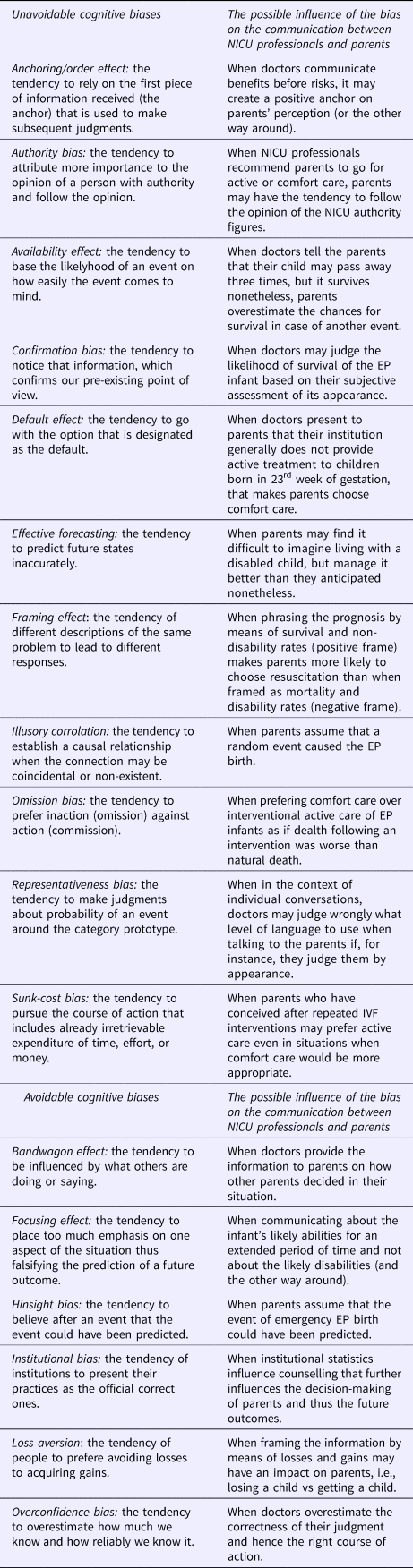
Nudges operate on two premises. The first premise is that people are not econs, rational economic optimizers, but that they exhibit bounded rationality (Reference Ploug and Holm6). They do not always rationally weigh all the options at hand in the limited time available to them, but they follow their cognitive biases and decide by following the principles such as rule of thumb, common sense, or educated guess (Reference Ploug and Holm6;Reference Halpern7). Irrational as it may be, such decision-making is predictable. The cognitive biases (see Table 1) are shared among many and they make people deviate from the optimal decision they would have made on the basis of their rationality alone (Reference Kahneman8).
The second premise is that institutions unavoidably influence the choice presented to people and thus push people one way or the other without having to be intentional about it (Reference Ploug and Holm6). Being intentional about the way choice is architected is what it means to nudge. In daily life, default settings on a mobile phone are a nudge, so is a GPS, or the size of glasses and plates (Reference Sunstein9). The decision-makers thus have two options. They can either not use the tool of nudging, but leave the unintentional choice architecture in place to guide the decision-making, essentially, closing their eyes and hoping for the best (Reference Stewart10). Or they can use to tool of nudging, which, however, requires them to take a stand on the background issues on the value level and thus be paternalistic. There is no neutral solution, either closing the eyes and hoping for the best or some level of paternalism.
Cognitive biases
In the context of NICUs, there is a list of cognitive biases that are at play when the decision between active and comfort care is taking place. When NICU professionals (neonatal doctors, nurses, psychologists, or other professionals, depending on the hospital) (Reference Hawlik and Stanak4) communicate with parents as part of the shared decision-making procedure, some of the biases on the side of parents as well as NICU professionals are unavoidable. Avoidability is defined here to be the freedom to communicate a specific message to the parent without tapping into a cognitive bias. While it is possible to communicate the data without referring to how other parents decided in that position (bandwagon effect), the use of the framing effect is unavoidable. There is no neutral framing NICU professionals may use as they simply must use words such as survival or mortality (or words conveying similar meaning) and their positive or negative connotation may have an impact on the parents’ choice (see Table 1 for a list of examples of cognitive biases potentially present in NICUs). The more unavoidable the bias is, the less neutrality in the process of communication is possible.
It needs to be noted that communication trainings for NICU professionals can help avoid the misusing of the more avoidable cognitive biases or, alternatively, can help in nudging parents toward the use of rational thinking in the decision-making processes. Indeed, improving parental decision-making competences should be the first step; however, that does not avoid the issue of biases in the shared decision-making procedure.
The tool of nudging and values
Nudging as a Tool Requiring an End
No longer is it the case then that the arsenal of decision-makers consists only of restrictions and incentives, sticks and carrots, but, in this way, nudging can be approached as another tool that the decision-makers have at hand. The Nuffield ladder of intervention for public health understands nudging strategies to precede the use of incentives and choice restriction, or elimination (13). When taken in the way as a tool, however, nudging requires an end toward which it can be used. Nudging is at the disposal of the agent, the person in the position of authority, who can use it for whatever ends deemed appropriate. Against this backdrop, nudging is criticized for being implemented without being scrutinized the same way other government restrictions are. Nudging often bypasses the principle of informed consent and, due to the lacking transparency, allows for paternalistic manipulation (Reference Ploug and Holm6).
Also, nudging is by no means a morally neutral tool that the decision-maker is automatically an expert on. When decision-makers choose to intentionally alter the choice architecture at their disposal, they automatically need to take a stand on what the good for the given individual or population is. Using of the tool of nudging brings about a conflict on the level of values as taking a stand is inevitably value laden. For instance, when NICU professionals communicate to parents that active care is the default option already at week 24 of gestation, they take a value stand that saving a child at this point of prematurity is already worth it.
The two points above highlight the need for making a distinction between two key sources of ethical issues at the heart of nudging. The first issue concerns the lack of transparency in the use of the tool of nudging, especially when compared with explicit government regulations that restrict or eliminate choice. The second issue concerns the background value judgments that are imminent whenever nudging is used for achieving a particular end. Nudging in the latter case merely highlights those conflicts that are rooted deeper in the topics at stake; hence, the value clashes vary with interventions.
Conflicts on the Value Level
The need for this distinction applies also to the context of NICUs. In the extreme cases around the limit of viability, not only are there conflicts between NICU professionals and parents, but there are also conflicts on the value level within particular NICU teams (elaborated on in Stanak) (Reference Stanak14). It is especially so because of the advances in technology that allow to keep most infants alive and by the prioritization challenges caused by the limited resources that force NICU professionals to participate in ethics (Reference Gallagher, Marlow, Edgley and Porock15). Such conflicts in the background will inevitably lead to different positions with regard to the use of nudging. To come up with ethical guidance for nudging, the issues of lacking transparency and the underlying conflicts on the value level need to be addressed.
Solution to normative issues with nudging
In the following section, I am going to argue that the accountability for reasonableness (A4R) framework can be a step toward the solution for the first issue with nudging (the lack of transparency) on the level of institutional and national formulation of guidelines (GLs) on the management of extremely preterm (EP) infants (Reference Daniels and Sabin16).
Procedural Justice as a Solution
At the beginning, it is important to establish the similarities between the private insurance rationing context where Daniels and Sabin apply the A4R (Reference Daniels and Sabin16) and the bedside rationing context at the limit of viability. The following core aspects are the same. NICUs face the problem that intersects the fields of medical ethics as well as political philosophy. They must ration due to shortage in staff counts or NICU beds (Reference Hawlik and Stanak4), their legitimacy to decide on behalf of the EP infant is in question as their view of the best interest for the infant may differ from the one of the parents (Reference Stanak14), and their fair treatment of similar cases similarly cannot be discerned as the outcome data is hard to access.
Moreover, the A4R framework can, in essence, be understood as a large shared decision-making procedure in which, just like in the NICU context, decisions are made by the decision-makers, evaluated and reviewed by the public or patients, and adjusted if unreasonable. The same process occurs in person with the parents of EP infants with the only difference that between weeks 23 and 24, the deliberation goes a step further as it is the parent who makes the ultimate decision based on the doctor's portrayal of the choices. It is important to note that there is a major difference in the nature of the two rationing context as the U.S. private insurance context is for profit, while the clinical NICU context is not.
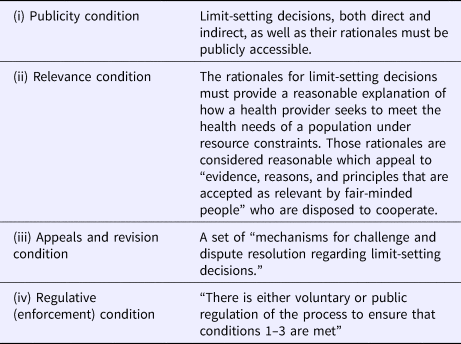
Even though the A4R framework was developed for the macro decision-making context, I want to suggest that because of the major similarities, the A4R framework can be also used in the clinical context of NICUs. When applying it to the NICU context, the A4R conditions (see Table 2) are hard to be envisaged in the bedside clinical encounter, but their role can be played in the formation of GLs on the management of EP infants. Currently, there is an agreement in the GLs of high-income countries that within weeks 22 and 25 of gestational age, shared decision-making with parents ought to be in place (Reference Guillén, Weiss and Munson2). These GLs on decision-making in NICUs in high-income countries are already to a large extent transparent. The roles of parents and NICU professionals are clearly defined, but the GLs do not include the issue of the form of communication with parents. Applying the above-outlined conditions of A4R in setting up of institutional and national GLs makes the use of the tool of nudging transparent, revisable, and able to be reflected upon; thus, it is a step toward addressing the first issue with nudging, the lack of transparency.
I want to argue that, even though the A4R framework is in theory a valuable procedural step toward more accountability, it does not address the how of the way rationales are communicated. The decision-makers in both macro and micro worlds can thus influence the process through their value-laden communication that can constitute paternalism and that undermines the main goal of A4R, namely, the provision of legitimacy and fairness (Reference Daniels and Sabin16). The A4R, hence, only pushes paternalism one step farther as even a good deliberative shared decision-making procedure remains paternalistic. For that reason, relying on the professional virtue of practical wisdom should guide the use of nudging in the bedside NICU context.
Virtue Ethics as a Solution
Looking for the solution to the second issue with nudging, namely the value conflicts in the background that also penetrate into the decision-making procedures, I want to suggest an agent-centered solution in line with the virtue ethics tradition. As argued by MacIntyre (Reference MacIntyre17), the modern moral conflicts are interminable as they lack a teleological, goal oriented, essence. The goal (telos) can be found in the professions and the solution to the moral conflicts in the virtue ethics tradition. The reason being that it is the virtues of the individual that help one discern what course of action to take and how to decide between competing moral principles in practice. Hence, I want to argue that virtues as character traits are necessary for the professional in pursuing the act of profession (the good of the patient). I want to suggest that we should look for the solution on how to use the tool of nudging in the moral structures of professionalism by placing trust in the NICU professionals (Reference Pellegrino, Walker and Ivanhoe18).
What makes professions distinct from mere occupations is the commitment to the profession's particular moral template (Reference Pellegrino, Walker and Ivanhoe18). A lawyer commits to protect the good of the client and pursues the value of justice, the teacher commits to protect the good of the student and pursues the value of knowledge, and the medical professional commits to protect the best interest of the patient and pursues the value of health. It is the act of profession where respective professionals commit to serve the good of their professions.
Furthermore, I want to link being a professional to a theory of moral virtues and suggest that the act of profession entails specific character traits in the person pursuing the respective profession. When giving the Hippocratic oath, medical professionals commit to using their special knowledge for the sake of patient's good (Reference Pellegrino, Walker and Ivanhoe18). On the way toward the good, certain character traits, virtues, enable one to attain it best. Virtue is understood here as a character trait that disposes the physician habitually to act well and wisely in medicine (Reference Pellegrino, Walker and Ivanhoe18). In the case of clinical medicine, those virtues that dispose the physician to act well that have been debated in the literature range from benevolence, to intellectual honesty, courage, compassion, or humility (Reference Pellegrino, Walker and Ivanhoe18). The application of these virtues (elaborated on in Stanak) (Reference Stanak14) puts the act of profession into clinical reality.
Phronesis: Practical Wisdom
Because the topic in question concerns the right use of the tool of nudging, I want to focus on the intellectual virtue of phronesis, practical wisdom, that has a key role in discerning what the right course of action is. In the context of professional ethics of NICUs, practical wisdom refers to the capacity to act in line with the good of the profession. Practical wisdom is the virtue that allows the NICU professional to correctly evaluate the value related issues at stake against the backdrop of the particular clinical facts and to make the morally right decision. Just as the clinical setting refers to clinical judgment that helps the clinician evaluate the factual data, practical wisdom is its analogue in the moral sphere (Reference Pellegrino, Walker and Ivanhoe18).
The clinical judgment represents a technical mastery of principles of diagnosis, prognosis, and therapeutics that serve the good of the patient (Reference Pellegrino, Walker and Ivanhoe18). In the profession of medicine, the clinical and the moral are inevitably fused. The clinical judgment requires the medical professional to apply the general medical knowledge to a particular patient, while practical wisdom involves complicated interactions between the general moral principles, clinical data, and the particular moral challenge. Practical wisdom, in the sense, is to be taken not as a moral judgment deduced from principles, as it is not an attempt to produce law-like relationships, but a situated context-specific knowledge (Reference Devettere19). Practical wisdom is not logically simple, in a way that it would provide self-evident clarity, and so it is not a kind of comfortable scientific approach applied to morality. It leaves the weight on the individual to, upon reflection, act correctly, according to right reason. Practical wisdom is not a theoretical wisdom, but wisdom based on making one's hands dirty in practice.
Deciding around the limit of viability is precisely the situation of making one's hands dirty. When NICU professionals communicate with parents of an EP infant that is to be born in week 23 of gestation, through dialogues, they attempt to work out from the bottom up what the best course of action is. Their decision in the actual situation of birth will thus be context specific. Aware of the general moral principles, the NICU professionals will have to decide in the particular case if active or comfort care ought to be pursued. They will have to use their practical wisdom together with their clinical judgment and parental consultation to discern the right course of action. The pitfall, however, that comes with leaving the NICU professionals to decide exclusively on their own judgment is that, if this position of authority is misused, also the tool of nudging will be used for the manipulation of the parents. For that reason, merging the A4R framework with the virtue of practical wisdom could be a step toward safeguarding the right use of nudging.
Practical Wisdom and Accountability for Reasonableness
I want to argue that merging the modern democratic framework of A4R with the ancient Greek virtue of practical wisdom can be seen as a guide to nudging. Through the application of transparency, the A4R framework may bring a solution on the level of GL formation, while the virtue of practical wisdom puts the emphasis on the agent trained in the qualities required for the correct pursuit of its profession to know how one ought to use the tool of nudging in practice. Hence, Hence, I want to sugest a framework merging accountability for reasonableness and practical wisdom.
The tool of nudging in the field of NICUs falls at hands of the NICU professionals. They pursue conversations that require reflection and judgment with parents as part of the shared decision-making procedures on daily basis. It is in these conversations where NICU professionals need to adjust their judgment on how to nudge to the specific situation and specific parents. Their aim ought to be improving parental decision-making capacity, reducing the impact of biases, as well as being in line with their professional commitment to the good of the patient. Intentional nudging is easier to justify outside of this morally ambiguous zone around the limit of viability, but the role of nudging is present also in these gray zone cases nonetheless. Even though this model remains to be paternalistic, compared with the current practice, it is a step forward that calls for the recognition of the impact of communication strategies (nudges) at the level of GL formation, as well as it calls for the professionals to recognize the role of ethics in the decision-making processes. The quest to eliminate paternalism in NICUs, however, is debatable as, depending on the context, there seem to situations in which parents explicitly want a competent professional to decide on their behalf (Reference Weiss, Barg, Cook, Black and Joffe20).
Even in a shared decision-making procedure, the form of communication (of rationales) around the limit of viability cannot be neutral. Transparency and reflexivity can improve the process, but they do not eliminate paternalism and the related challenges with fairness, or legitimacy. In the everyday practice at NICUs, the decision-making must rely on the character of the NICU professional to discern what principle to follow when. Same as with clinical judgment, practical wisdom is largely invisible in action and, hence, hard to be accounted for. But as clinicians are held liable for the clinical judgment, they should also be held accountable for their moral judgment at least on the grounds of GLs. The role of ethics committees and ethics moderation, however, is crucial in supporting the NICU professionals in such normatively intense situations (elaborated upon in Stanak) (Reference Stanak14).
In conclusion, I have argued that rather than ignoring the impact of choice architecture on the outcome and, thus, closing our eyes and hoping for the best, the NICU professionals should use the tool of nudging. Transparency about nudging at the level of GLs combined with professional virtues guiding the bedside rationing is the position suggested here. Nudging in this sense is nothing else, but using of another tool that is at disposal of the NICU professional toward the end of medicine, the good of the patient (Reference Pellegrino, Walker and Ivanhoe18). For that reason, NICU professionals ought to use the tool of nudging transparently in line with their act of profession and their practically wise judgment.





 You have
Access
The way choice is presented has an impact on decision-making. This is the case also in the clinical context of neonatal intensive care units (NICUs). Particularly, in the challenging cases that concern the limit of viability, which is the point in fetal development at which the infant has a reasonable chance of extra-uterine survival (Reference Mercurio1). There, between the beginning of week 22 and the end of week 25 of gestational age, shared decision-making with parents takes place (Reference Guillén, Weiss and Munson2). According to a systematic review from decision-making in high-income countries, weeks 23 and 24, in particular, are the zone of parental discretion where the parents ultimately make the decision between comfort (palliative) care and active care based upon the portrayal of choices by NICU professionals (Reference Guillén, Weiss and Munson2). This situation is of extreme gravity because it requires the surrogate decision-makers, the parents or NICU professionals, to operate at the border of beginning of life as well as end of life. The main aim is thus to minimize undertreatment as well as overtreatment by attempting to save each infant that has reasonable chances for meaningful survival and let go the one that does not, in order to prevent unnecessary harm (Reference Leuthner3).
This study is set against the backdrop of our research of the Austrian context where a limited number of intensive care beds, limited number of NICU professionals, and scarce financial resources make the decision-making in NICUs a matter of resource prioritization (Reference Hawlik and Stanak4;Reference Stanak and Hawlik5).
In this study, I want to examine the use of the tool of nudging using the NICU as the paradigm case. In doing so, I am going explain what nudging is, suggest that we should understand it as a tool, and elaborate on the moral challenges that come along in the context of NICUs. Furthermore, I am going argue that the democratic framework of accountability for reasonableness together with the virtue of practical wisdom (phronesis) can guide the right use of nudging in the NICU profession.
Nudging definition and theory
In the following section, I try to establish that, in any situation of decision-making, whenever one chooses between alternative options, choice architecture is present. Choice architecture refers to the particular way the options are laid out in front of the decision-makers without anybody intentionally guiding the choices. The way the options are presented triggers a spectrum of cognitive biases, where some are avoidable while others less so. Intentional alteration of choices based on the knowledge of these biases is what it means to nudge. Hence, when decision-makers intentionally decide to work with choice architecture, they become responsible for nudging.
Nudges operate on two premises. The first premise is that people are not econs, rational economic optimizers, but that they exhibit bounded rationality (Reference Ploug and Holm6). They do not always rationally weigh all the options at hand in the limited time available to them, but they follow their cognitive biases and decide by following the principles such as rule of thumb, common sense, or educated guess (Reference Ploug and Holm6;Reference Halpern7). Irrational as it may be, such decision-making is predictable. The cognitive biases (see Table 1) are shared among many and they make people deviate from the optimal decision they would have made on the basis of their rationality alone (Reference Kahneman8).
Avoidable and Unavoidable Cognitive Biases in NICUs (Reference Janvier, Barrington and Farlow11;12)
The second premise is that institutions unavoidably influence the choice presented to people and thus push people one way or the other without having to be intentional about it (Reference Ploug and Holm6). Being intentional about the way choice is architected is what it means to nudge. In daily life, default settings on a mobile phone are a nudge, so is a GPS, or the size of glasses and plates (Reference Sunstein9). The decision-makers thus have two options. They can either not use the tool of nudging, but leave the unintentional choice architecture in place to guide the decision-making, essentially, closing their eyes and hoping for the best (Reference Stewart10). Or they can use to tool of nudging, which, however, requires them to take a stand on the background issues on the value level and thus be paternalistic. There is no neutral solution, either closing the eyes and hoping for the best or some level of paternalism.
Cognitive biases
In the context of NICUs, there is a list of cognitive biases that are at play when the decision between active and comfort care is taking place. When NICU professionals (neonatal doctors, nurses, psychologists, or other professionals, depending on the hospital) (Reference Hawlik and Stanak4) communicate with parents as part of the shared decision-making procedure, some of the biases on the side of parents as well as NICU professionals are unavoidable. Avoidability is defined here to be the freedom to communicate a specific message to the parent without tapping into a cognitive bias. While it is possible to communicate the data without referring to how other parents decided in that position (bandwagon effect), the use of the framing effect is unavoidable. There is no neutral framing NICU professionals may use as they simply must use words such as survival or mortality (or words conveying similar meaning) and their positive or negative connotation may have an impact on the parents’ choice (see Table 1 for a list of examples of cognitive biases potentially present in NICUs). The more unavoidable the bias is, the less neutrality in the process of communication is possible.
It needs to be noted that communication trainings for NICU professionals can help avoid the misusing of the more avoidable cognitive biases or, alternatively, can help in nudging parents toward the use of rational thinking in the decision-making processes. Indeed, improving parental decision-making competences should be the first step; however, that does not avoid the issue of biases in the shared decision-making procedure.
The tool of nudging and values
Nudging as a Tool Requiring an End
No longer is it the case then that the arsenal of decision-makers consists only of restrictions and incentives, sticks and carrots, but, in this way, nudging can be approached as another tool that the decision-makers have at hand. The Nuffield ladder of intervention for public health understands nudging strategies to precede the use of incentives and choice restriction, or elimination (13). When taken in the way as a tool, however, nudging requires an end toward which it can be used. Nudging is at the disposal of the agent, the person in the position of authority, who can use it for whatever ends deemed appropriate. Against this backdrop, nudging is criticized for being implemented without being scrutinized the same way other government restrictions are. Nudging often bypasses the principle of informed consent and, due to the lacking transparency, allows for paternalistic manipulation (Reference Ploug and Holm6).
Also, nudging is by no means a morally neutral tool that the decision-maker is automatically an expert on. When decision-makers choose to intentionally alter the choice architecture at their disposal, they automatically need to take a stand on what the good for the given individual or population is. Using of the tool of nudging brings about a conflict on the level of values as taking a stand is inevitably value laden. For instance, when NICU professionals communicate to parents that active care is the default option already at week 24 of gestation, they take a value stand that saving a child at this point of prematurity is already worth it.
The two points above highlight the need for making a distinction between two key sources of ethical issues at the heart of nudging. The first issue concerns the lack of transparency in the use of the tool of nudging, especially when compared with explicit government regulations that restrict or eliminate choice. The second issue concerns the background value judgments that are imminent whenever nudging is used for achieving a particular end. Nudging in the latter case merely highlights those conflicts that are rooted deeper in the topics at stake; hence, the value clashes vary with interventions.
Conflicts on the Value Level
The need for this distinction applies also to the context of NICUs. In the extreme cases around the limit of viability, not only are there conflicts between NICU professionals and parents, but there are also conflicts on the value level within particular NICU teams (elaborated on in Stanak) (Reference Stanak14). It is especially so because of the advances in technology that allow to keep most infants alive and by the prioritization challenges caused by the limited resources that force NICU professionals to participate in ethics (Reference Gallagher, Marlow, Edgley and Porock15). Such conflicts in the background will inevitably lead to different positions with regard to the use of nudging. To come up with ethical guidance for nudging, the issues of lacking transparency and the underlying conflicts on the value level need to be addressed.
Solution to normative issues with nudging
In the following section, I am going to argue that the accountability for reasonableness (A4R) framework can be a step toward the solution for the first issue with nudging (the lack of transparency) on the level of institutional and national formulation of guidelines (GLs) on the management of extremely preterm (EP) infants (Reference Daniels and Sabin16).
Procedural Justice as a Solution
At the beginning, it is important to establish the similarities between the private insurance rationing context where Daniels and Sabin apply the A4R (Reference Daniels and Sabin16) and the bedside rationing context at the limit of viability. The following core aspects are the same. NICUs face the problem that intersects the fields of medical ethics as well as political philosophy. They must ration due to shortage in staff counts or NICU beds (Reference Hawlik and Stanak4), their legitimacy to decide on behalf of the EP infant is in question as their view of the best interest for the infant may differ from the one of the parents (Reference Stanak14), and their fair treatment of similar cases similarly cannot be discerned as the outcome data is hard to access.
Moreover, the A4R framework can, in essence, be understood as a large shared decision-making procedure in which, just like in the NICU context, decisions are made by the decision-makers, evaluated and reviewed by the public or patients, and adjusted if unreasonable. The same process occurs in person with the parents of EP infants with the only difference that between weeks 23 and 24, the deliberation goes a step further as it is the parent who makes the ultimate decision based on the doctor's portrayal of the choices. It is important to note that there is a major difference in the nature of the two rationing context as the U.S. private insurance context is for profit, while the clinical NICU context is not.
Even though the A4R framework was developed for the macro decision-making context, I want to suggest that because of the major similarities, the A4R framework can be also used in the clinical context of NICUs. When applying it to the NICU context, the A4R conditions (see Table 2) are hard to be envisaged in the bedside clinical encounter, but their role can be played in the formation of GLs on the management of EP infants. Currently, there is an agreement in the GLs of high-income countries that within weeks 22 and 25 of gestational age, shared decision-making with parents ought to be in place (Reference Guillén, Weiss and Munson2). These GLs on decision-making in NICUs in high-income countries are already to a large extent transparent. The roles of parents and NICU professionals are clearly defined, but the GLs do not include the issue of the form of communication with parents. Applying the above-outlined conditions of A4R in setting up of institutional and national GLs makes the use of the tool of nudging transparent, revisable, and able to be reflected upon; thus, it is a step toward addressing the first issue with nudging, the lack of transparency.
A4R Conditions (Reference Daniels and Sabin16)
I want to argue that, even though the A4R framework is in theory a valuable procedural step toward more accountability, it does not address the how of the way rationales are communicated. The decision-makers in both macro and micro worlds can thus influence the process through their value-laden communication that can constitute paternalism and that undermines the main goal of A4R, namely, the provision of legitimacy and fairness (Reference Daniels and Sabin16). The A4R, hence, only pushes paternalism one step farther as even a good deliberative shared decision-making procedure remains paternalistic. For that reason, relying on the professional virtue of practical wisdom should guide the use of nudging in the bedside NICU context.
Virtue Ethics as a Solution
Looking for the solution to the second issue with nudging, namely the value conflicts in the background that also penetrate into the decision-making procedures, I want to suggest an agent-centered solution in line with the virtue ethics tradition. As argued by MacIntyre (Reference MacIntyre17), the modern moral conflicts are interminable as they lack a teleological, goal oriented, essence. The goal (telos) can be found in the professions and the solution to the moral conflicts in the virtue ethics tradition. The reason being that it is the virtues of the individual that help one discern what course of action to take and how to decide between competing moral principles in practice. Hence, I want to argue that virtues as character traits are necessary for the professional in pursuing the act of profession (the good of the patient). I want to suggest that we should look for the solution on how to use the tool of nudging in the moral structures of professionalism by placing trust in the NICU professionals (Reference Pellegrino, Walker and Ivanhoe18).
What makes professions distinct from mere occupations is the commitment to the profession's particular moral template (Reference Pellegrino, Walker and Ivanhoe18). A lawyer commits to protect the good of the client and pursues the value of justice, the teacher commits to protect the good of the student and pursues the value of knowledge, and the medical professional commits to protect the best interest of the patient and pursues the value of health. It is the act of profession where respective professionals commit to serve the good of their professions.
Furthermore, I want to link being a professional to a theory of moral virtues and suggest that the act of profession entails specific character traits in the person pursuing the respective profession. When giving the Hippocratic oath, medical professionals commit to using their special knowledge for the sake of patient's good (Reference Pellegrino, Walker and Ivanhoe18). On the way toward the good, certain character traits, virtues, enable one to attain it best. Virtue is understood here as a character trait that disposes the physician habitually to act well and wisely in medicine (Reference Pellegrino, Walker and Ivanhoe18). In the case of clinical medicine, those virtues that dispose the physician to act well that have been debated in the literature range from benevolence, to intellectual honesty, courage, compassion, or humility (Reference Pellegrino, Walker and Ivanhoe18). The application of these virtues (elaborated on in Stanak) (Reference Stanak14) puts the act of profession into clinical reality.
Phronesis: Practical Wisdom
Because the topic in question concerns the right use of the tool of nudging, I want to focus on the intellectual virtue of phronesis, practical wisdom, that has a key role in discerning what the right course of action is. In the context of professional ethics of NICUs, practical wisdom refers to the capacity to act in line with the good of the profession. Practical wisdom is the virtue that allows the NICU professional to correctly evaluate the value related issues at stake against the backdrop of the particular clinical facts and to make the morally right decision. Just as the clinical setting refers to clinical judgment that helps the clinician evaluate the factual data, practical wisdom is its analogue in the moral sphere (Reference Pellegrino, Walker and Ivanhoe18).
The clinical judgment represents a technical mastery of principles of diagnosis, prognosis, and therapeutics that serve the good of the patient (Reference Pellegrino, Walker and Ivanhoe18). In the profession of medicine, the clinical and the moral are inevitably fused. The clinical judgment requires the medical professional to apply the general medical knowledge to a particular patient, while practical wisdom involves complicated interactions between the general moral principles, clinical data, and the particular moral challenge. Practical wisdom, in the sense, is to be taken not as a moral judgment deduced from principles, as it is not an attempt to produce law-like relationships, but a situated context-specific knowledge (Reference Devettere19). Practical wisdom is not logically simple, in a way that it would provide self-evident clarity, and so it is not a kind of comfortable scientific approach applied to morality. It leaves the weight on the individual to, upon reflection, act correctly, according to right reason. Practical wisdom is not a theoretical wisdom, but wisdom based on making one's hands dirty in practice.
Deciding around the limit of viability is precisely the situation of making one's hands dirty. When NICU professionals communicate with parents of an EP infant that is to be born in week 23 of gestation, through dialogues, they attempt to work out from the bottom up what the best course of action is. Their decision in the actual situation of birth will thus be context specific. Aware of the general moral principles, the NICU professionals will have to decide in the particular case if active or comfort care ought to be pursued. They will have to use their practical wisdom together with their clinical judgment and parental consultation to discern the right course of action. The pitfall, however, that comes with leaving the NICU professionals to decide exclusively on their own judgment is that, if this position of authority is misused, also the tool of nudging will be used for the manipulation of the parents. For that reason, merging the A4R framework with the virtue of practical wisdom could be a step toward safeguarding the right use of nudging.
Practical Wisdom and Accountability for Reasonableness
I want to argue that merging the modern democratic framework of A4R with the ancient Greek virtue of practical wisdom can be seen as a guide to nudging. Through the application of transparency, the A4R framework may bring a solution on the level of GL formation, while the virtue of practical wisdom puts the emphasis on the agent trained in the qualities required for the correct pursuit of its profession to know how one ought to use the tool of nudging in practice. Hence, Hence, I want to sugest a framework merging accountability for reasonableness and practical wisdom.
The tool of nudging in the field of NICUs falls at hands of the NICU professionals. They pursue conversations that require reflection and judgment with parents as part of the shared decision-making procedures on daily basis. It is in these conversations where NICU professionals need to adjust their judgment on how to nudge to the specific situation and specific parents. Their aim ought to be improving parental decision-making capacity, reducing the impact of biases, as well as being in line with their professional commitment to the good of the patient. Intentional nudging is easier to justify outside of this morally ambiguous zone around the limit of viability, but the role of nudging is present also in these gray zone cases nonetheless. Even though this model remains to be paternalistic, compared with the current practice, it is a step forward that calls for the recognition of the impact of communication strategies (nudges) at the level of GL formation, as well as it calls for the professionals to recognize the role of ethics in the decision-making processes. The quest to eliminate paternalism in NICUs, however, is debatable as, depending on the context, there seem to situations in which parents explicitly want a competent professional to decide on their behalf (Reference Weiss, Barg, Cook, Black and Joffe20).
Even in a shared decision-making procedure, the form of communication (of rationales) around the limit of viability cannot be neutral. Transparency and reflexivity can improve the process, but they do not eliminate paternalism and the related challenges with fairness, or legitimacy. In the everyday practice at NICUs, the decision-making must rely on the character of the NICU professional to discern what principle to follow when. Same as with clinical judgment, practical wisdom is largely invisible in action and, hence, hard to be accounted for. But as clinicians are held liable for the clinical judgment, they should also be held accountable for their moral judgment at least on the grounds of GLs. The role of ethics committees and ethics moderation, however, is crucial in supporting the NICU professionals in such normatively intense situations (elaborated upon in Stanak) (Reference Stanak14).
In conclusion, I have argued that rather than ignoring the impact of choice architecture on the outcome and, thus, closing our eyes and hoping for the best, the NICU professionals should use the tool of nudging. Transparency about nudging at the level of GLs combined with professional virtues guiding the bedside rationing is the position suggested here. Nudging in this sense is nothing else, but using of another tool that is at disposal of the NICU professional toward the end of medicine, the good of the patient (Reference Pellegrino, Walker and Ivanhoe18). For that reason, NICU professionals ought to use the tool of nudging transparently in line with their act of profession and their practically wise judgment.
Author ORCIDs
Michal Stanak, 0000-0003-0313-0997
Financial Support
This work was funded by the Ludwig Boltzmann Institute for Health Technology Assessment, Vienna, Austria.
Conflicts of interest
The author declares no conflicts of interest.