Introduction
Most marine invertebrates have a complex life cycle which includes a planktonic larval stage and juvenile or benthic adult stages (Degnan & Degnan, Reference Degnan and Degnan2010; Calado & Leal, Reference Calado and Leal2015). Generally, in the marine environment, hard substrates host sessile invertebrates such as barnacles, mussels, ascidians, bivalves, bryozoa, porifera, cnidaria and annelids (Connell, Reference Connell1999; Holloway & Connell, Reference Holloway and Connell2002; Perkol-Finkel & Benayahu, Reference Perkol-Finkel and Benayahu2006). The competent larvae in the pelagic stage begin to search for suitable substratum, where settlement and metamorphosis occurs. The larvae of sessile invertebrates are induced by a variety of physical, chemical or biological cues to settle (Rodriguez et al., Reference Rodriguez, Ojeda and Inestrosa1993). Settlement is a process which includes the search of substratum using larvae-specific sensory mechanisms (Matsumura & Qian, Reference Matsumura and Qian2014) before finally metamorphosing to a benthic juvenile.
Biotic and abiotic factors strongly influence invertebrate larvae during the settlement process (Rodriguez et al., Reference Rodriguez, Ojeda and Inestrosa1993; Vermeij & Sandin, Reference Vermeij and Sandin2008; Penin et al., Reference Penin, Michonneau, Carroll and Adjeroud2011). Initially, habitats are colonized by bacteria and diatoms (Zardus et al., Reference Zardus, Nedved, Huang, Tran and Hadfield2008; Satheesh & Wesley, Reference Satheesh and Wesley2011), which may alter the substrate properties (Lozano-Cortés & Zapata, Reference Lozano-Cortés and Zapata2014). Extracellular polymeric substances from the microbial biofilm (Camacho-Chab et al., Reference Camacho-Chab, Lango Reynoso, Castañeda Chávez, Galaviz Villa, Hinojosa Garro and Ortega Morales2016), settlement cues from surface-associated diatoms (Patil & Anil, Reference Patil and Anil2005) and conspecific cues (Da-anoy et al., Reference Da-Anoy, Villanueva, Cabaitan and Conaco2017) are reported to induce larval settlement. In addition to biotic factors, the experimental results from many studies reveal that abiotic factors like surface topography, luminous intensity, proximity, surface orientation, hydrodynamics, size and substrate colour influence invertebrate assemblages on substrates (Thorson, Reference Thorson1964; Maldonado & Young, Reference Maldonado and Young1996; Thomason et al., Reference Thomason, Letissier, Thomason and Field2002; Satheesh & Wesley, Reference Satheesh and Wesley2010; Muhammad et al., Reference Muhammad, deNys, David, Nicole and Whalan2014; Spagnolo et al., Reference Spagnolo, Cuicchi, Punzo, Santelli, Scarcella and Fabi2014; Whalan et al., Reference Whalan, Wahab, Sprungala, Poole and de Nys2015).
Introduction of artificial materials due to increasing urbanization is part of major habitat modifications in coastal ecosystems throughout the world (Vaz-Pinto et al., Reference Vaz-Pinto, Torrontegi, Prestes, Álvaro, Neto and Martins2014). Anthropogenic structures introduced in the water column become a suitable habitat for invertebrate colonization (Chase et al., Reference Chase, Dijkstra and Harris2016). Materials used in construction offer potential hard substrates for settlement of fouling organisms (Whomersley & Picken, Reference Whomersley and Picken2003; Yan et al., Reference Yan, Yan, Dong, Wang, Yan and Liang2006; van der Stap et al., Reference Van der Stap, Coolen and Lindeboom2016) and non-indigenous organisms (Cariton & Geller, Reference Cariton and Geller1993; Bax et al., Reference Bax, Williamson, Aguero, Gonzalez and Geeves2003; Page et al., Reference Page, Dugan, Culver and Hoesterey2006; Ruiz et al., Reference Ruiz, Freestone, Fofonoff, Simkanin and Wahl2009). Numerous studies report higher abundance and species richness of non-indigenous species on artificial substrates rather than natural habitats (Glasby et al., Reference Glasby, Connell, Holloway and Hewitt2007; Airoldi & Bulleri, Reference Airoldi and Bulleri2011; Dafforn et al., Reference Dafforn, Glasby and Johnston2012). The effect of an artificial substratum on benthic community recruitment has been studied for the assessment of macrofouling assemblages (Anderson & Underwood, Reference Anderson and Underwood1994; Satheesh & Wesley, Reference Satheesh and Wesley2008), non-indigenous species (Bumbeer & Rocha, Reference Bumbeer and Rocha2016; Marraffini et al., Reference Marraffini, Ashton, Brown, Chang and Ruiz2017) and artificial reef construction for the purpose of recreational diving, fishing and coral reef restoration (Baine, Reference Baine2001; Dupont, Reference Dupont2008; Oh et al., Reference Oh, Ditton and Stoll2008). Considering the role of artificial materials in benthic community colonization and introduction of non-indigenous species, it is important to study the effects of substrates and their orientation on larval recruitment.
Invertebrate larval settlement studies have shown variation in the community structure between horizontal and vertical surfaces (Connell, Reference Connell1999; Glasby & Connell, Reference Glasby and Connell2001). Studies determining the effect of orientation revealed that macrofouling organisms (tube worms and barnacles) are influenced by substrate orientation (Glasby & Connell, Reference Glasby and Connell2001). In our study, four different substrates: acrylic, concrete blocks, ceramic tiles and stainless steel plates, which mimic the materials used in marine applications (Glasby & Connell, Reference Glasby and Connell2001; Stachiw, Reference Stachiw2004; Dobretsov, Reference Dobretsov2015), were used to test the invertebrate settlement pattern. The following questions were addressed in our study: (i) Does the artificial substrate have an effect on larval recruitment? (ii) Is there any significant variation in invertebrate larval recruitment between different orientations? (iii) Is the variation in invertebrate recruitment in relation to substrate type and orientation consistent across temporal scales in the Red Sea? Since the central Red Sea is ultra-oligotrophic in nature (Almahasheer et al., Reference Almahasheer, Duarte and Irigoien2016), studying invertebrate recruitment on artificial substrates assumed significance, particularly due to the unique environmental conditions.
Materials and methods
Study area
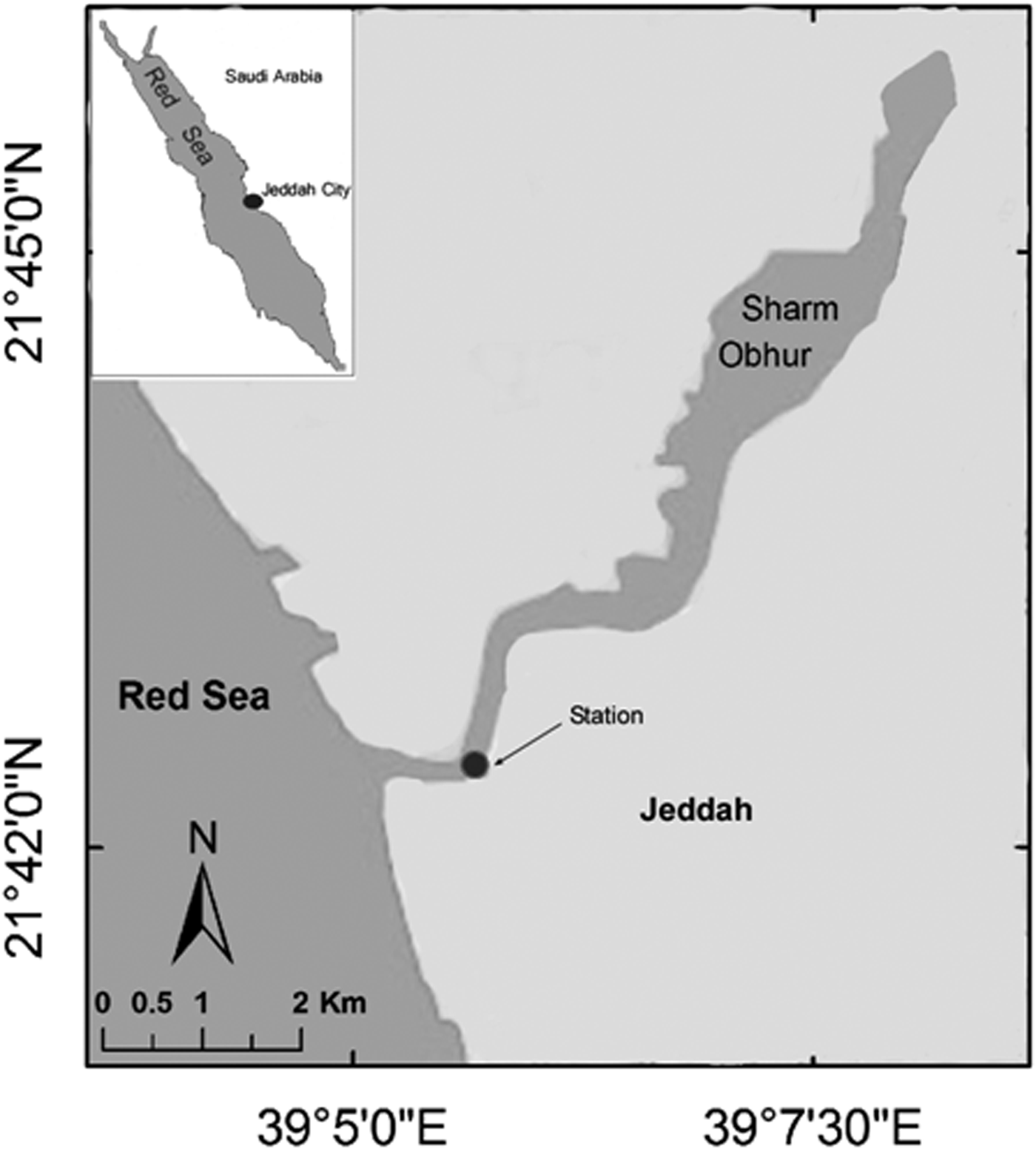
This study was conducted in Obhur Creek, central Red Sea, 35 km north of Jeddah, Saudi Arabia (21°42′33.52″N 39°5′45.71″E). Obhur Creek (Figure 1) is about 10 km long with a maximum width of 1.2 km and depth of 35 m and is connected directly to the Red Sea (El–Rayis & Eid, Reference El–Rayis and Eid1997). The creek is a popular place for recreational activities and marinas. The temperature of Obhur Creek varies between 27.16 and 33.22°C and the salinity varies between 39.82 and 40.22 psu during winter and summer respectively (AlSaafani et al., Reference Alsaafani, Alraddadi and Albarakati2017).
Map showing the Obhur Creek and the study area (station) in the central Red Sea coast of Saudi Arabia.

Experimental design
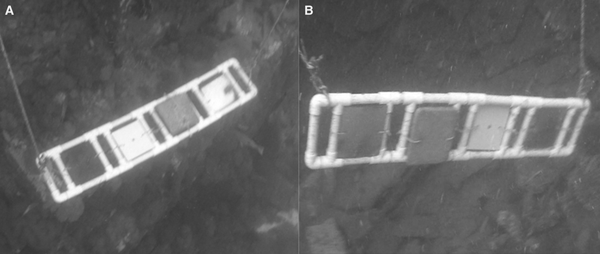
Treatment panels were prepared using four different types of substrate material: acrylic (colourless, transparent sheet, ISO 9001 grade), concrete blocks (a material used in pontoons or jetties), ceramic tiles (white polished surface) and stainless steel plates. Treatment panels (each panel: 15 × 15 cm) were randomly attached to a PVC raft using a cable tie. Each PVC raft contained four panels (one panel from each substrate) and eight rafts were deployed. Of these, panels on four rafts were placed in a horizontal position and the other four rafts in a vertical position (Figure 2). In brief, the experimental design consists of replicate treatments (N = 4 for each substrate and position, i.e. one panel from each raft) in all the four seasons.
Test panels with PVC raft submerged in the marine waters in (a) horizontal and (b) vertical positions. Test panels were prepared from four different substrates: acrylic, stainless steel, ceramic and concrete.

The rafts were submerged at a depth of 2 m at Obhur Creek near King Abdulaziz University Marine Research Laboratory (KAU marine station). The PVC rafts holding the treatment panels were hung (in vertical and horizontal positions) using a nylon rope from the KAU marine station jetty and positioned at the bottom using sufficient weight (concrete blocks). Treatment panels were submerged for 4 weeks during winter (December 2016), autumn (February 2017), spring (mid-April–mid-May 2017) and summer (July 2017) seasons. Panels were retrieved from the seawater after 4 weeks of submersion in each season. Panels were immediately transferred to the laboratory and stored (maximum storage duration: 24 h) at less than 4°C in a refrigerator for further analysis (Glasby & Connell, Reference Glasby and Connell2001). Marine benthic invertebrates recruited on the panels were analysed under a dissecting microscope (Leica DMI 3000B) and the number of organisms recruited on each test substrate (only one side) was counted (manually) and recorded (Dobretsov et al., Reference Dobretsov, Raeid and Christian2013). For horizontal orientation panels, the upper side was analysed. Organisms from the panels were scraped carefully and kept in 95% ethanol for further identification using a marine invertebrate field guide (Hibberd & Moore, Reference Hibberd and Moore2009). The abundance of organisms (mean ± SE) was described for the panel surface area of 225 cm−2 (one side of the panel).
Statistical analysis
Marine invertebrate settlement on four different substrates was analysed using nested ANOVA (analysis of variance) with substrates (nested within season and orientation), seasons and orientation as factors. Additionally, a two-way ANOSIM (analysis of similarities) was carried out using seasons and substrates as factors. ANOSIM was made based on the Bray–Curtis similarity index with 9999 permutations. Non-metric multidimensional scaling (n-MDS) analysis was used to visualize the similarity (Bray–Curtis similarity) in benthic community recruitment on treatment panels submerged in different seasons. SIMPER (similarity percentage) analysis was also carried out based on the Bray–Curtis similarity index to understand the percentage contribution of each invertebrate group to the dissimilarities between treatment panels. ANOVA was carried out using STATISTICA (data analysis software system, version 10). All other analyses were conducted using PAST (Paleontological Statistics Software Package, version 3.2; Hammer et al., Reference Hammer, Harper and Ryan2001).
Results
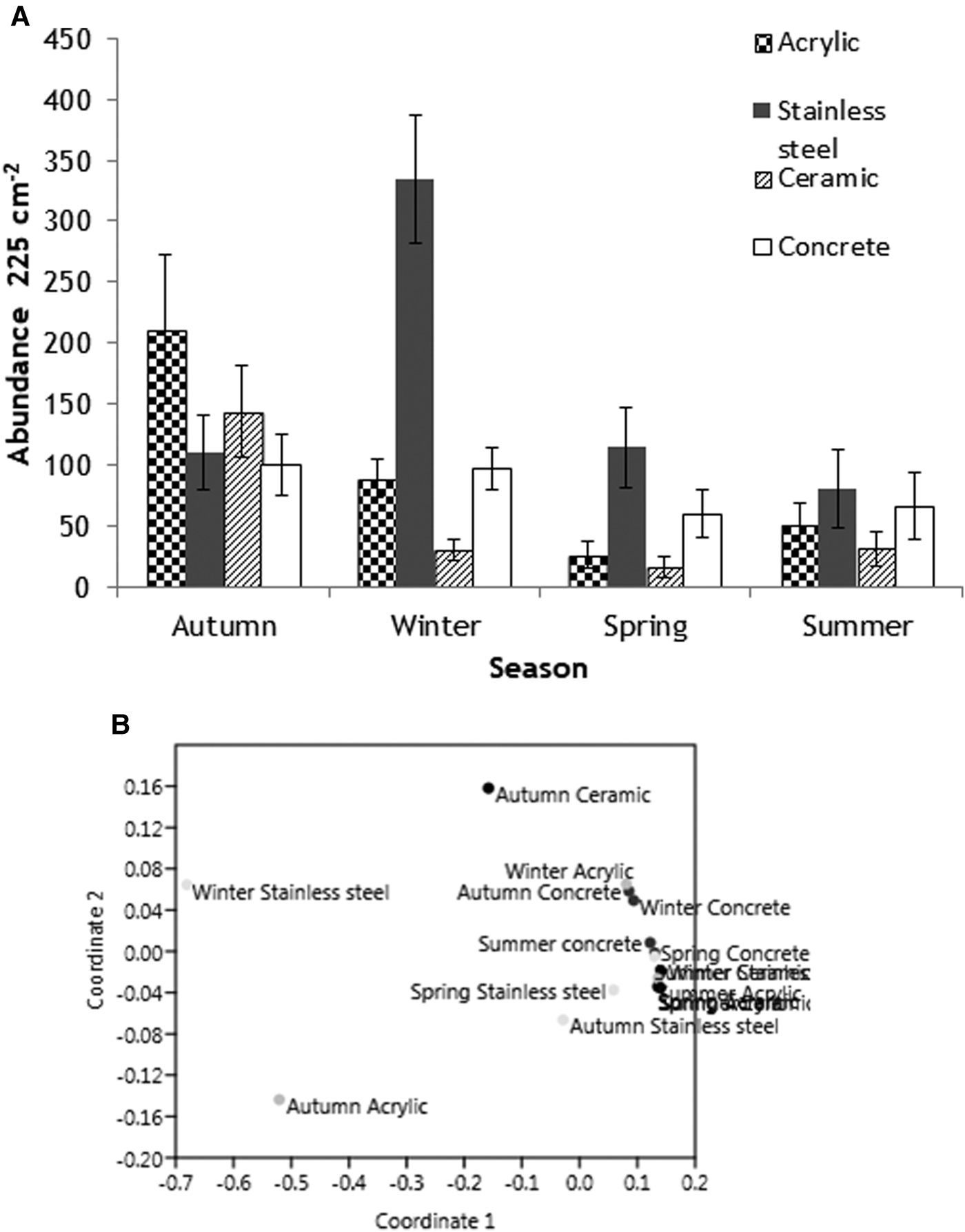
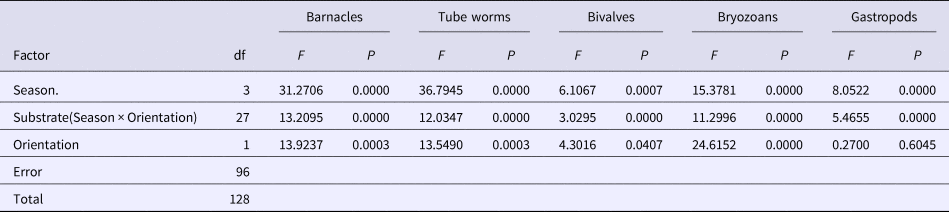
The abundance of invertebrates such as bryozoans, barnacles, tubicolous polychaetes (tube worms), bivalves and gastropods was studied in detail as these organisms were commonly recruited on panels. Results showed that the recruitment of marine invertebrates was high (though it differed with submersion season) on stainless steel panels followed by acrylic and concrete panels (Figure 3). The total number of invertebrates recruited on the substrates showed significant variations between substrates, seasons and orientation (Table 1). The orientation of the panels showed significant effects for the recruitment of most of the invertebrate groups in a nested ANOVA (Table 2). Further, n-MDS analysis indicated the effects of season and substrate types on invertebrate recruitment (Figure 3). Two-way ANOSIM also indicated a significant variation in the abundance of invertebrates in relation to test panel submersion season and substrate types (Table 3).
Recruitment pattern of marine invertebrates on artificial panels of four different materials in the central Red Sea. (A). Total number (abundance, mean ± SE, N = 4) of organisms recruited on artificial panels. (B) n-MDS plot showing the interaction of season and materials on invertebrate recruitment.

Three-way nested ANOVA (analysis of variance) results for total number of invertebrates recruited on artificial panels

Season, substrate (nested within season and orientation) and orientation were used as factors. P < 0.05 = significant.
Three-way nested ANOVA (analysis of variance) results for the recruitment of marine invertebrates between four different substrates (acrylic, stainless steel, ceramic and concrete)

Substrate (nested within season and orientation), season and orientation were used as factors for ANOVA. P < 0.05 = significant.
Two-way ANOSIM (analysis of similarities) results for the recruitment of invertebrates in relation to substrate type and season

ANOSIM was made based on Bray–Curtis similarity index with 9999 permutations. P < 0.05 = significant.
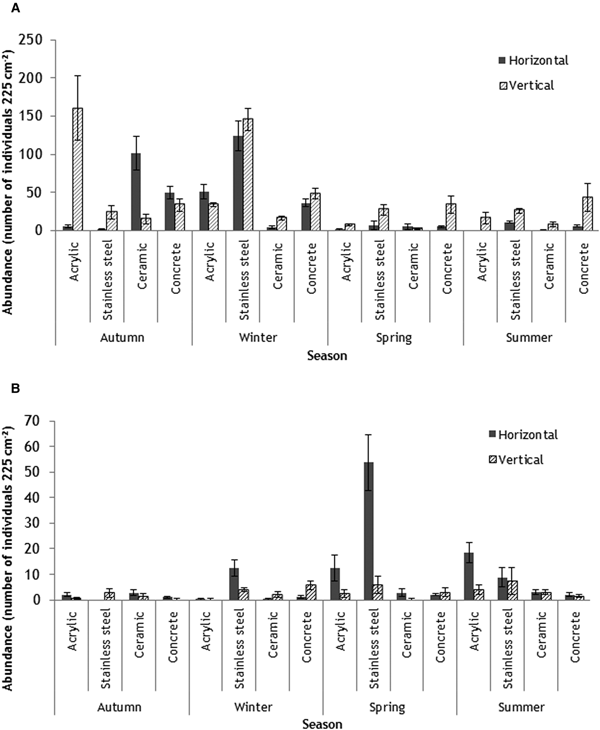
Among the invertebrates, tubicolous polychaetes were the dominant recruits on all the substrates during the four seasons, though significant seasonal variations (Table 2) were observed (Figure 4). The maximum abundance of tube worms on acrylic, stainless steel, ceramic and concrete panels was 160.5 ± 42.16 (autumn, vertical position), 123.75 ± 19.42 (winter, horizontal position), 101.5 ± 22 (autumn, horizontal position) and 49.75 ± 8.03 (autumn, horizontal position) individuals 225 cm−2 respectively (Figure 4). Nested ANOVA indicated significant variations in the recruitment of tube worms in relation to season, substrate type and orientation (Table 2). Bryozoans were the other important group found on the panels with a maximum abundance of 18.5 ± 3.84 (summer, horizontal position), 53.75 ± 10.96 (spring, horizontal position), 3 ± 0.91 (summer, vertical and horizontal positions) and 5.75 ± 1.6 organisms 225 cm−2 (winter, vertical position) respectively for acrylic, stainless steel, ceramic and concrete panels (Figure 4). Bryozoan recruitment also revealed significant variation in relation to season, substrate type and orientation (Table 2).
Recruitment (abundance, mean ± SE, N = 4) of tube worms and bryozoans on artificial panels submerged in horizontal and vertical positions. (A) Tube worms, (B) Bryozoans.

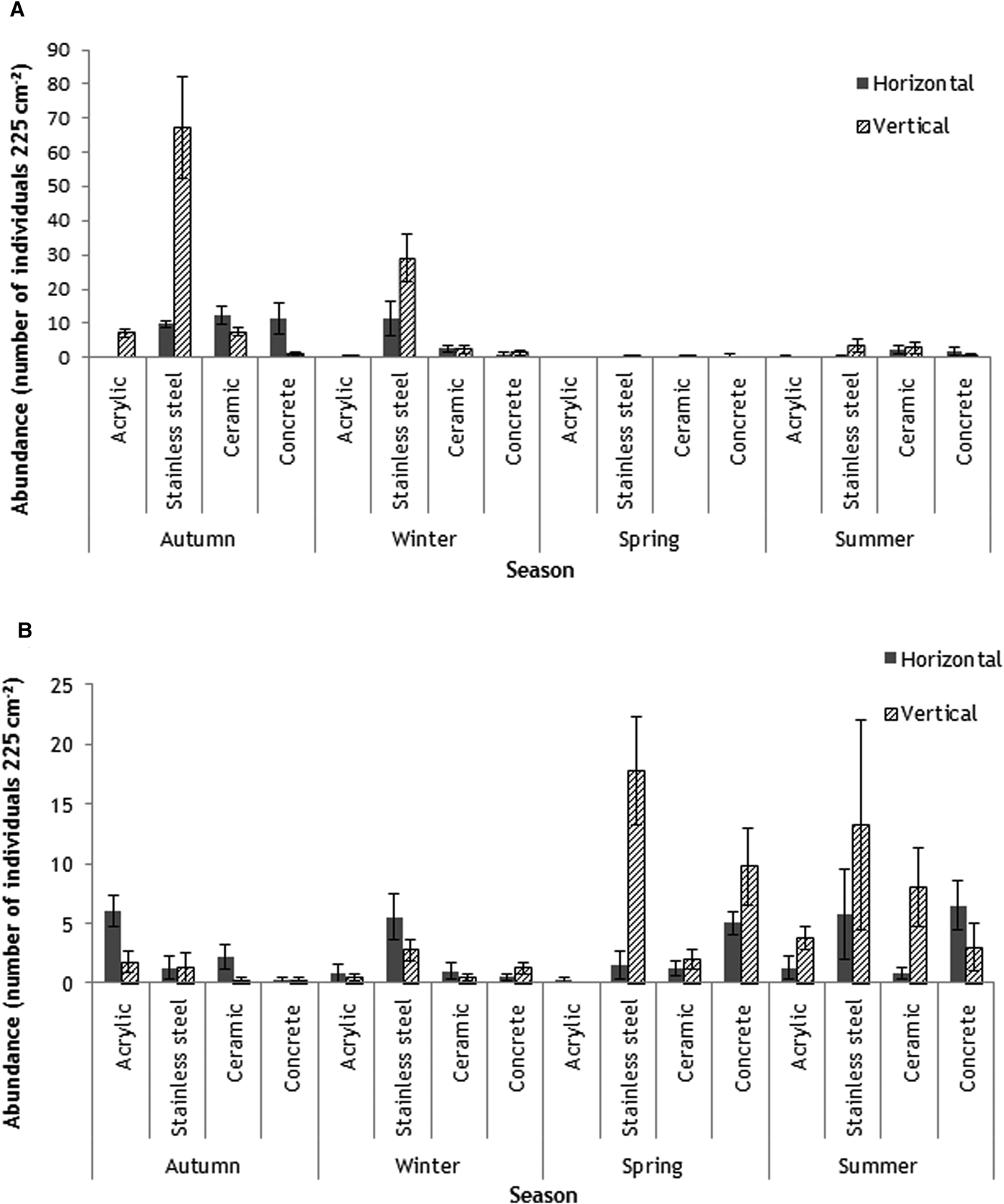
Barnacle recruitment revealed a maximum abundance of 7.25 ± 1.25 (autumn, vertical position), 67.25 ± 14.82 (autumn, vertical position), 12.25 ± 2.65 (autumn, horizontal position) and 11.5 ± 4.48 organisms 225 cm−2 (autumn, horizontal position) respectively on acrylic, stainless steel, ceramic and concrete panels (Figure 5). Nested ANOVA showed significant variations in barnacle recruitment among seasons, substrate types and orientation (Table 2). Bivalve recruitment was also high on stainless steel panels with a maximum of 17.75 ± 4.49 individuals 225 cm−2 (spring, vertical position). The maximum abundance of bivalves on acrylic, ceramic and concrete panels was 6 ± 1.29 (autumn, horizontal position), 8 ± 3.3 (summer, vertical position) and 9.75 ± 3.25 individuals 225 cm−2 (spring, vertical position) respectively (Figure 5). Bivalve recruitment also varied significantly between the seasons, substrate types and orientation (Table 2).
Recruitment pattern (abundance, mean ± SE, N = 4) of barnacles and bivalves on four different materials submerged in horizontal and vertical positions in the central Red Sea. (A) Barnacles, (B) Bivalves.

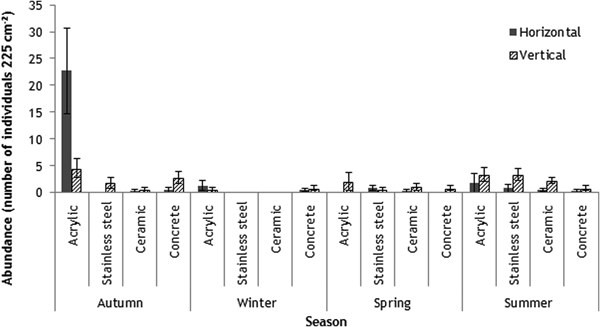
The recruitment of gastropods was high on acrylic panels, particularly during the autumn season on the panels submerged in the horizontal position (22.75 ± 7.99 individuals 225 cm−2). On stainless steel (3.25 ± 1.12 summer, vertical position), ceramic (2.25 ± 0.6 summer, vertical position) and concrete panels (2.75 ± 1.13 autumn, vertical position), the abundance of gastropods was very low (Figure 6). The abundance of gastropods showed significant variations between different seasons and substrates (Table 2). The orientation of the panels did not show a significant effect on the recruitment of gastropods (Table 2).
Abundance (mean ± SE, N = 4) of gastropods on artificial panels submerged in horizontal and vertical positions.

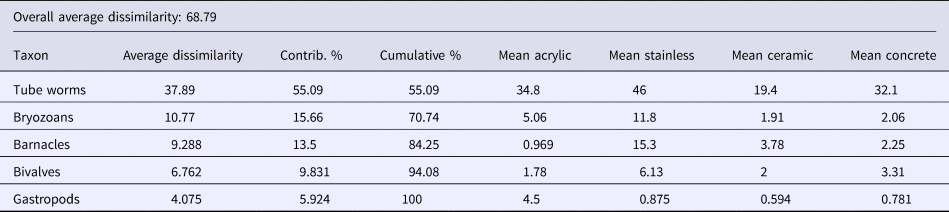
SIMPER analysis indicated an overall average dissimilarity of 68.97% on the abundance of invertebrates between substrates (Table 4). Tube worms topped the list with an average dissimilarity of 37.89% and their total contribution was 55.09%. Bryozoans showed an average dissimilarity percentage of 10.77 (contribution 15.66%) and for barnacles, the dissimilarity was 9.28% (contribution 13.55%). Bivalves and gastropods showed an average dissimilarity of 6.72 and 4.07% respectively (Table 4).
Similarity percentage (SIMPER) analysis on invertebrate recruitment patterns between different substrates

Discussion
Artificial panels are frequently used by marine ecologists to test various ecological hypotheses (Keough, Reference Keough1984; Anderson & Underwood, Reference Anderson and Underwood1994; Connell, Reference Connell1999; Satheesh & Wesley, Reference Satheesh and Wesley2011) due to their ease of handling and determining marine organism behaviour under various environmental conditions (Glasby & Connell, Reference Glasby and Connell2001; Satheesh & Wesley, Reference Satheesh and Wesley2011). In this study, treatment panels of four different materials (acrylic, stainless steel, ceramic and concrete) were used to understand the recruitment preferences of marine invertebrates. The influence of environmental variables on the settlement and development of benthic communities has been reported by many previous studies, particularly from the biofouling ecology point of view (Rajagopal, Reference Rajagopal1997; Satheesh & Wesley, Reference Satheesh and Wesley2011; Masi et al., Reference Masi, Coutinho and Zalmon2015). In addition to environmental factors, the substratum type and submerged position (orientation) in marine waters may also influence the settlement, recruitment and development of benthic organisms (Glasby, Reference Glasby1999a, Reference Glasby1999b; Glasby & Connell, Reference Glasby and Connell2001; Azevedo et al., Reference Azevedo, Carloni and Carvalheira2006; Tyrrell & Byers, Reference Tyrrell and Byers2007; Walker et al., Reference Walker, Schlacher and Schlacher-Hoenlinger2007; Satheesh & Wesley, Reference Satheesh and Wesley2010; Vaz-Pinto et al., Reference Vaz-Pinto, Torrontegi, Prestes, Álvaro, Neto and Martins2014). Results of our study indicated a significant difference in the abundance of invertebrates among treatments. Overall, barnacles, bryozoans and bivalves preferred to settle on stainless steel panels throughout the study period. Besides stainless steel, ceramic tiles also showed higher recruitment of marine invertebrates. Further, SIMPER analysis indicated that tube worms and bryozoans were the major contributors of dissimilarity between different substrates used in this study.
Results also indicated that the abundance of invertebrates on panels varied significantly among the seasons. Seasonal variations in biofouling community development on artificial panels have been reported from the Red Sea (Salama et al., Reference Salama, Satheesh and Balqadi2018). Ba-akdah et al. (Reference Ba-Akdah, Satheesh and Al-Sofyani2016) also reported significant seasonal variations in epifaunal assemblages associated with macroalgal beds in the Saudi Arabian coast of the Red Sea. The influence of season on recruitment was very much apparent in tube worms with a higher abundance on acrylic and ceramic panels during autumn and stainless steel panels in winter. Seasonal variations in benthic community recruitment may also depend on larval availability, breeding biology of the invertebrates and water current pattern of the study area (Young & Gotelli, Reference Young and Gotelli1988; Bertness et al., Reference Bertness, Gaines, Stephens and Yund1992; Brown & Swearingen, Reference Brown and Swearingen1998; Satheesh & Wesley, Reference Satheesh and Wesley2011).
This study revealed that the settlement behaviour of marine organisms is specific to particular benthic groups and the observations obtained for one group cannot be applied to another. For example, except gastropods, all other invertebrate groups observed in this study showed a significant difference between horizontal and vertical orientation panels. Hence, the abundance of invertebrate larval recruitment may also depend on orientation. Generally, more diverse and abundant communities were found on the lower side of surfaces placed in the horizontal position due to limited stress from physical and biological factors (Sokolowski et al., Reference Sokołowski, Ziółkowska, Balazy, Kukliński and Plichta2017). In this study, lower side surfaces of the panels placed in the horizontal position were not analysed due to the differences in surface topography of ceramic tiles (one side polished with the other side being rough).
Substrate orientation is an important physical factor influencing the settlement of larval forms on surfaces (Glasby, Reference Glasby1999a, Reference Glasby1999b; Walker et al., Reference Walker, Schlacher and Schlacher-Hoenlinger2007). The results of our study revealed that recruitment of benthic invertebrates such as barnacles, polychaetes and bivalves was high on panels placed in a vertical position. Bryozoan and gastropod recruitment was high on horizontal panels. The observed differences in invertebrate abundance between vertical and horizontal orientation substrates may be due to the smothering by sediment on horizontal surfaces (Baynes & Szmant, Reference Baynes and Szmant1989; Irving & Connell, Reference Irving and Connell2002). For instance, Walker et al. (Reference Walker, Schlacher and Schlacher-Hoenlinger2007) reported a lower abundance of barnacles on horizontal substrates than vertical substrates due to high sediment cover on the horizontal surfaces. Azevedo et al. (Reference Azevedo, Carloni and Carvalheira2006) observed higher recruitment of barnacles on the upper side of horizontal surfaces but reported high mortality due to sedimentation. The only invertebrate group that showed a significantly higher abundance on the horizontal surface was the bryozoans. Normally, bryozoans prefer horizontal surfaces, which could increase their resistance to the stress from environmental factors and predators or their ability to grow over the sediment layer (Irving & Connell, Reference Irving and Connell2002; Walker et al., Reference Walker, Schlacher and Schlacher-Hoenlinger2007). While an abundance of the bryozoan Watersipora subtorquata on the shaded side (lower side) of artificial substrates was reported by Connell (Reference Connell1999), a higher abundance of bryozoans observed in the present study on the upper side of the horizontal panels indicates that this encrusting invertebrate group can also settle on sediment-covered surfaces.
Generally, colonization of marine invertebrates on hard substrates depends on many features of the substrate such as physical factors, chemical composition, surface roughness, surface charge and mechanical properties (Chaudhury et al., Reference Chaudhury, Finlay, Chung, Callow and Callow2005; Flemming et al., Reference Flemming, Murthy, Venkatesan and Cooksey2009; Aldred et al., Reference Aldred, Scardino, Cavaco, de Nys and Clare2010; Satheesh & Wesley, Reference Satheesh and Wesley2010; Brzozowska et al., Reference Brzozowska, Maassen, Goh ZhiRong, Benke, Lim, Marzinelli, Jańczewski, Teo and Vancso2017). Surface roughness is cited as one of the major influencing factors determining the settlement of larvae on hard substrates (Bers & Wahl, Reference Bers and Wahl2004). While many laboratory studies confirmed that surface topography is important for larval settlement (Schumacher et al., Reference Schumacher, Aldred, Callow, Finlay, Callow, Clare and Brennan2007), under natural conditions other factors such as microfouling and environmental factors overplay the role of surface characters in larval settlement (Vucko et al., Reference Vucko, Poole, Sexton, Glenn, Carl, Whalan and de Nys2013; Brzozowska et al., Reference Brzozowska, Maassen, Goh ZhiRong, Benke, Lim, Marzinelli, Jańczewski, Teo and Vancso2017). The results of this study indicate that surface roughness may not be an important factor for larval recruitment of many invertebrate groups. This observation is based on the concrete panels used in this study. Concrete is one of the common materials used for the construction of artificial reefs (Fabi et al., Reference Fabi, Spagnolo, Bellan-Santini, Charbonnel, Çiçek, Goutayer García, Jensen, Kallianiotis and Neves Dos Santos2011) due to its stability and suitability to create more complex structures (Spagnolo et al., Reference Spagnolo, Cuicchi, Punzo, Santelli, Scarcella and Fabi2014). The surface roughness of the concrete panels may also be high compared with other materials used in this study (Azevedo et al., Reference Azevedo, Carloni and Carvalheira2006). The recruitment of marine invertebrates on concrete panels was lower than that on stainless steel and acrylic panels (except tube worms). The possible reason for the low abundance of invertebrates on concrete panels might be environmental factors, particularly accumulation of silt in the surface crevices. The accumulation of silt on surfaces may inhibit the colonization of many benthic organisms (Azevedo et al., Reference Azevedo, Carloni and Carvalheira2006).
There are conflicting reports in the literature regarding the influence of substrate material on benthic community recruitment. While some studies (Connell & Glasby, Reference Connell and Glasby1999; Glasby, Reference Glasby1999a, Reference Glasby1999b; Nandakumar et al., Reference Nandakumar, Matsunaga and Takagi2003; Azevedo et al., Reference Azevedo, Carloni and Carvalheira2006) reported variations in benthic community composition between different substrates, others (Creed & DePaula, Reference Creed and DePaula2007; Burt et al., Reference Burt, Bartholomew, Bauman, Saif and Sale2009; Dobretsov, Reference Dobretsov2015) observed no difference in benthic community among the substrates. In this study, results strongly support the hypothesis that benthic community recruitment varied between different substrates. It should be noted here that the present study focused on the abundance of benthic groups instead of the diversity of organisms. The abundance of organisms was indeed higher on stainless steel than on other materials, at least for barnacles, bryozoans and bivalves. Many of the previous reports on the difference in benthic communities between substrates suggested that the variations may be due to the orientation of the substrates, environmental conditions of the material immersion site and submersion time (Osman, Reference Osman1977; Qiu et al., Reference Qiu, Thiyagarajan, Leung and Qian2003; Field et al., Reference Field, Glassom and Bythell2007). Although the orientation of the substrates in this study was found to be significant for most of the invertebrate groups, the differences in the abundance among treatments such as acrylic, stainless steel, ceramic and concrete raise further questions as to whether the variations are due to substrate properties or environmental conditions.
Many previous studies (Tamburri et al., Reference Tamburri, Luckenback, Breitburg and Bonniwell2008; Hadfield, Reference Hadfield2011; Hadfield et al., Reference Hadfield, Nedved, Wilbur and Koehl2014; Freckelton et al., Reference Freckelton, Nedved and Hadfield2017) suggested that the microfouling developed on the substrates may induce settlement of marine invertebrates. Nandakumar et al. (Reference Nandakumar, Matsunaga and Takagi2003) reported considerable variations in microfouling development between three substrates. Further, microbial community assemblage on artificial panels has been shown to be influenced by substratum type (Chung et al., Reference Chung, Lee, Huang, Mok, Kolter and Qian2010; Witt et al., Reference Witt, Wild and Uthicke2011; Li et al., Reference Li, Chen, Yang, Bao, Guo, Liang, Shi, Li and Ding2014). Hence, it is noteworthy to study the site-specific variations, mainly differences in microfouling development between the materials and their further role in benthic community settlement.
In conclusion, the results obtained in this study can be summarized as follows: (1) benthic community recruitment in the central Red Sea showed strong seasonal variations; (2) preference of a particular substrate and orientation depend on benthic invertebrate taxa, most likely reflecting the settlement behaviour of marine invertebrates; and (3) significant seasonal variations in the abundance of invertebrate recruitment underline the role of site-specific processes along with substrate and orientation. Above all, this study confirmed that invertebrate colonization on artificial materials immersed in seawater is controlled by a combination of factors. Most of the factors may be local environmental conditions and hence further region-specific studies will improve our understanding of benthic community recruitment and coastal ecosystem functioning in the Red Sea.
Financial support
This project was funded by the Deanship of Scientific Research (DSR) at King Abdulaziz University, Jeddah, under grant no. G-222-150-38. The authors, therefore, acknowledge with thanks DSR for technical and financial support.