

1. INTRODUCTION
The subject of this paper and of its sequelFootnote 1 is Proposition 5 of Book III of Menelaus' Spherics (2nd century A.D.), along with proofs, commentaries and improvements by Ibn ʿIrāqFootnote 2 (10th century), Naṣīr al-Dīn al-Ṭūsī (13th century) and Ibn Abī Jarrāda (13th century). In the first paper we present two texts written by Ibn ʿIrāq, together with English translations and mathematical commentaries. In the second paper we will present texts written by Naṣīr al-Dīn al-Ṭūsī and Ibn Abī Jarrāda. From these texts, we also learn indirectly about earlier works on Menelaus' Spherics by al-Māhānī (9th century) and al-Harawī (10th century) and of attempts to understand the proof of Proposition III.5.Footnote 3
Let us start by stating Menelaus' Proposition III.5.
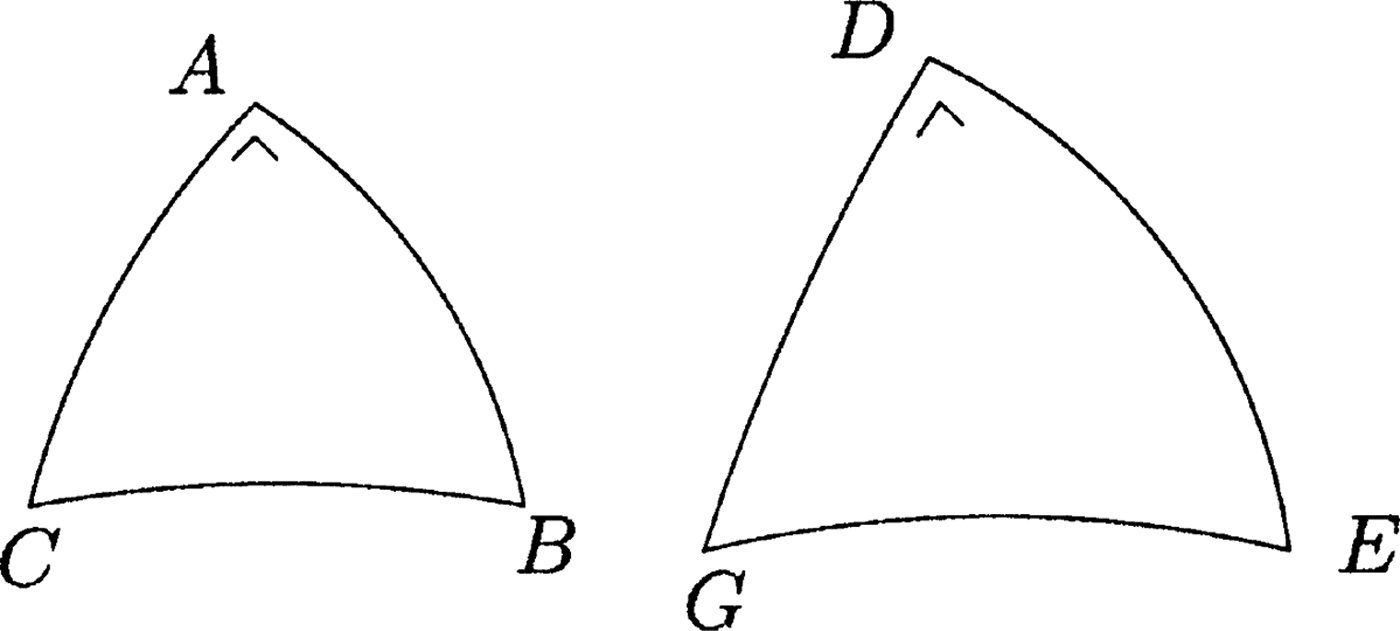
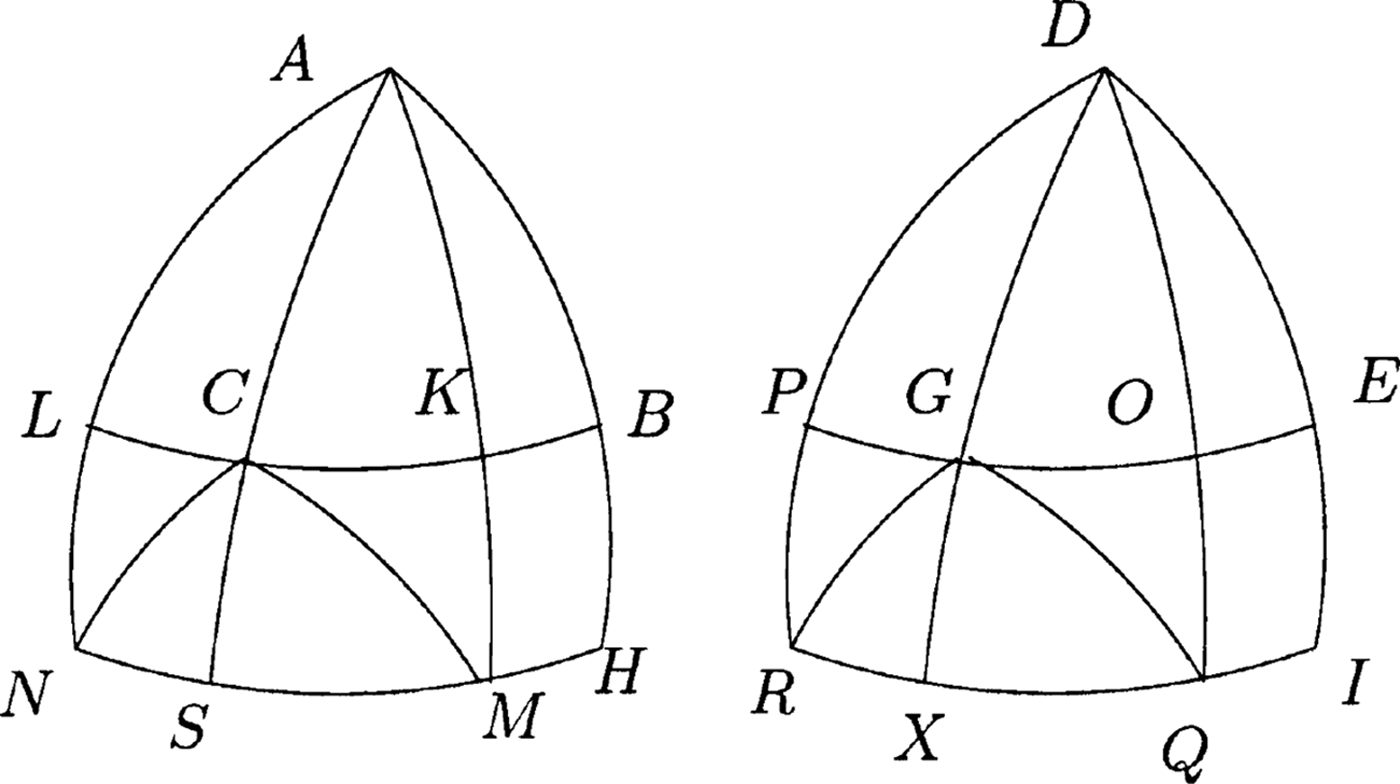
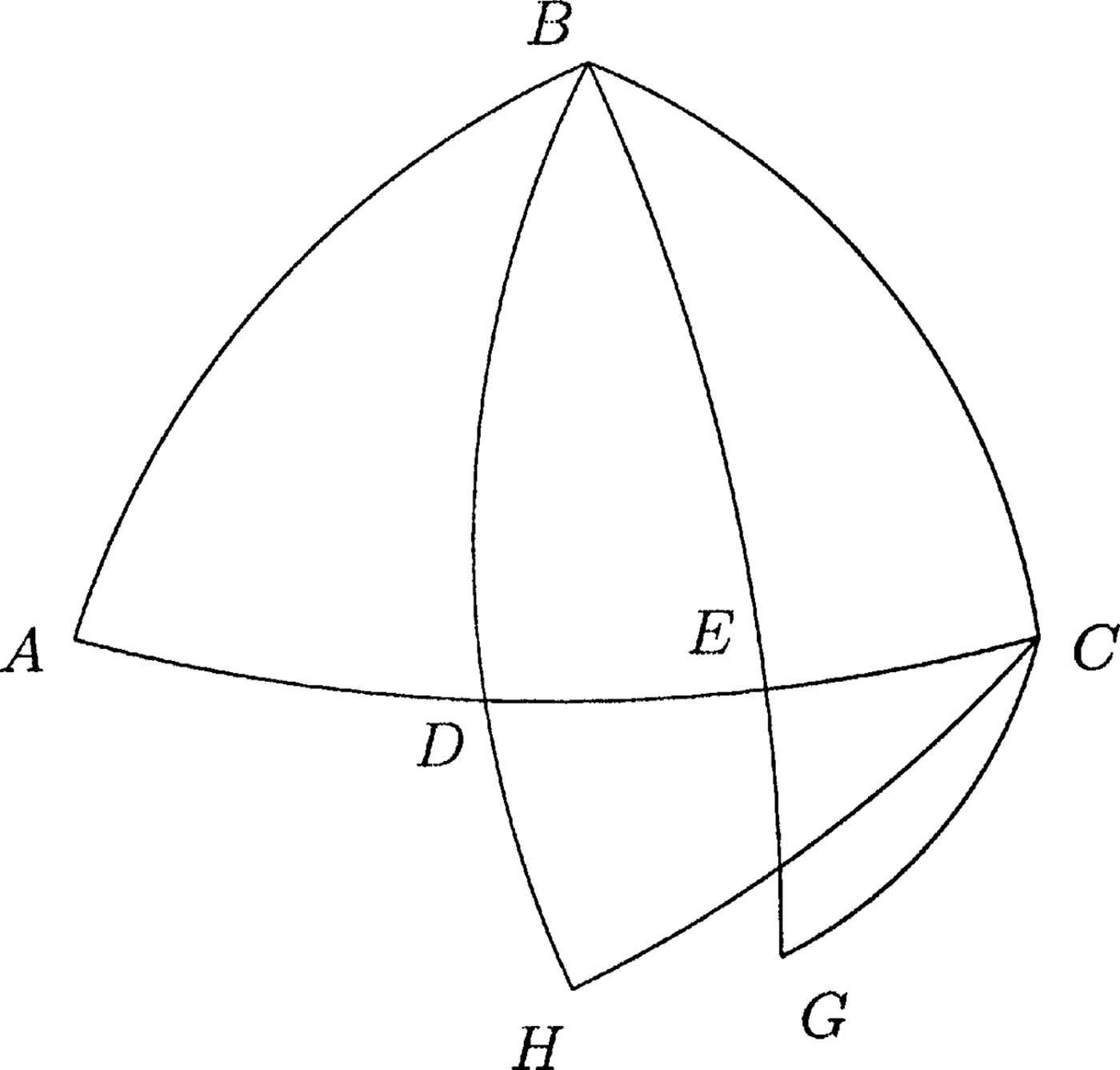
Consider two triangles ABC and DEG having right angles at A and D and acute and equal angles at C and G (Fig. 1). Assume furthermore that each of the arcs AC and DG is less than a quarter of a circle. Then, we haveFootnote 4
 $$\displaystyle{{{\rm crd}2\lpar BC + AC\rpar } \over {{\rm crd}2\lpar BC - AC\rpar }} = \displaystyle{{{\rm crd}2\lpar EG + DG\rpar } \over {{\rm crd}2\lpar EG - DG\rpar }}$$
or, equivalently, in terms of sines:
 $$\displaystyle{{{\rm sin}\lpar BC + AC\rpar } \over {{\rm sin}\lpar BC - AC\rpar }} = \displaystyle{{{\rm sin}\lpar EG + DG\rpar } \over {{\rm sin}\lpar EG - DG\rpar }}$$
Fig. 1.

The proposition is interesting for several reasons. First of all, from the purely mathematical point of view, it says that given a spherical triangle satisfying certain properties, a certain ratio involving chords of sums and differences of side lengths is an invariant of the triangle; that is, this ratio is independent of the choice of the triangle (having the required properties). This in itself is already an intriguing property. In fact, such an invariance property is rare in non-Euclidean geometry, one reason being the absence of similarity. We also note that the trigonometric formulae that involve sines and cosines of differences of side lengths are rare. Secondly, its proof is highly involved and requires many auxiliary constructions. The proposition was also used in astronomy, as mentioned in the first text of Ibn ʿIrāq and in the text of Naṣīr al-Dīn al-Ṭūsī.Footnote 5
But the main reason for which Proposition III.5 is important is that this proposition gave rise to extremely interesting developments in the field of spherical geometry. In fact, Menelaus did not give a proof of this proposition, but only an outline of a proof, and writing a complete proof became a big challenge that was taken up by several major mathematicians, in Baghdad and elsewhere, between the ninth and the thirteenth century. As a consequence, the proposition acted as a motivation and a major factor in reshaping the whole field of spherical geometry, and it led to a variety of fundamental new results in that field. Indeed, Menelaus' writing is cryptic at several places, and, in the proof that reached us of that proposition, he made several assertions that are correct but without proof. It is also worth mentioning that from the tenth century on, the mathematicians worked on improving the statement of Menelaus' Proposition III.5 by weakening the hypothesis, as we shall see for instance in the texts of Ibn ʿIrāq and Ibn Abī Jarrāda.
We point out, as an example of the developments that the proof of Proposition III.5 led to, that Menelaus used the invariance of a spherical cross ratio: we shall see this below in more detail. This is an analogue of the Euclidean cross ratio and it applies to spherical triangles after modifying the Euclidean formula in such a way that lengths are replaced by sines of these lengths (or, in the language of Menelaus, by half of the chords of the doubles of these lengths). This should be compared to the passage from the Euclidean Sine Rule to the spherical Sine Rule, where one replaces lengths (of sides of Euclidean triangles) by sines of lengths (of sides of spherical triangles). In fact, to prove this cross ratio invariance property, the mathematicians of the tenth century used the spherical Sine Rule which they had discovered themselves. It is even conceivable that the development of this rule was motivated by research in spherical geometry and the effort to prove results such as Proposition III.5 of Menelaus. Likewise, it is possible that the discovery by Ibn ʿIrāq of the notion of polar triangle was also motivated by his work on the proof of Menelaus' proposition. In fact, understanding the proof of Proposition 5 of Book III of Menelaus' Spherics became an important matter, not only for mathematicians, but also for astronomers and other scientists.
We present in these two papers four major texts in which the authors comment and rectify Menelaus' proposition. The first of them is a short treatise by Ibn ʿIrāq, titled The Rectification of a Proposition of the Book of Menelaus on the Spherics and the second one is extracted from Ibn ʿIrāq's treatise titled The Book of Menelaus on Spherical Propositions Rectified by the Emir Abū Naṣr Manṣūr Ibn ʿIrāq. In these texts, Ibn ʿIrāq provides a detailed proof of Menelaus' proposition.Footnote 6 The first text contains preliminary results that are used in the second one. We also learn from Ibn ʿIrāq's treatises that, before him, the mathematicians al-MāhānīFootnote 7 and al-HarawīFootnote 8 tried to understand the proof of Proposition III.5. Ibn ʿIrāq describes their methods as being based on Euclidean constructions outside the sphere. In the second paper, we present the treatises of Naṣīr al-Dīn al-Ṭūsī who studied the work of Ibn ʿIrāq on Menelaus' Proposition III.5 and commented on it and of Ibn Abī Jarrāda who also commented on Menelaus' Spherics.
Let us now briefly deal with the first two texts.
In The Rectification of a Proposition of the Book of Menelaus on the Spherics, Ibn ʿIrāq presents a set of propositions on spherical geometry that are useful in the proof of Menelaus' Proposition III.5. These propositions are of independent interest. The proofs are certainly not the ones that Menelaus gave, because they make heavy use of the spherical Sine Rule, and we know that this rule was invented by the tenth-century mathematicians. In one of the propositions, Ibn ʿIrāq shows the invariance of the spherical cross ratio, which seems to have been used without proof by Menelaus. After these propositions and their proofs, Ibn ʿIrāq discusses some precise points in Menelaus' proof, and in fact he improves the statement of the proposition. One point he makes is relative to an assumption that Menelaus made, concerning one of the sides of the triangles that are involved in the statement of the proposition. The assumption is that this side is less than a quarter of a circle. Ibn ʿIrāq shows that the proof can be done without this assumption. In the same way, Ibn ʿIrāq notices that at some other point Menelaus did not make the assumption that some arc is less than a quarter of a circle, an assumption which is necessary. While he works on these improvements he declares that not only Proposition III.5 needs to be corrected, but the whole treatise of Menelaus' Spherics. Ibn ʿIrāq then reports on the attempts by al-Māhānī and al-Harawī on correcting Menelaus' treatise and he discusses some precise points in their proofs.
The second text is part of The Book of Menelaus on Spherical Propositions, Rectified by the Emir Abū Naṣr Manṣūr Ibn ʿIrāq. In this text, the author gives a full proof of Proposition III.5 using the propositions he proves in the first text. The proof is involved, and polarity theory is used extensively.
2. ON THE WORKS OF IBN ʿIRĀQ ON SPHERICAL GEOMETRY
Spherical geometry is the earliest non-Euclidean geometry known. This is the field where one studies the metric properties of the surface of a sphere. During the 4th century of the Hegira (10th century A.D.), there was a renewal of this field by a group of scientists that included Abū al-Wafāʾ al-Būzjānī, Ibn ʿIrāq, al-Khujandī and Kūshyār Ibn Labbān.Footnote 9 These great scientists constituted an active science community, and at the same time they were competing with each other. Before that period, the astronomical computations, especially in the School of Alexandria (cf. Ptolemy's Almagest), were based on the notion of the chord of the double of an arc. The notions of sine, cosine, tangent, etc. together with the mathematical relations that govern them and which, later on, considerably simplified astronomical computations, were not yet discovered.
It is probable that the most important Greek writing on spherical geometry – apart from the Almagest – is Menelaus' Spherics, written at the end of the 1st century A.D. This book was translated into Arabic, in the 9th century, in Baghdad, either by Ḥunayn ibn Isḥāq or by his son Isḥāq. As fate would have it, the Greek original of Menelaus' Spherics is lost, and the Arabic translation remained. From the Arabic, the text was translated into other languages.
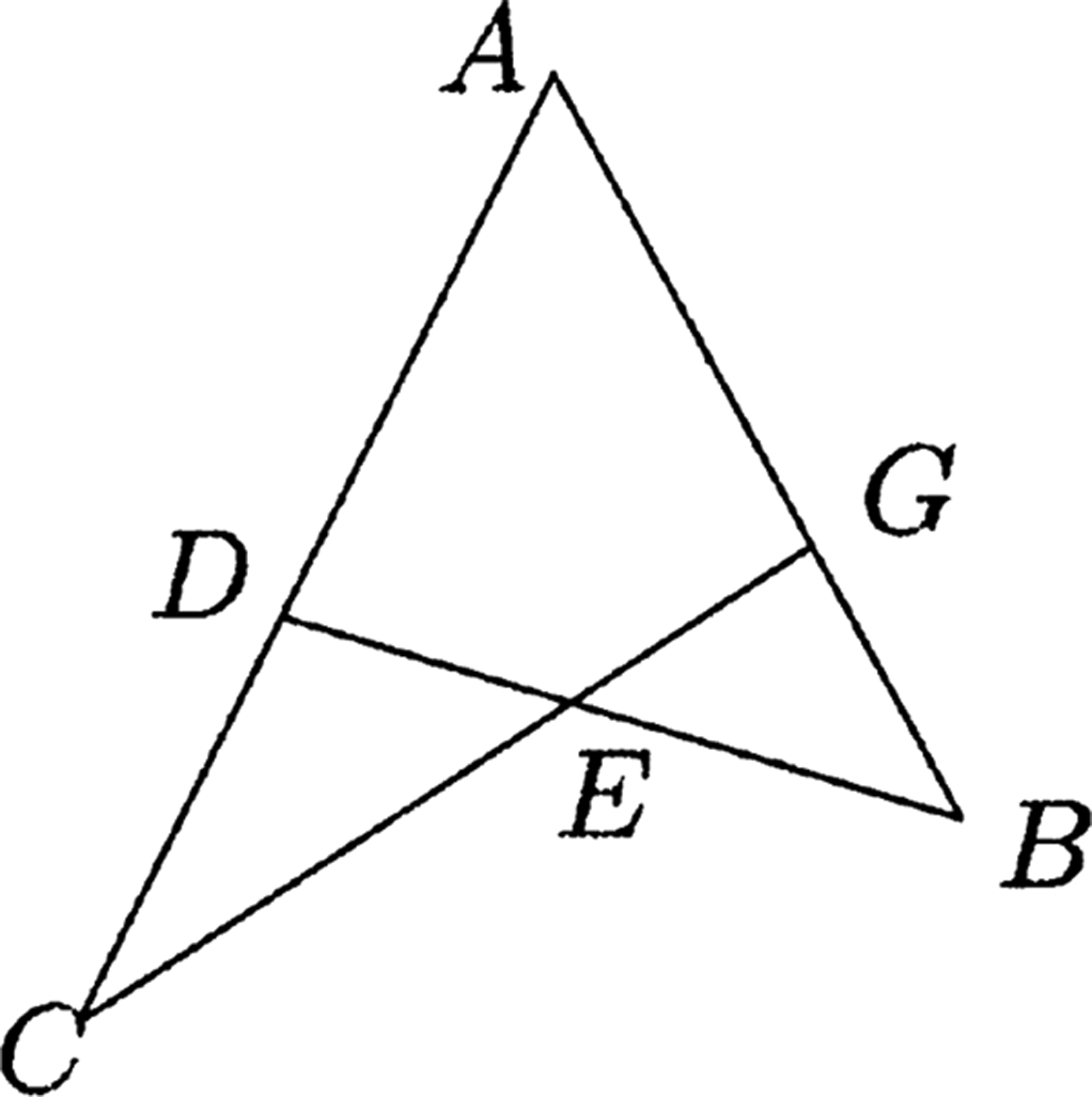
The book of Menelaus contains, among other things, two related theorems. The first of these theorems concerns figures on the flat plane and the second one concerns figures on the sphere. With the notation of Fig. 2, the first theorem says the following:
Analysis:
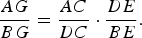 $$\displaystyle{{AG} \over {BG}} = \displaystyle{{AC} \over {DC}} \cdot \displaystyle{{DE} \over {BE}}.$$
Fig. 2.
Synthesis:
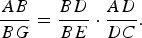 $$\displaystyle{{AB} \over {BG}} = \displaystyle{{BD} \over {BE}} \cdot \displaystyle{{AD} \over {DC}}.$$
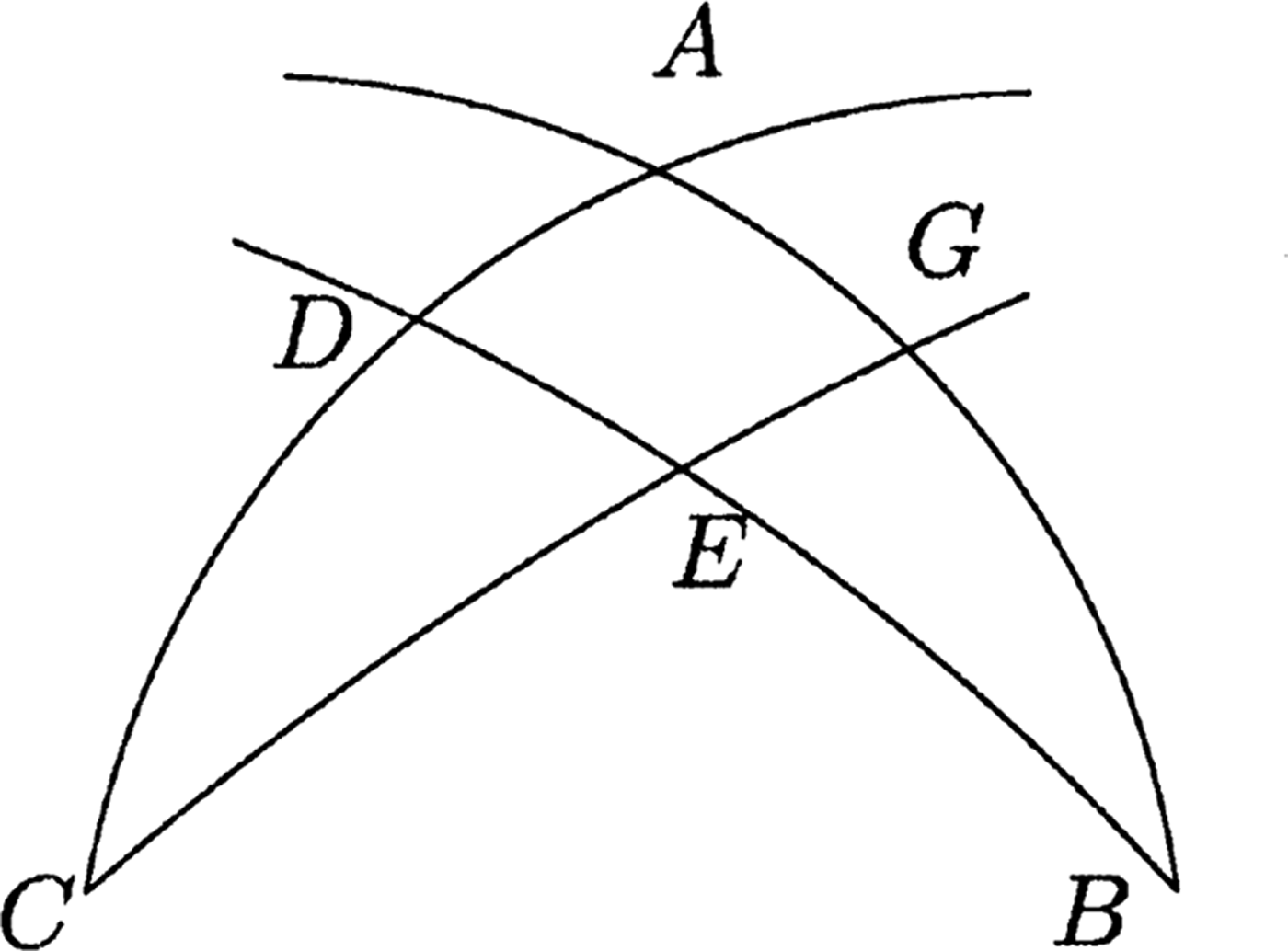
The second theorem, as stated by Menelaus, says the following (with the notation of Fig. 3):
 $$\displaystyle{{{\rm crd}2AG} \over {{\rm crd}2BG}} = \displaystyle{{{\rm crd}2AC} \over {{\rm crd2}DC}} \cdot \displaystyle{{{\rm crd}2DE} \over {{\rm crd}2BE}}.$$
Fig. 3.
In the words of Naṣīr al-Dīn al-Ṭūsī, in his Edition of the Book of Menelaus, the theorem says:
Let the arc BED cut the arc CEG between the two arcs BGA and CDA, each of the arcs being less than a quarter of a circle. Then the ratio of the chord of the double of AG to the chord of the double of BG is the product of the ratio of the chord of the double of AC to the chord of the double of DC and of the ratio of the chord of the double of DE to the chord of the double of BE.Footnote 10
This theorem establishes a relation between six arcs on four great circles on the sphere that form a complete quadrilateral,Footnote 11 that is, a quadrilateral whose sides have been extended until they intersect. It is easy for us today to translate the statement into the language of sines, but one must not forget that in order to be able to perform this step it was first necessary to imagine the language of sines, and this was done by Ibn ʿIrāq and his contemporaries, and not before.
The 9th-century scientists were aware of the theorem of Menelaus from two different sources. The first one is Ptolemy's Almagest. From that book, they also knew about the use of that theorem in astronomical computations. The second source is Menelaus' own book through an Arabic translation. These translations of the Almagest, of Menelaus' Spherics and of other works such as Theodosius' Spherics were the result of an unprecedented research activity in the science of astronomy. Soon after, the theorem of Menelaus became a recurrent subject of research, bearing the title of Sector Figure Theorem, or, more simply, Sector Figure. Thābit ibn Qurra (826–901) is among the scholars who commented on that theorem.Footnote 12 The book of Menelaus, with the new and profound material it carries, was the beginning of a new and continuous research program for the successors of Ibn Qurra, including al-Nayrīzī, al-Khāzin and Ibn ʿIrāq, according to what the latter wrote in his book titled Tahdhīb al-taʿālīm (The Refinement of Mathematics). As a matter of fact, the Sector Figure Theorem remained the basic tool in astronomical computations until the discovery of the spherical Sine Rule. Furthermore, the use of that theorem did not completely stop at the discovery of the Sine Rule. For instance, al-Ḥasan ibn al-Haytham, who knew the Sine Rule and who used it, also used the Sector Figure Theorem in his astronomical works.Footnote 13 In any case, the research conducted on the Sector Figure Theorem motivated other important research works, like the one on compound ratios – we shall comment on this notion below, and each of these works was part of a preparation for a transformation of the mathematical field of spherical trigonometry that was conducted by Abū al-Wafāʾ al-Būzjānī, al-Khujandī and, especially, Ibn ʿIrāq.
We can describe this epistemic change by the term “mathematisation” of spherical trigonometry and of spherical geometry, one of whose manifestations being the heavy use of the notion of spherical triangle and of its properties, and the study of the mathematical relations that govern spherical triangles. This led to a completely new chapter in spherical geometry, and also to a transformation of spherical trigonometry from a simple instrument in mathematical astronomy to an autonomous chapter in mathematics. It is here that lies the importance of Ibn ʿIrāq. His work did not only consist in the discovery of new results in spherical geometry, but he made a basic contribution to the epistemic change that we mentioned above, and in the construction of this new mathematical field. Moreover, as we shall see in what follows, Ibn ʿIrāq introduced for the first time the important notion of “polar triangle”.
The theorem of Menelaus – the Sector Figure Theorem – is based on compound ratios, that is, expressions of the form
 $$\displaystyle{A \over B} = \displaystyle{C \over D} \cdot \displaystyle{E \over F}.$$
Before that, such an expression constituted a mathematical difficulty, and even a mathematical obstacle. Euclid did not consider compound ratios in the fifth book of the Elements – which is the book in which he formulated the theory of proportions and which remained the main reference on this subject for the entire mathematical community for more than two thousand years. The difficulty in using compound ratios led mathematicians like Thābit ibn Qurra, al-Sijzī and others to conduct research on such ratios.Footnote 14 Others after them, in their effort to renew the science of spherical geometry, tried to avoid that theorem. This was the case of Abū al-Wafāʾ al-Būzjānī, Ibn ʿIrāq and al-Khujandī. An eyewitness, Abū al-Rayḥān al-Bīrūnī, who was Ibn ʿIrāq's student, tells us about the role of his master in this renewal. He wrote in his book Maqālīd ʿilm al-hayʾa (The Keys to the Science of Astronomy):
Abū Saʿīd Aḥmad ibn Muḥammad ibn ʿAbd al-Jalīl (known as al-Sijzī) collected several methods that are due to eminent geometers and authors of zījs (astronomical tables) on the determination of the azimuth of the qibla using computations and topographical instruments, and he preserved various results that were given without proof. I then informed him that my lord and initiator Abū Naṣr Manṣūr ibn ʿAlī ibn ʿIrāq – may God support him – was very capable in producing such mathematical proofs, of going in depth into that matter and learning it quickly. Therefore, he told me to ask Ibn ʿIrāq to give this matter some thought, in order to repair the defects of that theory and to discover what theorems belong to it; and indeed I did it. Abū Naṣr then wrote a book on that matter and he called it The Book of Azimuths (Kitāb al-Sumūt). He did what he was asked to; he proved the statements in that book that were needed for the proposition <that presented difficulties>, and only those that were needed.Footnote 15
Abū al-Rayḥān al-Bīrūnī continued, mentioning that this proposition was investigated at the same time by Abū al-Wafāʾ al-Būzjānī, al-Khujandī and Kūshyār ibn Labbān al-Jīlī, who ended up with the same conclusion. As we know, it often occurs in science that several scientists obtain independently the same result, and this often leads to disputes about the primacy of the discovery. This happened also this time, and a dispute took place. Nevertheless, al-Bīrūnī, who was known for his fairness and his precision, tended to give primacy to Ibn ʿIrāq. He says:
Concerning Abū Naṣr, I know most of his scientific production because I was watching him from the time I started doing mathematics. I also tried to collect all the books he had on his shelves. He dictated to me his conclusions and deductions, and I know that he refused to grab what was done by others; he was fair and merciful and he supported all those who were fighting for such an objective. He pretended to belong to scientists of lower rate even though there was nothing he could learn from them due to the abundance of his knowledge, his intelligence and his capability to understand these matters, and because of his exceptional natural gifts. Then, not only I do not accuse him of appropriating for himself a proposition that does not belong to him, but something like that would never occur to me.Footnote 16
From the testimony of al-Bīrūnī, we know that Ibn ʿIrāq composed The Book of Azimuths in order to satisfy al-Sijzī's request of establishing mathematical and astronomical proofs on solid grounds. Unfortunately we could not find that treatise, and it is probably lost. Ibn ʿIrāq himself refers to the Azimuths in other treatises, especially the one on the Planetary Arcs (al-Qusīy al-falakiyya). And we understand from this reference that he used the Sector Figure in the Azimuths, and that Abū al-Wafāʾ al-Būzjānī criticized him for that, since he thought that Ibn ʿIrāq was not aware of the Sine Rule that was used in replacement of the Sector Figure. Ibn ʿIrāq replied to that criticism saying that he resorted to the Sector Figure to make the explanation easier, and not because he did not know the Sine Rule. On the contrary, he knew that rule very well, and he wrote a proof of it in his treatise on the Planetary Arcs. As a proof of the sincerity of Ibn ʿIrāq, we can quote the existence of two propositions in the treatise on the Azimuths that are deduced from the Sine Rule, which show that he had discovered this rule before writing up this treatise. All this took place before the death of al-Būzjānī in 948.
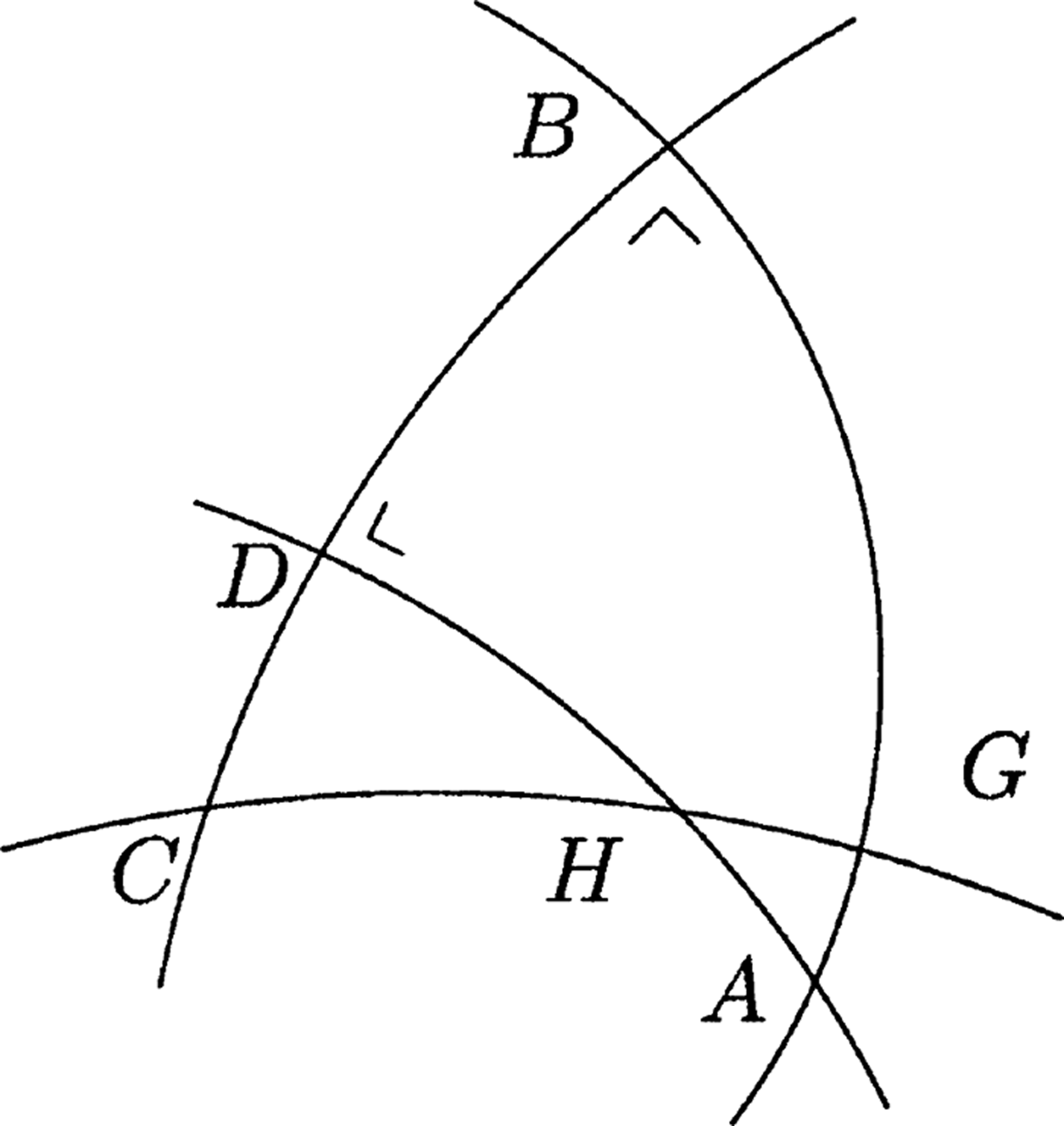
Let us now deal with the treatise On the Knowledge of the Planetary Arcs from Each Other, by a Way of Knowledge which is not the Sector Figure and the Compound Ratio, which was dedicated to al-Bīrūnī. The title of this treatise is itself an indication of the research and methods it contains, and on what it brings as new information compared to what was known before. In this treatise, Ibn ʿIrāq studies spherical triangles, and he makes use of the Sine Rule which, according to what he says, he had discovered before – or when – he wrote his treatise on the Azimuths. According to al-Bīrūnī, Ibn ʿIrāq proved this rule in the following way (see Fig. 4):
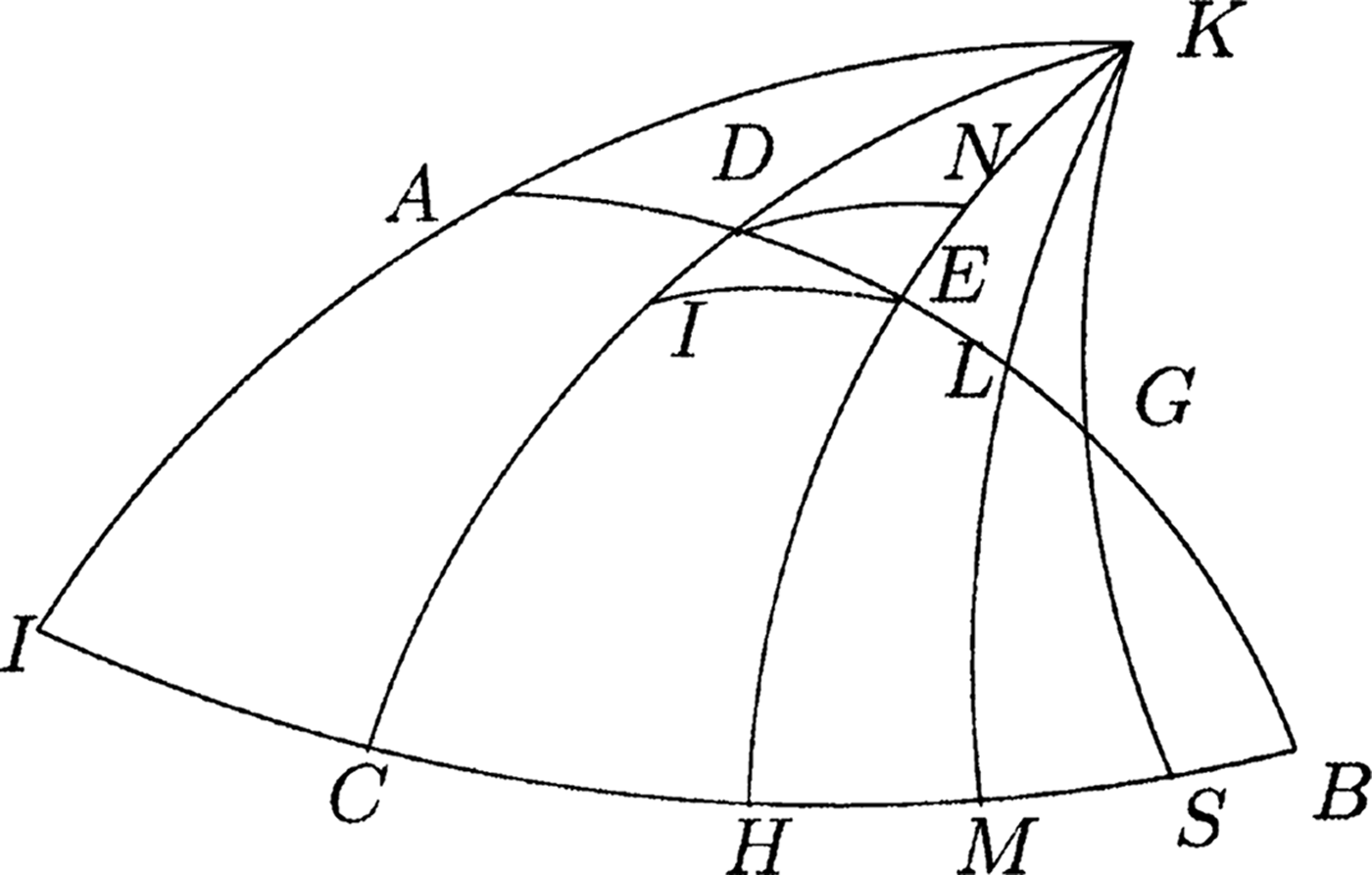
Abū Naṣr said: Consider two arcs AB, AD, each of them being equal to a quarter of a circle and two arcs CB and CHG, each of them being either less or more than a quarter of a circle or equal to a quarter of a circle. Then I say: The ratio of the sine of DH to the sine of GB is equal to the ratio of the sine of CH to the sine of CG.Footnote 17
Fig. 4.
This proposition was called the Four Quantities Rule. Examining its proof by Ibn ʿIrāq, one finds that the author considered it as a special case of the Sine Rule. Ibn ʿIrāq did not end his treatise with this proof, but he proved another proposition, which can be stated as follows:Footnote 18
 $$\displaystyle{{\sin AH} \over {\sin AG}} = \displaystyle{{\cos HG} \over {\cos BD}}.$$
After that, Ibn ʿIrāq gave a proof of the Sine Rule, which he stated as follows:
If we have on the surface of the sphere a triangle whose sides are arcs of great circles, then the sines of these sides are proportional to the sines of the arcs which are of the magnitude of the angles that are subtended in the triangle.
Example: given a triangle ABC on the surface of the sphere whose sides are great circle arcs, then I say that the ratio of the sine of AB to the sine of BC is equal to the ratio of the sine of the arc which is of the magnitude of the angle C to the sine of the arc which is of the magnitude of the angle A.Footnote 19
Ibn ʿIrāq establishes here an equality between two ratios, the first one being the ratio of the sines of the sides of a spherical triangle, and the second one being the ratios of the angles. Al-Bīrūnī puts it as follows:
The method Abū Naṣr used in the proposition that releases (that is, the proposition that releases from the Sector Figure, which is the Sine Rule) in the treatise he sent me is: The ratios of the sines of the sides of the triangle on the surface of the sphere made from great circle arcs are equal to the ratios of the respective opposite angles.Footnote 20
This clearly shows that in this work of Ibn ʿIrāq, as we already mentioned, the main object of research became the spherical triangle as a geometrical entity, with the rules that govern it. The Sine Rule in the general case of a spherical triangle with sides a, b, c is:
 $$\displaystyle{{\sin a} \over {\sin \hat A}} = \displaystyle{{\sin b} \over {\sin \hat B}} = \displaystyle{{\sin c} \over {\sin \hat C}}.$$
This transformation of the study of spherical triangles into a field of pure mathematics had many consequences. One of them was the discovery by Ibn ʿIrāq of another mathematical notion, which is the notion of polar triangle. We shall describe this shortly.
Ibn ʿIrāq participated, as we already said, together with his teacher Abū al-Wafāʾ al-Būzjānī, in the discovery of the Sine Rule, and each one of them did it in his own way and independently from the other one.Footnote 21 The two mathematicians used this rule in different manners, and this rule played a greater role in the spherical trigonometry of Ibn ʿIrāq than in the one of Abū al-Wafāʾ. The Sine Rule was of great help for the discovery by Ibn ʿIrāq of the polar triangle, as was shown by M.-Th. Debarnot.Footnote 22 This discovery was attributed – before the results of that paper – to François Viète (1540–1603). Naṣīr al-Dīn al-Ṭūsī borrowed this result and published it in his famous book titled The Sector Figure, and it is possible that the later mathematicians knew about this discovery from the book of al-Ṭūsī.
The notion of polar triangle is based on two main ideas. The first idea is the following: Given a spherical triangle with known angles and unknown sides, we can know its sides by transforming their computation to the computation of the angles of the polar triangle. The second idea which is at the basis of that discovery – and which is an important geometrical idea – is the idea of duality. This is a transformation between two figures in which certain properties of one figure become properties of the other figure, and where the properties in the two figures refer to objects which a priori are of a different nature. (For instance, angle properties of a triangle are transformed into side properties of another triangle, etc.Footnote 23)
Let us return for a while to the question raised by Ibn ʿIrāq:
Let the triangle ABC be a spherical triangle and let its angles A, B, C be known and its sides be unknown. We wish to know the sides.
Abū Naṣr says:
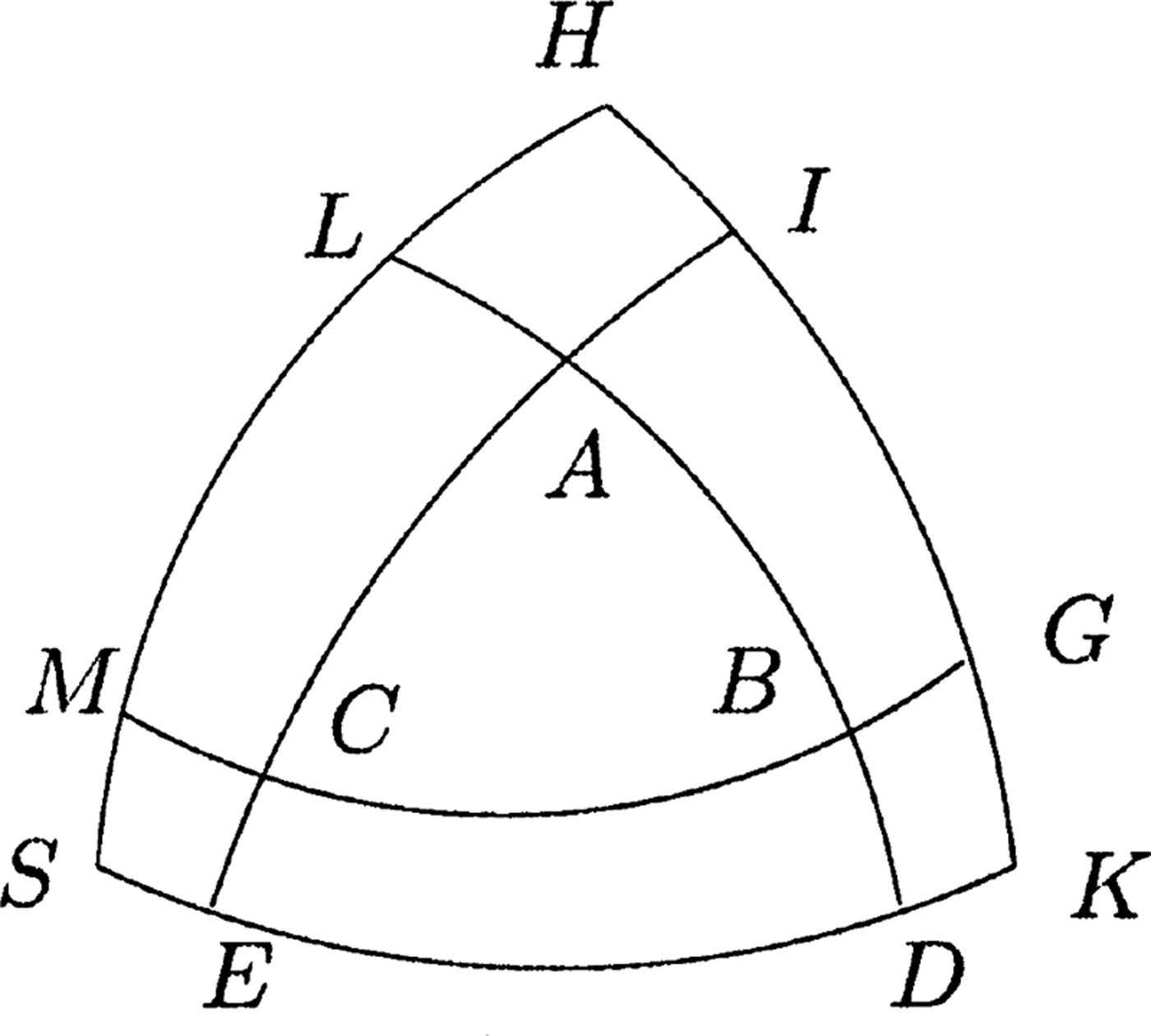
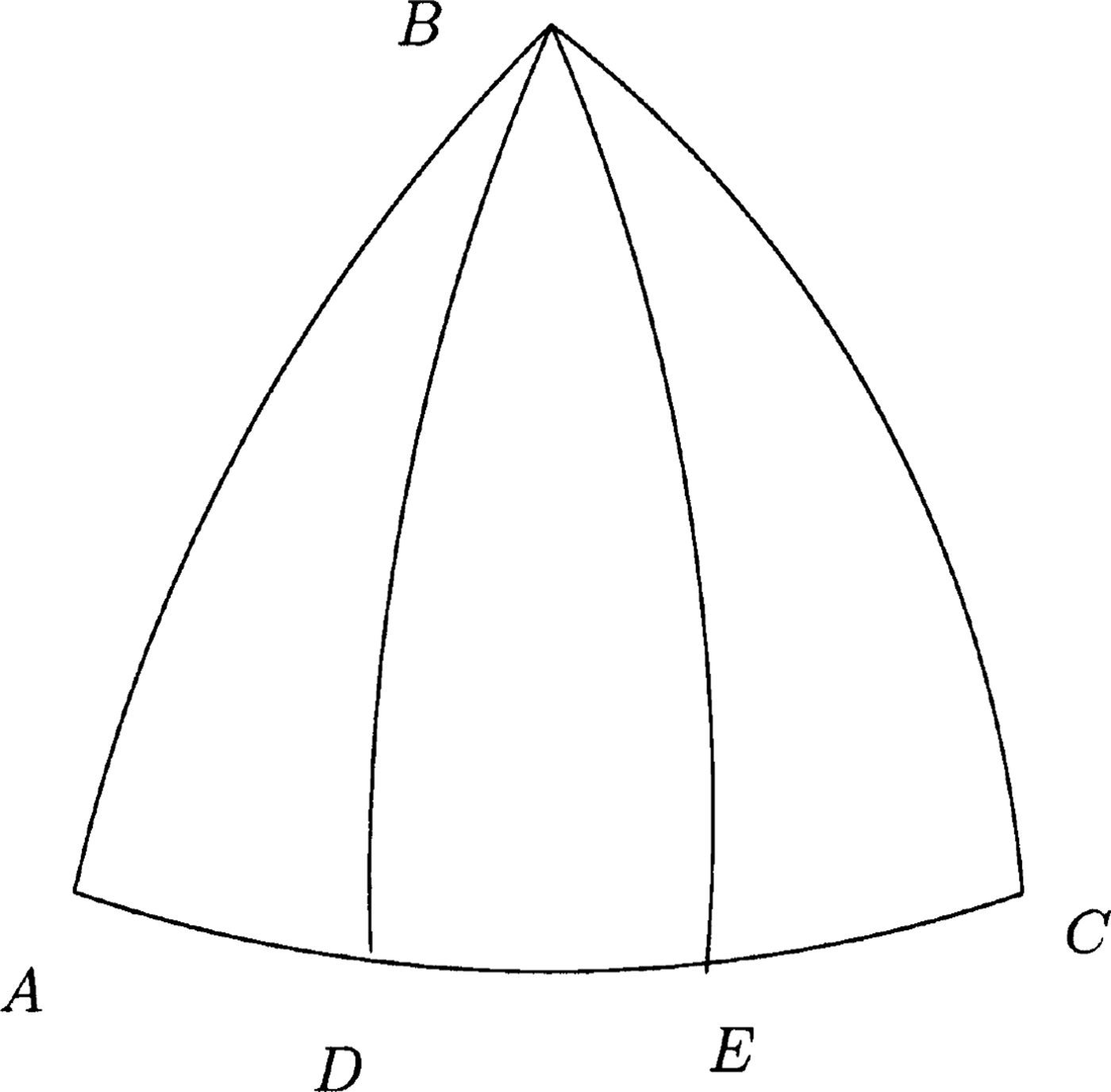
We complete (the sides) to a quarter of a circle and we draw using as a pole of each one of the points A, B, C and at a distance equal to a quarter of a circle the arcs ED, IG, LM. We then produce these arcs until the three circles meet. As these circles meet at points K, H, S, we get a triangle KHS made of great circle arcs. Since the angles A, B, C are known, the arcs DE, IG, LM are known. Since the circle AC passes by the poles of the circles DE, IG, these two circles also pass by the two poles of the circle AC. Therefore the point K is a pole of AC. Since the circle AB passes by the poles of the two circles DE, LM, these two circles also pass by the two poles A, B, and the point S is a pole of AB. Likewise, since the circle BC passes by the poles of the two circles IG, LM, these two circles also pass by the two poles B, C, and the point H is a pole of BC. Therefore, each of KE, DS, KI, GH, MH, LS is a quarter of a great circle. Since the arcs DE, IG, LM are known, the sides KH, HS, SK are known, because each of them exceeds a quarter by the complement of an arc which is known to a quarter; therefore the angles K, H, S are known. Therefore, the arcs IE, GM, LD are known, and IE exceeds a quarter by the complement of AC to a quarter, GM exceeds a quarter by the complement of BC to a quarter, and LD exceeds a quarter by the complement of AB to a quarter of a circle. Finally AB and AC are known, which is what we wanted.Footnote 24
To put this text in other words, the author takes a spherical triangle ABC with given angles and unknown sides, and he takes the points A, B, C to be poles of great circles on the sphere. These great circles intersect at points H, K, S, and these points define another triangle, the polar triangle HKS. The relations between the various sides and angles are:
 $$IE = 180^{{\circ}} - AC\semicolon \; GM = 180^{\circ} - BC\semicolon \; LD = 180^{\circ} - AB.$$
From this we deduce
 $$KS = 180^{\circ} - \hat A\semicolon \; HS = 180^{\circ} - \hat B\semicolon \; HK = 180^{\circ} - \hat C$$
and
 $$\hat H = 180^{\circ} - BC\semicolon \; \hat K = 180^{\circ} - AC\semicolon \; \hat S = 180^{\circ} - AB.$$
Fig. 5.
This is the so-called Dual Sine Theorem for spherical sines. With this, it is possible to pass from the angles of the triangle ABC to its sides, and vice versa.
We can also see from this that Ibn ʿIrāq proved a duality relation between the two spherical triangles ABC and HKS, these triangles being polar duals of each other. Indeed, the arc AC passes by a pole of IG and a pole of DE; the great circles IG and DE pass by a pole of the great circle AC and they intersect at the point K; therefore this point is a pole of AC. And with a similar argument, we see that the point S is a pole of AB and the point H is a pole of BC.
The notion of polar triangle simplified the computations of spherical triangles by establishing relations between angles and sides. Ibn ʿIrāq used this notion when he corrected the book of Abū Jaʿfar al-Khāzin called Zīj al-ṣafāʾiḥ and he showed there that when we know the sides of a spherical triangle, then we know its angles and vice versa.Footnote 25
The theoretical and mathematical strength of Ibn ʿIrāq and his background in this mathematical field allowed him to write his Rectification of a Proposition of the Book of Menelaus on the Spherics, which was the original book in that field. He finished this book in the year 398 of the Hegira, that is, in the year 1007 A.D. He recounts the story of this correction at the beginning of his treatise (see § 4.1 below). Ibn ʿIrāq wanted to complete what his predecessors started – among them al-Māhānī and al-Harawī – on correcting the book of Menelaus, using the methods of the latter. Continuing the correction of the work of Menelaus, Ibn ʿIrāq wrote an independent treatise on Menelaus' Proposition 5 of Book III, titled The Rectification of a Proposition of the Book of Menelaus on the Spherics (see below). The proposition is stated at the beginning of Ibn ʿIrāq's treatise, and recalled in the next section of this paper.
In his treatise, Ibn ʿIrāq uses the language of sines instead of the language of the double of chords that was used by Menelaus. As he puts it himself: “We use sines instead of doubles of chords, to make things lighter”. He means by this that the spherical computations become easier. In fact, Ibn ʿIrāq uses the language of sines in several of his astronomical treatises, including the Jadwal al-Taqwīm (Ephemeris) and his treatise concerning the circles drawn on the surface of the astrolabe.
3. MATHEMATICAL COMMENTARY
3.1. Ibn ʿIrāq, The Rectification of a Proposition of the Book of Menelaus on the Spherics
In this treatise, Ibn ʿIrāq gives a set of propositions in spherical geometry that are useful for the proof of Proposition 5 of Book III of Menelaus' Spherics. He makes heavy use of the spherical Sine Rule and of polarity theory – a theory which is particular to the field of spherical geometry.
Proposition 5 of Book III of Menelaus is the following:
Consider two spherical trianglesFootnote 26 having two equal acute angles and each triangle having also a right angle. Assume that in each rectangle the side that subtends the remaining angle is less than a quarter of a circle. Then, the ratio of the homologue of the sum of the two arcs that are adjacent to the acute angle in the first triangle to the homologue of their difference is equal to the ratio of the homologue of the sum of the two sides that are adjacent to the acute angle in the second triangle to the homologue of their difference.
Thus, in modern terms: given a spherical triangle ABC with right angle at B and acute angle at C, with AC being less than a quarter of a circle, the quantity
 $$\displaystyle{{{\rm crd}2\lpar AC + BC\rpar } \over {{\rm crd}2\lpar BC - AC\rpar }}$$
is independent of the chosen triangle, or, equivalently, in terms of sines, the quantity
 $$\displaystyle{{\sin \lpar AC + BC\rpar } \over {\sin \lpar BC - AC\rpar }}$$
is independent of the chosen triangle.
Ibn ʿIrāq works with sines instead of chords (which were used by Menelaus).Footnote 27
In the above statement of Proposition III.5, the word “homologue” of an arc means the chord of its double.
The relation between the sine of an arc α and its chord is sin α = ½(crd 2α). The use of the word “homologue”, instead of giving the precise formula, reflects the fact that the author considers that his reader is familiar with analogies between the statements of the formulae of Euclidean geometry and those of spherical geometry, where the passage between corresponding formulae involves the formal operation of replacing the value of certain arcs by chords of their doubles (or by sines). A well-known illustration of this passage is the Sine Rule, which, for a triangle with sides a, b, c opposite to angles A, B, C, gives:
 $$\displaystyle{a \over {\sin A}} = \displaystyle{b \over {\sin B}} = \displaystyle{c \over {\sin C}}$$
in Euclidean geometry, and
 $$\displaystyle{{\sin a} \over {\sin A}} = \displaystyle{{\sin b} \over {\sin B}} = \displaystyle{{\sin c} \over {\sin C}}$$
in spherical geometry. It is not hard to conclude from this example that several trigonometric formulae bear the same analogy, since many of them can be proved using the Sine Rule. Proposition III.5 is no exception, and here is the analogous statement, valid in Euclidean geometry: Given a triangle ABC with right angle at B and acute angle at C, then the (AC + BC)/(BC – AC) is independent of the chosen triangle. The proof is a consequence of the similarity of two triangles having the required properties.
The following are – in modern notation – the propositions which Ibn ʿIrāq proves. We have filled in some details of the proofs.
Proposition 3.1.
Let ABC be a spherical triangle. We join A by a great circle arc to a point K on the great circle joining BC. Then we have
 $$\displaystyle{{\sin KC} \over {\sin BK}} = \displaystyle{{\sin K\hat AC} \over {\sin B\hat AK}} \cdot \displaystyle{{\sin B} \over {\sin C}}.$$
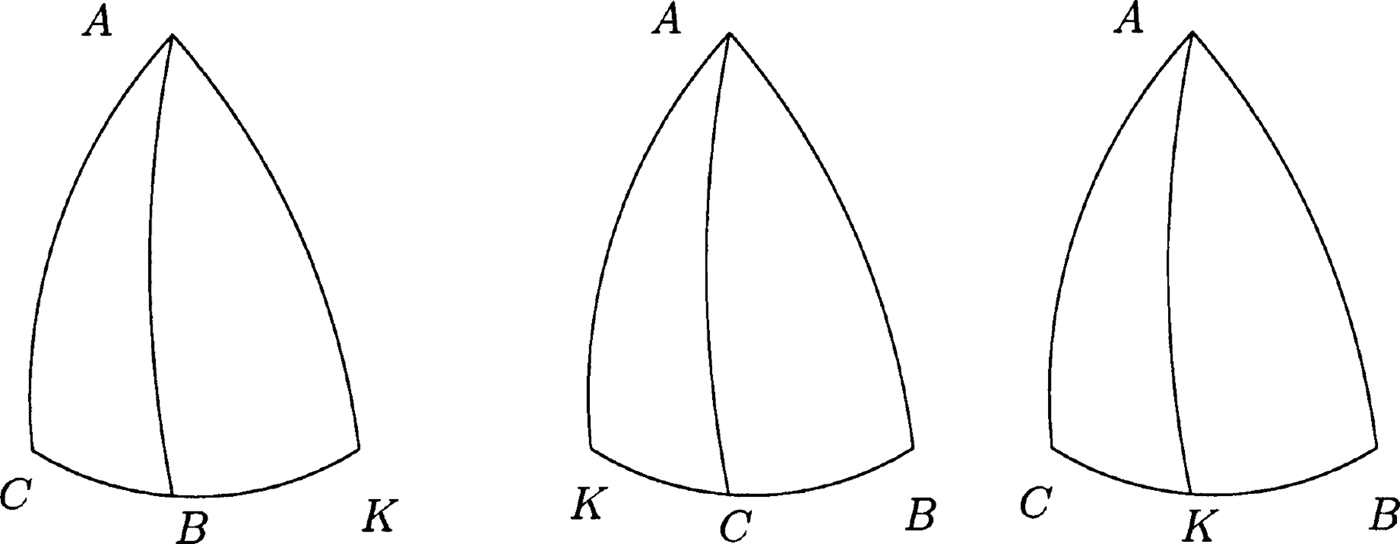
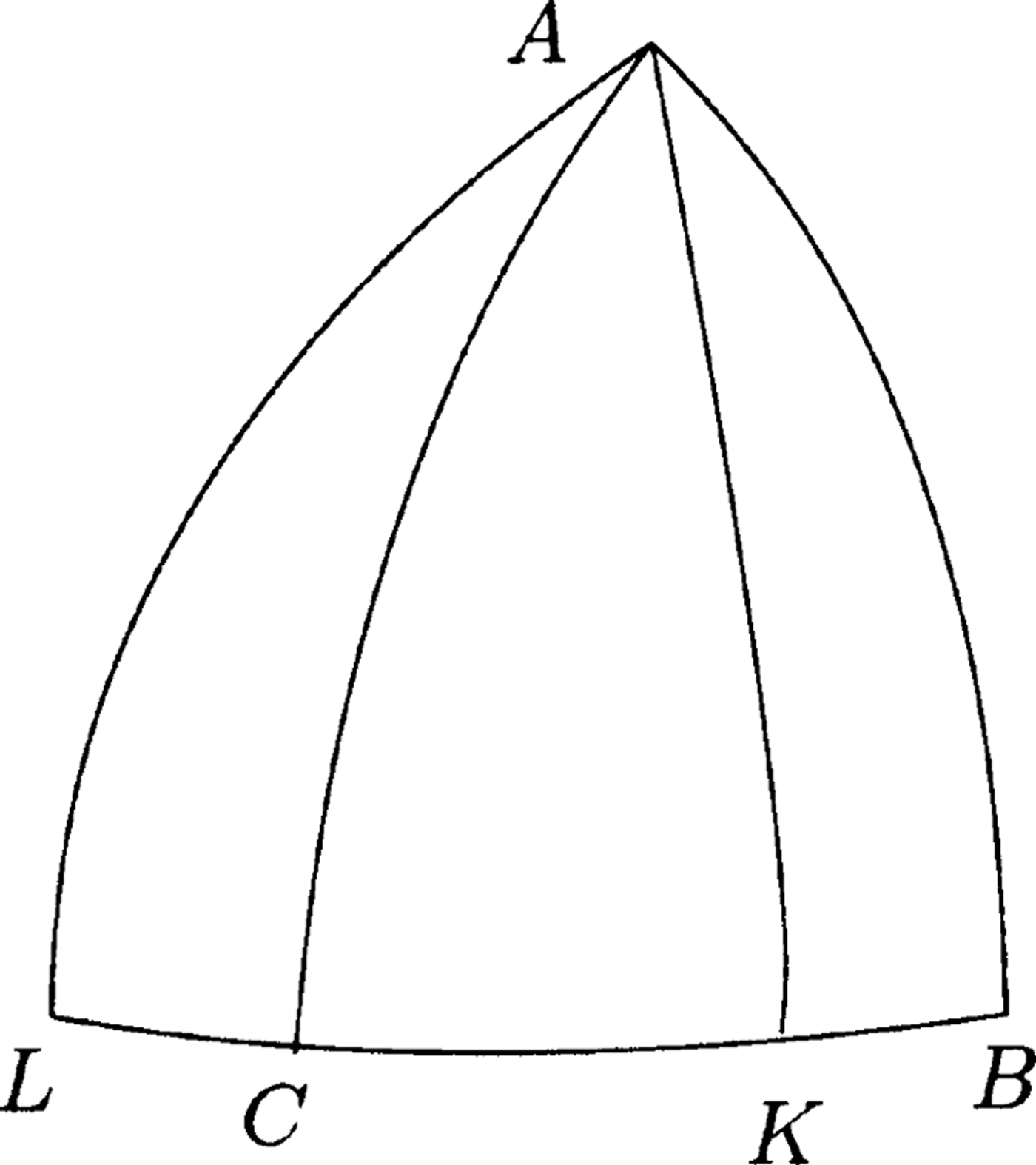
Proof. There are three cases to consider, according to the position of the point K on the great circle joining B and C: either K lies between B and C, or C lies between K and B or B lies between C and K.Footnote 28 The three cases are represented in Fig. 6.
Fig. 6.
The proof of the proposition is the same in the three cases. It relies on the spherical Sine Rule. Let us note that this rule is proved in the treatise by Naṣīr al-Dīn al-Ṭūsī.Footnote 29
Applying the Sine Rule in the triangle KAC, we have
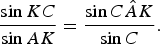 $$\displaystyle{{\sin KC} \over {\sin AK}} = \displaystyle{{\sin C\hat AK} \over {\sin C}}.$$
Applying the Sine Rule in the triangle BAK, we have
 $$\displaystyle{{\sin AK} \over {\sin BK}} = \displaystyle{{\sin B} \over {\sin B\hat AK}}.$$
From the last two equations, we obtain
 $$\displaystyle{{\sin KC} \over {\sin BK}} = \displaystyle{{\sin K\hat AC} \over {\sin B\hat AK}} \cdot \displaystyle{{\sin B} \over {\sin C}}.$$
This proves Proposition 1.
Proposition 3.2.
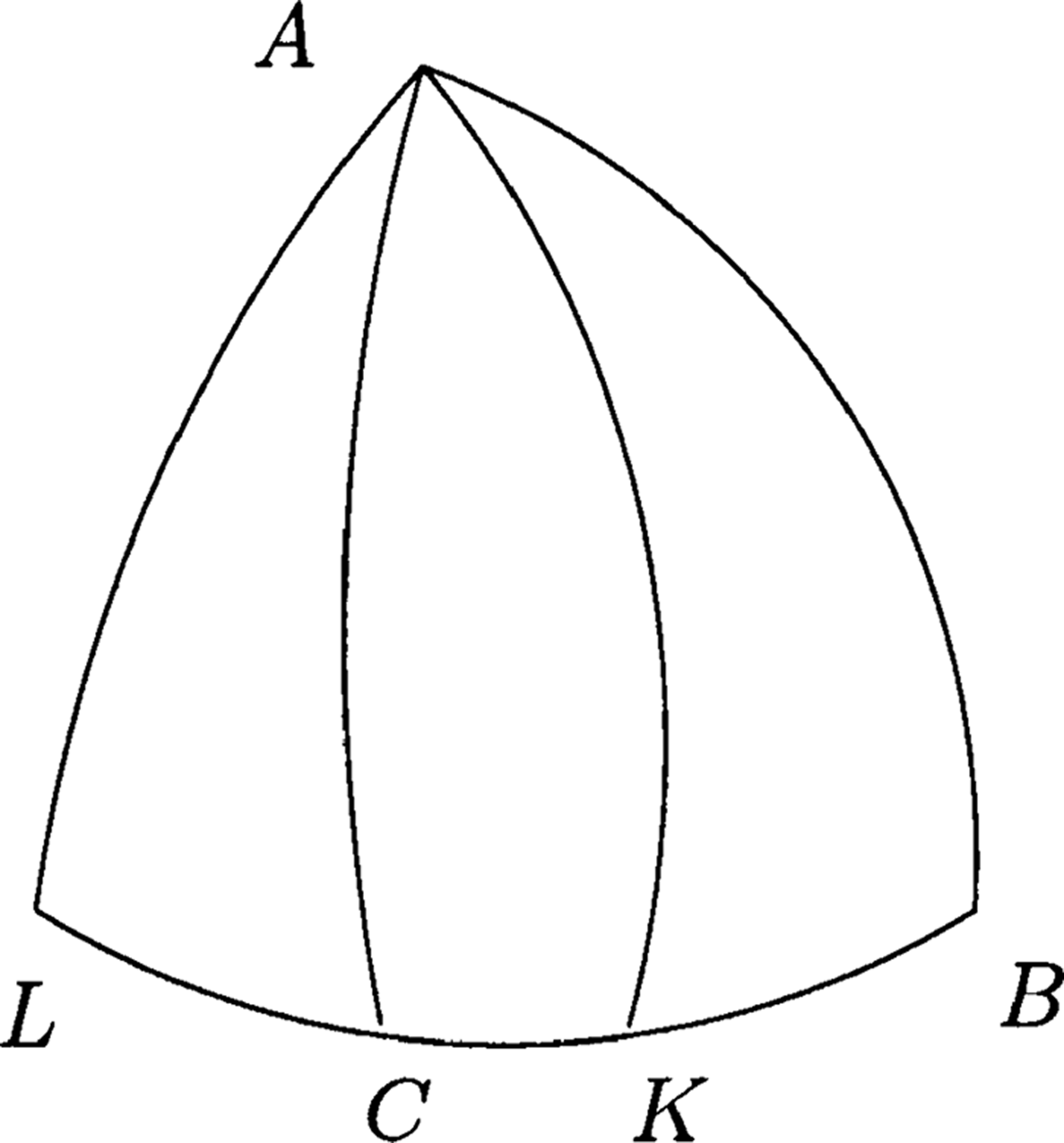
Given a spherical triangle ABL, we produce two great circle arcs AK and AC from A to two points K and C on the great circle of BL (see Fig. 7). Then we have
 $$\displaystyle{{\sin BL} \over {\sin LC}} \cdot \displaystyle{{\sin KC} \over {\sin BK}} = \displaystyle{{\sin B\hat AL} \over {\sin C\hat AL}} \cdot \displaystyle{{\sin K\hat AC} \over {\sin B\hat AK}}. \leqno \lpar \ast\rpar$$
Proof. Using Proposition 3.1, we have
 $$\displaystyle{{\sin BL} \over {\sin LC}} = \displaystyle{{\sin B\hat AL} \over {\sin C\hat AL}} \cdot \displaystyle{{\sin C} \over {\sin B}}.$$
Fig. 7.
Using again Proposition 3.1, we have
 $$\displaystyle{{\sin KC} \over {\sin BK}} = \displaystyle{{\sin K\hat AC} \over {\sin B\hat AK}} \cdot \displaystyle{{\sin B} \over {\sin C}}.$$
This implies (*) and proves Proposition 3.2.
Remark 3.3.
The result of Proposition 3.2 implies the invariance of the cross ratio in spherical geometry, since it says that the cross ratio of four points on a great circle arc which cuts four concurrent great circle arcs does not depend on the intersecting great circle arc. Here, we define the cross ratio [C, B, K, L] of the ordered quadruple C, B, K, L by the formula
 $$\lsqb C\comma \; B\comma \; K\comma \; L\rsqb = \displaystyle{{\sin BL} \over {\sin LC}} \cdot \displaystyle{{\sin KC} \over {\sin BK}}.$$
This notion of cross ratio in spherical geometry is defined in analogy with the cross ratio in Euclidean geometry, taking the sines of the lengths of segments instead of the lengths of segments. Menelaus, in his original proof which is recalled later on in this text, used (without proof) the spherical cross ratio invariance.
Proposition 3.4.
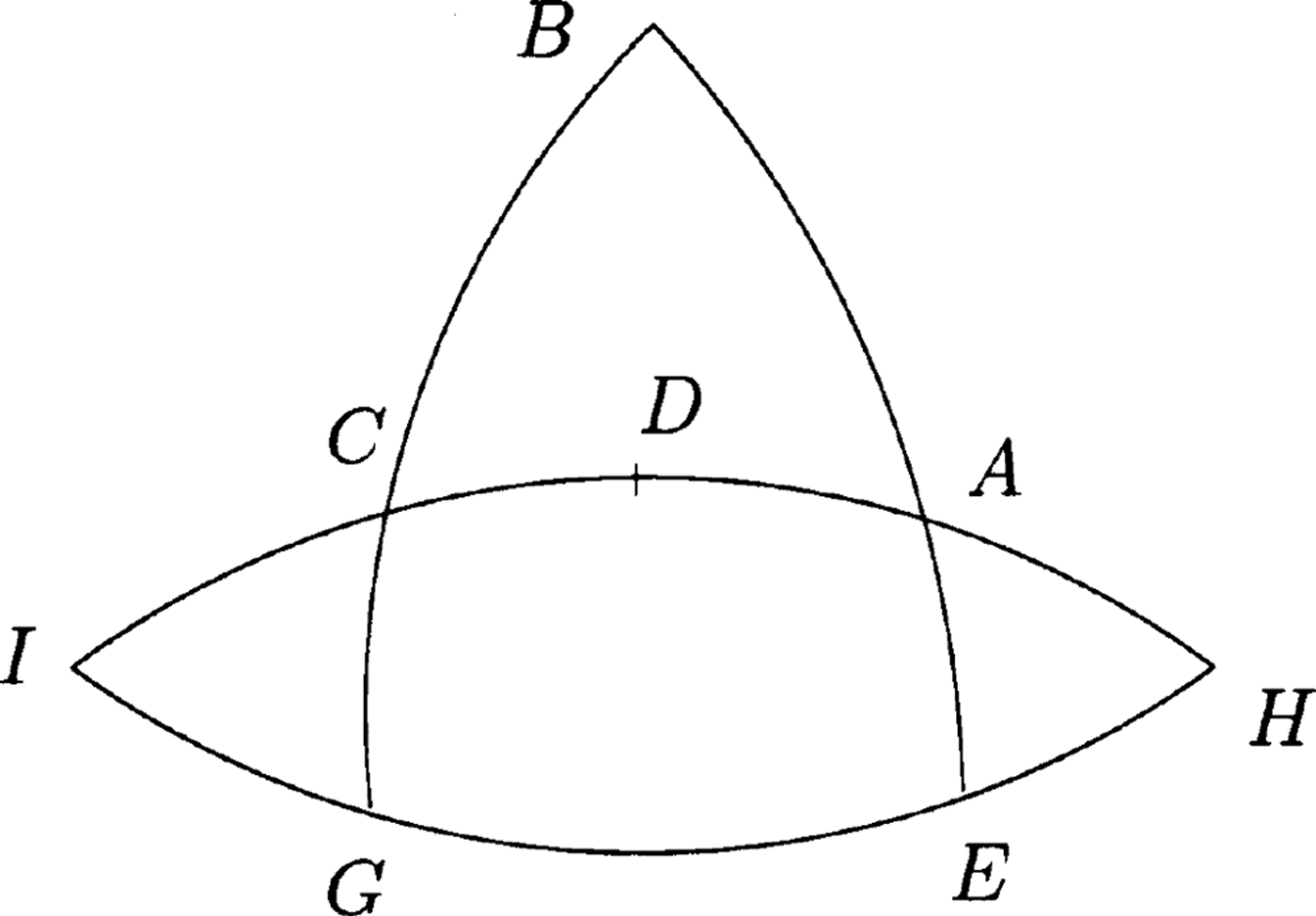
Given a spherical triangle ABC, we let D be the midpoint of the side AC and we consider a great circle having D as a pole. We produce the two sides BA and BC until the points E, G on that great circle. Then we have
 $$\displaystyle{{\sin AE} \over {\sin GC}} = \displaystyle{{\sin G} \over {\sin E}}.$$
Proof. We refer to Fig. 8, in which D is a pole of the great circle HEGI. We have DI = DH (they are both equal to a quarter of a circle since D is a pole of a great circle containing I and H). Since DC = DA, we get AH = IC. By the Sine Rule in the triangle AEH, we have
 $$\displaystyle{{\sin AE} \over {\sin AH}} = \displaystyle{{\sin H} \over {\sin E}}.$$
Fig. 8.
Since AH = IC we have, by the Sine Rule in the triangle CIG,
 $$\displaystyle{{\sin AH} \over {\sin GC}} = \displaystyle{{\sin G} \over {\sin I}}.$$
Using Î = Ĥ (they are both right angles), and multiplying both sides of the preceding two equations, we get
 $$\displaystyle{{\sin AE} \over {\sin GC}} = \displaystyle{{\sin H} \over {\sin E}} \cdot \displaystyle{{\sin G} \over {\sin I}} = \displaystyle{{\sin G} \over {\sin E}}.$$
This proves Proposition 3.4.
Proposition 3.5.
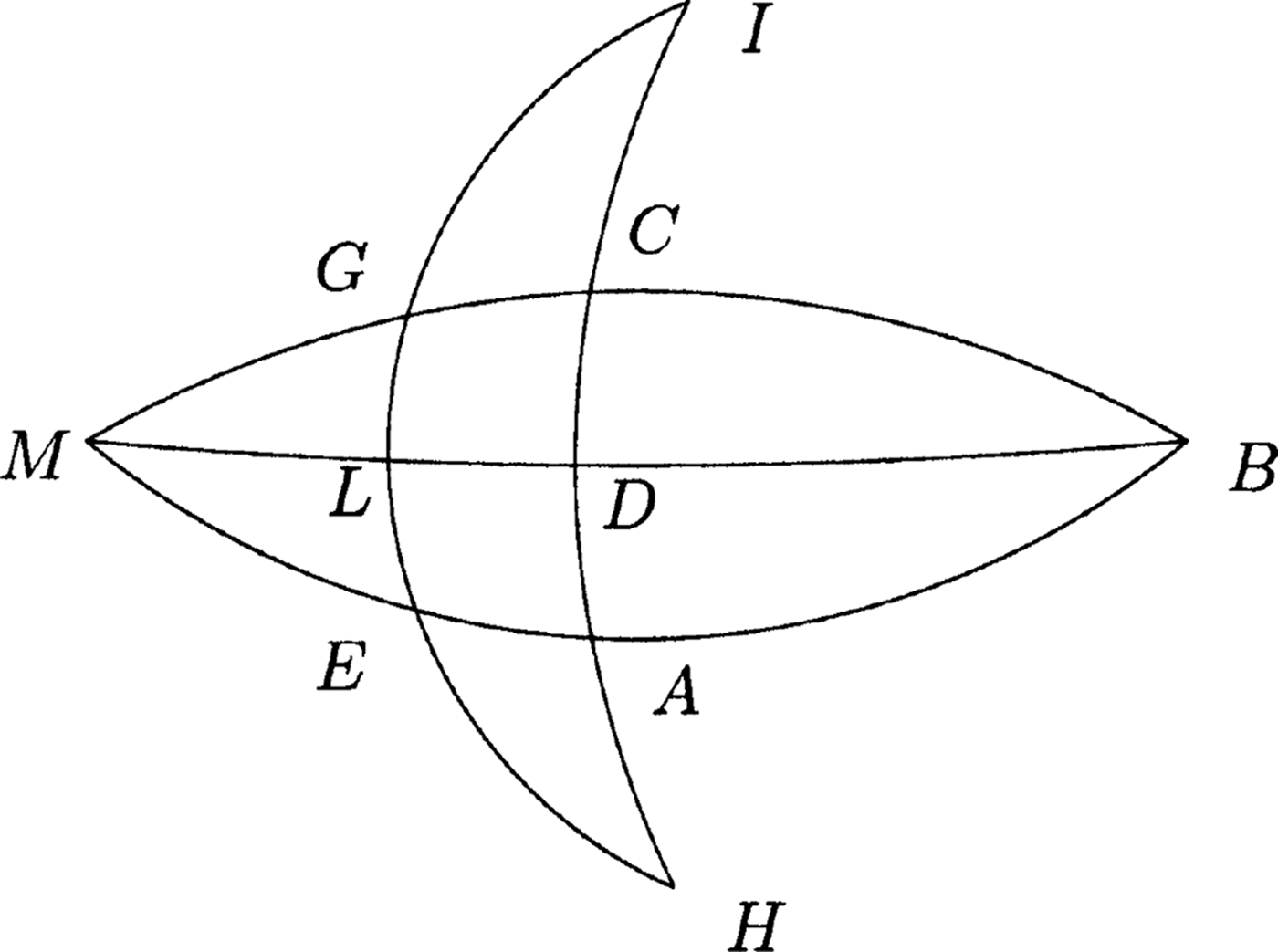
We keep the notation of Proposition 3.4 and we assume furthermore that BD = AD = DC. We produce the great circle arc BD until it meets the great circle EG at a point L. Then, we have EL = EH and LG = GI (see Fig. 9).
Fig. 9.
Proof. The three great circles BE, BL and BG passing by B meet at the common point M which is the polar opposite to B. From the proof of Proposition 3.4, we have AH = IC.
Since D is a pole of the great circle HLI, DL is a quarter of a circle. Therefore, ML + BD is a quarter of a circle. Likewise, DC + CI is a quarter of a circle.
Since DC = BD, we have ML = IC. Thus, we have AH = IC = LM.
Since D is a pole of the great circle HL, the angles at H and L are right angles.
The triangles MLE and AHE are congruent. Indeed, AH = LM, and the three angles are congruent (they have two right angles, the angles at E are vertically opposite, and we have  $L\hat ME = D\hat BA$, and
 $D\hat BA = B\hat DA$ since the triangle BDA is isosceles). Therefore, HE = EL. Likewise, we get LG = GI. This proves Proposition 3.5.
Proposition 3.6.
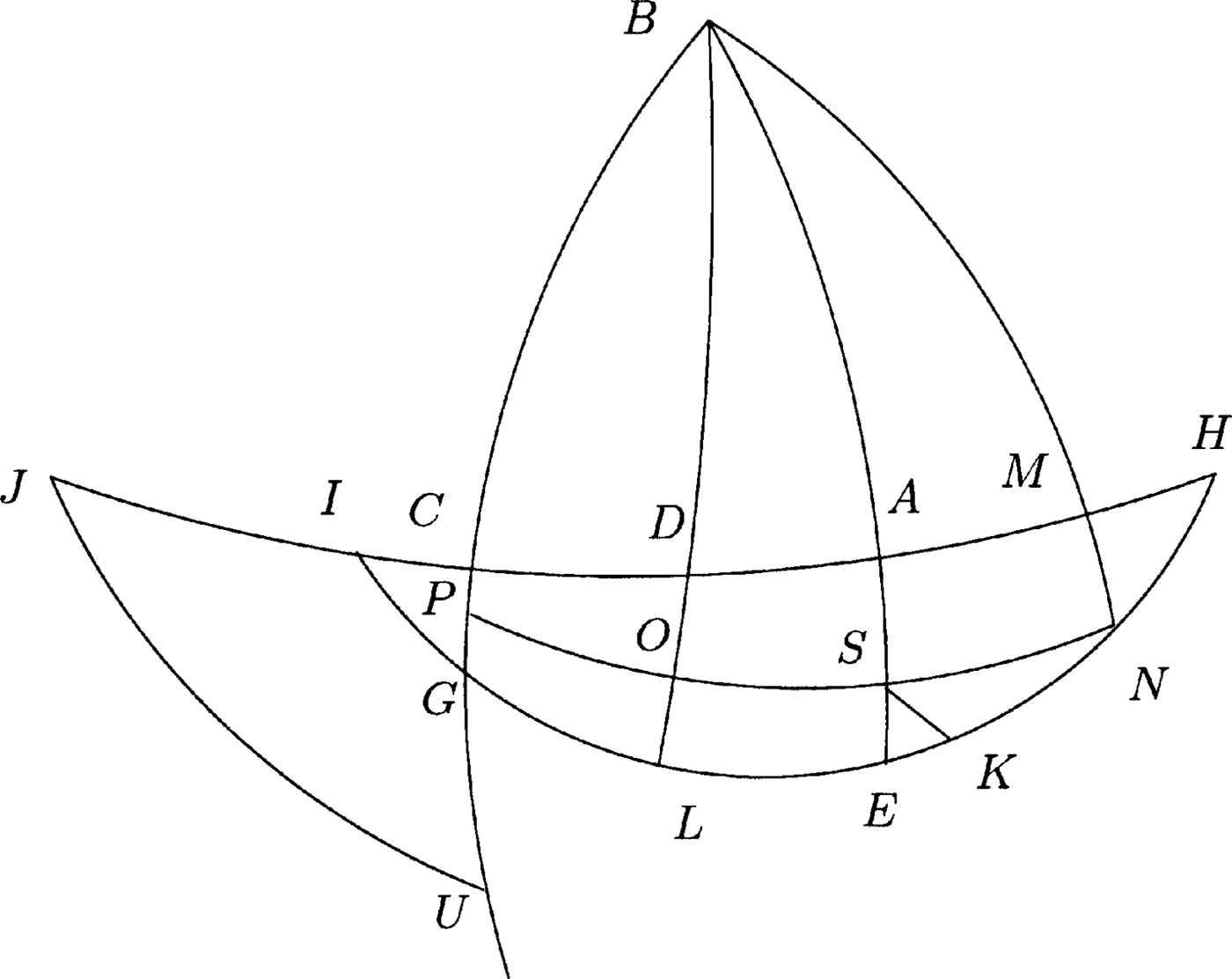
Consider a triangle ABC whose base AC is divided by an arc BD into two halves, CD and DA. We draw on the pole D a great circle HEGI and we produce onto it the great circle arcs BAE, BDL, BCG. Notice that the great circle HEGI passes by the two poles of the great circle joining B and L. Let N be a pole of BL. Let us connect N to B by a great circle arc and let M be an intersection point of this great circle arc with the great circle AC (see Fig. 10). Then the angle MBD is right and we have
 $$\displaystyle{{\sin A} \over {\sin C}} = \displaystyle{{\sin EH} \over {\sin IG}} \cdot \displaystyle{{\sin GC} \over {\sin AE}}. \leqno \lpar 1\rpar$$
Proof. Since the pole D of the great circle HEGI is on BL, then, by duality, the two poles of BL are on HEGI. Thus, the point N is on the great circle HEGI. Since D is a pole of HEGI, the angle at L is a right angle. The angle MBD is right since N is a pole of the circle BD.
Fig. 10.
Now we prove the last equality in the statement of the proposition.
We draw on the pole B a great circle arc NSOP. We produce BG so that CU = AE and we draw from U a great circle arc perpendicular to CG and intersecting the great circle AC at a point J. We consider the triangle CBM, with A on the side CM. From Proposition 3.1, we have
 $$\displaystyle{{\sin CM} \over {\sin AM}} = \displaystyle{{\sin C\hat BM} \over {\sin M\hat BA}} \cdot \displaystyle{{\sin A} \over {\sin C}}.$$
In the triangles UJC and EHA we have UC = EA and the angles at J and H are right. Therefore we have
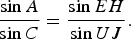 $$\displaystyle{{\sin A} \over {\sin C}} = \displaystyle{{\sin EH} \over {\sin UJ}}. \leqno \lpar 2\rpar$$
By the Sine Rule in the triangle UJC and since U is a right angle, we have
 $$\displaystyle{{\sin UJ} \over {\sin C}} = {\rm sin}UC = {\rm sin}\;AE. \leqno \lpar 3\rpar$$
By the Sine Rule in the triangle IGC and since I is a right angle, we have
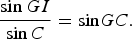 $$\displaystyle{{\sin GI} \over {\sin C}} = {\rm sin}GC. \leqno \lpar 4\rpar$$
We deduce from Equations (3) and (4) the following:
 $${\rm sin}UJ = {\rm sin}\;AE \cdot {\rm sin}C = {\rm sin}\;AE \cdot \displaystyle{{\sin GI} \over {\sin GC}}.$$
Thus we obtain
 $$\displaystyle{{\sin EH} \over {\sin UJ}} = \displaystyle{{\sin EH} \over {\sin IG}} \cdot \displaystyle{{\sin GC} \over {\sin AE}}. \leqno \lpar 5\rpar$$
Now we have, from (2) and (5):
 $$\displaystyle{{\sin A} \over {\sin C}} = \displaystyle{{\sin EH} \over {\sin IG}} \cdot \displaystyle{{\sin GC} \over {\sin AE}}$$
which is the required equality.
We expand Figure 10 by producing a great circle arc SK from S to the great circle HNEI making at K an angle equal to the angle G.
Proposition 3.7.
We have
 $$\displaystyle{{\sin PN} \over {\sin SN}} = \displaystyle{{\sin C\hat BM} \over {\sin M\hat BA}} = \displaystyle{{\sin PG} \over {\sin SK}}. \leqno \lpar 6\rpar$$
Proof. From the Sine Rule in the triangle PNB, we have
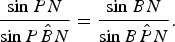 $$\displaystyle{{\sin PN} \over {\sin P\hat BN}} = \displaystyle{{\sin BN} \over {\sin B\hat PN}}.$$
From the Sine Rule in the triangle NBS, we have
 $$\displaystyle{{\sin NS} \over {\sin N\hat BS}} = \displaystyle{{\sin BN} \over {\sin N\hat SB}}.$$
Using the fact that angles BPN and NSB are equal (they are right angles) and dividing both sides of the last two equations, we obtain the first equality in (6).
Now we prove the second equality in the statement of the proposition.
By the Sine Rule in the triangle PGN, we have
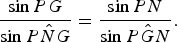 $$\displaystyle{{\sin PG} \over {\sin P\hat NG}} = \displaystyle{{\sin PN} \over {\sin P\hat GN}}.$$
By the Sine Rule in the triangle SKN, we have
 $$\displaystyle{{\sin \, SK} \over {\sin S\hat NK}} = \displaystyle{{\sin SN} \over {\sin S\hat KN}}.$$
Dividing both sides of the last two equations and using the fact that  $P\hat GN = S\hat KN$, we obtain the required equality.
Proposition 3.8.
We have
 $$\displaystyle{{\sin PN} \over {\sin NS}} = \displaystyle{{\sin GN} \over {\sin NE}} \cdot \displaystyle{{\sin SE} \over {\sin SK}}. \leqno \lpar 7\rpar$$
Proof. From the Sine Rule in the triangle PNG, we have
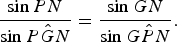 $$\displaystyle{{\sin PN} \over {\sin P\hat GN}} = \displaystyle{{\sin GN} \over {\sin G\hat PN}}. \leqno \lpar 8\rpar$$
From the Sine Rule in the triangle SKN, we have
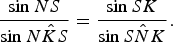 $$\displaystyle{{\sin NS} \over {\sin N\hat KS}} = \displaystyle{{\sin SK} \over {\sin S\hat NK}}. \leqno \lpar 9\rpar$$
Using the fact that  $P\hat GN = N\hat KS$, Equations (8) and (9) give
 $$\displaystyle{{\sin PN} \over {\sin NS}} = \displaystyle{{\sin GN} \over {\sin SK}} \cdot \displaystyle{{\sin N\hat KS} \over {\sin G\hat PN}}. \leqno \lpar 10\rpar$$
From the Sine Rule in the triangle SEN, we have
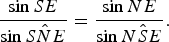 $$\displaystyle{{\sin SE} \over {\sin S\hat NE}} = \displaystyle{{\sin NE} \over {\sin N\hat SE}}. \leqno \lpar 11\rpar$$
 $$\displaystyle{{\sin PN} \over {\sin NS}} \cdot \displaystyle{{\sin S\hat NE} \over {\sin SE}} = \displaystyle{{\sin GN} \over {\sin SK}} \cdot \displaystyle{{\sin S\hat NE} \over {\sin G\hat PN}} \cdot \displaystyle{{\sin N\hat SE} \over {\sin NE}}.$$
Since the angles GPN and NSE are equal (both are right angles), we get (7).
Proposition 3.9.
We have
 $$\displaystyle{{\sin SE} \over {\sin SK}} = \displaystyle{{\sin AE} \over {\sin GC}}. \leqno \lpar 12\rpar$$
Proof. We have from Proposition 3.4,
 $$\displaystyle{{\sin AE} \over {\sin GC}} = \displaystyle{{\sin I\hat GC} \over {\sin A\hat EH}}.$$
In the triangle SKE, we have
 $$\displaystyle{{\sin SE} \over {\sin SK}} = \displaystyle{{\sin S\hat KE} \over {\sin S\hat EK}}.$$
Now since  $S\hat KE = I\hat GC$, we get (12), which proves the proposition.
Proposition 3.10.
 $$\displaystyle{{\sin PN} \over {\sin NS}} \cdot \displaystyle{{\sin A} \over {\sin C}} = \displaystyle{{\sin GN} \over {\sin NE}} \cdot \displaystyle{{\sin EH} \over {\sin IG}}.$$
Proof. From Propositions 3.7, 3.8 and 3.9, we have
 $$\displaystyle{{\sin PN} \over {\sin NS}} = \displaystyle{{\sin C\hat BM} \over {\sin M\hat BA}} = \displaystyle{{\sin GN} \over {\sin NE}} \cdot \displaystyle{{\sin EA} \over {\sin CG}}.$$
Then, from Equation (1), we have
 $$\displaystyle{{\sin A} \over {\sin C}} = \displaystyle{{\sin EH} \over {\sin IG}} \cdot \displaystyle{{\sin GC} \over {\sin AE}}\comma \;$$
which proves the proposition.
In the next propositions, we use the notation of Proposition 3.6.
Proposition 3.11.
We have the following:
(1) EL = EH;
(2) the great circle arc DE divides the angle ADL in two halves;
(3) the great circle arc DG divides the angle CDL in two halves;
(4) NE = GL.
Proof. From Proposition 3.5, we have EL = EH. Since D is a pole, the angle ADL is divided in two halves by the arcs HE and EL. Likewise the angle CDL is divided in two halves by the arcs IG and GL. Then GE is a quarter and NL is a quarter, therefore NE and GL are equal.
Proposition 3.12.
We have
 $$\displaystyle{{\sin CM} \over {\sin AM}} = \displaystyle{{\sin NG} \over {\sin GL}} \cdot \displaystyle{{\sin LE} \over {\sin EN}}.$$
Proof. First, we prove
 $$\displaystyle{{\sin CM} \over {\sin AM}} = \displaystyle{{\sin C\hat BM} \over {\sin C\hat BD}} \cdot \displaystyle{{\sin D\hat BA} \over {\sin A\hat BM}}. \leqno \lpar 13\rpar$$
By Proposition 3.1, we have
 $$\displaystyle{{\sin CM} \over {\sin CD}} = \displaystyle{{\sin C\hat BM} \over {\sin C\hat BD}} \cdot \displaystyle{{\sin \hat D} \over {\sin \hat M}}$$
and
 $$\displaystyle{{\sin AD} \over {\sin AM}} = \displaystyle{{\sin D\hat BA} \over {\sin A\hat BM}} \cdot \displaystyle{{\sin \hat M} \over {\sin \hat D}}.$$
Multiplying both sides of the preceding equations and using the fact that CD = AD, we get (13) as required. Now we prove
 $$\displaystyle{{\sin NG} \over {\sin GL}} = \displaystyle{{\sin NP} \over {\sin PO}} \cdot \displaystyle{{\sin BO} \over {\sin BL}}. \leqno \lpar 14\rpar$$
By the Sine Rule in the triangle NPG, we have
 $$\displaystyle{{\sin NG} \over {\sin N\hat PG}} = \displaystyle{{\sin NP} \over {\sin N\hat GP}}. \leqno \lpar 15\rpar$$
By the Sine Rule in the triangle GBL, we have
 $$\displaystyle{{\sin GL} \over {\sin G\hat BL}} = \displaystyle{{\sin BL} \over {\sin B\hat GL}}. \leqno \lpar 16\rpar$$
By the Sine Rule in the triangle PBO, we have
 $$\displaystyle{{\sin PO} \over {\sin P\hat BO}} = \displaystyle{{\sin BO} \over {\sin B\hat PO}}. \leqno \lpar 17\rpar$$
 $$\displaystyle{{\sin NG} \over {\sin GL}} = \displaystyle{{\sin G\hat BL} \over {\sin N\hat GP}} \cdot \displaystyle{{\sin NP} \over {\sin BL}}.\leqno \lpar 18\rpar$$
Now Equations (13) and (18) give:
 $$\displaystyle{{\sin NG} \over {\sin GL}} = \displaystyle{{\sin NP} \over {\sin PO}} \cdot \displaystyle{{\sin BO} \over {\sin BL}}\comma \;$$
which is Equation (14). Since B is a pole of the great circle NSOP, we have
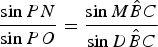 $$\displaystyle{{\sin PN} \over {\sin PO}} = \displaystyle{{\sin M\hat BC} \over {\sin D\hat BC}}$$
and Equation (14) gives:
 $$\displaystyle{{\sin NG} \over {\sin GL}} = \displaystyle{{\sin M\hat BC} \over {\sin D\hat BC}} \cdot \displaystyle{{\sin BO} \over {\sin BL}}. \leqno \lpar 19\rpar$$
We have sin BO = 1 since the arc BO is a quarter and we have
 $$\displaystyle{{\sin LE} \over {\sin EN}} = \displaystyle{{\sin OS} \over {\sin SN}} \cdot \displaystyle{{\sin LB} \over {\sin BO}}. \leqno \lpar 20\rpar$$
By Proposition 3.1 and the fact that the angles at O, S, N are right since B is a pole, we have
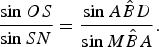 $$\displaystyle{{\sin OS} \over {\sin SN}} = \displaystyle{{\sin A\hat BD} \over {\sin M\hat BA}}.$$
Simplifying  $\displaystyle{{\sin BO} \over {\sin BL}}$ and
 $\displaystyle{{\sin LB} \over {\sin BO}}$, we obtain
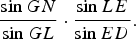 $$\displaystyle{{\sin GN} \over {\sin GL}} \cdot \displaystyle{{\sin LE} \over {\sin ED}}.$$
 $$\displaystyle{{\sin GN} \over {\sin GL}} \cdot \displaystyle{{\sin LE} \over {\sin EN}} = \displaystyle{{\sin M\hat BC} \over {\sin D\hat BC}} \cdot \displaystyle{{\sin A\hat BD} \over {\sin M\hat BA}}.$$
From Proposition 3.6, we have EN = GL. Now using Equation (13), we obtain
 $$\displaystyle{{\sin CM} \over {\sin AM}} = \displaystyle{{\sin NG} \over {\sin GL}} \cdot \displaystyle{{\sin LE} \over {\sin EN}}$$
which is the desired equation.
The preceding were the propositions that Ibn ʿIrāq proved, in order to fill in the details for the proof of Proposition 5 of Book III of Menelaus.
Ibn ʿIrāq notes at this point that Menelaus assumed in his statement of Proposition III.5 that one of the sides in each of the two triangles is less than a quarter, and that he did it for the needs of the proof he gave, but that the proof is the same whether the side is more than a quarter or less, because if the side were greater than a quarter, then one could work with the complement of the sides to semi-circles and do the same construction.Footnote 30
After these propositions, Ibn ʿIrāq declares that in fact it is not only that proposition that needs to be corrected, but other propositions throughout the book. He considers the following proposition.Footnote 31
Proposition 3.13.
Consider a triangle ABC and let us produce from the point B to the base AC two arcs BD and BE such that the angles ABD and CBE are equal. Then
 $$\displaystyle{{\sin ^2 AB} \over {\sin ^2 BC}} = \displaystyle{{\sin AE} \over {\sin CD}} \cdot \displaystyle{{\sin AD} \over {\sin CE}}.$$
Before giving a proof of this proposition, Ibn ʿIrāq mentions a proof by Menelaus which requires the condition that the arc BC is less than a quarter of a circle. He writes that Menelaus gave this proof without assuming this condition, and that al-Harawī also missed that point in his explanation. The proof that Ibn ʿIrāq gives does not need the condition that BC is less than a quarter.
Proof. By the Sine Rule in the triangle ABE, we have
 $$\displaystyle{{\sin AE} \over {\sin AB}} = \displaystyle{{\sin A\hat BE} \over {\sin E}}. \leqno \lpar 21\rpar$$
By the Sine Rule in the triangle BCD, we have
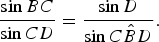 $$\displaystyle{{\sin BC} \over {\sin CD}} = \displaystyle{{\sin D} \over {\sin C\hat BD}}. \leqno \lpar 22\rpar$$
We have  $C\hat BE = A\hat BD \Rightarrow C\hat BD = A\hat BE.$ Equation (22) thus becomes
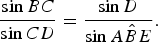 $$\displaystyle{{\sin BC} \over {\sin CD}} = \displaystyle{{\sin D} \over {\sin A\hat BE}}. \leqno \lpar 23\rpar$$
Multiplying both sides of Equations (21) and (22), we get:
 $$\displaystyle{{\sin AE} \over {\sin CD}} = \displaystyle{{\sin AB} \over {\sin BC}} \cdot \displaystyle{{\sin D} \over {\sin E}}. \leqno \lpar 24\rpar$$
By the Sine Rule in the triangle ADB, we have
 $$\displaystyle{{\sin AD} \over {\sin AB}} = \displaystyle{{\sin A\hat BD} \over {\sin D}}. \leqno \lpar 25\rpar$$
By the Sine Rule in the triangle BCE, we have
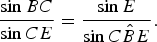 $$\displaystyle{{\sin BC} \over {\sin CE}} = \displaystyle{{\sin E} \over {\sin C\hat BE}}. \leqno \lpar 26\rpar$$
Using the fact that  $C\hat BE = A\hat BD$, we obtain
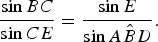 $$\displaystyle{{\sin BC} \over {\sin CE}} = \displaystyle{{\sin E} \over {\sin A\hat BD}}. \leqno \lpar 27\rpar$$
Multiplying both sides of Equations (25) and (27), we get
 $$\displaystyle{{\sin AD} \over {\sin CE}} = \displaystyle{{\sin AB} \over {\sin BC}} \cdot \displaystyle{{\sin E} \over {\sin D}}. \leqno \lpar 28\rpar$$
Multiplying both sides of Equations (24) and (28), we obtain
 $$\displaystyle{{\sin AE} \over {\sin CD}} \cdot \displaystyle{{\sin AD} \over {\sin CE}} = \left({\displaystyle{{\sin AB} \over {\sin BC}}} \right)^2$$
which is what had to be shown.
Ibn ʿIrāq then considers the following proposition,Footnote 32 as a proposition of “another species”, because it makes use of an ambient three-dimensional construction.
Proposition 3.14.
Consider on the surface of the sphere two great circles AB and BC (Fig. 12), each one of them being sloped with respect to the other and mark on the circle AB two points D and E that are not diametrically opposite. Drop from D and E perpendiculars DC and EH on BC. Then the ratio  $\displaystyle{{{\rm sin}\, {\rm CH}} \over {{\rm sin}\, {\rm DE}}}$is equal to the ratio of the product of the diameter of the sphere and the diameter of the circle that is parallel to the circle BC and that is tangent to the circle AB to the product of the diameters of the circles that pass through the points D and E and that are parallel to BC.
Fig. 11.
Fig. 12.
The result is not proved in the present treatise of Ibn ʿIrāq, but it is proved in his Book of Menelaus on Spherical Propositions Rectified.
The author says then that he can give a value for the ratio  $\displaystyle{{\sin CH} \over {\sin DE}}$ that is simpler than the one which is given in Proposition 3.14. He first gives the following statement:
Proposition 3.15.
The ratio  $\displaystyle{{{\rm sin}\, {\rm CH}} \over {{\rm sin}\, {\rm DE}}}$is equal to the ratio of the diameter of the circle passing through the point of intersection of the two circles at distance equal to
 $\displaystyle{\pi \over 2} - {\rm BC}$and which is parallel to the circle BC to the diameter of the circle that passes through the point E and which is parallel to the circle BC, and it is equal to the ratio of the diameter of the circle that passes from the intersecting point at distance equal to
 $\displaystyle{\pi \over 2} - {\rm BC}$to the circle that passes by the point D and which is parallel to the circle BC.
The explicit values given for the ratio  $\displaystyle{{\sin CH} \over {\sin CD}}$ in Proposition 3.14 and 3.15 should be compared to the monotonicity properties that are given (without explicit values) in Theodosius' Spherics (Prop. III.5) and in Ibn al-Haytham's spherical trigonometry.Footnote 33
Then Ibn ʿIrāq makes the following construction. Let G and L be the two points on BA such that BG =  $\displaystyle{\pi \over 2} - BC$ and BL =
 $\displaystyle{\pi \over 2} - BH$. We produce the two great circle arcs HE and CD in the direction of D and E until they meet at the pole of BC, and we call K this pole. We then produce the two great circle arcs KG and KL until the points S and M on BC. We then produce from the point E onto the arc KC a perpendicular EI and from the point D to the arc KH a perpendicular DN (see Fig. 12). He then proves the following:
Proposition 3.16.
We have
 $$\displaystyle{{\sin CH} \over {\sin DE}} = \displaystyle{{\sin KL} \over {\sin KD}}.$$
Proof. We have, using the Sine Rule:
 $$\displaystyle{{\sin CH} \over {\sin EI}} = \displaystyle{{\sin HK} \over {\sin KE}} = \displaystyle{1 \over {\sin KE}}$$
since HK is a quarter circle, and
 $$\displaystyle{{\sin EI} \over {\sin DE}} = \displaystyle{{\sin D} \over {\sin I}} = sin\;D$$
since the angle at I is right. We deduce
 $$\displaystyle{{\sin CH} \over {\sin DE}} = \displaystyle{{\sin D} \over {\sin KE}}.$$
We claim that sin D = sin KG. Indeed, denoting by I the point on the arc BG (beyond G) such that BI is a quarter circle, and we take A on KI. Then we have, in the triangle KAD:
 $$\cos\;D = \cos\left({\displaystyle{\pi \over 2} - C\hat BA} \right){\rm sin}\;CI.$$
Since BG = CA, we obtain
 $${\cos D} = {\sin C\hat BA }{\rm\; sin}\;BG. \leqno \lpar 29\rpar$$
In the triangle GBS, we have, from the sine rule,
 $${\rm sin}GS = {\rm sin}C\hat BA{\rm\; sin}\;BG. \leqno \lpar 30\rpar$$
 $${\rm cos}\;D = {\rm sin}GS = {\rm sin}\left({\displaystyle{\pi \over 2} - KG} \right)\comma \;$$
which gives sin D = sin KG. This shows the claim.
Therefore
 $$\displaystyle{{\sin CH} \over {\sin DE}} = \displaystyle{{\sin KG} \over {\sin KE}}.$$
Then, applying two times the Sine Rule, we obtain
 $$\displaystyle{{\sin CH} \over {\sin KC}} = \displaystyle{{\sin C\hat KH} \over {\sin \displaystyle{\pi \over 2}}}$$
since KC is a quarter circle and
 $$\displaystyle{{\sin DN} \over {\sin KD}} = \displaystyle{{\sin C\hat KH} \over {\sin \displaystyle{\pi \over 2}}}$$
since the angle at N is right. From these two inequalities, we get
 $$\displaystyle{{\sin CH} \over {\sin DN}} = \displaystyle{{\sin CK} \over {\sin KD}}$$
and using again the Sine Rule:
 $$\displaystyle{{\sin ND} \over {\sin DE}} = \displaystyle{{\sin E} \over {\sin N}} = {\rm sin}\;E.$$
This implies
 $$\displaystyle{{\sin CH} \over {\sin DE}} = \displaystyle{{\sin E} \over {\sin KD}}.$$
Now in the triangle KEA we have
 $${\rm cos}\;E = {\rm cos}\left({\displaystyle{\pi \over 2} - C\hat BA} \right){\rm sin}\;HI.$$
Using the fact that BL = HI, we get
 $${\rm cos}\;E = {\rm sin}C\hat BA{\rm \;sin}\;BL.$$
In the triangle LMB, we have
 $${\rm sin}\;LM = {\rm sin}C\hat BA{\rm \;sin}\;AL.$$
From the last two equalities, we get
 $${\rm cos}\;E = {\rm sin}LM = {\rm cos}\;LK.$$
Therefore, we get sin E = sin L, and we obtain
 $$\displaystyle{{\sin KL} \over {\sin KD}} = \displaystyle{{\sin CH} \over {\sin DE}}.$$
which is what we wanted.
Ibn ʿIrāq then notes that there are “other things that can be proved by methods that are different from those of Menelaus”, and that are not included in the Book of Menelaus on Spherical Propositions.
3.2. Ibn ʿIrāq on Menelaus' Proposition III.5, from The Book of Menelaus on Spherical Propositions, Rectified by the Emir Abū Naṣr Manṣūr Ibn ʿIrāq
Proposition 3.17
(Proposition 5 Book III of Menelaus' Spherics). Consider two spherical triangles ABC and DEG and assume that the two angles at A and D are right. Assume that the two angles at the points C and G are acute and equal, and that each of the arcs CA, DG is less than a quarter of a circle. Then, we have
 $$\displaystyle{{\sin \lpar BC + CA\rpar } \over {\sin \lpar BC - CA\rpar }} = \displaystyle{{\sin \lpar EG + GD\rpar } \over {\sin \lpar EG - GD\rpar }}.$$
Ibn ʿIrāq then presents a proof, which he says is Menelaus' proof, but in which he uses the language of sines. Some of the steps in Menelaus' proof are not proved, and Ibn ʿIrāq proves them later on.
Menelaus' proof reported on by Ibn ʿIrāq: We produce the great circle arc BC until a point L in such a way that CK = CL = AC.Footnote 34 We draw the great circle arcs AK and AL. We draw an arc of great circle HMSN having the point C a pole. We produce from the point A to the two great circle arcs BCL and HSN great circle arcs AH, AM, AS and AN. Then the point H is a pole of the great circle ACS since each of the two great circle arcs AH, HS is perpendicular to the great circle arc AS. We draw the two great circle arcs CM, CN. The arc CM is a quarter of a circle (since C is a pole of the arc HMS). Then  $K\hat CM = M\hat CS$ and
 $L\hat CN = N\hat CS.$Footnote 35
Now we do the same in the second triangle, that is, we take GP = GO = DG, we draw the great circle arc EGP, and we draw the two great circle arcs DO and DP. Taking the point G as a pole, we draw a great circle arc containing the points I, Q, X, R. As before, the great circle arc GQ bisects the angle EGX and that GR bisects the angle PGX.
Then Menelaus states that  $M\hat CS = Q\hat GX$ and
 $N\hat CS = R\hat GX$ and that MS = QX and NS = RX. Therefore we have MH = IQ.Footnote 36
Using the fact that LC = CK, we obtain
 $$\displaystyle{{\sin LB} \over {\sin BK}} = \displaystyle{{\sin BL} \over {\sin LC}} \cdot \displaystyle{{\sin CK} \over {\sin KB}}.$$
We haveFootnote 37
 $$\displaystyle{{\sin LB} \over {\sin BK}} = \displaystyle{{\sin NH} \over {\sin NS}} \cdot \displaystyle{{\sin MS} \over {\sin MH}}.$$
For the same reasons, we have
 $$\displaystyle{{\sin PE} \over {\sin EO}} = \displaystyle{{\sin IR} \over {\sin RX}} \cdot \displaystyle{{\sin QX} \over {\sin IQ}}.$$
Now since HM = IQ, MS = QX, NS = XR and NH = IR, we have
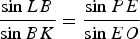 $$\displaystyle{{\sin LB} \over {\sin BK}} = \displaystyle{{\sin PE} \over {\sin EO}}$$
or, equivalently,
 $$\displaystyle{{\sin \lpar BC + CA\rpar } \over {\sin \lpar BC - CA\rpar }} = \displaystyle{{\sin \lpar EG + GD\rpar } \over {\sin \lpar EG - GD\rpar }}$$
and this is what had to be shown.
Ibn ʿIrāq considers that “Menelaus has obfuscated the proof of this proposition”, and he gives the following series of propositions that provide details for the proof.
The first proposition is a form of the invariance of the cross ratio in spherical geometry. This result is also contained in the preceding treatise of Ibn ʿIrāq, which contains several propositions that are useful in the proof of Proposition III.5.
Proposition 3.18.
We take a triangle ABC, with two points K and L on the great circle BC. We draw the great circle arcs AK and KL (Fig. 14). Then, we have
 $$\displaystyle{{\sin LB} \over {\sin LC}} \cdot \displaystyle{{\sin KC} \over {\sin KB}} = \displaystyle{{\sin B\hat AL} \over {\sin C\hat AL}} \cdot \displaystyle{{\sin K\hat AC} \over {\sin B\hat AK}}.$$
The proposition and its proof (based on applying the Sine Rule several times) are the same as Proposition 3.6 above, which appears in Ibn ʿIrāq's Rectification of a Proposition of the Book of Menelaus on the Spherics and we do not repeat it here.
Note that in the preceding proposition it is not assumed that KC = LC.
Next, Ibn ʿIrāq takes the particular case KC = LC, which is the case needed for Proposition III.5:
Proposition 3.19.
Using the notation of the preceding proposition and adding the hypothesis KC = LC, we obtain
 $$\displaystyle{{\sin B\hat AL} \over {\sin C\hat AL}} \cdot \displaystyle{{\sin K\hat AC} \over {\sin B\hat AK}} = \displaystyle{{\sin LB} \over {\sin KB}}.$$
Now Ibn ʿIrāq gives the complete proof of Proposition 5 of Book III of Menelaus.
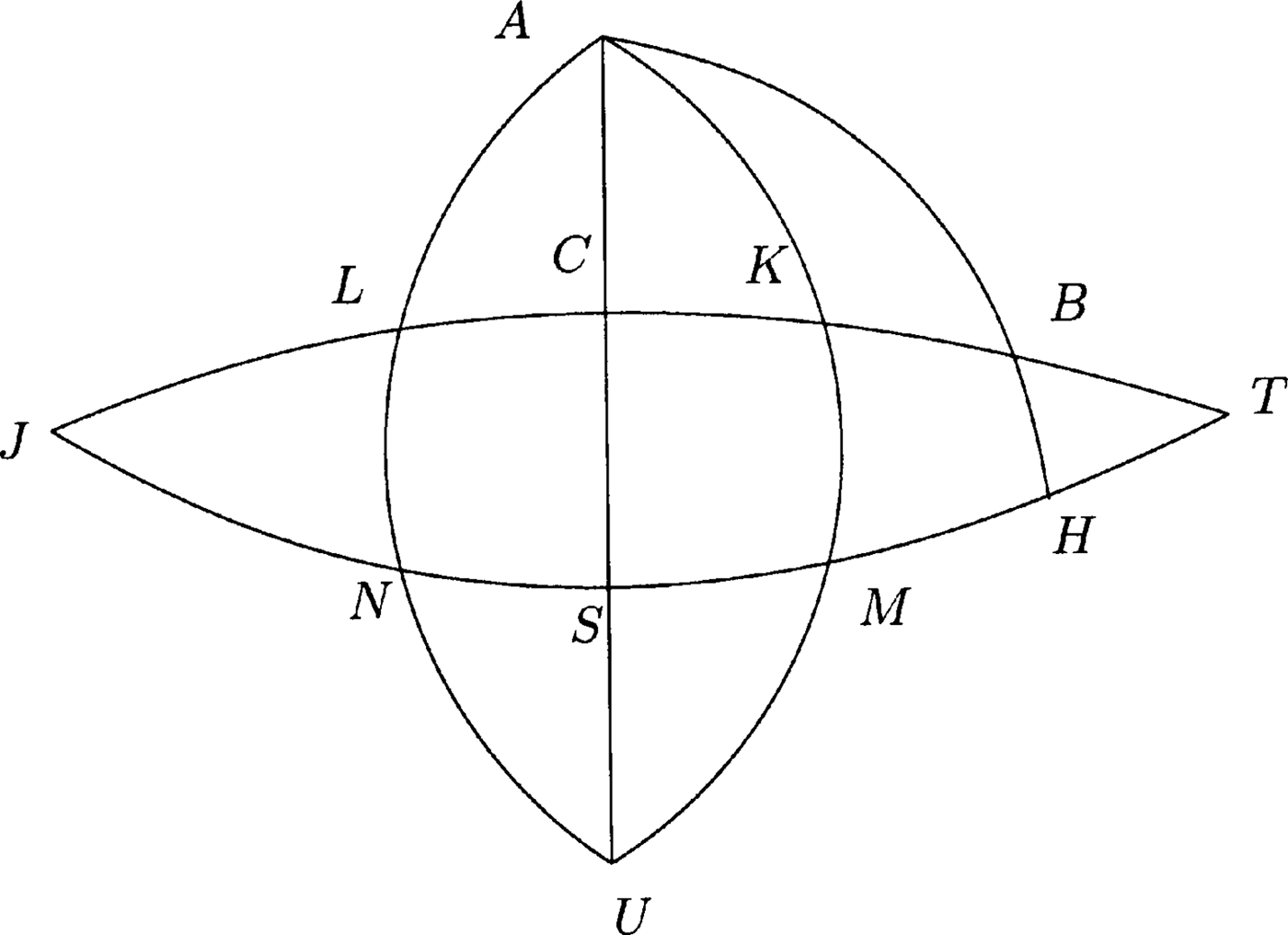
Proof of Proposition 3.17. We consider again Fig. 14 and we complete it, as in Fig. 13, that is, we draw the great circle arc HMSN whose pole is C. We then produce the great circle arcs AM, AS, AN until they meet at a point U (Fig. 15). We also produce the two great circle arcs HMS, LCKB until they meet at the two points J, T. Using the fact that AC = CK = LC and that C is a pole of the great circle HMS, we have SU = LJ = KT and the angles at S, J, T are right.
Fig. 13.
Fig. 14.
Fig. 15.
Now in the two spherical triangles SUN and LNJ the two vertically opposite angles are equal and we have  $C\hat AL = S\hat UN.$ Furthermore, the triangle ACL is isosceles (AC = CL), therefore
 $A\hat CL = C\hat AL.$ Therefore,
 $J\hat LN = A\hat LC = S\hat UN.$ Thus, the angles of the triangle SUN are congruent to the angles of the triangle LNJ, therefore the sides of the two triangles are respectively equal. The same holds in the triangles SUM, MTK. Therefore SN = NJ, and SM = MT.
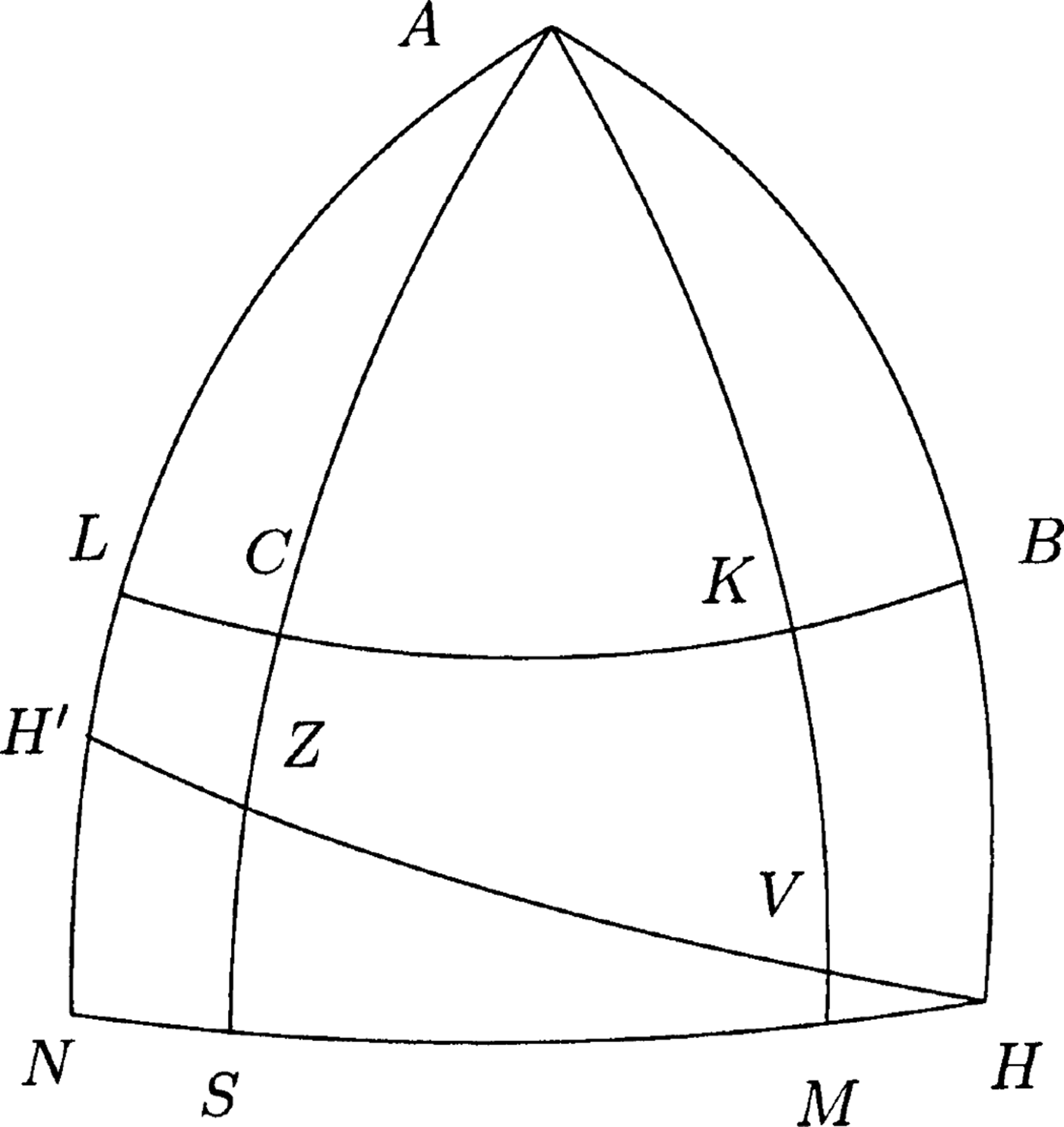
On the same figure, we take the point A as a pole and we draw the great circle arc VZ (Fig. 16). Since the point H is the pole of the great circle AC (remember that HS and HA are perpendicular to AC), this great circle passes through the point H. We then form the great circle arc HVZH′, with H′ on the great circle AL. Since A is a pole of the circle HVZH′, the value of the arc HV is equal to value of the angle BAK, the value of the arc VZ is equal to the value of the angle KAC, the value of the arc HH′ is equal to the value of the angle BAL and the value of the arc ZH′ is equal to the value of the angle CAL.
Fig. 16.
By the invariance of the cross ratio (Proposition 3.2 or Proposition 3.18) and using KC = LC, we get
 $$\displaystyle{{\sin LB} \over {\sin BK}} = \displaystyle{{\sin HH^{\prime}} \over {\sin ZH^{\prime}}} \cdot \displaystyle{{\sin VZ} \over {\sin HV}}. \leqno \lpar 31\rpar$$
We have (Proposition 3.1)
 $$\displaystyle{{\sin HN} \over {\sin SN}} = \displaystyle{{\sin HAN} \over {\sin NAS}} \cdot \displaystyle{{\sin S} \over {\sin AHM}} = \displaystyle{{\sin HH^{\prime}} \over {\sin H^{\prime}Z}} \cdot \displaystyle{{\sin S} \over {\sin AHM}}.$$
Since A is a pole,  $A\hat HZ$ is a right angle. We have (Proposition 3.1)
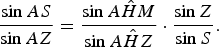 $$\displaystyle{{\sin AS} \over {\sin AZ}} = \displaystyle{{\sin A\hat HM} \over {\sin A\hat HZ}} \cdot \displaystyle{{\sin Z} \over {\sin S}}.$$
We deduce that
 $$\displaystyle{{\sin HN} \over {\sin SN}} = \displaystyle{{\sin HH^{\prime}} \over {\sin H^{\prime}Z}} \cdot \displaystyle{{\sin AZ} \over {\sin AS}}. \leqno \lpar 32\rpar$$
We have (Proposition 3.1)
 $$\displaystyle{{\sin SM} \over {\sin MH}} = \displaystyle{{\sin MAS} \over {\sin HAM}} \cdot \displaystyle{{\sin AHM} \over {\sin ASM}} = \displaystyle{{\sin VZ} \over {\sin VH}} \cdot {\rm sin}\;AHM$$
since the angle ASM is right. Then, since H is a pole, we have AZ =  $A\hat HZ$= π/2 and
 $A\hat HM$= SA. We deduce
 $$\displaystyle{{\sin SM} \over {\sin MH}} = \displaystyle{{\sin ZV} \over {\sin VH}} \cdot \displaystyle{{\sin SA} \over {\sin AZ}}. \leqno \lpar 33\rpar$$
Then
 $$\displaystyle{{\sin HN} \over {\sin NS}} \cdot \displaystyle{{\sin SM} \over {\sin MH}} = \displaystyle{{\sin HH^{\prime}} \over {\sin H^{\prime}Z}} \cdot \displaystyle{{\sin VZ} \over {\sin HV}}. \leqno \lpar 34\rpar$$
From Equations (31) and (34), we get
 $$\displaystyle{{\sin NH} \over {\sin NS}} \cdot \displaystyle{{\sin MS} \over {\sin MH}} = \displaystyle{{\sin LB} \over {\sin BK}}.$$
Now we refer again to Fig. 13. Since  $M\hat CS = Q\hat GX$ and
 $X\hat GR = S\hat CN$ and since HS = IX = MN = QR is a quarter of a circle, then CM bisects
 $K\hat CS$ and CN bisects
 $S\hat CL$, and in Fig. 13 we have
 $$\displaystyle{{\sin LB} \over {\sin BK}} = \displaystyle{{\sin PE} \over {\sin EO}}\comma \;$$
which is equivalent to the proposition stated by Menelaus.
Ibn ʿIrāq gives a second argument for the last statement:
Since MH and SN are equal and HS is a quarter, then the sine of HN is equal to the sine of MS. Therefore these two ratios are equal to the ratio of the sine of SM to the sine of MH squared.
We have MH = SN and HS = π/2, therefore sin HN = sin MS (the angles are supplementary). Then, we have (using the two preceding equations and the Sine Rule):
 $$\displaystyle{{\sin HN} \over {\sin NS}} \cdot \displaystyle{{\sin SM} \over {\sin MH}} = \displaystyle{{\sin H\hat AN} \over {\sin S\hat AN}} \cdot \displaystyle{{\sin S\hat AM} \over {\sin H\hat AM}}$$
and in the same way
 $$\displaystyle{{\sin BL} \over {\sin LC}} \cdot \displaystyle{{\sin KC} \over {\sin KB}}$$
is equal to the preceding (same proof), and Fig. 13 again. For the same reasons, we have
 $$\displaystyle{{\sin IR} \over {\sin RX}} \cdot \displaystyle{{\sin QX} \over {\sin IQ}} = \displaystyle{{\sin I\hat DR} \over {\sin X\hat DR}} \cdot \displaystyle{{\sin Q\hat DX} \over {\sin I\hat DQ}}.$$
Likewise,
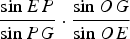 $$\displaystyle{{\sin EP} \over {\sin PG}} \cdot \displaystyle{{\sin OG} \over {\sin OE}}$$
is equal to the preceding, then again:
 $$\displaystyle{{\sin LB} \over {\sin BK}} = \displaystyle{{\sin PE} \over {\sin EO}}.$$
4. TRANSLATIONS
Treatise by Abū Naṣr Manṣūr ibn ʿAlī ibn ʿIrāq,Footnote 38the favourite of the Prince of the believers, on the rectification of a proposition in the book of Menelaus on the Spherics whose difficulty was avoided by those who corrected that book
Abū Naṣr said: I first thought that al-Māhānī passed away before he completed what he started on the rectification of the book of Menelaus on the spherics or that some reason prevented him from attaining that objective, until I looked at what Abū al-Faḍl al-Harawī did in the correction of that book. I found that he said in the introduction that a group of geometers aimed to correct the book, and since they did not succeed, they asked the help of al-Māhānī, who corrected the first book and part of the second and who stopped at a proposition whose aim, they considered, was difficult and whose proof was inaccessible. Then Abū al-Faḍl al-Harawī proved that proposition, but using a method which is different from the method of Menelaus. And since I personally wanted to correct that book, when I examined what Abū al-Faḍl mentioned, I thought that I would start by proving this proposition in accordance with the method that Menelaus used in his book.
This is what Menelaus says: If we have two three-sided figures with two equal acute angles at their base, and if two of the other angles are right and if each of the sides that subtend the remaining angles is less than a quarter of a circle, then the ratio of the homologue of the sum of the two arcs that surround the <equal> acute angle in one of the two figures to the homologue of their difference is equal to the ratio of the homologue of the sum of the two arcs that surround the <equal> acute angle in the second figure to the homologue of their difference; and we mean by “homologue” of an arc the chord of its double. We shall use, instead of chords, doubles of sines of arcs, in order to simplify. We introduce these lemmas.
Given a triangle ABC on the surface of the sphereFootnote 39 made out of great circles, we produce AK until we attain the great circle of BC in all possible ways. I say: the ratio of the sine of KC to the sine of BK is equal to the ratio of the sine of the angle KAC to the sine of the angle BAK multiplied by the ratio of the sine of the angle B to the sine of the angle C (see Fig. 6).
Proof: The ratio of the sine of KC to the sine of AK is equal to the ratio of the sine of the angle CAK to the sine of the angle C. And the ratio of the sine of AK to the sine of BK is equal to the ratio of the sine of the angle B to the sine of the angle BAK. Thus the ratio of the sine of KC to the sine of BK is equal to the ratio of the sine of the angle KAC to the sine of the angle C multiplied by the ratio of the sine of the angle B to the sine of the angle BAK, and this is equal to the ratio compounded of the ratio of the sine of the angle KAC, the third one, to the sine of the angle BAK, the sixth, and [76r] the ratio of the sine of the angle B, the fifth, to the sine of the angle C, the fourth. Therefore the ratio of the sine of KC to the sine of BK is equal to the sine of the angle KAC to the sine of the angle BAK multiplied by the ratio of the sine of the angle B to the sine of the angle C. This is what we wanted to prove.
There is also a proof of the converse.
A spherical triangle ABL (see Fig. 7) is made out of great circles, and we produce AK, AC on two great circles until they reach the <great> circle BL. I say that the ratio of the sine of BL to the sine of LC multiplied by the ratio of the sine of KC to the sine of BK is equal to the ratio of the sine of the angle BAL to the sine of the angle CAL multiplied by the ratio of the sine of the angle KAC to the sine of the angle BAK.
Proof: Since AL is produced from the vertex of the triangle BAC onto the circle BC, then the ratio of the sine of BL to the sine of CL is equal to the ratio of the sine of the angle BAL to the sine of the angle CAL multiplied by the ratio of the sine of the angle C to the sine of the angle B. And also if AK is produced from the vertex of the triangle ABC onto the circle BC, then the ratio of the sine of KC to the sine of BK is equal to the ratio of the sine of the angle KAC to the sine of the angle BAK multiplied by the ratio of the sine of the angle B to the sine of the angle C. In these four ratios, the ratio of the sine of the angle B to the sine of the angle C and the ratio of the sine of the angle C to the sine of the angle B are inversely proportional, and it remains that the ratio compounded of the ratio of the sine of BL to the sine of LC and of the ratio of the sine of KC to the sine of KB is equal to the ratio compounded of the ratio of the sine of the angle BAL to the sine of the angle CAL and of the ratio of the sine of the angle KAC to the sine of the angle BAK. This is what we wanted to prove.
Given a spherical triangle ABC made out of great circles, we divide the base AC into two halves at D, we draw the circle EG with D as a pole and at distance the side of a square,Footnote 40 and we produce the two sides BA and BC until we attain the points E, G of the circle EG (see Fig. 8). I say that the ratio of the sine of AE to the sine of GC is equal to the ratio of the sine of the angle G to the sine of the angle E.
Proof: If we produce the two arcs AC, EG from the points A, C, E, G until they meet at the two points H, I, then the two angles H and I are equal. Since D is the pole of the circle HEGI and since AD is equal to DC, then AH is equal to IC, and the ratio of the sine of AE to the sine of AH is equal to the ratio of the sine of the angle H to the sine of the angle E, and the ratio of the sine of AH – I mean IC – to the sine of GC is equal to the ratio of the sine of the angle G to the sine of the angle I which is equal to the angle H. By the equality of the perturbed proportions, the ratio of the sine of AE to the sine of GC is equal to the ratio of the sine of the angle G to the sine of the angle E. This is what we wanted to prove.
We now keep the same hypothesis and we assume that the arc BD is equal to each of the arcs AD, DC, and we produce it until L on the circle EG (see Fig. 9). I say that EL is equal to EH and that LG is equal to GI.
Proof: We produce the arcs BE, BL and BG until they meet at M. Since BD, AD, DC are equal and since D is the pole of EG, then the arcs AH, IC, LM are equal. The two vertically opposite angles at E are equal, and the angles H and L – since D is the pole of HL – are right angles, and since AH is equal to LM, then, HE is equal to EL. Likewise, [76v] LG is equal to GI. This is what we wanted to prove.
Again, we take a triangle ABC and an arc BD which divides the base AC into two halves and which is equal to each of CD and DA (the two halves), we draw on the pole D a great circle HEGI and we produce onto it the arcs BAE, BDL, BCG. It is clear that the circle HEGI passes by the two poles of the circle BL (see Fig. 10). Let the point N be a pole of BL and let us connect NMB by a great circle. Then the angle MBD is right. I say that the ratio of the sine of CM – which is the sum of BD and MD Footnote 41 – to the sine of AM – which is their difference – is equal to the ratio of the sine of NG to the sine of GL multiplied by the ratio of the sine of EL to the sine of EN.
Proof: We draw on the pole B an arc of great circle NSOP; we make CU equal to AE and we produce UJ perpendicularly to CI on a great circle. Then since from the vertex of the triangle ABC we produced on the circle AC the arc BM, the ratio of the sine of CM to the sine of AM is equal to the ratio of the sine of the angle CBM to the sine of the angle MBA multiplied by the ratio of the sine of the angle A to the sine of the angle C. Furthermore, the ratio of the sine of the angle A to the sine of the angle C is equal to the ratio of the sine of EH to the sine of UJ since CU and EA are equal, and the two angles H and J are right. Furthermore, the ratio of the sine of EH to the sine of UJ is equal to the ratio of the sine of EH to the sine of IG multiplied by the ratio of the sine of GC to the sine of AE which is equal to CU. Therefore the ratio of the sine of the angle A to the sine of the angle C is equal to the ratio of the sine of EH to the sine of IG multiplied by the ratio of the sine of GC to the sine of AE.
We produce the arc SK making an angle K equal to the angle G. Then the ratio of the sine of PN to the sine of SN is equal to the ratio of the sine of the angle CBM to the sine of the angle MBA and this is the ratio of the sine of PG to the sine of SK. Furthermore, the ratio of the sine of PG to the sine of SK is equal to the ratio of the sine of PN to the sine of SN – which is the ratio of the sine of GN to the sine of NE multiplied by the ratio of the sine of SE to the sine of SK – which is the ratio of the sine of AE to the sine of GC.
And the two ratios of the sine of AE to the sine of GC and the sine of GC to the sine of AE are inversely proportional. The ratio compounded of the ratio of the sine of PN to the sine of SN (which is equal to the ratio of the sine of the angle CBM to the sine of the angle MBA) and of the ratio of the sine of the angle A to the sine of the angle C, is equal to the ratio compounded of the ratio of the sine GN to the sine of NE and of the ratio of the sine of EH to the sine of GI.
And since the angle ADL is bisected by the arcs HE and EL, and likewise the angle CDL is bisected by the arcs IG and GL, then GE is a quarter (as NL is a quarter), therefore NE and GL are equal.
Thus, we presented what Menelaus said in that proposition, that if the acute angle D is the same in two triangles as we mentioned, then the ratio of the sine of the sum of the two sides that surround this acute angle to the sine of their difference is the same, according to what was shown in what we mentioned. From this we prove that the ratio of the sine of the sum of an arc on the ecliptic with its ascension in the right sphere to the sine of their difference is a unique ratio; it is the ratio of the sine of the complement of half of the great inclination to the sine of half of the great inclination multiplied by itself.
And even if we ourselves [77r] have shown what we wanted in this way, we nevertheless did not mention yet the method of Menelaus. In fact he says that the ratio of the sine of CM to the sine of AM is equal to the ratio of the sine of CM to the sine of CD multiplied by the ratio of the sine of AD to the sine of AM, because he makes the two sines CD and AD meansFootnote 42 between the sines of CM and AM, and since AD and CD are equal, then we remove the ratio of the sine of CD to the sine of DA.
And we ourselves have shown what is the ratio compounded of the ratio of the sine of CM to the sine of CD and of the ratio of the sine of AD to the sine of AM, whether the arc CD is equal to the arc AD or whether it is different, since we showed that this ratio is compounded of the ratio of the sine of the angle MBC to the sine of the angle DBC and of the ratio of the sine of the angle ABD to the sine of the angle MBA, but in that figure, since the ratio of the sine of NG to the sine of GL is compounded of the ratio of the sine of PN to the sine of PO (which is the ratio of <the sine of> the angle MBC to the sine of the angle DBC) and of the ratio of the sine of BO to the sine of BL. But the ratio of the sine of LE to the sine of EN is compounded of the ratio of the sine of OS to the sine of SN and of the ratio of the sine of LB to the sine of BO. And the ratio of the sine of OS to the sine of SN is equal to the ratio of the sine of the angle ABD to the sine of the angle MBA. And the two ratios of the sine of BO to the sine of BL and of the sine of BL to the sine of BO being inversely proportional, it remains the ratio compounded of the ratio of the sine of GN to the sine of GL and of the ratio of the sine of LE to the sine of EN.
But we already showed that EN is equal to GL, therefore we showed what Menelaus would have presented according to what he said, that is, that the ratio of the sine of CM to the sine of MA is compounded of the ratio of the sine of NG to the sine of GL and of the ratio of the sine of LE to the sine of EN. This is what we wanted to prove.
Since NG exceeds the quarter by an arc equal to EN and since NL is a quarter, then that ratio is the ratio of the sine of LE to the sine of EN multiplied by itself. And for this reason, we said concerning the ratio of the sine of the sum of an arc on the ecliptic with its ascension in the right sphere to the sine of their difference that it is equal to the ratio of the cosine of half of the great inclination to the sine of half of the great inclination multiplied by itself.
And when Menelaus assumes that one of the sides is less than a quarter, then he does it so that he can produce the arcs that he produced in the proof. But the proof is the same whether the side is more than a quarter or less, because if it were greater than a quarter, then we would proceed with the complement of the sides to a semi-circle, and this would lead us to a single construction.
It is not only this proposition that needs further explanation, and it is not the only one that needs to pass by a rectification. The book throughout contains propositions such that if we want to correct them, then we have to correct them in several aspects, in the same way needed for the proposition that we are talking about, and for the proposition that he mentions three propositions after this one. In fact he says that if we have a three-sided figure and we produce from its vertex to its base two arcs making between them and the two sides of the figure two equal angles, then the ratio compounded of the homologues of the parts of the base is equal to the ratio of the homologues of the two sides – one to another – in power, and also the inverse of that. Thus he says:
Let ABC be a three-sided figure and let us produce from the point B to the base AC two arcs BD and BE and let the angles ABD and CBE be equal. Then I say that the ratio of the square formed by the homologue of the arc AB to the square formed by the homologue of the arc BC is equal to the ratio of the product formed by the homologue of AE and the homologue of AD to the product formed by the homologue of DC and the homologue of CE. (see Fig. 11).
Fig. 17.
Proof: We produce from the point C onto the arcs BE and BD the two arcs CG and CH in such a way that the angle CGB [77v] is equal to the angle ABE and such that the angle CHD is equal to the angle ABD. Then we build the proof on that, and the proof will be correct except that if BC is a quarter, there is no arc produced from C to BD that makes with it an angle less than the angle CBD and likewise, there are no two sines such that the sine of BC is a mean between them except if they are equal to the sine of BC – if it is a quarter – then its sine is equal to half of the diameter and Menelaus does not assume that BC is less than a quarter <of a circle>.
And Abū al-Faḍl al-Harawī continued with the proof of Menelaus and did not mention this explanation. So the general way of the proof is the following: Since the two angles CBE and ABD are equal, then the angles CBD and ABE are equal (see Fig. 11). As for ourselves, since we have set the sines of AB and BC as two means between the two sines of AE and CD, the ratio of the sine of AE to the sine of AB equal to the sine of the angle ABE to the sine of the angle E, and the ratio of the sine of BC to the sine of CD equal to the ratio of the sine of the angle D to the sine of the angle CBD which is equal to the angle ABE, and since these two ratios that are the sine of the angle E to the sine of the angle ABE and the sine of the angle D to the sine of the angle CBD are the ratio of the sine of the angle D to the sine of the angle E, therefore the ratio of the sine of AE to the sine of CD is equal to the ratio of the sine of AB to the sine of BC multiplied by the ratio of the sine of the angle D to the sine of the angle E. Likewise, the ratio of the sine of AD to the sine of AB is equal to the ratio of the sine of the angle ABD to the sine of the angle D. And the ratio of the sine of BC to the sine of CE is equal to the ratio of the sine of the angle E to the sine of the angle CBE which is equal to <the sine of> the angle ABD. Therefore the ratio of the sine of AD to the sine of CE – if we make the sines of AB and BC means between them – is also the ratio of the sine of AB to the sine of BC multiplied by the ratio of the sine of the angle E to the sine of the angle D. And these two ratios that are of the sines of the two angles E and D among these four ratios are inversely proportional. Therefore the ratio compounded of the ratio of the sine of AE to the sine of CD and of the ratio of the sine of AD to the sine of CE is equal to the ratio of the sine of AB to the sine of BC multiplied by itself. This is what we wanted to prove.
And <here is> another species of propositions from that book: He says that if we have on the surface of the sphere two great circles and if each one is sloped with respect to the other and we mark on one of them two points that are not diametrically opposite, and we drop from each point a perpendicular on the other circle, then the ratio of the homologue of the arc that falls between the feet of the two perpendiculars to the homologue of the arc that is between the two marked points is equal to the ratio of the surface with right angles whose sides are the diameter of the sphere and the diameter of the circle that is tangent to one of the two circles and that is parallel to the other circle over the surface with right angles whose sides are the diameters of the two circles that pass by the two marked points on one of the great circles and that are parallel to the other circle.
Let there be two great <circles> on a sphere and on them AB and BC, and one of them sloped with respect to the other one (see Fig. 12). We mark on AB two points D and E, [78r] and we produce from the two points D and E onto BC two perpendiculars DC and EH. Then I say that the ratio of the homologue of the arc CH to the homologue of the arc DE is equal to the ratio of the rectangle whose sides are the diameter of the sphere and the diameter of the circle that is parallel to the circle BC and that is tangent to the circle AB to the rectangle whose sides are the two diameters of the circles that pass through the points D and E and that are parallel to BC.
This is so, except that we find for the sine of the arc CH over the sine of <the arc> DE a ratio that is simpler than that ratio. Indeed, the ratio of the sine of CH to the sine of DE is equal to the ratio of the diameter of the circle passing through the intersecting point of the two circles at a distance equal to the difference between BC and the quarter and which is parallel to the circle BC, to the diameter of the circle that passes through the point E and which is parallel to the circle BC, and it is equal to the ratio of the diameter of the circle that passes through the intersecting point at a distance equal to the difference between BC and a quarter to the diameter of the circle that passes by the point D and which is parallel to the circle BC.
Proof: Let BG be equal to the difference between BC and the quarter, and BL equal to the difference between BH and the quarter. We produce HE, CD to the pole of BC, let it be K, we produce the two great circle arcs KG and KL, and we extend them until they reach the points S and M on the circle BC. Likewise we produce from the point E onto the arc KC a perpendicular EI and from the point D to the arc KH a perpendicular DN (see Fig. 12). Then the ratio of the sine of CH to the sine of EI is equal to the ratio of the sine of HK to the sine of KE. And the ratio of the sine of EI to the sine of DE is equal to the ratio of the sine of the acute angle D to the sine of the angle I which is right. Equating these perturbed proportions, the ratio of the sine of CH to the sine of DE is equal to the ratio of the sine of the acute angle D to the sine of KE, and the angle D is of the same magnitude than the complement of the inclination of the complement of BC. We made BG equal to the complement of BC, therefore the ratio of the sine of CH to the sine of DE is equal to the ratio of the sine of KG to the sine of KE. Likewise, the ratio of the sine of CH to the sine of DN is equal to the ratio of the sine of CK to the sine of KD and the ratio of the sine of BD to the sine of DE is equal to the ratio of the sine of the acute angle E to the sine of the right angle N. Equating the perturbed proportions, the ratio of the sine of CH to the sine of DE is equal to the ratio of the sine of the acute angle E to the sine of KD. Now if we make BL equal to the complement of BH and the acute angle E of the same magnitude than the complement of the inclination of BH, then the ratio of the sine of KL to the sine of KD is equal to the ratio of the sine of CH to the sine of DE. This is what we wanted to prove.
There are other things than those that I showed here that can be proved by methods that are different from those given by the author of the book, and that are not included in that book. However I intend to correct the entire book, and what I have presented here is sufficient to indicate the thing that I intend to do, only if God wishes.
End of the treatise, thanks to God and prayer for Muḥammad and his family.
Proposition III.5, from The Book of Menelaus on Spherical Propositions Rectified by the Emir Abū Naṣr Manṣūr Ibn ʿIrāqFootnote 43
If we have two three-sided figures with two equal and acute angles at their base, if two of the other angles are right and if each of the sides that subtend the remaining angles is less than a quarter of a circle, then the ratio of the sum of the sines of the arcs that surround the acute equal angle in one of the figures to the sine of their difference is equal to the ratio of the <sum of the> sines [36v] of the arcs that surround the equal acute angle in the other figure to the sine of their difference.
Thus, let ABC and DEG be two three-sided figures, let the two angles at A and D be right, and the two angles at the points C and G acute and equal, and let each of the arcs CA, DG be less than a quarter of a circle. Then, I say that the ratio of the sine of the sum of the two arcs BC and CA to the sine of the difference between BC and CA is equal to the ratio of the sine of the sum of the two arcs EG and GD to the sine of the difference between the two arcs EG and GD (see Fig. 13).
<Proof:> We produce the arc BC <to L>, we make each of the two arcs CK and CL equal to the arc AC, and we produce the arcs AK and AL. We make the point C a pole and we draw with it an arc of great circle containing the points H, M, S. Then the point H will also be a pole of the arc ACS because each of the two arcs AH, HS is perpendicular to AS. Then we produce the two arcs CM, CN. Since the arc AC is equal to the arc CK, since the arc AC is not equal to a quarter of a circle and since the arc CM is a quarter of a circle, then the angle KCM is equal to the angle MCS. And likewise it is shown that the angle LCN is equal to the angle NCS.
Likewise we produce the arc EGP, we make each of the two arcs GP and GO equal to the arc DG and we produce the two arcs DO and DP. Then we make the point G a pole, we draw with it a great circle arc containing the points I, Q, X, R, and we show as we did before that the line GQ also bisects the angle EGX and that the line GR bisects the angle PGX. Therefore the angle MCS becomes equal to the angle QGX, the angle NCS becomes equal to the angle RGX, and the two points C and G are poles of the arcs HMSN and IQXR. Then the arc MS is equal to the arc QX and the arc NS is equal to the arc RX, and therefore the arc MH is equal to the arc IQ.
Since we can produce from the point A to the two arcs BCL and HSN arcs AH, AM, AS and AN, then the ratio of the sine of the arc LB to the sine of the arc BK is compounded of the ratio of the sine of the arc BL to the sine of the arc LC and of the ratio of the sine of the arc LC to the sine of the arc CK and of the ratio of the sine of the arc CK to the sine of the arc KB, and this ratio is equal to the ratio compounded of the ratio of the sine of the arc BL to the sine of the arc LC and of the ratio of the sine of the arc CK to the sine of the arc KB. This is because the arc CL is equal to the arc CK. And this [37r] ratio is equal to the ratio compounded of the ratio of the sine of the arc NH to the sine of the arc NS and of the ratio of the sine of the arc MS to the sine of the arc MH.
Likewise it is shown that the ratio of the sine of the arc PE to the sine of the arc EO is compounded of the ratio of the sine of the arc IR to the sine of the arc RX and of the ratio of the sine of the arc QX to the sine of the arc IQ. And it is clear that the arcs HM, <MS>, NS are equal to the arcs IQ, QX, XR and therefore the ratio of the sine of the arc LB to the sine of the arc KB is equal to the ratio of the sine of the arc PE to the sine of the arc EO.
Menelaus has obfuscated the proof of this proposition, either because he deliberately made the task very difficult for the reader of his book, or he considered that everything needed to complete the proof can be obtained with little examination.
Now we take again the triangle ABC; we produce the arcs AK, AL, and <we produce> KC until L as we did, in such a way that the three arcs AC, LC, KC are equal (see Fig. 14).
We say that the ratio compounded of the ratio of the sine of LB to the sine of LC and of the ratio of the sine of KC to the sine of KB – in any case: either as we represented it or otherwise, I mean whether the arcs AC, LC, KC are equal or different – is equal to the ratio compounded of the ratio of the sine of the angle BAL to the sine of the angle CAL and of the ratio of the sine of the angle KAC to <the sine> of the angle BAK.
Since the ratio of the sine of BL to the sine of AL is equal to the ratio of the sine of the angle BAL to the sine of the angle B, and the ratio of the sine of AL to the sine of LC is equal to the ratio of the sine of the angle C to the sine of the angle CAL, therefore the ratio of the sine of BL to the sine of LC is equal to the ratio of the sine of the angle BAL to the sine of the angle B multiplied by the ratio of the sine of the angle C to the sine of the angle CAL. And therefore it is equal to the ratio compounded of the ratio of the sine of the angle BAL, the third one, to the sine of the angle CAL, the sixth, and of the ratio of the sine of the angle C, the fifth, [37v] to the sine of the angle B, the fourth.
Likewise, the ratio <of the sine> of KC to the sine of AK is equal to the ratio of the sine of the angle KAC to the sine of the angle C, and the ratio of the sine of KA to the sine of BK is equal to <the ratio of the sine of the angle B to the sine of the angle BAK. Therefore the ratio of the sine of KC to the sine of BK> is compounded of the ratio of the sine of the angle KAC to the sine of the angle C and of the ratio of the sine of the angle B to the sine of the angle BAK. Therefore this is equal to the ratio compounded of the ratio of the sine of the angle KAC, the third one, to the sine of the angle BAK, the sixth, and of the ratio of the sine of the angle B, the fifth, to the sine of the angle C, the fourth. And from these four ratios, the ratio of the sine of the angle C to the sine of the angle B is the inverse proportion of the ratio <of the sine of> the angle <B> to the sine of the angle C. Therefore the ratio compounded of the ratio of the sine of BL to the sine of LC and of the ratio of the sine of KC to the sine of BK is equal to the ratio compounded of the ratio of the sine of the angle BAL to the sine of the angle CAL and of the ratio of the sine of the angle KAC to the sine of the angle BAK, and this is so in all spherical triangles in which we have produced in each one <between> two of its sides onto its base two arcs.
And since here KC is equal to LC, then the ratio compounded of the ratio of the sine of the angle BAL to the sine of the angle CAL and of the ratio of the sine of the angle KAC to the sine of the angle KAB, given what we said before, is equal to the ratio of the sine of LB to the sine of KB.
Then we repeat the figure and we produce the circles AM, AS, AN until they meet at a point U (see Fig. 15)Footnote 44 and we also produce the two circles HMS, LCKB from the points H, N, L, B until they meet at the two points J, T. Since AC, CK, LC are equal and C is the pole of HMS, then the arcs SU, LJ, KT are equal and the angles S, J, T are right. And in the two triangles SUN and LNJ the two vertically opposite angles are equal and the angle L is of the magnitude of the complement of the inclination of SN from the maximal inclination of the magnitude of the angle U; then the angles of the triangle SUN are equal to the angles of the triangle LNJ; therefore the sides of the two triangles are respectively equal, and the same holds in the triangles SUM, MTK. Then the arc SN is equal to the arc NJ, and the arc SM is equal to the arc MT.
Then we repeat again the figure, and we make the point A a pole and at a distance equal to the side of a square <we draw> an arc VZ.
It is clear that since the point H is a pole of the circle AC, <if we complete the circle VZ>, then it passes through the point H (see Fig. 16). Let it be the circle HVZH′. Then HV is of the magnitude of the angle BAK, and VZ is of the magnitude of the angle KAC, and HH′ is of the magnitude of the angle BAL and ZH′ [38r] is of the magnitude of the angle CAL. Therefore the ratio of the sine of LB to the sine of BK is equal to the ratio of the sine of HH′ to the sine of ZH′ multiplied by the ratio of the sine of VZ to the sine of HV. But the ratio of the sine of HN to the sine of SN is compounded of the ratio of the sine of HH′ to the sine of H′Z and of the ratio of the sine <of AZ to the sine of AS, and the ratio of the sine> of SM to the sine of MH is compounded of the ratio of the sine of ZV to the sine of VH and of the ratio of the sine of SA to the sine of AZ. And in these four proportions the ratio of the sine of AZ to the sine of AS is the inverse proportion of the ratio of the sine of AS to the sine of AZ. Then it remains that the ratio compounded of the <ratio> of the sine of HN to the sine of NS and of the ratio of the sine of SM to the sine of MH is equal to the ratio compounded of the <ratio of> the sine of HH′ to the sine of H′Z and of the ratio of the sine of VZ to the sine of HV; therefore the ratio compounded of the ratio of the sine of HN to the sine of NS and of the ratio of the sine of MS to the sine of MH is equal to the ratio of the sine of LB to the sine of BK. And since the angle MCS is equal to the angle QGX and the angle XGR is <equal to the angle> SCN and HS is a quarter like IX is a quarter, and likewise MN is a quarter like QR is a quarter, then CM bisects the angle KCS and CN bisects the angle SCL, and likewise in the second figure. Everything we indicated for the two figures of Menelaus on the ratio of the sine of LB to the sine of BK in the first figure is equal to the ratio of the sine of PE to the sine of EO in the second figure. This is what we wanted to prove.
Furthermore since MH and SN are equal and HS is a quarter, then the sine of HN is equal to the sine of MS. Therefore these two ratios are equal to the ratio of the sine of SM to the sine of MH squared. And since the ratio compounded of the ratio of the sine of HN to the sine of NS and of the ratio of the sine of SM to the sine of MH is compounded of the ratio of the sine of the angle HAN to the sine of the angle SAN and of the ratio of the sine of the angle <SAM to the sine of the angle> HAM and in the same way, the ratio compounded of the ratio of the sine of BL to the sine of LC and of the ratio of the sine of KC to the sine of KB is also compounded of these two ratios, and the ratio compounded of the ratio of the sine of IR to the sine of RX and of the ratio of the sine of QX to the sine of IQ is compounded of the ratio of the sine of the angle IDR to the sine of the angle XDR and of the ratio of the sine of the angle QDX [38v] to the sine of the angle IDQ, and likewise the ratio compounded of the ratio of the sine of EP to the sine of PG and of the ratio of the sine of OG to the sine of OE is also compounded of these two ratios, and when we showed that each of the two arcs QX and MS is of the magnitude of half of the angle KCS and that each one of the arcs RX and NS is of the magnitude of half of the angle SCL and that IQ is equal to MH, we see from this that the ratio of the sine of LB to the sine of BK is equal to the ratio of the sine of PE to the sine of EO. And from this we see that the <ratio of the sine> of the arc of the ecliptic if it is added to its ascension in the right sphere <to the sine of their difference> is equal to the sine of the complement of half of the great obliquity to the <sine> of half of the square of the great obliquity, and this is because when the acute angle C is of the magnitude of the great obliquity, then its obtuse angle is of the magnitude of the complement of that to a semi-circle. And since the arc CM bisects an obtuse angle C, then MS is half of the complement of the great obliquity to a semi-circle and HS is a quarter, then MH is half of the great obliquity.
بسم الله الرحمن الرحيم
قال أبو نصر: إني كنت أظن أن الماهاني اخترم قبل إتمام <ما> ابتدأه من إصلاح كتاب مانالاوس في الكريات، وأن سببًا عرض له <لم> يتمكّن معه من إكمال الغرض، إلى أن نظرت فيما عمله أبو الفضل الهروي من إصلاح هذا الكتاب؛ فوجدته يقول في صدره: إن جماعة من المهندسين راموا تصحيح هذا الكتاب، فلما لم يقدروا عليه استعانوا بالماهاني فأصلح المقالة الأولى وبعض الثانية، ووقف عند شكل، ذكروا أنه صعب المرام عسير البيان. ثم بيّن أبو الفضل الهروي ذلك الشكل، إلا أنه سلك فيه غير مسلك مانالاوس. وأنا، وإن كنت أنوي إصلاح هذا الكتاب، فإني عندما وقفتُ على ما ذكره أبو الفضل، رأيتُ أن أبيّن هذا الشكل أولاً على ما يليق بمسلك مانالاوس في كتابه.
وهذا هو الذي ذكره، قال مانالاوس: إذا كان شكلان ذوا ثلاثة أضلاع وكانت زاويتان من زواياهما التي على قاعدتيهما متساويتين حادتين، وكانت زاويتان من الزوايا الباقية منهما قائمتين وكان كلُّ واحد من ضلعيهما اللذين يوتّران زاويتيهما الباقيتين أقلّ من ربع دائرة، فإن نسبة نظير القوسين المحيطتين بالزاوية الحادة من أحد الشكلين مجموعتين إلى نظير فضل ما بينهما كنسبة نظير القوسين المحيطتين بالزاوية الحادة من الشكل الآخر مجموعتين إلى نظير فضل ما بينهما؛ ونعني بنظير القوس وتر ضعفها. ونحن نستعمل مكان أوتار الضعف جيوب القسي طلبًا للتخفيف، ونقدّم هذه المقدّمات.
مثلث ا؟ب؟ﺟ على بسيط كرة من دوائر عظام، وأخرج ا؟ﻛ إلى دائرة ب؟ﺟ من دائرة عظيمة كيفما اتّفق؛ أقول: إن نسبة جيب ﻛ؟ﺟ إلى جيب ب؟ﻛ كنسبة جيب زاوية ﻛ؟ا؟ﺟ إلى جيب زاوية ب؟ا؟ﻛ مثناة بنسبة جيب زاوية ب إلى جيب زاوية ﺟ.
برهانه: أن نسبة جيب ﻛ؟ﺟ إلى جيب ا؟ﻛ كنسبة جيب زاوية ﺟ؟ا؟ﻛ إلى جيب زاوية ﺟ، ونسبة جيب ا؟ﻛ إلى جيب ب؟ﻛ كنسبة جيب زاوية ب إلى جيب زاوية ب؟ا؟ﻛ، فنسبة جيب ﻛ؟ﺟ إلى جيب ب؟ﻛ كنسبة جيب زاوية ﻛ؟ا؟ﺟ إلى جيب زاوية ﺟ مثناة بنسبة جيب زاوية ب إلى جيب زاوية ب؟ا؟ﻛ؛ وتلك كالنسبة المؤلفة من نسبة جيب زاوية ﻛ؟ا؟ﺟ، الثالث، إلى جيب زاوية ب؟ا؟ﻛ، السادس، ومن [٧٦و] نسبة جيب زاوية ب، الخامس، إلى جيب زاوية ﺟ، الرابع. فنسبة جيب ﻛ؟ﺟ إلى جيب ب؟ﻛ كنسبة جيب زاوية ﻛ؟ا؟ﺟ إلى جيب زاوية ب؟ا؟ﻛ مثناة بنسبة جيب زاوية ب إلى جيب زاوية ﺟ؛ وذلك ما أردنا أن نبين.
وهنالك يتبين أيضًا عكس ذلك.
مثلث ا؟ب؟ل على بسيط كرة من دوائر عظام وقد أخرج ا؟ﻛ ا؟ﺟ إلى دائرة ب؟ل من دائرتين عظيمتين؛ أقول: إن نسبة جيب ب؟ل إلى جيب ل؟ﺟ إذا ثُنّيت بنسبة جيب ﻛ؟ﺟ إلى جيب ب؟ﻛ كنسبة جيب زاوية ب؟ا؟ل إلى جيب زاوية ﺟ؟ا؟ل مثناة بنسبة جيب زاوية ﻛ؟ا؟ﺟ إلى جيب زاوية ب؟ا؟ﻛ.
برهانه: أن ا؟ل خرج من رأس مثلث ب؟ا؟ﺟ إلى دائرة ب؟ﺟ، فنسبة جيب ب؟ل إلى جيب ﺟ؟ل كنسبة جيب زاوية ب؟ا؟ل إلى جيب زاوية ﺟ؟ا؟ل مثناة بنسبة جيب زاوية ﺟ إلى جيب زاوية ب. وأيضًا، فإن ا؟ﻛ خرج من رأس مثلث ا؟ب؟ﺟ إلى دائرة ب؟ﺟ، فنسبة جيب ﻛ؟ﺟ إلى جيب ب؟ﻛ كنسبة جيب زاوية ﻛ؟ا؟ﺟ إلى جيب زاوية ب؟ا؟ﻛ مثناة بنسبة جيب زاوية ب إلى جيب زاوية ﺟ. وهذه النسب الأربع تكافئ منها نسبة جيب زاوية ب إلى جيب زاوية ﺟ ونسبة جيب زاوية ﺟ إلى جيب زاوية ب، فتبقى النسبة المؤلفة من نسبة جيب ب؟ل إلى جيب ل؟ﺟ ومن نسبة جيب ﻛ؟ﺟ إلى جيب ﻛ؟ب كالنسبة المؤلفة من نسبة جيب زاوية ب؟ا؟ل إلى جيب زاوية ﺟ؟ا؟ل ومن نسبة جيب زاوية ﻛ؟ا؟ﺟ إلى جيب زاوية ب؟ا؟ﻛ؛ وذلك ما أردنا أن نبين.
مثلث ا؟ب؟ﺟ على بسيط كرة من دوائر عظام، وقُسمت قاعدة ا؟ﺟ بنصفين على د، ورسمت على قطب د وببُعد ضلع المربع دائرة ه؟ز، وأخرج ضلعا ب؟ا ب؟ﺟ إلى نقطتي ه ز من دائرة ه؟ز؛ أقول: إن نسبة جيب ا؟ه إلى جيب ز؟ﺟ كنسبة جيب زاوية ز إلى جيب زاوية ه.
برهانه: أنا نخرج قوسي ا؟ﺟ ه؟ز من نقط ا ﺟ ه ز حتى تلتقيا على نقطتي ح ط، فتكون زاويتا ح ط متساويتين. ولأن د قطب دائرة ح؟ه؟ز؟ط وا؟د تساوي د؟ﺟ، فإن ا؟ح تساوي ط؟ﺟ، ونسبة جيب ا؟ه إلى جيب ا؟ح كنسبة جيب زاوية ح إلى جيب زاوية ه، ونسبة جيب ا؟ح – أعني ط؟ﺟ – إلى جيب ز؟ﺟ كنسبة جيب زاوية ز إلى جيب زاوية ط المساوية لزاوية ح؛ فبالمساواة في النسبة المضطربة، نسبة جيب ا؟ه إلى جيب ز؟ﺟ كنسبة جيب زاوية ز إلى جيب زاوية ه؛ وذلك ما أردنا أن نبين.
وأيضًا فليكن هذا كما فرضنا، وقوس ب؟د مساوية لكل واحدة من قوسي ا؟د د؟ﺟ، ونخرجها إلى ل من دائرة ه؟ز؛ فأقول: إن ه؟ل تساوي ه؟ح ول؟ز تساوي ز؟ط.
برهانه: أنا نخرج قسي ب؟ه ب؟ل ب؟ز حتى تلتقي على م، فلأن ب؟د ا؟د د؟ﺟ متساوية ود قطب ه؟ز، فإن قسي ا؟ح ط؟ﺟ ل؟م متساوية، وزاويتا ه المتقابلتان متساويتان، وزاويتا ح ل - من أجل أن د قطب ح؟ل – قائمتان، وا؟ح قد كانت مساوية ﻟ ل؟م، ﻓ ح؟ه تساوي ه؟ل؛ ولمثل ذلك أيضًا [٧٦ظ] ل؟ز تساوي ز؟ط؛ وذلك ما أردنا أن نبين.
ثم نعيد مثلث ا؟ب؟ﺟ وقوس ب؟د التي تقسم قاعدة ا؟ﺟ بنصفين وتكون مساوية لكل واحدة من ﺟ؟د د؟ا، ونرسم على قطب د دائرة ح؟ه؟ز؟ط العظيمة، ونخرج إليها قسي ب؟ا؟ه ب؟د؟ل ب؟ﺟ؟ز، وبيّنٌ أن دائرة ح؟ه؟ز؟ط تمر على قطبي دائرة ب؟ل. فليكن قطب ب؟ل نقطة ن ونصل ن؟م؟ب من دائرة عظيمة، فتكون زاوية م؟ب؟د قائمة. وأقول: إن نسبة جيب ﺟ؟م، الذي هو مجموع ب؟د م؟د، إلى جيب ا؟م، الذي هو فضل ما بينهما، كنسبة جيب ن؟ز إلى جيب ز؟ل مثناة بنسبة جيب ه؟ل إلى جيب ه؟ن.
برهانه: أنا نرسم على قطب ب قوس ن؟س؟ع؟ف العظيمة، ونجعل ﺟ؟ص مساوية ﻟ ا؟ه، ونخرج ص؟ي عمودًا على ﺟ؟ط من دائرة عظيمة، فمن أجل أن من رأس مثلث ا؟ب؟ﺟ خرج إلى دائرة ا؟ﺟ قوس ب؟م، فإن نسبة جيب ﺟ؟م إلى جيب ا؟م كنسبة جيب زاوية ﺟ؟ب؟م إلى جيب زاوية م؟ب؟ا مثناة بنسبة جيب زاوية ا إلى جيب زاوية ﺟ. ونسبة جيب زاوية ا إلى جيب زاوية ﺟ كنسبة جيب ه؟ح إلى جيب ص؟ي من أجل أن ﺟ؟ص ه؟ا متساويان، وزاويتا ح ي قائمتان. ونسبة جيب ه؟ح إلى جيب ص؟ي كنسبة جيب ه؟ح إلى جيب ط؟ز مثناة بنسبة جيب ز؟ﺟ إلى جيب ا؟ه المساوي ﻟ ﺟ؟ص، فنسبة جيب زاوية ا إلى جيب زاوية ﺟ كنسبة جيب ه؟ح إلى جيب ط؟ز مثناة بنسبة جيب ز؟ﺟ إلى جيب ا؟ه.
ونخرج قوس س؟ﻛ بجَعْل زاوية ﻛ مساوية لزاوية ز، فنسبة جيب ف؟ن إلى جيب س؟ن كنسبة جيب زاوية ﺟ؟ب؟م إلى جيب زاوية م؟ب؟ا، وتلك نسبة جيب ف؟ز إلى جيب س؟ﻛ، فنسبة جيب ف؟ز إلى جيب س؟ﻛ كنسبة جيب ف؟ن إلى جيب س؟ن – التي هي نسبة جيب ز؟ن إلى جيب ن؟ه مثناة بنسبة جيب س؟ه إلى جيب س؟ﻛ – التي هي نسبة جيب ا؟ه إلى جيب ز؟ﺟ.
ونسبتا جيب ا؟ه إلى جيب ز؟ﺟ وجيب ز؟ﺟ إلى جيب ا؟ه متكافئتان. فالنسبة المؤلفة من نسبة جيب ف؟ن إلى جيب س؟ن، التي هي نسبة جيب زاوية ﺟ؟ب؟م إلى جيب زاوية م؟ب؟ا، ومن نسبة جيب زاوية ا إلى جيب زاوية ﺟ كالنسبة المؤلفة من نسبة جيب ز؟ن إلى جيب ن؟ه ومن نسبة جيب ه؟ح إلى جيب ز؟ط.
ولأن زاوية ا؟د؟ل تنقسم بنصفين بقوسي ح؟ه ه؟ل وكذلك زاوية ﺟ؟د؟ل تنقسم بنصفين بقوسي ط؟ز ز؟ل، فإن ز؟ه ربع كما أن ن؟ل ربع، ﻓ ن؟ه ز؟ل متساويان.
فقد ذكر بيان ما ذكره مانالاوس في هذا الشكل، فإن زاوية د الحادة متى كانت متساوية في مثلثين على ما ذكرنا، كانت نسبة جيب مجموع الضلعين المحيطين بالزاوية الحادة إلى جيب فضل ما بينهما واحدة على ما تبين مما ذكرنا. ومن ذلك يتبين أن نسبة جيب مجموع القوس من فلك البروج ومطالعها في الفلك المستقيم إلى جيب فضل ما بينهما نسبة واحدة، وهي نسبة جيب تمام نصف الميل الأعظم إلى جيب نصف الميل الأعظم مثناة بالتكرير.
نحن وإن كنا [٧٧و] بينا ما أردنا من ذلك، فإنا بعد لم نذكر طريق مانالاوس، فإنه يقول: إن نسبة جيب ﺟ؟م إلى جيب ا؟م كنسبة جيب ﺟ؟م إلى جيب ﺟ؟د مثناة بنسبة جيب ا؟د إلى جيب ا؟م، لأنه يجعل جيبـي ﺟ؟د ا؟د وسطين بين جيبـي ﺟ؟م ا؟م، وا؟د ﺟ؟د متساويان، فتُلقى نسبة جيب ﺟ؟د إلى جيب د؟ا.
ونحن فقد بينا أية نسبة هي التي تتألف من نسبة جيب ﺟ؟م إلى جيب ﺟ؟د ومن نسبة جيب ا؟د إلى جيب ا؟م، ساوت قوس ﺟ؟د قوس ا؟د أو اختلفتا، وذلك أنا بينا أن تلك النسبة هي التي تتألف من نسبة جيب زاوية م؟ب؟ﺟ إلى جيب زاوية د؟ب؟ﺟ ومن نسبة جيب زاوية ا؟ب؟د إلى جيب زاوية م؟ب؟ا، بل في هذه الصورة لأن نسبة جيب ن؟ز إلى جيب ز؟ل مؤلفة من نسبة جيب ف؟ن إلى جيب ف؟ع، التي هي نسبة <جيب> زاوية م؟ب؟ﺟ إلى جيب زاوية د؟ب؟ﺟ، ومن نسبة جيب ب؟ع إلى جيب ب؟ل. ونسبة جيب ل؟ه إلى جيب ه؟ن مؤلفة من نسبة جيب ع؟س إلى جيب س؟ن ومن نسبة جيب ل؟ب إلى جيب ب؟ع. ونسبة جيب ع؟؟س إلى جيب س؟ن هي نسبة جيب زاوية ا؟ب؟د إلى جيب زاوية م؟ب؟ا؛ ونسبتا جيب ب؟ع إلى جيب ب؟ل وجيب ب؟ل إلى جيب ب؟ع متكافئتان، فتبقى النسبة المؤلفة من نسبة جيب ز؟ن إلى جيب ز؟ل ومن نسبة جيب ل؟ه إلى جيب ه؟ن.
وقد بينا أن ه؟ن تساوي ز؟ل، فقد تبين ما أورده مانالاوس على ما ذكره، وهو أن نسبة جيب ﺟ؟م إلى جيب م؟ا مؤلفة من نسبة جيب ن؟ز إلى جيب ز؟ل ومن نسبة جيب ل؟ه إلى جيب ه؟ن؛ وذلك ما أردنا أن نبين.
ولأن ن؟ز تزيد على الربع قوسًا مساوية ﻟ ه؟ن ون؟ل ربع، فإن تلك النسبة نسبة جيب ل؟ه إلى جيب ه؟ن مثناة بالتكرير؛ ولذلك قلنا في نسبة <جيب> مجموع القوس من فلك البروج ومطالعها في الفلك المستقيم إلى جيب فضل ما بينهما  كنسبة جيب تمام نصف الميل الأعظم إلى جيب نصف الميل الأعظم مثناة بالتكرير.
ومانالاوس حين يفرض أحد الضلعين أقل من ربع، فإنما يفعل ذلك لكي يمكنه إخراج القسي التي يخرجها للبرهان. والبرهان واحد، سواء كان ذلك الضلع أكثر من ربع أو كان أقل، لأنا إن كان أكثر من ربع، نعمل بتمامي الضلعين إلى نصف دائرة، فيتأدّى بنا الأمر إلى عمل واحد.
وليس هذا الشكل وحده مما يحتاج إلى فضل بيان ولا أيضًا سبيل إصلاح. هذا الكتاب كله على هذا السبيل، فإن فيه أشكالاً إذا أصلحناه أصلحناها على عدة وجوه، كما يقتضيه الشكل الذي يكون الكلام فيه، كالشكل الذي أورده بعد ثلاثة أشكال من شكله هذا. فإنه يقول: إذا كان شكل ذو ثلاثة أضلاع، وأخرجت من نقطة رأسه إلى قاعدته قوسان، فأحدثتا فيما بينهما وبين ضلعي الشكل زاويتين متساويتين، فإن النسبة المؤلفة من نظائر أقسام القاعدة مساوية لنسبة نظيري الضلعين أحدهما إلى الآخر في القوة، وعكس ذلك أيضًا. ثم يقول:
فليكن شكل ذو ثلاثة أضلاع عليه ا؟ب؟ﺟ، وليخرج من نقطة ب إلى قاعدة ا؟ﺟ قوسا ب؟د ب؟ه، ولتكن زاويتا ا؟ب؟د ﺟ؟ب؟ه متساويتين؛ فأقول: إن نسبة المربع الكائن من نظير قوس ا؟ب إلى المربع الكائن من نظير قوس ب؟ﺟ كنسبة السطح الكائن من نظير ا؟ه في نظير ا؟د إلى السطح الكائن من نظير د؟ﺟ في نظير ﺟ؟ه.
برهان ذلك: أنا نخرج من نقطة ﺟ إلى قوسي ب؟ه ب؟د قوسي ﺟ؟ز ﺟ؟ح إخراجًا تكون به زاوية ﺟ؟ز؟ب [٧٧ظ] مساوية لزاوية ا؟ب؟ه، وتكون به زاوية ﺟ؟ح؟د مساوية لزاوية ا؟ب؟د. ثم نبني البرهان على هذا، فيكون صحيحًا، إلا أن ب؟ﺟ إذا كان ربعًا، فإنه ليس يخرج من ﺟ إلى ب؟د قوس تحيط معه بزاوية أصغر من زاوية ﺟ؟ب؟د، ولا أيضًا يوجد جيبان يكون جيب ب؟ﺟ وسطًا بينهما، إلا إذا كانا مساويين لجيب ب؟ﺟ – إذا كان ربعًا – فجيبه مساوٍ لنصف القطر. وليس يفرض مانالاوس ب؟ﺟ أقل من ربع.
وأبو الفضل الهروي قد استمرّ على برهان مانالاوس ولم يذكر هذا المعنى. فالوجه الأعم في البرهان هو هذا: لأن زاويتي ﺟ؟ب؟ه ا؟ب؟د متساويتان، فإن زاويتي ﺟ؟ب؟د ا؟ب؟ه متساويتان. ونحن إن جعلنا جيبـي ا؟ب ب؟ﺟ وسطين فيما بين جيبـي ا؟ه ﺟ؟د، ونسبة جيب ا؟ه إلى جيب ا؟ب كنسبة جيب زاوية ا؟ب؟ه إلى جيب زاوية ه، ونسبة جيب ب؟ﺟ إلى جيب ﺟ؟د كنسبة جيب زاوية د إلى جيب زاوية ﺟ؟ب؟د المساوية لزاوية ا؟ب؟ه، وهاتان النسبتان اللتان لجيب زاوية ه إلى جيب زاوية ا؟ب؟ه
ولجيب زاوية د إلى جيب زاوية ﺟ؟ب؟د هي نسبة جيب زاوية د إلى جيب زاوية ه، فنسبة جيب ا؟ه إلى جيب ﺟ؟د كنسبة جيب ا؟ب إلى جيب ب؟ﺟ مثناة بنسبة جيب زاوية د إلى جيب زاوية ه. وأيضًا، فإن نسبة جيب ا؟د إلى جيب ا؟ب كنسبة جيب زاوية ا؟ب؟د إلى جيب زاوية د، ونسبة جيب ب؟ﺟ إلى جيب ﺟ؟ه كنسبة جيب زاوية ه إلى جيب زاوية ﺟ؟ب؟ه المساوية لزاوية ا؟ب؟د، فنسبة جيب ا؟د إلى جيب ﺟ؟ه – إذا جعلنا جيبـي ا؟ب ب؟ﺟ وسطين بينهما – أيضًا كنسبة جيب ا؟ب إلى جيب ب؟ﺟ مثناة بنسبة جيب زاوية ه إلى جيب زاوية د، وهاتان النسبتان اللتان لجيبـي زاويتي ه د من هذه النسب الأربع تتكافئان، فتكون النسبة المؤلفة من نسبة جيب ا؟ه إلى جيب ﺟ؟د ومن نسبة جيب ا؟د إلى جيب ﺟ؟ه كنسبة جيب ا؟ب إلى جيب ب؟ﺟ مثناة بالتكرير؛ وذلك ما أردنا أن نبين.
ونوع آخر من أشكال هذا الكتاب، قال: إذا كانت في بسيط كرة دائرتان من الدوائر العظام، وكانت كل واحدة منهما مائلة على الأخرى، وتعلّمت على إحداهما نقطتان غير متقابلتين على القطر، وأخرج منهما إلى الدائرة الأخرى عمودان، فإن نسبة نظير القوس الواقعة فيما بين مسقطي العمودين إلى نظير القوس التي فيما بين النقطتين اللتين تعلّمتا، كنسبة السطح القائم الزوايا الذي يحيط به قطر الكرة وقطر الدائرة التي تماس إحدى الدائرتين وتوازى الدائرة الأخرى إلى السطح القائم الزوايا الذي يحيط به قطرا الدائرتين اللتين تمران بالنقطتين اللتين تعلّمتا على إحدى الدائرتين العظيمتين وتوازيان الدائرة الأخرى منهما.
فلتكن على كرة <دائرتان> من الدوائر العظام عليهما ا؟ب ب؟ﺟ ولتكن كل واحدة منهما مائلة على الأخرى، ونتعلّم على ا؟ب نقطتي د ه [٧٨و] ونخرج من نقطتي د ه إلى ب؟ﺟ عمودي د؟ﺟ ه؟ح. فأقول: إن نسبة نظير قوس ﺟ؟ح إلى نظير قوس د؟ه كنسبة السطح القائم الزوايا الذي يحيط به قطر الكرة وقطر الدائرة الموازية لدائرة ب؟ﺟ التي تماس دائرة ا؟ب إلى السطح القائم الزوايا الذي يحيط به قطرا الدائرتين اللتين تمران بنقطتي د ه وتوازيان ب؟ﺟ.
وذلك كذلك، إلا أنا نجد لجيب قوس ﺟ؟ح إلى جيب <قوس> د؟ه نسبة أبسط من هذه النسبة، فإن نسبة جيب ﺟ؟ح إلى جيب د؟ه كنسبة قطر الدائرة التي تمر من نقطة تقاطع الدائرتين ببعد مساوٍ لفضل ما بين ب؟ﺟ والربع، وتكون موازية لدائرة ب؟ﺟ إلى قطر الدائرة التي تمر بنقطة ه وتكون موازية لدائرة ب؟ﺟ، وكنسبة قطر الدائرة التي تمر من نقطة التقاطع ببعد مساوٍ لفضل ما بين ب؟ﺟ والربع إلى قطر الدائرة التي تمر على نقطة د وتكون موازية لدائرة ب؟ﺟ.
<برهان ذلك>: فليكن ب؟ز مساويًا لفضل ما بين ب؟ﺟ والربع، وب؟ل لفضل ما بين ب؟ح والربع، ونخرج ح؟ه ﺟ؟د إلى قطب ب؟ﺟ وليكن ﻛ، ونخرج قوسي ﻛ؟ز ﻛ؟ل العظيمتين، وننفذهما إلى نقطتي س م من دائرة ب؟ﺟ. وأيضًا، نخرج من نقطة ه إلى قوس ﻛ؟ﺟ عمود ه؟ط، ومن نقطة د إلى قوس ﻛ؟ح عمود د؟ن. فنسبة جيب ﺟ؟ح إلى جيب ه؟ط كنسبة جيب ح؟ﻛ إلى جيب ﻛ؟ه، ونسبة جيب ه؟ط إلى جيب د؟ه كنسبة جيب زاوية د الحادة إلى جيب زاوية ط القائمة؛ فبالمساواة في النسبة المضطربة، نسبة جيب ﺟ؟ح إلى جيب د؟ه كنسبة جيب زاوية د الحادة إلى جيب ﻛ؟ه، وزاوية د بقدر تمام ميل تمام ب؟ﺟ. وقد جعلنا ب؟ز مساويًا لتمام ب؟ﺟ، فنسبة جيب ﺟ؟ح إلى جيب د؟ه كنسبة جيب ﻛ؟ز إلى جيب ﻛ؟ه. وأيضًا، فإن نسبة جيب ﺟ؟ح إلى جيب د؟ن كنسبة جيب ﺟ؟ﻛ إلى جيب ﻛ؟د ونسبة جيب ب؟د إلى جيب د؟ه كنسبة جيب زاوية ه الحادة إلى جيب زاوية ن القائمة. فبالمساواة في النسبة المضطربة، نسبة جيب ﺟ؟ح إلى جيب د؟ه كنسبة جيب زاوية ه الحادة إلى جيب ﻛ؟د. وإذا جعلنا ب؟ل مساويًا لتمام ب؟ح وزاوية ه الحادة بقدر تمام ميل ب؟ح، فإن نسبة جيب ﻛ؟ل إلى جيب ﻛ؟د كنسبة جيب ﺟ؟ح إلى جيب د؟ه؛ وذلك ما أردنا أن نبين.
وأشياء أخر سوى التي ذكرنا لها طرق من البرهان غير الذي أتى به صاحب الكتاب لا تكون دون ما تضمّنه، ولكني أنوي إصلاح هذا الكتاب بأسره، فالذي قدّمتُ هاهنا على سبيل الإشارة إلى الغرض فيما أنوي كافٍ إن شاء اﷲ تعالى وحده.
تـمّت المقالة بحمد الله والصلاة على محمد وآله.
،الشكل الخامس <من كتاب مانالاوس في الأشكال الكرية
<إصلاح الأمير أبي نصر منصور بن عراق
إذا كان شكلان ذوا ثلاثة أضلاع وكانت زاويتان من زواياهما التي على قاعدتيهما متساويتين حادتين، وكانت زاويتان من الزوايا الباقية منهما قائمتين وكان كل واحد من ضلعيهما اللذين يوتّران زاويتيهما الباقيتين أقل من ربع دائرة، فإن نسبة جيب القوسين المحيطتين بالزاوية الحادة المساوية من أحد الشكلين مجموعتين إلى جيب فضل ما بينهما كنسبة جيب [٣٦ظ] القوسين المحيطتين بالزاوية الحادة المساوية من الشكل الآخر <مجموعتين> إلى جيب فضل ما بينهما.
فليكن شكلان ذوا ثلاثة أضلاع عليهما ا؟ب؟ﺟ د؟ه؟ز، ولتكن الزاويتان اللتان عند نقطتي ا د قائمتين، والزاويتان اللتان عند نقطتي ﺟ ز متساويتين حادتين، وليكن كل واحدة من قوسي ﺟ؟ا د؟ز أقل من ربع دائرة؛ فأقول: إن نسبة جيب قوسي ب؟ﺟ ﺟ؟ا مجموعتين إلى جيب فضل ما بين <ب؟ﺟ ﺟ؟ا كنسبة جيب قوسي ه؟ز ز؟د مجموعتين إلى جيب فضل ما بين قوسي> ه؟ز ز؟د.
لأنا نخرج قوس ب؟ﺟ <إلى ل>، ونجعل كل واحدة من قوسي ﺟ؟ﻛ ﺟ؟ل مساوية لقوس ا؟ﺟ، ونخرج قوسي ا؟ﻛ ا؟ل، ونجعل نقطة ﺟ قطبًا ونخطّ عليه قوسًا من دائرة عظيمة عليها ح م س، فتكون نقطة ح أيضًا قطبًا لقوس ا؟ﺟ؟س؛ وذلك أن كل واحدة من قوسي ا؟ح ح؟س قائمة على ا؟س على زوايا قائمة. فنخرج قوسي ﺟ؟م ﺟ؟ن. فلأن قوس ا؟ﺟ مساوية لقوس ﺟ؟ﻛ وليس قوس ا؟ﺟ بمساوية لربع دائرة وأن قوس ﺟ؟م ربع دائرة، تكون زاوية ﻛ؟ﺟ؟م مساوية لزاوية م؟ﺟ؟س. وكذلك أيضًا تبين أن زاوية ل؟ﺟ؟ن مساوية لزاوية ن؟ﺟ؟س.
وأيضًا، فإنا نخرج قوس ه؟ز؟ف ونجعل كل واحدة من قوسي ز؟ف ز؟ع مساوية لقوس د؟ز، ونخرج قوسي د؟ع د؟ف، ونجعل نقطة ز قطبًا ونخطّ عليه قوسًا من دائرة عظيمة عليها ط ق ش ر ونبين كما بينا آنفًا أن خط ز؟ق أيضًا يقسم زاوية ه؟ز؟ش بنصفين، وأن خط ز؟ر يقسم زاوية ف؟ز؟ش بنصفين، فتكون زاوية م؟ﺟ؟س مساوية لزاوية ق؟ز؟ش، وتكون زاوية ن؟ﺟ؟س مساوية لزاوية ر؟ز؟ش، ونقطتا ﺟ ز قطبا قوسي ح؟م؟س؟ن ط؟ق؟ش؟ر، فتكون قوس م؟س مساوية لقوس ق؟ش وقوس ن؟س مساوية لقوس ر؟ش، وتكون لذلك قوس م؟ح مساوية لقوس ط؟ق.
ولأنه قد خرج من نقطة ا إلى قوسي ب؟ﺟ؟ل ح؟س؟ن قسي ا؟ح ا؟م ا؟س ا؟ن، تكون نسبة جيب قوس ل؟ب إلى جيب قوس ب؟ﻛ مؤلفة من نسبة جيب قوس ب؟ل إلى جيب قوس ل؟ﺟ ومن نسبة جيب قوس ل؟ﺟ إلى جيب قوس ﺟ؟ﻛ ومن نسبة جيب قوس ﺟ؟ﻛ إلى جيب قوس ﻛ؟ب، وهذه النسبة هي مثل النسبة المؤلفة من نسبة جيب قوس ب؟ل إلى جيب قوس ل؟ﺟ ومن نسبة جيب قوس ﺟ؟ﻛ إلى جيب قوس ﻛ؟ب، وذلك أن قوس ﺟ؟ل مساوية لقوس ﺟ؟ﻛ؛ وهذه [٣٧و] النسبة هي مثل النسبة المؤلفة من نسبة جيب قوس ن؟ح إلى جيب قوس ن؟س ومن نسبة جيب قوس م؟س إلى جيب قوس م؟ح.
وكذلك أيضًا تبين أن نسبة جيب قوس ف؟ه إلى جيب قوس ه؟ع مؤلفة من نسبة جيب قوس ط؟ر إلى جيب قوس ر؟ش ومن نسبة جيب قوس ق؟ش إلى جيب قوس ط؟ق. وقد تبين أن قسي ح؟م <م؟س> ن؟س مساوية لقسي ط؟ق ق؟ش ش؟ر، فتكون لذلك نسبة جيب قوس ل؟ب إلى جيب قوس ﻛ؟ب كنسبة جيب قوس ف؟ه إلى جيب قوس ه؟ع.
فقد  مانالاوس برهان هذا الشكل، إما لأنه أحب إعنات الناظر من كتابه، أو كان عنده سائر ما يُحتاج إليه في إتمام البرهان يدرك بأدنى نظر.
لكنّا نعيد مثلث ا؟ب؟ﺟ كما كان، ونخرج قوسي ا؟ﻛ ا؟ل وﻛ؟ﺟ إلى ل كما عملنا، تكون القسي الثلاث التي هي ا؟ﺟ ل؟ﺟ ﻛ؟ﺟ متساوية.
ونقول: إن النسبة المؤلفة من نسبة جيب ل؟ب إلى جيب ل؟ﺟ ومن نسبة جيب ﻛ؟ﺟ إلى جيب ﻛ؟ب – كيفما كان الحال: كان كما مثلنا أو بخلافه، أعني تساوت قسي ا؟ﺟ ل؟ﺟ ﻛ؟ﺟ أو اختلفت-، كالنسبة المؤلفة من نسبة جيب زاوية ب؟ا؟ل إلى جيب زاوية ﺟ؟ا؟ل ومن نسبة جيب زاوية ﻛ؟ا؟ﺟ إلى <جيب> زاوية ب؟ا؟ﻛ.
لأن نسبة جيب ب؟ل إلى جيب ا؟ل كنسبة جيب زاوية ب؟ا؟ل إلى جيب زاوية ب، ونسبة جيب ا؟ل إلى جيب ل؟ﺟ كنسبة جيب زاوية ﺟ إلى جيب زاوية ﺟ؟ا؟ل، فنسبة جيب ب؟ل إلى جيب ل؟ﺟ كنسبة جيب زاوية ب؟ا؟ل إلى جيب زاوية ب مثناة بنسبة جيب زاوية ﺟ إلى جيب زاوية ﺟ؟ا؟ل، فهي إذن كالنسبة المؤلفة من نسبة جيب زاوية ب؟ا؟ل، الثالث، إلى جيب زاوية ﺟ؟ا؟ل، السادس، ومن نسبة جيب زاوية ﺟ، الخامس، [٣٧ظ] إلى جيب زاوية ب، الرابع.
وأيضًا نسبة <جيب> ﻛ؟ﺟ إلى جيب ا؟ﻛ كنسبة جيب زاوية ﻛ؟ا؟ﺟ إلى جيب زاوية ﺟ، ونسبة جيب ﻛ؟ا إلى جيب ب؟ﻛ <كنسبة جيب زاوية ب إلى جيب زاوية ب؟ا؟ﻛ، فنسبة جيب ﻛ؟ﺟ إلى جيب ب؟ﻛ> مؤلفة من نسبة جيب زاوية ﻛ؟ا؟ﺟ إلى جيب زاوية ﺟ ومن نسبة جيب زاوية ب إلى جيب زاوية ب؟ا؟ﻛ، فهي إذن كالنسبة المؤلفة من نسبة جيب زاوية ﻛ؟ا؟ﺟ، الثالث، إلى جيب زاوية ب؟ا؟ﻛ، السادس، ومن نسبة جيب زاوية ب، الخامس، إلى جيب زاوية ﺟ، الرابع. ومن هذه النسب الأربع نسبة جيب زاوية ﺟ إلى جيب زاوية ب تكافئ نسبة <جيب> زاوية <ب> إلى جيب زاوية ﺟ. فالنسبة المؤلفة من نسبة جيب ب؟ل إلى جيب ل؟ﺟ ومن نسبة جيب ﻛ؟ﺟ إلى جيب ب؟ﻛ كالنسبة المؤلفة من نسبة جيب زاوية ب؟ا؟ل إلى جيب زاوية ﺟ؟ا؟ل ومن نسبة جيب زاوية ﻛ؟ا؟ﺟ إلى جيب زاوية ب؟ا؟ﻛ، فهذا هكذا في جميع المثلثات الكرية التي خرج فيما <بين> ضلعين من كل مثلث منها إلى قاعدته قوسان.
وإذ هاهنا ﻛ؟ﺟ تساوي ل؟ﺟ، فإن النسبة المؤلفة من نسبة جيب زاوية ب؟ا؟ل إلى جيب زاوية ﺟ؟ا؟ل ومن نسبة جيب زاوية ﻛ؟ا؟ﺟ إلى جيب زاوية ﻛ؟ا؟ب، إذ هي كما قدمنا ذكره، كنسبة جيب ل؟ب إلى جيب ﻛ؟ب.
ثم نعيد الشكل ونخرج دوائر ا؟م ا؟س ا؟ن حتى تلتقي على نقطة ص، ونخرج أيضًا دائرتي ح؟م؟س ل؟ﺟ؟ﻛ؟ب من نقط ح ن ل ب حتى تلتقيا على نقطتي ي ت. فلأن ا؟ﺟ ﺟ؟ﻛ ل؟ﺟ متساوية وﺟ قطب ح؟م؟س، فإن قسي س؟ص ل؟ي ﻛ؟ت متساوية وزوايا س ي ت قائمات، وفي مثلثي س؟ص؟ن ل؟ن؟ي الزاويتان المتناظرتان متساويتان، وزاوية ل بقدر تمام ميل س؟ن من الميل الذي أعظمه بقدر زاوية ص، فزوايا مثلث س؟ص؟ن تساوي زوايا مثلث ل؟ن؟ي؛ فأضلاع المثلثين متساوية النظير للنظير، وكذلك الأمر في مثلثي س؟ص؟م م؟ت؟ﻛ. فقوس س؟ن تساوي قوس ن؟ي وقوس س؟م تساوي قوس م؟ت.
ثم نعيد الشكل أيضًا ونجعل نقطة ا قطبًا وببعد ضلع المربع <نخطّ> قوس ث؟ذ.
ومن البين أن نقطة ح قطب دائرة ا؟ﺟ، <فإذا تممنا دائرة ث؟ذ>، فإنها تمر على نقطة ح، فلتكن دائرة ح؟ث؟ذ؟خ. فيكون ح؟ث بقدر زاوية ب؟ا؟ﻛ وث؟ذ بقدر زاوية ﻛ؟ا؟ﺟ وح؟خ بقدر زاوية ب؟ا؟ل وذ؟خ [٣٨و] بقدر زاوية ﺟ؟ا؟ل، فنسبة جيب ل؟ب إلى جيب ب؟ﻛ كنسبة جيب ح؟خ إلى جيب ذ؟خ مثناة بنسبة جيب ث؟ذ إلى جيب ح؟ث. ولكن نسبة جيب ح؟ن إلى جيب س؟ن مؤلفة من نسبة جيب ح؟خ إلى جيب خ؟ذ ومن نسبة جيب <ا؟ذ إلى جيب ا؟س، ونسبة جيب> س؟م إلى جيب م؟ح مؤلفة من نسبة جيب ذ؟ث إلى جيب ث؟ح ومن نسبة جيب س؟ا إلى جيب ا؟ذ. ومن هذه النسب الأربع تكافئ نسبة جيب ا؟ذ إلى جيب ا؟س نسبة جيب ا؟س إلى جيب ا؟ذ، فتبقى النسبة المؤلفة من <نسبة> جيب ح؟ن إلى جيب ن؟س ومن نسبة جيب س؟م إلى جيب م؟ح كالنسبة المؤلفة من <نسبة> جيب ح؟خ إلى جيب خ؟ذ ومن نسبة جيب ث؟ذ إلى جيب ح؟ث؛ فالنسبة المؤلفة من نسبة جيب ح؟ن إلى جيب ن؟س ومن نسبة جيب م؟س إلى جيب م؟ح كنسبة جيب ل؟ب إلى جيب ب؟ﻛ. وإذ زاوية م؟ﺟ؟س مساوية لزاوية ق؟ز؟ش وزاوية ش؟ز؟ر <مساوية لزاوية> س؟ﺟ؟ن وح؟س ربع، كما أن ط؟ش ربع وأيضًا م؟ن ربع كما أن ق؟ر ربع، وذلك أن ﺟ؟م يقسم زاوية ﻛ؟ﺟ؟س بنصفين وﺟ؟ن يقسم زاوية س؟ﺟ؟ل بنصفين؛ وكذلك الأمر في الشكل الثاني. وكل ما أشرنا إليه في شكلي مانالاوس بنسبة جيب ل؟ب إلى جيب ب؟ﻛ <في الشكل الأول>، كنسبة جيب ف؟ه إلى جيب ه؟ع في الشكل الثاني منهما؛ وذلك ما أردنا أن نبين.
وأيضًا فإذ م؟ح س؟ن متساويان وح؟س ربع، فإن جيب ح؟ن يساوي جيب م؟س، فهاتان النسبتان كنسبة جيب س؟م إلى جيب م؟ح مثناة بالتكرير؛ ولأن النسبة المؤلفة من نسبة جيب ح؟ن إلى جيب ن؟س ومن نسبة جيب س؟م إلى جيب م؟ح لما كانت مؤلفة من نسبة جيب زاوية ح؟ا؟ن إلى جيب زاوية س؟ا؟ن ومن نسبة جيب زاوية <س؟ا؟م إلى جيب زاوية> ح؟ا؟م، كما أن النسبة المؤلفة من نسبة جيب ب؟ل إلى جيب ل؟ﺟ ومن نسبة جيب ﻛ؟ﺟ إلى جيب ﻛ؟ب مؤلفة أيضًا من تينك النسبتين، والنسبة المؤلفة أيضًا من نسبة جيب ط؟ر إلى جيب ر؟ش ومن نسبة جيب ق؟ش إلى جيب ط؟ق مؤلفة من نسبة جيب زاوية ط؟د؟ر إلى جيب زاوية ش؟د؟ر ومن نسبة جيب زاوية ق؟د؟ش [٣٨ظ] إلى جيب زاوية ط؟د؟ق، كما أن النسبة المؤلفة من نسبة جيب ه؟ف إلى جيب ف؟ز ومن نسبة جيب ع؟ز إلى جيب ع؟ه مؤلفة من هاتين النسبتين أيضًا، فإنا متى بينا أن كل واحدة من قوسي ق؟ش م؟س بقدر نصف زاوية ﻛ؟ﺟ؟س، وأن كل واحدة من قوسي ر؟ش ن؟س بقدر نصف زاوية س؟ﺟ؟ل، وأن ط؟ق تساوي م؟ح، تبين لنا من ذلك أن نسبة جيب ل؟ب إلى جيب ب؟ﻛ كنسبة جيب ف؟ه إلى جيب ه؟ع. ومن هاهنا تبين أن <نسبة جيب> القوس من فلك البروج إذا جمعت إلى مطالعها في الكرة المستقيمة <إلى جيب فضل ما بينهما> كنسبة جيب تمام نصف الميل الأعظم إلى <جيب> نصف الميل الأعظم مثناة بالتكرير، وذلك أن زاوية ﺟ الحادة إذا كانت بقدر الميل الأعظم، فإن زاويتها المنفرجة بقدر تمام ذلك إلى نصف الدائرة. وإذ قوس ﺟ؟م تقسم زاوية ﺟ المنفرجة بنصفين، ﻓ م؟س نصف تمام الميل الأعظم إلى نصف دائرة، وح؟س ربع، ﻓ م؟ح نصف الميل الأعظم.