Introduction
Precisely occluding heterodont dentition unlocked a range of efficient food-processing strategies, selecting for a close fit between fine aspects of tooth shape and dietary strategy in mammals (Simpson Reference Simpson1933; Crompton Reference Crompton1970; Ungar Reference Ungar2010; Bhullar et al. Reference Bhullar, Manafzadeh, Miyamae, Hoffman, Brainerd, Musinsky and Crompton2019). Tooth shape is expected to vary with the material properties of the plant and animal parts that mammals exploit for food (Yamashita Reference Yamashita1998; Lucas Reference Lucas2004; Ungar Reference Ungar and Ungar2007, Reference Ungar2010). Most attempts to link tooth shape to dietary adaptation have focused on the molars and premolars, as incisors and canines are under selection to facilitate ingestion of food items that may relate more to geometry or propensity for escape than to food material properties, and also for sociosexual functions (Kay Reference Kay1975, Reference Kay1977; Kay and Hylander Reference Kay, Hylander and Montgomery1978; Kay and Simons Reference Kay and Simons1980; Kay and Covert Reference Kay, Covert, Chivers, Wood and Bilsborough1984; Kay and Ungar Reference Kay, Ungar, Begun, Ward and Rose1997; Yamashita Reference Yamashita1998, Reference Yamashita2003; Lucas Reference Lucas2004; Boyer Reference Boyer2008; Bunn and Ungar Reference Bunn and Ungar2009; Ungar Reference Ungar2010; Bunn et al. Reference Bunn, Boyer, Lipman, St. Clair, Jernvall and Daubechies2011; Winchester et al. Reference Winchester, Boyer, St. Clair, Gosselin-Ildari, Cooke and Ledogar2014; Allen et al. Reference Allen, Cooke, Gonzales and Kay2015; López-Torres et al. Reference López-Torres, Keegan, Prufrock, Lin and Silcox2017; Pineda-Munoz et al. Reference Pineda-Munoz, Lazagabaster, Alroy and Evans2017; Selig et al. Reference Selig, Sargis and Silcox2019).
Molar Shape and Dietary Adaptation
Descriptive studies of tooth shape have long linked the qualitative form of the mammalian molar to aspects of diet (Gregory Reference Gregory1922; Simpson Reference Simpson1933; Crompton Reference Crompton1970). Quantitative approaches for describing the occlusal surface of teeth have taken two contrasting approaches: shearing metrics and dental topography metrics. Shearing quotients (SQ) and shearing ratios (SR) disaggregate and measure features on the tooth surface related to “shearing” or, more generally, food fragmentation, achieved through the interaction of blades on the tooth surface (Kay Reference Kay1975, Reference Kay, Teaford, Smith and Ferguson1978; Kay and Covert Reference Kay, Covert, Chivers, Wood and Bilsborough1984; Yamashita Reference Yamashita1998; Lucas Reference Lucas2004). SQ and SR are measured as the sum of the lengths of the shearing structures of a tooth normalized to tooth length. This measurement appears to reflect the proportion of structural carbohydrates in the diets of primates and is effective in distinguishing folivores and insectivores from frugivores (Kay and Covert Reference Kay, Covert, Chivers, Wood and Bilsborough1984). Folivores and insectivores resemble one another in shearing capacity, however, and must be distinguished using body size (Kay Reference Kay1975; Kay and Covert Reference Kay, Covert, Chivers, Wood and Bilsborough1984).
Comparisons using SQ and SR require the identification of homologous shearing structures across a sample of different taxa, which makes some contrasts impossible and others misleading if comparing teeth with different fundamental geometries (Kay and Simons Reference Kay and Simons1980; Kay and Ungar Reference Kay, Ungar, Begun, Ward and Rose1997). SQ and SR also cannot characterize many other potentially adaptive features of the occlusal surface, including tooth height, tooth surface complexity, or the projection of sharp cusps (Ungar and Williamson Reference Ungar and Williamson2000).
Dental topography metrics are designed to address these issues by abstracting functional information from a continuous occlusal surface. Dental topography metrics have the advantages over shearing metrics of (1) incorporating additional potentially relevant functional information, (2) ease of automation for the analysis of large samples, and (3) diminished reliance on the identification of homologous structures upon comparison among phylogenetically disparate taxa (Ungar and Williamson Reference Ungar and Williamson2000; Boyer Reference Boyer2008; Bunn et al. Reference Bunn, Boyer, Lipman, St. Clair, Jernvall and Daubechies2011; Winchester et al. Reference Winchester, Boyer, St. Clair, Gosselin-Ildari, Cooke and Ledogar2014; Winchester Reference Winchester2016). Whole occlusal surfaces may also have “emergent” functional properties that result from the interaction of multiple surface features and would not be captured by discretizing measurements of tooth surface structures (Winchester Reference Winchester2016).
Three dental topography metrics have been extensively applied to reconstruct dietary ecology in primates: relief index (RFI), Dirichlet normal energy (DNE), and orientation patch count (OPC). RFI measures crown relief, or the projection of the occlusal surface into space, a straightforward method of describing the functional surface available for processing food. RFI quantifies occlusal relief using a ratio of the area of the crown surface (“3D” area) to the cross-sectional area of the tooth footprint (Ungar and Williamson Reference Ungar and Williamson2000; Boyer Reference Boyer2008). Crown surface can be measured from the lowest point of the talonid basin (sensu Ungar and Williamson Reference Ungar and Williamson2000) or from the enamel–cementum junction (sensu Boyer Reference Boyer2008). RFI is expected to correlate with SQ and SR, as both capture the elaboration of occlusal features used to process structural carbohydrates (Boyer Reference Boyer2008; Bunn et al. Reference Bunn, Boyer, Lipman, St. Clair, Jernvall and Daubechies2011). However, in capturing the projection of the tooth into space without regard for the identity of individual tooth features, it is less sensitive to questions of homology. In capturing the walls of the tooth crown, RFI sensu Boyer (Reference Boyer2008) also measures hypsodonty, important as an adaptation to resist attritional agents found in many plant tissues (Fortelius et al. Reference Fortelius, Eronen, Jernvall, Liu, Pushkina, Rinne, Tesakov, Vislobokova, Zhang and Zhou2002; Jardine et al. Reference Jardine, Janis, Sahney and Benton2012).
DNE measures the curvature of the occlusal surface as deviation in normal “energy” from a plane (Bunn et al. Reference Bunn, Boyer, Lipman, St. Clair, Jernvall and Daubechies2011; Winchester Reference Winchester2016; Shan et al. Reference Shan, Kovalsky, Winchester, Boyer and Daubechies2019). Dirichlet's energy is used by mathematicians to describe the variability of a function (Spagnolo Reference Spagnolo and Hubbard1976). DNE applies this energy calculation approach to a digitized tooth surface. DNE is measured as a sum of the energies describing the change in orientation of mesh polygon “normal vector” (a line perpendicular to the polygon face) across a surface. DNE and RFI both capture tooth sharpness, which, like shearing crest length, is associated with the processing of tough structural carbohydrates. DNE, however, may be relatively less affected by wear than SQ, SR, and RFI, and can be calculated on digital surfaces independent of the orientation of the tooth, a major advantage in automating the analysis of large numbers of specimens (Bunn et al. Reference Bunn, Boyer, Lipman, St. Clair, Jernvall and Daubechies2011).
Mesh analysis methods, especially DNE, are sensitive to details of mesh quality and preparation, especially the number of mesh vertices and the iterative application of smoothing algorithms (Spradley et al. Reference Spradley, Pampush, Morse and Kay2017; Berthaume et al. Reference Berthaume, Winchester and Kupczik2019). A recently described implementation of DNE, “ariaDNE,” was developed to address these issues, allowing for comparisons among studies and concatenation of larger datasets (Shan et al. Reference Shan, Kovalsky, Winchester, Boyer and Daubechies2019). This metric is calculated by integrating measurements of the vertex-by-vertex normal energies of meshes over local “bandwidths,” which capture tooth surface features at different resolutions. Lower bandwidths capture smaller tooth surface features, which may or may not reflect functional adaptations of teeth. The sum of ariaDNE values calculated for each vertex is comparable to the DNE of Bunn et al. (Reference Bunn, Boyer, Lipman, St. Clair, Jernvall and Daubechies2011), which was designed principally to describe tooth sharpness. The variance of vertex-by-vertex ariaDNE across the surface can also be calculated, which may capture some aspects of the distribution of sharp and flat features on a tooth surface. The ability of ariaDNE to reclassify a limited number of platyrrhine teeth to genus has been examined (Shan et al. Reference Shan, Kovalsky, Winchester, Boyer and Daubechies2019), but correlation between these metrics and dietary ecology has not been examined in a large primate sample like that used in the validation of DNE sensu Bunn et al. (Reference Bunn, Boyer, Lipman, St. Clair, Jernvall and Daubechies2011).
Shearing metrics, RFI, and DNE measure the shape of the tooth surface as a correlate of a tooth's projection into space. OPC is distinctive in measuring the complexity of a tooth surface as a count of slopes sharing a single aspect (Evans et al. Reference Evans, Wilson, Fortelius and Jernvall2007; Evans and Jernvall Reference Evans and Jernvall2009; Evans Reference Evans2013; Pineda-Munoz et al. Reference Pineda-Munoz, Lazagabaster, Alroy and Evans2017; Evans and Pineda-Munoz Reference Evans, Pineda-Munoz, Croft, Su and Simpson2018). The calculation of OPC proceeds by first identifying regions of a digital model sharing a slope of the same orientation in one of a set number of cardinal directions (typically eight). The number of “patches” of cells sharing slopes of the same orientation is then counted. A simple tooth like the carnassial of a hypercarnivore will have a relatively low OPC, while a tooth with many intersecting crests and cusps or, alternatively, a tooth with a high degree of enamel crenulation will have more patches, yielding a higher score. OPC attempts to quantify the “number of tools” present on a dental surface, which makes it unique as a topography metric, most of which describe the “shape of the tools” (Evans et al. Reference Evans, Wilson, Fortelius and Jernvall2007).
Much of the promise of quantitative descriptors of tooth shape lies in their potential application to the fossil record. Application to fossil organisms requires descriptors to be validated on a sample of extant taxa of known dietary ecology. Primates have been a major focus of these studies since the first description of SQ, partially because of a persistent interest in the fossil record of primates and partially because of their subtly distinct but relatively well-studied dietary ecologies (Kay Reference Kay1975). Studies reconstructing diet in fossil organisms generally recommend combining multiple shape descriptors (an approach referred to as “multiproxy dental morphology analysis” by Pineda-Munoz et al. [Reference Pineda-Munoz, Lazagabaster, Alroy and Evans2017]), as this consistently improves model reclassification rates, particularly when using linear discriminant function analysis (DFA), by improving model fit (Bunn et al. Reference Bunn, Boyer, Lipman, St. Clair, Jernvall and Daubechies2011; Winchester et al. Reference Winchester, Boyer, St. Clair, Gosselin-Ildari, Cooke and Ledogar2014; Allen et al. Reference Allen, Cooke, Gonzales and Kay2015; Pineda-Munoz et al. Reference Pineda-Munoz, Lazagabaster, Alroy and Evans2017). However, the addition of model parameters introduces the danger of overfitting by allowing models to learn too much from the in-sample dataset. Overfitting compromises out-of-sample prediction by modeling noise in the multidimensional distribution of tooth shape parameters in addition to any biological signal. Bayesian approaches to parameter regularization and model comparison can combat overfitting (McElreath Reference McElreath2015) but have not previously been applied to tests of the relationship between tooth shape and dietary ecology.
Disaggregating Adaptation in Tooth Surface Features
The ability of mesh analysis methods to capture the shape of an entire tooth surface is both a strength and a weakness, as disaggregated regions of the tooth surface may play distinct functional roles that dental topography metrics have the potential to “average” away (Allen et al. Reference Allen, Cooke, Gonzales and Kay2015). Individual shearing crests and crushing basins may play particular roles in food fracture or in constraining the movements of the lower jaw in space as it comes into occlusion (Simpson Reference Simpson1933; Kay and Hiiemae Reference Kay and Hiiemae1974; Kay Reference Kay1975, Reference Kay1977; Sheine and Kay Reference Sheine and Kay1982). Past work testing these hypotheses has used approximations of areas and shapes derived from linear measurements of tooth surface features (Kay and Hiiemae Reference Kay and Hiiemae1974; Kay Reference Kay1975; Sheine and Kay Reference Sheine and Kay1982; Allen et al. Reference Allen, Cooke, Gonzales and Kay2015). Newly developed shape-segmentation methods introduced here allow the shapes of regions of the tooth surface to be analyzed quantitatively using the dental topographic approaches employed on whole-tooth surfaces. Metrics using the ariaDNE implementation of DNE are particularly appropriate for this analytical approach, as they are orientation invariant and show less sensitivity to variation in mesh face count than other dental topography metrics (Shan et al. Reference Shan, Kovalsky, Winchester, Boyer and Daubechies2019).
Objectives
The goals of this paper are twofold. First, combinations of dental topography metrics, including ariaDNE and Bayesian fitting approaches, are validated on a sample of extant strepsirrhine primates. This builds on the description of ariaDNE and instructions for use presented in Shan et al. (Reference Shan, Kovalsky, Winchester, Boyer and Daubechies2019). Second, high-performing combinations of metrics are applied to fossil and subfossil strepsirrhines to better understand strepsirrhine dietary evolution, particularly in the context of lemur origins.
A series of tests are first run on the extant strepsirrhine dataset. The dietary reclassification utility of the recent ariaDNE implementation of DNE, both summed across vertices and as a coefficient of variation of vertex-by-vertex values across the surface, is assessed on a sample of second lower molars from extant strepsirrhine primates. Bayesian models are constructed using regularizing priors, and model comparison metrics are used to address the potential for overfitting when combining ariaDNE with the additional dental topography metrics RFI and OPC. Finally, six bandwidths of ariaDNE averaging are compared to determine the highest performing in dietary reclassification. Dietary signal from disaggregated second lower molar segments is also investigated. If individual tooth structures are under relatively independent selection for function in food processing, then the dietary signal of aggregated tooth segment shapes should be higher than that of tooth surfaces considered as a single mesh (Allen et al. Reference Allen, Cooke, Gonzales and Kay2015).
High-performing combinations of dental topography metrics are then used to reconstruct the dietary ecology of seven fossil strepsirrhine taxa from the Tertiary of Africa and Asia and specimens representing seven recently extinct lemur genera, known only from subfossils. These reconstructions are compared to existing understandings of the dietary ecology of these taxa, derived from descriptive analyses of tooth shape, the calculation of shearing quotients, and dental microwear (Jungers et al. Reference Jungers, Godfrey, Simons, Wunderlich, Richmond, Chatrath, Plavcan, Kay, Jungers and van Schaik2002; Godfrey et al. Reference Godfrey, Semprebon, Jungers, Sutherland, Simons and Solounias2004, Reference Godfrey, Jungers, Schwartz, Gould and Sauther2006, Reference Godfrey, Winchester, King, Boyer and Jernvall2012; Marivaux et al. Reference Marivaux, Ramdarshan, Essid, Marzougui, Ammar, Lebrun, Marandat, Merzeraud, Tabuce and Vianey-Liaud2013).
Fossil taxa include the stem strepsirrhine Djebelemur martinezi; the fossil lorisiforms Karanisia clarki, Komba robustus, Nycticeboides simpsoni, and Wadilemur elegans; and the fossil chiromyiform lemurs Plesiopithecus teras and Propotto leakyi. Of these taxa, previous studies have quantitatively assessed diet preference in D. martinezi, K. clarki, P. teras, and W. elegans. Djebelemur martinezi has been reconstructed as primarily insectivorous using shearing quotients and dental microwear (Marivaux et al. Reference Marivaux, Ramdarshan, Essid, Marzougui, Ammar, Lebrun, Marandat, Merzeraud, Tabuce and Vianey-Liaud2013). Shearing quotients and body-size reconstructions have reconstructed P. teras as frugivorous and K. clarki and W. elegans as frugivorous and insectivorous (Kirk and Simons Reference Kirk and Simons2000; Marivaux et al. Reference Marivaux, Ramdarshan, Essid, Marzougui, Ammar, Lebrun, Marandat, Merzeraud, Tabuce and Vianey-Liaud2013). Karanisia clarki was also classified as an omnivore in the dental topographic analysis of Patel et al. (Reference Patel, Boyer, Perchalski, Ryan, St. Clair, Winchester and Seiffert2017), a result consistent with frugivory/insectivory. López-Torres et al. (Reference López-Torres, Selig, Burrows, Silcox, Nekaris and Burrows2020) report evidence from the distribution of enamel in the anterior dentition of K. clarki that it consumed a significant amount of tree exudates and should be thought of as an obligate gummivore. Qualitative arguments have been advanced for an insectivorous diet in K. robustus and for a diet consisting primarily of fruit (or at least not of leaves) in N. simpsoni and P. leakyi (Walker Reference Walker1969; MacPhee and Jacobs Reference MacPhee and Jacobs1986; McCrossin Reference McCrossin1992).
The recently extinct subfossil lemurs represent a diverse fauna, and dental microwear, shearing quotients, and dental topography metrics have all been applied to reconstructing their dietary ecologies (Jungers et al. Reference Jungers, Godfrey, Simons, Wunderlich, Richmond, Chatrath, Plavcan, Kay, Jungers and van Schaik2002; Godfrey et al. Reference Godfrey, Semprebon, Jungers, Sutherland, Simons and Solounias2004, Reference Godfrey, Jungers, Schwartz, Gould and Sauther2006, Reference Godfrey, Winchester, King, Boyer and Jernvall2012). The sample examined here includes individuals from the extinct families Archaeolemuridae (Archaeolemur and Hadropithecus), Palaeopropithecidae (Babakotia, Mesopropithecus, Palaeopropithecus) and Megaladapidae (Megaladapis), and the genus Pachylemur in the family Lemuridae. Palaeopropithecids and Megaladapis appear to have been primarily folivorous, while Pachylemur shared a primarily frugivorous diet with its extant lemurid relatives (Godfrey Reference Godfrey and Fuentes2017). The archaeolemurids show an unusual dental morphology most like that of some cercopithecoid monkeys and suggesting a diet requiring frequent hard-object processing (Godfrey et al. Reference Godfrey, Semprebon, Schwartz, Jungers, Flanagan, Cuozzo and King2005, Reference Godfrey, Crowley, Muldoon, Kelley, King, Best and Berthaume2016).
Methods
Sample
Metrics were calculated on digitized scans of 218 second lower molars from 40 extant strepsirrhine species representing 22 genera. Specimens were drawn from every lemur genus but the rare hairy-eared dwarf lemur Allocebus and the adaptively unusual aye-aye Daubentonia, whose molar morphology is unlikely to reflect its diet of defended grubs and fruits, and from every lorisiform genus but the recently erected Paragalago (Masters et al. Reference Masters, Génin, Couette, Groves, Nash, Delpero and Pozzi2017) (Supplementary Table 1). The sample builds on tooth scans compiled by Bunn et al. (Reference Bunn, Boyer, Lipman, St. Clair, Jernvall and Daubechies2011) and is processed using a similar protocol. Mesh “.ply” surfaces were produced from microcomputed tomography (microCT) scans of osteological specimens or epoxy casts made from polyvinylsiloxene molds using proprietary segmenting and smoothing functions in Avizo (v. 8) to facilitate cropping using the natural contour of the tooth crown (Visualization Sciences Group, Burlington, Mass., USA). The second lower molar was cropped from each mesh at the enamel–cementum junction using Geomagic (3D Systems, Rock Hill, S.C., USA), and individual teeth were simplified to 10,000 faces and smoothed over 20 iterations using smoothing functions in Avizo. Smoothing was kept to 20 iterations at each step to avoid the introduction of mesh irregularities at higher numbers of iterations (Spradley et al. Reference Spradley, Pampush, Morse and Kay2017). Teeth that showed minimal wear were selected a priori. However, distributions of calculated values were also examined post hoc, and teeth that were significant outliers and visibly more worn than other specimens in the sample for each taxon were then excluded (one specimen of Arctocebus, one specimen of Euoticus, one specimen of Lepilemur, three specimens of Microcebus, one specimen of Prolemur, and one specimen of Propithecus).
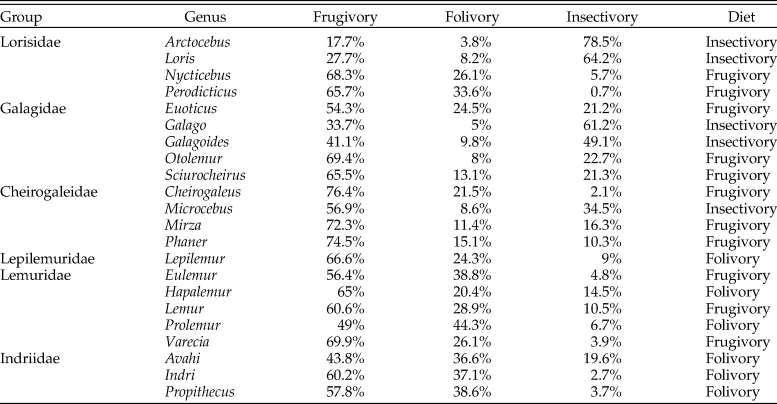
Three dietary categories were used, with taxa assigned to each category based on data on the proportional representation of foods from each category in diets observed in studies of wild populations (Charles-Dominique Reference Charles-Dominique1977, Reference Charles-Dominique1979; Hladik Reference Hladik and Doyle1979; Bearder and Martin Reference Bearder and Martin1980; Hladik et al. Reference Hladik, Charles-Dominique, Petter and Charles-Dominique1980; Ganzhorn et al. Reference Ganzhorn, Abraham and Razanahoera-Rakotomalala1985; Harcourt Reference Harcourt1986, Reference Harcourt1991; Harcourt and Nash Reference Harcourt and Nash1986; Nash Reference Nash1986; Masters et al. Reference Masters, Lumsden and Young1988; Overdorff Reference Overdorff1992; Sterling et al. Reference Sterling, Dierenfeld, Ashbourne and Feistner1994; Hemingway Reference Hemingway1996; Overdorff et al. Reference Overdorff, Strait and Telo1997; Balko Reference Balko1998; Fietz and Ganzhorn Reference Fietz and Ganzhorn1999; Vasey Reference Vasey2000, Reference Vasey2002; Thalmann Reference Thalmann2001; Britt et al. Reference Britt, Randriamandratonirina, Glasscock and Iambana2002; Nekaris and Rasmussen Reference Nekaris and Rasmussen2003; Powzyk and Mowry Reference Powzyk and Mowry2003; Streicher Reference Streicher2004, Reference Streicher2009; Nekaris Reference Nekaris2005; Gould Reference Gould, Gould and Sauther2006; Norscia et al. Reference Norscia, Carrai and Borgognini-Tarli2006; Wiens et al. Reference Wiens, Zitzmann and Hussein2006; Lahann Reference Lahann2007; Dammhahn and Kappeler Reference Dammhahn and Kappeler2008; Burrows and Nash Reference Burrows, Nash, Burrows and Nash2010; Olson et al. Reference Olson, Marsh, Bovard, Randrianarimanana, Ravaloharimanitra, Ratsimbazafy and King2013; Rode-Margono et al. Reference Rode-Margono, Nijman, Wirdateti and Nekaris2014; Sato et al. Reference Sato, Santini, Patel, Campera, Yamashita, Colquhoun and Donati2016; Erhart et al. Reference Erhart, Tecot and Grassi2018). If members of a genus consumed the greatest component of their diet from leaves or insects, the genus was classified as folivorous or insectivorous, respectively. Taxa that consumed the greatest part of their diet from fruits, gums, and other plant reproductive structures were classified as frugivorous (Supplementary Table 1).
Dental Topography Metrics
Functional tooth shape was quantified using the dental topography metrics DNE, RFI, and OPC. DNE was calculated both sensu Bunn et al. (Reference Bunn, Boyer, Lipman, St. Clair, Jernvall and Daubechies2011) using the R package molaR (Pampush et al. Reference Pampush, Winchester, Morse, Vining, Boyer and Kay2016b) and as ariaDNE using functions in MATLAB (Shan et al. Reference Shan, Kovalsky, Winchester, Boyer and Daubechies2019). The sum of ariaDNE at each vertex and its coefficient of variation (CV) across the tooth surface (here called ariaDNE and ariaDNE CV, respectively) were each calculated. RFI was calculated using the open-source stand-alone program Morphotester (Winchester Reference Winchester2016). RFI calculation on one specimen of Varecia variegata (USNM 84383) failed in Morphotester and was performed using molaR. OPC was calculated using the “orientation patch count rotated (OPCR)” approach implemented in molaR. OPCR accounts for deviation in the orientation of the tooth on the x,y plane by averaging the counts calculated over 45° rotations (Evans and Jernvall Reference Evans and Jernvall2009). OPCR was calculated using 3D-OPCR functions, which differs from the DEM-OPCR approach taken by previous studies examining large samples of strepsirrhine primates (Bunn et al. Reference Bunn, Boyer, Lipman, St. Clair, Jernvall and Daubechies2011; Winchester et al. Reference Winchester, Boyer, St. Clair, Gosselin-Ildari, Cooke and Ledogar2014). 3D-OPCR calculates OPCR from the orientation of the polygons directly, without first converting the occlusal topography into a digital elevation model (DEM), and appears to better reflect the complexity of tooth surface features (Winchester Reference Winchester2016). Variables were transformed to z-scores before analysis through the division of each data point by the sample standard deviation and the subtraction of the sample mean of each variable in order to correct for differences in the scale of each variable and to improve model fit.
Shape Segmentation
Each tooth in the sample was segmented into 15 regions using the hecate MATLAB package. This algorithm automatically identifies corresponding shape regions across all tooth surfaces in a consistent manner, using high-quality point-to-point mappings between all pairs of surfaces. These regions represent parts of the tooth that vary together across a given tooth sample and are intended to correspond to the sorts of structures commonly identified and named by morphologists, such as cusps and crests.
The algorithms implemented in hecate can be summarized in three phases. First, continuous Procrustes distances (Al-Aifari et al. Reference Al-Aifari, Daubechies and Lipman2013) are calculated between all pairs of sample meshes, using whole-surface meshes instead of sequences of landmarks as described in Gao et al. (Reference Gao, Yapuncich, Daubechies, Mukherjee and Boyer2018). The distances computed characterize pairwise (dis-)similarity among all surfaces by minimizing an energy function over all admissible maps between two disk-type surfaces, thus leading to an energy-minimizing point-to-point correspondence map associated with the distance value. Because the computations at this stage are all carried out in a pairwise manner, these point-to-point correspondence maps are generally not transitive. Next, the pairwise distances and their associated correspondence maps are assembled into a large-scale “random walk” modeling how a hypothetical “particle” would travel from tooth surface to tooth surface following the guidance of the correspondence maps; such a probabilistic model is known as a horizontal random walk (Gao Reference Gao2015, Reference Gao2021). Intuitively, when the particle is constrained to hop within similar surfaces (with small pairwise distance), the particle will slowly drift in position but mostly remain within corresponding regions of local geometric similarity; in contrast, when jumping across highly dissimilar surfaces (with large pairwise distance), the particle will quickly deviate from its regular routine and become visible all over any single tooth surface in the sample.
hecate leverages this phenomenon to identify corresponding regions across tooth surfaces by constructing a horizontal random walk matrix encoding the transition probability from each vertex on a triangular mesh to vertices on other triangular meshes, computed from the continuous Procrustes distance and the correspondence maps. Finally, eigen-decomposition of this horizontal random walk matrix provides a way to embed all tooth surfaces into a common “template” in the spectral domain. In this spectral representation, the tooth surfaces are all registered onto a virtual “common domain” to provide a basis for transitive, consistent comparisons across all surfaces in the sample. Machine learning techniques such as k-means clustering can then be applied to this spectral representation; the k groups of point clouds in the spectral domain can be mapped back to corresponding regions on the tooth surfaces, generating consistent segments across all surfaces.
The entire algorithmic workflow is integrated into the MATLAB software package hecate. This package takes as an input a set of meshes of whole teeth and outputs n mesh files, representing the number (n) of segments requested by the user. Input mesh files do not require processing beyond the “cleaning” routinely done in studies of dental topography (Winchester et al. Reference Winchester, Boyer, St. Clair, Gosselin-Ildari, Cooke and Ledogar2014). These mesh files can then be analyzed using orientation-invariant dental topography metrics like DNE. Metrics that rely on meshes sharing a consistent orientation can be misleading, however, as these meshes are oriented according to their positions in the teeth from which they have been segmented. Downloads of scripts to implement hecate in MATLAB and additional documentation are available from Winchester (Reference Winchester2020).
Dietary Signal and Dental Topography Metrics
The reclassification utility of ariaDNE implementations of DNE in combination with other dental topography metrics was assessed and compared with earlier implementations of DNE using the extant strepsirrhine sample in both DFA and multinomial modeling paradigms. Models were constructed using each of six bandwidths of ariaDNE and DNE sensu Bunn et al. (Reference Bunn, Boyer, Lipman, St. Clair, Jernvall and Daubechies2011) combined with RFI and OPC, creating models of nested complexity.
First, reclassification success rates from a cross-validated (“leave-one-out”) DFA was performed using the package MASS in R. Successful reclassifications of genera using genus mean values for each dental topography metric and the average successful reclassifications of the specimens within each genus are both reported from the DFA.
Second, likelihood of membership in each of the three dietary categories was modeled in a Bayesian, multilevel framework using functions in the R packages brms and the Stan engine (Bürkner Reference Bürkner2017). Four chains were run over 3000 iterations, with a 1000-iteration warm-up. Chain convergence was assessed using the rhat parameter, the number of effective samples returned, and visual inspection of the chain trace plots. Bayesian, multilevel methods, which have not previously been applied to dietary classification from dental topography metrics, were chosen to complement a more traditional linear discriminant analysis approach for two broad reasons. First, they allow for clustering in the data to be modeled as group-specific intercepts, which is useful for analyzing multiple specimens from single taxa or multiple segmented regions from a single molar, and for the joint modeling of phylogenetic covariance among taxa. Second, through the use of regularizing priors and model comparison metrics, they allow the explicit minimization and measurement of overfitting risk.
Models were constructed using the software default 0.8 bandwidth of ariaDNE, which, as discussed in the “Results,” was the highest performing in DFA. ariaDNE bandwidths correspond to the degree of local averaging around each vertex. For each vertex, the calculation of ariaDNE assigns a weight to the rest of the points in the mesh that is proportionate to the inverse square of the bandwidth value. Each bandwidth expresses a length of the same units as the distance between any two vertices in the mesh (Shan et al. Reference Shan, Kovalsky, Winchester, Boyer and Daubechies2019).
ariaDNE values were combined variously with ariaDNE 0.8 CV, RFI, and OPC in models of nested complexity using a sample of individual tooth specimens; in a multilevel framework with different slopes for each genus; and in a multilevel framework that incorporates phylogenetic covariance among genera using a consensus phylogeny from Herrera and Dávalos (Reference Herrera and Dávalos2016). Phylogenetic covariance is modeled in brms using a phylogenetic mixed modeling approach that jointly estimates and incorporates phylogenetic signal into the strength of the covariance relationships (Housworth et al. Reference Housworth, Martins and Lynch2004). The estimated phylogenetic signal can be reported as the proportion of the variance explained by the modeled covariance and is analogous to Pagel's lambda metric (Housworth et al. Reference Housworth, Martins and Lynch2004; Bürkner Reference Bürkner2020). Models of different complexity were compared using the “Pareto-Smoothed importance sampling leave-one-out cross validation” approximation (LOOIS) implemented in the loo package in R and accessed through brms (Vehtari et al. Reference Vehtari, Gelman and Gabry2017). This metric efficiently approximates a model's leave-one-out reclassification success. This allows the measurement of overfitting risk, which reflects the ability of a model to predict out-of-sample outcomes, an important consideration in models generated for application to the fossil record.
Dietary Signal in the Segmented Molar
ariaDNE values (at the 0.08 bandwidth of local averaging) were calculated on the sample of second lower molars segmented using the hecate method. Categorical multilevel models were constructed in a Bayesian framework, with specimens in each genus permitted to share independent intercepts. Two partitions of the data were considered. The likelihood of membership in each dietary category was modeled as a function of the shapes of each segment, with each tooth permitted to have an independent intercept and each class of segments permitted to share an independent intercept and slope. Likelihoods were also modeled using ariaDNE values calculated for each continuous surface. ariaDNE was used as a metric because it can be compared among surfaces, such as those of tooth segments with different areas, which differ in mesh face count (Shan et al. Reference Shan, Kovalsky, Winchester, Boyer and Daubechies2019). Models were constructed to account for the clustering of specimens within genus but did not incorporate phylogenetic covariance. Predictive models were compared using LOOIS (Vehtari et al. Reference Vehtari, Gelman and Gabry2017).
Reconstructed Dietary Ecology in Fossil Strepsirrhines and Subfossil Lemurs
Two approaches were taken to reconstruct dietary ecology in the extinct strepsirrhine sample. DFA models were constructed using genus mean data (“genus DFA”) and specimen-level data, with the mean reconstructed probability of membership in each dietary category among all of the individual specimens reported for each genus (“specimen DFA”). DFA modeling used the combination of variables that were the highest performing in reclassifying extant taxa using DFA leave-one-out cross validation. A Bayesian multilevel model was also constructed incorporating the maximally informative combination of variables that reported an acceptable (k < 0.7) overfitting risk as determined through LOOIS comparisons (k representing a parameter of the pareto fit to the importance ratios of each leave-one-out model). This model incorporates specimen-level clustering within genera by allowing each genus an independent intercept. Each extant taxon was stripped of information about its dietary ecology and classified to dietary ecology iteratively using the same approach. This allows the classifications of extinct taxa to be contextualized using informationally analogous reclassifications of extant taxa of known diet.
Institutional Abbreviations
CBI, Office National des Mines, Tunis, Tunisia; DLC/DPC, Division of Fossil Primates, Duke Lemur Center, Durham, N.C.; MCZ, Museum of Comparative Zoology, Harvard University, Cambridge Mass.; USNM, National Museum of Natural History, Smithsonian Institute, Washington, D.C.
Results
Dental Topography Metrics and Dietary Category
Calculated values for the 0.08 bandwidth of ariaDNE and ariaDNE CV, OPC, and RFI for each genus are presented in Supplementary Table 2. At each bandwidth, ariaDNE was highest in insectivores and lowest in frugivores, while ariaDNE CV was highest in folivores and lowest in insectivores. DNE sensu Bunn et al. (Reference Bunn, Boyer, Lipman, St. Clair, Jernvall and Daubechies2011) was highest in folivores and lowest in frugivores. OPC was also highest in folivores and lowest in frugivores. RFI was highest in insectivores and lowest in frugivores. Values for each dietary group overlapped at the upper and lower ends of their ranges, but means were separated by at least 1 SE for every metric (Supplementary Table 3).
Whole-Tooth Reclassification Success
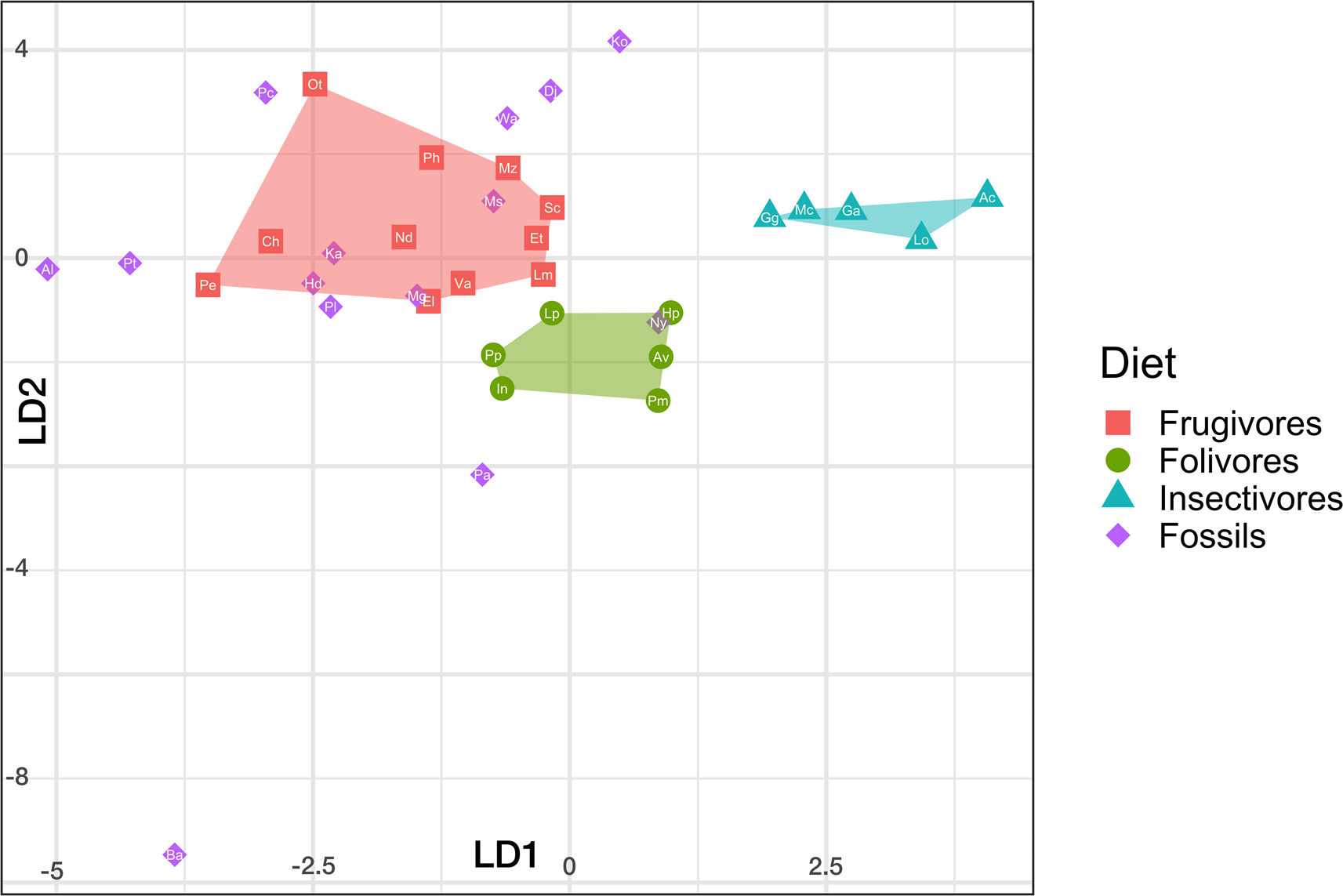
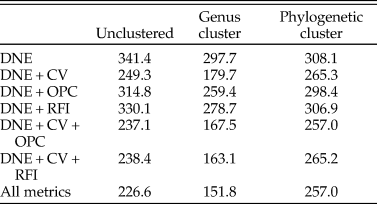
Implementations of ariaDNE showed the highest DFA reclassification success of all dental topography metrics (Table 1). The highest-performing combination of variables (ariaDNE sum and CV at the 0.08 bandwidth combined with RFI and OPC) reclassified strepsirrhine genera to the correct dietary ecology with 100% accuracy using genus means and with 86% accuracy when measured from the average reclassification success of the specimens within each genus. The position of each extant strepsirrhine genus on the two linear discriminant axes of a model combining ariaDNE 0.08, ariaDNE 0.08 CV, RFI, and OPC are presented in Figure 1. ariaDNE 0.08 is strongly correlated with the first linear discriminant axis (LD1) (r 2 = 0.95), ariaDNE 0.08 CV is strongly negatively correlated with LD2 (r 2 = −0.94); RFI is moderately correlated with LD1 (r 2 = 0.55), and OPC is moderately negatively correlated with LD2 (r 2 = −0.60).
Reclassifications to dietary ecology in extant strepsirrhines using discriminant function analysis (DFA). Reclassification success using genus means is reported, with the average reclassification success of the specimens in each genus reported in parentheses. Rows indicate different bandwidths and columns different combinations of variables. DNE, Dirichlet normal energy; SD, coefficient of variation of DNE; RFI, relief index; OPC, orientation patch count.

Plots of genus means along linear discriminant axes of discriminant function analysis (DFA). Model constructed using ariaDNE 0.08 with ariaDNE coefficient of variation (CV), relief index (RFI), and orientation patch count (OPC), including reconstructed subfossil lemurs. Ac, Arctocebus; Al, Archaeolemur; Av, Avahi; Ba, Babakotia; Ch, Cheirogaleus; Dj, Djebelemur; El, Eulemur; Et, Euoticus; Ga, Galago; Gg, Galagoides; Hd, Hadropithecus; Hp, Hapalemur; In, Indri; Ka, Karanisia; Ko, Komba; Lm, Lemur; Lo, Loris; Lp, Lepilemur; Mc, Microcebus; Mg, Megaladapis; Ms, Mesopropithecus; Mz, Mirza; Nd, Nycticebus; Ny, Nycticeboides; Ot, Otolemur; Pa, Palaeopropithecus; Pc, Pachylemur; Pe, Perodicticus; Ph, Phaner; Pl, Plesiopithecus; Pm, Prolemur; Pp, Propithecus; Pt, Propotto; Sc, Sciurocheirus; Va, Varecia; Wa, Wadilemur.

Whole-Tooth Multinomial Modeling
Chains from all models converged with a rhat of 1 and acceptable effective sample size (Supplementary Material). With each specimen treated as an independent data point, genus clustering accounted for, and phylogenetic covariance modeled, LOOIS preferred the combination of the 0.08 bandwidth of ariaDNE with its CV, OPC, and RFI (“all parameters model”) (Table 2). Comparisons among data partitions preferred the model that clustered specimens by genus over the unclustered model and the model that included phylogenetic information. LOOIS preferences across alternate parameter combinations in the clustered and phylogenetic methods were mostly relatively small, however, and all combinations of variables were in the “good” or “ok” range (k < 0.7), with > 98% in the “good” range (k < 0.5). Because of this, the unclustered Bayesian model is discussed and figured below in order to explicate the influence of the dental topography metrics studied on the probability of membership in each diet group. This model is chosen because it demonstrates the same directional trends as more complex models, but with narrower probability intervals, making the trends clearer to visualize. Full model parameter estimates are included in the Supplementary Material. Coefficient values reported below represent the mean of the posterior distribution estimated by each model.
Comparisons among pareto-smoothed importance sampling leave-one-out cross validation approximation (LOOIS) information criteria calculated on models constructing using the 0.8 ariaDNE bandwidth. DNE, Dirichlet normal energy; CV, coefficient of variation of DNE; OPC, orientation patch count; RFI, relief index.

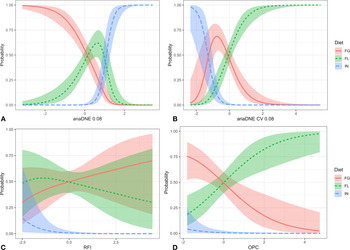
In the unclustered all parameters model, high ariaDNE values predict insectivorous diets (coefficient value predicting membership in category, relative to frugivory = 6.66); intermediate ariaDNE values predict folivorous diets (coefficient value predicting membership in category, relative to frugivory = 1.62); and low ariaDNE values predict frugivorous diets (Fig. 2). The molars of insectivorous strepsirrhines show the highest ariaDNE values, supporting this observation. High CV values predict folivorous diets (coefficient value predicting membership in category, relative to frugivory = 1.78); intermediate CV values predict frugivorous diets; and low CV values predict insectivorous diets (coefficient value predicting membership in category, relative to frugivory = −5.62). This reflects the concentration of folivorous taxa among the strepsirrhines with the highest ariaDNE CV values.
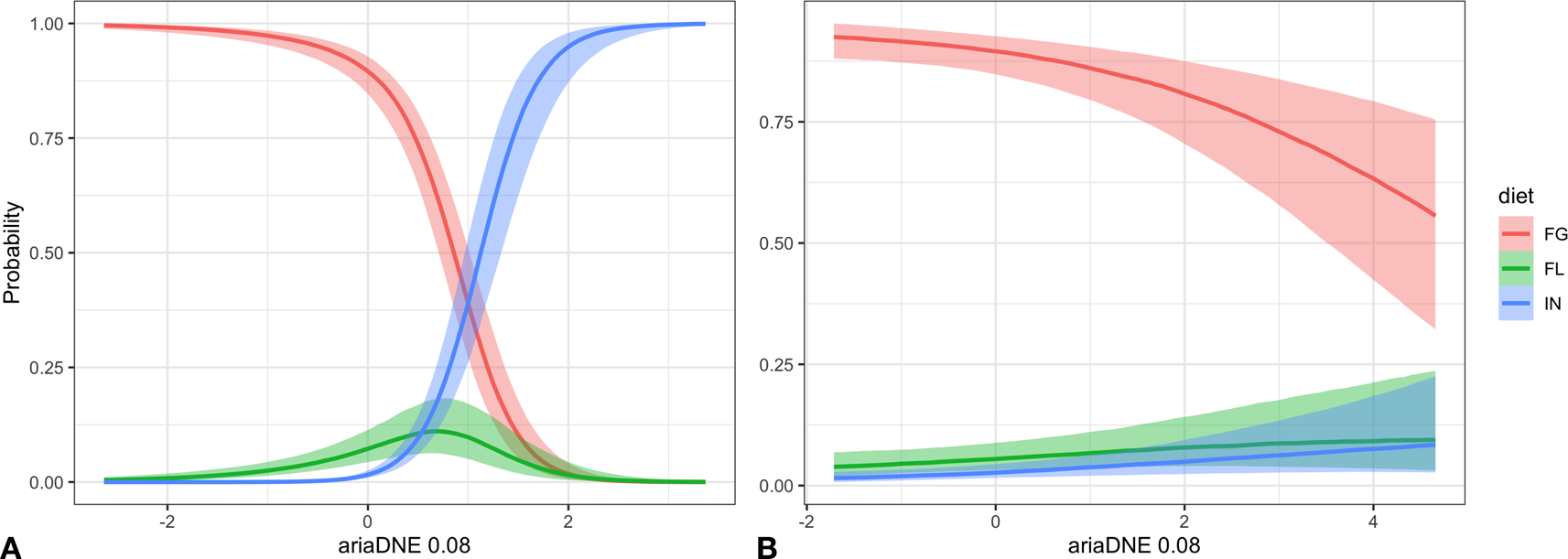
Relative probability of membership in each dietary category over the scaled range of values of ariaDNE bandwidth 0.08 estimated by multinomial Bayesian modeling (without including genus clustering or phylogenetic covariance) over the scaled range of values of A, ariaDNE; B, ariaDNE coefficient of variation (CV); C, relief index (RFI); D, orientation patch count (OPC). Shaded area represents consistency interval of middle 95% of the mass of the posterior distribution. FL, folivory; FG, frugivory; IN, insectivory.

High OPC was positively predictive of folivory (coefficient value predicting membership in category, relative to frugivory = 0.79) and negatively predictive of insectivory (coefficient value predicting membership in category, relative to frugivory = −0.85) (Fig. 2). Conditional on the strong relationships with ariaDNE and ariaDNE CV, high RFI was actually negatively predictive of folivory (coefficient value predicting membership in category, relative to frugivory = −0.18) and insectivory (coefficient value predicting membership in category, relative to frugivory = −1.45), despite being absolutely higher in these groups than among frugivores.
Segmented Tooth Multinomial Modeling
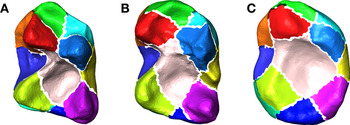
The hecate shape-segmentation algorithms were successful in isolating regions of local shape similarity corresponding to commonly identified cusps, crests, and basins (Fig. 3). However, models using the ariaDNE values of each segment performed no better in reclassification than models using ariaDNE summed across the tooth surface (LOOIS = −9.7 for whole-tooth model and −9.7 for segmented model) (Fig. 4). This indicates that the extra information provided by ariaDNE calculations on each segmented mesh did not improve dietary signal.
Regional segmentation of lower second molars created by hecate algorithms. A, Arctocebus; B, Avahi; C, Cheirogaleus.

Relative probability of membership in each dietary category over the scaled range of values of ariaDNE bandwidth 0.08 evaluated alone on A, each tooth surface; and B, segmented tooth surfaces. Shaded area represents consistency interval of middle 95% of the mass of the posterior distribution.

Classification of Extinct Strepsirrhines
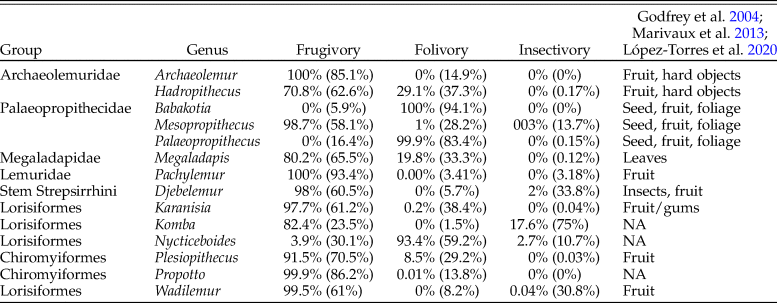
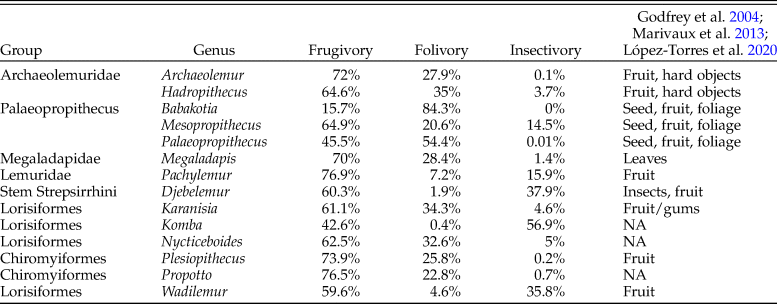
The dietary ecologies of extinct strepsirrhines were reconstructed using genus mean and specimen values in DFA and Bayesian multilevel models that included all parameters at the ariaDNE 0.8 bandwidth. Genus DFA and specimen DFA classifications are reported in Table 3. Means from the posterior probabilities of Bayesian model classifications included ariaDNE 0.08, ariaDNE CV 0.08, RFI, and OPC, and are reported in Table 4. In the DFA models, Archaeolemur, Djebelemur, Karanisia, Megaladapis, Mesopropithecus, Hadropithecus, Pachylemur, Plesiopithecus, Propotto, and Wadilemur were all reconstructed as frugivores; Babakotia, Nycticeboides, and Palaeopropithecus as folivores. Komba was reconstructed as frugivorous in the genus mean model and as insectivorous in the specimen classification model (Fig. 5). The Bayesian model differs from the genus mean DFA in classifying Nycticeboides as frugivorous and Komba as insectivorous (Tables 3, 4).
Ternary diagrams of the probability of reconstructed dietary ecologies from fossil and extant strepsirrhines. A, Dietary classification of each specimen averaged by genus, using discriminant function analysis (DFA) model incorporating ariaDNE 0.08, ariaDNE 0.08 coefficient of variation (CV), relief index (RFI), and orientation patch count (OPC); B, Dietary classification of each specimen averaged by genus, using Bayesian multilevel model incorporating ariaDNE 0.08, ariaDNE 0.08 CV, RFI, and OPC. FL, folivory; FG, frugivory; IN, insectivory. Ac, Arctocebus; Al, Archaeolemur; Av, Avahi; Ba, Babakotia; Ch, Cheirogaleus; Dj, Djebelemur; El, Eulemur; Et, Euoticus; Ga, Galago; Gg, Galagoides; Hd, Hadropithecus; Hp, Hapalemur; In, Indri; Ka, Karanisia; Ko, Komba; Lm, Lemur; Lo, Loris; Lp, Lepilemur; Mc, Microcebus; Mg, Megaladapis; Ms, Mesopropithecus; Mz, Mirza; Nd, Nycticebus; Ny, Nycticeboides; Ot, Otolemur; Pa, Palaeopropithecus; Pc, Pachylemur; Pe, Perodicticus; Ph, Phaner; Pl, Plesiopithecus; Pm, Prolemur; Pp, Propithecus; Pt, Propotto; Sc, Sciurocheirus; Va, Varecia; Wa, Wadilemur.

Reconstructions of dietary ecology in extinct strepsirrhines using discriminant function analysis (DFA). Reconstructed probabilities using genus means are reported, with the average reconstructions of all of the specimens in each genus reported in parentheses.

Reconstructions of dietary ecology (means of the posterior probabilities distributions of likelihood of membership in each dietary category) in extinct strepsirrhines from Bayesian multilevel model.

Discussion
The ariaDNE implementation of DNE has considerable value in describing dietary ecology in strepsirrhines, particularly when using larger bandwidths of local averaging. At all bandwidths, ariaDNE outperforms traditional DNE in dietary reclassification. ariaDNE can be implemented in both DFA and Bayesian multinomial frameworks, and neither overfitting, when combined with additional metrics, nor averaging of functional information across the occlusal surface appears to represent major confounding factors. ariaDNE and ariaDNE CV used in combination add a valuable new dimension to dietary discrimination, particularly in distinguishing primate folivores from insectivores, a task that has traditionally proved difficult without the inclusion of additional body-size information.
Insectivorous teeth show surfaces with high average curvature across the surface, while folivores show moderate average curvature but high variability. Both insects and leaves require consumers to fragment relatively tough structural carbohydrates (Kay Reference Kay1975; Lucas Reference Lucas2004; Ungar Reference Ungar2010). In leaves, structural carbohydrates are packaged within cellulose fibers and ligneous cell walls, while in insects they form the structural component of chitinous exoskeletons (Vincent Reference Vincent1990; Strait Reference Strait1993; Strait and Vincent Reference Strait and Vincent1998; Lucas Reference Lucas2004). The common demands of these food materials explain the common elaboration of shearing crests and other tooth cutting surfaces in both insectivores and folivores (Kay Reference Kay1975; Yamashita Reference Yamashita1998). However, leaves and insects differ in many important respects as potential food items.
Insect exoskeletons are both tough (requiring continuous application of force to propagate cracks) and stiff (requiring high concentrations of force to initiate cracks) (Strait Reference Strait1993; Strait and Vincent Reference Strait and Vincent1998; Evans and Sanson Reference Evans and Sanson2003). The toughness of insect exoskeletons selects for the elaboration of blades, which can propagate cracks linearly and prevent the puncturing of a material without crack propagation, but the stiffness of exoskeletons selects for the development of blade edges and pointed cusps with minimal radius of curvature in three dimensions (Strait Reference Strait1993; Evans and Sanson Reference Evans and Sanson2003). Animal matter is also highly elastic, which makes securing food items between interacting molar structures difficult, a problem best solved by high crests around deep basins (Strait Reference Strait1997). Strepsirrhine insectivores appear to arrive at a morphological compromise by developing sharp cusps and narrow molar basins connected by sharp shearing crests. This occlusal topography is characterized by uniformly high curvature, yielding a high ariaDNE with low variance.
Leaves are also tough, but generally less stiff, with a planar geometry that minimizes the ability for cracks to spread elastically through their tissue (Yamashita Reference Yamashita1998; Lucas Reference Lucas2004; Ungar Reference Ungar2010). This combination of properties selects for the elaboration of elongated blades that interact to slice leaves and shallow basins against which leaves can be triturated (Yamashita Reference Yamashita1998; Cuozzo and Yamashita Reference Cuozzo, Yamashita, Gould and Sauther2006). The differences in curvature between open basins and high crests is captured by the relatively high CV of ariaDNE values across the tooth surfaces of folivores. Strepsirrhine folivores also develop multiple, intersecting blades that yield higher tooth surface complexity and a high OPC, as also observed in herbivorous rodents and carnivorans (Evans et al. Reference Evans, Wilson, Fortelius and Jernvall2007). Plants have evolved a range of adaptations to resist mammalian predation by increasing the rate of dental wear in leaf consumers (Vincent Reference Vincent1990; Lucas Reference Lucas2004; Ungar Reference Ungar2010). Strepsirrhine folivores appear to have adapted to resist this wear by increasing crown height, as captured by RFI (Boyer Reference Boyer2008; Pampush et al. Reference Pampush, Spradley, Morse, Harrington, Allen, Boyer and Kay2016a).
Frugivores (which in this sample include gummivores) are thought to habitually consume foods with low toughness, although hard seed predation is important to some species (Godfrey et al. Reference Godfrey, Semprebon, Jungers, Sutherland, Simons and Solounias2004; Lucas Reference Lucas2004; Ungar Reference Ungar2010). This lack of dietary structural carbohydrates is reflected in the low ariaDNE, ariaDNE CV, RFI, and OPC values characterizing frugivorous strepsirrhines in this sample. This supports the suggestion that the elaboration of shearing tooth structures is less important in processing diets characterized by lower levels of structural carbohydrates (Kay Reference Kay1975; Bunn et al. Reference Bunn, Boyer, Lipman, St. Clair, Jernvall and Daubechies2011; Boyer Reference Boyer2008; Ungar Reference Ungar2010; Winchester et al. Reference Winchester, Boyer, St. Clair, Gosselin-Ildari, Cooke and Ledogar2014).
The combination of Bayesian modeling and the use of explicit overfitting metrics largely supports the suitability of combinations of ariaDNE, RFI, and OPC for out-of-sample reconstruction. Metric comparisons supported the use of more highly parameterized models, in line with the multiproxy approach recommended by Pineda-Munoz et al. (Reference Pineda-Munoz, Lazagabaster, Alroy and Evans2017). Models using disaggregated structures of the lower molar failed to outperform models constructed using ariaDNE values calculated for the whole surface. This suggests that, contrary to the concerns of Allen et al. (Reference Allen, Cooke, Gonzales and Kay2015), tooth occlusal surfaces are under selection as integrated units for maximizing food fragmentation. Dental topography metrics calculated on occlusal surfaces do not appear to aggregate away dietary information reflected in disaggregated shearing crests, and instead may capture emergent properties of interacting tooth crown structures (Winchester Reference Winchester2016).
Genus mean and specimen-level DFA models suggest that a majority of the recently extinct subfossil lemur genera subsisted on fruits. It has been observed that lemur faunas are depauperate of frugivores when compared with similar primate communities on other landmasses (Ganzhorn Reference Ganzhorn1992; Goodman and Ganzhorn Reference Goodman and Ganzhorn1997; Wright et al. Reference Wright, Razafindratsita, Pochron, Jernvall, Dew and Boubli2005). This frugivore depauperate fauna may have resulted from the recent extinction of some large-bodied, specialized frugivores and hard-object feeders (especially the lemurid Pachylemur and the archaeolemurids Archaeolemur and Hadropithecus). The extinction of large-bodied frugivores would be consistent with a broader pattern of ecological contraction in lemur communities hypothesized to have occurred over the Quaternary (Godfrey et al. Reference Godfrey, Jungers, Schwartz, Gould and Sauther2006, Reference Godfrey, Winchester, King, Boyer and Jernvall2012).
Dietary reconstructions of subfossil lemurs using the all-parameters DFA models are largely consonant with reconstructions based on dental microwear and the elaboration of shearing quotients, both of which predict many subfossil lemur genera to have been frugivorous or hard-object feeding, with the exception of the sloth lemurs (Palaeopropithecidae) and Megaladapis (Jungers et al. Reference Jungers, Godfrey, Simons, Wunderlich, Richmond, Chatrath, Plavcan, Kay, Jungers and van Schaik2002; Godfrey et al. Reference Godfrey, Semprebon, Jungers, Sutherland, Simons and Solounias2004, Reference Godfrey, Jungers, Schwartz, Gould and Sauther2006, Reference Godfrey, Winchester, King, Boyer and Jernvall2012; Scott et al. Reference Scott, Godfrey, Jungers, Scott, Simons, Teaford, Ungar and Walker2009) (Fig. 6). Models reconstruct two of the sloth lemurs, Palaeopropithecus and Babakotia, as folivorous, as expected. The palaeopropithecid Mesopropithecus, however, seems aberrant in this regard, as its dietary ecology was reconstructed as frugivorous with relatively high confidence by DFA and Bayesian methods. Its molar structure resembles that of Indri and Propithecus, with ariaDNE and ariaDNE CV values most like Propithecus, both of which were reclassified as frugivorous by the Bayesian model (Table 5). Propithecus is known to exhibit a significant degree of seasonal diet switching toward fruits and seeds, and this ecology may have characterized Mesopropithecus or its ancestors (Godfrey et al. Reference Godfrey, Semprebon, Jungers, Sutherland, Simons and Solounias2004; Norscia et al. Reference Norscia, Carrai and Borgognini-Tarli2006). The position of some paleopropithecids, although reconstructed as folivorous, far outside the ecological distribution of the extant species also underlines the extent to which some subfossil lemurs may lack clear ecological analogues among the extant fauna.
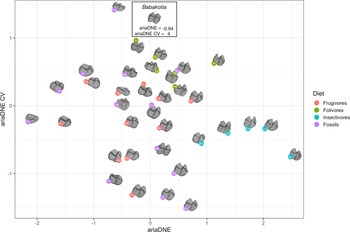
Strepsirrhine second molars plotted by scaled ariaDNE 0.08 and ariaDNE 0.08 coefficient of variation (CV) values. Ac, Arctocebus; Al, Archaeolemur; Av, Avahi; Ch, Cheirogaleus; Dj, Djebelemur; El, Eulemur; Et, Euoticus; Ga, Galago; Gg, Galagoides; Hd, Hadropithecus; Hp, Hapalemur; In, Indri; Ka, Karanisia; Ko, Komba; Lm, Lemur; Lo, Loris; Lp, Lepilemur; Mc, Microcebus; Mg, Megaladapis; Ms, Mesopropithecus; Mz, Mirza; Nd, Nycticebus; Ny, Nycticeboides; Ot, Otolemur; Pa, Palaeopropithecus; Pc, Pachylemur; Pe, Perodicticus; Ph, Phaner; Pl, Plesiopithecus; Pm, Prolemur; Pp, Propithecus; Pt, Propotto; Sc, Sciurocheirus; Va, Varecia; Wa, Wadilemur.

Reconstructions of dietary ecology (means of the posterior probabilities distributions of likelihood of membership in each dietary category) in extant strepsirrhines from Bayesian multilevel model.

Both DFA and Bayesian models classified Megaladapis as frugivorous. This was surprising, as this taxon exhibits long shearing crests and a strongly folivorous microwear signal (Jungers et al. Reference Jungers, Godfrey, Simons, Wunderlich, Richmond, Chatrath, Plavcan, Kay, Jungers and van Schaik2002; Godfrey et al. Reference Godfrey, Semprebon, Jungers, Sutherland, Simons and Solounias2004). The signal for frugivory in Megaladapis seems to arise from its relatively low ariaDNE CV. The long, continuous crests displayed by Megaladapis molars may have lower variability in vertex bending than the shorter, intersecting crests of other lemur folivores. Sixty-six percent of specimens from the morphologically similar Lepilemur were also misclassified by the Bayesian model as frugivorous, suggesting that ariaDNE CV may struggle to characterize this dental configuration.
Dental topography metrics were also applied to a sample of fossil strepsirrhines from the Paleogene and Neogene of Africa and Asia that includes a stem strepsirrhine, early fossil lorisiforms, and stem members of the chiromyiform lineage today represented by the aye-aye Daubentonia. Among these taxa, genus means strongly support frugivory (including potentially gummivory) in all taxa but Nycticeboides and Komba, with averaged specimen reclassifications indicating greater uncertainty but modally consistent results, despite the small size and apparently sharp teeth of Djebelemur and the Paleogene lorisiforms Wadilemur and Karanisia (Fig. 7). This is largely consistent with dietary reconstruction of the Paleogene species using shearing quotients (Kirk and Simons Reference Kirk and Simons2000; Marivaux et al. Reference Marivaux, Ramdarshan, Essid, Marzougui, Ammar, Lebrun, Marandat, Merzeraud, Tabuce and Vianey-Liaud2013).
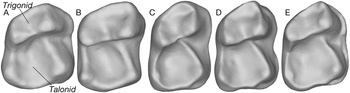
Occlusal view of the m2 of Paleogene strepsirrhines, Microcebus, and Euoticus. A, Microcebus (DLC 893m); B, Euoticus (MCZ 17591); C, Djebelemur (CBI 366); D, Wadilemur (DPC 16872); E, Karanisia (DPC 21456K).

The living mouse lemur Microcebus, which was reclassified by the DFA as an insectivore but by the Bayesian model as frugivorous, also consumes small fruits and gums, and would seem to represent the most likely ecological analogue for these early Paleogene taxa. However, Microcebus shows higher ariaDNE values than any of the three Paleogene genera (Fig. 8). This may capture the greater elaboration of flat trigonid and talonid basins in Djebelemur and Wadilemur, which could serve as crushing surfaces for processing small fruits, and the relatively high trigonid with low cusps of Karanisia. In these characters, these taxa seem to resemble the extant Euoticus, which is classified here as a frugivore/gummivore but is among the members of this category with the highest ariaDNE values. It seems likely that, like Euoticus, Djebelemur, Karanisia, and Wadilemur supplemented a frugivorous or gummivorous diet with insect protein. ariaDNE values from Paleogene fossil strepsirrhines overlap the distribution of both Microcebus and Euoticus, with a mean that is lower than both. The ecological distinction between small-bodied frugivore-insectivores and insectivore-frugivores may be ultimately difficult to detect using dental topographic analysis.
Box plot comparing specimen ariaDNE values of Euoticus, Microcebus, and Paleogene fossil taxa Djebelemur, Karanisia, and Wadilemur. IN, insectivory; FG, frugivory; X, unknown.

DFA, but not Bayesian, models reconstructed Nycticeboides as folivorous, a surprising result, as no extant lorisiforms consume leaves as a significant dietary component. Nycticeboides shares with strepsirrhine folivores high ariaDNE CV, reflecting the development of sharp shearing crests and relatively flat basins. A qualitative description of the dentition of Nycticeboides simpsoni noted the development of shearing crests but argued against the likelihood that this taxon regularly consumed leaves due to its small size and phylogenetic bracketing (MacPhee and Jacobs Reference MacPhee and Jacobs1986). Its body-size reconstruction is ambiguous, however, and it may have exceeded 500 g, placing it above “Kay's threshold,” the approximate mass at which leaves become a more efficient source of dietary protein for primates than insects (Kay Reference Kay1975; MacPhee and Jacobs Reference MacPhee and Jacobs1986). This may indicate greater ecological diversity among Asian lorisiforms during the Miocene.
The reconstructed diets of Paleogene strepsirrhines suggest that adaptations for frugivory or gummivory among Eocene crown and near-crown (Djebelemurinae) strepsirrhines distinguished them ecologically from the more insectivorous Afrotarsius and folivorous adapiforms and anthropoids (Kirk and Simons Reference Kirk and Simons2000). The exploitation of angiosperm reproductive structures may have played a significant role in the early adaptive history of strepsirrhines in Afro-Arabia. As strepsirrhines expanded into habitats without incumbent primate insectivores (including Madagascar and South Asia), and after the extinction of mainland African insectivores like Afrotarsius, some strepsirrhine taxa apparently shifted into more specialist insectivore roles.
Acknowledgments
This paper emerged from a dissertation chapter to which G. Gunnell, R. Kay, D. McShea, E. St. Clair, C. Wall, and B. Williams gave helpful guidance. Helpful comments from N. Vitek, M. Silcox, and anonymous reviewer improved an earlier version of the article. Many undergraduates in the Boyer Lab also assisted in processing scans, especially K. Montane and M. Schaeffer. L. Godfrey, E. Seiffert, and the collections staff at the Smithsonian National Museum of Natural History, the American Museum of Natural History, the Field Museum of Natural History, the Natural History Museum (UK), and the Division of Fossil Primates at the Duke Lemur Center all provided valuable access to specimens. Funding was provided by the Duke Graduate School dissertation research domestic travel grant and summer research support and by the grants NSF BCS 1552848 to D.M.B., NSF BCS 130405 to D.M.B. and Elizabeth St. Clair, and NSF BCS 1825129 to D.M.B. and A. Harrington.
Data Availability Statement
Data available from the Dryad Digital Repository: https://doi.org/10.5061/dryad.4mw6m908m.