When obstacles arise, misfortune strikes, or things just do not go as planned, people find different ways to cope and carry on. For some, one way to deal with difficulties is through religion. There is evidence that religion can help people to cope with distress by bolstering feelings of personal control (McCullough & Willoughby, Reference McCullough and Willoughby2009), particularly for those in individualistic cultural contexts (Sasaki & Kim, Reference Sasaki and Kim2011), and by fostering social affiliation with others (Ellison & George, Reference Ellison and George1994). Although these two consequences of religion are fairly well established, it is not entirely clear how these seemingly independent effects of religion are related to each other, and whether there are individual differences in how people are impacted by these effects of religion.
In this research, we examine how religion is linked to self-control and social affiliation in an experiment that combines genetic moderation and a social psychological approach. As demonstrated by research on differential susceptibility, people with certain genetic predispositions may show greater sensitivity to environmental influences, leading to not only negative but also positive outcomes (e.g., Belsky et al., Reference Belsky, Jonassaint, Pluess, Stanton, Brummett and Williams2009). For instance, although people with certain genetic susceptibilities are less likely to show prosocial behavior in the absence of relevant environmental influences, they show greater prosocial behavior in response to religious salience in the environment (Sasaki et al., Reference Sasaki, Kim, Mojaverian, Kelley, Park and Janušonis2013). In the present research, we examine how an experimental prime of religion impacts self-control in a social context for people with different genetic orientations toward sociality. We demonstrate a novel genetic moderation effect that uncovers how religion's influence on self-control is associated with the orientation for social affiliation.
Religion as a Means to Cope With Distress
Though religion undoubtedly comes with its fair share of good and bad outcomes, one way it may help people is by providing a means of coping in the face of distress. Religious involvement seems to largely predict positive outcomes for health and well-being (Koenig & Larson, Reference Koenig and Larson2001). For instance, it has been linked to longevity (see McCullough, Hoyt, Larson, Koenig, & Thoreson, Reference McCullough, Hoyt, Larson, Koenig and Thoresen2000, for meta-analysis) and may have protective effects against morbidity (Ellison & Levin, Reference Ellison and Levin1998; but see Pargament, Reference Pargament2002; Pargament, Koenig, Tarakeshwar, & Hahn, Reference Pargament, Koenig, Tarakeshwar and Hahn2001; Pargament & Raiya, Reference Pargament and Raiya2007, for discussion of both positive and negative forms of religious coping). Based on this fairly consistent link between religion and health outcomes, researchers have tried to uncover potential explanations for why religion may guard against mental illness (George, Ellison, & Larson, Reference George, Ellison and Larson2002).
Psychological benefits of religion seem to be explained mainly by two paths: self-control and social affiliation. Previous research finds that religious beliefs and practices tend to encourage individuals to exercise self-control: the ability to override a prepotent response, including a behavior, emotion, or motivation, for the sake of a long-term goal (McCullough & Willoughby, Reference McCullough and Willoughby2009). Religious involvement often facilitates adjusting or aligning oneself to a higher power and accepting one's circumstances to find meaning in difficulties (Pargament et al., Reference Pargament, Cole, VandeCreek, Behavich, Brant and Perez1999; Spilka, Hood, Hunsberger, & Gorsuch, Reference Spilka, Hood, Hunsberger and Gorsuch2003; Stephens, Fryberg, Markus, & Hamedani, Reference Stephens, Fryberg, Markus and Hamedani2013; see also Weisz, Rothbaum, & Blackburn, Reference Weisz, Rothbaum and Blackburn1984, for discussion of secondary control, a specific instance of self-control that involves adjustment and acceptance), which are goals that may help some people maintain their own mental health. A separate body of research shows that religion tends to foster social affiliation and interdependence with other people within a religious group (Atran & Norenzayan, Reference Atran and Norenzayan2004; Bloom, Reference Bloom2012; Durkheim, Reference Durkheim1995/1912; Shapira & Madsen, Reference Shapira and Madsen1974; Sosis, Reference Sosis2004). Religious people tend to be highly invested in their social relationships (McCullough, Enders, Brion, & Jain, Reference McCullough, Enders, Brion and Jain2005) and report having larger social networks and receiving greater social resources compared to nonreligious people (Ellison & George, Reference Ellison and George1994). Both successful regulation of the self (Baumeister & Vohs, Reference Baumeister, Vohs, Peterson and Seligman2004) and maintenance of social relationships (Cohen, Reference Cohen2004) play key roles in maintaining mental health more broadly, and we propose that these two pathways of benefit may be more interrelated than it seems.
Researchers have theorized a potential connection between social behaviors and the feelings of control promoted by religion (McCullough & Willoughby, Reference McCullough and Willoughby2009), and recent empirical evidence also suggests a possible link in certain cultural contexts. Of interest, the relationship between religion and self-control that is prevalent in the context of North America is much weaker in East Asia (Sasaki & Kim, Reference Sasaki and Kim2011), where there is already a greater emphasis on social connections with others (Markus & Kitayama, Reference Markus and Kitayama1991). In cultural contexts such as North America, where there is a stronger emphasis on independence, it is possible that religion may increase self-control for some people because it allows them to socially connect with others more. Priming the concept of religion increases behaviors indicating acceptance of the situation and, as a result, may make people more likely to consider another person's needs (Sasaki & Kim, Reference Sasaki and Kim2011). Moreover, there is an association between religious coping and social coping in response to daily stressors, and this relationship is in part explained by the use of acceptance and self-adjustment in a North American sample. Whereas the link between religion and self-control seems to be largely relevant in individualistic cultural contexts, the socially affiliative component of religion appears to be relevant in both cultures (although this seems to especially be the case in collectivist cultures; Sasaki & Kim, Reference Sasaki and Kim2011). Thus, one possibility is that social affiliation is the more primary outcome of religion, while self-control is a means to an end. We propose that the ultimate function of an increase in self-control via religion may be to facilitate socially affiliative behaviors.
Genetic Moderation of Religious Influence
Research incorporating a genetic moderation approach provides a unique opportunity to address the question of whether religion may be associated with self-control for certain reasons. According to research on Gene × Environment interactions (G × E), the same environmental input can lead to divergent responses depending on differences in genetic predispositions, and conversely, the same genetic predisposition may result in divergent responses depending on differences in the environment (Caspi et al., Reference Caspi, McClay, Moffitt, Mill, Martin and Craig2002, Reference Caspi, Sugden, Moffitt, Taylor, Craig and Harrington2003). More recently, a growing body of research suggests that individuals with certain genetic predispositions may experience greater sensitivity in response to environmental conditions, whether they are beneficial or harmful (Belsky, Bakermans-Kranenburg, & van IJzendoorn, Reference Belsky, Bakermans-Kranenburg and van Ijzendoorn2007; Belsky et al., Reference Belsky, Jonassaint, Pluess, Stanton, Brummett and Williams2009; Belsky & Pluess, Reference Belsky and Pluess2013; Ellis, Boyce, Belsky, Bakermans-Kranenburg, & van IJzendoorn, Reference Ellis, Boyce, Belsky, Bakermans-Kranenburg and van IJzendoorn2011; Obradović & Boyce, Reference Obradović and Boyce2009; Way & Taylor, Reference Way and Taylor2010). Rather than understanding certain genotypes as more vulnerable to stressors in the environment, these genotypes may be better conceptualized as having greater “plasticity” or “susceptibility” to environmental influences (for a review, see Belsky & Pluess, Reference Belsky and Pluess2009).
Building on the framework of differential susceptibility (Belsky et al., Reference Belsky, Jonassaint, Pluess, Stanton, Brummett and Williams2009), our previous paper showed that the effect of religion priming on prosocial behavior depends on variants of a dopamine receptor D4 gene (DRD4) polymorphism (Sasaki et al., Reference Sasaki, Kim, Mojaverian, Kelley, Park and Janušonis2013). To the extent that religion may act as an environmental pressure to behave prosocially by offering potential rewards for good deeds (or punishment for lack thereof; Shariff & Norenzayan, Reference Shariff and Norenzayan2011), we reasoned that this effect of religion may be relevant primarily for people who were genetically predisposed to be sensitive to those environmental pressures in the first place. In particular, people with certain variants of DRD4 seem to be more sensitive to the prospect of reward (Stice & Dagher, Reference Stice and Dagher2010) and thus may be more motivated to behave prosocially in response to external pressures to do so. The results of that investigation showed that people primed with religion were more willing to volunteer for environmental organizations than were people not primed with religion, but this effect emerged only among those with two- or seven-repeat alleles of DRD4, who tend to be more sensitive to the prospect of reward (Sasaki et al., Reference Sasaki, Kim, Mojaverian, Kelley, Park and Janušonis2013). This previous research is consistent with other work linking DRD4 to prosocial behavior (Bachner-Melman et al., Reference Bachner-Melman, Girsenko, Nemanov, Zohar, Dina and Ebstein2005) and provides evidence of DRD4 as a susceptibility factor by demonstrating environmental moderation of the DRD4–prosociality link (Bakermans-Kranenburg & van IJzendoorn, Reference Bakermans-Kranenburg and van IJzendoorn2011).
In the present research, we examine whether people with certain susceptibility orientations are more sensitive to religious salience in the environment than those with nonsusceptibility orientations using an additional polymorphism, which is localized in the oxytocin receptor gene (OXTR). We also take a novel approach by investigating whether the reason people with different genetic predispositions show divergent responses may be due to different motivations. In particular, we test genetic moderation of the influence of religion on self-control in order to elucidate self-control as a possible mechanism through which religion facilitates affiliation with others.
The Oxytocin–Sociality Link
Previous research has shown that religious cues in the environment can increase self-control (Sasaki & Kim, Reference Sasaki and Kim2011). If this increase in self-control is occurring in order to increase sociality, then the link between religion and self-control should be stronger for people who are predisposed to be more socially sensitive than for those predisposed to be less socially sensitive. The present research uses the perspective of G × E to examine whether religious salience in the environment increases self-control behaviors, particularly for people who are genetically predisposed for social affiliation.
From a biological perspective, the oxytocin system seems to play an important role in socially affiliative behaviors that emerge in response to stressful events (Bartz & Hollander, Reference Bartz and Hollander2006; Henrichs, von Dawans, & Domes, Reference Henrichs, von Dawans and Domes2009; Ross & Young, Reference Ross and Young2009). In particular, OXTR has a candidate polymorphism (rs53576) that has been implicated in an array of social and emotional behaviors, with different variants of OXTR predicting different outcomes. People who have two copies of the G allele of OXTR rs53576, compared to carriers of the A allele, tend to exhibit greater maternal sensitivity (Bakermans-Kranenburg & van IJzendoorn, Reference Bakermans-Kranenburg and van IJzendoorn2008), show higher levels of empathic accuracy, dispositional empathy, and physiological responses reflecting empathic concern (Rodrigues, Saslow, Garcia, John, & Keltner, Reference Rodrigues, Saslow, Garcia, John and Keltner2009; Smith, Porges, Norman, Connelly, & Decety, Reference Smith, Porges, Norman, Connelly and Decety2014), and also have lower rates of autism diagnosis (Wu et al., Reference Wu, Jia, Ruan, Liu, Guo and Shuang2005). Carriers of the G allele (vs. A allele) also show greater activation in the amygdala as they evaluate emotional expressions, and they report higher prosocial personality traits (Tost et al., Reference Tost, Kolachana, Hakimi, Lemaitre, Verchinski and Mattay2010). Across a number of different measures relevant to social affiliation, these findings generally support the idea that people with certain genotypes of OXTR tend to be more socially sensitive than others.
However, the narrative of OXTR's link to sociality is not as consistent as was once thought, because some research has found little evidence that OXTR significantly affects social behavior (e.g., see Bakermans-Kranenburg & van IJzendoorn, Reference Bakermans-Kranenburg and van IJzendoorn2013, for meta-analysis), questioning the reliability of certain genetic association findings. While there are clear challenges with the candidate gene approach (Munafo & Flint, Reference Munafo and Flint2011), it may be informative to utilize experimental manipulations of environmental moderators in G × E research for progress in this area (van IJzendoorn et al., Reference van IJzendoorn, Bakermans-Kranenburg, Belsky, Beach, Brody and Dodge2011). In addition, the effects of oxytocin in particular are likely to be moderated by contextual factors (Bartz, Zaki, Bolger, & Ochsner, Reference Bartz, Zaki, Bolger and Ochsner2011) because certain features of the social situation can be crucial for eliciting social behaviors in the first place. Our perspective is that human beings are necessarily embedded within sociocultural contexts through which they make sense of their experiences (Bruner, Reference Bruner1990), and thus, the situation or context of the people being investigated can play an instrumental role in changing the way different versions of a gene are expressed (Kim et al., Reference Kim, Sherman, Mojaverian, Sasaki, Park and Suh2011; Kim, Sherman, Sasaki, et al., Reference Kim, Sherman, Sasaki, Xu, Chu and Ryu2010; Kim, Sherman, Taylor, et al., Reference Kim, Sherman, Taylor, Sasaki, Chu and Ryu2010; Sasaki, Kim, & Xu, Reference Sasaki, Kim and Xu2011; see Kim & Sasaki, Reference Kim and Sasaki2014, for review). Examining OXTR within a particular social context may therefore elucidate meaningful patterns of influence for the question of how religion facilitates self-control.
OXTR Interacts With Social Contexts
Research on the interaction of genes and the environment has shown that OXTR may be differentially linked to sociality, including socially relevant coping behavior, depending on social aspects of the environment (Chen et al., Reference Chen, Kumsta, von Dawans, Monakhov, Ebstein and Heinrichs2011; Kim, Sherman, Sasaki, et al., Reference Kim, Sherman, Sasaki, Xu, Chu and Ryu2010; see also Sturge-Apple, Cicchetti, Davies, & Suor, Reference Sturge-Apple, Cicchetti, Davies and Suor2012, for evidence of OXTR interaction with interparental conflict in the environment). For instance, one study showed that people from an American cultural context, where it is more culturally normative to seek emotional forms of support in response to stress, reported seeking emotional support more compared to those from East Asia, where it is relatively less normative to seek emotional support. However, this cultural difference emerged only among people with one or two copies of the OXTR G allele, not among those with two copies of the A allele (AA genotypes), and only when people were under distress (Kim, Sherman, Sasaki, et al., Reference Kim, Sherman, Sasaki, Xu, Chu and Ryu2010). Another study showed that people with one or two copies of the G allele had lower cortisol responses to a laboratory stressor after receiving social support from a friend compared to those with the same genotype who did not receive social support, but there was no effect of the social support manipulation for those with AA genotypes (Chen et al., Reference Chen, Kumsta, von Dawans, Monakhov, Ebstein and Heinrichs2011). This study also found that the difference between genotypes emerged only in the social support condition, because there was no evidence of a genetic effect when participants did not receive social support. Taken together, these studies suggest that people with the same genotype of OXTR may cope with stress in different ways depending on the cultural context or the social situation, and concurrently, people with different genotypes may show divergent behaviors from each other primarily in social contexts that elicit the relevant response.
The Present Research
This research examines the link between religion and self-control for people with different genetic predispositions toward social sensitivity to address the question of whether religion increases self-control for social reasons. We aimed to test this question by using a novel approach that combines methods from multiple areas.
First, we examined a genetic polymorphism (OXTR rs53576) that is associated with social sensitivity, as well as a polymorphism (DRD4) that is not strongly associated with social sensitivity to provide a comparison. The moderating role of DRD4 in the effect of religion priming on prosociality has been shown; however, there are a few aspects of the previous study on religion and prosociality (Sasaki et al., Reference Sasaki, Kim, Mojaverian, Kelley, Park and Janušonis2013) that may explain the moderation by DRD4 as opposed to OXTR. In particular, the prosociality task measured charitable decision making without direct social interaction (i.e., choosing to volunteer for organizations with environmental causes while alone at a computer). In contrast, the present study on self-control crucially involves a task that is more interpersonal in nature, because participants experience a face-to-face interaction with an experimenter. Thus, we predicted that it should be OXTR, rather than DRD4, that moderates the effect of religion priming on self-control behaviors. By considering the two polymorphisms with different associations, we aimed to test the social motivation underlying self-control.
Second, we conducted a controlled social psychological experiment in which we created a mildly distressing situation in the laboratory and measured self-control responses. We used experimental priming methods to test the causal effect of religious salience on self-control. We also varied the degree of sociality in the situational context. More specifically, we examined how people responded to the distressing situation in a social context, as they interacted with the experimenter, and in a nonsocial context, when they were alone. If the influence of religion priming on self-control is socially motivated, then the self-control response should be found in situations involving a social interaction rather than in situations that lack it.
We hypothesized that religion priming and OXTR genotype would interact to affect self-control in a stressful situation. More specifically, we predicted that priming religion should increase self-control for people with GG genotypes, who are genetically predisposed to be more sensitive to social-oriented behaviors, whereas for people with AA or AG genotypes, there should be either a weaker effect or no effect of the religion prime on self-control. Moreover, the difference between people with GG and AA/AG genotypes in their responses to the religion prime should emerge particularly in social contexts, which involve direct interactions with another person, and not in contexts lacking social interaction. We did not expect that DRD4 would moderate the effect of religion priming on self-control.
Method
Participants
The study sample consisted of 110 undergraduate young adults who received course credit or $10 for their participation (data were collected as part of a larger study: see Kim et al., Reference Kim, Sherman, Mojaverian, Sasaki, Park and Suh2011; Sasaki et al., Reference Sasaki, Kim, Mojaverian, Kelley, Park and Janušonis2013). Based on previous research showing that religion priming increases self-control behaviors for European Americans but not Asians/Asian Americans (Sasaki & Kim, Reference Sasaki and Kim2011), the present study focused on participants from European American backgrounds.Footnote 1 There were 43 males and 67 females from 17 to 29 years of age (M age = 19.13, SD age = 1.45) who reported the following religious affiliations: 35.8% not religiously affiliated, 22.0% Catholic, 21.1% Protestant, 11.9% Jewish, and 9.2% other religious affiliations.
Materials and procedure
In this section we first provide a brief overview of the study procedure, followed by a more detailed explanation of each step of the procedure and the materials involved.
Brief overview
Consenting participants first completed pretask evaluations of different prize options that they could receive if they performed well on an upcoming problem-solving task. Next, participants completed the problem-solving task; and as they waited to receive their score on the task, they were randomly assigned to a condition that either implicitly primed religion or not. The experimenter then gave participants rigged feedback on the problem-solving task such that they each received a high score and were told that they would receive their first choice prize for performing well. Participants were then given their last choice prize, ostensibly by accident, and reactions to receiving the wrong prize were video recorded. The behavioral responses to this mildly distressing situation were coded and used as dependent measures. We coded whether participants expressed discontent in an attempt to change the situation, or whether they instead refrained from expressing discontent as an indication of accepting the situation. Prior to debriefing, participants completed demographics and gave saliva samples for DNA analysis. All tasks in this study were completed alone, and experimenters were unaware of priming condition, participant genotype, and study hypotheses. The procedure for this study was modified from previous research (Sasaki & Kim, Reference Sasaki and Kim2011, Study 2) that also examined how religion priming affects self-control. The main changes in the current study procedure were the use of an implicit rather than an explicit prime of religion; video recordings of participants' behavioral responses, both when they were interacting with the experimenter and when they were not interacting with anyone; and DNA collection.
Pretask prize evaluations
Following informed consent, participants in this study were first told that they would be asked to complete a problem-solving task later in the session, and if they performed well on that task, they could expect to receive a small prize. The experimenter presented participants with four sample prizes (a ballpoint pen, a mechanical pencil, a small notepad, and a folder) that pretesting showed did not differ in desirability. Participants examined the samples to help them rank each prize from most (1) to least desired (4). Then they rated each of the prizes on four features: likeability (1 = I really dislike it, 7 = I really like it), quality (1 = very low quality, 7 = very high quality), usefulness (1 = not useful at all, 7 = very useful), and attractiveness of design (1 = very unattractive design, 7 = very attractive design); these four rating items were combined into a composite scale representing evaluations of each prize (αs = 0.54–0.79). Finally, participants wrote down which one they wanted to take as their prize.
Problem-solving task
For the problem-solving task, participants completed Advanced Raven's Progressive Matrices Set II (Raven, Reference Raven1941), an abstract reasoning task that requires analytical thinking. The task was presented using DirectRT (Empirisoft Corporation), and items on the task were fairly challenging. Participants were told that they would receive their first-choice prize if they performed well on the task by scoring in the top 90th percentile of students at the same university who took the test in the previous year.
Implicit prime
Next, participants were asked to complete a “verbal fluency task” that was actually an implicit priming manipulation designed to make the concept of religion salient without their awareness, as used in past research with samples of mixed religious demographics (Shariff & Norenzayan, Reference Shariff and Norenzayan2007). Participants were randomly assigned to one of two implicit priming conditions so that they received either the religion prime or the neutral prime. Each condition contained a set of 10 five-word strings, and participants were instructed to drop the irrelevant word and unscramble the remaining words to create a four-word phrase or sentence. For example, for the word string “felt she eradicate spirit the,” a participant could write the sentence “She felt the spirit.” In the religion prime, half of the word strings contained words relevant to religion (God, spirit, divine, sacred, or prophet) and the remaining half of the strings did not have a consistent theme or contain any religion-related words. In the neutral prime, none of the strings contained words related to religion, and neither did the words form a consistent theme (e.g., shoes, sky, holiday, and worried).
Behavioral coping responses and posttask prize evaluations
Participants completed a filler task while the experimenter supposedly scored their Raven's Progressive Matrices Test. All participants then received a printout with their participant identification number and test score, which was rigged to place them in the 92nd percentile. The experimenter told participants that for scoring above the 90th percentile, they would receive their first-choice prize. However, because the lab was “currently out of prizes,” another lab assistant would have to run to another lab on a different floor of the building to get the prize the participant chose. The experimenter asked participants to wait in the testing room while another lab assistant retrieved the prize. In the room adjacent to the testing room, the experimenter then asked the other lab assistant, loud enough for participants to hear, to run and get the prize for the participant and to look at the participant's prize sheet first. After 2 min, the experimenter turned on a hidden camera to begin recording participants' behaviors. The experimenter then entered the testing room and presented participants with, not their first choice, but their last choice prize. To engage the participant in a social interaction, the experimenter gave verbal instructions for the posttask prize evaluation sheet, which asked participants to rate the prize they received on the same four items from the pretask prize evaluations. We included this deception to create a situation in which asking for the correct prize would incur some cost to the experimenter (i.e., having to go to another lab again to fetch the correct prize). If participants did not tell the experimenter about the wrong prize, then they completed evaluations for their last-choice prize. If they explicitly asked for the correct prize, the experimenter apologized, said that the other assistant “must have looked at the wrong prize sheet,” and then retrieved the correct prize for the participant. Participants who asked for the correct prize completed evaluations for their first-choice prize. After the experimenter left the testing room, or was no longer interacting with the participant face to face, the hidden camera continued to record the participants as they completed the posttask prize evaluation sheet in order to capture any responses they made in private, or in a nonsocial setting.
Demographics and saliva sample collection
Finally, participants completed a 10-item trait measure of religiosity (Religious Commitment Inventory; e.g., “My religious beliefs lie behind my whole approach to life;” α = 0.94; Worthington et al., Reference Worthington, Wade, Hight, Ripley, McCullough and Berry2003) and a demographics questionnaire (e.g., age, sex, and ethnicity). They provided saliva samples using the Oragene saliva kit OG-500 (DNA Genotek, ON, Canada) before debriefing.
Behavioral coding
Following the completion of the study, each videotaped response was rated by two independent coders from a larger pool of 10 coders of various ethnicities, who were all trained to code the behaviors according to specified guidelines. Self-control was operationalized as the extent to which participants accepted the situation, or controlled themselves by not expressing discontent. Coders rated whether or not participants verbally indicated that they received the wrong prize using binary ratings (i.e., 1 = yes, 0 = no). For each participant who did not verbally complain, coders next completed a binary rating of whether or not the participant showed at least one nonverbal indication of discontent (e.g., being clearly hesitant to continue on in the next task; 80% agreement). Disagreements between coders for binary ratings were settled by one of the authors, who was unaware of priming condition and participant genotype. Finally, the coders rated the extent to which participants expressed negative affect on a continuous scale from 1 (not at all bothered) to 7 (very much bothered; interrater reliability: r = .61, p < .001). Coders rated participants' nonverbal indications of discontent and expressions of negative affect while the experimenter was in the room (social context) and after the experimenter left the room (nonsocial context).
DNA extraction and genotyping
Manufacturer (Oragene) recommendations were followed for saliva collection and subsequent DNA extraction. DNA was quantitated using A260/A280 ratio. The rs53576 polymorphism of OXTR was genotyped by using a 5′ nuclease assay to discriminate between the G and the A allele (Taqman SNP Genotyping Assay OXTR-C-3290335_10, Applied Biosystems Inc., Foster City, CA). Polymerase chain reaction (PCR) was performed in 384-well plates, each using a 5-µl reaction volume containing 5 ng of DNA. The ABI 7900HT Sequence Detection System was used to obtain end point reads of fluorescence levels.
DRD4 genotypes were identified using the labeled forward primer VIC-5′-AGG ACC CTC ATG GCC TTG -3′ and the unlabeled reverse primer 5′-GCG ACT ACG TGG TCT ACT CG -3′ (Lichter et al., Reference Lichter, Barr, Kennedy, Van Tol, Kidd and Livak1993). PCR was performed in a total volume of 10 µl containing 25 ng of DNA, 0.5 µl of each primer (10 µM stock), 0.1 µl Takara LA Taq, 5 µl 2 × GC Buffer II (Takara Bio Inc., USA), and 1.6 µl dNTP. PCR cycling conditions consisted of an initial 1 min denaturation at 95 °C, followed by 30 cycles of 94 °C for 30 s, 62 °C for 30 s, 72 °C for 2 min, and finally, 72 °C for 5 min. PCR products were electrophoresed on an ABI 3730 DNA analyzer (Applied Biosystems) with a LIZ1200 size standard (Applied Biosystems). Data collection and analysis used Genemapper software (Applied Biosystems).
Results
Genotype distributions
Consistent with past research on OXTR rs53576 that included samples with European ancestry (Chen et al., Reference Chen, Kumsta, von Dawans, Monakhov, Ebstein and Heinrichs2011; Kim, Sherman, Sasaki, et al., Reference Kim, Sherman, Sasaki, Xu, Chu and Ryu2010), there was a higher proportion of people with the G allele of OXTR than the A allele in this study (9 AA, 50 AG, and 48 GG).Footnote 2 This genotype distribution did not deviate from Hardy–Weinberg equilibrium, χ2 (2, N = 107) = 0.65, p = .72. Given the small number of AA genotypes in this sample, carriers of the A allele (i.e., AA and AG genotypes) were grouped together and compared to those who were homozygous for the G allele.
For DRD4, the most common variants were 4/4 (n = 58), followed by variants with at least one seven-repeat allele (n = 26), and variants with at least one two-repeat allele (n = 20). The main variants with four- and seven-repeat alleles (4/4, 4/7, and 7/7) were in Hardy–Weinberg equilibrium, χ2 (2, N = 79) = 2.92, p = .23. In the analyses, participants with at least one susceptibility variant (i.e., a two- or seven-repeat allele) were grouped together, and participants with only nonsusceptibility variants (i.e., a three-, four-, five-, or six-repeat allele) were grouped together in order to account for the functional and evolutionary similarity of two- and seven-repeat alleles in DRD4 (Reist et al., Reference Reist, Ozdemir, Wang, Hashemzadeh, Mee and Moyzis2007; see also Jovanovic, Guan, & Van Tol, Reference Jovanovic, Guan and Van Tol1999). Thus, there were 43 participants with susceptibility variants and 66 participants with nonsusceptibility variants.Footnote 3
Manipulation check and differences in religiosity by genotype
In order to conduct a manipulation check and test for any differences in the extent of religiosity by genotype, we ran a 2 (prime: religion vs. neutral) × 2 (genotype: OXTR GG vs. OXTR AA/AG) analysis of variance (ANOVA) on religiosity. Results showed a significant main effect of prime, F (1, 103) = 7.51, p = .007, such that people who were implicitly primed with religion reported higher religiosity (M = 3.08, SD = 1.56) than those who were not primed with religion (M = 2.35, SD = 1.15), confirming the manipulation check. However, there was no main effect of OXTR genotype, F (1, 103) = 1.11, p = .29, and no interaction of prime and OXTR genotype on religiosity, F (1, 103) = 0.09, p = .77, which demonstrated that religiosity was not significantly different between GG and AA/AG genotypes of OXTR and that the religion prime did not impact levels of religiosity differently by genotype. The same analysis entering DRD4 instead of OXTR as a factor similarly yielded no main effect of DRD4 genotype, F (1, 104) = 0.13, p = .72, and no interaction of prime and DRD4, F (1, 104) = 0.22, p = .64. Thus, any differential effects of the religion prime on self-control between genotypes are unlikely to be driven by systematic differences in trait religiosity by OXTR or DRD4 genotype.
Effects on self-control responses in a social context
To address our main hypothesis, we first examined participants' responses in a social context, as they interacted with the experimenter face to face immediately after receiving the wrong prize. A chi-square test on religion prime and verbal complaints showed that fewer people made verbal complaints about the prize when they were primed with religion (n = 3; 6% of participants in religion condition) than when they were not primed with religion (n = 10; 18% of participants in neutral condition), χ2 = 4.14, N = 109, p = .042, Φ = 0.20, suggesting that more people were exhibiting self-control by not complaining about the prize when thinking about religion.
To test whether the religion prime had a stronger effect on verbal complaints according to OXTR genotype or DRD4 variant, we conducted a 2 (prime: religion vs. neutral) × 2 (genotype: OXTR GG vs. OXTR AA/AG or DRD4 two-/seven-repeat allele vs. no DRD4 two-/seven-repeat allele) × 2 (complaints: observed vs. not observed) log linear test for each gene, OXTR and DRD4. The first test examined OXTR genotype and yielded no significant Gene × Religion interaction, χ2 = 1.29, N = 107, p = .26. However, the second test revealed a significant interaction between DRD4 and the religion prime, χ2 = 4.12, N = 108, p = .042. In order to examine the nature of this interaction, we conducted follow-up chi-square analyses split by DRD4 genotype. Results showed that people without two- or seven-repeat alleles were no more likely to ask for the correct prize whether they were primed with religion (n = 3; 9% of participants in religion condition) or not (n = 5; 15% of participants in neutral condition), χ2 (1, N = 66) = 0.44, p = .51; people with two- or seven-repeat alleles were less likely to ask for the correct prize when primed with religion (n = 0; 0% of participants in religion condition) versus not (n = 5; 25% of participants in neutral condition), χ2 (1, N = 42) = 6.24, p = .012, Φ = 0.39.
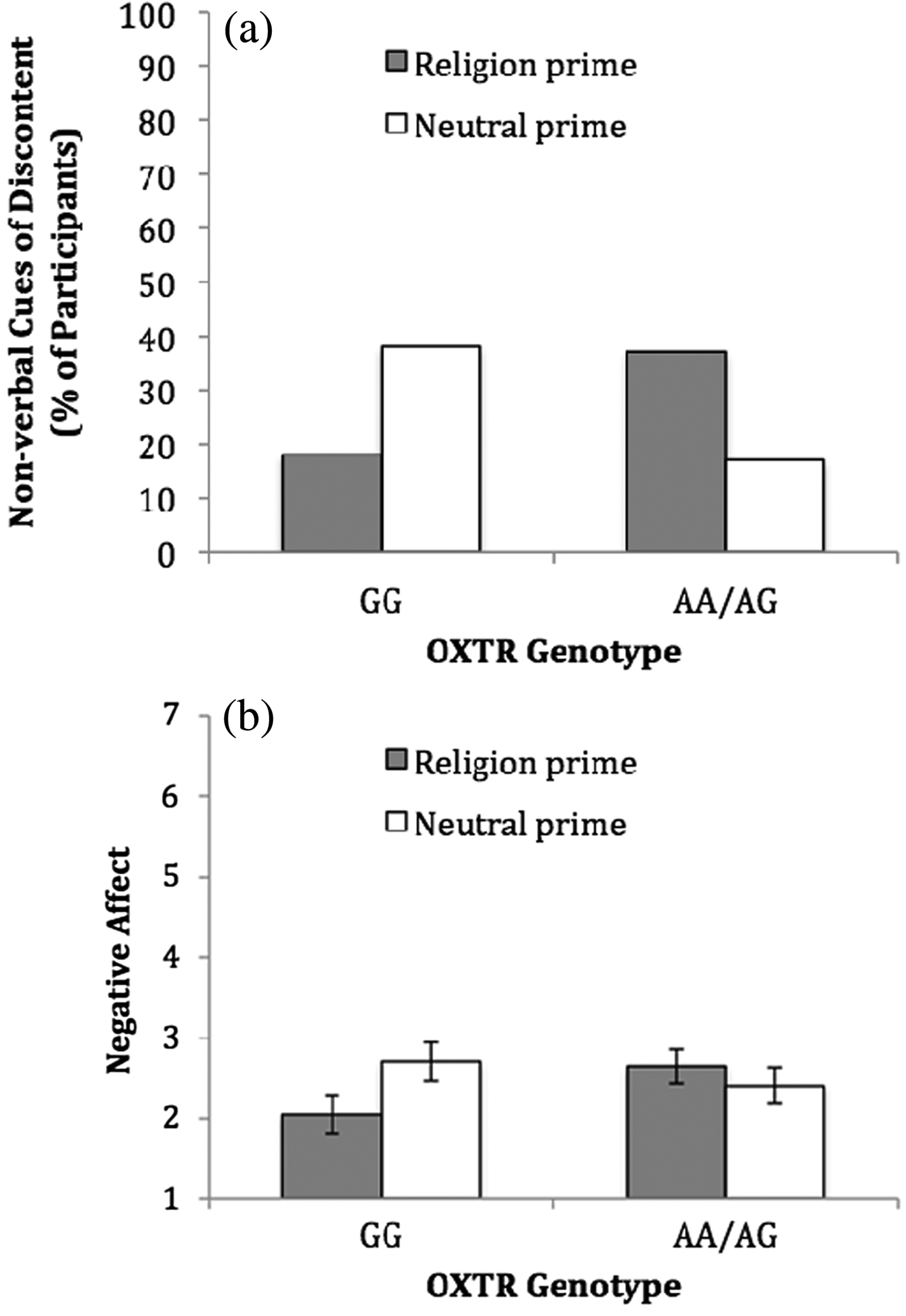
If participants did not say anything about the wrong prize, which was the case for the vast majority of participants (88%), we analyzed their nonverbal cues indicating discontent.Footnote 4 We conducted a 2 (prime: religion vs. neutral) × 2 (genotype: OXTR GG vs. OXTR AA/AG) × 2 (nonverbal cues: observed vs. not observed) log linear test and found no main effect of the religion prime (p = .996) or OXTR genotype (p = .92). However, there was a significant OXTR × Religion interaction, χ2 (1, N = 93) = 4.57, p = .032 (Figure 1a). Further analysis revealed that religion priming had opposite effects for people with GG genotype and people with AA or AG genotypes, although the difference within each genotype group was not significant. For people with AA/AG genotypes, nonverbal cues were slightly more frequent when primed with religion (n = 10; 37% of participants in religion condition) than not (n = 4; 17% of participants in neutral condition), χ2 (1, N = 50) = 2.38, p = .123, Φ = 0.22. However, there was an opposite pattern among people with the GG genotype, such that they were somewhat less likely to display nonverbal cues of discontent when they were primed with religion (n = 4; 18% of participants in religion condition) compared to when they were not primed with religion (n = 8; 38% of participants in neutral condition), χ2 (1, N = 43) = 2.12, p = .146, Φ = –0.22. Next we conducted a similar log linear test including DRD4 instead of OXTR genotype as a factor, and the analysis showed no significant main effect of DRD4 (p = .59) and no interaction between DRD4 and the religion prime (p = .56).
Effect of religion priming on nonverbal cues of (a) discontent and (b) negative affect by OXTR genotype.

To examine the effects of the religion prime and genotype on expressed negative affect, we conducted a 2 (prime: religion vs. neutral) × 2 (genotype: OXTR GG vs. OXTR AA/AG) ANOVA on negative affect. Although there was no main effect of prime, F (1, 89) = 0.94, p = .34, or OXTR genotype, F (1, 89) = 0.45, p = .50, the predicted interaction between prime and OXTR genotype was significant, F (1, 89) = 4.07, p = .047, η2 = 0.04 (Figure 1b). Pairwise comparisons showed that people with the GG genotype expressed lower negative affect when they were primed with religion (M = 2.05, SD = 0.72) than when they were not primed with religion (M = 2.71, SD = 1.16), F (1, 89) = 4.15, p = .045, d = 0.68. However, people with AA or AG genotypes did not show a difference in negative affect between the religion (M = 2.65, SD = 1.15) and neutral priming conditions (M = 2.41, SD = 1.18), F (1, 89) = 0.59, p = .44. In addition, the difference in expressed negative affect by genotype emerged in the religion condition, F (1, 89) = 3.81, p = .054, d = 0.63, but not in the neutral condition, F (1, 89) = 0.86, p = .36. We also conducted an ANOVA with DRD4 rather than OXTR as a factor, and the results showed no significant main effect of DRD4 (p = .67) and no DRD4 × Religion interaction (p = .57).
Effects on self-control responses in a nonsocial context
We then examined participant responses in a nonsocial context, after the experimenter left the testing room and let the participant complete the posttask prize evaluation sheet alone. To examine nonverbal responses, we conducted a 2 (prime: religion vs. neutral) × 2 (genotype: OXTR GG vs. AA/AG) × 2 (nonverbal cues: observed vs. not observed) log linear test and found no main effects and no Gene × Religion interaction (all ps > .49). The frequency of nonverbal cues in a nonsocial context was not significantly different for people with GG genotypes whether they were primed with religion (64%) or not (57%) compared to those with AA/AG genotypes whether they were primed with religion (59%) or not (67%). A similar log linear analysis using DRD4 instead of OXTR yielded no significant main effect of DRD4 (p = .83) and no interaction of DRD4 and religion prime (p = .59).
Next we focused on expressed negative affect in a nonsocial context as the outcome. A 2 (prime: religion vs. neutral) × 2 (OXTR genotype: GG vs. AA/AG) ANOVA on negative affect revealed no main effects of either the religion prime, F (1, 90) = 0.20, p = .66, or OXTR genotype, F (1, 90) = 0.24, p = .63. In addition, the interaction between the religion prime and OXTR genotype was not significant, F (1, 90) = 1.71, p = .19, suggesting that there was not a significant difference in the effect of the religion prime on negative affect for those with GG genotypes (religion prime: M = 2.91, SD = 1.30; neutral prime: M = 3.38, SD = 1.47) versus AA/AG genotypes (religion: M = 3.13, SD = 1.34; neutral: M = 2.89, SD = 1.09) in a nonsocial context. In a parallel analysis entering DRD4 rather than OXTR in an ANOVA, there was no significant main effect of DRD4 (p = .90) and no DRD4 × Religion interaction (p = .89).
Effects on self-reported prize evaluations
For those who did not ask for the correct prize, we also examined their appraisals of the distressing situation in a 2 (prime: religion vs. neutral) × 2 (OXTR genotype: GG vs. AA/AG) ANOVA with posttask evaluations of their last-choice prize as the dependent variable, controlling for pretask prize evaluations.Footnote 5 Results showed no main effect of the religion prime, F (1, 88) = 1.21, p = .28, or OXTR genotype, F (1, 88) = 0.52, p = .47, and no interaction, F (1, 88) = 0.02, p = .88. A subsequent ANOVA using DRD4 rather than OXTR as a factor also showed no main effect of DRD4 (p = .90) and no interaction of DRD4 and the religion prime (p = .48).
Discussion
The main findings from this study showed that OXTR genotype interacts with religion priming to affect certain self-control responses in a particular context. Consistent with previous research on religion and self-control behaviors (Sasaki & Kim, Reference Sasaki and Kim2011), this study found that European Americans adjusted themselves and accepted the situation more when they thought about religion without their awareness versus not. That is, the religion prime made them less likely to ask for the correct prize, indicating greater self-control as they coped with the distressing situation. This research demonstrated an interaction between OXTR and religion priming on behaviors relevant to self-control. The implicit religion prime seemed to make people more likely to engage in self-control, as evidenced by fewer cases of nonverbal distress cues and lower levels of observed negative affect, but more so for people who were genetically predisposed to be more socially sensitive, because there was no effect of the religion prime on self-control for those predisposed to be less socially sensitive. This genetic moderation finding builds on the perspective of differential susceptibility (Belsky et al., Reference Belsky, Jonassaint, Pluess, Stanton, Brummett and Williams2009) by demonstrating that people with GG genotypes of OXTR may be more sensitive to certain influences in the environment compared to people with AA or AG genotypes. Furthermore, this interaction emerged in a social context, when people were responding face to face with the experimenter; the effect did not occur when people later reacted in a private, nonsocial context. The influence of religion priming on self-control seems to be associated with social sensitivity at the level of genes, but critically, this genetic moderation occurs only when the context allows for it.
This study also included an analysis of DRD4 in order to test the extent to which the results for OXTR may be polymorphism specific, and the results showed an unexpected interaction between the religion prime and DRD4 on verbal complaints about the prize. Whereas the religion prime did not seem to impact people without DRD4 susceptibility genotypes, there was a significant effect for people with DRD4 susceptibility genotypes, such that fewer people made verbal complaints when primed with religion than not primed with religion. However, among people who did not ask for the correct prize, there were no DRD4 × Religion interactions on nonverbal cues or on negative affect. There is some evidence from past research that people with DRD4 susceptibility genotypes may be more likely to exhibit risky behavior than those without susceptibility genotypes (Kuhnen & Chiao, Reference Kuhnen and Chiao2009; Pérez de Castro, Ibáñez, Torres, Sáiz-Ruiz, & Fernández-Piqueras, Reference Pérez de Castro, Ibáñez, Torres, Sáiz-Ruiz and Fernández-Piqueras1997) but that these types of behaviors can be reduced by appropriate interventions. For example, Bakermans-Kranenburg, van IJzendoorn, Pijlman, Mesman, and Juffer (Reference Bakermans-Kranenburg, van IJzendoorn, Pijlman, Mesman and Juffer2008) demonstrated reduced externalizing behavior in children with DRD4 susceptibility genotypes using an intervention of maternal sensitivity and discipline training. We speculate that, in the present study, perhaps people with DRD4 susceptibility genotypes were less likely to show “risky,” externalizing behavior in the form of directly confronting the experimenter to ask for the correct prize because, when reminded of religion, they believed their direct verbal responses had some consequence for the prospect of reward, whereas perhaps this is not the case for their less direct, nonverbal, socioemotional responses. We return to this issue in more detail in the Specificity of Psychological Outcomes Section.
Finally, the results showed that the religion prime did not affect people's evaluations of the prize they received; furthermore, there was no Gene × Religion interaction on this outcome. These findings are consistent with previous research on religion and self-control showing that religion priming influenced people's publicly expressed behavioral responses to receiving the wrong prize, but not necessarily how much they actually liked the prize in the moment (Sasaki & Kim, Reference Sasaki and Kim2011). The effects on behavioral responses but not prize evaluations may help rule out the possibility that the religion prime increased participants' indifference toward receiving the wrong prize rather than impacting self-control per se. The results of the current study demonstrated that participants still did not like the prize after being primed with religion, but rather, they may have been motivated to exert self-control by hiding their disappointment from the experimenter for social reasons. Taking the prize evaluation findings together with the behavioral responses, it seems that religion priming made people with greater social sensitivities more likely to control how they expressed their experience of discontent.
Reconsidering the environment and psychological processes in G × E research
These findings contribute to genetic moderation research on OXTR by situating its influence within the context of sociality. As has been demonstrated by past research on socially relevant effects of OXTR, the social part of the environment is often crucial for observing differences in genetic predispositions to social sensitivity (Chen et al., Reference Chen, Kumsta, von Dawans, Monakhov, Ebstein and Heinrichs2011; Kim, Shermn, Sasaki, et al., Reference Kim, Sherman, Sasaki, Xu, Chu and Ryu2010). In many cases, there seem to be no observable differences in the way people with different OXTR genotypes behave in the absence of relevant social cues. Chen et al. (Reference Chen, Kumsta, von Dawans, Monakhov, Ebstein and Heinrichs2011), for instance, found no difference in the behaviors of people with different OXTR genotypes when there was no interpersonal exchange of social support; the effect of genotype emerged only in the context of a social support transaction. Similarly, Kim, Sherman, Sasaki, et al. (Reference Kim, Sherman, Sasaki, Xu, Chu and Ryu2010) provided evidence that people with different OXTR genotypes seek emotional support differently, but the effect was contingent on an individual's feelings of distress and the surrounding cultural norms that encourage certain types of social support seeking. In the present study, we did not find a Gene × Religion interaction on self-control when people were alone, in a nonsocial context. However, when people were directly interacting with another person, the interaction between OXTR and the religion prime emerged, suggesting that the social component of the environment was a key factor.
The current findings also raise the issue of how to conceptualize the environment for gene–environment interaction studies in general. Which aspects of the environment ought to be relevant for G × E interactions and why? Existing research has discussed genetic moderation findings in terms of vulnerability to stressful environments (Caspi et al., Reference Caspi, McClay, Moffitt, Mill, Martin and Craig2002, Reference Caspi, Sugden, Moffitt, Taylor, Craig and Harrington2003) and as differential susceptibility to both beneficial and harmful environmental influences, “for better and for worse” (Belsky et al., Reference Belsky, Bakermans-Kranenburg and van Ijzendoorn2007, Reference Belsky, Jonassaint, Pluess, Stanton, Brummett and Williams2009). Yet some types of environments are not clearly risky or supportive in and of themselves, although the organism in that particular environment may experience outcomes that impact fitness to varying degrees. Some psychological outcomes of Gene × Religion effects can arguably be construed in adaptive terms. For example, prosocial behavior toward strangers or nonspecific others, as an outcome of religion priming (Pichon Boccato, & Saroglou, Reference Pichon, Boccato and Saroglou2007; Sasaki et al., Reference Sasaki, Kim, Mojaverian, Kelley, Park and Janušonis2013; Shariff & Norenzayan, Reference Shariff and Norenzayan2007), may confer fitness advantages to the extent that an organism is often uncertain about the chances of future interactions with strangers (Delton, Krasnow, Cosmides, & Tooby, Reference Delton, Krasnow, Cosmides and Tooby2011). However, the environment in the present research was manipulated using a situational prime of religion, which in itself may or may not be adaptive from an evolutionary standpoint. There is an ongoing debate about the extent to which religion itself has adaptive value (Bulbulia, Reference Bulbulia2004) or is a by-product of multiple adaptive cognitive mechanisms (Boyer, Reference Boyer2001, Reference Boyer2003), but the main point is that a religious environment is not as clearly construed as wholly beneficial or harmful compared to some child-rearing environments, for instance, that can more easily be conceptualized as supportive versus abusive.
Because the valence of the religion prime itself, and the adaptive value of a religious environment in general, is less clear, the “environment” in the current Gene × Environment study is likely not best understood as beneficial or as harmful. Similarly, research that examines culture as a form of environment (Kim et al., Reference Kim, Sherman, Mojaverian, Sasaki, Park and Suh2011; Kim, Sherman, Sasaki, et al., Reference Kim, Sherman, Sasaki, Xu, Chu and Ryu2010; Kim, Sherman, Taylor, et al., Reference Kim, Sherman, Taylor, Sasaki, Chu and Ryu2010) does not conceptualize culture as a uniformly beneficial or harmful environment; rather, the way people respond to cultural environments may potentially result in adaptive benefits to different extents. It seems that a broader range of environments may be relevant for Gene × Environment studies than what has previously been considered. Thus, the field would benefit from stronger theoretical understandings of how people with certain genetic predispositions may be more influenced by particular environments, which may themselves be neither beneficial nor harmful, to ultimately lead to psychological outcomes that may confer either advantages or disadvantages.
As in many G × E studies, there is also the question of which psychological processes are at play and how they fit within existing theories of genetic moderation. In the current results on self-control and in previous findings on prosocial behavior (Sasaki et al., Reference Sasaki, Kim, Mojaverian, Kelley, Park and Janušonis2013), there appears to be a gene-related difference, not in the general effectiveness of the implicit religion prime, but in the way religion motivates subsequent behavior. People reported higher levels of religiosity when they were primed with religion versus not, and this effect was not moderated by DRD4 or OXTR genotype, suggesting that people are just as likely to think of themselves as more religious in response to an implicit religion prime regardless of sensitivity to reward (DRD4-related) versus socioemotional (OXTR-related) cues. Thus, DRD4 and OXTR genotype may not make people more or less attentive to the religion prime itself, but rather, once people are exposed to a prime of religion, people with different genotypes use the information in divergent ways depending on the particular gene of interest. People with susceptibility variants of DRD4 who are primed with religion may show more prosocial behavior because they are motivated by the prospect of reward (or absence of punishment), and people with certain OXTR genotypes who are primed with religion may show greater self-control because they are motivated by social sensitivities. This research thus makes a unique contribution to the literature on genetic moderation by suggesting that, at the level of psychology, differential susceptibility does not seem to manifest as differential attention to environmental stimuli. Instead, when people with susceptibility genotypes think about religion without their awareness, they are more likely to use that information to cope with a distressing situation by exerting greater control over their responses for the sake of sociality; people without genetic susceptibility are just as likely to think about religion beneath awareness in response to a situational prime, but they do not seem to use that information to cope via self-control. Therefore, people with susceptibility genotypes may not necessarily be more likely to notice social stimuli in the first place; it is what they subsequently do with that information, how the situational prime translates into behavior, that differs.
Specificity of psychological outcomes
As findings on OXTR and other oxytocin-related genes accumulate, there is a general pattern appearing in the types of behaviors that tend to be linked to oxytocin. Social behaviors that require perceiving others' emotions and interacting with them in a way that is sensitive to social cues are the kinds of behaviors that often appear to be implicated in investigations involving oxytocin (Bakermans-Kranenburg & van IJzendoorn, Reference Bakermans-Kranenburg and van IJzendoorn2008; Rodrigues et al., Reference Rodrigues, Saslow, Garcia, John and Keltner2009; Wu et al., Reference Wu, Jia, Ruan, Liu, Guo and Shuang2005). Yet as the body of scientific evidence on oxytocin has grown, so too has the realization that there is much left to be discovered on this topic. Because it is rarely the case that a gene or set of genes predicts psychological outcomes directly and uniformly across contexts, researchers should aim to consider when genetic associations of psychological outcomes exist and why. The present research moves in this direction by demonstrating that genetic (OXTR) moderation of religion occurred primarily in a social context. A clearer understanding of oxytocin's role in social behavior may require an interactionist approach (Bartz et al., Reference Bartz, Zaki, Bolger and Ochsner2011) or a differential susceptibility approach (Belsky et al., Reference Belsky, Bakermans-Kranenburg and van Ijzendoorn2007), which consider how individual differences and aspects of the social context may elicit or constrain biological effects across development.
Another interesting question is whether the OXTR × Religion interaction demonstrated in this study applies to all aspects of self-control, or only to specific forms of self-control, such as those centered on emotion-based responses (e.g., emotion regulation, which is a specific case of self-control; Tice & Bratslavsky, Reference Tice and Bratslavsky2000). Given that self-control involves overriding a response that can be a behavior, emotion, or motivation (McCullough & Willoughby, Reference McCullough and Willoughby2009), the present study included coded responses that indicated behavior, emotion, and motivation. One aspect of our coding involved rating the extent to which participants appeared to regulate (i.e., express vs. suppress) feelings of negative affect, and this emotion-based measure also showed the clearest evidence of OXTR × Religion interaction, with an effect of the religion prime for GG but not for AA/AG genotypes. Yet there was no DRD4× Religion interaction for these more emotion-based measures, because the DRD4 and OXTR moderations in this study did not overlap. Although many social responses (e.g., showing vs. not showing hesitance to continue on in an upcoming task, as in the present study) incorporate some degree of emotionality, it is possible that OXTR may be especially relevant for social outcomes that highly involve emotions.
Limitations and future research
While the psychological correlates of certain genes or sets of genes may be specific to some extent, biological systems do not work in complete isolation from each other. This research does not exclude the possibility that the religion prime also interacted with unmeasured genes to influence self-control behaviors. Most behaviors are influenced by many genes, which then interact with different environments; therefore, we do not suggest that OXTR rs53576 is the only polymorphism that should be pertinent to socially relevant outcomes. Future research should be conducted to replicate the initial effect and also to investigate how multiple genes may work together to interact with relevant social environments. Methods such as multilocus genetic composites (Stice, Yokum, Burget, Epstein, & Smolen, Reference Stice, Yokum, Burget, Epstein and Smolen2012) and candidate pathway analyses (Ramanan, Shen, Moore, & Saykin, Reference Ramanan, Shen, Moore and Saykin2012), which move beyond the single candidate gene approach while still allowing for hypothesis-driven testing, may be important next steps.
The present study incorporated genotyping with experimental methods to manipulate environmental conditions in a laboratory setting and also involved behavioral coding of face-to-face interactions, raising a number of limitations. First, large-scale data collection can be somewhat difficult for laboratory studies with both genotyping and social interaction components, and thus the small sample size is a limitation of this study and should be taken into account when interpreting the results. Second, the social interaction constructed in the lab was relatively brief in duration (i.e., less than 1 min). There is evidence that OXTR-relevant social behaviors can be accurately detected based on brief thin-slice observations (Kogan et al., Reference Kogan, Saslow, Impett, Oveis, Keltner and Saturn2011); however, it would be informative to combine the current findings with research on longer social interactions in the lab and longitudinal studies to provide greater ecological validity. Third, our main measure of self-control in this study involved observations of behavioral responses, and we also directly asked participants for their evaluations of the prize in order to rule out the possibility that participants simply felt indifferent to the prize after the religion prime. It will be useful for future investigations to include other measures of self-control, such as persistence on a difficult task or resisting temptation (Baumeister, Bratslavsky, Muraven, & Tice, Reference Baumeister, Bratslavsky, Muraven and Tice1998), to establish whether the present results conceptually replicate across different measures of self-control.
The findings should also be understood with the cultural and developmental background of the participants in mind. In this study, we did not predict, nor did we find, that religion priming increased self-control for East Asians (consistent with Sasaki & Kim, Reference Sasaki and Kim2011); neither did we find that the religion prime interacted with OXTR to influence self-control behaviors for this cultural group. Thus, the current results may be more generalizable to cultures that tend to be characterized by individualism rather than collectivism. This study also focused on a young adult sample to understand how people who have already formed meaningful representations of the concept of religion may respond to environmental inputs such as a religious prime. It is critical that once people have formed an understanding of religion, the way they respond to the situational salience of religion in the external environment may vary depending on genetic predispositions. It will be important for future research to continue to clarify the developmental processes in which different genetic variants interact with environments across the life span to build psychological mechanisms, which then regulate the way people think and behave (Belsky et al., Reference Belsky, Jonassaint, Pluess, Stanton, Brummett and Williams2009).
Implications for distress and psychopathology
Considering the social or cultural surroundings in G × E interaction research holds great promise for predicting health outcomes. Past research has shown that religion may alleviate distress for some by increasing self-control (McCullough & Willoughby, Reference McCullough and Willoughby2009; and more specifically, secondary control: see Weisz et al., Reference Weisz, Rothbaum and Blackburn1984) and encouraging social affiliation (Ellison & George, Reference Ellison and George1994), and the current study used genetic moderation in a novel experiment to suggest one way in which these two pathways of religious influence may converge. That is, for people who are more motivated toward social affiliation, thinking about religion may allow them to control themselves more, which can have implications for mental health. A more complete understanding of religion's role in mental health will ultimately require evidence at multiple levels of analysis. Research will need to uncover not only the psychological mechanisms through which religious involvement leads to health-related behaviors but also whether people may have different biological predispositions underlying their motivation to engage in those behaviors, and whether the broader social environment is optimally responsive to an individual's distress. Both control and social affiliation have been proposed as potential mediators of the link between religiosity and health (Ellison & Levin, Reference Ellison and Levin1998), and the current findings highlight the need for new models that consider how these mediators relate to each other and how genes may play a role.