INTRODUCTION
Anisakis simplex is a parasitic nematode that infects fish worldwide, including anadromous and catadromous species. Anisakis simplex complex comprises three sibling species: A. simplex sensu stricto (s.s.), A. pegreffii and A. simplex C. Anisakis simplex s.s. is distributed in the northern hemisphere (Mattiucci et al., Reference Mattiucci, D'Amelio and Rokicki1989).
Anisakis has an indirect, heteroxenous life cycle that involves a number of stages and hosts including marine mammals (cetaceans) as definitive hosts, crustaceans (primarily euphausiids) as first intermediate hosts, and many fish species and cephalopods acting as paratenic hosts (Mattiucci et al., Reference Mattiucci, Nascetti, Cianchi, Paggi, Arduino, Margolis, Brattey, Webb, D'Amelio, Orecchia and Bullini1997; Gutiérrez-Galindo et al., Reference Gutiérrez-Galindo, Osanz-Mur and Mora-Ventura2010). Fish become infected as they feed on other infected hosts. Once ingested the parasite migrates out from the gastrointestinal tract into the body cavity, with liver and pyloric caeca being the most common locations, or to the musculature, where it often encysts (Audicana et al., Reference Audicana, del Pozo, Iglesias, Ubeira, Miliotis and Bier2003; Smith & Hemmingsen, Reference Smith and Hemmingsen2003). It was not until the description of red vent syndrome (RVS) that evidence was provided on the vent as a location for large numbers of the parasite, at least for Atlantic salmon (Beck et al., Reference Beck, Evans, Feist, Stebbing, Longshaw and Harris2008; Noguera et al., Reference Noguera, Bruno, Pert and Webb2008, Reference Noguera, Beck, Williams and Longshaw2009a, Reference Noguera, Collins, Bruno, Pert, Turnbull, McIntosh, Lester, Bricknell, Wallace and Cookb).
Moreover, accidental human infections by the larval stages of the genus Anisakis can produce anisakiasis, an important fish-borne zoonosis (Mattiucci et al., Reference Mattiucci, Paoletti, Borrini, Palumbo, Macarone Palmieri, Gomes, Casati and Nascetti2011) and infestation may also result in allergic reactions (Audicana et al., Reference Audicana, Ansotegui, Fernández de Corres and Kennedy2002; Audicana & Kennedy, Reference Audicana and Kennedy2008).
Anisakis simplex shows a low degree of host specificity and consequently, a wide variety of unrelated fish species are infected with the third-stage larvae (L3) (Smith & Hemmingsen, Reference Smith and Hemmingsen2003). Infection is common in commercial species such as Atlantic cod (Gadus morhua), haddock (Melanogrammus aeglefinus), whiting (Merlangus merlangus), mackerel (Scomber scombrus) and herring (Clupea harengus) (Wootten & Waddell, Reference Wootten and Waddell1977; Valdimarsson et al., Reference Valdimarsson, Einarsson and King1985; Levsen & Lunestad, Reference Levsen and Lunestad2010). Wild Atlantic salmon is one of the many paratenic hosts of A. simplex s.s. in the marine environment. This host represents a significant economic resource that despite strong conservation measures, has experienced a decline in abundance (Mills et al., Reference Mills, Pershing, Sheehan and Mountain2013). This has been attributed to different factors including the effects of overfishing, freshwater habitat loss and changing oceanic conditions (Todd et al., Reference Todd, Friedland, MacLean, Whyte, Russell, Lonergan and Morrissey2012; Dittmer, Reference Dittmer2013; Friedland et al., Reference Friedland, Shank, Todd, McGinnity and Nye2013).
Investigations into the cause of RVS in wild Atlantic salmon started in the UK in 2007 following widespread reporting of the syndrome, although anecdotal information from anglers and field biologists indicated that sporadic observations compatible with RVS had been observed as early as 2005. Initial descriptions including the pathology, a severity index and the link with the nematode larvae A. simplex as causal agent were reported in the UK, with further analysis using molecular tools identifying the larvae as A. simplex sensu stricto (s.s.) (Noguera et al., Reference Noguera, Beck, Williams and Longshaw2009a, Reference Noguera, Collins, Bruno, Pert, Turnbull, McIntosh, Lester, Bricknell, Wallace and Cookb). RVS has currently been reported from wild Atlantic salmon in Canada, Ireland, Iceland and Norway (Helgason et al., Reference Helgason, Slavko and Kristmundsson2008; Noguera et al., Reference Noguera, Collins, Bruno, Pert, Turnbull, McIntosh, Lester, Bricknell, Wallace and Cook2009b; Mo et al., Reference Mo, Senos, Hansen and Poppe2010; Larrat et al., Reference Larrat, Bouchard, Séguin and Lair2013), and recently from Atlantic salmon captured in Greenland waters (P. Noguera and J. Webb, personal observations), but no other fish species has been analysed or reported positive.
Annual prevalence of RV has been recorded in salmon returning to rivers by the Environmental Agency (EA) for England and Wales since 2005, and in Scotland by Marine Scotland Science (MSS) since 2008. A variable prevalence has been reported from Scottish salmon depending on year and river (Pert et al., Reference Pert, Noguera and Bruno2009). This confirms previous observations that after several months in fresh water, the external lesions start to resolve and become less obvious, with no evidence to date that the condition affects artificially spawned fish or contributes to mortality during fresh water migration (Noguera et al., Reference Noguera, Collins, Bruno, Pert, Turnbull, McIntosh, Lester, Bricknell, Wallace and Cook2009b; Mo et al., Reference Mo, Senos, Hansen and Poppe2010).
The novel location in the salmon host for this parasite prompted the current investigation to provide data on accurate distribution and number of larvae in affected RV fish, to determine the relative importance of the vent as a site of infestation and to confirm the identity of the larvae from the vent and elsewhere in the affected salmon.
MATERIALS AND METHODS
Fish
Destructive sampling of large numbers of valuable wild Atlantic salmon is deemed unacceptable due to the fragile state of the stocks returning to many Scottish rivers, therefore, lethal sampling was restricted. Following the work carried out in 2007/2008, permission was sought during 2009 to sample a maximum of 10 fish for this study from a research netting station at Strathy Point, Scotland (58°06′N 04°00′W), an area that represents fish returning mainly to Scottish rivers on both east and west coasts (Shearer, Reference Shearer1992). The salmon analysed represent the same location as the stock from where RVS was first recorded in 2007. Fish were caught in commercial shore-based bag nets and killed. Based on external appearance of the vent area fish were allocated a severity score as previously described (Noguera et al., Reference Noguera, Collins, Bruno, Pert, Turnbull, McIntosh, Lester, Bricknell, Wallace and Cook2009b). Briefly, mildly affected fish showed a general reddening around the vent, sometimes with discrete petechial haemorrhage but limited swelling of the area. The moderate stage comprised a more widespread erythema in the surrounding area (~25–30 mm) with associated mild swelling, conspicuous foci of petechial haemorrhage and scale lifting. The severe stage of RVS comprised a marked protrusion of the vent area with generalized haemorrhage, swelling, breakdown of the skin surface, scale loss and bleeding.
Fish were individually labelled, bagged and transported surrounded with ice in polystyrene boxes. Several scales were removed from each fish and examined to assess fish age. Sampling was completed within 24 h, in line with Karl et al. (Reference Karl, Baumann, Ostermeyer, Kuhn and Klimpel2011) who demonstrated no difference in larval migration between fresh salmon caught and immediately gutted and individuals stored un-gutted for 24 h. Each fish was weighed (total fish weight = TFW) and photographed. The vent area was then dissected from the fish by cutting a block of tissue approximately 2 cm around the vent and uro-genital papilla (Figure 1) and placed into a Petri dish for examination. Initial collection of nematode larvae from the vent for molecular studies was performed at this stage, the number depending on the relative presence in each fish (range 10–13 larvae/fish). The body cavity was opened by dissecting along the middle line of the ventral surface allowing full access to the internal organs. If nematode larvae were obvious within the cavity, up to 10 were also removed and preserved for molecular studies. The head, tail and fins of each fish were then dissected as these portions were not used for the digestion process (see below). The fish carcass was further dissected into portions representing the front, middle and rear portions of the body, separating each into left and right sides, and the peduncle area (Figure 1). Therefore, both epaxial and hypaxial muscle are included in all analysed portions.
Location of body portions examined for the presence of Anisakis simplex from wild Atlantic salmon, Salmo salar. Fl, Front left; Ml, Middle left; Rl, Rear left; P, peduncle; V, vent. Note there are also right side equivalents for Front (Fr), Middle (Mr) and rear (Rr) portions.

Body portions other than the viscera (Vi) were defined as follows:
– Front (F) (l and r sides): from the pectoral fins to the anterior end of the dorsal fin (corresponding to the body portion around the stomach, liver and pyloric caeca).
– Middle (M) (l and r sides): portion just below the entire length of the dorsal fin base.
– Rear (R) (l and r sides): portion from the posterior end of the dorsal fin, to the anterior end of the anal area (minus the excised vent region).
– Peduncle (P): from the anal fin towards the peduncle in a single piece.
– Vent (V): includes the perianal region (the genital cavity and pore, the last portion of the urinary canal and the surrounding tissues of the posterior abdominal wall).
Therefore for each fish, nine portions were placed into separate labelled bags, weighed and kept frozen at −20°C until processed by enzymatic digestion. The cumulative weight of all processed portions (processed weight, PW) rather than TFW was used for most of the data analysis. All the viscera removed from the body cavity were chemically digested, with the exception of the gastrointestinal tract that was processed manually under a dissecting microscope. The nematode counts reported for viscera correspond to the total numbers found through both approaches.
Enzymatic digestion
Body portions were removed from the freezer ~12 h beforehand to allow for defrosting. The fish digestion methodology was an adaptation of the method described by Jackson et al. (Reference Jackson, Bier, Payne and McClure1981). The weight of individual portions was used to calculate the volume of digestion fluid required for each, in order to maintain a proportion of 1 l for up to 200 g of tissue. The digestion solution comprised 25 g pepsin digest powder (Sigma) per litre of 0.85% NaCl, and the pH was reduced to 2.0 using 3 N hydrochloric acid. Individual beakers were used for each portion, placed into a water bath at 40°C with agitation and left for 24 h. After digestion, the contents of each beaker were sieved through a 1 and 0.5 mm mesh into black plastic containers to aid the collection of nematode larvae. Larvae were counted and placed into labelled tubes with 70% ethanol and identified using the keys of Moravec (Reference Moravec2004). Biometric measurements of larvae were made using a digital calliper (Digimax, Camlab UK).
Molecular identification
Larvae removed pre-digestion from the body cavity and the vent area were stored in 100% ethanol and used for molecular analysis. In total 95 nematodes from the 10 fish were examined. DNA was extracted from the parasite tissue using the DNeasy Tissue Kit (Qiagen) according to manufacturer's instructions and eluted in 100 μl elution buffer, or in 30 μl lysis buffer as described by Cunningham et al. (Reference Cunningham, Mo, Collins, Buchmann, Thiery, Blanc and Lautraite2001) and the crude lysate used in further steps.
The internal transcribed spacer (ITS) region of the nematodes’ ribosomal DNA (rDNA) was amplified using the primers A (forward) (5′-GTCGAATTCGTAGGTGAACCTGCGGAAGGATCA-3′) and B (5′-GCCGGATCCGAATCCTGGTTAGTTTCTTTTCCT-3′), as given in Bachellerie & Qu (Reference Bachellerie, Qu and Hyde1993); in D'Amelio et al. (Reference D'Amelio, Mathiopoulus, Santos, Pugachev, Webb, Picanço and Paggi2000). The PCR reaction mix contained: 1 × NH4 Buffer (Bioline), 1.5 mM MgCl2, 0.25 mM dNTPs, 0.5 μM each primer, 6.25 units BioTaq Taq polymerase (Bioline), 2.5 μl crude lysate or eluted DNA and PCR grade water (Sigma) to a final volume of 50 μl. PCR cycling conditions were as follows: 95°C for 10 min followed by 35 cycles of 95°C for 30 s, 55°C for 30 s, 72°C for 75 s, followed by 72°C for 10 min.
The ITS PCR products were visualized on an ethidium bromide stained agarose gel (2%) and purified using the MinElute Gel Purification kit (Qiagen). Restriction Fragment Length Polymorphism (RFLP) analysis was carried out on the purified ITS PCR products using the restriction enzymes Hinfl and HhaI (D'Amelio et al., Reference D'Amelio, Mathiopoulus, Santos, Pugachev, Webb, Picanço and Paggi2000; Abollo et al., Reference Abollo, Paggi, Pascual and D'Amelio2003; Pontes et al., Reference Pontes, D'Amelio, Costa and Paggi2005; Umehara et al., Reference Umehara, Kawakami, Araki and Uchida2007).
Data analysis
Data gathered during the study were statistically analysed to examine the significance of the observations. A Spearman's rank-order correlation was used to determine if there was a correlation between fish weight or sex and number of Anisakis larvae, and used to determine if there was any correlation between the condition factor of the fish and the total vent region counts of A. simplex larvae.
Non-parametric Mann–Whitney U tests were used to investigate difference in number of A. simplex numbers between the vent and viscera, peduncle, as well as between the left and right portions of the fish, including front, middle and rear sections, and in the mean length of A. simplex from the viscera and vent. A one-way ANOVA was used to determine any significant differences between the numbers of parasites per gram of tissue from the different body portions. All analyses were carried out using the statistical package Minitab® version 15 (Minitab Inc., USA). Infestation intensity was obtained by dividing the number of larvae recovered from digestion by the weight of each portion of the fish (processed weight). The terms prevalence, intensity and abundance are used to describe parasite infestation data following Bush et al. (Reference Bush, Lafferty, Lotz and Shostak1997).
RESULTS
Fish
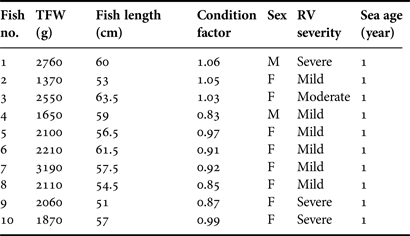
The Atlantic salmon used for this study comprised two males and eight females weighing between 1.37–3.19 kg (Table 1). The scale reading indicated fish had returned to Strathy Point after 1 year in the sea. Low numbers of sea lice, Lepeophtheirus salmonis (1–5) were observed on eight out of 10 salmon, confirming the fish were returning from the sea and had not yet migrated into fresh water. RVS occurred in both sexes with external scores from very mild to severe, although moderate severity was only recorded in one female (Table 1). The fish gut was devoid of food and parasite larvae were recorded visually within the body cavity (viscera, peritoneum and musculature) from all fish, and externally, around the vent of two of the severely affected fish. External severity scores did not show correlation with condition factor, fish weight or sex (Table 1).
Data obtained from wild Atlantic salmon, Salmo salar, collected from Strathy Point, Scotland.
Larvae distribution
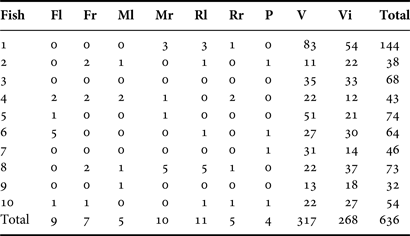
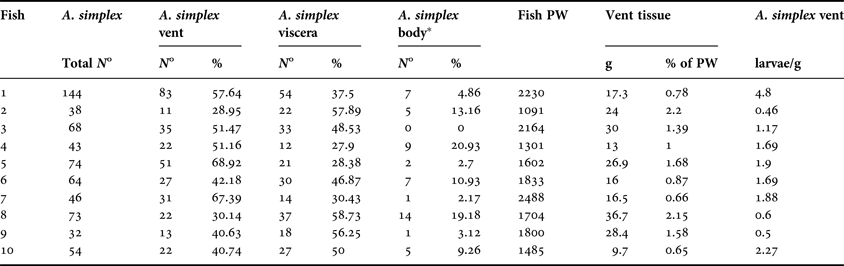
A total of 702 anisakidae larvae were collected from the 10 salmon. Anisakis simplex sensu lato, Hysterothylacium aduncum and Pseudoterranova decipiens were identified through morphological criteria (Moravec, Reference Moravec2004). From the total, 636 larvae corresponded to A. simplex s.s., the only species found in all nine body portions. Very low numbers of larvae were recovered from any of the bulk skeletal muscle portions (Table 2) and there was no difference in the mean number of A. simplex s.s. larvae in the F, M or R portions, therefore data from these and P portions are collated for analysis as ‘other body portions’ (Table 3). No significant correlation was found between the PW and total A. simplex s.s. count per fish (Table 3).The average vent weight was 21.9 g, ranging from 0.65 to 2.20% of the fish PW (Table 3). The most heavily infected portions were the vent and viscera, with relatively few larvae in all the main portions of bulk skeletal musculature. Results show that the vent harboured the highest total number of larvae per fish, irrespective of the presence of clinically observable RVS, and proportionally to biomass, was also the most heavily infested region (Table 3). Overall 49.84% of all A. simplex larvae were recovered from the vent area, 42.14% from the viscera and 8.02% from the other body portions (Table 3). The mean number of A. simplex larvae per gram of vent tissue was 1.70, with the vent representing on average just 1.3% of the total fish PW (Table 3). Infestation intensity of A. simplex in each body portion, expressed as a percentage of the total number found in the fish, is presented in Figure 2. Vent and viscera are clearly the most important locations and in some cases, the viscera harbours a higher number than found in the vent. When data are expressed as number of larvae per gram (g) of tissue by body portion (Figure 3), with 0.46–4.80 the vent becomes the most relevant location for all the fish analysed, with 0.22–0.63 for the viscera, 0–0.008 for the peduncle and 0–0.022 for the F, M and R segments. Analysis of data showed the number of parasites per g of tissue was significantly higher in the vent compared with other body portions (F 1,18 = 11.79, P < 0.01). In addition, the mean length of A. simplex from the viscera (17.94 mm ± 2.98 SD) was longer than those from the vent (16.00 mm ± 2.65 SD) (P < 0.001), based upon 175 nematodes (91 vent and 84 viscera).
Anisakis simplex s.s. recovered from each body portion, expressed as proportion of the total load per fish.
Anisakis simplex s.s. recovered from each body portion, as number of larvae per gram of processed tissue.
Total number of recovered Anisakis simplex s.s. larvae by body portion.
Processed data from wild Atlantic salmon, Salmo salar collected from Strathy Point, Scotland.
*Cumulative larvae recovered from F, M and R (left and right) and P portions.
PW, processed weight (g).
Molecular genetics
RFLP patterns were obtained for 84 nematodes, comprising of 41 from the body cavity and 43 from the vent. Another 11 specimens failed to give amplification products. All specimens were identified as A. simplex s.s. based on HinfI and HhaI RFLP patterns (D'Amelio et al., Reference D'Amelio, Mathiopoulus, Santos, Pugachev, Webb, Picanço and Paggi2000; Umehara et al., Reference Umehara, Kawakami, Araki and Uchida2007).
DISCUSSION
Prior to the initial reports of Beck et al. (Reference Beck, Evans, Feist, Stebbing, Longshaw and Harris2008) and Noguera et al. (Reference Noguera, Bruno, Pert and Webb2008, Reference Noguera, Collins, Bruno, Pert, Turnbull, McIntosh, Lester, Bricknell, Wallace and Cook2009b) the occurrence of nematodes in the discrete area of the vent and vicinity had not been recorded for Atlantic salmon or any other fish host of anisakid larvae. In contrast, the presence of A. simplex with a high prevalence in wild salmon is documented for viscera and musculature (Beverley-Burton & Pippy, Reference Beverley-Burton and Pippy1978; Deardorff & Kent, Reference Deardorff and Kent1989; Bristow & Berland, Reference Bristow and Berland1991; Angot & Brasseur, Reference Angot and Brasseur1993; Murphy et al., Reference Murphy, Berzano, O'Keeffe, Cotter, McEvoy, Thomas, Maoiléidigh and Whelan2010; Setyobudi et al., Reference Setyobudi, Seong and Kim2010). Data show that RV in Atlantic salmon was continuously present in returning wild stocks to the Scottish rivers since the first report of RV from 2007 (Noguera et al., Reference Noguera, Collins, Bruno, Pert, Turnbull, McIntosh, Lester, Bricknell, Wallace and Cook2009b; Pert et al., Reference Pert, Noguera and Bruno2009) up to and including 2014 (J. Webb, personal communication). From the current study, only Anisakis simplex s.s. larvae were identified from the vent of all 10 salmon by PCR amplification of the ITS gene and RFLP analysis, supporting earlier findings on the identity of the sole parasite associated with RV (Noguera et al., Reference Noguera, Collins, Bruno, Pert, Turnbull, McIntosh, Lester, Bricknell, Wallace and Cook2009b). Larger studies have confirmed A. simplex s.s. as the single species of the anisakid complex present in north-east Atlantic fish (Mattiucci & Nascetti, Reference Mattiucci and Nascetti2006, Reference Mattiucci and Nascetti2008; Kuhn et al., Reference Kuhn, García-Màrquez and Klimpel2011). Nevertheless, it is recognized that two species can occur in fish caught out-with the NE Atlantic area. For example, A. simplex s.s. and A. pegreffii larvae were reported in chub mackerel (Scomber japonicas) from Japanese waters (Suzuki et al., Reference Suzuki, Murat, Hosaka and Araki2010). However, these Anisakis species have a different distribution when experimentally acquired by rainbow trout (Oncorhynchus mykiss), with A. simplex s.s. migrating into the body muscle, whereas A. pegreffii were recovered from the body cavity (Quiazon et al., Reference Quiazon, Yoshinaga and Ogawa2011). While visceral organs and the mesentery are a common location in several non-salmonid hosts, reports for salmonids indicate the majority of the larvae occur in the musculature, particularly in Pacific salmon species, although a high proportion of larvae has also been found in the Atlantic salmon musculature (Beverley-Burton & Pippy, Reference Beverley-Burton and Pippy1978; Setyobudi et al., Reference Setyobudi, Seong, Lee and Kim2009, Reference Setyobudi, Seong and Kim2010; Karl et al., Reference Karl, Baumann, Ostermeyer, Kuhn and Klimpel2011; Mo et al., Reference Mo, Gahr, Hansen, Hoel, Oaland and Poppe2014). Karl et al. (Reference Karl, Baumann, Ostermeyer, Kuhn and Klimpel2011) for example, reported that more than 90% of the nematodes in maturing Pacific salmon (Oncorhynchus spp.) were found in the flesh, approximately 80% of which were found in the belly flap area of the fillet. Although the authors do not state whether the vent region was included in this portion, their written description indicates the belly flaps are the closest to the vent and perianal region of all the fish portions analysed in their work. Similarly, the belly flaps show high infestation of the edible fillet in herring and grey gurnard (Eutrigla gurnardus) (Levsen & Lunestad, Reference Levsen and Lunestad2010; Levsen & Karl, Reference Levsen and Karl2014).
In the present study there was no statistical difference in parasite numbers between the left and right sides of Atlantic salmon skeletal musculature, agreeing with Novotny & Uzmann (Reference Novotny and Uzmann1960) for chum salmon (Oncorhynchus keta). Moreover, total larval loads relative to tissue weights in the vent region were shown to be independent of the pattern of visceral infestation in all fish. No correlation between fish sex, weight, length or condition factor and RV external severity index was found, although it is recognized that the result may be influenced by the number of fish analysed. Larrat et al. (Reference Larrat, Bouchard, Séguin and Lair2013) in a larger study on Atlantic salmon from Canadian rivers also reported a lack of correlation of RVS severity and fish length. However, when numbers of larvae are analysed per gram of tissue, we observed that the vent visual score of ‘severe’ was generally correlated with the higher numbers of perianal larvae. This coincides with reports by Larrat et al. (Reference Larrat, Bouchard, Séguin and Lair2013) who noted that the odds of having RVS significantly increased with the number of larvae per gram of tissue in this area. In the current study A. simplex s.s. larvae were distributed throughout the fish, but ~49% were recovered from the vent region, although this region only represented 1.3% in average of the total PW. These results contrast however with those from a similar study in Atlantic salmon returning to Norwegian rivers (Senos et al., Reference Senos, Poppe, Hansen and Mo2013) where the average data from 17 fish showed a higher proportion of larvae in the viscera (60.8%), followed by the musculature (25.4%) and finally the vent (13.8%), despite some individuals showing the opposite trend. These authors conclude that vent infestation may simply reflect the trend of increased numbers of Anisakis in salmon as a host (Senos et al., Reference Senos, Poppe, Hansen and Mo2013). While there is evidence that Anisakis infestation has shown a general upward trend, the observed difference in tissue distribution in different Atlantic salmon stocks returning from different marine localities highlights that other factors may play a role in the larvae distribution, and the vent becoming swollen and haemorrhagic.
Parasites are known to select different microhabitats in their host and larval tissue distribution and preference for the edible portions of the fish is a relevant issue for a parasite species that represent a zoonosis. Distributional patterns of anisakids have been associated with different factors; for example Novotny & Uzmann (Reference Novotny and Uzmann1960) considered the individual fish total intensity of infestation to be the main influencing factor for their presence in the musculature in chum salmon. Additional factors such as an optimal pre-encapsulation migratory distance within host tissues has been suggested to play a role in the optimal migration range, and consequently distribution of L3 larvae may differ between species for other A. simplex hosts such as cod (Gadus morhua), saithe (Pollachius virens) and red fish (Sebastes marinus) (Strømnes & Andersen, Reference Strømnes and Andersen1998). In relation to the different host species, fishing grounds have also been reported as an important factor influencing the infestation level in the edible portions, as reported by Karl et al. (Reference Karl, Baumann, Ostermeyer, Kuhn and Klimpel2011). Recently an experimental study compared three salmonid hosts and showed A. simplex established more successfully in Atlantic salmon (S. salar) than in rainbow trout (O. mykiss), while brown trout (S. trutta) showed the highest natural resistance (Haarder et al., Reference Haarder, Kania and Buchmann2013).
Anisakis simplex penetrated the mucosa of the stomach and intestine earlier in salmon compared with rainbow trout and brown trout. The pyloric caeca and stomach were the preferred microhabitat for rainbow trout and Atlantic salmon, but the proportion of larvae recovered alive was markedly higher in salmon (Haarder et al., Reference Haarder, Kania and Buchmann2013). In their work, several other host tissues were analysed and larvae also found in the post-pyloric intestine, musculature, liver, swim bladder and, relevant for the RVS, in the rectum of the three species at just 2 days post-infestation. This suggests that host factors may also influence and determine larval tissue preference and their final location. A previous investigation including light microscopy of RVS-affected salmon highlighted the observation of some migrating larvae through the hindgut into the vent area (Noguera et al., Reference Noguera, Collins, Bruno, Pert, Turnbull, McIntosh, Lester, Bricknell, Wallace and Cook2009b), suggestive that at least a proportion of those present in the vent originates from a recent meal. Although Haarder et al. (Reference Haarder, Kania and Buchmann2013) did not state if the vent region was analysed, their finding, at only a short period after infestation, supports our previous observations that some larvae apparently ‘choose’ to travel down the intestinal tract before migrating out directly from the hindgut into the terminal portion of the body cavity and vent region.
In the present study a significant difference in the length of A. simplex s.s. from the viscera and vent area demonstrated that L3 larvae recovered from the latter region were smaller than those sampled from the viscera alone, an observation that suggests that larvae migrated in the vent area do not benefit nutritionally from this location. The viscera potentially provide a greater opportunity for growth, especially the liver, as reported by Strømnes & Andersen (Reference Strømnes and Andersen1998). In their comparative study involving cod, saithe and redfish, the growth of A. simplex L3 larvae was positively correlated with the fat content of the tissue in which it was encapsulated, and therefore nutrient availability. However, as fish can acquire the L3 larvae at different maturation stages and sizes depending on the infected prey, the smaller larval size in the vent region could also reflect a recent migration of an initially less-developed larvae from the intermediate host.
Fish hosts can acquire the parasite throughout their life and for Atlantic salmon it has been shown that A. simplex s.s. is present in the abdominal cavity shortly after entering the sea and therefore infestation starts from early in their sea migration (Murphy et al., Reference Murphy, Berzano, O'Keeffe, Cotter, McEvoy, Thomas, Maoiléidigh and Whelan2010). It comes as no surprise therefore that larvae abundance may increase with increasing body weight (as an expression of increasing size), as reported for other hosts including Norwegian spring spawning herring (Levsen & Lunestad, Reference Levsen and Lunestad2010).
Despite infestations from this parasite being recorded for over 100 years, the precise route and stimuli for penetration and migration out of the gastrointestinal tract and into its final location had not yet been determined. The pyloric caecum has been suggested as the probable optimum route to the peritoneal cavity in Pacific herring (Hauck & May, Reference Hauck and May1977) and was similarly suggested for A. simplex larvae in Atlantic salmon smolts by Murphy et al. (Reference Murphy, Berzano, O'Keeffe, Cotter, McEvoy, Thomas, Maoiléidigh and Whelan2010), although no data on abundance or tissue distribution was collected in this case to allow a distribution analyses. In the current study total larvae counts or larval loads relative to tissue weights in the vent region were shown to be independent of the pattern of visceral infestation.
The reported generalized increase in prevalence of Anisakis, including a higher abundance in returning adult Atlantic salmon (Senos et al., Reference Senos, Poppe, Hansen and Mo2013) can have different explanations that at the moment can only be surmised. Recent studies on Norwegian herring showed a two-fold increase in anisakid larval abundance in the fillets of larger fish between 2004 and 2007 (Levsen & Lunestad, Reference Levsen and Lunestad2010). Interestingly, 2007 was also the year when a peak of observations of RV was recorded with a widespread north Atlantic distribution (Noguera et al., Reference Noguera, Collins, Bruno, Pert, Turnbull, McIntosh, Lester, Bricknell, Wallace and Cook2009b).
The occurrence and transmission of parasites in the northern temperate zones has been reported as being governed by seasonality driven temperature changes in the ecosystem (Valtonen et al., Reference Valtonen, Rintamäki and Karvonen2007). Similarly, other attributes of the ecosystem including the dynamics of marine fish prey resources, species interactions, community composition, food availability and food web structure are also expected to be affected by temperature and climate-induced changes (Pörtner, Reference Pörtner2002; Pörtner & Farrell, Reference Pörtner and Farrell2008; Pörtner & Peck, Reference Pörtner and Peck2010). Reported examples are the large-scale shifts northwards in all warm-water copepods including those from European shelf areas (Beaugrand et al., Reference Beaugrand, Reid, Ibañez, Lindley and Edwards2002), resulting in alteration in the predator–prey relationships (Beaugrand et al., Reference Beaugrand, Reid, Ibañez, Lindley and Edwards2002; Pörtner, Reference Pörtner2002; Möllmann et al., Reference Möllmann, Diekmann, Müller-Karulis, Kornilovs, Plikshs and Axe2009; Pörtner & Peck, Reference Pörtner and Peck2010), which may also represent a potential direct link with an increase in prevalence of anisakids (Podolska & Horbowy, Reference Podolska and Horbowy2003). Indirectly, changing sea temperatures and currents may also have an impact by affecting the survival and behaviour of the mammalian definitive hosts of the parasite, through an increased pressure of infestation on the intermediate host of salmon prey (Murphy et al., Reference Murphy, Berzano, O'Keeffe, Cotter, McEvoy, Thomas, Maoiléidigh and Whelan2010). This would appear relevant to the current study for Atlantic salmon, as changing migration patterns, summer climate variability and ocean surface warming (Todd et al., Reference Todd, Hughes, Marshall, MacLean, Lonergan and Biuw2008; Friedland et al., Reference Friedland, Shank, Todd, McGinnity and Nye2013) could influence salmon feeding habits and prey distribution and availability, and hence infestation pattern.
Increased reports of a parasite in any given host may also reflect changing patterns of host distribution, as proposed for anisakids by Kuhn et al. (Reference Kuhn, García-Màrquez and Klimpel2011). Parasites closely follow the trophic relationships among their successive hosts, and therefore could be useful biological indicators for their final host distribution and abundance.
The mechanisms that contribute to the vent as a preferential location for A. simplex s.s. in Atlantic salmon still requires further research, as well as the apparent emergence of RVS simultaneously across the North Atlantic. As observed previously however, the vent is not a well-represented tissue in the routine analysis of salmon or any common Anisakis hosts, and therefore the parasite may have been present in that location for longer than currently reported. Anisakiasis constitutes an important zoonotic condition increasingly reported from regions where wild-caught fish are consumed raw or partially cooked (EFSA, 2010; Lamps, Reference Lamps2010), with reported cases specifically associated with consumption of raw salmon (Couture et al., Reference Couture, Measures, Gagnon and Desbiens2003). The current study highlights the relevance of the vent tissues of wild-caught A. salmon as a specific location for Anisakis infection, contributing to raise the awareness of the risks implied.
Larval load in the vent region does not appear to be related to the overall load of A. simplex in the individual fish. Further studies are still required to understand the vent region as a target location, for example, larval consumption and their release from different ingested prey and parasite surface and secretory proteins influencing the host physiological, immunological and pathological responses. Furthermore, analyses of A. simplex s.s. using other genetic markers, under different evolutionary constraints, might also provide additional information to help identify differences in origin or antigenicity of anisakids and the emergence of RVS.
ACKNOWLEDGEMENT
The authors thank Chris Todd of St Andrews University for carrying out the scale analysis.