Introduction
Suicide rates are high among the elderly in most countries (Hawton and van Heeringen, Reference Hawton and van Heeringen2009). As populations age, the number of suicides is expected to rise, and it has been estimated that suicide will be one of the ten most common causes of death in the world in less than a decade (Murray and Lopez, Reference Murray and Lopez1997). Risk factors for suicide in later life include previous attempt, mental and physical illness, stressful life events and social factors such as interpersonal conflicts and loneliness (Conwell et al., Reference Conwell, Duberstein and Caine2002).
Most studies on completed suicide in late life are retrospective in design. Close informant interviews and data from case notes, hospital registers and other sources are employed in order to reconstruct factors related to the suicide. Some study questions are difficult to research with this type of approach. As a previous attempt is a strong predictor of completed suicide, especially in later life, some researchers have suggested that the study of elderly suicide attempters may increase understanding of determinants of suicide in this age group (Pearson and Conwell, Reference Pearson and Conwell1995). Such an approach allows for examination of factors that do not lend themselves to retrospective study by proxy.
One such factor is the theoretical construct of “sense of coherence” (SOC), which is central to the salutogenic model (Antonovsky, Reference Antonovsky1987). According to Antonovsky, persons with strong SOC remain healthy in the face of stressful life events, and those with more limited inner resources are more vulnerable to illness. An individual with a low SOC score may have a more difficult time managing unexpected and stressful situations (Antonovsky, Reference Antonovsky1987). SOC is described as “a global orientation that expresses the extent to which one has a pervasive, enduring though dynamic feeling of confidence that (1) the stimuli deriving from one's internal and external environments in the course of living are structured, predictable and explicable; (2) the resources are available to one to meet the demands posed by these stimuli; and (3) these demands are challenges, worthy of investment and engagement” (Antonovsky, Reference Antonovsky1987). According to Antonovsky, SOC includes three components. Comprehensibility is the cognitive component, a measure of the extent that the individual perceives inner and outer stimuli as tangible, i.e. information is cohesive and structured rather than chaotic and unexpected. Manageability is the behavior component, and has to do with the extent to which the individual perceives themselves as having resources at their disposal. Meaningfulness is the motivational component, related to sense of purpose, which makes life's tasks worth the effort (Antonovsky, Reference Antonovsky1987).
Suicidal acts may be elicited in situations when an individual feels that available internal and external resources are insufficient to deal with the stressors of life. Reasons for dying may outweigh reasons for living (Edelstein et al., Reference Edelstein2009). An association between weak SOC and suicidal behavior has been demonstrated in both clinical (Petrie and Brook, Reference Petrie and Brook1992; Sjöström, Reference Sjöström2009) and non-clinical samples (Mehlum, Reference Mehlum1998; Kouvonen et al., Reference Kouvonen2010). None of the above-cited studies included elderly persons, however.
In the current study, which is part of a larger case-controlled study on attempted suicide in late life (Wiktorsson et al., Reference Wiktorsson, Runesson, Skoog, Östling and Waern2010), we aimed to examine the influence of social and health-related factors on low SOC in persons aged 70 years and over. As depression is common in elderly persons who attempt suicide (Wiktorsson et al., Reference Wiktorsson, Runesson, Skoog, Östling and Waern2010), and depression and SOC are related (Carstens and Spangenberg., Reference Carstens and Spangenberg1997; Skärsäter et al., Reference Skärsäter, Langius, Ågren, Häggström and Dencker2005; Kouvonen et al., Reference Kouvonen2010; Lundman et al., Reference Lundman2010), we sought to determine whether factors associated with low SOC remained significant in models adjusted for sex, age, and major depression.
Methods
Study participants
Individuals aged 70 years and above, who sought hospital care in connection with a suicide attempt, were recruited from five hospitals in the western part of Sweden during the period 2003–2006. Exclusion criteria included terminal illness, a Mini-Mental State Examination (MMSE) (Folstein et al., Reference Folstein, Robins and Helzer1983) score <15, and insufficient knowledge of the Swedish language. One-hundred-and-forty potential participants were identified. Seven were discharged before they could be informed about the study, and 28 declined participation. Two persons accepted participation but died on the hospital ward from natural causes before the scheduled interview, leaving 103 (participation rate 77.4%). Participants did not differ from non-participants with regard to sex and age (Wiktorsson et al., Reference Wiktorsson, Runesson, Skoog, Östling and Waern2010). Eight persons who received a research diagnosis of dementia (Wiktorsson et al., Reference Wiktorsson, Runesson, Skoog, Östling and Waern2010) were excluded from the present analyses, as were those (n = 15) lacking SOC data, leaving a total of 80 participants (38 men, 42 women, mean age 79.4 years, age range 70–91).
Procedure
The face-to-face interviews were all performed by the same person, a research psychologist (SW). Most of the interviews were performed at the hospital, but 14 were conducted after discharge. The median time between the suicide attempt and the interview was 11 days (Wiktorsson et al., Reference Wiktorsson, Runesson, Skoog, Östling and Waern2010).
Neuropsychological examination
The cognitive examination included the Swedish version of the MMSE, as well as tests of short- and long-term memory, abstract thinking, aphasia, apraxia, and agnosia, which were used to make dementia diagnoses (Skoog et al., Reference Skoog, Nilsson, Palmertz, Andreasson and Svanborg1993). A research diagnosis of dementia was used as an exclusion criterion only.
Psychiatric examination
Psychiatric symptoms during the month preceding the suicide attempt were rated in accordance with the Comprehensive Psychopathological Rating Scale (CPRS) (Åsberg et al., Reference Åsberg, Montgomery, Perris, Schalling and Sedvall1978). Items are scored 0–6, with increasing symptom severity. CPRS symptoms related to depression were utilized in our DSM-IV major depression algorithm (Appendix 1). Hopelessness was evaluated using a single item (Do you think your situation is hopeless?) from the Geriatric Depression Scale (GDS) (Yesavage et al., Reference Yesavage1982).
Rating of physical illness
Serious physical illness/disability was rated in accordance with the organ specific guidelines of the Cumulative Illness Rating Scale for Geriatrics (CIRS-G) (Miller et al., Reference Miller1992). Persons with ratings at level 3 (severe/constant disability or “uncontrollable” chronic problems) or 4 (extremely severe illness or severe disability) in any of the 13 somatic organ categories were considered to have serious physical illness/disability. Interview data and case records from primary care, psychiatric clinics, hospital emergency departments, and geriatric departments were reviewed by two authors (S.W. and M.W.).
Social situation
Data regarding the individual's social situation were categorized as follows: education beyond mandatory (yes/no), economic situation during adolescence (very poor/poor, average/good/very good), currently has partner (yes/no), divorced/separated (yes/no), widow/widower (yes/no), has or has had children (yes/no), living alone (yes/no), past year relationship problems in family (yes/no), too little time spent with children (yes/no), too little time spent with grandchildren (yes/no), too little time spent with neighbors (yes/no), perceived loneliness (yes/no), moved in the past five years (yes/no).
Sense of coherence scale
The interviewer read the 29-item SOC scale (Antonovsky, Reference Antonovsky1987) to the participants, and recorded their responses. The Swedish version, which has high reliability and validity (Langius et al., Reference Langius, Björvell and Antonovsky1992), was used. Items in this Likert-type scale are rated 1–7, yielding a maximum score of 203. A high score indicates strong SOC. One SOC variable was imputed for one individual missing one response, using the expectation maximization algorithm in SPSS. The distribution of SOC scores was symmetric among study participants. We opted to use total SOC scores rather than the Comprehensibility/Manageability/Meaningfulness subscales, as these components are interrelated (Antonovsky, Reference Antonovsky1987).
Statistical analysis
Total SOC score was dichotomized (lowest quartile (<114) versus all others). Owing to the small sample size, exact logistic regression was used to analyze associations between social and health variables (independent variables) and low SOC (dependent variable). Each independent variable that showed a significant association with low SOC in the univariate exact logistic regression analyses was analyzed in a separate multivariate exact logistic regression model adjusting for sex, age, and current major depression. Statistical analyses were performed with Statistical Package for the Social Sciences (SPSS), version 16.0 for Windows (SPSS, Chicago, IL, USA). Exact regression models were carried out using SAS 9.2 (SAS Inc., Cary, NC, USA). Results were considered significant when p<0.05.
Ethical approval
The Research Ethics Committee at the University of Gothenburg approved the study. All participants were informed of their right to withdraw from the study at any time. Written consent was obtained from all participants.
Results
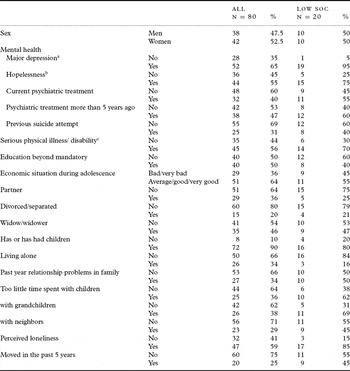
The mean SOC score for the total group (n = 80) was 129.56 (range 56–184). Health and social characteristics of all participants are presented in Table 1, which also shows characteristics of the subgroup with low SOC (n = 20).
Health and social characteristics of all participants and the subgroup with low SOC

Low SOC is defined as the lowest quartile of Total SOC score (<114).
a Including bipolar.
b Measured by the Geriatric Depression Scale question Do you think your situation is hopeless? (Yesavage et al., 1982).
c A rating ≥3 according to the Cumulative Illness Rating Scale – Geriatrics (CIRS-G) (Miller et al., Reference Miller1992).
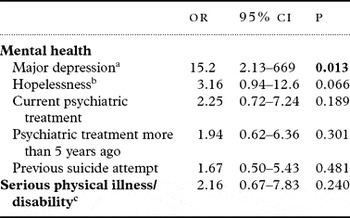
In the univariate exact logistic regression, major depression was strongly associated with SOC. A fifteen-fold increase in odds of having a SOC score within the lowest quartile was observed for this diagnosis (Table 2). Although three-quarters of those with low SOC acknowledged hopelessness, we could show neither a significant relationship with low SOC nor a relationship between serious physical illness/disability and low SOC.
Associations between health variables and sense of coherence (SOC). Results of exact univariate logistic regression analyses showing ORs for low SOC (lowest quartile) in elderly suicide attempters (n = 80). Higher odds of having low SOC were observed among persons with major depression.

aIncluding bipolar.
bMeasured by the Geriatric Depression Scale question “Do you think your situation is hopeless?” (Yesavage et al., 1982).
cA rating ≥3 according to the Cumulative Illness Rating Scale – Geriatrics (CIRS-G) (Miller et al., Reference Miller1992).
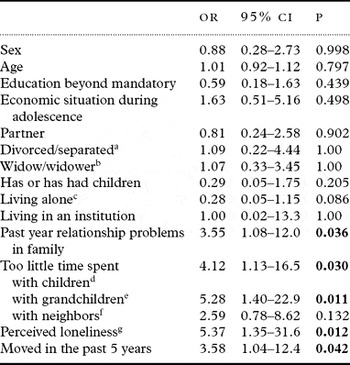
Neither sex nor age was associated with low SOC (Table 3). Past year relationship problems within the family was related to low SOC. Too little time spent with children was associated with a fourfold increase in odds for low SOC; a fivefold increase was noted for too little time spent with grandchildren. Perceived loneliness was also strongly related to low SOC, as was change of residence during the past five years.
Associations between social variables and Sense of Coherence (SOC) in elderly suicide attempters. Results of exact univariate logistic regression models showing ORs for low SOC (lowest quartile) in elderly suicide attempters (n = 80). Higher odds of having low SOC were observed in a number of social variables.

Note: aMissing value for 5 subjects. bMissing value for 4 subjects. cMissing value for 4 subjects. dMissing value for 11 subjects. eMissing value for 12 subjects. fMissing value for 1 subject. gMissing value for 1 subject.
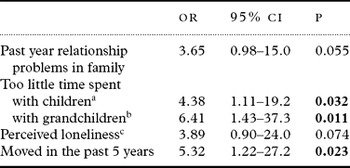
Results of the separate multivariate exact logistic regression analyses are presented in Table 4. The associations between family problems in the past year and perceived loneliness with low SOC was no longer significant after adjustment for sex, age and major depression. Social variables that remained independent factors were time spent with children, time spent with grandchildren and having moved in the past five years. ORs for major depression remained strong in all analyses, with values ranging from 10.6 (95% CI 1.33–471) to 17 (95% CI 2.24–792).
Association between mental health and social variables and low sense of coherence (SOC) (lowest quartile) in elderly suicide attempters (n = 80). Separate multivariate exact logistic regression analyses showing that persons reporting too little time spent with children, grandchildren and having moved in the past five years have higher odds of having low SOC after adjusting for sex, age and major depression.

Note: aMissing value for 11 subjects. bMissing value for 12 subjects. cMissing value for 1 subject.
Discussion
To our knowledge, this is the first study to examine factors related to low SOC in elderly suicide attempters. There was a strong relationship with major depression, but this could not explain observed associations with a number of social variables including too little time spent with children and grandchildren, and moving in the past five years.
The mean SOC score in this study (129) was lower than that reported in a study focusing on older psychophysically active German persons (mean age 67 years, mean SOC 151) (Wiesmann and Hannich, Reference Wiesmann and Hannich2008). It is also lower than that observed (mean SOC 144) for female survivors of myocardial infarction (mean age 72) (Norekvål et al., Reference Norekvål2010). Suicide attempters could be expected to have lower SOC in comparison with their peers, given previous reports on associations between SOC and suicidality in younger age groups (Petrie and Brook, Reference Petrie and Brook1992; Mehlum, Reference Mehlum1998; Sjöström, Reference Sjöström2009). Problem-solving ability is a related concept, and depressed elderly suicide attempters perform less well on problem solving tasks than non-suicidal depressed (Gibbs et al., Reference Gibbs, Dombrovski, Morse, Siegle, Houck and Szanto2009).
Our symptom algorithm approach identified those who fulfilled DSM-IV criteria for current major depression, and we could show a very strong association with low SOC. This contrasts with findings from a recent study that focused on very elderly Swedes (85+) (Lundman et al., Reference Lundman2010), which utilized the 13-item version of the SOC scale. The latter study could show no association between low SOC and a diagnosis of depression. Results from that study are not directly comparable with ours due to a number of methodological differences. Also persons who had been successfully treated for depression were included among those who received a depression diagnosis in that study.
The lack of association between low SOC and serious physical illness/disability in the suicide attempters in our study sample was somewhat unexpected. Lower SOC scores have been observed among very elderly persons with chronic health conditions including heart failure, obstructive lung disease, and osteoarthritis (Lundman et al., Reference Lundman2010). In the current sample, rates of serious physical illness/disability were relatively high in persons both with and without low SOC. Sample size was clearly a limitation here, which applies to the test of associations among specific somatic diagnostic entities, as well. As participant age ranged over more than two decades in the present study, and the association between physical illness and completed suicide has been shown to differ in younger and older elderly (Waern et al., Reference Waern, Rubenowitz and Wilhelmson2003), we wanted to stratify by age group. The sample was divided into young old (70–79 years) and old old (80–91 years), but we could show no difference between these age groups with regard to physical illness and SOC (results not shown).
A number of social factors were related to low SOC; relationships could not be explained by depression. Social support has been shown to correlate with SOC both in cross-sectional (Holmberg et al., Reference Holmberg, Thelin and Stiernström2004) and prospective studies (Skärsäter et al., Reference Skärsäter, Langius, Ågren, Häggström and Dencker2005). The amount of time spent with children and grandchildren impacts both social support and social inclusion. Offspring may constitute a more prominent part of the elderly person's social network as elderly partners, relatives and friends pass away. Seniors can rely on these persons in different situations, making life easier. Also, it is possible that elderly individuals experience spending time with the younger generations as uplifting. A number of different factors will interact to determine the frequency and quality of social contacts experienced by an elderly person. For example, hostility in relationships may affect suicidal individuals' perception of their social support (Harrison et al., Reference Harrison2010). One qualitative study suggested that elderly men who commit suicide may be lacking in the ability to show emotions, and this impacts on their capacity to have meaningful relationships (Kjølseth et al., Reference Kjølseth, Ekeberg and Steihaug2009). This may be the case in elderly male attempters, as well.
Moving within the past five years was also associated with low SOC. Moving might affect the individuals' level of social inclusion. Moving implies change in the external world that might disrupt individuals' sense of comprehensibility, especially if has been necessitated by a change in the internal world, related to loss of autonomy or death of a partner.
Methodological considerations
Strengths of the study include face-to-face interviews using a structured instrument for the rating of psychiatric symptoms. Our depression algorithm was based on the CPRS which has been shown to have good reliability and validity in elderly clinical samples (van der Laan et al., Reference van Der Laan, Schimmel and Heeren2005). All ratings were made by the same research psychologist. In a previous study (Wiktorsson et al., Reference Wiktorsson, Runesson, Skoog, Östling and Waern2010), the symptom ratings of this psychologist were shown to have high inter-rater agreement (0.77) with those of psychiatrists and research nurses. Diagnostic procedures made it possible to adjust for depression in regression models, allowing us to determine the independent contribution of social variables.
Some limitations need to be addressed. All cases were recruited from hospitals, but it is likely that some elderly suicide attempters do not seek hospital care. Second, participants were interviewed in the direct aftermath of a traumatic event, which would be expected to impact on their responses. Third, the interviewer read the SOC statements to the patient and this might have influenced the respondent's answers. This procedure was deemed necessary considering the mental and physical frailty of the participants. Fourth, some subgroups are small, which is reflected by the large confidence intervals. Failure to show significance may be due to lack of power. Finally, while this study is part of a larger case-control study, the SOC scale was administered to the attempter group only.
Concerning the representativity of the study sample, participants and non-participants did not differ regarding a number of sociodemographic variables (Wiktorsson et al., Reference Wiktorsson, Runesson, Skoog, Östling and Waern2010). However, it is possible that elderly persons who agree to take part in a study like this might have stronger SOC than those who decline participation. Results of this study cannot be directly generalized to other settings as determinants of suicidality and of help-seeking behavior differ among countries and cultures. Further, findings cannot be directly extrapolated to completed suicides. Recent evidence suggests that older attempters and completers may differ regarding some personality traits (Useda et al., Reference Useda2007), and these may be related to SOC. Prospective studies are needed to determine the clinical relevance of our findings; we will study whether SOC predicts long-term risk for new suicide attempts/completed suicide.
Implications for suicidal seniors
A number of social variables were independently associated with low SOC in this clinical cohort of elderly suicide attempters. While the identification and treatment of depression is central to late life suicide prevention, results from the current study suggest that interventions designed to improve resources might also prove useful in the prevention of suicidal behavior in this age group. One promising strategy is the Telehelp-telecheck program (De Leo et al., Reference De Leo, Dello Buono and Dwyer2002), in which seniors with frail social networks received telephone support. A systematic review of elderly suicide prevention programs (Lapierre et al., in press) concluded that strategies which improve individuals' coping ability are needed. Further research on psychosocial interventions and their effect on SOC and suicidality in seniors is called for.
Conflict of interest
None.
Description of authors' roles
Margda Waern and Ingmar Skoog designed the study; Stefan Wiktorsson collected the data; Margda Waern and Madeleine Mellqvist planned the analyses, and Madeleine Mellqvist and Erik Joas performed them. All authors contributed to the interpretation of the data. Madeleine Mellqvist and Margda Waern drafted the paper; and Stefan Wiktorsson, Erik Joas, Svante Östling, and Ingmar Skoog edited the paper.
Acknowledgments
The authors thank all study participants and co-workers at the Neuropsychiatric Epidemiology Unit. They also thank Tomas Berglund at the Department of Sociology, University of Gothenburg, and Thomas Marlow and Kristoffer Bäckman at the Neuropsychiatric Epidemiology Unit at the University of Gothenburg, for advice regarding statistics.
Appendix 1. Major depression algorithm
Numbers in parentheses refer to the Comprehensive Psychopathological Rating Scale (Åsberg et al., Reference Åsberg, Montgomery, Perris, Schalling and Sedvall1978) symptom severity which is required for the item to be included in the operational criteria.
Major Depressive Episode
Five or more of the following symptoms; at least one of the symptoms is either (1) or (2)
(1) Depressed mood, subjective (2–6) or observed (4–6)
(2) Anhedonia (2–6)
(3) Significant weight loss or weight gain or decrease or increase in appetite (2–6)
(4) Insomnia (3–6) or hypersomnia (4–6) nearly every day
(5) Psychomotor agitation (4–6) or retardation (4–6), observed decreased amount of speech (2–6)
(6) Fatigue or loss of energy (3–6) or loss of initiative (3–6) nearly every day
(7) Feelings of worthlessness or excessive or inappropriate guilt (3–6)
(8) Diminished ability to think or concentrate (4–6) or indecisiveness (3–6) (subjective) or inability to think or concentrate (4–6) or distractibility (4–6) (observed)
(9) Recurrent thoughts of death, recurrent suicidal ideation (2–6)