Recent years have witnessed considerable debate about how best to operationally define specific learning disabilities (SLDs). Fletcher, Francis, Morris, and Lyon (Reference Fletcher, Francis, Morris and Lyon2005) suggested that the theoretical explanations which inform SLD diagnostic procedures fall into four broad categories: (1) significant discrepancies between IQ and academic achievement; (2) persistent low academic achievement; (3) intra-individual profile variation; and (4) lack of response to evidence-based intervention. In the United States, from the 1970s to the mid-2000s educational jurisdictions applied an IQ-achievement discrepancy model in accordance with the 1975 Individuals with Disabilities Education Act (IDEA; Hughes & Dexter, Reference Hughes and Dexter2011). Sustained criticism of this approach on psychometric and ethical grounds resulted in the discrepancy-based approach being superseded by a response to intervention (RTI) model in many U.S. states when the IDEA was revised in 2004 (Berkeley, Bender, Peaster, & Saunders, Reference Berkeley, Bender, Peaster and Saunders2009).
The recent Fifth Edition of the Diagnostic and Statistical Manual of Mental Disorders (DSM-5; American Psychiatric Association [APA], 2013) removed substantial discrepancy between cognitive ability and academic achievement as a criterion for diagnosis, and now instead emphasises persistent low academic achievement, despite the provision of appropriate evidence-based intervention. Interestingly, although the RTI model is increasingly the preferred operational definition of U.S. practitioners, including school psychologists who assess students with SLDs, most also indicate at least moderate support for both the IQ-achievement discrepancy and the persistent low achievement models. Machek and Nelson (Reference Machek and Nelson2007) reported that while 75% of their sample of 549 school psychologists endorsed use of RTI when operationalising reading disabilities, 62% supported adopting an IQ-achievement discrepancy criterion as well. More recently, a similar study found that although school psychologists were statistically more likely to endorse an RTI-based model to SLD diagnosis, IQ-achievement discrepancy still obtained an overall rating of fair acceptability (O’Donnell & Miller, Reference O’Donnell and Miller2011).
In Australia, the lack of a clear and consistent operationalised definition of SLD across various educational authorities may have produced some confusion and ambiguity about diagnostic criteria among the various professionals who are responsible for psycho-educational assessment. A West Australian study of school psychologists found a degree of uncertainty about how best to conceptualise SLDs and a desire for greater clarity concerning the construct (Klassen, Neufeld, & Munro, Reference Klassen, Neufeld and Munro2005).
The measures used in psycho-educational assessment of children and young people with suspected SLDs fall into three main groups: (1) tests of overall cognitive ability; (2) tests of academic achievement; and (3) tests for specific cognitive deficits linked to SLDs (e.g., phonological awareness and rapid automatised naming). Comprehensive assessment typically comprises a combination of these measures, ideally with specific tests being chosen on a case-by-case basis to suit the needs of each individual. Most recently, the Cross-Battery Assessment approach has provided practitioners with a systematic, theoretically grounded method for integrating subtests from relevant test batteries (see Flanagan, Ortiz, & Alfonso, Reference Flanagan, Ortiz and Alfonso2013).
The traditional inclusion of IQ tests in SLD psycho-educational assessment appears to result from two factors: the historical emphasis on the IQ-achievement discrepancy model in identifying SLDs, and the perception that particular intra-cognitive profiles correspond to different types of SLDs. However, an accumulation of research has undermined the empirical basis of both the discrepancy (e.g., Hoskyn & Swanson, Reference Hoskyn and Swanson2000) and intra-individual cognitive difference models (e.g., D’Angiulli & Siegel, Reference D’Angiulli and Siegel2003), leading to questions about the necessity of utilising IQ tests as a component of SLD assessment (see, e.g., Callinan, Cunningham, & Theiler, Reference Callinan, Cunningham and Theiler2013).
There has been little research about the use of IQ tests in the identification of SLDs in Australia, apart from the study by Klassen and colleagues (Reference Klassen, Neufeld and Munro2005) that investigated beliefs and practices of 62 school psychologists. Somewhat surprisingly, given the historic lack of formal emphasis in Australia on IQ-achievement discrepancy as a primary approach to detecting SLDs, over 80% of respondents reported that they believed IQ tests were useful. Rather than using IQ tests as part of a discrepancy-based approach to diagnosis, however, psychologists were generally incorporating them in order to rule out intellectual disability as the cause of academic difficulties, or to identify cognitive indicators that would guide further assessment and intervention.
As understanding of the specific neuropsychological factors that contribute to the aetiology of learning difficulties (and particularly reading difficulties) has increased in recent years, so too has the range of available psychometric tests. For example, it is well established that deficits in phonological awareness produce a range of reading-related problems, including difficulty blending phonemes to form spoken words and impaired phonological recoding in the short-term auditory memory (Morris et al., Reference Morris, Stuebing, Fletcher, Shaywitz, Lyon, Shankweiler and Shaywitz1998; Perfetti, Reference Perfetti, Brady, Braze and Fowler2011). Consequently, tests of phonological awareness (e.g., the Comprehensive Test of Phonological Processing; Wagner, Torgesen, Rashotte, & Pearson, Reference Wagner, Torgesen, Rashotte and Pearson2013) are usually recommended as part of psycho-educational test batteries.
Other measures that are commonly used as part of psycho-educational assessment of SLDs include tests of memory and learning (e.g., the Children's Memory Scale; Cohen, Ledbetter, Vaughn, & Benavides, Reference Cohen, Ledbetter, Vaughn and Benavides1999), neuro-cognitive functioning (e.g., the NEPSY-2; Crews & D’Amato, Reference Crews and D’Amato2009) and cognitive processes (e.g., Cognitive Assessment System; Naglieri, Reference Naglieri, Scruggs and Mastropieri2003). Some authors have argued that a ‘multiple deficits’ approach should be adopted, with cross-battery psycho-educational testing for specific cognitive impairments that are known to represent important markers, for reading difficulties in particular (see, e.g., Callinan et al., Reference Callinan, Cunningham and Theiler2013).
The current study aimed to investigate the theoretical models currently being used by Australian school psychologists and guidance counsellors to conceptualise and identify SLDs. A second purpose of the study was to document practitioners’ usage of a range of psycho-educational tests for assessing students with suspected SLDs, and the reasons for their choices.
Method
Participants
The sample comprised 203 practitioners whose professional responsibilities included administering psycho-educational assessments to children and young people with suspected SLDs. There were 79 school psychologists (53 working in government schools, 26 in non-government schools) and 67 other professionals, most of whom were working in government schools, and held teaching degrees with postgraduate qualifications in guidance and counselling. The sample also included 31 psychologists working in private practice and 12 psychologists working in other contexts, as well as 11 non-psychologists working in other contexts. Three respondents did not specify their place of employment.
The participants were spread fairly evenly across the age ranges 31–40 years (n = 47), 41–50 years (n = 57), and 51–60 years (n = 50), with fewer in the younger and older ranges (20–30, n = 30; 61 and over, n = 18). One did not specify age. A significant majority (n = 162; 81%) were female. With respect to educational qualifications, respondents possessed a very broad range of both undergraduate and postgraduate awards including undergraduate degrees in psychology, teaching or education; postgraduate diplomas in educational psychology or school counselling; master’s degrees, mainly in educational and development psychology or guidance and counselling; and doctoral level awards.
On average, respondents reported spending 8.15 hours per week (SD = 5.82) undertaking psycho-educational assessment and report writing. Forty per cent of the sample were seeing three to five children or young people for psycho-educational assessments each month, with another 27% seeing between six and ten. There were no notable differences in the number of assessment cases across the different professional groups in the sample, with the exception of psychologists in private practice, the largest proportion of whom (42%) were administering psycho-educational assessments to only one or two clients each month.
Measure
A questionnaire was constructed especially for this study. Initial items requested participant information, including age, gender, academic qualifications, experience, current role and place of employment. Respondents were asked to indicate how many children or young people with suspected SLD they assessed each month on average, and approximately how many hours they spent on assessment each week. In addition, respondents were asked to indicate the extent to which their diagnostic decision making was influenced by the four major theoretical models of SLD identification described by Fletcher and colleagues (Reference Fletcher, Francis, Morris and Lyon2005), representing significant discrepancies between IQ and academic achievement, persistent low academic achievement, intra-individual profile variation, and lack of response to evidence-based intervention. Following Klassen et al. (Reference Klassen, Neufeld and Munro2005), one item asked whether participants believed IQ tests were useful in psycho-educational assessment of individuals with SLDs and, if so, why. A list of various psycho-educational tests was provided for respondents to indicate the frequency with which they used each test. Finally, there was a general question about participants’ main reasons for choosing particular tests, with the options being familiarity, experience and expertise, organisational requirements, ready access to the test, psychometric properties, and perceived usefulness in accurate diagnosis of SLDs.
Procedure
Professionals whose roles included psycho-educational assessments were contacted via email and invited to take part in this online survey. The targeted groups included: (1) psychologists registered with the Australian Psychological Society (APS) and located using the ‘Find a Psychologist’ function on the APS website under the search category ‘Learning Difficulties’; (2) members of the various state-based chapters of the Australian Psychologists and Counsellors in Schools Association (APACS); (3) school counsellors, guidance counsellors and school psychologists employed by government schools in several major mainland Australian states (including Queensland and Victoria); and (4) guidance counsellors working for Catholic Education affiliated schools in a number of mainland Australian dioceses located in Queensland, New South Wales and Victoria.
Completion of the online survey was considered to indicate a respondent's informed consent to participate. Approval to conduct the study was obtained from the Queensland University of Technology's Human Research Ethics Committee and from the relevant professional bodies and educational jurisdictions. Pseudonyms have been used throughout to protect the anonymity of respondents.
Results
Data Preparation and Screening
A small amount of randomly distributed missing data was initially identified during screening. Missing items were replaced with group means according to the approach of Tabachnick and Fidell (Reference Tabachnick and Fidell2007). Distributions of all variables were found to meet assumptions of univariate and multivariate normality.
Theoretical Models Underpinning SLD Assessment
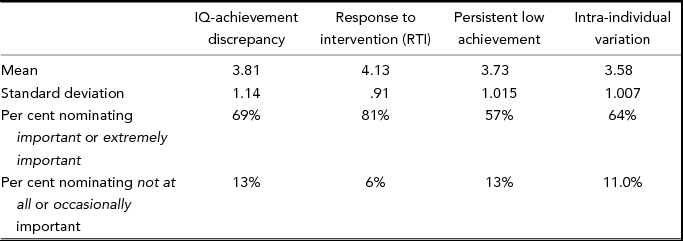
Respondents were asked how much importance they attributed to each of four broad theoretical approaches to the conceptualisation and identification of SLDs described by Fletcher et al. (Reference Fletcher, Francis, Morris and Lyon2005). As shown in Table 1, response to intervention was endorsed by the highest number of participants, but half to two thirds of the sample nevertheless believed that each of the other three approaches (IQ-achievement discrepancy, persistent low achievement, and intra-individual profile variation) was either important or extremely important.
Importance Attributed to Different Theoretical Perspectives Used to Identify SLDs on a Scale of 1 to 5 (n = 201)
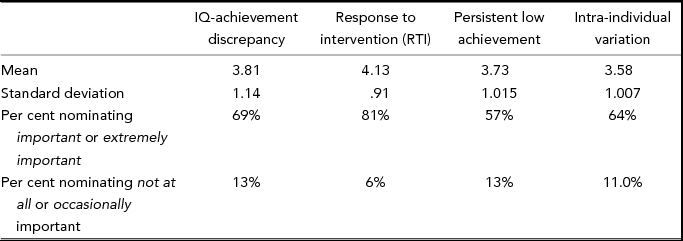
Paired sample t tests were conducted to ascertain whether there were significant differences between levels of importance attributed by participants to the various theoretical approaches. RTI was rated as significantly more important than the other three models: (1) discrepancy (t = 3.385, p = . 025); (2) persistent low achievement (t = 7.436, p < .001); and (3) intra-individual variation (t = 5.107, p < .001). Respondents also reported IQ-achievement discrepancy as significantly more important than persistent low achievement in identifying students with SLDs (t = 2.259, p = .025). Tukey HSD analyses indicated no significant differences in the levels of relative importance ascribed by different professional subgroups within the sample.
Tests Used in SLD Assessment
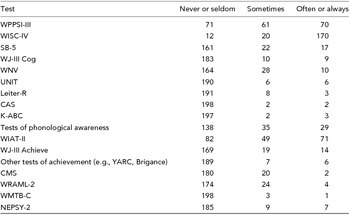
Table 2 presents the reported frequencies with which participants used each of the listed tests when assessing children and young people for SLDs. The Wechsler scales (WISC-IV and WPPSI-III) were the most commonly used, followed by the Wechsler Individual Achievement Test (WIAT-II) and specific tests of phonological awareness.
Numbers of Practitioners Who Use Each Psycho-Educational Test (n = 202)

Note: WPPSI-III = Wechsler Preschool and Primary Scale of Intelligence – Third Edition (Wechsler, Reference Wechsler2002); WISC-IV = Weschsler Intelligence Scale for Children — Fourth Edition (Wechsler, Reference Wechsler2005); SB5 = Stanford Binet Intelligence Scales, Fifth Edition (Roid, Reference Roid2003); WJ-III Cog = Woodcock-Johnson III Tests of Cognitive Ability (Woodcock, McGrew, & Mather, Reference Woodcock, McGrew and Mather2001); WNV = Wechsschler Nonverbal Scale of Ability (Wechler & Naglieri, Reference Wechsler and Naglieri2006); UNIT = Universal Nonverbal Intelligence Test (Bracken & McCallum, Reference Bracken and McCallum1998); Leiter-R = Leiter International Performance Scale — Revised (Roid & Miller, Reference Roid and Miller1997); CAS = Cognitive Assessment System (Naglieri & Das, Reference Naglieri and Das1995); K-ABC-2 = Kaufman Assessment Battery for Children (Kaufman & Kaufman, Reference Kaufman and Kaufman2004); WIAT-II = Weschsler Individual Achievement Test — Second Edition (Wechsler, Reference Wechsler2002); WJ-III = Woodcock-Johnson III (Woodcock et al., Reference Woodcock, McGrew and Mather2001); Brigance = Brigance Diagnostic Inventory of Basic Skills (Brigance & Glascoe, Reference Brigance and Glascoe1999); YARC = York Assessment for Reading Comprehension (Snowling et al., Reference Snowling, Stothard, Clarke, Bowyer-Crane, Harrington, Truelove and Hulme2009); CMS = Children's Memory Scale (Cohen, Reference Cohen1997); WRAML-2 = Wide Ranging Assessment of Memory and Learning, Second Edition (Sheslow & Adams, Reference Sheslow and Adams2003); WMTB-C = Working Memory Test Battery for Children (Pickering & Gathercole, Reference Pickering and Gathercole2001); NEPSY-2 = NeuroPsychological Assessment — Second Edition (Korkman, Kirk, & Kemp, Reference Korkman, Kirk and Kemp2007)
Rankings of six possible reasons for choosing these tests were provided by 153 respondents. Experience in using a particular test had the highest average position, with 42% of respondents selecting this as either their first or second most important reason, closely followed by the psychometric properties of a test. The reason with the lowest mean rank relative to the others was organisational requirements.
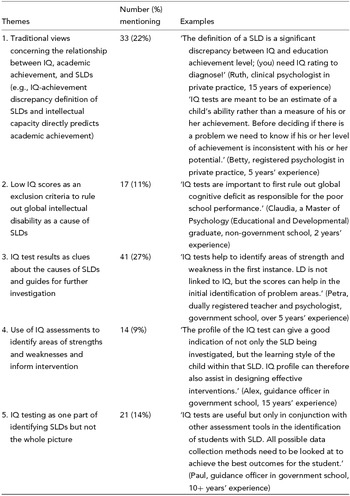
Participants who agreed or strongly agreed that IQ tests are useful in identifying SLDs (i.e., n = 153 or 76% of the sample) were asked to provide a rationale for this view. Thematic analysis of the qualitative data yielded a total of five themes that were referred to by at least eight individuals. These were: (1) traditional views concerning the relationship between IQ, academic achievement, and SLDs, including support for the IQ-achievement discrepancy model and the view that IQ scores strongly predict academic achievement; (2) low IQ scores as an exclusion criteria to rule out global intellectual disability as a cause of SLDs; (3) IQ test results as clues about the causes of SLDs and guides for further investigation; (4) use of IQ tests to identify areas of strengths and weaknesses and inform intervention; and (5) IQ testing as one part of identifying SLDs but not the whole picture. Examples of each theme are presented in Table 3. Specific comments have been selected on the basis that they represent the views of a number of participants in the study.
Thematic Analysis of Practitioners’ Reasons for Using IQ Tests are Useful in the Psycho-Educational Assessment of SLDs (n = 153)

Discussion
The findings from this research provide insights into the beliefs and psycho-educational assessment practices of Australian psychologists and guidance counsellors, and extend previous work in the area (e.g., Klassen et al., Reference Klassen, Neufeld and Munro2005). In particular, this appears to be the first study to document practitioner usage of different psycho-educational instruments in the assessment of SLDs.
The strong support that participants indicated for an RTI-based approach to diagnosing SLDs, along with moderate support for other models, is consistent with the findings of previous research in the United States (Machek & Nelson, Reference Machek and Nelson2007; O’Donnell & Miller, Reference O’Donnell and Miller2011). It is possible that the simultaneous endorsement of a range of theoretical perspectives reflects a lack of clarity about the best way to approach SLD diagnosis, and indeed such uncertainty was a common theme in a previous study of Australian school psychologists (Klassen et al., Reference Klassen, Neufeld and Munro2005). However, another possibility is that respondents see all four theoretical approaches as potentially having relevance. In addition, they may be viewing the primary purpose of assessment as intervention, rather than diagnosis. The reticence of some Australian educational jurisdictions to formally recognise SLDs has averted the need for those authorities to stipulate clear diagnostic guidelines, potentially resulting in an assessment approach that focuses more on gathering data to inform intervention, rather than on diagnosis (Klassen et al., Reference Klassen, Neufeld and Munro2005).
The relatively strong support for the discrepancy model of identifying SLDs is nevertheless somewhat surprising, given that this approach has been so widely criticised on both empirical and ethical grounds (e.g., Fletcher et al., Reference Fletcher, Francis, Morris and Lyon2005) and that the discrepancy-based diagnostic criterion has been removed from the latest edition of the DSM (DSM-5; APA, 2013). In their rationales for the value of IQ tests, almost one quarter of the sample referred to the diagnostic importance of discerning significant IQ-achievement discrepancies. It is of note, however, that the data were collected only a few months after the DSM-5 became available in Australia, so it is possible that some participants were unaware of the recent changes, or had not yet adjusted their previously held beliefs. On the other hand, the finding might indicate some initial resistance to change, or overriding beliefs that the discrepancy approach can still be valid, at least with respect to certain populations (e.g., those with average academic achievement who are intellectually gifted but nevertheless have SLDs).
The fact that IQ-achievement discrepancy has been excluded as a diagnostic criterion in the DSM-5 does not mean that intelligence testing is unnecessary, given the need to exclude intellectual disability as a contributor to difficulties with learning. This purpose was acknowledged by some participants in their statements of support for IQ testing. As in previous research (Klassen et al., Reference Klassen, Neufeld and Munro2005; Machek & Nelson, Reference Machek and Nelson2010), many also suggested the value of IQ test profiles for understanding the nature of a child's difficulties or for identifying areas of cognitive strength and weakness. Such information can suggest areas for further investigation using more specific measures, or contribute to the design of appropriate interventions.
Our results suggest that the overwhelming majority of Australian practitioners appear to be using IQ tests, predominantly the Wechsler scales, to assess students with suspected SLDs. Our data show that IQ tests are used much more frequently than tests of academic achievement or any other types of instruments. Among the sample, 84% reported using the WISC-IV often or always in psycho-educational assessment of children with SLDs but only 35% are using the WIAT-II with the same frequency, and very few are using alternate measures of academic achievement. Some of this disparity may be due to diagnoses of intellectual disability being made on the basis of WISC results, with further assessment of learning then deemed to be unnecessary. But it is unlikely that this situation accounts entirely for the substantial discrepancy in usage of IQ tests and tests of academic achievement. In addition, more specific tests, such as those assessing phonological awareness, are not commonly used, despite the critical importance of this construct to SLD diagnosis (Mather & Wendling, Reference Mather and Wendling2012). Tests of memory and learning (e.g., the Children's Memory Scale) are hardly used at all. While it is possible that many practitioners do not have easy access to a wide range of instruments, and that some may instead be using informal measures of key diagnostic features, such as phonological awareness, their very limited use of standardised tests that have the potential to provide valuable data is surprising.
Perhaps less surprising is the markedly higher use of the Wechsler scales, compared with alternative measures of intelligence. Again, it is possible that the Stanford Binet and Woodcock Johnson are not readily available to some practitioners or that they do not have the necessary expertise to administer them. In general, participants indicated that experience with a particular test and psychometric properties of the test were the most important factors influencing their choices among similar tests. The wider acceptance of the Wechsler scales in Australia is likely due, at least in part, to the fact that Australian norms are available. However, co-norming with the WIAT-II is less important now that the discrepancy approach has been discarded. Also likely to be relevant to the Wechsler scales’ domination is the fact that the WISC-IV and the WPPSI-III are sometimes the stated requirement by Australian educational jurisdictions for the assessment of children with intellectual disability as a component of verification and funding processes (see, e.g., Catholic Education Commission of Victoria, 2014). Anecdotal evidence suggests that some schools may reject, or at least request justification for the use of alternative intelligence tests.
Best practice in psycho-educational assessment requires practitioners to select the most appropriate test for the needs of a particular client. Thus, it is obviously important that practitioners have a range of available tests from which to choose, as well as the necessary expertise to use them, and the skills to evaluate the particular strengths and weaknesses of each test. The SB5 can be particularly useful when assessing children in the overlap age ranges of the WPPSI-III and WISC-IV, or the WISC-IV and WAIS-III, when it is often difficult to know which of the two Wechsler tests will provide the best assessment. The ability to compare verbal and nonverbal performance across the five indexes is another advantage of the SB5. The Woodcock Johnson has the advantage of including a diverse range of co-normed tests of both cognitive functioning and academic achievement within the one battery. For students with significant co-existing speech and language disorders or English as a second language, cognitive functioning may be more appropriately estimated with non-verbal measures such as the Universal Nonverbal Intelligence Test (UNIT) or Leiter.
Conclusions
The results of this study indicate that Australian psychologists and guidance counsellors are eclectic in their theoretical approaches to SLD conceptualisation and identification. Despite their support for a variety of theoretical orientations, however, they appear to be considerably limited in the range of measures they commonly employ in psycho-educational assessment. Practitioners nominated using IQ tests in general, and the Wechsler scales in particular, far more frequently than any other measures. Best practice dictates that assessment of individuals who present with learning difficulties requires information gathering with the use of a variety of appropriate, psychometrically sound instruments and strategies (Mather & Wendling, Reference Mather and Wendling2012). Given the substantial body of evidence showing that SLDs are associated with impairments in a range of neuropsychological processes, identifying the underlying deficits not only enables diagnosis of the specific type of SLD, but also determines more precisely the kind of intervention that is likely to be most effective (Feifer, Reference Feifer and Miller2010). The assessment practices of those who are responsible for identifying students with SLDs would undoubtedly benefit from greater familiarity with, and access to, a more diverse range of psycho-educational instruments, including measures of underlying cognitive processes known to be associated with SLDs. Comprehensive assessment will lead to more effective diagnosis, better understanding, and more targeted interventions for students with learning disabilities.