Twice almost every year since 1888, at the beginning of the year and on the monarch's official birthday, the British government has published a list of citizens who have been awarded state honours.Footnote 1 These ‘honours lists’ have been received variously with hope, pleasure, disappointment, sarcasm, and anger. Enveloped in ritual, tradition (much of it invented), and ceremony, the complex array of titles and post-nominal letters that people acquire from the British honours system have taken on a wide variety of meanings – positive and negative – through Britain's modern history.Footnote 2
This article investigates the changing fortunes of one group in particular – volunteers – as recipients of honours.Footnote 3 The single biggest shift in the official priorities, focus, and tone of the British honours system since the 1917 creation of the Order of the British Empire happened in 1993, when the government publicly and explicitly made the voluntary sector the system's highest priority. For much of the century, volunteer work was one of a number of different kinds of service to the state, nation, and empire that competed for honours, including paid state service, science, business, and the arts. The reforms of the early 1990s were anticipated by decades of earlier controversies and attempts at reform, but it was not until John Major's premiership that a majority of honours were given for private voluntary and philanthropic service, a seemingly intuitive change that secured greater popularity for a system that had long been associated with automatic honours for undeserving civil servants. Through Major's reforms, it became the single sector with the largest numerical share of crown honours.Footnote 4 This was not an easy or an inevitable process. It emerged out of multiple attempts at reform that reflected different political priorities. These shifting priorities reflected and contributed to wider social changes, especially at the end of the twentieth century. In tracing these changes, I suggest an alternative chronology for the relationship between the provision of welfare, politics, and British culture, in which the 1990s are a key decade in the evolution of a new consensus. The expansion of honours at the end of the century to include more volunteers seemed definitively to reward voluntary service above all others. However, for all the appearance of equality that these reforms produced, the means through which voluntary service's quantitative dominance was achieved reinforced a hierarchical view of British society where volunteers ranked below professionals and philanthropists.
I
To many observers, the honours system has been and is an expression of national culture that, as retired civil servant Hayden Phillips argued in 2004, ‘derives from the simple and laudable wish to recognize exceptional service and achievement and to show gratitude publicly’, a ‘public thank you to those who have demonstrated achievement and exceptional service’.Footnote 5 In this narrative, the occasional corruptions of this system by ambitious, short-sighted politicians were deviations from the norm. In such narratives, the honours system has remained at its core a positive expression of national merit, providing a unified roll of honour of distinguished Britons across the centuries.Footnote 6 More cynical commentators prefer to depict it as a tool of political patronage that recapitulated social hierarchies.Footnote 7 Few, if any, twentieth-century governments did not fall under suspicion of some form of unfair honours patronage, and on a number of occasions this turned into outright scandal when prime ministers and whips pushed the boundaries of acceptable honourific patronage too far.
There are elements of truth in both these depictions of the honours system: it was cynically used as political and social currency, and it did distinguish worthy people for valuable service to the state. However, both these portrayals downplay the importance of the honours system by assuming its social and political function to be immutable. They implicitly de-emphasize change within the honours system, as well as the wider social, political, and cultural implications and consequences of these changes. Positive depictions of the system present it as an eternal, value-neutral expression of the public will that forms an important and largely innocent part of British heritage. In doing so, they celebrate rather than question the centrality of hierarchical judgements in the system, as well as its use as a political tool. Negative accounts focus primarily on the various forms of patronage and corruption that have influenced honours lists. They risk losing sight of the way in which a majority of honours given in the twentieth century were not party political honours, even if their priorities and functions had a political edge. Reverence and scorn are not the best ways of analysing the historical complexities of this institution.
A third, more considered view of the history of honours can be found in work that focuses on statutory changes within specific orders of chivalry, but this literature usually avoids connecting this history to broader themes.Footnote 8 Honours have been an ever-present part of the background to British history, finding their way to the front of public debate only when they played an important part in some sort of wider political crisis. It is time that we take their political and social meaning more seriously.Footnote 9 At any given moment in modern British history hundreds of thousands of people have had legitimate claims on the state for recognition of worthy service. Yet only a fraction received honours at any given time. What was seen as uncontroversial or normal at any given moment in terms of honours is as important as the few controversies that emerged at particular points during the century. How and why has the British state chosen certain citizens and subjects over others to distinguish for valuable service? What do the choices made by the state say about changing ideas of service and merit?
The question of how and why the shift towards rewarding voluntary service came to be is not just a party political one. In fact, the day-to-day running of the honours system, as well as much of the power to shape wider policy, lay with Whitehall. Superficially, the prime minister was the person from whom civilian honours lists from Britain were forwarded to the monarch, but most of the decisions about who received what were made by civil service committees, fed names by departments and select institutions. At key moments, prime ministers did have a significant influence on honours policy and on individual appointments but the everyday operation of the honours system was in the hands of the civil service. Slow, partial change characterized honours policy. This makes instances of major change in the constituency and the official language of honours all the more significant because they indicate a conscious deviation from traditional policy, backed by the exercise of political will.
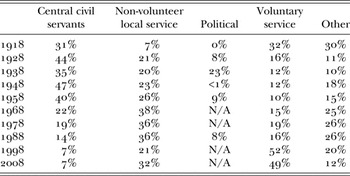
For much of the century, voluntary service as a discrete category did not exist in honours lists. Most citations for honours were short and vague enough that the paid or unpaid status of the recipient in relation to the service performed was unclear, and the civil service did not retain detailed records of the reasons for which individuals received honours from year to year. For this reason, it is difficult to determine the total numbers of honours given for voluntary service at any given time. Compounding this ambiguity is the fact that for most of the century most volunteers fell into the broad category of ‘local service’, which also included local politicians and administrators, as well as paid welfare workers. However, honours lists show a consistent pattern in how recipients of honours changed through the century. The sentence and sentence fragment-length citations published for all civilian honours in the London Gazette show that a limited number of honours explicitly for voluntary service were given out in the Order of the British Empire (the main order in which voluntary honours could be given) until the post-Second World War period (Table 1). These figures understate the civil service dominance of the honours system, since the civil service enjoyed a monopoly over many other orders and over the military division of the Order of the British Empire. They are also approximations: citation style was inconsistent between and within honours lists, and for most of the century direct information about the voluntary or paid status of recipients is unavailable. However, going by the status of recipients as publicly stated in honours lists, two trends are clear: first of all, that until the last part of the century honours lists were dominated by people who had performed some service for which they had been paid, usually by the state; and secondly, that voluntary service was only a middling priority between the early 1920s and the 1990s.
Percentage of civilian honours in the Order of the British Empire given to key groups in Britain, 1928–1998

Source: Based on citations published in the ordinary (New Year and King's/Queen's Birthday) honours lists in supplements to the London Gazette. Includes all domestic civilian honours in the Order of the British Empire. Labour governments after 1964 suspended political honours.
II
Before the First World War, honours were available to a limited set of elites throughout Britain and the British empire. Only one order – the Order of Merit, created in 1902 – was available to both men and women.Footnote 10 Most orders were restricted to specific kinds of service, most notably the Order of the Bath (for home civil servants and the military), and the Order of Saint Michael and Saint George (for diplomats and colonial dignitaries). The latter could be used to reward distinguished men for philanthropic service in the empire, although they were limited by statute to a certain number of living members and demand always exceeded supply. Male volunteers and philanthropists in Britain itself could be made knights bachelor or receive awards in the Royal Victorian Order (which were in the gift of the sovereign and were limited in number).Footnote 11 Women had even fewer options. In general, honours lists recognized a few hundred senior politicians, civil servants, royal servants, senior professionals, soldiers, businessmen, and aristocrats each year. The range of people who could aspire to crown honours was a narrow subsection of the monarch's subjects.
This changed in 1917. For civilians throughout Britain and its empire, the First World War was the focus of a massive voluntary effort, in which a wide range of important services such as nursing and the care of disabled veterans were delegated to non-state organizations.Footnote 12 Volunteer as well as paid nurses of the Red Cross and the Order of Saint John staffed military hospitals. Celebrities, industrial magnates, and socialites raised money for these and other charities. Munitions workers were fed by canteens, often set up and organized by middle-class volunteers. Women in particular, excluded from the front lines, enthusiastically pursued opportunities to contribute to the empire-wide effort to wage a modern war effectively. These opportunities exceeded those of any war in living memory, creating new debts of honour between the state and the public.
The idea of a new, more open, and in some sense democratic order had developed before the war, but it was not until the end of 1915 that the keeper of the privy purse, Frederick Ponsonby, pulled together the general discussion of the need for a popular order that would reward the war effort at home.Footnote 13 In a November memorandum to the secretary of the central chancery of the Orders of Knighthood, he argued that the UK lacked a formal way of rewarding people who served British society through culture or through philanthropic work, comparing this situation with that in France, where the Légion d'Honneur recognized cultural service directly.Footnote 14 Other European states, too, including Imperial Germany and Denmark, had honours systems that were more egalitarian and inclusive than Britain's.Footnote 15 After extensive debate between politicians, the royal household, and other interested parties, Ponsonby's proposal led to the creation of a new order of knighthood in 1917: the Order of the British Empire. This new order was given out in five ranks: Knight/Dame Grand Cross (GBE), Knight/Dame (KBE/DBE), Commander (CBE), Officer (OBE), and Member (MBE). A large majority of inductees were at the MBE and OBE levels. By the end of 1918, thousands of male and female civilians had been inducted into the new order, an unprecedented number in the British system.Footnote 16 By 1921, the Order had over 20,000 members, far more than any other existing British order of chivalry.
The initial idea for the Order of the British Empire was that it would reward only voluntary service, but the establishment of a military division for the Order and the demands of the massively expanded government ministries meant that the new order far exceeded this mandate. As Table 1 indicates, it was not only voluntary workers who received the Order during the war. Huge numbers of people with a wide variety of connections to the war government received honours, from individuals with unambiguous connections to various war ministries (particularly the Ministries of Food and Munitions) to people whose service went unrecorded in the London Gazette. Many citations listed only the individual's profession, not their service. Later honours lists were shorter and more standardized.
This moment when honours emphasized above all the democratic spirit of voluntary service was celebrated by the publication of the 1921 Burke's handbook to the Most Excellent Order of the British Empire.Footnote 17 The editor, A. Winton Thorpe, was himself a holder of the fourth division of the new order, which he had received in 1918 for his services as the director of publicity for the Ministry of Food from 1917 to 1918.Footnote 18 He was representative of the civilian men who received this first wave of new honours, as he was a private citizen who had served the state voluntarily during the war, offering his area of expertise – publishing and propaganda – to the cause. In his time and place, he was a notable local figure, but he was not significant enough to warrant an entry in the canonical directory of historically important Britons, the Oxford dictionary of national biography. He had worked as a journalist in England and France, and along with his managing editorship of Burke's peerage, he also served as the managing director of the London News Agency until 1919.Footnote 19
Thorpe structured the Handbook in such a way that its potted biographies of members of the Order, while similar to those that one would find in Who's who or Burke's peerage, specifically listed the recipient's war service. From this, we know that he himself served both in the Ministry of Food and the Metropolitan Central Constabulary during the war.Footnote 20 According to him, the Order was rendered necessary because the war had become ‘an intimate part of everyone's life. Its demands were inexorable and insatiable.’Footnote 21 The war was won because:
All the energies of the State, all the energies of industry, all the energies of individuals were directed towards the carrying on of a devouring and devastating struggle, which some day – but no one knew when – was to end in the victory of the allies, because on victory the will of the British people was firmly and immovably set. This unconquerable will to victory on the part of the British people is, next to the heroism of the British soldiers and sailors, the proudest memory of the Great War.Footnote 22
Proud of his own participation in this broader effort to win the war, Thorpe saw himself as a representative of a grand democratic effort to victory on the part of the whole British people – the Order could be ‘proud of its long list of members, and of the vast unnumbered host of war workers – unrecognised in the way of honorific distinction, but not unappreciated – whose representatives they are’.Footnote 23 The Order was a celebration of a domestic as well as an international triumph: Thorpe connected the Order to a rearrangement of British society that prized merit in both sexes over class, dispensing with old distinctions:
Democracy, thus animated, won the war; the Order of the British Empire is in the truest sense of the word the British Democracy's own Order of Chivalry. All classes are blended therein; the old distinctive qualification of being ‘a gentleman of blood’ has gone and left no trace; service is the only test of admission, and the service of women here finds its recognition in exactly the same way as the service of men. The newest and latest-born of the British Orders of Chivalry may therefore well be proud of its long list of members.Footnote 24
Thorpe offered an ideology of honours that celebrated a bright, democratic future for the system. In his view, merit was defined by individual voluntary action that built up across the community into a heroic, democratic collective effort.
III
Britain's efflorescence of honorific enthusiasm for collective service was brief. Within a few years, the Order of the British Empire's focus and scale had been transformed. If the publishers of Burke's handbook had hoped that it would become a kind of Debrett's for Britain's middle class they were disappointed. The 1921 edition was the only one ever published, and even as it was being printed the moment that it celebrated was gone, dismissed publicly as an outburst of corruption rather than a celebration of the people. The new order had become tarnished in the eyes of social and political elites by two factors. The first was the manner and the numbers in which it was given out. While pre-war honours lists had consisted of at most a few hundred men per year, between 1917 and 1921 around 25,000 men and women were made members of the Order of the British Empire.Footnote 25 This expansion of honours by orders of magnitude was deeply regretted by the royal household, aristocrats, civil servants, and many politicians, who saw a previously elite institution democratized in what was, from their perspective, the worst possible way. At the same time, David Lloyd George's creative use of the peerage and knighthood to reward political donors meant that the honours system as a whole was tarred with the very black brush of corruption in the immediate aftermath of the war.Footnote 26 The creation of the Order of the British Empire coincided with the twentieth century's biggest corruption scandal, and while the Order itself was not valuable enough to be a major part of Lloyd George's trade in honours, it was damaged by association.Footnote 27 The image of the honours system in 1917 through 1922 was felt to have reached a low point, and as officials considered the future of the Order of the British Empire, they determined to either reform or abolish Britain's new ‘Order for Britain's Everybody’.Footnote 28
Even before the honours scandal broke in 1922, interested parties were plotting to restrict the flow of honours. Through 1919 and 1920, a group of civil and royal servants who were concerned about the Order sought to rein in the numbers of appointments to the new Order. In 1920, the king asked the head of the treasury Warren Fisher to set up a small committee to consider the ‘permanent establishment’ of the Order of the British Empire.Footnote 29 After lengthy deliberations, it produced a final report in 1922, which set the total numbers of awards in the Order by statute.Footnote 30 The committee received advice from a variety of sources, but was ultimately controlled by the priorities of the treasury and the royal household more than those of the government. It effectively had a royal mandate to revise and renegotiate the nature of the new honours that had been invented during the war, and was implicitly charged with reversing the most gratuitous of wartime honours excesses, a mandate that included the total reform and reconstitution of the Order of the British Empire.
Ponsonby suggested that ‘there would be little to justify its existence’ if the Order of the British Empire were to be given out on ‘precisely the same lines as the existing orders’, by which he meant that it should not merely be a junior (and inferior) supplement to the Bath or the Order of Saint Michael and Saint George.Footnote 31 If it were to become a mere ‘sop to the disappointed’ among civil servants and soldiers it would ‘depreciate in value and become meaningless’.Footnote 32 As a result, Ponsonby stressed the importance of awarding it to non-traditional groups such as artists, scientists, philanthropists, people in local government, and women.Footnote 33 However, Lord Stamfordham (the king's private secretary) and Fisher rejected Ponsonby's ideas – Stamfordham argued for a more parsimonious approach with ‘very careful superintendence’ to keep in check the ‘growing love and demand for decorations’.Footnote 34 The lust for medals among the middle class needed to be kept in check.
This exchange of correspondence at the beginning of the interwar period shows a clash in visions of how the Order of the British Empire should work. Ponsonby's desire that the Order of the British Empire become an award for outstanding service by people outside of the traditional political and administrative elite was in line with the foundational wartime idea of the Order as an award for unpaid service by all the people of the British Empire. It was, indeed, to become an award that was given to artists, volunteers, and philanthropists in Britain and some Dominions. But the dominant trend of the interwar period was not towards more honours for these ‘worthy’ and undoubtedly neglected groups. Instead, the treasury under Fisher took control of the honours system, and adopted a conservative, state-centred approach to reorganizing the Order.
The treasury used its power to set quotas in a number of ways. They allocated 300–400 total civilian awards per year in the Order of the British Empire in Britain itself, with an equal number for the Dominions and a smaller quantity for the Colonies. The military was also allowed a significant allocation, which all branches desperately wanted and sought. The total number was massively reduced from the heights of the war years. Once they had set these new quotas, the treasury proceeded not only to enforce them but actively to build a buffer in the total numbers by allocating substantially fewer awards per year than those allowed by statute. They thus aggressively reversed the inflation of the war years while at the same time redirecting the flow of honours back to civil servants, in spite of initial political and administrative opposition from Ponsonby and Lloyd George.Footnote 35
The treasury tightened control by focusing on rewarding the people it knew best: civil servants and other paid state workers. During the war, Ponsonby and the other early organizers granted a share to the military and other state servants only reluctantly. In the interwar years under treasury control, on the other hand, between a third and a half of all awards were given to civil servants or political nominees, with another third going to other paid state employees (see Table 1). The hierarchy within the honours system was calibrated by using civil service pay grades, which made it easier to assign ranks in the different orders to people that corresponded to their perceived place in the social hierarchy. Recommendations for honours outside of people in direct state employment were still mostly made through government departments, and the quotas were assigned by department.Footnote 36 Philanthropic and voluntary service, along with other kinds of distinction such as scientific or artistic success, fell under the broad category of ‘local services’, which could also include paid work for the state.Footnote 37 When in 1937 one Air Ministry official suggested that a separate category be created for civil servants along the lines of those that already existed for the military, the proposal was rejected because it would reduce the flexibility of existing quotas and would add unnecessary confusion to an already confusing system.Footnote 38 In practice, this meant that the treasury was able to continue giving a large proportion of honours in the civil division of the Order of the British Empire to civil servants, or to local workers who were directly connected to government ministries.
As soon as the Second World War began, Neville Chamberlain suspended all honours except military and civilian gallantry awards.Footnote 39 This was a response to the perceived excesses of the First World War: Chamberlain, the king, and the treasury wanted no repeat of Lloyd George's wartime honours inflation. For almost two years, this policy continued, but by 1941, the internal demand within the government for political and administrative honours overwhelmed the scruples of politicians, and honours were given out on a similar basis to those given between the wars, with some notable exceptions, such as the large number of OBEs and MBEs given to merchant sailors for gallantry.Footnote 40 When the tap of civilian honour was opened again in the New Year 1941 list, the flow never turned into a flood, in spite of accumulated demand. An increase of 50 per cent on the usual quota was permitted to compensate for the lack of civilian honours over the previous year, but no more was allowed. In the end, the civilian list contained 323 names for Great Britain, a majority of which, as usual, were either OBEs or MBEs. The treasury followed pre-war practice in dividing the list into ‘State Services’ for central civil servants, ‘Local Services’ for local government and charitable work, and ‘Miscellaneous’.Footnote 41 An additional category, ‘Civil Defence’, was added, and it was in this group that the largest proportion of volunteers could be found. Of these, state service, as usual, had the largest share, with 135, while civil defence received a significant portion of the total, with forty-nine honours (forty-four of which were either OBEs or MBEs).Footnote 42 The dowager marchioness of Reading, as the chairman of Women's Voluntary Services, won the one award at the dame/knight level for civil defence, while the other honours mostly went to workers in particular localities.Footnote 43
At the CBE and OBE levels, civil defence honours went to engineers and managers who had helped prepare their towns and cities for air raid attack: people like Ernest Ford, the city engineer and surveyor of Coventry, or Samuel Loxton, the Dover town clerk, both of whom were made OBEs.Footnote 44 Air raid wardens, medical clerks and nurses, and air raid precautions officers were more likely to get MBEs. In contrast to the First World War, therefore, civilian honours in the Second World War were focused on experts more than amateur volunteers. In practice, this meant that many of the same kinds of people – civil servants in key ministries such as supply in particular – received honours, but the difference in principle and in execution was striking. Volunteer service was not valorized in the same way as it was in the earlier war. The system presented specialist service as the most meritorious.
IV
In the immediate aftermath of the war, Anthony Powell, who had just left the army after serving as a London-based liaison officer for European allies, went to a party attended by a variety of soldiers, former soldiers, and civilians. Powell noticed the medals of senior orders of chivalry on the chests of both officers and civil servants. In a relatively relaxed social atmosphere, the medals looked ‘reasonably appropriate on the uniforms of soldiers, however threadbare the khaki’, but Powell frowned at their presence on ‘the shiny lounge suits’ of civilian War Office officials. He told this story to his friend Hugh Kingsmill, who commented: ‘I always think moments like that are when the poetry of life has gone wrong.’Footnote 45 The honours system, with its mystique and tradition, was for many an important part of the ‘poetry’ of British life. As Powell's attitude showed, an increasing number of such people after the Second World War were willing to voice their disapproval of the civil service's administrative and quantitative domination of honours lists. ‘Buggins’ Turn’ – the idea that civil servants received honours for simply doing their job without distinction – became an increasingly frequent criticism of the honours system.
In the post-war years, this criticism was increasingly unjustified. Nationalization and the expansion of the welfare state broadened the reach of formal government institutions. The honours system followed. The expansion of public service and of paid employment by the state led steadily to the expansion of honours to new professions, cultural activities, and fields of social service. This was initially a slow process. The immediate post-war period saw only incremental adjustments to the honours system within Britain, in spite of the major social and political changes of that era. Nationalization under Clement Attlee's Labour government presented the first major problem for the civil servants who controlled the system. For the civil service, nationalization raised the question of whether new expanded allocations of honours should be made for the various nationalized industries. Attlee himself supported the expansion of honours to nationalized industries on the same scale as they were given to existing civil servants, but, busy with more weighty social and political changes, did not attempt extensive reforms of the system. While initially there was some tension between the Labour government and the treasury over the issue of honours, they eventually agreed to some limited allocations of honours to nationalized industries.Footnote 46 From the point of view of the civil servants who ran the honours system, the best justification for these was similar to one of those for civil service honours: workers in these industries were less generously remunerated than those in the private sector.Footnote 47
In 1948, the treasury launched an enquiry into the honours system.Footnote 48 The head of the treasury, Edward Bridges, conducted a survey of distinguished members of various professions and branches of the civil service, seeking their opinions about how well the honours system worked within their department or professional community. In a memorandum to the committee, he pointed out that quotas had increased in size since the interwar period and raised concern that press comment often ‘picked out for praise or blame’ the ‘inclusion or omission of certain individuals’.Footnote 49 Bridges wanted to know how people, especially in the ‘lower grades or walks of life’ felt about receiving honours, and about the colleagues who received them. The ‘teaching profession, the Universities, the Civil Service, local government service, [and] various branches of industry’ all received quotas of honours, and these quotas were determined in part by the Honours Committee, but Bridges feared that he lacked sufficient information about the reception of these honours.Footnote 50 The nationalization of industry compounded this problem, because any expansion in the inclusiveness of honours meant that new people, with potentially unformed attitudes towards honours, were now being exposed to them.
Bridges initially envisioned this enquiry as being wide ranging: he asked groups of senior people in each government department with any concern in the honours system to ‘keep their ears open at the time the honours list is published’, and confidentially to report back to the Honours Committee with their impressions. He felt that such investigations would be most worthwhile and interesting ‘in the field of learning, the arts and science’ rather than in industry, because recommendations for honours associated with ‘Production Departments’ were more of an in-house process than those in the arts and sciences.Footnote 51 Some other civil service department heads were sceptical, especially because they feared the public or the press learning of the enquiry. Public knowledge of any consultation would be ‘dangerous’ because it would expose the fact that honours were decided upon by a mixture of civil servants and politicians, not by the monarch. Because honours lists were conventionally understood as a ‘manifestation of Royal grace, which is not open to public challenge’, consultation might be seen as inviting criticism of a royal prerogative that should not be criticized.Footnote 52 Others suggested that any enquiry was unnecessary because civil servants and the public in general were mostly fairly happy with the honours system. In spite of these reservations, Bridges was determined that the enquiry should take place, and pushed it through a meeting of the Honours Selection Committee on 15 November 1948.Footnote 53
Bridges noted to the Honours Committee that the responses were, he felt, surprisingly positive, with few of the respondents complaining that their ‘class or interest’ was unfairly unrepresented.Footnote 54 More common were comments suggesting that their various interests or professions would appreciate a little more recognition at the lower levels. The responses were varied and tended to focus on local issues within the respondent's professional circles, although there were a number of consistent themes. As always, there was not enough honour to go around. Respondents tended to complain about groups within their own sphere of influence who were insufficiently rewarded, including: working farmers, Free Church ministers, general practitioners, as well as people in particular regions such as parts of Wales outside of Cardiff.Footnote 55 A. H. Ward commented that ‘a large part of the [Civil] Service is always on the verge of a sneer at the [honours] list’. This was usually kept ‘at bay’ by the odd excellent choice, but bad choices, which would be ‘unerringly spotted’, could bring the sneer out from the souls of civil servants and onto their faces.Footnote 56 The implication of such comments was that the status of honours depended on factors local to departments or professions: people respected or sneered at the list in response to the names they knew from within their world. But the most ‘excellent choices’ were ones internal to the civil service, where there was an endless supply of merit that could never be fully rewarded by the limited quotas within the system.
The scope and results of Bridges's enquiry illustrated an ongoing problem with the public image of the honours system: it remained opaque and inaccessible for the vast majority of the population. Most people did not know how to nominate a worthy acquaintance. Professional organizations on the margins of the establishment struggled to work out how best to nominate their members; for example, officers of the Medical Women's Federation (MWF) repeatedly attempted to use political influence to nominate prominent woman physicians for DBEs and CBEs with limited success.Footnote 57 In March 1952, one of the leaders of the MWF wrote to the prime minister's principal private secretary to argue that a prominent woman doctor should receive a CBE:
I understand that there is in being an ‘Honours Committee’, the members of which give close consideration to the merits of those whose claims are put forward. Apparently it is usual for well-wishers to write to the Prime Minister's Private Secretary, sending some details of the activities of the person concerned, and expressing the desire for such claim to receive full consideration.Footnote 58
The language of this letter was characteristic of recommendations made by outsiders to the opaque honours nomination process. Although this was technically the correct procedure for nominating people to honours, the MWF met with little success. Within a few years, the MWF was going beyond the formal proprieties of writing to the prime minister's office and trying to bring about agitation for honours for its members through more political conduits.Footnote 59 With little knowledge of the esoteric process of secret civil service committees through which honours were processed, like most from outside a set of established institutions with links to the process of nomination, their efforts were shots in the dark. The MWF was one of many entities that sought to influence the honours system, which continued, as in the interwar period and before, to involve a complex array of unofficial but important sources of information about nominees. The formal process for nominating someone for an award remained, as it had been since before the 1920s, to write to the prime minister's secretary to suggest that someone should receive an honour. But the distribution of honours continued to be moderated by an opaque and inaccesible network of informal relationships and advice.
Through the 1960s and 1970s, Harold Wilson attempted to reform certain elements of the honours system, although he was far from the most radical within his party on the issue (Tony Benn, who favoured a complete overhaul of honours, was frequently disgusted by his chief's approach to the system).Footnote 60 In 1965, Wilson asked the civil service to investigate whether they could get rid of automatic honours and reduce the proportion given to civil servants. Officials passively resisted these efforts, arguing that their share was already declining and that automaticity was a myth.Footnote 61 Various departments sent in memorandums showing how they had reduced their quotas or went through elaborate selection systems that were not automatic.Footnote 62 From the perspective of the civil service, their share in honours lists did indeed seem to be shrinking, as it seemed to many of them that higher ranks were required for lower-level orders than a few decades before.Footnote 63 The under-secretary level in particular was, senior civil servants claimed, ‘hard done by’.Footnote 64 By 1973, Milner-Barry was actively trying to increase the numbers given to civil servants, especially at the CBE, OBE, and MBE level.Footnote 65
The shrinkage in the total proportion of honours going to central civil servants showed that Wilson was successful in some of his attempts to influence and reshape the honours system to be more ‘democratic’ in tone. In effect, post-war honours policy led to redistribution from the central civil service to ‘local services’, broadly conceived. By 1968, according to official documents, 10 per cent of domestic civilian CBEs, 15 per cent of OBEs, and 20 per cent of MBEs went to people who were clearly central civil servants.Footnote 66 The estimates from that year's honours lists in Table 1 confirm these figures. Nurses, doctors, and teachers all received a larger share of honours than they had previously enjoyed. Sports people, businessmen, scholars, and artists benefited. Wilson's reforms made a difference in that he forced civil servants to reduce their share of the total, but he failed to offer a coherent alternative ideology of service: he rewarded sporting figures, pop musicians (most famously the Beatles in 1965), businessmen and women, and some volunteer workers, mostly in charities with close ties to the government like the National Savings Committees. The honours lists of the 1960s and the 1970s were more heterogeneous than pre-war lists. This variety better reflected public perceptions of valuable service, but its pluralism diluted the coherence of Wilson's reforms as a definite political or ideological statement. They reflected the expansion of professional public service beyond the traditional civil service. But in any honours system there are always more worthy people than awards to go around, and honours continued to be opaque and confusing to most Britons, even if there were more familiar names on the lists.
V
In the end, it was the Conservative party that succeeded in decisively reforming the honours system. However, these reforms were not made under Margaret Thatcher, in spite of enthusiasm among some of her political supporters for deep changes to the system.Footnote 67 In fact, during her time as prime minister Thatcher did little to change the way in which the honours system was run. Thatcher and her enemies were more preoccupied with political honours, which she used to reward donors and parliamentary allies but which constituted a highly visible but small minority of honours lists.Footnote 68 She herself suggested to civil servants that they give more honours to businessmen and entrepreneurs, but made no attempt at a wider reform of the honours system.Footnote 69 Like Attlee, Thatcher was concerned with a broader set of political and social changes that did not seem to have an immediate relationship with the honours system, and it would take her successor to translate the dramatic social changes of the 1980s into reforms within the honours system. Unlike Wilson, John Major was actually able to make decisive changes.
It was not until the early 1990s that the principle of honours for voluntary service seemed to make its triumphant return to the forefront of the priorities of the state honours system. Major saw these reforms as congruent with the ideal of a ‘classless society’. The honours system, with its strong residual hierarchical elements, appeared to be a bastion of precisely the kind of social distinction that conservative advocates of classlessness needed to avoid. As Major himself reflected, the reforms emerging out of his 1992 review of the honours system marked the most significant single change to the system since the end of the First World War.Footnote 70 Their official goal was to make the system formally classless and merit-based, while also making it easier for all Britons to contribute to the system through a less opaque nomination process.Footnote 71
These reforms abolished the implicitly working-class British Empire Medal, which had served as a working-class version of the middle-class ranks in the Order of the British Empire; began the process of removing class criteria from military medals; and insisted that the fundamental criteria for honours should be ‘for exceptional achievement or exceptional service, over and above that which normally might be expected’.Footnote 72 Civil servants and other office-holders who had, in the past, received honours or titles on the basis of their position should not, Major argued, receive honours simply on the basis of holding that position. Instead of the rank of an honour being determined by social or professional status, it should correspond to the degree of merit of the service performed by the recipient. Different levels of honour should reflect ‘different levels of achievement’.Footnote 73 In place of these civil service honours, Major argued that the honours system should be focused on rewarding voluntary service and philanthropy.
Parliamentary debate and some of the press reception of the reforms focused on the power of political parties to use honours for patronage, which was left mostly unchanged.Footnote 74 Whatever Major's personal feelings on this issue may have been (in private, he seems to have had little affection for the political use of honours), the use of honours for political patronage remained an essential and well-loved institution for the Conservative party in particular (Labour was less wedded to low-level political honours, and within a decade Tony Blair dismantled them).Footnote 75 Major's spurious defence of honours for political service and donations meant that these practices continued to affect the credibility of claims to democratization and classlessness. Some commentators have suggested that his reforms had a minimal impact as a result.Footnote 76 Major's credibility as a reformer was also undermined when he made Denis Thatcher the first and only new baronet since 1964 in 1997.Footnote 77 However, since 1917, political honours had represented a minority of total honours. Critics of the reforms tended to argue that they did not go far enough rather than disagreeing with their focus on voluntarism.Footnote 78 The real significance of the reforms was not in what they failed to do but in the areas they succeeded.
The more important impact of Major's reforms was to boost the popularity of the honours system through a renewed focus on voluntary service. Debate about the tawdry world of political patronage was a sideshow to a more fundamental shift in what the state represented publicly as the most important kind of service. The decisive nature of these shifts became clearer over the next decade, as new reforms were added on to Major's 1993 efforts. In 2000, the cabinet secretary, Richard Wilson, undertook another review to evaluate how Major's reforms were working.Footnote 79 It focused first of all on the relative success of the public nominations system, which had expanded from 28 per cent of honours given in 1994 to an average of around 45 per cent in the last few years of the 1990s.Footnote 80 The number of honours given out to people doing voluntary work also expanded. In 1994, a third of all honours were given to the voluntary sector, following growth in that sector since the end of the Second World War, especially after Harold Wilson's reforms. By 2000, the proportion was, on average, a little over half (see also Table 1).Footnote 81 Wilson's figures also showed the proportion given to state servants falling from 20 to 15 per cent of total honours between 1992 and 2000.Footnote 82 According to Wilson, these shifts were the direct result of Major's reforms.Footnote 83 John Major's seven years as premier have often been seen as a failure, but in terms of honours policy he made the most ideologically coherent and significant intervention since the beginning of the century.
There are suggestive affinities between these reforms and changes in the political and royal outlook on the honours system. The interests of the royal family, politicians of both the right and the left, and the wider public converged around these reforms. Major's reforms combined two key functions of the monarchy in the twentieth century: as the leader of the voluntary sector and the authenticator of national honour. Since before the beginning of the century, one of the main functions of the monarchy had been its symbolic and practical leadership of voluntary organizations.Footnote 84 The monarch's role as the ‘fount of honour’ was another of the monarchy's most visible public tasks. Since 1948, every British recipient of any rank of the Order of the British Empire had been entitled to attend a royal investiture, where they would receive their medal from the monarch or a close relative, making investitures a central part of the monarch's regular duties.Footnote 85 Investitures were one of the only means (along with royal garden parties) by which ordinary Britons could get the chance to meet and briefly talk with their sovereign. Recipients' autobiographies attest that for many this encounter, more than the initial offer from the prime minister or the public announcement at the New Year or Queen's Birthday, was the defining moment of their experience of receiving an honour.Footnote 86 The realignment of honours to focus more on voluntary service meant that the monarchy's functions were combined more directly with the most popular aspects of the honours system, even as the honours system discarded some of its more egregious forms of hierarchy. The credibility of both was boosted by this symbiosis.
The constellation of honours and monarchical welfare reinforced an idea of society where the most worthy and meritorious kind of service from non-elites was that which was given on a voluntary basis – not that which was provided by the state. Major's reforms publicly reinforced a vision of British society focused on voluntary work at the same time as Major's government encouraged a ‘contracts culture’ where charities took on a greater role in welfare.Footnote 87 This transformation was mostly uncontroversial because of its focus on people whose worthiness was almost without question, and because of its implied classlessness. The honours system's focus on state employees had always been out of line with the popular vision of public service, and the reforms brought popular, royal, and political ideas of honour into line with one another. The core reforms, and the shift in the moral economy of honour that the reforms affirmed, were popular across the political spectrum.
Richard Wilson's report suggested that the government had transformed the honours system through these reforms. However, this redefinition of public honour was not achieved through a fundamental redistribution of who received what across the board, as the percentages in Table 1 and Wilson's report seemed to indicate. In fact, the numbers were manipulated to produce a high percentage of voluntary workers by flooding the lowest rung of the honours hierarchy, especially the MBE, at minimal cost to groups who had traditionally enjoyed higher honours. People who previously received the newly abolished British Empire Medal, which was not counted in earlier calculations of the size of the honours list, now received the MBE. In the New Year 1998 list, just under a third of honours at the OBE level and above went to voluntary service. But a large majority of awards in the newly expanded MBE went to volunteers. Where in previous decades between a third and a half of appointees to the Order received MBEs, in 1998 it was two-thirds.Footnote 88 The composition of the higher levels (CBE and above) looked much the same as in 1988. Businesspeople, civil servants, and senior professionals enjoyed a larger share of high honours than volunteers.Footnote 89 The numerical focus on voluntary service concealed the reinforcement of a tiered honours system that rewarded different kinds of service at different ranks. Effectively, the government had managed to have it both ways: the upper levels of the system continued to be exclusive, while the system's popularity as a whole was boosted by the expansion and renovation of the MBE. Across the century, the biggest changes in the social composition of honours lists happened at the lowest levels of the system, concealing continuity at the upper levels, where professional, administrative, and political elites shared the most rarified draughts from the fount of honour.
Major's reforms reinforced a consensus around a neo-Victorian moral economy of honour and voluntary service. They presented what seemed to be a more community-oriented form of individualism than that offered by Thatcher. This new democratization of honours was aspirational in its vision of classlessness because it suggested that everyone could hope for honours that had previously been only accessible to the middle class. According to this revised ideology of honour, anyone could hope to be a patron of society and a servant of the community, rather than a passive beneficiary. It also embraced a more open national dialogue about who deserved honours by making the system less opaque. By reorienting the traditional proportions of recipients, the reforms of the end of the century set the terms for a revised relationship between honour, work, and merit for the bulk of the population outside of social, business, and political elites. This ideology of public service was simpler and clearer than the mixed messages about the relative importance of voluntary and paid service to the nation and empire that the honours system had given for much of the twentieth century.
At the same time, by expanding only the lower levels of the system, the reforms did not offend elites who had traditionally enjoyed higher honours because it kept this upper tier largely unchanged. The exclusivity of commander/companion-level and higher honours was preserved. Major's reforms were not classless; in fact, they reinforced class distinction because they divided ‘lower’ voluntary work and ‘higher’ forms of professional, philanthropic, or cultural service. Yet, these partial reforms helped win for the honours system – which continued to be a bureaucratic and hierarchical institution with a political edge – popularity and a renewed power to re-enchant the public, closely tied to the dignity of a resurgent monarchy.