Introduction
Marathon running has grown continuously in popularity over the past decade, with over 700 races and over 580,000 finishers in the United States this past year. 1 While several case series and reports have documented a relatively low incidence of life and limb threatening injuries and emergencies during marathon races, these events are not completely without risk. A recent study on medical complications during the Two Oceans Marathon Races (Cape Town, South Africa) cited a total of 545 medical complications over the course of four years, consisting primarily of exercise-associated collapse and musculoskeletal injuries.Reference Schwabe, Schwellnus, Derman, Swanevelder and Jordaan 2 A similar study in Nigeria reported that 56% of runners in the 2010 SPLASH/ICPC Marathon suffered from heat exhaustion at the finish line.Reference Ogwumike and Adeniyi 3 The growing popularity of running, particularly among inexperienced runners, may be contributing to the increasing incidence of marathon-related injuries. Data gathered since the 1970s have shown an annual incidence of injury for runners training for a marathon to be as high has 90%, and many of these injuries may be related to a higher average body mass of runners, less rigorous training history, and a generally reduced athleticism.Reference Frederickson and Misra 4 , Reference Tam, Astephen Wilson, Noakes and Tucker 5 A study regarding marathon injury awareness found that the majority of marathon participants were inexperienced and lacked concern for injury or medical complications associated with marathons.Reference Brown, Chiampas, Jaworski and Passe 6 While these studies certainly highlight the importance of adequate preparation for, and treatment of, medical complications associated with marathon running, the recent Boston Marathon (Boston, Massachusetts USA) bombings illustrate the growing need for a very different kind of preparation – disaster preparedness.
Since the Boston Marathon bombings in April 2013, there has been a concentrated effort to improve the efficiency of collective medical and disaster responses to terroristic events. The competence of the Boston medical community has been attributed largely to the time spent planning for a mass-casualty event. In particular, drills like “Operation Prometheus” in 2002, which simulated the explosion of a dirty bomb on an inbound airliner, helped to prepare the emergency responders of Boston for a large-scale disaster.Reference Jaworski 7 Furthermore, studies conducted in the wake of the disaster found that medical leaders have used the Boston Marathon as a “planned mass-casualty event” to practice and test disaster-response protocols. Similarly, just four years prior to the Boston Marathon bombings, Boston hosted a symposium on planning for, and responding to, terrorist bombing incidents.Reference Biddinger, Baggish and Harrington 8 Fortunately, long before the tragedy on Boylston Street, the medical community in Boston was prepared for a mass-casualty event. But this asks the question: what are other marathon coordinators and communities doing, if anything, to prepare?
The US Department of Homeland Security (Washington, DC USA) has acknowledged that college sport venues are conceivable terrorist targets due to the potential for “mass casualties and catastrophic social and economic impact.”Reference Hall 9 Likewise, as nations around the world take turns hosting millions of fans at major international sporting events, like the FIFA World Cup, the need for heightened levels of security and mass-casualty training has reached an unprecedented level. While the resources to expand security and disaster training largely are available at the international level, it is less clear what level of disaster-preparedness training exists at smaller scale sporting events. A survey of all German major soccer league clubs revealed that, despite adequate staffing of arenas, transport capacities and command structures were better equipped to deal with individual emergencies than mass-casualty incidents (MCIs).Reference Luiz, Preisegger and Madler 10 In addition, the frequency of MCIs in soccer arenas was surprisingly high in contrast to the frequency of MCI-related drills. In the United States, there are major deficiencies in the level of preparedness of college sport event security personnel related to risk management training and effective emergency response systems.
In light of the apparent shortage of disaster preparedness among college sports and small-scale sporting events, it is not surprising that there are currently no published studies regarding the level of disaster preparedness among marathons in the United States. The objective of this study was to determine the current state of medical emergency and disaster preparedness of marathons in the US. Identification of areas for improvement should promote the development of evidence-based guidelines for medical and disaster preparedness of marathon races.
Materials and Methods
The Penn State Hershey Medical Center Institutional Review Board (Hershey, Pennsylvania USA) waived this research as exempt from review and granted approval for this study. A cross-sectional study was conducted from January through May of 2014. An electronic questionnaire was distributed four times during the study period at one-month intervals. Race directors of US road and trail marathons were identified using a comprehensive internet database. 11 Marathon races were defined as any listed event that featured a competitive running distance of 26.2 miles. Included races occurred on all types of surfaces (ie, road, trail, gravel, and indoor) and from all regions of the United States. Marathon races were excluded if direct contact information was not available (e-mail address not available or form-based submission required for contact). A donation of US $2 to the One Fund Boston was made for every completed survey. Additionally, all participants who completed a survey were entered into a raffle for two $50 Amazon (Amazon Inc; Seattle, Washington USA) gift cards.
The electronic questionnaire was developed by the authors using Resource Electronic Data Capture (REDCap; Vanderbilt University, Nashville, Tennessee USA) to assess the current state of medical emergency and disaster preparedness of marathons in the US. Questions were developed by the authors to assess three areas of information: race demographics, medical preparedness, and disaster preparedness. While no protocols existed to guide the development of the survey, questions were chosen to highlight protocol development for common medical complaints and disaster scenarios, equipment and medication availability, pre-race training, and overall event planning (Appendix A; available online only). A pilot study was performed (the questionnaire was distributed to a convenience sample of three race directors to assess for comprehension and readability), and revisions were made in response to suggestions.
Data collection and analysis were also completed using the REDCap online system. Descriptive statistics were calculated for all response variables and 95% confidence intervals were calculated using an online calculator. 12 Overall medical and disaster planning was assessed, and data were stratified based on the reported number of race participants. “Small races” were defined as those with less than 500 participants and “large races” were defined as those with 500 or more participants during the previous year’s race. Significance of differences between the groups was determined by non-overlapping 95% confidence intervals.
Results
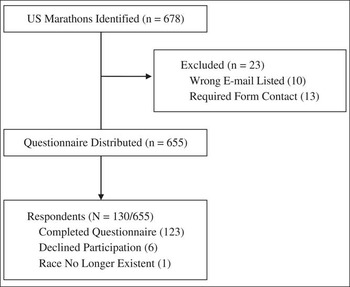
A total of 678 US marathons were identified, and ultimately, 655 questionnaires were distributed electronically to race directors (Figure 1). One hundred thirty responses were collected (123 completed questionnaires, six declined participation, and one race had not existed for many years), resulting in a 19% usable response rate.
Diagram of Participants.

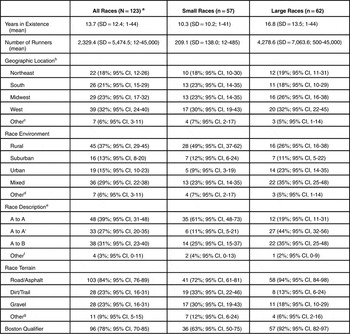
Races from all geographic regions of the country (including Alaska) and race environments were well represented (Table 1). The majority of responding races were held on road/asphalt roads, but there were also many respondents whose races featured alternate venues, such as nature trails, beaches, and indoor tracks.
Demographics of Included Marathons

a Four races did not provide a response to “Number of Runners” and could not be stratified as small or large.
b Geography defined by US census data.
c Other responses were free text entries and included: Alaska, Southwest, West Virginia, and Mid-Atlantic.
d Other responses were free text entries and included: Military Base, National Park, Track, Beach, Desert, and Trail.
e Defined by the following: A to A (start and finish are the same), A to A' (start is near the finish but not at the same location), and A to B (start and finish are at different locations).
f Other responses were free text entries and included: Track, Cloverleaf, and Loop.
g Other responses were free text entries and included: Boardwalk, Limestone, Sand, Track, Trails, Rocks, and Water.
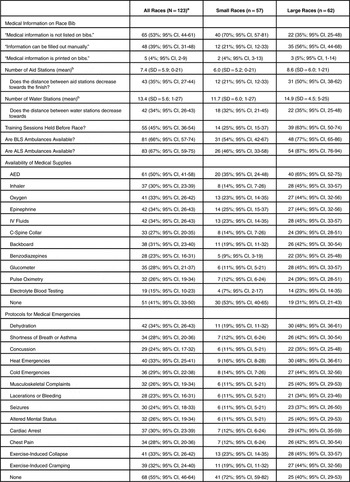
Table 2 demonstrates the medical emergency preparedness of US marathons in the sample, including availability of medical supplies and presence of protocols for medical emergencies. The number of medical aid stations on a marathon course varied greatly (7.4; SD = 5.9; Range 0-21) and were staffed by a wide variety of trained personnel, including first responders (43%), Basic Emergency Medical Technicians (49%), paramedics (49%), nurses (49%), and physicians (46%). The majority of races featured more than one level of provider (56%) at aid stations. When compared to larger races, smaller races were significantly less likely to staff aid stations with advanced medical personnel, such as paramedics (37%; 95% CI, 22-46 vs 62%; 95% CI, 49-72), nurses (30%; 95% CI, 19-43 vs 65%; 95% CI, 52-75), and physicians (28%; 95% CI, 18-41 vs 63%; 95% CI, 50-74). Other reported aid station staff included volunteers without medical training, American Red Cross (Washington, DC USA) trained volunteers, medical and nursing students, chiropractors, and athletic trainers.
Medical Emergency Preparedness, Affirmative Responses

Abbreviations: AED, automated external defibrillator; ALS, Advanced Life Support; BLS, Basic Life Support.
a Four races did not provide a response to “Number of Runners” and could not be stratified as small or large.
b A response of “150” (outlier) was removed from analysis.
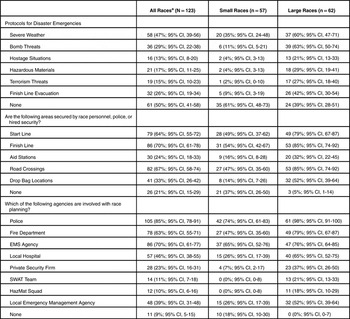
Table 3 demonstrates the disaster preparedness and security planning of US marathons in the sample. When stratified by number of participants, large races were more likely to have training sessions before the race, to have the immediate availability of certain medical supplies, to have protocols for selected medical emergencies and disasters, and to have involvement of security personnel during the race and with race planning.
Disaster Preparedness and Security Planning, Affirmative Responses

Abbreviations: EMS, Emergency Medical Services; SWAT, Special Weapons and Tactics Team.
a Four races did not provide a response to “Number of Runners” and could not be stratified as small or large.
Discussion
The objective of this study was to determine the current state of medical emergency and disaster preparedness of US marathons and to identify potential areas for improvement. According to the study results, there are a significant proportion of US marathons which may lack the equipment and protocols to deal with common medical emergencies and potential disasters that threaten both participants and spectators. Despite the fact that races in the sample featured a relatively high number of water stations (13.4; SD = 5.6; Range: 1-27), dehydration and heat exhaustion continue to make up a large component of marathon-related morbidity.Reference Schwabe, Schwellnus, Derman, Swanevelder and Jordaan 2 , Reference Ogwumike and Adeniyi 3 However, only 34% of race directors in the sample had a dehydration protocol in place and access to IV fluids for moderate to severe dehydration. Similarly, exercise-induced collapse is the most frequently seen condition at the finish line of all types of endurance events.Reference Jaworski 7 Only 33% of respondents, however, utilized an established exercise-induced collapse protocol. Furthermore, collapse may occur due to other serious medical conditions, such as cardiac arrest and hypoglycemia, but only a minority of races in the sample had access to automated external defibrillators (AEDs; 50%) or glucometers (28%) to diagnose and manage these conditions. Therefore, the data highlight possible deficiencies in medical emergency preparedness and raise the importance of creating standardized medical emergency protocols in order to ensure participant safety and adequate medical care on race day.
Additionally, based on the data, only 29% of race directors had a protocol in place for bomb threats, and only 26% of respondents had a plan to evacuate the finish line. Although greater than two-thirds of respondents had both starting and finish lines secured by race personnel, police, or hired security, 50% of race directors reported that they had no protocols in place for large-scale disaster emergencies.
The results of this study have significant implications for the running community. For example, a retrospective study of the Boston Marathon has suggested that life-threatening cardiac incidents sustained on race day may have been prevented or reduced by prior identification and medical clearance of advanced age runners and those with pre-existing history of coronary artery disease.Reference Cohen and Ellis 13 Based on the results of this study, one simple and cost-effective way to alert race volunteers and medical staff to high-risk runners is to ensure that race participants have personal medical information on racer’s bibs, thereby increasing the likelihood that, should they need medical attention during the race, they are evaluated and treated appropriately. Another small-scale intervention that has the potential to improve outcomes is pre-race training sessions for all medical responders and aid-station volunteers. Only 45% of race directors reported that they had pre-race staff training sessions with volunteers and medical providers. Mandatory pre-race training sessions would provide safety and medical staff with clear anticipatory guidance for race day as well as ensure the availability of adequate resources to manage an unexpected event.Reference Smith, Tuffin, Stratton and Wallis 14
Of note, this study sample revealed a lack of disaster protocols among large and small marathons alike. Although immediate access to medical equipment and highly trained, on-site personnel would enable marathon coordinators to implement disaster protocols more easily, it is understandable that small-scale races in particular have limited financial means to access these resources. That said, the successful response of the Boston medical community in quickly accommodating the victims of the marathon bombing was as much a result of the extensive resources at hand as it was the expeditious triage and transport of patients to the appropriate sites for medical care.Reference Biddinger, Baggish and Harrington 8 Strategic and history-inspired planning in the anticipation of such disasters could provide improved safety among future US marathons.
In a secondary analysis of the data, races were stratified based on number of participants. While the overall presence and availability of protocols and medical supplies was low, there was a distinct statistical difference between large and small races. In this sample, smaller races were much less likely to have protocols for all medical emergencies other than exercise-induced cramping and collapse, and they were also less likely to have advanced medical equipment and medications such as AEDs, pulse oximetry, glucometers, inhalers, and benzodiazepines. These races were also less likely to staff aid stations with advanced medical providers capable of using this equipment or administering these medications. Similarly, smaller races were less likely to have established disaster-related protocols, a secured start and finish line, and to have entities other than the police department involved in pre-race planning. While many of these discrepancies may exist due to the financial limitations of planning for a small-budget race, others may be due, in part, to a lack of established or published guidelines regarding medical and disaster preparations for endurance running events.
The events on Boylston Street on April 15th, 2013 serve as a constant reminder that, as nation-wide participation in marathons continues to grow, the collective susceptibility to large-scale threats does so as well. For this reason, it is important that the marathon community work towards the establishment of standardized medical emergency and disaster protocols and to protect the safety of its participants, volunteers, and spectators.
Limitations
This study has several limitations. Because the questionnaire was completed voluntarily and an incentive was provided to participants, the overall preparedness of US marathons to deal with medical emergencies and disasters may have been overestimated. Race directors without the financial support or infrastructure to become prepared, or those who were unprepared due to choice or lack of evidence-based recommendations, may have decided not to complete the questionnaire. Additionally, there were several race directors who were responsible for greater than five marathon races. While these directors did receive multiple survey links for each race, it is unlikely that a unique survey was filled out for each race, which ultimately lowers the overall response rate. Furthermore, the relatively low response rate may not reflect accurately the current state of medical emergency and disaster preparedness of marathons in the US. However, the collected data represent US marathons from a variety of geographic locations, environments, and race types (ie, number of registered runners, years of existence, and terrain).
In addition, it is difficult to determine the overall state of medical emergency and disaster preparedness of US marathons since evidence-based guidelines do not exist. Although a questionnaire was developed based on the opinions of the authors to measure marathon preparedness, this questionnaire has not been validated to measure preparedness, nor has compliance with elements of the questionnaire leading to improved outcomes been studied. However, the questionnaire was developed by authors with experience managing the medical planning and coverage of marathons and was vetted to several marathon directors for additional input prior to distribution. Future studies involving simulated medical emergencies and disasters surrounding marathon races need to be conducted to determine if preparedness strategies affect outcomes such as survival rates and morbidity. Lastly, as with any study involving questionnaires, there exists a problem with the accuracy of self-reporting, especially when conducted without site visits to each US marathon.Reference Choi and Pak 15
Conclusions
Areas for possible improvement in the preparedness of US marathons were identified, such as including printed medical information on race bibs, increasing pre-race training and planning sessions for volunteers, ensuring the immediate availability of certain emergency equipment and medications, and developing written protocols for specific emergencies and disasters.
Supplementary Material
To view supplementary material for this article, please visit http://dx.doi.org/10.1017/S1049023X15004859