Introduction
Traumatic brain injury (TBI) particularly affects the frontal lobes with many survivors suffering cognitive, social, and emotional difficulties, including poor or risky decision making (Hellawell, Taylor, & Pentland, Reference Hellawell, Taylor and Pentland1999; Salmond, Menon, Chatfield, Pickard, & Sahakian, Reference Salmond, Menon, Chatfield, Pickard and Sahakian2005). These difficulties can lead to a failure to return to employment and the breakdown of interpersonal relationships (Ownsworth & McKenna, Reference Ownsworth and McKenna2004).
Damasio and colleagues (Bechara, Damasio, Damasio, & Anderson, Reference Bechara, Damasio, Damasio and Anderson1994; Reference Bechara, Tranel, Damasio and Damasio1996; Bechara, Tranel, Damasio, & Damasio, Reference Bechara, Tranel, Damasio and Damasio1996; Damasio, Reference Damasio1994; Eslinger & Damasio, Reference Eslinger and Damasio1985) have long argued that emotion-based decision-making deficits experienced by individuals following frontal lobe lesions, particularly the ventromedial prefrontal cortex (VMPfC), are due to an inability to use emotion-based biasing signals generated from the body (somatic markers), when appraising different response options. It is hypothesised that decision making in complex and uncertain situations, such as social situations, involves a combination of carrying out a logical cost-benefit analysis of a given action and responding to somatic markers indicating how rewarding or punishing an action is likely to be (somatic marker hypothesis, Damasio, Reference Damasio1994; Reference Damasio1996). It is also suggested that the somatic markers lead to an ‘emotional hunch’ or ‘gut feeling’, which can guide cognitive decision making (Damasio, Adolphs, & Damasio, Reference Damasio, Adolphs, Damasio, Davidson, Scherer and Goldsmith2003).
Empirical support for the somatic marker hypothesis has largely stemmed from the Iowa Gambling Task (IGT), an experimental paradigm designed to mimic real-life decision making by factoring in complexity, uncertainty, reward, and punishment (see Bechara, Damasio, & Damasio, Reference Bechara, Damasio and Damasio2000). In the IGT, participants either win or lose money (real money or facsimile) by selecting cards from four separate decks. Two of the card decks have high wins and high losses (‘risky’ or ‘bad’ decks), and two of the decks have small wins and small losses (‘safe’ or ‘good’ decks). Participants are not told which decks are risky/bad or safe/good, and their choice of deck selection is recorded across 100 trials. A key feature of this task is that participants learn to forego short-term benefit for long-term profit over a long and complex (multiple decks with varying contingencies) reinforcement history. Changes in anticipatory skin conductance response (SCR) have been associated with successful learning, that is, making fewer ‘bad’ choices, and instead selecting from the safe decks, supporting the role of somatic markers in task performance (Bechara et al., Reference Bechara, Damasio and Damasio2000). It is argued, therefore, that to do well on this task participants must rely on ‘intuitive’ decision making processes, in particular, the activation of somatic marker biasing signals.
Consistent with the notion that the IGT mimics real-life complex decision making, individuals with frontal lobe damage failed to adopt optimal strategies when performing the IGT leading to a continued preference for the ‘risky’ decks (Bechara et al., Reference Bechara, Damasio, Damasio and Anderson1994). More importantly, these same individuals failed to show the anticipatory physiological changes in SCRs found in healthy controls (Bechara et al., Reference Bechara, Tranel, Damasio and Damasio1996). Similar findings have been shown in individuals following TBI (Cotrena et al., Reference Cotrena, Branco, Zimmermann, Cardoso, Grassi-Oliveira and Fonseca2014; Fujiwara, Schwartz, Gao, Black, & Levine, Reference Fujiwara, Schwartz, Gao, Black and Levine2008; Levine et al., Reference Levine, Black, Cheung, Campbell, O'Toole and Schwartz2005). Despite the wealth of evidence supporting the IGT as a test of emotion-based decision making (for a review, see Bechara, Reference Bechara2004), studies have questioned the role of somatic markers and whether alternative mechanisms can account for performance on the IGT (for review, see Dunn, Dalgleish, & Lawrence, Reference Dunn, Dalgleish and Lawrence2006). For example, some studies using dual-task methods (Hinson et al., Reference Hinson, Jameson and Whitney2002; Jameson et al., Reference Jameson, Hinson and Whitney2004; but see Turnbull et al., Reference Turnbull, Evans, Bunce, Carzolio and O'connor2005) and neurological studies (Bechara, Damasio, Tranel, & Anderson, Reference Bechara, Damasio, Tranel and Anderson1998) have found that performance on the IGT is influenced by working memory capacity. Other studies have questioned the assumption that tasks need to be as complex as the IGT to capture emotion-based decision making. For example, Bowman and Turnbull (Reference Bowman and Turnbull2004) designed the Bangor Gambling Task (BGT) to have a similar structure to the IGT, that is, a gambling task with explicit financial reward/punishment and with varying contingencies, but to be a simpler version of the task. In contrast to the four-deck IGT, the BGT involves using a single deck of cards; therefore, varying contingencies across time rather than time and space as in the IGT. It also has a simple ‘gamble/no gamble’ response and either a win or loss on each trial. In the original IGT, participants receive both win and loss feedback on each trial, which potentially increases the working memory demands of the task. In their study, comparing performance on the BGT directly with performance on the IGT, Bowman and Turnbull (Reference Bowman and Turnbull2004) found that undergraduate participants showed the same incremental learning across both tasks, with a significant correlation in overall performance. Furthermore, the same individuals were impaired using the IGT cut-off of +9 or below (Bechara et al., Reference Bechara, Dolan, Denburg, Hindes, Anderson and Nathan2001) on both tasks. Based on these findings, Bowman and Turnbull (Reference Bowman and Turnbull2004) concluded that not only does the BGT have similar structural properties to the IGT, but participants also perform similarly on both tasks, thus tasks do not need to be complex to measure emotion-based decision making. The authors suggested that the BGT potentially offers a simple measure of emotion-based decision making, removing the complex instructions and complex feedback of the IGT, which can be used with neurological patients.
Following this suggestion, we report the first study to examine the performance of individuals with TBI relative to healthy controls on the BGT. This study aimed to characterise BGT performance in survivors of TBI with the predictions that (i) survivors of TBI will make more ‘gamble’ choices than controls (total BGT score); (ii) more survivors of TBI than controls will fall below the Bowman and Turnbull (Reference Bowman and Turnbull2004) suggested cut-off of +9 or below; and (iii) survivors of TBI will have difficulty learning to change their ‘gamble’ response in the face of increasing losses. Specifically, there will be a significant Group by Block interaction, with no group difference on Block 1 (i.e., the first 20 trials, consistent with previous IGT studies see, for example, Tranel, Bechara, & Denburg, Reference Tranel, Bechara and Denburg2002).
Given the novelty of this study, we also set out to explore patterns of performance across blocks using cluster analysis to identify sub-groups. This is of interest given the individual differences shown in control performance on emotion-based decision tasks (e.g., Dunn et al., Reference Dunn, Dalgleish and Lawrence2006; Horstmann, Villringer, & Neumann, Reference Horstmann, Villringer and Neumann2012; Steingroever, Wetzels, Horstmann, Neumann, & Wagenmakers, Reference Steingroever, Wetzels, Horstmann, Neumann and Wagenmakers2013), and the heterogeneity in TBI (e.g., pre-morbid ability, mechanism of injury, time since injury, extent brain damage, etc.).
Finally, given the literature exploring alternative mechanisms for performance on emotion-based decision making tasks (e.g., for a review, see Dunn et al., Reference Dunn, Dalgleish and Lawrence2006), the current study aimed to explore possible predictors of performance. Whole group multiple regressions were conducted with working memory and executive function ability as predictors. The additional variables of presence of injury, speed of processing, estimated pre-morbid IQ, age, and gender were included as possible predictors.
Method
Participants
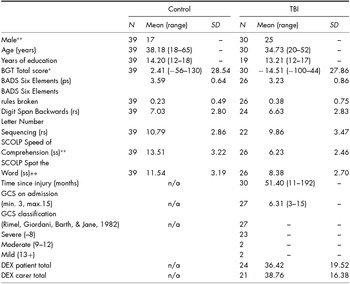
Thirty survivors of TBI (25 males, 5 females; mean age: 34 years, range: 20–52 years; mean years of education: 13 years, range 12–17 years), recruited from a regional specialist neurorehabilitation centre, participated in this study (see Table 1 for details of sample characteristics). All participants survived a closed head injury, were at least 6 months post injury (mean time since injury: 51.4 months, range: 11–192 months) and had emerged from post-traumatic amnesia. According to the Glasgow Coma Scales (GCS, Teasdale & Jennett, Reference Teasdale and Jennett1974) severity classifications, 23 of the survivors suffered severe TBI (GCS 3–8), 2 suffered moderate TBI (GCS 9–12), and 2 suffered mild TBI (GCS 13+), with missing data for 3 participants. Despite the missing data and the variability in injury severity, all participants showed clinically significant impairments in everyday functioning consistent with referral to the specialist neurorehabilitation service.
Demographics, Cognitive Functioning, and Injury Characteristics for Control and TBI Groups

N = sample size; SD = standard deviation; BGT = Bangor Gambling Task; BADS = Behavioural Assessment of the Dysexecutive Syndrome; SCOLP = Speed and Capacity of Language Processing; GCS = Glasgow Coma Scale (Teasdale & Jennett, Reference Teasdale and Jennett1974); DEX = Dysexecutive Syndrome Questionnaire.
*p < .05; ** p < .01
ps = profile score as derived from manual; ss = scaled score as derived from manual; rs = raw score.
Thirty-nine healthy control participants (17 males, 22 females; mean age: 38 years, range: 18–65 years; mean years of education: 14 years, range 12–18 years) were recruited from the MRC Cognition and Brain Sciences Unit's volunteer panel.
The groups did not significantly differ on age (p = .27) or years of education (p = .13), but there were significantly more females in the healthy control sample than the TBI sample (χ2(1) = 11.25; p = .001).
This study had ethical approval from the University of Cambridge local research ethics committee and written informed consent was obtained.
Measures
Bangor Gambling Task (BGT)
The BGT was administered in accordance with the procedures outlined by Bowman and Turnbull (Reference Bowman and Turnbull2004). Using a deck of 100 playing cards, 9 were labelled as ‘win 20p’, 29 ‘win 10p’, 35 ‘lose 20p’, and 27 ‘lose 10p’. Participants were given written instructions, which were also read aloud by the examiner, informing them that the aim was to make as much money as possible. It was at the discretion of the player whether to gamble or not, but they were instructed to inform the experimenter prior to turning over the top card of the deck. At the start of the game, all participants were given £ 2.00 and told that they could keep any money they won. Unknown to the participants, the deck was split into five blocks of 20 card selections. If participants gambled on every card, they would win £1.00 on Block 1 (15 win, 5 lose cards), neither win nor lose on Block 2 (10 win, 10 lose), lose £ 1.00 on Block 3 (5 win, 15 lose), lose £ 2.00 on Block 4 (5 win, 15 lose at a higher value), and lose £ 3.00 on Block 5 (3 win, 17 lose). The cards were administered in the same order to each participant. The task took approximately 15 minutes to complete (with instructions).
Consistent with the IGT and the Bowman and Turnbull (Reference Bowman and Turnbull2004) original study, performance was calculated as the number of ‘no gamble’ minus the number of ‘gamble’ decisions made per block and overall. A negative score indicates more ‘gamble’ responses.
It is important to note that in the BGT to gamble in the first block is advantageous; therefore, choosing to ‘gamble’ in Block 1 could be interpreted as exploratory behaviour rather than impaired decision making. As with other measures of emotion-based decision making (e.g., the IGT), participants would not be aware of this without first sampling the cards; therefore, Block 1 is included in the main analysis with the prediction of no group difference on Block 1.
Characterisation measures and potential predictors of BGT performance
Survivors of TBI and controls completed the following measures: The Speed and Capacity of Language Processing test (SCOLP, Baddeley, Emslie, & Nimmo-Smith, Reference Baddeley, Emslie and Nimmo-Smith1992) measured speed of processing (Speed of Comprehension) and estimated pre-morbid IQ (Spot the Word). Working memory was measured using two subtests of the Wechsler Adult Intelligence Scales 3rd edition (WAIS-III, Wechsler, Reference Wechsler1997), digit span and letter−number sequencing, and executive function was measured using the Modified Six Elements (6 Elements) subtest of the Behavioural Assessment of the Dysexecutive Syndrome (BADS, Wilson, Alderman, Burgess, Emslie, & Evans, Reference Wilson, Alderman, Burgess, Emslie and Evans1996). In addition, survivors of TBI and their relatives completed the Dysexecutive Syndrome Questionnaire (DEX, Wilson et al., Reference Wilson, Alderman, Burgess, Emslie and Evans1996) to characterise behavioural symptoms of everyday executive function difficulties.
A measure of attention, the Sustained Attention to Response Task (SART, Robertson, Manly, Andrade, Baddeley, & Yiend, Reference Robertson, Manly, Andrade, Baddeley and Yiend1997), was originally included in the study protocol; however, only 56% (n = 22) of the controls and 16.6% (n = 5) of the TBI group completed this measure. Due to the large amount of missing data, the SART was excluded from subsequent analysis.
Plan of Analysis
A Student's T test was used to test for group differences on total BGT score, and a Chi-Squared test was used to test for differences in the proportion of survivors of TBI performing below the cut-off (+9 or below) relative to the proportion of controls.
To test for the predicted Group (TBI, Control) by Block (1, 2, 3, 4, 5) interaction, a mixed-model ANOVA with a between-subjects factor of Group and a within-subjects factor of Block was conducted. Box's test of equality of variances was not significant; however, Mauchly's test of sphericity was significant; therefore, the Greenhouse–Geisser correction was applied. G-Power indicated that to detect a significant two-way interaction (Group by Block) with a medium effect size, at alpha .05 and power .85, a total sample size of 36 would be required.
To explore individual differences in performance across Blocks, and potential sub-groups, a hierarchical cluster analysis was conducted using the squared Euclidian distance measure of difference between cases. The clustering variables were scores for performance on each of the five blocks. As these measures are on the same scale, it was not necessary to standardise the scores prior to clustering. Identified clusters were compared in terms of proportion of TBI vs. controls, demographics (age and gender) and cognitive variables (SCOLP Speed of Comprehension, SCOLP Spot the Word, BADS 6 Elements, letter-number sequencing, and backwards digit span).
Finally, to explore predictors of total BGT performance and to test contribution of specific executive and working memory variables, a stepwise hierarchical multiple regression was conducted with overall BGT score as the outcome variable, demographic variables in Model 1 (age, gender), injury group, SCOLP Speed of Comprehension scaled score (processing speed), and SCOLP Spot the Word scaled score (estimated pre-morbid IQ) in Model 2, and letter–number sequencing and backwards digit span (working memory), and BADS 6 Elements profile score (executive function) in Model 3.
Results
Table 1 shows the participant demographics, characteristics, and performance on the measures included in the hierarchical multiple regressions.
Hypotheses 1 to 3: Survivors of TBI Will be Impaired Relative to Controls on the BGT
As predicted (Hypothesis 1), overall, survivors of TBI made more gamble choices than controls (total BGT score: t(67) = 2.47, p = .02; see Table 1). However, when the suggested cut-off of +9 or below (Bowman & Turnbull, Reference Bowman and Turnbull2004) was applied, the number of survivors of TBI (80%) classified as ‘impaired’ was not significantly greater than the number of controls (66.7%; Hypothesis 2: χ2(1) = 1.51; p = .22).
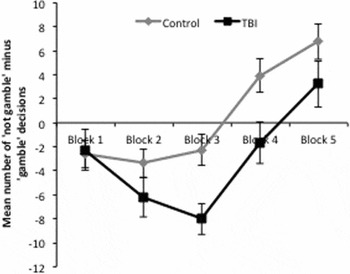
Unexpectedly, the prediction that survivors of TBI will have difficulty learning to change their ‘gamble’ response in the face of increasing losses (Hypothesis 3) was not supported (Group by Block interaction: F(2.19, 67) = 1.98, p = .14; ηp 2 = .03, small effect). The mixed-model ANOVA revealed, however, a significant main effect of Group (F(1, 67) = 6.41; p = .01; ηp 2 = .09, medium effect) and a significant main effect of Block (F(2.19, 67) = 23.74, p = .0001; ηp 2 = .26, large effect). Paired t-tests (Bonferroni correction, p ≤ .005) revealed the following pattern of performance across the Blocks: 1 = 2 = 3 < 4 < 5, indicating that in Blocks 4 and 5 participants were selecting more advantageously than in Blocks 1–3; therefore, participants showed evidence of learning across blocks (see Figure 1).
Performance (mean number of ‘not gamble’ minus ‘gamble’ decisions per block, with standard error bars shown) of each group (Control, TBI) on the BGT across the five blocks.

Exploring Individual Differences and Sub-Groups on BGT Performance
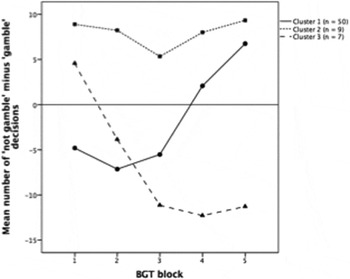
Inspection of the dendrogram derived from the hierarchical cluster analysis identified a parsimonious cut-off of +10, which yielded three clusters. These clusters were very clearly distinguished by pattern of performance, as shown in Figure 2. Cluster 1 (n = 50) showed a tendency to gamble more initially over Blocks 1–3 and reversal of this from Block 4 to 5. Cluster 2 (n = 9) largely refrained from gambling throughout, showing a tendency towards gambling on Block 3, and then reversal of this pattern. Cluster 3 (n = 7) was similar to Cluster 2 at Block 1 but showed a contrasting pattern of increased gambling over time, with little or no reversal over the later blocks. The performance of three participants was not classified by the analysis.
Chart showing mean performance for each of the three clusters on the BGT across the five blocks.

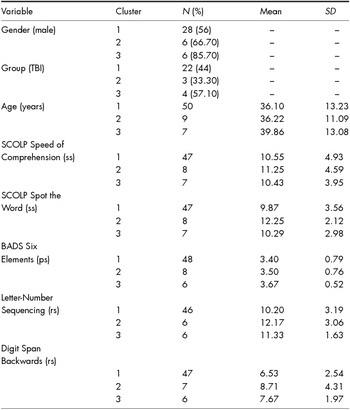
Post-hoc analyses were not performed due to the small sample sizes in the clusters (particularly Clusters 2 and 3); however, as shown in Table 2, descriptively, Cluster 3 appeared to be characterised by more males and more survivors of TBI.
Characteristics of the Three Clusters Differentiated by Block-by-Block Pattern of BGT Performance

N = sample size; SD = standard deviation; BGT = Bangor Gambling Task; SCOLP = Speed and Capacity of Language Processing; BADS = Behavioural Assessment of the Dysexecutive Syndrome.
ps = profile score as derived from manual; ss = scaled score as derived from manual; rs = raw score.
Exploring Predictors of BGT Performance
Model 1 (age and gender) was significant (F(2, 55) = 4.31; p = .02), with addition of group, processing speed, and estimated pre-morbid IQ significantly improving the model (Model 2, Adjusted R2 = .20; R2 change = .13, F(3, 52) = 3.14; p = .03). Addition of working memory and executive variables did not significantly improve variance accounted for in Model 3 (R2 change = .01, F(3, 49) = .31; p = .82). Model 2 accounted for the greatest amount of variance in BGT performance (20%), with only age (β = −.28; t = −2.28; p = .03) and group (β = −.54; t = −2.67; p = .01) remaining significant.
Discussion
This study aimed to characterise BGT performance in survivors of TBI. Findings suggest that consistent with previous studies examining emotion-based decision making (e.g., IGT; Cotrena et al., Reference Cotrena, Branco, Zimmermann, Cardoso, Grassi-Oliveira and Fonseca2014; Fujiwara et al., Reference Fujiwara, Schwartz, Gao, Black and Levine2008; Levine et al., Reference Levine, Black, Cheung, Campbell, O'Toole and Schwartz2005), overall survivors of TBI made more gamble choices than controls.
The groups did not significantly differ, however, when the Bowman and Turnbull (Reference Bowman and Turnbull2004) suggested cut-off of +9 or below to indicate ‘impaired’ performance was applied, due to a high proportion of controls (66.7%) being classified as ‘impaired’. It is not uncommon to find emotion-based decision making ‘impairments’ in controls. For example, Steingroever et al. (Reference Steingroever, Wetzels, Horstmann, Neumann and Wagenmakers2013) found that up to a third of controls failed the IGT, with some authors suggesting that individual differences in task approach and strategy use can account for this (e.g., Horstmann, Villringer, & Neumann, Reference Horstmann, Villringer and Neumann2012). Interestingly, more controls were classified as impaired in the current study (66.7%) compared to the undergraduate sample reported in the original BGT study (35%; Bowman & Turnbull, Reference Bowman and Turnbull2004). There are many possible reasons for the difference in performance between the two control groups and a direct comparison is not possible. However, from examining the reported demographic data, the controls in the original study were younger than those in the current study and age has been shown to be associated with both performance (Cauffman et al., Reference Cauffman, Shulman, Steinberg, Claus, Banich, Graham and Woolard2010) and strategy use (Wood, Busemeyer, Koling, Cox, & Davis, Reference Wood, Busemeyer, Koling, Cox and Davis2005) on emotion-based decision making tasks. Also, the control group in the current study had a higher proportion of male participants (44%) compared to the original study (30%), and gender has also been associated with performance on emotion-based decision making tasks (van den Bos, Homberg, & de Visser, Reference van den Bos, Homberg and de Visser2013). It is also worth noting that the BGT cut-off suggested in the original study was taken from Bechara et al. (Reference Bechara, Dolan, Denburg, Hindes, Anderson and Nathan2001), who used the performance of individuals with VMPfC damage on the IGT to guide the criteria for impairment in other patient groups (e.g., substance use). It is possible, therefore, that the suggested cut-off of +9 or below is not the most sensitive measure of impairment on the BGT.
Based on previous studies (e.g., Bechara et al., Reference Bechara, Damasio, Damasio and Anderson1994), it was expected that survivors of TBI would show difficulty learning to reduce their ‘gamble’ responses in the face of increasing losses and thus show a different pattern of performance compared to controls across the five blocks. This prediction was not supported, and despite an a priori power calculation indicating that the current study had a large enough sample size to detect a medium effect size (Group by Block interaction), the actual effect obtained was small, suggesting a larger sample size might have been needed. The results were consistent with the findings on overall BGT score, in that the TBI group made more gamble choices than the controls (main effect of Group); however, both groups showed the general pattern of making more gamble choices on Blocks 1–3, and then reversing this on Blocks 4 and 5 (main effect of Block). Analysing performance between-groups and across blocks of 20 trials is consistent with previous studies of emotion-based decision making tasks (e.g., Bechara et al., Reference Bechara, Dolan, Denburg, Hindes, Anderson and Nathan2001; Bowman & Turnbull, Reference Bowman and Turnbull2004; Tranel et al., Reference Tranel, Bechara and Denburg2002); however, some authors have questioned the sensitivity of this approach, particularly for patient populations (e.g., Dunn et al., Reference Dunn, Dalgleish and Lawrence2006; Ryterska, Jahanshahi, & Osman, Reference Ryterska, Jahanshahi and Osman2013).
We explored the data further to identify potential sub-groups with broadly similar patterns of performance. Three clusters were identified, with both survivors of TBI and controls being represented in each cluster. The largest group (Cluster 1) tended to gamble initially (which is favourable in Block 1), increase tendency to gamble slightly in Block 2 (which would lead to a neutral outcome), but reduce gambling over Blocks 3–5. This pattern of performance suggests evidence of learning in response to the change in contingencies. Taking this a step further, given that 22 of the 30 survivors of TBI were represented in this cluster, this suggests that survivors of TBI can show learning on an emotion-based decision making task.
Participants in Cluster 2 appeared to avoid gambling throughout the task, even in Block 1 where gambling is advantageous, suggesting a risk-avoidant strategy, whereas Cluster 3 increased gambling throughout the task and did not change their behaviour in response to the change in contingency. The pattern of performance in Cluster 3 suggests an inability to forgo short-term gain for long-term profit, although the profile is even more extreme than that typically shown by individuals with bilateral damage to the VMPfC (e.g., Bechara et al., Reference Bechara, Damasio, Damasio and Anderson1994; Tranel et al., Reference Tranel, Bechara and Denburg2002). Although not tested here, alternative mechanisms might also account for this finding including adopting a risk-taking strategy or being sensation seeking, apathy or insensitivity to negative outcomes, impaired reversal learning, or an inability to inhibit a response (see Dunn et al., Reference Dunn, Dalgleish and Lawrence2006 for detailed discussion).
Differences between clusters on performance during Block 1, and prior to any manipulation of contingencies, indicate potential for large individual differences in approach to the task, which may make identification and interpretation of performance differences following contingency changes more problematic. Furthermore, although overall differences in the BGT between controls and survivors of TBI could be accounted for by the TBI group having an acquired impairment in emotion-based decision making, an alternative account is that individual differences in risk-taking behaviour might underlie the likelihood of sustaining a TBI, further confounding interpretation of performance on gambling tasks such as the BGT.
Given the small group sizes it was not possible to analyse differences on demographic or cognitive variables; however, descriptively, Cluster 3 appeared to have more survivors of TBI than controls and more males than females. Despite the caveats of this being an exploratory analysis with the cluster yielding a small group size, the higher proportion of survivors with TBI than controls in Cluster 3 is consistent with the main prediction that survivors of TBI will fail to learn from increasing losses, although an individual differences account cannot be ruled out.
In relation to the sex-difference found in Cluster 3, there is a growing body of literature suggesting that men and women perform emotion-based decision making tasks differently. These studies generally show that men focus on the long-term gain, whereas women focus on both the long-term gain and the win/loss frequency when performing tasks such as the IGT (for review, see van den Bos, Homberg, & de Visser, Reference van den Bos, Homberg and de Visser2013). Sex differences in performance (or task strategy) on the BGT have not been examined; therefore, it is not possible to conclude that males and females perform the task differently, and instead, it is possible that the higher number of males in Cluster 3 is accounted for by the higher number of survivors with TBI, who were predominantly male (83.3% of the sample) in the current study. Related to this possible explanation, presence of injury was significant in the multiple regression analysis when examining predictors of overall BGT performance, whereas gender was not.
The multiple regression analysis also found no significant influence of processing speed or pre-morbid IQ on overall BGT performance, despite group differences on these variables. The finding that processing speed did not influence overall BGT performance is consistent with the recent literature examining predictors of IGT performance (Gansler, Jerram, Vannorsdall, Schretlen, Reference Gansler, Jerram, Vannorsdall and Schretlen2011). Similarly, a review of 43 studies of gambling task performance indicated that only a small number of studies found significant effects of IQ on IGT performance and, in these studies, effect sizes were small (Toplak, Sorge, Benoit, West, & Stanovich, Reference Toplak, Sorge, Benoit, West and Stanovich2010).
There was also no significant influence of working memory or executive function ability on overall BGT performance, which is in keeping with some previous studies (e.g., Bechara et al., Reference Bechara, Damasio, Tranel and Anderson1998; Turnbull et al., Reference Turnbull, Evans, Bunce, Carzolio and O'connor2005). It is worth noting that there was also no significant difference between the survivors of TBI and controls on these measures which, although inconsistent with some studies of neurocognitive performance following TBI (e.g., Dunning, Westgate, & Adlam, Reference Dunning, Westgate and Adlam2016; Zimmermann et al., Reference Zimmermann, Pereira, Hermes-Pereira, Holz, Joanette and Fonseca2015), is consistent with findings reported in patients with anterior VMPfC (i.e., poorer emotion-based decision making relative to controls but intact working memory, Bechara et al., Reference Bechara, Damasio, Tranel and Anderson1998).
Finally, the multiple regression analysis suggested that age influenced overall BGT performance. As with gender (see above), age differences in performance on the BGT have not been directly studied; however, studies using the IGT have found age differences in performance between adolescents and adults up to the age of 30, with avoidance of the disadvantageous decks improving with age (i.e., make fewer ‘bad’ choices, Caufmann et al., Reference Cauffman, Shulman, Steinberg, Claus, Banich, Graham and Woolard2010). This is inconsistent with our finding of poorer overall performance (i.e., make more ‘gamble/bad’ choices) with increasing age. It is possible that differences in strategy use might have influenced performance (e.g., Wood et al., Reference Wood, Busemeyer, Koling, Cox and Davis2005; although their study found no corresponding difference in task performance); however, age effects should be directly studied before firm conclusions can be drawn.
Limitations and Future Directions
As discussed above, the cut-off used to classify ‘impaired’ vs. ‘not impaired’ performance on the BGT was not directly derived from BGT data and, therefore, might not be sensitive to group differences in performance (as suggested by the finding of a significant difference in total score, but not when using the cut-off to classify total score). Future research might want to consider alternative approaches to identifying impaired performance on the BGT, and total score might in itself not be a sensitive measure (see Dunn et al., Reference Dunn, Dalgleish and Lawrence2006 for discussion). Related to this, given the lack of a significant Group by Block finding, future research (particularly with clinical groups) might want to examine linear contrasts/trends in performance rather than performance across blocks of 20 trials (see Dunn et al., Reference Dunn, Dalgleish and Lawrence2006). The exploratory cluster analysis raised some interesting findings; however, the small sample sizes in the clusters limited the use of post-hoc tests to further examine their characteristics. Future research might want to extend this approach to analysing emotion-based decision making performance in a larger sample of participants and identifying models that can best account for individual differences (e.g., Franken & Muris, Reference Franken and Muris2005), including pre-injury factors and acquired neurocognitive changes in survivors of TBI.
A further limitation of our study is that estimated IQ, as measured using the SCOLP Spot the Word subtest, significantly differed between the TBI and control groups and is, therefore, a potential confound. Future studies might want to address this by including groups matched on IQ.
Finally, the current study, consistent with the original BGT study (Bowman & Turnbull Reference Bowman and Turnbull2004), did not test whether the BGT relies on somatic markers (emotion biasing signals) to guide decision making. Future studies might want to examine this more directly using psychophysiology methods.
Clinical Implications
Despite the attractiveness of its simplicity over other tests (e.g., the IGT), and that it is free to use (compared to IGT (prices in 2016): £ 472 in the UK; $574 in the USA; $1072.50 in Australia), the current study raises a number of issues that need to be addressed prior to recommending use of the BGT as a measure of emotion-based decision making for survivors of TBI. First, a meaningful, reliable, and sensitive approach to classify task performance as being impaired or not needs to be developed. This may, for example, model individual differences in patterns of performance rather than classify a total score. Second, the mechanisms underpinning task performance (e.g., somatic markers, reversal learning, or individual differences in sensation-seeking behaviours, etc.) need to be confirmed. Third, the relationship between performance on the BGT and real-life emotion-based decision making needs to be confirmed. Finally, if the BGT is to replace the IGT, then it needs to be confirmed that the BGT shares similar properties to the IGT when performed by survivors of TBI, for example, by a direct comparison as tested in the original Bowman and Turnbull (Reference Bowman and Turnbull2004) study.
Conclusion
Despite survivors of TBI making more gamble decisions compared to controls on the BGT, this study suggests considerable overlap between survivors of TBI and controls in their individual patterns of performance. These findings are in keeping with an individual difference account of emotion-based decision making, and it is suggested that future research focuses on developing models to best capture performance on emotion-based decision making tasks in survivors of TBI. It is also suggested that future research examines the mechanisms underpinning performance on emotion-based decision making tasks, and the neural correlates associated with performance, in survivors of TBI. In conclusion, the current study raises a number of issues that need to be addressed prior to recommending use of the BGT as a measure of emotion-based decision making for individuals with neurological conditions.
Acknowledgements
We thank the participants and their families for their continued support with our research. We would also like to thank the following individuals for their contribution to the study: Dr Tom Manly, Dr Andrew Bateman, Dr Rebecca Rous, Eve Greenfield, and Joe Deakin. We are also grateful to Louise Head for her support with the preparation of the manuscript.
Funding
For Dr Fergus Gracey, the research was supported by the National Institute for Health Research (NIHR) Collaboration for Leadership in Applied Health Research and Care (CLAHRC) East of England at Cambridgeshire and Peterborough NHS Foundation Trust. This report describes independent research. The views expressed are those of the author(s) and not necessarily those of the NHS, the NIHR or the Department of Health. No other author received funding to conduct the research.
Conflict of Interest
None.
Ethical Standards
The authors assert that all procedures contributing to this work comply with the ethical standards of the relevant national and institutional committees on human experimentation and with the Helsinki Declaration of 1975, as revised in 2008.