Introduction
In his biography of Kurt Cobain, Charles Cross tells the story of Nirvana's 1989 road-trip with the band Tad. As the story goes, Tad's lead singer, Tad Doyle, suffered a gastrointestinal ailment and had to vomit every morning before the van could depart. Cobain reputedly loved this ritual, describing Doyle's upheaval as a work of art. One of Doyle's band-mates, Kurt Danielson, recalled how Cobain would respond to the occasion:
He would stand there patiently, holding this plastic tub with a delightful glitter in his eyes. He'd look up at Tad expectantly, and finally Tad would puke, and it would just come out in a glorious, colorful flow, and Kurt would catch it all. No one else got to hold the tub; it was Kurt's job and it was his delight. (Cross Reference Cross2001, p. 140)
Cross goes so far as to say that ‘in some ways, Tad's gastrointestinal system became Kurt's muse that fall’ in 1989 (Cross Reference Cross2001, p. 140) and, in fact, Cobain based the song ‘Breed’ (first called ‘Imodium’) on the medication Doyle took for frequent bouts of diarrhea.Footnote 1 Cobain himself suffered digestive ailments, including a chronic stomach condition, irritable bowel syndrome and frequent vomiting, ailments which did not improve with his heroin habit and relentless touring schedule. These physical conditions shaped his life and subjectivity; he once mused that if a rock 'n' roll opera were to be written about him, it would be ‘all about vomiting gastric juices’ (Cobain Reference Cobain2002, p. 185).
Cobain's Journals, published in 2002 by Riverhead Press, attest to the importance of his health and body to his aesthetic ideals and output. The volume of excerpts was compiled from 23 of Cobain's personal notebooks (some 800 pages), purchased from Courtney Love for $4 million. It contains, in approximate chronological order, handwritten prose, copies of newsletters, scrawled notes on gig logistics, drafts of song lyrics, and numerous drawings. These fragments are predominantly handwritten, often on stained notebook pages, filled with cross-outs, marginalia and drawings.
Having studied the larger archive of journals from which the published volume was excerpted, Charles Cross notes that ‘his [Cobain's] songs and his journal entries … were obsessed with the human, bodily functions: Birth, urination, defecation, and sexuality were topics he was accomplished in’ (Cross Reference Cross2001, pp. 90–91) and that ‘the anatomical world accounted for 90 per cent of the themes he wrote about and the art he created’ (Cross Reference Cross2008, p. 40). Among the excerpts in the published Journals are comic strips, self-portraits, short stories about bodily fluids, lists of self-identifying physical features, essays on the viscerally embodied aspects of musical performance, as well as autobiographical accounts of his digestive ailments. Together, these various fragments show the importance of the ravaged body to the whole of his multimedia output. Further, they demonstrate a homology between his different expressive avenues – essaying, drawing, singing, song writing and performing.
Cobain's understanding of the sick body came from his life experiences as a thin male with chronic stomach problems, scoliosis, a heroin addiction, and a stage routine that featured regular stage diving, equipment smashing and prolonged screaming. His sickly physique marginalised him among the mainstream ‘jock’ culture of his high school and hometown, such that he associated this body type with outsider status. As a symptom of malnutrition and digestive illness, of harrowing touring schedules, and of heavy drug use and a performance practice that hurt his voice and spine, the sick body also came to stand for a life of hardship, intensity and physical risk.
Drawing on the Journals fragments, I will first argue that for Cobain, hardship, intensity and risk comprised an ideal of ‘authenticity’ – an ideal that shaped his approach to politics as well as aesthetic forms. In the Journals fragments in which he critiqued Reagan-era politics, heteronormative masculine pressure or mass market arena rock (to name a few examples), the sick body offered a repertoire of metaphors with which to signal the intensity and authenticity of his opinions; if semantics and coherence were lost along the way, this was further proof of the intensity of the expressive act. Lastly, I argue that in song lyrics and performance, Cobain prized scatological imagery, eviscerating vocals and unintelligible lyrics as a means to signal the ‘realness’ of his art – that is, his art came from the ‘gut’.
In this paper I aim to show a way to study historical punk or rock formations through the lens of an organising metaphor, one that is translated into various media – visual art, prose and lyrics, as well as music. I treat Cobain as a case study and do not, for example, explore the ways that this metaphor circulated among fans of the hardcore and grunge scenes in the late 1980s and 1990s. Additionally, I have narrowed my focus to his voice: one specific parameter within Cobain's and Nirvana's various musical tools. Thus, I do not in this space consider the role of the ‘sick body’ in the band's instrumental techniques, in the relationship between the instruments and vocals, or in the band's physical movements about the stage – though it appears from the Journals that this metaphor did shape other aspects of Nirvana's performances.
Authenticity and grunge
The authenticity-vs.-commercialism dialectic has been a predominant theme in rock and punk scholarship, and claims to authenticity have been theorised as central within both genres. Scholars have parsed this authenticity into several components: a politics of social marginalisation; freedom from the demands of a large record label; independence from mainstream pop song formulas (and conventions of ‘pleasant’ sounds); and a performance practice revealing of the ‘real’ emotions or experiences of the musician (Frith Reference Frith1981; Brackett Reference Brackett2000; Moore Reference Moore1993). Punk's authenticity has also encompassed an aesthetic of ‘anti-talent’, valuing unpractised, three-chord techniques, cheap equipment, lo-fi recording quality and unstudied spontaneity; Frith notes these features, for example, in his account of the 1970s British working-class punk movement (Frith Reference Frith1981, p. 159).
In the band's early years, Nirvana seemed to manifest many of these defining elements of authenticity: a lo-fi recording aesthetic; marginal status in terms of both social class and musical mainstreams; as well as musical techniques that seemed untrained or even haphazard. The band developed amidst local underground rock scenes, first in Aberdeen, then Olympia, and finally Seattle.Footnote 2 With the help of fanzines and the independent label Sub Pop, the underground scene in Seattle and surrounding towns had been cultivating a genre that the media termed ‘grunge’.Footnote 3 Grunge tended to be characterised by low-pitched and distortion-heavy instrumentals, gravelly, raspy singing, and a pulse slower than that of hardcore punk. In a reading similar to Dick Hebdige's (1979) critique of punk style, Michael Azerrad suggests that the genre of grunge arose out of a localised rebellion against Seattle ‘yuppie’ culture, manifested in a number of ways, including the ironic reappropriation of working-class attire (Azerrad Reference Azerrad1995, pp. 2–3).
Biographies of Cobain similarly foreground his rebellious stance in relation to his lifetime on the margins. A child of blue collar, divorced parents, he felt like an outsider at home, in high school, and in the economically depressed towns of Aberdeen and Montesano, Washington, where he grew up.Footnote 4 He was drawn to punk music in high school largely for its anti-establishment associations, as a means to articulate a subcultural identity. His marginalised experiences at home and at school were the reference point for what Sarah Ferguson has called grunge's ‘politics of damage’; Ferguson argues that the ‘social identity’ of grunge musicians thematised ‘psychological damage – with all its concurrent themes of child abuse, drug addiction, suicide, and neglect’ (Ferguson Reference Ferguson and Cateforis2007, pp. 283–5).
Following the platinum success of Nirvana's Reference Nirvana1991 album Nevermind, Cobain worried that he had sold out on his ‘indie’ beginnings, that he now belonged to mainstream commercial pop – essentially, that he'd lost his authenticity. Cobain scholarship has thus tended to frame him in terms of the dialectic between his underground identity and his post-Nevermind star status (Fish Reference Fish1995; Jones Reference Jones1995; Mazzarella Reference Mazzarella1995; Kahn Reference Kahn2000; Mazullo Reference Mazullo2000). Some of this work has shown how Cobain resonated among 1990s youth as ‘the voice of a generation’, and how songs such as ‘Smells Like Teen Spirit’ served as anthems of disenchantment for young fans. This work has tended not to focus on details of specific songs or writings, but rather on Cobain's interview comments, dress and general performing style. Exceptions to this include Duane Fish's exhaustive study (1995) of Nirvana song lyrics, in which he discovers a recurrence of certain topics (drugs, sex, suicide and violence), and of writing strategies (paradox and metaphor) – but it is not within the scope of his article to consider the sounded, musical manifestations of these themes. In another example, Tim Hughes (Reference Hughes and Inglis2006) examines minute musical details in a bootleg recording of a particular 1990 Nirvana performance, showing how Cobain and Nirvana achieved their distinctive ‘intensity’. However, it is not within his project to define this intensity, or to link it to specific biographical and social contexts.
Mark Mazullo (Reference Mazullo2000) examines the commercialism–authenticity dialectic in Cobain's aesthetics and brings this dialectic to bear on particular songs: ‘Endless Nameless’ (the hidden track from Nevermind) and Nirvana's cover of ‘The Man Who Sold the World (from the MTV Unplugged performance). While ultimately I do not agree with Mazullo's evaluative argument (that Nirvana's output was less ‘progressive’ than Cobain's interview comments suggest), I appreciate his attempt to link details of Nirvana's music (in his case, vocal timbres, song structures, amplification equipment and drum patterns) to broad aesthetic and social formations of hardcore punk, prog rock, heavy metal and grunge. In what follows I make a similar attempt to connect specific details of Cobain's verbal, visual and musical style to his aesthetic and social ideal of authenticity.
Cobain on the authentically ‘uneducated’ voice
Julie Grau of Riverhead Press referred to Cobain's Journals as ‘an intimate, unadulterated portrait’, and commented in an interview that:
As you would imagine with anybody's personal journal or diary, it's uniquely revealing of what that person was thinking and moved to record in writing at any particular point in their life. The important thing is that these journals represent Kurt Cobain's life and his thoughts … This is a book that is going to stand on its own. It's by Kurt Cobain. There's no point comparing it to anything anyone else has written, because these are his words. (quoted in Cohen Reference Cohen2002)
The fragments may have been penned by Cobain, but what they reveal is complicated by the same sorts of factors which Simon Frith identifies as problems with interpreting ‘the voice’ in the performance of song texts: namely, whose voice is expressed in the performance of those lyrics – the singer's, the lyricist's, the song's protagonist's? (Frith Reference Frith1996, pp. 185–6). As Frith asks, ‘Is music really so transparently expressive of personality? Is a voice?’ (Frith Reference Frith1996, p. 185). Thus, it is important to question Grau's claim of transparency in the Journals. Charles Cross notes that Cobain often showed his writings to friends and that ‘his journals would lie open around the apartment’ (Cross Reference Cross2001, p. 165). Additionally, Cobain frequently wrote his personal thoughts in epistolary mode, beginning with the salutation ‘hi’ and using the second person without referencing anyone in particular. Whether Cobain composed some or all of these fragments with some kind of imagined audience in mind, or whether he adopted the second person in order to write ‘in character’, the issue remains that there are multiple ‘voices’ at play in his Journals – his voice as a writer, his voice as the (possibly fictional) protagonist of a narrative, his voice as his everyday self. In fact, it seems as though putting on character (and ‘putting on’ his audience) was an important part of his creative process.
Conscious of the complications surrounding ‘the voice’ of his Journals, Cobain filled them with warnings against the literal interpretation of his writing. For example, he opens one stream-of-consciousness essay with this disclaimer,
This is not to be taken seriously. This is not to be read as opinions. It is to be read as poetry. Its obvious that I am on the educated level of about 10th grade in high school. Its obvious that these words were not thought out or even re-read.Footnote 5 (Cobain Reference Cobain2002, p. 175)
In marking his words as improvised (‘not thought out or even re-read’), Cobain discourages his readers from interpreting his remarks as his ‘real’ voice. Rather, his words are to be read as poetry, as verbal performance. Later on the same page, he writes: ‘I've always reverted back to the conclusion that man is not redeemable and words that don't necessarily have their expected meanings can be used descriptively in a sentence as art. True English is so fucking boring’ (Cobain Reference Cobain2002, p. 175). Elsewhere in the Journals, he again cautions:
I like to have strong opinions with nothing to back them up but my primal sincerity. I like sincerity. I lack sincerity. These are not opinions. These are not words of wisdom, this is a disclaimer … its not even a poem. Its just a big pile of shit like me. (Cobain Reference Cobain2002, p. 99)
In these passages, Cobain articulates a distinction between two sorts of writing. The first sort features ‘primal sincerity’, symptoms of which include misspellings, scatological metaphors and runaway sentences generated by free-association. (This deliberate carelessness corresponds to ‘anti-talent’ prized within the punk formulations of authenticity noted above.) The second sort of writing features ‘thought-out’ arguments and an ‘educated’ style, free of misspellings, slang and grotesque language. Within this dichotomy, scatological language is linked to the ‘primally sincere’ mode of writing – such that, scatological language marks the writing as ‘authentic’.
Another of Cobain's deviations from writing conventions includes his use of homonyms and invented spellings – such as his juxtaposition of ‘liking’ and ‘lacking’ sincerity (above), ‘womban’ instead of ‘woman’ (Cobain Reference Cobain2002, p. 186), ‘t-shurts’ instead of ‘t-shirts’ (p. 103), or ‘Beef Strokin’-Off' instead of ‘Beef Stroganoff’ (Cobain Reference Cobain2002, p. 121). Often, the new spellings contained some reference to the human body. These spelling deviations are another way that Cobain critiques the classed, mainstream aspects of ‘correct’ language use; they are a means to perform an ‘uneducated’, ‘working-class’, outsider identity.
Metaphors for authenticity
As stated above, Cobain references the sick body in order to mark his anti-establishment stance, to express his relationship to the world around him, and to mark the intensity of his opinions. Before ‘Nirvana’, Cobain toyed with a number of scatological and food-oriented band names, such as Poo Poo Box, Egg Flog, Whisker Biscuit, Puking Worms, Pukearrhea, and Throat Oysters; his first band was called Fecal Matter (Cross Reference Cross2008, pp. 37, 39). Scatological references appear throughout his lyrics, prose and drawings as well – examples include the lyrics ‘I'm on warm milk and laxatives’, ‘pee-pee pressed against my lips’, and ‘poop as hard as rock’.Footnote 6 The ultimate litany appears in the song ‘Mexican Seafood’, when he writes ‘Now I vomit cum and diarrhea/On the tile floor like oatmeal pizza’.Footnote 7 A similar vocabulary appears in his prose writing as well, used as a set of metaphors through which to relate experiences, to advance critiques of US political culture and, in some cases, to conjure fantastical narratives. For example, in the following passage on his process of amassing musical and literary repertoire, he describes the new materials as a kind of fluid to be ‘soaked’ in by his body.
I was once a magnet for attracting new offbeat personalities who would introduce me to music and books of the obscure and I would soak it into my system like a rabid sex crazed junkie hyperactive mentally retarded toddler who's just had her first taste of sugar. (Cobain Reference Cobain2002, p. 189)
In another fragment, Cobain describes the journey of some beads of sweat as they drip from the armpit of an elderly man. Through his unconventional use of punctuation and grammar, the scenario in this passage flows in run-on sentences, with verbs not immediately calling out to the specific subjects they modify.
Starting from the arm pit of an old man in a rush of slow motion-flood gates, blown wide-open. Sweat butter melts downward through the valleys of ripe, pink-prune skin, wrapped loosely around his brittle arm, congregating at the tips of uncut, jaundiced fingernails, beads meet and breed, then jump to their death. They land as a splash on smoothe thighs of infants lying limp on beds of mohair … (Cobain Reference Cobain2002, p. 114)
The narrative feels hallucinatory. Whereas in psychedelic rock, the language might include cosmic and pastoral imagery, Cobain's verbal repertoire instead focuses on bodies, body fluids and food. Following the tendency that Duane Fish (Reference Fish1995) identifies in Cobain's writing style, the above passage does not tell a cohesive story, and functions more as a fragmented, fantastical layering of images – a layering in which sweat becomes personified as the agent of the narrative. Rather than communicating a believable scenario, Cobain instead pursues an effect both improvisatory and uncouth; they are no doubt words and scenarios likely to be marginalised within contexts of the US educational system and of the commercial pop song.
The same repertoire of images appears in Cobain's essays on music and politics, where he often uses metaphors relating to gluttony, disease and rape. In several places in the Journals, he critiques the US right wing, linking it to a politics of anti-abortion, misogyny, white supremacy and corporate control (Cobain Reference Cobain2002, pp. 167–70, 259). In these instances, bodily fluids index a conglomeration of feelings and experiences – sickness, intensity, rebellion – the kind of ravaged authenticity that for him came from high-risk living. One such passage reads:
I had a cigarette in my hand, I thought it was a pen. I started writing a letter to my congressman. I told him about misery and corruption and bat cave death rock girls who have danced at nude clubs in the city while trying to get off drugs and how they really, really care and if more vegetarian vampires could concentrate on disclaimer-malpractice, sitting in the dark channeling the combined energy of all the lost infant souls in this sphere or realm then we could all sip licorice-flavored alcoholic beverages down by the lazy rivers of the rhone or rhine. I don't have a beef with you, or a terrible, bitter, starvation for or in general. and its really hurting my lungs … (Cobain Reference Cobain2002, p. 161)
In this vague assessment of US politics, Cobain seems to be referencing the national problem of drug addiction, an issue central to the White House agenda during the Reagan and first Bush administrations – and one with personal resonance, particularly after a September 1992 Vanity Fair article suggested that his wife Courtney Love took drugs during pregnancy with their daughter. In the Journals passage, Cobain suggests that addicts are sincere (they ‘really, really care’), whereas vegetarians are hypocrites (in that they are also vampires). He portrays these two political camps through food and drug-related metaphors: ‘licorice-flavored’ alcohol, beef, starvation and lungs. He changes the meaning of the colloquialism ‘to have a beef’ by taking the phrase literally, and juxtaposing the act of beef eating with its opposite (starving). He uses the beef metaphor as a launching pad for free-association, and subsequently veers to a seeming non sequitur about his lungs. This writerly ‘move’ is likely a playful one in part. But, because those body, food and drug metaphors were tied to his own physical traumas, they also mark the authenticity of his opinions. By including phrases about alcohol, beef and lungs, he invokes the intense feelings that were linked to his food experiences. Body fluids, and the processes that produce them, mark the authenticity of the feeling behind his critiques.
Cobain's marginal body
The Journals demonstrate Cobain's anxiety around his small physique. While always on the thin side, he became increasingly gaunt when his digestion ran amok and his heavy drug use began. In the Journals, Cobain refers to his body as ‘enemic [sic], rodent-like’ and ‘malnourished’, and writes ‘I've been the same bird weight since I've had the dreaded gut rot’ (Cobain Reference Cobain2002, p. 182). In one essay, cited above, he suggests that a rock opera be written about him, ‘a rock opera all about vomiting gastric juices, being a borderline anorexic-Auschwitz-grunge-boy’ (Cobain Reference Cobain2002, p. 182). Later, he writes that ‘every time I swallowed a piece of food I would experience an excruciating burning nauseous pain in the upper part of my stomach lining’, that ‘there were many times that I found myself literally incapacitated in bed for weeks vomiting and starving’, and that at one point, ‘the pain left me immobile doubled up on the bathroom floor vomiting water and blood’ (Cobain Reference Cobain2002, p. 197).Footnote 8 In a section on the results of a heroin binge during a European tour, he recalls that he spent three days ‘sleeping, kicking, vomiting’ and suffering ‘the worst gas you'll ever know’ (Cobain Reference Cobain2002, p. 194).
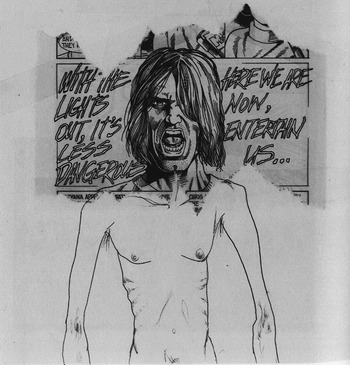
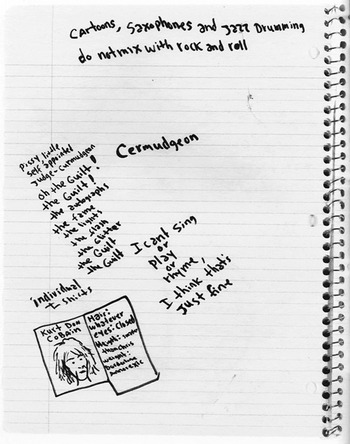
In several of the Journals' drawings and prose fragments, Cobain represents his body as sickly and skeletal. For example, to one notebook page, he attached a cartoonist's portrayal of him singing ‘Smells Like Teen Spirit’ (see Figure 1). The cartoonist's image is of a powerful Cobain, broad-shouldered, with substantive face, neck and chest muscles visibly tensed. Below this clipping, Cobain sketches his ‘real’ body – a narrow torso, emaciated with ribs showing. In other fragments, he lists identifying features of his physique with an undertone of self-ridicule. Parodying an ID card (Figure 2), he describes his height as ‘smarter than Chris [Novoselic]’ and his weight as ‘borderline anorexic’ (Cobain Reference Cobain2002, p. 260). In a list of personal characteristics (accompanied by a drawing of a bug-covered leg, Figure 3) he writes ‘I am obsessed with the fact that I am skinny and stupid’ (Cobain Reference Cobain2002, p. 124).
Cobain's self-portrait, in which he draws a torso beneath a cartoonist's rendering of his head.

Cobain's mock-identification card appears on the lower left.

A page from Cobain's Journals in which he lists various self-identifying attributes.

In life, he attempted to make himself look bigger by purchasing mail-order weight-gain powders and wearing layers upon layers of clothes, even on trips to the beach (Cross, Reference Cross2001, p. 91). Former girlfriend Tracy Marander remembered, ‘He didn't wear shorts unless it got really hot because he was so self-conscious about how skinny his legs were’ (quoted in Cross, Reference Cross2001, p. 91). But while his small size was a feature to be masked in the everyday (because it placed him on the margins of masculinity), it was something to be marked in creative practice (because it gave him status as marginalised). In the Journals he performs exaggerated versions of those characteristics that made him an outcast, portraying his physique as prepubescent or female. For example, in one passage he notes ‘They [his school mates] had hair down there long before I stopped playing with dolls’ (Cobain Reference Cobain2002, p. 105). Describing himself when he was 13, he recalls ‘I was a rodent-like, underdeveloped, hyperactive spaz who could fit his entire torso in one leg of his bell-bottomed jeans’ (Cobain Reference Cobain2002, p. 105). Twice in the Journals, Cobain refers to the soreness of his breasts. In a draft of a letter to a friend, he writes ‘Lately my nipples have been really sore. Can males lactate?’ (Cobain Reference Cobain2002, p. 131). And in a self-description later on, ‘I am male. Age 23 and I'm lactating. My breasts have never been so sore not even after receiving titty twisters from bully-school mates’ (Cobain Reference Cobain2002, p. 124). This stance seems partly to do with what Greil Marcus calls ‘the deliberate removal of all attributes of entitlement (in [Cobain's] case primarily maleness) and their replacement by attributes of abjection’ (Marcus Reference Marcus2000, p. 752).Footnote 9 It also seems to come from his own feelings of exclusion for his health, class, politics and musical style.
For Cobain, this sickly self existed in opposition to ‘the jock’ – a persona embodying a mainstream of athletic, heterosexual masculinity that seemed to dominate his surroundings in high school, in Aberdeen, in US right-wing political culture, and in musical scenes of rock and hardcore punk. In one fragment, he represents American capitalists as jocks, culminating his rant with a series of bodily metaphors:
Hi, yeah, all isms feed off one another, but the top of the food chain is still the white, corporate, macho, strong ox male. … And the hairy, sweaty, macho, sexist dickheads will soon drown in a pool of razorblades and semen, stemmed from the uprising of their children … (Cobain Reference Cobain2002, pp. 167–8)
He explains in another passage that hardcore emerged out of 1970s punk, when the ‘jocks who already had short hair from the wrestling team got involved’, using it as ‘an excuse to fight’ (Cobain Reference Cobain2002, pp. 96–7).
The jock was also a character he had encountered in his mother's boyfriend, Pat O'Connor, a sort of bully who called Cobain a ‘faggot’ for not bringing women home (Cross, Reference Cross2001, p. 52). For Cobain, the ‘jock’ was responsible for oppressing not only minorities and women, but also diminutive men. Cobain's fascination with high school, evidenced in interviews, song lyrics, prose and music videos, centred on the conflict he felt between these two body types and the subjectivities to which they referred.
The meaning of screams
Among the hallmarks of Nirvana's sound was Cobain's ravaged singing. Featuring screams at the top of his pitch range, his approach was one discouraged by vocal pedagogues on account of damage to the voice.Footnote 10 His vocals drew on an inherited repertoire of stylised growls, rasps and shouts from blues, country, and eventually mainstream rock traditions. As previous scholars have noted, loud and ravaged vocal timbres have been prized within rock ideologies as evidence of expressive authenticity, as proof that a performance is the materialisation of true feelings and real-life hardship (Middleton Reference Middleton and Potter2000, p. 34–5). In the genres of punk and heavy metal, both of which influenced Cobain, screaming vocals likewise have served as signs of a singer's genuine emotional and physical investment.Footnote 11 From punk's 1970s beginnings, artists opposed the reified sentiment of commercial pop songs by incorporating vocal markers of ‘raw’ feeling and of untrained or ‘ugly’ technique (Frith Reference Frith1981, p. 158–9; Middleton Reference Middleton and Potter2000, p. 34).
Hardcore punk bands of the late 1980s, as well as the grunge bands they influenced, similarly signalled their authenticity via ‘unmediated’, abrasive vocals. Singers such as Buzz Osborne (from the Melvins) and Tad Doyle (from Tad) belted past their tightened vocal cords to create a raspy sound that evoked heaving, or that at least that suggested physical strain to the voice.Footnote 12 In some instances, hardcore bands conjured sounds of human sickness. Scratch Acid and the Butthole Surfers, for example, included moments of vocalised vomiting in their songs ‘Mess’ and ‘Lady Sniff’, respectively.Footnote 13 Cobain thus was not unique in his use of eviscerated timbres. Indeed, part of what made these timbres meaningful for him was their prevalence in the 1970s and 1980s punk contexts with which he identified.
Descriptions of Nirvana's live performances and recordings tended to focus on the ravaged nature of Cobain's singing – a singing style that in some instances approximated heaving, as in the abbreviated grunts following the verses in ‘Tourette's’ (In Utero) or in the final phrases of ‘Hairspray Queen’ (Incesticide).
His high-volume, raspy singing voice was often dramatised in journalistic coverage. Numerous articles circulated the trope that the volume and breaks in his timbre indexed either Cobain's bodily investment in the act of performance, or his intense and painful biography. Journalists found a variety of descriptors for these timbres, such as ‘menacing growl’, ‘an irritated marble-mouthed snarl’, ‘sandpaper howl’, ‘plaintiff groan’, ‘primal howling’ and ‘battered croon’.Footnote 14 One critic remarked on how he ‘sings with a growl and a sneer in his voice’ and another noted that ‘Cobain's voice, moving from a zombie drone to an anguished croon to a primal scream, is the album's [In Utero] most potent ingredient. He sings with an honesty that is fearless and literally brutal.’Footnote 15 Another wrote that ‘Cobain pushes the words so hard it's as though he's trying to vomit them out’, that ‘he croons, growls and then screams from the pit of his stomach’ (Savage Reference Savage1997, p. 332), and another that ‘… you'd swear sometimes Cobain would sing like [Paul] McCartney if only he hadn't spent his life swallowing razor blades and fighting back bile’ (Sullivan Reference Sullivan1993, p. 45). It is difficult to say whether these assessments originated from the journalists (and not the press releases). What they do show, however, is the massive currency of the idea that Cobain's timbre and life were directly linked.
In more than one interview, Cobain himself remarked on the physical pain his screamed style of singing caused and at one point said that he would sometimes ‘sing and cough up blood’ (Fricke Reference Fricke1993, p. 64). His biographer Michael Azerrad noted:
Ironically, Kurt's [stomach] condition may have had something to do with his agonised wail. Or vice versa. Asked to pinpoint the source of the pain, he indicates a spot just below his breastbone – it also happens to be exactly where he says his scream originates. (Azerrad Reference Azerrad1993, p. 305)
In a New York Times interview, Cobain explained the relationship between sickness and emotion relative to his music:
My body is damaged from music in two ways. I have a red irritation in my stomach. It's psychosomatic, caused by all the anger and the screaming. I have scoliosis, where the curvature of your spine is bent, and the weight of my guitar has made it worse. I'm always in pain, and that adds to the anger in our music. I'm grateful to it in a way. (Reynolds Reference Reynolds1991, p. H34)
He once told Rolling Stone, ‘I was always afraid that if I lost the stomach problem, I wouldn't be as creative’ (Fricke Reference Fricke1994, p. 34). Charles Cross has stated that ‘… Kurt most certainly suffered the artist's predicament: the very reasons he felt pain were the fuel that drove his artistic passion. His dysfunction was his greatest gift and his heaviest burden’ (Cross Reference Cross2008, p. 9). For Cobain, pain enhances emotional urgency at the same time that this urgency in turn causes pain in his throat, stomach and spine. Pain and urgency are linked to an extent that his ailments, as well as the vocal techniques that exacerbated them, index an emotionally ravaged ‘angry’ – in other words ‘authentic’ – subjectivity. The link between physical pain and expressive authenticity are what give the damaged body significance within Cobain's output.
Music, for Cobain, provided an element of physicality and feeling not available in other expressive registers. In one essay he praises the Aberdeen, Washington-based band, the Melvins, a band that, like other hardcore punk bands of the late 1980s and early 1990s, sometimes included food and body imagery in their lyrics and song titles.Footnote 16 In the essay, Cobain writes: ‘WORDS aren't as important as the energy derived from music … IN one live MELVINS performance you wont be able to understand very many words, as is with any band, but you will FEEL the negative ENERGY’ (Cobain Reference Cobain2002, p. 59).
Later in the Journals, Cobain writes: ‘I exhausted most conversation at age nine. I only feel with grunts, screams and tones and with hand gestures and my body’ (Cobain Reference Cobain2002, p. 115), echoing the common Western trope that ‘music is the language of emotion’. I would argue, however, that there was more feeling invested in his writing than he admits. His multiple drafts of lyrics and letters, as well as his experiments with alternate spellings, indicate his interest in language's aesthetic and communicative potential, even in its conflicted and arbitrary aspects. Further, Charles Cross notes at least one moment in Cobain's journaling when he wrote ‘with so much pressure the pen went through the paper’, possibly indicating the intense physicality of his writing process (Cross Reference Cross2001, p. 165). Where music trumps language for Cobain, then, is in its power to give it meaning as visceral and biographically rooted communication. In moments of recorded and live performances when the words are unintelligible, the fact of their unintelligibility signals intense, ‘authentic’ emotion.
The place of screams in Nirvana recordings
Among his commercially recorded works, Cobain sometimes confines his broken timbres to phrase peaks, such as at the midpoints of the verses of ‘About a Girl’, or at the chorus endings of ‘Floyd the Barber’ (0:43–0:44; 2:04–2:09). Other songs feature more extended periods of cracked vocals – often with Cobain belting lyrics in his upper register, at high volume and with raspy timbre for the duration of the entire track (‘School’ and ‘Beeswax’), or for the duration of the chorus (‘Lithium’ and ‘Smells Like Teen Spirit’). In some cases, he increases volume and rasp for repeats of the verses and choruses. In the song ‘Territorial Pissings’, for example, with each repeat of the chorus, his voice not only becomes louder but it also breaks increasingly into a rougher and rougher sound.
Cobain also tends to conclude formal sections with what I would term vocal ‘cadenzas’: wordless, raspy wails in his upper register. He concludes the chorus in ‘Paper Cuts’ with an extended wail before continuing with the verse in a screamed timbre (1:28–2:16). He sings a similar cadenza in ‘Aneurysm’ on the last word of the chorus (3:28–3:36) and in ‘Negative Creep’, at the end of the second repeat of the verse (1:24–1:31). In many of these examples, Cobain gives extra emphasis to these raspy sections by surrounding them with sections of straight-toned, quieter singing.
The album containing fewest of these moments is Nevermind – the album within Nirvana's small output considered the closest to mainstream pop. Isolated examples of vocal cadenzas include the scream before the final verse of ‘Drain You’ (2:29–2:31) and the screeched verses in the hidden track ‘Something in the Way’. In In Utero he returns to more of the vocal techniques of Incesticide and Bleach – including cadenzas at the ends of choruses in ‘Scentless Apprentice’ (on the word ‘Away’) and in more extended ones in ‘Tourette's’ (0:33–0:39; 0:55–1:02; 1:23–1:30).
Rock critics have pointed to the more accessible melody and hook-oriented style of Nevermind. Compared to the others, this album includes fewer irregularities in song structure; for the most part, the songs of that album follow a standard pattern of alternations between quiet verses and loud choruses. Momentum in a Nevermind song is generated as Cobain sings verses with increased volume and rasp with each repeat; choruses similarly become increasingly rasped, breaking into more and more pitches.
Following the album's release, Nirvana members expressed displeasure with the ‘pop’ aspects of the album. Cobain commented in one interview that ‘It's [Nevermind] such a perfect mixture of cleanliness and nice, candy-ass production … It may be extreme to some people who aren't used to it, but I think it's kind of lame myself’ (quoted in Berkenstadt and Cross Reference Berkenstadt and Cross1998, p. 99). According to Berkenstadt and Cross, the album's producers, however, recalled the band members being happier with the album than their comments let on, making it possible that Cobain's criticisms were more a symptom of his ambivalence towards its mainstream success than of qualities of the recording (Reference Berkenstadt and Cross1998, p. 99). Cobain apparently had to fight to have the hidden track ‘Endless Nameless’ included on the album, presumably because of its non-commercial aspects. This track starkly contrasts with the rest of the songs on the album, and recalls Nirvana's earlier work from the late 1980s. From the start of the song, verses are screamed to the point of unintelligibility; the track ends with the sound of Cobain smashing his guitar.
The place of screams in ‘Hairspray Queen’
In trying to understand how Cobain may have understood authenticity within his performances, I am drawn especially to his pre-Nevermind recordings. These include a wider range of vocal techniques, as well as idiosyncratic formal structures. I have chosen to focus on the song ‘Hairspray Queen’ because it manifests the full range of Cobain's repertoire of timbres and includes the lengthiest cadenzas of Cobain's commercially released output. Additionally, the lyrics of the song seem not seem to make literal ‘sense’. This case study can hopefully suggest ways that Cobain's early work can be used as a window into his aesthetic ideals, as a site through which to study the interaction between his screams and lyrics.
Cobain had written ‘Hairspray Queen’ by January 1987, as documented by a band rehearsal video from that date.Footnote 17 It was on the set-list of Nirvana's first public performance in March 1987, and it continued to be a set staple during 1989–1990.Footnote 18 A studio version was eventually included on the 1992 compilation album Incesticide. Cobain's handwritten lyrics for the song appear in the Journals (Cobain Reference Cobain2002, p. 50).
The song's theme sets up an antagonistic relationship between the narrator and the protagonist, the hairspray queen. ‘Hairspray queen’ may be a reference to 1980s US high school culture (and the prevalence of hairspray-oriented styles among teens) in the way that ‘teen spirit’ in ‘Smells Like Teen Spirit’ signified (albeit indirectly) in the early 1990s as a youth-oriented deodorant and as a US high school subcultural identity.Footnote 19 If this is the case, then the lyrics could be read as an indirect response to mainstream high school culture, as embodied by the coiffed hairspray queen. Chuck Crisafulli, on the other hand, suggests that the song may have been intended as a taunt to a mainstream rock club audience (Crisafulli Reference Crisafulli1996, p. 73); this seems possible considering the song's harrowing, deliberately ‘ugly’ vocal approach.
The central antagonism is set up in the first iteration of the verse, with an alternation between two basic lines: ‘I was your enemy’ and ‘you were mine’ (see Figure 4). On the recording (beginning at 0:49), Cobain screams these lines, overdriving the words using his chest voice in his top register, creating heavy rasp and several simultaneous pitches for each syllable. He drops to his low register every two or three syllables. As the verse progresses, he forces the air out harder, leading to more breaks in the upper tones.
Cobain's handwritten lyrics to ‘Hairspray Queen’.

As he breaks up his tones through overdriven delivery, he obscures the words through subtle use of repetition, homonyms, articulation and breathing. The lyric sheet contained in the Journals (Cobain Reference Cobain2002, p. 50) shows that he wrote stutters into the line ‘I was your enemy’, so that it first reads ‘I was your your enemy’ and then ‘I was was your enemy’. The repeat of the words ‘your’ and ‘was’ appears to be a composed feature of the song, standardised on his lyric sheet.
Additionally, he alternates between similar-sounding versions of the two basic lines, playing with the sounds of the words ‘mine’ and ‘mind’. As his lyric sheet shows, while lines two and four contain the primary phrase ‘you were mine’, lines one and three include variations: line one reads ‘I was your mind’ and line two ‘you would mind’. Further, he uses the word ‘mind’ in line one as a noun, and in line three as a verb, deriving a third homonym out of that same syllable.
Finally, his lyric sheet also shows his transformation of the word ‘enemy’ into a homonym. He writes the word split in two and with an ‘e’ at the end, grafted onto the ‘y’: ‘ene-mye’. By line three, he eliminates the ‘y’ so that the word appears ‘ene-me’. Other fragments in the Journals show Cobain writing a word over and over, gradually chancing upon ‘meaningful’ homonyms, as in his invented spelling of ‘woman’ as ‘womban’ discussed earlier. Thus, it is possible that in the process of writing the word ‘enemy’ repeatedly in his lyric sheet, he discovered that the word ‘me’ could be found in the word ‘enemy’, if he broke the word down and spelled it phonetically.Footnote 20 For Cobain, such a discovery – that the word for the first person (‘me’) is found in the word for the antagonised second person (‘enemy’) – exemplifies his view (quoted above) that ‘words don't necessarily have their expected meanings’, that contradictory meanings can sometimes be found within the same word.
His vocal delivery further obscures the verse lyrics. Among his techniques, the most obvious is his broken, screaming timbre, which makes the verses challenging to understand and to endure physically. That the verse is intentionally loud and damaging is noted in the chorus that follows, where Cobain sings ‘ears rang/your ears rang’ (1:00–1:10).
Additionally, ends of phrases are slurred into subsequent beginnings, while he takes his breaths in the middle of verse lines, rather than at their end. His breathing placement thus allows him to slur the final syllable of each verse to the beginning word of the next, resulting in emphasis on the words ‘me-you’, and non-emphasis on the complete phrases ‘I was your enemy’ and ‘you were mine’. On the lyric sheet, he draws emphasis to particular syllables within the word ‘enemy’ to interfere with its meaning; in performance, he draws emphasis to the syllables ‘me-you’, possibly to obscure communication of the semantic meaning of the line.
Cobain's tactic changes with the appearance of chorus II (1:51), where he minimally fleshes out the hairspray queen's character: at night, she is a ‘wishful goddess’ and a ‘disco goddess’. When this chorus returns for the second time, he adds the lines ‘itch so modest’, ‘crisco lochness’, ‘fishful goblets’ and ‘mouthful omelets’. These images arise through free-association based on the rhyme scheme, metre, and a repertoire of body and food-related words. The litany of images seems thematically unrelated to the verse, as though he is making a point not to tell a cohesive story. At the end of both chorus II sections he adds a vocal cadenza on the word ‘god’ (spelled ‘GAWD’ on his lyric sheet): a wordless melisma travelling to the top and bottom of his registers. The first time such a cadenza appears, it lasts approximately 12 seconds (2:03–2:17). The second of these seems to derail the entire song, lasting nearly 30 seconds and including clear moans and raspy groans (3:37–4:06). Towards the middle of the cadenza, he glissandos upward with a heavy, car engine-like growl in his tone (3:45–3:50). The climax of the cadenza occurs with several measures of vocalised heaving, in which he uses his stomach to force air in short spurts through constricted vocal cords (3:51–4:03). He ends with a simple, clear-toned moan (4:04–4:06).
The intensity contained in these cadenzas is above all physical, as Cobain overdrives his vocal apparatus in his high-pitched, high-volume screams. We know about the lasting and painful effect of this mode of singing from the Journals and from biographical accounts. It is a performing style seemingly incongruous with the lyrics, lyrics rendered semantically meaningless by the delivery; in this respect ‘Hairspray Queen’ calls to mind Cobain's description of the Melvins' live performances, that ‘you won't be able to understand very many words, as is with any band, but you will FEEL the negative ENERGY’ (Cobain Reference Cobain2002, p. 59). The physically painful experiences of performing and hearing ‘Hairspray Queen’ – as well as the experience of not being able to hear the lyrics – are meaningful because they are rooted in Cobain's biography of physical pain and social marginalisation. Further, as a veritable catalogue of anti-mainstream markers (painful timbres, unintelligible lyrics and runaway improvisations that ultimately derail the song), the song ‘means’ in relation to an audience situated in a late 1980s musical moment where commercialist pressure was felt as an oppressive, omnipresent force.
Conclusion
I have argued here that the ‘sick body’ functioned for Cobain as a central metaphor, one that he translated into multiple artistic forms and that encapsulated his idea of authenticity. The centrality of this metaphor echoes Dick Hebdige's early theorisation of punk style, in which he argues that drug-use, music, ‘insurrectionary poses’, ‘vomiting’ and ‘spitting’ were part of a homology connected to punk meaning-making (Hebdige Reference Hebdige1979, p. 126). As stated above, Cobain's homology emerged largely from cultural contexts of hardcore and New Wave punk scenes. A more thorough study of Nirvana and their surrounding underground music contexts could therefore investigate how the figure of the sick body circulated among fans and performers, in everyday talk and fanzines, in rehearsal moments, in audience behaviour, and among other bands of that particular time and place.
For a band credited with ending a major musical genre (punk) there has been surprisingly little scholarship around Nirvana or its front man. Possibly, this is because of the seeming impenetrability of Cobain's lyrics, or because of the formulaic verse-chorus-verse, soft-loud-soft-loud song structures that seem not to reward careful study. Possibly the figure of Cobain and the meaning of Nirvana's music seems ‘overdetermined’ by the mass media to an extent that makes fresh, non-clichéd analysis hard to imagine. In my view, by shifting the analytic parameters to be less about formal structure and the semantic meanings of the lyrics, and more about those aspects of music and writing prized by Cobain, one gains a fuller appreciation of his individuality as an artist, and of the amount of change taken in his approach to song-writing and performance during his short career. For example, songs from later in his career contain more obvious references to his life experiences and political opinions. Hopefully, this article demonstrates that different moments of Cobain's career require different interpretive strategies.
Finally, I also hope to have shown that, despite Cobain's claims to a haphazard, unschooled process, he invested deep, careful attention in the minute details of words – down to the level of letter and syllable – and that the role of scatological language in his lyrics and prose is more than a means to antagonise a ‘mainstream’ – that it indexed and brought to bear the specifics of his life that, for him, grounded the authenticity of his expression.
Acknowledgements
Thanks are due to Christina Gier, Nicola Dibben and an anonymous reviewer for their comments on earlier versions of this article. All images are used with permission from the US and UK divisions of the Penguin Group. Lyrics to ‘Hairspray Queen’ and ‘Mexican Seafood’ are used with permission from Hal Leonard Corporation. Lyrics to ‘Smells Like Teen Spirit’ reprinted with permission from Hal Leonard Corporation, Murky Slough Music and Alfred Publishing Company. I also need to thank the Gustave Reese Endowment of the American Musicological Society.