INTRODUCTION
Biological communities are expected to vary according to environmental gradients, either gradually or abruptly. The responses of mammals to such gradients have been studied worldwide, and many response patterns have been detected. One of these gradients is altitude, for which strong responses of mammals have been documented (McCain Reference MCCAIN2004, Sánchez-Cordero Reference SÁNCHEZ-CORDERO2001). Small-mammal diversity along altitudinal gradients has shown higher values for low (Kasangaki et al. Reference KASANGAKI, KITYO and KERBIS2003) and middle altitudes (McCain Reference MCCAIN2004), which could be explained by specific factors. In particular, four main factors might affect biological communities on altitudinal gradients: climate, habitat heterogeneity, species–area effect and mid-domain effect (Körner Reference KÖRNER2007b, McCain Reference MCCAIN2005, Rowe Reference ROWE2009, Sánchez-Cordero Reference SÁNCHEZ-CORDERO2001). There is evidence for the importance of interacting climatic, habitat, area and geometric factors, respectively, on altitudinal diversity patterns of small mammals.
Habitat selection allows species to coexist, and they may be generalists or specialists (Orians & Wittenberg Reference ORIANS and WITTENBERG1991). Multispecies studies have emphasized the potential for differential specialization and optimal habitat selection to maintain community diversity (Rosenzweig Reference ROSENZWEIG1991). An interesting aspect of habitat selection in small mammals is habitat partitioning between forest and grassland dwellers. Theoretically, small-mammal communities can be divided into these two ecological groups in South America, according to the main habitat division on the continent, the arid Andean zone in the west and the tropical Brazilian zone in the east (Ab'Saber Reference AB'SABER1977). A promising area for ecological studies is the contact zone between these two biogeographic regions, and a secondary zone, termed the ‘open-formation diagonal’. In Brazil, this latter zone lies between the Amazon and Atlantic forests, and is composed of the following biomes: pantanal wetlands and chaco in the south-west, cerrado (savanna) in the centre, and caatinga in the north-east (Ab'Saber Reference AB'SABER1977). Therefore, the region is complex and is influenced by several biogeographic domains (Costa Reference COSTA2003, Vivo Reference VIVO1997).
Considering the broad extent of tropical South America and in spite of the continent's great topographical variability, few studies have been carried out on altitudinal gradients which also involve habitat selection. In this tropical region, altitudinal studies were mainly conducted in the Atlantic Forest in eastern Brazil, and emphasized the altitudinal gradient (Bonvicino et al. Reference BONVICINO, LANGGUTH, LINDBERGH and PAULA1997, Geise et al. Reference GEISE, PEREIRA, BOSSI and BERGALLO2004, Vieira & Monteiro-Filho Reference VIEIRA and MONTEIRO-FILHO2003). With regard to habitat selection, few studies focusing on small mammals have been conducted in the grasslands of central Brazil (Bonvicino et al. Reference BONVICINO, CERQUEIRA and SOARES1996, Lacher & Alho Reference LACHER and ALHO2001) and only one study has been conducted in the northern chaco biome (Yahnke Reference YAHNKE2006).
In order to fill this gap and to test the habitat heterogeneity hypothesis, we conducted a study on the effects of altitude and vegetation on small mammals in the Urucum Mountains in western Brazil, near the Bolivian and Paraguayan borders. This forest–grassland region is located in a complex zone (Vivo Reference VIVO1997) with biogeographic influences from at least four domains: Amazon, Atlantic Forest, cerrado (all in the Brazilian tropical zone), and chaco (in the arid diagonal zone; Ab'Saber Reference AB'SABER1977). Our hypotheses were: (1) a clear altitudinal gradient will be apparent for the small mammals (McCain Reference MCCAIN2004, Sánchez-Cordero Reference SÁNCHEZ-CORDERO2001) even considering the relatively small range of altitudes in the region (150–1000 m asl); (2) some species will be influenced by only one or by both factors, since we expect there are both forest-dependent and open-vegetation species in the region (Lacher & Alho Reference LACHER and ALHO2001, Santos-Filho et al. Reference SANTOS-FILHO, DA SILVA and SANAIOTTI2008) and the simultaneous effect of altitude and habitat is unknown for this small-mammal community; (3) even with the possibility of biogeographically complex species interactions in the region (Vivo Reference VIVO1997), we expected that some specialized species will show patterns of ecological gradient responses within the limits of each vegetation type, such as forest-dweller species occurring only in forest habitats, and that such species (e.g. forest and grassland dwellers) will share space mostly in ecotonal areas, such as in the interface between forest and grassland habitats.
MATERIALS AND METHODS
Study site
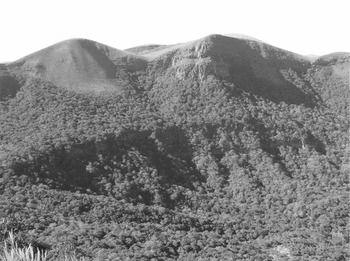
The Urucum Mountains are located in the western part of the pantanal wetlands, an upland region near the Brazil–Bolivia border, in a contact zone with the chacoan vegetation of eastern Bolivia and north-eastern Paraguay. The mountains average 1000 m asl in altitude, with semideciduous forests covering their slopes (from approximately 150 m up to 900 m asl), savannas (sparsely covering all altitudes, except mountaintops), and grasslands mostly at the top (Figure 1). In this study, because of their open character, we included savanna and grassland in the same vegetation category, namely ‘grassland’, in order to compare with the forest physiognomy. The Urucum Mountains are covered by a mosaic of forest–grassland vegetation (Figure 1). The climate is highly seasonal, with a marked dry and colder season (April–September) and a wet and warmer one (October–March). Land use in the region is dominated by mining (iron and manganese) at higher altitudes and cattle at lower altitudes, but these influences on the sampling units established in this study were thought to be negligible.
Southern flank of the Urucum Mountains, Corumbá region, western Brazil. Note the denser forests at the lower altitude, the complexity at the middle altitude, with shaded portions, and the gradual change to grassland at the high altitude (Photo: M. N. Godoi).

We carried out the study in two localities in the Urucum Mountains, MCR (Mineração Rio Tinto Reunidas; 19°12′41″S, 57°33′49″W) and MMX (MMX Corumbá Mineração; 19°11′58″S, 57°37′44″W), 10 km distant from each other. Both are located in the municipality of Corumbá, Mato Grosso do Sul state, Brazil.
In the MCR and MMX localities, the lowest altitude has a richer understorey and a taller canopy, whereas the higher altitude shows a continuum to more open forest, with shorter trees and lack of a dense understorey. There are numerous palm trees at the two lower altitudes of both localities (below 700 m asl); the density of trees is greatest at the middle altitude. Rocky outcrops are common at the lowest altitude, and small ferns are common in the higher-altitude forest.
In the MMX locality, humid forests following watercourses are common at the low altitudes (150–300 m asl), but savanna occasionally occurs at the middle altitude (300–600 m). Grassland normally occurs above this altitude in this locality, mainly in steep locations, dominating the mountaintops.
Both localities (MCR and MMX) were used to examine habitat selection and altitudinal effect, based on qualitative, binary community data. The MCR sample units were mainly used to examine altitudinal effects in a continuum of lowland forest habitats up to the mountaintop, based on quantitative data.
Methods
Small-mammal abundance, composition, and richness were sampled along transect lines, totalling 31 sampling units in the mountains. For preliminary analyses, altitudes were divided into three categories: those at 150–399 m (termed ‘low altitude’; with eight sampling units), at 400–699 m (termed ‘middle altitude’; with six sampling units), and at 700–1000 m (termed ‘high altitude’ which included the mountaintop; with 17 sampling units). For example, significant differences between localities and time will be important to delineate those further gradient analyses by excluding localities or time of collection and by choosing the appropriate statistical test to explore community variation. Samples were obtained during three field-phase periods: December 2000–June 2002 (MCR), August 2006–September 2007 (MCR) and December 2007–June 2008 (MMX).
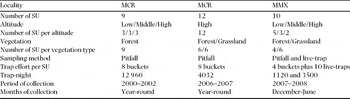
In the first period in the MCR, nine sampling units were set, totalling 24 pitfall traps at each altitude, and 72 in total for the period. These 24 traps were separated into three transect lines of eight buckets in each sampling unit. Only forested habitats were sampled in this period. Surveys were performed monthly at each of the three altitudes in this first sampling period, with monthly field phases lasting 5 d. The low altitude was monitored for 12 mo, the middle altitude for 17 mo, and the high altitude for 19 mo (Table 1).
Description of the effort for sampling small mammals in two localities of the Urucum Mountains in western Brazil. Legends: low, middle, and high refer to altitudinal categories: low (150–399 m), middle (400–699 m) and high altitude (700–1000 m), respectively; SU is sampling unit.

In the second period in the MCR, 12 sampling units were set, totalling 96 pitfall traps for the period. The organization of the transect lines was the same as that of the first sampling period in the MCR (eight buckets per sampling unit). Only the high-altitude areas (six sampling units in forest habitats and six in grassland habitats) were sampled in this period. Forest and grassland habitats were sampled similarly (50:50) in this period. Surveys were carried out every 2 mo, with the six field phases lasting from 4–10 d, and totalling 42 d of sampling (Table 1).
In the third field period in the MMX, 10 sampling units were set, totalling 40 pitfall traps and 100 live-traps (Sherman and wire-mesh models) for the period. Bait for live-traps was a mixture of banana, bacon and commercial catfish-liver oil. Each sampling unit had four pitfalls and 10 live-traps arranged on two separate transect lines. Traps (lines of pitfalls or live-traps) were set 10 m apart from each other. Five sampling units were set at the low altitude (three in forest near streams, and two in grassland), three at the middle altitude (one in forest and two in grassland), and two at the high altitude (both in grassland). The sampling effort had two main periods, one in the wet and the other in the dry season, totalling 28 trap d. Live-traps were used in all altitudes (low, middle and high), and were added to the general effort as a complementary trapping effort to pitfalls (Table 1). Live-traps ranged between 30 and 35 cm in length.
In general, buckets were placed 10 to 15 m from each other in each 60-m or 90-m sequence of eight pitfall traps (transect line), and were connected by a 50-cm-high mesh fence (Caceres et al. Reference CACERES, NAPOLI, CASELLA and HANNIBAL2010). The buckets for pitfalls had a volume of 108 L in the sampling units in the MCR locality, and 80 L in the MMX locality. Each sampling unit was at least 500 m distant from the next for all altitudes. Sequences of large pitfalls are effective in capturing not only terrestrial, but also arboreal small mammals, capturing more species and individuals than conventional live-traps in the cerrado biome (Caceres et al. in press).
Captured individuals were marked with holes in the ears and released, and only collected when there were doubts as to species identification. Voucher specimens were deposited in the Vertebrate Collection of the Universidade Federal do Mato Grosso do Sul (UFMS) and the Mammal Collection of the Universidade Federal de Santa Maria (UFSM), in Brazil.
Statistical analyses
Differences in the species composition of small mammals at different altitudes and vegetation types were assessed by the one-way Randomization Test Comparing Groups of Sampling Units (RTCG; Pillar Reference PILLAR2006), setting the following factors, which were analysed separately (one factor each time): altitude (low, middle and high), vegetation (forest and grassland), locality (MCR and MMX), and time (2000–2002, 2006–2007, and 2007–2008). RTCG is philosophically and mathematically allied with analysis of variance (Brum et al. Reference BRUM, DUARTE and HARTZ2010), being uni- or multivariate, in that it compares dissimilarities within and among groups, particularly for biological community analyses (Pillar & Orlóci Reference PILLAR2006). Analyses using binary data (presence/absence of species) were performed because there was a quite different effort over the localities and years (Table 1). All sampling units (n = 31) were used, setting the main species collected as variables. As a similarity measure, the Sørensen index was calculated between sampling units. The number of random permutations was 1000, and the program used was Multiv version 2.4 (Pillar Reference PILLAR2006).
RTCG was carried out again for abundance data, using only the data from forested altitudes in the MCR locality taken during 2000–2002. These data were used in order to best compare the community variation along altitudes, without the effect of grasslands, and because of the assumption of evenness in sampling effort, the greatest effort employed in those sampling units (n = 9 units, and an effort of about 13 000 trap-nights) and the reduction of variation caused by time. In this case, Euclidean distance was calculated between sampling units as a similarity measure, and all species were included.
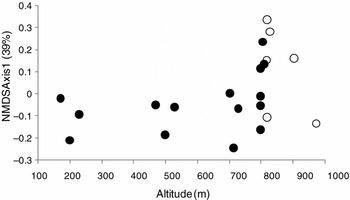
In order to evaluate the influence of altitude at community level, a Spearman correlation analysis between altitude and species diversity (i.e. species abundance reduced by a multivariate analysis; Caceres et al. Reference CACERES, NAPOLI, CASELLA and HANNIBAL2010) was performed. Again, only sampling units (n = 21) of the MCR locality were included, for the reasons explained above. For this purpose, a multidimensional scaling analysis (NMDS; Bray–Curtis similarity measure) was run for all species, based on their abundances which were standardized by dividing them by the number of months when sampling was carried out in each sampling unit. After that, NMDS axis 1 was correlated with the altitude of sampling units.
At the species level, the multiple logistic regression was applied to the vegetation and altitude data, setting them as predictor variables to examine the role of both factors in the occurrence of each species (presence/absence) in all sampling units in the two localities studied. For each sampling unit, vegetation was defined as forest (1) and grassland (0), and altitude was used as a quantitative variable, but transformed as a proportion of 1000 m. This last value is the maximum altitude of the region, and then each particular altitude was transformed accordingly, e.g. a 500-m altitude was transformed to 0.50 by dividing the actual altitude (500 m) by the maximum altitude (1000 m). In logistic regression, an odds ratio that approximates 1.0 indicates no effect of the independent factor on the response variable; values higher than 1.0 (usually more than 10.0) indicate the magnitude of the chance that a given category of a factor (that assigned as 1 in the binary variable) will influence the response variable; and an odds ratio approximating 0.0 will indicate how much the opposite category (assigned as 0 in the binary variable) influences the dependent variable (Peng et al. Reference PENG, LEE and INGERSOLL2002). The same logic is applicable to the quantitative independent variable altitude, in which odds values higher than 1.0 will indicate altitude affinity and odds values near zero, lowland affinity, and this effect will be as strong as the P-value is low. In addition, Spearman correlation analyses between relative abundances (i.e. dividing abundance by the number of months of sampling) of each species and altitudes for the MCR locality were performed, to add a quantitative analysis. BioEstat version 5.0 (Ayres et al. Reference AYRES, AYRES, AYRES and SANTOS2007) was used for these analyses.
RESULTS
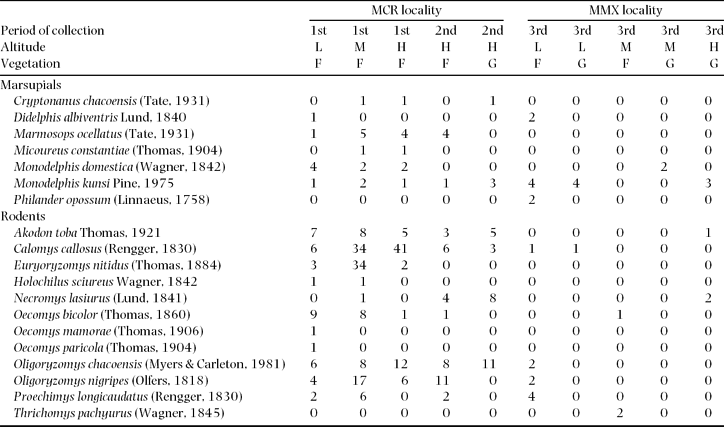
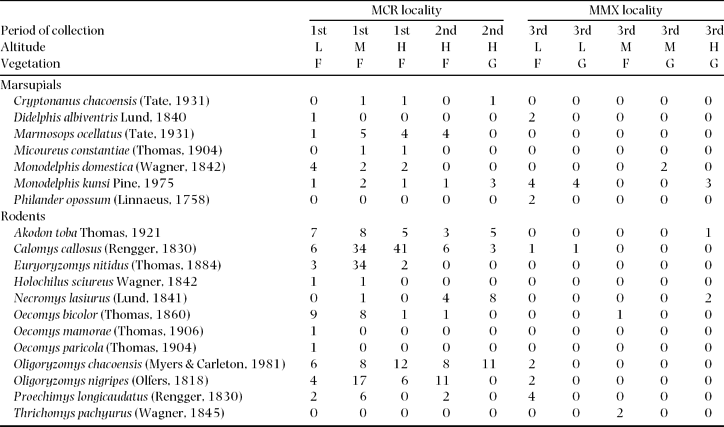
After an effort of 18 112 trap-nights for pitfall and 3500 trap-nights for live-traps in the two localities, a total of 355 individual small mammals were trapped, representing 19 species (seven marsupial and 12 rodent species). Most individuals were caught at the high altitude (n = 153), followed by the middle altitude (133) and lastly the low altitude (69). Overall, the rodents Calomys callosus (92 individuals), Oligoryzomys chacoensis (47), O. nigripes (40) and Euryoryzomys nitidus (39) were the most common species. For vegetation, all 19 species occurred in forests (with 12 being exclusive to forest), and only seven species occurred in grasslands (Table 2).
Number of individuals of small-mammal species captured in the Urucum Mountains, western Brazil, according to locality, sampling period, altitude and vegetation. Altitudes: low (L: 150–399 m), middle (M: 400–699 m), high (H: 700–1000 m); vegetation: F = forest, G = grassland.
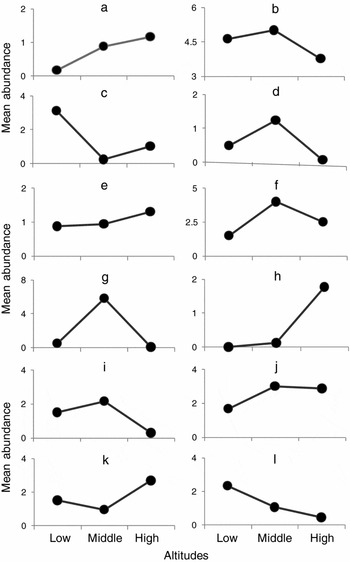
Along the main altitudinal gradient examined, the low and middle altitudes averaged more small-mammal species, particularly forest dwellers (Figure 2). At low altitude, locally rarer species occurred such as Didelphis albiventris, Philander opossum, Oecomys mamorae and O. paricola (Table 2); whereas at middle altitude, locally abundant species occurred such as E. nitidus, O. nigripes and C. callosus. The middle altitude proved to be the richest altitude. The mountains showed a pattern of decreasing species abundance as the gradient became steeper and the vegetation changed from forest to grassland; examples of such forest dwellers were E. nitidus, Oecomys bicolor and Proechimys longicaudatus. However, analysing species which also occurred in grassland at high altitude and following the low- to high-altitudinal gradient, a second, generalist species group became evident, which is represented by Necromys lasiurus, O. chacoensis and Akodon toba, all exhibiting high abundance in the high-altitude sector (Figure 2).
Mean abundance of main small-mammal species according to altitude in the Urucum Mountains, western Brazil. Mean abundance was obtained by dividing total number of individuals by number of sampling units installed in a given altitudinal category. Number of sampling units was 19 for forest-dwelling species (asterisk) and 31 for grassland-dwelling species. Mean richness is shown in (b). Species are: Marmosops ocellatus* (a), Monodelphis kunsi (c), Monodelphis domestica (d), Akodon toba (e), Calomys callosus (f), Euryoryzomys nitidus* (g), Necromys lasiurus (h), Oecomys bicolor* (i), Oligoryzomys nigripes* (j), Oligoryzomys chacoensis (k) and Proechimys longicaudatus* (l).

The randomization tests comparing groups of samples involving species composition of small mammals gave significant results for all factors: altitude (randomization test, Q = 2.97, P = 0.001; high altitude was the most different category), vegetation (randomization test, Q = 2.77, P = 0.001), locality (randomization test, Q = 2.63, P = 0.001), and time (randomization test, Q = 4.40, P = 0.001; all sampling periods differed significantly among each other, by analysing contrasts). When we considered the abundance data from forested altitudes in the MCR locality taken during 2000–2002, a significant difference was found (randomization test, Q = 508, P = 0.008) suggesting an important role of altitude in the community variation.
The correlation between altitude and species diversity was significant (rs = 0.48, n = 21 sampling units, P = 0.029). Axis 1 of NMDS was responsible for 39.4% of the variance, and M. kunsi (rs = −0.69, P < 0.01), N. lasiurus (rs = 0.65; P < 0.01), O. bicolor (rs = −0.57, P < 0.01) and A. toba (rs = 0.53, P < 0.05) were the species mainly correlated with this axis (Figure 3).
Relationship between altitude and community diversity shown as the first axis of an NMDS (Non-metric Multidimensional Scaling) analysis of species abundances by sampling units, from the MCR locality in the Urucum Mountains. NMDS axis 1 explained 39% of data variation. Spearman correlation analysis was significant (rs = 0.48, n = 21 sampling units, P = 0.029). Black circles: forest sampling units; white circles: grassland sampling units.

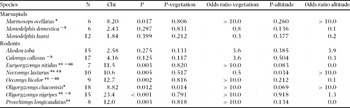
The logistic regression revealed six species (55%) that were significantly related to specific vegetation and/or altitude in the study region (n = 11 species treated; Table 3). Marmosops ocellatus and O. chacoensis were related more to forests (odds ratio higher than 10.0) and high altitudes (odds ratio higher than 10.0); E. nitidus and O. bicolor were related more to forests (odds ratio higher than 10.0) and low altitudes (odds ratio near 0.0); N. lasiurus was related more to grasslands (odds ratio below 1.0) and high altitudes (odds ratio higher than 10.0); and O. nigripes was related more to forests (odds ratio higher than 10.0) but to no specific altitude (odds ratio around 1.0). Although the odds ratio revealed the likelihood that a given species will occur in a vegetation type or altitude, the respective P-values were not always significant; this was possibly an artifact of sampling (at least for vegetation type), since there was a significant and negative Spearman correlation between the number of sampling units in which a given species occurred (N in Table 3) and the P-value for vegetation type (rs = −0.89; n = 11 species; P < 0.001), but not for altitude (rs = 0.28; n = 11 species; P = 0.399). In addition, M. domestica, A. toba and C. callosus tended to occur in both vegetation types (odds ratio around 1.0), and M. kunsi tended to occur in grassland (odds ratio near 0). Spearman correlation analyses between relative abundances and altitudes for the MCR locality revealed negative correlations for M. domestica, C. callosus, E. nitidus and O. bicolor with altitude, and confirmed the positive relationship between N. lasiurus and altitude (Table 3).
Multiple logistic regression results for species composition in vegetation types (binary variable: 1 – forest; 0 – grassland) and altitudes (quantitative variable) at two localities in the Urucum Mountains, western Brazil. High odds-ratio values indicate high chances of species occurring in forest or at higher altitude, and this will increase as the respective P-value decreases; odds values below 1.0 and mainly near 0.0 indicate the opposite trend (that is, species tend to occur in grassland and at low altitude, respectively). N is the number of sampling units in which the species was present. Asterisk indicates a significant likelihood for a given species to occur in a vegetation type or altitude (*P < 0.05; **P < 0.01); letter ‘a’ indicates Spearman correlation significance between species abundance and altitude for the MCR locality (aP < 0.05; aaP < 0.01; + or – indicates the sign of the rs coefficient).

DISCUSSION
The variation in community structure of small mammals in the Urucum Mountains can be explained by both altitude and vegetation type, based on individual species and diversity analyses. Our analyses revealed that these two variables affect the small-mammal community, possibly with an interaction between them. Some species that are significantly influenced by altitude and vegetation will occur in a given altitudinal zone and habitat type with a specific probability. Our major finding here is the interaction between altitude and vegetation in determining the community diversity pattern of small mammals. The lack of forests on the high-altitude mountaintops (Körner Reference KÖRNER2007a) can be understood as an effective barrier to forest-dwelling small mammals occupying mountaintops, though some forest species occur in the high-altitude forests (Godoi et al. Reference GODOI, CUNHA and CACERES2010). As indicated by the correlation and regression analyses, vegetation should change according to altitude, partially explaining the community variation. Indeed, in the Urucum, forests at high altitude are near the transition to grassland, becoming less complex, shorter and with an open understorey. The high altitude contains a mixture of forest and grassland small-mammal species, but tends to show lower species richness (Bonvicino et al. Reference BONVICINO, LANGGUTH, LINDBERGH and PAULA1997, Geise et al. Reference GEISE, PEREIRA, BOSSI and BERGALLO2004, Kasangaki et al. Reference KASANGAKI, KITYO and KERBIS2003).
Around 55% of species analysed exhibited some response to the altitudinal or vegetational gradients in the Urucum Mountains. This is an important finding, but should be interpreted with caution for vegetation types, because of possible sampling artefacts. In particular, forest-dwelling species responded strictly to the gradient, with examples of species commonly found in forests typical of low or high altitudes. These observations suggest that the forest habitat changes mainly according to altitude and its respective vegetation structure, climate and topography, and that specialist species follow this gradient, altering mainly their abundance (Nor et al. Reference NOR, BATIN and AKBAR2001, Vieira & Monteiro-Filho Reference VIEIRA and MONTEIRO-FILHO2003). This is thought to be true for forest-dwelling species such as M. ocellatus, E. nitidus, O. bicolor and P. longicaudatus (Bonvicino et al. Reference BONVICINO, CERQUEIRA and SOARES1996, Caceres et al. Reference CACERES, FERREIRA and CARMIGNOTTO2007, Lacher & Alho Reference LACHER and ALHO2001, Santos-Filho et al. Reference SANTOS-FILHO, DA SILVA and SANAIOTTI2008), but not for Oligoryzomys species which are habitat-generalists (Bonvicino et al. Reference BONVICINO, LINDBERGH and MAROJA2002, Yahnke Reference YAHNKE2006). The variation in composition was meaningful for the high altitude, where forest is replaced by grassland, a common phenomenon worldwide (Bonvicino et al. Reference BONVICINO, LANGGUTH, LINDBERGH and PAULA1997, Geise et al. Reference GEISE, PEREIRA, BOSSI and BERGALLO2004, Kasangaki et al. Reference KASANGAKI, KITYO and KERBIS2003, McCain Reference MCCAIN2004, Reference MCCAIN2005, Sánchez-Cordero Reference SÁNCHEZ-CORDERO2001). As an example of an open-habitat species (Lacher & Alho Reference LACHER and ALHO2001, Yahnke Reference YAHNKE2006), N. lasiurus responded positively to altitude and grassland vegetation, exhibiting a strictly montane gradient culminating at the mountaintop. In contrast, arboreal species such as O. bicolor tended to occur in the lower or middle altitudes, corroborating the expected relationship between arboreal life and more-complex forest environments (Hannibal & Caceres Reference HANNIBAL and CACERES2010, Vieira & Monteiro-Filho Reference VIEIRA and MONTEIRO-FILHO2003). The well-developed understorey present in the lower and middle altitudes explained the prominence of Oecomys species, as demonstrated by Mauffrey & Catzeflis (2002).
Therefore, we have identified two small-mammal groups responding to the altitudinal variation in the Urucum Mountains, the first with species primarily living in grassland, and the second living in forest. We believe that the first group can be divided into two other groups, one composed of more habitat-generalist species (M. domestica, A. toba, C. callosus), and the other composed of two grassland-specialist species (M. kunsi and N. lasiurus). These categories agree in part with studies carried out elsewhere (Lacher & Alho Reference LACHER and ALHO2001, Santos-Filho et al. Reference SANTOS-FILHO, DA SILVA and SANAIOTTI2008, Yahnke Reference YAHNKE2006). Therefore, there are two faunal groups in the Urucum region, from a biogeographic approach: one with grassland affinity and other with forest affinity. Grassland species are typical of the cerrado and chaco biomes, whereas forest species are mainly related to the Amazon Forest (Costa Reference COSTA2003, Fonseca et al. Reference FONSECA, HERRMANN, LEITE, MITTERMEIER, RYLANDS and PATTON1996, Rodrigues et al. Reference RODRIGUES, MEDRI, TOMÁS and MOURÃO2002, Yahnke Reference YAHNKE2006). This complex interaction of fauna is expressed by the ‘open-formation diagonal’ which is inserted between the Amazon and Atlantic forests (Ab'Saber Reference AB'SABER1977, Vivo Reference VIVO1997). The emerging pattern is the habitat-generalist small-mammal group, which occurs in the forest formation at Urucum; to better explain this, we postulate that such primarily grassland species enter forests in certain periods of the year, particularly during the dry season when the forest is more deciduous and open (Rowe Reference ROWE2009). The edge effect is also important in the high altitude of Urucum, where grassland species invade forest patches but forest-dwelling species are restricted to forests (Godoi et al. Reference GODOI, CUNHA and CACERES2010, Santos-Filho et al. Reference SANTOS-FILHO, DA SILVA and SANAIOTTI2008).
In addition to these ecotonal zones that influence the ecological gradient, we note other important factors that could help to explain the gradient, such as the mid-domain hypothesis as opposed to the hypothesis of more environmental determination. The mid-domain hypothesis has been extensively examined around the world, and its effect is apparent. However, whereas the area effect (mountains become smaller as they increase in altitude) favoured increasing diversity towards lower altitudes, the climate effect favoured increasing diversity towards higher altitudes (McCain Reference MCCAIN2005, Rowe Reference ROWE2009). The Urucum Mountains appear to fit partially in the mid-domain hypothesis, since species richness and many species peaked in the mid-elevation. Since other environmental factors have some probable influence along the altitudinal gradient, such as the decreasing mountain area and vegetation complexity with increasing altitude, we postulate that a combination of these factors will explain most of the community variation (McCain Reference MCCAIN2005, Rowe Reference ROWE2009), in addition to the pattern we have seen with vegetation.
In conclusion, the Urucum Mountains preponderantly show two interacting assemblages of small mammals, with forest and grassland affinities according to their biogeographic origins. There was a strict influence of altitude on the small-mammal community, and vegetation was an important factor affecting individual species. The mid-domain, species-area and climate hypotheses are thought to complement the explanation for the changes in the composition of this small-mammal community at different altitudes.
ACKNOWLEDGEMENTS
MCR-Rio Tinto, MMX-Floresta and the Universidade Federal do Mato Grosso do Sul provided logistical support. The authors thank H. G. Bergallo for helping with multivariate statistics, A. P. Carmignotto for helping with species identification, C. M. de Carvalho, R. Ávila, A. T. de Britto and V. B. de Souza for help in the field, and L. Z. Prates, C. F. Vargas, J. Casella, N. R. Azambuja, and A. F. Machado for helping in the laboratory work. Anonymous reviewers helped to improve the ideas contained in the text. J. W. Reid revised the English text. NCC is a CNPq-research fellow. VLF thanks Fundect/MS/Brazil for research funding.