Emergency medical response teams, hospitals, health care coalitions, and communities need to prepare to respond to disasters when they strike, regardless of magnitude. However, the uncertainty surrounding the frequency and scale of disasters makes evaluating the value of preparedness efforts particularly challenging. Together with fiscal austerity, this lack of evidence has likely contributed to a decrease in federal funding for preparedness. In particular, the Assistant Secretary for Preparedness and Response’s (ASPR’s) Hospital Preparedness Program (HPP) saw a 31% decrease in grant funding to states from 2013 to 2014 and a 54% decrease from the peak funding level in 2004.
Health care preparedness stakeholders across the country require innovative solutions to sustain the critical services they provide to the community.Reference Pines, Pinlkington and Seabury 1 - Reference McSharry 4 The application of economics in health care preparedness is rarely performed, yet these types of investigations can help to justify the use of investments and to develop economically practical models for disaster preparedness. This study applies economic principles and evaluation methods in a real-world setting to examine the return on investment of preparedness and identifies potential financial models to promote sustainability.
Methods
Setting, Subjects, and Data Sources
This study demonstrates the application of economic principles by looking at the experience of the South Eastern Pennsylvania (SEPA) Surge Medical Assistance Response Team (SMART). SMART is a multi-disciplinary, collaborative effort between the SEPA Regional Task Force, the Pennsylvania Department of Health, and the SEPA regional health community. SMART includes a wide variety of volunteers who work together to augment surge capacity at hospitals and alternate care sites.
The study was a 6-year retrospective analysis using grant funding data and information on 17 actual hospital-based critical infrastructure and medical surge emergency events the regional team responded to between 2008 and 2013. The study was conducted from a societal perspective with all monetary figures reported in 2013 dollars by using an inflation adjustment based on the Bureau of Labor Statistics medical Consumer Price Index. All figures were calculated by use of Microsoft Excel 2010 (Microsoft Corp, Redmond, WA).
Cost-Benefit Analysis (Return on Investment)
One approach to effectively allocating scarce resources for preparedness is to view it as an investment. A cost-benefit analysis, analogous to return on investment, compares the cost of preparedness to the benefits expressed in monetary terms derived from the investment in preparedness.
The cost of the regional response team, hereby referred to as the “investment cost,” was calculated by adding amortized funding to the dollar value of volunteer labor required to respond to the 17 events. The funding amounts were allocated to the 6-year study period by using a 10-year amortization process. The value of volunteers was estimated by multiplying the average regional health care salary by the number of staff and hours worked for each of the 17 emergency events to which the team responded during the study period.
When an investment is made, there is usually a next best alternative investment that is not chosen. The difference between the value of the decision made and the value of the alternative is the benefit (or loss) of the investment. For the purpose of this study, the net benefit (or return) was calculated by subtracting the investment cost from the alternative cost of the response team. The alternative cost is defined as the value of the best alternative responses to the 17 events assuming the regional response team was not involved. Alternative responses for each event were established on the basis of feedback from hospital administrators and relevant emergency preparedness personnel. Alternative cost was estimated by using event-specific information including location, date, duration, number of patients impacted, and level of event severity. This information was linked to the appropriate location- and time-specific fees derived from Medicare ambulance and emergency room fee schedules; regional average inpatient and nursing home cost per day; equipment rental costs, including phones, generators, and heaters; and Disaster Medical Assistance Team (DMAT) fees. The formula used to calculate return on investment is presented in Figure 1.
Cost-Benefit (Return on Investment) Formula.

Financial Membership Model
Health care preparedness can also be viewed as a form of insurance. A membership model was built on the equitable transfer of risk, resulting cost associated with facility-based events, and information on the response team’s catchment area.
The model included only hospital and long-term care facility events with alternative costs greater than $1000. Risk associated with unexpected future events were built into the model by adding one standard deviation to the average number of events per year for each type of facility. Hospital-related costs associated with the long-term care facility event were shared between hospitals and long-term care facilities because of the low occurrence and high shared cost of this particular event.
Membership fees (or premiums) for the 2 types of facilities were calculated by dividing the average annual adjusted alternative cost for each type of facility by the number of facilities within the catchment area adjusted by the expected participation rate. The expected participation rate of the facilities in the response team’s membership program was based on actual regional health care coalition participation rates. The formula used to calculate membership fees is presented in Figure 2.
Membership Fee Formula.

Results
Eighty-two percent of the events the emergency team responded to were critical infrastructure failures, 12% were medical surge, and the remaining event was a planned event. Infrastructure events included power failures (n=9) resulting in offline cardiac monitoring systems, phone system failures (n=3), and a roof collapse (n=1). All surge events were flu-related. The planned event was a request to support a mass casualty plan for a major international event.
Cost-Benefit Analysis (Return on Investment)
The 10-year amortization process resulted in 69% ($1.310 million) of the total funding ($1.904 million) of the response team allocated during the 6-year study period. Adding this amortized funding to the value of volunteer labor attributable to the 17 events resulted in a total investment cost of the program of $1.351 million. The total alternative cost of the 17 events was estimated at $1.424 million. On the basis of the cost-benefit formula, 6 years of investment in the response team resulted in a 5% positive return.
Financial Membership Model
The financial model was built on the facility events that took place during the study period. The average number of events per year was 2 with a standard deviation of 2.3. The majority of these events were hospital-based.
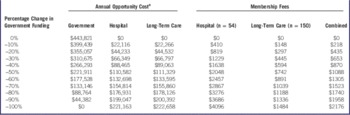
The financial model is presented in Table 1 by use of a sensitivity analysis demonstrating how annual membership fees by facility type change in relation to the percentage decrease in federal government funding. For example, if government funding decreased by 50%, then annual membership fees of $2048 for hospitals and $742 per long-term care facility would keep the regional response team sustainable. These figures are conservative given the adjustments for additional risk and participation rates. The annual value of the response team in the financial model is estimated at $0.443 million, which is approximately double and more than covers the annual investment cost of $0.225 million owing to the adjustments for additional risk.
Financial Model: Sensitivity Analysis

a The opportunity costs for hospital and long-term care facilities are similar because the team responded to one very costly long-term care facility event and several less costly hospital events.
Discussion
Measuring the value of health care preparedness activities begins by evaluating both the risks and the outcomes (including costs) associated with different types of hazardous events and disasters. The risk of critical infrastructure failures is a major concern for this study’s health care facilities and many others impacted by disaster. Restoring lost utility and providing care under resource-constrained environments are critical missions to avoid patient evacuation and resorting to alternate standards of care. If these risks and outcomes are defined and measured, an evaluation of investments in preparedness aimed at improving these outcomes can occur.
This study used the key microeconomic concept of “opportunity cost” to measure return on investment. Opportunity cost is typically measured as the difference between the value of your choice and the value of the best alternative forgone. In this study, opportunity cost was equivalent to net benefit or loss [-InvestmentCost−(−∑Alternative Costs)]. Although the emergency response team requires an up-front investment cost, the net benefit of this investment is avoiding catastrophic scenarios at higher cost. In other words, an alternative cost greater than the investment cost represents a surplus, or a positive return on investment. As studied, this regional emergency response team has certain financial options to consider that could mitigate the impact of decreased federal funding of the critical services it provides to the community. The positive return on investment results could be shared with other public and private investors to create partnerships and generate additional funding. The value to the community, described here, could be used to encourage support from engaged community members and private sector companies. Although not quantified, risk associated with patient transportation and the provisions of a regional operational safety net in disasters are of added benefit (or return) that should be mentioned to possible investors.
Also demonstrated in the findings, health care preparedness can be considered and funded much like a traditional insurance program. Here the base price (value) of health care preparedness is based on the occurrence (risk) and effect (economic cost) associated with different types of emergency events taking place in the response team’s catchment area. The analysis demonstrates that a membership model would share risk and could be an economically responsible approach for communities where organizations cannot maintain additional capacity for patients. As such, the membership model becomes a community-level insurance policy to sustain facility operations and create medical surge capacity.
Under a membership model, the regional response team could be funded in 2 ways: through membership fees and fee-for-service. Members would share risk and receive predefined emergency response coverage. Nonmembers would still benefit from emergency response efforts, but they would have to pay for services rendered after the fact at a higher fee-for-service rate. Under this model, the emergency response team would be a joint public-private partnership. Together with financial incentives, member facilities could possibly be incentive with additional benefits above the basic public response coverage of nonmember facilities. Both membership and fee-for-service payments could be used to fund team responses if federal funds for preparedness activities continue to decrease.
Implementing such a membership-based financial model requires additional analysis of the facilities’ preferences, in particular the facilities’ willingness to pay for emergency services. Although the willingness of health care facility administrators to participate in a membership model is outside the scope of this study, certain evaluation methods could be used to conduct these analyses.Reference Mitchell and Carson 5 , Reference Lancsar, Louviere and Donaldson 6 Both risk sharing and mitigating additional risk from transporting patients need to be explicitly communicated as added benefits from membership. Furthermore, because this study used a societal perspective and focused on the effects on the community and not on an individual facility, revenue loss from one facility was offset by the gain of another and thus not quantified. Although not quantified, the loss in revenue and other facility-based indirect benefits such as damage to facility reputation should also be communicated as reasons for becoming a member.
Another approach a regional response team could consider is to become a not-for-profit organization (under the IRS 501(c)(3) model). The not-for-profit model is routinely used to support fire and emergency medical services. Choosing this model, a not-for-profit regional disaster response team could include within its charter the goal of proving enhanced regional medical surge capacity as well as supporting health care facilities during critical infrastructure failures. The not-for-profit model could follow a fee-for-service structure providing medical support for special events, such as marathons, fairs, and other large gatherings. As a 501(c)(3), the response team would be tax exempt, and donations of cash, equipment, supplies, and services would be treated as tax-deductible, as long as they comply with IRS regulations. A not-for-profit model would complement corporate sponsorships from health care facilities, insurance companies, utilities, and philanthropic donations from individuals, foundations, and other key stakeholders.
Limitations
There were a few limitations to this study. First, the analysis was predicated on the regional centralized emergency response model and availability of information for 17 real-world events. Future economic evaluations will need to be adapted to the specific structure and circumstances of individual health care coalitions or response teams and take into account the available data sources. Second, the study did not estimate certain alternative costs associated with the hazardous events that are more difficult to quantify, including patient safety or risk associated with emergency evacuation and transportation, disruption to continuity of care including damage to facility reputation, value associated with regional operational safety net, and the impact on family access to patients at preferred hospitals. The return on investment presented here is thus likely to be undervalued because a larger alternative cost would result in a larger return on preparedness investment. The literature surrounding these difficult-to-measure costs is scarce and a subject for future research.Reference Ben-Ezra, Goodwin and Palgi 7 , Reference Brown, Dosa, Thomas and Hyer 8 Finally, considering health care preparedness as a form of insurance requires quantifying risk and outcomes of covered events. It is much easier to calculate the premium for smaller-scale, frequent events than for infrequent, large-scale events. The member model presented in this study is not designed to support large-scale catastrophic care. Sophisticated actuarial models are usually used for catastrophic insurance, which is a method beyond the scope of this study.
Conclusions
Uncertainty, varying response expectations, recent declines in preparedness funding for disaster preparedness, and continuing disasters make economic analyses increasingly important in health care preparedness. The practical application of economic evaluation methods can help decision-makers better understand the value of preparedness and create financial mechanisms to ensure the sustainability of preparedness activities at the regional level. The regional centralized emergency response model minimizes the risk associated with transporting patients and strengthens the ability for facilities to maintain operations. Importantly, this economic analysis demonstrated a positive return on investment for the first 6 years of operations of the regional response team program. With decreased government funding, a sustainable regional risk-based insurance-like membership model could be implemented to maintain the critical services provided. Other financing options, such as not-for-profit incorporation could also be considered.
Acknowledgments
This research was financially supported by the US Department of Health and Human Services’ Assistant Secretary for Preparedness and Response. Special thanks to Assistant Secretary for Preparedness and Response, Pennsylvania Department of Health, South Eastern Pennsylvania (SEPA) Surge Medical Assistance Response Team (SMART), and Abington Memorial Hospital for their efforts in making this study possible.
Disclaimer
The findings and conclusions in this report are those of the authors(s) and do not necessarily represent the views of the Department of Health and Human Services or its components.