Introduction
Support for family carers is of increased interest on the political agenda as well as in palliative care practice and research (Payne et al., Reference Payne, Hudson and Grande2010; Harding et al., Reference Harding, List and Epiphaniou2012). Palliative care is an approach that aims to recognize patients and their families as a “unit of care” (World Health Organization, 2002). Furthermore, dying at home is largely dependent from the availability of a family member who is willing and able to take on some responsibility for care of a terminally ill relative (Gomes and Higginson, Reference Gomes and Higginson2006). Interventions to support carers have shown to be effective in terms of lowering depression scores if initiated early (Dionne-Odom et al., Reference Dionne-Odom, Azuero and Lyons2015). To assess family carers’ support needs is important for this, however, not systematically a part of palliative home care. This is the case especially in the German-speaking countries, where a suitable tool has not been available so far.
The Carer Support Needs Assessment Tool (CSNAT) is an evidence-based comprehensive tool developed in the UK to identify carer support needs in palliative home care (Ewing and Grande, Reference Ewing and Grande2013). It allows to assess support needs directly and adopts a screening format based on 14 broad support items. The tool has been designed to use in practice, assessing physical, practical, social, psychological, spiritual, and financial support needs. The CSNAT facilitates tailored support for family carers using a simple question and answer format to ask them in which areas they need more support with. They can indicate whether or not they need more support in relation to each domain. Based on this, an assessment conversation takes place, which focuses on the domains prioritized by the carer. Use of the CSNAT is based on a person-centred approach of assessment and support (the CSNAT approach), which means that it is carer led but facilitated by practitioners (Ewing et al., Reference Ewing, Austin and Grande2016).
Early-stage research in the UK had shown comprehensibility, face, content, and criterion validity (Ewing et al., Reference Ewing, Brundle and Payne2013). Recent activities have focused on implementation issues (Austin et al., Reference Austin, Ewing and Grande2017) as well as application in populations with specific needs such as carers of patients with motor neurone disease (Aounet al., Reference Aoun, Deas and Kristjanson2017). In a recent Swedish study, construct validity and reliability were examined (Alvariza et al., Reference Alvariza, Holm and Benkel2018). To our knowledge, no paper has been published to reflect on cultural issues regarding the application of CSNAT nor have acceptance and feasibility issues of CSNAT in other than English-speaking countries been addressed so far.
The context of this study is a 3-year project on promoting carer support in Germany within the palliative home care setting. One key strategy was the implementation of a valid and effective approach to identify informal carers’ needs. In light of the evidence available regarding the tool itself (Aoun et al., Reference Aoun, Grande and Howting2015; Grande et al., Reference Grande, Austin and Ewing2017), the German project focused on good quality of the translation and consideration of issues of language and cultural understanding on the one hand as well as implementation issues on the other.
The aims of this study were to translate and develop a culturally adapted version of the CSNAT for a German-speaking context, including assessment of feasibility, face, and content validity.
Methods
A translation and validation study was conducted in three steps: (1) translation of the CSNAT following the International Society for Pharmacoeconomics and Outcomes Research (ISPOR) criteria (Wild et al., Reference Wild, Grove and Martin2005), (2) cognitive testing in five German-speaking regions, and (3) pilot testing in palliative home care. These steps will be described in detail in the following sections.
Translation
License agreements with the Universities of Cambridge and Manchester (mandatory for any use of CSNAT, http://csnat.org) were obtained. Moreover, formal permission to translate the CSNAT into German language was granted by the authors of the original version.
The CSNAT was translated into German according to the good practice model for translation and cultural adaptation proposed by the ISPOR (Wild et al., Reference Wild, Grove and Martin2005). This model defines five steps to be fundamental: (1) forward and backward translations, (2) iterative reviews of the results after each step, (3) the active involvement of researchers and managers from both the source and the target country/language, (4) a cognitive testing phase involving a sample of the target population, and (5) the agreement on a final document.
Following the ISPOR criteria, the forward translations of the CSNAT-source document in English language (English version 0/Ev0) were conducted independently by two members of the scientific team. They were native German speakers, fluent in English, one from Austria and one from Germany. This resulted in two German versions (Gv1 and Gv2). The researchers compared these initial versions and discussed all critical issues with the third author in telephone conferences. If no corresponding German term was found, the respective term had to be paraphrased. In case no consensus on the exact meaning of a phrase was achieved, one of the CSNAT UK authors (GE) was consulted. On the ground of those results, a common German version (Gv3) was agreed upon and then translated backward by a professional translator (Ev1). In a consensus meeting of the scientific team, these three versions (Ev0, Gv3, and Ev1) were compared line by line. The aim was to ensure the adequacy of the translated content with the original instrument. Adaptations which were made at this stage led to a German version (Gv4) ready for cognitive testing.
Cognitive testing
The aim of cognitive testing is to assess content validity. This includes comprehensibility and cognitive equivalence of a translation and identification of any item that may be inappropriate or cause confusion (Wild et al., Reference Wild, Grove and Martin2005; Beatty and Willis, Reference Beatty and Willis2007). As part of the process for translations defined by ISPOR, the cognitive testing phase shall involve representatives of the target population.
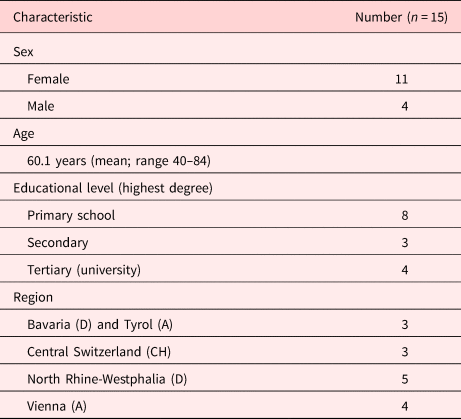
To cover the broad regional variation of the German language, family carers from five geographically distinct regions in Germany, Austria, and Switzerland were involved. As active carers might be burdened by their caregiving role and therefore might rather reflect on their own support needs than answering the interview questions, also bereaved carers were included. For recruitment, hospice and palliative care services were approached. Sampling was done by convenience (active or bereaved family carers of cancer patients). Participants’ socio-demographic characteristics are shown in Table 1.
Sample characteristics of family carers in the cognitive testing phase

Five regional interviewers were involved in conducting face-to-face interviews with carers. A written interview manual was produced to guide the interviewers; in addition, they were briefed personally or by phone in advance.
Participants were handed out the German version of the CSNAT (Gv4) by the interviewer, encouraged to read carefully each question, and to spontaneously comment on whether and how they had understood the questions (“think aloud” technique). The interviewees were asked additional prompting questions to comment on those terms that had raised discussions among the researchers during the translation process. In addition, they were asked to give their opinions on alternative German translations of the “CSNAT” acronym. Finally, an open question offered the opportunity to give additional comments.
The interviewers produced written interview protocols. After anonymization, all responses were structured by the first author, reviewed and compared carefully. Each item that needed further refinement or rewording was discussed in depth with the scientific team. Finally, the findings were synthesized and the German CSNAT-version was adapted slightly (Gv5).
Pilot testing
To assess comprehensibility and acceptance as well as feasibility, and content validity in a “real life” setting, a pilot study of the German CSNAT (Gv5) was conducted from September to December 2016 in four palliative home care services in North Rhine-Westphalia.
Setting and participants
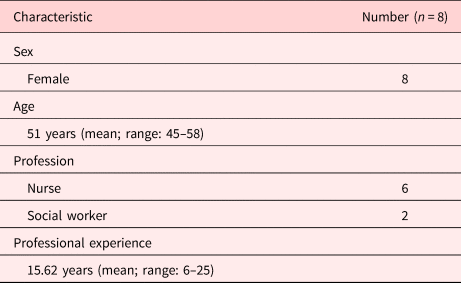
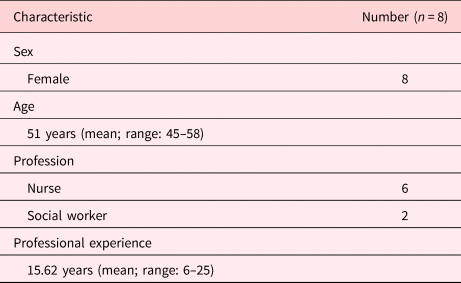
The four hospice and palliative home care services in North Rhine-Westphalia, which were cooperation partners in the 3-years project, were involved in the pilot testing and implementing the German version of the CSNAT (Gv5). Two health care professionals out of each participating service took part. They acted as voluntary champions for the KOMMA project. These eight professionals were trained in a 3-hour workshop to make carers familiar with the CSNAT and the “CSNAT approach” (for professionals’ characteristics, see Table 2). All of them were handed out a brief manual describing each step.
Characteristics of professionals in the pilot testing
As participants for the assessments, adult family carers of palliative patients with a diagnosis of cancer or chronic illness (other than dementia) cared for at home were included in the pilot.
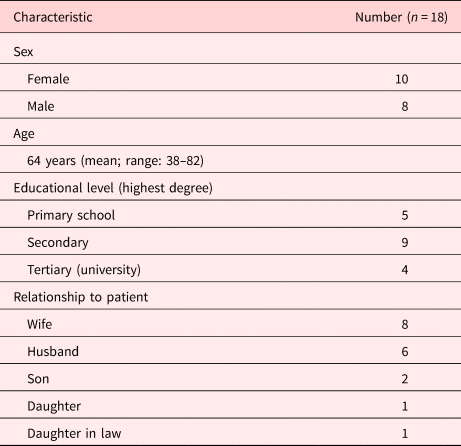
The trained health care professionals were expected to use the CSNAT approach in their regular daily work and to offer it systematically in all newly accepted families in the palliative home care service. They introduced the study and the CSNAT to the family carer and handed out information material and the consent form. To guarantee optimum support for all carers irrespective of consent to study participation, all of them were offered a second meeting for the assessment conversation. If having given written informed consent, they were included in the study. Characteristics of the carers are provided in Table 3.
Characteristics of family carers in the pilot testing

Data collection
Two to 14 days following the assessment conversation, semi-structured telephone interviews with the family carers (10–15 min each) were conducted by three experienced interviewers who had been briefed both by a written guideline and personally. The interviews were recorded in written protocols. Data were collected until saturation was reached.
The eight health care professionals were telephone interviewed during the field phase by one of the authors (CK) and asked about their experiences using the CSNAT (open-ended questions).
At the end of the data collection phase, a focus group with the eight health care professionals was arranged, facilitated by one of the authors (SP), lasting 85 min. A structured interview guide was used (which was informed by first results of the interviews) consisting of an open-ended initial question and further semi-structured questions. Data were audio recorded and transcribed verbatim.
Data analysis
Data were analyzed using qualitative methodology (content analysis according to Mayring, Reference Mayring2010) and processed with MaxQDA software. Interview protocols and transcripts were coded and systematically grouped into categories, each illustrated by an original quotation. Analysis and interpretation were discussed with the scientific team.
Ethical considerations
The study was approved by the Ethics Committee of the German Society of Nursing Science (Nr.16-017) and reported to the Research Committee for Scientific and Ethical Questions of the Health & Life Sciences University (UMIT, Austria). Participating services, family carers, and professionals gave written informed consent.
Results
Steps 1 (translation) and 2 (cognitive testing)
Of the 14 CSNAT items, 12 were discussed controversially and had to be thoroughly adapted in the translation process (step 1). This was also the case with the opening and concluding text of the tool. In the subsequent cognitive testing (step 2), most of the items (11 out of 14) were well understood by the participants. Three items needed further clarification. However, the opening and concluding text still raised questions. The following issues emerged with regard to semantic, conceptual, syntactic, and idiomatic aspects:
Semantic issues
Due to German grammar, a consistent use of gender-inclusive language was a challenge. In German, nouns and pronouns are restricted to one “genus”. To apply an inclusive language, both forms — male and female — must be used. The German equivalent of “your relative”, for example, usually is used in the male version in common language (“Ihr Angehöriger”). Finally, a slash version (“Ihr/Ihre Angehörige/r”) was agreed upon for the tool.
Furthermore, there is no appropriate German equivalent for the term “practitioner”. All alternatives discussed in step 1 (“professional”, “qualified person”, or “doctor or nurse”) seemed to be too narrow. For step 2, the alternative wording “our staff member” was introduced and well understood.
Conceptual issues
A key concept of CSNAT is “support needs”. Translating this term was challenging because the English term is carrying two different meanings for which two different words are used in German language: it may be used either in the sense of an subjectively perceived need (“Bedürfnis”) or refer to a more objective/general level of need (“Bedarf”). As the CSNAT's goal is to indicate individual support needs, we finally opted for the term “Unterstützungsbedürfnis” for “support needs”.
Moreover, the translation of the question “Do you need more support with getting a break from caring overnight?” was identified by the thinking aloud technique in step 2 as a source of misinterpretation. Participants understood a variety of things, e.g. receiving day-care or taking a short break. This issue was sorted out by consultation with the CSNAT's authors who were able to clarify the original meaning.
Syntactic issues
The question “Do you need more support with knowing who to contact if you are concerned about your relative (for a range of needs including at night)?” sounded complex if translated literally and was well understood only by four interviewees. Therefore, the syntax was adapted accordingly.
Idiomatic issues
The German “benötigen” for the verb “to need”, which was used in the introduction and final text of the CSNAT, was not supposed to be common in Switzerland and regarded as snobbish. It was replaced by “brauchen”, which can be applied broadly. Also, the term “at the moment” showed regional variability which, however, did not impair comprehensibility.
Finally, a comprehensible German title for the tool was urgently requested by carers and professionals. After a discussion of several alternatives with users, the acronym “KOMMA”, for “Kommunikation mit Angehörigen” (“communication with family carers”), turned out to work best.
In general, for the interview partners it was demanding to reflect merely on cognitive aspects such as language issues, while the topic of interest was so close to their own emotional experiences, which was especially the case for active carers.
Step 3 (pilot testing)
In total, 25 assessment conversations with family carers were performed, and 18 of them agreed to a follow-up interview. With the 8 health care professionals, a total of 12 field-phase interviews as well as a focus group discussion were carried out.
Both family carers and health care professionals perceived the final KOMMA version as comprehensible, regarding both the entire tool and single items. The structure and briefness of the tool were reported to be adequate, and users rated the layout positively. A carer said: “Its likeable small, well done psychologically” (C [=carer] 4).
Perspective of family carers
They used the tool mostly on their own, some in the presence of a professional (4/18; 22.2%) or a relative (1/18; 5.6%). Some carers waited a couple of days before completing it, others went through it immediately. The time needed for completion was between 10 min and 1 hour. Overall acceptance was high. Using KOMMA was reported to be simple, and it was appreciated that support needs were addressed actively. Furthermore, family carers reported that the items covered relevant issues: “My problems were adequately identified. My needs were reflected very well” (C7). The boxes for specifying the level of support needs were perceived as helpful, except for one participant (5.6%). Of note, some carers felt stimulated to think about personal matters. Positive feedback included the experience that competencies, resources, and achievements were reflected on. Some family carers called it “funny”, “special”, or “challenging” that their own support needs were addressed. Two carers (11.1%) appreciated KOMMA, but were concerned about not receiving appropriate support subsequently.
Health care professionals perceived high levels of acceptance of the tool on the side of the carers. They reported some carers to be surprised and others to be relieved that their support needs were addressed. “[…] family carers were amazed and I had also the feeling, that they were glad to be asked” (P [= professional] 8). They assumed that the carers might prioritize patient needs above their own needs. “I've perceived some carers as being shy when asked to talk about their needs, in the sense of ‘Am I allowed to do so?’” (P1). Moreover, health care professionals reported that support needs were revealed that they had not expected: “All in all, I was very surprised where suddenly boxes had been ticked. I had not expected that; it reassures me to try not just start out from our views and to decide what is good for whom or what he or she is possibly preferring, but just to look at it without any bias …” (P2). In some cases, however, carers expressed fewer needs than health care professionals had expected. Professionals stated that, while applying KOMMA, they became increasingly aware of the relevance of carers’ self-assessment.
The assessment conversations following completion of the tool were described as deep and intense. “It was also enriching for me. I haven't had such intensive conversations with carers for a long time” (P3). Although these conversations were highly time-consuming (some lasting up to 1 h), this issue was not discussed further. Mostly, assessment conversations took place between a health care professional and the carer only. Reasons for third persons to attend were the carer's or family's wish to do so. In these cases, negative effects on conversation quality were stated by the professionals. They felt that the carers could not openly discuss their concerns.
While KOMMA was thought to be applied during the first visit of the health care professional to the patient's home, which is also suggested by the original CSNAT approach, this did not always work well. A possible reason for deviance of the recommendation was that in such cases, health care professionals (and/or family carers) prioritized patient needs higher than those of the carers, and subsequently postponed the introduction of KOMMA to a following visit. “I had CSNAT with me all the time, but finally the initial patients’ assessment was affected by the patients’ symptoms. That's why they get in touch with specialized palliative home care, because of the patients’ burden… and usually the situation is overloaded… so I thought, that's too much, so” (P8). There was also concern that health care professionals themselves might be unable or lacked competencies to meet family carers’ needs. “There is also the risk…what can we offer? What do we have to offer, when we ourselves can't offer any support or when we have no solution?” (P7). Concerns were expressed that by the thorough assessment process, attention might be focused on carers’ needs at the cost of patient care.
Discussion
This article summarizes the process of the German translation and cultural validation of the CSNAT, which is a novel assessment tool addressing the support needs of informal carers in palliative home care. Key findings include: (1) the synthesis of a German working template of CSNAT, (2) good face validity revealed by cognitive testing, and (3) high acceptance of family carers and professionals as well as content validity. Finally, this study demonstrated that the tool is feasible for use in a German-speaking context of palliative home care.
These results of an early-stage CSNAT study in a German-speaking context are reflected by international experience. A large trial in Australia (Aoun et al., Reference Aoun, Grande and Howting2015) revealed that applying the CSNAT was safe, acceptable, and provided reassurance and empowerment to the carers, which are also key findings in the German context. Moreover, the Australian group observed a significant reduction in carer burden (Aoun et al., Reference Aoun, Grande and Howting2015). However, there were some concerns raised by health care professionals about potential negative effects on family carers and patients. They worried that carers might expect support that would not be available. Another concern was that shifting attention to the family carers might negatively affect patient care. As in a UK study, these concerns were expressed before having made the CSNAT (Ewing et al., Reference Ewing, Austin and Grande2016). After performing some assessment conversations, health care professionals were aware that CSNAT/KOMMA is embedded in a person-centred health care approach, which itself is a health care intervention. Also, concerns about timing and additional workload, as in a study by Austin et al. (Reference Austin, Ewing and Grande2017), were raised. This merits further discussion as support for family carers is an essential part of the palliative care approach (WHO, 2002). Nevertheless, high levels of distress seem to prevail ubiquitously (Ullrich et al., Reference Ullrich, Ascherfeld and Marx2017; Areia et al., Reference Areia, Fonseca and Major2018). Thus, novel interventions that effectively reduce carers’ distress and are acceptable across different cultures are urgently needed.
Some family carers indicated that it was unusual for them to be asked for their personal support needs, which was also confirmed by professionals’ statements. This can be interpreted in light of research showing that on the one hand, own support needs are neglected by family carers in favor of the patient (Harding and Higginson, Reference Harding and Higginson2000; Ward-Griffin et al., Reference Ward-Griffin, McWilliam and Oudshoorn2012). On the other hand, in this study family carers expressed that CSNAT stimulated them to reflect on their needs, which approves the intention of CSNAT. A further positive effect of using CSNAT was that carers became aware of resources and competencies, which might also empower family carers.
As demonstrated in our study, a Swedish study reported on professionals’ concerns of being unable to help with support needs indicated by family carers (Alvariza et al., Reference Alvariza, Holm and Benkel2018). The authors conclude that there might be a misunderstanding of the CSNAT approach and point out that professionals’ training is essential to overcome this issue. However, the professionals in our study received a 3-h training in the CSNAT/KOMMA approach. Hence, it might be worthwhile to adapt the structure of the training by adding a follow-up module after a practice phase to give professionals the opportunity to reflect on the CSNAT approach and its implications.
Doing cognitive interviews with family carers raised some ethical and methodological issues, which might be worthwhile to discuss. Wild et al. (Reference Wild, Grove and Martin2005) recommend that cognitive interviewing should include people that match the target population “for as many criteria as reasonably practical”. We included active and bereaved carers. While bereaved carers might have commented on the CSNAT/KOMMA items from a more distant point of view, for active carers it was difficult to reflect on the tool itself rather than on their individual support needs. It seemed that our interest and questions were kind of overstraining, for example, professionals reported carers to get tired going through all the questions. Their interest was to talk about their concerns, not about the content and understanding of the questions. Alvariza et al. (Reference Alvariza, Holm and Benkel2018) and also Beck et al. (Reference Beck, Olsson Möller and Malmström2017), who performed cognitive interviews with patients, did not report any such issues. Willis (Reference Willis1999) identified “subject resistance” as a disadvantage of cognitive interviewing, meaning that some participants tend to simply answer the questions that are asked, without further elaboration. We could not find any hints to overcome these challenges. However, with regard to issues of content validity, the interviews with active carers provided valuable insights.
A finding was that the acronym CSNAT did not seem suitable for a German-speaking context, neither for professionals nor carers. It took some effort to find a coherent German wording for the tool, and we used cognitive interviewing also for feedback regarding the name. With “KOMMA”, a label was created that is describing well the core target of CSNAT, namely the communication with carers. However, changing the name of a licensed tool may raise further issues. First of all, permission of the authors who developed CSNAT was crucial. While in scientific contexts, it is necessary to use the original English title in order to allow identification and to link with existing evidence, promoting the approach in a German-speaking practice requires a German name. We did not find any published experience on how to deal with such issues concerning the translation of acronyms. Therefore, a careful examination of comprehensibility of the acronym “CSNAT” (or, otherwise, agreement on an alternative label) is recommended for any cultural context.
Among the strengths of this study is the multiregional and cross-border approach within the German-speaking area. Cognitive interviews were performed in five regions in Austria, Germany, and Switzerland in order to cover a broad range of accents. Each variation in wording was discussed with health care professionals from the respective region to clear any misunderstandings. Due to the fact that CSNAT is a carer-led instrument based on self-assessment, comprehensibility was a crucial aim of the entire process. The frequent contacts with the UK authors helped to adhere to the original version as closely as possible. In the validation steps (2 and 3), the choice of qualitative methodology regarding data collection (open-ended and semi-structured questions) and analysis (Mayring's content analysis, Reference Mayring2010) allowed for a broad range of themes to emerge with regard to the tool itself as well as issues on feasibility regarding its implementation.
A limitation of the study is that participants in a pilot study may not be representative for the entire target population. A further limitation refers to CSNAT itself, which is a tool developed to assess carers’ needs in the palliative home care setting. Thus, findings may not be transferable to other settings. Moreover, physicians as well as families caring for patients with conditions other than cancer or chronic disease have not been included in this study.
Regarding further translations of CSNAT, the three-step approach as used in this study can be recommended for adapting the tool to regional variation. Additionally, a team approach, the involvement of professional translators, and a close cooperation with the CSNAT authors are highly suggested to make sure that each translation will accurately reflect the original intention.
Conclusion
A German version (KOMMA) of the CSNAT has been developed and culturally validated in this study by using a multi-step approach of translation, cognitive testing, and pilot testing. Pilot testing demonstrated content validity and revealed that the tool is acceptable, useful, and feasible for family carers as well as health care professionals in a German-speaking context. The findings may inform further adaptations of the CSNAT to other languages and cultural contexts. They may also facilitate its implementation into existing hospice and palliative home care settings.
KOMMA is now available to support family carers in palliative home care in the German-speaking countries. The tool will be systematically applied during a three-year research project addressing implementation issues. Embedded in a person-centred approach for assessment and support, the KOMMA tool requires health care professionals to adapt their role with regard to family carers. Using KOMMA will contribute to better support for family carers both with respect to their needs concerning the patients’ care and their personal support needs. This may contribute to reducing stress, morbidity, and mortality in family carers of seriously ill persons and enable these patients to be cared for and to die at their preferred place.
Acknowledgments
The authors would like to thank the family carers and health care professionals for their participation.
We also thank Monika Ecker, Yvonne Eisenmann, Ursula Egolf, Claudia Schwaizer, and Claudia Wenzel for their contribution with data collection.
In this study, the Carer Support Needs Assessment Tool (CSNAT) developed by Dr Gail Ewing and Prof Gunn Grande (Copyright © 2009) University of Cambridge (Centre for Family Research)/The University of Manchester (School of Nursing, Midwifery, and Social Work) was used. All rights reserved. We kindly thank the authors for their collaboration and support.
Funding
The study was funded by Stiftung Wohlfahrtspflege Nordrhein-Westfalen.
Ethics approval and consent to participate
Ethical approval for the study was sought and granted from the ethics committee of the German Society of Nursing Science in Witten (No. 15-017, date: 05.06.2016). Professionals and family carers were asked to sign an informed consent agreement. The developers of the CSNAT provided permission for use.