

Introduction
A subcommittee of the International Psychogeriatric Association (IPA) Task Force on Testamentary Capacity and Undue Influence undertook to establish guidelines for expert assessment of contemporaneous testamentary capacity. This paper focuses on the contemporaneous assessment of testamentary capacity by an “expert clinician”. “Contemporaneous” or “lifetime” assessment refers to the assessment of a testator/testatrix (hereafter referred to as testator) while alive and in close temporal proximity to the execution/signing of the will. Implicit is the assumption that a lawyer, family member or testator has made a preliminary determination that the presumption of competence may be overruled when the will is brought for probate after the death of the testator. An expert opinion may be sought because of (1) suspicious circumstances (Hull and Hull, Reference Hull and Hull1996) – such as a significant change from previously expressed wishes or inconsistency in the distribution of assets by a testator executing multiple wills; (2) preliminary evidence of a concurrent mental, neurologic or serious medical disorder; or (3) anticipation of a possible challenge to the will by an aggrieved potential beneficiary or beneficiaries; or (4) very advanced age. In the majority of circumstances, the finding of diminished capacity is determined outside of the court room by clinicians, attorneys and others who work with older adults (Moye and Marson, Reference Moye and Marson2007). Settlements may be reached on the basis of expert reports but a small minority of cases proceed to trial.
Contemporaneous assessment presents special opportunities not afforded by the more common retrospective or “post-mortem” assessment which has been addressed elsewhere (Shulman et al., Reference Shulman, Cohen and Hull2005) and is being addressed by a separate IPA subgroup. As opposed to extrapolating from indirect evidence or interpreting the assessment of other clinicians, the clinician-expert in this circumstance has the opportunity to directly examine and probe specific issues related to the legal concept of testamentary capacity as defined below. Champine (Reference Champine2006) has highlighted the powerful influence of a “lifetime” or contemporaneous assessment which almost always carries the day in will disputes. This growing awareness from a societal and legal perspective is likely to increase the frequency of requests for contemporaneous assessments of testamentary capacity. This is reflected in recent reviews of legal and clinical aspects of testamentary capacity (Spar and Garb, Reference Spar and Garb1992; Marson et al., Reference Marson, Huthwaite and Hebert2004; Marson and Hebert, Reference Marson, Hebert and Larabee2005; Peisah, Reference Peisah2005; Shulman et al., Reference Shulman, Cohen and Hull2005; Reference Shulman, Cohen, Kirsh, Hull and Champine2007; Champine, Reference Champine2006; Jacoby and Steer, Reference Jacoby and Steer2007; Posener and Jacoby, Reference Posener, Jacoby, Jacoby, Oppeinheimer, Dening and Thomas2008). Adding to the pressure for more challenges is the fact that the largest transfer of wealth in human history from the Second World War cohort to the baby-boomer generation is about to occur (Havens and Schervish, Reference Havens and Schervish2003). The increasingly complex nature of modern families with multiple allegiances compounded by the high prevalence of dementia and cognitive impairment in older adults suggests that challenges to wills on the basis of lack of testamentary capacity and/or undue influence is ripe for a dramatic increase over the next generation.
Although testamentary capacity is a legal concept determined ultimately by the court, the decision may be informed by expert medical or psychological opinion. Moye and Marson (Reference Moye and Marson2007) have highlighted the need for increased education for clinicians who may be asked to help the courts in such determinations in the coming years. In the U.K., Mr. Justice (later Lord) Templeman formulated the “golden rule” in which medical practitioners are recommended for the assessment of aged or seriously ill testators (Kenward v. Adams, 1975):
In the case of an aged testator or a testator who has suffered a serious illness, there is one golden rule which should always be observed, however straightforward matters may appear, and however difficult or tactless it may be to suggest that precautions be taken, the making of a will by such a testator ought to be witnessed or approved by a medical practitioner who satisfied himself of the capacity and understanding of the testator, and records and preserves his examination and finding.
However, Jacoby and Steer (Reference Jacoby and Steer2007) have highlighted some potential problems associated with such a recommendation. Many clinicians lack the knowledge and skills necessary for the assessment of testamentary capacity. One of the overriding principles for giving expert opinion enshrined in some expert codes of conduct (e.g. in Australia, the Uniform Civil Procedure Rules (Amendment No. 12) 2006, under the Civil Procedure Act 2005, New South Wales) is the importance of providing opinion only within one's area of expertise. This applies not only to clinical knowledge but to medico-legal expertise. The assessment of testamentary capacity is a highly specialized area of expertise and should be reflected in the credentials of the expert assessor (see below). Potential expert assessors need to be educated about the legal and clinical issues relevant to testamentary capacity. It is hoped that growing awareness will lead to more contemporaneous assessments by qualified experts and provide a more objective opinion for the court to consider than a retrospective assessment after the testator has died. This paper is an attempt to provide consensus guidelines for such assessments.
General principles of capacity assessment
The tension in all capacity assessments is the conflict between two ethical principles, autonomy or self-determination versus beneficence or the need to support and protect vulnerable individuals (Berg et al., Reference Berg, Applebaum, Lidz and Parker2001). A prime goal of capacity assessment is to facilitate the involvement of competent older adults in important and meaningful processes such as will-making, while identifying those who lack capacity and protecting them and others from the consequences of impaired decision-making. The two fundamental components of any mental capacity assessment are (i) an understanding of relevant facts and (ii) an appreciation of the consequences of taking or not taking specific actions.
Like all capacities, testamentary capacity is task-specific and is not determined only by the presence of a mental disorder or cognitive impairment. Banks v. Goodfellow (1870) is the English case that underpins most legal discussions of testamentary capacity. The testator John Banks suffered from a major mental disorder resulting in his “being confined as a lunatic.” Nonetheless, the court determined that Banks' delusions did not influence the disposition of his assets, and thus he was considered capable of executing a will. Most Anglo-American jurdisdictions base their legal criteria for testamentary capacity on Banks v. Goodfellow (see below).
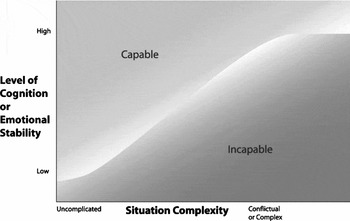
Not as well recognized or defined is the “situation-specific” nature of all capacities (Shulman et al., Reference Shulman, Cohen, Kirsh, Hull and Champine2007). Figure 1 outlines the relationship between complexity of the milieu or environment of the testator and his/her emotional stability or cognitive function. The greater the complexity and conflict within a testator's environment, and the greater the complexity of the will itself, the higher the level of cognitive function or emotional stability necessary to be considered capable. While the task-specific aspects of testamentary capacity form the basis of an assessment, they must be understood within the situation-specific milieu of the individual testator. Standardized assessment instruments must be interpreted within this context. In one individual, a certain level of cognitive impairment or neuropsychological dysfunction may not interfere with testamentary capacity, but in a complex or conflictual milieu or complicated will, the same level of impairment or vulnerability may compromise that individual's ability to understand or appreciate relevant issues (Figure 1).
Cognition, Emotions and Situation Specific Capacity. (Adapted from Shulman et al., Reference Shulman, Cohen, Kirsh, Hull and Champine2007)
Task-specific criteria for testamentary capacity
Table 1 outlines the criteria of Lord Chief Justice Cockburn in the Banks v Goodfellow case. In some American jurisdictions the criteria for testamentary capacity are identical or similar to Banks v Goodfellow, with the exception that the doctrine of insane delusion is distinct from general testamentary capacity. In this way, it is possible for a testator to have testamentary capacity but suffer from an insane delusion that invalidates the will (American Law Institute: Restatement of the Law, Third: Property [Wills and Other Donative Transfers]. Philadelphia: American Law Institute, 2003, section 8.1).
Banks v Goodfellow criteria

One of the fundamental criteria of Banks v. Goodfellow is knowledge of the extent of one's assets. Does the preoccupation with the extent of the testator's assets appear misguided? It has been suggested that the testator only requires knowledge of the “general extent” of his assets and in some countries there have been case precedents for a relatively lower threshold for asset knowledge (Sprehe and Kerr, Reference Sprehe and Kerr1996; Peisah, Reference Peisah2005). For example, one can lack knowledge of the specifics or even the extent of one's assets but theoretically retain capacity. As long as a testator knows that he wants to leave the assets in a specific proportion for reasons that are clear, rational and consistent, then he might be considered capable. Another opportunity afforded by a contemporaneous assessment is that the assessor may be able to help the testator understand the extent of his estate in order for him to retain the information long enough to demonstrate that he can make a rational decision about its distribution (Spar and Garb, Reference Spar and Garb1992). As long as the expert assessor notes the process by which this information was determined, the court is then in a position to determine whether this is valid from a legal perspective. Of course, a complex proportional or fractional distribution may require more understanding of assets. Moreover, it is almost always true that the need for formal assessment of contemporaneous testamentary capacity is in the context of a complex or conflictual milieu. In anticipation of a challenge to the will from an aggrieved potential beneficiary, the specifics of a testator's assets and the impact of their distribution are important considerations.
Additional issues specific for testamentary capacity were identified by Shulman et al. (Reference Shulman, Cohen, Kirsh, Hull and Champine2007). The following areas for probing and documentation are designed to assess whether the testator can formulate a coherent plan that connects his beliefs, values and relationships with the proposed distribution of assets:
• the rationale for any dramatic changes or significant deviations from the pattern identified in prior wills or previous consistently expressed wishes regarding disposition of assets.
Does the lack or recall of knowledge of prior wills automatically make a testator incapable in order to determine capacity? A testator should be able to show an awareness of his or her previous beliefs, values and wishes in order to provide a rationale for the latest will. This can serve to reinforce a consistency of thinking with respect to asset distribution. Similar to the issue of knowledge of the extent of assets, in a contemporaneous assessment, the assessor may help the testator to recall prior wills. In the case of a significant change from prior will(s), the assessor must determine whether the testator is able to explain why his testamentary dispositions are to be changed and furthermore determine whether or not the changes are being made on the basis of a delusion or disorder of mind.
• the testator's understanding and appreciation of any conflicts or tensions in his or her environment;
• the appreciation of the consequences and impact of a particular distribution, especially if it deviates from or excludes “natural” beneficiaries, such as close family members or spouses;
• clarification of concerns about potential beneficiaries who are excluded from the will or bequeathed lower amounts than might have been expected – specifically ruling out the presence of a delusion, overvalued idea or cognitive impairment that influences the distribution;
• evidence of behavioral or psychiatric symptoms at the time of the execution of a will, for example, behavioral and psychological symptoms of dementia such as apathy, agitation, impulsiveness, disinhibition, aggression, hallucination and delusions; and
• evidence of an inability to communicate a clear, consistent wish with respect to the distribution of assets; for example, frequent will changes are sometimes made in a desperate attempt to garner care, support, or comfort at a time when the testator feels increasingly vulnerable or threatened.
Rules of engagement
Ideally, the assessment of testamentary capacity should take place in close temporal proximity to the giving of instructions for the will by the testator. Prior to undertaking a formal assessment of testamentary capacity, expert clinicians are encouraged to establish clear ground rules for the assessment. Experts should: (i) determine whether they have sufficient expertise to provide an assessment including adequate knowledge of relevant medico-legal literature related to testamentary capacity; (ii) clarify who is requesting the assessment, i.e. the lawyer or the client; (iii) clearly identify retainer and hourly fees defined by the usual and customary fees of the local jurisdiction; (iv) clarify who is responsible for the payment of fees (lawyer versus client); and (v) agree on clear expectations regarding possible actions resulting from the preliminary review, e.g. a verbal or written report.
The following materials (where available) should be reviewed by the assessor prior to the clinical assessment of the testator:
• prior will(s);
• the specific will in question or multiple wills in question;
• a list of the testator's assets from a corroborative source;
• medical records and reports;
• residential care notes;
• community care notes.
At the outset of the assessment, the expert assessor should establish the testator's understanding of the nature of the assessment, its potential consequences and obtain his/her consent to proceed. There is no consensus as to whether this should be signed or verbal only. In addition to the assessment of the testator directly, it is preferable to interview an objective observer (relative or friend) keeping in mind that there are often conflicts of interest involved in such relationships. The interview of the observer should take place independent of the clinical assessment of the testator and vice-versa.
Clinical assessment for testamentary capacity
The clinical assessment should include the usual features of a medical and psychiatric history, mental status and cognitive examination as well as the specific issues relevant to testamentary capacity as defined above. Ideally, the assessment should establish a provisional diagnosis or diagnoses for the purpose of supporting the opinion of the expert. Ultimately, the clinical examination should be linked to the testator's capacity to meet the specific elements of testamentary capacity. Often, a single interview is adequate. However, an important advantage of contemporaneous assessment is the ability to conduct more than one interview in order to establish the consistency of the testator's wishes, rationale and level of cognitive function. This is relevant in clinical conditions that fluctuate or individuals who have made multiple changes in their wills.
History
This should include family, personal, medical and psychiatric history designed to support a provisional clinical diagnosis and personality profile. History-taking should also identify prior values and beliefs as they relate to estate distribution. It should include a review of the testator's recollection of prior wills or codicils.
Mental status and cognitive examination
This should follow the usual features of a mental status examination and include: appearance, speech, behavior, mood, thought process, thought content (including evidence of delusions or hallucinations with specific reference to any paranoid ideation) as well as insight into any identified mental or cognitive disorder. The detailed description of the testator's thought content is important as it relates to the legal concept of “insane delusion.” Specifically, the nature of any suspicious beliefs or frank delusions should be documented as well as the extent to which they are firmly held. Can the testator express wishes clearly and consistently? Can the testator establish a rational and logical connection between his/her values, beliefs, relationships and the disposition of his/her assets?
Mental status and cognitive examination should include an assessment for sensory or language impairment (dysphasia) which can profoundly affect the perception of capacity. If necessary, alternative means of communication need to be established to determine whether comprehension or communication is the primary deficit. More formal testing can include cognitive screening instruments such as the Mini-mental State Examination (MMSE; Folstein et al., Reference Folstein, Folstein and McHugh1975) or the clock drawing test, while frontal/executive tests may include verbal fluency, abstraction, the three-step Luria test, go-no-go test and the frontal assessment battery (FAB) as well as other validated screening tests (Shulman and Feinstein, Reference Shulman and Feinstein2006). The expert assessor should ensure that these tests are culture specific whenever possible. Age, education, premorbid intelligence and language are potential confounders when assessing the results of formal cognitive instruments. A detailed neuropsychological assessment is not essential but can be helpful in correlating deficits in cognition to the disposition of the will. It may be useful for the expert to correlate the neuropsychological findings on specific tasks to an individual's capacity in order to support an opinion. However, these neuropsychological findings are not in and of themselves definitive. The findings on cognitive examination should support the expert's opinion based on the specific criteria of Banks v. Goodfellow as well as the other criteria for testamentary capacity. In particular, findings on frontal/executive tests may correlate with capacity for abstract thinking, judgment and impulsivity.
Relationship to undue influence
The risk factors for undue influence have been addressed in a separate paper by our Task Force (Peisah et al., Reference Peisah2009). While the concept of undue influence is inextricably linked to testamentary capacity, it has been argued that the undue influence doctrine allows the courts to maintain a relatively low threshold for testamentary capacity and hence preserve the primacy of individual autonomy so highly valued in Western culture (Frolik, Reference Frolick2001). Undue influence remains a legal concept determined by the court. Challenges to wills commonly include allegations of lack of testamentary capacity as well as undue influence. In most jurisdictions, the testator must be considered capable before undue influence can be invoked. One of the expert's roles is to help the court establish the extent of psychological or cognitive “vulnerability to influence” that existed at the time of the execution of the will in question. Whether influence was exerted at all and whether it was “undue” remains the jurisdiction of the court.
Expert opinion and report
While the expert assessor is being asked to render an “opinion,” it is a clinical as opposed to a legal opinion. The expert's opinion is one component of the body of evidence to be considered by the court which is the ultimate arbiter of the question: “Did the testator have the task-specific capacity to execute a will in the context of a situation-specific environment?” The judge must weigh other factors including other expert opinions and evidence from other observers, not necessarily interviewed by the clinical expert. The judge also takes into account precedent case law, including other judicial principles.
The expert assessor can provide the court with evidence of a mental disorder or cognitive impairment. However, the task-specific nature of testamentary capacity suggests that the existence of a mental or cognitive disorder should be considered a “suspicious circumstance” and should not, ipso facto, lead the expert assessor to the conclusion of incapacity. Nonetheless, the diagnosis helps to support the clinical findings of the expert which must be linked to the legal criteria for testamentary capacity.
The expert assessor should qualify his or her opinion as being based on the available facts and should clearly identify the assumptions upon which that opinion is based. The implication is that the clinical opinion may change if the facts or assumptions relied upon by the clinician-expert are proven to be incorrect. Moreover, the courts are sensitive to any indication that the expert has assumed an advocacy role on behalf of the client. Clinical experts must maintain an objective perspective and understand that any written opinions will be challenged under cross-examination or by the judge.
Future considerations
Capacity assessment in the future will cross many professional disciplines – as exemplified by the recent collaboration of the American Psychological Association and the American Bar Association Commission on Law and Aging (Wood and Moye, Reference Wood and Moye2008). Marson et al. (Reference Marson, Huthwaite and Hebert2004) and Champine (Reference Champine2006) have called for the development of a “lifetime” (contemporaneous) assessment instrument based on clear legal criteria. However, there are methodological challenges involved in assessing testamentary capacity in a standardized way. Like many high-level capacities, it is the specific nature of the information and situation extant at the time of executing a will that determines whether the testator is capable (Marson et al., Reference Marson, Huthwaite and Hebert2004). The development of capacity assessment instruments is likely to be a major initiative in the future with a shift from a “diagnosis-based” assessment to the consideration of key functional abilities for specific capacity domains (Heinik et al., Reference Heinik, Werner and Lin1999; Grisso, Reference Grisso2003). Intact cognitive function and a normal mental state is much more likely to be associated with capacity while severe impairment is likely to be associated with incapacity. In the gray zone, it is necessary to assess capacity at a situation-specific level as this varies among individuals depending on the complexity of their social and personal milieu and the implications of their decisions on the lives of others. The extent to which “lifetime” instruments can incorporate situation-specific factors will determine their usefulness as standardized instruments. However, standardized instruments provide a template and guideline that may allow the court a more consistent approach to testamentary capacity judgments (Champine, Reference Champine2006).
The inevitable increase in challenges to wills on the basis of lack of testamentary capacity and/or undue influence will result in a parallel increase in contemporaneous assessments. If performed by competent and knowledgeable clinicians such assessments will provide a more objective and valid opinion of capacity and may help to reduce the proportion of cases that proceed to trial. Marson et al. (Reference Marson, Huthwaite and Hebert2004) conclude that “considerable work must be done in areas of theory and model building, instrument development and validation, clinical education and targeted empirical studies.” This is a task that calls for the collaboration of health care professionals, the legal profession as well as ethicists in the hope of providing clearer guidelines for future experts who will be called upon to help the courts make their judgments.
Conflict of interest
None.
Description of authors' role
Ken Shulman chaired the subcommittee on contemporaneous assessment of testamentary capacity. Carmelle Peisah, Robin Jacoby, Jeremia Heinik, and Sanford Finkel contributed to the intellectual content and revisions of the manuscript. Sanford Finkel is Chair of the IPA Task Force.



