Democratic institutions are ostensibly designed to serve the majority. Yet in some democracies, politicians routinely cater to the interests of a few rather than the good of many. Why are democratically elected leaders more responsive to parochial interests in some countries than in others? A large and growing body of research points to the importance of electoral rules in shaping politicians’ incentives to cater to certain constituencies.Footnote 1 However, no clear consensus exists as to which electoral system makes politicians most responsive to narrow interests. Some argue that plurality electoral rules provide the greatest incentives for politicians to cater to the interests of a few.Footnote 2 Others argue that proportional electoral rules cause politicians to be relatively more responsive to narrow interests.Footnote 3
Empirical evidence suggests support for both arguments. For example, Rogowski and Kayser found evidence that proportional electoral rules lead politicians to privilege narrow producer groups at the expense of consumers. However, Persson and Tabellini found evidence that politicians elected via plurality rules are more likely to favour narrow interests over broad.Footnote 4 Conflicting conclusions about a topic so central to democratic politics are puzzling. This study aims to provide a potential solution to the debate over which institutions make politicians most responsive to narrow interests.
Geography can help to explain competing expectations about the effects of electoral rules. Voters who share a common narrow interest may be geographically concentrated in one electoral district. Alternatively, voters with a shared narrow interest may be spread across an entire country. The argument developed in this article posits that the effect of electoral rules on politicians’ incentives to cater to narrow interests (i.e. interests shared by a small proportion of the electorate) depends on the geographic distribution of voters that share a narrow interest.
Plurality rules incentivize politicians to cater to geographically concentrated narrow interests. For example, in an attempt to win key Congressional seats in the steel-producing states of Ohio and Pennsylvania, the American government imposed a 30 per cent tariff on steel imports in 2002.Footnote 5 Incumbent politicians were able to target benefits to voters in these states using industry-specific trade protection because the steel industry was geographically concentrated. If the industry had been geographically diffuse across the entire country, steel tariffs would have been an inefficient electoral tool in the United States – a plurality system where elections are won district-by-district and state-by-state.
Politicians and parties competing in proportional systems have incentives to cater to narrow interests even when voters who share an interest are geographically diffuse. In proportional electoral systems, legislative seats are awarded in accordance with parties’ share of the national vote. Thus, the geographic location of potential voters matters less in proportional systems than in plurality systems. This may explain why subsidies to geographically diffuse industries tend to be more generous in proportional systems than in plurality systems. For example, subsidies to the geographically diffuse forest sector are eight to ten times greater in Austria, an archetypal proportional system, than in the United Kingdom, a classic plurality system.Footnote 6
Governmental spending patterns in fourteen countries over a twenty-year period demonstrate the importance of voters’ geographic distribution. In plurality systems, governments spend a larger share of their budgets on programmes that benefit relatively few voters when voters who share an interest in such programmes are geographically concentrated. Specifically, when voters with a shared interest in subsidies for manufacturing industries are geographically concentrated, spending on manufacturing-sector subsidies constitutes a larger share of total government expenditures in plurality systems than in systems using proportional representation (PR). When voters with a shared interest in manufacturing-sector subsidies are geographically diffuse, subsidies account for a larger share of government expenditures in PR systems, as compared to plurality systems, holding all else equal.
This novel finding provides a potential solution to the on-going debate over which set of electoral institutions leads politicians to be most acquiescent to narrow interests. Both plurality electoral systems and proportional rule systems generate incentives to cater to narrow interests under certain conditions. This finding represents an important step forward; it provides a bridge between two prominent, rival arguments and specifies the conditions under which one is more appropriate than the other. As such, this research makes an important contribution to understanding precisely how democratic institutions matter for distributive outcomes.
Existing Research
Despite a large and still growing literature on the effects of electoral institutions, the electoral formula that causes politicians to be most responsive to narrow interests remains unclear. Electoral formulas refer to the method by which vote totals translate into claims upon legislative seats.Footnote 7 Plurality and proportional representation are the primary formulae for choosing political leaders in democratic elections. A plurality electoral formula is one in which votes are cast for individuals and the top k vote-recipients win seats (where k is the magnitude of the district).Footnote 8 Plurality systems tend to have single-member districts and therefore k generally equals one in these systems.
Some argue that plurality systems with single-member districts provide the greatest incentives for politicians and parties to cater to narrow interests.Footnote 9 For example, Persson and Tabellini contended that a party needs only 25 per cent plus one of the national vote to win an election (i.e. 50 per cent plus one of half the districts) in a majority electoral system.Footnote 10 In contrast, a party needs one vote more than 50 per cent of all votes to win in a country with a single national district and proportional electoral rules. As a result, parties competing under plurality electoral rules are thought to have stronger incentives to cater to narrow interests than parties competing under proportional rules.
Other scholars argue that proportional representation formulas, which allocate legislative seats to parties according to the proportion of votes polled by each party, provide greater incentives to respond to narrow interests.Footnote 11 Rogowski and Kayser, for example, argued that in proportional systems, politicians are able to cater to narrow interests without having to be overly concerned with any election losses they might incur for doing so.Footnote 12 In contrast, politicians in plurality systems cannot stray far from the preferences of the median voter because a small change in vote share can produce a large change in seat share. Therefore, Rogowski and Kayser posited that politicians in PR systems will be relatively more responsive to narrow interests than politicians in plurality systems.Footnote 13
Both arguments find empirical support. Rogowski and Kayser found that more proportional systems are associated with higher consumer prices.Footnote 14 Higher consumer prices, arguably, reflect governmental policies that privilege narrow producer groups at the expense of consumers. Similar evidence, provided by Pagano and Volpin, indicated that proportional systems privilege entrepreneurs and employees over unorganized groups, such as consumers or shareholders.Footnote 15 Mansfield and Busch also reported similar findings; in a sample of fourteen countries, they found that PR systems were associated with higher non-tariff barriers than plurality systems.Footnote 16 Legislatively imposed barriers to trade benefit narrow producer groups but raise the prices of goods to consumers, which may help to explain why Rogowski and Kayser found higher consumer prices in PR systems than in plurality systems.
However, other studies report evidence that politicians elected via plurality rules are more likely to favour narrow interests than politicians elected via PR.Footnote 17 Evans, for example, found higher average tariffs in plurality systems than in proportional systems.Footnote 18 Arguably, higher tariffs reflect the relative electoral importance of narrow, industry-specific interests in plurality rule systems. Similar evidence, provided by Rickard, indicated that governments elected via majoritarian electoral rules are more likely to be accused of violating GATT/WTO restrictions on narrowly targeted trade protection than those elected via proportional electoral rules.Footnote 19 Persson and Tabellini also claimed evidentiary support for the idea that politicians elected via plurality rules favour narrow interests over broad.Footnote 20 They showed that spending on social services is 2 to 3 per cent lower in plurality systems, as compared to proportional systems, holding all else equal. Governments in plurality systems may spend less on programmes that benefit broad segments of the population, such as social services, in order to be able to spend more on programmes that benefit a few, select voters. Such programmes may include, for example, industry-specific subsidies.Footnote 21
Previous studies’ conflicting conclusions for a topic so central to democracy are puzzling. One possible explanation for the contradictory findings may be that the effects of electoral rules on politicians’ incentives to cater to certain constituencies are conditional rather than direct. The argument developed in the current study suggests that the geographic distribution of voters with a shared narrow interest conditions the effects of electoral systems on politicians’ incentives to cater to narrow interests.
This study is not the first to suggest the potential importance of geographic concentration for democratic politics. However, many previous studies simply assume that narrow interests are geographically concentrated. For example, Grossman and Helpman explicitly assumed that each electoral district contains one unique industry.Footnote 22 Similarly, McGillivray assumed that concentrations of industries occur entirely within distinct, geographically defined electoral districts.Footnote 23 The assumption that narrow interests are geographically concentrated is crucial to the conclusion that plurality systems lead politicians to be more responsive to narrow interests than PR systems. It is unclear if this conclusion holds once assumptions about the geographic concentration of narrow interests are relaxed.
Previous empirical studies of geographic concentration have focused exclusively on plurality systems. For example, McGillivray examined the effects of geographic concentration in two countries with plurality electoral rules: the United States and Canada.Footnote 24 In these countries, McGillivray found that concentrated industries tend to win more trade protection than diffuse industries. Similarly, Hansen established that geographically concentrated industries are more likely to secure favourable rulings for anti-dumping claims in the United States.Footnote 25 Milner showed that concentrated industries in the United States made fewer trade concessions in negotiations over the North American Free Trade Agreement (NAFTA).Footnote 26
These studies demonstrate that geographic concentration is a political asset for industries in plurality systems. Whether or not geographic concentration plays a similar role in PR systems remains unclear due to previous studies’ exclusive focus on plurality systems. Cognizant of this limitation, McGillivray recommended that future research investigate the effects of geographic concentration in proportional rule systems.Footnote 27 The current research represents an initial effort to respond to McGillivray by conducting a quantitative study of the effects of geographic concentration in fourteen democratic countries with various electoral systems. This study focuses on comparing the effects of different electoral rules holding geographic concentration constant. In other words, this research examines how governments elected via proportional rules differ from governments elected via plurality rules in their treatment of diffuse (concentrated) industries.
Argument
The effects of electoral rules depend critically on the geographic distribution of voters with a common, narrow interest. Narrow interests are defined as economic interests shared by a relatively small percentage of the voting population. Voters who share a narrow interest may be geographically concentrated, for example, in one electoral district. When this is the case, voters that share a narrow interest will enjoy relatively more political influence in plurality systems. To illustrate this point, consider an industry that employs less than 2 per cent of the country's total population whose employees are geographically concentrated in one electoral district. Voters employed in this industry have a common ‘narrow’ interest in the economic performance of the industry. These voters support government programmes that improve the economic fortunes of their industry.Footnote 28 Various governmental programmes can oblige: for example, subsidies can protect the industry from competition with lower-cost foreign imports and maintain wages and employment above competitive market levels.Footnote 29 Subsidies to the British textile industry, for example, were funded for precisely these reasons.Footnote 30 Following a rapid increase in import-competition, the geographically concentrated textile industry was heavily subsidized by a conscious assistance programme created by the government to maintain employment and wage levels in the industry.Footnote 31
Politicians elected via plurality rules, like those in Britain, will be especially responsive to geographically concentrated narrow interests because elections in these systems are won district-by-district. Politicians’ primary concern, therefore, is winning the support of voters in their geographically defined electoral district. When voters in a district share a common economic interest, politicians can increase their re-election chances by appealing to that interest by, for example, providing industry-specific subsidies. The benefits of such subsidies will be concentrated in a politician's electoral district, while the costs will be spread across taxpayers and consumers. Subsidies are, therefore, an efficient way for incumbent politicians to maximize their chances of re-election in plurality systems when voters with an economic interest in subsidies are geographically concentrated.
In contrast, subsidies are an inefficient electoral tool for politicians in plurality systems when voters with an interest in subsidies are geographically diffuse. Politicians whose electoral successes depend on support only from their geographically defined constituents have few incentives to cater to geographically dispersed interests. Doing so neither sufficiently rewards their efforts nor maximizes incumbents’ chances for re-election because the electoral rewards for catering to diffuse interests are spread across districts. For example, in an industry whose employment spans, geographically, an entire country, the benefits of industry-specific subsidies accrue to voters in all electoral districts. In this case, promoting subsidies would be an inefficient way to ‘buy’ votes in plurality systems. Allocating government expenditures to these types of programmes is inefficient from an electoral perspective in plurality systems.
However, in proportional rule systems, politicians and parties have electoral incentives to cater to narrow interests even when voters that share a narrow interest are geographically diffuse. In PR systems, the geographic location of votes is less consequential for electoral success because legislative seats are awarded in accordance with the parties’ shares of the national vote. Politicians, therefore, have incentives to work to maximize their party's share of the national vote because this, in turn, maximizes their chances of (re-)election. Because every vote contributes to the allocation of legislative seats between parties, politicians and parties competing in proportional systems have incentives to cater to geographically diffuse narrow interests. For example, in an industry employing 2 per cent of the electorate dispersed across the country, a party could potentially ‘buy’ the support of voters employed in that industry by providing subsidies to the industry. The electoral support of this segment of the electorate is valuable to parties competing in PR systems because this support has the potential to increase the parties’ share of legislative seats by as much as 2 per cent.Footnote 32 In Sweden, for example, a 2 per cent vote gain could translate into as many as seven additional legislative seats. This may help to explain why, in Sweden, geographically diffuse sectors, such as the forest sector, receive generous government subsidies. Ten per cent of all industrial subsidies in Sweden go to the forest sector, although the sector employs less than 1 per cent of the total population.Footnote 33
In sum, electoral systems influence politicians’ incentives to cater to narrow interests and the effects of electoral systems depend critically on the geographic concentration of voters with a shared narrow interest. When voters with a common narrow interest are geographically diffuse, politicians in PR systems will be more responsive to these voters than politicians in plurality systems. The following section outlines the strategy for testing this argument empirically.
Empirical Measures
Governments’ spending patterns provide evidence of the extent to which elected politicians cater to narrow interests. The current study focuses exclusively on one particularly informative item in governments’ budgets: subsidies to manufacturing industries.Footnote 34 Manufacturing subsidies benefit those voters who own production factors, such as labour or capital, employed in manufacturing industries.Footnote 35 Subsidies can, for example, increase returns, such as wages, to levels above those in a purely competitive market.Footnote 36 In the United States, for example, subsidies to the geographically concentrated sugar industry maintain a domestic sugar price two to three times higher than the world's market price.Footnote 37 As a result, sugar cane farmers in the United States receive, on average, an extra $369 million a year above the internationally determined value for the commodity.Footnote 38 However, these benefits for sugar farmers come at a cost to a broader group of citizens. Consumers pay artificially higher prices for the commodity and taxpayers pay higher taxes to cover the costs of subsidies. In fact, estimates show American taxpayers and consumers pay over $2.3 billion a year more for sugar due to government subsidies and other trade barriers.Footnote 39
Because subsidies benefit a few at the expense of many, spending on subsidies by national governments provides useful information about how politicians’ weigh narrow demands against broader societal interests. This is particularly true when subsidy spending is reported as a percentage of total government expenditures (excluding interest payments).Footnote 40 This ratio indicates the relative importance of subsidies among governments’ myriad spending priorities and represents an important innovation in measuring governments’ propensity to cater to narrow interests.
Measuring how politicians’ weigh narrow demands against broader societal interests is notoriously difficult. Despite the theoretical and normative importance of this concept, no standard empirical measure of it exists in the literature. Existing measures vary significantly and often capture only indirectly the relative importance of narrow interests. For example, Rogowski and Kayser used national price levels to estimate the responsiveness of politicians to narrow interests.Footnote 41 Similarly, McGillivray used industry stock prices to measure industries’ political influence.Footnote 42 These indirect measures, while innovative, capture many factors that have nothing to do with governments’ responsiveness to narrow interests, such as transport costs, market size and consumer demand.Footnote 43
Existing spending measures are similarly problematic. Milesi-Ferreti, Rostagno and Perotti estimated government spending on narrowly targeted transfers using the sum of social security payments and other transfers to families, plus subsidies to firms.Footnote 44 Persson and Tabellini operationalized broadly targeted transfers as spending on education, transport, law and order and safety.Footnote 45 Both measures conflate geographically-targeted spending with more broadly targeted spending and illustrate the difficulty of measuring governments’ willingness to privilege select groups of voters. The variety of different measures used in previous studies may help to explain, in part, the mixed empirical findings found to date regarding the effects of electoral rules on governments’ propensity to cater to parochial interests.
The current study proposes a novel empirical measure of governments’ relative responsiveness to narrow interests: the percentage of total government expenditure devoted to subsidies for the manufacturing sector. This variable provides a direct measure of how politicians’ weigh narrow demands against broader societal interests. Additionally, this variable captures an increasingly important component of governments’ budgets. As international agreements restrict the use of tariffs, governments employ subsidies more and more often to protect their markets from international trade.Footnote 46 On average, governments in developed countries allocate nearly 10 per cent of total government expenditure to subsidies, grants and subsidized loans, and subsidies may account for an even greater share of government expenditure in developing countries.Footnote 47 Despite the growing political and economic importance of subsidies, only a few studies explicitly examine government spending on subsidy programmes.Footnote 48 The current study aims to further understanding of the cross-national variation in government spending on subsidies amongst democratic countries.
The geographic concentration of manufacturing employment is used to measure the concentration of voters with a shared interest in manufacturing subsidies. Employment data from Cambridge Econometrics disaggregated into Nomenclature of Territorial Units for Statistics (NUTS-2 and NUTS-3) regions make possible the construction of entropy indices that calculate within-country sector employment concentrations.Footnote 49 This measure captures the degree of a sector's employment concentration relative to the geographic distribution of aggregate employment. Weighted sector employment per square kilometre represents the degree of aggregate employment for that particular square kilometre, and in effect, conditions physical space according to the distribution of aggregate employment.Footnote 50 The ‘no-concentration’ benchmark implies that the employed within a particular square kilometre allocate their working time among sectors in exact proportions corresponding to those sectors’ uses of employed labour among all locations. The concentration score ranges from 0 to 1 with higher values indicating more geographic concentration.
This measure captures a politically important aspect of geographic concentration.Footnote 51 In a hypothetical country where the manufacturing sector has a 0 concentration score, employment in the sector is geographically spread exactly proportional to total employment. As a result, the level and intensity of demand for government subsidies from the manufacturing sector will be no greater (or less) than from any other sector(s) in a given geographic location. In this situation, politicians cannot use manufacturing subsidies to target voters in select electoral districts and thus subsidies are likely to be less useful as electoral tools in plurality systems than in PR systems.
The construction of the geographic concentration variable is data intensive. Consequently, it is possible to calculate this variable for only fourteen European countries from 1976 to 1996.Footnote 52 Although this limited sample raises potential questions about the external validity of the results, it does allow for direct comparisons with previous studies of electoral institutions that use similar samples.Footnote 53 In this sample, Concentration ranges from a minimum of 0 (Ireland 1988, 1992) to a maximum of 0.13 (Greece 1976).Footnote 54
The definition of electoral rules used in this study classifies countries as PR systems if proportional electoral rules control most of the seats in the lower house. Specifically, the variable PR equals 1 if proportional electoral rules are used to select most of the seats in the lower house, and 0 if most of the seats are filled via plurality. Data used to construct this variable come from the World Bank's Database of Political Institutions.Footnote 55
Although Germany has a mixed-member electoral system, it is coded as being proportional. Mixed-member electoral systems, like Germany's, typically combine nominal-tier elections with list-tier elections.Footnote 56 In the former, citizens vote for individual candidates who accrue votes independently of party affiliation. In the latter, the distribution of legislative seats is according to votes for multiple candidates nominated on party lists.
Germany's system is characterized as a mixed member proportional system (MMP) by Shugart and Wattenberg because the total number of legislative seats received by a party is proportional to its list-tier results.Footnote 57 Since linking the tiers obtains outcomes that are proportional, MMP systems, like Germany's, often resemble pure PR systems. In fact, several previous studies of the effects of mixed-member systems have demonstrated the similarity between MMP and PR systems.Footnote 58 Germany is, therefore, included together with pure PR systems in the current study (i.e. PR equals 1).
Several additional measures of electoral institutions are used to test the robustness of the results to various specifications of countries’ institutions. First, Gallagher's least squares index, which measures disproportionality between the distributions of votes and seats, is used.Footnote 59 This variable (Disproportionality) ranges, in theory, from 0 to 100. Lower values indicate less disproportionality. An electoral system where the legislature perfectly matches the distribution of votes would receive a score of 0. A legislature scoring 100 would consist only of individuals for whom not a single member of the electorate voted. Usefully, Gallagher's disproportionality index provides greater cross-national variation than the dichotomous measure of electoral systems (PR).
Secondly, the variable Ballot, measures parties’ control over access to the ballot.Footnote 60 Access to the ballot determines, in part, the extent to which an electoral system is candidate-centred or party-centred. Politicians competing in candidate-centred systems tend to have geographically defined constituencies and thus an incentive to cater to geographically concentrated interests. In contrast, politicians competing in party-centred systems tend not to have geographically defined constituencies. Instead, candidates’ electoral fortunes are determined by their party's national electoral success and thus politicians in party-centred systems have fewer incentives to cater to geographically defined interests.
Thirdly, Mean District Magnitude refers to the number of seats filled according to the vote tally from a given district.Footnote 61 Plurality systems generally have an average district magnitude of 1. In the sample of fourteen countries, mean district magnitude ranges from 1 to 150. The variable Mean District Magnitude is logged to minimize the potential impact of outliers.
Model
To investigate whether the effect of electoral systems on subsidies is conditional on the geographic distribution of voters with a shared interest in subsidies, the estimated models include an interaction term equal to the product of electoral systems and Concentration, along with both constitutive terms. More precisely, a partial-adjustment, ordinary least squares (OLS) model with the following form and robust standard errors is estimated:
 $$ Subsidies_{it} = {{\beta }_0} + {{\beta }_1}PR_{it - 1} + {{\beta }_2}\,Concentration_{it - 1}+{{\beta }_3}PR_{it - 1}\, \ast \,Concentration_{it - 1}+\beta {{X}_{it - 1}}\, + \,{{\lambda }_t}+{{\epsilon}_{it}} $$
where λt is a year fixed effect, and εit is an error term. The coefficient on β3 is expected to be negatively signed; as the geographic concentration of manufacturing employment increases, politicians in plurality systems will become relatively more responsive to demands for subsidies.
Xit-1 refers to a vector of control variables, which are lagged by one year to minimize concerns about endogeneity and account for the fact that government budgets generally go through the legislative process and are voted on prior to the year in which spending occurs.Footnote 62 All estimated models include three key control variables: the first is a measure of trade openness. Since subsidies assist domestic producers’ in competing with lower cost foreign imports, countries more open to trade may spend more on subsidies.Footnote 63 This is problematic if trade openness systematically relates to electoral institutions. Rogowski argued that countries dependent on international trade are more likely to have proportional electoral rules.Footnote 64 To minimize the potential for spurious correlation, a variable measuring trade openness as the sum of imports plus exports divided by gross domestic product (GDP) is included as a control.
The necessary second control variable is country size, measured by the natural log of a country's land area in square kilometres. Large countries will tend to have bigger manufacturing industries, which may increase government spending on manufacturing subsidies. Country size may also relate systematically to electoral systems; larger countries are more likely to have plurality electoral rules.Footnote 65 Controlling for country size minimizes the possibility of finding a spurious correlation between electoral rules and manufacturing subsidies.
The third control variable included in all estimated models is GDP per capita. Electoral support from lower-income voters may be relatively cheaper to ‘buy’ using subsidies.Footnote 66 Manufacturing subsidies may, therefore, be higher in countries whose voters have lower incomes as a result of strategic vote-maximizing spending by national governments.
Despite the potential relationship among the three control variables, standard tests show acceptable levels of multicolinearity,Footnote 67 and their inclusion in a single model does not introduce undue bias. Introduction of additional control variables one-at-a-time further minimizes multicolinearity. These additional control variables are:
Federalism, a dichotomous variable coded 1 for federal systems and 0 otherwise. This is a potentially important control since the spending data refer only to central government expenditure. Data on general government spending, including that from local and regional governments, is often missing and when available it tends to be less reliable than central government spending data.Footnote 68 Furthermore, the precise definition of local and regional governments’ outlays are often not comparable between different countries and time periods.Footnote 69
Central government expenditure on subsidies may be lower in federal systems than non-federal systems if some of the burden of subsidizing industries falls on regional and local governments. This would be particularly problematic if federal systems co-vary with electoral systems. In other words, if plurality electoral systems occur more often in federal systems, identifying a spurious negative correlation between plurality electoral rules and subsidy spending may be possible. To minimize this possibility, Federalism is introduced as a control variable.
Sector Employment equals the number of people employed in the manufacturing sector as a percentage of the total labour force. This is a potentially important control variable because the number of people employed in manufacturing may influence both the amount spent on manufacturing subsidies and the geographic distribution of manufacturing employees.
Left is a dichotomous variable coded 1 if the largest governmental party is left of centre and 0 otherwise. In general, governments’ industrial policies tend to have only a minimal ideological component.Footnote 70 Verdier found that left-leaning governments spend more on subsidies favouring labour, while right-leaning governments spend more on subsidies that favour capital.Footnote 71 Given this, the effect of a government's ideology on total subsidies to the manufacturing sector is unclear. However, controlling for ideology is important because left governments tend to be associated with proportional electoral systems.Footnote 72 Failure to control for the ideological tendency of a government could result in mistakenly assigning explanatory power to electoral rules rather than ideology.
Concentration (squared) tests for the possibility that maximum political influence occurs at some intermediate level of geographic concentration. The literature on interest group politics in plurality systems hypothesizes a positive coefficient for the un-squared concentration term and a negative coefficient for the squared term.Footnote 73 In other words, concentration may increase a group's political influence only up to some point. Beyond that point, any additional increase in geographic concentration may reduce the group's political influence.
Results
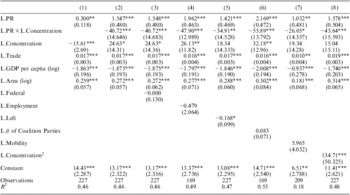
Table 1 reports the coefficient estimates for the ordinary least squares (OLS) regression of manufacturing subsidies on PR, Concentration, the key interaction term and the control variables. The coefficient estimates provide evidence that the geographic distribution of voters with a common narrow interest matters for accurately specifying the effects of electoral rules. Subsidies for the manufacturing sector constitute a larger share of government expenditure in plurality systems than in PR systems when manufacturing employment is geographically concentrated. However, when employment is diffuse, governments in PR systems assign relatively more of their budgets to subsidies than governments in plurality systems, holding all else equal.
Effect of PR on Subsidy Budget Shares

Note: Robust standard errors appear in parentheses. All models include year fixed effects. Year coefficients are not reported due to space constraints. ***p < 0.01, **p < 0.05, *p < 0.1.
The key interaction term, which equals the product of PR and Concentration, is included in Columns 2 through 8. Therefore, the estimated coefficient for PR in Columns 2 through 8 reports the marginal effect of PR for the unique case when Concentration equals 0.Footnote 74 When Concentration equals 0, the effect of proportional electoral rules on manufacturing subsidies is positive and statistically significant. In other words, governments elected via PR spend more of their budgets on subsidies than governments in plurality systems when the geographic diffusion of manufacturing employees is exactly proportional to total employment.
The marginal effect of PR is positive and significant whenever Concentration is less than 0.033. When Concentration is less than 0.033, as it is for 67 per cent of the sample, governments in proportional rule systems assign relatively more of their budgets to manufacturing sector subsidies than governments in plurality systems, holding all else equal. Arguably, this is because manufacturing subsidies provide greater electoral benefits to politicians in PR systems than politicians in plurality systems when voters employed in the sector are geographically diffuse. If the geographic diffusion of manufacturing employees is exactly proportional to total employment (i.e. Concentration equals 0), politicians cannot use manufacturing subsidies to target voters in select electoral districts. In proportional systems where voters’ geographic locations are unimportant for the electoral success of parties, this is not a problem. However, in plurality systems, elections are won district-by-district and, therefore, parties and politicians seek to target benefits to voters in geographically defined electoral districts.Footnote 75 Given this, subsidies are relatively less valuable to politicians competing for office in plurality systems when the beneficiaries of subsidies are geographically diffuse. Therefore, manufacturing subsidies account for a smaller share of government expenditure in plurality systems than in proportional systems when manufacturing employment is diffuse.
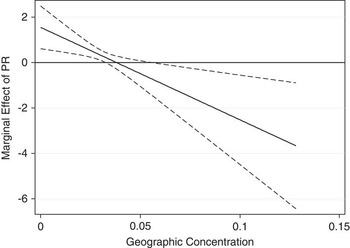
As expected, the positive marginal effect of PR on subsidies declines and eventually becomes negative as Concentration increases. The marginal effect of PR on subsidy budget shares is calculated across the observed range of Concentration using the relevant elements from Column 2 in Table 1.Footnote 76Figure 1 graphically reports these results. The solid line in Figure 1 represents the marginal effect of PR on subsidy budget shares and the broken lines represent the 95 per cent confidence intervals for two-tailed tests. Whenever both the upper and lower bounds of the confidence interval appear above (or below) the zero line, the marginal effect of PR is statistically significant at the 0.05 level.Footnote 77
Marginal effect of PR on subsidy budget shares

Subsidies constitute a larger share of government expenditures in plurality systems than in proportional systems when voters with an economic interest in subsidies are geographically concentrated. When Concentration is greater than 0.054, proportional electoral rules have a negative marginal effect on the share of government appropriations devoted to subsidies. The robust reductive effect of proportional electoral rules on subsidy spending shares holds for nearly 15 per cent of the sample. In other words, governments elected via plurality rules spend more of their budgets on manufacturing subsidies than governments elected via PR when manufacturing employment is highly concentrated geographically.
For approximately one-fifth of the sample, no statistically significant difference exists between PR systems and plurality systems. The marginal effect of proportional electoral rules is not statistically different from 0 when Concentration falls between 0.033 and 0.054. When manufacturing employment is neither concentrated nor diffuse, governments elected via different electoral systems allocate similar percentages of their budgets to manufacturing sector subsidies, all else equal. In other words, there are some conditions under which electoral rules do not matter for governments’ subsidy spending. Failing to account for the geographic distribution of voters who share a narrow interest may therefore lead to incomplete, and potentially inaccurate, conclusions about the effects of electoral rules on politicians’ responsiveness to narrow interests.
A few words about the control variables are in order. Countries more open to foreign trade spend relatively more on manufacturing subsidies, all else equal. This suggests that governments fund subsidies at least in part to shield domestic manufacturers from the effects of international trade. Typically, the assumption in much of the literature on globalization and spending is that governments respond to trade openness by increasing spending on social welfare programmes.Footnote 78 However, the results reported here suggest that governments use multiple fiscal policies to offset the costs of trade, including subsidies. Understanding when and under what circumstances governments choose a particular fiscal policy in response to globalization is an important question for future research.Footnote 79
Country size, measured by the natural log of a country's land area in square kilometres, is consistently positive and significant. Apparently, larger countries spend relatively more on subsidies for their manufacturing sectors as a share of total government expenditures (minus interest payments), all else equal.
GDP per capita has a negative effect on subsidies. A possible explanation is that richer voters have greater abilities to insure themselves against price volatility and income risk. Alternatively, lower-income voters may be less costly to attract with subsidies,Footnote 80 and consequently governments in countries with lower levels of GDP per capita spend more on subsidies.
Robustness Checks
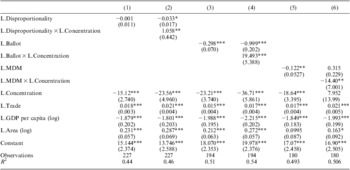
A number of sensitivity analyses evaluate the robustness of the current study's key findings.Footnote 81 First, several different measures of electoral institutions are used to test the robustness of the results to alternative specifications of countries’ institutions. Gallagher's disproportionality index is substituted for the dichotomous variable, PR. Results found using Gallagher's disproportionality index show that more proportional electoral systems favour geographically diffuse interests, while less proportional systems favour more concentrated interests. These results are reported in Table 2. Using the relevant elements of the variance–covariance matrix from Column 2 in Table 2, the marginal effect of Disproportionality is calculated across the entire range of Concentration. When Concentration is less than 0.009, the marginal effect of Disproportionality is negative and statistically significant.Footnote 82 An increase in the disproportionality of electoral outcomes decreases subsidy spending shares when manufacturing employment is geographically diffuse. As employment becomes more and more concentrated, the negative marginal effect of Disproportionality declines in magnitude and eventually becomes positive and statistically significant. When Concentration is greater than 0.055, an increase in the disproportionality of electoral outcomes increases subsidy spending shares. This is consistent with the finding that PR has a negative marginal effect on subsidy spending shares when manufacturing employment is geographically concentrated.
Effects of Alternative Measures of Electoral Rules on Subsidy Budget Shares

Notes: Robust standard errors appear in parentheses. All models include year fixed effects. Year coefficients are not reported due to space constraints. *** p < 0.01, ** p < 0.05, * p < 0.1.
Table 2 also reports the estimated coefficients on Ballot and Mean District Magnitude. The estimated coefficients on Ballot demonstrate that geographically concentrated sectors win more subsidies in candidate-centred systems than in party-centred systems. Geographically diffuse sectors win more subsidies in party-centred systems than in candidate-centred systems. Arguably, this is because politicians’ relevant constituencies tend not to be geographically defined in party-centred systems. In these systems, candidates maximize their chance of being in office by working to maximize the party's share of the national vote. In contrast, politicians’ best electoral strategy in candidate-centred systems is to appeal directly to the interests of their geographically defined constituents by, for example, providing subsidies to geographically concentrated industries.
The estimated coefficients on Mean District Magnitude show that governments elected from multi-member districts allocate less government money to subsidies than governments elected from single-member districts when manufacturing employment is geographically concentrated. More precisely, when Concentration is greater than 0.27, Mean District Magnitude has a negative and significant marginal effect on subsidy budget shares, all else equal. The magnitude of the reductive effect of Mean District Magnitude increases as Concentration increases.
In sum, different measures of electoral institutions report strikingly consistent results. Taken together, these results demonstrate that the geographic distribution of voters with an interest in subsidies is a necessary consideration needed to specify accurately the effects of electoral institutions on subsidy spending.
The OLS models estimated thus far do not account for the fact that the choice of electoral institutions is not likely to be random.Footnote 83 Although countries choose their own electoral systems, it seems improbable that the choice of electoral rules would be endogenous to manufacturing subsidies in the short to medium term. Similarly, it seems unlikely that electoral rules would be endogenous to changes in the geographic concentration of manufacturing employment in recent decades. In fact, no difference exists between the average levels of geographic concentration in PR systems and plurality systems.Footnote 84 The sample mean value of Concentration is equal to 0.035 in PR countries and 0.031 in plurality countries. The difference (−0.004) is not statistically significant, as demonstrated by a two-sample t-test with equal variances.
The fact that geographic concentration of manufacturing employment is no higher in plurality systems than in PR systems, on average, helps to minimize concerns about the potential endogeneity of electoral institutions. A two-stage least squares model is estimated to allay concerns about endogeneity. Following Persson and Tabellini, Evans and others, indicators of the historical periods during which the current electoral rules were adopted are used as instruments in the first stage of the model.Footnote 85 The distribution of current electoral rules varies with the age of the rules.Footnote 86 Experience of other democracies and prevalent political and judicial doctrines shift systematically over time and may explain why the distribution of current electoral rules varies with the age of the rules. To exploit this temporal pattern, three dummy variables are constructed that correspond to the periods 1921–50, 1951–80 and post-1981, which take a value of 1 if the current electoral rule originated in the respective period, and 0 otherwise.Footnote 87 Although countries’ electoral systems are associated with the year in which countries’ constitutions were adopted, the date at which a country adopts its constitution is unlikely to affect industrial policy or manufacturing subsidies directly.
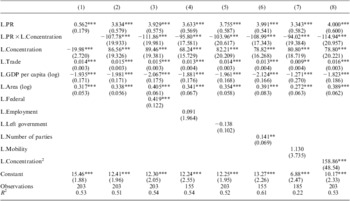
The results from the second stage of the 2SLS model are reported in Table 3. As before, the marginal effect of PR on subsidies is positive and statistically significant at low levels of geographic concentration. As Concentration increases, the positive marginal effect of PR declines and eventually becomes negative. At high levels of Concentration, the marginal effect of PR is negative, substantively large and statistically significant. In short, the key results are robust to an alternative model specification that relaxes the assumption that electoral systems are exogenous.Footnote 88
Second Stage Results from 2SLS Model of the Effect of PR on Subsidy Budget Shares

Notes: Robust standard errors appear in parentheses. All models include year fixed effects. Year coefficients are not reported due to space constraints. ***p < 0.01, ** p < 0.05, * p < 0.1.
Alternative explanations
Before concluding, it is worth considering possible alternative explanations for the reported results. Production factors employed in geographically concentrated sectors may be faced with higher adjustment costs than factors in geographically diffuse sectors. This raises the possibility that asset specificity rather than Concentration, per se, explains the reported results. To test for this possibility, a measure of labour mobility is introduced as a control variable. This measure estimates the adjustment costs facing workers in the manufacturing sector by calculating the rate of labour movement between industries in the sector.Footnote 89 The rate of movement varies according to the costs to workers of voluntarily entering and exiting different industries. Higher rates of movement indicate lower adjustment costs. Including Labour Mobility in the estimated model does not change the key results and suggests that geographic concentration is, in fact, a better explanatory source than adjustment costs.Footnote 90
Another plausible alternative explanation is the number of parties in government. The current study's argument maintains that electoral systems affect politicians’ incentives to cater to certain constituencies and that these incentives influence spending on subsidies. Alternatively, electoral systems may influence subsidy spending via the number of parties in government. Single-party governments are most common in plurality systems, while PR systems are more likely to foster multi-party governments. Bawn and Rosenbluth argued that multi-party governments will spend more than single-party governments because multi-party governments negotiate less efficient logrolls.Footnote 91 This raises the possibility that multi-party governments will spend more on subsidies than single-party governments. If this is the case, the reported results may not be the consequence of the suggested electoral dynamics but rather the accountability and bargaining dynamics induced by multi-party versus single-party governments.
To test for this possibility, the number of parties in government is introduced as an additional control variable. Including the number of parties in government as a control variable in the estimated model does not change the key results. The fact that the key results are robust, even with the inclusion of this variable, demonstrates that electoral systems affect spending on subsidies via their influence on politicians’ incentives to cater to certain interests rather than the composition of governments.
Conclusions and Implications
Rules governing democratic elections, particularly rules that specify how votes translate into legislative seats, influence politicians’ incentives to cater to the interests of a few citizens at the expense of many. However, the effects of electoral rules depend critically on the extent to which voters with narrow interests are geographically concentrated. Politicians competing in plurality systems privilege narrow interests when voters with a shared narrow interest are geographically concentrated. When voters with a common narrow interest are geographically diffuse, they have greater political influence in proportional systems than in plurality systems. This novel finding provides a potential solution to the on-going debate over which set of electoral rules leads politicians to be most acquiescent to narrow interests. Some argue that plurality electoral rules provide the greatest incentive for politicians to cater to the interests of a few; others argue that proportional electoral rules make politicians more responsive to narrow interests. This research suggests that both positions can be correct depending upon the geographic concentration of voters with a shared narrow interest. As such, this research provides an important bridge between prominent competing arguments and specifies the conditions under which one is more appropriate than the other.
The solution proposed in this article suggests that the on-going debate over the effects of electoral systems is mired by imprecision and restrictive assumptions. For example, virtually all previous studies have assumed that narrow interests are geographically concentrated. Yet, as this study shows, narrow interests can be more or less geographically concentrated. A manufacturing industry employing 2 per cent of the electorate is a ‘narrow’ interest in that it represents a small proportion of all voters. Voters that share this interest may be geographically concentrated in a single electoral district or dispersed throughout the country. Politicians in both PR and plurality systems have incentives to cater to this ‘narrow’ interest under certain conditions, as demonstrated by this study.
This perspective suggests the usefulness of re-casting the current debate over the expected effects of electoral rules, de-emphasizing discussions of ‘narrow’ interests, and emphasizing instead politicians’ relevant constituencies. As this research has shown, when competing in plurality systems, politicians’ relevant constituencies are geographically defined. In contrast, relevant constituencies tend not to be defined exclusively by geography in proportional systems. The idea of relevant constituencies has been previously articulated by Franzese.Footnote 92 This study provides a novel conceptualization of the idea and innovative empirical test that advances our understanding of the effects of electoral systems on politicians’ incentives and subsequent policy decisions.
This research has further important implications for understanding the role of geographic concentration in democratic politics. Although some scholars have previously suggested the importance of concentration in plurality systems, this research represents the first cross-national, quantitative test of the effects of geographic concentration among democratic countries with varying electoral systems. The results show that the conventional wisdom regarding the political importance of geographic concentration holds only in plurality systems. In proportional rule systems, geographic concentration is not an essential characteristic needed to win desired policy outcomes, such as subsidies. In fact, concentration may be something of a political liability in proportional rule systems.
Reasons exist to suggest caution when adopting the findings. First, the sample is relatively small. Future work must determine the generalizability, or perhaps, the limitation of these findings. Secondly, additional work is needed to understand the choice of electoral systems better and to know how such institutional decisions might be influenced by industrial policy or the geographic distribution of voters. Although important research remains to be done, the current study contributes significantly to understanding democratic representation and the conditions under which politicians are most prone to respond to the interests of a few rather than the good of many.