Based on the existing evidence, one would believe that there might be electoral consequences or benefits for legislators who deviate from the party line. On the one hand, voters dislike parties that appear divided (see, for example, Kam Reference Kam2009; Wolak Reference Wolak2017), and they might therefore punish legislators who cause such divisions. On the other hand, they like independent-minded legislators (see, for example, Crisp et al. Reference Crisp2013; Méndez-Lago and Martínez Reference Méndez-Lago and Martínez2002) and might reward those who dissent instead.
This article tests this common belief with data from the UK, where party discipline has been weakening for the last fifty or so years. Once considered the archetype of party government, recent decades have seen Members of Parliament (MPs) rebel more often, in greater numbers, and with greater effect (Cowley Reference Cowley2002; Cowley Reference Cowley2005; Cowley Reference Cowley, Anthony and Mike2015; Cowley and Norton Reference Cowley and Norton1999; Cowley and Stuart Reference Cowley and Stuart2014; Norton Reference Norton1975; Norton Reference Norton1980). This has included high-profile rebellions on matters of high politics, such as the Iraq war or Britain's membership of the European Union. In line with most findings elsewhere, research finds that British voters prefer MPs who deviate from the party line in this way (Campbell et al. Reference Campbell2019; Johnson and Rosenblatt Reference Johnson and Rosenblatt2007; Wagner, Vivyan and Glinitzer Reference Wagner, Vivyan and Glinitzer2020).
Yet, this work mostly draws on surveys or experiments – and we need to know whether these have external validity. Voters may appear to prefer independent-minded MPs, but this is of less significance if it does not manifest itself in electoral behaviour.
Expecting to detect electoral correlates for the way MPs voted on individual issues is to set an exceptionally high bar. It requires voters to have a stance on an issue and to know their MPs' voting on that issue, and for the two to then be so in conflict or agreement that this one issue changes the way they will vote at the next election. It is therefore perhaps not surprising that attempts to discover such effects find relatively little. Hanretty, Mellon and English (Reference Hanretty, Mellon and English2021) found only extremely limited effects even when examining the way voters reacted to MPs' voting over Brexit, which is about as good a test case as it is possible to imagine (and, moreover, they found that MPs appeared to know they were largely immune from any electoral sanction for their voting). Vivyan and Wagner (Reference Vivyan and Wagner2012) detected only marginal effects when it came to voting over Iraq. Earlier research found only small electoral correlates on a number of high-profile social issues (Pattie, Fieldhouse and Johnston Reference Pattie, Fieldhouse and Johnston1994).
More plausibly, though, voters might acquire a vaguer sense of whether an MP is independent minded or not. This would not require knowledge of specifics about the way an MP has voted, but rather to have picked up on the extent to which they were in lockstep with their party. This still requires some knowledge of an MP's behaviour and for it then to be enough to influence the voter at the ballot box – but the bar here is lower. An MP's voting record would not be the only thing driving this effect, as there are other ways an MP can demonstrate their independence (Campbell et al. Reference Campbell2019), but we might expect their voting record, broadly conceived, to at least constitute a part of how they are perceived by their voters. We know that British voters appear to value independence because they see it as a valence issue, rather than being concerned about the details of the votes themselves (Campbell et al. Reference Campbell2019). There is also evidence that rebels may have a higher profile in their constituencies as a result of their behaviour (Kam Reference Kam2009).
Data and Design
We look for the electoral effects of legislator dissent in the House of Commons on the general elections in the UK, from where much of the existing evidence originates in the first place. Indeed, ‘nearly all studies [on this topic] are conducted in single-member district systems, such as the United States and United Kingdom, which are generally considered most-likely settings for observing such effects’ (Bøggild and Pedersen Reference Bøggild and Pedersen2020, 1). If we find – as we do – that dissent does not affect electoral outcomes in the UK, this poses a significant challenge to such claims.
Our study draws on two datasets. First, we have generated an MP-level panel dataset that covers the period between 1997 and 2019, bringing together observations from: (1) MPs' legislative votes during six parliamentary terms; and (2) their vote share in the elections that follow these terms. Second, we have complemented this with panel survey data on (3) their constituents' electoral behaviour, which limits the beginning of the period to 2010 for the voter-level analysis. All data come from publicly available sources.Footnote 1
We focus on two outcome variables, measuring the support for incumbents at the level of MPs and voters: Vote Share is the proportion of valid votes cast for incumbents; and Vote Choice is whether (1) or not (0) individual constituents vote for incumbents. Our independent variable of interest measures how often an MP, m, votes against the majority of members of their party, p, in a parliamentary term, t:
 $$Dissent_{mpt} = \displaystyle{{{\rm \# } \, {\rm votes}\;{\rm cast}\;{\rm against}\;{\rm the}\;{\rm majority}\;{\rm of}\;{\rm party}\;{\rm member}{\rm s}_{mpt}} \over {{\rm \# } \, {\rm votes}\;{\rm held}\;{\rm in}\;{\rm a}\;{\rm parliamentary}\;{\rm ter}{\rm m}_t}}$$
By definition, this design excludes three groups of MPs from the analysis: (1) those who do not run for re-election; (2) those who do not vote (that is, speakers, deputy speakers and absentee MPs from Northern Ireland); and (3) who do not belong to a party (that is, independent MPs). To increase the comparability of our observations, we also exclude MPs whose party affiliation and/or constituency change from one election to the next. All exclusions are specific to a parliamentary term or terms that MPs meet one or more of these criteria.Footnote 2
Most existing studies of backbench dissent in the UK exclude what are called ‘free votes’, that is, those occasions where the party managers (the whips) did not issue instructions to their MPs. This happens on some social issues, various procedural votes and when a party is trying to avoid high-profile splits on other matters. The data utilized here are more inclusive, taking in all votes in the Commons in the periods analysed, both free and whipped.Footnote 3 We think it must be moot whether too many members of the public closely follow the intricacies of party management. While it may matter internally – the whips will look more askance at an MP deviating from the party on a whipped vote – we suspect the public will not pick up on such distinctions. This method also gives us a fuller data source, covering all parties in Parliament for the period examined, whereas published data on dissent (more narrowly conceived) are only available for the government. However, for the record, the two sources of data match closely anyway.Footnote 4
Simple comparisons of electoral outcomes for those who dissent more or less from their party line are likely to be misleading. There might be systematic differences between these two groups of MPs that might affect both legislative dissent and electoral outcomes. For example, senior legislators are more likely to dissent from their party line (Slapin et al. Reference Slapin2018) and they have an increased incumbency advantage in elections (Butler Reference Butler2009). While we can measure and control for seniority, doing so for all potential factors is not credible.
One way to address such concerns is to use linear fixed-effects regressions – limiting the analysis to within-MP and, for individual-level analysis, within-voter comparisons over time. This forms the basis of our identification strategy.Footnote 5
Results
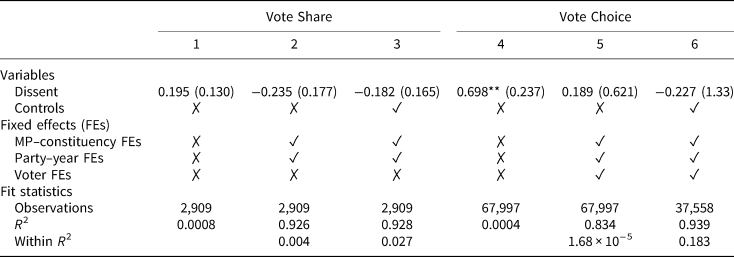
Table 1 presents the main regression models: three for MP-level Vote Share and three for individual-level Vote Choice. In the baseline models without fixed effects (Models 1 and 4), we estimate the results using the pooled data – pooling all observations across time, constituencies, MPs and voters. With this naive approach, we find that the coefficients for Dissent are positive, and in the case of Vote Choice, the effect is relatively large and statistically significant.
Effect of dissent on vote share and vote choice

Notes: Standard errors are clustered at the level of MPs. Controls refer to three variables in Vote Share models (Attendance, Majority and Office) and additionally four variables in Vote Choice models (Political Knowledge, Media Consumption, Left–Right Position and Party ID). See the Online Appendix for the complete results (see Table A2) and for further details on the underlying data and variables. *p < 0.05; **p < 0.01; ***p < 0.001.
However, when we limit the analysis to within MPs and within voters, the results change, which indicates that there might be selection bias in our initial estimates. We use fixed effects for the MP–constituency and party–election pairs for Vote Share. In estimating the effect of legislator dissent on Vote Choice, we also include fixed effects for individual voters. Finally, we cluster the standard errors at the level of MPs in all models.
In the models with fixed effects, we find that the coefficients for Dissent are statistically insignificant. These results suggest that, on average, MPs are neither rewarded nor punished electorally following a parliamentary term in which they dissent more from their party line. At the aggregate level, we find no change in vote share as a result of dissent, nor at the individual level do we find constituents becoming more or less likely to vote for them. This does not change with the inclusion of time-variant control variables: Attendance, Majority and Office in Model 3, and, additionally, Political Knowledge, Media Consumption, Left–Right Position and Party ID in Model 6. We describe these variables in the Online Appendix.
Multiverse Analysis
In this section, we report evidence from a multiverse analysis to show that the null results are not sensitive to the coding of the independent variable (Steegen et al. Reference Steegen2016) and/or to the combination of the control variables (Young and Holsteen Reference Young and Holsteen2017). First, we systematically recode Dissent by excluding divisions based on (1) parliamentary- and (2) party-level attendance, and (3) party-level shares of rebellious MPs. Low attendance might indicate low salience or three-way splits (see Footnote 4), while high rebellion might indicate free votes or make individual rebels less noticeable by voters. In one iteration of this process, for example, we disregard rebellion if it occurred in a division where (1) less than 30 per cent of all MPs or (2) 20 per cent of MPs in their own party voted, or (3) more than 10 per cent of MPs in their own party rebelled as well. With ten different percentage thresholds for each of these three variables, we therefore recode Dissent (103) one thousand times to systematically address such concerns.
Then, based on each of these thousand recodings, we re-estimate the fixed-effects models across all (23 + 27 = 136) combinations of possible control variables. Unlike in Table 1, where we report models either with all or without any controls, this process allows us to observe results in between these two extremes. In total, we therefore estimate 136,000 regression models.
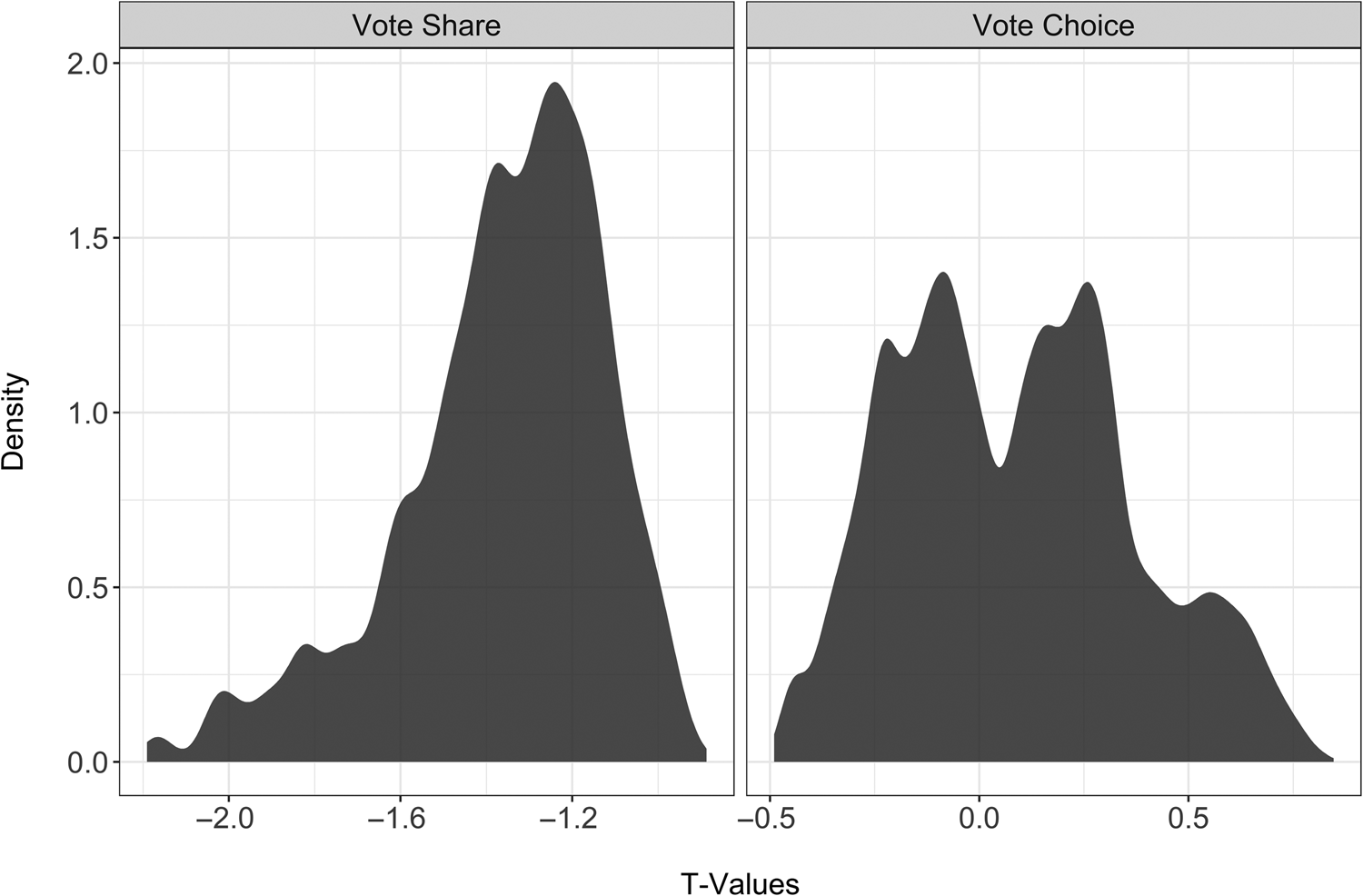
Figure 1 plots the t-values associated with the coefficient estimates for Dissent. It shows that the results presented in Table 1 are robust as the t-values are small, and they indicate statistical significance (that is, greater than 1.96 in magnitude) in just 0.17 per cent of the regression models. We consider these false positives, especially because they occur when our underlying data on divisions is reduced to, on average, 10.99 per cent of the sample (s.d. = 1.74; median = 11.78; min = 5.36; max = 11.94). Besides, after estimating this many regression models, we would expect up to 5 per cent false positives.
Distribution of t-values from a multiverse analysis.

Conditional Effects
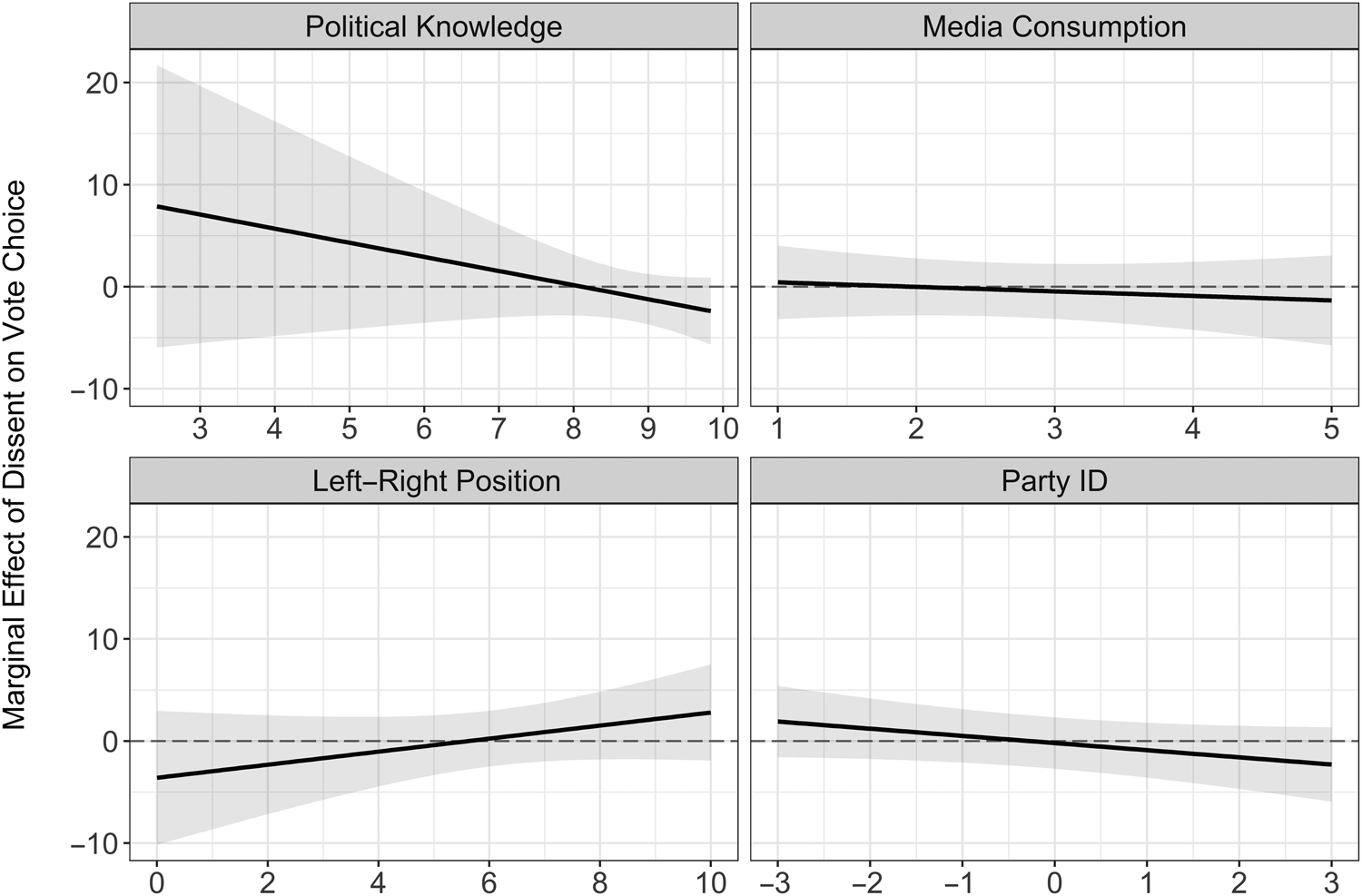
In this section, we report conditional effects to show that the null results hold across different levels of voter characteristics that could potentially moderate the effect of legislator dissent. How voters react to dissent could depend, for example, on their party identity (Kam Reference Kam2009) or ideological positions (Besch and López-Ortega Reference Besch and López-Ortega2021). We therefore re-estimate Model 6 in Table 1, by adding interaction terms between Dissent and four variables: Political Knowledge, Media Consumption, Left–Right Position and Party ID. We provide these models in Table A3.
Figure 2 plots the relevant estimates with 95 per cent confidence intervals. Most of these estimates are small and the confidence intervals include zero. For example, as we move from voters on the left to those on the right along the ideological spectrum, the best estimate for the effect of Dissent turns from negative to positive, but none of these estimates are statistically significant. In other words, the results remain null under these potentially moderating conditions.
Marginal effect of Dissent on Vote Choice, conditional on various voter characteristics.

Conclusion
Our results therefore do not support the expectation that legislator dissent might have effects on electoral outcomes. We found results that are most compatible with the null hypothesis, that is, that legislator dissent is neither rewarded nor punished in elections. In addition to the analysis reported earlier, we conducted nine further robustness tests, which are detailed in the Online Appendix. Each increased our confidence in these null results.
We did not, of course, ever expect to find especially large electoral effects. Britain remains a party-based democracy. For all that rebellious behaviour has been increasing at Westminster, it remains limited: most votes in the House of Commons still see complete cohesion; most rebellions are small; even the most rebellious MPs vote with their party most of the time; and the government almost always still wins. Most voters will live their lives blissfully unaware of the way their MPs behave and will continue to vote according to national or party factors.Footnote 6 The personal vote of an MP has been growing, but it remains relatively small. The 2019 British Election Study found just one in ten voters saying that they voted for the local candidate rather than national factors. Smith (Reference Smith2013) estimated the personal vote at 1–2 percentage points for Labour and Conservative MPs, if larger for Liberal Democrats, and an MP's voting pattern will only ever constitute a portion of their personal vote, with the rest accounted for by broader constituency service (Cain, Ferejohn and Fiorina Reference Cain, Ferejohn and Fiorina2013).
However, our findings are both statistically and substantively insignificant. Based on the models with control variables, a one within-unit standard deviation increase in Dissent leads to a −0.12 [−0.35 to 0.1] percentage-point decrease in incumbents' vote share and a −0.0016 [−0.02 to 0.02] percentage-point increase in the probability that constituents vote for their incumbent MP. Even at the ends of the 95 per cent confidence intervals in the square brackets, these are negligible effects in UK elections. Of all observations of electoral margins in our analysis, only 1.09 per cent of constituency races were decided by less than 0.35 per cent of the votes.
In sum, we have looked at the most likely case, we have examined both aggregate and individual-level outcomes, we have provided a range of further tests (covering multiverse analysis, conditional effects and a raft of robustness checks), and we have found results that are substantively negligible, in addition to being statistically insignificant. We are therefore left with a puzzle. There is plenty of evidence that MPs are increasingly willing to break ranks and defy their party managers. British voters say they prefer MPs who demonstrate independence and who are willing to deviate from the party line. At the same time, they dislike parties that appear divided. Yet, there is little or no evidence that voters then reward or punish MPs accordingly.
Supplementary Material
Online appendices are available at: https://doi.org/10.1017/S0007123422000618
Data Availability Statement
The replication package for this article is available at the BJPolS Dataverse at: https://doi.org/10.7910/DVN/XI3ACQ
Acknowledgements
The authors would like to thank Mathias Poertner, Jens Wäckerle, David M. Willumsen and the audiences at the 2021 American Political Science Association Annual Meeting, 2021 European Political Science Association Annual Conference and the 6th Conference of the Standing Group on Parliaments for their comments on earlier versions of this article.
Financial Support
None.
Competing Interests
None.