Implications
Social learning that occurs during early-life as a consequence of mother–infant interactions has a long-lasting influence on an individual’s behavioral patterns. However, we do not know whether sex-specific early life learning patterns exist. If such patterns were present, then well-known sex-related differences in spatial behaviors of grazing adult sheep could be explained by early life social learning and would underscore the importance of infant social conditioning in livestock. We found no evidence of sex-biased social-learning of location avoidance behaviors in lambs but documented the apparent influence of a lamb’s sex on its mother’s activity patterns.
Introduction
Early-life mother–infant interactions in sheep affect a lamb’s welfare (Napolitano et al., Reference Napolitano, De Rosa and Sevi2008) and survival (Dwyer, Reference Dwyer2008; May et al., Reference May, Andersen, Landa, van Dijk and JÄrM2008) and can shape its lifetime patterns of habitat (Hinch et al., Reference Hinch, Lynch, Elwin and Green1990) and diet preference (Mirza and Provenza, Reference Mirza and Provenza1990). Maternal influence begins during gestation (Simitzis et al., Reference Simitzis, Deligeorgis, Bizelis and Fegeros2008; Coulon et al., Reference Coulon, Hild, Schroeer, Janczak and Zanella2011) and lactation (Nolte and Provenza, Reference Nolte and Provenza1992) but is strongest throughout the 1st weeks of life. During this period, ewe–lamb pairs exhibit tight behavioral synchrony (sensu Coussi-Korbel and Fragaszy, Reference Coussi-Korbel and Fragaszy1995) which is possibly responsible for social learning of food and feeding site preferences in lambs (Black-Rubio et al., Reference Black-Rubio, Cibils and Gould2007).
Ewe–lamb behavioral synchrony occurs due to the tendency of new-born lambs to closely follow their dams (Lent, Reference Lent1974) and to remain in their proximity during the 1st weeks of life (Hinch et al., Reference Hinch, Elwin, Lynch and Lecrivain1987). However, compared with females male lambs can travel farther from their mother (Guilhem et al., Reference Guilhem, Bideau, Gerard, Maublanc and Pépin2006) or exhibit a lower degree of behavioral synchrony with their dam which can result in higher predation losses of male v. female lambs (May et al., Reference May, Andersen, Landa, van Dijk and JÄrM2008). Sex-specific differences in mother–infant interactions could conceivably give way to early life sex-specific social learning patterns of habitat preference. Such differences could be the underlying mechanism responsible for sexual segregation of habitat selection, a widespread phenomenon which occurs in mouflon (Guilhem et al., Reference Guilhem, Bideau, Gerard, Maublanc and Pépin2006) and bighorn sheep (Geist and Petocz, Reference Geist and Petocz1977) as well as ibex (Villaret and Bon, Reference Villaret and Bon1995), and other mammals (Main et al., Reference Main, Weckerly and Vernon1996).
We conducted an experiment to determine whether the strength and persistence of maternally induced feeding site avoidance behaviors of male and female lambs differed. We hypothesized that maternal influence would be stronger on female v. male lambs due to the fact that females usually exhibit higher mother–infant behavioral synchrony compared with their male counterparts (Guilhem et al., Reference Guilhem, Bideau, Gerard, Maublanc and Pépin2006; May et al., Reference May, Andersen, Landa, van Dijk and JÄrM2008).
Material and methods
Animals, treatments and routine feeding procedures
This experiment was conducted at the Corona Range and Livestock Research Centre (Lat 34° 15′ 36″ N, Long 105° 24′ 36″ W), located 22 km east of Corona, NM, USA, between June and August 2006. The New Mexico State University Institutional Animal Care and Use Committee approved all animal handling, housing and treatment protocols. Sixteen, 3-year-old rangeland-raised Western White Face ewe–lamb pairs were selected shortly after lambing. Eight pairs included a male lamb and the remaining eight a female lamb. Ewe lambs were (mean±s.e.m.) 19±2 days old, and ram lambs were 16±2 days old at the beginning of the experiment.
Ewe–lamb pairs were randomly allotted to four treatments: (1) shock aversion training applied to mothers of male lambs (MS); (2) shock aversion training applied to mothers of female lambs (FS); (3) no aversion training (control) to mothers of male lambs (MC); and (4) no aversion training (control) to mothers of female lambs (FC). Controlled shock was used to modify the location preference of ewes (Black-Rubio et al., Reference Black-Rubio, Cibils and Gould2007). Painful stimuli inflicted on the skin of prey animals (including livestock) elicit a number of defensive behaviors (flight, freezing, analgesia) that are analogous to those elicited by predators (Blanchard and Blanchard, Reference Blanchard and Blanchard1987).
Initial weights were recorded for each ewe and lamb before treatment allocation (8 June) and again at weaning (1 August) and final lamb weights were also recorded when the experiment concluded (17 August). Ewes weighed 59.0±1.21 kg. Initial weight of female and male lambs was 9.0 and 8.3±0.60 kg, respectively. Final weights for female and male lambs were 22.1±1.52 and 25.7±1.20 kg, respectively. Study animals were housed together in a large pen (30×10 m) adjacent, but not in view of the experimental arena (Supplementary Figure S1). Free access to shade and drinking water was provided in the housing pen. Immediately after daily trials (∼1200 h), 2 kg/head per day of long stem Bermuda grass hay (Cynodon spp.;12%CP, 63%NDF; as fed) was offered in the housing pen. Feed refusals were collected at 2100 h to insure ewes had sufficient appetite during trials the following morning. Lambs were offered free access to a pelleted creep ration (12.5% CP, monensin 20 g/ton) the entire time that they were held in confinement. Immediately before daily trials (0700 h) pairs were moved out of the housing pen and sorted, by pair, into individual holding pens (2 ×3 m) where they remained for the duration of the daily trials (∼5 h during mornings). Holding pens were adjacent but not in view of the experiment arena (Supplementary Figure S1).
Adaptation to experimental foods and preference tests
Before the experiment, pairs were adapted to the experimental food and containers (20 cm diameter, 8 cm deep rubber bowls) that were used throughout the study. Experimental foods were ground alfalfa hay (Medicago sativa; 17%CP, 40%NDF as fed), and ground Bermuda grass hay (same as basal diet) hereafter referred to as high and moderate quality feed, respectively. Animals were offered 1200 g of both foods at separate times (morning v. afternoon) in 18 bowls for a half hour each, once per day, for 5 days in the holding pens. Refusals were weighed after each session. After the food adaptation period and before beginning the experiment, preference for each food type was measured by leading pairs into the arena individually in random order. Pairs had the choice to feed out of four bowls, two bowls contained 20 g of alfalfa each and the remaining two bowls contained 20 g of Bermuda grass each. A set of bowls (one of each food choice) were placed in opposite corners of the arena. After 5 min of exposure, pairs were removed, refusals of each food type were weighed to the nearest gram, and bowls were refilled. This trial also served to adapt ewes and lambs to the experimental arena.
Experimental arena and feeding sites
The experimental arena (Supplementary Figure S1) had an area of 324 m2 (18×18 m), was obstructed from view of housing and sorting pens, and cleared of all vegetation. Alphanumeric signs were mounted every 2 m along the perimeter to establish a grid system that allowed animal locations to be recorded. Nine bowls, each containing 40 g of alfalfa were placed in the center of the arena to establish a high-quality artificial feeding site. Bright orange traffic cones were placed around the high-quality feeding site no closer than 2.5 m from any bowl and served as visual cues. Ewes in the shock treatments were trained to avoid the unsafe high-quality feeding site surrounded by cones (UFS). A safe moderate quality artificial feeding site (SFS) consisting of nine bowls, each containing 40 g of Bermuda grass were arranged around the periphery of the arena surrounding UFS. There was no punishment associated with feeding in this area. All lambs remained naïve to shock for the duration of the experiment.
Experiment protocol
The experiment consisted of seven phases: (1) training SFS (TRS; ewes and lambs); (2) training UFS (TRU; ewes and lambs); (3) testing with ewes and lambs (TEST); (4) extinction with ewes and lambs (EXT); (5) retraining ewes and lambs (RTN); (6) extinction with lambs alone (LEXa); (7) extinction with lambs alone and no visual cues surrounding UFS (LEXb). Trials began at 0700 h and the entry order of pairs was randomized every morning. During the daily 10-min trials the locations and activity of the ewe and lamb (feeding, standing, moving, nursing or other) were recorded every 15 s. Activity categories were defined following Hurnik et al. (Reference Hurnik, Webster and Siegel1995) except for ‘feeding’ which we defined as the voluntary act of ingesting experiment foods offered in the arena. Activities classified as ‘other’ included lying and grooming. All activity classes were exclusive. Locations were used to determine proportion of time in each feeding site as well as the mean and maximum distance between ewes and lambs. After each trial, food refusals in both feeding sites were collected, pooled and weighed; the bowls were then replenished with their respective foods and placed back in their original locations (Supplementary Table S1).
During the training phases ewe–lamb pairs were subjected to the consequences of feeding in each habitat. During the TRS phase, individual pairs in each treatment group were exposed to SFS and allowed to consume the ground Bermuda grass hay with no consequence for 5 days (days 1 to 5). The safe feeding site was the only experimental feeding site in the arena during TRS. Next, during the TRU phase, individual pairs in each treatment group were exposed to UFS for 5 days (days 6 to 10). The unsafe feeding site was the only experimental feeding site in the arena during this phase. Ewes in the shock aversion treatments received a painful stimulus (shock) each time they attempted to enter the UFS, while ewes in the MC and FC treatment groups were allowed to enter UFS with impunity. Shock was administered using Tritronics Classic 70’s® (Tritronics Inc, Tuscon, AZ, USA) training collars fitted with extended contact points. Before trials, wool was removed from the underside of the neck to minimize difference in shock stimulation among animals. All animals, regardless of treatment, were fitted with collars before entering the arena. A 2 s momentary electrical stimulation was administered to ewes in the shock aversion groups whenever their head passed beyond the coned boundary of UFS. On the 1st day of TRU, trained ewes required on average 2.65 stimulation events (range: 2 to 5). Four ewes required a single additional stimulation event on either day 4 or 5 of TRU. Shock was administered remotely from the observer station using a handheld transmitter set to deliver a moderate level of stimulation (i.e. 3 on a scale from 1 to 6). Stimulation was increased on an individual basis if necessary (levels 3, 4 or 5). Voltage of shock collars ranges from 2.5 to 7.5 kV, which is somewhat milder than standard electric fences (5.0 to 10.0 kV).
Testing trials (days 11 to 15) offered all pairs the choice of the two discrete feeding sites. During TEST each pair was exposed to SFS and UFS simultaneously and ewes received the same treatments as they did during the training phases (i.e. ewes in shock aversion treatments received controlled electrical stimulation if they entered UFS). Immediately after testing, a 5-day extinction phase (days 16 to 20) involving ewes and lambs was conducted (EXT). During this phase all ewes were allowed to enter UFS with impunity; no shock reinforcement was administered although every ewe was fitted with a deactivated collar. All pairs were then turned out to pasture for 34 days (days 21 to 54, 27 June–2 August) before the initiation of the extinction trials with lambs alone.
Ewe–lamb pairs were brought back to the holding pen on 2 August, a day before RTN which consisted of retraining pairs for 3 days (days 55 to 57) using the same procedures as described for testing trials. Lambs were weaned immediately after the retraining period and were allowed 3 days to recover from weaning stress (days 58 to 60). Individual lambs were then exposed to the arena with both feeding sites without their mothers during 10-min trials for 5 days (days 61 to 65, LEXa). Locations and lamb activity were again recorded every 15 s to determine the willingness of lambs to explore UFS once maternal influences were removed. Feed refusals were again collected after each trial as in the testing phase. Finally, during the last phase of extinction (LEXb, days 66 to 70), lambs were exposed to the arena with both feeding sites but the visual cues (orange traffic cones) surrounding UFS were removed to determine the influence of distal cues on maternally induced feeding site avoidance behaviors.
Data analysis
Food preference during arena adaptation was analyzed with a paired t-test. All other statistical analyses were conducted using a mixed-model approach with PROC MIXED (SAS version 9.1, SAS Institute, Cary, NC, USA). Because no treatment contingencies were applied in TRS no analyses were conducted for this phase. All other phases of the experiment were analyzed separately. Data were analyzed as a repeated measures (day within phase repeated) having a 2×2 factorial arrangement with lamb sex and shock conditioning treatment as the factors. A mixed effects ANOVA model with animal nested within treatment (random effect) was used to analyze day, lamb sex, treatment and all interactions on response variables. The response variables measured were: (a) the number of 15 s intervals during which each ewe and lamb were observed in UFS and SFS; (b) activity (feeding, standing, moving or nursing) of ewes and lambs at 15 s intervals; (c) amount of food (grams) consumed in each feeding site; and (d) mean distance between ewes and lambs. Arcsine transformations were applied to all proportion data to address deviations from normality of residuals evidenced in QQ plots of ANOVA assumption diagnostic tests in SAS (SAS version 9.1, SAS Institute). The Kenward–Rogers technique was used in SAS to partition the degrees of freedom. The auto regressive (1) structure fit best and was used to model covariance in all tests using SAS. Means were compared using the least square mean separation technique in SAS. An alpha level of P⩽0.05 was used to declare detectable differences. F-tests with P⩽0.1 were interpreted as indicating a trend approaching statistical significance.
Behavioral synchrony between ewes and lambs was assessed by determining the linear correlation between the activity of a ewe and its lamb and location during each of the 10-min trials throughout the TRU, TEST, EXT and RTN phases of the experiment. Data from 72 trials for each treatment group, except for MC, were used in this analysis (18 trials days×4 ewe–lambs pairs). For the MC group, data from 56 tests were analyzed. Analyses were conducted using PROC CORR in SAS (SAS version 9.1, SAS Institute). The alpha level used to declare statistical significance was of P⩽0.05.
Results
Preference tests and food adaptation
On the 1st day of adaptation, ewes immediately explored food bowls once they were placed in the pen and consumed 72% of Bermuda grass offered in the half hour period. Intake of Bermuda grass increased each day with the largest proportion consumed on the last day (day 2=82%, day 3=85%, day 4=87% and day 5=91%). Ewes consumed alfalfa more readily; intake on day 1 was 92% of alfalfa offered in the half hour period, on day 2, 98% and on days 3, 4 and 5, 100% of the alfalfa was consumed. During the preference tests ewes consumed detectably more alfalfa (mean±s.e.m. 47.3 g±4.10) than Bermuda grass (11.6 g±2.56) (P<0.01). No lambs were observed feeding on experimental foods however they did explore the bowls throughout both periods.
Modification of ewe feeding behavior
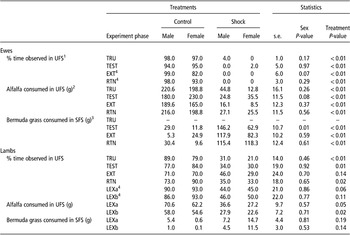
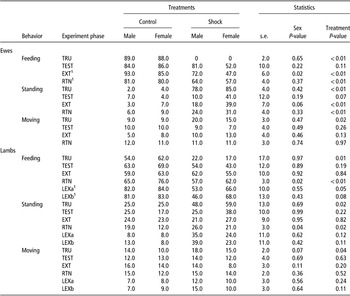
Ewes that received shock stimulation completely avoided UFS (proportion of time in SFS, the reciprocal of UFS use, is not reported) whereas their control counterparts were observed most often in this feeding site during TRU (P<0.01; Table 1). All ewes required multiple shock stimulations on the 1st day of TRU, and several required additional reinforcement on day 4. During TRU, more alfalfa was consumed by control ewe–lamb pairs (209.7±9.96 g) than shock-stimulated pairs that included ewes that had been trained to avoid UFS (28.8±9.96 g; P<0.01; Table 1). Predictably, control ewes were observed feeding more often (P<0.01) and standing (P<0.01) or moving (P=0.02) less often than shock-trained ewes (Table 2) during this phase.
Effect of shock aversion training (performed on ewes) and lamb sex on the percent time that ewes and lambs were observed in the unsafe feeding site (UFS) and the amount of alfalfa consumed in UFS and Bermuda grass consumed in the safe feeding site (SFS) by ewes and lambs during 10-min trials in the following experiment phases: unsafe feeding site training (TRU), testing (TEST), extinction (EXT), re-training (RTN) and 1st and 2nd extinction trials with lambs alone (LEXa and LEXb, respectively)

s.e.=standard error of least square means of four ewes or four lambs per treatment group.
1 Ewes in the shock aversion treatment were trained to avoid the UFS. Lambs did not receive shock aversion training (Supplementary Table S1).
2 UFS was surrounded by bright orange traffic cones and consisted of a group of nine bowls each containing 40 g of alfalfa hay (Supplementary Figure S1).
3 SFS consisted of nine bowls, each containing 40 g of Bermuda grass hay that were arranged around the periphery of the arena surrounding UFS (Supplementary Figure S1). No Bermuda grass hay was offered during TRU.
4 During EXT, RTN, LEXa and LEXb the number of animals in the MC treatment was reduced to n=2.
Effect of shock aversion training (performed on ewes) and lamb sex on the percent time that ewes and lambs were observed feeding, standing or moving during 10-min trials in the following experiment phases: unsafe feeding site training (TRU), testing (TEST), extinction (EXT), re-training (RTN) and 1st and 2nd extinction trials with lambs alone (LEXa and LEXb, respectively)

s.e.=standard error of least square means of four ewes or four lambs per treatment group.
1 During EXT, RTN, LEXa and LEXb the number of animals in the MC treatment was reduced to n=2.
When a choice of two distinct feeding sites was presented during TEST, control ewes again spent most of the 10-min trials in UFS while their trained counterparts completely avoided this feeding site (P<0.01; Table 1). No shock reinforcement was required during TEST. Control pairs again consumed more alfalfa than shock pairs (209.3 and 25.8±11.33 g, respectively; P<0.01; Table 1). Unlike alfalfa, all pairs had equal opportunity to consume Bermuda grass but pairs in the shock treatment groups consumed more Bermuda grass (108.9±10.00 g) than controls (16.0±10.00 g) during TEST (P<0.01; Table 1). Compared with shock-trained ewes, control counterparts tended to be observed feeding more often and standing less often but were observed moving a similar number of times (feeding: P=0.11; standing P=0.07; moving: P=0.26; Table 2).
A ewe in the MC group died and a 2nd ewe in this treatment was removed after becoming sick during EXT. Data from these pairs were removed from the entire EXT phase, and no subsequent data was collected on the orphaned lamb. Although shock was not administered during EXT trials, ewes in the shock aversion groups continued to avoid UFS while control ewes continued to consistently select UFS (P<0.01; Table 1). Alfalfa intake was greater for control pairs (177.3±9.11 g) than shock pairs (12.3±9.11 g) during EXT despite the fact that contingencies were not administered (P<0.01; Table 1). Shock pairs continued to consume more (100.1±10.27 g) Bermuda grass than control pairs (15.1±10.27 g; P<0.01; Table 1). Control ewes again were observed feeding more often (P<0.01), standing less often (P<0.01) but were observed moving a similar number of times (P=0.13) than shock-trained ewes (Table 2). Mothers of ram lambs were observed feeding more often (82.3±4.55%) and tended to spend a lower proportion of time standing (10.3±5.12%) than ewe lamb mothers (feeding: 66.2±4.55%; P=0.02; standing: 23.3±5.12%; P=0.06) (Table 2).
The sick pair in the MC treatment group that was removed during EXT rejoined the experiment in RTN. During this phase ewes in the shock group once again completely avoided UFS while control ewes remained in the area for most of the daily 10-min trials (P<0.01; Table 1). A single ewe on day 2 and another on day 3 required shock reinforcement. Control pairs again consumed more alfalfa (207.4±11.49 g) than shock pairs during RTN (26.3±10.64 g; P<0.01; Table 1). The opposite was true of Bermuda grass intake; shock pairs consumed more (116.9±11.98 g) than control pairs (20.0±12.94 g; P<0.0l; Table 1) during this phase. Shock-trained ewes again were observed feeding less often (P<0.01), standing more often (P=0.02), and moving as often as their control counterparts during RTN (Table 2).
Lamb feeding behavior
Female and male lambs in the shock groups entered UFS less frequently than lambs in the control groups during TRU (P<0.01; Table 1), but no detectable differences between male and female lambs were observed. Control lambs were observed feeding more often than lambs of shock-trained ewes even though the latter were not restricted from feeding in UFS (P=0.01; Table 2). Control lambs were observed standing (P=0.02) and moving (P=0.04) less often than lambs of shock-trained ewes (Table 2). Overall, there was a tendency for ram lambs to be observed moving more often (6.3±0.51%) than ewe lambs (5.1±0.51%; P=0.07).
During TEST, lambs in the control group were observed in UFS more often than lambs of shock-trained mothers (P=0.01; Table 1) but again, no differences between male and female lambs were detected. Contrasting with activity patterns of ewes (see above), lambs in all treatment groups were observed (P>0.10) feeding, standing and moving a similar proportion of times for the entire TEST phase. Feeding site use by lambs was not as clear as that of ewes during EXT. Although female and male lambs in the control groups were observed more often in UFS than their shock treatment counterparts (control: 70.7±15.98%, shock: 37.2±15.98%; P=0.14; Table 1), these differences were not statistically detectable. No detectable differences in feeding site use of female v. male lambs in shock treatment were observed either. Lambs in all groups were observed feeding, standing and moving a similar number of times during EXT (Table 2).
During RTN, female and male lambs whose mothers had been trained with shock were again observed less frequently in UFS than their control counterparts (P=0.02; Table 1). Lambs of shock-trained mothers were observed feeding less often (P<0.01), standing more often (P=0.02) and moving as often as their control counterparts during RTN (Table 2). Ewe lambs were observed feeding more often (69.2±2.09%) than ram lambs (60.7±2.09%; P=0.02) that were observed standing more often (22.5±2.29%) than their ewe counterparts (16.0±2.12%; P=0.04). A lamb in MC died shortly after weaning thus reducing the number of individuals in this treatment group (n=2).
Three days after weaning, lambs of shock-trained mothers tended to avoid UFS more than control lambs regardless of whether visual cues surrounding UFS were present (LEXa: P=0.06) or not (LEXb: P=0.10, Table 1). No detectable differences were observed between male and female lambs of shock-trained mothers. Control lambs consumed detectably more alfalfa in both extinction phases than lambs of shock-trained ewes (LEXa: P=0.03, LEXb: P=0.03; Table 1). Lambs in both treatment groups consumed similar amounts of Bermuda grass during LEXa (P=0.18; Table 1); however, lambs of shock-trained mothers tended to consume more Bermuda grass than control lambs during LEXb (P=0.06; Table 1). Control lambs tended to feed more often (LEXa: P=0.05; LEXb P=0.08), and to move, or remain standing as often as lambs of shock-trained mothers (Table 2). No clear sex-related differences were observed in either period (Table 2).
Ewe–lamb interactions
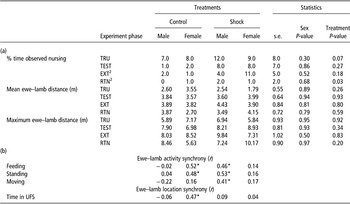
Lambs whose mothers were trained with shock to avoid UFS during TRU and RTN tended to nurse more frequently than control lambs (Table 3), although no sex-specific differences were observed. Mean and maximum distance between ewes and lambs apparently increased as the experiment progressed (this was not tested) but no treatment or sex-related differences were observed (Table 3). Ewe lambs in the control treatment showed highest location synchrony with their mothers (Table 3). Conversely, no location synchrony between control ram lambs and their mothers was observed (Table 3). Ewe lambs in both treatment groups and ram lambs of shock-trained mothers showed feeding synchrony with their dams (Table 3). Ewe lambs in both treatment groups also showed higher standing behavior synchrony with their dams (Table 3). Either negative or no correlation between shock-trained mothers and ram lambs was observed for all other behaviors (Table 3).
Effect of shock aversion training (performed on ewes) and lamb sex on the percent time that lambs were observed nursing and on the mean and maximum ewe–lamb distance during 10-min trials in the following experiment phases: unsafe feeding site training (TRU), testing (TEST), extinction (EXT), re-training (RTN) and 1st and 2nd extinction trials with lambs alone (LEXa and LEXb, respectively)

s.e.=standard error of least square means of four lambs per treatment group.
Pearson’s correlation coefficients describing the linear relationship between the frequencies with which ewes and lambs were observed feeding, standing, moving or in the unsafe feeding site (UFS) in each of 72 10-minute trial sessionsFootnote 1 . Coefficients followed by an asterisk indicate a statistically detectable correlation (P⩽0.05).
1 Data from TRU, TEST, EXT and RTN phases were used in this analysis (18 days×4 ewe–lamb pairs=72 tests per treatment group). For the MC group number of tests included was 56.
2 During EXT and RTN the number of animals in the MC treatment was reduced to n=2.
Discussion
Consistent with previous studies that used painful stimuli to elicit fear-based location avoidance behavior in sheep (Black-Rubio et al., Reference Black-Rubio, Cibils and Gould2007), cattle (Cibils et al., Reference Cibils, Howery and Ruyle2004) or deer (Gallagher and Prince, Reference Gallagher and Prince2003), shock-trained ewes in this study learned to avoid a preferred experimental feeding site (UFS) associated with the risk of pain. Their lambs also learned to avoid UFS and continued to do so after weaning despite not receiving direct painful stimuli themselves. Ewe–lamb pairs and weaned lambs on the shock-trained treatment avoided high-quality food offered in UFS even in the absence of shock reinforcement (ewes) or when trained ewes and visual cues were removed (lambs). Both shock trained ewes and their lambs tended to feed less often and remain standing more often than their control counterparts, an activity pattern that is consistent with previous studies (Vandenheede et al., Reference Vandenheede, Bouissou and Picard1998; Black-Rubio et al., Reference Black-Rubio, Cibils and Gould2007), which may have been the result of increased vigilance levels (Dwyer, Reference Dwyer2004) in both the shock-trained ewes and their lambs.
Contrary to our prediction however, maternally induced feeding site avoidance was not sex-specific. Both male and female lambs whose mothers had been trained to avoid UFS showed similar feeding site avoidance and foraging patterns. Fear conditioning in ewes appeared to eliminate sex-specific ewe–lamb behavioral synchrony patterns which were observed in the control treatment group (i.e. higher mother–infant synchrony in female v. male lambs, Table 3) and that have been reported in previous studies (Guilhem et al., Reference Guilhem, Bideau, Gerard, Maublanc and Pépin2006; May et al., Reference May, Andersen, Landa, van Dijk and JÄrM2008). Fear conditioning was associated with significant ewe–lamb feeding synchrony in both male and female lambs, consistent with a commonly observed fear response in ungulates thought to reduce offspring predation rates (Mathisen et al., Reference Mathisen, Landa, Andersen and Fox2003; May et al., Reference May, Andersen, Landa, van Dijk and JÄrM2008). This phenomenon may have been responsible for social learning of UFS avoidance and foraging activity patterns observed in male and female lambs in this study.
The lack of sex-bias in maternally induced feeding site avoidance in lambs may have been a result of low concentrations of sex hormones (such as testosterone) that can modulate an individual’s response to fear. Mature rams are much less fearful than ewes (Vandenheede and Bouissou, Reference Vandenheede and Bouissou1993a). Fear responses in ewes, on the other hand, are reduced when injected with testosterone before a fear-eliciting stimulus (Vandenheede and Bouissou, Reference Vandenheede and Bouissou1993b). Testosterone levels of mature rams are 20 to 100 times higher than those of ewes, and range from 2.0 ng/ml (non-breeding season, (Fallah-Rad, Reference Fallah-Rad1998) to >10 ng/ml (breeding season, (Field et al., Reference Field, Ho, Russell, Riley, Murdoch, Van Kirk, Ercanbrack and Williams1989). In contrast, mature ewes only exhibit concentrations of 0.1 ng/ml of this hormone (Parkinson et al., Reference Parkinson, Smith, Long, Douthwaite, Mann and Knight2001). Testosterone levels in pre-pubertal ewes and ram lambs, however, are more similar. Ram lambs exhibit concentrations of <0.1 ng/ml between birth and 8 weeks of age, 0.3 ng/ml between 8 and 20 weeks of age, and >2.0 ng/ml (peak concentration) during puberty at 28weeks (Schanbacher et al., Reference Schanbacher, Gomes and VanDemark1974). Data reporting testosterone levels in pre-pubertal ewe lambs could not be found; however levels would be expected to be equal or lower than those of non-cycling mature ewes (0.1 ng/ml; Hallford, D. personal communication). Thus, socially induced fear responses of young pre-pubertal lambs are probably less hormonally controlled than in mature individuals, a phenomenon which could account for the lack of sex differences observed in this study.
The offspring’s sex appeared to influence the behavior of ewes, particularly in the shock-aversion treatment group. Mothers of female lambs tended to feed less often and to remain standing more often than ewes that had mothered male lambs (Table 2). These results provide partial support for a hypothesis proposed by Ruckstuhl and Festa-Bianchet (Reference Ruckstuhl and Festa-Bianchet1998) who argued that because more energy is required to raise male v. female lambs (Jorgenson et al., Reference Jorgenson, Festa-Bianchet and Berube1996) mothers with sons should spend more time foraging than mothers with daughters. Male lambs in this study gained ~3.5 kg more than females during the study period and likely required higher levels of energy and nutrients than females, a trend which was evident in post-weaning alfalfa intake levels (Table 1) and which may have resulted in higher maternal investment into male v. female lambs during early weeks of lactation.
Alternatively, differences in ewe behavior associated with the sex of the offspring could have been caused by sex-specific infant motivation of maternal behaviors (Pryce, Reference Pryce1992). Such behaviors arise from complex neuro-endocrine mechanisms that interact with infant sensory stimuli (Levy and Keller, Reference Levy and Keller2008) such as facial expressions and tactile and auditory cues (Pryce, Reference Pryce1992). Although vocalizations (auditory stimuli) were not measured in this study, Hernandez et al. (Reference Hernandez, Bloomfield, Harding, Matthews and Oliver2009) reported that female lambs vocalized more during separation from their dam and were faster than males in returning to their mother (tactile stimuli) after separation. These sex-specific differences may be responsible for the life-long mother–daughter bonds that are established in sheep (Hinch et al., Reference Hinch, Lynch, Elwin and Green1990; Rowell, Reference Rowell1991). Although we did not find sex-related differences in nursing frequency or in the mean and maximum distance between lambs and their mothers, it is possible that differences in the frequency of auditory or other tactile stimuli may have motivated ewes with daughters to be more vigilant than ewes that were nursing male lambs.
Removal of visual cues (traffic cones) which surrounded UFS in the last phase of this study (LEXb) did not hasten the extinction of learned feeding site avoidance in male and female lambs of shock-trained ewes. Lambs appeared to have developed an aversion for the specific area (UFS) where their mothers were shocked and apparently did not associate the visual cues with this aversion. This avoidance pattern is consistent with results from a previous study with sheep (Black-Rubio et al., Reference Black-Rubio, Cibils and Gould2007) but contrasts with learned avoidance patterns observed in cattle by Cibils et al. (Reference Cibils, Howery and Ruyle2004). Smaller-bodied prey species such as sheep may have evolved fear responses to more general cues, or combinations of cues, as a more conservative means of coping with the risk of predation by multiple predator species (Sinclair et al., Reference Sinclair, Mduma and Brashares2003). Lighter (smaller-bodied) breeds of sheep, for example, react more negatively to a wider variety of stimuli (balls, stuffed predators and presence of dogs) than heavier breeds (Hansen et al., Reference Hansen, Christiansen, Hansen, Braastad and Bakken2001). Cattle on the other hand, suffer predation by fewer species of predators and thus may adopt less conservative risk coping strategies which allow them to be more specific in their recognition of risk-related cues (Cibils et al., Reference Cibils, Howery and Ruyle2004).
Conclusions
Fear conditioning in ewes elicited feeding site avoidance and changes in foraging patterns of both ewes and their naïve lambs, confirming the critical role of mothers in moulding behavioral patterns of their offspring. Early-life social learning of feeding site avoidance in lambs occurred regardless of sex and persisted after weaning. Fear conditioning in mothers appeared to alter sex-related differences in mother-infant behavioral synchrony by increasing and decreasing the synchrony of male and female lambs, respectively. The offspring’s sex, on the other hand, appeared to influence the activity patterns of ewes. Mothers of ram lambs were observed feeding more often and standing less often than ewes with daughters. More research into the mechanisms underlying this phenomenon is needed. Lambs appeared to rely more heavily on spatial memory than on visual cues to detect an experimental unsafe feeding site which may be a more conservative predator avoidance strategy. This study suggests that social conditioning at an early age could be a viable tool to induce learning of feeding site avoidance in female and male lambs alike.
Acknowledgements
This study was funded by the New Mexico Agricultural Experiment Station, the USDA-CSREES Rangeland Ecosystems Grant, and NMSU Corona Range and Livestock Research Centre. Tri-tronics provided shock collars and support through Hank Hartnek and Tim Duncan. The authors thank Dr Tim Ross, Shad Cox and Michael Rubio for providing logistical support. Drs Mark Petersen, Ed. Fredrickson, Tim Ross and Christopher Brown provided valuable comments and discussion on an earlier version of this manuscript.