The large national banks in New York were the dominant credit providers to the call loan market for much of the national banking era. The considerable size of the call loan market meant that the large New York City banks inevitably had a substantial proportion of their assets in call loans. Hence, the banks had a great incentive to maintain the market's liquidity and stability. But their influence began to wane in the 1890s as outside intermediaries increased their lending in the call loan market. By 1907 trust companies along with interior and foreign banks had become serious rivals to the New York banks on the call loan market.
While the influence of outside lenders was suspected by the New York bankers, there was no systematic evidence being collected on the volume of lending or the identity of the lenders on the call loan market. This article presents the only direct evidence on the size of the call loan market and the types of intermediaries making loans on call. It reveals that by 1907 the influence of outside lenders was large and probably comparable to that of the New York bankers and the Clearing House. Influence in the call loan market arose from a class of intermediaries providing a large enough share of credit that any substantial change in their behavior would noticeably change interest rates and the volume of credit. In other words, they were not price takers. Explicit coercion or regulatory power was not necessary for intermediaries to have influence.
When the New York Clearing House banks were the dominant providers of credit to the call loan market during the preceding national banking era (1863–1913) panics, in a crisis the Clearing House would issue clearing house loan certificates as a liquidity provision mechanism. The collateral for call loans was largely stock equity, and member banks offered the stock equity as collateral for the clearing house loan certificates. The additional liquidity would help maintain call market credit levels and facilitate the continued credit extension with temporary liquidity. The loss of dominance over the call loan market hindered liquidity provision because outside credit providers were not part of the clearing house system; the proportion of call loan volume arising from these sources was approaching 50 percent by 1907. In effect, the call loan market had become a much less closed system with the rise of the outsiders.
If large volumes of call loan liquidations started among the outside credit providers, the collateral value would not have been monitored by the Clearing House Committee. It could also not be offered as collateral for clearing house loan certificates because it was not held by member institutions. Liquidity provision through loan certificates would be delayed and its effective volume would be diminished. The decline in the influence of New York Clearing House banks in the call loan market is an important reason as to why the large New York national banks finally gave their support to the establishment of a central bank in the United States.
The New York Clearing House banks had the incentive to monitor the solvency and liquidity of its member banks to ensure that the liquidity of the call loan market was preserved. As intermediaries outside the Clearing House gained direct access to the call loan market, the ability of the New York Clearing House banks to monitor creditor solvency and credit provision to the call loan market began to break down. The trust companies and interior banks that issued loans on call appear to have been free riding on the insurance provided by the Clearing House member banks. These outside participants in the call loan market may have shared the same concern about the long-term viability of the market. However, the actions of the outside participants during crises were consistent with the tragedy of the commons; that is, the individual institutions behaved as if their actions individually were unimportant. This behavior arose from the lack of an organization for these institutions similar to the New York Clearing House, and it became a potential source of liquidity risk for the market. Had such an organization existed for the trusts, there would have been more stability in the call loan market. Clearing house loan certificates would have provided liquidity more broadly during a panic, as they would have been circulating in a more closed system that was much less subject to shocks to collateral from outside lenders.
We view the efforts of the New York City bankers to maintain liquidity provision to the call loan market as an example of an implicit insurance contract, a twofold contract between the stockbrokers and the bankers, as well as one between the individual bankers themselves. The insurance argument describes fairly well the interactions between the bankers during nineteenth-century panics through the New York Clearing House, combined with intentional lack of action – namely, forbearance on calling in loans – between bankers and brokers during panics. Outsiders were less likely to practice forbearance simply because they had no reliable means to coordinate it, unlike the Clearing House banks.
Before 1907, the New York Clearing House had been able to control panics. In 1873 reserve pooling and loan certificates were adequate to contain the panic in New York; the additional step of suspension of convertibility was unnecessary according to Wicker (Reference Wicker2000, p. 33). Prompt action by the Clearing House in 1884 and 1890 stopped these nascent panics short (Wicker Reference Wicker2000, p. 41). The Clearing House at first did not wish to intervene in the first stage of the Panic of 1893, as it was playing out in the interior and not threatening New York. The Clearing House finally issued loan certificates in July to aid the shipment of currency to interior correspondents. The threat in the Panic of 1907 from trust companies and panicked correspondent banks, who remembered the indifference of the New York banks in 1893, posed a new threat to the Clearing House membership. Unlike in earlier panics, the influence of the New York banks and Clearing House over the call loan market was clearly called into question and became apparent to the Clearing House banks for the first time.
The relatively greater exposure to the call market of the large New York banks made them the ‘monitors’ for systemic withdrawals from the call market. If interior banks liquidated their call loans to retrieve cash reserves to meet depositor withdrawals during a panic, the resulting contraction in call loan liquidity would either force New York banks to: (a) take over the loans, or (b) risk the possibility that the borrower would have to sell the collateral on the market during a panic to pay the loan. Rapid contractions of call loans during a panic could spur a ‘fire sale’ of the loan collateral, which was largely stock equity. Liquidating stock equity during a panic would threaten a downward spiral in stock prices, deepening the crisis. The extension of additional call loans during panics by the Clearing House banks was most likely motivated by their perceptions of market illiquidity and their full recognition of their extensive exposure to the call market. The withdrawal of funds from the call market by these other institutions is analogous to the movement of ‘hot money’ during the Asian Crisis in 1997. The portfolio managers shifted the placement of funds toward the areas of highest return rather than being concerned with the long-run viability of the Asian financial markets. Separately, the liquidation of assets in the Asian markets could also have been motivated by exogenous liquidity demands arising from outside the respective countries. The combination of these events put enormous pressure on the developing Asian financial markets. The same analysis applies to the failure of the overnight repurchase agreement market in 2007–8.
Brunnermeier (Reference Brunnermeier2009) and Brunnermeier and Pedersen (Reference Brunnermeier and Pedersen2009) present a useful theoretical framework for understanding the effects of liquidity drying up in the call loan market. A fire sale would result in a loss of market liquidity; that is, it became difficult to sell call loan collateral at a reasonable price. At the same time, funding liquidity would disappear as brokers found it increasingly difficult to borrow against collateral, at least at a reasonable call loan rate and haircut.
The costs of having lenders outside of the Clearing House participating in the call loan market are clear: the stability of the market was reduced. But there were benefits, nevertheless. Outsiders increased the volume of credit available to stock market participants, which would have contributed to financial innovation and more funding for new firms and industries. Equity markets were also more liquid because of trust company and outsider lending, at least during normal times. Relying only on Clearing House member banks to lend on call, while maintaining stability, would have drastically reduced the depth of trading in equities.
I
The call loan market was the key source of funds for margin borrowing on the New York stock market, and this kept stock market trading liquid under normal conditions. Call loans were potentially demandable or callable on notice within the day. They were typically not called after 12:15pm, but that was by custom rather than as a rule. The explicit term of the loan was overnight, but 95 percent of loans were renewed or rolled over. The call loan rate in New York City was a competitive market rate on new loans, and the renewal rate was the average of loan rates observed on that day. The borrower could sell the collateral and seek to substitute another stock for the liquidated collateral in order to maintain the loan. All such substitutions were subject to the approval of the lender, and all lending was to be transacted through a broker. Rehypothecation, or reuse of collateral, was a concern in 1907 (Myers Reference Myers1931, p. 281), as it was in the 2007–9 crisis. Such reuse greatly expanded the volume of financial assets at risk, well beyond the volume of subprime loans. The extent of such practices was not well understood in 1907, reflecting similar uncertainty today.
Call loans typically were made for 80 percent of the collateral presented, and the lender held the collateral, usually the stock certificates purchased with the loan, akin to the current method of purchasing stock on margin. Call loans in New York City also had particular legal covenants that essentially gave all power to the lender in the event the borrower breached any of the contract terms.Footnote 1 For example, the lender could, upon breach of contract, sell the collateral with the borrower still being liable for the remaining balance if the sale price was insufficient to cover the loan balance. Borrowers could default on a loan if the collateral value fell below 80 percent of the loan value, but they would then run the risk of being shut out of the call loan market in the future. Banks, however, were known to forebear on calling in loans whose collateral value was less than loan's value, particularly during a financial crisis. The hope was that the collateral value would return to normal after the crisis had past. Instances of formal litigation were uncommon, probably because of perceived litigation costs and the resulting payment delays.
Similar to the present-day margin lending, a transaction involving call loans could originate with money brokers (located anywhere in the country), banks, or on the New York Stock Exchange. Each alternative fund source would administer their loans differently. Some might call them in regularly, or others like the New York banks might just roll them over unless otherwise directed. Ultimately, the sources of call loan funds were banks and other intermediaries, and the money broker played the role of loan distributor for banks. In order to lend on the stock exchange, suppliers of funds had to lend through a broker who was a member of the exchange. Brokers could also lend their own funds on call. The brokerage houses are considered intermediaries. We have reliable data on New York City national bank loan activities in the call market, but we do not have such data for private banks or frequent data on state banks or trust companies. We rely on anecdotal evidence, Congressional reports, or special investigations to assess the participation level of these intermediaries.
In New York City, the national banks developed relationships with brokerage houses and other brokers, and they lent on call through these brokers on the exchange. Institutions that lent on the exchange were either New York City banks or trusts, or out-of-town institutions that lent funds through New York City correspondents. In this latter case, the New York City intermediaries (national or state banks, or trust companies) acted as agents in arranging call money loans for the out-of-town banks, and often the out-of-town banks were required to hold balances with their New York intermediary. The durability of the lender–broker relationship was important between the New York City intermediaries – either as agents for interior banks or as the fund providers – and the brokers that lent the call loans on the stock market.
A unique feature of the Panic of 1907 reveals the concern of the large banks for the call loan market: the increase in loans at New York national banks during the panic. Sprague (Reference Sprague1910, pp. 300–1) describes the volume of loans taken over by New York national banks to maintain liquidity in the money markets and the stock exchange:
We have already seen that call loans were particularly favored by both trust companies and the outside banks. Even in 1873 the clearing-house banks were able to reduce loans of that kind relatively little, and it might be naturally expected that still less contraction would have been feasible in 1907…
Among the many lessons which may be drawn from a study of the experiences of the national banks during crises, the entire absence of liquidness in call loans, so far as New York banks are concerned, is the most certain and by no means the least important. Out of a total loan increase of $63,000,000, call loans accounted for $54,000,000; and, furthermore, time loans with collateral security, which are largely of stock-exchange origin, account for another $4,000,000.
The New York banks took over call loans because, as Sprague (Reference Sprague1910, p. 302) notes, ‘Call loans … are local New York loans, and consequently the amount of them which must be made by New York banks increases when other lenders retire from the market.’
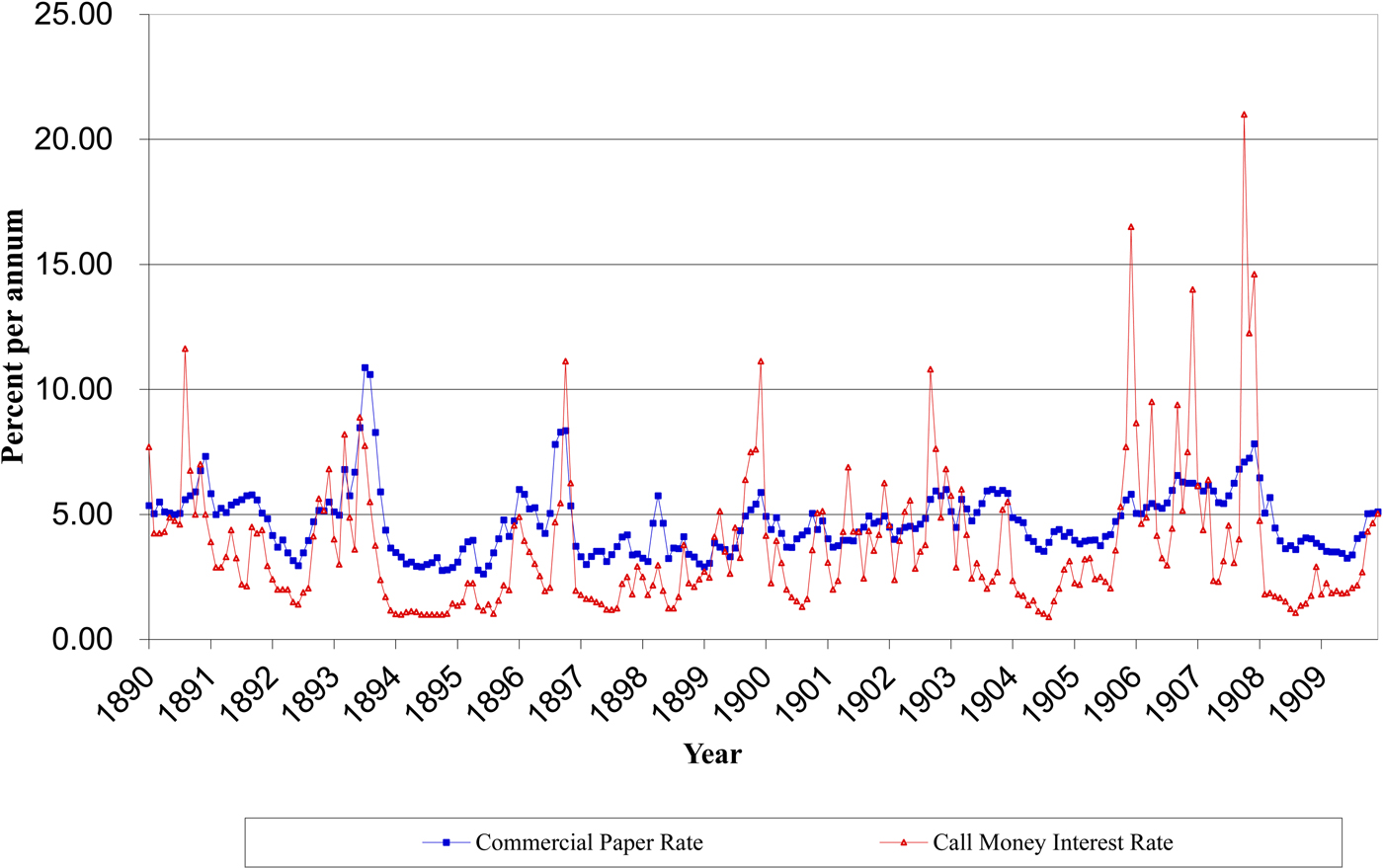
Financial stress arose during the panics of the national banking era in 1873, 1884, 1890, 1893, and most dramatically 1907. During those crises, when system-wide reserves were tight, the New York stock market faced a lack of credit for call market loans, and the call money interest rate would increase sharply. Figure 1 displays the call money interest rate and the commercial paper rate (each the monthly average of the weekly rates) over the time period 1890 to 1910. Generally, the call rate was below the rate of interest paid on commercial paper (and the rate on time loans with collateral security), but there were notable sharp upward spikes in the call money interest rate associated with these periods of ‘financial stringency’. Francis Hirst, editor of The Economist, noted that some banks and trust companies privately offered lower rates than the high, publicly observed rates during panics. These rates, however, were offered to the most reputable brokers offering high-quality securities as collateral, and they required higher margins than the usual 20 percent. The high rates were paid by the ‘needy and poorer class’ of borrowers on relatively small sums (Hirst Reference Hirst1911, pp. 114–15). These spikes were much higher in the years leading up to 1907.
US short-term interest rates, 1890–1909
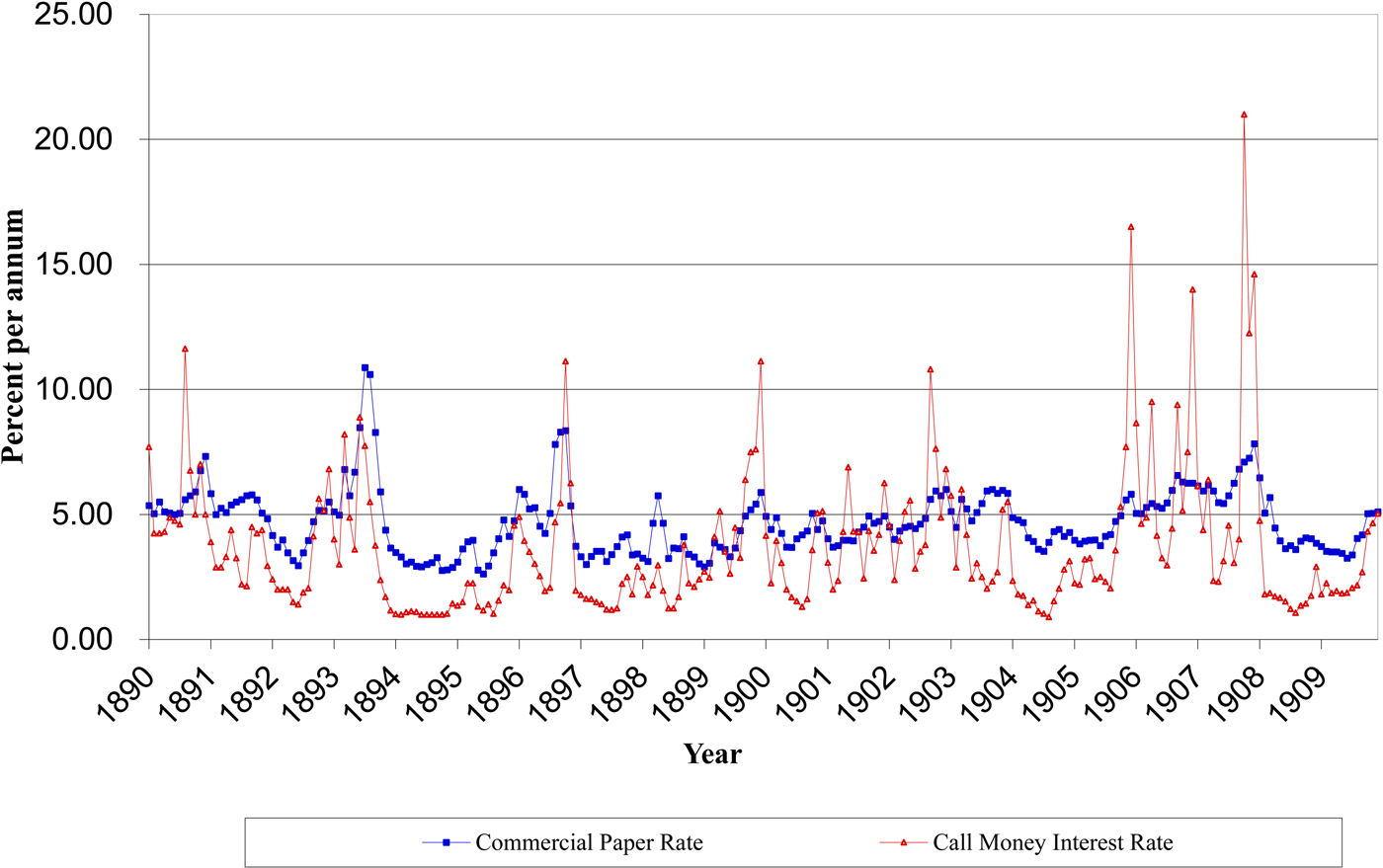
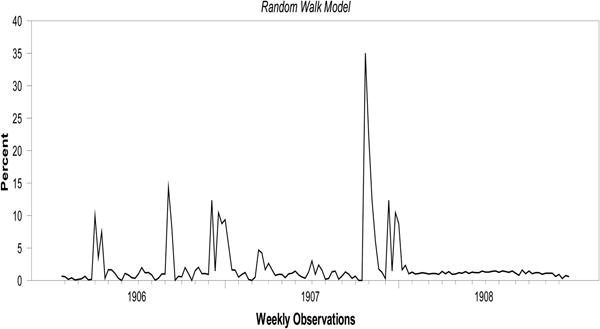
Figure 2 presents an estimate of the volatility of the call loan rate based upon a simple random walk model of the expected call loan rate using weekly observations. Volatility is clearly higher in the years leading up to the panic than in the aftermath of the panic. In 1908, volatility falls close to zero, consistent with the evidence provided by Fohlin, Gerhig and Hass (Reference Fohlin, Gehrig and Haas2016, p. 16).
Call rate volatility estimate

The volatility of the call loan interest rate in the years leading up to the Panic of 1907 was higher than previously observed, and contemporary observers attributed this to larger fluctuations in the volume of funds available for issue on call. Woodlock (Reference Woodlock1908) was especially concerned that the direct lending by interior banks on the call market was potentially destabilizing because it bypassed the New York City national banks, thereby hindering their ability to maintain a liquid market.
We know from historical documentation that there was a perception of insufficient liquidity on the call loan market in October 1907.Footnote 2 The behavior of the call money interest rate supports that view, reaching a high of 125 percent per annum on 24 October, even though very few trades were placed at that price. Under those circumstances, it is likely that the New York Clearing House banks were willing to deal directly with the trust companies (although on terms determined by the Clearing House) in order to prevent panic-induced stock sell-offs in an illiquid stock market, despite a history of rivalry and dissention. It was well known before 1907 that the trust companies were invading the turf of national banks in New York City on both the deposit-taking side, and in the supply of loans to the call loan market. The banks were critical of the lax reserve requirements placed on trusts, and New York trusts benefited from strong political influence at the state level that exceeded the influence of New York national banks. Ultimately the New York banks under the guidance of J. P. Morgan took over nearly $70 million in call loans from outside lenders like the trusts by creating money pools to provide funds to maintain funding liquidity to keep the call loan market and, hence, the stock market, from freezing up.
Griffiss (Reference Griffiss1925), Watkins (Reference Watkins1929), and Myers (Reference Myers1931) comment that the New York City Clearing House banks were the largest local source of call loan funds. Also, Myers (Reference Myers1931, p. 269) notes that during the Great Depression ‘the New York banks comprised the only group which felt any responsibility for the market, and therefore the only group which felt obliged to assume the loan burden as other lenders withdrew’. The statement by Myers applies to the 1907 experience as well, as the New York City national banks increased their call loans. This does not imply that the big six banks and J. P. Morgan intervened out of altruistic concern for the participants in the call loan market. Maintaining the funding liquidity of the market by Morgan and colleagues also protected their investments in stocks and railroad bonds. Their personal interest simply was closely aligned with the interest of other participants in the call loan market. Laughlin (Reference Laughlin1912, p. 65) applauded the New York City national banks for increasing their call loans during the Panic of 1907 and emphasized the palliative effects of credit extension during panics. The statement also emphasizes the role that the New York Clearing House member banks played in this institutional framework, that is, the long-term market participants whose intentions were to preserve the enduring viability of the call loan market for all participants, brokers and borrowers as well as lenders (Clearing House banks).
II
The call loan market was not an ideal structure for holding reserves in the short run, but given the institutional arrangements of the national banking system it was likely to have been the best arrangement in the absence of a rediscount market for commercial paper in the United States. The New York Clearing House had no direct authority over the call market. Indeed, there was no official authority monitoring the call loan market. Pratt (Reference Pratt1912, p. 262) notes that the New York Clearing house had considered setting the call rate daily but chose not to, thinking that the act would be viewed as creating a monopoly in call money. Banks with excess reserves could readily park them in the call loan market. But banks desiring to increase reserves or ‘borrow’ reserves were limited to the volume of their outstanding call loans they could liquidate; they could not directly borrow funds through the call loan market. Cannon notes that both the Boston and Chicago Clearing Houses had developed methods for member banks to trade their excess clearing balances with other members who had found themselves in a clearing deficit at the end of the clearing process. This was a precursor to the modern federal funds market (Cannon Reference Cannon1908, pp. 232–3, 276). Furthermore, the rise of lenders outside the New York Clearing House umbrella became a matter of increasing concern over the course of the later nineteenth century. While the loans were backed by equity collateral, this provided little protection during periods of financial crisis. The Clearing House had little ability to force nonmember banks and lenders to pool resources in an attempt to prevent an unwanted fire sale of the collateral backing call loans. With regard to the Panic of 1907, Paul Warburg wrote:
Banks and individuals with hundreds of millions in call loans at their disposal could not save those that were drowning. As already mentioned, without a central reserve organization and without an elastic note issue, one bank could only strengthen itself by weakening another, and any attempt to call in funds from a debtor would only throw him into desperate confusion and set in motion a chain of further embarrassments and insolvencies. (Warburg Reference Warburg1930, vol. i, p. 21)
A less well-known contributor to the central bank movement, Victor Morawetz, also noted the role of the call loan market in spreading the credit problems during the Panic of 1907:
Each bank that has loaned money on call assumes that, in case of need, it can strengthen its reserve by calling such loans; but it fails to consider that, generally, when a loan is called the borrower is obliged to borrow the same sum from some other bank, although a high rate of interest may be enacted, and, therefore, that call loans affect the security of the entire bank situation practically to the same extent as time loans. (Morawetz Reference Morawetz1909, pp. 48–9)
The call loan market under normal conditions could have loans rearranged to meet bank-specific liquidity needs while remaining liquid overall. Under a systemic increase in the demand for cash or liquidity, the call loan market could not produce a net increase in liquidity. While the Clearing House banks could issue clearing house loan certificates to increase cash available to panicked depositors and correspondent banks, loan certificates made existing assets more liquid and could provide only a limited increase in system liquidity (Moen and Tallman Reference Moen, Tallman and Humpage2015). Furthermore, as noted above, the outsider credit providers did not have direct access to the New York Clearing House nor to the liquidity resource of clearing house loan certificates.
The disruption from outside lenders during the Panic of 1907 revealed the risks of linking, however inadvertently, the payments system to capital markets. Before 1907 the New York Clearing House banks had been the important intermediaries for coordinating the payments system; indirectly they served as key intermediaries for capital allocation through the call loan market. A key feature of subsequent central banking proposals was a common opposition to the call loan market as a secondary source of liquidity for the US financial system. This was an attempt to limit the connection between the payment system and capital markets. In earlier panics, the New York Clearing House banks had sufficient resources to maintain liquidity on the call market while suspending convertibility of deposits into currency in the payment system. The diminishing relative size and, hence, influence of the New York Clearing House banks weakened their ability to offset the risks faced by the financial system during the Panic of 1907, both in the call market and in secondary effects to the payments system. The banks may have recovered some influence over the call market after the panic, but a source of reserves outside the call loan market did not appear until seven years later when the Federal Reserve System was founded.
III
The largest source of lending outside the national banks in 1907 came from the trust companies, state-chartered intermediaries originally chartered to attract time deposits and hold funds in trust. The trust companies in New York City grew tremendously between 1896 and 1907, so much so that by 1907 they were roughly comparable in size to the national banks in New York City when measured by assets or deposits (Barnett Reference Barnett1910, p. 235; White Reference White1984, p. 37). In New York State the reserve requirement for trusts was 15 percent, but only one-third of that had to be vault cash; the rest could be deposits at banks. In contrast, national banks in New York City faced a 25 percent reserve requirement in the form of gold or legal tender in their vaults. During much of the nineteenth century the trust companies had been much less competitive with banks with respect to retail payments, displaying only 7 percent of the check clearing volume of national banks. The lower volume of clearings was a justification for why trusts held fewer reserves.
The trust companies had been lending in the call loan market by the early 1870s, and several had to suspend payments in the Panic of 1873 because they could not call in loans quickly enough (Hansen Reference Hansen2014, p. 551). While a few of the trusts were as large as the some of the larger banks, the total volume of assets held by the trusts didn't rival that of the banks until the late 1890s. By the late 1890s, however, the trust companies were increasingly able to compete with banks in attracting individual deposits and banker's balances in excess of required reserves from interior banks. These excess reserves placed with trusts would not count as required reserves for interior national banks, but they could be used for interregional transactions. New York City trusts also often offered interest rates on banker deposits higher than those of national banks, and they were able to do that mainly because they held fewer non-interest-earning cash balances. That is, trust companies paid a lower reserve tax because a smaller proportion of their assets was mandated to be held as cash. The balances in excess of required reserves held at trust companies were purportedly put to use in the call loan market, although it is impossible to find official measures of call loans held by trusts before the panic because there was no regulatory authority monitoring the call loan market.
As the resources of trusts grew, so did their participation in the call loan market, which is consistent with comments made by O. M. W. Sprague (Reference Sprague1910, p. 47): ‘By far, the larger part of the loans of trust companies are made against collateral securities. In the call loan market, they compete constantly with the banks, and are said to take a larger proportion of the total of those loans than of time.’ The trust companies participated in the call loan market both as suppliers of funds directly and as agents of interior bank funds. Myers (Reference Myers1931, p. 269) and Goodhart (Reference Goodhart1969, p. 101) note that Chicago banks as early as 1880 could loan on call in New York City directly.
Compounding their influence in the call loan market was the fact that trust companies played a critical but less recognized role in the first step of creating a call loan, the over-certification of a check. Even though a broker and his customer usually relied on credit to purchase stock equity, the seller expected payment in full upon transfer of the shares. To initiate the transfer, the broker would write a check to present to the seller. But the broker usually did not have enough funds in his account to cover the full purchase amount. The broker's bank, however, would certify the check for most or all of the amount beyond the margin (usually 10 percent) the broker or seller was putting up, meaning that the bank stood ready to transfer all funds to the seller. The broker could then take possession of the shares. He would then take them to his bank and use them as collateral for a call loan to cover the over-certified check. This was to happen within the business day and could not remain overnight like a call loan. A daylight overdraft was in effect being used to create the call loan. Pratt (Reference Pratt1912, pp. 267–73) describes this process in detail.
Trust companies were central in the over-certification of checks, for the national banks were forbidden by the National Bank Acts from certifying checks if the drawer of the check had funds insufficient to cover the check. Trust companies were not subject to the National Banking Acts and provided a large volume of over-certified funds (Pratt Reference Pratt1912, p. 269). In a panic trusts would try to liquidate their call loans, and they would stop certifying checks. Both actions heightened illiquidity on the stock market. The volume of over-certified checks is almost impossible to determine, and it is likely that the national banks could not take over much of this function during a panic even though they had been developing ways to innovate around the prohibition (Pratt Reference Pratt1912, p. 271).
Thomas Woodlock, writing in 1908, expressed the concern apparent at the time about the influence of direct lending by out-of-town banks on the call loan market. Although they used New York banks as agents in placing the loans, such loans did not appear in the weekly bank statement of the New York banks. He describes the potential danger as follows:
This practice first attracted attention as a dangerous element in the situation in the summer of 1902. At that time a quiet investigation developed the fact that something over one hundred million dollars was being lent in this way by out-of-town institutions, subject to the call of those institutions. It was a time of considerable stringency in the money market, and New York bankers felt that the existence of a mass of credit of these dimensions not subject to control has within it the potency of disaster … In December of last year (1906) it was estimated that over four hundred million dollars of money were being loaned in New York City for account of country institutions, over which New York banks had no control whatever. In view of what has happened in the last three months (of 1907) we may be truly grateful that the storm did not break as it might have broken twelve months ago, instead of coming, as it did, after many months of very severe liquidation, during which these direct loans by country banks were enormously reduced. (Woodlock Reference Woodlock1908, pp. 36–7)
The president of the New York Clearing House, Alexander Gilbert, expressed similar concern in September 1908 in his address to the American Bankers’ Association Conference:
They [New York Clearing House banks] realized also that a dangerous situation had been created by the large amount of funds sent to New York by the interior banks to be loaned in Wall Street at prevailing high rates, knowing full well that the first indication of trouble would result in a recall of those funds … Another threatening danger was the large volume of trust company deposits, almost as great as the bank deposits, against which a very small percentage of cash reserve was being carried.Footnote 3
In contrast to the New York City national banks, interior country banks typically had not considered the ‘external effects’ of liquidating call loans. Bartow Griffiss also notes this concern:
Country bankers realize that the small individual loans which they make in the call money market are practically negligible in comparison with the huge volume of funds which is daily lent or withdrawn from the market. Hence, they feel no trepidation as to what effect their withdrawals will have on such a market, whereas in a more limited and narrow market, similar withdrawals, would have a serious effect on the general tone of the market from which they were withdrawn. (Griffiss Reference Griffiss1925, p. 92)
Canadian banks were another source of outside lending and had about $60 million lent on call in December 1906; by December 1907 that amount was down to $42 million owing to reductions in New York City. Rather than adjusting domestic loans to maintain reserves, the Canadian banks used call loans as a source to adjust reserves. Jacob Viner notes that this practice led to these ‘outside reserves’ held in New York fluctuating much more than reserves held in Canada (Viner Reference Viner1924, p. 177). Leonard Watkins notes that withdrawals of funds from the call loan market by Canadian banks in 1907 ‘added to the difficulties of New York banks during this period’ (Watkins Reference Watkins1929, pp. 30–1).
Writing for the National Monetary Commission, John Joseph French Johnson (Reference Johnson1910, p. 70) describes the use of call loans by larger Canadian banks in some detail. He points out that Canadian bankers view reserves as being made up of four types of assets: (1) cash, (2) balances at other banks, (3) call loans, and (4) securities. Call loans serving as reserves are for the most part call loans made in New York. Call loans made in Canada were less liquid than New York call loans and were rarely called in suddenly. Canadian bankers realized that calling in Canadian call loans would not result in a net increase in cash for the Canadian banking system, preferring to call in New York call loans. In 1907 call loans outside Canada accounted for about a third of Canadian bank reserves (Johnson Reference Johnson1910, chart 8).
When the panic struck in New York, Johnson points out that Canadian banks ‘immediately adopted measures of self-protection’ (Reference Johnson1910, p. 117). Over the next two weeks they withdrew over $22 million in call loans from New York. Given that New York banks increased their loans during the panic by more than $70 million, in part from taking over call loans of trust companies, the reduction by Canadian banks was significant. After the panic, Canadian banks returned to the New York call loan market. After October 1908, their participation grew dramatically to over $135 million by December 1909, up from $42 million in December 1907. The Bank of Montreal was the single biggest lender, having $77 million lent on call in New York in October 1909 (Johnson Reference Johnson1910, p. 49). Johnson claims this run up in call loans was due to the lack of worthwhile lending opportunities in Canada at the time (Reference Johnson1910, p. 83)
John T. P. Knight, the secretary–treasurer of the Canadian Banker's Association and the manager of the Montreal Clearing House, speaking in Winnipeg, Canada, in September 1907, echoed Johnson's views on call loans made by Canadian banks in New York. The Monetary Times reports Knight's view on call loans:
Mr Knight thought that call loans in Canada could not be realized upon in case of emergency. Therefore, the term ‘call’ was a misnomer. Money loaned under such circumstances in the United States could be obtained for immediate use, being covered by such securities as could be realized at once. When there was depression in Canada its securities would naturally be unrealizable, and banks could not obtain the necessary money to satisfy the depositors.Footnote 4
There was concern that the funds being lent by Canadian banks on call in New York should be lent in Canada. Speaking at the annual meeting of shareholders of the Bank of Montreal, the vice president of the bank, Sir Edward Clouston, vigorously defended the practice. First, he notes the safety of holding reserves in New York call loans:
Every dollar of this money is loaned on call at short time upon the most ample security. It constitutes a part of the reserves of Canadian banks. If tomorrow we were to call in the whole of our loans of this class, which at all times are immediately available, the mercantile public of Canada would derive absolutely no benefit from the action. Being a portion of our reserves, the choice given the bank is between retaining the money unproductive in its vaults or lending it at call upon interest in foreign financial centers. We adopt the latter alternative as being in the interest not alone of the shareholders but of the commercial community of Canada.
He then points out the dangers of placing reserves on call in Canada:
Assume that these call loans on readily realizable securities protected by ample margins had been in the same markets in Canada, and that the money was required for commercial purposes, does not anyone suppose that the sudden calling in of the loans would not have been attended by the most baneful effects? In making such loans here we would probably have enhanced local stock market values unduly, to be followed by a sharp collapse and serious losses upon the sudden withdrawal.
He finally asserts that even during the panic, the reserves placed as call loans were always callable and could be used to import gold from England if that were advisable:
I have no hesitation in saying that there has been no time during the present crisis when we could not realize all our call loans in the United States, and transfer the proceeds to England, whence we could easily import gold here if it should be considered advisable. But as we know how liquid and available they are, we continue to retain all that is not needed here, both as part of our reserves and as a valuable aid to our international exchanges.Footnote 5
Apparently, the Bank of Montreal had done just that. In the week after 26 October, after the New York Clearing House authorized clearing house loan certificates and suspension of convertibility, prompting a currency premium, the Commercial and Financial Chronicle (9 Nov. 1907, p. 1170) points out that
The engagements (of gold) were chiefly effected for the account of New York banks; it is noteworthy, however, that 1 ½ millions was ordered by the Bank of Montreal 8 ½ millions by banks in Chicago, and smaller amounts by other domestic institutions in interior cities.
Georg Rich (Reference Rich1989) challenges the view that Canadian banks worsened the panic in New York by withdrawing gold by reducing call loans and returning the proceeds in gold to Canada. He argues that Canadian exporters let the lag between exports and receipts increase, easing the seasonal liquidity problems in New York. He also presents evidence that Canadian banks actually shipped gold to New York during the panic, further easing the liquidity problems. There is, however, no contradiction between these two stories. Johnson is arguing that Canadian banks liquidated call loans in New York; this would have happened during the week of 21 October. After clearing house loan certificates were authorized by the New York Clearing House and suspension of deposit convertibility announced on 26 October, a currency premium appeared the next week in New York. The premium was large enough, around 3 percent, to start attracting gold inflows from abroad. Gold imports from Europe started arriving two weeks later. Rich (Reference Rich1989, p. 142) reports that because of the premium $2 million worth of gold was shipped from Montreal to New York on 30 November.
This timing is not at all inconsistent with an initial withdrawal of gold through the liquidation of call loans followed by return flows of gold in response to the subsequent appearance of the currency premium. Because much of the monetary evidence Rich presents for Canada is quarterly, these very short-term gold flows at the beginning of the panic will not be observable, having been swamped by quarterly averages. Canadian banks could very well have ended up serving as a ‘lender of last resort’ to New York in 1907 after their initial withdrawal of call loans.
IV
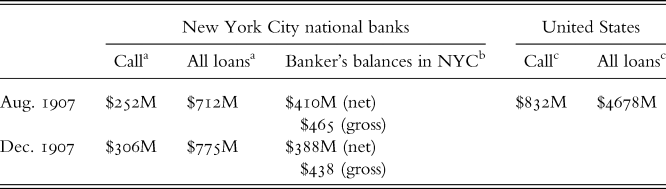
Identifying who was lending on the call loan market in New York remains a problem. Call loans aggregated across all US national banks in August 1907 showed $832 million out of total loans of $4,678 million, just over 15 percent of all national bank loans as call loans (see Table 1).Footnote 6 The New York national banks provided $252 million in call loans, which was about 36 percent of all New York national bank loans.Footnote 7 The amount of loans on call at the New York Stock Exchange, however, was much larger than the funds directly contributed by the New York City national banks. Also, the ‘total’ numbers reflect call loan exposure of national banks, and so they do not include funds placed in the call market directly by New York City trust companies, the funds from interior state-chartered banks, or from private banks. Furthermore, it is likely that the state banks and some interior national banks used a New York City trust company as its agent for issuing call loans.
Call loans and total loans for national banks

Sources: a Sprague (Reference Sprague1910, p. 301). b Watkins (Reference Watkins1929, p. 70, 216). c Laughlin (Reference Laughlin1912, p. 113).
The actual size of the call loan market is hard to determine, as there was no specific agency monitoring it and regularly collecting information on the volume of call loans. A similar problem existed with the repo market during the financial crisis of 2007–9. National banks reported their volume of call loans once a year to the Comptroller of the Currency, but no numbers for individual banks were published. The Comptroller also did not make a distinction between collateralized loans on time and on call in the Annual Report.
In making a call loan, the lender, usually a bank, kept the collateral and put it in an envelope with the description of the loan amount and borrower written on the outside. Any changes to the loan were written on the envelope. When the loan was liquidated, the collateral was returned and the envelope destroyed. So, there was likely to have been little daily record of the volume of call loans, the identity of the borrowers, or the nature of the collateral presented kept by banks (O'Sullivan Reference O'sullivan2016, pp. 294–5).
Trust companies and state banks did not have to report to the Comptroller. This heightened lender uncertainty about the call loan market, especially among the trusts, whose presidents didn't know each other well, or the out-of-town lenders who did not know the extent or character of other lenders. During the peak of the 1907 panic J. P. Morgan even had to introduce many of the trust company presidents to each other and then sequester them in his library in an attempt to get them to help each other during the early stages of the panic. The competition to supply funds to the call loan market reduced the profit margins of the New York City national banks and also limited the effectiveness of their attempts to quell call market disruptions arising from a lack of liquidity.
Margaret Myers and Leonard Watkins point out that the only source of evidence on the volume of funds being lent on the call loan market and the type of lender – bank, trust company, or out-of-town lender – is contained in the records of the Pujo Committee hearings on the money trust in New York held in response to Panic of 1907. The Committee requested New York banks and trust companies to report the volume of correspondent deposits and call loans made for correspondents on their own account. About 30 New York City banks and trust companies reported their own loans and those made for correspondents on stock exchange collateral to the Committee. The reports are for January, June and November for 1908 through 1912, and they report loans by reporting intermediary along with correspondent deposits. Unfortunately, the records start only in January 1908, missing the run up to the Panic of 1907, but they reveal the degree to which out-of-town lenders could influence the call loan market and, indirectly, the stock market. While not all banks and trusts sent reports to the Committee, the largest New York banks are included. Interior banks making call loans without using a New York agent are not covered by these figures.
In testimony before the Pujo Commission hearings, several lenders on the call loan market stated clearly that there were few records of the volume of lending on call at the New York Stock Exchange. Charles Turner, the lending agent for National City Bank on the Stock Exchange testified that much lending was done directly between banks and brokers over the telephone, bypassing the money post on the floor of the New York Stock Exchange altogether. This made the volume of lending on call difficult to determine.Footnote 8 J. H. Griesel, a broker specializing in lending money on call for banks and trust companies, gave similar testimony.Footnote 9
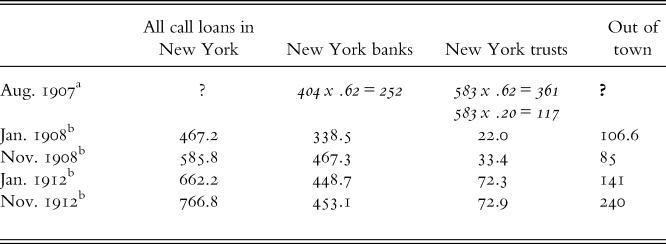
For 1907 we can only guess at the volume of loans on call by banks and trusts in New York. The figures in Table 2 for August 1907 are the actual volume of all collateralized loans held by banks and trust companies, which includes collateralized loans on time as well as on call (Moen and Tallman Reference Moen and Tallman1992, pp. 622–4). H. Peers Brewer, however, presents evidence that suggests trust companies held a percentage of loans as call loans that was comparable to that of the national banks (Brewer Reference Brewer1986, p. 143). Moen and Tallman multiply the figure for the collateralized loans of trusts ($583m) by .62, the percentage of collateralized loans held by national banks in the form of call loans, to get a volume of call loans estimated to be $361 million. They also multiply the trust figure for collateralized loans by .20 to show that even if trusts held a much smaller share of call loans than did banks, their presence in the call loan market could nevertheless be substantial. Their estimates indicate that the trusts could possibly have held more call loans than the national banks on the eve of the 1907 panic.
Sources of call loans in the New York money market (millions of dollars)
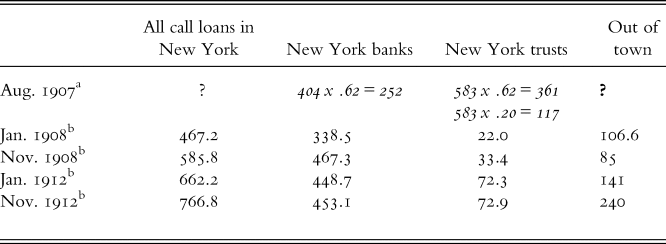
Sources: a Estimated. See Moen and Tallman (Reference Moen and Tallman1992, p. 623). b US Congress (1913) MTIH, Statement B, pp. 1193ff.).
Table 2 presents the volume of all call loans for January and December 1908 and 1912 for New York banks and trusts that reported such information to the Pujo Committee hearings. The level of detail found in Table 2 on the sources of call loans has not been presented before, outside of the Pujo hearings reports. Myers (Reference Myers1931, p. 269) uses the Pujo data but does not report call loans for banks and trust companies separately as in Table 2. Mary O'Sullivan (Reference O'sullivan2016, pp. 294–6) also uses the Pujo Committee data to analyze the lending of specific banks in New York. Table 2 presents a breakdown of call loans into those made by New York national banks for out-of-town correspondents as well as those made for their own account. The figures reveal the extent of outside lending that the activity of out-of-town lenders did not slow down after 1908, increasing more quickly than that of the New York national banks. The volume of call loans at the trust companies fell dramatically after the panic. As the panic focused on the trusts, this is not surprising. The increase in correspondent loans as seen in the Pujo Committee data came mainly from the national banks that reported to the committee. The trusts that reported correspondent loans reported much smaller volumes than did the banks. The correspondent call loans of the national banks appear to have replaced trust company loans made for their own account. Whether this indicates that the national banks intentionally took business away from the trusts or that they just stepped in to fill a gap left by the trusts weakened after the panic is not certain. Nevertheless, the call loan market was not reined in after the 1907 panic, despite the obvious instability it inserted into the New York financial markets. The New York banks continued to have a substantial part of their liquidity tied up in call loans.
V
The call market became increasingly volatile because interior banks and New York City trust companies were placing their funds on call directly. Interior banks using trust companies as correspondents and the trust companies placing their own call loans bypassed the New York City national banks and the Clearing House, exerting an influence on call market interest rates and loan volumes independent of that of the New York Clearing House banks. As a result, the trust companies broke down the influence of the New York Clearing House in the call loan market, free riding on the co-insurance arrangements among New York Clearing House banks. More importantly, the trusts failed to consider the systemic costs of their contracting the aggregate amount of call loans and the external effects on the financial system during a crisis. Combined with their role in over-certifying checks, trust companies were central in the contraction of short-term lending in New York. In short, the trusts decreased funding liquidity, amplifying the decrease in market liquidity as described by Brunnermeier (Reference Brunnermeier2009) and Brunnermeier and Pedersen (Reference Brunnermeier and Pedersen2009).
During previous panics the national banks worked through their Clearing House to issue liquidity to the call loan market. The increasing participation of outsiders, however, had weakened the ability of the New York national banks to protect the call loan market and stem panics. We present the first evidence to show the volume of lending on the call loan market by trust companies and other outside lenders. It reveals that by 1907 the New York national banks were lending about half of the funds lent on the call loan market, with trust companies and other outside lenders providing the other half. The big six national banks accounted for about two-thirds of the funds lent by all the New York national banks (Myers Reference Myers1931, p. 271). The big six and the Clearing House were no longer able to dominate the call loan market. After 1907 the New York banks reclaimed some of their influence over the call loan market that they had lost to the trust companies in the years leading up to the Panic of 1907, while their out-of-town correspondents also increased their influence at the expense of the trusts.