Impelled to seek relief from a “peccant chest” (L233) at the seaside, Christina Rossetti travelled to Hastings in December 1864, taking a carefully wrapped bundle of unfinished manuscript poetry with her.Footnote 1 Throughout the winter until the following March, a series of letters to Cheyne Walk kept her brother Dante Gabriel abreast not only of her gradual recovery, but also of her efforts to complete her second book of poetry, two years after she had made a successful debut with Goblin Market. Shortly after her arrival, Rossetti reported that she was struggling to finish “The Prince's Progress,” the long narrative poem that was to lend its title to the new volume:
[M]y Alchemist still shivers in the blank of mere possibility: but I have so far overcome my feelings and disregarded my nerves as to unloose the Prince, so that string wrapping paper may no longer bar his “progress.” Also I have computed pages of the altogether-unexceptionable, and find that they exceed 120: this cheers though not inebriates. Amongst your ousted I recognize sundry of my own favourites, which perhaps I may adroitly re-insert when publishing day comes round. . . . Meanwhile I have sent 3 (I hope) pot-boilers to Mac's Mag. (L233)
In the past few decades, Rossetti's lifelong effort to see what critics have variously called “the divine spiritual essence of material beauty” (Harrison 56), the “moral and spiritual significance in physical signs” (Arseneau 279), and “the spiritual in the sensuous, the numinous in the material” (Kooistra, Illustration 38) has become a mainstay of Rossetti scholarship. This excerpt from her correspondence, in contrast, reveals her equally profound preoccupation with the materiality and economics of writing. Issues of textual ownership, authorial control, and literary marketability confronted Rossetti in the 1860s as her financial situation forced her to balance book publication with regular contributions to the periodical press, notably Macmillan's Magazine, the magazine owned by Rossetti's publisher Macmillan and Co., which carried more of her poetry than any other British periodical in the nineteenth century. These issues extended beyond Rossetti's personal dealings with Macmillan, however, shaping the material and interpretive consumption of her work throughout her career. This arc may be seen in the publication and adaptation history of one of her most popular poems, “A Birthday,” from its first appearance in Macmillan's Magazine in 1861 until her death. Over time, the poem underwent various types of mediation: reprints in gift books and poetry anthologies, musical adaptation, vocal performance, and quotations in fictional works. Finally, her reaction to the three parodies of her poems published in an 1888 comic magazine – particularly to “An Unexpected Pleasure,” the parody of “A Birthday” – demonstrate her perspective on the increased commodity value of the original poem.
Engaging with Macmillan
The letter from Hastings provides a valuable insight into the genesis of The Prince's Progress, revealing Rossetti's reluctance to take up her pen, cast off her doubts, and continue writing. Fascinatingly, it does so by construing the progress of the Prince, whose ill-fated journey to his royal bride is delayed by various obstacles and wayside distractions, into the prolonged creation process of the volume's title poem itself, and thus, by extension, into Rossetti's own progress as a poet. “Unloos[ing] the Prince” upon her arrival, Rossetti appropriates the Prince's body as a metaphor for the body of unfinished texts on which she is labouring, while her doubts and procrastination materialize in the wrapping paper hiding the work from view and preventing it from being expanded. Like the poem's loitering protagonist, Rossetti switches her attention to less pressing matters, repeatedly “indulging,” as she confesses when she is visited by her mother, “in a holiday from all attempt at Progress” (L253): she counts pages, ponders over a set of poems rejected by her brother, and sends poetry to Macmillan's Magazine. Meanwhile, her “Alchemist . . . shivers” from lack of creative heat, still “mak[ing] himself scarce” (L248) three weeks later as she adds the finishing touches to the “Prince.” Finally, on 30 January, Rossetti is able to announce, casting herself as the old man at his “seething-pot,” who “feed[s] [his] fire with a sleepless care, / Watching [his] potion wane or wax” (Complete Poems 94): “Here at last is an Alchemist reeking from the crucible. He dovetails properly into his niche. . . . He's not precisely the Alchemist I prefigured, but thus he came & thus he must stay: you know my system of work” (L250).
With its imagery of uncovering – of untying the strings and unfolding the paper that “bar[red]” the “progress” of the Prince on the one hand and its allusions to alchemical transformation on the other – Rossetti's letter draws attention not only to the sheer physical demands of writing. Extracted from the very stuff and substance of the text itself, these metaphors of creativity also suggest a poet closely in touch with her poetry and keenly aware of its changing shapes and material textures. The intimate nature of the imagery is especially striking compared to the casual remark that closes the passage: “Meanwhile I have sent 3 (I hope) pot-boilers to Mac's Mag.” Prosaically named “pot-boilers,” Rossetti's submissions to Macmillan's Magazine abruptly shift our attention away from the slow progress of the Prince, the Alchemist's crucible, and the challenges of writing good poetry to much more mundane concerns of household responsibilities and livelihood. They also suggests distance, detachment even: while Rossetti keeps her “Prince” close at Hastings, the three pot-boilers are sent off to Macmillan's office in London, where they will hopefully take care of themselves, and of their author. “Spring Fancies,” “Last Night,” and “Consider” were published in April and May 1865 and January 1866 respectively. Three weeks before returning to London, Rossetti dropped a group of poems that she had long been considering for inclusion in the new volume: “Squad finally rejected for vol. 2,” she informed her brother, “though I keep my commercial eye upon it for Magazine pot-boilers” (L258). One member of the “squad,” “By the Waters of Babylon,” appeared in October 1866. Between February 1861 and March 1869, an additional eighteen pot-boilers landed on the pages of Macmillan's. Rossetti's twenty-third and final contribution to the magazine was published fourteen years later, in April 1883.
Rossetti turned to Macmillan at a crucial moment both in her own career and in the history of the young magazine. Macmillan's was only one of a host of shilling monthlies that emerged in the mid-1800s on a periodical landscape long dominated by a handful of quarterly reviews. Launched in October 1859, it was soon joined by the Cornhill, Good Words, and Temple Bar in 1860, Victoria (1863), Belgravia (1866), Argosy (1865), and Tinsley's (1867), which all offered a mixture of serial fiction and short stories, poetry, essays, and book reviews. In such a highly competitive market, as George J. Worth argues in his monograph on Macmillan's Magazine, contributions by the leading poets and novelists of the day were a key strategy to “attract attention, gain readers and give the new monthly a cachet of solid respectability” (20). “Everyone to sign his name and no flippancy or abuse allowed” (qtd. in Worth 9), co-founder Thomas Hughes summed up the editorial policy of the new magazine. Tennyson's much-anticipated “Sea-Dreams,” obtained by Alexander Macmillan through tireless networking and flattery in letters addressed to the Poet Laureate's wife, was strategically scheduled to appear opposite the first issue of the Cornhill in January 1860. Tennyson was paid a princely £250, “about a pound a line for a poem that spanned eight pages of a very important issue” (Ledbetter 57). In 1866, Matthew Arnold was thrilled to receive a tenth of that sum for a piece of similar length, calling it “a splendid, extraordinary payment” and the “best pay [he had] yet had” (qtd. in Worth 49).
Other early contributors included R. D. Blackmore, Dinah Mulock Craik, Sydney Dobell, Charles and Henry Kingsley, Caroline Norton, Margaret Oliphant, Coventry Patmore, and Charlotte Mary Yonge – many of them respectable novelists or poets who had already established a steady literary reputation in the previous decades. Macmillan was particularly zealous in his efforts because he knew that contributors to the magazine were potential authors of his books. While he did not succeed in bringing Tennyson over until 1884, when the poet left Kegan Paul, he served as publisher of Arnold's poetry from the mid-1860s onwards, shepherded the complete Angel in the House through four editions in 1863–66 after the project had been abandoned by Parker, and published a significant portion of the fictional works of Craik, Oliphant, and Yonge. In 1861, he took a calculated risk by contracting little-known Christina Rossetti just months after she had submitted her first poems to the magazine. The deal marked the beginning of a long professional partnership, which for all its productivity is only briefly dealt with in Worth's study. When “Up-Hill” was published, the publisher was congratulated by other contributors “on having got a poet at last” (D. G. Rossetti 348), the proprietary connotations of the phrase reflecting their high expectations of what Rossetti could do for the Macmillan brand. “Clearly, she was to be the next ‘name’,” Alexis Easley observes. Her “notoriety would help to build the publisher's reputation and sales” (169). Rossetti, for her part, was delighted with the prospect of putting a volume together and declared herself “happy to attain fame (!) and guineas by means of the magazine” (L137). In addition to Goblin Market, The Prince's Progress, and the twenty-three pot-boilers, Macmillan and Co. would also publish the story collection Speaking Likenesses (1874), A Pageant and Other Poems (1881), and the posthumous New Poems (1896), as well as a number of collected and illustrated editions of her works.
If explicit pursuit of pecuniary gain seems uncharacteristic of Rossetti, it is not only because William Michael famously identified “over-scrupulosity” as his sister's only “serious flaw” (lxvii) in his posthumous edition of her Poetical Works. More important, it is because literary criticism has tended to privilege the study of her books over the study of her periodical publications, and because the focus has largely been on her strategies for retaining “control over her work as both aesthetic object and commercial commodity” (Kooistra, “Copyright” 61) with little attention to the ways in which this control was lost. As has been pointed out repeatedly, Macmillan's plan to bring out a soberly executed volume of Goblin Market for the Christmas season was pre-empted by the Rossettis’ decision to include elaborate frontispiece and title-page designs, which Dante Gabriel did not complete until the early spring (Kooistra, Illustration 10; Marsh 278). When Macmillan tried to coax Christina into a second collection soon after the favourable reception of the first, she kindly but firmly explained:
A rather longer book will I doubt not be possible should the demand arise: but I know myself too well to foresee that even were I ever so successful, I should always be a worry to the publishing world. Write to order I really cannot. (L179)
The Prince's Progress took its definitive form during the winter at Hastings but did not go to press for another year because Macmillan was, again, asked to wait for the illustrations. If Rossetti felt frustrated, she did not say so to her brother. In a letter written in April 1865, the loitering Prince once more embodies the volume's slow advancement towards completion: “My Prince, having dawdled so long on his own account cannot grumble at awaiting your pleasure; and mine too, for your protecting woodcuts help me to face my small public” (L269).
While Dante Gabriel's interference with his sister's publications admittedly diminished her own agency in the matter, Macmillan suffered the greater loss by having to relinquish aesthetic control to the Rossettis, in addition to missing two commercially critical deadlines. As with Goblin Market, he had offered Rossetti half profits for The Prince's Progress once production costs had been met, a system that was common among the leading publishing houses of the day and, as he later explained, especially suitable for works that were not “likely to lead to a large or immediate popularity” (Macmillan 310). In the decade following its publication, the volume brought in so little that Macmillan was forced to withhold part of the earnings for the 1875 Poems to recover his expenses. The balance was settled in January 1878, and two years later, he sent his author the first substantial check, of £9 17s. 8d., for the new volume (Marsh 461). Much more than seeking financial gain, however, Rossetti clung to what she considered the most fundamental of all authorial rights, her “dear copyright” (L897) – a phrase that rehearses not only the deep affinity with her work that is evident from the Hasting letters, but also the high economic value that she placed on authorial ownership. Embittered by “the bold, shameless injustice” that “the law – so-called – of copyright” (Macmillan 272) did little to prevent the book market from being flooded by cheap, unauthorized reprints, Macmillan usually invited authors to become “joint [copyright] holders” (310) of their published works. With the famous exception of Speaking Likenesses, which was sold for £35 after a temporary estrangement, Rossetti retained the copyright of all poems that appeared under the Macmillan im
Macmillan's advantageous copyright terms applied to poetry volumes, but not to submissions to his magazine, for which Rossetti was paid by check in exchange for the copyright. The procedure, she hoped, would enable her to keep the pot boiling as she was working on more ambitious projects, but it also confronted her with a significant loss of control which in recent studies of her poetry volumes has largely gone unnoticed. In a series of single transactions, Macmillan not only claimed exclusive ownership of the poems as objects of commerce, but also barred his poet from any direct involvement in the formal and aesthetic aspects of the publication process. It would not be long before Rossetti became aware of the subtle implications of this double move. The February issue of 1863 carried “Light Love,” Rossetti's fourth poem in the magazine and the first to appear after Goblin Market. In a provocative essay on teaching Victorian periodicals to graduate students, Linda Hughes has invited closer attention to what she terms the “cultural codings of format” (320) in periodical publication. Hughes follows her class in arguing that Macmillan's distanced itself from the controversial issues of seduction, betrayal, and illegitimacy raised by “Light Love” through “down-market presentation” (321): the poem is printed on a single page in two columns rather than one, reminiscent of, for example, the pages of Dickens's two-penny weekly All the Year Round. While we may never know whether in this particular case Macmillan and his editor David Masson were acting out of moral concern (Jan Marsh, for one, believes that the poem “chimed with Macmillan's social conscience” [295]), Rossetti's correspondence shows that she “decoded” the poem's format rather differently, in terms of financial profitability rather than contents.
When Macmillan asked her in January 1863 why she had not submitted any new material for over a year, she confessed to feeling “disappointed at drawing no more funds or fame from the Magazine,” adding with gentle rebuke: “I thought you were so well aware of my literary existence, that if I was wanted the same might be notified to me” (L179). Nevertheless Rossetti, who not long before had told her publisher that she could not write poetry volumes to order, without much hesitation granted his request for more magazine submissions. “Light Love” was one of several that month and earned her the modest sum of £2 2s. Upon acknowledging the receipt of the check, she could not help observing that the same amount had been given to her for “Maude Clare” by Once A Week in 1859, “before [she] could rank as ‘any body’” (L180), and more recently by Macmillan himself, for a poem not half as long as “Light Love.” “I don't think I ought to afford much longer pieces than [‘An Apple-Gathering’],” she warned, “losing copyright as of course I do, for the same sum” (L180). Her “pet grievance” was not that she had been paid the standard rate of two guineas per page, but the fact that had the poem “been printed not in columns it might have covered 2 pages” (L182), earning her the full £4 4s. to which she considered herself entitled now that she was “‘somebody’ in the literary world” (Marsh 295).
What made the decision particularly difficult to accept for Rossetti was that format, which she was used to appropriate at her own discretion – as an aesthetic principle governing the preparations of her debut volume and as a commercial determinant for calculating the immediate profits of the pot-boilers – had been reclaimed by Macmillan to serve his own editorial agenda. Whether he had opted for the two-column layout because he was troubled by the poem's content, as Hughes suggests, or because he was guided by spatial constraints, or because he had become more cautious since the Tennyson poem “did not have the dramatic effect on the fortunes of the Magazine that [he] had hoped for” (Worth 21) was ultimately of little importance to Rossetti. For her, the format represented a missed opportunity to capitalize the rise of her reputation since Goblin Market. “[F]or the future I think I must be more careful” (L180), she mused, realizing that copyright loss was too high a price to pay if a poem, for reasons beyond her control, brought her less “fame and guineas” than she had anticipated.
Why then, after the brief controversy over “Light Love,” did Rossetti continue to submit material for publication in Macmillan's throughout the 1860s, apparently accepting the transfer of copyright ownership and commercial control that came with it? The simple answer is that she was financially pressed to do so. Despite the positive reception of her poetry volumes, it took “months or even years” before she “saw her share . . . trickle in a few pounds at a time” (Kooistra, Illustration 93). In his posthumous edition of her Poetical Works, William Michael Rossetti called his sister's income “decidedly meagre,” estimating that “from 1854 to 1862 she seldom made £10 in a year; from 1862 to 1890 there might be (taking one year with another) an average of perhaps £40 per annum – less rather than more” (li). If we map these estimates onto the figures provided by her correspondence, it becomes clear that at least in the early stages of her literary career a significant portion of her annual earnings was derived from periodical publication. For the three poems published in Macmillan's Magazine in 1861, Rossetti was paid £4 4s. in total.Footnote 2 If we go by the standard rate of two guineas a page, the six poems published in 1863 must have earned her approximately £10. Her correspondence, however, suggests that by that time Macmillan was paying her slightly above the usual rate, closer to £15 per year in total.Footnote 3 Perhaps in answer to her “pet grievance,” he gave her more, presumably £2 2s., for “The Bourne” in early March 1863 than she considered appropriate for a poem of ten lines. “Is it possible that your system involves such a rate of over-pay for such a trifle” (L184), she inquired somewhat caustically. The following week she fulfilled her promise to “refund one guinea” (L184), yet in December she happily accepted a check of £3 3s. for another fairly short poem, “One Day” (L203). Clearly, Rossetti was struggling to reconcile the economic necessity to negotiate the monetary value of her poetry with the profound conviction that creativity and artistic independence were essentially priceless.
The Example of “A Birthday”
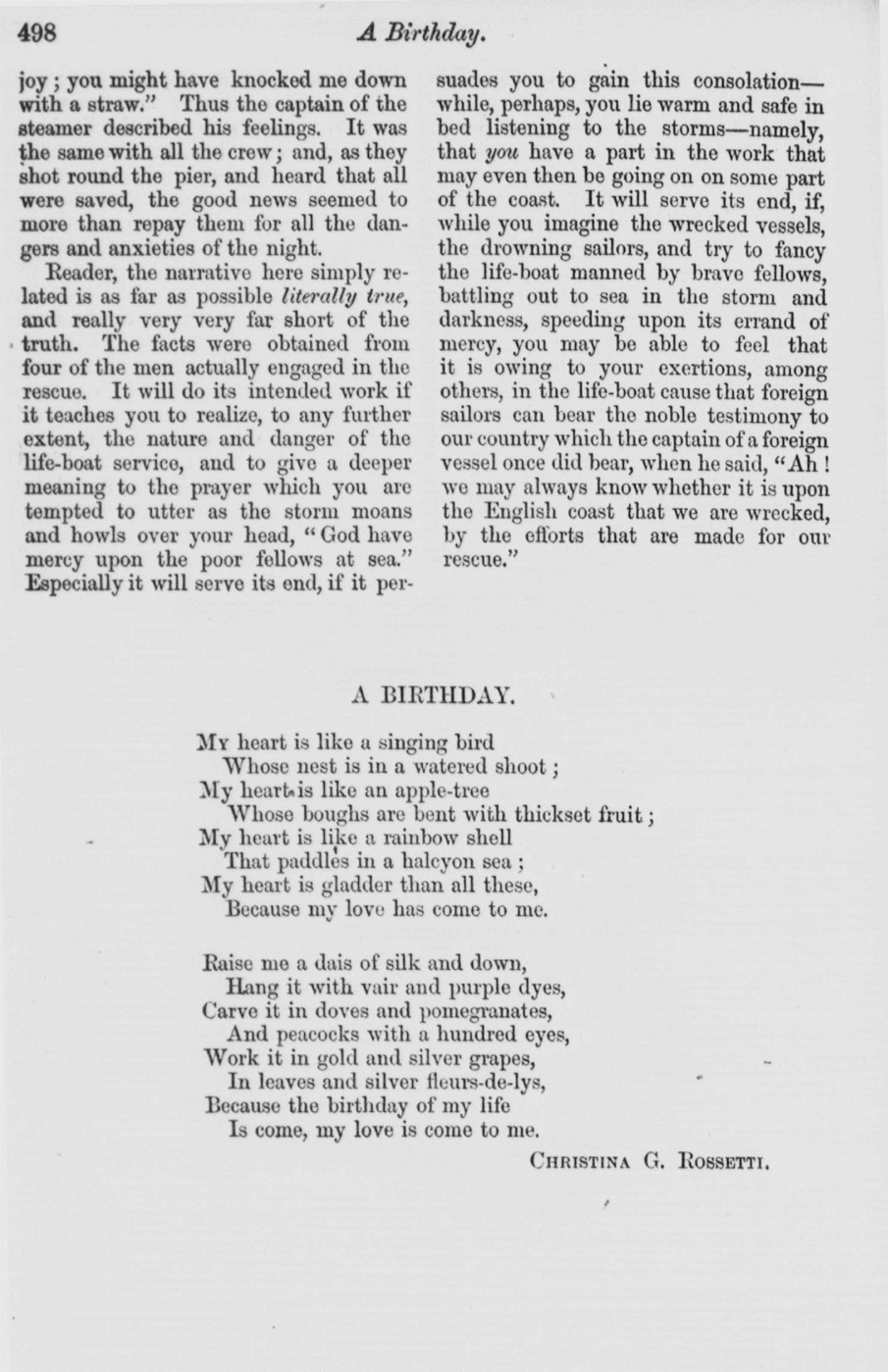
The sums mentioned in Rossetti's letters allow us only to make a good estimate of her direct income through periodical publication. In no way do they provide us with a reliable yardstick for measuring the thriving commercial afterlife of some of her pot-boilers. One poem that would turn out to become such a “universal favorite” (Hassett 5) is “A Birthday,” Rossetti's second submission to Macmillan's Magazine, published in April 1861 (Figure 11). Recent discussions of “A Birthday” have repeatedly pointed to the celebratory abundance and material richness of the poem. Isobel Armstrong notes that “the release of exuberant passion is celebrated characteristically with a ritual of artifice” (357), and Suzanne Waldman similarly comments that the “lushly aesthetic details . . . invoke sensual jouissance while alluding to biblical discourses of divine royalty and blessed plenitude” (18). Antony Harrison calls “A Birthday” “one of Rossetti's most exuberant poems and at the same time, significantly, one of her most ‘aesthetic’” (111). “Symmetrically structured in two eight-line stanzas,” it is “dense with beautiful, richly ambiguous images” (111), moving away, as it describes the speaker's delight in the prospect of love, from the nature imagery of the first part to the decorative artifice of the second. By means of these contrasting details, Harrison argues, Rossetti demonstrates that “the only true and permanent fulfillment of love is to be found in the art it gives birth to” (112).
Christina G. Rossetti. “A Birthday.” Macmillan's Magazine 3.18 (April 1861): 498. Image published with permission of ProQuest.

All critics quote “A Birthday” from Rebecca Crump's 1980s edition of The Complete Poems of Christina Rossetti without considering the original publication context of the poem in Macmillan's Magazine and Rossetti's reasons for publishing it there in 1861. Unlike the longer “Light Love” two years later, “A Birthday” is granted a single, centred column in Macmillan's on the bottom half of the page. The abundant use of white allows the poem to take up all the space it needs and more, providing a blank canvas onto which the silks and purple dyes, fruits and feathers, golds and silvers are brought into vivid relief. At the same time, the magazine half-page resists such aestheticist readings because, as Rossetti's correspondence reveals, it had first and foremost measurable monetary value for the poet: a poem that could fill that amount of space in the magazine would earn her precisely £1 1s. To put it differently, reading the poem in its original context brings out the latent tension between the speaker's conception of “the world of art” as “a bulwark against [the] mutability” (Harrison 112) of the natural world, and the poet's personal struggle to make poetry serve as “a bulwark” against financial distress. Shortly after the poem was published, D. G. Rossetti praised his sister's poems in Macmillan's Magazine as “little pennyworths of wheat, prominent among the pebbles,” speaking rather contemptuously of the poor publishing conditions offered by “Macmillan's Macademy of stones for bread” (357). While Rossetti, with the pragmatism of a businessman, was merely speaking in terms of immediate financial gain, his sudden outburst of discontentment would prove prophetic for the persistent imbalance throughout his sister's career between commercial success and personal income – between “fame” and “guineas,” as she herself would have it.
The guinea for which she parted with “A Birthday” disappears into insignificance when compared to the commodity value later accumulated by the poem through reprints and musical adaptations. Reprints appeared not only in the authorized editions by Macmillan and by Roberts Brothers of Boston, but also in English verse anthologies and collections of love poetry published on both sides of the Atlantic. Among the earliest are R. A. Willmott's Poets of the Nineteenth Century (which wrongly assumed the initial of Rossetti's middle name to stand for “Gabriella”) published by Harper in 1872 and Rossiter Johnson's Works of the British Poets (1876). The elegantly produced gift books Lyrics of Love, from Shakespeare to Tennyson (1874) selected and arranged by W. D. Adams, and Love-knots and Bridal-bands (1883) and Tablets of the Heart (1883) by Frederick Langbridge all contained “A Birthday” among other poems by Rossetti. Adams's is a cloth-bound octavo with gilt edges that sold at 3s. 6d.; Langbridge's were issued by the famous London greeting card company of Raphael Tuck and Sons who, according to a review in the Standard, cleverly disposed of their excess stock of high-quality Christmas cards by inserting them as illustrations into the volume (“New Books”). When Elizabeth Sharp published Women's Voices in 1887, Oscar Wilde was pleased to note that she had included contemporary poets like Christina Rossetti, “some of whose poems are quite priceless in their beauty” (88–89). Sharp also selected “A Birthday” for Women Poets of the Victorian Era (1890), as did her American colleague Jessie Fremont O'Donnell for Love Poems of Three Centuries published in the same year. While the British editors duly acknowledge that their volumes contain copyrighted material, some by means of a general statement, others by identifying the copyright holder for each poem, all American publications appear to consist for the greater part of pirated material. With no international copyright legislation to protect “A Birthday” against unlicensed reprinting, even Macmillan was no longer in full control of its printing history.
The poem attracted the attention not only of anthology editors but also of professional and amateur composers. Upon the first centenary of Rossetti's birth Virginia Woolf predicted:
[S]ome of the poems you wrote in your little back room will be found adhering in perfect symmetry when the Albert Memorial is dust and tinsel. Our remote posterity will be singing: When I am dead my dearest, or: My heart is like a singing bird, when Torrington Square is a reef of coral perhaps and the fishes shoot in and out where your bedroom window used to be. (“I Am Christina Rossetti” 244)
As Constance Hassett rightly points out, Woolf “is referring to actual singing, for the poem became a performance piece as soon as it appeared” (5). At least eight musical settings were written by British composers and published as sheet music during Rossetti's lifetime, some by the leading music publishers of the day. “My Love is Come” by Signor Traventi, composed in 1866 and published by Duncan Davison in 1868, no longer exists. The British Library holds copies of other settings entitled “A Birthday” by F. E. Gladstone (1872), A. C. Mackenzie in Three Songs issued by Novello (1878), Adrienne Ardenne (Weekes, 1891), and Frederic Cowen (1893); “My Heart is Like a Singing Bird” by Henry F. Schroeder (1866) and Nita Gaetano Moncrieff (Boosey, 1882); and “My Love is Come” by Theo Marzials (1882).
Because most composers kept the instrumentation fairly simple, writing for voice and piano alone, and did not make high demands on the singer's vocal range and technique, their music was readily consumable by performers of varying degrees of skill as well as their audiences. Newspapers and music magazines such as the Musical Times, School Music Review, Musical Mirror, and Musical Standard not only document the publication of settings through advertisements and reviews, but also provide ample evidence of live performances: Mademoiselle Liebhart singing the song at Signor Traventi's soirée musicale on 5 July 1868; Nita Moncrieff singing her own composition at the Albert Hall in Nottingham on 23 February 1882 and the London Steinway Hall on 29 June 1886; Theo Marzials singing “My Love is Come” at an amateur concert in Chester on 2 January 1882; Lady Breadalbane singing Moncrieff at the annual concert of the Kenmore Choral Union on 28 December 1882; Marzials performed by Frank Quatremayne, Herbert Thorndike, and Gabriel Thorp; and various other professional and amateur performances in concert halls and chapels across the country.Footnote 4
Even fictional characters joined in the singing. In the opening scene of Ada L. Halstead's 1892 novel The Bride of Infelice, the young Alice Meredith sings “My Love is Come,” accompanying herself on the drawing-room piano while her admirer, the man she eventually marries, is watching her secretly through the window.
She let her fingers stray deftly over the keys in a brief and happy prelude; then her white throat swelled, and her voice throbbed out full, clear and sweet as a silver bell, to search the gloaming and to vibrate through his soul until it seemed to leap from its dwelling place to soar deliriously in the bent of the heavenly strains: –
“My heart, my heart is like a singing bird,” . . .
What had prompted Alice Meredith to sing “My Love Is Come” on that of all nights in her lifetime? (7)
A story in the Ladies’ Treasury for November 1893 opens with a similar scene. A man walks into a room where a young woman is playing “a rippling accompaniment” on the piano, “singing a melody in a soft undertone,” unaware of the visitor standing behind her.
A lovely voice it was, remarkable for sweetness and fullness rather than for compass – its purity of tone was worth the execution of a finished singer. . . . The words of the song were quaint, the melody had a gladness somewhat rare in modern days, and Ella Caswell sang as if her heart echoed the joyous refrain.
“My heart is like a singing bird, whose nest is in a watered shoot.” (Gorton 653–54)
Likewise, Anna Rogers in M. A. Makins's “Won by Stratagem,” published in Belgravia in April 1889, wins the admiration of a man by singing.
Quietly, and without effort, Miss Rogers struck a few chords and then began to sing. She had chosen that song “My love is come,” and surely never before had those passionate words been sung with so much passion. Vanished was that hard, cold voice, and in its place a rich full contralto rang out in the evening air, which reached the passers-by, and made them pause to listen, and to envy such a glorious gift. (217)
In all three stories, musical settings of “A Birthday” play a key role in the development of the love plot.
Rossetti must have been particularly happy with the settings by Signor Traventi and Theo Marzials. Traventi was an old family friend who previously composed music to her father's poetry and wrote his song in consultation with the poet: “Traventi called at Albany Street,” William Michael Rossetti reported in his diary on 21 November 1866, “wishing Christina to make some verbal alterations in the Birthday, to make it more intelligible when set to music; she consented” (Rossetti Papers 197). Earlier that year, Traventi also set “Song. [When I am dead my dearest]” to music. “How delightful, my song at Traventi's concert,” Rossetti wrote to Amelia Barnard Heimann, “nicely set too, as Maria reports” (L311). The young baritone Theo Marzials sang at Dante Gabriel's house in Cheyne Walk in the 1870s (Munro 5) and asked Christina permission for himself and Nita Moncrieff to set “A Birthday” to music in February 1881. Rossetti replied:
You and Mrs Moncrieff give me pleasure by making use of my words as you propose. Pray oblige me by making her welcome to the Birthday. As to “tariff” I have none! But if not the musician but the publisher is paymaster, and if other writers of words sell such permissions, I suppose I may as well do as they do. (L935)
Although Macmillan owned the copyright to “A Birthday” and requests for reprints consequently had to be addressed to him, permission to set the poem to music had to be given by Rossetti. Yet it was not until Marzials invited her to name her price that she realized that such permissions could be sold rather simply granted. “I have never yet received anything on such an occasion,” she explained, declaring herself to be “quite ignorant of what is thought of such a transaction” – “if it is considered more decorous not to take money at all please forbear.” No record of payment exists, but on 30 May she thanked Marzials in a letter for sending her flowers and concluded with the wish: “May our combination of music & words make up as faultless a harmony. Yours shall be, as it ought to be, the lordly & dominant element, so long as mine may hope to be recognised as ladylike & retiring” (L1020).
Still, Hassett's assertion that musical adaptation was “a form of tribute that frankly pleased [Rossetti]” (5) needs qualification, since most composers who contacted her were strangers rather than friends like Traventi and Marzials. In December 1864, while residing at Hastings, she received requests for settings of “Echo” by Virginia Gabriel, “From House to Home” by the Rev. Robert H. Baynes and “Song [When I am dead my dearest]” by Alice Mary Smith. With regard to Virginia Gabriel's plans with “Echo,” she wrote to her brother: “I am truly pleased at the honour done me by Miss Gabriel. Echo, expectant, awaits her musical echoes” (L249). To express her approval, Rossetti again drew on the metaphors handed to her by her own work, as she had done the previous month when reporting on the progress of the Prince. Here it is “Echo” who figures as the personification of her own anticipation of Gabriel's setting. Why she chose thus to accentuate her close bond with the poem becomes clear in the subsequent sentence: “It is quite a pleasing variety to be asked for something that is mine, instead of for Uphill or the Birthday.” As poems published on half profits in Goblin Market, the copyright remaining with the author, “Echo,” “From House to Home” and “Grown and Flown” were Rossetti's legal as well as her intellectual property. “Up-Hill” and “A Birthday,” by contrast, were magazine pot-boilers to which Macmillan held the copyright and which Rossetti consequently no longer considered hers. As the popularity of these poems among composers grew, her claim that “the more of my things get set to music, the better pleased I am” (L235) increasingly meant “the more of my things get set to music, the better pleased I am.” As the correspondence with Marzials suggests, it was not so much a money issue as an issue of artistic integrity. Recognition from fellow artists was most gratifying to Rossetti when it was paid to her for works she considered to be among her best and held closest to her heart.
The Poet Laughs Last
As Rossetti was well aware, the decision to sell the poems limited her material and intellectual control of their journey through various print editions and artistic media. She may not have been surprised, then, to learn towards the end of her career that three of her best-known poems, including two pot-boilers, had become the object of parody in a London comic magazine. In his 1904 edition of The Poetical Works of Christina Rossetti, William Michael Rossetti reported that “in some illustrated comic paper a parody of [‘A Birthday’] was printed” (481). Betty Flowers mentions the existence of the parody in her notes to Crump's edition of The Complete Poems (892) but not does identify the magazine. “An Unexpected Pleasure” was published in Judy: The London Serio-Comic Journal on 29 February 1888, followed by “Song [When I'm out dining, dearest]” on 28 March and “Remember,” parodying the eponymous sonnet from Goblin Market, on 18 April. All three poems carefully mimic the structure of the originals while bluntly vulgarizing their contents. In “Song,” the anonymous parodist asks his wife not to sit up late, but rather to “Be a long glass on salver / With Schweppes and brandy set” (lines 5–6) for when he comes home drunk with wine, longing for a nightcap. In the second stanza he warns her of the negligence and lack of responsibility that go along with drunkenness:
“Remember” is addressed not to a loved one but to a friend or acquaintance who has debts with the speaker and despite talking of “repayment sagely planned” (6) fails to proffer the money.
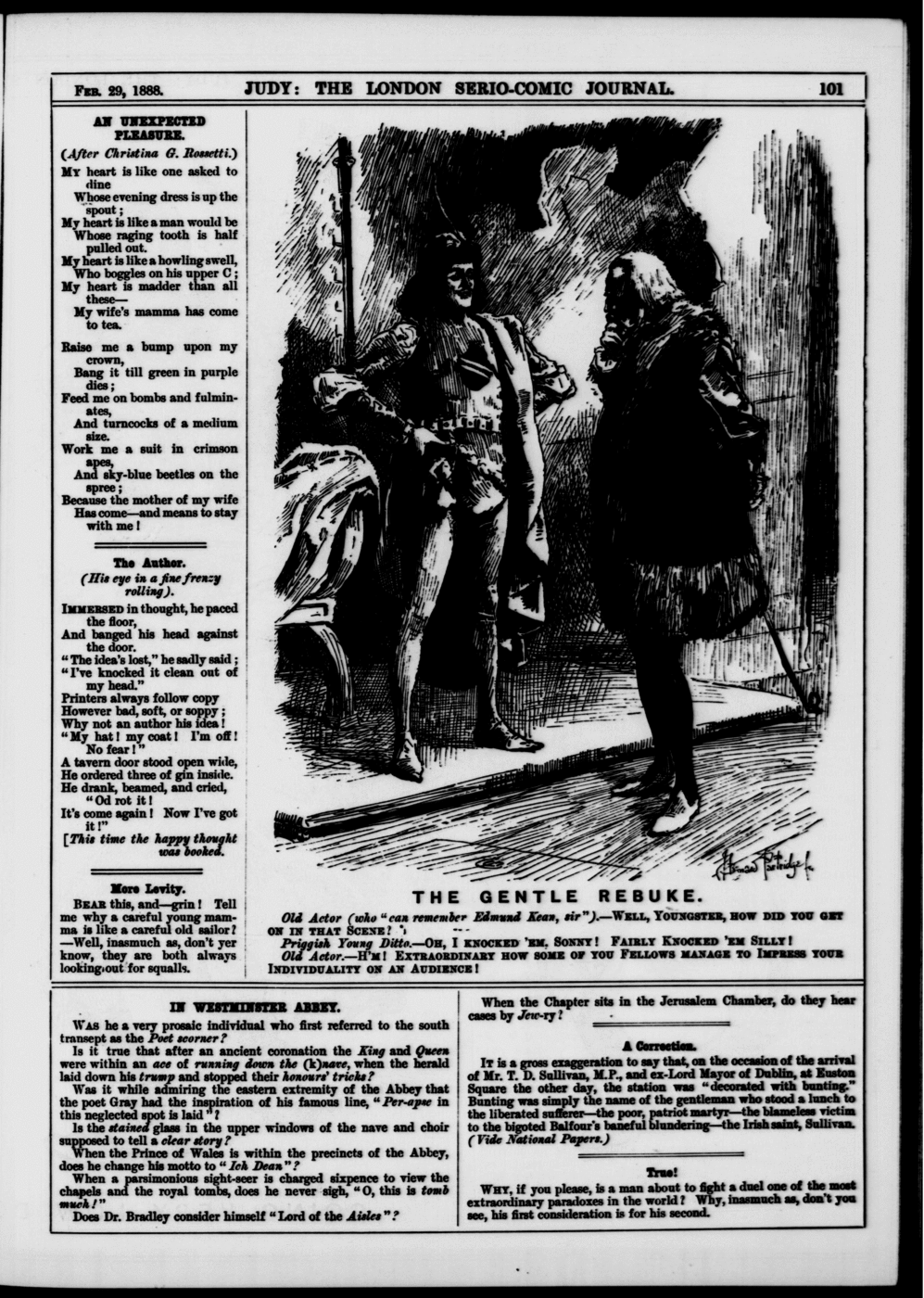
Whereas the sex of the speaker in “A Birthday” is indeterminate, most readers tacitly assuming it to be female, “An Unexpected Pleasure” portrays a married man losing his temper because his mother-in-law has come to visit with no intention of leaving any time soon (Figure 12).
The idyllic nature similes of the first stanza have been replaced with grotesque human, more particularly male, imagery of mishap and pain, with a sly reference to the popularity of the original poem among amateur singers. The second stanza “expertly preserves [the] acoustic extravagance” of the original “by outlandishly topping it” (Hassett 9) as the sensory appeal of the rich colours and fine textures gives way to the green and purple of bruised skin, the deadly taste of explosives, and clothes made out of absurdly coloured drunk animals. The layout of the parody completes the down-market reworking. Rather than swimming in white space like “A Birthday” in Macmillan's a quarter of a century earlier, the poem has been relegated to the side of the page by a large cartoon and crammed into a column that is obviously too narrow, pushing the last words of each line to the next.
“An Unexpected Pleasure. (After Christina G. Rossetti.)” Judy, or the London Serio-Comic Journal (29 Feb. 1888): 101. Image published with permission of ProQuest.
According to William Michael Rossetti, Christina was so “amused” by “An Unexpected Pleasure” that she “pasted it into a copy of her Poems, 1875” (481). I agree with Hassett that “An Unexpected Pleasure” paid the poet “the compliment of superlative parody” (9), but I think Rossetti's reasons for liking the poem are more complex and more personal than Hassett suggests. A collected edition of previously published works, the 1875 Poems was officially titled Goblin Market, The Prince's Progress, and Other Poems. It united the longer poems first published on half profits to which Rossetti had devoted so much time and effort, such as “The Prince's Progress” and “Goblin Market,” and the pot-boilers, some of which had until then only appeared in periodicals. By cutting the parody out of its original periodical context and pasting it into her copy of Poems, Rossetti not only recognized and even cherished its parasitic reliance on her work, but also symbolically reversed both the original transfer of “A Birthday” to the Macmillan company and the multiple acts of appropriation and adaptation that had turned the poem into a popular cultural commodity. Unlike the reprints, the parody directly engaged with the intellectual substance of, and consequently with Rossetti's inalienable moral rights to the poem. Publicly acknowledging to have been written “After Christina G. Rossetti,” it served as a playful reminder to the poet that while the copyright to “A Birthday” had long been sold to her publisher, her authorship and authority remained intact.
Shortly after Rossetti's death, a reviewer of Mackenzie Bell's biography noted in Belgravia: “There are some, I dare say, who have scarcely ever heard of Christina Rossetti; to most people she is known only as the author of ‘When I am dead, my dearest,’ ‘My heart is like a singing bird,’ and other lyrics which have been successfully set to music” (Adams 315). Later Virginia Woolf not only envisioned “our remote posterity” singing the two songs when “Torrington Square is a reef of coral” but also identified “A Birthday” as “what women hummed at luncheon parties before the war” (Room of One's Own 16). The humming women aptly serve as a synecdoche for the general public's familiarity with the poem at the turn of the century, when it was so well known as a song that the lyrics had become redundant and the poet who originally supplied them no longer needed to be named. Once written not for “remote posterity” but out of financial necessity, “A Birthday” effortlessly survived as a tune without words, a poem detached not only from its material body but also from itself. Rossetti's cutting and pasting of the parody, then, signal her return to the material text, recalling her preoccupation with the physical process of writing at the beginning of her career, when in the winter of 1864 she nervously “unloose[d] the Prince” to start working on the unfinished poem. This time, however, she did not do so with reluctance, but with the amusement of someone who in later life had learnt to appreciate the irony and humour in the fact that the one-guinea pot-boiler had become one of the most popular poems of her time.