INTRODUCTION
Unplanned school closures (USC), defined as closures that are not on the original calendar prepared at the beginning of the academic year, occur for many reasons such as inclement weather, natural disasters, teacher strikes, and illness outbreaks.Reference Wong, Shi and Gao1 These closures can range from 1 day to several weeks in a single occurrence.Reference Wong, Shi and Gao1 From August 2011 to June 2017, approximately 70 000 USCs occurred in the United States. Natural disasters were the second leading cause (after inclement weather events) and resulted in the largest number of prolonged closures (those lasting 4 or more days). Ninety-three percent of the prolonged closures resulted from Hurricane Sandy, which wreaked havoc on New Jersey, New York, and Connecticut in 2012.Reference Wong, Shi and Gao1
Until 2017, Sandy was the second most disruptive and costly hurricane in US history, behind Hurricane Katrina in 2005. This record was broken on August 25, 2017, when Harvey made landfall near Rockport, Texas, as a Category 4 hurricane.Reference Samenow2 Harvey moved throughout Southeast Texas for several days and produced record-breaking rainfall.Reference Samenow2 As the hurricane weakened and continued on its path, it took its toll on other states, such as Louisiana and Tennessee.Reference Samenow2 In response to the threat and the damage caused by this natural catastrophe, many schools closed, beginning August 23, 2017, and remained closed for a number of days to weeks, affecting more than 1 million students.Reference Kindelan3
Studies have shown that monitoring and analyzing the characteristics of USCs outside of an influenza outbreak provide context for how communities may cope with a recommendation for preemptive closures as a mitigation strategy in the event of an influenza pandemic.Reference Wong, Shi and Gao1 By conducting a content analysis, we are able to gain a more comprehensive view of the impact of USCs caused by hurricanes or other events on an educational community. Investigating these types of closures has helped in developing guidance for disaster planning and can also be used as a proxy to understand the potential community response to preemptive, USCs.Reference Zheteyeva, Rainey and Gao4,5 Therefore, we conducted this study using publicly available information to better understand and describe the underlying reasons and characteristics of the USC due to Hurricane Harvey.
METHODS
Data Collection/Data Management
As part of an ongoing project within the Centers for Disease Control and Prevention (CDC) Community Interventions for Infection Control Unit, Google, Google News, and Lexis-Nexis are searched systematically each day to explore usability of publicly available data for monitoring school closures lasting 1 or more days in the United States.Reference Wong, Shi and Gao1 The search is primarily conducted using the following search terms and phrases: “school closed,” “schools closed,” “schools are closed,” and “schools will be closed.” The closures are recorded in a database, and the resources that contain the information regarding the event are saved. The USCs are verified through other sources, such as the school or school district’s website or social media (eg, Twitter and Facebook), if possible.
For the purpose of this study, all closures associated with Hurricane Harvey were extracted from the aforementioned database along with the resources and verification for each event. To ensure that the data were clean, duplications between reports of district and individual school closures were eliminated by comparing the district identification numbers from the National Center for Education Statistics database and the closure dates for each school and school district. One person reviewed each report and extracted any information that was directly or indirectly related to school closures from the resources and verifications. If the initial resources and verifications that were collected prompted further investigation, similar information was also collected from other news sources or schools’ social media posts. For example, if the initial resources did not mention a reopening date because a date had not yet been announced by the school or school district, or if the article was vague in describing the extent of the physical damage to the educational structure, we used Google to search for additional information. Articles containing any relevant new information were saved.
Content Analysis
The content deemed relevant in characterizing USCs caused by a natural disaster was extracted and placed into categories based on content questions by 1 extractor. These content questions were predetermined by taking a 10% sample of previously collected resources associated with closure events that occurred in each state affected by Harvey and evaluating the recurring reasons and characteristics. These questions served as the template that was used to extract the content. The resulting questions include the following:
1. Did the school close or remain closed due to structural damage caused by heavy rain, flooding, the wind, or a tornado?
2. Did the school close due to power outages?
3. Did the school close due to flooding in the area?
4. Was the school used as a shelter during the unplanned closures?
5. Did the school act as a dispatch facility for necessities, such as food and clothing?
6. Does the source mention whether students were relocated to a different school? If there was a change of location of the school, where was it?
To simplify the results of the content analyses, the primary reasons for closures or characteristics of the closure in each content question were used to form predominant characteristic subcategories. The subcategories were then truncated to form the main emerging reasons for closures.
Maps of the districts and schools that closed because of Harvey were created using the ggmap and ggplot2 packages in R version 3.4.0 (R Foundation for Statistical Computing, Vienna, Austria) via the RStudio interface version 1.0.153.
The project underwent an ethical review at the CDC and was determined not to involve human subjects; therefore, it was not subject to institutional review board review requirements.
RESULTS
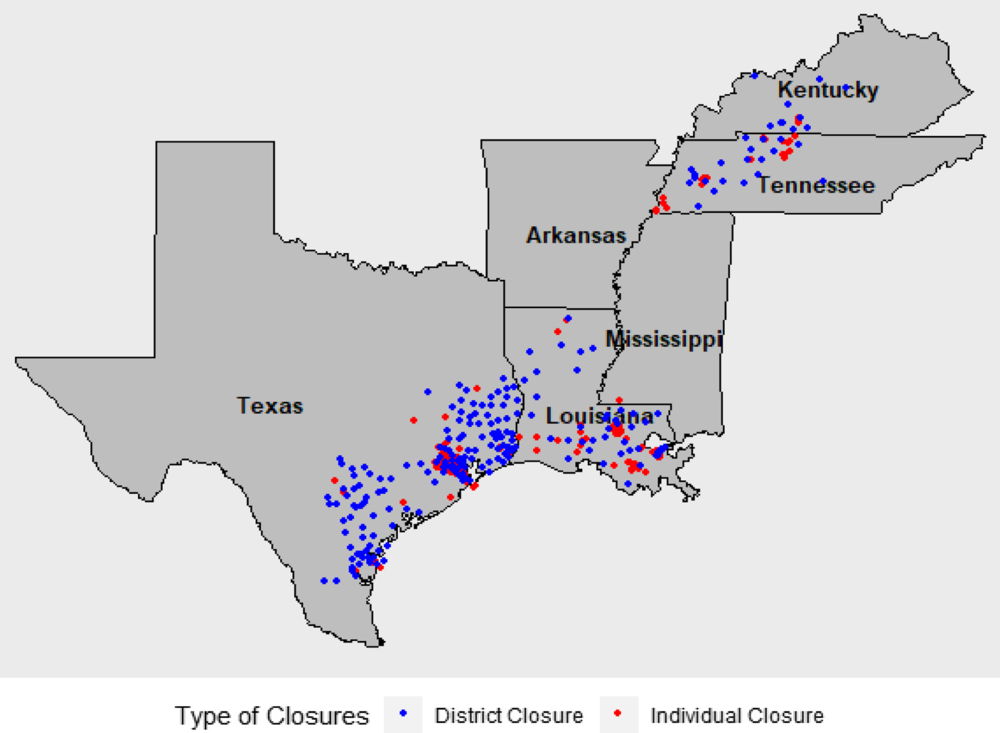
There were a total of 3026 USC events due to Hurricane Harvey (Table 1). Of the school closures, 2735 (90%) were part of 214 district-wide closures, and 291 were individual school closures. Figure 1 illustrates that most of the school closures occurred in Texas (63%, n = 1916), whereas the remaining closures occurred in Louisiana (25%, n = 759), Tennessee (9%, n = 274), and Kentucky (3%, n = 77). For the 2381 schools whose reopening dates were reported in a district-wide closure announcement via a news source, school website, or social media platform, 39% closed for 1 to 3 days, 12% closed for 4 to 6 days, and the remaining 49% closed for 7 days or more. For the 122 individual school closures that reported a reopening date, 66.4% closed for 1 to 3 days, 18.0% closed for 4 to 6 days, and 15.6% closed for more than 7 days. All of the schools that closed for 7 or more days were in Texas.
Characteristics of Publicly Announced School Closures Due to Hurricane Harvey (2017) by State and by Stated Reason

a Individual-level school closures.
b Schools closed as part of a district-wide closure.
c Lengths of closures were computed from 122 individual schools and 170 school districts that had this information reported through a collected source.
d The reasons/subcategories for school closure were determined based on a 10% sample of information associated with closures that occurred in each state impacted by Harvey.
e Reasons/subcategories are not mutually exclusive.
* The exact number of schools could not be determined based on the information given in the sources that were collected.
Locations of Individual-Level or District-Wide School Closure Events in Texas, Louisiana, Tennessee, and Kentucky, Caused by Hurricane Harvey, 2017

Information pertaining to at least 1 of our categories was available for 61 districts, which account for 1245 schools, and 34 schools that closed at the individual level. Three reasons emerged for the closures: infrastructure damage, use for resource allocation, and displacement. Some information from a given school or school district was classified in more than 1 category. Examples of the reported information include the following:
1. Infrastructure damage – “After receiving notification and new information from municipal utility districts that serve our campuses, we have learned that several campuses are affected by sewage issues.”
2. Infrastructure damage – “Due to the lingering effects of Hurricane Harvey and continued power outages, all [Texas school district] schools and facilities will remain closed through Tuesday, August 29th.”
3. Displacement and infrastructure damage – “Many of our students and employees are currently being displaced from their homes due to rising flood water, and more rain is expected over the next 2 to 3 days.”
4. Resource allocation – “If you are in the [Texas] community and need a place to go to escape the flood, come to the [Texas school district] school. We have plenty of space, power, hot food, water, shower facilities, and other supplies.”
5. Displacement – “[Texas school district] students return to school at [Texas school district] High School on 9/7/17.”
6. Resource allocation – “The school district and its partners have successfully launched [Texas school district] Cares, a resource center for families in our area. The center has clothing and shoes for youth and adults, hygiene products, and school supplies.”
Nineteen school districts indicated that all of their schools closed because of structural damage from heavy rain, flooding, wind, or tornadoes. All 19 districts were in Texas and remained closed for 6 to 11 unplanned days. These 19 school districts account for 692 schools, but the number of schools that had only minor damage could not be determined from the sources that were collected. Nineteen schools in 7 districts had significant structural damage, and the students and staff were relocated to other schools or facilities. In addition to the district-wide closures for structural damage, schools also closed or remained closed because of power outages (n = 83) or flooding (n = 790) in the surrounding areas caused by Harvey and its aftermath (see Table 1). For individual-level school closures, the reported reasons were lack of power (n = 13) or flooding (n = 21) in the area. The exact number of schools that did not have power could not be determined from the information in the sources that were screened.
Some of the closed schools in Texas (n = 14) were used for providing food and other necessities that were scarce or harder to access after the natural disaster. These schools were all in closed districts; we did not find that any schools that closed individually were used for this purpose. Furthermore, 22 schools that closed as part of district-wide events were used as shelters (see Table 1).
DISCUSSION
Our qualitative analysis of characteristics of USCs in response to Hurricane Harvey using publicly available sources showed that schools and districts throughout Texas, Louisiana, Kentucky, and Tennessee remained closed for various numbers of days for reasons due to the immediate effects of the hurricane. The most prominent reasons for the closures were power outages, flooding in the area, and structural damage to the school buildings. Most of the closures occurred in Texas, and almost half closed for 7 days or more for those that reported dates of reopening. Some closed schools in Texas were used as community shelters or as locations for providing food or other resources.
Texas schools were the most impacted, as expected, because of the landfall location and the unprecedented rainfall that lasted for several days, causing historic flooding.Reference Samenow2 These weather conditions devastated multiple schools. Those schools that sustained major damage and were not able to be repaired in a timely manner relocated to nearby vacant facilities or merged with other schools in their district until the school buildings were repaired.6 For those school districts that closed indefinitely, the students who were not completely displaced were allowed to enroll in other school districts under the McKinney-Vento Homeless Assistance Act.Reference Alvarado7 This federal law states that students who have been deemed homeless because of a natural disaster are allowed to enroll in another school district.8
Schools and school districts did not report how they would make up the days that were missed in the sources available to us. This was expected because the Texas Education Agency determines how missed instructional time will be accounted for. The Texas Education Agency requires that schools have a minimum of 75 600 minutes of instruction per academic year.9 Texas schools normally add hours to the calendar to account for days missed because of bad weather or other emergencies. In the event that a school does not meet the time requirements, its funding could be reduced. In response to Harvey, the Texas Education Agency allowed schools and school districts within the 58-county disaster area to apply for a missed school day waiver.9,10 If the waiver was granted, schools and school districts did not have to make up days that were missed from September 5, 2017, to September 8, 2017.10 The number of days waived could not exceed 4 days or 420 minutes per day.9 If it did, the schools had the options of using the additional minutes that were built into their calendars or extending the school year by the necessary minutes.9,10 These strategies to account for missed school days or hours have been used during similar events, such as Hurricane Irma.Reference Atterbury11 Online distance learning is an alternative strategy that could maintain continuity of instruction during some emergencies; however, Harvey was so destructive that many students did not have power or were displaced from their homes.Reference Schwartz, Ahmed and Tamargo12
There are some limitations in our study. Detailed information that was analyzed in this study about school closures is limited to that released or captured through public media sources. Additional information could have been sent to parents and others in the community through phone calls, e-mails, and text messages, or information could have been unreported entirely. Also, reasons for closures were available for only 12 percent (34/291) of individual school closures and 29% (61/214) of district-wide events, so the results may not be generalizable to the other schools or districts for which reasons were not announced or captured through our searches.
During an emergency situation that prompts a USC, the ability of schools to adjust and have an effective response may be of concern. Having a plan in place will help resolve possible issues. Our study indicates that there may be potential options for advance planning that aids in a better, more effective response. For instance, plans to provide additional resources in an emergency will allow schools to enroll more displaced students. Another potential option is having a plan in place to implement distance learning when possible to help schools meet the required educational hours. Furthermore, these findings inform short-term closures but could also be used to inform planning for longer closures, such as those that may be recommended in an influenza pandemic response.
CONCLUSION
In conclusion, studies on the unplanned closure of individual schools or entire school districts may be used to understand and help mitigate the challenges that educational communities experience during and after natural disasters or other large-scale emergency events. The information gained by such studies can help inform preparedness planning for emergency events, including events such as influenza pandemics when preemptive, coordinated school closures or dismissals may be recommended as part of the response efforts.Reference Qualls, Levitt and Kanade13
Conflict of Interest Statement
That authors have no conflicts of interest to declare.
The findings and conclusions in this report are those of the authors and do not necessarily represent the official position of the Centers for Disease Control and Prevention.