

Introduction
Gastric ulceration has been studied in various horse populations, but has mainly been found in racehorses and sport horses (dressage, eventing, showjumping). Various studies have shown the number of horses affected by ulcers ranges between 16% in standardbreds (Bezdekova et al. Reference Bezděková, Jahn, Vyskočil and Plachý2005) and up to 100% in working racehorses (Murray et al. Reference Murray, Schusser, Pipers and Gross1996). The adult horse's stomach is divided into two regions, the lower glandular area, where acid and mucous is secreted, and the upper, squamous region, which is paler and has no secretory structures and is not protected by mucous (Reese and Andrews Reference Reese and Andrews2009). pH in the stomach has been reported to be strongly acid, with pH values ranging between 2.7 and 3.2 (Murray and Grodinsky Reference Murray and Grodinsky1989; Nadeau et al. Reference Nadeau, Andrews, Mathew, Argenzio, Blackford, Sohtell and Saxton2000). Horses have evolved to consume small amounts of feed continuously for around 18 hours per day (Luthersson et al. Reference Luthersson, Hou Nielsen, Harris and Parkin2009), and, as such, secrete acid continuously as well (Murray, Reference Murray1997). If the stomach is empty for any appreciable length of time, which may occur during transport, before exercise or daily in animals offered a small number of large meals, this leaves them vulnerable to acid contact in the upper, unprotected region of the stomach. The resulting ulceration mainly occurs along the Margo plicatus equatorial region where the two tissue types meet.
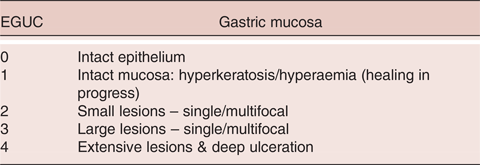
A standardised global scoring system for equine ulceration has been developed, as shown in Table 1 based on the research by McAllister et al (Reference MacAllister, Andrews, Deegan, Ruoff and Olovson1997) and Equine Gastric Ulceration Council, (1999), which is based on degree of severity and numbers of lesions.
EGUC scoring system (1999)

Algae contains many useful minerals which may be utilised in animal nutrition (Kandale et al., Reference Kandale, Meena, Rao, Panda and Babu2011) and is now being increasingly harvested for use from clean coastal areas of the world as well as being farmed on a large scale. The algal product under test for this trial (Maxia Complete®, Seahorse Supplements Ltd., Christchurch, NZ) contains high levels of minerals. Maxia Complete® contains 32% organic calcium (356,800 ppm) and other nutritional minerals (chloride 1,206 ppm; iodine 49 ppm; iron 745 ppm; magnesium 28,390 ppm; manganese 29 ppm; phosphorus 3,454 ppm; molybdenum 1.6 ppm; potassium 1,287 ppm; silicon 475 ppm; sodium 5,302 ppm; sulphur 3,756 ppm and zinc 2.4 ppm) that the algae have incorporated into their cell walls via normal metabolism, whereby the minerals are bound to sulphated polysaccharide structures (Barnes, Reference Barnes2003). Calcium acts as a buffer to stomach acids, reducing the pH of the stomach contents to prevent acid damage to the sensitive upper stomach wall and around the Margo plicatus. However, calcium in its inorganic form, whilst having this useful activity, can act very quickly in the stomach, thereby potentially reducing the necessary activity of acid, i.e. in promoting the activity of trypsin protease enzymes, which facilitate the primary hydrolysis of proteins (Frape, Reference Frape2004). It is considered that naturally occurring calcium, such as that found in algae, is more slowly available, allowing protein digestion but preventing long term ulceration by buffering the stomach acid, once it has completed its proteolytic activities. This may be useful in animals which experience periods of time between feed ingestion, where ulceration poses a major risk. Previous research has demonstrated how high calcium forages can help buffer stomach acids for six hours or more (Andrews et al., Reference Andrews, Buchanan, Elliot, Clariday and Edwards2005), and previous work using Maxia Complete® in a laboratory model of the horses gut, showed that it had a significant buffering effect, controlling acidity in the foregut and promoting correct hind gut fermentation (Moore-Colyer et al., Reference Moore-Colyer, O'Gorman and Wakefield2014). The current trial was conducted to investigate if the high natural calcium levels in algae can have the same effect in the field.
Materials and methods
Advertising for volunteer animals for this pilot study in the vicinity of Christchurch in New Zealand, resulted in 57 horses (25 sport horses, 20 standardbred and 12 thoroughbred) being put forward, which were endoscoped to assess individual levels of ulceration. Of these, ten were found to have ulcer scores (1 or more on EGUC scale) that made them suitable for taking part in the trial. This gave an ulcer rate of 17.5% in the selection population of volunteered animals. This test group comprised six males and four females with an average age of 4.5 years ± 2.51. The division in terms of breeds within the trial group of ten horses was three thoroughbreds, six standardbreds (trotting horses) and one sporthorse (mixed breed). Initial scores on the standard EGUC scale averaged 2.2 ± 0.75. After initial scoring and identification of suitable candidates (T0), the selected horses were fed their existing diets (no change – to maintain existing stomach conditions under which ulcers had established) supplemented with 40 g/d of Maxia Complete® (Seahorse Supplements Ltd, Christchurch, New Zealand) algae supplement, which was top dressed and mixed into each horses daily complete feed. The ulceration scores obtained from each horse at T0 were used as the baseline, and a further scoping was undertaken after the horses had been treated for 30 days (T30) to identify changes in EGUC scoring. Ulcer scoring was conducted after 16 hours of feed and water removal according to the methods recommended by Gordon (Reference Gordon2010) which has been previously used in published work (Stowers et al., Reference Stowers, Waldron, Pryor, Hill and O'Brien2013). The endoscopy was carried out by Mr John O'Brien BVSc. MANZCVSc. Data was analysed using T0 as the baseline point comparing the change at the T30 time point, with means and standard deviations reported. Statistics were analysed using Unistat (Release 5.5, London UK) by ANOVA in the GLM procedure of the program.
Results
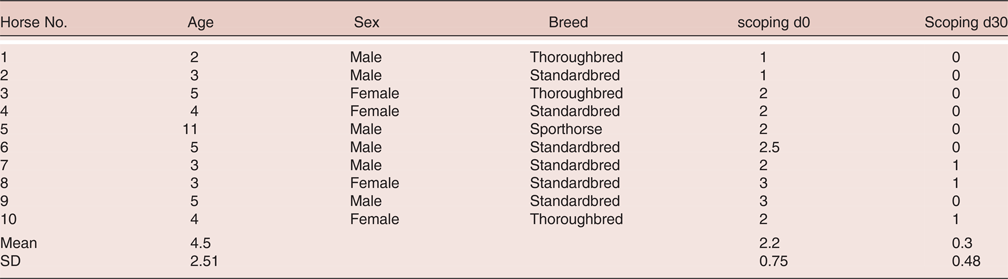
All horses were healthy and maintained good body condition score throughout the 30 day trial period. The results are shown in Table 2 below.
Trial animal demographics and endoscopy results before (T0) and after (T30) feeding Maxia Complete algal supplement to adult horses with gastric ulcers

All horses had improved ulceration scores 30 days of feeding the high calcium Maxia Complete® algal supplement, with seven out of ten having no signs of ulcers and the remaining three showing improvement to low levels of inflammation and keratinosis, most likely indicative of healing. From this initial pilot study, even though animal numbers were low and their background diets varied, the data showed that top dressing a high calcium, algal based supplement such as Maxia Complete®, significantly (P < 0.0001) reduced damage to the sensitive upper non-secretory part of the equine stomach, and thus reduced ulceration scores over a 30 day period.
Conclusions
In a small group of horses with ulceration, where diets and management were varied, feeding a natural source of calcium from algae via Maxia Complete® reduced the acid damage to the stomach mucosa over a 30 day period and resulted in reduced ulceration scores. This agrees with other research which has shown that high calcium forages (Andrews et al., Reference Andrews, Buchanan, Elliot, Clariday and Edwards2005) and other algal products tested in vitro have had a similar effect (Moore-Colyer et al., Reference Moore-Colyer, O'Gorman and Wakefield2014). The role and importance of the form of calcium, i.e. as a natural form rather than inorganic, may be important in the prevention of ulceration without affecting digestive functions in the stomach. Further work is warranted to compare this activity to inorganic calcium compounds, investigate efficacy in ulceration control and subsequent impact on protein digestion.
Acknowledgements
This pilot study was sponsored by Seahorse Supplements Ltd, Christchurch, NZ
Declaration of interest
T. Moir is the director of Seahorse Supplements Ltd, Christchurch, NZ