For several decades, scholars have analyzed the factors that motivate parties and candidates to shift their policy positions. The roots of this research tradition include the classic works of Downs, and also of Miller and Stokes.Footnote 1 Building on the theoretical foundations of this research, more recent studies identify a variety of factors that motivate parties and candidates to adjust their policy positions, including shifts in voters’ preferences,Footnote 2 changing economic conditions,Footnote 3 issue ownership,Footnote 4 and past election results.Footnote 5 Research has also revealed that these effects are mediated by parties’ organizational characteristics.Footnote 6
In recent years, scholars have also analyzed how parties’ and candidates’ positions are influenced by valence dimensions of evaluation.Footnote 7 Building on these studies, I examine the connection between changes in parties’ character-based valence attributes relating to competence, integrity, and unity (party image), and changes in parties’ policy positions. By ‘character-based valence attributes’ I mean party characteristics that voters will intrinsically value, as opposed to those attributes of strategic value to parties, such as the ability to run effective election campaigns,Footnote 8 or institutional attributes, such as party size.Footnote 9 The analyses, which include nine West European party systems over the period 1976–2003, produce two key findings. First, I find that parties’ policy positions respond to changes in their character-based valence attributes. In particular, I find that as parties’ valence attributes decline (i.e., parties’ images worsen), parties tend to moderate their Left–Right positions, i.e., valence declines exert centripetal effects on party positions. Second, I find that changes in parties’ character-based valence attributes exert lagged effects on their policy shifts. In other words, parties moderate over the course of the current inter-election period when their character-based valence attributes declined during the prior inter-election period. As I discuss below, evidence of the lagged effects of valence complements the findings of other recent studies on parties’ policy positions.Footnote 10
The findings are of interest for several reasons. First, from a purely descriptive perspective our explanations of political parties’ policy shifts gain additional depth whenever we can show the relevance of previously ignored or understudied variables.Footnote 11 Currently, I am unaware of any cross-national study which analyzes how parties’ character-based valence attributes affect their policy positioning strategies. Second, my findings are relevant to an ongoing debate regarding how parties and candidates respond when they have a valence advantage/disadvantage. Both theoretical and empirical support has been found for the proposition that valence-advantaged parties and candidates should moderate their policy positions,Footnote 12 and also for the opposing proposition that valence-advantaged parties and candidates have incentives to adopt more extreme positions.Footnote 13 I do not attempt to provide a definitive answer with regard to this debate. However, since these propositions have been largely examined either in a purely theoretical context, or empirically with data pertaining to American elections, I contribute to this ongoing dialogue by testing whether, and how, parties respond to changes in their valence attributes with comparative data from West European party systems. As I note above, my findings support the conclusion that parties adopt more moderate policy positions as their character-based valence declines. Finally, my findings are relevant to studies of political representation. Extant studies of representation emphasize the degree of ideological congruence between voters and parties. Normatively, it is often assumed that ‘good’ representation occurs when the ideological distance between voters and parties is minimized,Footnote 14 or when parties respond to public opinion shifts – the notion of ‘dynamic representation’.Footnote 15 The results presented here suggest that parties’ policy strategies are also sensitive to changes in their images with respect to character-based valence attributes. In this respect, I add to an emerging body of scholarship that also considers how political representation can be viewed in terms of the interaction between valence and policy dimensions of evaluation.Footnote 16
Considering Valence
The term ‘valence’ has been used in so many different ways that some academics grumble that it no longer has any clear definition. The first known mention of valence in relation to the discipline of political science appeared in Donald Stokes's seminal critique of spatial modeling, in which he argued that it would not do to exclude what he termed ‘valence issues’ from the discussion.Footnote 17 In subsequent writing, Stokes clarified valence issues as those issues upon which ‘parties or leaders are differentiated not by what they advocate but by the degree to which they are linked in the public's mind with conditions or goals or symbols of which almost everyone approves or disapproves’.Footnote 18 For Stokes then, valence issues represented a dimension of party/candidate evaluation, along which all voters hold identical positions (preferring more to less), such as ‘reducing crime’, or ‘increasing economic growth’, but also including desirable non policy-related characteristics such as honesty, trustworthiness, unity, competence, etc. So, for example, Stokes argued that if office-holders are shown to be corrupt, then there will be calls to remove those individuals from office. However, the impact of these calls will stem not from where the parties have positioned themselves on a scale ranging from ‘honesty’ to ‘dishonesty’, but on how closely the parties are linked with the universally disapproved symbol of corruption.Footnote 19 Alternatively, positional issues represent dimensions of evaluation, along which voters – as well as parties or candidates – can plausibly hold a range of preferred positions and would encompass debates such as those over immigration policy, the European Union, tax policy, abortion, gun control, etc.Footnote 20 Stokes's perspective of parties competing over valence issues has been applied to research based around the idea of ‘issue ownership’, whereby voters evaluate parties/candidates on the basis of which party/candidate is the ‘most capable’ at handling a given issue, rather than which party/candidate has presented the policy position most proximate to voters’ preferred policy positions.Footnote 21 Several studies present compelling empirical evidence that electoral politics are now best understood in terms of valence issues.Footnote 22
In a second group of valence-related studies, scholars perceive valence in terms of nonpolicy-related factors that can provide parties/candidates with an electoral advantage vis-à-vis their opponents. For example, scholars have highlighted the state of the economy,Footnote 23 as well as factors pertaining to the ‘incumbent advantage’, such as name recognition, fundraising skills, or the ability to win federal ‘pork’ for one's district.Footnote 24 Here, however, I am particularly interested in studies emphasizing the role of character-based valence attributes of political parties/elites. Numerous studies address the electoral impact of voters’ evaluations of leaders’ personalities,Footnote 25 while research on US Congressional elections highlights the importance of desirable candidate attributes. In particular, Mondak et al. examine the extent to which valence-based attributes, such as competence and integrity, influence the electoral success of House incumbents.Footnote 26 Similarly, several recent articles highlight the significance of candidate qualities such as honesty, diligence, integrity, and command of the issues.Footnote 27 In a West European context, recent studies have also demonstrated the electoral importance of parties’ character-based valence attributes.Footnote 28
Developing Valence-Positioning Hypotheses
Existing studies have reached differing conclusions with regard to how parties or candidates shift their positions when valence dimensions of evaluation are taken into consideration. However, the one point of agreement is that parties’ or candidates’ valence-related attributes do indeed affect their policy positioning strategies. In the majority of studies, analyses suggest that parties or candidates who enjoy a valence advantage will moderate their policy positions whereas valence-disadvantaged parties or candidates will shift to more extreme positions.Footnote 29 The general premise underlying these effects is that valence-advantaged parties/candidates have electoral incentives to move closer to the center of the voter distribution, thereby enhancing their policy appeal and minimizing their policy differences with valence-disadvantaged opponents. Absent policy differentiation, voters will be left to vote primarily on valence-related factors, and the valence-advantaged parties or candidates will be virtually unbeatable. As a result, a valence-disadvantaged party or candidate will be forced to adopt more extreme policy positions to differentiate themselves on policy grounds.Footnote 30
However, other studies reach different conclusions with regard to how valence affects parties’ positioning strategies. For example, in an American context, scholars have presented evidence that valence-advantaged candidates have incentives to move away from their district's preferences, because such an advantage gives politicians the electoral leeway to announce their sincere (non-centrist) beliefs.Footnote 31 In the same vein, Adams and Merrill present a spatial model of policy-seeking parties in parliamentary democracies and conclude that parties whose images suffer with respect to character-related valence attributes (competence and integrity, for example) will moderate their policy positions, whereas valence-advantaged parties will present more extreme positions.Footnote 32 The logic behind this argument is that valence-advantaged parties have the electoral leeway to shift their policies away from the center of the voter distribution, because these parties’ valence advantages confer sufficient electoral ‘ballast’ to compensate for their non-centrist positions. Valence-disadvantaged parties, by contrast, lack comparable leeway to propose non-centrist policies. The authors label this finding the ‘Centripetal Valence Effect.’ Somer-Topcu empirically tests the Adams–Merrill model and finds support for the effect in the context of post-communist European party systems.Footnote 33 Finally, Serra presents a formal model incorporating endogenous valence (i.e. candidates can try to improve their valence), in which candidates compete along both policy and valence dimensions of evaluation simultaneously.Footnote 34 His findings suggest a trade-off in that candidates display high valence, or low polarization, but not both, with the consequence of improving character valence being that candidates will diverge.
Hypotheses
Given these divergent theoretical and empirical findings, I propose testing competing hypotheses using original data on parties’ character-based valence attributes from nine West European party systems. In line with the research suggesting that parties and candidates moderate when their valence-related attributes improve (and vice-versa), the first hypothesis states:
HYPOTHESIS 1: (The Improvement-Moderation Hypothesis): As parties’ character-based valence attributes improve, parties will shift toward more moderate policy positions.
The second hypothesis is motivated by the Centripetal Valence Effect discussed by both Adams and Merrill, and by Serra:Footnote 35
HYPOTHESIS 2: (The Decline-Moderation Hypothesis): As parties’ character-based valence attributes decline, parties will shift toward more moderate policy positions.
Note that I do not analyze how parties shift their policy positions when their valence-related attributes improve or worsen ‘relative’ to other parties. Rather, I analyze whether parties moderate or radicalize their policy positions in response to changes in their valence-related attributes, and to consider whether any empirical evidence of policy shifts are consistent with the theoretical arguments advanced in the extant literature.
Data and Measurement
To test the hypotheses outlined above, I require longitudinal measures of both parties’ character-based valence attributes and parties’ Left–Right policy positions.
The Independent Variable: Parties’ Character-Based Valence Attributes
Measuring parties’ character-based valence attributes is not straightforward. Absent any kind of cross-national, longitudinal measures that capture parties’ character-based valence attributes, such as comparable cross-national survey data, I employ an original, exogenous, measure constructed from content analysis of Keesing's Record of World Events.Footnote 36 Similar data has been employed in several recent studies, and is discussed in each, but a brief overview is warranted here.Footnote 37
Over the course of an inter-election period, many events occur that affect voters’ evaluations of parties’ character-based valence attributes. For example, political scandals affect how the electorate views a specific party or candidate. As I note above, Stokes contended that the potency of a valence issue, such as corruption, stems from ‘how closely the rival parties are linked with the universally approved symbol of honesty and the universally disapproved symbol of dishonesty’.Footnote 38 What Stokes did not elaborate upon was how a party became linked with honesty or dishonesty. So, ceteris paribus, if a party becomes embroiled in situations where the integrity of its members is called into question, I expect these events to depress the party's image with respect to integrity.Footnote 39 It is through such valence-related events that parties become linked with certain character-based valence attributes. I am also concerned with events that reflect on the unity (i.e. internal cohesion) of political parties. Again applying a ‘Stokesian’ perspective, unity can be considered a valence issue, since virtually all would agree that voters prefer a unified party to a divided one. A party whose members publicly squabble over their party's positions, for example, does little to inspire the electorate's confidence that they can provide stable, coherent leadership as a governing party.Footnote 40 Finally, I also consider the attribute of competence in valence terms. All would agree that political elites need to demonstrate competence, and actions or events that suggest otherwise put the party at a valence disadvantage. In sum, and as Stone and Simas point out, qualities such as competence, integrity, and unity help define the character and abilities of political representatives, and as such they are intrinsically valued by voters.Footnote 41
To measure European parties’ character-based valence attributes, I require a thorough record of significant political events. Keesing's Record of World Events (formerly Keesing's Contemporary Archives) is appropriate for this purpose. Published every month for over seventy years, Keesing's provides objective coverage of global events, by drawing on worldwide press, wire services, and internet sources. These information sources are used to create detailed, comprehensive reports covering a wide range of events including natural disasters, campaigns, and election coverage, political appointments and departures, economic reports, scandals, and policy announcements. As a result of its coverage, Keesing's has been employed by researchers and journalists alike to augment their work.Footnote 42 The data used for the measurement of valence attributes must also be comparable cross-nationally as this allows for the possibility of pooling the data for the nine countries included in the study, since in any single country the universe of elections that can be feasibly studied is too small for any credible attempt at statistical analysis.
For each of the nine countries included in the study (France, Spain, Portugal, Greece, Germany, Denmark, the Netherlands, Italy, and Britain), a list of news reports was created for each year of the period 1976–2003 by using the comprehensive index, which accompanies each yearly collection of Keesing's. Each report was then content-analyzed manually to determine if it contained information that pertained to the character-based valence attributes of political elites in terms of their competence, integrity, or unity, and thus the parties to which those elites belonged. Given their relative length, it would be impractical to outline the coding procedures employed during the process of content analysis in their entirety, but here I provide an overview.Footnote 43
The content analysis procedure involved compiling a list of news articles for each country included in the study by referring to the annual index published by Keesing's. Each news report was then content-analyzed by the study's author for evidence of events that reflected upon parties’ competence, integrity, or unity. In order to aid this process, and provide uniformity with regard to the coding procedure, a set of coding guidelines was followed. These guidelines helped to assure the process of content analysis completed three tasks – first, to identify a valence event affecting a given party; second, to categorize an event as one that affected either a party's ‘competence’, ‘integrity,’ or ‘unity’; and third, to award valence events a score based upon their seriousness/magnitude. In terms of the first task, coders examined news reports for evidence of valence events. Reports that were not content-analyzed included those discussing economic conditions, those covering events related to parties’ policy positions, and changes in party leadership.Footnote 44
Reports that typically produced valence event codings included those covering political scandals such as bribery, personal misconduct (such as drug-related and alcohol-related incidents), inappropriate comments or statements such as those which were racial or anti-Semitic in nature, and abuse of official powers for personal gain, reports discussing poor performance or a lack of judgment on the part of parties or political elites, and those highlighting intra-party divisions. The guidelines instruct coders to categorize valence events affecting political elites’ behavior in violation of social and professional norms as ‘integrity’ events, while events related to performance in office (such as the handling of a crisis, or those where political elites made controversial remarks or statements) were coded as ‘competence’ events. Lastly, the guidelines instructed coders to code events covering internal party disputes as ‘unity’ events. Any ambiguity over whether events discussed in a news report should be coded or not as a valence event resulted in a default ‘do not code’ decision.
In order to keep the coding procedure relatively simple to aid reliability, a scoring scheme was implemented that awarded parties a score for each valence event affecting them of −2, −1, 0, +1, or +2 depending on the content of the specific valence-related report.Footnote 45 To determine the seriousness of any valence event identified, the guidelines instructed coders to consider several factors: how much space (in column inches) the news report received in Keesing's, the standing or importance of the party official(s) under scrutiny, the language used in recounting an identified valence event, whether a particular event involved current or former party figures, whether the same event was covered multiple times in different reports (over time), and any reported consequences of the event.Footnote 46 Relatively serious events, on the one hand, such as abuse of office by a high-ranking party official would typically result in a score of −2 being awarded to the party in question. On the other hand, less note-worthy events, e.g. the arrest of a rank-and-file party member for disturbing the peace, or an ill-considered comment, would typically result in a score of −1 being awarded to the affected party.
In theory, the scoring assigned to any pertinent events appearing in Keesing's news reports could range from +2 (for reported events that reflected very positively on political elites’ competence, integrity, or unity) to −2 (for reported events that reflected very negatively on the party). However, it was rare for the reported events appearing in Keesing's to cast political elites in a positive light, so the scores that were awarded to instances of valence-related behavior were virtually always negative.Footnote 47 In Appendix A1 I provide examples that illustrate the content of Keesing's news reports, and of how these reports were coded for evidence of events that would reflect on political elites’ character-based valence attributes and, therefore, on the parties to which they belonged.
Once news reports had been content-analyzed and coded, the scores awarded for each example of valence-related behavior were aggregated by party for each inter-election period, to coincide with the CMP data of parties’ policy positions (discussed below). For my purposes, the inter-election period started immediately after the election at t − 1 and ran up to the election at t. This resulted in a series of cumulative valence scores for each party for each inter-election period. These cumulative valence scores were then used as my measure of parties’ character-based valence attributes in the statistical analyses reported below. In order to calculate the change in each party's valence score from one inter-election period to the next, I took the difference between each party's cumulative valence score over the prior inter-election period (between t − 1 and t − 2), and the current inter-election period (between t − 1 and t). So, if a party had a cumulative valence score of −20 over the course of the prior inter-election period, and in the current inter-election period it had a cumulative valence score of −5, then the ‘change in valence score’ between the two periods would be +15 for the party in question (i.e. the change from −20 to −5).
One concern raised by the process of content analysis is the reliability of the valence scores produced. Despite coding guidelines, it is possible that a different coder could award different scores to the news reports taken from Keesing's Record of World Events. In order to address inter-coder reliability, a second coder followed the coding guidelines, and content-analyzed and coded the news reports from most of the countries included in the study, and the resulting inter-coder correlations between the author's codings and those of the second coder were as follows: France: 0.76; Spain: 0.93; Portugal: 0.70; Greece: 0.75; Germany: 0.70; Britain 0.82. These figures suggest that it is acceptable for different coders to analyze the news reports for content, and that they will award similar scores for any valence events identified.Footnote 48
The Dependent Variable: Parties’ Policy Positions
For measures of parties’ Left–Right policy positions, I make use of the data provided by the Comparative Manifesto Project (CMP),Footnote 49 a research endeavor which has coded the policy programs of parties competing in elections in more than thirty democracies in the period since the Second World War. Apart from being the only longitudinal and cross-national estimates of parties’ policies, it has been argued that these estimates of parties’ positions are plausibly reliable, because policy programs provide comprehensive and authoritative statements about the parties’ policy priorities at the time of elections. Furthermore, the heated debates within parties over the content of these public statements also signal their importance.Footnote 50 The coding procedures used to map parties’ policy positions are lengthy, and discussed in great detail in a number of CMP-related publications.Footnote 51 The coding procedure involves matching up quasi-sentences in a party's policy program with a category of policy (welfare, education, law and order, etc.) and taking the percentages of each category as a measure of the party's policy priorities. Based on these measures, the authors develop an index that measures the overall ideology for the program of each party in each election year, with scores ranging from −100 to +100, with more positive scores denoting a greater right-wing emphasis. The CMP mappings generally correspond with other measures of party positioning, such as expert placements, parliamentary voting analyses, survey respondents’ party placements, and ‘language-blind’ word scoring techniques.Footnote 52
Model Specification
A straightforward regression model is specified in order to evaluate Hypotheses 1 and 2, the Improve-Moderation and Decline-Moderation Hypotheses. Hypothesis 1 states that as parties’ character-based valence attributes improve they will moderate their policy positions, while Hypothesis 2 predicts that parties moderate their positions when their character-based valence attributes decline. To evaluate these hypotheses I specify a model where the dependent variable is the change in the party's Left–Right position in the current election compared to the previous election, relative to the voter distribution:
 $$\rDelta Pj{\rm{(}}t{\rm{)}}\ \:{\rm{ = }}\ \:{{b}_{\rm{0}}}\:{\rm{ + }}\:{{b}_{\rm{1}}}{\rm{[}}\rDelta PCBVAj(t){\rm{]}}$$
where ΔPJ (t) = the change in party J's Left–Right position in the current election (t) as compared with party J's position in the previous election (t − 1), relative to the center of the voter distribution.
ΔPCBVAj(t) = the change in the party's cumulative valence score in the current inter-election period at t, as compared with its cumulative valence score in the previous inter-election period at t − 1.
In terms of Hypothesis 1, if an improvement in parties’ character-based valence attributes causes parties to moderate their Left–Right policy positions (i.e. right-wing parties move to the left toward the center of the voter distribution, and left-wing parties move to the right), then the parameter estimate on b 1 should be positive and statistically significant. In terms of Hypothesis 2, if a decline in parties’ character-based valence attributes causes parties to moderate their Left–Right positions, then the parameter estimate on b 1 should be negative and statistically significant. Since we are interested in parties’ positional shifts relative to the center of the voter distribution, the term ΔPj(t) in Equation 1 takes into account not only the magnitude, but also the direction of the party's policy shift. Following Adams et al.Footnote 53 I coded parties as being left-wing or right-wing based upon the CMP's classification of party ‘families’, as reported in Appendix 1 of Budge et al.Footnote 54 Members of the Communist, Social Democratic and Green party families were coded as left-wing, while members of the Conservative, Christian, and Nationalist party families were coded as right-wing.Footnote 55 To construct values for each party's policy shift that indicate whether a party shifted to a more moderate or a more extreme position, parties’ rightward shifts were coded as moderating shifts in the case of left-wing parties – since these shifts plausibly moved these parties closer to the center of the voter distribution – but as radicalizing shifts in the case of right-wing parties, since such shifts plausibly moved right-wing parties away from the center of the voter distribution. Moderating shifts were assigned a positive score that was equal to the absolute value of the party shift, while radicalizing shifts were assigned a negative score equal to the magnitude of the party shift.Footnote 56 This approach entails the assumption that the mean voter position in each country is located to the right of all parties in a party system coded as left-wing in the analysis, and vice-versa. To evaluate this assumption I examined the Eurobarometer survey 31A (1989) which asked respondents to place not only themselves on the Left–Right ideological scale but the parties also, and find that the assumption holds.Footnote 57 Finally, to facilitate interpretation of coefficients I rescale the CMP data mapping parties’ policy positions over time to a 1–10 Left–Right scale.
In addition to the variables described for the basic model specification, I included several additional variables to control for factors which could potentially influence parties’ policy shifts. First, a plausible influence on a party's Left–Right strategy in the current election is the direction of the party's policy shift in the previous direction.Footnote 58 Studies by Budge and by Adams both suggest that party elites have electoral incentives to shift their party's policies in the opposite direction from their shifts in previous elections.Footnote 59 Budge argues that party elites may deliberately pursue a strategy of ‘policy alternation,’ because they recognize the need to satisfy both the moderate and radical wings of their parties, while Adams develops a spatial model in which voters are moved by a combination of policy distance, and nonpolicy considerations, and concludes that voters’ nonpolicy-related attachments (such as party identification) can give political parties electoral incentives to shift their policies back and forth over time.Footnote 60
Second, past research has hypothesized that parties may shift their policy positions depending on their electoral performance in the previous election. Budge plausibly argues that party elites’ only clear signal as to the effectiveness of their policy positions is whether their party gained or lost votes in the last election.Footnote 61 Therefore, he hypothesizes that parties will shift their policy positions in the same direction as their previous policy shift if they gained votes in the previous election, and in the opposite direction if they lost votes. In the same vein, Laver explores a decision-making rule whereby party leaders modify their party's policy position depending upon whether their previous policy shift won the party greater support, or lost them support.Footnote 62 Therefore, I also present a model specification that includes a measure of each party's change in vote share in the previous election (the difference between the party's vote share at election t − 1 and its vote share at election t − 2). This variable is labeled Previous Change in Vote Share, while the interaction between this measure and the Previous Policy Shift variable is labeled Previous Policy Shift by Previous Change in Vote Share. This latter variable is constructed so that a positive coefficient estimate implies that parties respond to past election results by shifting their policy positions in the same direction as the last time if they gained votes in the previous election, and in the opposite direction if their vote share declined.
Third, I analyze a specification which includes a lag of the key independent variable, the change in parties’ character-based valence attributes between the election at t − 1 and the election at t − 2. My reasoning relates to the temporal aspect of parties’ policy shifts, i.e., parties cannot immediately change their policy strategies in response to the changing political environment. A recent study provides evidence for such lagged effects, as the authors identify significant time lags in parties’ responses to public opinion shifts.Footnote 63 Therefore, to evaluate the possibility that time lags intervene before parties respond to changes in their valence-related attributes, I incorporate the variable Δ Parties’ Character-Based Valence Attributes t − 1 which denotes the change in the party's cumulative valence score between the previous election and the election before that. Table 1 reports summary statistics for the key independent, and dependent, variables along with their respective lags, while Table 2 provides correlation values for each individual component of the overall valence measure variable (competence, integrity, and unity) and the dependent variable, parties’ policy shifts during the current inter-electoral period (relative to the mean voter position).
Summary Statistics of Variables

Correlations between the Components of the Valence Measure (Parties’ Character-Based Valence Attributes) and Parties’ Moderating Policy Shifts

Notes: This table reports correlations between each component of the overall valence measure (parties’ character-based valence attributes) employed in the analyses, and parties’ policy shifts relative to the mean voter position as measured using the CMP data. Mean voter position determined from Eurobarometer respondent self-placement item. *p < 0.05.
Evaluating Hypotheses
The analyses presented cover 125 policy shifts by parties in nine countries over approximately a twenty-seven year period.Footnote 64 The data are treated as Time-Series Cross-Sectional (TSCS) data, and tests for party-specific effects are performed since a simple regression on pooled data can lead to invalid conclusions if there are unobserved differences between parties. The tests for party-specific heterogeneity indicate this is not a concern for the model specified above.Footnote 65 However, I estimate a party-specific effects (fixed-effects) model, since I am primarily concerned with intra-party and over-time variation of the dependent variable (as opposed to cross-national variation).Footnote 66 Second, the policy alternation findings of both Budge and Adams discussed above suggest that serially correlated errors may be of concern.Footnote 67 Including a lagged dependent variable in the model specification helps to address this concern.Footnote 68 However, a Lagrange multiplier test fails to reject the null hypothesis of no serial correlation, suggesting that this should not be a problem for the basic model specification.
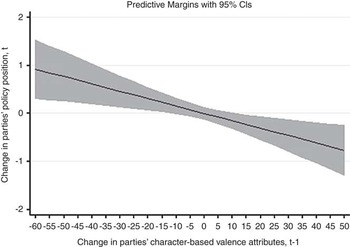
Table 3 presents the results of empirical analyses designed to assess the Improve-Moderation and Decline-Moderation Hypotheses. Column 1 of Table 3 presents the coefficient estimates on the basic model, which I label the Valence Attributes Model, which strongly supports the Decline-Moderation Hypothesis. While the coefficient estimate for the Δ Parties’ Character-Based Valence Attributes variable does not reach statistical significance, the lag of this variable, Δ Parties’ Character-Based Valence Attributes (t − 1), is statistically significant (p < 0.01). Taken together, these two coefficient estimates demonstrate two findings. First, I find no evidence in support of the Improve-Moderation Hypothesis i.e. that parties tend to moderate their Left–Right policy positions as their character-based valence attributes improve. Second, I do find support for the Decline-Moderation Hypothesis. Since the coefficient estimate for the lagged variable is both negative and statistically significant, this indicates that, ceteris paribus, parties moderate their policy positions over the current election period in response to a decline in their character-based valence attributes over the course of the prior election period. Furthermore, the magnitude of the coefficient estimate on the Δ Parties’ Character-Based Valence Attributes (t − 1) variable is substantively meaningful. The coefficient value of −0.015 implies that, ceteris paribus, a lagged decline in a party's character-based valence attributes of 25 points – which represents a change of two standard deviations in the observed values of this variable (see Table 1) – would prompt a party to moderate its Left–Right position by nearly four tenths of one unit along the 1–10 Left–Right scale used in my computations. The size of this estimated Left–Right shift is comparable to the magnitudes of the observed effects relating to public opinion and past election results identified in previous studies.Footnote 69 Figure 1 displays the relationship between lagged changes in parties’ character-based valence attributes and their Left–Right shifts, which illustrates that the marginal effects of lagged changes in parties’ valence attributes exert statistically significant effects on parties’ moderating shifts across a wide range of valence scores.Footnote 70
Estimating the Effects of Parties’ Character-Based Valence Attributes on Parties’ Policy Shifts

Notes: The table reports fixed effects OLS regression estimates. For these analyses, the dependent variable was the party's change in Left–Right policy position between the current election (t) and the previous election (t − 1). The definitions of the independent variables are given in the text. Robust standard errors are in parentheses, clustered by party. R 2 is calculated as the within-group estimator. *p < 0.10, **p < 0.05, ***p < 0.01, two-tailed tests.
Graph showing marginal effects of changes in parties’ character-based valence attributes at t−1 on parties’ policy shifts at t Note: Predictive margins with 95% confidence interval.

Column 2 of Table 3 reports the results of a model that also considers the possibility that parties respond to their past election results (measured in terms of vote share). The coefficient estimate for the Previous Policy Shift variable is both negative and statistically significant, which suggests that in the current inter-electoral period parties tend to shift in the opposite direction to their previous policy shift – a finding in line with the theoretical arguments and empirical findings advanced in studies by each of Budge, Adams, and Laver, discussed above.Footnote 71 However, I do not find evidence that parties respond to past election results, as the coefficient estimates on the Previous Change in Vote Share variable and the Previous Policy Shift × Previous Change in Vote Share variable, also reported in column 2, are statistically insignificant.Footnote 72 These results are consistent with findings reported by Adams et al. who similarly examine whether parties strategically respond to past election results.Footnote 73 Lastly, column 3 of Table 3 presents the parameters of a model that controls for shifts in public opinion, since these shifts plausibly motivate parties to shift their positions,Footnote 74 while also controlling for what I refer to as Independent Moderation, i.e. the tendency for parties to moderate their positions over time independent of any valence-related effects. While I find no evidence of a general relationship between shifts in public opinion, and parties’ moderating policy shifts, I do find support for the notion that parties moderate their policy positions over time. Importantly, the inclusion of these control variables does not affect my central findings with regards to the effects of parties’ character-based valence attributes.Footnote 75
As a robustness check on the findings reported in Table 3, I also examine whether the central findings hold when I estimate the basic model using each component of the valence measure separately. The results of these additional analyses support the findings reported in Table 3, with the coefficient estimates similar to those obtained from the analyses using the overall valence measure discussed above. Furthermore, as with the models reported in Table 3, neither the Δ Party Competence, Δ Party Integrity nor the Δ Party Unity variables measured over the current inter-electoral period reaches significance, while the lagged versions of these variables do. The one exception is the coefficient for the lagged Δ Party Competence variable, which does not reach statistical significance at conventional levels. With a relatively small N, it is not surprising that parsing the data for the measure of valence into its constituent parts invokes some changes in the significance of the variables of interest (examples of competence-related events were also the rarest over the time period covered by the study). However, even for the lagged Δ Party Competence variable, the coefficient estimate has the correct sign and is still reasonably similar in magnitude to the coefficient estimate for the lagged Δ Parties’ Character-Based Valence Attributes variable.Footnote 76
Other Sensitivity Concerns
One important issue to address concerns the cross-national comparability of the data and model. For example, it is possible that the reliability of the CMP's Left–Right coding procedures varies across countries, as some scholars have contended.Footnote 77 Accordingly, the models reported in Table 3 were re-estimated omitting one country's observations at a time from the pooled dataset. These estimates continue to support the substantive conclusions reported above and provide assurance that the results are not driven by measurement error or other factors specific to a single country.
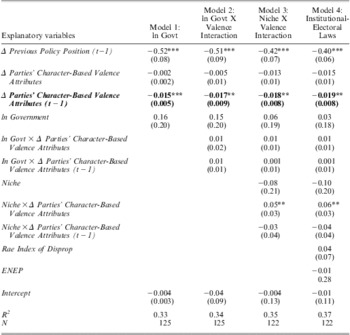
I also ran the analyses while controlling for additional factors that might mediate the effects of character-based valence on parties’ policy shifts, including whether a party was in government, party type (‘mainstream’ or ‘niche’), as well as features of the electoral laws employed in the countries included in the study. Specifically, I ran the analyses including a simply dummy variable (equal to 1 if a party was in office at the time of the current election and 0 otherwise), and I also interacted the In Government dummy variable with the Δ Parties’ Character-Based Valence Attributes variable (and the lagged version of this variable) to assess whether governing and opposition parties respond differently to changes in their character-based valence attributes. In addition, following Adams et al. (Reference Adams, Clark, Ezrow and Glasgow2006), I ran the analyses including a dummy variable equal to 1 if the party could be classified as a ‘niche’ party, i.e. a Green, Communist or Nationalist party, and 0 otherwise, and I also interacted this variable with the two valence attributes variables. Finally, I controlled for features of electoral laws by including measures of disproportionality (Rae's index of disproportionality) and the effective number of electoral parties (ENEP). The results of these additional analyses are reported in columns 1–4 of Table 4. In all cases, the substantive findings remain unchanged, with the coefficients of the key valence variables maintaining their sign, magnitude, and significance.Footnote 78
Additional Sensitivity Analyses

Notes: The table reports fixed effects OLS regression estimates for Models 1 and 2, while for Models 3 and 4 random effects OLS regression estimates are reported (since the ‘niche’ dummy is time-invariant). For all of these analyses, the dependent variable was the party's change in Left–Right policy position between the current election (t) and the previous election (t − 1) relative to the mean voter position as measured using the CMP data rescaled to a 1–10 Left–Right scale. For all models, robust standard errors are in parentheses, clustered by party. R 2 is calculated as the within-group estimator. Data for Rae's ‘Index of Disproportionality’ and ‘Effective Number of Election Parties’ is taken from the Comparative Political Dataset 1960–2009, accessed 18 April 2012. The dataset can be found online at: http://www.ipw.unibe.ch/content/team/klaus_armingeon/comparative_political_data_sets/index_ger.html.
*p < 0.10, **p < 0.05, ***p < 0.01, two-tailed tests.
A final point worth discussing concerns the assumption of orthogonality, since an anonymous reviewer has suggested that certain valence characteristics such as unity, and to a lesser extent competence, may not be orthogonal to policy. By way of example, the reviewer noted that any incidents of internal party divisions that were coded may well have arisen due to differing party factions looking to exert influence over policy direction, thus confounding the crucial distinction between my measures of valence and policy positioning. This is an important consideration since incidents affecting party unity (or its absence) tend to stem from policy disputes. In order to test the robustness of the orthogonality assumption, I proceeded in two ways. First, I re-ran the main analysis using only the Δ Party Integrity variable as the key independent variable, since the valence attribute of integrity is most clearly orthogonal to policy. Importantly, the results of the analyses employing Δ Party Integrity scores are very similar to those reported in Table 3 discussed earlier. Second, I ran a structural equation model on the three components of the valence measure – competence, integrity, and unity – in addition to changes in parties’ Left–Right policy positions. The results of this analysis suggest that a party's Left–Right position does not contribute to latent valence, while the component measures of competence, integrity, and unity do. This finding is also supported by the inter-item correlations between the three component valence measures and parties’ changes in policy positions, which are near zero in all cases, ranging from 0.06 for parties’ policy position changes and competence, to −0.002 for parties’ policy position changes and integrity (see Table 2). In sum, the evidence suggests I can have confidence that the orthogonality assumption has not been violated.Footnote 79
Summary
To summarize, I find that parties respond to declines in their character-based valence attributes by moderating their Left–Right policy positions, but that this response is lagged. There are two notable points I can draw from these findings that are relevant to existing studies of party policy strategy. First, my findings are relevant to an ongoing dialogue among scholars of party strategy. Spatial models that emphasize parties’ vote-seeking incentives generally predict that parties radicalize their policies as their valence attributes deteriorate,Footnote 80 whereas spatial models of policy-seeking parties generally predict the opposite, i.e. that policy-seeking parties will moderate when their valence attributes deteriorate.Footnote 81 My results provide empirical support for the theoretical arguments of this latter group of scholars, and in particular the ‘Centripetal Valence Effect’ outlined by Adams and Merrill.Footnote 82 This suggests the tentative conclusion that real world political party elites significantly emphasize the types of policy-seeking objectives that are highlighted in Wittman's seminal research.Footnote 83
Second, my results indicate that paying attention to the temporal nature of hypothesized relationships is an important consideration. As with other studies analyzing parties’ policy shifts, evidence of lagged effects is both theoretically and normatively reassuring – given the relative stability in parties’ ideologies over time, it makes sense that parties do not immediately alter their policies in response to changes in their character-based valence attributes over the same time period, but instead exhibit lagged policy responses. These lagged effects also make sense when one considers the time-consuming process of writing an authoritative document like a party manifesto, which can take several years to draft and then circulate among party elites and activists for feedback and potential revision.Footnote 84 Given these concerns, parties cannot simply change their Left–Right policy positions ‘on the fly’. On this point, I note that while I have presented evidence on how European parties adjust their Left–Right policy positions in response to changes in their character-based valence attributes, my discussion as to ‘why’ party elites behave in this way is limited to the competing spatial theories with regard to how valence and policy positioning relate to one another. It is beyond the scope of the research presented here, but systematic analysis of internal party documents, as well as the personal documents of political elites such as diaries and memoirs, may shed light on the individual decision-making processes of party leaders and strategists when their party has seen its image suffer or improve.
Third, it is also worth thinking about the strategic implications of these findings for parties. Parties cannot ‘control’ their valence attributes per se, beyond trying to ensure their members stay out of trouble, act in the public interest, and avoid publicizing intra-party disputes. In this respect, parties can work to foster greater professionalism among their office-holding members, but such efforts will always run into the vagaries of human nature. In short, a party's valence-related image is essentially ‘exogenous’, since it will depend upon maintaining discipline in the ranks, and hoping that party elites do not appear in the news for the wrong reasons. The exogenous measure of valence used in this study contrasts nicely with recent research by scholars such as Serra, who presents a model in which candidate valence is endogenous, in that candidates can work to improve their valence attributes via obtaining advanced educational degrees, gaining political experience in relevant jobs that should improve their competence, and so on.Footnote 85
Finally, I believe these empirical findings shed light on the oft-ignored role played by parties’ valence-related attributes. The existing literature on parties’ policy strategies has been strongly influenced by normative and theoretical arguments regarding political representation and, more specifically, how parties locate themselves in response to shifts in attitudes among the electorate or various sub-constituencies.Footnote 86 My analyses suggest that research should also consider the role played by parties’ character-based valence attributes. In this respect, my findings dovetail with the works of several scholars whose research highlights that electoral competition involves the interaction between policy and valence with important implications for the process of political representation.Footnote 87 For example, defining valence in terms of ‘character valence’, as I do here, Serra argues that his findings suggest a trade-off: candidates display high valence or low polarization, but not both, with the consequence of improving character valence being that candidates diverge on policy. Given this finding, he argues that voters might be better off overall by ‘suffering some polarization in exchange for higher valence’.Footnote 88 In a similar vein, Adams et al. conclude that ‘candidates with desirable character qualities have incentives to provide good quality representation as well.’Footnote 89 Viewed in terms of political representation, my findings suggest that European electorates can also benefit from parties who are cognizant of both dimensions of evaluation, since a decline in valence tends to push parties closer to the mean voter position, thereby providing enhanced policy representation. In line with Serra's conclusions, however, it would appear that even in European party systems there are trade-offs involved – all else being equal, voters can have either lower polarization or higher valence, but not both.
Appendix A
To illustrate the typical content of a Keesing's news report, and to provide some idea of how a Keesing's news report would be coded, several examples are provided below. The first example is an excerpt from a June 1993 report regarding Germany:
Resignation of Mollemann – Cabinet Reshuffle
Jurgen Mollemann resigned on Jan. 3 as Vice-Chancellor and Economics Minister after it emerged that he had used his influence to promote a product manufactured by a relative's company. Mollemann, who had been Economics Minister since January 1991 and Vice-Chancellor since May 1992, initially claimed in a December statement that pre-signed blank writing paper, intended for use when he was out of the office, had been used by an aide without his knowledge. In his resignation statement, however, he admitted that he had signed letters to supermarkets promoting the security devices for supermarket trolleys.Footnote 90
The Free Democratic Party (FDP), to which Mollemann belonged, was awarded a score of −2 in the ‘integrity’ category for this valence event. Following the coding guidelines, the above would be considered a serious event because of who was involved (a high-ranking party official), and because of what happened (abuse of office resulting in resignation). The event falls into the ‘integrity’ category because Mollemann took advantage of his position to benefit people close to him. The second example is an excerpt from a February 1994 report, and refers to Denmark:
Resignation of Social Affairs Minister – Precarious Position of Ruling Coalition
The newly appointed Minister for Social Affairs, Bente Juncker, was unexpectedly compelled to resign on Feb. 11, amid controversy after she had passed on to the media some unsubstantiated rumours about sexual abuse of patients by the director of a centre for the mentally handicapped. She was replaced by Yvonne Herloev Andersen. Prime Minister Paul Nyrup Rasmussen had sought to strengthen unity within his four-party coalition in his late January Cabinet reshuffle by bringing in Juncker, the parliamentary group leader of the Centre Democrats (CD) and hitherto a critic of the government. Instead, however, the coalition was actually deprived of its formal overall majority in parliament on Feb. 28, when Juncker decided to leave the CD after a move against her by her constituency party.Footnote 91
This particular valence event, affecting the Danish Centre Democrats, was awarded a score of −2, also in the ‘competence’ category. The event was considered serious because of Juncker's position (a high-ranking party official), and because of the consequences of her actions – she had to resign as a result of her comments, the ramifications of which also affected her party's parliamentary majority. As with the past example, the event fell into the ‘competence’ category because it was the official's poor performance that led to her resignation. The final example is taken from an April 1993 report for Spain:
Internal PSOE Dispute
The election announcement followed a PSOE executive committee meeting on April 10 which ended in a stand-off between Gonzalez, the PSOE secretary-general, supported by conservative Cabinet members, and the PSOE deputy secretary-general Alfonso Guerra, a former Deputy Prime Minister, who was leader of the left wing and in control of the party apparatus … Jose Maria ‘Txiki’ Benegas, the PSOE organizational secretary who was third in the party hierarchy and an ally of Guerra, had made public a letter to Gonzalez on March 29, in which he indicated his willingness to resign but counterbalanced this offer with a pointed attack, thereby making his letter an effective declaration of war by the party on the government. Benegas accused ministers of breaching traditions of party loyalty and solidarity, and of seeking to topple him by blaming him for the Filesa scandal.Footnote 92
This valence event, affecting the Spanish Socialist party, was awarded a score of −2 in the ‘unity’ category in accordance with the coding guidelines. This was because the events surrounding the Filesa scandal (coded elsewhere) were serious enough to cause a major intra-party dispute between some of the party's most high-ranking officials, which eventually led to a decision to hold new elections.