This paper is a story of hope. Wontulp-Bi-Buya College (WBBC) is an Indigenous-controlled Registered Training Organisation (RTO) which has been providing adult education to Indigenous students from across Australia since 1983. Quietly driven by a social justice and Christian ethic, and a strategic plan that states ‘We incorporate a holistic approach and have a vision to empower [italics added] Indigenous people with knowledge and understanding to become holistic leaders within their respective communities’ (WBBC, 2011). The staff are unequivocal in their concern to equip Aboriginal and Torres Strait Islander people with the skills needed to be effective agents for change in their communities (WBBC, 2013). For this reason, ‘empowerment’ of people and communities were core questions of recent evaluation studies. Empowerment is seen by the College as a means by which to increase the awareness of community challenges including mental health and suicide, and achieved through training. A WBBC graduate possess the characteristics of the empowered person — leadership, empathy and the capacity to work with others towards common goals (WBBC, 2013) and a stronger sense of control over their own life circumstance, health and environment. ‘Systemic empowerment’ forms the basis of WBBC's particular approach to training which we unpack throughout this paper.
In this paper, we present both an emic and etic view of training. The College works against the presentation of Australian Indigenous cultures drawn from a stereotype of despair. While the contemporary milieu is offered, the College is working both for and with Indigenous people and has an insider view of the issues their students face on a daily basis (V. Joseph, L. Baird, E. Turpin, & D. Monro, personal communication, 2014). The training foregrounds contemporary social contexts to post-European Indigenous perspectives of Australian history to build a narrative of hope, cultural enrichment and fulfilment through the vehicle of training. Training, then, produces multiple outcomes and is regarded as a successful model with course completion rates regularly above 55% of enrolees from day 1. Proud graduates receive a certificate of attainment, new skillsets, friendships and so on. But above all, a collective understanding of intergenerational and postcolonial trauma and its connectedness to family and community violence (Closing the Gap Clearinghouse [AIHW] & AIFS, 2016), suicide ideation (Aboriginal and Torres Strait Islander Suicide Prevention Evaluation Project [ATSISPEP], 2017b) and psychological distress (Australian Bureau of Statistics (ABS), 2010b). This knowledge is built through a personal, transformative process of personal healing from the experiences students have had with such issues. The logic follows that stronger and more resilient people, or empowered men and women, who are in control of their personal wellbeing and health are better positioned for social and community work and leadership. If such a theory of change can be demonstrated, WBBC will have been at the forefront of a quiet social change for over 30 years.
With an openness to research and inquiry-based learning, the College welcomed the commissioning of two evaluations by funding bodies to assess the delivery and outcomes of two courses: The Certificate III in Addictions Management and Community Development (AMCD III) and the Certificate IV in Indigenous Mental Health: Suicide Prevention (IMH IV) between 2012–2015. Both courses are nationally accredited to support Indigenous workforce capacity in the human services sectors and largely attract students from remote and very remote communities. They are structured to deliver face-to-face training in four residential two-week blocks over 1 year, mostly held in Cairns and some conducted in regional centres in other states. Workbooks were complete of core modules by students at home between the residential training blocks.
WBBC has graduated 140 students with an AMCD Cert III since 2012 (Stephens, Reference Stephens2014). The College had adjusted this course to cover a range of issues identified by course participants and trainers as relevant to the specific needs of Aboriginal and Torres Strait Islander people. The course is an amalgamation of studies of addiction management and community organisation both of which are inextricably linked in the eyes of the College staff (V. Joseph et al., personal communication, 2014). Students are drawn to this course from community sectors including health, education, culture and arts, church and civil society organisations. The demand for community service and development courses offered by the College has doubled since 2011 much of which has come from word of mouth promotion by students (Stephens, Reference Stephens2014). The demand for this course exceeded the College's expectations and trainee–trainers have been recruited to build the training capacity of the College.
The IMH IV course was a pilot to test the effectiveness of promoting localised responses to suicide and mental health issues through Indigenous mental health training. The funding for the IMH IV was derived from a competitive grant of the Taking Action to Tackle Suicide (TATS) package (Stephens, Reference Stephens2015). At the time the funding was sought, the suicide rates for Aboriginal and Torres Strait Islander females aged 15–19 years were 5.9 times higher than non-Indigenous females in this age group and for males the ratio was 4.4 (Australian Bureau of Statistics (ABS), 2010a), and rising. The issue has become a public health priority for all Australian governments (Department of Health, 2016). IMH IV contains strategies for programmatic intervention for the prevention of suicide through high-quality workforce development and training to Cert IV level. It is delivered in a similar mode to the AMCD III, and resembles only two other training programmes; the Aboriginal Mental Health First Aid (Kanowski, Jorm, & Hart, Reference Kanowski, Jorm and Hart2009) and The Djirruwang Aboriginal Mental Health Worker Education and Training Program (Brideson, Havelka, McMillan, & Kanowski, Reference Brideson, Havelka, McMillan, Kanowski, Dudgeon, Milroy and Walker2014). According to the College Principal, the AMCD III and IMH IV are designed to be both culturally aware and delivered with cultural competence (V. Joseph et al., personal communication, 2014). The trainers task is to provide a safe and supportive learning environment which is necessary as students explore confronting and challenging issues of relevance to the course content (Baird, personal communication, Reference Baird2014; Turpin, personal communication, 2014). These may include and are not limited to alcohol and drug abuse, community and domestic violence, sexual assault, suicide and mental health, language and cultural loss. AMCD III takes students through a process in which they develop strategies to implement projects that respond to an identified community need (Stephens, Reference Stephens2014), while the IMH IV has a strong focus on the development of workforce skills. Students are taught to recognise and respond to substance misuse and addictions behaviour, know when, where and to whom to refer individuals with mental health disorders and provide counselling and Indigenous mental health first aid for suicide prevention.
In this paper, we will describe the methodology of the evaluation studies followed by a summary of the key findings drawn from each report. We will then build on these in a discussion that synthesises the themes and issues contained within the studies and the wider literature. We conclude this paper with statements about the importance of both Indigenous controlled RTOs and the needs of a College like this to continue to do its work. In this way, this paper is not a mere summary of the evaluations but by thinking about the significance of each of these, we are developing a theory of systemic empowerment through training as a sociopolitical intervention for the individual and communal wellbeing of Aboriginal and Torres Strait Islander people and communities. Ethical clearance was obtained from James Cook University's Human Research Ethics Committee, no. H5025 — compliant with the National Health and Medical Research Council's ‘National Statement on Ethical Conduct in Human Research’ (2007).
Methodological Framework of the Evaluation Studies: A Developmental-Action Research Approach
The objectives of the evaluation studies of AMCD III and IMH IV (2012 to 2015) were aligned in that both sought to investigate the effectiveness of the delivery and outcomes of each programme. The AMCD III evaluation sought evidence of personal empowerment and healing from trauma as a consequence of doing the Certificate III course and the IMH IV, training promoting help seeking behaviour and positive lifestyle choices, the development of localised responses to suicide and other related issues within communities and the development of local community capacity to address these issues (Stephens, Reference Stephens2014, Reference Stephens2015). Both studies did not call for cost-benefit or financial accountability analysis, rather the penetration of the training into the socioemotional wellbeing of people and their capacity to influence whole communities.
Both evaluations employed an utilisation-focussed developmental approach with participatory action research to explore the pedagogical and organisational processes that bought into effect the evaluations’ findings reported in this paper. The utilisation-focussed evaluation (UFE) approach (Patton, Reference Patton1994, Reference Patton2008) and participatory action research (Bradbury, Reference Bradbury and Bradbury2015; Dick, Reference Dick2006), both make explicit the four distinct stages of action: plan, act, observe and reflect, throughout the phases of the evaluation. These processes were deployed over a 3-year period of continuous observation and data collection. The approach had high levels of involvement from staff in the planning, conduct and analysis phases to ensure that all data were informed by the perspective of ‘local’ and ‘insider’ knowledge (Eversole, Reference Eversole2003; Wallerstein & Duran, Reference Wallerstein and Duran2006), and grounded in the experience of the course students, trainers and College administrators. Two trainers (LB and ET) became co-evaluators, as they were actively investigating their own practice within the research process (Kennedy-Lewis, Reference Kennedy-Lewis2012) and College administrators have been active in the production of subsequent research activity giving presentations at conferences and roundtables, collaborating with others and contributing to the generation of an active and ongoing research agenda (Guenther et al., Reference Guenther, Bat, Boughton, Dwyer, Marshall, Skewes and Wooltorton2016; Guenther et al., Reference Guenther, Bat, Stephens, Skewes, Boughton, Williamson and Dwyer2017b; Zoellner, Stephens, Joseph, & Monro, Reference Zoellner, Stephens, Joseph and Monro2016). Muhammad et al. (Reference Muhammad, Wallerstein, Sussman, Avila, Belone and Duran2015) reminds us of the need to be reflexive of the researcher relationships to the specific research project. For the principle researcher — an academic, Caucasian Australian, PhD trained, female sociologist; social identity, location and status could help or hinder. My core values and their alignment to the people of the research effect those relationships and matter if the outcome is to ‘[strengthen] community capacities in research and action. . . creating collectively based knowledge to confront and change the historic social conditions that produce inequities’ (Muhammad et al., Reference Muhammad, Wallerstein, Sussman, Avila, Belone and Duran2015, p. 18). The intersections of race, religion, social position, education, gender and employment all shaped the identity of the research team (Anthias, Reference Anthias2013) to collaboratively produce and disseminate knowledge for the community and College stakeholders’ benefit. In alignment with the view of empowering others, the research is as much about setting into motion a bi-directional educational process of empowerment and critical consciousness with the research participants and co-evaluation team, as much as providing written reports for the commissioning agencies (Muhammad et al., Reference Muhammad, Wallerstein, Sussman, Avila, Belone and Duran2015, p. 6). As such, the research team has been mindful to think critically of the College, of its achievements and limitations, in an ongoing conversation motivated by honesty and openness towards the generation of reliable evidence of the impact of their efforts. There is strong buy-in from the College staff to think critically about all aspects of course delivery, student engagement, relevance and their accountability and role in those processes, including co-authorship of various publications. Participatory approaches legitimise these efforts (Kendall, Sunderland, Barnett, Nalder, & Matthews, Reference Kendall, Sunderland, Barnett, Nalder and Matthews2011).
The methodology accommodates mixed-method data collection techniques. Quantitative and qualitative data was collected. An enrolment file audit collated both quantitative data pertaining to student enrolment, completion and retention. The College files contained students’ age, gender, residential location, educational attainment, employment status and, importantly, their motivation for enrolling in the course and personal goals. Qualitative data collections enable researchers to explore the pedagogical, cultural and organisational processes that bring into effect the outcomes reported in this evaluation. The principle investigator undertook an estimated 32 hours of classroom observation, and up to 50 interview hours of one-on-one and focus group discussions with students. A total of eight days of visits to Cape York communities to talk with stakeholders, students and graduates, was also undertaken.
The principle investigator was introduced to classes and made frequent visits during each courses residential blocks. She met casually throughout the day as she sat in on the training, talked with students during meal breaks and attended some events (i.e. graduation night). In this way, she became familiar to the classes and students observed her interactions with trainers and other students. Interviews were conducted with students at various stages of course completion and graduates of the AMCD III or IMH IV. With a gatekeeper, usually the trainer or enrolment manager, a snowball approach was used to recruit interviewees, enabling students to opt-in to be interviewed. With their consent, some students were interviewed at their home or workplace on field trips to communities on Cape York and the Torres Straits facilitated by the College. Participants were invited to ‘have a yarn’ with the evaluator, and were never forced. The interviews were conducted using the informal yarning approach which involved using a semistructured questionnaire conducted in gardens, lounge rooms, cafes and so on, to maximise the student's comfort with the evaluator and minimise forced responses. The conversations were guided but did not seek to restrict students from sharing thoughts that came to mind at the time of the interview. Being sensitive to power dynamics meant that the trainers or College staff were not present during interviews. We were aware of the potential for students to answer questions that conceal negative opinions of either staff or fellow students. Active listening, watching attentively to body language cues, allowing for long periods of silence between asking a question and hearing a response, and avoidance of suggestive statements or clarifying the question unless asked to do so, were strategies used to help interviewees speak in their own voice. Interview transcripts were anonymous and, as much as possible, de-identified to avoid recognition by training and administration staff. Some interviews with graduates were conducted by telephone selected randomly from the enrolment files, although this was done in consultation with the enrolment manager who was often aware of any circumstances that might preclude an interview (i.e. Sorry Business or homelessness). A common problem in education evaluation is exploring in detail the views of people who left without completing a course (Miller, Reference Miller2005). Efforts were made to find and interview withdrawn students to discuss the causes of their attrition; however, more commonly responses to this line of questioning were elicited with students who had subsequently reenrolled.
Included in the compilation of qualitative data were the Course Coordinator's interim reports, field notes, dialogues with the trainers and staff, recording various successes as well as obstacles impeding course delivery and reviews of the student withdrawals. Each module of the IMH IV contained an optional evaluation questionnaire but the response rate was low. Four discreet researcher-led questionnaires were developed to correspond to each teaching block of the AMCD III, and were completed by interviewees. A Likert rating scale instrument was developed to gauge levels of satisfaction with the AMCD III, 36 people, at various stages throughout the course, responded to the survey.
All data was stored in NVIVO (QSR International, 2012) and a thematic constant, comparative analyse technique deployed to enact the emergence of overarching themes and subthemes (synthesised to form the headings in the discussion of this paper). Interview transcripts and questionnaires were coded against these themes to develop a picture of the student motivation for undertaking the course, learning and skill development, experience of the training course, and postcourse utilisation of new learned skills and knowledge. In this paper, we have sought to generate a better understanding of the processes used to empower individuals through training and as such draw on these reports’ findings to inform our understanding of these processes. Readers are encouraged to review the reports available online for more particular details of the outcomes of both training courses conducted.
Key Findings of the Evaluation Studies
The outcomes achieved by this College are remarkable. It is a story worth telling. While the ninth and most recent Prime Minister's Report of the Closing the Gap policy framework discloses the limited progress Australia is making towards its targets (Department of the Prime Minister and Cabinet, 2017), there is much in the literature to demonstrate that community dysfunction, experienced by thousands of people surviving in places across Australia is the product of decades of neglect by successive mainstream Australian governments and non-government agencies. As Nakata (Reference Nakata2003) has stated, the historical neglect, lack of access, lack of resources and the general conditions of the lives of Indigenous people, has resulted in poverty, poor nutrition and a range of social stressors such as overcrowded housing, low education, low income and high unemployment (ABS, 2013; AIHW & AIFS, 2016). These are contributors to alcohol misuse and illicit drug use, interpersonal violence (AIHW & AIFS, 2016) and rising levels of suicide ideation (ATSISPEP, 2017b). These issues are connected to and opened up for personal and community investigation during the training courses. Postcolonial trauma as a complex set of root causes for the challenges faced across Australia today is understood as historical waves of transgenerational trauma from European first contact to the Northern Territory Intervention (www.CreativeSpirits.info, 2017). Contemporary discrimination and racism, loss of Aboriginal identity, fragmented connection to Country and the legal struggle for Native Title rights, recognition, self-determination and sovereignty, may all weave their way into a WBBC classroom. The Aboriginal and Torres Strait Islander Suicide Prevention Evaluation Project (ATSISPEP) links the experience Indigenous people have with this history to the current predominance of social and economic disadvantage. It claims that factors such as cultural continuity, exposure to trauma, alcohol abuse and the phenomenon of suicide clustering, are causes of rising rates of suicide amid the Aboriginal and Torres Strait Islander population (ATSISPEP, 2017b, p. 23). It is within this very personal and troubling context that College staff situate their course content. WBBC courses are an interventionary measure to improve whole-of-community wellbeing through the empowerment of individuals and leaders. For some ‘healing begins with finding what it means to be Indigenous’ (V. Joseph et al., personal communication, 2014). The following section draws on the evaluation studies as well as work by Miller (Reference Miller2005) and more recently Guenther et al., (Reference Guenther, Bat, Stephens, Skewes, Boughton, Williamson and Dwyer2017b) are important benchmark studies. We begin with a discussion of personal to community wellbeing, followed by enrolment, course completion and withdrawal, and employment and engagement in the voluntary sector.
Personal to Community Wellbeing
According to Miller (Reference Miller2005) for training to be effective with Aboriginal learners, it needs to reaffirm students’ own identities, cultures and histories to provide the appropriate space in which people can acquire skills for employment, community development and self-determination (p. 8). The effect of WBBC's training and pedagogical approach was explored in the interviews with students and staff and how the course deals with traumatic events manifested in the lives of students. As this quote below suggests, at times learning is painful:
Ahh, everyone was in tears. You see wounds are opened. The cry of helplessness of ‘where to start’. This course is intense but sensitive. It touches issues we tend to hide. I said to them: ‘You don't know where to start, but if you do this course – it is very important because the first person you start with is yourself. For us to make a change, we must start with ourselves’. And changes do happen. One of the students was very quiet. Now, she talks – she has the confidence to talk. (Anonymous, personal communication, 6 Sept, 2013)
Personal development and course completion had been cited as important reasons for enrolling in both courses (Stephens, Reference Stephens2014, Reference Stephens2015). College staff reported observable changes in individuals during the course (V. Joseph et al., 2014). One student reported a change in the way they responded to difficult emotional states (i.e. with less use of violence, less shame and a greater willingness to talk through an issue) (Stephens, Reference Stephens2014, p. 4). The statement below captures the degree to which learning triggered cognitive dissonance (Harmon-Jones, Harmon-Jones, & Levy, Reference Harmon-Jones, Harmon-Jones and Levy2015; Pedersen, Walker, Paradies, & Guerin, Reference Pedersen, Walker, Paradies and Guerin2011) through increased awareness of the sociopolitical situation in their community applied to themselves:
I'm just blown away. I'm learning about myself. My past dysfunction and addictions. About domestic violence. I already knew from experience. But now I'm actually doing the work. My life changed after every time I went to Cairns [for the residential teaching blocks]. Some of my friends have dropped away and I've had to change my life and how I live my life. Dysfunctional people I've had to disregard. I've learnt about the boundary setting. My life had to change as well. So I can help others. So my whole life has changed. More limits but amazing freedom and a different world has opened to me. My mind has expanded. (Anonymous, personal communication, 12 Aug, 2014).
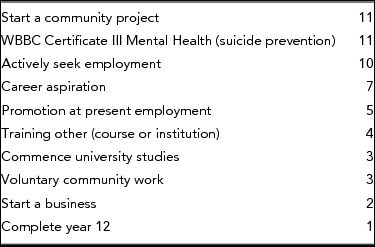
Upon enrolment, it was stated by many that a motivational driver was to undertake personal development by completing the AMCD III (Stephens, Reference Stephens2014). Second to that, many students were driven by altruistic motivations to serve their community, but this orientation was found to emerge during the course. Interviewees were asked midway through the AMCD III 1-year course where they could see themselves following course completion. Table 1 below summarises these aspirations. Most students reported thinking about using this training to start a project, build on it by doing the AMH III, or find employment.
Student Futures: Where AMCD III Students See Themselves Following Course Completion

Source: (Author, 2015).
Students reported wanted to utilise new skills in project management to establish social enterprises, small businesses or social programmes to respond directly the challenges they recognised in their own community (Stephens, Reference Stephens2014, Reference Stephens2015). Miller (Reference Miller2005) also discusses the importance of ‘true partnerships’ stating that:
. . .they establish a process through which Indigenous community aspirations can be incorporated within VET provider, industry and government priorities. Partnerships involve joining up with organisations, within communities and with external parties, which have the professional, financial and structural means to assist Indigenous communities to meet their aspirations. These types of partnerships can reduce duplication of services and wastage of effort. (p.8)
With the delivery of the IMH IV funded by the national TATS package, the establishment of community-based partnerships with students was a course objective (V. Joseph et al., personal communication, 2014). Students were encouraged to research and engage with service providers with these processes embedded in assessment tasks (Stephens, Reference Stephens2015). Many students discussed with their trainer, a plan or progress towards implementing a community plan to deal with suicide in their community (Baird, Reference Baird2014). Past students were found to be active in the implementation of a plan, or were in a preimplementation phase with community-based organisations including schools, police and health providers (Stephens, Reference Stephens2015).
It is as true today as it was in Miller's (Reference Miller2005) report that ‘Educational achievements are the intermediate and intentional steps towards gaining employment, enhancing community development and fulfilling personal goals’ (p. 19). Interviewees of both courses typically discussed their sense of personal achievement in completing a formal accredited course (Stephens, Reference Stephens2014, Reference Stephens2015). As Guenther et al. (Reference Guenther, Bat, Stephens, Skewes, Boughton, Williamson and Dwyer2017b) found in their recent work, students report other benefits such as the gaining of self-confidence (assertiveness, pride and personal growth) and foundation skills (literacy, numeracy, public speaking, writing skills and cultural knowledge) (p. 29). These sentiments are encapsulated by the following comments:
I've had depression and alcoholism all my life and it's been a personal battle with suicide too. And I've always wondered why? So doing the course helped me understand my personal battle. And it really helped me get over my depression and I've lost 48 kgs. (Anonymous, personal communication, 5 Jul, 2012)
I was the 1st to read today—a few big words. I started reading and the more I read the more confident I became. I can't read though. So this is another big barrier I'm breaking through. I believe I can do it. (Anonymous, personal communication, 12 Aug, 2014)
Enrolment, Course Completion and Withdrawal
The College achieves outstanding outcomes in terms of student enrolment and course completion. Student completion rates consistently exceeded the national averages where attrition rates can be as high as 80% for VET studies by Aboriginal and Torres Strait Islander students (NCVER, 2016) and completion rates for Aboriginal and Torres Strait Islander students are consistently lower than for non-Indigenous students, regardless of geolocation (Guenther et al., Reference Guenther, Bat, Stephens, Skewes, Boughton, Williamson and Dwyer2017b).
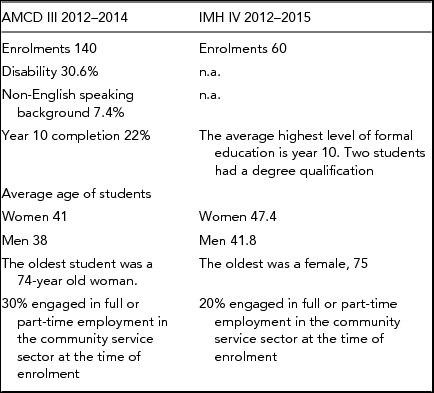
Fifty-seven (57) percent of students enrolled in the AMCD III graduated between 2012 and 2014 (Stephens, Reference Stephens2014). A further 15% of students completed, but had not paid the entire student contribution fee and were therefore unable to receive accreditation for course completion (V. Joseph et al., personal communication, 2014). The IMH IV enrolled 60 between 2014 and 2015 students, had 13 withdrawals after day 1, and 47 completions (78.3% of the cohort) (Stephens, Reference Stephens2015). Table 2 below provides a snapshot comparison of both courses in terms of enrolments, students’ age, education and employment.
Cohort Profiles

Source: (Author, 2014, 2015).
In relation to student recruitment of the IMH IV, the original funding application cites the following objective ‘To recruit 15–20 community leaders and concerned residents to complete the Certificate IV in Indigenous Mental Health (Suicide Prevention)’ (Baird, Reference Baird2014). This outcome was exceeded and, like the AMCD III, the intake was from a wider number of communities than originally anticipated, including distinct clusters over five students from the same community, including Yarrabah, Thursday Island, Cairns and Broome.
WBBC students are commonly of mature age, many are employed or voluntary workers and are looking to build their personal capacity (Guenther et al., Reference Guenther, Bat, Stephens, Skewes, Boughton, Williamson and Dwyer2017b). They come from across Australia, but several clusters of students derive from the Cape York Peninsula, regional parts of Western Australia and Queensland's South East (Stephens, Reference Stephens2014, Reference Stephens2015).
Consistent with national trends, the enrolments in the community development stream at WBBC nearly doubled in the evaluation period (2012–2015) (Stephens, Reference Stephens2014). The number of Aboriginal and Torres Strait Islanders holding VET qualifications more than doubled in very remote parts of Australia in the 5 years to 2011 (Guenther et al., Reference Guenther, Bat, Stephens, Skewes, Boughton, Williamson and Dwyer2017b, p. 12) and high participation rates in the training sector have continued throughout this decade (Crawford & Biddle, Reference Crawford and Biddle2017).
Student withdrawal is attributable to personal family reasons (i.e. death or illness in the family), course expulsion for inappropriate conduct (i.e. substance or alcohol misuse during residential block study periods) and gaining employment (V. Joseph, D.Monro, & L.Baird, personal communication, 2015). One student returned to complete the IMH IV in 2015 after being unable to complete her training in the 2014 intake and ten students reenrolled in the AMCD III between 2012 and 2014 (Stephens, Reference Stephens2014, Reference Stephens2015). One student reenrolled three times, building confidence, skills and resolving serious posttraumatic stress disorder, to graduate in 2014 (E. Turpin, personal communication, 2014).
Employment and Voluntary Sector Engagement
The evaluation studies considered employment outcomes as one of several outcomes of training. Employment is an important and conventional indicator of success. Educational qualification are said to reduce the unemployment rate for Aboriginal and Torres Strait Islander people, in both full-time and part-time categories, to a rate less than half that of people who do not have these qualifications (ABS, 2014). Yet, we concur with Miller (Reference Miller2005) that we need to understand and incorporate different concepts of employment and work-related outcomes linked to training as a focus on paid jobs ignores some of the most critical outcomes that Indigenous people aspire to (p. 22). More recently, Guenther et al. (Reference Guenther, Bat, Stephens, Skewes, Boughton, Williamson and Dwyer2017b) state that attempts to understand success can and should be measured in terms of the multiple personal and collective transforming and sustaining benefits. The authors state that ‘. . . impact could easily be represented in other ways, for example, through maintaining and strengthening culture and language; through individual and family health and wellbeing; through improved social cohesion; and through employment outcomes’ (p. 31). Training indeed is likely to have an unmeasurable afterlife of nonquantifiable and unpredictable outcomes.
It is clear from the evaluation studies that students do value employability as a worthy reason to undertake a course of study but consider paid and voluntary positions with equal merit and in the context of their needs. While it remains the case that public and private paid employment is generally limited in rural and remote areas where labour markets are small (Miller, Reference Miller2005, p. 7), the courses equipped students to work in the community and social sectors in wide range of social capacities (Wontulp Bi-Buya College, 2013). Students found employment or meaningful voluntary roles, up-skilled or sought to expand their personal and professional knowledge (Stephens, Reference Stephens2014, Reference Stephens2015). The AMCD III led to employment in the ‘health’ and ‘society and culture’ sectors, as qualified community and personal service workers (Department of Industry, 2014). Approximately 20% of students were employed prior to enrolling in the AMCD III training and these graduates commonly reported workplace promotions and lateral movement within organisations as a result of completing the training (Stephens, Reference Stephens2014). Of the IMH IV study, enrolment records revealed that up to 20% of the cohort were likely engaged in full or part-time employment in the community service sector at the time of enrolment. Twelve students recorded actively seeking full- or part-time employment (Stephens, Reference Stephens2015). Six instances of people obtaining full-time employment due to their completion of the IMH IV course were recorded at the College postcompletion (V. Joseph et al., personal communication, 2014).
A significant number of AMCD III students were not employed and not seeking employment at the time they commenced their study. This is likely indicative of the maturity of the cohort (students over 55), many of whom were participating in education and training for the first time since leaving school at year 10 (see Table 2 above) (Stephens, Reference Stephens2014). Of those who identified as seeking full-time or part-time employment, prior to the course, students expressed confidence in new employment opportunities with new skill sets to work in paraprofessional and support roles dealing with community violence, alcohol and drug-related harms and family support (Stephens, Reference Stephens2014, Reference Stephens2015). Others expressed an interest in further training, another important indicator of successful VET outcomes as noted by Miller (Reference Miller2005). Student comments included:
I'm now applying for counselling jobs and I feel very confident that I will find a counselling job. (Anonymous, personal communication, Aug 2014)
I want to do more through WBBC. It is the natural choice to educate through WBBC. They can relate to me. I get on pretty well with staff. (Anonymous, personal communication, Mar 2015)
Three primary reasons were cited by students in terms of their motivation to enrol in the IMH IV course. These were skills training to enhance community leadership and mentoring skills, to gain or retain employment in a relevant sector, and expand awareness and understanding of suicide prevention and mental health (Stephens, Reference Stephens2015):
There have been a number of young people committing suicide and self harming in my home community. So by undertaking this course, I want to be able to culturally appropriately help my communities. (Anonymous, personal communication, Aug 2014)
I want ‘grassroots’ perspectives on how to assist families in my communities and how to deal with mental health and suicide prevention. (Anonymous, personal communication, Aug 2014)
Students reported learning practical skills to better equip them in counselling positions, including knowing when and where to make referrals, identification of particular mental health issues, the relationship between ATODs and mental health disorder or illness, the indicators of suicide risk, and professionals’ legal requirements and obligations (Stephens, Reference Stephens2015). Employed students who were using the course for professional development, identified counselling as a core role and crucial skill. Graduates work with police, hospital and health services and schools (Stephens, Reference Stephens2015):
WBBC gave me the counselling skills I needed. I applied for and got the support worker position with [organisation name omitted], fulltime. I work with mental health clients and others in the across the Torres Strait Island communities. (Anonymous, personal communication, Mar 2015)
Discussion: Empowerment and Empowered Individuals
According to Vestman and Conner (Reference Vestman, Conner and Segone2008), evaluation fulfils two purposes. These are to inform and to make judgments. By inform, an evaluation produces knowledge concerning the success or otherwise of an intervention, with the intention of holding duty bearers to account. By judgment, a statement of value is ascribed and the contribution of such analysis matters of public interest. Clearly, these evaluation projects have provided an opportunity to inform. In the spirit of UFE, many people have looked at, considered and acted upon the findings and recommendations of these reports. For the research community, previous evaluation research at WBBC has opened a door and contributed meaningfully to our knowledge of effective VET delivery by Indigenous controlled RTOs (see Stephens, Baird, & Tsey, Reference Stephens, Baird and Tsey2012a; Stephens, Baird, Turpin, & Tsey, Reference Stephens, Baird, Turpin and Tsey2012b).
Yet, Vestman and Connor (Reference Vestman, Conner and Segone2008) rightly state that evaluation cannot avoid the issue of politics or avoid, itself, being an instrument of a political process that seeks to enable interested parties and organisations wider scope in which to observe and influence (p. 47). When thinking about empowerment, therefore, it is worthy to note that in the absence of a political challenge to the existing social order, social empowerment may enhance living standards but fall short of socially transformative change (Batliwala & Pittman, Reference Batliwala and Pittman2010, p. 33). The distinction between these two levels of empowerment highlights different approaches to development, for example, programmes that aim to provide improved or new social services versus interventions that explicitly aim to transform the power relations and social fabric itself. In our view, WBBC is attempting that later. We propose that the College's approach be described as a systemic empowerment approach through training; training that evokes a critical and holistic analysis of the opportunities, constraints and relationships (Kaufman, Reference Kaufman2012) between people, structures and events that make up the social networks of a community. This concept commences with a reclaiming of the term ‘empowerment’.
Empowerment and the Empowered Person
The concept of empowerment in social work and education has a long history. Originally defined by the psychologist Julian Rappaport in 1981 as ‘a construct that links individual strengths and competencies, natural helping systems, and proactive behaviours to social policy and social change’ (Perkins & Zimmerman, Reference Perkins and Zimmerman1995, p. 569) it has come to be understood as an active, participatory process through which individuals and groups gain greater control over their lives, acquire rights and reduce marginalisation (Peterson, Reference Peterson2014, p. 96). This empowerment approach encapsulates a process by which professionals support or guide others to leave them in a better position, with better access to resources, and in a higher state of mental health and wellbeing (Perkins & Zimmerman, Reference Perkins and Zimmerman1995). The goal then of empowerment theory, research and interventions is to link the oppressed individual or groups to the larger social and political institutional environment. This empowerment approach spread quickly entering the World Health Organisations vernacular in 1990s (World Health Organization (WHO), 1991) and throughout the social sciences including evaluation practice itself, as mentioned above. David M. Fetterman, for example, saw the role of the evaluation discipline as one in which evaluators should bring the voice of disempowered citizens to those who have power and facilitate citizens’ control over their own affairs; a tool for self-sufficiency and self-determination (Miller & Campbell, Reference Miller and Campbell2006, p. 297).
Empowerment is then a concept that has become privileged over other modes of practice (Peterson, Reference Peterson2014; Wendt & Seymour, Reference Wendt and Seymour2010). Yet, it is problematic because the approach described here, rooted in modernity, is fraught if practitioners do not uncritically question their power and positionality in relation to the vulnerable people whom they serve (Wendt & Seymour, Reference Wendt and Seymour2010). Empowerment has been criticised for being an ‘easy action’ (Pease, Reference Pease2002) where the transmission of knowledge from the knower to another as a core activity is seen to be enough in itself and as such, requires no further justification or critique.
Clearly, the question of what empowerment means to WBBC, how empowerment processes occur, the way in which occurrences of empowerment can be known and their consequence understood, are important ones to ask where empowerment of Indigenous people is core to their mission as an RTO. The positionality of the trainers and managers is one differentiation from the students enrolled. Despite the staff identifying as Aboriginal and/or Torres Strait Islander people with strong connections to their own country, nations, language and communities (V. Joseph et al., personal communication, 2014), they are also in a position of privilege. The College staff hold status — degrees, permanent employment, seniority within the church and for some, Elder and civic rights leadership status. The question then of who holds and produces knowledge and truth for which others can then be shown and come to know (Wendt & Seymour, Reference Wendt and Seymour2010) can be stated as: Do the staff carry a status as ‘holders of truth’?
The answer which is apparent in the many interviews conducted with WBBC students is that the staff do hold positions of respect by the student cohorts and with that, an authority (as a teacher, mentor, leader, etc.). But concurrently, WBBC staff are not operating within an illusionary field in which there is an assumed ‘equality of power’ between teacher and student. In talking with staff, it is very apparent of their awareness of the power relations that operate both to situate teacher–student relationships as well as WBBC's place in the Australian training sector apparatus (Guenther et al., Reference Guenther, Bat, Boughton, Dwyer, Marshall, Skewes and Wooltorton2016; Zoellner et al., Reference Zoellner, Stephens, Joseph and Monro2016). While they hold the firm view that an education is beneficial to individuals so that they can improve their own lives (V. Joseph et al., personal communication, 2014), universalised solutions are known by the College not to work (Miller, Reference Miller2005; Zoellner et al., Reference Zoellner, Stephens, Joseph and Monro2016). Within the limits of a structured course and its conformity to external forms of quality and standard assessment, they treat every person as a person, ready when they are able to take what is on offer (V. Joseph et al., personal communication, 2014). They resist the pressure to compel students to undertake training, take on personal debt to do so and for completion ‘no matter what’ (Zoellner et al., Reference Zoellner, Stephens, Joseph and Monro2016). WBBC could almost be described as operating within a set of institutions and training systems as a point of resistance. Its power is located within the communities and cohorts of the people it serves outside the dominant mainstream training system. Working with and for their people is where their ‘indigenous perspectives’ are derived (V. Joseph et al., personal communication, 2014) and is purposively articulated throughout their training programmes and administrative processes. Their value-driven focus on knowledge sharing for collective and individualised healing helps the College resist producing dominating effects on learners and averts formal exercises of authority and control (Wendt & Seymour, Reference Wendt and Seymour2010). The nature of power and its exercise lies at the heart of the relationships between trainers and students so an examination of exercises of power in those relationships and the process of how a WBBC graduate might come to see themselves as being empowered, even if mundane and routine (Wendt & Seymour, Reference Wendt and Seymour2010), is necessary.
Empowerment as a Modelled Strategy
Education has the power to change individual's prospects — life expectations, health and living standards (Bell, Boughton, & Bartlett, Reference Bell, Boughton, Bartlett, Anderson, Baum and Bentley2004; Hunter, Reference Hunter1997, Reference Hunter2007) and is enacted through the development of critical thinking and self-reflection skills (Forrest, Reference Forrest1999; Taylor, Reference Taylor2008; van der Merwe & Albertyn, Reference van der Merwe and Albertyn2010). WBBC's systemic empowerment approach embeds critical thinking skills within its courses to awaken people to matters of collective intergenerational social and economic disadvantage. As the findings section above indicate, students reflect on how they are affected personally, within their community, Australia-wide and globally, as members of the world's Indigenous population (V. Joseph et al., personal communication, 2014). They are then encouraged (required by an assessment item) to undertake a locally responsive, community development project (Stephens, Reference Stephens2014, Reference Stephens2015).
We suggest that WBBC teaching offers a strengths-based or solution-focussed cognitive reframing where difficult situations become challenges for which there are solutions. Most importantly, however, this is a strategy modelled by the trainers. With roots in community development training offered in 1984 where social analysis for social action were used as a framework, there have been other influences, including the Family Wellbeing Program (Stephens et al., Reference Stephens, Baird and Tsey2012a, Reference Stephens, Baird, Turpin and Tsey2012b; Tsey, Patterson, Whiteside, Baird, & Baird, Reference Tsey, Patterson, Whiteside, Baird and Baird2002; Tsey et al., Reference Tsey, Whiteside, Haswell-Elkins, Bainbridge, Cadet-James and Wilson2010) that have given the courses more clarity to effectively structure WBBC's strengths-based training. Alongside the personal development, WBBC encourages individuals to consider themselves as present and future leaders, and in doing so, to inspire people to take action and utilise their insights. The trainers use peer-to-peer mentoring to demonstrate the characteristics of empowered leadership looking to themselves as role models, current or past students or the use of contemporary Indigenous figures in the Australian sociocultural landscape (Stephens, Reference Stephens2014, Reference Stephens2015).
An Empowering Pedagogy
The training evaluations presented an opportunity to observe the unique pedagogical approach employed by trainers to deliver courses in the community development stream. The trainers themselves are Aboriginal and/or Torres Strait Islander men and women, two of whom have been employed with the College for a decade or more (V. Joseph et al., personal communication, 2014). Miller (Reference Miller2005) found that the commitment, expertise, understanding and sensitivity of teachers, tutors, support staff and administrators has a direct bearing on training effectiveness (p. 9). Guenther et al. (Reference Guenther, Bat, Stephens, Skewes, Boughton, Williamson and Dwyer2017b) found that trainer longevity as opposed to a rapid trainer turnover was cited as an important contributor of successful training outcomes and that further to this ‘Good trainers were recognised for their support of trainees and they were respected by learners. Trainers who were adaptable, flexible and demonstrated a willingness to learn themselves’ (p. 25). In terms of willingness to learn, one of the evaluation studies noted that ‘Two trainees expressed a strong desire to work towards gaining a university degree, inspired by the WBBC trainers’ (Stephens, Reference Stephens2014, p. 31). At that time, the trainers were enrolled in a Bachelor and PhD programmes. Since then, the College's senior administrator is a confirmed PhD candidate and the College Principal is enrolled in a Master's programme, continuing to value both formal course-work learning to improve their teaching and to participate in research practices.
Similar to the ‘two-way’ approach (Hooley, 2002), WBBC trainers combine student-centredness, cultural practices and an Indigenous perspectives, at residential blocks and in all the text-based teaching materials. Classroom time and activities for the trainees are notably heuristic and discussion orientated to encourage full participation of students grounded in oral communication cultures (Stephens, Reference Stephens2014, Reference Stephens2015). Students arrive with various educational levels (see Table 2 above) often having limited experience of working in classroom settings. As one student stated ‘We're not reading people — we don't sit down and read things’ (quoted in Stephens, Reference Stephens2014, p. 34), yet for others the experience of talking in public can incite shame. The trainers claim to have an understanding of learning styles and they were observed adjusting their teaching, materials and offering experiences (i.e. field trips) to cater to that diversity (Baird, Reference Baird2014; E. Turpin, personal communication, 2014). Staff, including dedicated literacy support staff, work closely with students to prevent early withdrawal due to low confidence in literacy and learning skills, or the psychological distress induced by aspects of the course content (as discussed above) (Stephens, Reference Stephens2014, Reference Stephens2015). A classroom culture of supportive, nurturing and peer-mentoring is fostered, with the mantra ‘No student left behind’ (Baird, Reference Baird2014).
Returning to the College's mission to empower individuals, we can see the link between the collective wellbeing of Australian Aboriginal and Torres Strait Islanders literacy skill development and health outcomes (Boughton, Reference Boughton2000; Guenther et al., Reference Guenther, Bat, Stephens, Skewes, Boughton, Williamson and Dwyer2017a) as further justification of the WBBC's systemic empowerment approach. Tsey et al. (Reference Tsey, Whiteside, Haswell-Elkins, Bainbridge, Cadet-James and Wilson2010) found that the gaining of personal empowerment changes an individual's sense of control over their wellbeing and health. In addition to this, Durnan, Beetson & Boughton (Reference Durnan, Beetson and Boughton2013) argues that socially transformative practices are produced through literacy education itself. He states that ‘. . .how people learn to read, speak and write words’ gives people power (n.p.). The ramifications of which are manifest in self-determination politics and safer communities (Durnan et al., Reference Durnan, Beetson and Boughton2013). If WBBC is enabling empowerment to occur at a community-wide level, it is through the holistic multiplicity of approaches inherent within the training for understanding of the colonialised past and postcolonial trauma healing, literacy, workforce skills/certification, leadership and community ownership of the training.
Community Ownership and Involvement
There is unequivocal evidence that the single most important factor in achieving positive outcomes is Indigenous community ownership and involvement in the training from start to finish; the more control and authority a community has in its training, the more successful that training will be (Miller, Reference Miller2005, p. 8). Trainees express pride in their achievement, many obtaining their highest level of formal education (Stephens, Reference Stephens2014, Reference Stephens2015). Participants of this course have been observed actively teaching and mentoring others to promote help seeking behaviour, positive lifestyle choices and develop local responses and strategies to ameliorate the pervasiveness of mental health issues (Stephens, Reference Stephens2014, Reference Stephens2015; V. Joseph et al., personal communication, 2014).
The courses are responsive to workforce need and have adapted AQF registered courses to provide industry-standard training (Stephens, Reference Stephens2014, Reference Stephens2015; V. Joseph et al., personal communication, 2014). The AMCD III and the IMH IV courses provide students with enhanced skills for employment in the community service sectors where there are predicted shortfalls across Northern Australia (Babacan, Reference Babacan2014). Sullivan (Reference Sullivan2014) states that the ‘Indigenous sector has great potential for meeting priority development goals through the personal development, training and employment of Aboriginal and Torres Strait Islander individuals’ (p. 166), while skilled Indigenous workers in human services sectors are crucial to communities where the post-colonial impact is acute and a major factor in social dysfunction (AIHW & AIFS, 2016):
WBBC is addressing all of these issues in a holistic way through training key personnel who are committed to working with, and for, their communities to help ameliorate these harms and lessen the incidence of mental ill-health/disorders, and therefore lessen the loss of life caused by suicide. (Baird, Reference Baird2014, n.p.)
In so doing, course development is in consultation with employers and funding agencies, as well as in recognition of the voices of past, present and future students. Their contribution, for some WBBC students, resonates with a desire to be self-determining (Baird, Reference Baird2014).
Conclusion
. . . a primary outcome and purpose of training is the support and realisation of community development goals. (Miller, Reference Miller2005, p. 22)
The call for further investment in VET is questionable when the completion rates of Aboriginal and Torres Strait Islander participants across courses are low and social gains from training by conventional measure of success, that is, employment, in regional and remote Australia are similarly uninspiring. Yet, as Guenther et al.’s (Reference Guenther, Bat, Stephens, Skewes, Boughton, Williamson and Dwyer2017b) report exposes, this view is constructed on a set of assumptions that conceals an alternate view of success in training based on the outcomes that Indigenous people themselves aspire to achieve. As Miller (Reference Miller2005) stated, there are fundamental outcomes at a personal level which may include such things as completing the course and moving to other education, to getting a job or even running a community organisation (Miller, Reference Miller2005, p. 16).
The story of WBBC presented here shows that training provided by RTOs can produce very different outcomes. And while it corroborates the views of what ‘works’ found in both Miller and Guenther et al.’s studies, the collective view represented in this paper of the College staff is that success must not only be measured differently, but that it needs to be understood systemically. That is, within a complex set of historical and contemporary issues. The systemic empowerment approach that we articulate here is intended to capture the importance of reflexive and critical thinking of past and present, by individuals and collectives, to produce a host of outcomes that are desired by trainees themselves. And, in terms of what we deem, ‘successful’ training may not be contingent on course completion but on indicators of many transformative process where individual and community advantages accrue in terms of positive cultural, personal and social transformation that may not be dependent on completion (Guenther et al., Reference Guenther, Bat, Stephens, Skewes, Boughton, Williamson and Dwyer2017b, p. 9).
The systemic empowerment approach we have begun to describe is grounded in the College's emic theory of change as mentioned at the outset of this paper. Put simply, empowered men and women are better positioned for social and community work and leadership. The idea finds support in the literature, for example, Tsey et al. (Reference Tsey, Whiteside, Haswell-Elkins, Bainbridge, Cadet-James and Wilson2010) note that programmes that make empowerment strategies explicit increase people's ability to manage disease, adopt healthier lifestyles, use health services more effectively. This simple theory of change is clearly evident in the IMH IV where training to empower is the strategy to reduce suicidal ideation (Stephens, Reference Stephens2015), by building an Indigenous workforce of informed, active and empowered community members. Similarly, with its focus on addictions management, the AMCD III attempts to intercede in the occurrence of a range of social dysfunctions linked to the substance and alcohol misuse. Yet, by taking a systemic empowerment approach and bringing a collective awareness to the table, its attempt is to tackle the issues holistically and at their root.
More time and research is needed to find evidence of a connection between WBBC radically transformative sociopolitical change, across widespread Aboriginal and Torres Strait Islander communities. Yet, previous work in this area by one of the authors has pointed to the possibility of such change (Stephens et al., 2012a). Calls for more systemic natured responses to meet multiple targets in policy agendas, or a political intent that seek to strengthen the health, vitality, independence and self-determination of Australian Aboriginal and Torres Strait Islander communities are not new (Tsey et al., Reference Tsey, Whiteside, Haswell-Elkins, Bainbridge, Cadet-James and Wilson2010; Zoellner, Reference Zoellner2012; Zoellner et al., Reference Zoellner, Stephens, Joseph and Monro2016). For work by RTOs such as WBBC to continue in this space, through the mechanism of training to produce long-term outcomes that might effectively close many of the identified gaps in the standard of living, health and education between mainstream and Indigenous Australians, the crucial issue of security of funding must be addressed. Guenther et al.’s (Reference Guenther, Bat, Stephens, Skewes, Boughton, Williamson and Dwyer2017b) study reported the funding security being an important issue in the sector across Australia, where stakeholders of all their case studies noted inadequate and uncertain funding cycles producing insecurity and even a sense of despair (p. 28).
Another important consideration in moving forward is to question how to measure and evaluate the impact of training that deals with complex and systemic phenomena. If conventional indicators are deemed too limited (Espinosa, Reference Espinosa2013, p. 178) and linear cause-effect reductionism inappropriate to capture less tangible characteristics of empowerment (Patton, Reference Patton2011), such as strengthening culture and language or changes in individual and family health and wellbeing through improved social cohesion, then we need to consider how impact can be represented in other ways (Guenther et al., Reference Guenther, Bat, Stephens, Skewes, Boughton, Williamson and Dwyer2017b). Producing hard evidence of an intervention's effectiveness in for example reducing suicide rates is not always feasible or appropriate, but the capability of a programme that through its design may be able to make a social change or improvement, should be a consideration (ATSISPEP, 2017a). And finally, this may open the door for acknowledging the afterlife of training. Training, in particularly, may have far-reaching impacts beyond the short- or medium-term outcomes that are unable to be predicted (Burns & Worsley, Reference Burns and Worsley2015).
Acknowledgments
While this research received no specific grant from any funding agency, commercial, or not-for-profit sectors, the authors acknowledge The Commonwealth Department of Health and Aging, TEAR Australia and The Healing Foundations for funding to Wontulp-Bi-Buya College enabling programme evaluation research, and the Northern Research Futures Collaborative Research Network for its Postdoctoral ECR support. The authors would like to thank Dr Don Zoellner and Rev. Lesley Baird for their contribution to the original evaluations, review and comments on the developing manuscript.
About the Authors
Anne Stephens (BA, BEd (GE), PhD) is a sociologist, researcher and lecturer with previous appointments at James Cook University, the University of Queensland, Queensland Department of Education and was a Visiting Scholar at Columbia University's School of International and Public Affairs. Anne is the author of two books and over 50 journal articles, reports and conference papers since 2012. She now leads the Research, Monitoring and Evaluation team for Respect Victoria focussing on the primary prevention of violence against women and all forms of family violence.
Davena Monro identifies strongly as an Aboriginal woman of the Butchulla and Garawa People of K'Gari and the Gulf of Carpentaria in Australia. Davena is currently undertaking a PhD with the University of Melbourne. It is through her passion for working with her people in the space of governance, education and community development that has led her to research and to work alongside her family clan group to identify culturally appropriate governance structures and systems. She is Business and Operations Manager and Lecturer in wellbeing and community development with Wontulp-Bi-Buya College, Cairns, Australia.