Although a few decades ago only a minority of congenital heart disease (CHD) patients could reach adulthood, at present, thanks to the improvement in the treatment of congenital heart abnormalities, many of these patients are reaching adulthood. In fact, adults with CHD are an increasing population, which will continue to grow in the future.
The spectrum of adult CHDs is extremely varied, from septal defects and valvular obstructions to complex hypoxaemic single-ventricle lesions with pulmonary outflow obstruction, which may require palliation with staged surgical repairs. Similarly, uncorrected high-flow and/or high-pressure congenital heart anomalies may lead to the development of chronic pulmonary arterial hypertension, shunt reversal, and secondary hypoxaemia (Eisenmenger syndrome). As hypoxaemia entails a higher risk of long-term complications such as renal insufficiencyReference Inatomi, Matsuoka, Fujimaru, Nakagawa and Iijima 1 – Reference Agras, Derbent and Ozcay 3 and as proteinuria identifies patients with an increased risk of cardiovascular problems, we understand the considerable growing interest of hypoxaemia in CHD patients.Reference Chiurchiu, Remuzzi and Ruggenenti 4 , 5
The aims of this study were to compare proteinuria concentration and the 24-hour albumin excretion rate between hypoxaemic and non-hypoxaemic CHD patients and to evaluate whether hypoxaemic CHD patients have new, persistent, or worsening proteinuria at medium-term follow-up.
Methods
In total, 27 hypoxaemic CHD patients (cases) and 48 non-hypoxaemic CHD patients (controls) were studied and compared in order to observe the differences between demographic data, blood samples, and 24-hour urine tests. Hypoxaemic CHD patients were also followed-up to assess the renal function at medium term.
Cases and controls for the study were recruited from the Adolescent and Adult Congenital Heart Disease Unit of the Complejo Hospitalario Universitario Insular-Materno Infantil of Gran Canaria. Controls were selected at random from asymptomatic non-hypoxaemic CHD patients, above 14 years of age, with an atrial septal defect or a ductus – both of them had to be small defects not operated on or operated on during infancy – or a restrictive ventricular septal defect. Patients with ventricular dilatation or dysfunction were not included. Meanwhile, the inclusion criteria for the case group were as follows: aged above 14 years and having a structural CHD with associated hypoxaemia. Hypoxaemic patients were excluded from the follow-up based on the following criteria: death, lived outside the island, or inability or refusal to participate in the study. Hypoxaemic and non-hypoxaemic CHD patients were matched for diabetes mellitus and systemic arterial hypertension.
Hypoxaemic CHD patients were divided into the following categories: non-operated, repaired with palliative surgery such as Blalock–Taussig’s and Glenn’s shunts, or operated on with a Fontan procedure. Patients with more than one defect were classified according to the prevalent lesion from a clinical or haemodynamic point of view. Patients were identified as hypoxaemic if their haemoglobin oxygen saturation, measured using a digital oximeter (Model 512 Handheld Pulse Oximeter; Novametrix Medical Systems Inc., Wallingford, CT, United States of America), was 93% or less.
All the patients were Caucasians, and all of them or their parents gave their informed consent for participation in the study. The protocol of the study was approved by the hospital’s Ethics Committee.
CHD patients were examined in an outpatient setting. After an overnight fasting period of at least 10 hours, blood samples were collected to measure serum levels of creatinine, albumine, total proteins, and N-terminal pro B-type natriuretic peptide. In addition, a 24-hour urine test was carried out with the patients on their usual diet, except that they had to avoid alcohol intake and strenuous exercise. Measurement of serum creatinine, albumine and total protein levels as well as the 24-hour urine test were carried out by spectrophotometry usingan Olympus AU 2700 equipment (Olympus Diagnostic, Hamburg, Germany). Determination of the N-terminal pro B-type natriuretic peptide concentration was carried out by immunoassay using the Siemens Stratus CS Acute Care Diagnostic System (Siemens Healthcare Diagnostics, Inc., Newark, DE, United States of America).
Body weight and height were measured with the patients wearing light clothes and barefoot, and body mass index was determined as weight (kg)/[height (m)×height (m)]. Glomerular filtration rate was estimated in all the patients with Modification of Diet in Renal Disease formulae (186×[creatinine (mg/dl)]−1.154×[age (years)]−0.203×[0.724 if female]).Reference Levey, Greene, Kusek and Beck 6 , Reference Stevens, Coresh, Greene and Levey 7 The diagnosis of pulmonary arterial hypertension was performed if there was a resting mean pulmonary artery pressure of ⩾25 mmHg. Pulmonary artery pressure was calculated invasively by means of cardiac catheterisation or non-invasively using Doppler echocardiography;Reference Quiñones, Otto and Stoddard 8 24-hour proteinuria was established if the urine protein concentration was higher than 0.15 g, which was considered our upper normal reference range. Meanwhile, the normal value for 24-hour albumin excretion rate was between 0 and 20 µg/min.
The values are expressed as mean±standard deviation or as median and quartile values (25, 75). Qualitative variables were expressed as counts (percentages). A related samples Student t-test or the Mann–Whitney U-test was used to compare two dependent samples as the assumption of normality or homogeneity of variance was met or not met, respectively. The non-parametric Kruskal–Wallis H-test was used for comparing two or more independent samples. Meanwhile, the Wilcoxon non-parametric test was used to compare two paired samples. Binary logistic regression multivariate analysis was performed to compare the 24-hour proteinuria (concentrations ⩽0.15 or >0.14 g/24 hours) and the 24-hour albumin excretion rate (concentrations ⩽20 or >20 µg/min) dichotomous variables with those independent variables that had a p-value below 0.10 in the univariate analysis. The results are expressed as odds ratio and its 95% confidence interval. The data analyses were performed using SPSS 20.0 (SPSS Institute, Chicago, IL, United States of America); p values below 0.05 were considered to be significant.
Results
Between September, 2008 and January, 2013, 27 out of 560 CHD patients met the inclusion criteria described for hypoxaemic patients in the methodology section; 13 (48.1%) patients were male, two (7.4%) patients had diabetes mellitus, one of whom was a smoker, one (3.7%) patient had systemic arterial hypertension, and 11 (40.7%) patients showed pulmonary arterial hypertension. Body mass index was 23.9±6.6, and the mean follow-up time was 3.1±1.9 years.
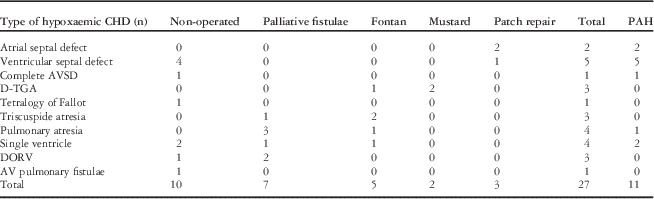
Table 1 shows the distribution of hypoxaemic CHD patients, according to the type of cardiac abnormality, the surgery performed, and the existence of pulmonary arterial hypertension; nine patients were under oral anticoagulation therapy, one patient was under aspirin treatment, eight patients used furosemide, three patients used spironolactone, three patients used β-blockers, three patients used digoxin, three patients used amiodarone, two patients used allopurinol, one patient used calcium antagonists, one patient used angiotensin-converting enzyme, and one patient used angiotensin II receptor blockers. Of the 11 patients with pulmonary arterial hypertension, seven patients were under bosentan treatment and one patient was under sildenafil therapy.
Types of hypoxaemic CHDs, type of surgical repair, and number of patients with pulmonary arterial hypertension (PAH).

AV=arteriovenous; AVSD=atrioventricular septal defect; DORV=double-outlet right ventricle; D-TGA=dextro-transposition of the great arteries; n=number of patients
In the non-hypoxaemic group (48 patients), 27 patients had restrictive ventricular septal defects, 16 patients had atrial septal defects – nine patients were not operated on due to its small size and seven patients were operated on during infancy – and four patients had ductus arteriosus – three patients showed a small ductus and one patient had a ductus arteriosus operated on during infancy. None of them were under medical treatment.
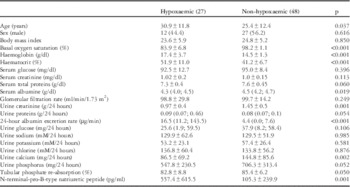
Table 2 shows the demographic data and laboratory test results of hypoxaemic (cases) and non-hypoxaemic (control) CHD patients at baseline. Hypoxaemic CHD patients showed almost significantly higher 24-hour urine protein levels and significantly higher 24-hour albumin excretion rates compared with non-hypoxaemic CHD patients. Meanwhile, binary logistic regression multivariate analysis, including as independent predictors age, sex, being or not being hypoxaemic, haemoglobin concentration, and haematocrit level, showed that being acyanotic was the only protective factor from developing 24-hour proteinuria [odds ratio 0.163; 95% CI 0.038–0.698; p=0.015] and 24-hour albumin excretion [odds ratio 0.092; 95% CI 0.016–0.52; p=0.007].
Demographic data and laboratory test results from hypoxaemic and non-hypoxaemic CHD patients at baseline.

Quantitative variables are expressed as mean±standard deviation or as median and 25th and 75th percentile. Glomerular filtration rate estimated with Modification of Diet in Renal Disease formulae
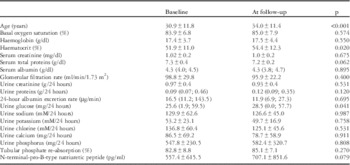
Table 3 shows the demographics and analytical data of hypoxaemic CHD patients at baseline and at follow-up. No significant differences were seen in the 24-hour urine parameter during the follow-up, except for 24-hour urine glucose excretion. In relation to blood parameters, hypoxaemic CHD patients showed significantly higher haematocrit levels at follow-up, despite having similar basal oxygen saturations and haemoglobin concentrations. Out of 27 patients, nine of them (33.3%) at baseline and 10 of them (37%) at the end of the study showed 24-hour proteinuria. Of the nine patients with 24-hour proteinuria at baseline, seven (77.8%) patients had persistent proteinuria at the follow-up, including two patients who were on angiotensin-converting enzyme inhibitors and angiotensin II receptor blockers therapy, respectively.
Demographic data and laboratory test results from the 27 hypoxaemic CHD patients at baseline and at follow-up.

Quantitative variables are expressed as mean±standard deviation or as median and 25th and 75th percentile. Glomerular filtration rate estimated with Modification of Diet in Renal Disease formulae
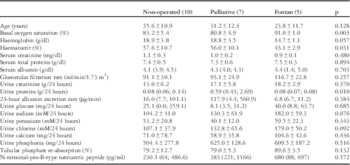
Table 4 shows the demographic data and laboratory test results from different subgroups of hypoxaemic CHD patients – none operated on, with palliative surgery, or with a Fontan procedure, – at baseline. This table evidences significantly higher urine protein (g/24 hours) concentrations in those CHD patients with a palliative surgery; however, at medium-term follow-up, non-significant differences were found in urine protein levels (g/24 hours) and 24-hour albumin excretion rates (µg/min) among the three subgroups of hypoxaemic CHD patients. Similarly, no significant differences were observed between baseline and follow-up 24-hour proteinuria or 24-hour albumin excretion rate among patients with palliative shunts. Meanwhile, binary logistic regression multivariate analysis of hypoxaemic CHD patients at follow-up, including as independent factors age, sex, haemoglobin concentration, haematocrit level, basal oxygen saturation, pulmonary arterial hypertension, and the different types of hypoxaemic CHD, including non-operated, palliative, and Fontan procedure, determined that none of these parameters favoured, by themselves, the development of 24-hour proteinuria. Similar findings were observed for 24-hour albumin excretion rate in hypoxaemic CHD patients.
Demographic data and laboratory test results from different types of hypoxaemic CHD patients at baseline.

Quantitative variables are expressed as mean±standard deviation or as median and 25th and 75th percentile. Glomerular filtration rate estimated with Modification of Diet in Renal Disease formulae
Discussion
Healthy kidneys excrete <150 mg of protein/day, of which ~20 mg is albumin. Meanwhile, microalbuminuria is defined as daily excretion of 30–300 mg of albumin/day and is an early and sensitive marker of nephropathy. Microalbuminuria is associated with an increased risk of cardiovascular disease in patients with and without diabetes and/or hypertension, and proteinuria has been shown to be an independent risk factor for the progression of kidney disease rather than simply being a marker for glomerular dysfunction;Reference Chiurchiu, Remuzzi and Ruggenenti 4 , Reference Naderi and Reilly 9 however, little is known about proteinuria and its progression over time in hypoxaemic CHD patients.Reference Dittrich, Haas, Bührer, Müller, Dähnert and Lange 10 – Reference Burlet, Drukker and Guignard 12
Hypoxia, by itself, may damage glomeruli and increase permeability, which ultimately leads to endothelial swelling and sclerosis. On the other hand, secondary erythrocytosis may promote shear stress and intraglomerular release of nitric oxide and angiogenic factors,Reference Akita, Matsuoka and Kuroda 13 – Reference Gupte, Vaideeswar and Kandalkar 15 which may favour glomerular damage.
Moreover, shunted systemic venous megakaryocytes in the systemic arterial circulation with faulty pulmonary clearance, as seen in hypoxaemic CHD patients with right-to-left shunt, may carry cytoplasmic platelet-derived growth factor and transforming growth factor-β to the glomerular capillary beds, stimulating mesenchymally derived cells, enhancing connective tissue formation, and promoting protein synthesis, extracellular matrix formation, fibrosis, and cell proliferation.Reference Perloff, Latta and Barsotti 14 This may explain, besides hypoxaemia, the emergence of proteinuria in patients with palliative corrections as it occurred in our series. Patients with palliative surgeries have a single-ventricle or double-ventricle morphology, and therefore a near-complete mixing of their systemic and pulmonary venous blood. On the contrary, non-operated CHD patients with pulmonary arterial hypertension (Eisenmenger syndrome) have lower shunts because the pressures in both the ventricles are equalised. Meanwhile, in the Fontan procedure, all the blood returning to the heart first passes through the pulmonary bed, which is the reason why there are no shunted systemic venous megakaryocytes in the systemic arterial circulation.
In addition, a low cardiac output may favour renal hypoperfusion,Reference Elsayed, Tighiouart and Griffith 16 renal damage, and secondary proteinuria. Volume overload, frequently seen in patients with palliative shunts, may impair over time the systemic ventricular function leading to renal hypoperfusion. On the contrary, advantages of a Fontan circuit include near normalisation of the arterial saturation and the abolishment of the chronic volume overload. To this is added the fact that myocardial hypoxaemia, by itself, may induce ventricular dysfunction. Finally, diuretics – most commonly used in complex heart abnormalities – may increase the risk of volume depletion. Similarly, the administration of radiographic contrast agents may lead to direct toxic effects on kidney cells.
Moreover, age and obesity may increase the risk of renal insufficiency. Elderly patients have less renal reserve capacity, and therefore greater susceptibility to the development of chronic renal disease with any given insult. Meanwhile, obesity has become not only a risk factor for the development of proteinuriaReference Metcalf, Baker, Scragg, Dryson, Scott and Wild 17 , Reference Ribstein, du Cailar and Mimran 18 but also a factor for rapid progression to renal failure.Reference Hall, Crook, Jones, Wofford and Dubbert 19 Nevertheless, none of these two factors – age and overweight – seem to have an important influence on the analytical parameters of our series, because our patients were young and their body mass index was within the normal limits. Despite this fact, other authors have determined that proteinuria is a significant and independent predictor of end-stage renal disease, even after adjustment for body mass index.Reference Iseki, Ikemiya, Iseki and Takishita 20
In relation to hypertension and diabetes, the two biggest risk factors for proteinuria, none of them seems to justify the proteinuria observed in our hypoxaemic CHD series after matching both the CHD groups, with and without hypoxaemia, for classic cardiovascular risk factors; however, we should take into account that proteinuria in the general population is generally the consequence of manifest glomerular damage, whereas microalbuminuria is in most cases related to underlying diabetes or hypertension, which are frequently not diagnosed.Reference Naderi and Reilly 9
Regarding urine creatinine levels, daily excretion varies by 4–8%, irrespective of diet and physical activity. Moreover, not only the type of diet but the way it is prepared can influence creatinine excretion. In addition, different drugs may affect creatinine concentration and its excretion or interfere with its assays; however, we think that a low muscle mass,Reference Kalantari and Bolton 21 a finding frequently seen in hypoxaemic CHD patients,Reference Martínez-Quintana, Miranda-Calderín, Ugarte-Lopetegui and Rodríguez-González 22 may be the key factor that explains the significant lower daily creatinine excretion observed in our series. This is especially important as some authors, in the general population, have shown that baseline daily urinary excretion of creatinine is inversely associated with mortality and with major cardiovascular events.Reference Oterdoom, Gansevoort, Schouten, de Jong, Gans and Bakker 23
Regarding the resolution of proteinuria during follow-up, in two out of nine patients with baseline proteinuria it could have been in the context of transient and orthostatic proteinuria, up to 5% of adolescents may have orthostatic or postural proteinuria. As a rule, patients with orthostatic proteinuria excrete <1 g of protein over 24 hours, as it occurred in both our patients, is uncommon over the age of 30, and the long-term prognosis for adolescents with orthostatic proteinuria is excellent;Reference Naderi and Reilly 9 however, highly concentrated urine may also show an abnormal result even when the absolute daily protein excretion is normal. For this reason, insisting on proper urine collection and carrying out an appropriate follow-up of such patients are important to know whether proteinuria persists after repeat testing.
Despite our awareness of the study’s limitations because of the small number and the young age of our hypoxaemic CHD patients, we think that routine testing for microalbuminuria and proteinuria should be recommended for CHD patients with associated hypoxaemia and/or heart failure,Reference Martínez-Quintana and Rodríguez-González 24 especially if they have been corrected with palliative surgeries; however, there is currently insufficient evidence to determine the effectiveness of angiotensin-converting enzyme inhibitors, angiotensin II receptor blockers, and aldosterone antagonists in patients with stage 1–3 chronic kidney disease who do not have diabetes mellitus, despite reducing proteinuria levels.Reference Sharma, Blackburn, Parke, McCullough, Marks and Black 25 – Reference Alfie, Aparicio and Waisman 27 Nonetheless, longer-term follow-up studies with a greater number of patients should be performed to determine the renal outcome and the response of proteinuria to potential treatments.
Acknowledgement
None.
Financial Support
This research received no specific grant from any funding agency, commercial, or not-for-profit sectors.
Conflicts of Interest
None.