Phlebopenes Perty is one of 32 valid genera currently recognised in Eupelminae (Gibson Reference Gibson2017), one of three subfamilies of Eupelmidae (Hymenoptera: Chalcidoidea) (Gibson Reference Gibson1989, Reference Gibson1995). The genus is restricted to the New World with a distribution range extending from southernmost Arizona, United States of America through Central America and South America (Callan Reference Callan1976; Gibson Reference Gibson1995). Noyes (Reference Noyes2017) lists a total of 14 valid names. Phlebopenes females are the largest bodied of all Eupelminae, some being up to 2 cm in length, excluding very long ovipositor sheaths that extend at least twice the length of the body (Gibson Reference Gibson1995). The only published host record is for a female of P. viridis (Westwood), which Gibson (Reference Gibson1995) reported from label data as reared from Trypoxylon nitidum Smith (Hymenoptera: Crabronidae) in Brazil. Here we report P. longicaudata (Westwood) as a parasitoid of an unidentified species of oil-collecting bee of the genus Tetrapedia Klug (Hymenoptera: Apidae) and suggest that species of Phlebopenes are parasitoids of solitary wasps and bees rather than of wood-boring Coleoptera.
Trap nests. Observations were made from trap nests set in two localities in São Paulo State, Brazil. The trap nests were made of black cardboard tubes (5.8 cm long×0.6 cm in diameter) inserted into 55 holes drilled in wooden plates according to the protocol described by Camillo et al. (Reference Camillo, Garófalo, Serrano and Muccillo1995). Another trap-nest model used consisted of bamboo, Bambusa vulgaris Schrader ex Wendland (Poaceae), internodes with one of the ends closed by a node. A total of nine metallic frames containing two wooden plates (totalling 110 tubes) and three bundles of ~100 bamboo canes were installed at the Caetetus Ecological Station (22.4167°S, 49.7167°W), Gália, São Paulo. The area consists of 2176.1 ha of native, well-preserved forest fragment surrounded by pastures and crops (Tabanez et al. Reference Tabanez, Durigan, Keuroghlian, Barbosa, Freitas and Silva2005). The climate in the region is classified as mesothermal with dry winters and rainy summers, and the annual precipitation oscillates from 1100 to 1700 mm (Tabanez et al. Reference Tabanez, Durigan, Keuroghlian, Barbosa, Freitas and Silva2005). Parasitised nests were collected on 9 January 2009 and taken to the laboratory for emergence of specimens.
Three wooden plates (totalling 330 black cardboard tubes) were established in Ribeirão Preto, São Paulo, with each wooden plate attached to the external wall of a building on the campus of University of São Paulo (21.17°S, 47.86°W). The campus encompasses an area of about 573 ha comprised of educational and administrative buildings, a residential area, and a reforestation area of 75 ha with plant species from semi-deciduous forest (Pais and Varanda Reference Pais and Varanda2010). According to the Köppen system, the climate in Ribeirão Preto is classified as tropical with a hot and rainy season (from September to April) and a cold and dry season (from May to August) (Elias Reference Elias2003). A female wasp was observed at this site with its long ovipositor inserted into a cell of the trap nest. This was filmed and the parasitised nest taken to the laboratory, but no host specimens emerged because the nest was attacked by fungal pathogens.
Identification of taxa. No host specimens emerged from the Gália trap nests and it was therefore not possible to identify the host species. However, given the nest characteristics (nest partitions and operculum made of oil and sand) the nests were assigned to species belonging to the genus Tetrapedia. Nests of another oil-collecting bee, Centris analis (Fabricius) (Hymenoptera: Apidae), were commonly recorded in the Ribeirão Preto wooden plates, but no eupelmid female was observed parasitising them. Because of the nest features, the nest the female wasp had its ovipositor inserted into was identified as belonging to a Tetrapedia species.
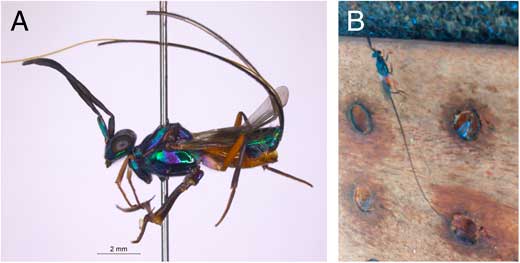
Identification of the parasitoid wasps is based on examination of type material of most of the described Phlebopenes species, by one of the authors (G.A.P.G.), and following Roman (Reference Roman1920). Four names exist for described species whose females are characterised by a dark, finely longitudinally striate acropleuron, dark prepectus, upper face without distinct scrobal channels, gaster with the basal tergites somewhat orange but at least the apical three tergites dark, and the metatibia and tegula dark. Of these, P. longicaudata (Westwood) and P. basilica (Marshall) have dark profemora, whereas P. consors (Walker) and P. ogloblini De Santis have entirely orange or only apically dark profemora. The wasps are provisionally identified as P. longicaudata based on the reared females possessing the above features, including dark profemora (Fig. 1A), and the name being the oldest of the two available names for this form. A revision of the species of Phlebopenes is required to identify specimens more confidently to species, but voucher specimens of our reared specimens are deposited in the Coleção de Abelhas e Vespas Solitárias of the Biology Department of Faculdade de Filosofia, Ciências e Letras de Ribeirão Preto, Universidade de São Paulo (Ribeirão Preto, São Paulo, Brazil).
A, Lateral view of female Phlebopenes longicaudata (ovipositor sheaths partly missing). B, A female of P. longicaudata parasitising a Tetrapedia nest in the campus of University of São Paulo, Ribeirão Preto, Brazil.
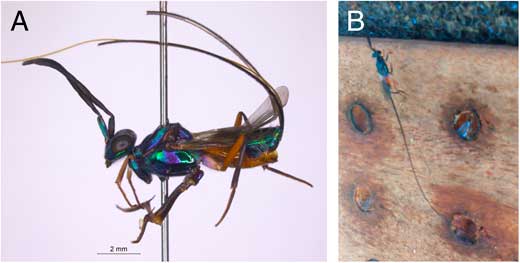
Two females of P. longicaudata emerged from one nest established in the Caetetus Ecological Station on 9 October 2009. Two females (one illustrated in Fig. 1A) emerged from another nest on 31 October 2009 and one dead specimen was found within the same nest on the same day.
Only one female was observed, on 13 April 2015, around 07:40 AM, with its long ovipositor inserted into a Tetrapedia brood cell (Fig. 1B) on the campus of University of São Paulo, presumably ovipositing onto a host immature, though this cannot be confirmed.
Host diversity of Eupelminae is very broad, with most species being primary or facultative hyperparasitoids or predators of the immature stages of other insects and spiders that mostly are concealed or protected in plant tissue or fibrous material. The majority of species are ectoparasitoids of the larvae or prepupae of holometabolous insects, though some are predators or endoparasitoids of eggs of a wider variety of insects and spiders (Gibson Reference Gibson1995), and one species is a parasitoid of a pseudoscorpion (Pseudoscorpiones) (Austin et al. Reference Austin, Gibson and Harvey1998). Of the about 800 recognised valid species of Eupelminae (Noyes Reference Noyes2017), only 10 species have been previously associated with aculeate Hymenoptera as hosts or possible hosts. Species of Anastatus Motschulsky are mostly egg endoparasitoids but there are single reports of four species, A. ashmeadii (Melander and Brues), A. drassi (Riley), A. myrmecobius Ferrière, and A. reduvii (Howard), either as a parasitoid of the cocoon of Dryinidae (Hymenoptera) (Burks Reference Burks1967), collected running with ants (Hymenoptera: Formicidae) (Ferrière Reference Ferrière1931; De Santis Reference De Santis1979) or collected on burrows of Lasioglossum pruinosum (Robertson) (Hymenoptera: Halictidae) (Melander and Brues Reference Melander and Brues1903). Arachnophaga tarsata (Waterston) was reared through Mutilla glossinae Turner (Hymenoptera: Mutillidae) parasitising Glossina morsitans Wiedemann (Diptera: Glossinidae) (Lamborn Reference Lamborn1916), whereas Arachnophaga matritensis (Bolívar y Pieltain) was reared once from an unidentified Apidae nesting in the wood of Haloxylon scoparium Pomel (Amaranthaceae) (Ferrière Reference Ferrière1966). Eupelmus pulchriceps Cameron and E. urozonus Dalman have been reared as hyperparsitoids through Bethylidae (Hymenoptera) (Voukassovitch Reference Voukassovitch1924; Nickels et al. Reference Nickels, Pierce and Pinkney1950) and E. vesicularis was reported reared from a nest of Spilomena enslini Blüthgen (Hymenoptera: Crabronidae), though possibly as a hyperparasitoid because three other parasitoids were also reared from nests (Valkeila Reference Valkeila1957). Finally, on the basis of label data Gibson (Reference Gibson1995) reported that Phlebopenes viridis was reared from Trypoxylon nitidum (Hymenoptera: Crabronidae). Of the other two subfamilies of Eupelmidae (Neanastatinae and Calosotinae), only four species of the genus Calosota Curtis (Calosotinae), C. fumipennis Bolívar y Pieltain, Calosota species near C. robusta Hedqvist, C. sinensis Ferrière, and C. vernalis Curtis, are reported as reared from the nests of Colletidae, Megachilidae, or Vespidae (Bolívar y Pieltain Reference Bolívar y Pieltain1923; Ferrière Reference Ferrière1935; Daly Reference Daly1988).
Nests of Tetrapedia species are attacked by a myriad of different species of natural enemies, including species of the cleptoparasitic bee genus Coelioxoides Cresson (Hymenoptera: Apidae) and parasitoids of different families and orders such as Meloidae (Coleoptera), Bombyliidae (Diptera), and Leucospidae and Eulophidae (Hymenoptera) (Gazola and Garófalo Reference Gazola and Garófalo2009; Rocha-Filho and Garófalo Reference Rocha-Filho and Garófalo2015). Our record is the first of a species of Eupelmidae apparently parasitising Tetrapedia. However, given that no host specimens emerged from the parasitised nests, it is also possible that P. longicaudata is an obligate or facultative hyperparasitoid of Tetrapedia species through the immature stages of their other natural enemies. Although Gibson (Reference Gibson1995) reported P. viridis as a parasitoid of Trypoxylon nitidum, he suggested that Phlebopenes species likely are more commonly parasitoids of wood-boring Coleoptera. This assumption was based on museum specimens often being labelled as being associated with dead trees, the very long ovipositor sheaths of females, and the absence of aculeate Hymenoptera as typical hosts of Eupelminae. However, based on our new record for P. longicaudata in conjunction with the P. viridis record, we hypothesise that species of Phlebopenes are actually parasitoids of solitary bees and wasps that nest in pre-existing or excavated cavities in wood. The only other Eupelmidae that parasitise bees, i.e., females of some Calosota species, have short ovipositors that project just beyond the gaster, which suggests they can parasitise only the outer most cells in a nest. In contrast, the very long ovipositors of Phlebopenes suggest they are better adapted to parasitizing separate cells along the length of tunnels.
Acknowledgements
The authors thank Tiago Falcon for providing the video on a P. longicaudata female parasitising a Tetrapedia nest in Ribeirão Preto, “Coordenação de Aperfeiçoamento de Pessoal de Nível Superior (CAPES)” for granting a scholarship to the first author, Eduardo A.B. Almeida for allowing the use of the digital imaging equipment to photograph the P. longicaudata female, and “Fundação de Amparo à Pesquisa do Estado de São Paulo (FAPESP)” (grant number 04/15801-0) for financial support. The authors also thank Natalie Dale-Skey, from The Natural History Museum, London, United Kingdom, for providing habitus images of the holotypes of P. consors and P. longicaudata for comparison.