INTRODUCTION
The franciscana, Pontoporia blainvillei, is a small dolphin endemic to shallow, coastal waters of tropical and temperate regions along the coasts of Brazil, Uruguay and Argentina (Crespo et al., Reference Crespo, Harris and González1998; Siciliano et al., Reference Siciliano, Di Beneditto and Ramos2002). Mortality of franciscana in fishing operations has been observed for almost sixty years. Reports on by-catch in shark gillnet fisheries off Uruguay date back to the early 1940s (Van Erp, Reference Van Erp1969). Although gillnetting in Argentina and southern Brazil also emerged in the 1940s, no record of by-catch exists for those areas. Gillnet fisheries for bottom dwelling fish became the major conservation concern for franciscana in both countries only in the 1980s. Nowadays, by-catch has been reported from all main fishing villages along most of the species' geographical distribution (Corcuera, Reference Corcuera1994; Praderi, Reference Praderi, Pinedo and Barreto1997; Secchi et al., Reference Secchi, Zerbini, Bassoi, Dalla Rosa, Moller and Roccha-Campos1997; Kinas & Secchi, Reference Kinas and Secchi1998; Ott, Reference Ott1998; Di Beneditto & Ramos, Reference Di Beneditto and Ramos2001; Bertozzi & Zerbini, Reference Bertozzi and Zerbini2002; Ott et al., Reference Ott, Secchi, Moreno, Danilewicz, Crespo, Bordino, Ramos, Di Beneditto, Bertozzi, Bastida, Zanelatto, Perez and Kinas2002; Rosas et al., Reference Rosas, Monteiro-Filho and Oliveira2002).
On the coast of Rio Grande do Sul, southern Brazil, the franciscana has been suffering a high by-catch in gillnets for at least 25 years (Praderi et al., Reference Praderi, Pinedo, Crespo, Perrin, Brownell, Zhou and Liu1989; Moreno et al., Reference Moreno, Ott, Danilewicz, Pinedo and Barreto1997; Ott et al., Reference Ott, Secchi, Moreno, Danilewicz, Crespo, Bordino, Ramos, Di Beneditto, Bertozzi, Bastida, Zanelatto, Perez and Kinas2002). Recent annual estimates of mortality of franciscanas in this region have been around one thousand individuals (Secchi et al., Reference Secchi, Zerbini, Bassoi, Dalla Rosa, Moller and Roccha-Campos1997; Ott, Reference Ott1998; Ott et al., Reference Ott, Secchi, Moreno, Danilewicz, Crespo, Bordino, Ramos, Di Beneditto, Bertozzi, Bastida, Zanelatto, Perez and Kinas2002; Secchi et al., Reference Secchi, Kinas and Muelbert2004). Multiple lines of evidence, including a declining trend in stranding rates and capture per unit of effort (CPUE), suggested that the stock inhabiting southern Brazil and Uruguay (Franciscana Management Area III (FMA III); see Secchi et al., Reference Secchi, Danilewicz and Ott2003a, for definitions) is declining (Praderi, Reference Praderi, Pinedo and Barreto1997; Pinedo & Polacheck, Reference Pinedo and Polacheck1999; Secchi, Reference Secchi1999; Kinas, Reference Kinas2002). Recently, the whole species was considered Vulnerable under the IUCN Red List of Threatened Species due to the same reasons (IUCN, 2008).
Knowledge of population size plays a crucial role in wildlife conservation. Aerial surveys using fixed-wing aircraft associated with the line transect distance sampling methodology have been extensively used to study distribution and to estimate abundance of mammals (e.g. Burnham et al., Reference Burnham, Andersonm and Laake1980; Guenzel, Reference Guenzel1986, Reference Guenzel1994; Firchow et al., Reference Firchow, Vaughan and Mytton1990; Johnson et al., Reference Johnson, Lindsey and Guenzel1991; Secchi et al., Reference Secchi, Ott, Crespo, Kinas, Pedraza and Bordino2001; Andriolo et al., Reference Andriolo, Piovezan, Costa, Laake and Duarte2005, Reference Andriolo, Martins, Engel, Pizzorno, Más-Rosa, Freitas, Morete and Kinas2006). This technique can provide accurate estimates, which can be corrected for availability and perception biases, provides confidence intervals and other measures to evaluate the reliability of estimates, and is generally less expensive and less time consuming than traditional trends counts (Guenzel, Reference Guenzel1994). The line transect technique is useful to study franciscana dolphin because they tend to be widely distributed throughout a large area along the coast which necessitates survey subsampling.
The estimation of franciscana abundance has been repeatedly recommended as a highest research priority to better assess the status and improve the management of the species (e.g. Secchi et al., Reference Secchi, Ott and Danilewicz2002). However, the species' small body size, inconspicuous colour pattern, small group size, and boat avoidance behaviour make surveys for estimating abundance for this species challenging. To date, there is no estimate for almost all populations along the species' range. The only attempt to compute abundance was a pioneering aerial survey conducted in 1996 in a limited fraction (1%) of the franciscana distribution-range in Rio Grande do Sul, southern Brazil (Secchi et al., Reference Secchi, Ott, Crespo, Kinas, Pedraza and Bordino2001). Their results indicated a density of 0.66 individuals/km2 within a survey area of 435 km2. In this study, we present new population density estimates for the species surveyed over a broader area in southern Brazil, and combine the results with the current by-catch mortality in order to evaluate the fishery impact on the population. Moreover, we discuss the potential sources of bias in the franciscana abundance studies and recommend enhancements for further research.
MATERIALS AND METHODS
Study area and field methodology
The survey was conducted along the coast of Rio Grande do Sul, from Torres (29°19′S 49°43′W) up to 31 km north to the border with Uruguay (33°17′S 052°46′W) (Figure 1). The survey design followed a zig-zag pattern and transect lengths ranged from 22.2 to 35.2 km (mean = 27.9 km). Survey mean offshore limit was 24 km and the overall area surveyed comprised 13,341 km2.
Map of the study area presenting the line transects for the franciscana (Pontoporia blainvillei) aerial survey in Rio Grande do Sul, Brazil.

Survey effort depended primarily on the weather. Surveys were undertaken only on sea conditions of Beaufort 3 or less. The research team remained mobilized in the field during ten days waiting for the proper weather conditions. The study area could be fully covered during two days of work (19 and 24 February 2004).
A high-wing, twin-engine Aerocommander aircraft was used as the survey platform. The aircraft was equipped with one bubble window on each side to allow for direct visualization underneath the plane (trackline). It flew at a constant altitude of 500 ft (152 m) and airspeed of nearly 165 km/h. The survey crew consisted of the pilot, co-pilot, and a team of four observers. The latter rotated among a left and right observation position, data recorder and a resting position at the end of each transect (6–10 minutes in duration). Each transect started no earlier than 30 minutes after sunrise and finished no later than 30 minutes before sunset. The survey was conducted in ‘passing mode’ (i.e. the aircraft did not end effort or divert from its course when franciscanas were seen) (Buckland et al., Reference Buckland, Anderson, Burnham and Laake2001).
Information on weather condition (sun glare, Beaufort state and visibility) was collected by each observer in the beginning of the transect or every time a change in weather was noted. Visibility was subjectively scored on a scale of 1 (excellent) to 4 (bad). Glare was noted as the percentage of the observer search view that was affected by the sun glare. Communication among observer and data recorder was done through the aeroplane internal communication system. When a sighting occurred, the observer alerted the recorder to mark the time and the position on a GPS. Then the species identity, group size, and vertical angle relative to the aircraft measured with a hand-held inclinometer were immediately reported to the recorder. Sightings detected by the data recorder or off the survey transects (e.g. when changing transects or when flying from/to the airport) were recorded as ‘off effort’. To familiarize the pilot and observers with survey protocols, we conducted two training flights on which we made three sightings on 18 transects. These data were used for training only, and are not analysed here.
Data analysis
Density was estimated using conventional distance sampling methods (Buckland et al., Reference Buckland, Anderson, Burnham and Laake2001) using program Distance 4.0. The uncorrected density (g0 = 1) estimator (Dun ) is given by:

where n was the number of sightings, E(s) the expected mean group size, L the total distance searched and ESW the effective search width.
In aerial surveys for marine mammal abundance estimation, the probability of detecting groups on the trackline (g0) is always lower than 1. For this reason, the quantity computed with the estimator above needs to be corrected for missed dolphins: density D = Dun × g0−1. In order to improve our estimation of group size, off-effort sightings were included in the analysis because these records were done when observers had more time to visualize and estimate franciscana group size.
For the corrected densities D, variance estimates were calculated with the following equation obtained by the delta method (Seber, Reference Seber1982):

The probability of detecting a franciscana group on the transect line (g0) is affected by both availability bias (animals that are submerged and cannot be sighted) and perception bias (observer fails to detect an animal on the surface due to observer inexperience, fatigue, or adverse survey conditions such as glare or rough sea state) (Marsh & Sinclair, Reference Marsh and Sinclair1989). So, g0 is computed as the product of availability and perception bias. Availability bias was estimated using the formulae provided by Barlow et al. (Reference Barlow, Oliver, Jackson and Taylor1988):

where: s is the average time of franciscana being at the surface; d is the average time of franciscana being submerged; and t is the time window during which the franciscana is within the visual range of an observer. Values of s (1.2 seconds) and d (21.7 seconds) were obtained from a study on ecology and behaviour of franciscanas in Argentina by Bordino et al. (Reference Bordino, Thompson and Iñiguez1999). The time window that a franciscana is at the surface to be detected by the observer was calculated by collecting this value from the aircraft for floating objects at various distances. The values of time were then regressed against distance, and the resulting linear regression (y = 0.0292x + 5.7723; R2 = 0.93) presented a time window of 5.77 seconds for an object on the transect line. In this manner, availability bias was calculated as 0.304. It was not possible to calculate perception bias in this study and therefore, for the purpose of the analysis presented here, g0 was assumed to correspond to the value of availability bias presented above.
Effective search width was estimated by fitting perpendicular distance data with three key functions (uniform, half-normal, hazard rate) with: (1) no adjustment term; (2) cosine; (3) simple; and (4) hermite polynomial series expansions. The best model was selected by the Akaike information criterion (AIC). To minimize the negative effect of sunglare on observer sightability, segments of transect that presented more than 80% of sun glare in the observer search view were discarded from the analysis.
Abundance uncertainties and impact assessment of the by-catch levels
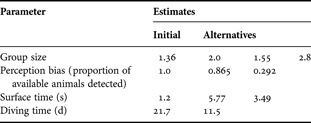
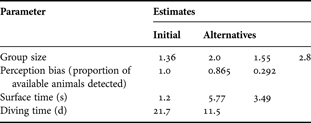
In order to assess the effects of uncertainties in g0 and group size on the estimates of franciscana abundance, eight alternative values for perception bias, diving and surfacing time (affecting g0), and group size were applied (Table 1). Alternative group size values utilized were the mean on-effort (1.36) and the mean off-effort group size from this study (2.0), and the mean group size provided by Bordino et al. (Reference Bordino, Thompson and Iñiguez1999) (2.8). Alternative estimates of perception bias used were those published for harbour porpoise for experienced and inexperienced observers (Laake et al., Reference Laake, Calambbokidis, Osmek and Rugh1997). The alternative diving time (11.5 seconds) was the approximate median of the data published by Bordino et al. (Reference Bordino, Thompson and Iñiguez1999). The alternative surfacing time was the maximum time a dolphin remained available for an observer (5.77 seconds), and the mean between this maximum value and the initial estimate (1.2 seconds). For details, see the section ‘Evaluation of the field survey and statistical methods’ in the Discussion. These scenarios produced 59 alternative abundance estimations. The 60 franciscana abundance estimates for the Rio Grande do Sul varied from very wide variations.
Estimates of the parameters applied in modelling the density estimates of franciscana (Pontoporia blainvillei) in Rio Grande do Sul, Brazil.
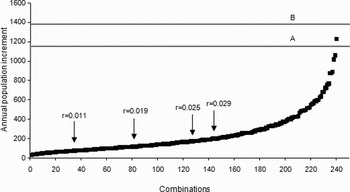
For an evaluation of the impact of the by-catch on the franciscana population of Rio Grande do Sul, four estimates of the population rate of increase were applied to the 60 abundance estimations, resulting in 240 estimates of the annual population increment, that is, how many animals are added to the population each year. Rates of increase were estimated by Secchi (Reference Secchi2006) utilizing a deterministic model with no fishing (r = 0.029) and with the current fishing effort (r = 0.017), and a stochastic model with no fishing (r = 0.025) and with the current fishing effort (r = 0.011). The estimates of population increments were compared to the latest mortality estimates for Rio Grande do Sul (1149 and 1379 animals), after combining data from Secchi et al. (Reference Secchi, Kinas and Muelbert2004) and Danilewicz (Reference Danilewicz2007).
RESULTS
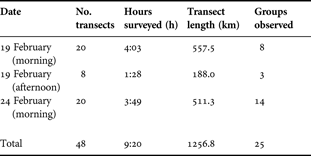
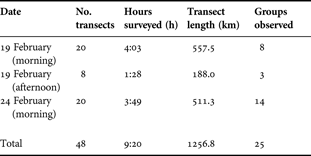
During the 48 transects and a total effort of 1256.8 km, 31 franciscanas were observed in 25 groups (Table 2). Twelve off-effort sightings were made by the data recorder or by the observers between the end of a transect and the beginning of another or during displacements to/from the airports. Group size ranged from 1 to 5 individuals, with solitary individuals representing 67.5% of the sightings. Mean group size for on-effort and off-effort sightings was 1.36 and 2.0, respectively. Mean group size applied in the analysis was 1.55 (the mean for both on- and off-effort sightings). There was no significant relationship between group size and perpendicular distance from the transect line (linear regression; P = 0.66, r2 = 0.01).
Description of line transects efforts and franciscana (Pontoporia blainvillei) sightings during this study.
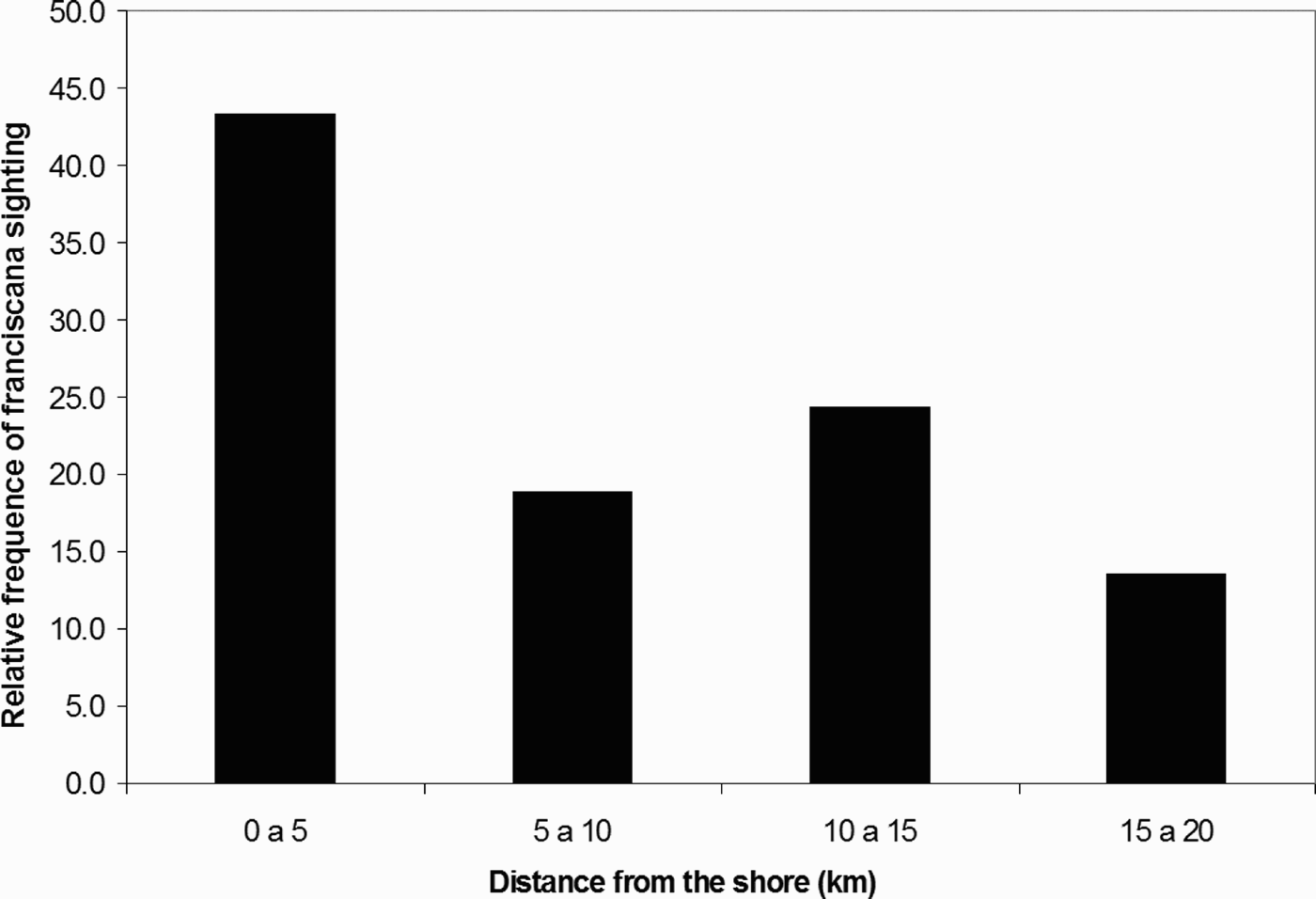
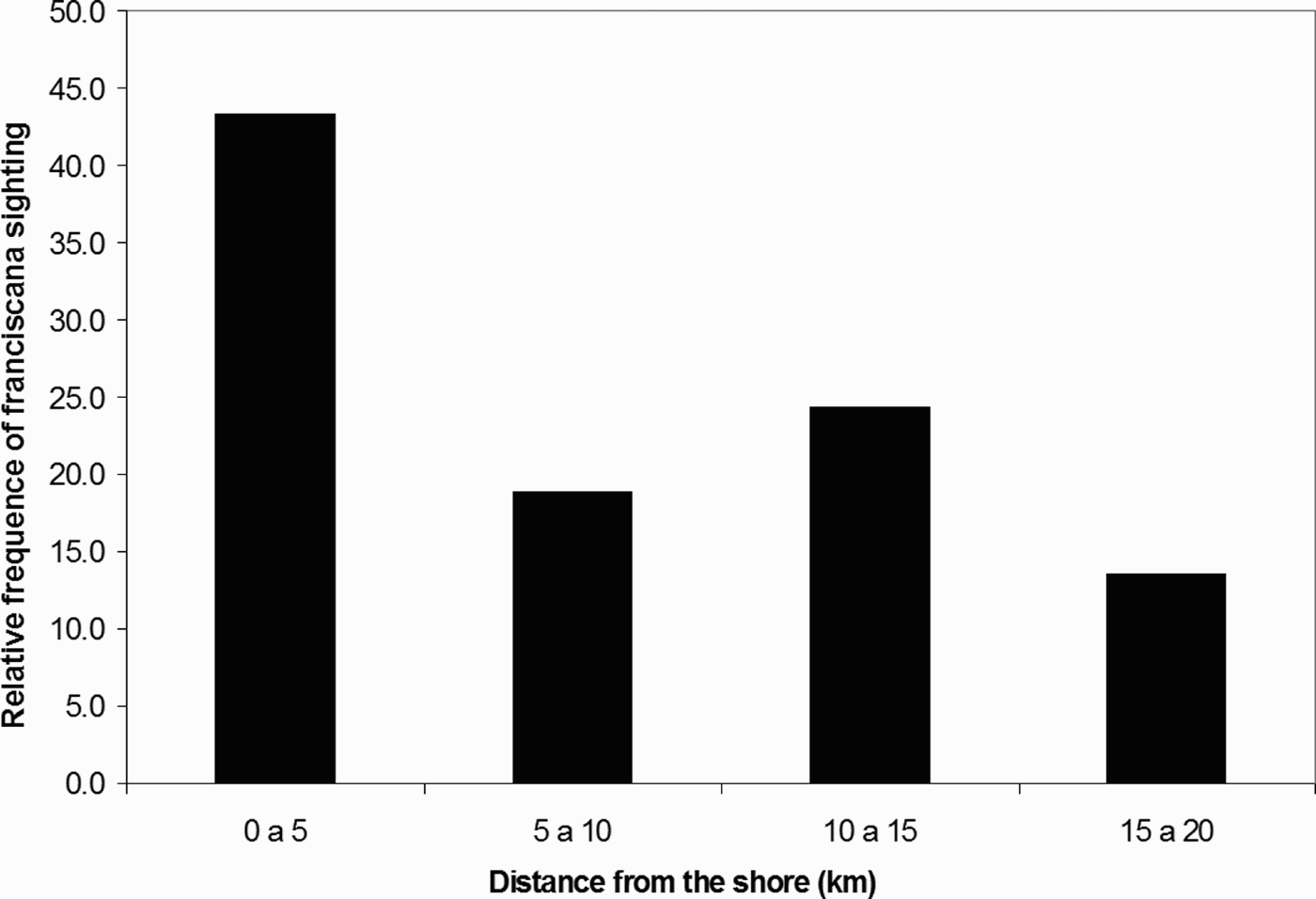
Franciscana sightings were recorded from the shoreline to 19.6 km offshore. Three groups were observed just beyond the surf zone, and about 70% of the sightings were located in waters up to 10 km offshore (Figure 2). Displacements of dolphins and abrupt dive as a negative reaction to the aircraft noise were observed just once. A calf was recorded in only one group.
Relationship between distance from the shore and percentage of franciscana (Pontoporia blainvillei) sightings in Rio Grande do Sul, Brazil.
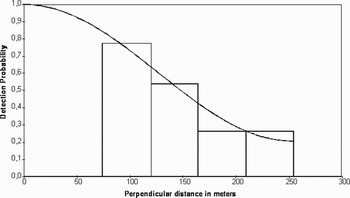
Few observations were recorded near the trackline, so the perpendicular distance data were left-truncated at 74 m prior to analysis. Right truncation was specified at 254 m from the line, reducing the dataset used to fit the detection function to 21 sightings. The best perpendicular distance fitting model (AIC = 56.14; Chi-P = 0.87) was the uniform function with one cosine adjustment term (Figure 3).
Distribution of perpendicular distances and fit of the detection function for the franciscana (Pontoporia blainvillei) using a uniform model with one cosine adjustment term. Survey data were left truncated during analysis due to few sightings in the trackline.

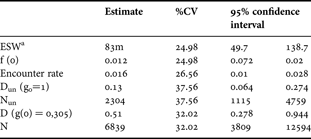
The corrected density for area surveyed was 0.51 franciscanas per km2, resulting in an abundance estimation of 6839 franciscanas (CV = 32%; 95% CI = 3709–12,594). The encounter rate for franciscana groups was 0.020 groups/km surveyed (Table 3).
Summary of parameter estimation and confidence interval for franciscana (Pontoporia blainvillei) abundance estimation in Rio Grande do Sul. CV, coefficient of variance; ESW, effective search width; f, probability density function; Dun, uncorrected density; Nun, uncorrected abundance; D, density; N, abundance.
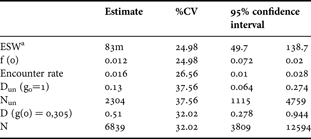
a, survey data were left truncated during analysis due to few sightings in the trackline.
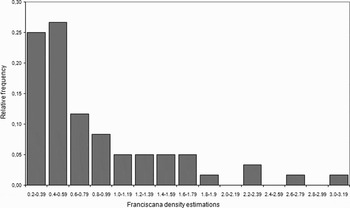
The combination of alternative values for g0 and group size resulted in 60 franciscana densities, ranging from 0.205 to 3.17 franciscanas/km2 (Figure 4). In 59.3% of combinations, the alternative estimates were higher than the initial density presented in this paper. The annual population increment of franciscanas in Rio Grande do Sul ranged from 30 to 1227 animals (Figure 5).
Relative frequency of density estimates for franciscanas (Pontoporia blainvillei) in Rio Grande do Sul, considering 60 different scenarios for group size and g(0).

Estimates of annual population increment for franciscana (Pontoporia blainvillei) in Rio Grande do Sul (N = 240), applying 60 combinations of g(0) and group size and four population rates of increase. Grey lines A and B indicate the two latest annual bycatch mortality estimates for Rio Grande do Sul. The arrows point to the population increments for each of the rates of increase according to the initial abundance estimation (6839 franciscanas).

DISCUSSION
Comparison of franciscana population size estimates from different aerial surveys
The previous estimate (1996) of franciscana density for Rio Grande do Sul (D = 0.657; CV = 34.47%; Secchi et al., Reference Secchi, Ott, Crespo, Kinas, Pedraza and Bordino2001) is slightly higher than the one presented here (D = 0.55; CV = 33.3%). This difference should not be viewed as a population decline since the two estimates are not comparable. The area covered in both studies differed greatly because of the constraints imposed by the flight autonomy of the single-engine aircraft utilized in 1996. The first study was composed of eight replicate flights in the same area located to the south of Cassino beach, between the shoreline and a maximum distance of 9.3 km from the coast, corresponding to a boundary approximately at the 15 m isobath. The present study covered an area more than 30 times greater. In some regions the mean offshore distance of 24 km corresponded to the isobath of 50 m. In addition, the aeroplanes differed in some characteristics that potentially affect the observation of animals.
The two surveys conducted in Rio Grande do Sul had the same sighting rate (0.02 group/km) and that can be used to estimate adequate sample sizes for future studies (Buckland et al., Reference Buckland, Anderson, Burnham and Laake2001). Subsequent aerial surveys in Rio Grande do Sul should cover about 3000 to 4000 km of transects in order to obtain a minimum of 60–80 sightings recommended by Buckland et al. (Reference Buckland, Anderson, Burnham and Laake2001) for adequate estimation of detection probability.
Extrapolation of abundance estimates
In the 1996 survey, Secchi et al. (Reference Secchi, Ott, Crespo, Kinas, Pedraza and Bordino2001) extrapolated the franciscana density found in the 435 km2 surveyed area for all the stock inhabiting the FMA III (coastal waters of Uruguay and Rio Grande do Sul, up to the 30 m isobath). It resulted in an abundance of 42,048 franciscanas (95% CI 33,024–53,504) within an area of 64,000 km2.
Extrapolation of abundance estimates to areas outside those covered by the survey effort needs to be considered carefully (e.g. Ancrenaz et al., Reference Ancrenaz, Goossens, Gimenez, Sawang and Lackman-Ancrenaz2004). One of the most common ways to overestimate population size is through the extrapolation of high density areas over non-surveyed low density areas. Since it is not known if the franciscana density within the surveyed area in Rio Grande do Sul equals the density beyond the surveyed area within the range of this stock (FMAIII—including the coast of Uruguay and areas beyond the 50 m isobath), we present a franciscana abundance estimate only for the area covered in this survey.
Evaluation of the field survey and statistical methods
Population abundance is very important to viability analysis of populations under threat. It is fundamental information when designing and negotiating enforcement and management procedures with the scientific community, governments, and stakeholders. It is therefore important that all significant sources of uncertainty be considered, quantified whenever possible, and reported.
The parameters used to calculate availability bias for franciscana aerial surveys (surface time, diving time, and the time an object remained in the view of the observer) were accounted for in this study. The first two parameters were obtained from a study of the diving behaviour of free-ranging franciscanas in Bahia Anegada, Argentina (Bordino et al., Reference Bordino, Thompson and Iñiguez1999). The study was carried out with observers both from boat- and land-based platforms. These results show that franciscanas remain available for a very short time above the surface for observers on a boat. However, the estimated average surfacing interval (only 1.2 seconds in Bordino et al., Reference Bordino, Thompson and Iñiguez1999) should be lower than if observations were made from an airborne platform. Franciscanas remain visible for a longer period, even under the water surface (personal observations from this survey), when seen from an aeroplane.
Diving time may vary among individuals, gender, behavioural state, age/size-class, and region (e.g. Bordino et al., Reference Bordino, Thompson and Iñiguez1999). This parameter is not easily obtained from aerial surveys and therefore it must be taken from other studies. In this work, the mean value (21.7 seconds) provided by Bordino et al. (Reference Bordino, Thompson and Iñiguez1999) was used. Nevertheless, the distribution of franciscana diving times is positively skewed, as shown in figure 9 in Bordino et al. (Reference Bordino, Thompson and Iñiguez1999). The median is less sensitive to outliers than the mean and is a measure of a central tendency that better reflects a skewed distribution (Zar, Reference Zar2000). If the median diving time (~11.5 seconds) is applied in the estimation of g(0), the resulting franciscana density decreases drastically from 0.51 to 0.28 group/km2. That indicates the importance of obtaining new and reliable estimates of diving time for the species.
Estimation of group size is one of the variables affected by aircraft speed. As well as reducing potential issues with responsive movement (Buckland et al., Reference Buckland, Anderson, Burnham and Laake2001), increased flight speed will reduce the time available for accurately counting the number of individuals in a group. Franciscana group size estimates from aerial surveys are smaller than the estimates obtained from vessel surveys. Bordino et al. (Reference Bordino, Thompson and Iñiguez1999) in their observations from vessels and land reported a mean group size of 2.8 franciscanas, while the aerial surveys mean group sizes ranged from 1.17 to 1.55 animals (Secchi et al., Reference Secchi, Ott, Crespo, Kinas, Pedraza and Bordino2001; this study). Such differences suggest that estimates of franciscana group size are likely underestimated in aerial surveys. This led us to propose that future aerial surveys should consider the use of closing mode instead of passing mode methodology. This methodological change may result in more accurate estimates of group size, but will require significantly more surveys effort.
Franciscana births in Rio Grande do Sul occur mainly from October to December (Danilewicz, Reference Danilewicz2003), and lactation and parental care last about nine months (Brownell, Reference Brownell1984). Besides that, the pregnancy rates are high—about 65% of mature females give birth each year in Rio Grande do Sul (Danilewicz, Reference Danilewicz2003)—and consequently, groups with calves would be expected to be observed during the aerial survey period (February). However, in only one sighting (3% of all observations) a calf was observed. Franciscana calves are only 70–100 cm in length at this time of the year. As there is no difference in pigmentation, smaller franciscanas are obviously more difficult to spot from the aeroplane than larger ones and it is probably yet another factor contributing to underestimation of franciscana group size.
Because of the lack of a perception bias estimate, both this and past studies assumed that observers detected all franciscanas that were available on the transect lines. This assumption is violated in this study, as it is also in most other aerial surveys. For example, perception bias occurs even in surveys working with very good sightability, that is, clear and calm water, large and/or conspicuous species, such as humpback whales, Megaptera novaeangliae, in Brazil (Andriolo et al., Reference Andriolo, Martins, Engel, Pizzorno, Más-Rosa, Freitas, Morete and Kinas2006) and Hector dolphins, Cephalorhynchus hectori, in New Zealand (Slooten et al., Reference Slooten, Dawson and Rayment2004).
Harbour porpoises (Phocoena phocoena) resemble franciscana in some respects, such as small body size and group size. Laake et al. (Reference Laake, Calambbokidis, Osmek and Rugh1997) estimated perception bias from aerial surveys for harbour porpoises in Washington and concluded that the probability that an experienced observer saw and correctly identified a group of harbour porpoises that was near the surface was 0.865. However, this probability decreased to only 0.292 for inexperienced observers. Due to the franciscana characteristics summarized above, it is likely that perception bias is also less than unity in franciscana aerial surveys, even for experienced observers, and is one of the most important sources of bias while estimating franciscana population size.
In summary, while the lack of information needed to correct for perception bias and group size underestimation leads to an underestimation of franciscana abundance, to employ surfacing interval and diving time data gathered from boat- and land-based surveys is likely to cause its overestimation. Since the magnitude of these correction factors is unknown, it should not be assumed that they balance each other. The corrected density for this survey (0.51 franciscanas per km2) yielded an abundance estimate of 6839 franciscanas (CV = 32%; 95% CI = 3709–12,594).
Management implications
The franciscana is probably the most endangered small cetacean of the Atlantic coast of South America (e.g. Secchi et al., Reference Secchi, Ott, Danilewicz, Gales, Hindell and Kirkwood2003b). The latest estimates of annual mortality for Rio Grande do Sul are 1149 and 1379 dolphins, after combining data from Secchi et al. (Reference Secchi, Kinas and Muelbert2004) and Danilewicz (Reference Danilewicz2007), and there is no reason to believe that mortality estimates are positively biased. In fact, all evidence suggests that by-catch numbers are underestimated. First, an unknown number of fishing vessels from other regions of Brazil (e.g. Santa Catarina) operate in Rio Grande do Sul waters utilizing gillnets which by-catch franciscanas. These vessels have not collaborated with franciscana conservation projects and were never included in the franciscana mortality statistics. Second, fishermen tend to underreport by-catches. Even the most scrupulous and cooperative fishermen may underreport by-catches by forgetting to complete log-books. Third, a small number of entangled dolphins may fall from the net before or during the hauling-in process (Bravington & Bisack, Reference Bravington and Bisack1996) and remain unreported in the log-books.
Although there is a consensus that the franciscana by-catch is unsustainable in Rio Grande do Sul (Kinas, Reference Kinas2002; Secchi, Reference Secchi2006), and it is agreed that management procedures for franciscana are necessary, the uncertainty of the abundance estimates are viewed by some as a reason to delay implementation of mitigation procedures. However, these uncertainties indicate that the franciscana conservation issue in Rio Grande do Sul might be even worse than currently stated.
The simulations of alternative scenarios of franciscana densities and annual population increment combined with the latest by-catch estimates, strongly suggest that the current mortality is not sustainable (Figure 5). Even in the most optimistic scenarios, that is, when the lowest g0 and the highest group size are incorporated in the density estimates, the population increment does not sustain even the lowest mortality estimate, providing additional evidence that this population may be declining (see also Secchi, Reference Secchi1999, Reference Secchi2006; Kinas, Reference Kinas2002; Secchi & Wang, Reference Secchi and Wang2003). In only one out of 240 combinations (0.42%), was the resulting population increment higher than the by-catch mortality. Although these analyses compare the population increment obtained from density estimates restricted to the surveyed area, with mortality estimates obtained from a slightly larger area, by-catch estimates are also likely underestimated (Secchi et al., Reference Secchi, Kinas and Muelbert2004; Danilewicz, Reference Danilewicz2007). Despite the simplicity of these simulations, which require further refinement, the wide range of scenarios is likely to exceed any effect of parameter uncertainty (i.e. variance). Therefore, parameter uncertainty is not sufficient reason to further delay implementation of by-catch mitigation procedures.
There are currently a plethora of proposals and attempts to mitigate small cetacean by-catch (Reeves et al., Reference Reeves, Smith, Crespo and Notarbartorlo di Sciara2003). Management actions for the mitigation of franciscana by-catch are reviewed by Danilewicz (Reference Danilewicz2007) and will unavoidably lead to modification of the current commercial fishery methodology in southern and south-eastern Brazil. Among the mitigation procedures usually suggested are: (i) the reduction of fishing effort by decreasing gillnet length or fishing activity period; (ii) excluding fishing effort by creating marine protected areas; or (iii) the use of acoustic deterrent devices (pingers) in the gillnets. Independently of the chosen action, it is imperative to reinforce here two simple—but often forgotten—considerations. First, top-down imposition is not an optimal management strategy. Second, management is inadequate when it is seen as an end in itself. The franciscana by-catch problem requires an adaptive management model characterized by a programme of continual monitoring of indicators that measure progress toward its goal, that is, the reduction of by-catch. Management should then be viewed as a hypothesis test. By-catch mortality and population abundance must be measured continually, and will only be measured satisfactorily with the cooperation and involvement of most stakeholders (e.g. fishermen and vessel owners). Reliable population estimation will only be achieved with predictable research effort, methodology improvements, quantification of sources of bias, and further observer training.
ACKNOWLEDGEMENTS
This study was possible thanks to the financial support of Fundo Nacional do Meio Ambiente—Brazilian Federal Government (Projeto Biologia e Conservação de Pontoporia blainvillei FNMA 094/2001) and Yaqu Pacha Organization. We are very grateful to all the people that gave invaluable logistical and safety support for this survey: the Museu Oceanográfico de Rio Grandés staff, mainly director Lauro Barcellos, CECLIMAR staff, Aeroclube de Osório, PATRAM e Brigada Militar do Rio Grande do Sul, M. Borges-Martins, R. Machado, R. Baleia and Mestre Gasolina. D. Danilewicz wishes to thank L. Rib and G. Vibrissa for companionship and L.S. Heinzelmann for editing this manuscript. We wish to express our gratitude to the pilots M.M. Graciano and F. Moura for their notable work. We are indebted to A. Zerbini for assisting with the analyses and reviewing the manuscript. The Conselho Nacional para o Desenvolvimento Cientifico e Tecnológico—CNPq (Brazil) has granted PhD fellowships to D. Danilewicz (140452/2003-6) and I.B. Moreno (140660/2004-6). E. Sacchi was also sponsored by CNPQ (PQ 305214/2008-1). This paper is GEMARS Contribution No. 24.