Introduction
The lichen-forming fungal family Graphidaceae (Ascomycota: Ostropales) comprises c. 2100 species; however, it is predicted to contain more than 3500 species worldwide (Lücking et al. Reference Lücking, Johnston, Aptroot, Kraichak, Lendemer, Boonpragob, Cáceres, Ertz, Ferraro and Jia2014). Together with Parmeliaceae, Graphidaceae represents over 20% of the total species diversity of lichen-forming fungi (Kraichak et al. 2014 Reference Kraichak, Parnmen, Lücking, Rivas Plata, Aptroot, Cáceres, Ertz, Mangold, Mercado-Díaz and Paponga ; Lücking et al. Reference Lücking, Hodkinson and Leavitt2017). Phylogenetic studies have changed the traditional concept of the family and the current classification recognizes three subfamilies, Fissurinoideae, Graphidoideae and Redonographoideae, with the previously included subfamily Gomphilloideae excluded (Rivas Plata & Lumbsch Reference Rivas Plata and Lumbsch2011; Rivas Plata et al. 2012 Reference Rivas Plata, Lücking and Lumbscha ; Lücking et al. Reference Lücking, Johnston, Aptroot, Kraichak, Lendemer, Boonpragob, Cáceres, Ertz, Ferraro and Jia2014, Reference Lücking, Hodkinson and Leavitt2017; Medeiros et al. Reference Medeiros, Kraichak, Lucking, Mangold and Lumbsch2017). Graphidoideae is the largest subfamily, divided into eight tribes: Graphideae, Ocellularieae, Thelotremateae, Acanthothecieae, Diploschisteae, Leptotremateae, Sanguinotremateae and Wirthiotremateae (Rivas Plata et al. 2012 Reference Rivas Plata, Lücking and Lumbscha , Reference Rivas Plata, Lücking and Lumbschb ; Lumbsch et al. Reference Lumbsch, Kraichak, Parnmen, Rivas Plata, Aptroot, Cáceres, Ertz, Feuerstein, Mercado-Díaz and Staiger2014; Lücking et al. Reference Lücking, Mangold, Rivas Plata, Kraichak and Lumbsch2015). Tribe Graphideae contains a large number of lirellate taxa, whereas the bulk of thelotremoid species is included in tribes Ocellularieae and Thelotremateae. The thelotremoid taxa contain over 900 species in 43 genera (Frisch et al. Reference Frisch, Kalb and Grube2006; Rivas Plata et al. 2010 Reference Rivas Plata, Lücking, Sipman, Mangold, Kalb and Lumbscha ; Lumbsch et al. Reference Lumbsch, Kraichak, Parnmen, Rivas Plata, Aptroot, Cáceres, Ertz, Feuerstein, Mercado-Díaz and Staiger2014; Lücking et al. Reference Lücking, Hodkinson and Leavitt2017). Recent taxonomic studies on these lichens have shown their extraordinary diversity in the tropics, with thelotremoid Graphidaceae occurring mostly on bark in humid but semi-exposed, mature and old forests (Rivas Plata et al. Reference Rivas Plata, Lücking and Lumbsch2008).
India is situated in the Northern Hemisphere between 8°4′ and 37°6′N, and 68°7′ and 97°25′E, with a tropical climate in its southern and north-eastern parts. The dense tropical or evergreen rainforests harbour more than half of the total lichen diversity occurring within the country. Thelotremoid lichens have previously been studied in the southern and eastern parts of the country, collected in the Western Ghats, the Eastern Himalaya and the islands of Andaman and Nicobar (Patwardhan & Kulkarni 1977 Reference Patwardhan and Kulkarnia , Reference Patwardhan and Kulkarnib ; Patwardhan & Makhija Reference Patwardhan and Makhija1980; Patwardhan & Nagarkar Reference Patwardhan and Nagarkar1980; Nagarkar et al. Reference Nagarkar, Sethy and Patwardhan1985, Reference Nagarkar, Sethy and Patwardhan1986, Reference Nagarkar, Sethy and Patwardhan1987, Reference Nagarkar, Sethy and Patwardhan1988; Patwardhan et al. Reference Patwardhan, Sethy and Nagarkar1985; Sethy et al. Reference Sethy, Nagarkar and Patwardhan1987; Singh & Sinha Reference Singh and Sinha2010). From a global perspective, the knowledge of Indian lichens is still fragmentary, especially with regard to Graphidaceae. Recently, Joshi et al. (2012 Reference Joshi, Upreti and Nayakaa , Reference Joshi, Upreti and Haridasb ) revised Chapsa, Leucodecton and Myriotrema species in India. Following the contemporary nomenclatural changes based on phylogenetic studies worldwide, in addition to the previously studied genera, the present work focuses on the taxonomy of known Indian thelotremoid Graphidaceae, including 24 genera: Asteristion, Astrochapsa, Austrotrema, Chapsa, Chroodiscus, Cruentotrema, Diploschistes, Glaucotrema, Leucodecton, Melanotrema, Myriotrema, Nadvornikia, Nitidochapsa, Ocellularia, Pseudochapsa, Pseudotopeliopsis, Pycnotrema, Reimnitzia, Rhabdodiscus, Sanguinotrema, Stegobolus, Thelotrema, Topeliopsis and Wirthiotrema. Type specimens of species described from India and China were re-examined, and the status and taxonomic placement of 124 species was assessed. Important diagnostic characteristics of each species in addition to the generic description are given.
Materials and Methods
More than 500 samples were studied and deposited in the herbarium of the CSIR-National Botanical Research Institute, Lucknow (LWG, LWG-AWAS, LWG-LWU, LWG-CAL and LWG-NRLC). Additionally, type material deposited in the herbaria of the Agharkar Research Institute, Pune (AMH) and the Museum of Natural History in Vienna (W) was re-examined. The morphology of the specimens was examined using a Magnus Zoom Stereo Trinocular (MSZ-TR) dissecting microscope using standard microscopy techniques. Thin hand-cut sections of the ascomata and thalli were mounted in tap water, cotton blue and 5% KOH, and observed using a compound microscope (LEICA DM 500). Lugol’s iodine solution was used to check amyloidity of the hymenium, asci and ascospores. Chemical spot tests and TLC (using solvent system A) were conducted according to Orange et al. (Reference Orange, James and White2010). Terminology for ascomatal structure follows Rivas Plata et al. (Reference Rivas Plata, Lücking and Lumbsch2008, Reference Rivas Plata, Lücking, Sipman, Mangold, Kalb and Lumbsch2010a).
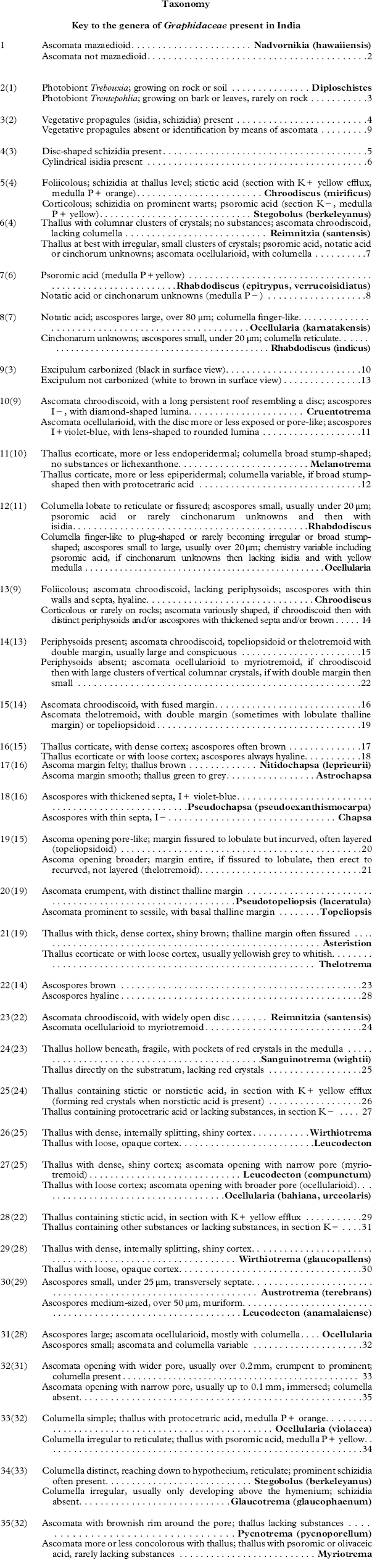
Asteristion Leight.
Trans. Linn. Soc. London 27: 163 (1870).
This genus was recently resurrected to accommodate seven species previously placed in the genera Chapsa, Ocellularia, Phaeotrema and Thelotrema (Medeiros et al. Reference Medeiros, Kraichak, Lucking, Mangold and Lumbsch2017). Four species are currently known from India. Characteristic features include: Ascomata are round to angular immersed to erumpent ascomata, disc covered to exposed, flesh-coloured to brown, white pruinose, proper exciple fissured to recurved, separated from the thalline margin by a narrow slit (double margin) forming a prominent rim around the disc, thalline margin white to pale brown, entire to recurved, hymenium clear, lacking columellar structures, ascospores hyaline to brown, transversely septate to muriform, and the presence of stictic acid and associated satellite substances.
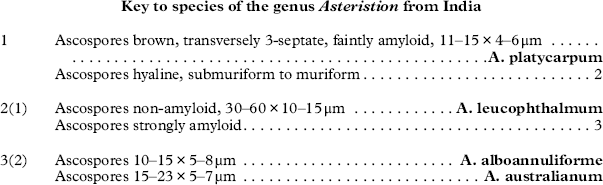
Asteristion alboannuliforme (Nagarkar et al.) I. Medeiros et al.
Fieldiana Life and Earth Sciences 9: 7 (2017).
Thallus olivaceous.
Ascomata semi-emergent, lepadinoid with white margins; proper exciple free; asci 8-spored; ascospores 10–15×5–8 µm with 3 transverse and 0–1 longitudinal septa per segment.
Chemistry. Stictic acid chemosyndrome.
Remarks. This species is similar to A. australianum in ascomatal morphology and the distinctly amyloid ascospores; however, the latter differs in producing comparatively longer and thinner submuriform ascospores. Asteristion alboannuliforme has been described from Tamil Nadu in the Western Ghats by Nagarkar et al. (Reference Nagarkar, Sethy and Patwardhan1985), as Thelotrema alboannuliforme Nagarkar et al. The species appears to be endemic to India.
Specimen examined. India: Tamil Nadu: Tirunelevelli District, Singhalamtheri, Kalakkudu primary rainforest, elev. c. 1200 m, P. G. Patwardhan & M. B. Nagarkar 84–9 (AMH).
Asteristion australianum I. Medeiros et al.
Fieldiana Life and Earth Sciences 9: 8 (2017).
Thallus olivaceous, thin, corticate.
Ascomata conspicuous, emergent; proper exciple free; ascospores small, 15–23×6–8 µm, with 4–6 transverse and 0–1 longitudinal septa per segment.
Chemistry. Stictic acid chemosyndrome.
Remarks. Asteristion platycarpoides (Tuck.) I. Medeiros et al. is apparently similar in ascomatal morphology but produces brown, predominantly transversely-septate ascospores. Material belonging to A. australianum was previously reported from the Western Ghats (Karnataka) as Ocellularia albo-olivacea (Vain.) Zahlbr. by Patwardhan & Kulkarni (1977 Reference Patwardhan and Kulkarnia ); the latter name must therefore be removed from the Indian lichen biota and A. australianum is a new record for the Indian subcontinent.
Specimens examined. India: Kerala: Wayanad District, Kalpetta, back side of Banasura sagar, 2013, A. R. Logesh s. n. (LWG). Tamil Nadu: Palni Hills, on way from Perumalmalai to Oothu near Mulaiyar, elev. c. 1350 m, Kr. P. Singh 70–1167 (LWG–LWU).
Asteristion leucophthalmum (Nyl.) I. Medeiros et al.
Fieldiana Life and Earth Sciences 9: 10 (2017).
Thallus different shades of yellow, green and grey with a waxy and loosely corticate texture.
Ascomata large, numerous; proper margins lacerate, separated from lobate thalline margins with a split (double margins); asci 6–8-spored; ascospores non-amyloid, moderately large, hyaline, muriform, 30–60×10–15 μm.
Chemistry. Stictic acid chemosyndrome.
Remarks. In India, A. leucophthalmum has so far been reported only from the Andaman and Nicobar Islands by Sethy et al. (Reference Sethy, Nagarkar and Patwardhan1987), as Thelotrema leucophthalmum Nyl.
Asteristion platycarpum (Tuck.) I. Medeiros et al.
Fieldiana Life and Earth Sciences 9: 12 (2017).
Thallus dark olive-green to olive-brown or pale yellowish-brown.
Ascomata erumpent, rounded to slightly irregular apothecioid to chroodiscoid, with double margins; asci 8-spored; ascospores faintly amyloid, grey-brown, transversely 3-septate, ellipsoidal to fusiform, 11–15×4–6 μm.
Chemistry. Stictic acid chemosyndrome.
Remarks. This species was previously known from the Western Ghats (Kerala) as Phaeotrema platycarpum (Tuck.) Zahlbr. (Patwardhan & Kulkarni 1977 Reference Patwardhan and Kulkarnia ). The distinct double margins separate this species from otherwise similar taxa in the genera Astrochapsa and Nitidochapsa.
Astrochapsa Parnmen et al.
PLoS ONE 7: e51392, 8 (2012).
The genus was recently described to accommodate species differing phylogenetically from Chapsa s. str., usually featuring a densely corticate thallus and almost exclusively subdistoseptate, non-amyloid ascospores. Parnmen et al. (Reference Parnmen, Lücking and Lumbsch2012) included 18 species, five of which occur in India that were previously classified in Chapsa (Joshi et al. 2012 Reference Joshi, Upreti and Nayakaa ).
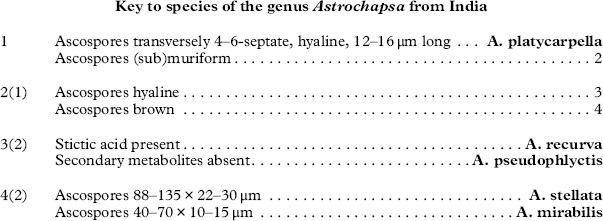
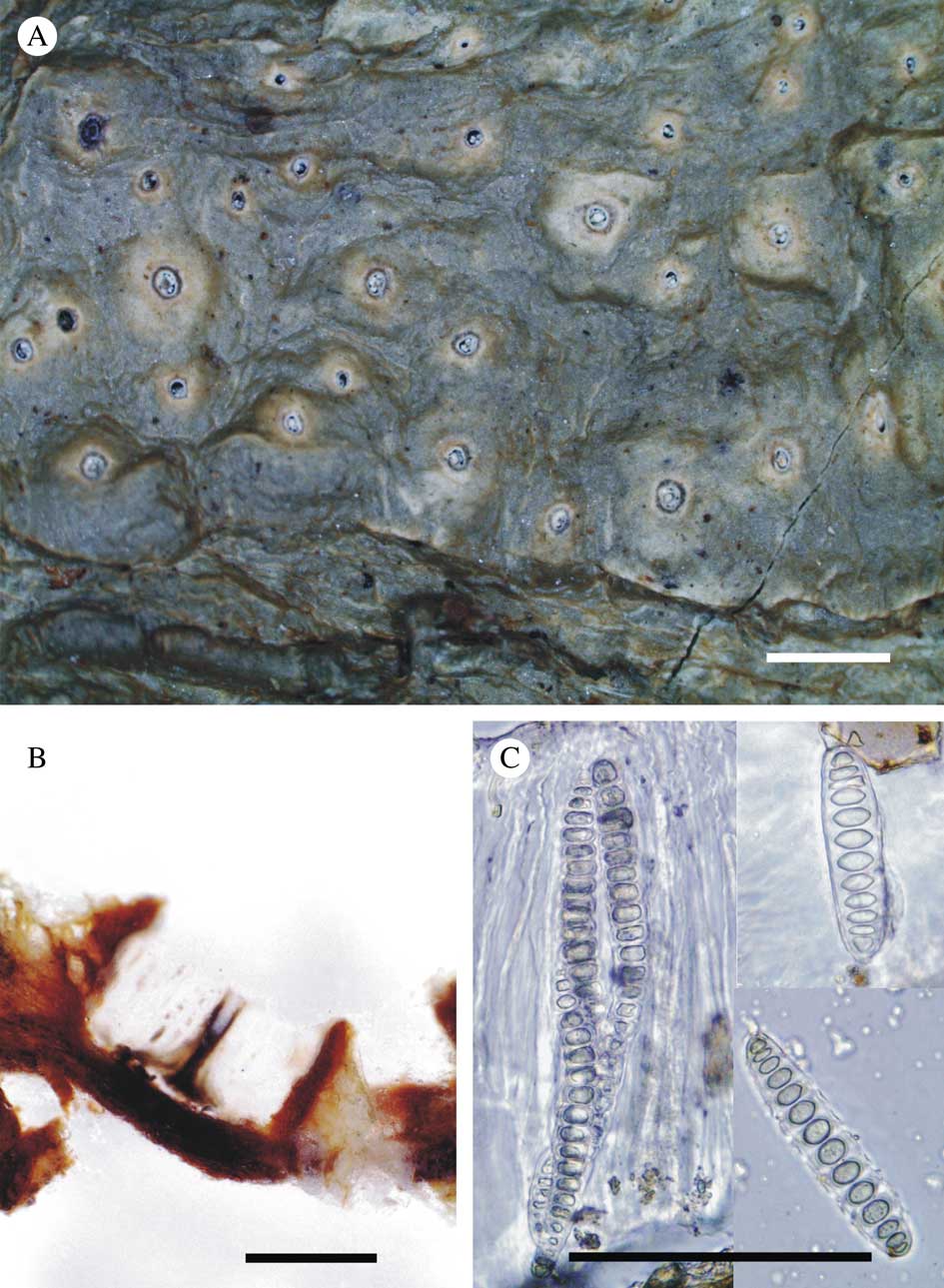
Astrochapsa mirabilis (Zahlbr.) Lücking & S. Joshi comb. nov.
MycoBank No.: MB 826953
Phaeographina mirabilis Zahlbr., Symb. Sinic. 3: 62 (1930); type: China, Fukien, Gu-shan near Fudshou, elev. 500–600 m, 1926, F. Chung 387 (W—holotype).
Thallus corticate, olive-green to dull greyish green.
Ascomata angular to shortly lirellate with recurved margins; disc, blackish, densely covered with white pruina; hymenium inspersed with oil droplets; asci 8-spored; ascospores brown, muriform; 65–80×14–17 μm.
Chemistry. Stictic acid.
Remarks. This species is a new record for India, reported recently from the Eastern Himalayan region (Manipur).
Specimens examined. India: Manipur: Ukhrul District, Lunghar Village, elev. 1789 m, K. K. Ingle 17–031802 (LWG); Lungchap Village, elev. 1338 m, K. K. Ingle 17–031801 (LWG).
Astrochapsa platycarpella (Vain.) Parnmen et al.
PLoS ONE 7: e51392, 9 (2012).
Thallus olive-green to pale green, cartilaginous.
Ascomata scattered to aggregate, round to angular with a thin, fissured to lobed, recurved margin; disc white pruinose blackish; proper exciple±hyaline; asci 8-spored; ascospores hyaline, transversely 3–5-septate, fusiform, 12–16×3–5 μm.
Chemistry. No substances detected.
Remarks. This species has been reported from evergreen tropical forest in the Western Ghats.
Specimen examined. India: Kerala: Idukki District, Adimali Forest Range, Thondi Kappu, B. Haridas 06–009598 (LWG).
Astrochapsa pseudophlyctis (Nyl.) Parnmen et al.
PLoS ONE 7: e51392, 9 (2012).
Thallus whitish grey to pale grey.
Ascomata round to angular with jagged, often eroded margins; asci 2–6-spored; ascospores hyaline, muriform, 36–60×16–24 μm.
Chemistry. No substances detected.
Remarks. Astrochapsa recurva is similar but can be readily distinguished by the presence of stictic acid. Astrochapsa pseudophlyctis was first reported from the Eastern Himalaya (Meghalaya and Sikkim) by Jagadeesh Ram & Sinha (Reference Jagadeesh Ram and Sinha2009) under the genus Chapsa. Thelotrema subhiatum Patwardhan & Kulkarni described from India (Patwardhan & Nagarkar Reference Patwardhan and Nagarkar1980) has been included in the synonymy of A. pseudophlyctis (Buaruang et al. Reference Buaruang, Boonpragob, Mongkolsuk, Sangvichien, Vongshewarat, Polyiam, Rangsiruji, Saipunkaew, Naksuwankul and Kalb2017). The species is also known from Nagaland in the Eastern Himalaya, and the Andaman and Nicobar Islands.
Specimen examined. India: Nagaland: Dimapur-Kohima road, near Ghaspani, P. G. Patwardhan & M. B. Nagarkar 77–1403 (AMH).
Astrochapsa recurva (G. Salisb.) Parnmen et al.
PLoS ONE 7: e51392, 9 (2012).
Thallus corticate, whitish grey, smooth.
Ascomata numerous, solitary, round to elongated, semi-emergent, chroodiscoid; asci 2–4-spored; ascospores hyaline, muriform,≥68 µm long.
Chemistry. Stictic acid.
Remarks. Nagarkar et al. (Reference Nagarkar, Sethy and Patwardhan1986) reported this species (as Thelotrema recurvum G. Salisb.) from the Andaman and Nicobar Islands.
Astrochapsa stellata (Hale) Parnmen et al.
PLoS ONE 7: e51392, 9 (2012).
Thallus greenish, glaucous, continuous, mostly epiperidermal.
Ascomata dispersed, slightly immersed, chroodiscoid with recurved margins; disc white pruinose; proper exciple±fused, brown; asci 1-spored; ascospores ellipsoidal, olivaceous to brownish, muriform, 88–135×22–30 μm.
Chemistry. No substances detected.
Remarks. This taxon was previously recognized as Leptotrema stellatum Hale from Meghalaya in the Eastern Himalayan region (Patwardhan & Nagarkar Reference Patwardhan and Nagarkar1980).
Austrotrema I. Medeiros et al.
Fieldiana Life and Earth Sciences 9: 14 (2017).
This genus is separated mainly on characters such as small, barely emergent ascomata with double margins, non-amyloid to faintly amyloid ascospores, and the presence of stictic acid. It is separated from Thelotrema by having a dense, prosoplectenchymatous cortex, and from Asteristion by the small, pore-like ascomata. The similar genus Wirthiotrema produces a glossy thallus with a cortex that splits internally. Three species are included within the genus, with a single species known from India.
Austrotrema terebrans (Nyl.) I. Medeiros et al.
Fieldiana Life and Earth Sciences 9: 17 (2017).
Thallus shiny, warty, yellowish grey to straw-coloured.
Ascomata immersed; proper exciple pale yellow; asci 8-spored; ascospores transversely 5–12-septate, hyaline, non-amyloid to weakly amyloid, 15–22×5–7 µm.
Chemistry. Stictic acid chemosyndrome.
Remarks. This species was previously recorded as Thelotrema bicinctulum Nyl. (Mangold et al. Reference Mangold, Elix and Lumbsch2009; Singh & Sinha Reference Singh and Sinha2010) which has a restricted distribution in Australia and adjacent areas. Austrotrema terebrans has been reported from the Andaman and Nicobar Islands as Ocellularia terebrans (Nyl.) Zahlbr by Nagarkar et al. (Reference Nagarkar, Sethy and Patwardhan1988). In addition, it is commonly found in different parts of the Western Ghats (Karnataka, Kerala, Maharashtra and Tamil Nadu).
Specimen examined. India: Andaman & Nicobar Islands: Middle Andaman, Long Island, A. Singh 61–52959 (LWG).
Chapsa A. Massal.
Atti Reale Ist. Veneto Sci. Lett. Arti, sér. 3 5: 256 (1860).
The genus Chapsa was introduced by Massalongo in 1860 and resurrected by Frisch et al. (Reference Frisch, Kalb and Grube2006) to accommodate species characterized by a thin, corticolous, endoperidermal to epiperidermal thallus, chroodiscoid ascomata with a fused to ±free proper exciple internally lined by periphysoids, and thin-walled ascospores (Mangold et al. Reference Mangold, Elix and Lumbsch2009; Rivas Plata et al. 2010 Reference Rivas Plata, Lücking, Sipman, Mangold, Kalb and Lumbscha ). This genus is suspected to be polyphyletic since its resurrection. Consequently, in more recent studies, molecular evidence and re-examination of phenotypic characters recognized several clades that resulted in the segregation of various genera from Chapsa s. l., viz., Astrochapsa, Crutarndina, Gintarasia, Pseudochapsa, Pseudotopeliopsis, Myriochapsa and Nitidochapsa (Parnmen et al. Reference Parnmen, Lücking and Lumbsch2012, Reference Parnmen, Cáceres, Lücking and Lumbsch2013; Kraichak et al. 2014 Reference Kraichak, Parnmen, Lücking and Lumbschb ). Sixteen species of Chapsa s. l. had been recorded from India previously (Joshi et al. 2012 Reference Joshi, Upreti and Nayakaa ). However, after the segregation of other genera, only eight of these belong in Chapsa s. str. Generally, Chapsa and allied genera are most diverse in the southern and eastern regions of the country, usually distributed at altitudes below 1000 m. The rainforests of the Western Ghats and the Eastern Himalaya with their semi-exposed and humid climate provide suitable habitats for the species.
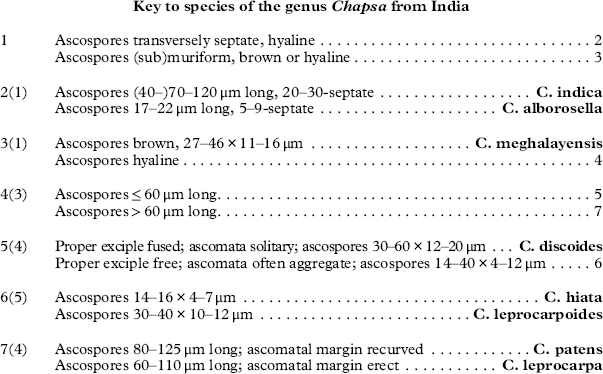
Chapsa alborosella (Nyl.) Frisch
Biblioth. Lichenol. 92: 90 (2006).
Thallus ecorticate, pale olive-green.
Ascomata round to angular or shortly elongate, pale brown, level with the thallus; asci 8-spored; ascospores hyaline, transversely septate, fusiform to clavate or oblong, I−.
Chemistry. No substances detected.
Remarks. Patwardhan & Kulkarni (1977 Reference Patwardhan and Kulkarnia ) and Nagarkar et al. (Reference Nagarkar, Sethy and Patwardhan1988) reported this species from south India as Ocellularia alborosella (Nyl.) R. Sant. It is known from the tropical evergreen forests of the Eastern Himalaya and the Western Ghats.
Specimen examined. India: Mizorum: Champhai District, Murlen National Park, elev. 1668 m, A. R. Logesh & M. Chinlampianga 14–031438 (LWG).
Chapsa discoides (Stirt.) Lücking
Phytotaxa 55: 35 (2012).
Thallus ashy white, smooth, partly hypophloeodal.
Ascomata semi-emergent with chroodiscoid, erect to recurved margins; proper exciple brown, fused to free; hymenium hyaline; asci 4–8-spored; ascospores hyaline, ellipsoid, muriform.
Chemistry. No substances detected.
Remarks. This species has incorrectly been reported as Thelotrema velatum Müll. Arg. and Chapsa velata (Nyl.) Cáceres & Lücking from the Andaman and Nicobar Islands and the Eastern Himalayan region (Patwardhan & Makhija Reference Patwardhan and Makhija1980; Singh & Sinha Reference Singh and Sinha2010; Joshi et al. 2012 Reference Joshi, Upreti and Nayakaa ).
Specimens examined. India: Assam: Nagaon District, Chapanala, elev. 60 m, A. Dey 13–021806 (LWG). West Bengal: West Medinipur District, Mohanpur, IISER Kolkata campus, T. Hembram 14–024653 (LWG).
Chapsa hiata (Hale) Sipman
Phytotaxa 55: 38 (2012).
Thallus ecorticate.
Ascomata wide and open, with recurved margins; proper exciple free; asci 4–8-spored; ascospores small, hyaline, muriform, I−, 14–16× 4–7 μm.
Chemistry. No substances detected.
Remarks. Astrochapsa pseudophlyctis is similar to C. hiata in having an ecorticate thallus lacking lichen compounds but it has larger ascospores and a fused proper exciple. The species was originally described as Thelotrema hiatum Hale (Hale 1978 Reference Haleb ; Patwardhan et al. Reference Patwardhan, Sethy and Nagarkar1985) and occurs in the Eastern Himalaya and the Eastern and Western Ghats.
Specimens examined. India: Assam: Nagaon District, Misa Village, A. Dey 12–020496 (LWG). Karnataka: South Canara District, Hebri, P. G. Patwardhan & U. V. Makhija 80–517 (AMH). Orissa: Ganjam District, Barhampur University campus, near guest house, D. D. Awasthi et al. 86–044 (LWG–LWU).
Chapsa indica A. Massal.
Atti I. R. Ist. Veneto Sci. Lett. Arti, sér. 3 5: 257 (1860).
Thallus ecorticate, brownish white to olive-grey.
Ascomata level with the thallus, rounded to angular or shortly elongated and slightly branched; asci 6–8-spored; ascospores large, hyaline, transversely 20–30-septate, oblong-fusiform.
Chemistry. No substances detected.
Remarks. Patwardhan & Nagarkar (Reference Patwardhan and Nagarkar1980) and Nagarkar et al. (Reference Nagarkar, Sethy and Patwardhan1988) reported the species incorrectly as Ocellularia pycnophragmia (Nyl.) Zahlbr. from tropical rainforests of the Andaman and Nicobar Islands, and Assam and Meghalaya (Eastern Himalaya).
Specimen examined. India: Tripura: North Tripura District, Rowya Reserve Forest, Panisagar, Rupam Debnath 12–023193 (LWG).
Chapsa leprocarpa (Nyl.) Frisch
Biblioth. Lichenol. 92: 108 (2006).
Thallus pale to dark olive-grey.
Ascomata large, chroodiscoid with a lobed and recurved margin; disc pale brown to blackish but heavily white pruinose; asci 1-spored; ascospores muriform.
Chemistry. No substances detected.
Remarks. Awasthi (Reference Awasthi1991) first recorded C. leprocarpa from the Andaman and Nicobar Islands incorrectly as Thelotrema colobicum Nyl. Thelotrema poeltii Patw. & C. R. Kulk., described from India, has been reduced to synonymy with C. leprocarpa by Rivas Plata et al. (2010 Reference Rivas Plata, Lücking, Sipman, Mangold, Kalb and Lumbscha ). Chapsa leprocarpa inhabits lowland and submontane regions in the Western Ghats and also occurs in the Andaman Islands and the Eastern Himalaya. Chapsa patens is similar but differs in producing slightly larger ascospores and a recurved ascomatal margin.
Specimens examined. India: Andaman & Nicobar Islands: South Andaman, Baratang Island, between Nilambur and Jarwa Creek, A. Singh 61–79724 (LWG). Goa: South Goa, Cotigao Wildlife Sanctuary, Paigar Sacred grove, Gaodong Village, elev. 300 m, S. Nayaka et al. 03–001619 (LWG). Karnataka: Chikmagalure District, Chamudi Ghat, Kuvettu, elev. 104 m, H. T. Lumbsch, D. K. Upreti & P. K. Divakar 08–19739R (LWG). Kerala: Idukki District, ICRI campus, Myladumpara, elev. c. 1200 m, D. D. Awasthi & G. Awasthi 84–88 (LWG–LWU). Maharashtra: Pune District, near Lonavala, Tiger point, D. D. Awasthi 59–4076 (LWG–AWAS). Mizorum: Aizawl District, Sateek Village area, enroute to Lunglei, A. R. Logesh & M. Chinlampianga 14–019151 (LWG).
Chapsa leprocarpoides (Hale) Cáceres & Lücking
Libri Bot. 22: 52 (2007).—Thelotrema confertum Nagarkar, Sethy & Patw., Kavaka 13: 58 (1987) [“1985”]; type: India, Karnataka, South Canara District, Hebri, on bark, 30 January 1980, P. G. Patwardhan & U. V. Makhija 80–518 (AMH—holotype).
Thallus ecorticate, pale olive to fawn, reflecting the bark through the matted surface.
Ascomata immersed to semi-immersed, rounded to angular; disc flesh-coloured, pruinose with low jagged to lobed margins; proper exciple pale to brownish or hyaline, free; asci 8-spored; ascospores hyaline, muriform, ellipsoid to ovoid.
Chemistry. No substances detected.
Remarks. The examined type material of Thelotrema confertum Nagarkar et al. agrees with C. leprocarpoides, viz., an ecorticate thallus producing no secondary metabolites, aggregated ascomata with erect margins, thinly white pruinose, flesh-coloured disc, 4–6-spored asci and small, submuriform (3–6×0–2 septa), non-amyloid ascospores, 20–25(–30)×9–12 µm. It was collected from evergreen tropical forests of the Western Ghats on rough tree barks at lower altitude.
Specimens examined. India: Karnataka: Shimoga District, Sagar to Talguppa, Ulanahalli, elev. 697 m, H. T. Lumbsch, D. K. Upreti & P. K. Divakar 08–19742E, 08–19742I (LWG). Tamil Nadu: Kambam, Meghamalai Wildlife Sanctuary, Mathuthulu, S. Nayaka 99–75948 (LWG).
Chapsa meghalayensis (Patw. & Nagarkar) Lumbsch & Divakar
Lichenologist 42: 183 (2010).
Thallus ecorticate, granular.
Ascomata immersed, chroodiscoid with recurved margins; exciple lacerate; asci 2-spored, ascospores small, muriform, brown, 27–46×11–16 μm.
Chemistry. No substances detected.
Remarks. This species is endemic and described from evergreen forests of the Eastern Himalayan region. It was first described from Meghalaya by Patwardhan & Nagarkar (Reference Patwardhan and Nagarkar1980) as Leptotrema meghalayense Patw. & Nagarkar and later classified in Myriotrema by Awasthi (Reference Awasthi1991) but subsequently placed in Chapsa (Rivas Plata et al. 2010 Reference Rivas Plata, Lücking, Sipman, Mangold, Kalb and Lumbscha ).
Specimen examined. India: Meghalaya: 20 km from Shillong, in evergreen forest on roadside at Barapani, P. G. Patwardhan & M. B. Nagarkar 77–736 (AMH).
Chapsa patens (Nyl.) Frisch
Biblioth. Lichenol. 92: 111 (2006).
Thallus ecorticate, dark olivaceous grey to dark grey or blackish.
Ascomata immersed, mostly rounded to slightly angular with raised, lobed and recurved margins; disc white pruinose; proper exciple hyaline to pale brown; asci 1-spored; ascospores hyaline, muriform, 80–125×20–35 μm.
Chemistry. No substances detected.
Remarks. This species has been reported from tropical rainforests of the Eastern Himalaya where it is common in open, old-growth forests with large tree trunks (Joshi et al. 2012 Reference Joshi, Upreti and Nayakaa ). Chapsa leprocarpa, which also lacks secondary metabolites, differs from C. patens in having a slightly lower hymenium and smaller ascospores, and growing at lower altitudes (1000–1200 m).
Specimen examined. India: West Bengal: Darjeeling District, Tiger Hill, north face of the hill, elev. c. 2500 m, D. D. Awasthi & M. R. Agarwal 67–21 (LWG–LWU).
Chroodiscus (Müll. Arg.) Müll. Arg.
Lichenes epiphylli novi: 18 (1890).
The genus currently includes 14 species worldwide (Rivas Plata et al. 2010 Reference Rivas Plata, Lücking, Sipman, Mangold, Kalb and Lumbscha ), including two species also reported from India. Comprehensive accounts of the genus have been provided by Frisch et al. (Reference Frisch, Kalb and Grube2006), Lücking et al. (Reference Lücking, Papong, Thammathaworn and Boonpragob2008), Papong et al. (Reference Papong, Lücking, Thammathaworn and Boonpragob2009) and Mangold et al. (Reference Mangold, Elix and Lumbsch2009). Currently, the genus includes only foliicolous species with chroodiscoid ascomata a hyaline proper exciple lacking lateral paraphyses, rather lax paraphyses and thin-walled, I− ascospores. Some taxa show facultative parasitism, mostly on Porina spp. (Lücking & Grube Reference Lücking and Grube2002). Awasthi (Reference Awasthi1991) reported Chroodiscus coccineus and C. mirificus from India and later Singh & Sinha (Reference Singh and Sinha2010) catalogued three species of the genus, namely C. mirificus, C. australiensis and the recently described C. himalayanus Nayaka & Upreti, which has now been recombined and treated under the genus Stictis as Stictis himalayanus (Nayaka & Upreti) S. Joshi & Upreti (Joshi et al. Reference Joshi, Upreti and Nayaka2010).

Chroodiscus australiensis Vězda & Lumbsch
Nova Hedwigia 50: 246 (1990).
Thallus pale greenish, smooth to uneven.
Ascomata reddish orange; ascospores 1-septate, 7–10×2–3 µm.
Chemistry. Stictic acid chemosyndrome.
Remarks. In India, this species is recorded from the Andaman and Nicobar Islands, and Arunachal Pradesh and West Bengal in the Eastern Himalayan region (Singh & Sinha Reference Singh and Sinha2010).
Chroodiscus mirificus (Kremp.) R. Sant
Nova Hedwigia 50: 249 (1990).
Thallus smooth, uneven, grey to whitish grey; isidia disc-shaped.
Ascospores submuriform, fusiform to oblong, 8–15×3–5 µm.
Chemistry. Stictic acid.
Remarks. This species occurs in tropical rainforests of the Andaman and Nicobar Islands, and Arunachal Pradesh in the Eastern Himalayan region (Singh & Sinha Reference Singh and Sinha2010).
Cruentotrema Rivas Plata et al.
Fungal Diversity 52: 119 (2012).
Species in this genus were previously recognized as the “Ocellularia” cruentata group, with a carbonized proper exciple and fissured or cruentodiscoid ascomata (Rivas Plata et al. 2010 Reference Rivas Plata, Lücking, Sipman, Mangold, Kalb and Lumbscha ). Subsequently, this group, forming a separate phylogenetic clade in the subfamily Fissurinoideae, was segregated as a separate genus. The delimiting characters for the genus include ecolumellate ascomata with split margins, trypethelioid ascospores with diamond-shaped lumina and non-amyloid ascospores (Rivas Plata et al. 2012 Reference Rivas Plata, Lücking and Lumbscha ). Of the four recognized species, two are known from India and represent new country records.

Cruentotrema cruentatum (Mont.) Rivas Plata et al.
Fungal Diversity 52: 119 (2012).
Thallus yellowish brown to brown.
Ascomata aggregated, fused, appearing irregular in shape, chroodiscoid, with a layered thalline margin with red pigment turning K+ green; disc greyish brown; proper exciple pale brown to distinctly carbonized; epihymenium grey, crystalline, 15–20 µm high; hymenium clear, 170–200 µm high; asci 8-spored; ascospores submuriform, oblong to ellipsoid, 4–6×1–2 locular, 23–26×9–12 µm, non-amyloid, halonate.
Chemistry. No substances detected.
Remarks. The species is newly recorded from the Western Ghats, occurring in rainforests.
Specimen examined. India: Karnataka: Uttarakannada District, Kumta taluk, Vadgeri (Chandawar), S. Duani 14–024694 (LWG).
Cruentotrema kurandense (Mangold) Rivas Plata et al.
Fungal Diversity 52: 119 (2012).
Thallus yellowish brown to pale brown.
Ascomata round to irregular, chroodiscoid with incurved, split and lobed margins with white pruina; disc blackish; proper exciple fused, 30–40 µm thick, yellowish brown to carbonized marginally; epihymenium crystalline greyish brown, 15–20 µm high; hymenium clear, 80–100 µm high; asci 8-spored; ascospores submuriform, ellipsoidal, fusiform, hyaline, 4–7×1–3 locular, 14–20×5–8 µm, non-amyloid, non-halonate.
Chemistry. No substances detected.
Remarks. This species is a new record for India. The closely related C. cruentatum differs in having pigmented ascomatal margins. It occurs in tropical rainforests and is known from the Western Ghats.
Specimen examined. India: Karnataka: Chickmaglore District, Chamudighat near Kotigchara, elev. 979 m, H. T. Lumbsch, D. K. Upreti & P. K. Divakar 08–19735R/A (LWG).
Diploschistes Norman
Nyt. Mag. Naturvidensk. 7: 232 (1853).
This genus is one of few genera in Graphidaceae having Trebouxia as photobiont and growing mostly on soil and rock, with its centre of distribution in arid to semi-arid regions. The thallus is covered by an epinecral layer. The ascomata are perithecioid to urceolate, with a carbonized pseudoparenchymatous excipulum with lateral paraphyses, 1–8-spored asci, submuriform to muriform, usually brown ascospores and varied chemistry. Diploschistes comprises 43 species worldwide, growing on rock, soil, mosses and sometimes on other lichens (CABI Bioscience et al. 2010; Rivas Plata et al. 2010 Reference Rivas Plata, Lücking, Sipman, Mangold, Kalb and Lumbscha ; Fernández-Brime et al. Reference Fernández-Brime, Llimona, Lutzoni and Gaya2013). In India, Awasthi (Reference Awasthi1991) recorded six species: D. actinostoma, D. candidissimus, D. cinereocaesius, D. megalosporus, D. muscorum and D. scruposus. Subsequently, Pant & Upreti (Reference Pant and Upreti1993) added a new species, D. awasthii, and five new records, viz. D. caesioplumbeus, D. diacapsis, D. euganeus, D. gypsaceus, D. rampoddensis, and the two subspecies of D. muscorum. Diploschistes nepalensis Pant & Upreti, described from the Himalayas (Nepal), does not belong to the genus but is probably a species of Gyalidea. Currently, the genus is represented by a total of 13 taxa from India (Pant & Upreti Reference Pant and Upreti1993; Singh & Sinha Reference Singh and Sinha2010).
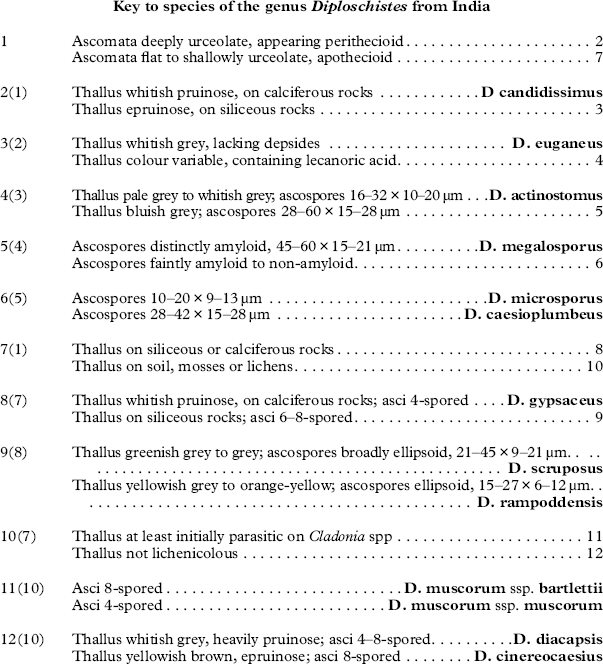
Diploschistes actinostoma (Pers. ex Ach.) Zahlbr.
Hedwigia 31: 34 (1892).
Thallus areolate, shiny.
Ascomata perithecioid; asci 8-spored; ascospores small, 16–32×10–20 µm.
Chemistry. Lecanoric acid.
Remarks. It grows on siliceous rocks and is widely distributed in India, occurring in the Western and Eastern Himalayas, Central India and the Western Ghats.
Specimens examined. India: Himachal Pradesh: Chamba District, in and around Khajiar, elev. 2000 m, D. K. Upreti & S. Nayaka 01–75464 (LWG). Jammu & Kashmir: Srinagar District, Shankaracharya Hills, D. D. Awasthi 53–2650 (LWG–AWAS). Karnataka: Bellari District, Hampi, along riverside, A. Singh, G. P. Sinha & S. Singh 90–234 (LWG–NRLC). Madhya Pradesh: Anuppur District, Amarkantak, A. Prajapati 10–017129 (LWG). Maharashtra: Pune District, Pune City, Chandni Chowk, NDA road, Banjara Hill, elev. 580 m, S. Nayaka 06–005076, 06–005081 (LWG). Meghalaya: 7 km from Cherapunji, elev. c. 1000 m, D. D. Awasthi 75–7980 (LWG–AWAS). Tamil Nadu: Salem District, Yercaud, Shevaroy Hills, near Kiliur Falls, elev. 1350 m, D. K. Upreti & G. N. Hariharan 90–202155 (LWG). Uttarakhand: Pithoragarh Distict, en route to Milam Glacier, Munsiyari to Lilam, elev. 2250–1800 m, Santosh Joshi 07–010319, 07–010321 (LWG).
Diploschistes caesioplumbeus (Nyl.) Vain.
Bot. Mag. (Tokyo) 35: 70 (1921).
Thallus areolate epruinose.
Ascomata perithecioid; ascospores 28–42× 15–28 µm.
Chemistry. Lecanoric acid.
Remarks. This species differs from the closely related D. actinostomus and D. candidissimus by having larger ascospores, and from the latter also by the epruinose thallus growing on silicious rock. It has been recorded from the arid zone (north-west) and Central India (Madhya Pradesh) by Pant & Upreti (Reference Pant and Upreti1993).
Specimen examined. India: Rajasthan: Sirohi District, Mount Abu, near Arbuda Devi temple, A. Singh 73–101312 (LWG).
Diploschistes candidissimus (Kremp.) Zahlbr.
Cat. Lich. Univ. 2: 600 (1923).
Thallus calcicolous, areolate and pruinose.
Ascomata perithecioid; asci 4–8-spored; ascospores 18–38×15–21 µm.
Chemistry. Lecanoric acid as a major constituent.
Remarks. This species is known from the Eastern Himalaya, North and Central India, and the Eastern and Western Ghats.
Specimens examined. India: Himachal Pradesh: Bilaspur District, Namhol, Tepra, Bahadurpur, elev. 1500–2200 m, D. K. Upreti 03–001361, 03–001322A (LWG). Jammu & Kashmir: Srinagar District, Shankaracharya Hill, D. D. Awasthi s. n. (LWG–AWAS). Karnataka: Hassan District, Shravanabelagola, Chandragiri Hills, A. Singh & G. P. Sinha 90–220 (LWG). Madhya Pradesh: Hosangabad District, Pachmarhi, Rajat Pratap Falls, elev. 1060 m, D. K. Upreti & U. C. Mishra 80–75, 80–114 (LWG). Orissa: Ganjam District, Taptapani, 5 km Berhampur, D. D. Awasthi 86–062 (LWG–LWU). Rajasthan: Sirohi District, Mount Abu, near Arbuda Devi temple, A. Singh 73–101335, 73–101343 (LWG). Tamil Nadu: Nilgiri District, Nilgiri Hills, Upper Bhani road from Avalanche, on Lakribetta top, elev. c. 2400 m, D. D. Awasthi & Kr. P. Singh 71–732 (LWG–LWU). Uttarakhand: Bageshwar District, near Phurkia dakbanglow, elev. 3510 m, D. D. Awasthi 70–7732 (LWG–AWAS); Pithoragarh District, en route to Milam Glacier, Lilam to Bogudiyar (Rargari udiyar), elev. 2400 m, Santosh Joshi 07–010349 (LWG).
Diploschistes cinereocaesius (Sw. ex Ach.) Vain.
Ann. Acad. Sci. Fenn., sér. A 15: 172 (1921).
Thallus verrucose.
Asci 8-spored; ascospores 18–27×9–15 µm.
Chemistry. Lecanoric and diploschistesic acids.
Remarks. This is a terricolous species. The similar D. rampoddensis differs in lacking diploschistesic acid and occurs on siliceous rocks. In India D. cinereocaesius occurs in the Western and Eastern Himalayas, and the Western Ghats.
Specimens examined. India: Kerala: Idukki District, Munnar, Deviculam area, elev. c. 1500–1600 m, D. D. Awasthi, R. Tewari & R. Mathur 85–163 (LWG). Meghalaya: 3 km towards Mawsmai from Cherrapunji, elev. c. 1100 m, D. D. Awasthi 75–7932 (LWG–LWU). Sikkim: Gangtok District, Tashi viewpoint, elev. 1750 m, S. Chatterjee & P. K. Divakar 20–77187 (LWG). Tamil Nadu: Nilgiri District, Nilgiri Hills, Konada tea estate area, by roadside, D. D. Awasthi & Kr. P. Singh 71–13 (LWG–LWU); near Ooty, Emerald road, Fern Hill, Kr. P. Singh 73–499 (LWG–LWU).
Diploschistes diacapsis (Ach.) Lumbsch
Lichenologist 20: 20 (1988).
Thallus whitish, pruinose.
Ascomata apothecioid; asci 8-spored; ascospores 21–33×12–18 µm.
Chemistry. Lecanoric and diploschistesic acids.
Remarks. This species was recorded from the Western Himalaya (Himachal Pradesh and Uttarakhand) by Pant & Upreti (Reference Pant and Upreti1993) and Singh & Sinha (Reference Singh and Sinha2010).
Diploschistes euganeus (A. Massal.) J. Steiner
Verhandl. Zool. Bot. Ges. Wien 69: 96 (1919).
Thallus grey to greyish brown.
Ascomata perithecioid; asci 8-spored;ascospores 24–36×15–18 µm.
Chemistry. No substances detected.
Remarks. This saxicolous species was recorded from the Western Himalaya by Pant & Upreti (Reference Pant and Upreti1993).
Specimen examined. India: Uttarakhand: Uttarkashi District, Hasil, on way to Gangotri, A. Singh 97254 (LWG).
Diploschistes gypsaceus (Ach.) Zahlbr.
Hedwigia 31: 35 (1892).
Thallus whitish pruinose.
Asci 4-spored; ascospores 30–45×15–18 µm.
Chemistry. Lecanoric acid.
Remarks. In India, the species is reported from the Western Himalaya and Central India. Diploschistes scruposus differs in having an epruinose thallus and occurring in siliceous as opposed to calciferous rock habitats.
Specimens examined. India: Himachal Pradesh: Kinnaur District, Reckong Peo to Kalpa Village, elev. 2950 m, D. K. Upreti, R. Srivastava & Prakash Singh Kunwar 03–002664 (LWG). Jammu & Kashmir: Doda District, Badharwah, Ramkund, Chandrashekhar 10–012578 (LWG). Uttarakhand: Almora District, Karbala pine forest, elev. 1600 m, D. K. Upreti, S. Chatterjee & J. Tandon 97–L69753, 97–L69754 (LWG).
Diploschistes megalosporus Lumbsch & H. Mayrhofer
Mycotaxon 38: 311 (1990).
Thallus areolate.
Ascomata perithecioid; asci 4–6-spored; ascospores 42–60×15–21 µm, I+ blue when young.
Chemistry. Lecanoric and diploschistesic acids.
Remarks. This species was described from the Western Ghats (Tamil Nadu) and is endemic to India. The morphologically close D. actinostoma and D. caesioplumbeus differ in having smaller, faintly to non-amyloid ascospores.
Diploschistes microsporus Lumbsch & Elix
Biblioth. Lichenol. 86: 124 (2003).
Thallus smooth, rimose-areolate.
Ascomata perithecioid; asci 8-spored; ascospores non-amyloid, 10–20×9–13 µm.
Chemistry. Lecanoric and diploschistesic acids.
Remarks. This species is recorded from Meghalaya in the Eastern Himalayan region (Singh & Singh Reference Singh and Singh2016). Diploschistes caesioplumbeus differs from this species in producing slightly larger ascospores.
Diploschistes muscorum subsp. bartlettii Lumbsch
Herzogia 7: 602 (1987).
Thallus grey to whitish grey, rimose, areolate.
Ascomata immersed, urceolate.
Chemistry. Diploschistesic, lecanoric and orsellinic acids.
Remarks. This species is a juvenile parasite on Cladonia spp. Two subspecies are present in India, the 4-spored nominal subspecies and the 8-spored D. muscorum subsp. bartlettii. In India, the latter subspecies is reported from the Western Ghats, and the Western and Eastern Himalayas.
Specimens examined. India: Himachal Pradesh: Kinnaur District, Chitkul forest area, elev. 3900–4000 m, D. K. Upreti, R. Srivastava & Prakash Singh Kunwar 03–002749 (LWG). Jammu & Kashmir: Doda District, Bahadurpur, Kailash Kund, Chandrashekhar 10–012537 (LWG). Karnataka: Chikmagalure District, way to Kemmangundi, elev. c. 1400 m, D. D. Awasthi, D. K. Upreti & U. C. Misra 79–434 (LWG). Kerala: Wayanad District, Chembra Hills, elev. 1050 m, B. Haridas 06–009647 (LWG). Meghalaya: Shillong District, A. Singh, S. Chatterjee & S. Singh 91–38 (LWG). Mizoram: Aizwal District, Chawn pui, elev. 1450 m, M. Chinlampianga 12–018692 (LWG). Tamil Nadu: Nilgiri District, Nilgiri Hills, Lovedale, Kr. P. Singh 73–507 (LWG–LWU). Uttarakhand: Almora District, elev. 2400 m, D. D. Awasthi & A. M. Awasthi 50–687 (LWG–AWAS). West Bengal: Darjeeling District, Kurseong, elev. 2400 m, D. D. Awasthi & M. R. Agarwal 66–321(LWG).
Diploschistes muscorum subsp. muscorum (Scop.) R. Sant.
Lichenologist 12: 106 (1980).
This subspecies differs from D. muscorum subsp. bartlettii in having a smaller hymenium and 4-spored asci. In India, the taxon occurs in the Western and Eastern Himalayas and the Western Ghats.
Specimens examined. India: Jammu & Kashmir: Srinagar District, Shankaracharya Hill, D. D. Awasthi 53–2644 (AWAS). Kerala: Idukki District, Munnar, Rajamallay area, along border of tea plantation, elev. 1500–1600 m, D. D. Awasthi, R. Tiwari & Mathur 85–89 (LWG–LWU). Uttarakhand: Chamoli District, Badrinath, east of the temple, elev. c. 3250 m, K. Dange 76–838 (LWG–LWU).
Diploschistes rampoddensis (Nyl.) Zahlbr.
Cat. Lich. Univ. 2: 665 (1924).
Thallus verrucose.
Ascomata apothecioid; asci 8-spored; ascospores 15–27×6–12 µm.
Chemistry. Lecanoric acid.
Remarks. The terricolous D. cinereocaesius has broader ascospores and those of D. scruposus are larger. Furthermore, both species produce diploschistesic acid as an additional thallus compound. Diploschistes rampoddensis occurs in the Western and Eastern Himalayas, Central India and the Western Ghats.
Specimens examined. India: Himachal Pradesh: Bilaspur District, Namhol, Tepra, Bahadurpur, elev. 1500–2200 m, D. K. Upreti et al. 03–001343 (LWG). Madhya Pradesh: Dindori District, Chauradader, elev. 1500 m, D. K. Upreti, S. Nayaka & Satya 05–005646A (LWG). Maharashtra: Satara District, Mahabaleshwar, Wilson Point, elev. 1470 m, R. Bajpai 10–013822 (LWG). Tamil Nadu: Palni Hills, Kodaikanal, Shembaganur near Silver Cascade, elev. c. 1800 m, Kr. P. Singh 70–1129 (LWG–LWU). Uttarakhand: Almora District, on way to Kasardevi, elev. 1650 m, D. D. Awasthi 56–3475 (AWAS).
Diploschistes scruposus (Schreb.) Norman
Nyt Mag. Naturvidensk. 7: 232 (1853).—Diploschistes awasthii G. Pant & Upreti, Lichenologist 25: 38 (1993); type: India, Uttarakhand, Bageshwar District, near Phurkia dakbunglow, elev. 3300 m, 10 June 1970, D. D. Awasthi 7662 (LWG-AWAS—holotype).
Thallus grey to greenish grey, rimose, areolate, verrucose.
Ascomata apothecioid; asci 4–8-spored; ascospores brown, 21–45×9–21 µm.
Chemistry. Lecanoric and diploschistesic acids.
Remarks. Diploschistes scrupsosus is widely distributed in the Western and Eastern Himalayas, Central India and the Western Ghats. It is both saxicolous and terricolous.
Specimens examined. India: Arunachal Pradesh: Kameng (west) District, labour camp, 3 km before Bomdila, D. K. Upreti et al. 08–009273 (LWG). Himachal Pradesh: Kinnaur District, Reckong Peo, in and around Kalpa, elev. 2950 m, D. K. Upreti, R. Srivastava & Prakash Singh Kunwar 03–002664 (LWG). Jammu & Kashmir: Anantnaag District, Pahalgam, north side, elev. 2280 m, M. Sheikh 05–006090 (LWG). Karnataka: Banglore District, Bannergatta Hazam Kalu, elev. 980 m, D. D. Awasthi, D. K. Upreti & U. Misra 79–237 (LWG). Madhya Pradesh: Raisen District, Bhimbetka, D. K. Upreti 04–003557 (LWG). Meghalaya: Shillong District, Elephant Falls, A. Singh, S. Chatterjee & S. Singh 91–24 (LWG). Sikkim: East Sikkim, Tsomgo Lake area, 3600 m, S. Chatterjee & P. K. Divakar 20–77153B (LWG). Tamil Nadu: Nilgiri District, Nilgiri Hills, Lovedale, Kr. P. Singh 73–518 (LWG). Uttarakhand: Pithoragarh District, en route to Milam Glacier, Munsyari to Lilam, Santosh Joshi 07–010316, 07–010317 (LWG). West Bengal: Darjeeling District, Kurseong, near Mahanadi towards north side, along tea garden, elev. 2400 m, D. D. Awasthi & M. R. Agarwal 66–291 (LWG–LWU).
Glaucotrema Rivas Plata et al.
Taxon 61: 1174 (2012).
The genus was established to accommodate the Myriotrema glaucophaenum group, characterizing species with a dense, splitting thallus cortex, prominent ascomata with a hyaline proper exciple, often the presence of a pseudocolumella, transversely septate to submuriform, hyaline ascospores, and containing psoromic and sometimes hypoprotocetraric acids (Rivas Plata et al. 2012 Reference Rivas Plata, Lücking and Lumbschb ). Of the four species known worldwide, a single species is reported from India.
Glaucotrema glaucophaenum (Kremp.) Rivas Plata & Lumbsch
Taxon 61: 1175 (2012).
Thallus greenish to yellowish grey.
Ascomata emergent; pseudocolumella indistinct; proper exciple±free; asci 8-spored; ascospores transversely 3–5-septate, hyaline, 10–20×5–8 μm.
Chemistry. Psoromic acid.
Remarks. Recent collections confirm the occurrence of this species in India in the Western Ghats and the Eastern Himalaya. The previous report of Ocellularia glaucophaena Patwardhan & Kulkarni (Patwardhan & Kulkarni 1977 Reference Patwardhan and Kulkarnia ) from Kerala has been included in O. verrucoisidiata (Frisch et al. Reference Frisch, Kalb and Grube2006).
Specimens examined. India: Kerala: Idduki District, Kallar Munnar Hills, A. Singh 75–103067B (LWG). Meghalaya: Garo Hills, Thodlackein area, 2008, D. K. Upreti s. n. (LWG).
Leucodecton A. Massal.
Atti Reale Ist. Veneto Sci. Lett. Arti, sér. 3 5: 325 (1860).
Leucodecton, as currently circumscribed, includes several species previously placed in Leptotrema, Myriotrema and Thelotrema. Leucodecton is characterized by having usually small, apothecioid to perithecioid ascomata and a fused or free proper exciple of distinctly paraplectenchymatous hyphae lacking radially oriented tips, markedly interwoven and often scarcely branched paraphyses, an absence of periphysoids, ±muriform, usually non-amyloid, mostly brown ascospores, and the presence of stictic and norstictic acids (Frisch et al. Reference Frisch, Kalb and Grube2006; Mangold et al. Reference Mangold, Elix and Lumbsch2009; Rivas Plata et al. 2010 Reference Rivas Plata, Lücking, Sipman, Mangold, Kalb and Lumbscha ; Joshi et al. 2012 Reference Joshi, Upreti and Haridasb ). The genus currently includes c. 19 species worldwide and nine species are known from India so far.
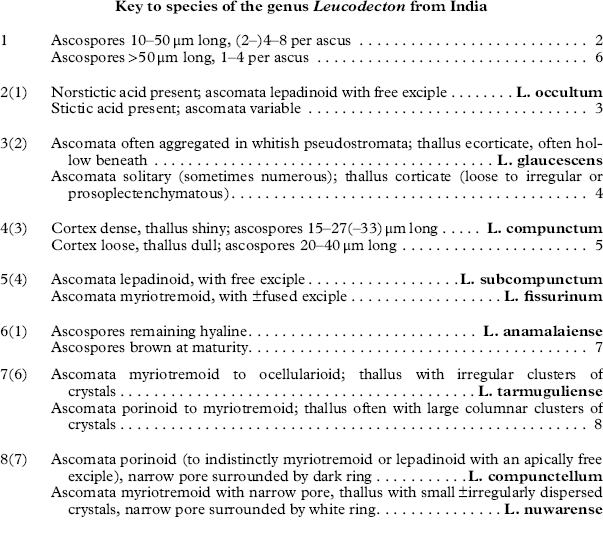
Leucodecton anamalaiense (Patw. & C. R. Kulk.) Rivas Plata & Lücking
Lichenologist 42: 184 (2010).
Ascomata lepadinoid; exciple brownish, lacking lateral paraphyses; asci 2–4-spored; ascospores muriform, hyaline, 50–80× 15–20 μm.
Chemistry. Stictic acid chemosyndrome.
Remarks. This species was described as Thelotrema anamalaiense Patw. & C. R. Kulk. from the Anamalai Hills in the Western Ghats by Patwardhan & Kulkarni (1977 Reference Patwardhan and Kulkarnib ) but was recently placed in Leucodecton due to the combination of characters described above. Leucodecton nuwarense is similar but differs in having smaller ascospores that turn brown in late maturity (Rivas Plata et al. 2010 Reference Rivas Plata, Lücking, Sipman, Mangold, Kalb and Lumbscha ).
Specimen examined. India: Kerala: Idduki District, Sholayar forest, in the ravine near dam, Anamalai Hills, P. G. Patwardhan & A. V. Prabhu 76–344 (AMH).
Leucodecton compunctellum (Nyl.) Frisch
Biblioth. Lichenol. 92: 155 (2006).
Thallus pale yellowish grey to straw-coloured, finely rugose to verrucose surface with large columnar clusters of crystals.
Ascomata porinoid with very small pores (c. 0·05 mm); proper exciple fused; asci 1–4-spored; ascospores brown,≥140 μm long.
Chemistry. Stictic acid.
Remarks. This species has been previously reported from India incorrectly as Leptotrema elachistoteron (Leight.) Patw. & C. R. Kulk., L. microglaenoides (Vain.) Zahlbr., L. oligosporum (Müll. Arg.) Patw. & Makhija, Myriotrema elachistoteron (Leight.) Hale and M. reclusum (Kremp.) Hale (Patwardhan & Makhija Reference Patwardhan and Makhija1980; Nagarkar et al. Reference Nagarkar, Sethy and Patwardhan1986; Awasthi Reference Awasthi1991; Mangold et al. Reference Mangold, Elix and Lumbsch2009; Singh & Sinha Reference Singh and Sinha2010). It is known from the Andaman Islands and the Western Ghats.
Specimens examined. India: Andaman & Nicobar Islands: Unknown Island, near evergreen forest compound, A. Singh 61–79745 (LWG). Kerala: Idukki District, ICRI campus, Myladumpara, elev. c. 1200 m, D. D. Awasthi & G. Awasthi 84–116 (LWG).
Leucodecton compunctum (Ach.) A. Massal.
Atti Inst. Veneto Sci. Lett., Arti, sér. 3 5: 325 (1860).
Thallus rather glossy, smooth to crystalline.
Ascomata immersed, perithecioid, with minute pores; ascospores brown, muriform.
Chemistry. Stictic acid.
Remarks. This species can be separated from Sanguinotrema wightii (Taylor) Lücking by the lack of red anthraquinone crystals and from L. compunctellum and L. subcompunctum by having smaller ascospores. Its distribution in India is restricted to tropical rainforests of the Western Ghats.
Specimen examined. India: Kerala: Kollam District, Rosemala, B. Haridas 06–009582 (LWG).
Leucodecton fissurinum (Hale) A. Frisch
Biblioth. Lichenol. 92: 156 (2006).
Thallus compact, regularly fissured, areolate thallus.
Ascomata myriotremoid; exciple fused to incompletely free, bordering ascoma with a rounded pore as brown ring; ascospores muriform (3–10×1–3 septate), 20–40×9–13 μm.
Chemistry. Stictic acid.
Remarks. Ascospore characters are the major characters distinguishing L. fissurinum from L. subcompunctum. In India this species was reported as Myriotrema fissurinum Hale (Awasthi Reference Awasthi1991; Singh & Sinha Reference Singh and Sinha2010). It occurs in the Western Ghats and the Eastern Himalaya.
Specimens examined. India: Kerala: Idukki District, ICRI campus, Myladumpara, elev. c. 1200 m, D. D. Awasthi & G. Awasthi 84–103 (LWG–LWU). Tamil Nadu: Nilgiri District, Nilgiri Hills, Avalanche, Hatchery Shola, elev. c. 2100 m, Kr. P. Singh 71–564 (LWG–LWU). West Bengal: Darjeeling District, Rangit River valley, Rangit, near the bridge, elev. c. 600 m, D. D. Awasthi & M. R. Agarwal 67–185 (LWG–LWU).
Leucodecton glaucescens (Nyl.) Frisch
Biblioth. Lichenol. 92: 164 (2006).
Thallus usually hollow beneath and very fragile.
Ascomata chroodiscoid-lepadinoid, aggregated in whitish pseudostromata; proper exciple±free; asci 8-spored; ascospores small, brown, muriform, mostly under 20×10 μm.
Chemistry. Stictic acid.
Remarks. Awasthi (Reference Awasthi1991) reported the species as Myriotrema glaucescens. The closely related L. phaeosporum, L. subcompunctum and L. fissurinum have a loosely corticate thallus, mostly solitary ascomata and larger ascospores. Leucodecton glaucescens is restricted to tropical forests of the Western Ghats.
Specimens examined. India: Kerala: Idukki District, Munnar, Rajamallay area, along border of tea plantation, elev. c. 1500–1600 m, D. D. Awasthi, R. Tewari & R. Mathur 85–55 (LWG–LWU); on way from Myladumpara to Munnar, Chinnakanal area, elev. c. 1350 m, D. D. Awasthi & G. Awasthi 84–251 (LWG–LWU).
Leucodecton nuwarense (Hale) Frisch
Biblioth. Lichenol. 92: 155 (2006).
Thallus pale greenish grey, unevenly cracked.
Ascomata numerous, immersed; proper exciple free; asci 2-spored; ascospores brown, muriform, 42–55×10–15 μm.
Chemistry. Stictic acid chemosyndrome.
Remarks. This taxon was originally recorded as Leptotrema nuwarense (Hale) Nagarkar et al. and Myriotrema nuwarense Hale from South Andaman (Nagarkar et al. Reference Nagarkar, Sethy and Patwardhan1986; Awasthi Reference Awasthi1991). Leucodecton nuwarense is similar to L. anamalaiense, which is distinguished by the consistently hyaline and somewhat larger ascospores.
Leucodecton occultum (Eschw.) Frisch
Biblioth. Lichenol. 92: 157 (2006).
Thallus ecorticate, fissured, yellowish grey to greenish grey.
Ascomata immersed to slightly emergent; proper exciple free; ascospores small, brown, submuriform or muriform, 5–9×1–5 septate, thick-walled, 20–40×10–17 μm.
Chemistry. Norstictic acid chemosyndrome.
Remarks. Patwardhan & Kulkarni (1977 Reference Patwardhan and Kulkarnia ) recognized L. occultum as Leptotrema compunctum, and Patwardhan & Nagarkar (Reference Patwardhan and Nagarkar1980) as Leptotrema norstictideum Patw. & Nagarkar. Leucodecton occultum occurs in the Andaman and Nicobar Islands, Central India, the Eastern Himalaya, and the Eastern and Western Ghats.
Specimens examined. India: Andhra Pradesh: Vishakhapatnam District, Simhachadam area in cashew plantation, D. D. Awasthi et al. 86–240, 86–248 (LWG–LWU). Assam: Gauhati to Shillong road, 10 km from Gauhati, Burnhatti, P. G. Patwardhan & M. B. Nagarkar 77–695 (AMH). Kerala: Trivandrum District, Botanical and Zoological Garden, D. D. Awasthi, D. K. Upreti & U. Mishra 79–898 (LWG–LWU). Orissa: Ganjam District, on way to Seranga, D. D. Awasthi et al. 86–128 (LWG–LWU). West Bengal: 24 Parganas District, Sunderban, Sajanakholi forest office, on bark, v 1975, K. N. Roychowdhury 75–3871 (LWG–CAL).
Leucodecton subcompunctum (Nyl.) Frisch
Biblioth. Lichenol. 92: 162 (2006).
Thallus olive-grey to olive-brown, fissured to areolate, ±glossy, loose, irregularly corticate.
Ascomata immersed, round to angular; disc with wide opening, blackish but covered with white pruina; proper exciple free to partly fused; asci 8-spored; ascospores brown, muriform, 3–8×1–3 septate, 15–35×10–20 μm.
Chemistry. Stictic acid chemosyndrome.
Remarks. The compact, crystalline, irregularly fissured to areolate thallus and lepadinoid ascomata with free excipulum separate L. subcompunctum from L. fissurinum. Leucodecton subcompunctum occurs in tropical evergreen forests of the Western Ghats.
Specimens examined. India: Kerala: Idukki District, Kallar Munnar Hills, elev. 1140 m, A. Singh & M. Ranjan 75–103044 (LWG). Tamil Nadu: Nilgiri District, Nilgiri Hills, Kodanad, tea estate area, elev. c. 2019 m, D. D. Awasthi & Kr. P. Singh 70–1447, 70–1500 (LWG–LWU).
Leucodecton tarmuguliense (Sethy et al.) Frisch
Biblioth. Lichenol. 92: 155 (2006).
Thallus yellowish grey to olivaceous.
Ascomata prominent; proper exciple fused; asci 2-spored; ascospores brown, muriform, 70–93×15–23 μm.
Chemistry. Stictic acid chemosyndrome.
Remarks. Sethy et al. (Reference Sethy, Nagarkar and Patwardhan1987) described this species as Leptotrema tarmuguliense from South Andaman; later it was accommodated in Myriotrema (Awasthi Reference Awasthi1991) until the recent re-evaluation of the thelotremoid group. Leucodecton tarmuguliense differs from the closely related L. compunctellum by its prominent (emergent) ascomata and irregular clusters of crystals. Leucodecton tarmuguliense is so far reported only from the Andaman and Nicobar Islands and is apparently endemic to India.
Specimen examined. India: Andaman & Nicobar Islands: South Andaman, near Wandoor, Tarmuguli Island, M. B. Nagarkar & P. G. Patwardhan 85–1862 (AMH).
Melanotrema A. Frisch
Biblioth. Lichenol. 92: 382 (2006).
This group of species was recently segregated from Ocellularia s. l. (Frisch et al. Reference Frisch, Kalb and Grube2006) to accommodate species having strong carbonization in the ascomata an Ocellularia-type proper exciple with a broad stump-shaped to reticulate columella without incorporation of calcium oxalate crystals, and an ecorticate thallus producing no lichen compounds, except lichexanthone. Twelve species are known worldwide, of which two are reported from India.

Melanotrema platystomum (Mont.) A. Frisch
Biblioth. Lichenol. 92: 397 (2006).
Ascomata round to shortly lirellate, immersed to strongly emergent; proper exciple free; ascospores hyaline, transversely 5–8-septate, 16–26×6–8 µm.
Chemistry. Lichexanthone is an accessory compound.
Remarks. This species was recorded as Thelotrema platystomum Mont. from the Andaman Islands (Nagarkar et al. Reference Nagarkar, Sethy and Patwardhan1988). A recent collection also showed its occurrence in the Western Ghats.
Specimen examined. India: Karnataka: Shimoga District, near Hebri, elev. 107 m, H. T. Lumbsch, D. K. Upreti & P. K. Divakar 08–19733T/A (LWG).
Melanotrema submicrosporoides (Nagarkar, Sethy & Patw.) S. Joshi & Lücking comb. nov.
MycoBank No.: MB 826954
Leptotrema submicrosporoides Nagarkar Biblioth. Lichenol. 40: 3 (1991); type: India, Andaman & Nicobar Islands, South Andaman, Tarmuguli Island, on bark, 19 December 1985, P. K. Sethy & M. B. Nagarkar 85–1975 (AMH—holotype).
Thallus pale to fawn-coloured, glossy, smooth.
Ascomata black-rimmed, immersed; proper exciple and columella distinctly carbonized; asci 8-spored; ascospores hyaline to brown, transversely 3-septate, amyloid (before initial pigmentation), 10–13×4–6 µm.
Chemistry. No substances detected.
Remarks. Upon re-examination the type of L. submicrosporoides was found to exhibit the above characters. This species was also reported as Ocellularia submicrosporoides (Nagarkar et al.) D. D. Awasthi in Awasthi (Reference Awasthi1991). Melanotrema submicrosporoides appears to be endemic and was described from the Andaman and Nicobar Islands. Superficially, it resembles a member of the non-lichenized family Stictidaceae.
Myriotrema Fée
Essai Crypt. Écorc. 1: xlix, 103 (1825).
The diagnostic characters of the genus include an internally splitting prosoplectenchymatous cortex, small, myriotremoid ascomata immersed in the thallus and usually lacking periderm layers in the margin, a prosoplectenchymatous, uncarbonized proper exciple with radiating tips, an absence of periphysoids, and a thallus producing mostly psoromic or hypoprotocetraric acids or some unknown compounds. The genus was resurrected by Salisbury (Reference Salisbury1978) and Hale (Reference Hale1980, Reference Hale1981) but its circumscription has changed and numerous taxa have been transferred to Chapsa, Leucodecton, Ocellularia, Thelotrema and Wirthiotrema. Currently, 50 species of Myriotrema are recognized worldwide (Lücking et al. Reference Lücking, Mangold and Lumbsch2016). Joshi et al. (2012 Reference Joshi, Upreti and Haridasb ) reported nine species from India; however, the revised concept of the genus supported the placement of M. masonhalei and M. pertusarioides in Ocellularia, M. glaucophaenum in the newly established genus Glaucotrema, and M. desquamans in Wirthiotrema (Rivas Plata et al. 2010 Reference Rivas Plata, Lücking, Sipman, Mangold, Kalb and Lumbscha ; Lücking et al. Reference Lücking, Mangold and Lumbsch2016). Consequently, we recognize only five species strictly belonging to this genus in India.
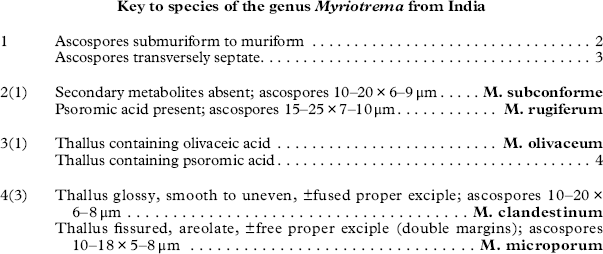
Myriotrema clandestinum (Fée) Hale
Mycotaxon 11: 133 (1980).
Thallus pale greenish to olivaceous, continuous, glossy.
Ascomata immersed; proper exciple ± fused; ascospores small, hyaline, transversely 3-septate, 10–20×6–8 μm.
Chemistry. Psoromic acid.
Remarks. The similar M. microporum differs in having a fissured thallus and double margins. Myriotrema clandestinum occurs in the Andaman and Nicobar Islands, the Western Ghats and the Eastern Himalaya. This species was reported by Nagarkar et al. (Reference Nagarkar, Sethy and Patwardhan1988) incorrectly as Ocellularia terebratula (Nyl.) Müll. Arg.
Specimens examined. India: Karnataka: Uttarakannada District, Kumta taluk, Vadgeri (Chandawar), S. Dudani 14–024494 (LWG). Kerala: Kollam District, Rosemala, B. Haridas 06–009585 (LWG). Tamil Nadu: Palni Hills, Perumal to Palni roadside, via short-cut road, elev. 1350–1500 m., Kr. P. Singh 70–984 (LWG).
Myriotrema microporum (Mont.) Hale
Mycotaxon 11: 134 (1980).
Thallus thick, areolate, fissured, dark dull grey.
Ascomata small with double margins; asci 8-spored; ascospores transversely 3-septate, hyaline, 10–18×5–8 μm.
Chemistry. Psoromic acid chemosyndrome.
Remarks. This species was previously recognized as O. micropora (Mont.) Müll. Arg. (Nagarkar et al. Reference Nagarkar, Sethy and Patwardhan1988). It occurs in the Eastern Himalaya, and the Western and Eastern Ghats.
Specimens examined. India: Assam: North Cachar Hills District, Haflong, D. K. Upreti & Jayshree Rout 05–002992 (LWG). Kerala: Idukki District, ICRI campus, Myladumpara, elev. c. 1200 m, D. D. Awasthi & G. Awasthi 84–118, 84–128, 84–148 (LWG–LWU). Mizoram: Champai District, Murlen National Park, elev. 2092 m, A. R. Logesh & M. Chinlampianga 14–031477 (LWG). Orissa: Ganjam District, on way to Seranga, D. D. Awasthi et al. 86–127 (LWG–LWU). Tamil Nadu: Palni Hills, Perumal to Palni roadside, via short-cut road, elev. 1350–1500 m, Kr. P. Singh 70–981 (LWG–LWU).
Myriotrema olivaceum Fée
Essai Crypt. Écorc. 1: 103 (1825).
Thallus light greenish grey to ashy grey, smooth, fissured, areolate.
Ascomata with proper exciple free; asci 8-spored; ascospores small, 9–13×5–6 μm, transversely 3-septate.
Chemistry. Olivaceic with isonotatic and norisonotatic acids.
Remarks. This taxon was recorded by Nagarkar et al. (Reference Nagarkar, Sethy and Patwardhan1986) as Ocellularia olivacea (Fée) Müll. Arg. from the Andaman and Nicobar Islands. It differs from the closely related M. microporum by producing olivaceic acid and related substances.
Myriotrema rugiferum (Harm.) Hale
Mycotaxon 11: 135 (1980).
Thallus pale olive to greyish and greenish white, thick, corticate.
Ascomata small, immersed; proper exciple free; asci 4–8-spored; ascospores small, 15–25×7–10 μm, hyaline, submuriform, 3–6×0–3 septate.
Chemistry. Psoromic acid.
Remarks. The otherwise similar M. subconforme differs in lacking lichen compounds. Myriotrema rugiferum is confined to the tropical forests of the Western Ghats.
Specimens examined. India: Kerala: Idukki District, ICRI campus, Myladumpara, elev. c. 1200 m, D. D. Awasthi & G. Awasthi 84–136, 84–73, 84–83 (LWG–LWU).
Myriotrema subconforme (Nyl.) Hale
Mycotaxon 11: 135 (1980).
Thallus pale olive to greyish green or greenish grey, verruculose, corticate, with numerous crystals inclusions.
Proper exciple free; asci 8-spored; ascospores small, 10–20×6–9 μm, submuriform, 3–5×1–3 septate.
Remarks. Myriotrema subconforme is similar to M. clandestinum in lacking thallus compounds but differs in having transversely septate ascospores. Nagarkar et al. (Reference Nagarkar, Sethy and Patwardhan1987) reported M. subconforme (as Thelotrema subconforme) from the Andaman and Nicobar Islands, and the Western Ghats.
Nadvornikia Tibell
Beih. Nova Hedwigia 79: 672 (1984).
The genus currently contains four species worldwide, viz. the mazaediate Nadvornikia hawaiensis (Tuck.) Beih. and N. sorediata R. C. Harris, and two non-mazaediate species (Mangold et al. Reference Mangold, Elix and Lumbsch2009; Medeiros et al. Reference Medeiros, Kraichak, Lucking, Mangold and Lumbsch2017). It was introduced by Tibell (Reference Tibell1984) and has previously been placed in the family Caliciaceae accommodating only N. hawaiensis, but subsequent molecular studies showed that it belongs to Graphidaceae (Lumbsch et al. Reference Lumbsch, Mangold, Lücking, García and Martín2004; Mangold et al. Reference Mangold, Martín, Lücking and Lumbsch2008). Nadvornikia typically has mazaedioid ascomata with small, brown, bilocular ascospores. In India only one species is known.
Nadvornikia hawaiensis (Tuck.) Tibell
Beih. Nova Hedwigia 79: 672 (1984).
Thallus lacks a true cortex, is verrucose, continuous, in shades of pale greenish to yellowish grey, bulging and flaking away from the substratum.
Ascomata mazaedioid, emergent, subglobose to urceolate; proper exciple fused to±apically free; asci 8-spored; ascospores 2-locular, oblong to fusiform or subglobose, brown, non-amyloid, 6–10×4–6 μm, with thickened walls, septum with ornamentation (Mangold et al. Reference Mangold, Elix and Lumbsch2009).
Chemistry. Stictic acid chemosyndrome.
Remarks. Nadvornikia diplotylia (Nyl.) G. Pant & D. D. Awasthi (Pant & Awasthi Reference Pant and Awasthi1989) was reported from India but was later synonymized with N. hawaiensis (Mangold et al. Reference Mangold, Elix and Lumbsch2009). Nadvornikia hawaiensis is known from the Andaman and Nicobar Islands and the Western Ghats (Singh & Sinha Reference Singh and Sinha2010).
Nitidochapsa Parnmen et al.
Bryologist 116: 128 (2013).
The genus was described to accommodate species that are phylogenetically well separated from Chapsa s. str. and fall within the Ocellulariae tribe rather than the Thelotremateae tribe, and that share characters, viz., a nitidous, brown, corticate thallus, Chapsa-like ascomata with a wide open, grey-pruinose disc, lobulated to recurved, felty white margins, small brown ascospores, and a lack of secondary metabolites (Parnmen et al. Reference Parnmen, Cáceres, Lücking and Lumbsch2013). Currently five species are accepted in the genus (Poengsungnoen et al. 2014), including one species also recorded from India.
Nitidochapsa leprieurii (Mont.) Parnmen et al.
Bryologist 116: 131 (2013).
Thallus corticate, brown-olive, cartilaginous.
Ascomata Chapsa-like, rather small, rounded to slightly elongated or branched with lobate to recurved, felty white margins; disc grey-pruinose; asci 8-spored; ascospores transversely septate, brown, oblong to ellipsoidal or clavate, 12–16×5–6 µm.
Chemistry. No substances detected.
Remarks. Nitidochapsa leprieurii was previously recorded as Thelotrema leprieurii (Mont.) Hale and Chapsa leprieurii (Mont.) Frisch from Karnataka, Kerala and Tamil Nadu in the Western Ghats (Awasthi Reference Awasthi1991; Singh & Sinha Reference Singh and Sinha2010; Joshi et al. 2012 Reference Joshi, Upreti and Nayakaa ).
Specimen examined. India: Kerala: Trivandrum, Palode, TBGRI campus, 2013, A. R. Logesh s. n. (LWG).
Ocellularia G. Mey.
Nebenst. Beschäft. Pflanzenk. 1: 327 (1825).
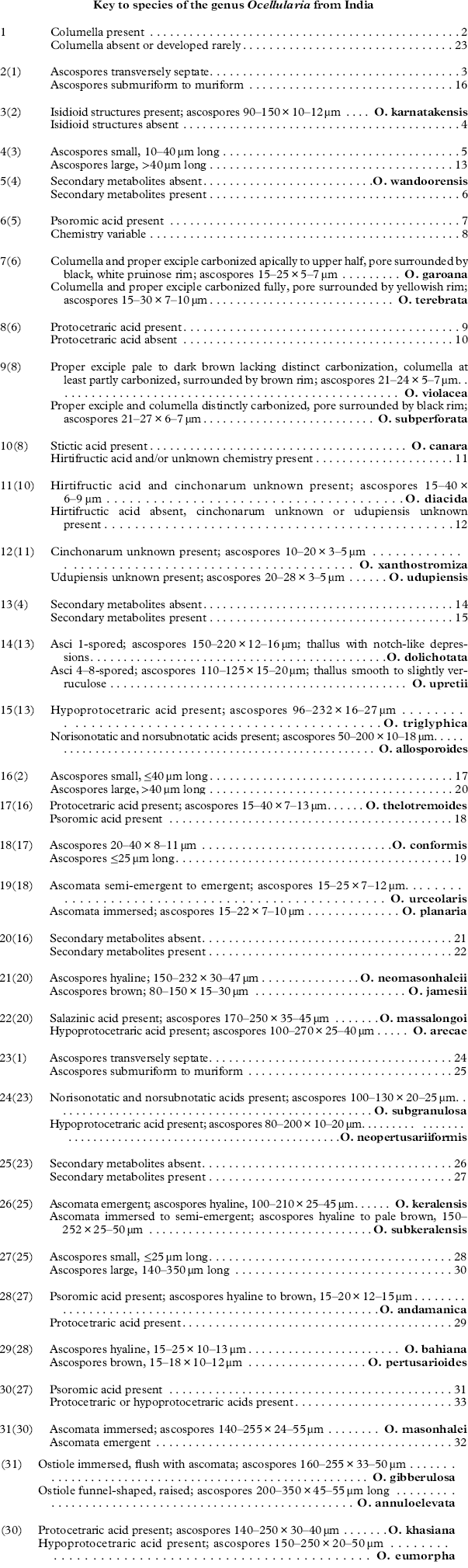
The genus Ocellularia is the largest genus of thelotremoid lichens in the family and was first revised by Frisch et al. (Reference Frisch, Kalb and Grube2006) who restricted the genus to species with a simple columella, a carbonized or hyaline proper exciple and amyloid ascospores. The genus Stegobolus was reinstated in that study and the genera Gyrotrema Frisch, Melanotrema Frisch and Redingeria Frisch were described to accommodate species with complex columellar structures. Another genus, Ampliotrema Kalb, was described to accommodate a small homogeneous group of species lacking a columella but having a carbonized excipulum, an inspersed hymenium and protocetraric acid. Whereas initial molecular studies did not support the separation of Ampliotrema and Stegobolus, and both genera were included in Ocellularia (Mangold et al. Reference Mangold, Elix and Lumbsch2009), subsequent phylogenetic studies further refined the generic delimitations in the tribe Ocellularieae, which includes the genus Ocellularia and relatives (Rivas Plata et al. 2012 Reference Rivas Plata, Lücking and Lumbschb ; Kraichak et al. 2014 Reference Kraichak, Parnmen, Lücking, Rivas Plata, Aptroot, Cáceres, Ertz, Mangold, Mercado-Díaz and Paponga ). Currently, the genera Ocellularia and Myriotrema are accepted together with the resurrected Stegobolus and Rhabdodiscus Vain., while the distinction of Ampliotrema and Gyrotrema remains unclear since they were found to be nested within Ocellularia s. lat.
Even in the restricted sense Ocellularia includes over 300 species worldwide (Rivas Plata et al. 2012 Reference Rivas Plata, Lücking and Lumbschb ; Singh et al. Reference Singh, Singh and Bhatt2013; Kraichak et al. 2014 Reference Kraichak, Parnmen, Lücking, Rivas Plata, Aptroot, Cáceres, Ertz, Mangold, Mercado-Díaz and Paponga ; Lücking et al. Reference Lücking, Mangold and Lumbsch2016). The first comprehensive report on Indian Ocellularia species was provided by Patwardhan & Kulkarni (1977 Reference Patwardhan and Kulkarnia , Reference Patwardhan and Kulkarnib ). Subsequently, Nagarkar et al. (Reference Nagarkar, Sethy and Patwardhan1988) discussed a total of 43 taxa including those previously placed under the genus Thelotrema (Nylander Reference Nylander1869, Reference Nylander1873) with four new species from south India. More recently, a small number of studies included Indian material of this genus (Frisch et al. Reference Frisch, Kalb and Grube2006; Rivas Plata et al. 2010 Reference Rivas Plata, Lücking, Sipman, Mangold, Kalb and Lumbscha ; Kraichak et al. 2014 Reference Kraichak, Parnmen, Lücking, Rivas Plata, Aptroot, Cáceres, Ertz, Mangold, Mercado-Díaz and Paponga ).
Species in the genus grow on bark in lowland to montane habitats but a few saxicolous species are also known. It occurs predominantly in undisturbed tropical rainforests (Rivas Plata et al. Reference Rivas Plata, Lücking and Lumbsch2008; Kraichak et al. 2014 Reference Kraichak, Parnmen, Lücking, Rivas Plata, Aptroot, Cáceres, Ertz, Mangold, Mercado-Díaz and Paponga ). Ocellularia species are more diverse on large tree trunks spreading up to 2000 m altitude and are good indicators of ecological continuity and forest health (Rivas Plata et al. Reference Rivas Plata, Lücking and Lumbsch2008).
Typically, Ocellularia species mostly have a corticate, olive or grey thallus in greenish to yellowish or whitish shades; ±round, porinoid, solitary to strongly fused ascomata; usually a carbonized, brown or pale yellowish proper exciple lacking lateral paraphyses; a hyaline to brownish epihymenium; a non-amyloid, hyaline, clear or inspersed hymenium often with a columella; 1–8-spored, clavate, non-amyloid asci; transversely septate to submuriform or muriform, hyaline to brown ascospores; the presence or absence of a large number of secondary metabolites (orcinol depsidones) and unknown compounds (Mangold et al. Reference Mangold, Elix and Lumbsch2009).
Here we report 34 species, 13 of which are potentially endemic (including the new taxon Ocellularia upretii), particularly in the Western Ghats of India. Owing to a narrowly defined species concept provided by Lücking (Reference Lücking2014) for O. perforata and O. papillata, we cautiously excluded both these species from the present account, though listed in Singh & Sinha (Reference Singh and Sinha2010).
Ocellularia allosporoides (Nyl.) Patw. & C. R. Kulk.
Kavaka 5: 5 (1977).—Ocellularia verrucomarginata Patw. et al., Biovigyanam 11: 135 (1985); type: India, Karnataka, Chikmagalure District, South Canara District, Agumbe, on bark, 26 January 1980, P. G. Patwardhan & M. B. Nagarkar 80–109 (AMH—holotype).
Ocellularia canariana Patw., Sethy & Nagarkar, Biovigyanam 11: 134 (1985); type: India, Karnataka, Chikmagalure District, North Canara District, Armol Ghat, 25 February 1977, A. V. Prabhu & M. B. Nagarkar 77–49 (AMH—holotype).
Thallus pale greenish to yellowish green or pale olive, glossy, smooth, continuous to ±verruculose.
Ascomata apothecioid; proper exciple mostly brown to indistinctly or sometimes strongly carbonized; columella entire, brown to carbonized; asci 4–8-spored; ascospores amyloid, oblong to fusiform, hyaline (becoming mottled in late maturity), transversely 10–20-septate, 50–130×10–18 µm.
Chemistry. Norisonotatic and norsubnotatic acids.
Remarks. Re-examination of the type materials of O. verrucomarginata and O. canariana confirmed similar anatomy and chemistry (originally reported as psoromic acid in the latter), except for the slightly immersed ascoma of O. verrucomarginata. Ocellularia allosporoides has a wide distribution in India and was recorded from the Andaman and Nicobar Islands, the Western Ghats and Eastern Himalaya.
Specimens examined. India: Andaman & Nicobar Islands: Middle Andaman, Parlob Jig, A. Singh 61–79802 (LWG); ≤30 m, A. Singh 61–79894, 61–79895, 61–79896 (LWG). Karnataka: Chikmagalure District, 2 km before Chamudi, way to Dharamstala, elev. 561 m, H. T. Lumbsch, D. K. Upreti & P. K. Divakar 08–19737D, 08–19737/J (LWG). Kerala: Ernakulam District, Thattekkad BS, elev. 400 m, B. Haridas 06–009581(LWG).
Ocellularia andamanica (Nyl.) Tat. Matsumoto & Dequchi
Bryologist 102: 89 (1999).
Thallus pale grey to pale yellowish or greenish grey, slightly glossy, smooth, continuous to markedly verruculose, non-rimose.
Ascomata inconspicuous, round, immersed to emergent; asci 4–8-spored; ascospores amyloid, submuriform, subglobose to ovoid, hyaline (brown at maturity), 2–6×1–4 locular, 15–20×12–15 µm.
Chemistry. Psoromic acid.
Remarks. This species is similar to O. bahiana which differs by the thallus containing protocetraric acid. It is known to occur in rainforests of the Andaman and Nicobar Islands and the Western Ghats (Singh & Sinha Reference Singh and Sinha2010).
Specimen examined. India: Andaman & Nicobar Islands: South Andaman, Wright Myo, elev. <30 m, A. Singh 61–88279 (LWG).
Ocellularia annuloelevata (Nagarkar, Sethy & Patw.) S. Joshi & Upreti comb. nov.
MycoBank No.: MB 822093
Thelotrema annuloelevatum Nagarkar et al., Kavaka 13: 57 (1987) [“1985”]; type: India, Tamil Nadu, Upper Kodayar, Agasthi Hills, on bark, 24 January 1983, P. K. Sethy & M. B. Nagarkar 83–325 (AMH—holotype).
Thallus olive-grey to greenish grey, dull, ±rimose (due to bark texture).
Ascomata emergent, ecolumellate opening by a slightly raised, funnel-shaped (raised) ostiole; proper exciple marginally carbonized; asci 1-spored; ascospores amyloid, muriform, hyaline, 200–350×45–55 µm.
Chemistry. Psoromic acid.
Remarks. The eastern palaeotropical O. inturgescens (Müll. Arg.) Mangold is similar but has uncarbonized ascomata. Ocellularia annuloelevata is known only from India and has been described from the Andaman and Nicobar Islands and the Western Ghats.
Ocellularia arecae (Vain.) Hale
Mycotaxon 11: 136 (1980).
Thallus pale greenish grey.
Ascomata perithecioid to indistinctly apothecioid emergent; proper exciple fused, dark brown, mostly carbonized at margins and in the upper parts; columella carbonized; asci 1-spored; ascospores large, hyaline, muriform 100–270×25–40 µm.
Chemistry. Hypoprotocetraric acid chemosyndrome.
Remarks. In India, it is known from the Western Ghats to the Eastern Himalaya and the Andaman and Nicobar Islands.
Specimens examined. India: Andaman & Nicobar Islands: South Andaman, Port Blair, A. Singh 61–67607 (LWG). Kerala: Idukki District, ICRI campus, Myladumpara, elev. c. 200 m, D. D. Awasthi & G. Awasthi 84–77 (LWG–LWU).
Ocellularia bahiana (Ach.) Frisch
Biblioth. Lichenol. 92: 503 (2006).
Thallus thick, bulging.
Ascomata immersed to emergent or hemispherical; columella absent; proper exciple mostly brown to reddish brown; ascospores brown, muriform, 3–5×1–2 septate, 18–24× 12–13 µm.
Chemistry. Psoromic acid.
Remarks. This species is readily distinguished from O. andamanica in lacking a carbonized proper excipulum and by its chemistry. It is known from the Western Ghats.
Specimens examined. India: Goa: South Goa, Quepem-Rivona, Arecanut orchard, elev. 300–400 m, S. Nayaka, Pathak & Samuel 02–223413 (LWG); Margao-Rivona, 1962, P. Chandra s. n. (LWG).
Ocellularia canara Hale
Biovigyanam 66: 9 (1980).
Thallus pale to yellowish or fawn-coloured, glossy,±verrucose.
Ascospores amyloid, transversely 5-septate, hyaline, 17–20×5–7 µm.
Chemistry. Stictic acid chemosyndrome.
Remarks. This species is very close to O. pyrenuloides Zahlbr. which differs in its ascoma carbonization. Ocellularia canara is endemic to India and occurs in the Western Ghats.
Specimen examined. India: Karnataka: North Canara District, 6 km east of Yellapur, elev. c. 750 m, on remnants of evergreen forests, 28 ii 1978, M. E. Hale 78–50665 (AMH).
Ocellularia conformis (Fée) Hale
Mycotaxon 11: 136 (1980).
Thallus whitish green to pale olive, glossy.
Proper exciple apically carbonized; columella carbonized; asci 8-spored; ascospores muriform, 8–11×1–3 septate, 24–40× 8–11 µm (Awasthi Reference Awasthi1991).
Chemistry. Psoromic acid.
Remarks. This species was previously recorded as Thelotrema conforme Fée by Patwardhan & Nagarkar (Reference Patwardhan and Nagarkar1980) and is known from the Eastern Himalaya (Assam).
Ocellularia diacida Hale
Mycotaxon 7: 378 (1978).
Thallus greyish to greenish grey or pale olive, dull to glossy; whitish to pale orange medulla.
Ascomata±rounded immersed to moderately emergent; asci 8-spored; ascospores amyloid, 15–40×6–9 µm, transversely septate.
Chemistry. Hirtifructic acid and cinchonarum unknown present.
Remarks. This species differs from O. fumosa in having a clear hymenium. Ocellularia diacida was described from the Western Ghats.
Specimen examined. India: Karnataka: Devimane Ghat on Kumtha-Sirsi road, elev. c. 100 m, M. E. Hale 77–47933 (AMH).
Ocellularia dolichotata (Nyl.) Zahlbr.
Cat. Lich. Univ. 2: 589 (1923).
Thallus off-white to fawn, verruculose to finely rugulose with numerous depressed notch-like spots formed by eroded cortex over the surface.
Ascomata columellate, often with a verruculose pore; proper exciple carbonized; columella simple, carbonized; asci 1-spored; ascospores amyloid, 20–30-locular, 150–220× 12–16 µm.
Chemistry. No substances detected.
Remarks. Ocellularia allosporoides is similar but differs from O. dolichotata in having a smooth thallus and comparatively smaller ascospores. Ocellularia dolichotata has been reported from the Andaman and Nicobar Islands and the Western Ghats (Singh & Sinha Reference Singh and Sinha2010).
Ocellularia eumorpha (Stirt.) Hale
Mycotaxon 11: 136 (1980).
Thallus pale greenish grey to yellowish grey, ±glossy, ±verrucose.
Ascomata perithecioid, immersed to emergent; proper exciple fused, internally yellowish brown to rarely carbonized (at margins and in the upper parts); perithecia, ecolumellate; asci 1–2-spored; ascospores muriform, hyaline to pale brownish (in late maturity), large, amyloid, 150–250× 20–50 µm.
Chemistry. Hypoprotocetraric and convirensic acids.
Remarks. The similar O. arecae differs in producing columellate ascomata. Ocellularia eumorpha is known from the Western Ghats.
Specimens examined. India: Karnataka: Chikmagalure District, Charmudi Ghat, Kuvettu, elev. 104 m, H. T. Lumbsch, D. K. Upreti & P. K. Divakar 08–19739G (LWG). Kerala: Idukki District, ICRI campus, Myladumpara, elev. 1200 m, D. D. Awasthi & G. Awasthi 84–77 (LWG–LWU). Tamil Nadu: Kanyakumari District, Mahendragiri Hills, elev. 1000–1200 m, V. Sundareshan 13–020488 (LWG).
Ocellularia garoana Patw. & Nagarkar
Biovigyanam 6: 7 (1980).
Ascomata pores surrounded by black, whitish pruinose rims; proper exciple apically carbonized; columella carbonized; ascospores 5–9-septate, 15–25×5–7 µm.
Chemistry. Psoromic acid.
Remarks. This species was described from the Western Ghats by Patwardhan & Nagarkar (Reference Patwardhan and Nagarkar1980), and recorded recently from the Eastern Ghats and the Eastern Himalayan region. It appears to be endemic to India.
Specimens examined. India: Assam: Navgaon District, A. Dey 09–014936 (LWG). Kerala: Tivendrum District, Palode, TBGRI campus, 2013, A. R. Logesh s. n. (LWG). Meghalaya: Garo Hills, Ningwal Bibra, near coal mine, M. B. Nagarkar 78–290 (AMH). Tamil Nadu: Palni Hills, on way from Perumalmalai to Oothu, near Mulaiyar, elev. 1200 m, Kr. P. Singh 70–1192 (LWG).
Ocellularia gibberulosa (Müll. Arg.) Mangold
Fl. Australia 57: 656 (2009).
Thallus greyish green, uneven,±verrucose.
Ascomata emergent, crowded, ecolumellate; asci 1-spored; ascospores amyloid, large, muriform, 160–255×33–50 µm.
Chemistry. Psoromic acid.
Remarks. This species was previously described from the Western Ghats as Thelotrema kalakkadense Nagarkar et al. (Nagarkar et al. Reference Nagarkar, Sethy and Patwardhan1985).
Specimen examined. India: Tamil Nadu: Tirunelvelli District, Singhalamtheri, Kalakkadu primary rainforest, elev. c. 1200 m, P. G. Patwardhan & P. K. Sethy 84–57A (AMH).
Ocellularia jamesii (Patw. & C. R. Kulk.) D. D. Awasthi
Biblioth. Lichenol. 40: 3 (1991).
Thallus pale olivaceous, fawn to citrine-green, dull, continuous, warty.
Ascomata emergent, crowded; proper exciple dark brown, carbonized at tips; columella developed±apically, carbonized; asci 1-spored; ascospores amyloid (before initial pigmentation), hyaline to brown, muriform, 80–150×15–30 µm.
Chemistry. No substances detected.
Remarks. This species is unique in producing large brown ascospores; O. kalbii is similar but has even larger ascospores and well-developed columellar structures. Ocellularia jamesii was described from the Western Ghats as Leptotrema jamesii Patw. & C. R. Kulk. by Patwardhan & Kulkarni (1977 Reference Patwardhan and Kulkarnib ), and is endemic to India.
Specimen examined. India: Karnataka: South Canara District, Agumbe-Udupi road, C. R. Kulkarni 74–3080 (AMH).
Ocellularia karnatakensis Hale
Mycotaxon 7: 378 (1978).
Thallus with isidioid verrucae (cylindrical verrucae) conspicuously developed on the thallus.
Ascomata flush to immersed; ascospores 90–150×10–12 µm.
Chemistry. Notatic acid.
Remarks. Other characters and chemistry appear similar to those in O. allosporoides, consequently it was previously considered conspecific (Mangold et al. Reference Mangold, Elix and Lumbsch2009). Ocellularia karnatakensis was described from the Western Ghats and occurs only in India.
Specimen examined. India: Karnataka: Chikmagalure District, Liana, 5 km SE of Yellapur, elev. c. 600 m, M. E. Hale 77–46205 (AMH).
Ocellularia keralensis Patw. & C. R. Kulk. ex Hale
Bull. Br. Mus. Nat. Hist., Bot. 8: 308 (1981).
Thallus pale green to yellowish green, uneven, ±verrucose.
Ascomata emergent, ecolumellate with a black rimmed ostiole; proper exciple apically carbonized; asci 1-spored; ascospores large, muriform, hyaline, 100–210×25–45 µm.
Chemistry. No substances detected.
Remarks. Ocellularia eumorpha is similar but differs in containing hypoprotocetraric acid. Ocellularia keralensis is known from the Western Ghats.
Specimens examined. India: Karnataka: Uttarakannada District, Sharavathi Ghat, near Gersoppa, elev. 718 m, H. T. Lumbsch, D. K. Upreti & P. K. Divakar 08–19745V (LWG). Kerala: Idukki District, Myladumpara, ICRI campus, elev. c. 1200 m, D. D. Awasthi & G. Awasthi 84–145, 84–146 (LWG–LWU).
Ocellularia khasiana (Patw. & Nagarkar) Kraichak et al.
Phytotaxa 189: 74 (2014).
Thallus dark olive-green to dark grey-green, smooth.
Ascomata strongly emergent, ecolumellate; proper exciple fused, apically carbonized; ascospores large, muriform, amyloid, 140–250×30–40 µm.
Chemistry. Protocetraric acid.
Remarks. This was described from the Eastern Himalaya as Thelotrema khasianum Patw. & Nagarkar and is endemic to India.
Specimen examined. India: Meghalaya: Khasi Hills, near Nongstoin, in evergreen forests, M. B. Nagarkar 78–482 (AMH).
Ocellularia masonhalei (Patw. & C. R. Kulk.) Lücking
Herzogia 29: 507 (2016).
Thallus greenish grey to grey, glossy, wrinkled to warty.
Ascomata immersed, ecolumellate; proper exciple pale brown, fused; carbonized marginally or at apices; asci 1-spored; ascospores amyloid, oblong-ellipsoid, hyaline, muriform, large, 140–255×24–55 μm.
Chemistry. Psoromic acid.
Remarks. This species was described from Maharashtra as Thelotrema masonhalei Patw. & C. R. Kulk by Patwardhan & Kulkarni (1977 Reference Patwardhan and Kulkarnib ) and later recorded from Kerala and Karnataka in the Western Ghats (Singh & Sinha Reference Singh and Sinha2010). Ocellularia annuloelevata is distinguished in morphology and has larger ascospores.
Specimens examined. India: Karnataka: Shimoga District, Agumbe Ghat, elev. 600–700 m, R. Shankar & S. Ganapathy 09–016240 (LWG). Kerala: Idukki District, Myladumpara, ICRI campus, elev. c. 1200 m, D. D. Awasthi & G. Awasthi 84–106, 84–114 (LWG–LWU). Maharashtra: Sindhudurg District, Amboli, sunset point, A. V. Prabhu & M. B. Nagarkar 74–2262 (AMH).
Ocellularia massalongoi (Mont.) Hale
Mycotaxon 11: 137 (1980).
Thallus olive to pale brownish green, glossy, smooth.
Ascomata large, columellate, perithecioid with annulate pores; proper exciple dark brown to carbonized; columella dark brown to carbonized; asci 1–2-spored; ascospores muriform, oblong ellipsoidal, hyaline, distinctly amyloid, 170–250×35–45 µm.
Chemistry. Salazinic acid.
Remarks. This species is unusual in containing salazinic acid, which is rare in the genus. It occurs in evergreen forests of the Andaman and Nicobar Islands and the Western Ghats (Singh & Sinha Reference Singh and Sinha2010).
Specimens examined. India: Andaman & Nicobar Islands: Middle Andaman, Parloli Jig, elev. c. 30 m, A. Singh 79893 (LWG); South Andaman, Port Blair, A. Singh et al. 61–67607 (LWG).
Ocellularia neomasonhalei (Patw. et al.) D. D. Awasthi
Biblioth. Lichenol. 40: 3 (1991).—Ocellularia guptei (Nagarkar, Sethy & Patw.) D. D. Awasthi, Biblioth. Lichenol. 40: 3 (1991); type: India, Andaman & Nicobar Islands, South Andaman, Port Mount, 14 February 1985, P. G. Patwardhan & M. B. Nagarkar 85–21 (AMH—holotype).
Thallus glaucous green to greenish grey, smooth, continuous.
Ascomata columellate, open by raised ostioles with annulate rims; proper exciple apically carbonized; columella apically carbonized; asci 1–2-spored; ascospores hyaline, muriform, 150–232×30–47 µm.
Chemistry. No substances detected.
Remarks. The material examined did not contain secondary metabolites; Awasthi (Reference Awasthi1991) and Singh & Sinha (Reference Singh and Sinha2010) erroneously reported psoromic acid. The taxon occurs in the Andaman and Nicobar Islands and the Western Ghats, and is known only from India.
Specimens examined. India: Andaman & Nicobar Islands: Andaman Islands, South Andaman, Port Blair, A. Singh 61–67614 (LWG). Tamil Nadu: Coimbatore District, Anamalai Hills, on way to Valparai, elev. c. 1000 m, P. K. Sethy & M. B. Nagarkar 82–268 (AMH).
Ocellularia neopertusariiformis Hale
Bull. Brit. Mus. (Nat. Hist.), Bot. 8: 315 (1981).
Thallus corticolous, greenish grey, dull to glossy, smooth.
Ascomata solitary, sessile, constricted, perithecioid, ecolumellate; asci 6–8-spored; ascospores hyaline, transversely 24–37-septate, oblong-fusiform, 80–200×10–20 µm, amyloid, with acute or slightly appendiculate ends.
Chemistry. Hypoprotocetraric acid.
Remarks. This species has only recently been recorded from India (Singh et al. Reference Singh, Singh and Bhatt2013). Ocellularia pertusariiformis (Leight.) Zahlbr. differs in having 10–11-septate, smaller ascospores and a thallus containing unknown secondary metabolites. It was recorded from Assam in the Eastern Himalayan region.
Ocellularia pertusarioides (Nagarkar et al.) Lücking
Herzogia 29: 509 (2016).
Thallus pale to yellowish grey warty.
Ascomata numerous, emergent, basally constricted, ecolumellate; proper exciple fused reddish yellow; asci 8-spored; ascospores amyloid (when young), brown, muriform, 1–3×0–3 septate, 15–18×10–12 μm.
Chemistry. Protocetraric acid.
Remarks. Nagarkar et al. (Reference Nagarkar, Sethy and Patwardhan1986) described the species as Leptotrema pertusarioides Nagarkar et al., while Awasthi (Reference Awasthi1991) reported the species as Myriotrema pertusarioides (Nagarkar et al.) D. D. Awasthi. It is known from the Andaman and Nicobar Islands, and is endemic to India.
Specimen examined. India: Andaman & Nicobar Islands: South Andaman, Wandoor, Alexandria Island, M. B. Nagarkar & P. K. Sethy 85–1115 (AMH).
Ocellularia planaria (Hale) Hale
Mycotaxon 11: 137 (1980).
Thallus thick, grey to greenish grey, smooth, glossy, uneven (due to bark texture).
Ascomata immersed having a wide ostiole circumscribed by a pale brown to brown rim; proper exciple apically carbonized; columella (sometimes with 1–2 strands) developing apically; asci 8-spored; ascospores amyloid, hyaline, submuriform. 3–5×1 septate, 15–22× 7–10 µm.
Chemistry. Psoromic acid.
Remarks. This species is endemic to India and was described as Thelotrema planarium (Hale 1978 Reference Halea ) from the Western Ghats.
Specimen examined. India: Kerala: Gudampara, Cardamon Hills, elev. 1100 m, M. E. Hale 76–46427 (AMH).
Ocellularia subgranulosa (Homchant. & Coppins) Lumbsch & Papong
Lichenologist 42: 133 (2010).
Thallus pale olive-brown to greyish brown, dull, areolate, verrucose to warty.
Ascomata semi-emergent, ecolumellate to weakly columellate, perithecioid; asci 2-spored; ascospores amyloid, hyaline, transversely 10–12-septate, 100–130×20–25 µm.
Chemistry. Norisonotatic and norsubnotatic acids.
Remarks. The chemically similar O. chonestoma (Leight.) Zahlbr. has smaller ascospores. This taxon was recently recorded from the Eastern Himalayan region (Arunachal Pradesh) by Singh et al. (Reference Singh, Singh and Bhatt2013).
Ocellularia subkeralensis (Nagarkar, Sethy & Patw.) S. Joshi & Upreti comb. nov.
MycoBank No.: MB 822095
Thelotrema subkeralense Nagarkar et al., Kavaka 13: 60 (1987) [“1985”]; type: India, Tamil Nadu, Trunelvelli District, Singhalamtheri, Kalakkadu primary rainforest, elev. 1200 m, on bark, 1 February 1984, P. G. Patwardhan & P. K. Sethy 84–55A (AMH—holotype).
Thallus grey-brown to olive-brown, smooth to slightly verruculose, dull.
Ascomata immersed to semi-emergent, ecolumellate; proper exciple carbonized in the ostiole region; asci 1-spored; ascospores amyloid, hyaline to pale brown, muriform, 150–252×25–50 µm.
Chemistry. No substances detected.
Remarks. The similar O. keralensis differs in having emergent ascomata and hyaline ascospores. So far, O. subkeralensis is known only from the Western Ghats.
Ocellularia subperforata Nagarkar et al.
Biovigyanam 13: 36 (1988).
Thallus with elongate verrucae.
Ascomata with 0·3–0·4 mm wide pores surrounded by blackish rim; excipulum fully carbonized; columella broad stump-shaped; ascospores 21–27×6–7 µm.
Chemistry. Protocetraric acid.
Remarks. This species was previously included in the synonymy of O. perforata (Leight.) Müll. Arg. by Frisch et al. (Reference Frisch, Kalb and Grube2006) but it has more distinct ascoma carbonization and elongate thallus verrucae (Lücking Reference Lücking2014). It was described from the Western Ghats (Nagarkar et al. Reference Nagarkar, Sethy and Patwardhan1988).
Specimens examined. India: Karnataka: South Canara District, Hiriyadka, Udupi to Hebri road, elev. 45 m, P. G. Patwardhan 78–52 (AMH). Kerala: Trivandrum District, Peppara Wildlife Sanctuary, B. Haridas 06–009592 (LWG).
Ocellularia terebrata (Ach.) Müll. Arg.
Flora 70: 398 (1887).
Thallus light yellow-olive, uneven.
Ascomata pores surrounded by yellowish margins; proper exciple carbonized; columella indistinct when seen from above, carbonized; ascospores 5–7(–9)-septate, 15–30×7–10 µm (Lücking Reference Lücking2014).
Chemistry. Psoromic acid.
Remarks. Ocellularia terebrata is recorded from the Andaman and Nicobar Islands and the Western Ghats (Singh & Sinha Reference Singh and Sinha2010).
Ocellularia thelotremoides (Leight.) Zahlbr.
Cat. Lich. Univers. 2: 603 (1925).—Thelotrema mahabalei Patw. & C. R. Kulk., Norw. J. Bot. 24: 128 (1977); type: India, Kerala, Idukki District, Munnar-Kodaikanal road, below Yellapatti, elev. 450m, on bark, 24 January 1976, C. R. Kulkarni 76–540 (AMH—holotype).
Thallus pale greenish grey to yellowish grey or olive, dull to glossy with a loosely developed cortex.
Ascomata immersed to strongly emergent; proper exciple slightly carbonized at apices and very rarely developed; columella carbonized confined apically in the centre of ascomata asci 8-spored; ascospores amyloid, 6–10×1–4 locular, muriform, 15–40×7–13 µm.
Chemistry. Protocetraric acid.
Remarks. This species is known in India from the Eastern Himalaya and the Western Ghats (Singh & Sinha Reference Singh and Sinha2010).
Specimens examined. India: Kerala: Idukki District, ICRI campus, Myladumpara, elev. c. 1200 m, D. D. Awasthi & G. Awasthi 84–152 (LWG–LWU). Tamil Nadu: Nilgiri Hills, Avalanche, in Shola near forest rest house, elev. c. 2100 m, D. D. Awasthi & Kr. P. Singh 71–247 (LWG–LWU).
Ocellularia triglyphica (Kremp.) Overeem & D. Overeem
Bull. Jard. Bot. Buitenzorg, sér. 3 4: 119 (1922).
Thallus pale greenish grey.
Ascomata strongly emergent; proper exciple laterally carbonized; columella well-developed, carbonized; ascospores transversely 24–35-septate, 96–232×16–27 µm (18–20-septate ascospores, 70–150×10–15 µm; Awasthi Reference Awasthi1991).
Chemistry. Hypoprotocetraric acid.
Remarks. This is a pantropical species and is known from Meghalaya in the Eastern Himalayan region (Singh & Sinha Reference Singh and Sinha2010).
Ocellularia udupiensis Patw. et al.
Biovigyanam 11: 135 (1985).
Thallus thick, olive-green to greenish grey,±smooth, continuous.
Ascomata immersed to moderately emergent; proper exciple apically carbonized; columella apically carbonized; asci 8-spored; ascospores amyloid, transversely 5–9-septate, hyaline, 20–28×4–8 µm.
Chemistry. Unknown greyish substance (“udupiensis” unknown at Rf value ≤ 0·5).
Remarks. This species is unique in producing “udupiensis” unknown. It was described from the Western Ghats and is endemic to India.
Specimen examined. India: Karnataka: South Canara District, Udupi to Hebri road, P. G. Patwardhan 78–42 (AMH).
Ocellularia upretii S. Joshi, Divakar, Lumbsch & Lücking sp. nov.
MycoBank No.: MB 822092
Differing from Ocellularia allosporoides in lacking secondary metabolites.
Type: India, Karnataka, Central Western Ghats, Shimoga District, 3 km before Agumbe Ghat, Kopra to Agumbe, on bark, 14 January 2008, H. T. Lumbsch, D. K. Upreti & P. K. Divakar 19730C (LWG—holotype; F—isotype).
Ocellularia upretii (holotype). A, habitus; B, ascoma (CS); C, ascus and ascospores. Scales: A=1 mm; B & C=100 μm. In colour online.
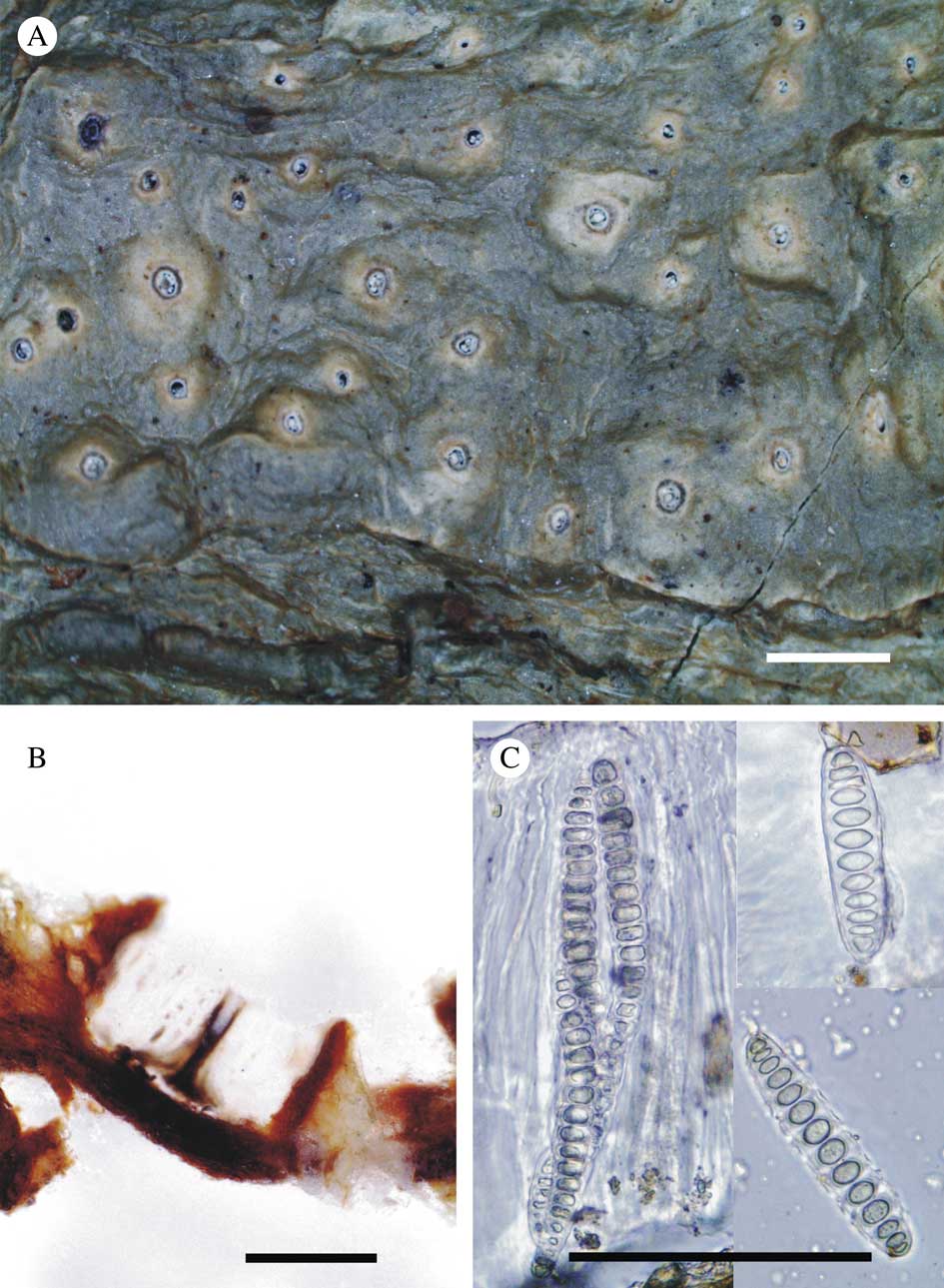
Thallus corticolous, greyish green, olivaceous green, smooth to uneven or verruculose, glossy, hard, continuous, <400 µm thick, corticate; cortex well developed, continuous, 40–50 µm thick; algal layer trentepohlioid, 50–70 µm thick; medulla white, crystalline, 120–150 µm thick.
Ascomata numerous, dispersed, porinoid, immersed to prominent, round to slightly angular, 0·1–0·8(–1.5) mm diam.; pore rounded to oval, surrounded by mottled or pale-coloured thalline margin, 0·2–0·3 mm diam.; proper exciple entire, brownish to reddish brown, (50–)100–185 µm thick; epihymenium greyish, granular, crystalline, 10–15 µm high; hymenium hyaline, clear, 200–220 µm high; columella simple, entire, conical, entirely carbonized, apically pruinose, protruding out of the pore, (50–)120–225 µm thick; asci 4–8-spored; ascospores hyaline, fusiform, transversely 10–20-septate, with thick septa and lens-shaped lumina, 100–125×15–25 µm, strongly amyloid (I+ blue-violet).
Chemistry. K−, PD−, C−; no substances detected by TLC.
Etymology. The new species is named in honour of the prominent Indian lichenologist Dr Dalip K. Upreti on the occasion of his retirement.
Ecology and distribution. The new taxon has a wide distribution in evergreen forests of the Western Ghats in south India and tropical rainforests of the Andaman and Nicobar Islands and the Eastern Himalaya. It was usually found growing in association with members of Graphidaceae, Porinaceae and Trypetheliaceae.
Remarks. This new taxon is characterized by a reddish brown proper exciple, simple carbonized columella, transversely septate ascospores and the absence of secondary compounds. The material belonging to this taxon can be superficially confused with, but is phylogenetically separated from, Ocellularia allosporoides (Kraichak et al. 2014 Reference Kraichak, Parnmen, Lücking, Rivas Plata, Aptroot, Cáceres, Ertz, Mangold, Mercado-Díaz and Paponga ). It agrees in all aspects with Ocellularia allosporoides except the latter contains norisonotatic and norsubnotatic acids in the thallus. Ocellularia dolichotata is similar to the new species but produces single-spored asci with larger ascospores (150–220×12–16 µm).
Additional specimens examined. India: Andaman & Nicobar Islands: Middle Andaman, Parlob Jig, elev. ≤30 m, A. Singh 61–79802, 61–79823, 61–79830 (LWG). Assam: Cachar District, Bontarapur, xii 2009, A. Dey 09–014934, 09–014915 (LWG). Karnataka: Chikmagalure District, Charmudi Ghat, near Kotigehara, elev. 929 m, H. T. Lumbsch, D. K. Upreti & P. K. Divakar 08–19735V/A (LWG); Koppa, elev. 770 m, H. T. Lumbsch, D. K. Upreti & P. K. Divakar 08–19729B (LWG); Koppa to Agumbe, 08–19730C (LWG); North Kannada District, forest near PWD Guest House, elev. 1700 m, A. Singh & D. K. Upreti 83–11541(LWG); Shimoga District, Sharavati River Basin, Sagar taluk, elev. 594 m, S. Nayaka 01–222717, 01–10232 (LWG); elev. 623 m, S. Nayaka 01–222773 (LWG); elev. 594 m, S. Nayaka 01–222750 (LWG); Negiloni, elev. 710 m, S. Nayaka 01–107244 (LWG); forest near Jog Falls, A. Singh & D. K. Upreti 83–L11528/A, 83–L11528/B, 83–L11529 (LWG); Uttarakannada District, Sharavati Ghat, near Gersoppa, elev. 718 m, H. T. Lumbsch, D. K. Upreti & P. K. Divakar 08–19742I, 08–19744E, 08–19744H, 08–19745K, 08–19745N, 08–19745O, 08–19745S, 08–19744A–2, 08–19744G (LWG); Sirsi taluk, near Vibhooti Falls, S. Dudani 14–024480 (LWG); Agumbe Ghat, elev. 600–700 m, Ravishankar & S. Ganapathy 09–016238, 09–016252 (LWG). Kerala: Ernakulam District, Thattekkad, elev. 320 m, B. Haridas 06–009651 (LWG); Mallapuram District, Wayanad area, Thakarpadi, elev. 450 m, A. Singh & M. Ranjan 75–102215, 75–102216, 75–102204, 75–102204A, 75–102218 (LWG); Thirunelli, Begur Range, elev. 900 m, B. Haridas 06–009584 (LWG); Kollam District, Rosemala, B. Haridas 06–009576, 01–009593 (LWG); Palghat District, Silent Valley National Park, B. Haridas 06–009649 (LWG); MCL mines area, Walayar Forest, elev. c. 300 m, D. D. Awasthi, R. Tewari & R. Mathur 85–25, 85–22, 85–11, 85–16, 85–2, 85–4, 85–6 (LWG–LWU); Thrissur District, Vazhachal Range, elev. 300 m, B. Haridas 06–009589 (LWG); Anakkayam Range, B. Haridas 06–009577 (LWG); Trivandrum District, Braemore, elev. 520 m, B. Haridas 06–009629 (LWG).
Ocellularia urceolaris Ach.
Syst. Orb. Veg. (Lundae) 4: 242 (1927).
Thallus whitish green to pale olive, shiny.
Ascomata semi-emergent to emergent; proper exciple carbonized; columella carbonized; ascospores 3×1 septate, hyaline, 15–25×7–12 µm.
Chemistry. Psoromic acid.
Remarks. This taxon was reported previously as O. leucina (Müll. Arg.) Hale from the tropical rainforests of Kerala and Tamil Nadu in the Western Ghats (Singh & Sinha Reference Singh and Sinha2010) but that name is considered a synonym of O. urceolaris (Buaruang et al. Reference Buaruang, Boonpragob, Mongkolsuk, Sangvichien, Vongshewarat, Polyiam, Rangsiruji, Saipunkaew, Naksuwankul and Kalb2017).
Ocellularia violacea Räsänen
Suom. Elain-ja Kasvit. Seuran Van. Tiendon. Pöytäkirjat 3: 184 (1949).
Thallus pale greenish grey to pale olive, ±glossy, smooth to slightly verruculose.
Ascomata mostly immersed to slightly emergent; proper exciple pale brown to brownish, dark brown, scarcely marginally carbonized; columella, often filling the pores, well-developed, carbonized, apically white pruinose; asci 8-spored; ascospores amyloid, small, hyaline, transversely 4–7-septate, oblong to fusiform or ellipsoid, amyloid, 21–24×5–7 µm.
Chemistry. Protocetraric acid.
Remarks. This species is a new record for India and herbarium specimens have previously been misidentified as O. papillata (Leight.) Zahlbr. Ocellularia violacea was earlier included in the synonymy of O. perforata, but following the narrowly defined species concept for Ocellularia by Lücking (2014), O. violacea was reinstated. It occurs in the Western Ghats.
Specimens examined. India: Karnataka: Shimoga District, Sharavati River Basin, Sagar taluk, elev. 594 m, S. Nayaka 01–222751–8 (LWG). Kerala: Thrissur District, Vazhachal, Peringalkuthu, elev. 400 m, B. Haridas 06–009623 (LWG).
Ocellularia wandoorensis Nagarkar et al.
Mycotaxon 27: 78 (1986).
Thallus greenish grey, ±warty.
Ascomata semi-emergent to emergent; proper exciple weakly carbonized; columella entire to irregularly reticulate, carbonized; hymenium inspersed; asci 8-spored; ascospores amyloid, fusiform, hyaline, transversely 3-septate, 8–10×3–5 µm.
Chemistry. No substances detected.
Remarks. It has been collected in the Andaman Islands and is endemic to India.
Specimen examined. India: Andaman & Nicobar Islands: South Andaman, Wandoor, Alexandria Island, P. K. Sethy & M. B. Nagarkar 85–1103 (AMH).
Ocellularia xanthostromiza (Nyl.) Zahlbr.
Cat. Lich. Univ. 2: 604 (1923).
Thallus greyish green to grey, verrucose, glossy.
Ascomata semi-emergent; proper exciple carbonized; columella carbonized; ascospores hyaline, transversely 2–5-septate, 10–20×3–5 µm.
Chemistry. Cinchonarum unknowns chemosyndrome.
Remarks. This species was included in the synonymy of O. cavata (Ach.) Müll. Arg. by Mangold et al. (Reference Mangold, Elix and Lumbsch2009) but later reinstated by Kraichak et al. (2014 Reference Kraichak, Parnmen, Lücking, Rivas Plata, Aptroot, Cáceres, Ertz, Mangold, Mercado-Díaz and Paponga ). It is known in India from the Andaman and Nicobar Islands (Singh & Sinha Reference Singh and Sinha2010).
Pseudochapsa Parnmen et al.
PLoS ONE 7: e51392, 10 (2012).
This new genus was described to accommodate species phylogenetically well separated from Chapsa s. str. and characterized by an ecorticate or loosely corticate thallus lacking secondary metabolites or containing stictic acid and relatives, ascomata with exposed disc and fissured to lobate margins, a brown exciple and transversely septate or muriform, colourless or occasionally brown, distoseptate, amyloid ascospores (Parnmen et al. Reference Parnmen, Lücking and Lumbsch2012). The genus comprises 16 species worldwide with a single species from India.
Pseudochapsa pseudoexanthismocarpa (Patw. & C. R. Kulk.) Parnmen et al.
PLoS ONE 7: e51392, 10 (2012).
Thallus pale yellowish to greenish brown or pale olive, verrucose.
Ascomata rounded to somewhat irregular and sometimes perithecioid, erumpent, immerged to semi-emergent with lacerate margins; asci 4–8-spored; ascospores hyaline, fusiform, trans-septate, 100–200×10–20 µm.
Chemistry. No substances detected.
Remarks. Patwardhan & Kulkarni (1977 Reference Patwardhan and Kulkarnib ) described the species from Kerala as an Ocellularia, but it was later recognized under Chapsa owing to the scabioid ascomata and lacerate exciple (Rivas Plata et al. 2010 Reference Rivas Plata, Lücking, Sipman, Mangold, Kalb and Lumbscha ; Joshi et al. 2012 Reference Joshi, Upreti and Nayakaa ). Its distribution is in the Western Ghats.
Specimen examined. India: Kerala: Idukki District, Vazhachal, Anamalai Hills, M. B. Nagarkar & K. D. Gole 76–308 (AMH).
Pseudotopeliopsis Parnmen et al.
PLoS ONE 7: e51392, 10 (2012).
This genus was recently segregated from Chapsa s. l. to accommodate a small group of species having a densely corticate thallus lacking secondary metabolites, Topeliopsis-like ascomata with a striate excipulum (covering the disc), hyaline or brown excipulum, and colourless to brown, trans-septate to muriform, subdistoseptate, non-amyloid ascospores (Parnmen et al. Reference Parnmen, Lücking and Lumbsch2012). Six species are currently accepted worldwide, including Pseudotopeliopsis laceratula from India.
Pseudotopeliopsis laceratula (Müll. Arg.) Parnmen et al.
PLoS ONE 7: e51392, 11 (2012).
Thallus pale to dark olive-green to olive-brown, corticate.
Ascomata round to irregular, perithecioid to apothecioid with lacerate margins; asci 1–2(–4)-spored; ascospores hyaline, fusiform, muriform, 70–170 µm long.
Chemistry. No substances detected.
Remarks. This species was recorded previously as Thelotrema laceratulum Müll. Arg. and Chapsa laceratula (Müll. Arg.) Rivas Plata & Mangold (Patwardhan & Kulkarni 1977 Reference Patwardhan and Kulkarnia ; Rivas Plata et al. 2010 Reference Rivas Plata, Lücking, Sipman, Mangold, Kalb and Lumbscha ). It occurs at lower elevations in evergreen forests of the Western Ghats (Karnataka, Kerala, Maharashtra and Tamil Nadu). Material included previously under the name Chapsa laceratula by Joshi et al. (2012 Reference Joshi, Upreti and Nayakaa ) has now been identified as Thelotrema adjectum.
Pycnotrema Rivas Plata & Lücking
Fungal Diversity 52: 120 (2012).
This monospecific genus was described to accommodate a species with no well-defined diagnostic characters that separate it from Ocellularia s. l. and Mytriotrema s. l. but was phylogenetically distantly classified from them and placed in the subfamily Fissurinoideae (Rivas Plata et al. 2012 Reference Rivas Plata, Lücking and Lumbscha ).
Pycnotrema pycnoporellum Nyl.
Fungal Diversity 52: 120 (2012).
Thallus thick, greenish grey, warty.
Ascomata aggregated, immersed, with a black annulate rim around the ostiolar region; exciple fused; asci 8-spored; ascospores amyloid, hyaline muriform, 20–25×5–7 µm.
Chemistry. No substances detected.
Remarks. This species was collected in Karnataka in the Western Ghats as Thelotrema pycnoporellum Nyl. (Singh & Sinha Reference Singh and Sinha2010).
Reimnitzia Kalb
Mycotaxon 79: 325 (2001).
The genus Reimnitzia is monospecific and delimited from the closely related Chapsa and Thelotrema based on characters such as an isidiate thallus, deep photobiont layer with inclusions of large columns of calcium oxalate crystals responsible for the warty appearance of the thallus, thick-walled, non-halonate, immature ascospores, and lax and comparatively less distinct paraphyses. Worldwide only a single species, Reimnitzia santensis, is currently known.
Reimnitzia santensis (Tuck.) Kalb
Mycotaxon 79: 325 (2001).
Thallus greenish glaucous to pale glaucous blue, ecorticate, farinose, thick, isidiate.
Ascomata large, chroodiscoid with wide open disc; proper exciple fused; ascospores small, brown, submuriform with irregular locular arrangement.
Chemistry. No substances detected.
Remarks. This species was recorded as Leptotrema santense (Tuck.) Zahlbr. from Kerala and Tamil Nadu in the Western Ghats by Patwardhan & Kulkarni (1977 Reference Patwardhan and Kulkarnia ).
Specimen examined. India: Tamil Nadu: Coimbatore District, Siruvani Waterfall, elev. 1440 m, H. T. Lumbsch, D. K. Upreti & P. K. Divakar 08–19706B (LWG).
Rhabdodiscus Vain.
Ann. Sci. Acad. Fenn., sér. A 15: 184 (1921).
The genus was recently resurrected by Rivas Plata et al. (2012 Reference Rivas Plata, Lücking and Lumbschb ) and includes species that are morphologically and phylogenetically well separated from the columellate genera (Ocellularia and Stegobolus). It differs from Ocellularia in having a reticulate columella, and from Stegobolus in the distinctly carbonized ascomata with thin margins lacking felty pruina, and columella penetrating the hymenium completely. Additionally, it produces prominent ascomata, mostly chroodiscoid, and hyaline or brown ascospores. Currently, more than 40 species are known globally, of which seven (two endemic) are known from India.
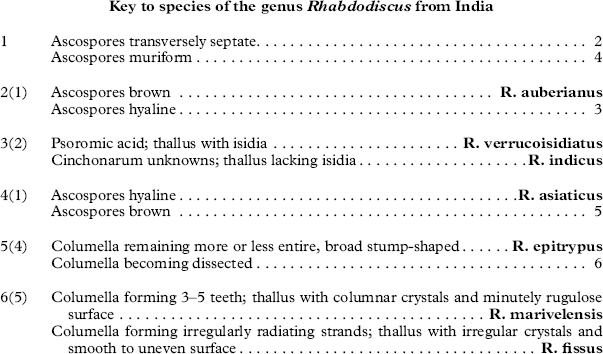
Rhabdodiscus asiaticus (Vain.) Rivas Plata et al.
Taxon 61: 1175 (2012).
Thallus greyish to pale greenish or yellowish grey to olive, ±glossy, smooth to verruculose.
Ascomata semi-emergent; proper exciple thick, brownish to distinctly carbonized; columella well-developed, entire to distinctly complex and carbonized; asci 8-spored; ascospores amyloid, transversely septate to indistinctly submuriform, mostly fusiform, hyaline to occasionally pale brownish, 10–40×7–12 µm.
Chemistry. Psoromic acid syndrome.
Remarks. This species resembles R. fissus, which differs in having smaller brown ascospores that are submuriform. Rhabdodiscus asiaticus is known from the Andaman and Nicobar Islands and the Western Ghats.
Specimens examined. India: Kerala: Idukki District, Myladumpara, B. Haridas 06–009573 (LWG); ICRI campus, elev. c. 1200 m, D. D. Awasthi & G. Awasthi 84–158, 84–84 (LWG–LWU).
Rhabdodiscus auberianus (Mont.) Vain.
Ann. Acad. Sci. Fenn., sér. A 15: 184 (1921).
Ascomata rounded to shortly lirellate; columella broad stump-shaped to reticulate, carbonized; proper exciple strongly carbonized; asci 4–8-spored; ascospores brown, transversely 3–7-septate 10–27×5–8 µm.
Chemistry. Psoromic acid.
Remarks. This species has been reported from Tamil Nadu in the Western Ghats (Singh & Sinha Reference Singh and Sinha2010).
Rhabdodiscus epitrypus (Nyl.) Vain.
Ann. Acad. Sci. Fenn., sér. A 15: 184 (1921).
Thallus greenish grey.
Ascomata emergent; columella carbonized, 3–4-stranded; proper exciple carbonized; asci 8-spored; ascospores submuriform, hyaline to brown, 2–3×1 septate, 10–15×8–10 µm.
Chemistry. Psoromic acid.
Remarks. This species was previously recorded as Ocellularia epitrypa (Nyl.) Hale (Awasthi Reference Awasthi1991) and later synonymized under Ocellularia fissa (Müll. Arg.) Hale (Mangold et al. Reference Mangold, Elix and Lumbsch2009). In a subsequent study, Rivas Plata et al. (2012 Reference Rivas Plata, Lücking and Lumbschb ) reinstated the species. In India it occurs in the Andaman and Nicobar Islands and the Western Ghats (Kerala and Tamil Nadu) (Singh & Sinha Reference Singh and Sinha2010).
Rhabdodiscus fissus (Nyl.) Vain.
Ann. Acad. Sci. Fenn., sér. A 15: 184 (1921).
Thallus pale greenish grey or olivaceous, continuous, in a shade of yellow, ±glossy.
Ascomata emergent; proper exciple brownish to carbonized; columella well-developed, entire to complex, carbonized; asci 8-spored; ascospores±submuriform, 2–5×1–2 septate, pale to brown (at maturity), 8–22×6–12 µm.
Chemistry. Psoromic acid chemosyndrome.
Remarks. In India this species is known from the Andaman and Nicobar Islands, the Eastern Himalaya and the Western Ghats.
Specimen examined. India: Assam: Nagaon District, Chapanala Village, A. Dey 12–020495 (LWG).
Rhabdodiscus indicus Pushpi Singh & Kr. P. Singh
Taiwania 58: 246 (2013).
Thallus isidiate, pale yellowish, rugose.
Ascomata rounded to irregular; disc white pruinose; columella reticulate; exciple brown; ascospores hyaline, transversely 3-septate, 10–13×5–6 µm.
Chemistry. Cinchonarum unknown present.
Remarks. Rhabdodiscus isidiifer (Hale) Rivas Plata et al. is similar but contains psoromic acid. Rhabdodiscus indicus has recently been described from Arunachal Pradesh in the Eastern Himalaya (Singh et al. Reference Singh, Singh and Bhatt2013) and is so far known only from India.
Rhabdodiscus marivelensis (Vain.) Rivas Plata et al.
Taxon 61: 1176 (2012).
Thallus yellowish grey, ±glossy, ±verruculose.
Ascomata emergent; proper exciple brown to carbonized; columella well-developed; asci 8-spored; ascospores submuriform to muriform, 3–9×0–5 septate, hyaline to brownish (in late maturity), large, 10–30× 7–15 µm.
Chemistry. Psoromic acid chemosyndrome.
Remarks. This species was previously recorded as Ocellularia marivelensis (Vain.) Hale and O. confluens (Kremp.) Zahlbr. (Hale Reference Hale1980; Mangold et al. Reference Mangold, Elix and Lumbsch2009). Rhabdodiscus marivelensis is similar to R. fissus but differs in having slightly larger ascospores. It is recorded from the Western Ghats.
Specimens examined. India: Kerala: Idukki District, ICRI campus, Myladumpara, elev. c. 1200 m, D. D. Awasthi & G. Awasthi 84–57, 84–76, 84–78, 84–143 (LWG–LWU).
Rhabdodiscus verrucoisidiatus (Nagarkar, Sethy & Patw.) S. Joshi, Upreti & Lücking comb. nov.
MycoBank No.: MB 822096
Ocellularia verrucoisidiata Nagarkar et al., Biovigyanam 14: 39 (1988); type: India, Kerala, Cardamom Hills, Devicolam-Kumily road, near Kumily, on bark, 25 January 1976, C. R. Kulkarni 76–836 (AMH—holotype).
Thallus pale greenish grey, thick, uneven, with globose or verrucose structures (isidioid verrucae).
Ascomata semi-emergent; columella carbonized, broad, fills ascoma (sometimes with 2–3 strands); ostiole, irregular, widely open with raised margins; proper exciple carbonized; asci 8-spored; ascospores large, transversely 5–7-septate, hyaline, 15–20×5–8 µm.
Chemistry. Psoromic acid.
Remarks. This species was recorded from Kerala in the Western Ghats and is endemic to India.
Sanguinotrema Lücking
Bot. J. Linn. Soc. 179: 441 (2015).
This monospecific genus was introduced to accommodate Sanguinotrema wightii, previously known in the genus Leptotrema as L. wightii (Taylor) Müll. Arg. Subsequent molecular studies revealed that the generic delimitations of Leptotrema were well represented by L. zollingeri Mont. & Bosch, long considered in the synonymy of Leptorema wightii. Consequently, the latter species has been placed in the newly established genus Sanguinotrema and the tribe Sanguinotremateae (Lücking et al. Reference Lücking, Mangold, Rivas Plata, Kraichak and Lumbsch2015).
Sanguinotrema wightii (Tayl.) Lücking
Bot. J. Linn. Soc. 179: 441 (2015).
Thallus hollow, fragile, with a gall-like appearance, with columnar clusters of calcium oxalate crystals, pale greenish grey, photobiont and medulla with blood-red crystals.
Ascomata myriotremoid; asci uniformly thinned; ascospores thick-walled (young), 10–30×8–15 µm.
Chemistry. No substances detected.
Remarks. Sanguinotrema wightii is known from Central India and the Western Ghats (Singh & Sinha Reference Singh and Sinha2010).
Specimen examined. India: Goa: Goa University area, Bamboli, D. K. Upreti, S. Chatterjee & P. K. Divakar 04–004377 (LWG).
Stegobolus Mont.
London J. Bot. 4: 4 (1845).
The genus was reinstated by Frisch et al. (Reference Frisch, Kalb and Grube2006) including two major groups: the S. berkeleyanus group and the S. auberianus group. These groups were shown to represent two monophyletic clades. Consequently, the S. auberianus group is now being considered as the separate genus Rhabdodiscus, whereas Stegobolus is restricted to the S. berkleyanus group. Stegobolus s. str. includes species with complex, weakly to uncarbonized pseudocolumellar structures, ±sessile ascomata small, hyaline, transversely septate to submuriform ascospores and commonly the presence of psoromic acid (Rivas Plata et al. 2012 Reference Rivas Plata, Lücking and Lumbschb ). Although molecular phylogeny showed that Rhabdodiscus and Stegobolus s. str. are not closely related, some studies still treated Stegobolus in a wide sense and included species of Rhabdodiscus within Stegobolus s. l. (Sipman et al. Reference Sipman, Lücking, Aptroot, Chaves, Kalb and Tenorio2012).
Stegobolus berkeleyanus Mont.
London J. Bot. 4: 4 (1845).
Thallus olive-green, schizodiscs present.
Asci 8-spored; ascospores amyloid, hyaline, transversely 3-septate, 10–15×3–6 µm.
Chemistry. Psoromic acid.
Remarks. This species is known from the Andaman and Nicobar Islands and the Western Ghats.
Specimens examined. India: Andaman & Nicobar Islands: South Andaman, Baratang Island, Nilambur (Oralkachha), elev. < 30 m, A. Singh 61–79719 (LWG). Kerala: Trivandrum District, Ponmudi, 10th HP Curve, elev. 700 m, B. Haridas 06–009613 (LWG).
Thelotrema Ach.
Meth. Lich.: 130 (1803).
Following the concept of Hale (1974 Reference Halea , Reference Haleb , 1978a, b, 1981), the original circumscription of Thelotrema was greatly modified by Frisch et al. (Reference Frisch, Kalb and Grube2006), Mangold et al. (Reference Mangold, Elix and Lumbsch2009) and Rivas Plata et al. (2010 Reference Rivas Plata, Kalb and Frischb ). Several species previously recorded in Thelotrema have now been transferred to numerous genera including Asteristion, Astrochapsa, Chapsa, Myriotrema, Ocellularia, Reimnitzia, Topeliopsis and Wirthiotrema following phylogenetic studies (Frisch et al. Reference Frisch, Kalb and Grube2006; Mangold et al. Reference Mangold, Elix and Lumbsch2009; Rivas Plata et al. 2010 Reference Rivas Plata, Lücking, Sipman, Mangold, Kalb and Lumbscha ; Parnmen et al. Reference Parnmen, Lücking and Lumbsch2012; Medeiros et al. Reference Medeiros, Kraichak, Lucking, Mangold and Lumbsch2017). Thelotrema presently forms the largest genus in the tribe Thelotremateae and includes more than 100 species worldwide (Mangold et al. Reference Mangold, Elix and Lumbsch2009; Rivas Plata et al. 2010 Reference Rivas Plata, Lücking, Sipman, Mangold, Kalb and Lumbscha ; Singh & Sinha Reference Singh and Sinha2010). Forty-three species were recorded for the genus by Singh & Sinha (Reference Singh and Sinha2010); some had not been collected for a long time, while others needed thorough revision. Singh & Sinha (Reference Singh and Sinha2010) accepted 16 species of the genus endemic to India from rainforests of the Western Ghats, Andaman Islands and the Eastern Himalaya. In the current circumscription, 18 species are included from India three of which are known only from India.
Thelotrema is characterized by a weakly corticate to ecorticate, immersed to superficial, greyish to greenish or olivaceous thallus in shades of yellow, brown or white, ±round to slightly irregular, lepadinoid, ±indistinctly chroodiscoid ascomata mostly with double margin, a ±free, rarely fused pale brown to hyaline proper exciple with lateral paraphyses (periphysoids), a hyaline, greyish to brownish epihymenium, hyaline, clear or inspersed hymenium lacking columellar structures, 1–8-spored, clavate, non-amyloid asci, transversely septate to muriform, hyaline to yellowish or brown, non-amyloid to distinctly amyloid, non-halonate to±distinctly halonate ascospores, and the presence or absence of β-orcinol depsidones.
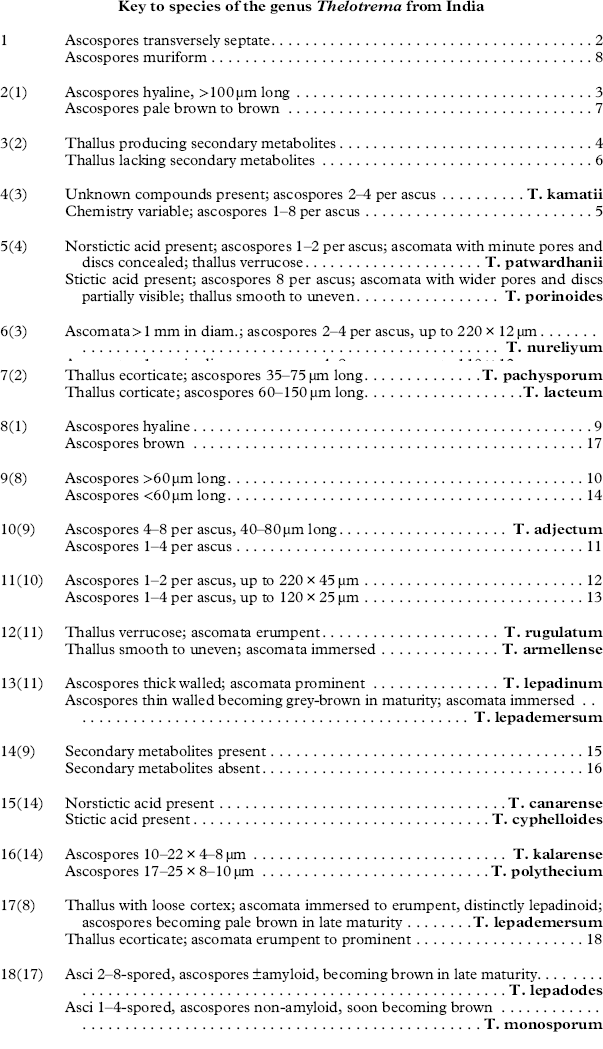
Thelotrema adjectum Nyl.
Flora 49: 290 (1866).
Thallus green to olive-green, mostly dull, continuous.
Ascomata immersed to semi-emergent, with wide ostiole, partly exposed flesh-coloured disc, ±layered margins; proper exciple free, hyaline to pale brown; asci 4–8-spored; ascospores non-amyloid to weakly amyloid, muriform, 11–17×0–5 septate, 40–80×8–25 µm.
Chemistry. No substances detected.
Remarks. This taxon is a new record for India. It is somewhat similar to Chapsa laceratula but differs in having mostly ecorticate to loosely corticate thalli. It occurs in different parts of the Western Ghats.
Specimens examined. India: Goa: South Goa, Cotigao Wildlife Sanctuary, Gaodanger Village, elev. 300 m, S. Nayaka 03–001605C (LWG). Karnataka: Chikmagalure District, Chamudi Ghat, Kuvettu, elev. 104 m, H. T. Lumbsch, D. K. Upreti & P. K. Divakar 08–19739S (LWG). Maharashtra: Kolhapur District, Dajipur, Radha Nagari, Ugavai, Sacred Grove, elev. 700 m, S. Nayaka 99–75973/A (LWG). Tamil Nadu: Nilgiri District, Nilgiri Hills, Gudalur Way, after Naoluvattum, Kr. P. Singh 73–620, 73–635 (LWG–LWU).
Thelotrema armellense Patw. et al.
Biovigyanam 11: 136 (1985).
Thallus smooth to uneven.
Ascomata immersed to slightly raised; open by wide ostiole; disc brown epruinose; proper exciple colourless, mostly fused to free, internally lined (at apices) by periphysoids; asci 1–2-spored; ascospores weakly amyloid, large 130–220×25–45 µm, becoming mottled in late maturity.
Chemistry. No substances detected.
Remarks. This species seems close to the T. monosporum complex and resembles T. lepademersum which is distinct in its morphology, producing a double margin around the ascomata. Thelotrema armellense was described from Karnataka in the Western Ghats by Patwardhan et al. (Reference Patwardhan, Sethy and Nagarkar1985) and is endemic to India.
Specimens examined. India: Karnataka: North Canara District, Armol Ghat, Yellapur to Ankola road, P. G. Patwardhan 78–10 (AMH). Maharastra: Pune District, Thamini, elev. 600 m, S. Nayaka 99–86222B (LWG).
Thelotrema canarense Patw. & C. R. Kulk.
Norw. J. Bot. 24: 128 (1977).
Thallus pale brown, honey brown, fawn-coloured, glossy, thin, smooth, continuous, evanescent reflecting bark.
Ascomata immersed, solitary, lepadinoid; asci 8-spored; ascospores non-amyloid, hyaline, submuriform, 5–7×1–2 septate, 20–25×9–10 µm.
Chemistry. Norstictic acid.
Remarks. Another norstictic acid-containing species is T. patwardhanii (Hale) Rivas Plata & Mangold, which differs in having a verrucose thallus, 1–2-spored asci and transversely septate, larger ascospores. Thelotrema canarense was described from Karnataka in the Western Ghats by Patwardhan & Kulkarni (1977 Reference Patwardhan and Kulkarnib ) and also occurs in the Western and Eastern Himalayas.
Specimens examined. India: Karnataka: South Canara District, at Manjeshwar, near Mangalore, P. G. Patwardhan & A. V. Prabhu 76–1201 (AMH). Uttarakhand: Pithoragarh District, Kali River valley, on way to Punyagiri from Tanakpur, elev. 300 m, (55–56)–3187, (55–56)–3377 (LWG–AWAS). West Bengal: Darjeeling District, Kurseong, near 1st loop, elev. 30–60 m, D. D. Awasthi & M. R. Agarwal 66–98 (LWG–LWU).
Thelotrema cyphelloides Müll. Arg.
Bull. Herb. Boissier 3: 314 (1895).
Thallus grey to greenish grey, smooth, prosoplectenchymatous cortex.
Ascomata numerous, erumpent; asci 8-spored; ascospores non-amyloid small, hyaline, 6–10×1–2 septate, 20–27×4–8 µm.
Chemistry. Stictic acid chemosyndrome.
Remarks. This muriform species in India was described as T. subexpallescens Nagarkar et al. from the Andaman and Nicobar Islands by Nagarkar et al. (Reference Nagarkar, Sethy and Patwardhan1987).
Specimen examined. India: Andaman & Nicobar Islands: Middle Andaman, Long Island range, Parlobjig Island, M. B. Nagarkar & P. K. Sethy 85–2258 (AMH).
Thelotrema diplotrema Nyl.
Ann. Sci. Nat., Bot., sér. 4 11: 258 (1859).
Thallus mostly ecorticate, uneven, pale greenish grey to pale olive.
Ascomata immersed, lepadinoid; asci 4–8-spored; ascospores amyloid, hyaline, transversely 10–20-septate, 50–110×8–12 µm.
Chemistry. No substances detected.
Remarks. Thelotrema nureliyum is comparable to T. diplotrema in lacking lichen compounds but differs in having larger ascomata and ascospores. Thelotrema diplotrema was reported from the Andaman and Nicobar Islands by Nagarkar et al. (Reference Nagarkar, Sethy and Patwardhan1987) as Ocellularia turgidula Müll. Arg.
Thelotrema kalarense Sethy et al.
Mycotaxon 28: 194 (1987).
Thallus glaucous grey to silver-grey, smooth, glossy ecorticate.
Ascomata immersed to semi-emergent, lepadinoid; asci 8-spored; ascospores weakly amyloid, hyaline, muriform, sometimes I+ violet-blue, 4–5×1–2 septate, small, 10–22×4–8 µm.
Chemistry. No substances detected.
Remarks. This species was described by Sethy et al. (Reference Sethy, Nagarkar and Patwardhan1987) from evergreen forests of the Andaman and Nicobar Islands and is endemic to India.
Specimen examined. India: Andaman & Nicobar Islands: North Andaman, Kalara, Diglipur range, in evergreen forest, P. G. Patwardhan & M. B. Nagarkar 86–460 (AMH).
Thelotrema kamatii (Patw. & C. R. Kulk.) Hale
Mycotaxon 6: 8 (1980).
Thallus corticate, olive-green, smooth, continuous.
Ascomata immersed to semi-emergent, lepadinoid; asci 4–8-spored; ascospores non-amyloid, hyaline, transversely 15–21-septate, 90–110×8–10 µm.
Chemistry. Unknown compounds present (yellow spots at Rf value 4 and 5).
Remarks. Thelotrema kamatii was described from Karnataka by Patwardhan & Kulkarni (1977 Reference Patwardhan and Kulkarnib ) as Ocellularia kamatii Patw. & C. R. Kulk. It is also known from the Andaman and Nicobar Islands, and Kerala in the Western Ghats.
Specimen examined. India: Karnataka: Chikmagalure District, Kalmaggi, in Charmudi Ghat, M. B. Nagarkar & K. D. Gole 76–1061 (AMH).
Thelotrema lacteum Kremp.
Flora 47: 269 (1867).
Thallus±corticate, different shades of pale and greenish grey.
Ascomata prominent, lepadioid with pruinose disc; ascospores brown, transversely 17–27-septate, thick-walled ≤150 µm long.
Chemistry. No substances detected.
Remarks. Thelotrema pachysporum and T. diplotrema can be confused with T. lacteum but differ in having shorter ascospores and persistently hyaline ascospores, respectively. Earlier, Hale (Reference Hale1981) treated T. pachysporum and T. lacteum as conspecific but subsequently both taxa were accepted as distinct by Frisch et al. (Reference Frisch, Kalb and Grube2006). In India the species has been reported from the Andaman and Nicobar Islands and the Eastern Himalaya (Assam) by Nagarkar et al. (Reference Nagarkar, Sethy and Patwardhan1986) as Phaeotrema lacteum (Kremp.) Müll. Arg.
Thelotrema lepademersum Nagarkar et al.
Kavaka 13: 59 (1985).
Thallus grey-green, green, greenish grey, smooth to uneven, verrucose; cortex irregular, loose.
Proper exciple colourless; asci 1–4-spored; ascospores hyaline, grey in older stage, muriform.
Chemistry. No substances detected.
Remarks. This species was described from Karnataka by Nagarkar et al. (Reference Nagarkar, Sethy and Patwardhan1985). It is recorded from the Western Ghats and the Eastern Himalaya. The species shows a close resemblance to T. lepadinum, which differs in having prominent ascomata and persistently hyaline ascospores.
Specimens examined. India: Assam: Nagaon District, Salna Village, A. Dey 12–020497 (LWG). Karnataka: North Canara District, on the way to Jog Falls, P. G. Patwardhan & U. V. Makhija 81–633 (AMH).
Thelotrema lepadinum (Ach.) Ach.
Meth. Lich.: 132 (1803).
Thallus different shades of pale and yellow-green.
Ascomata emergent, lepadinoid, proper exciple hyaline; asci 1–4-spored; ascospores hyaline, muriform, 100–120×20–25 µm.
Chemistry. No substances detected. However, Singh & Sinha (Reference Singh and Sinha2010) mentioned an infrequent occurrence of yellow pigment.
Remarks. Morphologically, many species resemble T. lepadinum but differ in ascospore size and septation. The closely related T. lepademersum differs in producing immersed ascomata and thin-walled ascospores which are not persistently hyaline. Thelotrema lepadinum has its distribution mainly in the Western Ghats, and in some parts of the Eastern Himalaya.
Specimens examined. India: Karnataka: Uttarakannada District, Kumta taluk, Sampegadde, S. Dudani 13–024452 (LWG). Kerala: Idukki District, ICRI campus, Myladumpara, elev. c. 1200 m, D. D. Awasthi & G. Awasthi 84–78 (LWG–LWU). Tamil Nadu: Nilgiri District, Nilgiri Hills, way to Doddabetta Peak, elev. 2500–2633 m, G. Awasthi 82–4D (LWG–LWU).
Thelotrema lepadodes Tuck.
Proc. Amer. Acad. Arts Sci. 5: 405 (1862).
Thallus pale grey to yellowish grey.
Ascomata ±emergent; asci 2–8-spored; ascospores moderately large, brown, non-amyloid to weakly amyloid, muriform, 60–120 µm long.
Chemistry. No substances detected.
Remarks. This species had previously been considered under the synonymy of T. monosporum by Frisch et al. (Reference Frisch, Kalb and Grube2006) but recently was accepted under its current name (Mangold et al. Reference Mangold, Elix and Lumbsch2009; Rivas Plata et al. 2010 Reference Rivas Plata, Lücking, Sipman, Mangold, Kalb and Lumbscha ). Thelotrema lepadodes differs from the closely related T. monosporum in having 2–8-spored asci and fusiform ascospores with ±subacute ends, ascospore septation, time of maturity (browning) and amyloidity. Thelotrema lepadodes has been reported as Leptotrema lepadodes (Tuck.) Zahlbr. by Patwardhan & Kulkarni (1977 Reference Patwardhan and Kulkarnia ) from Tamil Nadu. In addition, it occurs in the Andaman and Nicobar Islands, the Eastern Himalaya, and the Eastern and Western Ghats.
Specimens examined. India: Assam: Nagaon District, Lumding forest, A. Dey 09–19055 (LWG). Karnataka: Uttarakannada District, Honnavar taluk, Karikan sacred grove, S. Dudani 12–016872 (LWG). Orissa: Berhampur District, Taptapani, elev. c. 750 m, D. D. Awasthi 45–204 (LWG–AWAS). Tamil Nadu: Nilgiri District, Nilgiri Hills, Kodanad, near tea estate, in the Shola, elev. c. 2000 m, D. D. Awasthi & Kr. P. Singh 70–1482 (LWG–LWU).
Thelotrema monosporum Nyl.
Ann. Sci. Nat., Bot., sér. 4 15: 46 (1860).
Thallus ecorticate.
Ascomata emergent; asci 1–4-spored; ascospores large,<100 µm long, brown, muriform.
Chemistry. No substances detected.
Remarks. Thelotrema monosporum is formally recognized as a separate species from the closely related T. lepadodes on the basis of longitudinal septation, darkening and amyloidity of ascospores and the number of spores per ascus. It was recorded from the Andaman and Nicobar Islands (Awasthi Reference Awasthi1991) and also occurs in the Western Ghats (including Karnataka, Kerala and Maharashtra) and the Western Himalaya.
Specimens examined. India: Andaman & Nicobar Islands: South Andaman, unnamed island, near Baratang Island, A. Singh 61–79745 (LWG). Kerala: Idukki District, ICRI campus, Myladumpara, elev. c. 1200 m, D. D. Awasthi & G. Awasthi 84–119 (LWG–LWU). Tamil Nadu: Nilgiri District, Nilgiri Hills, on way to Doddabetta, elev. c. 1800 m, Kr. P. Singh 73–417 (LWG–LWU). Uttarakhand: Pithoragarh District, Ginny Band, D. K. Upreti et al. 09–012104 (LWG).
Thelotrema nureliyum Hale
Bull. Br. Mus. (Nat. Hist.), Bot. 8: 261 (1981).
Thallus pale greenish grey to olive or yellowish grey, strongly rimose, verrucose.
Ascomata>1 mm in diam.; asci 2–4-spored; ascospores large, up to 220×20 µm, transversely septate.
Chemistry. No substances detected.
Remarks. Patwardhan et al. (Reference Patwardhan, Sethy and Nagarkar1985) recorded the species from the Western Ghats (Tamil Nadu) as Ocellularia nureliya (Hale) Patw. et al.
Thelotrema pachysporum Nyl.
Bull. Soc. Linn. Normandie, sér. 2 2: 72 (1868).
Thallus pale grey to pale yellowish grey, thin, ecorticate.
Ascomata large, proper exciple free; ascospores moderately large, transversely septate, thick-walled, brown.
Chemistry. No substances detected.
Remarks. This species was earlier considered conspecific with T. lacteum (Hale Reference Hale1981) but recently (Mangold et al. Reference Mangold, Elix and Lumbsch2009) it has been treated as a different species with smaller ascospores of 35–75 µm compared to the 60–150 µm long ascospores of T. lacteum. Samples from India with brown ascospores were misidentified previously as T. subtile Tuck., which differs in producing consistently hyaline ascospores (Sipman et al. Reference Sipman, Lücking, Aptroot, Chaves, Kalb and Tenorio2012). The species was first collected in 1879 from the Eastern Himalaya (Assam) as T. exalbidum by A. Watt, and has been reported from Karnataka and Maharastra in the Western Ghats by Patwardhan & Kulkarni (1977 Reference Patwardhan and Kulkarnia ) and Nagarkar et al. (Reference Nagarkar, Sethy and Patwardhan1988) as Ocellularia subtilis (Tuck.) Riddle. It is also known to occur in the Andaman Islands, the Gangetic Plains and the Eastern Himalaya.
Specimens examined. India: Andaman & Nicobar Islands: Middle Andaman, Bajalungta, <60 m, A. Singh 61–52913 (LWG). Assam: Nagaon District, Jugijan Village, A. Dey 10–019001 (LWG). Karnataka: Hassan District, near Sakleshpur, Sambhalli, D. D. Awasthi, D. K. Upreti & U. Misra 79–315 (LWG). Tamil Nadu: Tirunelveli District, Pothigai Hills, Papanasum, near upper Tamra barni Dam, elev. 1000–1200 m, Upreti & G. N. Hariharan 90–202296 (LWG). Uttar Pradesh: Behraich District, Katarniaghat Wildlife Sanctuary, near Bicchiya, elev. 120 m, D. K. Upreti, S. Nayaka & J. Tandon 07–008540 (LWG).
Thelotrema patwardhanii (Hale) Rivas Plata & Mangold
Lichenologist 42: 184 (2010).
Thallus green to olive-green or pale green, verrucose, continuous.
Ascomata inconspicuous, perithecioid; asci 1–2-spored; ascospores muriform, ≤200 µm long.
Chemistry. Norstictic acid.
Remarks. The type material examined was rather poor and could not be studied for ascomatal anatomical characters. It was previously described as Ocellularia patwardhanii Hale from Karnataka and Kerala in the Western Ghats and has so far been recorded only from India.
Specimen examined. India: Karnataka: South Canara District, Agumbe, P. G. Patwardhan 77–426 (AMH).
Thelotrema polythecium Sethy et al.
Mycotaxon 28: 195 (1987).
Thallus ecorticate, translucent pseudocortex present, off-white to smoke grey, brown, smooth.
Ascomata immersed to slightly raised, with lacerate margins; asci 8-spored, ascospores non-amyloid, small, hyaline, muriform to submuriform, 5–6×1–2 septate, 17–25× 8–10 µm.
Chemistry. No substances detected.
Remarks. Thelotrema kalarense is similar but has smaller ascospores with fewer septa. Thelotrema polythecium was described from the Andaman and Nicobar Islands by Sethy et al. (Reference Sethy, Nagarkar and Patwardhan1987).
Specimen examined. India: Andaman & Nicobar Islands: North Andaman, Mayabandar Range, Kaichi Nala, M. B. Nagarkar & P. G. Patwardhan 85–2793 (LWG).
Thelotrema porinoides Mont. & Bosch
Pl. Jungh. 4: 484 (1855).
Thallus greyish green.
Ascomata±conspicuous, emergent; asci 8-spored; ascospores amyloid, transversely septate, hyaline, 40–170×15–22 µm.
Chemistry. Stictic acid chemosyndrome.
Remarks. The morphologically similar T. nureliyum does not contain secondary compounds. Ocellularia agasthiensis Nagarkar et al., O. albidiformis (Leight.) Zahlbr. and O. exanthismocarpa (Leight.) Zahlbr., treated previously as separate species (Patwardhan & Kulkarni 1977 Reference Patwardhan and Kulkarnia ; Nagarkar et al. Reference Nagarkar, Sethy and Patwardhan1988), have subsequently been synonymized with T. porinoides (Rivas Plata et al. 2010 Reference Rivas Plata, Lücking, Sipman, Mangold, Kalb and Lumbscha ; Singh & Sinha Reference Singh and Sinha2010). This taxon is known from the Andaman and Nicobar Islands and the Western Ghats.
Specimens examined. India: Andaman & Nicobar Islands: South Andaman, Mount Harriat, elev. c. 360 m, A. Singh 61–67629 (LWG). Tamil Nadu: Manjolai Upper Kodayar, Agasthi Hills, P. K. Sethy & M. B. Nagarkar 83–188B (AMH).
Thelotrema rugatulum Nyl.
Bull. Soc. Linn. Normandie, sér. 2 7: 168 (1873).—Thelotrema verrucorugosum Nagarkar et al., Kavaka 13: 60 (1987) [“1985”]; type: India, Karnataka, South Canara District, Ganga Mulla to Nagatritha, on the way to Kudremkha, on bark, 1 January 1981, P. G. Patwardhan & D. Rane 81–13 (AMH—holotype).
Thallus off-white, smooth.
Ascomata numerous, erumpent, with a depressed indistinct to distinct ostiole; proper exciple indistinctly free; asci 1(–2)-spored; ascospores non-amyloid, hyaline, muriform, large, 150–200×20–30 µm.
Chemistry. No substances detected.
Remarks. Nagarkar et al. (Reference Nagarkar, Sethy and Patwardhan1987) recorded T. rugatulum from the Andaman and Nicobar Islands.
Topeliopsis Kantvilas & Vězda
Lichenologist 32: 347 (2000).
The genus Topeliopsis was introduced to accommodate species having a thick, slightly pale proper exciple lined by indistinctly separated periphysoids and straight, parallel to slightly interwoven paraphyses that never have strongly thickened tips. A total of c. 19 species of the genus are known worldwide. Only two species are known in India: T. muscigena and T. tuberculifera. Topeliopsis pseudoexanthismocarpa (Mont. & Bosch) Mangold, placed in the genus earlier, was later treated under Chapsa pseudoexanthismocarpa and thereafter accommodated in Pseudochapsa as P. pseudoexanthismocarpa. The genus differs from the closely related Thelotrema by the fused proper exciple and arrangement of paraphyses and periphysoids (Mangold et al. Reference Mangold, Elix and Lumbsch2009). The other common diagnostic characters of the genus include 1–8-spored asci, and transversely septate to muriform, usually hyaline, rarely yellowish to brown, thin- to thick-walled, mostly I+ violet ascospores, halonate or not.

Topeliopsis muscigena (Stizenb.) Kalb
Mycotaxon 79: 322 (2001).
Thallus grey to olive-grey or pale yellowish grey, smooth, ecorticate.
Ascomata urceolate, sessile to shortly stipitate, margin exfoliating; corticate, smooth, cylindrical, reddish brown ascomatal base; proper exciple fused with periphysoids; asci 1(–2)-spored; ascospores amyloid, muriform, thin-walled, hyaline to brownish, large, 100–210×20–55 µm, may generate ascoconidia.
Chemistry. No substances detected.
Remarks. This species is mostly muscicolous (rarely corticolous). It differs from T. tuberculifera in having a smooth thallus and fissured to denticulate or lobulate ascomatal margins. Topeliopsis muscigena was previously recognized as T. indicum Hale by Hale (Reference Hale1975) and is currently known from the Western Ghats.
Specimens examined. India: Tamil Nadu: Nilgiri District, Nilgiri Hills, along road to Doddabetta, elev. 2600 m, M. E. Hale & P. G. Patwardhan 73–40185 (AMH); Doddabetta, elev. 2619 m, 2012, A. R. Logesh, P. Shukla & K. K. Ingle s. n. (LWG).
Topeliopsis tuberculifera (Vain.) Rivas Plata & Mangold
Lichenologist 42: 185 (2010).
Thallus pale olivaceous to greenish, glaucous, warty.
Ascomata numerous, ±emergent; proper exciple brown, fused; asci 1-spored; ascospores amyloid, larger, muriform, 130–150×25–50 µm.
Chemistry. No substances detected.
Remarks. The species was earlier recorded as Thelotrema tuberculiferum Vain. from Karnataka and Kerala (Patwardhan & Kulkarni 1977 Reference Patwardhan and Kulkarnia ), and occurs in the Western Ghats.
Wirthiotrema Rivas Plata et al.
Lichenologist 42: 198 (2010).
The recently introduced genus Wirthiotrema contains five species worldwide (Rivas Plata et al. 2010 Reference Rivas Plata, Kalb and Frischb ; Sipman et al. Reference Sipman, Lücking, Aptroot, Chaves, Kalb and Tenorio2012), including three found in India: W. desquamans, W. trypaneoides and W. glaucopallens. The genus differs from the allied genera Myriotrema, by its paraplectenchymatous excipulum, Leucodecton, in having thick-walled, non-amyloid ascospores, and Thelotrema, in having myriotremoid ascomata. Other characters of Wirthiotrema are a compact, glossy, prosoplectenchymatous cortex, immersed to erumpent, round to angular ascomata a brownish proper exciple, non-amyloid, muriform ascospores and the presence of stictic acid and satellite substances.

Wirthiotrema desquamans (Müll. Arg.) Lücking
Phytotaxa 55: 200 (2012).
Thallus glossy, corticate.
Ascomata small-pored, immersed; perithecioid; proper exciple fused; ascospores brown, muriform, 5–11×1–6-septate.
Chemistry. Stictic acid.
Remarks. This species was misidentified as Leptotrema irosinum (Vain.) Zahlbr. by Patwardhan & Kulkarni (1977 Reference Patwardhan and Kulkarnia ) and recognized as L. desquamans (Müll. Arg.) Patw. & Makhija by Patwardhan & Makhija (Reference Patwardhan and Makhija1980). Joshi et al. (2012 Reference Joshi, Upreti and Haridasb ) accepted the species as Myriotrema desquamans (Müll. Arg.) Hale. It is similar to Wirthiotrema trypaneoides (Nyl.) Rivas Plata & Lücking (Rivas Plata et al. 2010 Reference Rivas Plata, Kalb and Frischb ), which has a densely inspersed hymenium. In India, the species occurs in the Andaman and Nicobar Islands and the Western Ghats (Singh & Sinha Reference Singh and Sinha2010).
Wirthiotrema glaucopallens (Nyl.) Rivas Plata & Kalb
Lichenologist 42: 201 (2010).
Thallus glossy, smooth; different shades of olive.
Ascomata myriotremoid, level with the thallus; ascospores oblong to ellipsoidal, hyaline, submuriform to muriform, 5–9×1–2 septate.
Chemistry. Stictic acid chemosyndrome.
Remarks. This species was previously collected from the Andaman and Nicobar Islands and the Western Ghats as Thelotrema glaucopallens Nyl. (Patwardhan & Kulkarni 1977 Reference Patwardhan and Kulkarnia ; Awasthi Reference Awasthi1991).
Specimens examined. India: Karnataka: Shimoga District, Agumbe Ghat, elev. 199 m, H. T. Lumbsch, D. K. Upreti & P. K. Divakar 08–19732A (LWG). Kerala: Kollam District, Rosemala, B. Haridas 06–009627 (LWG); Palghat District, MCL mines area, Walayar Forest, elev. c. 300 m, D. D. Awasthi, R. Tewari & R. Mathur 85–8 (LWG–LWU).
Wirthiotrema trypaneoides (Nyl.) Rivas Plata & Lücking
Lichenologist 42: 201 (2010).
Thallus thick, glossy, corticate.
Ascomata immersed to slightly emergent, perithecioid, with minute pores; proper exciple dark; hymenium inspersed; ascospores brown, muriform, 5–11×0–5 septate.
Chemistry. Stictic acid chemosyndrome.
Remarks. This species was recorded in India as Leptotrema trypaneoides (Nyl.) Riddle by Nagarkar & Kulkarni (1977a) and as Myriotrema trypaneoides (Nyl.) Hale by Awasthi (Reference Awasthi1991) from Karnataka, Tamil Nadu and Kerala in the Western Ghats.
This work was financed by SERB-DST (DST no. SERB/LS-297/2013) and CSIR 12th Five year Plan (BSC 0106) projects. The authors DKU and SJ are grateful to the Director, CSIR-National Botanical Research Institute, Lucknow for providing infrastructure to accomplish the work. SJ acknowledges the Director of the Agharkar Research Institute (ARI, Pune), Dr Bharati Om Sharma (ARI, Pune) and the collectors for their kind cooperation and contribution to the study. SJ also thanks Invertis University, Bareilly, for unconditional research assistance. Field Museum NSF grants DEB-1025861 (ATM – Assembling a Taxonomic Monograph: The Lichen Family Graphidaceae) and DEB 0516116 (Phylogeny and Taxonomy of Ostropalean Fungi, with Emphasis on the Lichen-forming Thelotremataceae) provided support to develop the systematic framework on which the study was based.