INTRODUCTION
Expressive suppression is an emotion regulation strategy that consists of top-down, conscious control of overt emotional reactions (e.g., laughter, crying; Gross & John, Reference Gross and John2003). As such, expressive suppression regulates how one’s emotions appear to others, or whether they are apparent at all. Expressive suppression can be contrasted with another emotion regulation strategy known as reappraisal (also known as reframing), which entails controlling of covert emotional reactions, that is, regulation of how one feels (Gross & John, Reference Gross and John2003). There is considerable evidence showing that emotion regulation in general is related to executive functioning (EF), such that higher EF is associated with more successful expressive suppression (Gyurak et al., Reference Gyurak, Goodkind, Kramer, Miller and Levenson2012; Schmeichel et al., Reference Schmeichel, Volokhov and Demaree2008) and reappraisal (Schmeichel & Tang, Reference Schmeichel and Tang2015). Consistent with these associations, the networks that subserve these emotion regulation strategies overlap with EF networks, involving multiple regions of the prefrontal cortex, evidenced by both imaging and lesion studies (Abler et al., Reference Abler, Hofer and Viviani2008; Giuliani et al., Reference Giuliani, Drabant, Bhatnagar and Gross2011; Hermann et al., Reference Hermann, Bieber, Keck, Vaitl and Stark2014; Ohira et al., Reference Ohira, Nomura, Ichikawa, Isowa, Iidaka, Sato, Fukuyama, Nakajima and Yamada2006; Salas et al., Reference Salas, Castro, Yuen, Radovic, d’Avossa and Turnbull2016).
However, there are some important neuroanatomic and functional differences between reappraisal and expressive suppression. First, whereas reappraisal has been shown to result in a decrease in amygdalar activation, expressive suppression has been shown to have the opposite effect (McRae, Reference McRae2016). Second, whereas reappraisal relies relatively more heavily (though not exclusively) on the working-memory networks including the dorsolateral prefrontal cortex (Ochsner & Gross, Reference Ochsner, Gross and Gross2007), expressive suppression has been shown to rely primarily (though not exclusively) on the response selection and inhibition networks including ventral and medial frontal regions (Ohira et al., Reference Ohira, Nomura, Ichikawa, Isowa, Iidaka, Sato, Fukuyama, Nakajima and Yamada2006). Third, whereas effective use of reappraisal is associated with better physical and mental health, over-reliance on expressive suppression is associated with higher rates of both physical and mental illness (Aldao et al., Reference Aldao, Nolen-Hoeksema and Schweizer2010; Haga et al., Reference Haga, Kraft and Corby2009; John & Gross, Reference John and Gross2004) perhaps in part due to its ineffectiveness in reducing autonomic arousal and negative feelings (Li et al., Reference Li, Wang, Fan, Zhu, Li, Zhang, Qi and Luo2017). For a review of the similarities and differences between reappraisal and expressive suppression, see McRae (Reference McRae2016).
In addition to the above differences, reappraisal and expressive suppression differ in how they impact EF. Specifically, recent (or acute) use of reappraisal is not associated with any subsequent changes in EF (Niermeyer et al., Reference Niermeyer, Ziemnik, Franchow, Barron and Suchy2019). In contrast, both experimentally manipulated (Fischer et al., Reference Fischer, Kastenmüller and Asal2012; Franchow & Suchy, Reference Franchow and Suchy2017; Schmeichel, Reference Schmeichel2007) and naturally occurring (Franchow & Suchy, Reference Franchow and Suchy2015; Niermeyer et al., Reference Niermeyer, Franchow and Suchy2016, Reference Niermeyer, Ziemnik, Franchow, Barron and Suchy2019) expressive suppression are associated with subsequent decrements in EF performance. The magnitude of such decrements can be as much as 2 scaled scores (or 2/3 of a SD), a difference that is clinically significant (Franchow & Suchy, Reference Franchow and Suchy2015) and reflects between 12% and 17% of EF variance (Franchow & Suchy, Reference Franchow and Suchy2015, Reference Franchow and Suchy2017).
Although the underlying mechanism of the deleterious impact of expressive suppression on subsequent EF is not yet fully understood, it has been hypothesized that it is due to a depletion of resources required for both suppression and EF (Baumeister et al., Reference Baumeister, Bratslavsky, Muraven and Tice1998; Evans et al., Reference Evans, Boggero and Segerstrom2016; Gailliot, Reference Gailliot, Mikulincer and Shaver2010; Inzlicht & Gutsell, Reference Inzlicht and Gutsell2007). Specifically, because expressive suppression and EF rely on common neuroanatomical networks (i.e., prefrontal cortices and associated subcortical connections; Bechara et al., Reference Bechara, Damasio and Damasio2000; Goldin et al., Reference Goldin, McRae, Ramel and Gross2008; Ochsner & Gross, Reference Ochsner, Gross and Gross2007) and a common set of cognitive control processes (i.e., inhibitory and attentional control, self-monitoring; Inzlicht & Schmeichel, Reference Inzlicht and Schmeichel2012; Johns et al., Reference Johns, Inzlicht and Schmader2008; Schmeichel, Reference Schmeichel2007), it is possible that EF resources are fatigued (i.e., depleted) by the use of expressive suppression. More importantly, as noted earlier, the act of suppressing (but not the act of reappraising) increases the normally occurring amygdalar and autonomic activation accompanying strong emotions (Gross & Levenson, Reference Gross and Levenson1993; Ohira et al., Reference Ohira, Nomura, Ichikawa, Isowa, Iidaka, Sato, Fukuyama, Nakajima and Yamada2006), thereby representing an acutely demanding activity not only from a cognitive standpoint, but from a physiologic standpoint as well.
The notion that the physiologic demands of expressive suppression might be contributing to EF disruption is further supported by the fact that EF can also be temporarily disrupted by other physiologically demanding factors, including pain (Karp et al., Reference Karp, Reynolds, Butters, Dew, Mazumdar, Begley, Lenze and Weiner2006; Nes et al., Reference Nes, Roach and Segerstrom2009), sleep disturbance (Benitez & Gunstad, Reference Benitez and Gunstad2012; Sutter et al., Reference Sutter, Zöllig, Allemand and Martin2012; Tinajero et al., Reference Tinajero, Cribbet, Rau, Bride, Williams and Suchy2018), sexual arousal (Suchy et al., Reference Suchy, Holmes, Strassberg, Gillespie, Nillsen, Niermeyer and Huntach2019), and, in some populations, activation of the brain’s reward systems (Suchy & Kosson, Reference Suchy and Kosson2005, Reference Suchy and Kosson2006). Importantly, these effects cannot be explained by the typical performance decrements associated with dual-tasking, since the impact of expressive suppression on EF persists for some time (30 min or longer) even after the need to suppress has been removed (Gailliot et al., Reference Gailliot, Baumeister, DeWall, Maner, Plant, Tice, Brewer and Schmeichel2007; Pocheptsova et al., Reference Pocheptsova, Amir, Dhar and Baumeister2009; Schmeichel et al., Reference Schmeichel, Vohs and Baumeister2003).
The growing evidence that EF is prone to deleterious fluctuations due to factors like expressive suppression has potential ramifications for daily functioning, since EF and functional independence are also closely related. For example, poorer performances on EF tests are strongly associated with poorer performances on objective measures of instrumental activities of daily living (IADL) among cognitively healthy older adults and among individuals diagnosed with dementia (Chaytor & Schmitter-Edgecomb, Reference Chaytor and Schmitter-Edgecombe2003; Kraybill & Suchy, Reference Kraybill and Suchy2011; Marshall et al., Reference Marshall, Rentz, Frey, Locasscio, Johnson and Sperling2011; Mitchell & Miller, Reference Mitchell and Miller2008). Declines in EF are also related to declining IADL performance over time (Kraybill et al., Reference Kraybill, Thorgusen and Suchy2013; Royall et al., Reference Royall, Palmer, Chiodo and Polk2004). Given these associations between EF and daily functioning, it can be expected that expressive suppression (with its transiently depleting effect on EF) could also result in IADL lapses in daily life. In fact, greater expressive suppression is associated with subsequently increased incidence of impulsive spending, breaking diets, aggression, and sexual indiscretion (Baumeister et al, Reference Baumeister, Bratslavsky, Muraven and Tice1998; Baumeister & Alquist, Reference Baumeister and Alquist2009; Huebner et al., Reference Huebner, McGarrity, Perry, Smith and Suchy2018; Muraven et al., Reference Muraven, Tice and Baumeister1998).
Despite the considerable theoretical implication of a relationship between expressive suppression and IADL (given their shared connection to EF), past research has not directly examined whether expressive suppression specifically impacts the ability to execute IADL. Furthermore, it is not clear whether expressive suppression would impact IADL directly, or whether any such association would be mediated by decrements in EF. Lastly, it is equally possible that EF might moderate the association between expressive suppression and IADL, such that daily functioning of those individuals who are already vulnerable to IADL lapses (due to EF weaknesses) would be particularly affected by expressive suppression. In fact, evidence that EF moderates the association between predictors and outcomes has already begun to emerge. For example, research shows that greater daily busyness is associated with higher rate of medication management errors, but only for older (not younger) adults, that is, only for adults whose EF has begun to decline due to age (Neupert et al., Reference Neupert, Patterson, Davis and Allaire2011). Similarly, setting daily goals predicted adherence to a medical regimen, but only for those individuals with low EF (Wiebe et al., Reference Wiebe, Baker, Suchy, Stump and Bergin press).
To address the above questions, the present study assessed EF, the ability to perform IADL, and recent engagement in expressive suppression among community-dwelling older adults. We then examined the association between expressive suppression and IADL, as well as the possible mediating and moderating effects of EF. Based on available research, we tested two competing hypotheses: (1) that expressive suppression would predict IADL performance, but that this effect would be mediated by EF (since EF relates to IADLs, and since engagement in ES seems to lead to a subsequent decrement in EF), and (2) that the association between expressive suppression and IADL would be moderated by EF, such that the association would be stronger for individuals with EF weaknesses. To our knowledge, this is the first study to simultaneously examine the relationships among expressive suppression, IADL, and EF.
METHOD
Participants
Participants were drawn from a larger study (N = 110) on the effects of experimentally manipulated expressive suppression on executive and motor performance (Franchow & Suchy, Reference Franchow and Suchy2017; Niermeyer et al., Reference Niermeyer, Suchy and Ziemnik2017, Reference Niermeyer, Ziemnik, Franchow, Barron and Suchy2019). These community-dwelling older adults were eligible for the study if they were 60 years of age or older and had at least 8 years of education. They were recruited from the community and from the University center for adult learners using flyers. Exclusion criteria for both the parent study and the current study included sensory or motor limitations that precluded task completion (e.g., uncorrected hearing loss, colorblindness), self-reported history of a neurological condition (e.g., mild cognitive impairment, dementia, or moderate to severe traumatic brain injury), major psychiatric illness (e.g., psychosis), and left-handedness (as some motor and EF abilities vary as a function of handedness; Beratis et al., Reference Beratis, Rabavilas, Kyprianou, Papadimitriou and Papageorgiou2013; Gunstad et al., Reference Gunstad, Spitznagel, Luyster, Cohen and Paul2007).
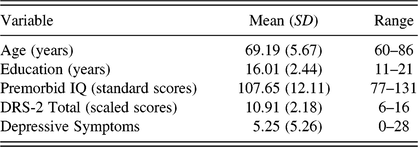
Three participants were excluded from analyses: one due to colorblindness that became apparent during testing, one due to being an extreme outlier (i.e., more than 4 standard deviations above the sample mean) on burden of expressive suppression, and one due to severely impaired performance on the EF measures and an inability to follow instructions. This resulted in a final sample of N = 107. Participants were primarily women (66.4%) and identified as Caucasian (93.5%). Basic demographic and cognitive characteristics of the sample are presented in Table 1.
Characteristics of the sample

N = 107. SD, standard deviation; Premorbid IQ, age-corrected standard scores on the Test of Premorbid Functioning (Mean = 100, SD = 15); DRS-2 Total, age-corrected scaled scores on the Dementia Rating Scale, 2nd edition (Mean = 10, SD = 3); Depressive Symptoms, Geriatric Depression Scale total raw scores.
For this sample, multiple imputation method (5 datasets) was used so that participants with some instances of missing data could be included in the analyses (one expressive suppression question missing, n = 1; all expressive suppression questions missing, n = 1; one IADL task missing due to experimenter error, n = 1). The minimum relative efficiency across all analyses was .995, suggesting that the procedure did an adequate job recovering information contained within the missing data. Of note, the results remained virtually unchanged using a listwise deletion approach.
Procedure and Instruments
The study was approved by the University of Utah Institutional Review Board and completed in accordance with the Helsinki Declaration. All participants signed an informed consent document prior to the start of testing. Participants completed measures to assess burden of expressive suppression, depressive symptoms, premorbid IQ, IADL tasks, general cognitive status, and EF (in that order).
Characterizing the sample
To characterize the level of intellectual functioning, general cognitive status, and depressive symptoms, participants completed the Test of Premorbid Functioning (Pearson, 2009), the Dementia Rating Scale 2nd edition (DRS-2; Jurica et al., Reference Jurica, Leitten and Mattis2001), and the Geriatric Depression Scale (GDS; Yesavage et al., Reference Yesavage, Brink, Rose, Lum, Huang, Adey and Leirer1982).
Instrumental activities of daily living
IADL were assessed using the Timed Instrumental Activities of Daily Living Scale (TIADL; Owsley et al., Reference Owsley, Sloane, McGwin and Ball2002). The TIADL is comprised of a series of common daily tasks including finding a telephone number, making change, reading the ingredients on a can of food, finding food items on a shelf, and reading instructions on a medicine container. Participants were informed that they would be timed and instructed to remain as focused as possible on each task; speed and accuracy were recorded. Overall performance accuracy was reflected in the total number of errors across all tasks. Overall performance speed was computed by creating the mean of the Z scores for each of the TIADL items, following procedures used by the test developers (Owsley et al., Reference Owsley, Sloane, McGwin and Ball2002). This was done to place all test items on the same metric (i.e., individual items vary in the amount of time needed for completion). While performance speed reflects the efficiency of task completion, accuracy reflects the risk for functional lapses (i.e., the potential to make mistakes while performing daily tasks). Both efficiency and accuracy were used as variables in analyses.
Burden of expressive suppression
To measure expressive suppression use as it occurs in daily life, we administered the Burden of State Emotion Regulation Questionnaire (B-SERQ; Franchow & Suchy, Reference Franchow and Suchy2015; Niermeyer et al., Reference Niermeyer, Franchow and Suchy2016, Reference Niermeyer, Ziemnik, Franchow, Barron and Suchy2019). Participants were instructed to rate 14 items that queried about the frequency of their use of expressive suppression over (a) the past two weeks (excluding the 24 hr prior to testing) and (b) the 24 hr prior to and excluding the testing session. The 24-hr and 2-week time frames distinguish between the acute, or state, effects of suppression and the effect of more chronic or habitual reliance on suppression. While acute suppression has a distinct depleting effect on EF (Franchow & Suchy, Reference Franchow and Suchy2015; Schmeichel, Reference Schmeichel2007), chronic suppression is positively associated with depression and psychomotor slowing (Brans et al., Reference Brans, Koval, Verduyn, Lim and Kuppens2013; Franchow & Suchy, Reference Franchow and Suchy2015; Niermeyer et al., Reference Niermeyer, Ziemnik, Franchow, Barron and Suchy2019), as well as adverse long-term emotional and physical health outcomes (Aldao et al., Reference Aldao, Nolen-Hoeksema and Schweizer2010; Denollet et al., Reference Denollet, Vrints, Conraads and Gidron2008). Items were rated using a 5-point scale: never (0), once or twice (1), sometimes (2), often (3), or all the time (4). The key ways in which the B-SERQ differs from other existing self-report measures of emotion regulation, such as the Emotion Regulation Questionnaire (ERQ; Gross & John, Reference Gross and John2003), is that the ERQ and other similar measures focus on stable, trait-like tendencies and preferences, whereas the B-SERQ assesses the degree to which a person experiences expressive suppression as burdensome, both in an acute timeframe (24 hr) and more chronically (2 weeks). Two expressive suppression composite scores were created, one for each time period: expressive suppression over 2 weeks (ES-2wk) and expressive suppression over the past 24 hr (ES-24hr). For the individual items, see online supplementary materials.
Previous studies with younger (Franchow & Suchy, Reference Franchow and Suchy2015; Niermeyer et al., Reference Niermeyer, Franchow and Suchy2016) and older (Niermeyer et al., Reference Niermeyer, Ziemnik, Franchow, Barron and Suchy2019) adults demonstrated that greater burden of expressive suppression was associated with poorer EF, primarily for the acute 24-hr time frame. Such associations existed above and beyond depressive symptoms, demonstrating that the construct measured by the B-SERQ is not synonymous with depression. Importantly, in prior research (Franchow & Suchy, Reference Franchow and Suchy2015) participants rated their 24-hr B-SERQ as being somewhat atypical for them, demonstrating that the 24-hr B-SERQ is tapping into acute emotion regulation states, rather than preferred trait. In the present sample, the measure evidences excellent internal consistency (ES-2wk Cronbach’s alpha = .852 and Expressive Supression-24hr = .816).
Executive functioning
EF was assessed using the Behavioral Dyscontrol Scale (BDS; Grigsby et al., Reference Grigsby, Kaye and Robbins1992). The BDS consists of motor and cognitive regulation tasks, including go/no-go, motor sequencing, and alphanumeric sequencing, as well as the examinee’s awareness of their performance accuracy (i.e., asking examinees for an estimate of number of errors on each trial). The BDS has been shown to relate positively to performance on traditional EF measures (Kraybill & Suchy, Reference Kraybill and Suchy2011; Kraybill et al., Reference Kraybill, Thorgusen and Suchy2013) and predicts functional ability in both healthy and neurologically compromised older adult populations (Grigsby et al., Reference Grigsby, Kaye, Baxter, Shetterly and Hamman1998, Reference Grigsby, Kaye, Eilertsen and Kramer2000; Suchy et al., Reference Suchy, Blint and Osmon1997). It takes about 10 min to administer. A research scoring system was used, such that each of the nine tasks was assigned a score of 0 to 3 based on number of errors and time to complete. The total raw score was used in analyses.
Analytic Plan
First, we conducted zero-order correlations among dependent and independent variables and potential covariates to determine which variables represent potential confounds and should be used as covariates. Next, we conducted two general linear regressions using TIADL-time and TIADL-errors as the dependent variables, potential confounds (per zero-order correlations) as covariates, and the two expressive suppression variables (24 hr and 2 weeks) as predictors. Lastly, we used the PROCESS approach to examine the following mediation and moderation models based on the literature reviewed in the introduction.
For mediation, we hypothesized that any observed associations between TIADL performance and expressive suppression would be mediated by EF; in other words, we expected that expressive suppression would have a deleterious impact on EF, which in turn would result in a deleterious impact on TIADL performance. For moderation, we hypothesized that the association between expressive suppression and TIADL performance would be stronger for individuals with poorer EF.
RESULTS
Preliminary Analyses
Zero-order correlations
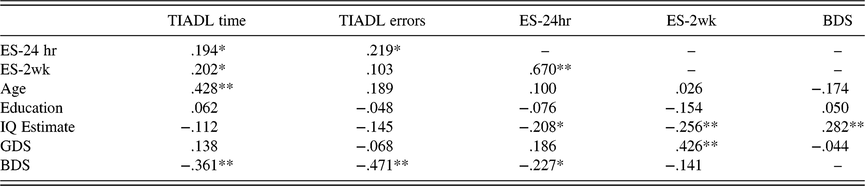
Table 2 presents zero-order correlations among dependent and independent variables and the sample characteristics. As expected, TIADL, expressive suppression, and EF were all related. See Table 2 for individual coefficients.
Zero-order correlations among dependent and independent variables and sample characteristics

N = 107; p < .05; p < .01.
ES-24hr, expressive suppression burden over the past 24 hr excluding the testing session; ES-2wk, expressive suppression burden over the past two weeks, excluding the day of testing; IQ Estimate, Test of Premorbid Functioning (Mean = 100, SD = 15); GDS, Geriatric Depression Scale scores; BDS, Behavioral Dyscontrol Scale (higher scores reflect better EF).
Principal Analyses
TIADL and expressive suppression
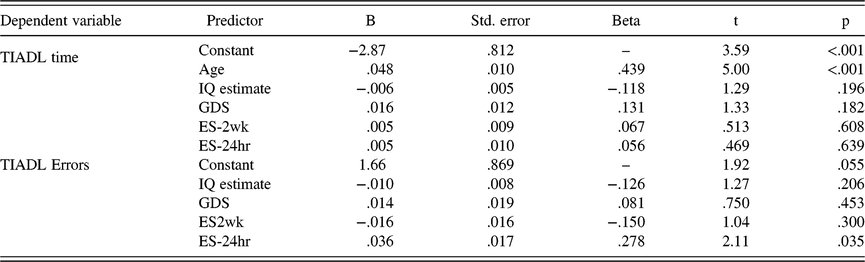
To test the hypothesis that higher self-reported burden of expressive suppression prior to testing would be associated with poorer TIADL performance, we conducted two general linear regressions with TIADL time and TIADL errors as the dependent variables and expressive suppression variables as predictors. Additionally, in both analyses, we adjusted for estimated IQ and depressive symptoms, since these variables were significantly associated with expressive suppression (Table 2); in the analysis that used the speed of TIADL performance as the dependent variable, we also adjusted for age, due to the significant association between age and performance speed (Table 2).
As seen in Table 3, TIADL errorsFootnote 1 were predicted by ES-24hr above and beyond chronic expressive suppression, as well as beyond IQ and depressive symptoms [full model F(4, 102) = 1.92, p = .114, R 2 = .070, adjusted R 2 = .033, R 2 change for ES-24hr = .042]. In contrast, TIADL time was only related to age, with no relationship to either of the two expressive suppression variables [full model F(5, 101) = 6.52, p < .001, R 2 = .494, adjusted R 2 = .244].
General linear regression predicting TIADL variables by self-reported expressive suppression burden, adjusting for relevant covariates

N = 107; TIADL, Timed Instrumental Activities of Daily Living; ES-2wk, expressive suppression burden over the past two weeks, excluding the day of testing; ES-24hr, expressive suppression burden over the past 24 hr excluding the testing session. Interaction refers to the interaction term between ES-2wk and ES-24hr. Higher ES scores indicate higher burden of self-reported expressive suppression and poorer TIADL performance.
EF as a mediator
Next, to determine whether the association between TIADL errors and ES-24hr was mediated by EF, we conducted a mediation analysis using the PROCESS approach (Hayes, Reference Hayes2017), with TIADL errors as the dependent variable, IQ estimate and GDS as covariates, ES-24hr as the focal predictor, and BDS as the mediator. The results showed that the general linear regression (with all predictors) was significant [F(4, 102) = 7.87, p < .001, R 2 = .240], and that BDS emerged as the only significant predictor of TIADL errors (B = −.125,p < .001; poorer BDS performance was associated with more TIADL errors), suggesting that BDS accounted for the variance that was shared between TIADL errors and ES-24hr in our previous analysis (see Table 3). However, a formal test of mediation using a bootstrapping approach from 5000 samples showed that the indirect effect of ES-24hr through BDS on TIADL errors was not statistically significant (i.e., zero was included in the confidence interval; 95% CI[−.003, .029]), suggesting that true mediation is not supported.
EF as a moderator
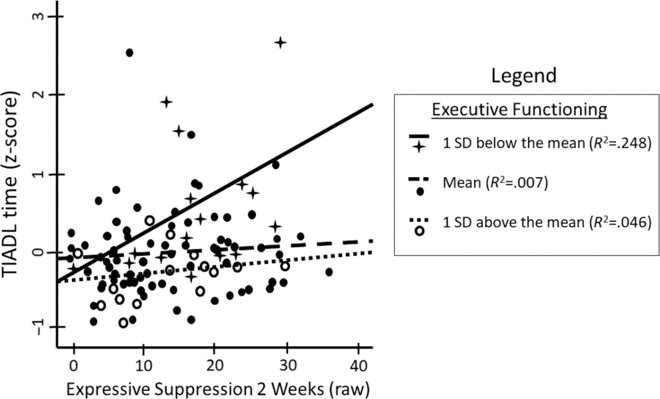
Next, to determine whether EF moderates the associations between TIADL and expressive suppression, we conducted four moderation analyses again using the PROCESS approach (Hayes, Reference Hayes2017). Specifically, we examined whether EF was a significant moderator of the positive association between TADL errors and the two expressive suppression variables (each examined separately) and between TIADL time and the two expressive suppression variables (again examined separately). Consistent with all previous analyses, IQ estimate and GDS were included as covariates for TIADL errors, and age, IQ estimate, and GDS were included as covariates for TIADL time. The results showed that the moderating effect of BDS was present only for the association between ES-2wk and TIADL time [F(6, 100) = 8.43, p < .001, R 2 = .336]. Specifically, this analysis showed that the association between ES-2wk and TIADL time became stronger as EF scores decreased (B = −.004, p = .027).
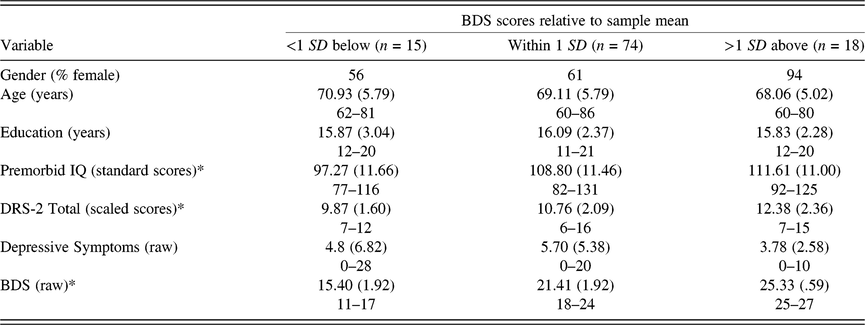
Simple slope analyses centering EF 1 SD below the mean, at the mean, and 1 SD above the mean revealed that ES-2wk was significantly positively associated with TIADL time only for individuals with low EF (i.e., 1 SD or more below the sample mean). For these individuals, chronic expressive suppression accounted for nearly 25% of variance in TIADL speed. See Figure 1 for the graphical illustration of the moderation effect. See Table 4 for cognitive and demographic characteristics of the sample when divided by BDS performance.
General linear regression lines showing the association between expressive suppression over the past two weeks and performance speed on the Timed Instrumental Activities of Living (TIADL) task for three groups of participants divided based on their performance on the Behavioral Dyscontrol Scale (BDS), which is a measure of executive functioning. Participants are divided into those within 1 SD of the sample mean and more than 1 SD above and below the mean. As seen, expressive suppression has a significant positive relationship to TIADL speed only for participants with the poorest BDS scores. Higher scores on the BDS reflect better performance. Higher Z scores on the TIADL reflect slower (less efficient) performance. Higher expressive suppression scores reflect greater suppression burden over the past two weeks, excluding the day of testing.

Demographic and cognitive characteristics of groups with high, middle, and low EF

N = 107.
BDS, Behavioral Dyscontrol Scale (higher scores reflect better EF, possible score range, 0–27); Premorbid IQ, age-corrected standard scores on the Test of Premorbid Functioning (Mean = 100, SD = 15); DRS-2 Total, age-corrected scaled scores on the Dementia Rating Scale, 2nd edition (Mean = 10, SD = 3); Depressive Symptoms, Geriatric Depression Scale total raw scores.
* groups differ, Analysis of Variance; all F values >6.0, all p values < .005.
DISCUSSION
The present study examined the association between the perceived burden of expressive suppression (both acute and chronic) and performance on a measure of IADL in a sample of community-dwelling older adults. The key findings from this study are that (a) high chronic expressive suppression was related to slow IADL performance beyond covariates (age, IQ, depression), but only for individuals with low EF and (b) high acute expressive suppression was associated with lower accuracy on IADL tasks beyond covariates (IQ, depression), but this association was fully explained [though not mediated] by EF. These findings demonstrate that expressive suppression burden may have an adverse impact on daily functioning of older adults, manifested in functional lapses (errors) during periods of acute suppression burden, as well as a decrease in efficiency (for those with low EF) when suppression burden is more chronic.
Theoretical Implications
The current findings suggest that acute expressive suppression burden is associated with more error-prone IADL performance. The association between acute self-reported expressive suppression burden (ES-24hr) and IADL errors held even when accounting for chronic emotion regulation burden (ES-2wk); in contrast, the positive zero-order association between expressive suppression and IADL speed was not unique to either the acute or the chronic expressive suppression beyond each other or beyond covariates. In addition, the relationship between IADL errors and the acute burden of expressive suppression was fully accounted for by EF, which suggests that EF may be the mechanism underlying this association. This interpretation is consistent with the known connection between EF and IADL performance in older adults (Grigsby et al., Reference Grigsby, Kaye, Baxter, Shetterly and Hamman1998; Hart & Bean, Reference Hart and Bean2011; Kraybill et al., Reference Kraybill, Thorgusen and Suchy2013; Puente et al., Reference Puente, Lindbergh and Miller2015; Rog et al., Reference Rog, Park, Harvey, Huang, Mackin and Farias2014), such that factors impacting EF will in turn place older adults at risk for functional mistakes. However, a formal test of mediation was not statistically reliable, suggesting that more work is needed to help explain the above relationships.
The finding that acute expressive suppression burden accounted for variance in IADL errors beyond chronic expressive suppression burden is consistent with prior findings, showing that EF is particularly prone to state-level (i.e., intra individual) fluctuations (for a review, see Suchy, Reference Suchy2015, pp. 146–150). In other words, this result suggests that it is the increase in suppression above the person’s more typical baseline that is primarily responsible for the impact on EF and on IADL. The novel finding that greater burden of expressive suppression is related to poorer IADL performance suggests that acute factors thought to tax EF may lead to lapses in daily functioning. The notion that situational factors may increase the risk for intermittent lapses has important public health ramifications, as even a single lapse, such as a medication error, can have considerable consequences for older adults’ health and wellbeing (Field et al., Reference Field, Gurwitz, Harrold, Rothschild, DeBellis, Seger, Auger, Garber, Cadoret, Fish, Garber, Kelleher and Bates2004; Sokol et al., Reference Sokol, McGuigan, Verbrugge and Epstein2005).
As seen in Table 2, acute, but not chronic, expressive suppression burden was associated with EF. This is consistent with prior work showing that acute expressive suppression burden consistently impacts higher-order processes (such as EF), whereas chronic expressive suppression burden impacts lower-order processes (such as processing speed) among both younger (Franchow & Suchy, Reference Franchow and Suchy2015) and older adults (Niermeyer et al., Reference Niermeyer, Ziemnik, Franchow, Barron and Suchy2019). Similarly then, in the present study, elevations in chronic expressive suppression burden were related to slower, but not more error-prone, IADL performance. The association between chronic expressive suppression burden and performance speed is also consistent with research showing that chronic expressive suppression is associated with an increased risk of depression (Brans et al., Reference Brans, Koval, Verduyn, Lim and Kuppens2013; Gross, Reference Gross1998; Gross & Levenson, Reference Gross and Levenson1993) and increased cardiovascular burden (Chapman et al., Reference Chapman, Fiscella, Kawachi, Duberstein and Muennig2013; Denollet et al., Reference Denollet, Vrints, Conraads and Gidron2010), both of which are associated with reduced processing/psychomotor speed. As such, neurobiological changes associated with depression and vascular health represent two possible mechanisms that may underlie the connection between chronic expressive suppression use and reduced speed.
Of note, although we have found a significant relationship between depressive symptoms (i.e., the GDS) and ES-2wk in the current sample (Table 2), individuals with low EF and high chronic expressive suppression exhibited a decreased TIADL speed beyond depressive symptoms. However, samples with a wider range of depressive symptomology and disease burden are needed to test these mechanistic possibilities more directly (Niermeyer et al., Reference Niermeyer, Ziemnik, Franchow, Barron and Suchy2019). Future studies examining the mechanisms underlying the connection between higher chronic expressive suppression and reduced speed should also consider that transient factors associated with chronic physical and mental health conditions (e.g., blood glucose level in diabetes) may be associated with state-level fluctuations in cognition.
Importantly, the association between expressive suppression burden and the speed/efficiency of TIADL performance was limited to individuals with low EF. Ignoring the interaction between contextual factors and EF when looking at the relationship between EF and functional outcomes may in part be why EF tests have been criticized for having poor ecological validity (Burgess et al., Reference Burgess, Alderman, Forbes, Costello, Coates, Dawson, Anderson, Gilbert, Dumontheil and Channon2006). Future research should also test whether similar moderation effects of EF exist between IADL performance and other executively taxing contextual factors, such as sleep disturbance (for a review, see Holanda & de Almondes, Reference Holanda and de Almondes2016) and pain (for a review, see Berryman et al., Reference Berryman, Stanton, Bowering, Tabor, McFarlane and Moseley2014). Considering interactions between these factors and EF is likely to clarify for whom and under what circumstances EF is related to functional outcomes.
Potential Implications for Clinical Practice
Mental health practitioners who work with older adults might consider educating their patients about the cognitive and functional risks of expressive suppression, and introduce alternative coping strategies (e.g., cognitive reappraisal) that are more effective at reducing negative emotion, and without known downsides (for a review, see Gross, Reference Gross1998). It appears especially important to provide this information to patients who are reporting functional problems, or who demonstrate objective evidence of weak EF on cognitive testing. Clinicians can further identify patients who are the prime targets for intervention by regularly inquiring about risk factors that may fluctuate over the course of treatment (e.g., emotion regulation strategies, sleep, and pain).
The present findings are consistent with the Contextually Valid Executive Assessment (ConVExA) model (Suchy, Reference Suchy2015, pp. 158–159), which posits that the association between EF and functional outcomes is moderated by contextual factors. As future research increases our understanding of how contextual factors, such as expressive suppression, influence EF and day-to-day functioning, clinicians may eventually be able to account for how contextual factors might be influencing their patients’ (a) EF performance on the day of a cognitive assessment and (b) functional abilities in day-to-day life. Generating a “depletion risk score” (Suchy, Reference Suchy2011, p. 251; Reference Suchy2015, p. 158) could increase the accuracy of results of cognitive testing and improve the recommendations given to a patient. The accuracy of a depletion risk score will be determined by the correct inclusion and weighting of various contextual factors (e.g., acute expressive suppression, pain, and sleep). It is possible that such contextual factors could interact with one another and with variables that are chronic or trait-like (e.g., chronic physical or mental health conditions). Future research is necessary to develop a system for calculating a depletion risk score.
Limitations
The current paper has a number of limitations. First, the sample consists of highly educated older adults where Caucasian women are overly represented. Replication with more diverse samples is needed to understand the generalizability of the current findings. Furthermore, causal conclusions cannot be drawn from correlational designs. Thus, it is not clear whether increased expressive suppression causes reduced TIADL and EF performance; nevertheless, a causal interpretation is supported by research showing that experimentally manipulated expressive suppression leads to lower performance on subsequent EF tests (Fischer et al., Reference Fischer, Kastenmüller and Asal2012; Franchow & Suchy, Reference Franchow and Suchy2017; Schmeichel, Reference Schmeichel2007). However, bidirectional relationships among these abilities and functional outcomes are also likely and should be examined in future research; for example, while expressive suppression taxes EF, stronger executive abilities inform both the choice and the effectiveness of emotion regulation efforts.
Additionally, while lab-based measures of IADL performance such as the TIADL test are commonly used, the face validity of these measures does not guarantee ecological validity. It is recommended that the connection between functional outcomes and expressive suppression be tested with other methodologies that more directly assess actual daily functioning. For example, future research may wish to measure changes in expressive suppression and/or other contextual factors like sleep disturbance and pain over time using a daily diary or ecological momentary assessment (Shiffman et al., Reference Shiffman, Stone and Hufford2008). Such studies could then examine relationships between fluctuations in contextual factors with real functional lapses, such as medication management mistakes observed with an electronic monitoring system.
While questionnaires are a common method for measuring expressive suppression (Garnefski et al., Reference Garnefski, Kraaij and Spinhoven2001; Gratz & Roemer, Reference Gratz and Roemer2004; Kamholz et al., Reference Kamholz, Hayes, Carver, Gulliver and Perlman2006) and the B-SERQ has demonstrated good construct validity and internal consistency (Franchow & Suchy, Reference Franchow and Suchy2015; Niermeyer et al., Reference Niermeyer, Franchow and Suchy2016, Reference Niermeyer, Ziemnik, Franchow, Barron and Suchy2019), we recognize the inherent limitations of the self-report method. Well-established biases in participants’ self-report include perceived demand characteristics, concern for social desirability, and variable motivation and/or perceived salience of questionnaire content. Participants may also have imperfect memory for events relevant to the questions or interpret item content in various ways, which is particularly relevant for emotionally salient situations (Richards & Gross, Reference Richards and Gross2000). Retrospective self-report also does not allow us to observe and measure the relative success of participants’ efforts to suppress, though the depleting effect of suppression on EF is demonstrated in the current study and past studies regardless of the actual success of suppression efforts. Despite these limitations, self-report remains the only practical method of measuring participants’ perceived burden of expressive suppression in daily life.
The current findings come from a shared sample where we have previously demonstrated a connection between self-reported expressive suppression 24 hr prior to testing and EF as measured by the Delis-Kaplan Executive Function System (D-KEFS) (Niermeyer et al., Reference Niermeyer, Ziemnik, Franchow, Barron and Suchy2019). Reassuringly, the current study used cognitive outcome variables not previously studied in the work on expressive suppression (e.g., the BDS as a measure of EF and TIADL performance), and our lab has recently replicated the link between self-reported expressive suppression and EF performance in yet another sample of older adults (Niermeyer et al., Reference Niermeyer, Roth, Gibbs, Ray and Suchy2019, February). Nevertheless, additional replication of the current findings in unique samples is needed. Finally, not all of the current results would remain significant if strict multiple comparison corrections were used, which again stresses the need for replication to guard against the possibility of Type I error.
ACKNOWLEDGEMENTS
The study was funded by a University of Utah Department of Psychology Student Research Grant that was awarded to Emilie Franchow. The authors are grateful to the members of the Executive Lab who assisted with data collection.
CONFLICTS OF INTEREST
The authors have nothing to disclose.
SUPPLEMENTARY MATERIALS
To view supplementary material for this article, please visit https://doi.org/10.1017/S1355617719000328