Introduction
Family businesses have special characteristics due to their distinctive blend of business objectivity with familial intimacy (Tagiuri & Davis, Reference Tagiuri and Davis1996; Astrachan, Klein, & Smyrnios, Reference Astrachan, Klein and Smyrnios2002; Zellweger, Eddleston, & Kellermann, Reference Zellweger, Eddleston and Kellermann2010; Sanchez-Famoso, Maseda, & Iturralde, Reference Sanchez-Famoso, Maseda and Iturralde2017). This confluence of the family’s social system with business necessities results in complex social dynamics (Dyer, Reference Dyer2003; Nordqvist, Hall, & Melin, Reference Nordqvist, Hall and Melin2009). Hence, family business research can benefit from qualitative assessments that account for the complex dynamics between family and business (Fletcher, De Massis, & Nordqvist, Reference Fletcher, De Massis and Nordqvist2016; Hamilton, Cruz, & Jack, Reference Hamilton, Cruz and Jack2017).
This paper outlines the use of a novel qualitative approach for the field of family business research: the integrated use of two qualitative methods, namely narrative analysis and Q-method. Narrative analysis is well established in family business research for exploring social dynamics and complexities; it is primarily useful for generating in-depth, contextualized findings (Dawson & Hjorth, Reference Dawson and Hjorth2012). Q-method, which applies statistical analysis to qualitative methods, is used for studying human subjectivity in terms of attitudes or feelings (Ellingsen, Størksen, & Stephens, Reference Ellingsen, Størksen and Stephens2010; Dziopa & Ahern, Reference Dziopa and Ahern2011) and represents a fresh approach to family business research. Hence, this paper focuses on illustrating the benefits of this hybrid approach for analyzing the complexity of family businesses, mainly by assessing CEOs’ value orientations.
Analyzing values is methodologically beneficial for two reasons. Defined as ‘desirable trans-situational goals, varying in importance, that serve as guiding principles in the life of a person or other social entity’ (Schwartz, Reference Schwartz1994: 21), values influence emotional and cognitive processes that ultimately shape attitudes and behavior (Kluckhohn, Reference Kluckhohn1951; Rokeach, Reference Rokeach1973). As a result, organizational research is highly interested in analyzing values as management instruments (Meglino & Ravlin, Reference Meglino and Ravlin1998; Stackman, Pinder, & Connor, Reference Stackman, Pinder and Connor2000; Schein, Reference Schein2010; Sackmann, Reference Sackmann2011; Avolio, Sosik, Kahai, & Baker, Reference Avolio, Sosik, Kahai and Baker2014). However, extracting values effectively remains a challenging task: organizational researchers have designed numerous surveys to measure values (Ashkanasy, Broadfood, & Falkus, Reference Ashkanasy, Broadfood and Falkus2000; Sackmann, Reference Sackmann2011; Denison, Nieminen, & Kotrba, Reference Denison, Nieminen and Kotrba2014), but these do not allow participants to reflect on the meanings attributed to values (Rousseau, Reference Rousseau1990; Schein, Reference Schein2010). Thus responses may be subject to different interpretations. Furthermore, the subjective quality of values can produce biases in terms of social desirability or acquiescence (Paulhus, Reference Paulhus1991; Patton, Reference Patton2005). These challenges are especially relevant for family firms, where assessments need to be sensitive to the unique interaction between business and family that shapes value orientations (Fletcher, Melin, & Gimeno, Reference Fletcher, Melin and Gimeno2012; Fletcher, De Massis, & Nordqvist, Reference Fletcher, De Massis and Nordqvist2016; Vaara, Sonenshein, & Boje, Reference Vaara, Sonenshein and Boje2016).
For family firms, values provide a competitive advantage by acting as a kind of behavioral ‘compass’ for organizational members that fosters a common identity and purpose (Koiranen, Reference Koiranen2002; Parada & Viladás, Reference Parada and Viladás2010; Schein, Reference Schein2010; Denison, Nieminen, & Kotrba, Reference Denison, Nieminen and Kotrba2014). For all organizations, such values provide continuity to organizational practices and entrepreneurial decisions, but in family firms, they also serve as a cipher and guide for family patterns and logics (Fletcher, Melin, & Gimeno, Reference Fletcher, Melin and Gimeno2012). In other words, values are related to two interwoven systems in a family firm – the family itself and the business – and thus have substantial organizational impact. For this reason, research on family businesses must go beyond traditional organizational value research and instead consider the complexities and contextual factors that are unique to these firms (Simon, Marquès, Bikfalvi, & Muñoz, Reference Simon, Marquès, Bikfalvi and Muñoz2012; Sorenson, Reference Sorenson2014).
In such firms, familial experiences often give rise to value orientations that family members then transfer to their business (Duh, Belak, & Milfelner, Reference Duh, Belak and Milfelner2010; Sorenson, Reference Sorenson2013; Zwack, Kraiczy, von Schlippe, & Hack, Reference Zwack, Kraiczy, von Schlippe and Hack2016). Family values are often conveyed via traditions and stories about a family member’s particular achievements, which then provide a deep and longstanding anchor for family identity. The value orientations that arise from this shared family history and identity may influence the firm for generations as family members assume key positions and model value orientations (Parada & Dawson, Reference Parada and Dawson2017). In these roles, family members may focus more on the moral and social values of their business, in line with their family interactions (Koiranen, Reference Koiranen2002; Sorenson & Bierman, Reference Sorenson and Bierman2009; Payne, Brigham, Broberg, Moss, & Short, Reference Payne, Brigham, Broberg, Moss and Short2011). In this way, such values produce principles that encompass not only business goals but also stable, harmonious, and emotional relationships (Stewart, Reference Stewart2003; Vallejo, Reference Vallejo2008; Jiménez, Martos, & Jiménez, Reference Jiménez, Martos and Jiménez2015).
This research focuses particularly on family members acting as CEOs, given their function as role models and decision-makers (Sharma, Reference Sharma2004; Parada & Dawson, Reference Parada and Dawson2017). CEOs are essentially culture-bearers in family firms, embodying a family’s value concepts and translating them into organizational principles (Ling, Simsek, Lubatkin, & Veiga, Reference Ling, Simsek, Lubatkin and Veiga2008; Vallejo, Reference Vallejo2009; O’Reilly, Caldwell, Chatman, & Doerr, Reference O’Reilly, Caldwell, Chatman and Doerr2014). Since CEOs in family firms derive their value orientations from emotional experiences within the family, they employ those values in their role as business leader. Thus, analyzing CEOs’ values is a key to understanding how family experiences shape values and how the executive has attributed meaning to values.
Value research in family firms already provides some insights into how family influences the firm (Sorenson, Reference Sorenson2014), particularly in underscoring the interplay of the family and business social systems (Astrachan, Klein, & Smyrnios, Reference Astrachan, Klein and Smyrnios2002); however, there are still several questions unanswered. So far there has been little explicit research on how familial relations and experiences influence value orientations. It is also not clear how family experience – as a value-forming contextual factor – specifically affects the attributed meaning, interpretation, and importance of values (Simon et al., Reference Simon, Marquès, Bikfalvi and Muñoz2012; Sorenson, Reference Sorenson2013). Moreover, even though scholars agree about the organizational impact of values, the family business literature lacks an appropriate measurement approach that accounts for both relational and contextual details (Simon et al., Reference Simon, Marquès, Bikfalvi and Muñoz2012).
In light of this, this study combines the use of narrative analysis and Q-method to understand CEOs’ value orientations in family businesses.
This paper presents a novel approach to uncovering complex social phenomena in family business research – namely the combination of two methodological approaches for their distinct advantages. The first approach, Q-method, prioritizes values and creates value patterns; the second, narrative interviews, reconstructs family experiences and thereby reveals the context and interpretation of values. By merging these methods, this paper outfits the current literature with an innovative approach that can deliver nuance to qualitative family business research by considering complexities and contextual elements. In this way, a better understanding of how the family influences the firm is promoted (Simon et al., Reference Simon, Marquès, Bikfalvi and Muñoz2012; Sorenson, Reference Sorenson2014). This study also addresses recent calls for more in-depth qualitative studies and a combined use of qualitative methodological approaches (Reay & Zhang, Reference Reay and Zhang2014; Fletcher, De Massis, & Nordqvist, Reference Fletcher, De Massis and Nordqvist2016; Reilly & Jones, Reference Reilly and Jones2017).
The paper is organized as follows: first, the literature on family businesses is examined and the contributions and limitations of qualitative and narrative analysis are ascertained. Second, the advantages of integrating Q-method and narrative interviews are described. Third, an outline of this research study is offered. Finally, empirical findings are presented and discussed.
Literature Review
Achievements of qualitative methods in family business research
Researchers have recently called for an increased usage of qualitative methods in family business research (Nordqvist, Hall, & Melin, Reference Nordqvist, Hall and Melin2009; De Massis & Kotlar, Reference De Massis and Kotlar2014; Reilly & Jones, Reference Reilly and Jones2017). Qualitative methods have been established in other organizational and management research areas (Buchanan & Bryman, Reference Buchanan and Bryman2009; Bansal & Corley, Reference Bansal and Corley2011; Vaara, Sonenshein, & Boje, Reference Vaara, Sonenshein and Boje2016), but quantitative approaches continue to dominate the family business literature (Dawson & Hjorth, Reference Dawson and Hjorth2012; Reay & Zhang, Reference Reay and Zhang2014; Evert, Martin, McLeod, & Payne, Reference Evert, Martin, McLeod and Payne2016; Fletcher, De Massis, & Nordqvist, Reference Fletcher, De Massis and Nordqvist2016). Because qualitative methods uncover the subjective meaning of individual life experiences, they are better suited to capturing the complexity and dynamics of human relations and social interactions (Leitch, Hill, & Harrison, Reference Leitch, Hill and Harrison2010; Parada & Dawson, Reference Parada and Dawson2017). In the context of family businesses, qualitative methods can capture the individual, relational, and contextual aspects of research objects, thereby exposing the tensions, paradoxes, and dualities that arise from the interplay between business and family (Fletcher, De Massis, & Nordqvist, Reference Fletcher, De Massis and Nordqvist2016).
In family business studies, researchers have had to cope with specific social complexities that stem from the inherent interpersonal dynamics between the family and business systems (Debicki, Matherne, Kellermanns, & Chrisman, Reference Debicki, Matherne, Kellermanns and Chrisman2009; Reilly & Jones, Reference Reilly and Jones2017), the variety of individuals (Dawson & Hjorth, Reference Dawson and Hjorth2012), and the firms’ focus on nonfinancial goals (Berrone, Cruz, & Gomez-Mejia, Reference Berrone, Cruz and Gomez-Mejia2012; Zellweger, Nason, Nordqvist, & Brush, Reference Zellweger, Nason, Nordqvist and Brush2013). Qualitative approaches turn these issues into a focal point by reconstructing family businesses as highly complex social phenomena (Fletcher, De Massis, & Nordqvist, Reference Fletcher, De Massis and Nordqvist2016; Reilly & Jones, Reference Reilly and Jones2017).
Thus far, though, qualitative family business research has mainly emphasized individuals and the accompanying issues – for example, succession, the relationship to nonfamily managers, change management, and cultural issues, etc. (Fletcher, De Massis, & Nordqvist, Reference Fletcher, De Massis and Nordqvist2016). A review of most-cited recent qualitative articles highlights the prevalence of single and multiple case study designs, and the relative rarity of ethnographic fieldwork, grounded theory, or phenomenology (Reay & Zhang, Reference Reay and Zhang2014; Fletcher, De Massis, & Nordqvist, Reference Fletcher, De Massis and Nordqvist2016). Because they often compare different firms, multiple case study designs typically lack the in-depth understanding of the phenomena that is possible with a single case study (Reay & Zhang, Reference Reay and Zhang2014; Fletcher, De Massis, & Nordqvist, Reference Fletcher, De Massis and Nordqvist2016). This study focuses on a particular qualitative method that has demonstrated great utility for uncovering social realities: narrative analysis. This approach highlights individual, sense-making stories in order to probe multifaceted social constructs of family businesses (Dawson & Hjorth, Reference Dawson and Hjorth2012; Fletcher, De Massis, & Nordqvist, Reference Fletcher, De Massis and Nordqvist2016; Zwack et al., Reference Zwack, Kraiczy, von Schlippe and Hack2016). Instead of highlighting single outcomes, narratives emphasize the importance of events, contextual factors, and relational dynamics among the persons involved (Hjorth & Dawson, Reference Hjorth and Dawson2016; Parada & Dawson, Reference Parada and Dawson2017). By connecting the relational and emotional aspects of a phenomenon to the broader social mechanisms at work, narratives effectively bring history to bear on the present (Dawson & Hjorth, Reference Dawson and Hjorth2012). Previous narrative studies of family businesses have focused on processes and relations (Dawson & Hjorth, Reference Dawson and Hjorth2012), entrepreneurship and innovation (Larty & Hamilton, Reference Larty and Hamilton2011; Jaskiewicz, Combs, & Rau, Reference Jaskiewicz, Combs and Rau2015; Kammerlander, Dessì, Bird, Floris, & Murru, Reference Kammerlander, Dessì, Bird, Floris and Murru2015), and the role that history plays in succession (e.g., Dalpiaz, Tracey, & Phillips, Reference Dalpiaz, Tracey and Phillips2014; Hjorth & Dawson, Reference Hjorth and Dawson2016). More recently, narrative research has tried to uncover the role of the family in members’ efforts to establish and manage the business entity (Randerson, Bettinelli, Fayolle, & Anderson, Reference Randerson, Bettinelli, Fayolle and Anderson2015; Hamilton, Cruz, & Jack, Reference Hamilton, Cruz and Jack2017). Current narrative studies on family have been closely linked with research on collective identities (Zellweger et al., Reference Zellweger, Nason, Nordqvist and Brush2013; Parada & Dawson, Reference Parada and Dawson2017) and values transmission (Parada & Viladás, Reference Parada and Viladás2010; Zwack et al., Reference Zwack, Kraiczy, von Schlippe and Hack2016).
In short, the literature illustrates the benefits of narrative analysis for family business research. Understanding a family’s history helps to align the family’s origin, identity, and continuity with the business’ decisions and behavior (Brown, Reference Brown2006; Fenton & Langley, Reference Fenton and Langley2011; Rowlinson, Casey, Hansen, & Mills, Reference Rowlinson, Casey, Hansen and Mills2014). Hence, narratives are able to position the family and its members at the heart of inquiry (Hamilton, Cruz, & Jack, Reference Hamilton, Cruz and Jack2017).
How research on values in family businesses benefits from narrative analysis
Values are one of the most complex phenomena in family business research: they represent the core of identity, influence individual behavior, and affect firm success (Meglino & Ravlin, Reference Meglino and Ravlin1998; Koiranen, Reference Koiranen2002; Parada & Viladás, Reference Parada and Viladás2010). Research on values in family businesses benefits from narrative analysis because sense-making of experiences uncovers how values are evolved and interpreted (Sarbin, Reference Sarbin1986; Riessman, Reference Riessman2008). Previous narrative research on values in this context has emphasized that narratives transmit (family) values trans-generationally to shape a common identity and ensure continuity (Parada & Viladás, Reference Parada and Viladás2010; Martin, Reference Martin2016). Narratives impart values via stories, myths, and legends that convey emotions, foster empathy, and provide orientation (Boyce, Reference Boyce1996). As a result, narratives become a crucial socialization mechanism for anchoring values in the family firm (Hytti, Alsos, Heinonen, & Ljunggren, Reference Hytti, Alsos, Heinonen and Ljunggren2017), as well as a manifestation of family members’ individual experiences (Parada & Viladás, Reference Parada and Viladás2010). Hence, narratives communicate values in a natural, comprehensible, memorable, and vivid manner that extends beyond business issues (Fiese & Spagnola, Reference Fiese and Spagnola2005; Roessl, Reference Roessl2005; Zwack et al., Reference Zwack, Kraiczy, von Schlippe and Hack2016). Therefore, narratives are well suited to transporting and translating implicit values within the duality of family and business (Zwack et al., Reference Zwack, Kraiczy, von Schlippe and Hack2016; Hamilton, Cruz, & Jack, Reference Hamilton, Cruz and Jack2017).
Methodological gaps
The literature has emphasized the benefits of in-depth qualitative approaches in family business research; however, there are still many unanswered questions, especially in terms of the character and complexity of family firms (Chrisman, Kellermanns, Chan, & Liano, Reference Chrisman, Kellermanns, Chan and Liano2010; Reay & Zhang, Reference Reay and Zhang2014; Fletcher, De Massis, & Nordqvist, Reference Fletcher, De Massis and Nordqvist2016). Part of this issue stems from the tendency toward aggregation: Specifically, qualitative studies (and most often, case studies) have often generalized the findings from individual-level studies to the firm level (De Massis & Kotlar, Reference De Massis and Kotlar2014; Fletcher, De Massis, & Nordqvist, Reference Fletcher, De Massis and Nordqvist2016). However, this approach neglects the heterogeneity and uniqueness of individual intentions, sense-making, and viewpoints (Sharma, Reference Sharma2004), and thereby causes insufficient consideration of complexity (Fletcher, De Massis, & Nordqvist, Reference Fletcher, De Massis and Nordqvist2016; Zwack et al., Reference Zwack, Kraiczy, von Schlippe and Hack2016).
Due to aggregation, the literature lacks an in-depth approach for understanding individual experiences and constructions of reality (Fletcher, De Massis, & Nordqvist, Reference Fletcher, De Massis and Nordqvist2016). Even though the complexity of family business research demands an integrated, mixed methodology to capture multifaceted phenomena, previous studies have made insufficient use of multiple data resources (Reilly & Jones, Reference Reilly and Jones2017); consequently, it remains unclear how contextual factors influence individual intentions and interpretations (Fletcher, De Massis, & Nordqvist, Reference Fletcher, De Massis and Nordqvist2016). Open-ended approaches, such as ethnographic work or interpretative designs, may be able to fill this gap better than structured methods (Reay & Zhang, Reference Reay and Zhang2014). Indeed, even for business research in general, there are more calls for developing a ‘hybrid approach’ that includes qualitative considerations such as informal interviews (Alam & Bhatti, Reference Alam and Bhatti2018). This approach can be useful for dealing with the ambiguity of perceiving and interpreting values, and by extension, mitigates the risk of misunderstanding the narrative (Zwack et al., Reference Zwack, Kraiczy, von Schlippe and Hack2016).
Moreover, previous qualitative studies are lacking transparency regarding their analytical steps and science-theoretical grounding (Fletcher, De Massis, & Nordqvist, Reference Fletcher, De Massis and Nordqvist2016).
Consequently, previous qualitative have tended to simplify the complexity of family firms. Open-ended approaches can alleviate this problem by allowing researchers to deeply explore the micro-processes of social dynamics (Reay & Zhang, Reference Reay and Zhang2014).
Forming an integrated perspective using narrative interviews and Q-method
To close the research gap mentioned by the five items above, this paper integrated narrative analysis with Q-method as a novel approach in family business research. Although narrative analysis is widely used in family business research, relevant studies using Q-method in family business research were not found in the literature review.
This paper addresses the scarcity of qualitative methods for exploring the complexity of values in family business research by presenting a novel analytical approach. By doing so, this approach responds to recent calls for methodological pluralism (Chamberlain, Cain, Sheridan, & Dupuis, Reference Chamberlain, Cain, Sheridan and Dupuis2011), which entails examining complex viewpoints in a more comprehensive manner (Castro, Kellison, Boyd, & Kopak, Reference Castro, Kellison, Boyd and Kopak2010; Creswell, Reference Creswell2010; Denzin, Reference Denzin2012; Reilly & Jones, Reference Reilly and Jones2017). Specifically, the study combines narrative interviews (Riessman, Reference Riessman2008; Bold, Reference Bold2011) with Q-method. Q-method is a rank-ordering procedure for evaluating characteristic patterns that occupy a space between qualitative and quantitative methods (Stephenson, Reference Stephenson1953; Shemmings, Reference Shemmings2006). Although narrative interviews enable contextualization and the exploration of interpretation schemes (Craig, Reference Craig2009; Vaara, Sonenshein, & Boje, Reference Vaara, Sonenshein and Boje2016), Q-method categorizes values and investigates different value patterns (Watts & Stenner, Reference Watts and Stenner2012).
Researchers’ interest in Q-method has grown enormously in recent years (Lazard, Capdevila, & Roberts, Reference Lazard, Capdevila and Roberts2011; Trafimow, Reference Trafimow2014; Eyvindson, Kangas, Hujala, & Leskinen, Reference Eyvindson, Kangas, Hujala and Leskinen2015; Ramlo, Reference Ramlo2016) as a response to the long-favored paradigm of statistical significance testing. Hence, Q-method research is increasingly used in social psychology and family research (Ellingsen, Størksen, & Stephens, Reference Ellingsen, Størksen and Stephens2010; Dziopa & Ahern, Reference Dziopa and Ahern2011). As a constructivist approach, Q-method investigates how and why people think the way they do, and identifies the similarities and differences of opinions or values (McKeown & Thomas, Reference McKeown and Thomas2013). As such, Q-method provides sharper insights into these viewpoints while building patterns based on individuals’ similarities (Steelman & Maguire, Reference Steelman and Maguire1999).
Responding to the limitations of previous qualitative work, this methodological approach makes several contributions to family business research. The approach offers a novel method to integrate and connect individuals’ past experiences and present evaluations. Narratives reconstruct past experiences within families and provide insight into how prior experiences are interpreted (Fletcher, De Massis, & Nordqvist, Reference Fletcher, De Massis and Nordqvist2016), whereas Q-method captures the present assessment of values (Stenner, Reference Stenner2009). The mixed methodology and use of triangulation lowers the risk of misinterpreting values. Moreover, the paper closes the gap of empathic understanding of individuals in family firms by strictly remaining on the individual level and contributing to a detailed understanding of individual sense-making. This means that the study not only analyzes individual experience but also reports on findings on individual instead of firm level. This approach differs from most qualitative studies using case study designs by building patterns between different individuals without focusing on firm level. In short, narratives provide insights into the evolution and interpretation of values (Dawson & Hjorth, Reference Dawson and Hjorth2012), whereas Q-method provides an ordered framework for comparing value patterns amidst their complexity (Stenner, Reference Stenner2009).
Therefore, this approach is in line with constructivist tradition, which maintains that subjective interpretation and contextualization are necessary to understand social phenomena (Leitch, Hill, & Harrison, Reference Leitch, Hill and Harrison2010). Instead of focusing on causal explanations based on objective facts, as the positivist tradition argues, this view sees participants’ experience as the heart of research (Cope, Reference Cope2005). Thus, this approach has mixed two methods that emphasize subjectivity: narratives reflect the inner working of individuals and provide insight into identity-building processes (Sarbin, Reference Sarbin1986; Cope, 2005; Kourti, Reference Kourti2016), whereas Q-method allows a sorter to order their subjective feelings and experiences (Stenner, Reference Stenner2009). Thus, both methods emphasize subjectivity. Finally, this integrated approach does not only involve the interpretative processes of participants but also of the researcher.
Methods
Based on the literature review on measuring values in family firms, two pilot interviews with former managing partners of two family firms in the logistics and transportation industry were conducted. These pilot interviews provided a basis for crafting the interview guide and modifying the statements for the Q-sort.
Sample and data collection
The sampling strategy followed purposive sampling (Onwuegbuzie & Collins, Reference Onwuegbuzie and Collins2007; Teddlie & Yu, Reference Teddlie and Yu2007) and chose family firms based on family influence, firm size, industry, and location. Following previous family business studies, family influence was defined in terms of family ownership and management (Chua, Chrisman, & Sharma, Reference Chua, Chrisman and Sharma1999; Zwack et al., Reference Zwack, Kraiczy, von Schlippe and Hack2016; Anglin, Reid, Short, Zachary, & Rutherford, Reference Anglin, Reid, Short, Zachary and Rutherford2017). Firms employing between 35 and 200 employees, where the family held more than 50% of firm shares and at least one family member served on the top management team were included.
Next, firm selection was accounted for the fact that values differ due to the influence of firm size (Gordon, Reference Gordon1991; Vallejo-Martos & Puentes-Poyatos, Reference Vallejo-Martos and Puentes-Poyatos2014), industries and regions (Chatman & Jehn, Reference Chatman and Jehn1994; Zwack et al., Reference Zwack, Kraiczy, von Schlippe and Hack2016), and social–cultural conditions (Dess, Ireland, & Hitt, Reference Dess, Ireland and Hitt1990). To reduce the influence of the firm’s environment, the sample was limited to the logistics and transportation industry in northern Germany, as family-run businesses are dominant in this field. To reduce the influence of the firm’s industry and environment, industry-specific and environmental influences were also limited. Moreover, this sampling aligns with Q-method designs that do not require large numbers of participants (Dziopa & Ahern, Reference Dziopa and Ahern2011), as the main interest is in discerning a participant group’s subjective viewpoints rather than establishing causality or generalizability (Ellingsen, Størksen, & Stephens, Reference Ellingsen, Størksen and Stephens2010; Watts & Stenner, Reference Watts and Stenner2012). Furthermore, the sampling followed the common purposive sampling practice used in mixed methods studies, which typically include samples with fewer than 30 cases (Onwuegbuzie & Collins, Reference Onwuegbuzie and Collins2007; Teddlie & Yu, 2007). To find family firms meeting the outlined criteria, the business database Hoppenstedt was used.
The selection of participants focused on top managers currently managing a family firm, and not solely on company owners, because managers whose values influence the firm on a daily basis should be included. Previous literature has identified the crucial role of top managers in determining the organizational culture and values of family firms (Sharma, Reference Sharma2004; Eddleston, Reference Eddleston2008; Schein, Reference Schein2010; Zwack et al., Reference Zwack, Kraiczy, von Schlippe and Hack2016). Potential participants were contacted by mail and telephone. Ultimately, 16 participants took part in the narrative interviews and the Q-sorting process. All participants were members of the top management board and represented different age groups: Four participants were younger than 35 years, six participants were between 35 and 49 years, and six participants were 50 years or older. Participants’ tenure with the company varied from 8 months to 41 years. One-half of the participants had completed vocational training, whereas the other half held a university degree.
Data collection occurred between September 2014 and July 2015 at each participant’s headquarters.
Narrative interviews
First, in-depth face-to-face interviews with the CEOs to better understand their value preferences were conducted. These interviews focused on family tradition to understand the antecedents of their values, as well as the takeover story, which represents an important autobiographical event. Autobiographical events importantly convey values and influence cultural role modeling (Dailey & Browning, Reference Dailey and Browning2014), and hence they are widely used in narrative studies in family business research (Dawson & Hjorth, Reference Dawson and Hjorth2012).
In line with researchers who argue for using mixed forms (Murray, Reference Murray2003; Hennink, Hutter, & Bailey, Reference Hennink, Hutter and Bailey2010), a modified form of an origin narrative interview was employed. In particular, the interview guide featured open questions, but structured the interview according to different interview topics. The interview guide contained two topics that addressed CEOs’ founding/takeover story and their family tradition. Each interview started with an open question about the founding/takeover story: ‘Can you tell me the story about your founding/takeover of the firm? What has been especially important for you?’ This initial question served as an anchoring point for the narrative interview, triggering a narration about interviewees’ value preferences and points-of-view. The researcher also asked about the existence of family tradition(s) to elicit important values in family and gain insights in the attributed meaning: ‘Please tell me about practices within your family that influenced you? Which traditions exist?’
The interviews lasted one hour, were audio-recorded, and fully transcribed. Narrative interviews were analyzed via thematic narrative analysis to identify main themes in participants’ stories, as the interest was in the content (‘what is said’) rather than the structure (‘how it is said’) of stories (Czarniawska, Reference Czarniawska2004; Riessman, Reference Riessman2008; Bold, Reference Bold2011).
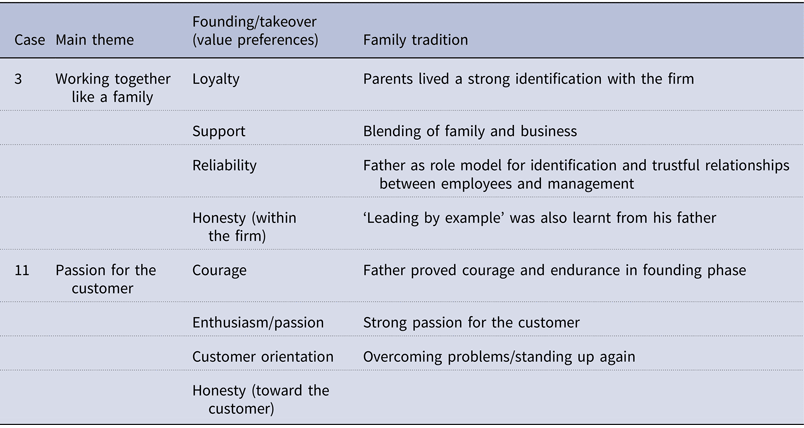
Each case was analyzed separately to preserve the integrity and sequencing of each narrative. The thematic narrative analysis followed two analytical steps: First, analysis focused on what was said regarding the firm takeover, which provided information about what was important for each CEO (Dawson & Hjorth, Reference Dawson and Hjorth2012). Second, these themes were screened for expressed values and value codes were derived from the themes (Saldana, Reference Saldana2015). These value preferences referred to actual words from the narrators. This analytical presentation allowed to discover variation across cases (narrators). These two analytical steps were repeated to analyze the narratives about family tradition. Finally, a table representing the findings for both exemplary narratives was constructed (Table 4).
Q-study
After the interview, each interviewee participated in the Q-study. Q-method was used to structure the data because of its ability to construct types of viewpoints, attitudes, and preferences, as well as to discern patterns and configurations (Watts & Stenner, Reference Watts and Stenner2005).
Beginning a Q-study requires first defining the Q-set, which is a collection of Q-statements that represent the sum of different opinions on a topic (Bartlett & DeWeese, Reference Bartlett and DeWeese2015). The final Q-set consisted of 52 statements, meeting the criteria that a Q-set should contain between 40 and 80 statements (Stainton Rogers, Reference Stainton Rogers1995). Following the categorization of McKeown and Thomas (Reference McKeown and Thomas2013), the Q-set was built from a mixed sample of statements derived from the pilot interviews, along with ready-made statements taken from literature studies and value surveys (Rokeach, Reference Rokeach1973; O’Reilly, Chatman, & Caldwell, Reference O’Reilly, Chatman and Caldwell1991; Schwartz, Reference Schwartz1994; García‐Álvarez & López-Sintas, Reference García‐Álvarez and López‐Sintas2001; Vallejo, Reference Vallejo2008; Duh, Belak, & Milfelner, Reference Duh, Belak and Milfelner2010).
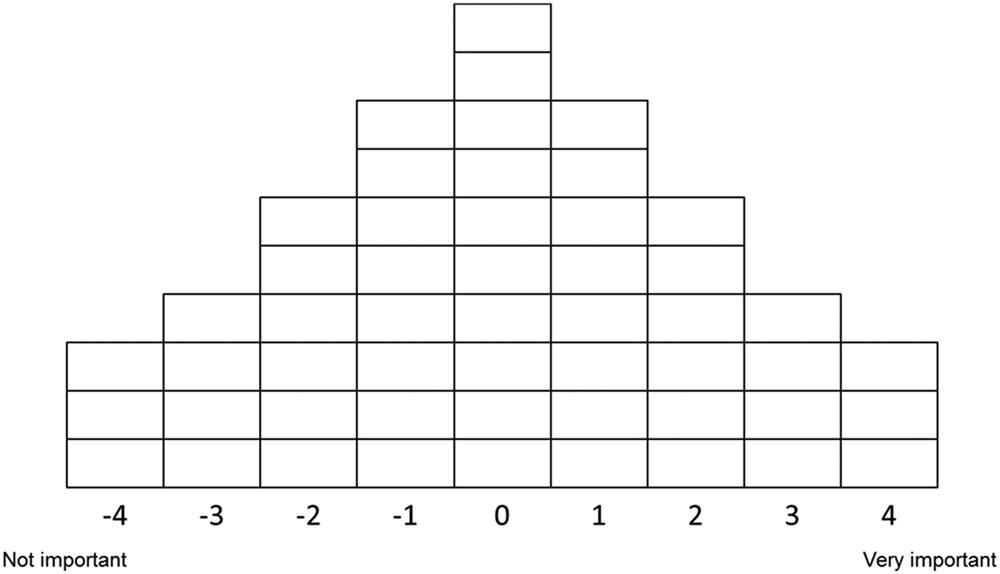
For the Q-sorting process, participants were asked to sort the provided statements on a scale with nine categories, ranging from ‘not important’ to ‘very important’ (Figure 1). The ‘forced’ distribution followed a normal distribution with the following spaces: 3-4-6-8-10-8-6-4-3 (Watts & Stenner, Reference Watts and Stenner2012).
Sort grid

Each participant received the same sorting instruction: ‘Please sort the following statements regarding the importance each statement has for you as CEO of your company.’ During the sorting process, participants were encouraged to rearrange the cards as necessary and think out loud while doing so. After this procedure, a brief post-sorting interview was conducted to consolidate the sorting results (Watts & Stenner, Reference Watts and Stenner2005). Participants were asked to reflect on their choices by explaining what each value meant to them (Gallagher & Pollock, Reference Gallagher and Pollock2010).
The PQ-method program was used to analyze the Q-sorts (Schmolck & Atkinson, Reference Schmolck and Atkinson2002). After entering the data, a principal component analysis was proceeded with a varimax rotation to associate participants with one factor, and thereby improve the factor solution. Afterwards, each sort that loaded highly negatively or positively on a factor was flagged manually. This loading of each Q-sort indicates how strongly it correlates with a prototypical Q-factor (Stephenson, Reference Stephenson1953; Brown, Reference Brown1996; Watts & Stenner, Reference Watts and Stenner2005). The conducted factor analysis is person-centered in order to group participants with similar viewpoints together (Dziopa & Ahern, Reference Dziopa and Ahern2011). A factor selection is suitable if there is a low number of undedicated sorts and minimal factor correlations. Previous Q-studies point out that at least two participants should load significantly on one factor and confounding participants have to be excluded (McKeown & Thomas, Reference McKeown and Thomas1988; Dziopa & Ahern, Reference Dziopa and Ahern2011).
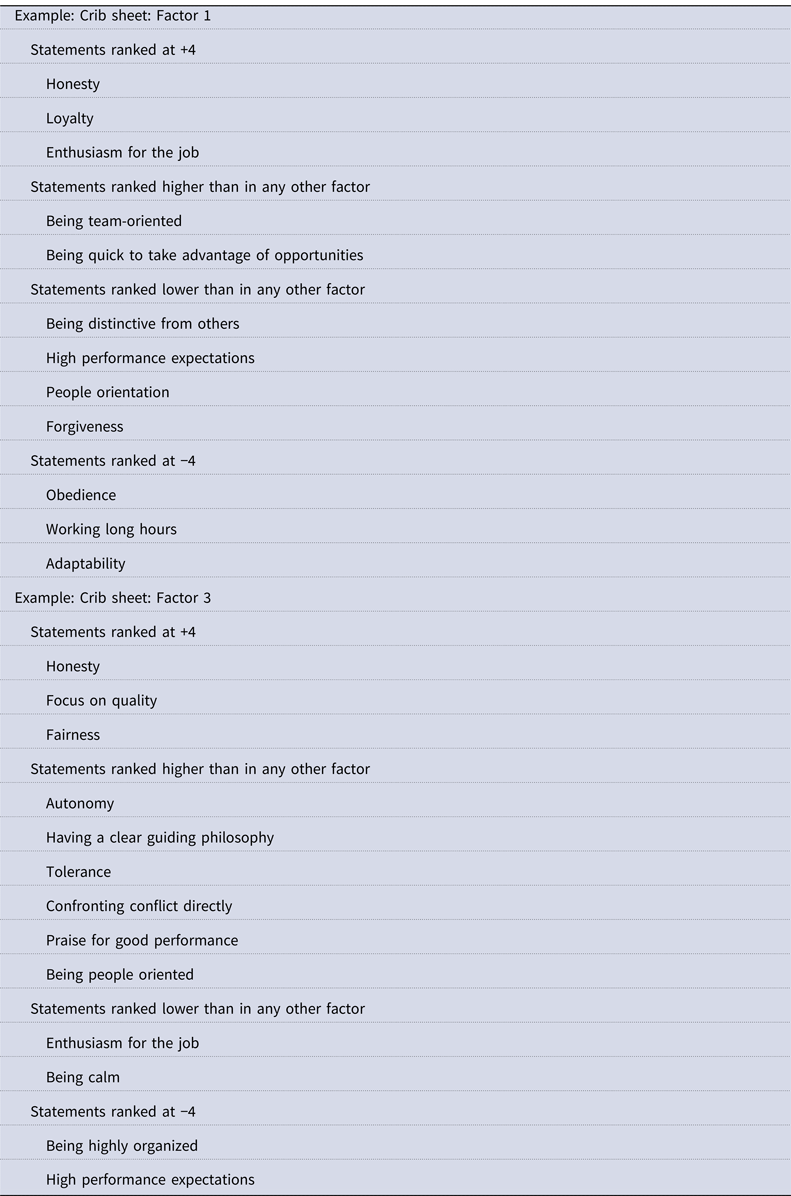
After selecting the number of factors, each factor was defined by analyzing the factor arrays, the correlations between sorts, and the distinguishing statements. To better perform the factor interpretation, a crib sheet for each factor was created (Table 1). This crib sheet illustrates characteristic statements and thus allows a systematic factor interpretation (Watts & Stenner, Reference Watts and Stenner2012).
Crib sheet for systematic Q-factor interpretation (Examples: Q-factor 1 and Q-factor 3)

The factor interpretation was built on this crib sheet and factor arrays were screened for additional statements that contributed to the meaning of each factor. The entire statement configuration was analyzed to uncover the whole viewpoint of each factor. In addition, demographic information was included in the interpretation process, as it could have influenced participants’ viewpoints.
Integration of findings
After these analytical steps, the findings from the thematic narrative analysis were integrated into the Q-factor interpretation. The Q-results served as the analytical starting point, and narratives were used to examine how value statements from the Q-sort were construed and contextualized. In sum, narrative sequences were used to work out what participants had in mind when talking about a specific value. Therefore, narrative sequences from those participants who highly loaded on a factor were compared and how these participants framed articulated value themes was worked out. As the aim of this paper was to illustrate the integration of both research methods, those value statements that were sorted as most or least important in the Q-factor were clarified. To this end, both narrative sequences (founding/takeover sequence and family tradition sequence) were considered to identify instances of repeated meaning and experience, and therefore of prominent importance. Hence, the Q-factor interpretation was enriched by contextual and narrative information about family values and tradition.
Results
The following results represent an illustrative case of the implementation of this novel methodological approach. Thus, findings from the Q-study and integrated results from thematic narrative analysis were selected to demonstrate how the use of narrative interviews contributes to a refined Q-factor interpretation and how these insightful findings contribute to family business research.
Findings from Q-sort analysis
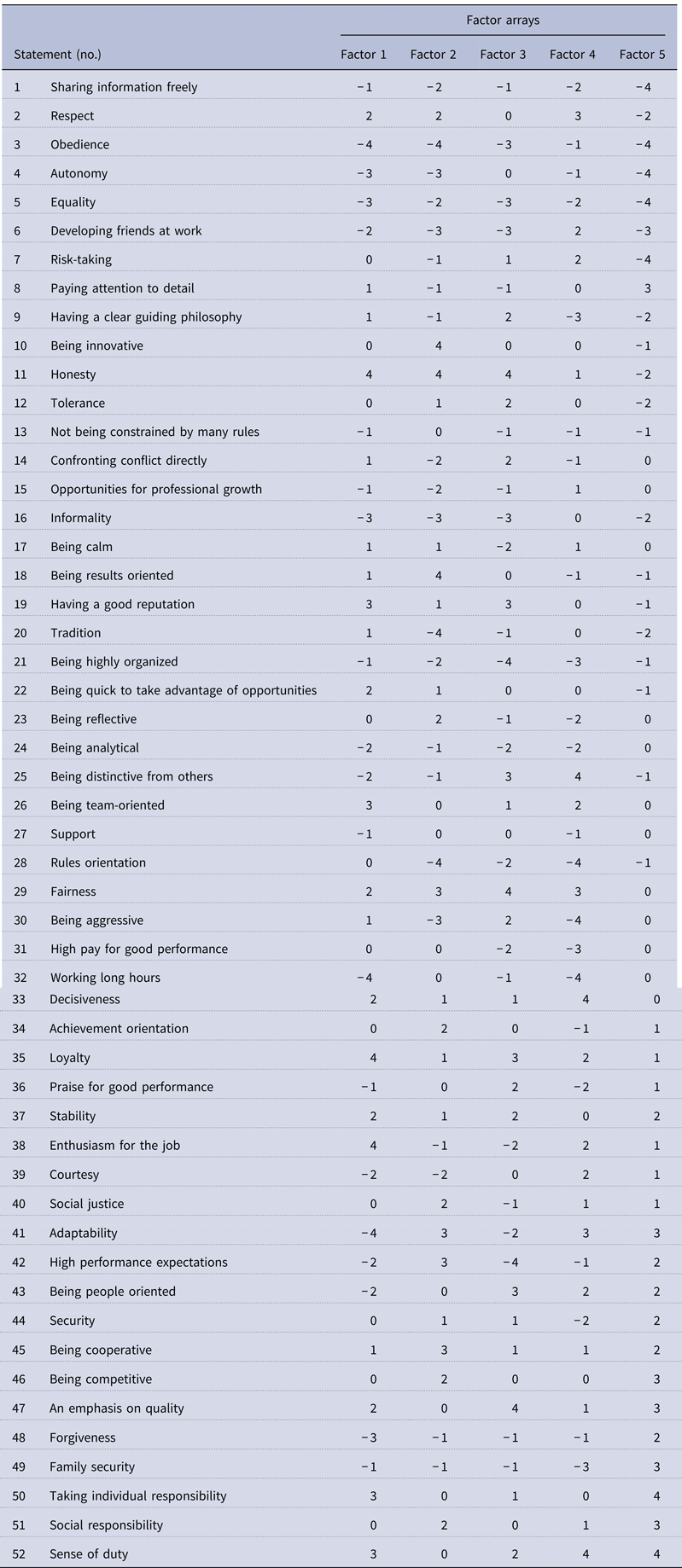
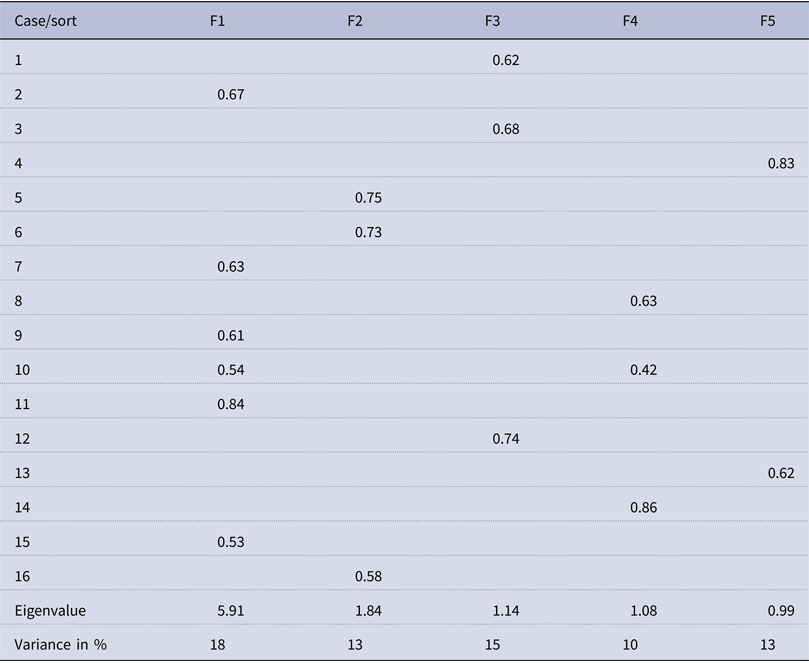
The analysis with PQ-method identified five different factors that explain 69% of the variation. Each factor represents a prototype of a specific value pattern, namely: Enthusiasm, Innovation, Reliability, Determination and Responsibility. These factors were unipolar, as evidenced by the positive factor loadings for all sorts (Table 2).
Factor arrays from Q-sort

The results indicate that 15 sorts loaded significantly on one factor. Sort 10 was confounded, loading significantly on two factors. The following exemplary interpretation of two of five Q-factors is based on those sorts that loaded clearly on each factor (Table 3).
Loading of Q-sorts (case numeration is adjusted to narrative interview cases, Table 4)

Exemplary presentation of defining of Q-factors
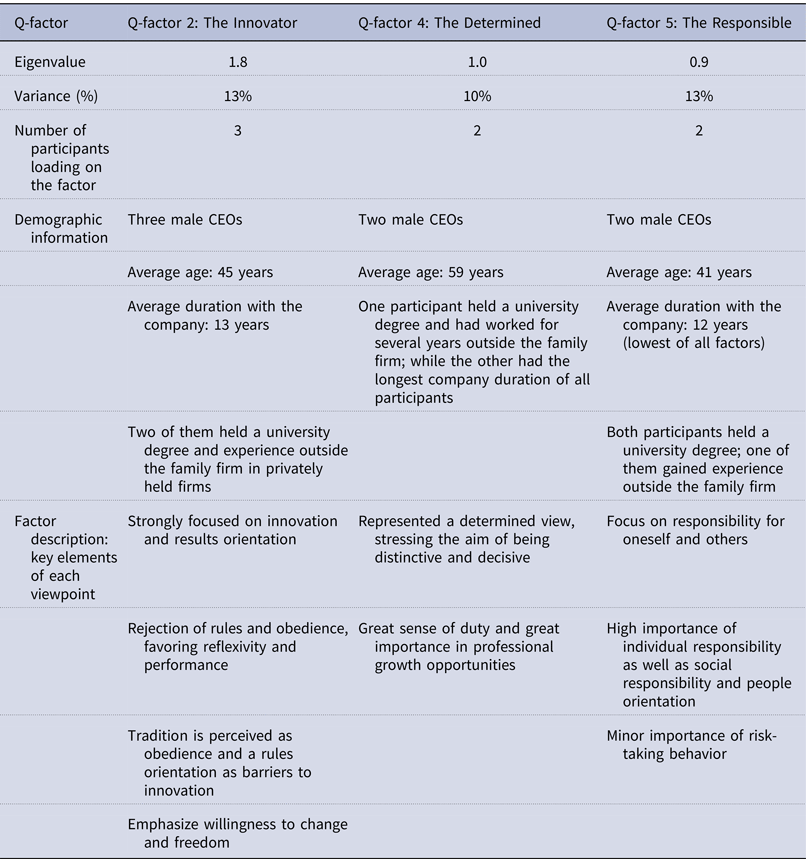
In this section, Q-factors are interpreted and defined. First, the crib sheets of each factor that was built on factor arrays was considered. The crib of Q-factor 1 (The Enthusiast) and Q-factor 3 (The Reliable) was presented to make the analytical procedure transparent and comprehensible (Table 1). Second, demographic information and distinguishing statements were included in the factor interpretation, as outlined in the data analysis section. A brief summary of the three other Q-factors is presented in an overview in the following (Table 6).
Q-factor 1: The Enthusiast
Factor 1 had an eigenvalue of 5.9 and explained 18% of the study variance. Five male CEOs loaded on this factor. Their average age was 46 years and their average duration with the company was 21 years. Four of the participants finished vocational training; one held a university degree.
For the CEOs loading on this factor, enthusiasm (‘enthusiasm’, distinguishing statement: +4) for the job was considered the basis for success. These CEOs highly identified with their profession and their firm. Instead of avoiding working long hours, they volunteered extra time when necessary (‘working long hours’: −4). They considered honesty and loyalty to be a particularly important foundation for business relations (‘honesty,’ ‘loyalty’: +4). These CEOs emphasized the collective rather than the individual, as underlined by the high ranking for team orientation (‘being team oriented’: +3). They ranked adaptability (‘adaptability,’ distinguishing statement: −4) and obedience (‘obedience’: −4) as the least important. Thus, these CEOs may be driven more by their passion and intrinsic motivation than by rules or regularities, underlined by their low ranking of obedience. The focal point of this viewpoint is commitment and engagement for the firm. Their low rankings for forgiveness (‘forgiveness’: −3) and people orientation (‘being people orientated,’ distinguishing statement: −2) underscore their focus on passion for their job rather than people.
Q-factor 3: The Reliable
Factor 3 had an eigenvalue of 1.1 and explained 15% of the study variance. Three male CEOs and one female CEO loaded on this factor. Three of the CEOs had an average age of 35; the average age of all four participants was 43. Their duration in the company ranged between 3 and 40 years, with an average duration of 17 years. The two participants in their early 30s held a university degree and had experience outside the family firm. The other two had finished their vocational training and had not worked outside the firm.
These CEOs focused on fairness and on the quality of products and processes (‘fairness’; ‘an emphasis on quality’:+4). For them, relevant tasks had to be done carefully and conscientiously, but they placed minor importance on remaining calm (‘being calm’: −2). In their viewpoint, people needed to be treated fairly (‘honesty’: +4; ‘being people orientated’: +3). These CEOs placed relatively greater importance on obligation, as reflected in their desire to address conflicts directly (‘confronting conflict directly’: +2) and ensure a sense of reciprocity through praise, fairness, and trust (‘honesty’: +4; ‘loyalty’: +3). In contrast, these CEOs placed less emphasis on high performance and organization (‘being highly organized; ‘high performance expectations,’ distinguishing statement: −4). They abided by a guiding philosophy (‘having a clear guiding philosophy’: +2) of being fair and consistent in their interactions, whereas enthusiasm was of little importance (‘enthusiasm for the job’: −4).
Refining Q-factors by integrating findings from narrative analysis
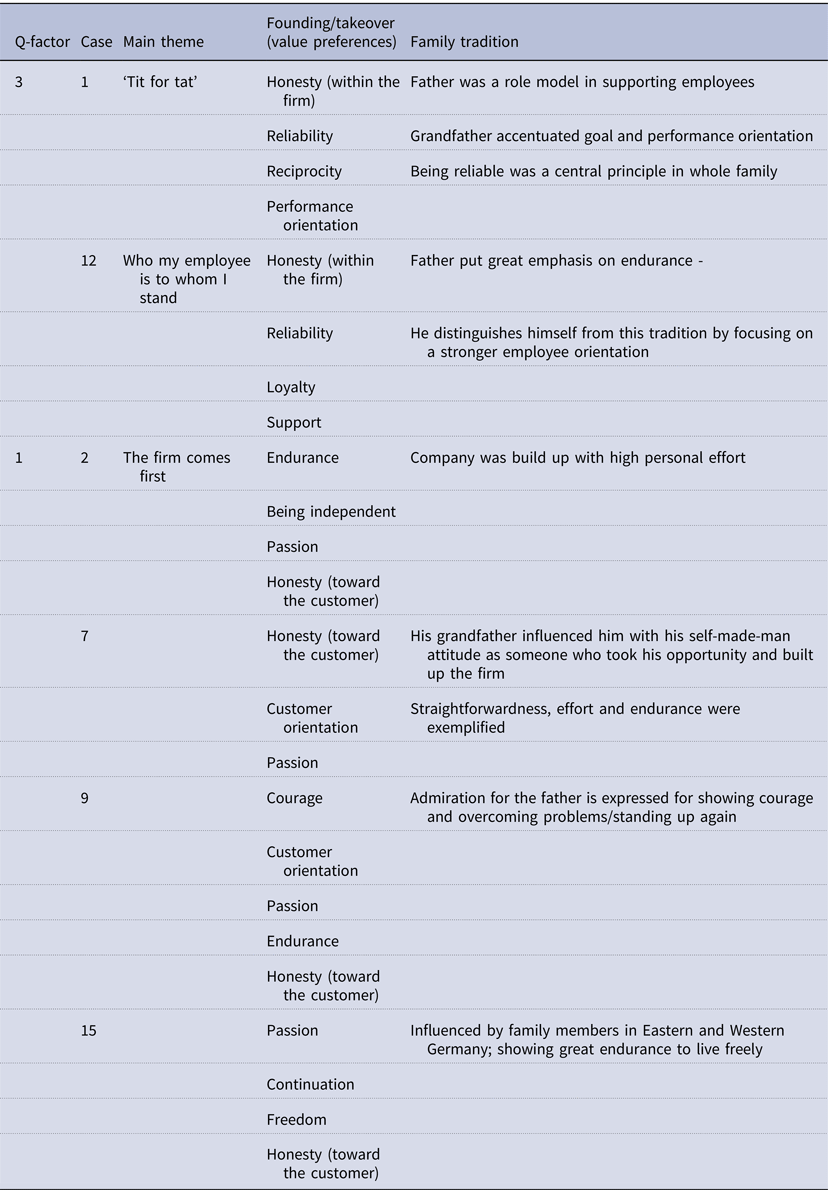
Finally, findings from the thematic narrative analysis were applied to interpret and differentiate the Q-factors more accurately. Owing to the volume of results generated by both studies, narrative sequences that helped to refine two of the five Q-factors were selected. Two Q-factors were chosen because the values ‘honesty’ and ‘loyalty’ were ranked as important in both viewpoints. This paper focused on an exemplary presentation of narrative sequences from CEOs who loaded highly on each factor, because these CEOs exemplify the quality of the Q-factor. Besides illustrating narrative analysis on two examples in more detail, narratives from other participants loading on the presented Q-factors were analyzed to verify that all participants who were loading on the same Q-factor interpreted value statements similarly. As this paper can only present a small portion of all results, it focused on illustrating how differently the value ‘honesty’ was interpreted in narrative cases loading on one of the two illustrated Q-factors (Table 5).
Narrative example for refining interpretation of Q-factor 1 (The Enthusiast)
Case 11’s story: Passion for the customer
The takeover story of case 11 – a CEO in his 40s – introduced courage and a strong customer orientation – typical entrepreneurial characteristics. He illustrated enthusiasm and strives for motivating his customers. He associated honesty with courage, enthusiasm, and a strong customer focus. In his narrative, he had no doubts about engaging in the family firm and underlined that inspiring customers with passion is his strongest impulse:
[…] From childhood it was clear that I am entering the parental enterprise. For me it was always there. I always had little hobbies and was always with the company. That was clear from the beginning that I enter into these footsteps. My focus is the customer, customer orientation, which is still the same. Of course, the times change, it is now very fast-moving. If you see the whole thing on the price, then we cannot keep up – if you see honesty and everything, then this is just a bit more expensive […] The enthusiasm of the satisfied customer. That has already driven me. […] Our vision is clear: being a service leader. (Narrative part about takeover)
He admired his father’s attitude: Standing up again after difficult years in the firm and showing courage with the decision to be self-employed.
We learned this from our father, being positive. In the beginning everyone around us was very negative and critical, but our father was very courageous and then his career took a few hits, and he remained positive. I believe that this had quite a big impact on who I am today […] This is a thing our father has taught us: What does the customer want? What serves him well? Actually nothing much has changed in this regard. I share my father’s enthusiasm. This has been passed on to me from the generation that founded this business. We are entrepreneurs. We are positive by nature. We have to be fighters, and we have to say that we will go on, and we must not lose the values of honesty and enthusiasm. I live this honesty, not by manipulating something or by doing anything else. What is always best and most effective is people driven by passion. (Narrative part about family tradition)
Contributions to the interpretation of Q-factor 1 (The Enthusiast)
This narrative underlines the enthusiastic character of Q-factor 1 and provides detailed information about the interpretation of the abstract value statement ‘enthusiasm for the job.’ The narrative sequence about family tradition emphasizes that the CEO’s father exemplified courage and a positive, enthusiastic entrepreneurial attitude, which then became family values.
Other cases loading on Factor 1 largely agreed, emphasizing the need for a customer orientation alongside typical entrepreneurial characteristics, such as courage and a positive attitude. For them, honesty is fundamental to entrepreneurial activity: They highlighted the importance of dealing honesty with customers and identifying strongly with the company. For cases loading on Q-factor 1, ‘honesty’ is contextualized with business concerns through frankness and customer-centrism. The narrative example emphasized the entrepreneurial character of Q-factor 1 toward a ‘passionate entrepreneur.’
Narrative example for refining interpretation of Q-factor 3 (The Reliable)
Case 3’s story: Working together like a family
Case 3 – a CEO in his early 30s – highlighted the importance of loyalty within the firm, which meant a strong sense of identification with the firm’s goals. In drawing an analogy between employee relations and familial support, his narrative emphasized values of honesty, loyalty, support, and reliability. He explained that he had to bear sudden responsibility for the firm and expressed gratitude for the support from employees. He considered this support and loyalty to be success factors in his takeover period:
I had a pretty shitty start. I was still studying when my father was diagnosed and died few months later. It all happened very suddenly […] I eventually ended up managing the business while I was writing my thesis, and I was completely on my own. This brings me to the central theme of values. Without this team, without this level of loyalty to the business, with this connection to the business, what we like to call family, none of this would have happened. Every employee came to me and said: We are supporting you. We are there for you. This was a very, very tough time […] On the other hand they paid me back. The employees came to me, and they said that we are all working towards the same goals. (Narrative part about takeover)
In his childhood, the firm was always part of their private life. He further described the role model behavior that he learned from his father, who demonstrated unlimited commitment and loyalty to his employees. Regarding family tradition, he explained that honesty, loyalty, and a sense of reliability built the basis for trust and togetherness:
I grew up like that. […] The company is the family. So you can actually say it. Trust, commitment - it’s just like that. It was always the same at home. […] It was always giving and taking. And that is the same in the family. […] (Narrative part about family tradition)
On the other hand, I have given a lot. This is who I am, and it is a value that my father taught me. […] You cannot join the business straight from university and be the boss who knows everything better. I myself hold all of the driving licenses required […] I do everything. And I believe that this is key to leading by example: Okay, if the worst comes to the worst, I work just like any other employee.[…] – and my father was no different – I expect let me call this 100% loyalty to the business. I need to know that my guys are 100% loyal and honest, because I need to be able to trust them 100%. When an employee asks me which direction we are taking, and I give them an answer, I have to bear the consequences and stand to my words. […] (Narrative part about family tradition)
Contributions to the interpretation of Q-factor 3 (The Reliable)
In this narrative, the importance of a trusting and fair relationship is illustrated by case 11. This sense of trust and loyalty as well as ‘leading by example’ is something the narrator learned from his father. This underlines the importance of fairness as expressed by Q-factor 3.
For cases loading on Factor 3, honesty and loyalty are based on reliability and reciprocity. Honesty was contextualized as the ‘predictability’ of interpersonal relations within the family firm. In their view, the trust that arises from honesty produces a sense of predictability. Thus, the standards of a ‘reliable and reputable merchant’ need to be upheld for Q-factor 3 (Tables 4–6).
Overview of results from thematic narrative analysis for narrative examples of case 3 and 11

Results from thematic narrative analysis for further cases loading either on Q-factor 1 or Q-factor 3

Brief description of other Q-factors that were not detailed illustrated

Novel insights for family business research
Answering the call for a more in-depth use of qualitative methods (Reay & Zhang, Reference Reay and Zhang2014), this approach truly emphasizes a deep immersion in individual family socialization and its impact on CEOs’ current value orientations. By investigating how family experiences influence CEOs’ interpretation and prioritization of values, the analysis demonstrated that values are rooted in family’s tradition and role models.
Moreover, because the approach combined narrative interviews with Q-sort, links between family experiences/history and the content-related meaning of single values could be established. Indeed, the multiple interpretations and narratives that resulted from the Q-sort allowed to refine the Q-factor interpretation. Thereby, this approach deviates from traditional qualitative methods by abstaining from ‘one single truth’ (Fletcher, De Massis, & Nordqvist, Reference Fletcher, De Massis and Nordqvist2016). Hence, deeper insights into the dualistic character of a family firm were gained (Fletcher, De Massis, & Nordqvist, Reference Fletcher, De Massis and Nordqvist2016).
Moreover, the study applies methodological triangulation by systematically linking two methodological approaches in order to maximize the validity of the results (Denzin, Reference Denzin2012). Narrative interviews contextualized the value statements ‘honesty’ and ‘loyalty’ gleaned from Q-sort, and helped to mitigate misinterpretations of the value patterns. In short, this combined methodology allowed not only to enrich the understanding of the meaning and origin of CEOs’ values but also to minimize misinterpretations and thereby increase the quality of the results. Also, the triangulation of both methods allowed to cross-verify the results, thereby improving validity and reliability. Thus, this novel approach contributes to the recent calls for a broader application of mixed-method designs (Reilly & Jones, Reference Reilly and Jones2017).
Discussion
In this paper, a methodological approach that enriches a Q-sort study with contextual information gained from narrative interviews is described. Such an approach contributes to a more comprehensive and tangible understanding of the typical value orientations of CEOs in family firms. This discussion will focus on the value of the integrated methodological approach and delay discussing content-related findings until a subsequent paper.
First, Q-method was applied as a novel approach in family business research. The findings from the Q-sort illustrated five Q-factors that express subjective viewpoints on value preferences and hence CEOs’ typical value orientations: the Enthusiast, the Innovator, the Reliable, the Determined, and the Responsible. Thus, Q-method proved to be a useful approach for grouping single statements into value patterns (Watts & Stenner, Reference Watts and Stenner2005; Eyvindson et al., Reference Eyvindson, Kangas, Hujala and Leskinen2015) that reflected the subjectivity of different viewpoints.
Secondly, narratives from CEOs’ founding period and family experience were integrated to portray Q-factor 1 (Enthusiast) and Q-factor 3 (Reliable) in more detail. These two Q-factors were refined with narratives because they showed the strongest similarity among all factors. The Q-sort results indicated a strong overlap between Q-factor 1 (Enthusiast) and Q-factor 3 (Reliable) due to a shared emphasis on honesty and loyalty. The narratives indicated a different understanding and contextualization of both values: in the view of Q-factor 1, honesty is related foremost to business, encompassing a passion for one’s work and attention to one’s customers. In the view of Q-factor 3, however, honesty applies to the relationship with employees, encompassing issues like reliability and reciprocity.
By integrating findings from the thematic narrative analysis with the Q-sort, nuances in how honesty and loyalty are contextualized differently across viewpoints were identified. This integration of narratives revealed the entrepreneurial focus of Q-factor 1 and the binding manner of Q-factor 3. Thus, the integration of findings from narrative analysis in the interpretation of Q-factors contributed to the differentiation of both Q-factors. This strengthens the expression of subjective viewpoints through Q-sort. Hence, this approach helps to address the methodological concern that the same value statements might be interpreted differently by different participants (Lundmann & Villadsen, Reference Lundmann and Villadsen2016). Besides gaining a better understanding of the relevant values for both Q-factors, considering the narratives helped to make the CEOs’ viewpoints tangible and to empathize with the viewpoints represented by the Q-factors. The narratives illustrated abstract value statements with personal experience and conveyed an overall message and emotions (Kourti, Reference Kourti2016; Zwack et al., Reference Zwack, Kraiczy, von Schlippe and Hack2016).
The findings thus contribute to two central questions in qualitative family business research: Which contextual factors influence the social processes and dynamics in a family firm? And how do individuals make sense of their experiences? (Fletcher, De Massis, & Nordqvist, Reference Fletcher, De Massis and Nordqvist2016).
Regarding the importance of context, this approach sought to integrate contextual information to a high degree. Family socialization was identified as an important contextual variable. Specifically, family values – contained in family myths and traditions – highly influence the value preferences of CEOs and work to shape organizational values and behavior (Lumpkin, Martin, & Vaughn, Reference Lumpkin, Martin and Vaughn2008; Sorenson, Reference Sorenson2013). Therefore, this integrated approach responds to recent calls for more contextual consideration in family business research (Fletcher, De Massis, & Nordqvist, Reference Fletcher, De Massis and Nordqvist2016; Reilly & Jones, Reference Reilly and Jones2017). In this way, this methodological approach specifies why and how variation between organizations exists (Härtel & O’Connor, Reference Härtel and O’Connor2014) and illuminates the heterogeneity of family businesses (Chua, Chrisman, Steier, & Rau, Reference Chua, Chrisman, Steier and Rau2012).
With regard to value research, findings indicate that family experience directly influences CEOs’ value orientations and interpretation, thereby addressing the question about the influence of family experience on values (Simon et al., Reference Simon, Marquès, Bikfalvi and Muñoz2012; Sorenson, Reference Sorenson2014). Moreover, the systematic integration of family socialization as a context factor underscores the importance of considering processes and history instead of more static variables (Dawson & Hjorth, Reference Dawson and Hjorth2012). Using contextual information about family socialization clarified how CEOs construe values and the extent to which individual experience causes variation in value interpretation. In this regard, this paper contributes to the debate on the alignment between family and firm identity (Zellweger et al., Reference Zellweger, Nason, Nordqvist and Brush2013; Anglin et al., Reference Anglin, Reid, Short, Zachary and Rutherford2017) by analyzing family identity and core values on a more complex and relational level, accounting for the context of family experiences and its influence on values (Fletcher, Melin, & Gimeno, Reference Fletcher, Melin and Gimeno2012; Simon et al., Reference Simon, Marquès, Bikfalvi and Muñoz2012). Generally, the integration of contextual variables contributes to further theory development in the family business field, whereas the richness of in-depth contextual knowledge provides new conceptual insight (Hjorth & Dawson, Reference Hjorth and Dawson2016; Hamilton, Cruz, & Jack, Reference Hamilton, Cruz and Jack2017). Such insights benefit research on topics such as social capital (Arregle, Hitt, Sirmon, & Very, Reference Arregle, Hitt, Sirmon and Very2007; Sorenson, Reference Sorenson2013) and stewardship (Vallejo-Martos & Puentes-Poyatos, Reference Vallejo-Martos and Puentes-Poyatos2014), and may have ramifications for research on organizational values.
This novel approach also considered individual sense-making and interpretation. Narrative data were used to comprehensively interpret and refine the Q-factors’ meanings to enrich understanding of values and minimize misinterpretations. Ultimately, narratives illuminate how narrators interpret values and how family experiences influence value preferences. This is in line with research showing that values are the core of personal identity and are shaped by socialization (Ashforth & Mael, Reference Ashforth and Mael1989; Hitlin, Reference Hitlin2003). Multiple influencing factors form the attributed meaning of values, and this mechanism is useful for exploring how family traditions strongly influence value orientations (Sorenson, Reference Sorenson2013). The integration of narratives enabled a reconstruction of individual experiences, identities, and relationships, thus developing an in-depth perspective of individual actors in family businesses (Fletcher, De Massis, & Nordqvist, Reference Fletcher, De Massis and Nordqvist2016). Thereby, the applied approach answers the call for the use of truly open-ended qualitative methods (Reay & Zhang, Reference Reay and Zhang2014).
Finally, in the debate on qualitative versus quantitative approaches, these results support the notion that contextualization and understanding are necessary for increasing the content validity of the measured statements. For example, narrative reflections shed light on the individualized meaning that participants associate with single-value statements. In this vein, the combined methodology supports further quantitative research by allowing scholars to explore the meanings that participants attribute to values. From a scientific-theoretical perspective, the use of narratives strengthens the capacity of Q-method to identify, reconstruct, and understand subjective viewpoints. Therefore, this study is in line with the constructivist research paradigm and phenomenological approaches in that meaning is derived from subjective interpretation and becomes context-dependent (Härtel & O’Connor Reference Härtel and O’Connor2014). The chosen research design proved suitable for an in-depth exploration of context-specific social phenomena such as values and their meanings: Q-sort provided structure for the data through the use of value statements and the exploration of subjective value viewpoints, while integrating the thematic narratives allowed to better analyze the results and discover congruencies. Thus, this approach has methodological implications.
This novel approach is exemplified by the analysis of CEOs’ values in family firms, which represent a complex organizational environment where the firm is strongly influenced by the family. Thus, the approach advanced here may be applied for other organizational forms and research topics.
Limitations
First, the two methods used in this study both involve high word counts (Bold, Reference Bold2011; Watts & Stenner, Reference Watts and Stenner2012), which limited the ability to present the full results.
Second, the sample size was somewhat small. Although Q-sort can accommodate small samples, future research should aim to validate the illustrated findings with extended sample sizes. The Q-study did, in fairness, meet the criteria that at least two participants load significantly on a Q-factor (Dziopa & Ahern, Reference Dziopa and Ahern2011), but including more participants would still be beneficial for the interpretation.
Third, this study focused specifically on CEOs in the logistics industry in order to mitigate industry influence. It would be valuable to compare viewpoints across different industries and assess the heterogeneity among family businesses (Chua et al., Reference Chua, Chrisman, Steier and Rau2012). Scholars could also map out differences rooted in demographics (e.g., women vs. men, educational backgrounds, different age groups, etc.). Indeed, there has been recent scholarly interest in the role of women as managers of family firms (Meroño-Cerdán & López-Nicolás, Reference Meroño-Cerdán and López-Nicolás2017).
Fourth, this study derived the value statements for the Q-sort from a mixed collection – some from interviews and others from previous studies (McKeown & Thomas, Reference McKeown and Thomas2013). Future studies could instead use original anecdotes or quotes for sorting. Finally, researchers could reach beyond family socialization to explore how other socialization events (e.g., friendships, love relationships, or customer experiences) may influence CEOs’ interpretation of values.
Implications for Management Practice
This illustrated approach contributes to both organizational development and communication. Regarding the former, the approach encourages reflection, addresses the challenge of recruiting participants, and adds to the discussion on user-friendly methods. Owing to the approach’s haptic nature and reflection process, the participants became enthusiastic over Q-sort. Because Q-sort allows organizational members to actively participate in data collection, it has the potential to mobilize members in a process of organizational reflection and change. Moreover, a method that participants regard as valuable facilitates their acceptance of it, which may provide practitioners with a useful supplement to statistical analysis. This corresponds with current trends in research that aim to generate greater involvement among study participants and thereby achieve a better understanding and implementation of research findings.
Regarding value communication, this approach helped the CEOs to articulate their organization’s values and thereby render them more vivid and tangible. Imbuing said values with personal and emotional anecdotes adds substance to abstraction and helps employees identify with the firm. With the capacity to connect with employees on a personal and emotional level, these ‘tangible viewpoints’ become useful for organizational practice.
Acknowledgement
The author would like to thank the anonymous reviewers as well as the associate editor for their highly constructive feedback and encouragement during the review process.