The institution of judicial review is an important mechanism of holding the government legally accountable, nevertheless questions remain about its proper role in a system of separation of powers. Scholars have long argued that the exercise of judicial review should be limited in complex and technical policy areas so that governmental officials can bring their superior expertise on policy problems courts are institutionally ill-equipped to decide (Landis Reference Landis1938; Shapiro Reference Shapiro1983; Breyer Reference Breyer1986; Cross Reference Cross1999; Tushnet Reference Tushnet2005; Posner Reference Posner2006; Sunstein Reference Sunstein2006). Prominent Supreme Court justices have also insisted that norms of judicial deference should govern policy domains where courts lack the necessary expertise required by the modern-day governance (Frankfurter Reference Frankfurter1930; Scalia Reference Scalia1989). From Justice Stevens’s argument that “judges are not experts in the field”Footnote 1 to Justice Roberts’s emphasis on “the lack of competence on the part of the courts,”Footnote 2 considerations of relative institutional competence have been at the forefront of normative justifications for judicial deference (Solove Reference Solove1999; Eskridge and Baer Reference Eskridge and Baer2008; Chesney Reference Chesney2009).
The argument for limiting judicial review on epistemic grounds essentially assumes that the expertise available to policy makers is independent of the institutional structure under which public policies are fashioned. It neglects the fact that government is not a unitary actor or implicitly assumes that the internal ecology of the government is not directly relevant to the principle that judicial review should be restrained on grounds of institutional competence. Missing from this account is the fact that policy makers, those with formal power to make policy decisions, have to rely on experts for information regarding the consequences of various courses of action. That policy makers depend on experts for information and advice when addressing various policy problems is an institutional fact of modern government: the President relies on the White House staff and bureaucrats for policy advice; the House and the Senate depend on staff members, congressional committees and bureaucrats for valuable information when drafting legislation; the heads of administrative agencies depend on lower-level bureaucrats for information regarding the potential impact of various regulations; and so on. This inherent division of labor between policy making and policy expertise implies that the amount of information available for policy making is endogenous to the politics of information transmission, a simple observation which leads to, as we shall show, a novel assessment of judicial review from an expertise perspective.
In this article, we develop a game-theoretic analysis to show how the exercise of judicial review by non-expert court can induce more informed policies when we account for the strategic interaction between policy makers and policy experts. To illustrate the conditions under which judicial review fosters policy expertise, we compare a baseline model of an interaction between a policy maker and an expert in the absence of judicial review with an institutional setting in which a court can assess the legality of policies. This analysis shows that the judiciary can be better off without its review power if judicial checks dilute the amount of information available for policy making, which implies that there are endogenous judicial incentives to limit the detrimental effect of judicial review on expertise. More importantly, the institutional analysis underscores that judicial review can enhance the amount of information available for policy making, while, under those conditions, the judiciary prefers to exercise legal review, even though it lacks the knowledge to precisely assess the likely effects of various policies. In other words, not only that it can be desirable solely on expertise grounds to subject governmental policy to the muster of judicial review, but non-expert courts have incentives to employ judicial review in a manner consistent with institutional concerns for policy expertise.
Our analysis adds to a literature that analyzes the positive and normative effects of judicial review in a separation of powers system. Judicial review is a widely adopted institutional method of checking the legality of policies, including the consistency of governmental action with the rights and liberties of individuals. Given its importance in the constitutional structure of developed and, increasingly, developing democracies (Ginsburg Reference Ginsburg2007), scholars have studied the effect of judicial review from a variety of theoretical perspectives, including the effect of judicial review on policy durability (Landes and Posner 1975), the effect of judicial checks on elected politicians’ incentives to pander to public opinion (Fox and Stephenson Reference Fox and Stephenson2011), the effect of judicial oversight on bureaucratic incentives to exert effort (Stephenson Reference Stephenson2006; Bueno de Mesquita and Stephenson Reference Bueno de Mesquita and Stephenson2007), the effect of different types of judicial rulings on policy (Staton and Vanberg Reference Staton and Vanberg2008; Fox and Vanberg Reference Fox and Vanberg2013), the effect of judicial review on legislative-judicial relationship (Rogers Reference Rogers2001; Vanberg Reference Vanberg2001; Clark Reference Clark2009), and the conditions under which legal limits and judicial ruling can be self-enforcing (Staton Reference Staton2006; Dragu and Polborn Reference Dragu and Polborn2013; Hadfield and Weingast Reference Hadfield and Weingast2013), among other topics.Footnote 3 We contribute to this literature by analyzing the effect of judicial review on the policy-making process from an expertise perspective to show how the presence of a credible threat by non-expert courts can improve the amount of ex ante information available for policy making.
The article also adds to a literature on cheap talk communication, a literature that builds upon Crawford and Sobel’s (1982) analysis of strategic information transmission between an informed expert and an uninformed decision maker. Crawford and Sobel’s seminal analysis has been applied to a variety of settings including organizational design (Dessein Reference Dessein2002), legislative politics (Gilligan and Krehbiel Reference Gilligan and Krehbiel1987, Reference Gilligan and Krehbiel1989; Krishna and Morgan 2001), and lobbying (Austen-Smith Reference Austen-Smith1993; Grossman and Helpman Reference Grossman and Helpman2001), among others. In most of these models, the decision-making authority lies in the hands of a single actor and the main question is how that decision maker can extract more information from expert(s). We expand the analysis of cheap talk communication to a setting in which a veto bargaining rather than a single decision maker determines the implemented policy,Footnote 4 and show that adding a veto player to the standard game between a (uninformed) policy maker and an (informed) expert can increase the degree of information transmission even if the veto player is uninformed. Although there are technical subtleties to the argument,Footnote 5 the intuition is relatively straightforward: the fundamental problem that imposes a limit on the possibility of information transmission in the standard game is the risk that the decision maker will use the information transmitted by the expert in a way that can be detrimental to the expert’s interests. As a result, a strategic expert will provide as much information insofar as it will induce policies that promote her interest. By constraining the decision maker with a veto player, these dynamics are changed: if the interests of the expert and the veto player are sufficiently aligned, the presence of the veto can implicitly protect the expert against adverse uses of information by the decision maker. This means that the potential downsides of transmitted information are more limited, which can induce the expert to reveal more information in equilibrium. Moreover, we also derive novel results regarding the preferences of players over the institutional structure under which public policies are fashioned (i.e., single decision maker versus veto bargaining).
The cheap talk analysis developed here can be applied to other institutional structures in which the decision-making authority is divided so that multiple actors must agree on a policy. The division of political power among several institutions such that each will have a veto over changing the existing policy is a normative underpinning of several important institutions such as presidential veto power over legislation, bicameralism and judicial review (Dragu, Fan and Kuklinski Reference Dragu, Fan and Kuklinski2014). For instance, bicameralism and presidential veto are important institutional arrangements specified in the constitutional structure of various developed and developing democracies (Cameron Reference Cameron2000; Gailmard and Hammond Reference Gailmard and Hammond2011). Our formal analysis can be used to assess the normative and positive effects of presidential veto, bicameralism and other checks and balances institutions from an informational perspective.
The paper proceeds as follows. First we discuss the argument for limiting judicial review on expertise grounds and makes the case that this argument needs to be assessed in light of the politics of information transmission. Then we introduce the formal model, present the analysis of policy making without and with judicial review and also present the results of the comparative institutional analysis. In the last two sections, we discusses some extensions of our model and the implications of the analysis. All proofs are contained in the “Supplementary material.”
POLICY EXPERTISE AND JUDICIAL DEFERENCE
Discussions about the proper place of judicial review in a separation of powers system, on grounds of relative institutional competence, have been at the forefront of the academic and legal discourse since the advent of the administrative state. During the New Deal era, scholars advanced a prescriptive view of policy making in which expert agencies determine the best way to solve a particular problem and implement an appropriate policy, whereas inexpert, generalist courts recognize their proper role by allowing expert agencies to act with minimal judicial interference (Schiller Reference Schiller2007). For example, Justice Frankfurter (Reference Frankfurter1930, 35) argued that judges are poor decision makers in most fields of public policy because they lack specialized knowledge and because the complexity of modern society makes “heavy demands upon wisdom and omniscience.”Footnote 6 The legal process scholarship too paid attention to how to allocate authority between different potential decision makers in light of their relative institutional competence (Hart et al. Reference Hart, Sacks, Eskridge and Frickey1994). The argument that non-expert courts are institutionally ill-equipped to review expert policies has been recurrent in both the scholarly literature and case law, suggesting a consensus that a certain degree of judicial deference is suitable in policy areas where the public authority is better placed to know what consequences will follow from a particular decision.Footnote 7
The notion that judicial review should be limited on expertise grounds is particularly salient in the context of national security and administrative rulemaking (Schiller Reference Schiller2007; Eskridge and Baer Reference Eskridge and Baer2008; Chesney Reference Chesney2009; Pearlstein Reference Pearlstein2010). Arguments for limiting judicial review because of asymmetric institutional competence are constantly voiced in the scholarship on administrative rulemaking (Cross Reference Cross1999; Sunstein Reference Sunstein2006). Judicial intervention in rulemaking can be at odds, so the argument goes, with the very rationale of creating administrative agencies: to have an institutional repository of expertise in realms in which elected officials lack the necessary information required by the complexity of the modern-day governance (Landis Reference Landis1938). Similarly, some scholars argue that national security is an area of questionable judicial competence where executive officials should be afforded considerable discretion to devise security policies because the executive has superior information about how best to address a security threat (Sunstein Reference Sunstein2005; Tushnet Reference Tushnet2005; Posner Reference Posner2006).Footnote 8
When courts review agency decisions or national security policies, they often emphasize that the specialized subject matter and lack of expertise require them to be at their most deferential.Footnote 9 This deference principle seems appealing because it is supported by basic notions of institutional competence. However, the argument of limiting judicial review because of asymmetric institutional expertise treats the government in monolithic terms when it comes to the expertise available for policy making or implicitly assumes that the internal structure of the government is not relevant to the principle of deference on expertise grounds. Missing from this account is the fact that there is an inherent division of labor within the government between those actors who make policy decisions and those actors who have expertise and information about the likely effects of various courses of action. As one scholar notes, “[t]he federal government [has] extraordinary expertise, but that expertise [is] highly compartmentalized” (Kettl Reference Kettl2013, 39).
This division between policy making and policy expertise is a systematic feature of modern governance and is imprinted upon the organization of various governmental branches and agencies. For instance, scholars have noted that one important rationale for the development of the committee system in the US Congress is to acquire specialized policy expertise and to dispense such information during the process of law-making (Gilligan and Krehbiel 1987, 1989). Similarly, scholars have underscored the expertise rationale for the development of the institutional presidency: the various units and organizations inside the White House whose expertise span national security, international trade, and economic policy, and whose role is to provide information and policy advice to the president when it comes to the formulation of public policy (Nathan Reference Nathan1983; Gailmard and Patty Reference Gailmard and Patty2013). Scholars of bureaucratic politics too have pointed out the division of labor inside governmental agencies between those bureaucrats that make policy decisions and those bureaucrats whose role is to acquire information and develop specialized knowledge to further the policy goals of the agency (Downes Reference Downs1967; Rourke Reference Rourke1976; Wilson Reference Wilson1991).
To illustrate this division between policy making and policy expertise, consider the following examples. Suppose that legislators want to adopt antiterrorism surveillance legislation. Which surveillance policies should be enacted depends on their security benefits, which in turn depends on information about the magnitude of the terrorist threat. For instance, legislators may be willing to adopt more intrusive surveillance policies if the terrorist threat is high rather than low. However, legislators are likely to be relatively uninformed in comparison with the security agencies in charge of terrorism prevention that know far more about the terrorist threat because of the very nature of their work and operations. As a result, legislators need information from these agencies when drafting antiterrorism surveillance laws. A similar reasoning applies when the president adopt counterterrorism and other security policies.
For another example, suppose that an administrative agency plans to adopt a a social regulation. Which regulation should be adopted depends on the expertise regarding the feasibility of different technologies and/or on specific information about the various parameters of the regulated industry. For example, for social regulations that seek to ensure adequate safety, the regulators would need to know about the risks created by different types of products and production processes. However, the heads of executive agencies or the governing bodies of independent commissions are less informed in comparison with career bureaucrats about the likely consequences of adopting various regulations. As a result, the policy makers in administrative agencies often need information from the (lower-level) career bureaucrats when considering various regulatory actions (Rourke Reference Rourke1976; Wilson Reference Wilson1991).
The asymmetry of information between the policy makers and policy experts essentially implies that the expertise available for informed decisions is endogenous to the incentives of experts to transmit valuable information. Since Max Weber (Reference Landes and Posner2009, 232) argued that “the political master finds himself in the position of a dilettante” against the professional expert, numerous scholars have documented and analyzed this politics of information transmission in a variety of governing settings (Downes Reference Downs1967; Rourke Reference Rourke1976; Nathan Reference Nathan1983; Wilson Reference Wilson1991; Gilligan and Krehbiel 1987; Zegat Reference Zegat2009; Gailmard and Patty Reference Gailmard and Patty2013, among others), however its implications for the notion of limiting judicial review on expertise grounds have not been explored yet.Footnote 10 To be sure, some legal scholars have argued in general terms that the internal complexity of the government and the various agency problems that plague modern government ought to be accounted for in legal arguments and judicial doctrines of deference (Solove Reference Solove1999; Chesney Reference Chesney2009; Huq Reference Huq2012). However, scholars have not investigated how the presence (or absence) of judicial review affects the information available for policy decisions, which is crucial to evaluate the argument for limiting judicial review on epistemic grounds. What is missing is an analysis of the following counterfactual: how much information is available to policy makers if there is no judicial review as compared with the situation in which (non-expert) courts can review the legality of policies while considering the strategic interaction between policy makers and policy experts. In the next section, we develop a game-theoretic model to analyze this counterfactual.
THE MODEL
To analyze the effect of judicial review from an expertise perspective, we develop a game with three players, an expert, E, a policy maker, P, and a court, C. The players have preferences over a one-dimensional policy outcome space, Y=ℝ. The utility of each player depends on a policy p and some facts about the world, which are described by a random variable θ. Different values of θ (different facts) results in a different ranking of policy options. For example, θ might indicate the magnitude of terrorist threat (higher value of θ reflecting a higher level of terrorist threat), and the knowledge of θ would affect how one ranks various level of surveillance powers.
To formalize the fact that the relationship between a policy and its outcome is not straightforward, let the final policy outcome y be a function of both the policy chosen p and the realization of a random variable θ. That is, we assume that there is a stochastic and linear relationship between a policy and its outcome, y=p−θ, where θ is uniformly distributed over the unit interval, θ~U[0,1]. Moreover, to capture the division between expertise and policy making, and the corresponding asymmetry in information between the expert and the decision makers regarding the likely effects of various policies, we assume that the expert knows the precise value of θ.
Each player has single-peaked preference with a preferred outcome, given by y E , y P and y C for the expert, policy maker and court, respectively. Specifically, the players’ preferences over outcomes are given by the following utility functions:
 $$U_{E} \,{\rm =} \,{\minus}(y_{E} {\minus}y)^{2} ;\quad U_{P} \,{\rm =} \,{\minus}(y_{P} {\minus}y)^{2} ;\quad U_{C} \,{\rm =} \,{\minus}(y_{C} {\minus}y)^{2} .$$
We assume that y P ≠y E ≠y C . Without loss of generality, we normalize y P =0 and y E >0, and consider the following three cases in our subsequent analysis: (a) y E >0>y C ; (b) y E >y C >0 and (c) y C >y E >0.Footnote 11
Note that the (expected) utility of each player, given that an outcome y is a function of a random variable θ, can be written as follows:
 $$U_{j} {\rm =}{\minus}\upsilon ar\left( y \right){\minus}\left( {E\left[ y \right]{\minus}y_{j} } \right)^{2} $$
for j∈{E,P,C}.Footnote 12
The first term of Expression 1 can be thought as representing informational losses which arise when the chosen policy is not perfectly responsive to the value of θ, causing some variance in the outcome y. The second term of Expression 1 can be thought as distributional losses which arise when the expected value of y is not equal to a player’s preferred outcome. Expression 1 indicates that reducing the uncertainty about the relationship between policies and outcomes is collectively beneficial (reducing the variance of an outcome y), all else equal, and this can be distinguished from the distributional effects, the private benefits for each player, of a given policy. Therefore, the players have some common interest to reduce the unexpected consequences of policies even if they disagree about what is the best policy choice.
A strategy for the expert specifies a (written) report r(θ) that may convey information regarding the value of θ; the expert’s reports have no value other than the information they convey: they are cheap talk. A strategy for the policy maker specifies which policy, p∈ℝ she chooses given the expert’s report r. A strategy for the court specifies a binary decision, d(r,p)∈{0,1} where 0 denotes accepting the legality of policy p and 1 denotes rejecting the legality of policy p, for each report r and each policy p. If the court finds policy p legal, the final policy is p and if the court finds policy p illegal, the final policy is the status quo policy p 0, where p 0∈ℝ is some (exogenous) status quo policy.
Formally, the timing of the game is as follows. First, nature chooses the realization of the random variable, θ~U[0,1]. Second, the expert learns the value of θ and sends a report r∈ℝ. Third, the policy maker observes r but not θ and chooses a policy p∈ℝ. Fourth, the court observes r and p but not θ, and decides whether policy p is legal or not. If the court finds the policy p legal, the final policy is p and if the court finds the policy p illegal, the final policy is the status quo policy p 0.
POLICY MAKING WITHOUT JUDICIAL REVIEW
To understand the effect of judicial review from an expertise perspective, we need to assess the interaction between the policy maker and the expert in the absence of judicial review. The properties of this strategic interaction are well understood. In a seminal paper, Crawford and Sobel (Reference Crawford and Sobel1982) have analyzed this strategic interaction and showed that perfect information revelation is not possible as long as there is even a slight divergence of preference between the players. Rather the expert communicates some valuable information, they show, if the divergence of preference between the policy maker and the expert is not too big.
More formally, Crawford and Sobel (Reference Crawford and Sobel1982) showed that every Bayesian equilibrium of this game is partitional. A partition equilibrium is a partially pooling equilibrium, in which the expert reveals some but not all her information about the value of θ. In such an equilibrium, the expert essentially tells the policy maker the range of values in which θ lies. That is, the expert sends one of n distinct reports, r i ∈{r 1, r 2, ..., r n }, whenever θ∈[θ i−1, θ i ), informing the policy maker that θ∈[θ i−1, θ i ). The precise values of r 1, r 2, ..., r n do not matter; what is important is that a different report is sent for each range of values, so that by observing the report r the policy maker can figure out the range of values in which θ lies. For example, if we think of θ as indicating the underlying level of terrorist threat, the agencies in charge of terrorism prevention, the expert, may credibly communicate to legislators that the terrorist threat is low, medium or high (formally, there is an equilibrium in which the expert sends three reports depending on the precise value of θ; that is, r 1 if θ∈[0,θ 1), r 2 if θ∈[θ 1,θ 2), and r 3 if θ∈[θ 2,1]). Moreover, there is an upper bound on the number of reports possible in any equilibrium (and thus on the amount of information revelation possible in any equilibrium), which depends on the divergence of preferences between the expert and the policy maker.Footnote 13
Given the expert’s equilibrium strategy described above, the policy maker
interprets a report r
i
to mean that θ
i−1≤θ<θ
i
. As such, the policy maker updates her beliefs about θ,
and knows that θ~U[θ
i−1,θ
i
] after a report r
i
. As a result, the policy maker’s optimal choice after a report
r
i
is the mid-point of the interval,
 $$p_{i} {\rm =}{{\theta _{{i{\minus}1}} {\rm {\plus}}\theta _{i} } \over 2}$$
. For this to be an equilibrium, though, the expert’s strategy
r
i
needs to be optimal given the policy maker’s strategy
 $$p_{i} {\rm =}{{\theta _{{i{\minus}1}} {\rm {\plus}}\theta _{i} } \over 2}$$
after a report r
i
. The expert will not have an incentive to deviate if the expert of type
θ
i
on the boundary between two intervals [θ
i−1,θ
i
) and [θ
i
,θ
i+1) are indifferent between the policies chosen by
the policy maker in the lower and in the higher interval.Footnote
14
The policy maker will have more expertise available for decision making (i.e., the expert transmits more information) if the equilibrium has a finer partition of the range of values in which θ lies. Crawford and Sobel (Reference Crawford and Sobel1982) showed there can be multiple partition equilibria (for the same values of exogenous parameters) that can be ranked in terms of their informativeness, and the equilibrium in which the expert sends more reports (i.e., the equilibrium with the finest partition of the range of values of θ) is the equilibrium in which the policy maker has the highest amount of information available for decision making.Footnote 15
This completes the equilibrium analysis of policy making without judicial review.
POLICY MAKING WITH JUDICIAL REVIEW
We turn next to analyze the interaction between the policy maker and the expert in the presence of judicial review. We solve for a perfect Bayesian equilibrium of the game. Let us denote by E[θ|r i ] the policy maker’s and the court’s expectation of θ given a report r i .Footnote 16 Then the policy maker’s preferred policy is E[θ|r i ] and the court’s preferred policy is E[θ|r i ]+y C , given a report r i .
In the judicial review stage of interaction, when deciding the legality of a policy p i , the court is effectively making a choice between p i and the status quo, p 0. Because the court’s preferred course of action is E[θ|r i ]+y C , the court will declare a policy p i illegal whenever p 0 is closer to its preferred policy than p i . Thus the court’s optimal decision is to declare illegal any policy p i such that,
 $$\left| {p_{0} {\minus}E\left[ {\theta \,\mid\,r_{i} } \right]{\minus}y_{C} } \right|\lt \left| {E\left[ {\theta \,\mid\,r_{i} } \right]{\rm {\plus}}y_{C} {\minus}p_{i} } \right|,$$
and to declare legal any policy p i otherwise. As a result, given that the policy maker’s preferred policy is p i =E[θ|r i ], the court will reject the legality of policy p i if min{p 0,p 0−2y C }<p i <max{p 0,p 0−2y C }, and will find a policy p i legal otherwise.
Given the court’s optimal decision, the policy maker will anticipate the judicial review constraint and adjust her choices accordingly. To see this, let us consider the policy maker’s optimal policy choice if, for example, y C <0. We consider three (exhaustive) possibilities for the policy maker’s optimal choice if y C <0, given the constraint of judicial review:
-
(a) E[θ|r i ]≤p 0 or E[θ|r i ]≥p 0−2y C . In these instances, the policy maker can choose her preferred policy p i =E[θ|r i ], without fearing the constraint of judicial review.
-
(b) p 0 <E[θ|r i ]≤p 0− y C . Any policy above p 0 will be rejected by the court, since the court’s preferred choice is E[θ|r i ]+y C <p 0 while any policy below p 0 is worse for the policy maker than p 0 itself. The policy maker can do no better than choose, for example, her preferred policy p i =E[θ|r i ] and accept a judicial veto, with the status quo p 0 remaining in place.Footnote 17
-
(c) p 0−y C <E[θ|r i ]<p 0−2y C . The court will reject any policy that is further from the status quo than its preferred course of action (i.e. any policy above 2E[θ|r i ]+2y C −p 0), and since policy 2E[θ|r i ]+2y C −p 0 is still less than E[θ|r i ], this policy is the closest the policy maker can get to her preferred policy.
The above analysis described the policy maker’s optimal strategy for y C <0. The expression below characterizes the policy maker’s optimal choice for any value of y C . In this context, denote by p P * the policy maker’s optimal policy, given a report r i from the expert and the constraint of judicial review. The policy maker’s optimal choice is as follows:
 $$p_{P}^{{\rm {\asterisk}}} {\rm =}\left\{ {\matrix{ {E\left[ {\theta \,\mid\,r_{i} } \right]} \hfill \cr {p_{0} } \hfill \cr {2E\left[ {\theta \,\mid\,r_{i} } \right]{\rm {\plus}}2y_{C} {\minus}p_{0} } \hfill \cr } } \right.\matrix{ {{\rm for}\,E\left[ {\theta \,\mid\,r_{i} } \right]\leq min\,\left\{ {p_{0} ;p_{0} {\minus}2y_{C} } \right\}\,{\rm or}\,E\left[ {\theta \,\mid\,r_{i} } \right]\geq max\,\left\{ {p_{0} ;p_{0} {\minus}2y_{C} } \right\}} \hfill \cr {{\rm for}\,min\,\left\{ {p_{0} ;p_{0} {\minus}y_{C} } \right\}\lt E\left[ {\theta \,\mid\,r_{i} } \right]\leq max\,\left\{ {p_{0} ;p_{0} {\minus}y_{C} } \right\}} \hfill \cr {{\rm for}\,min\,\left\{ {p_{0} {\minus}y_{C} ;p_{0} {\minus}2y_{C} } \right\}\lt E\left[ {\theta \,\mid\,r_{i} } \right]\lt \,max\,\left\{ {p_{0} {\minus}y_{C} ;p_{0} {\minus}2y_{C} } \right\}} \hfill \cr } $$
Give the court’s and the policy maker’s optimal decisions, it remains to determine the expert’s optimal strategy. Recall that in the absence of judicial review, the expert’s optimal strategy is to reveal some but not all her information about θ. However, because the existence of a partition equilibrium is not guaranteed in the game with judicial review, we first need to show that such an equilibrium exists.Footnote 18 In addition, we need to show that the expert’s strategy is optimal given the court’s and the policy maker’s optimal strategies. In a partition equilibrium, the expert’s strategy will be optimal if the expert types on the boundary between each intervals (i.e., each range of values that is reported to the policy maker) are indifferent between the policies induced in the two adjacent intervals. The general form of this family of indifference conditions for an expert type θ i is as follows:
 $${{p_{{i{\minus}1}} {\rm {\plus}}p_{i} } \over 2}\,{\rm =}\,\theta _{i} {\plus}y_{E} ,$$
where p i−1 is the policy maker’s optimal policy knowing that θ∈[θ i−2,θ i−1] and where p i is the policy maker’s optimal policy knowing that θ∈[θ i−1,θ i ]. The indifference condition that must be satisfied by two consecutive intervals depends on where E[θ|r i ] lies, since the policy maker’s optimal choice, p P *, depends on in which region of the potential range of θ values E[θ|r i ] falls.
Taken together, Expressions 2, 3 and 4 describe a partitional equilibrium of the game: the conditions imply that the expert maximizes her expected utility given the resulting policies, while the policies are chosen in such a way that neither the policy maker nor the court can gain by deviating from their specified strategies. Thus, we have the following result:
Proposition 1: There exists a (partitional) Bayesian equilibrium in which Expressions 2, 3 and 4 specify the players’ optimal strategies.
Proposition 1 completes the equilibrium analysis of the game with judicial review. Next, we turn to comparing the two institutional arrangements in terms in terms of the amount of information available for policy making and the utilities of players.
COMPARATIVE INSTITUTIONAL ANALYSIS
To analyze the effects of judicial review from an expertise perspective, we compare the most informative perfect Bayesian (partition) equilibrium of the game with and without judicial review in terms of the amount of information available for policy making.
To make the notion of the informativeness of an equilibrium precise, think that
policies are chosen to minimize the variance of the final outcome,
y, given that the expert informed the policy maker that
θ lies in a certain range of values. If the variance of
y is lower, it means that the expert reveals more
information about θ. Thus, as in standard cheap talk games,
the variance of y can be used as a measure of informativeness
of an equilibrium. Therefore, given an equilibrium partition
 ${\cal P}{\rm =}\{ [0,\theta _{{\rm 1}} ),[\theta _{{{\rm 1},}} \theta _{{\rm 2}} ),\,\ldots\,,[\theta _{n} _{{{\minus}{\rm 1}}} ,{\rm 1}]\} $
, we define the informativeness of an equilibrium as
follows:
Definition 1:
 $${\rm Informativeness}\,({\cal P}){\rm =}{\minus}\upsilon ar\,(\hat{y}),\,{\rm where}\,\hat{y}(\theta ){\rm =}{{\theta _{{i{\minus}1}} {\rm {\plus}}\theta _{i} } \over 2}{\minus}\theta \,{\rm for}\,\theta \in \left[ {\theta _{{i{\minus}1}} ,\theta _{1} } \right).$$
Because θ is uniformly distributed on [0,1], the
informativeness of an equilibrium can be rewritten as informativeness
 $\left( {\cal P} \right){\rm =}{\minus}{1 \over {12}}\mathop{\sum}\nolimits_{i=1}^n {l_{i}^{3} } $
, where l
i
=θ
i
−θ
i−1 is the length of the ith
partition element given a partition equilibrium
 ${\cal P}{\rm =}\{ [0,\theta _{{\rm 1}} ),[\theta _{{{\rm 1},}} \theta _{{\rm 2}} ),\,\ldots\,,[\theta _{n} _{{{\minus}{\rm 1}}} ,{\rm 1}]\} $
.Footnote
19
Also, we will be using the following definition for a median player in the context of our comparative institutional analysis:
Definition 2: The median player is the player whose most preferred outcome is the median among the three players’ most preferred outcomes.
Recall that we normalize y P =0 and y E >0. Therefore, without loss of generality, we consider the following three cases for our comparative institutional analysis: (1) the policy maker is the median player, y E >0>y C ; (2) the court is the median player, y E >y C >0 and (3) the expert is the median player, y C >y E >0.Footnote 20
Before proceeding with the comparative institutional analysis, it is worth noting that relative to the game in which the policy maker is unconstrained, the analysis of the institutional setting with judicial review depends on an additional parameter, the status quo policy, p 0. Because the court will not accept any change that is not better than p 0, the precise location of the status quo policy will affect the nature of communication, and thus how much information the policy maker has when making a policy choice in the institutional setting with judicial review.Footnote 21 In turn, the comparative institutional analysis regarding the effect of judicial review on information transmission may depend on the location of the status quo policy.
The Policy Maker is the Median, y E >0>y C
We first consider the case in which the policy maker is the median player, y E >0>y C . Proposition 2 below shows that judicial review can only reduce the amount of information transmitted in this situation (relative to the institutional setting without judicial review), regardless of the location of the status quo policy, p 0.Footnote 22
Proposition 2: If y E >0>y C , the amount of information available for policy making is (weakly) higher in the institutional setting without judicial review as compared with the institutional setting with judicial review, regardless of the location of the status quo policy p 0.
The intuition for Proposition 2 is as follows: When the policy maker is the median player, in certain situations, judicial review constrains the policy maker to choose policies that are further away from the expert’s preference relative to the equilibrium without judicial review, effectively driving a larger wedge between the policies chosen by the policy maker and the expert’s preferred choices than in the institutional setting without judicial review. Such larger wedge of preferences, in turn, induces the expert to reveal less information in the equilibrium of the institutional setting with judicial review and this holds regardless of the value of p 0.
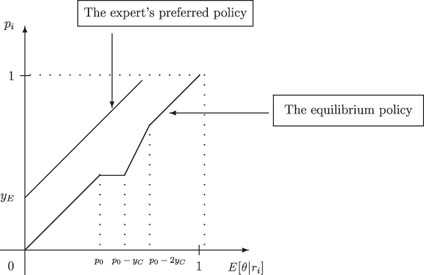
Figure 1 shows the equilibrium policy in the presence of judicial review when y E >0>y C for some location of the status quo policy p 0. Note that the policy maker can choose her preferred policy, p i =E[θ|r i ], if E[θ|r i ]≤p 0 or if E[θ|r i ]≥p 0−2y C so in these situations the presence of judicial review makes no difference for the amount of information transmitted in equilibrium (relative to the game without judicial review). However, the presence of judicial review constrains the choice of the policy maker to induce a policy further from the expert’s preferred policy if p 0<E[θ|r i ]<p 0−2y C , as described by the policy maker’s optimal strategy (3). In these instances, the expert transmits less information than in the equilibrium without judicial review because there is a wider wedge of preference between the expert’s preferred policy and the policy resulting from the veto bargaining.
The expert’s preferred policy and the equilibrium policy

Next, we compare the court’s and the other players’ utilities in the equilibrium with and without judicial review when the policy maker is the median player. We have the following result:
Proposition 3: (1) If y E >0>y C , the court’s utility may be higher, lower or the same in the institutional setting without judicial review as compared with the institutional setting with judicial review. (2) If y E >0>y C , the expert’s utility and the policy maker’s utility is at least as high in the institutional setting without judicial review as compared with the institutional setting with judicial review.
Recall that we can decompose a player’s expected utility into informational losses and distributional losses. From the court’s perspective, the power of judicial review mitigates the court’s distributional losses, allowing the court to reject policies that are unfavorable relative to the status quo policy. However, the court’s informational losses are increased because the expert, facing a greater divergence between her preferred policy and the policy actually chosen, withholds more information in the institutional setting with judicial review. Depending on which of these effects dominates, the court may be either better or worse off with judicial review.
The intuition for why the expert’s and the policy maker’s utility are (weakly) higher in the institutional setting without judicial review is as follows. Proposition 2 shows that the informational losses are (weakly) higher in the institutional setting with judicial review. And because the court can use its veto power to reject policies that are worse than the status quo (form the court’s perspective), the distributional losses are also (weakly) higher for the expert and the policy maker if y E >0>y C .Footnote 23 Because both the informational and the distributional losses are (weakly) higher in the institutional setting with judicial review for the policy maker and the expert, these players are weakly better off without judicial review.
Proposition 2 shows that judicial review can have a detrimental effect on information available for policy making if y E >0>y C , thus suggesting an expertise rationale for judicial restraint. At the same time, Proposition 3 indicates that the court itself is better off without the power of judicial review if informational losses outweigh distributional losses. This suggests that courts can have endogenous incentive to limit the exercise of judicial review if judicial review has a detrimental effect on policy expertise.Footnote 24
The Court is the Median Player, y E >y C >0
Next we consider the situation in which the court is the median player, y E >y C >0. Below we present an example to illustrate the positive effect of judicial review on information available for decision making in this scenario.
Example: Consider the following parameter values:
 $y_{E} {\rm =}{1 \over {20}}$
,
 $y_{C} {\rm =}{1 \over {30}}$
, and the status quo
 $p_{0} {\rm =}{1 \over {30}}$
. Given these parameter, we compute the most
informative (partition) equilibrium with and without judicial
review.
Policy Making without Judicial Review
The most informative equilibrium without judicial review is characterized
by the intervals
 $\left[ {0,{2 \over {15}}} \right)$
,
 $\left[ {{2 \over {15}},{7 \over {15}}} \right)$
and
 $\left[ {{7 \over {15}},1} \right]$
, which partition the range of values of
θ into three regions. The expert sends a different
report, r
1, r
2 or r
3, depending on whether θ lies in the first,
second or third interval respectively. Since there is no judicial review,
the policymaker chooses her preferred policy based on the information
learned from the expert. For instance, if report r
1 is sent, the policymaker knows that θ must
lie between 0 and
 ${2 \over {15}}$
, and she will choose policy
 $p_{1} {\rm =}{1 \over {15}}$
(the mid-point of the interval) to minimize her
distributional losses. And in response to reports r
2 and r
3 the policymaker will choose policies
 $p_{2} {\rm =}{9 \over {30}}$
and
 $p_{3} {\rm =}{{11} \over {15}}$
respectively. The informativeness of this equilibrium
is
 ${\minus}\upsilon ar\left[ y \right]{\rm =}{\minus}0.0{\rm 1592593}$
.
Policy Making with Judicial Review
The previous equilibrium cannot be an equilibrium in the institution with
judicial review, because in the second interval the court would veto
policy p
2 in favor of the status quo
 $p_{0} {\rm =}{1 \over 3}$
, which is in fact the court’s preferred policy. This in
turn induces the expert to prefer sending the report r
1, suggesting that θ lies in the first
interval, for values of θ of
 ${2 \over {15}}$
and slightly higher. The most informative equilibrium
with judicial review is characterized by the intervals
 $$\left[ {0,{7 \over {45}}} \right)$$
,
 $$\left[ {{7 \over {45}},{{22} \over {45}}} \right)$$
and
 $\left[ {{{22} \over {45}},1} \right]$
, resulting in politics
 $p'_{1} ={7 \over {90}}$
,
 $p'_{2} ={{29} \over {90}}$
, and
 $p'_{3} ={{67} \over {90}}$
. Note that in the most informative equilibrium with
judicial review, the boundary of the first interval shifts to the right
(relative to the equilibrium without judicial review), pushing the second
interval to the right as well. The informativeness of this equilibrium is
 ${\minus}\upsilon ar\left[ y \right]{\rm =}{\minus}0.0{\rm 1452675}$
.
The previous example shows that judicial review increases the amount of information transmission. Proposition 4 below shows more generally that judicial review can only increase the amount of information available for policy making when y E >y C >0, regardless of the position of the status quo p 0.
Proposition 4: If y E >y C >0, the amount of information available for policy making is (weakly) higher in the institutional setting with judicial review as compared with the institutional setting without judicial review, regardless of the location of the status quo policy p 0.
The intuition behind Proposition 4 is as follows: When the court is the median player, in certain situations, judicial review constrains the policy maker to choose policies that are closer to the expert’s most preferred outcome relative to the equilibrium without judicial review, effectively driving a smaller wedge between the policies chosen by the policy maker and the expert’s preferred policies than in the absence of judicial review. Such closer alignment of effective policy preferences, in turn, induces the expert to reveal more information in the equilibrium with judicial review.
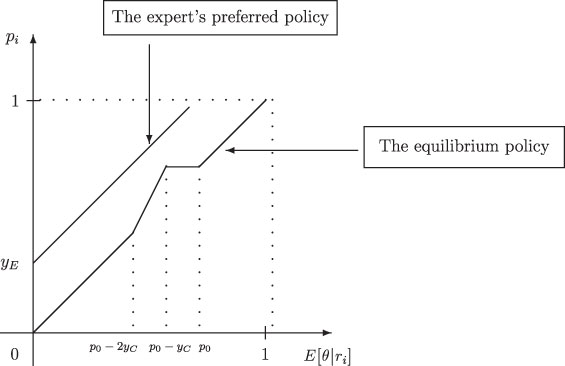
Figure 2 shows the effect of judicial review on the equilibrium policy in this scenario, given some location of the status quo policy, p 0. Again, note that the policy maker can choose her preferred policy, p i =E[θ|r i ], if E[θ|r i ]≤p 0 or if E[θ|r i ]≥p 0−2y C , so in these instances the presence of judicial review makes no difference for the amount of information transmitted in equilibrium (relative to the game without judicial review). However, the presence of judicial review constrains the choice of the policy maker to induce a policy closer to the expert’s preferred policy if p 0<E[θ|r i ]<p 0−2y C , as described by the policy maker’s optimal strategy (3). In these instances, the expert transmits more information than in the equilibrium without judicial review because there is a smaller wedge of preference between the expert’s preferred policy and the policy resulting from the veto bargaining.
The equilibrium policy when the court is the median player

Proposition 4 suggests an expertise rationale for judicial review, even if the courts do not have the knowledge to precisely assess the consequences of various policies. Judicial review can serve as a commitment device to better align the preferences of the policy maker and the expert with the effect of inducing more information transmission from the expert. The institution of judicial review can thus be thought as having an “expertise-forcing” effect,Footnote 25 which implies that there need not be a trade-off between the rule-of-law ideal of checking the legality of policies and the separation-of-powers principle of dispensing policy making to those institutions with superior expertise. In other words, we can reconcile the review of expert policy decisions by non-expert courts in a manner that is consistent with both the desideratum of checking the legality of policies and institutional considerations for policy expertise.
Next, we compare the court’s and the other players’ utilities in the equilibrium with and without judicial review. We have the following result:
Proposition 5: (1) If y E >y C >0, the court’s utility is at least as high in the institutional setting with judicial review as compared with the institutional setting without judicial review. (2) If y E >y C >0, the expert’s utility is at least as high and the policy maker’s utility can be higher, lower or the same in the institutional setting with judicial review as compared with the institutional setting without judicial review.
The rationale for why the court’s (and the expert’s) utility are (weakly) higher with judicial review when y E >y C >0 is as follows. Proposition 4 shows that the informational losses are (weakly) lower in the institutional setting with judicial review. And given that the court can use its veto power to reject policies that are worse than the status quo, the distributional losses are also (weakly) lower for the court (and the expert as well). Because both the informational and the distributional losses are (weakly) lower in the institutional setting with judicial review, the court (and the expert) are (weakly) better off with judicial review.
On the other hand, the judicial review can only increase the policy maker’s distributional losses as compared with the institutional setting without judicial review since the policy maker is unconstrained in that institution. However, judicial review (weakly) decreases the policy maker’s informational losses as compared with the institutional setting without judicial review when y E >y C >0. Depending on which of these two effects dominates, the policy maker may be either better or worse off in the institutional setting with judicial review when y E >y C >0.
Proposition 4 suggests an expertise rational for judicial review as the policy maker makes a more informed policy decision when y E >y C >0. At the same time, Proposition 5 indicates that the court itself is better off in the institutional setting with judicial review, implying that the court lacks incentives to restraint itself to not review governmental policies on grounds of institutional competence. Taken together, these results suggest that courts have incentives to exercise judicial review in those instances in which judicial review has a positive effect on policy expertise.
The Expert is the Median Player, y C >y E >0
Finally, we consider the case in which the expert is the median player, y C >y E >0. This situation essentially combines the previous two scenarios. For some values of y C , judicial review induces the policy maker to choose policies closer to the expert’s own preferred policy, thus increasing the amount of information the expert transmits in equilibrium. However, for other values of y C , the policy maker may be compelled to choose policies further from the expert’s preferred policy (relative to the institution without judicial review), thus reducing the amount of information the expert transmits in equilibrium. As a result, the effect on judicial review on information transmission is ambiguous when y C >y E >0. Likewise, the effect of judicial review on the court’s welfare is similar to the previous cases: when judicial review has a negative effect of information transmission, the court can sometimes be better off restraining its power; and when judicial review has a positive effect on information transmission, the court is better off exercising its power. As such, the results regarding the judiciary’s endogenous incentives to limit or exercise judicial review are similar with the previous two cases. For simplicity of exposition, we relegate the formal analysis of this case to the appendix.Footnote 26
EXTENSIONS AND ROBUSTNESS
We provide two extensions on the basic framework. First, we show that our key results hold for more general bargaining protocols than the veto bargaining (i.e., the court declares a policy legal or illegal) previously analyzed. Second, we show that our analysis can be robust to a setting in which the court does not observe the communication between the expert and the policy maker. These extensions are developed in the “Supplementary material.”
DISCUSSION AND IMPLICATIONS
Our analysis shows that judicial review can induce more informed policy making, even if the courts lack the knowledge to precisely assess the likely consequences of various policies. The analysis contributes to several literatures including a scholarship on the proper role of judicial review in a separation of powers system, doctrinal debates about the practice of judicial deference, and a scholarship on the political economy of judicial review.
First, the argument about restricting the practice of judicial review on expertise grounds implicitly addresses the question of whether judicial review is desirable or not as a balancing exercise between the rule-of-law ideal of checking the legality of policies and the separation-of-powers principle of dispensing policy making authority to those institutions with superior expertise. As such, the expertise rationale for limiting the scope of judicial review seems simple and intuitive: When questions of law are intertwined with matters of fact and policy choice and when the courts are unsure what consequences will follow from a particular decision, judicial second-guessing can throw governmental policies off course. And if the harm to public policy caused by potentially erroneous judicial decisions outweighs the rule-of-law benefits of assessing the legality of policies, it is allegedly desirable to limit judicial review on grounds of institutional competence, especially in technical and complex policy areas such as national security and administrative action.
Notwithstanding the foregoing, restraining the exercise of judicial review for epistemic reasons, some scholars argue, is bound to create a zone of legal unaccountability where governmental power can be deployed in an arbitrary and illegal manner, with potentially deleterious effects for the effectiveness of public law. Because even the most expert body can act unlawfully, foreclosing legal review in certain policy areas amounts to an abdication of the judicial duty to enforce relevant legal limits (Allan Reference Allan2011). The pressing question then is this: Can we reconcile the review of expert policy decisions by non-expert courts in a manner that is consistent with both the rule-of-law ideal of checking the legality of policies and the separation-of-powers concern for policy expertise?
Our analysis shows how the exercise of judicial review can have a beneficial effect on expertise, even if the courts are relatively ill-equipped to evaluate the likely effects of various policies. Not only that it can be desirable solely on expertise grounds to subject governmental policy to the muster of judicial review, but non-expert courts have incentives to employ judicial review in a manner consistent with institutional concerns for policy expertise. In other words, there need not be a trade-off between the rule-of-law ideal of checking the legality of policies and the separation-of-powers principle of dispensing policy making authority to those institutions with superior expertise.
Second, the analysis has implications for normative and empirical legal debates regarding how courts should operate judicial deference in practice. Some judges and scholars maintain that certain judicial deference decisions ought to be precedents entitled to stare decisis effects, at least in policy domains where the relative asymmetry of institutional competence is at its peak (Scalia Reference Scalia1989; Kavanagh Reference Kavanagh2009). Others argue that courts should not follow such bright-line rules of deference in pre-designed policy areas, but rather should consider the benefits and drawbacks of judicial deference on a case-by-case basis (Allan Reference Allan2011). Such doctrinal debates rest on certain positive assumptions regarding judicial incentives of self-restraint. Our analysis shows that courts will not have incentives to always follow a bright-line approach and thus self-abide by pre-established rules of deference, even if they lack the knowledge to evaluate the consequences of various policies. As such, the positive analysis here is more in line with the contextualized approach to a doctrine of judicial deference.
The analysis also has implications for empirical findings about how judges operationalize rules of judicial restraint in practice (Eskridge and Baer Reference Eskridge and Baer2008). Indeed, from a doctrinal perspective, the courts in the United States have enunciated on various occasions that, in the face of legal ambiguity, governmental officials should be afforded considerable latitude in setting policies because of their superior scientific, economic, and national security expertise. For example, the US Supreme Court has issued various methodological opinions such as Chevron and Curtiss-Wright, which some scholars and judges, as mentioned, have interpreted as establishing rules to govern judicial restraint in future litigation (Scalia Reference Scalia1989).Footnote 27 However, empirical analyses indicate that courts do not apply deference precedents in a consistent manner in subsequent cases, suggesting that courts do not give such precedents anything close to stare decisis effect in administrative rulemaking or national security, the emblematic domains of asymmetric institutional competence (Epstein et al. Reference Epstein, Ho, King and Segal2005; Clark Reference Clark2006; Raso and Eskridge Reference Raso and Eskridge2010; Eskridge and Baer Reference Eskridge and Baer2008). Consistent with such empirical findings, our analysis indicates that the judiciary can be better off exercising its power of review in certain circumstances, implying that, in practice, a regime of restraint on expertise grounds is not likely to follow a bright-line manner, but rather a more contextualized approach.
Third, the analysis adds to a political economy literature on judicial review. It does so by showing how the presence of a credible threat of legal review by non-expert courts can improve the quality of decision making on the part of policy makers and by documenting that non-expert courts can have incentives to exercise judicial review in an informative manner. Our analysis complements other studies that document how judicial review can have informational effects. For example, some scholars have argued that situations exist where seeing the policy in force can generate information pertinent to the legality of policies. Landes and Posner (1994) write that when deciding before rather than after the government implements a policy, the court sometimes lacks “the benefits of information generated by the act itself.” Consistent with this view, scholars have developed game-theoretic analyses of situations in which, for sequential reasons, courts have more (ex post) information than legislators regarding the consequences of enacted law because they can see the effects of enacted policies (Rogers Reference Rogers2001; Rogers and Vanberg Reference Rogers and Vanberg2002). In this article, we focus on the effect of judicial review on the quality of (ex ante) information available for policy making to assess the expertise rationale for judicial deference. Future work may investigate the effect of judicial review on policy making while taking into account the fact that the quality of policies depends on both the ex ante expertise available for making informed policy decisions and also on ex post information about the consequences of enacted policies.
The article focuses primarily on analyzing the effect of judicial review from an expertise perspective. Democratic legitimacy is another prominent normative criterion by which scholars assess the place of judicial review in the institutional fabric of democratic societies (Bickel Reference Bickel1962; Kramer Reference Kramer2004; Waldron Reference Waldron2006). Our analysis might be useful to evaluate the institution of judicial review from the perspective of democratic legitimacy as well. When judicial review increases the amount of information available for policy making, Proposition 5 shows that the policy maker is better off in the institutional arrangement with judicial review if the informational losses outweigh distributional losses. As a result, under the assumption that the preferences of the policy maker are closer to the preferences of the citizenry, Proposition 5 suggests that the institution of judicial review can be desirable from a democratic legitimacy perspective under the conditions in which judicial review has a positive effect on expertise. In other words, it is possible that judicial review is desirable both from an expertise as well as democratic legitimacy perspective.