1. Introduction
In 2010, a wave of protests, popularly coined as the Arab Spring, started in Tunisia. Two years later, at the end of the civil uprisings, 17 Middle Eastern, and North African regimes felt at least some pressure from the people in their country, and five countries actually experienced a regime change. In Syria, a multi-sectarian civil war persists since 2011, with the original leader still in power. Presently, only Tunisia has emerged from internal conflict as a democracy. These uprisings resurfaced the question of emerging democracies, and the paths that a nation can choose from their transition into their following consolidation.
The Arab Spring and subsequent global unrest sparked a debate about whether a fourth wave of democracy emerged in the global political arena starting in 2010.Footnote 1 A different source started each wave, but the end result stays the same: a government transitioning from a non-democratic regime to a democratic one. A key issue arises from these emerging democracies, or ‘countries in transition’, about what types of government institutions will be adopted by the new democracies. The emphasis in this paper is placed on what determines electoral rule choice in transitional nations.
This paper considers how economic structure impacts the proportionality of the electoral system, via the electoral rules adopted by a country. A varieties of capitalism (VoC) approach is used to determine if the coordinated market economies (CMEs) and liberal market economies (LMEs) divide exists in transitioning countries by using simple, disaggregated macroeconomic indicators. After, it is predicted that a more coordinated economy will produce more proportional electoral systems. Coordinated economies rely on strategic or non-market coordination, meaning that economic actors work together to achieve results outside of market forces. A liberal economy functions by mainly using market forces to solve coordination problems.
Previous work by Cusack et al. (Reference Cusack, Iversen and Soskice2007, Reference Cusack, Iversen and Soskice2010) found that in Western Europe the economic structure shaped the outcomes of electoral rule choice at the turn of the 20th century. This paper intends to extend the existing theoretical framework to transition countries, including two Arab Spring participants, Morocco and Tunisia, to evaluate electoral rule choice when building new government institutions. The remaining countries studied in this paper include nations from Latin and South America, nations from Sub-Saharan Africa, nations affected by the dissolution of the USSR, and emerging economies in Asia. Specifically, this paper tests if the evolution of the organization and structure of the economy as a country undergoes a political transition impacts its electoral rule system. It is predicted that more coordinated economies, as defined by their macroeconomic characteristics, will lead to more proportional electoral rule systems.
To test this hypothesis, the effective number of parties resulting from legislative elections, which is used as a proxy for the electoral rule system, is regressed on macroeconomic indicators, which are used as proxies for coordination. Next, additional regressions use a democratic sample to witness the differences between non-democratic and democratic regimes undergoing the transition process. This addition is needed since many transitional nations cannot be considered as democratic, and the theoretical framework is set for democratic countries. Although using the democratic sample touches the previous literature more closely, it is an interesting exercise to see how this theory works for countries in general in the developing world, democracies or not.
The findings show that strategic coordination, as measured by basic attainment of education levels, a strong industrial sector, a focus away from exports, which are likely commodity goods, and a weaker reliance on equity markets to access finance, tends to encourage the adoption of proportional representation (PR) electoral rules. The findings are stronger in democracies.
The structure of the paper is as follows. First, the theoretical background on CMEs versus LMEs, the majoritarian and PR electoral rule divide, and the effect of economic organization on electoral rule choices is presented. Second, a brief note about the structure of transitioning economies provides insight into the countries studied in this paper. Then, the data is explained, along with the empirical approach used in this paper. After, the results from the empirical work are given and interpreted. Finally, the conclusion summarizes the findings from this study.
2. Literature review
This paper considers a range of the literature due to the multidisciplinary approach used in this study.
When considering CMEs versus LMEs, Hall and Soskice (Reference Hall and Soskice2001) place the firm at the centre of the analysis. They state that firms are actors seeking to exploit core competencies, or methods to develop, produce, and distribute goods profitably. Capabilities of the firm are relational, so the firm must coordinate with the economic actors connected to the success of the firm. There are five spheres firms need to develop in order to eliminate the coordination problems that arise with the relational nature of the firm: the industrial relation sphere, the vocational training sphere, the corporate governance sphere, the inter-firm relations sphere, and the sphere of employee relations.
Non-market relationships define the way CMEs build and exploit their core competencies. Vocational training systems, technology transfers, labour market regulation, and employee representation characterize coordinated capitalist countries. In CMEs, employers are more prone to cooperating with unions to ensure that the workers are trained with specific skills.
In LMEs, firms coordinate mainly through the competitive market. There is an emphasis on flexible labour markets, which favour general education and skills, and the dismantling of unions. Firms have little incentive to protect their employees, as their employees have no specific skills unique to their firm or industry (Iversen and Soskice, Reference Iversen and Soskice2011).
CMEs and LMEs each have institutional complementarities (ICs) operating across their respective political economic spheres. ICs occur when the presence of one set of institutions raises the returns available from another institution. Amable (Reference Amable2016) states that when jointly present, ICs reinforce one another and improve the function and stability of specific institutional configurations. This becomes quite relevant as ICs imply there is no ‘right way’ of configuring an institutional set up, only that one institutional presence in an economy impacts another.
Development on the VoC literature came after the realization that many countries did not fit into either the CME or LME category. After recognizing that a type of ‘mixed market economy’ (MME) exists, scholars such as Amable (Reference Amable2003) extended the VoC theory to include more classifications, such as the Market-based Model, the Social-Democratic model, the Continental European Model, Mediterranean Model, and the Asian Model.
However, the inclusion of MMEs and additional categories still largely focus on developed countries. Others have created theories to explain the type of capitalism in Latin America (Bizberg, Reference Bizberg2014) and East Central Europe (Nölke and Vliegenthart, Reference Nölke and Vliegenthart2009). Although the inclusion of developing countries using new categories provides insight into workings of the respective countries or regions, the new VoCs are, in most cases, extremely specific and are limited regionally. Thus, a gap in the VoC literature exists, for it is still unknown whether the theory built around advanced democracies can be applied to developing or transitioning countries.
The VoCs are linked to political institutions. Before considering political institutions, however, one should first understand how democracies are shaped. Lijphart (Reference Lijphart1999) divides democracies into two separate camps: majoritarian democracies and consensus democracies. The camps are defined by the underlying belief of to whom governments are responsible. Majoritarian countries believe the government should be accountable to the majority of the people, while consensus governments should be accountable to ‘as many people as possible’. Lijphart finds that consensus governments tend to multi party systems with PR, while majoritarian governments tend to two party systems with higher levels of disproportionality.
Cusack et al. (Reference Cusack, Iversen and Soskice2007) extend this idea by explaining how the economic structure of a country influences the choice of electoral rules. Cusack et al. (Reference Cusack, Iversen and Soskice2007) find that when looking at advanced democracies, countries with coordinated economies at the end of the 19th century tended to develop PR electoral rules at the turn of the 20th century. On the other hand, the nations with LMEs tended to develop majoritarian electoral rules.
Cusack et al. (Reference Cusack, Iversen and Soskice2007) conclude that the origin of PR came from the movement of economic networks from a local to national level. With coordinated local economies, a common interest existed in a regulatory system and some form of insurance against specific assets with respect to skill acquisition. The incentives and opportunities for class collaboration inspired the PR system.
Cusack et al. (Reference Cusack, Iversen and Soskice2010) show this logic also works in the short run. Countries with organized economic interests leads to specific groups wanting their interests represented in the legislature. The short run argument aligns up with the long run analysis because a political economy that starts with heavy investment in co-specific assets will be comprised of representative parties. PR is the preferred electoral system when parties are representatives of specific interests.
Conversely, majoritarian systems keep their electoral system in place because their political economy is starting off with investments in general assets, and therefore want an electoral rule system that benefits broad campaigns that target the support of a ‘middle’ group. In the short run, economies comprised of weakly organized interests will opt to maintain the majoritarian electoral rule system in order to best protect the middle class interest.
Including the short run analysis in the argument is crucial because it extends the investigation to a set of newly democratizing countries and their choice of electoral systems.
3. Theory
This paper tests the work of Hall and Soskice (Reference Hall and Soskice2001) and Cusack et al. (Reference Cusack, Iversen and Soskice2007, Reference Cusack, Iversen and Soskice2010) on a sample of transitioning countries. The literature on the types of capitalism, and the following adoption of electoral rules for advanced democracies is well known, but little exists about how economies in transition adapt and then evolve their political institutions, notably their electoral rules.
In general, the concepts derived from the work by Cusack et al. (Reference Cusack, Iversen and Soskice2007, Reference Cusack, Iversen and Soskice2010) are applied to this study. There are, however, a few notable exceptions. The first exception comes from the nature of national continuity. Where advanced democracies have experienced decades of stability, developing nations may have been disrupted by colonization or civil wars.
A second issue arises from variable choice. For example, Cusack et al. (Reference Cusack, Iversen and Soskice2007) considered the presence of traditional guilds to increase the level of coordination in the economy. However, transitional countries have experienced ruptures in their economies that have hindered the development of traditional guilds. An example of this is the economic reorganization of colonized countries to serve their parent country, such as how the Belgian government set up extractive institutions in the Congo (Acemoglu et al., Reference Acemoglu, Johnson and Robinson2001). For this reason, variable selection may differ in this analysis.
Other variables to consider arise from development economics. Development economics often focuses on how certain macroeconomic indicators impact democracy and the democratic transition. Advocates of modernization theory state that as a country develops, by increases in the levels of education and income, it will become more democratic.
If indicators such as education or other macroeconomic variables can impact the evolution of democracy, then they might also help in understanding how the structure of the economy, as it is formed by macroeconomic variables, can impact the path of democracy of a transitioning country.
4. Data and empirical approach
Sample selection
The database constructed for this study includes 65 countries selected from the Bertelsmann Transformation Index (BTI) from Bertelsmann Stiftung. Every country in the BTI was used in this database if there was also available election data and economic data for the respective country. The countries used are shown in the appendix. Overall the BTI includes 129 countries. The election data comes from the Parline database supported by the Inter-Parliamentary Union, an organization that works closely with the United Nations.
The time period for this study ranges from 1995 to 2012. This period was chosen due to the ability of data and due to the characteristics of the countries included in this study, notably that many countries formed only in the 1990s.
The effective number of parties
Effective number of parties (effnops). The dependent variable is the effective number of parties resulting from legislative elections. In the case of bicameral legislatures, all election data came from the lower house. A unicameral legislature is a legislative system with only one body of parliamentary members, for example the Danish parliament, the Folketing. A bicameral parliament is a legislative system that has two houses, the lower house, which typically is bestowed with more power, and the upper house. An example of a bicameral legislative system is the United States with the House of Representatives (lower house) and the Senate (upper house). This variable is intended to proxy the electoral rule systems studied in the literature: PR and majoritarian.
There are differences between the proxy used in this paper and the actual electoral rules of a system. An electoral rule is an ex ante tool to allocate seats in a legislature. The effective number of parties is an ex-post number indicating the fragmentation of a legislature. A more fragmented legislature represents a more proportional legislature because each different fragment represents a separate entity. This proxy works by indicating that a high number means the system tends toward PR, while a lower number indicates a majoritarian system with a smaller number of effective parties.Footnote 2
The effective number of parties can be found by measuring either votes or seats gained by each party that arise from an election. This paper uses the number of seats. The variable is calculated by
 $$\begin{equation*}
\frac{1}{{\sum {s_i^2} }}
\end{equation*}$$
where s represents party i’s proportion of the vote. This measure provides a more realistic representation of seats in a parliament because it places a higher weight on parties with many more seats than on parties with few seats (Benoit, Reference Benoit2001). The number 4.14 implies that the party system is ‘in effect’ as fragmented (proportional) as if there were 4.14 identically sized parties.
This variable was chosen due to the availability of data and because of the abundant use of the effective number of parties as a measure of proportionality in the literature. It should be noted that criticism of the index has come up,Footnote 3 and another measure of proportionality, the effective electoral threshold, is often said to be a stronger measurement tool. However, as Gallagher (Reference Gallagher1991) points out, no single method is uniquely accepted as a means to measure proportionality.
Lastly, using OECD data, the two variables tend to correlate to one another, such that a more proportional system will have a lower effective electoral threshold and a higher number of effective parties. The correlation coefficient is −0.67 and a regression run using the OECD data shows that the p value is significant at one percent and the R-squared value is 0.4426. Thus, the effective number of parties is regarded as the best available variable for this study.
The effective number of parties changes with each election year, and then stays the same throughout the database until the next election year for a specific country.
Independent variables
The goal of this paper is to witness how the level of economic coordination, whether it reflects either a CME or LME, impacts the choice of electoral rules. The independent variables represent economic coordination within a country. Measuring economic coordination can be tricky to define in the empirical and in the literal sense. Indeed, Hall and Gingerich (Reference Hall and Gingerich2009) state that coordination is not perfectly measured in the political economic literature. The use of five macroeconomic variables avoids the problems of using coordination indices, outlined in detail below, by evaluating the performance of the economy as suggested by the actual level of the coordination in the economy, not the way in which an index suggests the level of coordination should be.
The first attempt to analyse the connection between proportionality and coordination was made by using a compilation of economic coordination indicators found in the Institutional Profile Database (IPD).Footnote 4
The compilation of the economic coordination index uses four key economic coordination variables that are found in the IPD (2012), which included 143 countries in the 2012 round. These variables include the independence and pluralism of trade unions, redeployment and retraining mechanisms for employees and continuous vocational training, employment contract protection, and the effectiveness of social dialogue at a company level, a national level, and a branch level. Each of the separate components of coordination also has a positive relation with the proportionality of the electoral rule system, but in order to give a more encompassing view, the four indicators were combined. A score of 0 represents very weak or absent non-market coordination, whereas a score of 4 represents a high level of non-market coordination. The effective number of parties measures the proportionality of the electoral system.
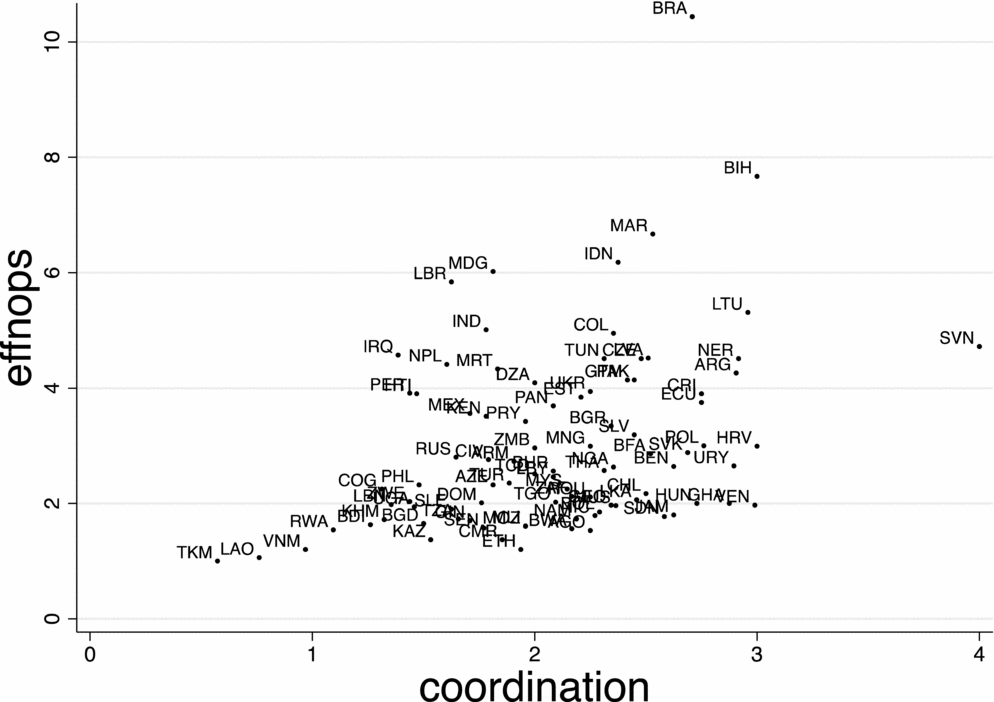
The graph shown in Figure 1 includes 91 countries.Footnote 5 In the northeast quadrant of the graph, the section of the graph with a higher number of effective parties and a higher ranking of coordination, all countries have adopted PR systems. The most southwest quadrant of the graph, the part including Turkmenistan, Laos, Uzbekistan, and Vietnam, includes countries that have adopted majoritarian electoral rules, as stated by the Database for Political Institutions.
Correlation between the number of effective parties and coordination.

Figure 1 shows the correlation between the effective number of parties and the coordination variables from the 2012 version of the IPD for the full sample of countries. When the effective number of parties is regressed on coordination, the result is positive and significant at a one percent level. The correlation coefficient is 0.3665.
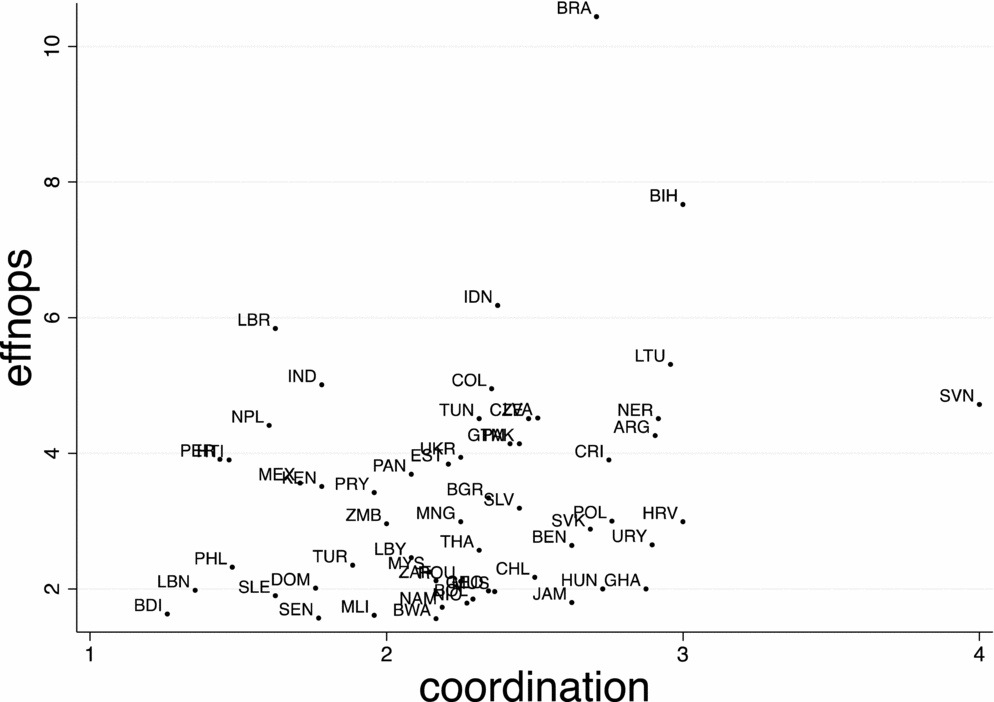
However, many of these countries in the southwest quadrant of Figure 1, notably the specific ones mentioned above, are not authentic democracies. For this reason, the graph shown in Figure 2 includes 57 countries, which represent the democratic sub-sample from the database. The southwest quadrant shows a mixture of electoral rules, but in the section of the graph corresponding to the countries with the highest level of coordination and the highest number of effective parties, only PR electoral systems remain. The data suggests that there is a tendency for high coordination in an economy and a large number of effective parties to correspond with proportional electoral rules.
Correlation between the effective number of parties and coordination for the democratic sub sample.

Figure 2 shows the correlation between the effective number of parties and the coordination variables from the 2012 version of the IPD for the democratic countries. When the effective number of parties is regressed on coordination, the result is positive and significant at a five percent level. The correlation coefficient is 0.2705.
To improve the understanding about the relationship between the effective number of parties and the economic coordination of a country, a regression analysis is used in this paper.
Coordination indices are often advised when studying economic coordination. For example, Botero, et al. (Reference Botero, Djankov, La Porta, Lopez-de-Silanes and Shleifer2004) builds coordination indices for 85 countries based off of employment, collective relations, and social security laws. These indicators are beneficial for studying more developed countries, but may overestimate the strength of coordination in an economy for the cases of developing or transitioning countries for a few reasons.
First, instead of one index, a panel database shows how the economic structure impacts the proportionality of the electoral rule system over time. Also, these coordination indices are usually built after the beginning of the democratic transition.
The next drawback of indices is that written laws may be carried out differently in practice than what is stated in written form. For example, in Mozambique, a law formed in 1990 strongly protected the rights of workers, but this law was limited because the way the companies behaved (misrepresentation of company performance, mismanagement) hindered the performance of unions. Often, the laws in the rulebooks of developing nations are not enforced or formally respected (Dibben and Williams Reference Dibben and Williams2012).
A third drawback when using a coordination index for this study unfortunately applies to the work done in this paper as well. Transitional countries often have a large proportion of informal labour. An International Labour Organization (ILO) report using 40 countries, 37 of which are in this study, evaluates the severity of informal labour. Out of the 37 countries which overlap between the two studies, 19 countries have over a 50 percent share of informal jobs in total employment, over a 50 percent share of people employed in the informal sector, or over a 50 percent share in both of these categories. When lowering the threshold to 30 percent, 29 countries fall into one of these three categories.Footnote 6
Additionally, Webster et al. (Reference Webster, Wood and Brookes2006) state that in sub-Saharan Africa, a region featured in this paper, there is a reliance on personal networks in the labour market that favour local practices over lawful ones, such that even when labour unions are present, their impact on practices in the workplace is likely to be limited in scope. For example, the 1998 Labour Law in Mozambique provides workers a sufficient level of job security and collective bargaining rights, but this law is exclusive of casual workers. To avoid being subject to the 1998 Labour Law, firms increasingly began to classify their employees as casual workers.
This means that despite having laws that provide (or discourage) coordination between the firm and its employees or unions, a significant amount of the work force is not ruled by the legal framework, making the coordination indices less useful.
Due to the problems outlined above and insufficient coordination data on transitioning countries, the strategy used in this paper is to evaluate how coordinated economies impact certain macroeconomic indicators, and then use these indicators as proxies for coordination.
The macroeconomic variables serving as the independent variables in this study come from the World Development Indicators database by the World Bank.
Exports.Footnote 7 Cusack et al. (Reference Cusack, Iversen and Soskice2007, Reference Cusack, Iversen and Soskice2010) state that skill-based exports of goods and services, as a percentage of GDP, should have a positive relation to electoral proportionality. Exports within the industrial sector levy a premium on the ability of firms to differentiate their products, thus encouraging firms to take advantage of specific skills. Cusack et al. state that a strong export sector works as an indicator of the necessity for compromises over wages and training, which is a known feature of coordinated economies.
However, in this paper the majority of the transitional countries are commodity exporters. If a country has a significant export sector, but is largely exporting commodity goods, this could reflect a lack of coordination in the economy, as workers are not required to have high levels of skills to work for firms focused on commodities. Exports should be negatively related to the effective number of parties.
Primary. Primary education, as measured by the total primary completion rate,Footnote 8 is expected to have a positive relation to the effective number of parties in this study.
Turner (Reference Turner2006) states that CMEs have institutions that limit the amount of educational inequality. Moreover, the mean percentage of GDP spent on social expenditures, a category that includes public education, is higher in CMEs than in LMEs.
Iversen and Soskice (Reference Iversen and Soskice2009, Reference Iversen and Soskice2011) add to this concept by finding that there is more education equality in CMEs, and that educational performance is better in CMEs at the lower end of the scale. In CMEs, those with little formal education earn higher education scores as compared to their counterparts in LMEs. The link between basic educational attainment is related to the prevalence of vocational training in CMEs. Further, they conclude that businesses in CMEs require relatively high levels of literacy and numeracy, even for those from poorer backgrounds, in order to invest in further training in their workers. In LMEs, there is an increasing need for higher education, which by extension means that those who achieve a higher education also passed the primary level, but this achievement comes at the cost of increasing inequality in educational outcomes in these countries. Since the amount of educational inequality is minimized in CMEs, there should be an overall higher number of people who achieved a primary education.
Moreover, Hall and Gingerich (Reference Hall and Gingerich2009) state that training systems in CMEs build off what the workers employed by a firm achieve in formal schooling before employment. Since having a primary education is a base on which to build these skills, a high level of primary education will be encouraged in CMEs and positively impact electoral system proportionality.
Manufacture. As a proxy for the level of industrialization, the amount of manufacturing as a percentage of value added to GDP is predicted to have a positive relation to the effective number of parties. Countries with high levels of industrialization face the greatest need to organize and coordinate their economic activities. Jo Martin and Swank (Reference Jo Martin and Swank2012), who focus on the role of business associations and labour market coordination, state that the leaders of industrialization incur the greatest need to organize to obtain economic order, and therefore higher manufacturing shares of total economic output should tend to encourage higher levels of business organization. In addition, firms in manufacturing require a more skilled labour force to produce their product. Manufacturing firms provide specific training to their workers, and workers will demand insurance for the skills in which they have developed. For this reason, manufacture should positively impact proportionality.
Unemployment.Footnote 9 Kenworthy (Reference Kenworthy2002) analyses the relationship between corporatist countries and unemployment. Corporatist countries, due to the emphasis on bargaining and negotiation, align with the CMEs. Kenworthy states due to wage restraint, many studies have shown a connection between low unemployment and corporatist countries. He finds a relation between countries with coordinated wage-setting agreements and low unemployment in the 1980s for OECD countries. This relation continues into the 1990s, but the reasoning behind the relationship changes. In the 1990s, the link between corporatist countries and low unemployment is because of union participation in policy making instead of wage coordination.
Turner (Reference Turner2006), with a similar study, finds that in the OECD during the 1980s in CMEs, unions traded wage restraint for employment, which limited the amount of unemployment in the economy.
In a more time-consistent manner, Pontusson (Reference Pontusson2005) provides a convincing argument for the relationship between coordinated economies, or as he names them, social market economies (SMEs), of advanced democracies and unemployment. Pontusson divides the category of advanced democracies in to Nordic SMEs, Continental SMEs, and LMEs. He uses this division to visually display unemployment performance across five different time periods, 1980–1984, 1985–1989, 1990–1994, 1995–1999, and 2000–2003. In three time periods out of five, from 1980–1994, the average unemployment in both Nordic and Continental SMEs was lower than in LMEs. After taking the average of the unemployment levels for Nordic and Continental SMEs, the unemployment level becomes lower for SMEs as a group than the LME category across all five periods. Pontusson admits that LMEs have succeeded in lowering unemployment in this time period, but his analysis clearly shows that, overtime, coordinated economies succeeded in maintaining lower levels of unemployment compared to liberal economies. This finding aligns with the theory of coordinated capitalism, as the economy-wide collective bargaining practice found in CMEs encourages wage restraint, which may help improve the trade-off between unemployment and inflation. Also, unemployment benefits, a notable feature of CMEs, are linked to lower levels of unemployment in coordinated economies.
For this reason, unemployment is predicted to have a negative relation to the effective number of parties.
Capital. The variable capital stands for the market capitalizationFootnote 10 of listed domestic companies, as a percentage of GDP, and can be thought of as a proxy for the stock market. Hall and Soskice (Reference Hall and Soskice2001) consider that firms must be able to raise finance as a key component of VoCs. Firms operating within a liberal economy typically use bond and equity markets for external finance more often and more intensely than in coordinated economies. Jackson and Deeg (Reference Jackson and Deeg2006) extend this idea by stating LMEs are more market-based than CMEs, and work in more securities-market oriented systems. Conversely, CMEs tend to be bank based, as bank-based systems are likely to support investment in non-tangible assets, like employee training. Hall and Gingerich (Reference Hall and Gingerich2009) state CMEs ability to access finance is linked to their reputation rather than their share value, whereas LMEs tend to rely on large equity markets.
Hall and Gingerich note that recently CMEs have placed more emphasis on the stock market when attempting to access finance, but this pattern holds true for LMEs also. In liberal countries there is a greater reliance on market capitalization compared to bank-based means of accessing finance, even if CMEs are starting to rely more on equity markets. For this reason, capital should be positively associated with more liberal economies, and therefore should inversely related to coordinated economies. Capital should have a negative relation to the effective number of parties.
Included in extended versions of the model are two dummy variables that account for change in the electoral system. First, is a dummy variable that accounts for if the year in question was an election year. Electionyear takes the value of 1 if the country considered held an election that year, and the value of 0 otherwise. The presence of an election year is not expected to influence the proportionality of the electoral system.
Secondly, the variable overthrow is a binominal variable, taking the value of 1 if there was a non-democratic change in leadership during the year considered. The data for overthrow comes from the Centre for Systemic Peace database on coup d’état events (Marshall and Marshall, Reference Marshall and Marshall2016).
Overthrow is expected to be negatively related to the effective number of parties in a country, because a non-democratic means of leadership change reflects a power-grab within the country. In any situation where the government cannot control power changes within its borders, the strength of cooperation and ability to proportionally represent the people of the country is greatly weakened.
A third dummy variable indicating whether a country actually has adopted a PR electoral system, pr, is included in the last model in this paper. The pr variable takes the value 1 if the electoral rule system is a PR system, and takes the value 0 if otherwise. The inclusion of this variable is a simple robustness check to see that, indeed, the PR system is associated with a higher number of effective parties.
Empirical strategy
In this paper, both a fixed effect (FE) regression and a random effect (RE) regression were run for the primary model. Only comments about the FEs model are made due to the empirical goals in this paper. A FE model is used when interested in analysing the effects of variables that vary over time because it takes out the country specific characteristics that do not vary over time in order to make an assessment of the net effect of each independent variable on the dependent variable. However, the results from the FE estimation and the RE estimation are largely comparable.
In order to correct for potential endogeneity, the primary model is improved by using a lagged five-year moving average for the independent variables. In additional to the potential endogeneity, panel heteroskedasticity, and autocorrelation are accounted for by using a panel-corrected standard error model. Finally, the model is run using the full sample and a democratic sample. Testing the model using a democratic sample is more credible, as it aligns more closely with the original literature corresponding to the advanced democracies. The specifics of the empirical strategy are outlined further in the results section.
5. Results
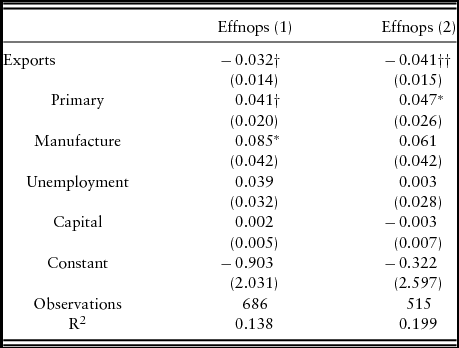
The primary model for this paper is a FE model that regresses the effective number of parties on the five macroeconomic indicators selected for this study: exports, primary education completion rate, manufacturing, the unemployment rate, and the market capitalization. The FE results for the primary model are shown in Table 1, with column one showing the results using the full sample, and column two showing the results using the democratic sample. A country is considered democratic if it scores a six or higher on the Polity IV index. In 2012, 46 out of the 65 countries considered in this paper scored a six or higher on the Polity IV index. When considering the time period 1995 to 2012, 52 countries scored a six or higher on the Polity IV index for at least one year. In order to take into consideration that the Polity IV score may change for a country in this sample, and drastically at that, an average of the Polity IV index is taken for each country and a separate model is run using this score as the democracy benchmark. The results are shown in the appendix. As there are significant data constraints for this set of countries, these results should be seen as a first attempt to uncover if and how the economic structure of a transitioning country impacts their electoral rule system.
The determinants of the effective number of parties (FE model)

Table 1 shows the regression results for the fixed effects model. The effnops is the dependent variable, standing for the effective number of parties. The first column represents the results from the full sample, and the second column represents the results for the democratic country sample.
The standard errors are in parenthesis.
* p < 0.10; †p < 0.05; ††p < 0.01
Exports is negative with five percent level of significance in column one and a one percent level of significance in column two.
The primary completion rate, primary, has a positive sign and is significant at a five percent level in the first column and a 10 percent level in the second column. In coordinated economies, educational inequality should be minimized, and the amount of people with a primary education should be maximized. This finding aligns with the hypotheses made above.
Manufacture and unemployment are positive. Manufacture is significant at a 10 percent level when using the full sample, but not with the democratic sample. Due to the organizing quality of coordinated economies, industrialization, for which manufacturing is a proxy, is facilitated. Industry requires a high level of organization and cooperation, and is thus will be stronger in economies with high levels of coordination. Unemployment is not significant in either model. Capital is positive in column one and negative in column two, but not significant.
It is argued that the economic structure influences the number of effective number of parties in a country, but one could instead consider that it is the type of electoral system that impacts the economy. To account for the potential endogeneity issue, five-year lags for the macroeconomic indicators are used to evaluate the effect of the economic structure on the proportionality of the electoral system.
A five-year lag allows enough time to see the impact of the economy on the proportionality of the electoral system, but is still short enough that it does not damage the integrity of the 18 year time frame of the study.
After accounting for a potential endogeneity problem, another issue arises. The independent variables change from year to year, for example, unemployment can increase or decrease by a significant percentage one year to the next. However, the effective number of parties stays stationary until the next election for each country. This means that a stationary dependent variable is often being regressed on the independent variables changing annually. To account for this, moving averages, created for each independent variable, are used. To be consistent with the previous analysis, a 5-year lagged moving average is used. For example, if one considers the variable unemployment at time t, the moving average associated with it is composed of the average of unemployment of the previous five years, t-1, t-2, t-3, t-4, and t-5.
With panel data, it is often advised to work under ‘panel error assumptions’, notably that panel data is subject to panel heteroskedasticity and autocorrelation. Following the suggestion of Beck and Katz (Reference Beck and Katz1995), a model using panel-corrected standard errors (PCSE) corrects for these issues. The PCSE model is shown in Table 2 for the full sample, and Table 3 for the democratic sample. The PCSE model is more appropriate for this study, as it corrects for any potential autocorrelation and heteroskedasticity.
The determinants of the effective number of parties (PCSE model, full sample)
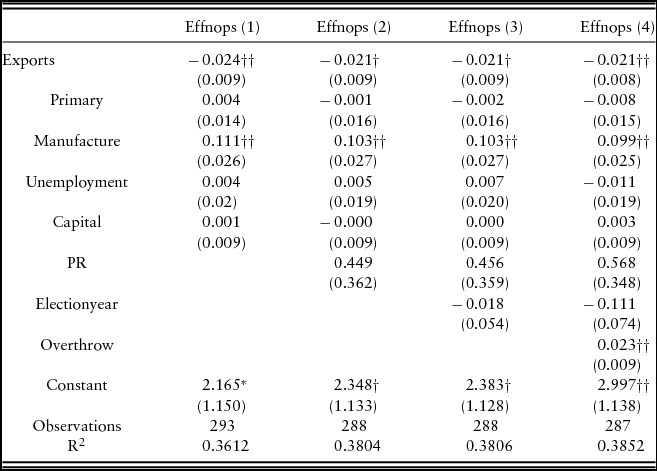
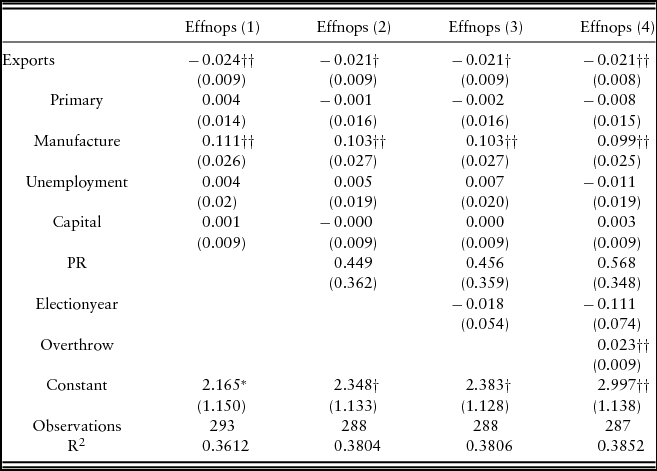
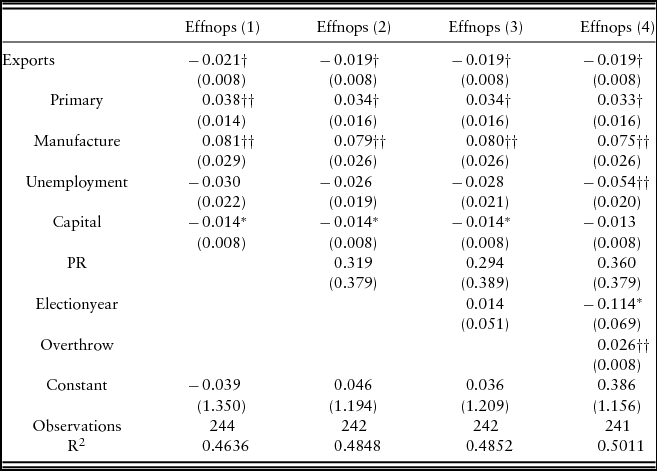
Table 2 shows the regression results for PCSE model using the full sample. The effnops is the dependent variable, standing for the effective number of parties. The first column is from only the five macroeconomic independent variables, the second column adds pr, the third column adds electionyear, and the fourth column adds overthrow.
The standard errors are in parenthesis.
*p < 0.10; †p < 0.05; ††p < 0.01
The determinants of the effective number of parties (PCSE model, democratic sample)

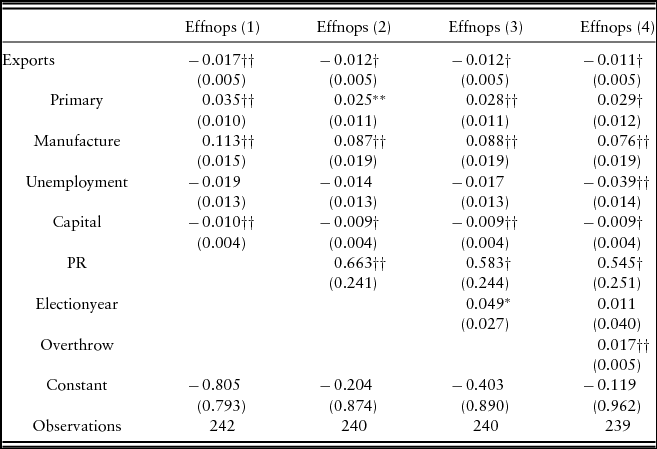
Table 3 shows the regression results for the PCSE model using the democratic sub-sample. The effnops is the dependent variable, standing for the effective number of parties. The first column is from only the five macroeconomic independent variables, the second column adds pr, the third column adds electionyear, and the fourth column adds overthrow.
The standard errors are in parenthesis.
*p < 0.10; †p < 0.05; ††p < 0.01
In Table 2, column one contains the five macroeconomic independent variables, column two adds the dummy variable pr, which indicates if a country has a PR system, column three adds the dummy variable electionyear, which indicates if the year in question in the times series was an election year, and finally column four adds the dummy variable overthrow, which indicates if the year in question in the time series experienced a non-democratic change of leadership. This manner of structuring the regression is used for the remainder of this paper.
In the PCSE model using the full sample, exports is negative and significant at a one percent level for columns one and four, and five percent level for columns two and three. The primary completion rate is, contrary to expectations, negative in second to fourth columns. Notably, it is not significant. Manufacture is positive and significant at a one percent level across the columns. Unemployment is positive in the first three columns and negative in the last column, but not significant. Capital is negative in only the second column, but it is not significant in model two. The PR dummy variable is positive, but not significant. The variable electionyear is negative, but not significant. Overthrow is positive, which goes against the original prediction made in this paper, and significant at a one percent level.
The democratic sample, shown in Table 3, shows a slightly different picture from the full sample. The variable exports is negative and significant at a five percent level across all columns. Primary is now positive, as predicted, and significant at a one percent level for the first specification run, and a five percent level for the following ones. Manufacture is also positive and significant at a one percent level for all columns. Unemployment is negative, but only significant in column four. Capital is negative, as predicted, and significant at a 10 percent level across all regressions run under this model with the democratic sample except for in column four.
The variable overthrow is positive and at one percent level in the last specification. The sign of this variable is the opposite of what was predicted. It could be that the non-democratic change in leadership is coming from a popular democracy movement in order to change an authoritarian ruler. This motivates strong support from a variety of different parties and classes in the country. Thus, if the year in question is a year of a successful popular revolution, it could end up being more proportional. The variable electionyear is negative and significant in column four at a 10 percent level. It was predicted that if a year happened to be an election year, there should be no effect on the proportionality of the electoral system.
It is notable that pr is not significant in this regression, as a PR electoral rule system should indeed be more proportional. Using a feasible generalized least squares (FGLS) regression, shown as a robust check for the democratic sample in the appendix, the pr variable becomes significant. However, it is not advised to use the FGLS model in cases where N > t, or in cases where the number of panels is larger than the number of time series. The FGLS models should be therefore interpreted with caution.
From this set of regressions it is shown that in democracies exports is negative and significant. This result is similar to the findings from the models run with the full sample. This paper considered that the sign of exports might be reversed to what is expected by the traditional theory due to the composition of exported goods from developing countries. Unfortunately, the data does not indicate what type of goods are being exported, but the findings do suggest that, whatever they may be, the mechanism at work is different to that of advanced democracies. The idea put forth after this finding is that many developing countries tend to rely on commodity based exports. The extraction or production of such goods does not require a high level of skills or an advanced organized economic structure.
From the models using the democratic sample it is shown that the primary completion rate and manufacturing strength of an economy positively influence the proportionality of the electoral rule system. This finding complements the predictions made in this paper, as more coordinated economic systems should have a lower level of educational inequality, and thus actively promote basic education to all citizens, a need for a basic minimum level of education, on which specific skills can be built, and economic activities that thrive from organization and cooperation, like the manufacturing sector.
Notably, primary was not significant in the full sample, which included non-democratic transitioning countries. This finding may emerge because democracies typically have stronger and more inclusive institutions, which are able to translate equipped citizens into productive sectors. Manufacture still remained relevant in the full sample, indicated that it is indeed an important component for improving the proportionality of the electoral system across economies in general.
From the democratic sample, the next key indicators that successfully explain proportionality in the electoral system are the unemployment rate and the capitalization of the market. The finding that unemployment is negative comes from the theory that coordinated economies tend to have lower levels of unemployment. This tendency found in CMEs positively influences electoral rule proportionality. The variable capital also has a negative relation to the effective number of parties, or proportionality of the electoral rule system. The negative relation comes from the idea that economies that do not rely on the market to coordinate activities tend to have a weaker reliance on market capitalization, and instead they use a more bank-based approach when attempting to gain access to finance.
Comparing the results from the full sample, where unemployment and capital are not significant, to the results from the democratic sample, noted above, these variables corresponding to coordinated economies are evidently stronger in democracies. This finding makes sense, since democracies tend to be more capitalistic than non-democracies (for example, autocracies or dictatorships where an elite controls the market), and also because democracies tend to have more powerful institutions, which, in and of itself means economic and political institutions will be stronger, and also that a linkage is enabled between the economy and political sphere.
6. Conclusion
This paper attempts to disaggregate coordination in the economy into simple macroeconomic indicators. In turn, these variables representing the economic coordination in a country are used to test if more coordinated economics lead to PR electoral rules. This paper does not suggest that the exact same mechanism found historically in the CMEs and LMEs of advanced democracies is at work in developing countries, only that patterns in countries emerge and certain underlying characteristics of an economy tend to encourage different electoral rule systems.
This paper shows how economic structure can determine whether a country is of the more coordinated or of the more liberal type of economic system. The findings show that CMEs, characterized by skilled production, widespread primary education, lower levels of unemployment, and lower levels of capitalization tend to produce more proportional electoral systems. Using the effective number of parties as a proxy for electoral systems, this paper claims that during a political transition, more coordinated economies tend to produce PR electoral systems.
On the other hand, liberal economies with weak coordinating structures tend to support majoritarian electoral rule systems. These liberal economies have higher levels of education inequality, leading to a smaller population that can be equipped with specific skills, little cooperation between the firm and the worker, and moreover do not require that the employee gain a high level of specified skill in order to work for the commodity firm.
The results noted above were stronger in the democratic sample, although there was some weak support for the theories presented by this paper for the full sample. Democracies tend to support more functional and more inclusive institutions, both economic and political. It then makes sense that coordinated countries with stronger institutions will see effects of their economic institutions in other sectors of the government, like the political institution electoral rules. Also, democratic countries are more likely to be capitalist economies. As the original theory of VoC is based off capitalist economies, it follows that in these types of countries, the mechanism linking coordinated economies and PR will be stronger.
Although the concept of ICs was mentioned only briefly in this paper, it remains a key concept for the VoC literature. The results from the democratic sample show that a variety of institutional factors are at play in influencing the proportionality of the electoral rule system. These different variables work as a specific institutional configuration in order to create a more proportional electoral rule system in the case of a coordinated economy, and a two-party electoral rule system model in the case of a liberal economy. Despite being outside the scope of this paper, it would be interesting to discover if interactions between different institutions are occurring in this sample of countries.
Acknowledgements
I am grateful for the helpful comments from Bruno Amable, Elvire Guillaud, and Thibault Darcillon and for the funding from the Panthéon-Sorbonne Masters in Economics PhD scholarship.
Appendix
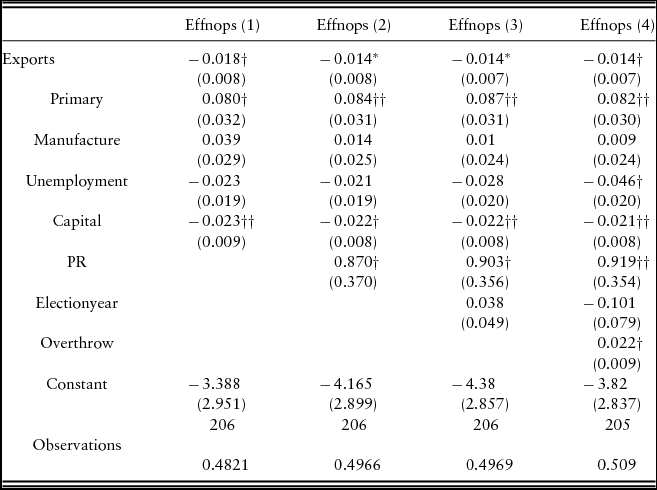
Table A1 shows a panel-corrected standard errors model, with a democratic sub-sample that considers a country democratic if the overall Polity IV score average from 1995 to 2012 is above six.
Table A2 shows a cross section time series feasible generalized least square regression with the democratic sample and corrections for autocorrelation and heteroskedasticity. The force command was used to gain regression results.
The determinants of the effective number of parties (PCSE model, democratic sample with threshold of democracy as the average Polity IV score from 1995 to 2012)

The determinants of the effective number of parties (FGLS model, democratic sample)

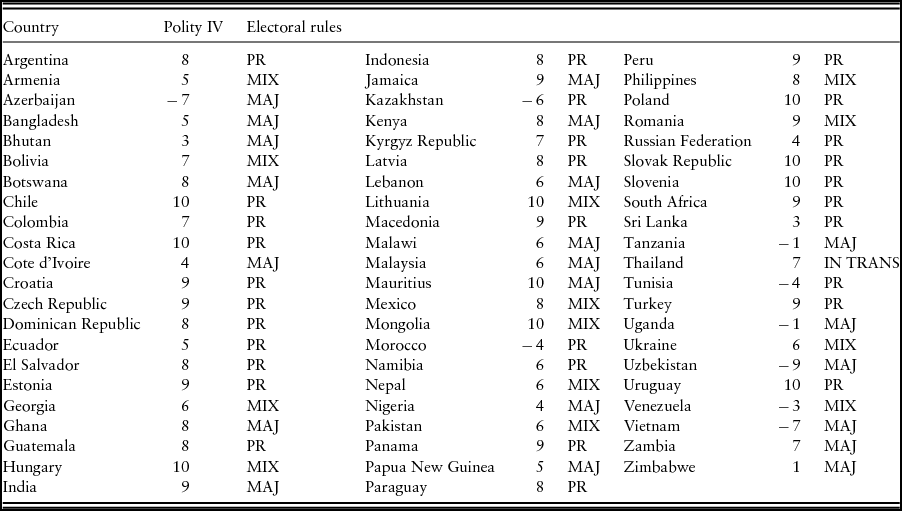
Table A3 displays the countries used for the regressions in this paper. The name of the country is in column one, the Polity IV score is in column two, and the type of electoral rule system family is in column three, where ‘PR’ stands for proportional representation, ‘MAJ’ is majoritarian system, and ‘IN TRANS’ stands for ‘in transition’. A country is considered a democracy if the Polity IV score is a six or above. The data is from the year 2012, and comes from the Centre for Systemic Peace. The score may differ from the rest of the years in the panel data, and the reader is encouraged to consult the Polity IV dataset for additional materials. The data for the electoral rule system family comes from the International Institute for Democracy and Electoral Assistance (IDEA), except for in the case of Armenia, which comes from the Inter-Parliamentary Union.
The score for Tunisia is from 2010, as the years 2011 and 2012 were transition years for the country. Tunisia is now considered a democracy, and in 2014 had a Polity IV score of 7.
Countries, polity IV scores, and electoral rule system family