Terrorism is typically employed by the politically aggrieved, but recent scholarship finds that the tactic tends to impede groups from achieving their demands. Unlike selective attacks on military targets, indiscriminate attacks on civilian targets risk lowering public support for concessions and hence the odds of attaining them.Footnote 1 Why then do militant groups target civilians so frequently given the potential political costs?
To answer this question, much of the extant scholarship posits that militant groups are irrational actors or motivated by an apolitical incentive structure.Footnote 2 Other studies advance structural arguments about regime type and the relative power of militants.Footnote 3 These explanations are incomplete. First, they struggle to account for tactical variation within and across militant groups over time.Footnote 4 Second, the groups are generally treated as unitary actors despite the invalidity of that assumption.Footnote 5 A growing consensus maintains that militant groups are composed of internally heterogeneous members with varying preferences and commitment.Footnote 6 We build on this insight to propose and then test a theory of when militant groups are liable to engage in terrorism by targeting civilians.
Our core argument is that the extent of leadership control over the rank and file strongly influences whether militant groups will attack civilians. Leadership deficits promote civilian targeting because the incentives of members to perpetrate indiscriminate violence are inversely related to their position within the organizational hierarchy. Organizations with weak leadership control gravitate to terrorism because tactical decisions are delegated to lower-level members with stronger incentives to harm civilians. To explain the targeting choices of militant groups, we therefore draw on a principal-agent framework where leaders are understood as principals and foot soldiers as agents.
Recent scholarship has applied aspects of this framework to other important questions about militant groups.Footnote 7 We demonstrate its relevance to whether they engage in terrorism by targeting civilians. Potential parallels are found within national militaries, where progovernment militias are significantly more likely than elite units to attack civilians.Footnote 8 Ill-disciplined government forces from the police to the army are also disposed to sexual violence and other atrocities against the population.Footnote 9 More broadly, wayward agents of the state are associated with violating the laws of war.Footnote 10
Anecdotal evidence abounds of militant groups attacking civilians because of a loss of principal control. Afghan Taliban leader Mullah Mohammad Omar routinely reproached his foot soldiers for indiscriminately attacking the population. He commanded his fighters to strike high-value targets such as “foreign invaders, their advisors, their contractors and members of all associated military, intelligence and auxiliary departments,” but to “protect the lives and wealth of ordinary people.”Footnote 11 Doku Umarov, leader of the al-Qaida-linked Caucasus Emirate, likewise cautioned the Mujahedeen “to focus their efforts on attacking law enforcement agencies, the military, the security services, state officials,” but “to protect the civilian population.”Footnote 12 The leader of the Kurdistan Workers' Party, Murat Karayilan, also directed his forces to engage “military targets” and “not harm civilians.”Footnote 13 Similarly, the leader of Lashkar-e-Taiba, Hafiz Muhammad Saeed, blamed the 2008 Mumbai attacks and other instances of violence against the population on uncontrolled “rogue elements within the group.”Footnote 14 Even ostensible exceptions may prove the rule. Osama Bin Laden, the founder of modern-day al-Qaida, was notorious for orchestrating the deadliest terrorist incident in history. Less well known, however, is that he and his lieutenants subsequently admonished lower-level members for slaughtering civilians in Iraq, Yemen, and other Muslim-majority countries as the strategic costs became apparent.Footnote 15 The implication is that a particular class of militant groups may be more likely to target civilians—those lacking strong leadership control. All else equal, militant group violence should become less discriminate as members with stronger incentives to attack civilians gain tactical autonomy.
Beginning with the most general of tests, we find in a sample of militant groups operating in the Middle East and North Africa (MENA) that those lacking centralized leaderships are more than twice as likely to target civilians. MENA groups are also more likely to engage in civilian targeting when the leaders are hindered from communicating tactical instructions to the rank and file. We then examine the impact of the unmanned aerial vehicle (UAV) campaign on the targeting choices of militant groups operating in the Afghanistan-Pakistan region. When their leaderships are degraded through decapitation strikes, militant groups become significantly less discriminate in their targeting choices. Finally, the mechanism behind these findings is scrutinized with a detailed case study of the al-Aqsa Martyrs Brigade, a Palestinian group that adopted terrorism when its leadership was decimated during the Second Intifada (2000–2005) and ceded tactical decision making to the rank and file. Our multipronged research strategy balances competing concerns over generalizability and causal identification. The most general tests are weakest on identification (the cross-sectional MENA analyses), whereas the strongest on identification is least generalizable (the al-Aqsa Martyrs Brigade case study). Together, however, the evidence consistently indicates that militant groups are inclined toward civilian targeting when principals lose organizational control and their agents are thus granted additional tactical autonomy.
Why Do Groups Resort to Terrorism?
The definition of terrorism remains contested, but it generally denotes nonstate attacks against civilian targets for political ends.Footnote 16 Upon reflection, however, this combination of target selection and objective appears in tension. Across a wide variety of methodologies and disciplines, a growing body of empirical research finds that attacking civilians is ineffective, even counterproductive for groups to achieve their strategic demands. Terrorism may aid organizations in redressing their grievances under very specific conditions,Footnote 17 but targeting civilians generally carries substantial downside political risks. Why then do so many militant groups employ this tactic given the potential costs?
For decades, specialists have noted that terrorism rarely results in political success. In the 1970s, Laqueur published “The Futility of Terrorism” in which he claimed that practitioners seldom achieve their strategic demands.Footnote 18 In the 1980s, Cordes, Hoffman, and Jenkins observed that “terrorists have been unable to translate the consequences of terrorism into concrete political gains … In that sense terrorism has failed. It is a fundamental failure.”Footnote 19 Crenshaw also pointed out how “few [terrorist] organizations actually attain the long-term ideological objectives they claim to seek, and therefore one must conclude that terrorism is objectively a failure.”Footnote 20 Schelling proclaimed in the 1990s, “Terrorism almost never appears to accomplish anything politically significant.”Footnote 21 More recently, empirical studies confirmed that only a handful of terrorist groups in modern history have managed to accomplish their political platforms.Footnote 22
Theoretical explanations may help to account for the low political success rate, but the tactic does not appear to be epiphenomenal to government intransigence or the result of selection bias.Footnote 23 On the contrary, the latest wave of scholarship finds that escalating violence against civilians actually hinders nonstate challengers from attaining their demands. To evaluate the political efficacy of terrorism, Abrahms exploits variation in the target selection of 125 violent nonstate campaigns.Footnote 24 Groups are significantly more likely to coerce government compliance when their violence is directed against military targets instead of civilian ones even after controlling for the capability of the perpetrators, the nature of their demands, and other tactical confounds. After factoring out the relative capabilities of rebel groups, Fortna finds that in civil war they too lower the odds of bargaining success by attacking the population with terrorism.Footnote 25 Getmansky and Sinmazdemir find that the Israeli government in particular is significantly less likely to cede land to the Palestinians when they have perpetrated terrorism.Footnote 26 To mitigate selection bias, they exploit variation in the operational outcome of terrorist attacks; evidently, only those that physically harm civilians inhibit Israeli concessions. In hostage settings, Abrahms and Gottfried find that killing civilians lowers the chances of militant groups attaining government concessions.Footnote 27 Relatedly, Chenoweth and Stephan find that protest groups suffer at the bargaining table when they engage in violence against the population.Footnote 28
Terrorism rarely frightens citizens of target countries into supporting more dovish politicians. Studies on public opinion find that the attacks on civilians tend to raise popular support for right-wing leaders opposed to appeasement. Berrebi and Klor, for example, show that Palestinian terrorism boosts Israeli support for the Likud and other right-bloc parties.Footnote 29 Gould and Klor reveal that the most lethal Palestinian terrorist attacks are the most likely to induce this rightward electoral shift.Footnote 30 These trends appear to be the international norm. Chowanietz analyzes variation in public opinion within France, Germany, Spain, the United Kingdom, and the United States from 1990 to 2006.Footnote 31 In each target country, terrorist attacks have shifted the electorate to the political right in proportion to their lethality. Related observations have been registered after al-Qaida and its affiliates killed civilians in Egypt, Indonesia, Jordan, the Philippines, Russia, Turkey, and the United States.Footnote 32 Controlled experiments reach similar results, further ruling out the possibility of a selection effect.Footnote 33 RAND observes in a précis of the literature: “Terrorist fatalities, with few exceptions, increase support for the bloc of parties associated with a more intransigent position. Scholars may interpret this as further evidence that terrorist attacks against civilians do not help terrorist organizations achieve their stated goals.”Footnote 34 By bolstering hardliners, terrorist attacks are also among the most common ways for militant groups to end.Footnote 35
Terrorism as a Principal-Agent Problem
Why, then, do groups indiscriminately attack civilians? More specifically, how do we account for the tactical variation both within and across militant groups over time? The answer may reside in the fact that militant groups exhibit substantial heterogeneity in terms of membership incentives and clout within the organization.
We maintain that the position of members within the organizational hierarchy shapes their incentive structure over targeting civilians.Footnote 36 Members' incentives to attack civilians are inversely related to their station within the group. By definition, senior leaders carry more sway within militant groups than their foot soldiers, whereas in between these stylized categories are midlevel leaders. The target selection of militant groups consequently depends on leadership control, particularly from the top. Leadership deficits in militant groups foster indiscriminate attacks by ceding tactical decisions to lower-level members with weaker incentives against harming civilians. Militant groups gravitate to terrorism not when low-level members completely take over, but when empowered to pursue their divergent preferences.Footnote 37
For numerous reasons, the position of members within the organizational hierarchy is inversely related to their incentives for attacking civilians. First, senior leaders are generally the oldest members of the group and have spent the longest time working in it. In fact, the top leaders of militant groups are often their founders.Footnote 38 Foot soldiers and other low-level operatives, by contrast, are typically the newest recruits or volunteers with the least experience at any level of combat.Footnote 39 Based on their relative exposure to conflict, senior leaders are thus the most likely to have personally observed the strategic fallout of indiscriminate bloodshed and to consequently oppose such counterproductive targeting practices. Second, the lowest members of militant groups have the fewest resources at their disposal, incentivizing them to attack softer targets.Footnote 40 Because more senior members are in a superior position within the organizational hierarchy, they have greater discretion in marshaling resources for comparatively sophisticated attacks against hardened targets. Third, the lowest-level members stand to gain the most from civilian targeting. Their dearth of organizational resources incentivizes predation of civilian assets, which can be furthered through the intimidation that inevitably accompanies indiscriminate violence. Attacks on civilians also help lower-level members to ascend within the group by “outbidding” rival members, whereas the senior leadership is already at the organizational apex.Footnote 41 Further, foot soldiers are the most likely to have lost close friends on the front line, creating even stronger incentives to perpetrate attacks on civilians to avenge such personal losses.Footnote 42 Finally, the senior leadership presumably has longer time horizons than lower-level members for achieving the organization's political cause. Not only have leaders spent the most time operating within the organization, but they are more constrained from leaving it. Whereas lower-level members may have the option of fading back into the population, leaders are more likely to be organizational lifers because they are easier for authorities to identify. Because lower-level members have shorter time horizons, they are more likely to prioritize short-term gains from civilian targeting over longer-term strategy. The result is an essential difference in commitment. Hinting at both this problem and the principal-agent problems and tradeoffs that it in engenders, Shapiro and Siegel note, “terrorist groups repeatedly include operatives of varying commitment and often rely on a common set of security-reducing bureaucratic tools to manage these individuals.”Footnote 43 In sum, the differences in targeting preferences hail less from any inherent cognitive qualities among members than from their relative stations within the organization, which shape incentives for or against civilian targeting.Footnote 44
This organizational explanation for terrorism has a strong theoretical basis. Principal-agent theory emphasizes a disconnect between the preferences of leaders and the actual behavior of subordinates, which often runs counter to the formal mission of the organization.Footnote 45 As previous research details, agency problems arise because prospective members have an incentive to manipulate private information by overstating their qualifications (that is, adverse selection) and to then pursue private agendas upon joining (that is, agency slack or moral hazard).Footnote 46 Agency problems are inherent in all organizations, but leadership deficits understandably exacerbate them because principals must delegate authority to less reliable agents.Footnote 47
It is impossible to test directly whether agency problems are responsible for suboptimal organizational behavior.Footnote 48 But a basic premise of organizational theory is that group structure affects the locus of decision making. As such, group structure is a standard proxy for leadership control in numerous organizational contexts,Footnote 49 including militant groups.Footnote 50 The more centralized an organization, the less autonomy is delegated to subordinates.Footnote 51 Few studies on terrorism consider the potential downside of decentralization from the perspective of the challenger.Footnote 52 Decentralization is characteristically described as an unconditional best practice against the defender. As with other organizations, decentralization is thought to unleash the human potential of militant groups by making them more adaptive, flexible, inclusive, innovative, resilient, and specialized. More concretely, decentralization is said to confer a bounty of strategic advantages by rendering organizations harder to anticipate, detect, infiltrate, isolate, prosecute, and ultimately defeat.Footnote 53
Despite such advantages of decentralization, the application of principal-agent theory predicts inherent tradeoffs to delegation.Footnote 54 Empowering foot soldiers with greater tactical autonomy is not cost-free precisely because it means ceding control to members with incentive structures that coincide imperfectly with leadership imperatives. The nature of organizational violence may therefore hinge on the structure of militant groups, leading to our first hypothesis:
H1
Organizations with decentralized leadership are more likely to target civilians than are organizations with centralized leadership.
To gain insight into whether civilian targeting springs from a loss of principal control, it is essential to incorporate whether leaders approve of their members engaging in terrorism. Based on our organizational explanation, groups should be less likely to attack civilians when leaders publicly oppose this practice, though the ability to impose this preference should be conditional on their strength. Specifically, militant organizations should be least likely to target civilians when their leaders are strong and oppose civilian targeting because they are best equipped to tamp down these displays of radicalism to serve their strategic ends. Conversely, militant group violence should be least restrained when leaders are weak and advocate civilian targeting. As their position strengthens within the organization, its violence should become more selective because even leaders who initially advocate civilian targeting may realize that indiscriminate violence is ultimately counterproductive. Further, militant leaders sometimes issue threats without actually directing their members to carry them out.Footnote 55 Together, these expectations yield the following conditional hypotheses:
H2A
Organizations are least likely to target civilians when leaders are strong and do not publicly authorize civilian targeting.
H2B
Organizations are most likely to target civilians when leaders are weak and publicly authorize civilian targeting.
Beyond their organizational structure, other aspects of militant groups also affect leadership control. Communications are essential in all organizations for members at the top to convey information to those at the bottom. When such communications are impeded, agency loss is inevitable as lower-level members are compelled to act more independently.Footnote 56 The ability of militant leaders to communicate with subordinates may vary for a number of reasons. The leadership often prioritizes security over communications by encouraging the organization to operate in more secretive ways.Footnote 57 Communications are also hampered when operatives expand their theater of operations, particularly abroad. This logic generates the following additional hypotheses:
H3
Clandestine organizations are more likely than open organizations to target civilians.
H4
International organizations are more likely than domestic organizations to target civilians.
H5
Organizations that frequently conduct cross-border attacks are more likely to target civilians.
Admittedly, these predicted empirical relationships may arise from reverse causation. Skeptics may wonder, for example, whether leaders structure the organization based on their targeting preferences, whether organizations are clandestine to minimize audience costs from targeting civilians, and whether foot soldiers expand their theater of operations to punish foreign populations.Footnote 58
To address these concerns, we turn to another empirical strategy. Decapitation campaigns are exogenous to the preferences of militant group members but deeply affect organizational structure, communications, and thus leadership control. The explicit goal of the ongoing unmanned aerial vehicle (UAV) campaigns against al-Qaida, the Taliban, and affiliates is to degrade their leaderships.Footnote 59 Our organizational theory therefore predicts specific changes in the targeting practices of these groups in response to the UAV campaign. Operationally successful decapitation strikes obviously weaken the leadership, endowing lower-level members with additional tactical autonomy. Regardless of whether the strike actually connects with the target, though, the attempt itself may degrade command by forcing leaders to curtail communication, question the loyalty of subordinates, go into hiding, and thereby lower their profile within the organization. These insights inform two other hypotheses.
H6
Operationally successful UAV strikes are positively associated with attacks on civilains.
H7
UAV strike density is positively associated with attacks on civilians.
Research Design and Findings
To test our initial proposition that decentralized organizations are more likely to perpetrate terrorism, we investigate the determinants of civilian targeting among the militant groups in the Minorities at Risk Organizational Behavior (MAROB) data set.Footnote 60 MAROB has several advantages over comparable data sets for our research purposes.Footnote 61 First, MAROB codes for group structure, which facilitates assessment of whether militant organizations are disproportionately inclined to civilian targeting when their decision making is diffuse. Second, MAROB furnishes data on whether the groups attacked civilian targets, military ones, or none at all, capturing such tactical variation from 1980 to 2004.Footnote 62 Third, all of the groups in the sample are nonstate actors that express political aims. Fourth, the sample focuses on groups operating in Middle Eastern and North African countries, intrinsically important regions for the study of conflict in general and civilian targeting in particular. Fifth, the sample includes scores of organizations that are sometimes described as terrorist groups, but which are often omitted from civil war data sets for operating outside this particular context.Footnote 63
The dependent variable is a dichotomous measure of whether the organizations target civilians (1) or not (0) in a given year.Footnote 64 Civilian targets include any nonsecurity state personnel, thereby excluding military or police forces.Footnote 65 To assess H1, we rely on a binary measure of whether the group is centralized (1) or not (0). We collapse the MAROB variable LEAD such that groups with either factionalized or weak leaderships are characterized as decentralized, whereas those with a strong ruling council or strong single leader are treated as centralized. Thus, the MAROB data codes the extent to which the leadership exerts unified command over lower-level members.
We also include a variety of control variables to account for potential confounds with our key independent variable of organizational structure and the dependent measure of civilian targeting. These controls hold constant relevant organization- and country-level attributes based on the broader conflict literature.
Capability is arguably relevant to militant group target selection. At least two studies have found that state challengers are disposed to civilian victimization when weak (or “desperate”).Footnote 66 More commonly, scholars assert that terrorism is a “weapon of the weak” though this adage is empirically contested.Footnote 67 We employ several proxies for organizational capability to help disentangle this potential influence on target selection. In line with a RAND study, we control for the age of groups with a count variable based on the number of years since their founding.Footnote 68 The relationship between organizational age and capability is not straightforward. Horowitz finds an inverse relationship between the lifespan of terrorist groups and their innovative capacity, whereas Kalleberg, Knoke, and Marsden observe that organizations procure resources over time with weaker organizations selected out of the population.Footnote 69 Miller and Scott believe age promotes effectiveness because older organizations are liable to be standardized and routinized, making their performance less unstable and susceptible to a liability of newness.Footnote 70 We also account for organizational membership size because nonstate challengers gain power in numbers,Footnote 71 as well as for whether the organization holds territory, which helps to secure resources from the local population.Footnote 72 At the domestic level, we address the extent of both popular support for the organization and its outreach efforts by controlling for propaganda and educational output.Footnote 73
The ideology of militant groups is another potential confound. Juergensmeyer and Hoffman believe that the universalist nature of religious motivations promotes larger attacks by enabling adherents to discount the negative consequences of mass casualties.Footnote 74 The “cosmic wars” perceived by religiously motivated groups might dispose them toward deadlier indiscriminate attacks. Even Pape, who maintains that occupation is the “taproot” of suicide terrorism, identifies religious differences as an important predictor.Footnote 75 We control for religiously and ethnically motivated groups because these characteristics promote sectarian violence and are a common precondition for civil strife generally.Footnote 76 Both ideologies may also be confounded with leadership structure because of altered incentives and relationships with religious- or kin-based hierarchies.
At the state level, we are mainly interested in accounting for factors that may insulate targets from terrorism and covary with organizational structure. Population density is relevant, for example, because higher values increase potential targets. Following Walsh and Piazza, we also account for educational attainment and gross domestic product (GDP) per capita even though opinion remains divided over whether these characteristics provoke terrorism.Footnote 77 Regime type is also addressed; democracies reportedly attract terrorism because their commitment to civil liberties impedes them from adopting harsh countermeasures and their low civilian cost tolerance invites political blackmail.Footnote 78 Because counterterrorism responses frequently encounter collective action problems, we control for levels of executive authority affecting the capacity to act independently on behalf of citizens.Footnote 79 With Banks's data, we control for the extent of ongoing conflict within the country, which may reflect unobservable conditions ripe for terrorism or even perpetuate it.Footnote 80
To establish whether civilian targeting arises from a loss of principal control, we also explore the extent to which leaders approve of their members engaging in terrorism. Conveniently, MAROB supplies data on whether the leaders publicly authorize civilian targeting. This information is invaluable for determining whether weak leaders are associated with terrorism due to their tactical preferences, indifference, or lack of agency control.
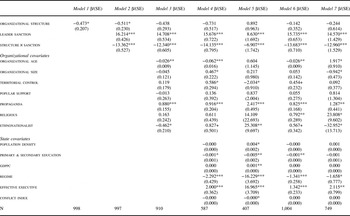
Table 1 presents the results of seven logistic regressions.Footnote 81 Following Achen, Model 1 is a bivariate test of the relationship between leadership strength and target selection.Footnote 82 This model also allows us to maintain the maximum available data, while bolstering confidence that the observed effect of group structure is not a function of bias generated by missing data in the covariates.Footnote 83 Models 2 to 5 incorporate the dummy variable for whether the organization leader authorizes civilian targeting as well as an interaction term between this indicator and leadership strength.Footnote 84 Model 2 is limited to just the interaction and its components. Model 3 includes the organizational covariates, whereas Model 4 integrates the state-level covariates as well. Model 5 is identical to Model 4 but employs organization fixed effects (all five models contain year fixed effects).
Civilian targeting

Notes: Estimates are maximum likelihood coefficients obtained from logit equations with the organization year as the unit of analysis. Robust standard errors are in parentheses. All models include year fixed effects. + <.10; *p <.05; **p <.01; ***p <.001.
The declining number of observations from Model 1 to Model 5 is because of missing data. There are missing observations in all the independent variables, especially in the state-level covariates, although there does not appear to be systematic structure to what is missing that would cause particular concern. As an additional check, we reran Models 4 and 5 with imputed missing values. These models (Models 6 and 7) yield similar results overall. The main difference is that the coefficient for the interaction term more closely resembles results from Models 1 to 4 rather than Model 5, suggesting that the decline in magnitude in that model stems from missing data rather than from the organizational fixed effects.
As anticipated, the coefficient for our key organizational structure variable in Model 1 is negative and significant. Interpreting the magnitude of coefficients, however, is not intuitive in maximum likelihood models. Moreover, the key question is not the difference between the estimates and zero, but whether weak and strong leaderships are distinguishable with regard to organizational targeting. In practical terms, there is a decline from an approximately 40 percent chance that a decentralized group will attack civilians to a 25 percent chance of a centralized group doing so. Militant groups with weak leaderships are thus about 15 percent more likely to target civilians. Groups led by weak leaders are indeed highly associated with civilian targeting at least in MENA countries.
Although this preliminary finding links civilian targeting to groups with weak leadership, it leaves unclear whether such leaders disproportionately support indiscriminate violence, whether it stems from a loss of principal control, or whether weak leaders are associated with terrorism simply because they do not care about their organization's specific tactical choices. In the parlance of principal-agent theory, foot soldiers may have broad discretion over which targets to attack; discretion entails a grant of authority to achieve the principal's goal but does not stipulate the specific actions for agents to attain it.Footnote 85
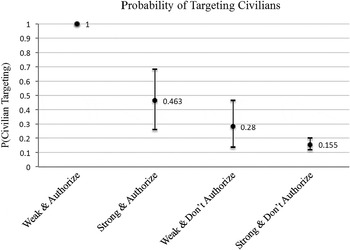
The more important consideration, then, is the conditional relationship between leadership strength and targeting preferences. Consistent with our expectations, the interaction and authorization variables in Models 2 to 5 are negative and significant. Figure 1 depicts the predicted probabilities of militant groups attacking civilians depending on the strength of the leaders and their public position on it. The most salient feature is that militant groups seldom commit terrorism when strong leaders do not authorize attacks on civilians. Under these conditions, the rank and file overrides the tactical instructions of their leaders by committing terrorism only 15 percent of the time. By contrast, the militant groups in our sample invariably engage in terrorism when their leaders are weak and publicly authorize civilian targeting.Footnote 86 Among organizations with strong leaderships, there is a substantively and statistically significant difference between those who authorize terrorism and those who do not, underlining their strong tactical influence. Of course, the decision to publicly authorize terrorism may itself be strategic. For instance, weaker leaders may issue post hoc appeals for civilian targeting to appear in control. The most informative comparisons are therefore within the categories of weak and strong leadership rather than between them.
Probability of targeting civilians

Our organizational theory points to other implications that are testable with the MAROB data. Should the anticipated theoretical relationships hold in these alternative constructions, they would strengthen confidence in our argument behind militant group targeting. As we have outlined, communications are essential for leaders to exercise control over lower-level members. When communications from the top are hindered, foot soldiers and other operatives must rely on instruction from lower-level leaders or even act independently, thereby eroding principal control.
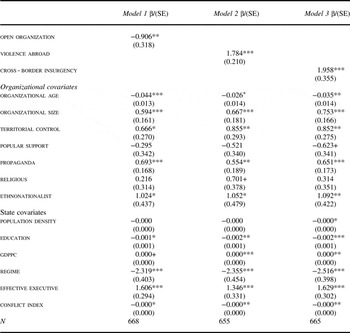
Table 2 presents the results of three additional models assessing this expectation. Model 1 tests whether clandestine organizations (MAROB variable ORGOPEN) are disposed toward civilian targeting from prioritizing security over communications. Models 2 and 3 evaluate two other measures affecting the leadership's ability to communicate with subordinates—whether the theater of operations is essentially “international” (MAROB variable ORGLOCVIOL) and whether the groups frequently engage in “cross-border” raids (MAROB variable ORGST8A). The specific rationale behind these tests is that international attacks are more likely to be geographically dispersed, inhibiting communications as operatives travel away from their leaders. Further, operating in foreign countries requires militants to hide among hostile populations, impeding the flow of information from the top.
The influence of communication on civilian targeting

Notes: Estimates are maximum likelihood coefficients obtained from logit equations with the organization year as the unit of analysis. Robust standard errors are in parentheses. +<.10; *p<.05; **p <.01; ***p <.001.
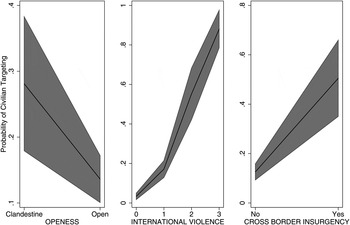
The key coefficients in these models are significant and run in the anticipated direction. To illustrate the substantive impact, Figure 2 presents three graphs based on results from the corresponding models in Table 2. Groups are roughly twice as likely to engage in civilian targeting when clandestine, international, or involved in cross-border raids. These results further illustrate how militant groups are prone to terrorism when lower-level members call more of the shots.
Communication and Civilian Targeting

Although these cross-national findings are quite robust, we gain confidence by testing the theory from another angle with different data. The ongoing UAV campaign in the Afghanistan-Pakistan tribal regions enables additional assessment because the explicit purpose is to diminish the militant group leaderships through decapitation strikes.
Information on these strikes comes from the New America Foundation's Drone Database. This database is an aggregation of credible news reports from international wire services (Associated Press, Reuters, Agence France Presse), leading Pakistani newspapers (Dawn, Express Times, The News, The Daily Times), South Asian and Middle Eastern television networks (Geo TV, Al Jazeera), and reputable Western outlets with extensive regional coverage (CNN, New York Times, Washington Post, Los Angeles Times, BBC, The Guardian). For inclusion in the database, each targeting event was independently verified by at least two of these sources.Footnote 87
The Drone Database supplies information on the timing of the decapitation strike attempts and operational outcomes—both of which should affect leadership influence over the rank and file. When a decapitation strike kills any level of leader, subordinates are given a freer hand in conducting operations, thereby ceding autonomy to members with stronger incentives to harm civilians. Even when a strike fails to connect with the target, it forces the leader and others at the top level to assume a diminished posture within the organization to prioritize security over control, resulting in agency loss.Footnote 88
We match data on UAV strikes with information on militant group target selection from the Global Terrorism Database (GTD). As before, we disaggregate organization attacks on soft targets versus hard ones, that is, against civilians versus military and police forces. Regional authorities have tended to treat al-Qaida, the Taliban, and local affiliates as a single unit within the territory because of their close operational coordination during our observation period (2004–11).Footnote 89 Our estimation strategy follows this approach by treating the overlapping groups as a single organizational entity. Any bias generated from aggregating unlike units would almost certainly attenuate the results.
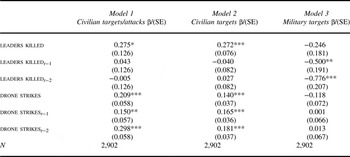
Table 3 presents the coefficients from three new models. The first is a fractional logit regression on the selectivity of militant group violence calculated as a proportion of civilian attacks to total attacks (civilian and military). We then scrutinize the targeting behavior by pulling apart that proportion to assess its constituent parts. The second model is thus a negative binomial regression on the number of attacks against civilian targets in particular. Model 3 repeats that exercise, but for military targets rather than civilian ones. In all three models, the unit of analysis is the day within the period of analysis. We employ fixed effects to help isolate the impact of decapitation strikes on militant group targeting choices.Footnote 90 To assist with identifying the changing effects of target selection over time, we lag both the number of decapitation attempts and leaders killed by them over a three-week period.
Decapitation strikes and target selection

Notes: Model 1 is a fractional logit. Coefficients in Models 2 and 3 are derived from negative binomial models. All models have a daily unit of analysis and contain week fixed effects. *p <.05; **p <.01; ***p <.001.
All three models indicate that the decapitation campaign renders the target selection of the militant groups less discriminate. Model 1 reveals that when a leader of the militant group is killed, the proportion of its violence against civilian targets rises by approximately 7 percent. Strike density has a similar short-term effect on group tactics. Regardless of the target's fate, a decapitation attempt increases the proportion of attacks against civilian targets by 6.5 percent. The preliminary evidence therefore suggests that militant group violence loses selectivity when lower-level members are required to assume additional tactical responsibilities because their leaders are killed or forced into hiding for self-preservation.
More insight can be gained by pulling this proportion apart. Group violence may become less discriminate through increased attacks on soft targets, decreased attacks on hard targets, or both. In accordance with our theory, Models 2 and 3 indicate that decapitation strikes promote civilian targeting and decrease military targeting. Strike density and success appear to influence these outcomes differently. In general, strike density appears to have a strong positive effect on civilian targeting but little influence on military targeting. By contrast, successful decapitation strikes are associated with both an increase in civilian targeting and a decrease in military targeting, though in different time frames.Footnote 91
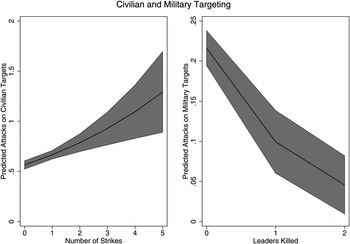
To help illustrate the marked uptick in civilian targeting from the decapitation campaign, panel 1 of Figure 3 plots the predicted number of civilian targets and the number of strike attempts.Footnote 92 Over the span of that variable, the number of attacks per day on civilians nearly triples from .50 to 1.50. Strikes, regardless of whether they actually connect with the target, apparently put enough pressure on leaders to weaken their command and control over the rank and file. As anticipated, operationally successful decapitation strikes have an immediate and substantial impact on civilian targeting; when just one leader is killed, predicted civilian targeting rises suddenly by approximately 40 percent.Footnote 93
Civilian and Military Targeting

By contrast, the influence of the UAV campaign on the probability of attacks on military targets appears only when strikes are actually successful in neutralizing leadership. This finding accords with our argument that such targets are the top priority of high-level leadership. Also telling is that this effect appears after a short lag, presumably because of the role of central planning in these attacks. Once plans are developed and delegated, the attacks already in the pipeline may proceed even in the absence of leadership. What declines is the next round of selective attacks because they never get planned. Thus, the right-hand panel of Figure 3 reveals how the UAV campaign lowers the likelihood of attacks against military targets. There is a reduction in the rate of attacks against hard targets from one every five days to one every twenty days when two leaders have been successfully neutralized in the prior week.Footnote 94 True to our principal-agent theory, groups in the Afghanistan-Pakistan tribal regions appear far more likely to target civilians as the influence of leaders over the rank and file recedes.
These findings dovetail with recent empirical research suggesting that decapitation strikes may be strategically effective.Footnote 95 The UAV campaign in Afghanistan-Pakistan limits attacks on coalition and government security forces, at least in the short term. The corresponding increase in civilian targeting is clearly undesirable from a normative perspective, but it also puts at risk the militants' support base and thus their overall capabilities. That said, nothing in our work speaks to the extent to which collateral damage or infringements on sovereignty might lead to popular resentment. Although beyond the scope of this study, these additional considerations must also be taken into account before clear policy prescriptions can be made.
The Case of the al-Aqsa Martyrs Brigade
The preceding analyses establish generalizable empirical relationships, but case studies can aid in further establishing the mechanism.Footnote 96 The al-Aqsa Martyrs Brigade exemplifies how leadership deficits within the organization led it to target civilians during the Second Intifada (2000–2005). Consistent with our organizational theory, the historical record reveals that (1) the Brigade leadership consistently favored selective violence to create a Palestinian state; (2) the Brigade's target selection became less discriminate as the Intifada unfolded; (3) the diminished targeting selectivity was attributable to a loss of principal control over Brigade operatives as a result of Israeli decapitation strikes; and (4) whereas the leadership recognized that attacks on civilians are politically counterproductive, lower-level members perpetrated them for alternative—albeit no less rational—reasons based on their station within the organization.
As the military wing of Yasser Arafat's secular Fatah Party, the Brigade was established in September 2000 to pressure Israel into withdrawing from territories captured in the 1967 war.Footnote 97 To end the occupation of Jerusalem, the West Bank, and Gaza Strip, Brigade chief Marwan Barghouti advocated selective attacks against the Israel Defense Forces (IDF) and settlement outposts, while opposing indiscriminate violence against Israeli civilians within the pre-1967 borders or so-called Green Line.Footnote 98 Barghouti stated in interviews: “We said we would not attack inside the Green Line. The real face of the occupation is the settlements and the soldiers.”Footnote 99 He repeatedly emphasized that “Fatah's line is only targets outside of [19]67 borders,”Footnote 100 that “Our policy in Fatah has been to restrict our actions to the territories,”Footnote 101 and that “I, and the Fatah movement to which I belong, strongly oppose attacks and the targeting of civilians inside Israel, our future neighbor.”Footnote 102 Fatah leader Hussam Khader also stressed the strategic importance of selective violence against Israelis, “When they realize that there are no civilian casualties and only soldiers dying in a foreign land, it will spark a change we need on the Israeli street to bring an end to the occupation.”Footnote 103 Even Arafat expressed “total opposition to actions targeting civilians on both sides.”Footnote 104 This position went largely unchallenged among lower-level Brigade leaders. The head of the Bethlehem network declared that harming Israeli civilians is “completely unacceptable to us in al-Aqsa” and that instead “Our strategy is to fight settlement and settlers [by] attacking Israeli military posts.”Footnote 105 A Ramallah-based Brigade leader reiterated, “I am against touching civilians,” though he was strongly supportive of hitting the IDF and other instruments of the occupation.Footnote 106
Initially, Brigade members complied with these targeting guidelines. In late 2001, operatives attacked the IDF in Haifa, Hebron, and Tel Aviv, sparing civilians. By early 2002, however, the Brigade committed mass casualty attacks on a bat mitzvah in Hadera, a kibbutz in Menashe, and the Tel Aviv Central Bus Station.Footnote 107 The reduced targeting selectivity was unmistakable. The National Consortium for the Study of Terrorism and Responses to Terrorism observed: “At the outset, [the] al-Aqsa Martyrs Brigade expressly targeted Israeli settlers and security forces. However, the group soon expanded its targets to include citizens in Israeli cities.”Footnote 108 The Council on Foreign Relations also noted: “While the group initially vowed to target only Israeli soldiers and settlers in the West Bank and Gaza Strip, in early 2002 it joined … in a spree of terrorist attacks against civilians in Israeli cities.”Footnote 109 The US State Department listed the Brigade as a terrorist organization during this unprecedented wave of indiscriminate bloodshed.
It stemmed from a loss of leadership control. The locus of decision making became increasingly decentralized in early 2002, as the IDF killed off dozens of Brigade commanders, culminating with the arrest of Barghouti that spring.Footnote 110 According to Usher, “Fatah's resistance went from guerrilla warfare to freelance martyrdom operations inside Israel” because of “the increasing autonomy of the militias” and resultant “widening gulf between political and military wings.”Footnote 111 The International Crisis Group reported that as a result of the decapitation strikes, “the network is diffuse, fragmented, localized, and does not take orders from leaders of the organization.”Footnote 112 Human Rights Watch also described the centrifugal effects of the decapitation campaign: “The military elements responsible for the [terrorist] attacks are not under the control of the political leadership” because “there is no infrastructure, just small groups making their own small decisions” with “a [large] degree of autonomy and improvisation.”Footnote 113 An Arab-Israeli journalist underscored the growing disconnect between principal preferences and agent actions: “Most of the military operations are being carried out by gunmen who don't report to their political leaders. Even if the factions had reached an agreement, this wouldn't have meant a complete end to the [terrorist] violence.”Footnote 114 A Palestinian intellectual affirmed the independence of agent actions, “The decision to resist was taken independently in the [Jenin] camp, in violation of the leadership's orders.”Footnote 115 When asked about the Brigade's target selection, even the militants acknowledged that “not all military acts by al-Aqsa were done with the agreement of the political wing” because “professed identity with Fatah did not necessarily translate into compliance with Fatah decisions.”Footnote 116
Although Brigade leaders feared that indiscriminate violence against Israeli civilians would be politically counterproductive, its operatives were driven by alternative incentives based on their position within the organization. Barghouti opposed Palestinian attacks on civilians because he had observed over the years how “its impact on Israeli public opinion was detrimental to us.”Footnote 117 Arafat too had come to learn the strategic perils of civilian targeting, warning in the largest Palestinian daily: “Actions that target civilians are counter to the lofty interests of our nation, hurt the legality of its legitimate struggle against the occupation, and cause damage to its image.”Footnote 118 Other Fatah leaders also seemed to appreciate the costs of attacks on civilians; Khader, for example, lamented that “they unite the world against us”Footnote 119 and al-Sheikh worried that “they have reduced the level of international support for the Palestinian people.”Footnote 120 In May 2002, the 130-member Fatah Revolutionary Council issued a statement condemning “military operations inside Israel … because they are likely to have a negative impact on national resistance.”Footnote 121 The following month, dozens of Palestinian leaders released an even stronger statement in al Quds: “We call upon the parties behind military operations targeting civilians in Israel to reconsider their policies … these bombings do not contribute toward achieving our national project … On the contrary, they strengthen the enemies of peace on the Israeli side.”Footnote 122 Yet the rank and file was committed to attacking civilians for its own reasons. Operatives perpetrated terrorism so the local community would look up to them and as a power grab to advance within the organization by outbidding more restrained rivals.Footnote 123 The International Crisis Group emphasized how “above all” lower-level members were motivated by “struggles for power and position” within the Brigade.Footnote 124 Other observers pointed to the role of blood revenge among foot soldiers at the front line. The New York Times, for example, reported that Brigade operatives committed terrorism “often in revenge for Israeli killings” of their loved ones.Footnote 125 A piece in the New York Review of Books also noted: “In many cases the bombers say they are taking revenge for the death of someone quite close to them, a member of their family or a friend.”Footnote 126 These observations accord with a seminal demographic study on Palestinian operatives, which finds that “revenge was their primary motive,” unlike that of the leadership.Footnote 127
In sum, the al-Aqsa Martyrs Brigade further illustrates how organizational factors affect the nature of militant group violence. As Sayigh remarks, “Internal dynamics help explain the often chaotic and counterproductive nature of Palestinian military activity.”Footnote 128 This was manifestly the case during the Second Intifada, when Brigade violence became less selective because of a loss of principal control. Although the leadership understood the political costs of attacking the Israeli populace, the decapitation campaign empowered lower-level members bent on attracting esteem within the community, climbing the organizational hierarchy, and avenging Palestinian suffering to which they were disproportionately exposed.
Conclusion
This study helps to explain the conditions under which militant groups are inclined toward terrorism against civilians. Our principal-agent framework is based on the growing consensus that militant groups are internally heterogeneous. Building on this insight, we explain how the incentives of members to attack civilians are inversely related to their position within the organization. Our multimethod analysis provides strong empirical evidence that leadership deficits promote terrorism by empowering lower-level members with weaker incentives against civilian targeting. Future research may bolster confidence in these findings and unearth new insights on how the internal dynamics of militant groups influence their tactical choices.
First, researchers might expand the sample of militant groups to probe the generalizability of our theory and identify any scope conditions. Admittedly, most organizations in the analysis are Muslim because the MAROB data set focuses on groups operating in the Middle East and North Africa. Moreover, the lion's share of drone strikes has happened in Muslim-majority areas, particularly Afghanistan, Pakistan, Yemen, as well as in the West Bank. Including more socialist groups such as the Red Army Faction, Communist Combatant Cells, and Direct Action as well as more secessionist groups such as Euskadi Ta Askatasuna, Irish Republican Army, and Chechen separatists would help to determine the broadness of the theory and any antecedent conditions for it to hold. So, too, would testing the theory on more groups involved in protracted, full-scale civil wars. In the MAROB data, only a handful of observations (organization-years) meet this criterion, though other studies do test alternative theories of civilian targeting in the context of civil wars.Footnote 129
Second, supplementary case studies would reveal whether detailed evidence of the causal mechanism is manifest beyond the al-Aqsa Martyrs Brigade. As we have shown, agency problems within the Brigade can explain variation in its targeting practices during the Second Intifada. But more cases would help to affirm whether such dynamics apply across groups and time. Additional cases would also strengthen our understanding of how militant leaders try to condition foot soldiers into wielding violence more selectively. The Brigade leadership was highly critical of indiscriminate violence against the Israeli population, but it did not actually punish operatives for committing it. Leaders of other militant groups in this analysis, such as in the Taliban, routinely penalize subordinates for attacking the population.Footnote 130 Prospective research should explore the different ways in which militant group leaders try to keep their operatives in check.
Third, additional research should explore how decapitation campaigns affect militant group violence. Historically, research on targeted killings has assessed the normative basis.Footnote 131 More recently, a burgeoning empirical literature has developed over the strategic utility of decapitation.Footnote 132 Such research tends to evaluate whether decapitating the leaders of militant groups reduces their ability to generate violence. Our analysis departs from this research program by analyzing how the nature of organization violence changes in the face of decapitation strikes. Increasingly, Yemen has become a major theater for operations against al-Qaida in the Arabian Peninsula. As the data become available, future research should test whether decapitation strikes have the same effect on militant groups as in Afghanistan, Pakistan, and the West Bank. Research might also delve into explaining why strike density has a stronger effect on civilian targeting than the killing of leaders, whereas the opposite holds true with respect to military targeting.
Fourth, alternative empirical strategies would likely yield new evidence that violence against civilians tends to hail from the rank and file. Anecdotal evidence indicates that when lower-level members split from the leadership, they may exhibit less restraint toward civilians.Footnote 133 Further, when members of a militant group attack civilians, the leaders may be less likely to claim credit for the violence.Footnote 134 Future work could rigorously test such claims in the context of our principal-agent theory.
Fifth, future research should inspect whether militant groups refrain from terrorism when strong leaders emerge or whether the tactic leads to an inevitable path of no return. Our data are ill-suited for answering this question definitively, but our theory implies that organizations can in fact graduate from this tactic if their leadership becomes stronger. Groups should be able to heal once leadership control is reestablished because then leaders are better equipped to transmit their incentives for civilian restraint to the rank and file. Our study also has direct implications for conflict resolution in terms of fostering moderate leaders to avert spoilers and other impediments to peace processes.
Finally, it might prove fruitful to assess the conditions under which militant leaders favor civilian targeting. Based on our analysis, older groups are less likely to attack civilians even after controlling for organizational structure (Tables 1 and 2). Similar to bin Laden, other militant leaders may exhibit signs of learning by advocating more selective violence over time consistent with a rational political actor.Footnote 135