Introduction
Adolescence is characterized by extensive cognitive development (Steinberg, Reference Steinberg2005), including the ability to monitor, learn from, and modify behavior. The error-related negativity (ERN) has been conceptualized as a neural marker of this adaptive cognitive process, which reflects expectancy violations, particularly when outcomes are worse than expected (Holroyd & Coles, Reference Holroyd and Coles2002) and as a mechanism of cognitive control, which is particularly active following errors (Yeung et al., Reference Yeung, Botvinick and Cohen2004). Based on these conceptualizations, individual differences in ERN trajectories across youth may represent development of maladaptive reinforcement or cognitive control mechanisms. Examination of individual differences in ERN trajectory requires characterization of normative change in ERN magnitude, which, like other markers of cognitive control, may be related to increased neural efficiency (Segalowitz et al., Reference Segalowitz, Santesso and Jetha2010). Yet, the normative development of the ERN during adolescence remains understudied. Cross-sectional research (Boen et al., Reference Boen, Quintana, Ladouceur and Tamnes2022; Davies et al., Reference Davies, Segalowitz and Gavin2004; Lo, Reference Lo2018; Tamnes et al., Reference Tamnes, Walhovd, Torstveit, Sells and Fjell2013) as well as longitudinal research spanning childhood (Brooker, Reference Brooker2018; DuPuis et al., Reference DuPuis, Ram, Willner, Karalunas, Segalowitz and Gatzke-Kopp2015; Kessel et al., Reference Kessel, Nelson, Finsaas, Kujawa, Meyer, Bromet, Carlson, Hajcak, Kotov and Klein2019; Meyer et al., Reference Meyer, Hajcak, Torpey-Newman, Kujawa, Olino, Dyson and Klein2018) and early adolescence (Cole et al., Reference Cole, Mehra, Cibrian, Cummings, Nelson, Hajcak and Meyer2023; Meyer et al., Reference Meyer, Bress and Proudfit2014) has indicated that the ERN increases from early childhood into adulthood. In the only longitudinal study to span adolescence, the ERN was larger in 12 to 18-year-olds compared to 7 to 9-year-olds (Taylor et al., Reference Taylor, Visser, Fueggle, Bellgrove and Fox2018); however, the developmental increase was only observed on the between-person level. Thus, little is known about whether within-person developmental trajectories of the ERN differ between individuals, and which factors may contribute to these differing trajectories.
Individual differences in ERN magnitude have also been proposed to reflect the degree to which errors are perceived as threatening, which is relevant to psychopathology (Weinberg et al., Reference Weinberg, Meyer, Hale-Rude, Perlman, Kotov, Klein and Hajcak2016). Consistent with this conceptualization, anxiety disorders, which are characterized by increased threat sensitivity (Craske et al., Reference Craske, Rauch, Ursano, Prenoveau, Pine and Zinbarg2011), are associated with a larger ERN. In particular, a larger ERN has been consistently observed in anxious adolescents (Meyer, Reference Meyer2017 for review). However, recent evidence suggests that the relationship between anxiety and the ERN differs by age, such that a larger ERN is associated with anxiety beginning in late childhood to early adolescence (Ip et al., Reference Ip, Liu, Moser, Mannella, Hruschak, Bilek, Muzik, Rosenblum and Fitzgerald2019; Meyer et al., Reference Meyer, Weinberg, Klein and Hajcak2012). Even further, anxiety disorders characterized by anxious apprehension (i.e., cognitive symptoms of anxiety) are associated with larger ERNs (Moser et al., Reference Moser, Moran, Schroder, Donnellan and Yeung2013). The larger ERN in anxious apprehension has been proposed as a compensatory mechanism which reengages cognitive control when an individual is experiencing worry-related distraction from goal-directed activity (Moser et al., Reference Moser, Moran, Schroder, Donnellan and Yeung2013) and as increased self-monitoring, or sensitivity to endogenous threats (Weinberg et al., Reference Weinberg, Meyer, Hale-Rude, Perlman, Kotov, Klein and Hajcak2016). Both generalized and social anxiety are characterized by increased worrying and self-monitoring, and indeed, the strongest relationships between the ERN and anxiety have been found for these disorders. Specifically, generalized and social anxiety have been linked to a larger ERN in adolescents (e.g., Chong et al., Reference Chong, Mirzadegan and Meyer2020; Hanna et al., Reference Hanna, Liu, Rough, Surapaneni, Hanna, Arnold and Gehring2020; Kujawa et al., Reference Kujawa, Weinberg, Bunford, Fitzgerald, Hanna, Monk, Kennedy, Klumpp, Hajcak and Phan2016; Meyer, Carlton, Crisler, & Kallen, Reference Meyer, Carlton, Crisler and Kallen2018) and adults (e.g., Endrass et al., Reference Endrass, Riesel, Kathmann and Buhlmann2014; Weinberg, Klein, & Hajcak, Reference Weinberg, Klein and Hajcak2012). The ERN has also predicted first-onset generalized anxiety disorder (GAD; Meyer et al., Reference Meyer, Nelson, Perlman, Klein and Kotov2018) and social anxiety (Filippi et al., Reference Filippi, Subar, Sachs, Kircanski, Buzzell, Pagliaccio, Abend, Fox, Leibenluft and Pine2020; Lahat et al., Reference Lahat, Lamm, Chronis-Tuscano, Pine, Henderson and Fox2014), as well as elevated generalized and social anxiety symptoms during adolescence (Meyer et al., Reference Meyer, Mehra and Hajcak2021). In contrast, anxiety disorders that are primarily characterized by anxious arousal (e.g., specific phobia) have not demonstrated relationships with the ERN (Hajcak et al., Reference Hajcak, McDonald and Simons2003). Altogether, this pattern of findings suggests that adolescent development of maladaptive error processing may confer risk for anxiety disorders, particularly generalized and social anxiety disorder.
Conversely, the emotion context insensitivity observed in depression (Rottenberg et al., Reference Rottenberg, Gross and Gotlib2005) suggests individuals with depression may demonstrate a decreased response to aversive and threatening stimuli (such as errors) due to blunted affective valuation. Indeed, in adolescents and adults, depressive symptoms have been associated with an attenuated ERN (Dell’Acqua et al., Reference Dell’Acqua, Hajcak, Amir, Santopetro, Brush and Meyer2023; Olvet et al., Reference Olvet, Klein and Hajcak2010; Tan et al., Reference Tan, Rozenman, Chang, Jurgiel, Truong, Piacentini and Loo2021; Weinberg et al., Reference Weinberg, Meyer, Hale-Rude, Perlman, Kotov, Klein and Hajcak2016). Ladouceur et al. (Reference Ladouceur, Slifka, Dahl, Birmaher, Axelson and Ryan2012) found that older children and adolescents with depression had smaller ERNs and did not demonstrate normative age-related increases in the ERN. However, findings are mixed in adult samples, with studies also showing a larger (Holmes & Pizzagalli, Reference Holmes and Pizzagalli2008; Moran et al., Reference Moran, Schroder, Kneip and Moser2017) or similar (Olvet et al., Reference Olvet, Klein and Hajcak2010) ERN in individuals with depression compared to healthy controls, larger ERN for elevated depressive symptoms among those with social anxiety (Endrass et al., Reference Endrass, Riesel, Kathmann and Buhlmann2014), and smaller ERN in individuals with depression only on post-error trials (Ruchsow et al., Reference Ruchsow, Herrnberger, Wiesend, Gron, Spitzer and Kiefer2004). Although there is no evidence that ERN development predicts later depression, research suggests maladaptive error processing is related to concurrent depression, which may be due to decreased threat sensitivity.
Anxiety and depression commonly co-occur in childhood and adolescence, which is thought to be due to overlap in assessed symptoms, common etiological factors, and anxiety increasing risk for future depression (Garber & Weersing, Reference Garber and Weersing2010). However, existing research suggests there may be unique characteristics of anxiety and depression that differentially relate to the ERN. Importantly, these opposing relationships might suppress each other in instances of psychiatric comorbidity. For instance, in adults, a larger and smaller ERN was related to anxiety and depression symptoms, respectively, but only when controlling for the other symptoms (Lee et al., Reference Lee, Fox and Notebaert2020). Indeed, studies have shown that the larger ERN associated with anxiety is eliminated in the presence of co-occurring depression (Schrijvers et al., Reference Schrijvers, De Bruijn, Destoop, Hulstijn and Sabbe2010; Weinberg et al., Reference Weinberg, Kotov and Proudfit2015; Weinberg, Klein, & Hajcak, Reference Weinberg, Klein and Hajcak2012). In adolescent samples, larger ERN was related to anxiety symptoms and smaller ERN was related to depression diagnosis, regardless of co-occurring depression symptoms or anxiety diagnosis, respectively (Bress et al., Reference Bress, Meyer and Hajcak2015; Ladouceur et al., Reference Ladouceur, Slifka, Dahl, Birmaher, Axelson and Ryan2012).
While there is evidence to suggest the ERN relates to concurrent and future psychopathology, little is known about factors which may influence ERN development, such as childhood anxiety or depression symptoms. It is possible that the relationship between psychopathology and neurodevelopment is bidirectional, and thus is it crucial to examine how early psychopathology symptoms are related to neurodevelopment. Support for this viewpoint is provided by the Stress Generation Hypothesis, which posits that depression leads an individual to experience more stressful interpersonal life events (Hammen, Reference Hammen1991). Moreover, Connolly et al. (Reference Connolly, Eberhart, Hammen and Brennan2010) found that adolescents with anxiety experienced more stressful events than non-anxious adolescents, and those with anxiety and depression experienced more stress than those with anxiety or depression alone. This relationship between childhood psychopathology and stress is particularly relevant for ERN development, given that increased life stress, particularly during early adolescence, is associated with a larger ERN in adulthood (Banica et al., Reference Banica, Sandre, Shields, Slavich and Weinberg2022). Despite the well-established importance of childhood psychopathology on development, studies have yet to examine how childhood psychopathology, particularly depression and anxiety, relate to ERN developmental trajectories.
The present study sought to (1) characterize within-person changes in the ERN across adolescence, and (2) examine childhood anxiety and depression symptoms as predictors of the developmental trajectory of the ERN. A sample of 317 8 to 14-year-old adolescent girls completed a flanker task to measure the ERN during baseline, 2-year, and 5-year follow-ups. Multilevel growth modeling was leveraged to examine within-person change in the ERN across adolescence. Baseline generalized and social anxiety symptoms were included as predictors in separate models with depression symptoms to test whether childhood psychopathology statistically predicted development of the ERN. We hypothesized a linear increase in the ERN from ages 8 to 22. We also hypothesized that those with high baseline generalized or social anxiety symptoms would have the steepest rate of increase in ERN across adolescence. Conversely, for those with high depression symptoms, we hypothesized the slowest developmental increase in ERN across adolescence. Although the primary aims of the present study were to examine ERN development and its association with childhood psychopathology, we also explored the reverse relationship (i.e., the association between baseline ERN and symptom trajectories) in supplemental materials.
Method
Participants
The sample included 317 8 to 14-year-old girls who participated in the Impact of Puberty on Affect and Neural Development across Adolescence study, a longitudinal investigation of trajectories of reward sensitivity and depression for females across adolescence. The sample was recruited via a commercial mailing list of families within a 30-mile radius of Stony Brook University with an 8 to 14-year-old girl and via fliers and online postings. Participants were eligible if they lived with an English-speaking biological parent and did not have any significant developmental or medical disabilities. After completing the baseline assessment (T 1), participants were invited to return for two follow-up assessments, approximately two (T 2) and five (T 3) years after baseline assessment. Parents and their daughters provided informed consent and assent, respectively, and families were financially compensated for their participation. The research protocol for this study was approved by the Institutional Review Board at Stony Brook University.
At the baseline assessment, the sample consisted of 317 8 to 14-year-old (M = 12.5, SD = 1.8) girls. Participant racial background was 86.7% White, 6.3% Black, 0.3% Native American, and 6.7% more than one race, and 10.1% of the sample was Hispanic. Average annual household income was $129,400 (SD = 74,606). Educational attainment of at least one parent per household was 31.6% graduate degree, 30.9% bachelor’s degree, 30.2% associate degree or some college, 6.9% high school diploma or GED, and 0.3% some high school. The average time between T1 and T2 was 2.06 years (SD = 0.36) and between T2 and T3 was 3.46 years (SD = 0.80). T3 was extended due to in-person research suspension and restrictions during the COVID-19 pandemic. Among the T3 sample, 22.3% participated after the COVID-19 suspension.
Baseline clinical measures
Screen for Child Anxiety Related Emotional Disorders
The Screen for Child Anxiety Related Emotional Disorders (SCARED; Birmaher et al., Reference Birmaher, Khetarpal, Brent, Cully, Balach, Kaufman and Neer1997) is a 41-item self-report measure of anxiety symptoms in youth. Each item is rated on a scale of 0 (Not True or Hardly Ever True) to 2 (Very True or Often True). The present study focused on the 9-item generalized anxiety subscale (α = .84) and the 7-item social anxiety subscale (α = .83). Higher scores represent greater anxiety severity. For the generalized anxiety subscale, possible scores range from 0 to 18, and scores of 9 or above may indicate clinically significant generalized anxiety. For the social anxiety subscale, possible scores range from 0 to 14, and scores of 8 or above may indicate clinically significant social anxiety. Factor analytic evidence supports the use of generalized and social anxiety subscales, as they are consistently observed to be measures of distinct constructs (Hale et al., Reference Hale, Crocetti, Raaijmakers and Meeus2011).
Children’s Depression Inventory
The Children’s Depression Inventory (CDI; Kovacs, Reference Kovacs1978) is a 27-item self-report measure of depression severity in children. Children are instructed to select the responses that best describe them over the past two weeks. Each item consists of three response options, which are rated on a scale ranging from 0 to 2. The present study used the CDI total score (α = .89), where higher scores indicate greater depression severity. Possible CDI total scores range from 0 to 54, and the recommended clinical cutoff score is 20.
Procedure
At the beginning of each assessment, a research assistant obtained informed consent and assent. The laboratory visit lasted approximately 5 hours and included self-report measures and psychophysiological tasks and recordings. EEG data collection was completed at the beginning of the laboratory visit. Within the EEG collection period, task order was counterbalanced using a Latin square design.
Flanker task
Participants completed an arrow version of the flanker task (Eriksen & Eriksen, Reference Eriksen and Eriksen1974), administered via Presentation software (Neurobehavioral Systems, Inc.). During each trial, participants were presented with five horizontally aligned arrowheads in the center of the screen for 200 ms, followed by a random inter-trial interval ranging from 2300-2800 ms. Trials involved either compatible (“<<<<<” or “>>>>>”) or incompatible (“<<><<” or “>><>>”) arrows. The order of trial type was randomly determined such that there were an equal number of compatible and incompatible trials. Participants were instructed to click the right mouse button if the center arrow pointed to the right, and the left mouse button if the center arrow pointed to the left. Following instruction, participants completed 30 practice trials to ensure task proficiency. To encourage participants to respond as quickly and accurately as possible, performance feedback was provided at the end of each block of 30 trials. Participants received the message “Please try to be more accurate” if their accuracy was at or below 75%, “Please try to respond faster” if accuracy was above 90%, or “You’re doing a great job” if their accuracy fell within the optimal range.
At the baseline (T 1) assessment, participants completed the flanker task consisting of 11 blocks of 30 trials (330 total trials). At the T2 and T3 follow-up assessments, participants completed an adaptive version of the flanker task. To improve efficiency of data collection, the adaptive flanker task terminated after the participant had made 20 errors, which is sufficient for achieving adequate internal consistency (Clayson, Reference Clayson2020).
EEG acquisition and processing
Continuous EEG was recorded during the flanker task using the BioSemi ActiveTwo system (BioSemi, Amsterdam, Netherlands) and an elastic cap with 34 electrode sites placed according to the 10/20 system and two electrodes on the left and right mastoids. Four facial electrodes were used to collect electrooculogram data produced by eye movements and eye blinks. To capture horizontal eye movements, two facial electrodes were placed approximately 1 cm outside the outer edge of the right and left eyes, and for vertical eye movements and eye blinks, two electrodes were placed approximately 1 cm above and below the right eye. Electrodes were sintered Ag/AgCl electrodes. To improve signal-to-noise ratio, EEG was preamplified at the electrode then amplified with a gain of one by the BioSemi ActiveTwo system. EEG was recorded using at low-pass fifth order sinc filter with a half-power cutoff of 204 Hz and was digitized at 24-bit resolution and a 1024Hz sampling rate. Active electrodes were referenced to a common mode sense active electrode producing a monopolar (non-differential) channel during EEG data acquisition.
EEG data was processed offline using Brain Vision Analyzer Version 2.2 (Brain Products, Gilching, Germany). EEG data were re-referenced to the average of both mastoids and band-pass filtered between 0.1 and 30.0 Hz with a 24 dB/oct roll-off. EEG was segmented for each trial from 500 prior to and 1000ms following mouse click response. Eye movements and eye blinks were corrected based on Gratton et al. (Reference Gratton, Coles and Donchin1983). The artifact rejection procedure was semi-automatic, such that artifacts were automatically detected based on the following criteria: a voltage step of more than 50 µV between sample points, a voltage difference of 300 µV within a trial, or a maximum voltage difference of less than 0.5 µV within a 100-ms interval. A research assistant then visually inspected each segment and manually detected outstanding artifacts. Individual channels that contained any identified artifacts were eliminated from the segment during which the artifact appeared. On average, 1.2% (SD = 4.0%) of trials for each participant were excluded in the final sample due to artifacts at FCz (T1: M = 0.7%, SD = 2.2%; T2: M = 1.2%, SD = 2.9%; T3: M = 1.9%, SD = 6.1%).
Across both the full and adaptive versions of the flanker task, response-locked ERPs were generated by separately averaging the first 20 correct and 20 error trials for each participant. For participants that had committed less than 20 errors, error averages consisted of all available error trials. Error and correct averages were baseline corrected using the time window of 500 to 300 ms prior to response onset. To obtain the ∆ERN, mean amplitude within a 100 ms window surrounding the largest negative peak from -50 to 100 ms relative to response at FCz was exported from the difference wave (i.e., error–correct trials).
Data analysis
∆ERN trajectory
Participants were included in ERN trajectory analyses if they provided usable data from at least one EEG session (99 participants had all three EEG observations, 105 had two EEG observations, 87 had one EEG observation). At T1, 67 did not complete the flanker task, 7 had poor data quality (subjective data quality rating), 9 had low accuracy (< 55% correct responses), and 1 had less than 6 error trials with usable EEG data (Pontifex et al., Reference Pontifex, Scudder, Brown, O’Leary, Wu, Themanson and Hillman2010). At T2, 55 did not return for the study (17% attrition), 67 did not complete the flanker task, 6 had poor data quality, 5 had low accuracy, 2 had less than 6 errors trials. At T3, 123 did not return for the study (39% attrition), 2 did not complete the flanker task, 6 had poor data quality, 1 had low accuracy, and 6 had less than 6 error trials. Therefore, the final sample used in analyses included 594 ∆ERN observations from 291 unique individuals and, in total, was comprised of 233 observations at T1, 182 observations at T2, and 179 observations at T3.
To evaluate the presence of error-related brain activity, a one-sample t-test comparing the ∆ERN at each time point to zero was conducted. Multilevel growth modeling was next used to assess patterns of intraindividual change in the ∆ERN across adolescence, and to evaluate baseline depression symptoms, along with generalized and social anxiety symptoms, as predictors of interindividual differences in the ∆ERN trajectory across adolescence. Of note, the terms “predictor” and “prediction” are used in a statistical sense to denote longitudinal associations and do not imply causality given the observational study of the design. In all growth models, time was represented as the age in years of the participant at the corresponding ∆ERN assessment, allowing for the examination of intraindividual change, as well as broader developmental trajectories. The intercept was set at age 12, the average age of participants at baseline assessment.
To examine the general trajectories of the ∆ERN across adolescence, a series of four unconditional models were fit. First, an intercept-only model (Model 0) was used to obtain the intraclass correlation coefficient (ICC), an estimate of the proportion of variance in the ∆ERN attributable to interindividual (vs. intraindividual) differences. Then, a linear growth model with a fixed slope effect was fit (Model 1), where the slope represents the average linear trajectory of the ∆ERN from age 8 to 22 for the entire sample. Next, a random slope effect was added and correlation between the random intercept and slope was specified (Model 2), which allowed for the examination of between-person differences in the within-person linear trajectory of the ∆ERN and of the association between the ∆ERN at age 12 and the rate of linear change. Finally, a model with a random intercept, random linear slope, and fixed quadratic curvature (Model 3) was fit to examine nonlinear change in the ERN. The observed data were insufficient to estimate a model which included a random quadratic effect in addition to random linear and intercept effects. To establish the best-fitting model for the ∆ERN, nested models were compared using likelihood ratio tests (LRT). The most complex model that provided a statistically significant improvement in model fit above the previous, less complex model based on the LRT was deemed the best-fitting model.
To evaluate baseline anxiety and depression as potential predictors of ∆ERN trajectory, two separate conditional growth models of the ∆ERN were tested, which were identical except for which SCARED anxiety subscale (i.e., generalized anxiety or social anxiety) was included. Both models included baseline SCARED (generalized or social) anxiety, baseline CDI total, and the baseline SCARED (generalized or social) anxiety X CDI total interaction as time-invariant predictors of the ∆ERN intercept and slope. Age at baseline was included as an additional time-invariant covariate to account for any age-related effects on baseline depression or anxiety given the range of ages at which these reports were provided. All predictors were grand-mean centered.
To test for independence of any observed effects of depression and generalized or social anxiety on the ∆ERN, given that both types of anxiety are associated with anxious apprehension, a final conditional model was tested which included both sets of predictors from the previous models (i.e., social anxiety, depression, and their interaction; generalized anxiety, depression, and their interaction). Models that included each psychopathology predictor independently, as well as depression and generalized or social anxiety without their interaction, were tested.
Psychopathology trajectory
To explore the relationship between baseline ∆ERN and psychopathology symptoms across adolescence, multilevel growth modeling was conducted as described above. For each symptom, a series of unconditional growth models was first tested to determine the best-fitting model. Baseline ∆ERN and age were then added as predictors to the best-fitting model. Full details and results are presented in Supplemental Materials.
Statistical analyses were conducted using version 4.2.3 of R Statistical Software (R Core Team, 2021). Specifically, models were constructed using version 1.1-23 of lme4 (Bates et al., Reference Bates, Mächler, Bolker and Walker2015) and version 3.1-3 of lmerTest (Kuznetsova et al., Reference Kuznetsova, Brockhoff and Christensen2017) for R. Restricted Maximum Likelihood estimation was used for model building and Satterthwaite approximation for reporting p-values. Total variance in ∆ERN explained by each model (i.e., R 2 ) was calculated using version 0.3.7 of r2mlm (Shaw et al., Reference Shaw, Rights, Sterba and Flake2022). Before comparing models using LRT, models were rebuilt using Maximum Likelihood (ML) Estimation.
Results
Sample characteristics
Baseline (T 1) SCARED generalized anxiety scores ranged from 0 to 18 (M = 5.66, SD = 4.06, clinical cutoff = 9), SCARED social anxiety scores ranged from 0 to 14 (M = 5.09, SD = 3.51, clinical cutoff = 8), and CDI total scores ranged from 0 to 31 (M = 6.66, SD = 6.47, clinical cutoff = 20). Medium to large correlations were observed between SCARED generalized anxiety and CDI total (r = .59, p < .001), SCARED generalized anxiety and social anxiety (r = .52, p < .001), and SCARED social anxiety and CDI total (r = .43, p < .001). Age at baseline was also associated with baseline SCARED generalized anxiety (r = .31, p < .001), SCARED social anxiety (r = .16, p = .014), and CDI (r = .25, p < .001). At baseline, 37% of the sample surpassed clinical cutoff scores for SCARED generalized anxiety (11%), social anxiety (12%), CDI (1%), generalized and social anxiety (9%), generalized anxiety and CDI (1%), social anxiety and CDI (1%), or all three (2%).
Age, demographics, and self-report measures did not differ between the baseline and final sample, nor did they differ between participants who completed 1, 2, or 3 EEG sessions.
Error-related brain activity
Within each of the three timepoints, moderate to good reliability was observed for ERN (T1: 0.67, T2: 0.77, T3: 0.79) and CRN (T1: 0.75, T2: 0.79, T3: 0.85), determined by the split-half reliability and Spearman-Brown prophecy formula correction (Nunnally, Reference Nunnally1967). Reliability of the ∆ERN was moderate within each of the three timepoints (T1: 0.53, T2: 0.53, T3: 0.55), according to an adjusted formula, which estimates reliability of a difference score based on the variance, reliability, and correlation between each component (i.e., error and correct trial averages; Furr & Bacharach, Reference Furr and Bacharach2013). Reliability of the ∆ERN was 0.44 across timepoints, based on the ICC derived from the intercept-only model and average number of observations per person (k = 2.04; Shrout & Lane, Reference Shrout and Lane2012).
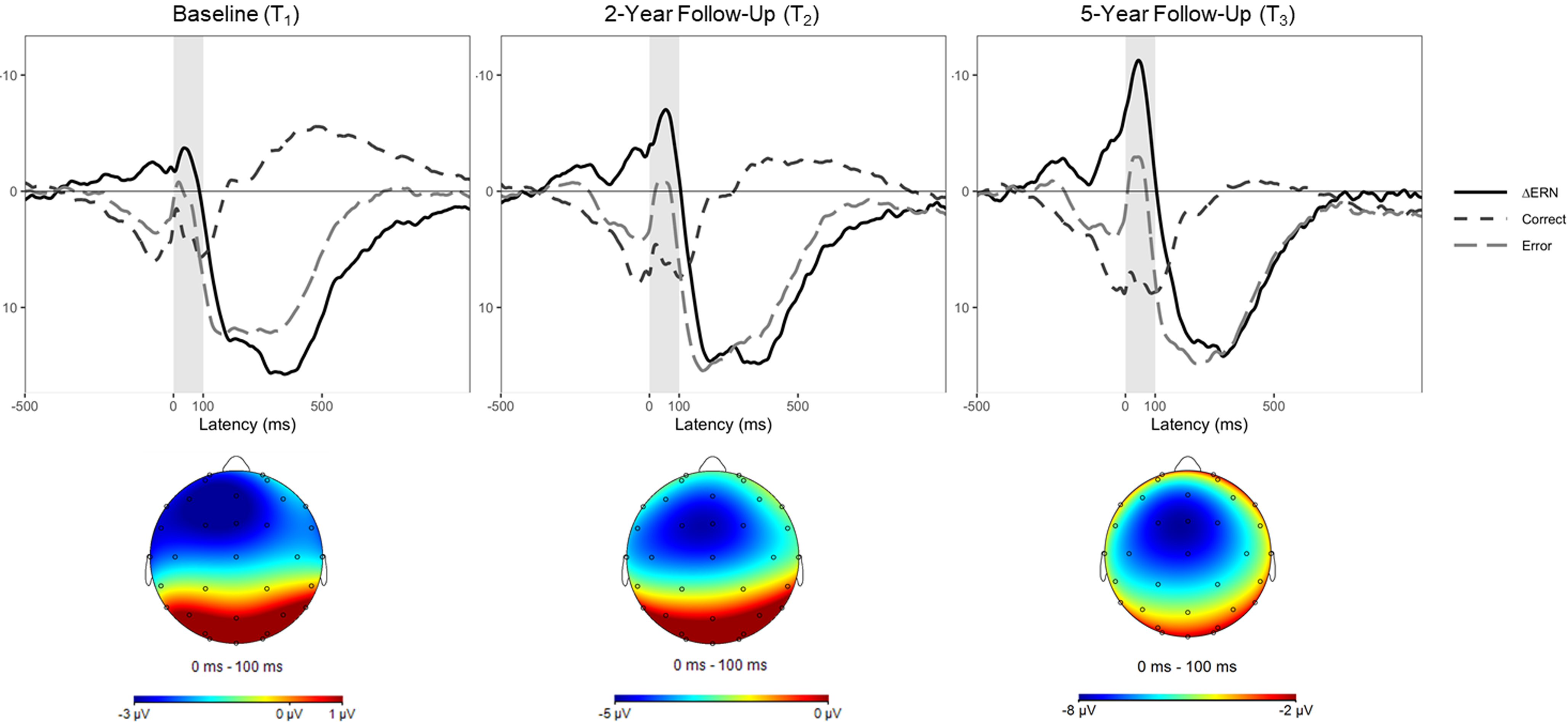
Figure 1 displays ERP waveforms and ∆ERN scalp topography for each timepoint. One-sample t-tests indicated that the ∆ERN was significantly larger (more negative) than 0 at T1 [t(232) = −7.91, p < .001], T2 [t(181) = −13.14, p < .001], and T3 [t(178) = −16.60, p < .001]. ∆ERN did not differ between those who completed the flanker task before and after the COVID-19 research suspension. At baseline (T 1), ∆ERN was not significantly correlated with SCARED generalized anxiety (r = −0.12, p = .060), SCARED social anxiety (r = −.10, p = .138), or CDI total (r = −.10, p = .114). Correlations between symptom measures and ∆ERN across all three timepoints are presented in Supplementary Table 1.
ERP waveforms and head maps for baseline (T 1), 2-year follow-up (T 2), and 4-year follow-up (T 3) visits; head maps represent the difference between responses to error and correct trials (∆ERN); scaling of head maps differs by timepoint to maintain visibility of scalp distribution despite changes in magnitude of ∆ERN.

∆ERN unconditional growth models
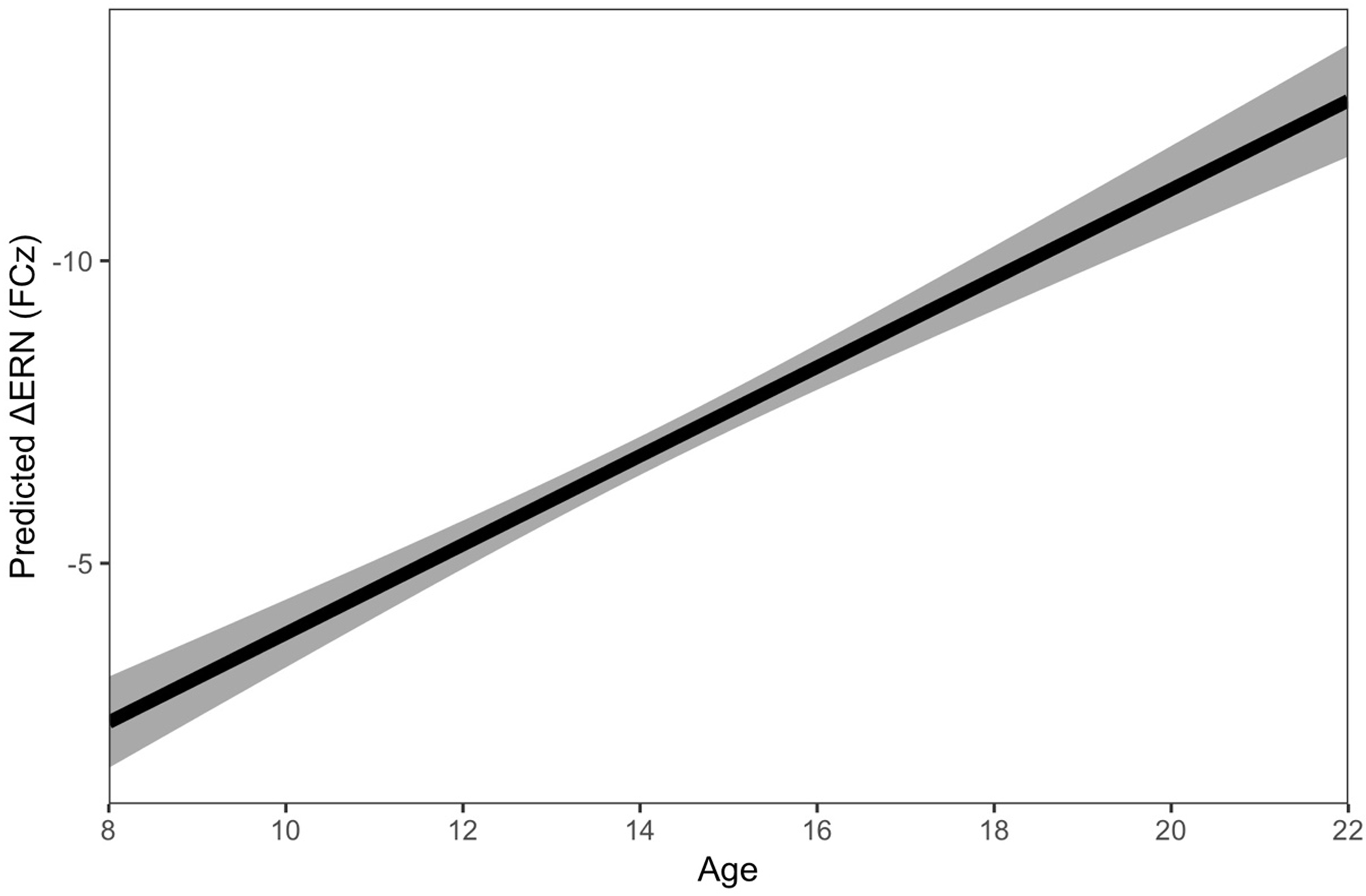
Table 1 contains the results of unconditional models for ∆ERN using all available observations (Nobs = 594). Based on the intercept-only model, the ICC was .279, which is indicative of more within-person than between-person variability in the ∆ERN. As shown in Figure 2, based on the LRT, the best-fitting model for ∆ERN was model 2, with both random intercept and slope effects (p = .034). As predicted, change in ∆ERN was characterized by a linear increase (more negative) across adolescence. On average, ∆ERN increased by 0.84 µV (SE = 0.12) each year across adolescence, t(192) = −7.13, p < .001, and the rate of linear change differed significantly between individuals. In addition, there was a significant negative correlation between intercept and slope (r = −0.54, 95% CI [−0.88, −0.23]), such that a larger (more negative) ∆ERN at age 12 was associated with a less steep increase in ∆ERN across adolescence.
Estimated mean trajectory of the ∆ERN at electrode site FCz based on the best-fitting random intercepts and random slopes unconditional model.

Unconditional multilevel growth models of ∆ERN

Note. Model 0 = unconditional means model; Model 1 = linear growth model with a fixed slope; Model 2 = linear growth model with a random slope; Model 3 = quadratic growth model with random linear slope and fixed curvature; χ2Diff = likelihood ratio test comparing fit of nested models as follows: model 1 is compared to model 0, model 2 is compared to model 1, model 3 is compared to model 2; Age is coded in years, where 0 = 12 years old; R 2 represents the total variability in ∆ERN accounted for by the model; Acronyms are defined as follows: AIC = Akaike Information Criteria, BIC = Bayesian Information Criteria, ICC = intraclass correlation; Significant effects are bolded and the best fitting model is shaded in gray; Nobs = 594, Nperson = 291.
∆ERN conditional growth models
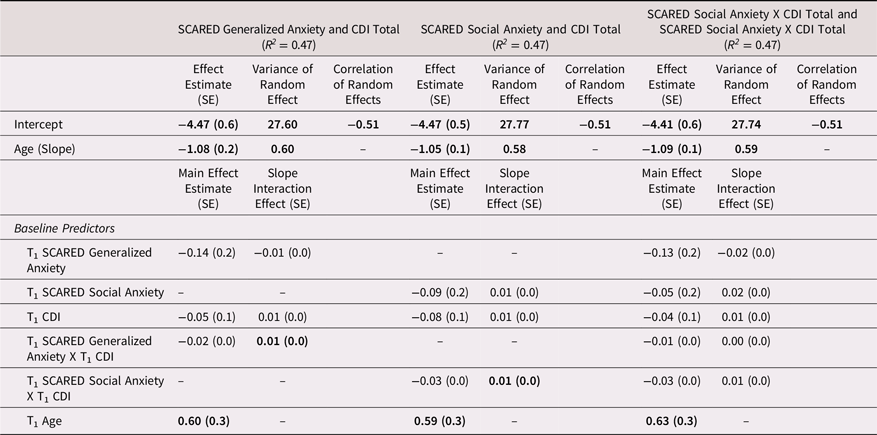
Table 2 contains the results of the ∆ERN conditional models.
Conditional multilevel growth models of ∆ERN

Note. Age is coded in years, where 0 = 12 years old; SE = standard error; significant effects are bolded; R 2 represents the total variability in ∆ERN accounted for by the model; Nobs = 594, Nperson = 291.
Generalized anxiety, depression, and ∆ERN trajectory
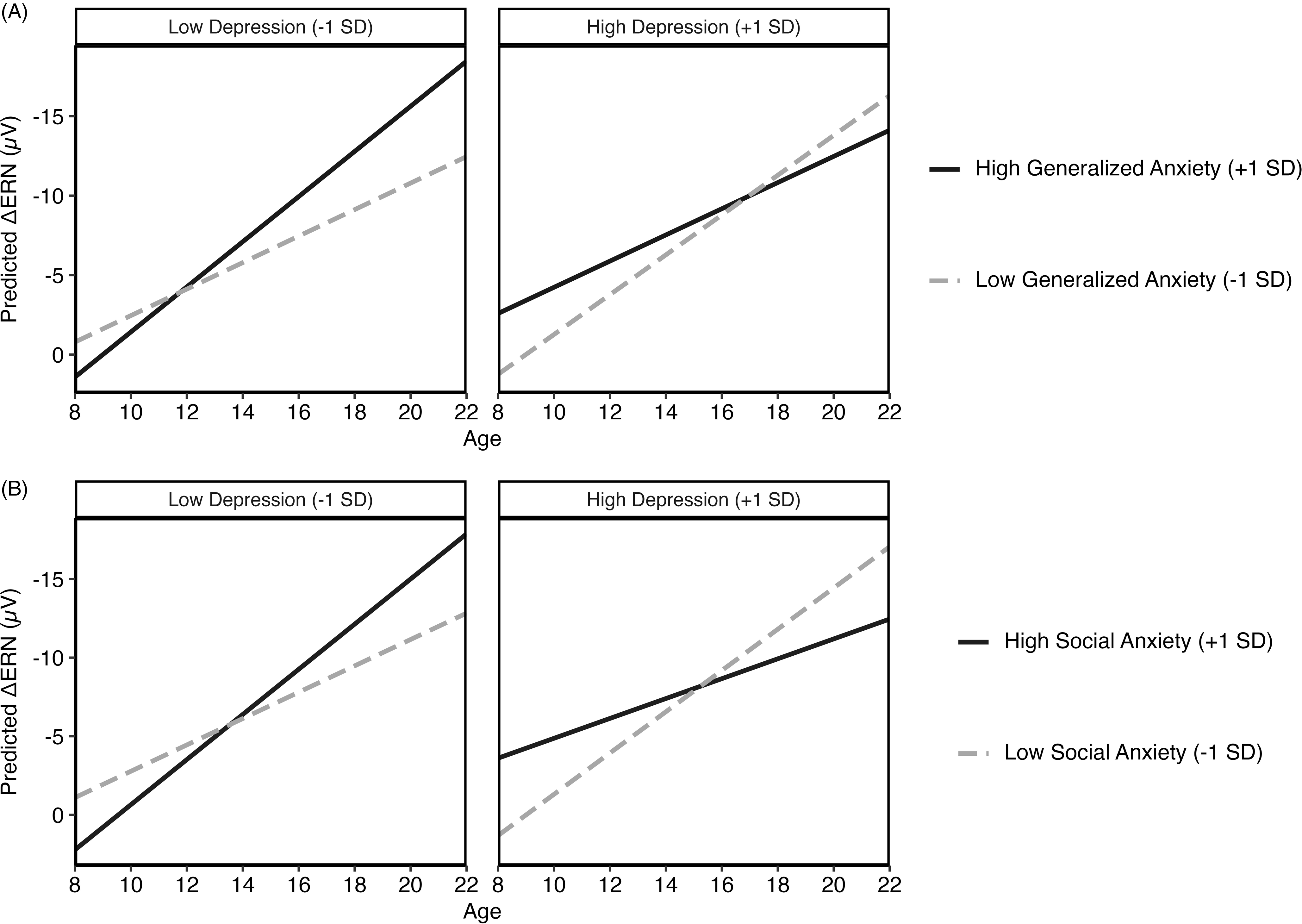
In the model that included baseline SCARED generalized anxiety, CDI symptoms, their interaction, and age as predictors, there remained a significant average increase in ∆ERN of 1.08 µV (SE = 0.15) per year, t(240) = −7.45, p < .001. Inconsistent with hypotheses, baseline SCARED generalized anxiety and CDI were not independently related to the intercept or slope (ps > .05). Instead, there was a significant 3-way interaction between the slope, baseline SCARED generalized anxiety, and baseline CDI, t(173) = 2.30, p = .023. To investigate this interaction, we conducted simple slopes analyses for participants with SCARED generalized anxiety and CDI scores ± 1 SD from the mean. Figure 3A displays model-estimated trajectories based on the simple slopes analysis. All estimated trajectories were negative (i.e., ∆ERN increasing) and significantly different from 0 (ps < .01). Notably, individuals who reported high SCARED generalized anxiety (+1 SD) with low CDI scores (−1 SD) were characterized by the steepest increase in ∆ERN across development (M = −1.42, SE = 0.31), consistent with the hypotheses that higher baseline SCARED generalized anxiety would relate to steeper trajectories whereas higher baseline CDI symptoms would relate to less steep trajectories. However, contrary to that hypothesis, those reporting the opposite pattern of symptoms (i.e., low generalized anxiety and high CDI) showed the second steepest trajectory (M = −1.25, SE = 0.39). Surprisingly, participants showed the smallest developmental increase in the ∆ERN when SCARED generalized anxiety and CDI were both low (M = −0.83, SE = 0.21) and when high SCARED generalized anxiety co-occurred with high CDI symptoms (M = −0.82, SE = 0.19).
Estimated developmental trajectories of the ∆ERN based on a conditional growth model with (A) baseline depression (CDI total score), baseline generalized anxiety (SCARED generalized anxiety score), and their interaction as level-2 predictors; and (B) another conditional growth model with baseline depression (CDI total score), baseline generalized anxiety (SCARED generalized anxiety score), and their interaction as level-2 predictors; high (+1 SD) and low (-1 SD) depression and anxiety are relative to the study sample.

Social anxiety, depression, and ∆ERN trajectory
Similar results were obtained for the model which included baseline SCARED social anxiety, CDI symptoms, their interaction, and age as predictors, such that the slope effects remained significant, t(247) = −7.86, p < .001. As in the previous model, neither baseline SCARED social anxiety or CDI symptoms were independently related to intercept or slope, contrary to hypotheses. Again, there was a significant 3-way interaction between the slope, baseline SCARED social anxiety, and baseline CDI, t(216) = 2.67, p = .008. As shown in Figure 3B, simple slopes analyses revealed that all estimated trajectories were negative (i.e., ∆ERN increasing) and significantly different from 0 (ps < .01). In concordance with the previous model which included generalized anxiety, individuals who reported high SCARED social anxiety (+1 SD) with low CDI scores (−1 SD) were characterized by the steepest increase in ∆ERN across development (M = −1.44, SE = 0.29), followed by those reporting the opposite pattern of symptoms (i.e., low social anxiety and high CDI; M = −1.31, SE = 0.30). As highlighted in the previous model, these results were concordant and discordant with hypotheses, respectively. When SCARED social anxiety and CDI were both low (M = −0.84, SE = 0.22) and when high SCARED social anxiety co-occurred with high CDI symptoms (M = −0.63, SE = 0.19), participants showed the smallest developmental increase in the ∆ERN.
Generalized anxiety, social anxiety, depression, and ∆ERN trajectory
Given the similar pattern of findings from testing both conditional models which included either generalized or social anxiety, a test of independence of effects was warranted. When SCARED generalized anxiety, CDI total, and their interaction were included the same model with SCARED social anxiety, CDI total, and their interaction, along with baseline age, the previously observed interactions became non-significant (ps > .05), which suggests the effects of social and generalized anxiety with depression were not independent of one another.
Psychopathology growth models
Supplementary Table 2 contains the results of unconditional models for each psychopathology symptom measure. Based on the LRT, trajectory of CDI total scores was best represented by model 3 (random intercept, random linear slope, and fixed quadratic curvature effects; p = .015), which suggests CDI scores increased at the onset of adolescence, but that the rate of increase slowed with age. The trajectory of SCARED generalized anxiety was best represented by model 1 (random intercept, fixed slope), in which generalized anxiety increased across adolescence at a similar rate across participants. The trajectory of SCARED social anxiety was best represented by model 0 (intercept-only model), which suggests social anxiety symptoms did not change across adolescence. Supplementary Table 3 contains the results of the conditional models for each symptom measure. Across conditional models, baseline ∆ERN was unrelated to all symptoms and symptom trajectories (ps > .05).
Discussion
In a sample of 291 girls, ERN development was characterized by a linear, within-person increase (i.e., more negative) from late childhood to early adulthood. In addition, baseline anxiety and depression symptoms together related to ERN developmental trajectory. Generalized and social anxiety symptoms had similar, non-independent effects on ERN trajectory. Overall, the present findings provide support for a within-person, developmental increase in ERN across adolescence and highlight the potential role of childhood psychopathology symptoms in the development of error-related brain activity.
The present study is consistent with existing cross-sectional findings indicating the ERN increases from early childhood into adulthood (Boen et al., Reference Boen, Quintana, Ladouceur and Tamnes2022; Tamnes et al., Reference Tamnes, Walhovd, Torstveit, Sells and Fjell2013) and provides novel longitudinal evidence of this increase spanning adolescence. This within-person increase in ERN may reflect increased error processing efficiency across adolescence, similar to the increased neural efficiency observed for other cognitive control mechanisms (Segalowitz et al., Reference Segalowitz, Santesso and Jetha2010). In addition, existing age-restricted longitudinal studies of ERN development during adolescence (Meyer et al., Reference Meyer, Bress and Proudfit2014; Taylor et al., Reference Taylor, Visser, Fueggle, Bellgrove and Fox2018) relied on group mean level comparisons, whereas the current study employed multilevel modeling to provide evidence of within-person trajectories of change in the ERN. These findings have meaningful implications, particularly for the use of the ERN as a measure of individual differences or intra-individual change. Understanding the magnitude of increase in the ERN across adolescence is crucial for appropriately selecting and controlling for sample age range in cross-sectional studies of individual difference, as well as measuring change or identifying atypical developmental trajectories of the ERN in repeated measures designs. Relatedly, extant literature suggests temporal stability of the ERN (e.g., test-retest reliability) is moderate for adults (Weinberg & Hajcak, Reference Weinberg and Hajcak2011) and low to moderate for children and adolescents (Meyer et al., Reference Meyer, Bress and Proudfit2014). Therefore, cross-sectional measurements of individual differences in the ERN should be interpreted with caution, even when controlling for age, given that normative development is likely not solely responsible for variation in the ERN.
The present study also found that individual differences in baseline anxiety and depression symptoms predicted the development of the ERN. Participants who reported high generalized or social anxiety and low depression symptoms at baseline were characterized by the steepest increase in ERN across adolescence into early adulthood. This finding is consistent with our hypothesis based on studies showing enhanced ERN in adolescents (e.g., Chong et al., Reference Chong, Mirzadegan and Meyer2020) and adults (e.g., Weinberg, Klein, & Hajcak, Reference Weinberg, Klein and Hajcak2012) with GAD. However, participants who reported high depression and low generalized or social anxiety symptoms were also characterized by a steeper increase in ERN across adolescence than those with low depression and anxiety symptoms. This finding was inconsistent with our predictions based on research demonstrating attenuated ERN for adults (Olvet et al., Reference Olvet, Klein and Hajcak2010; Schrijvers et al., Reference Schrijvers, De Bruijn, Maas, Vancoillie, Hulstijn and Sabbe2009; Tan et al., Reference Tan, Rozenman, Chang, Jurgiel, Truong, Piacentini and Loo2021; Weinberg et al., Reference Weinberg, Meyer, Hale-Rude, Perlman, Kotov, Klein and Hajcak2016) and adolescents (Bress et al., Reference Bress, Meyer and Hajcak2015) with elevated depression symptoms, as well as attenuated ERN and lack of normative developmental increase in ERN for children and adolescents with MDD (Ladouceur et al., Reference Ladouceur, Slifka, Dahl, Birmaher, Axelson and Ryan2012). Instead, the findings of the present study are more in line with findings that have shown that enhanced ERN is related to MDD diagnosis (Holmes & Pizzagalli, Reference Holmes and Pizzagalli2008) or elevated depression symptoms in adults with social anxiety (Endrass et al., Reference Endrass, Riesel, Kathmann and Buhlmann2014). Nonetheless, caution is warranted in interpreting the depression-related findings in the present sample, as participants with clinical levels of depression represented a small portion of the sample.
Although elevated anxiety or depression symptoms alone had similar effects on ERN trajectory (i.e., steeper increase), those with co-occurring elevated depression and anxiety symptoms did not demonstrate the same effect on ERN trajectory. In the case of generalized anxiety, these participants showed nearly identical ERN trajectories to those with low generalized anxiety and low depression symptoms. For social anxiety, those with co-occurring high social anxiety and high depression symptoms had even lower developmental trajectories than those who were low in both. The observed effect is consistent with findings from the adult literature which show that enhanced ERN was observed in GAD patients without MDD but not GAD patients with MDD (Weinberg et al., Reference Weinberg, Klein and Hajcak2012, Reference Weinberg, Kotov and Proudfit2015). Similar to the ERN suppression observed in adults cross-sectionally, results from the present study provide support for suppression of ERN development when anxiety and depression symptoms are present at the onset of adolescence. However, the current findings suggest that developmental ERN suppression is not a result of opposing effects of depression and anxiety symptoms on ERN trajectory, but instead a more complex interaction effect. Notably, this interaction effect was concordant across generalized and social anxiety symptoms, and neither provided independent predictive power over the other. These findings suggest that the self-report measures of generalized and social anxiety in this study may be capturing a more general anxiety factor, observed by Whitmore et al. (Reference Whitmore, Kim-Spoon and Ollendick2014) in a similar-aged sample, and that the broader factor may relate to ERN development. Broadly, these findings extend support for examining the interaction between anxiety, including social and generalized anxiety, depression, and the ERN across the lifespan by providing evidence that this relationship may also have significant developmental impacts. Clinically, the results of the present study underscore the importance of early intervention for psychopathology, as the presence of psychopathology symptoms in childhood may have lasting effects on neural development, particularly for error processing.
The present study had several limitations. First, the sample was limited to a relatively homogeneous sample of white, middle class, female adolescents. This homogeneity did not allow for examination of other factors that may influence development of error processing. For example, the female sample did not allow for measurement of sex differences. Previous findings have shown adult males exhibit larger ERNs than females (Larson et al., Reference Larson, South and Clayson2011), and meta-analytic evidence also suggests that the relationship between ERN and anxiety is stronger for females than males (Moser et al., Reference Moser, Moran, Kneip, Schroder and Larson2016). The present findings may differ for males, such that they may have larger baseline ERNs, steeper increases in the ERN, or ERN trajectories extending further into adulthood, as well as weaker relationships between ERN and psychopathology compared to females. However, meta-analytic evidence suggests that sex does not moderate age-related differences in the ERN (Boen et al., Reference Boen, Quintana, Ladouceur and Tamnes2022), so it is possible that similar ERN developmental trajectories could be observed for males. Taken together, replicating the present study to test for sex differences in a sample which includes males is warranted. In addition, research demonstrating that socio-evaluative stress in adolescence is associated with larger ERN later in life (Banica et al., Reference Banica, Sandre, Shields, Slavich and Weinberg2022) suggests that stressors related to socioeconomic status (e.g., social comparison) or identity (e.g., racism) may influence development of the ERN beyond what was captured in the present sample. The sample was also from the community, so rates of full-threshold psychopathology were low, particularly for depression. However, research suggests that subthreshold depression predicts later depression onset (Wesselhoeft et al., Reference Wesselhoeft, Sørensen, Heiervang and Bilenberg2013) and both subthreshold anxiety and depression are associated with increased impairment (Balázs et al., Reference Balázs, Miklósi, Keresztény, Hoven, Carli, Wasserman, Apter, Bobes, Brunner, Cosman, Cotter, Haring, Iosue, Kaess, Kahn, Keeley, Marusic, Postuvan and Resch2013). Still, replication of the current findings in a clinical sample is necessary for determining whether these effects are generalizable to more severe, early-onset anxiety and depression. Second, participants completed baseline assessments at different ages, ranging from 8 to 14 years old. Though age at baseline was controlled for in the models, reported psychopathology may have differed as a function of age. Moreover, the variation in age at baseline assessment did not allow for reliable assessment of concurrent relationships between psychopathology and ∆ERN via intercept effects. Third, though the overall age range of the study (i.e., 8-22 years old) included all of adolescence, it was not broad enough to capture the full development of the ERN. Future research is needed to examine early childhood development of error processing into adolescence and to further probe non-linear trajectories, particularly into adulthood. Fourth, although the present study took a dimensional approach to measuring symptom severity, symptoms were categorized by disorder rather than transdiagnostically due to availability of clinical measures. Therefore, findings provided limited insight into the clinically significant, transdiagnostic mechanisms which may be most closely related to ERN development. Finally, while these findings, combined with extant literature, strongly support further investigation into the bidirectional relationship between psychopathology and ERN development, advanced statistical modeling should be employed to examine concurrent trajectories of ERN and psychopathology, as well as their prospective associations across adolescence.
In conclusion, the present study provided novel longitudinal evidence of a linear, within-person increase in ERN across adolescence. Findings also demonstrated that the rate of increase in ERN was associated with childhood anxiety (i.e., generalized or social anxiety) and depression symptoms.
Supplementary material
For supplementary material/s referred to in this article, please visit https://doi.org/10.1017/S0954579425100370
Data availability statement
Research data are not shared.
Funding statement
This work was supported by the National Institute of Mental Health (R01 MH097767 to Drs. Brady D. Nelson and Greg Hajcak; F31 MH102880 to Dr. Alexandria Meyer).
Competing interests
Dr. Greg Hajcak has served as a paid consultant for Alto Neuroscience and Universal Brain.