INTRODUCTION
To date, 3600 species of terrestrial isopods are known (Schumalfuss, Reference Schmalfuss2003). Despite this great number, knowledge regarding the population dynamics is restricted to few species (Koop & Field, Reference Koop and Field1980; Furota & Ito, Reference Furota and Ito1999; Tsai & Dai, Reference Tsai and Dai2001; Achouri et al., Reference Achouri, Charfi-Cheikhrouha and Marques2003; Dias & Sprung, Reference Dias and Sprung2003; Araujo & Bond-Buckup, Reference Araujo and Bond-Buckup2004). Previous growth studies concerned with Oniscidea are scarce, and few authors have applied the von Bertallanfy growth model (VBGM) to describe it. Despite its widespread use to estimate growth in peracarids (Fonseca et al., Reference Fonseca, Veloso and Cardoso2000; Fonseca & D'Incao, Reference Fonseca and D'Incao2003), the VBGM has never been used to estimate growth in length of any species of Ligia Fabricius, 1798.
McQueen & Carnio (Reference McQueen and Carnio1974) studied the growth in weight of Porcellio spinicornis Say, 1818 based on the modified von Bertallanfy model. Haddad & Verani (Reference Haddad and Verani1984) analysed post-marsupial growth of Balloniscus sellowii (Brandt, 1833) under laboratory conditions and Araujo & Bond-Buckup (Reference Araujo and Bond-Buckup2004) estimated growth of a wild population of Atlantoscia floridana (van Name, 1940) based on the increment of cephalothoracic length. Later, Araujo & Bond-Buckup (Reference Araujo and Bond-Buckup2005) used the von Bertallanfy method to analyse the age-structure in a natural population of the same species. Meinhardt et al. (Reference Meinhardt, Quadros and Araujo2007) studied the growth the Balloniscus glaber Araujo & Zardo, 1995 based in the von Bertallanfy model.
Carefoot (Reference Carefoot1973) estimated length-relationships, reproduction pattern and life cycle of Ligia pallasii Brandt, 1833 in Canada, verifying that males presented higher growth rates and larger body size than females. Koop & Field (Reference Koop and Field1980) studied a population from South Africa and verified the role of food availability on population dynamics of Ligia dilatata Brandt, 1833, observing that growth is reduced during summer and increased in winter, when food is more abundant.
Ligia exotica Roux, 1828 is a semi-terrestrial isopod inhabiting the supralittoral of rocky shores worldwide (Lemos de Castro, Reference Lemos de Castro1971). Investigations regarding the population dynamics of L. exotica have focused on the reproductive process, particularly on the comparison of reproductive strategies of inland and littoral zone populations (Tsai & Dai, Reference Tsai and Dai2001), and on the comparison of reproductive traits of co-generic species (Tsai & Chen, Reference Tsai and Chen1997). For the Brazilian southern coast, two studies have addressed the reproductive biology of L. exotica in two different estuaries (Souza, Reference Souza1998; Lopes et al., Reference Lopes, Blasina, Dumont and D'Incao2006). Concerning individual growth, no information is available, and the VBGM has not been attempted to describe the growth of L. exotica. In order to increase knowledge on the growth process of this species, the present investigation reports growth parameters—based on the VBGM—of two different populations of L. exotica inhabiting distinct sites in the Patos Lagoon estuary.
MATERIALS AND METHODS
Study area
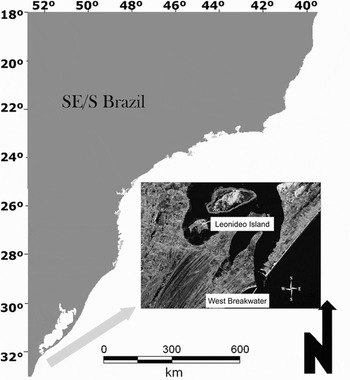
The estuarine area of Patos Lagoon is characterized by shallow water bays and numerous islands (Cordazzo & Seeliger, Reference Cordazzo and Seeliger1995). This region comprises an area of 971 km2 and water exchange with marine environment occurs through a channel 20 km long (Bonilha & Asmus, Reference Bonilha and Asmus1994). Most of the area is composed of muddy and sandy soft bottoms; however, the presence of artificial rocky structures (e.g. 5 km long breakwater on both sides of a channel connecting the estuary to the sea) can be observed (Capítolli, Reference Capítolli, Seeliger, Odebrecht and Castello1998). Studied areas were two artificial rocky structures: West Breakwater (32º15987′S 52º09783′W—connecting the estuary to marine environment) and Leonideo Island (32º02029′S 52º11951′W—inner estuarine zone) (Figure 1).
South-eastern and southern Brazil highlighting the estuarine zone of Patos Lagoon, where both populations of Ligia exotica were studied. The population from West Breakwater is located close to the marine environment and therefore subject to higher salinity water. On the other hand, the population established on Leonideo Island is located at the inner area of the estuary, where salinity is consistently lower.

Biological sampling
Sampling was performed fortnightly from February 2003 to July 2004 at West Breakwater and from May 2003 to October 2004 at Leonideo Island. Individuals were manually collected in the morning by three researchers, during a standard period of 1 hour, and taken to the laboratory. In the laboratory, isopods were sexed and measured (total length (TL)). TL, from the anterior border of the cephalothorax to the posterior border of the telson, was measured with a caliper.
Individual growth
Growth was estimated through modal progression analysis (MPA), using a length-class interval of 0.5 mm to obtain total length–frequency histograms. Length data were fitted to the von Bertalanffy growth model (VBGM) (von Bertalanffy, Reference von Bertalanffy1938) by an automated least squares procedure. The TL∞ was fixed as a mean value of individuals larger than 29 mm (females) and 34 mm (males). The VBGM is given by: TLt = TL∞ [1 − e−k(t−t)0], where TL∞ is the asymptotic length, k is coefficient of growth and t0 is the theorical age when the size is equal to 0.
The criteria used to validate a cohort were the biological coherence with life cycle of species (coherent estimate of longevity based on the duration of a cohort in time and values suggested in the literature) and statistical significance of the of adjustment to VBGM (Fcalculated > F critical). Comparison of growth curves was performed by using an F test (P < 0.05), according to Cerrato (Reference Cerrato1990). Longevity was estimated by inverted VBGM with the modification suggested by D'Incao & Fonseca (Reference D'Incao, Fonseca, Von Vaupel Klein and Schram1999), considering t0 = 0 and TLi/L∞ = 0.99. The equation of longevity is given by: Tmax = 0 − (1/k)Ln[1 − (TLi/TL∞)].
RESULTS
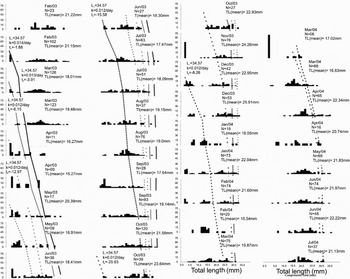
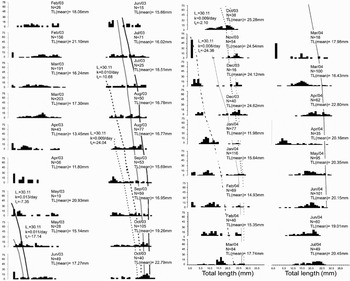
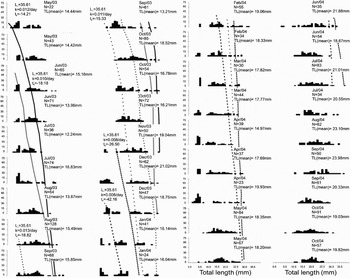
In the West Breakwater were collected 5376 individuals (1494 juveniles, 1748 males and 2134 females). The TL ranged from 2.3 to 7.80 mm, 7.81 to 35.42 mm and 7.81 to 31.40 mm, for juveniles, males and females, respectively. At Leonideo Island, 5519 individuals were collected (510 juveniles, 1956 males and 3053 females). The size of individuals ranged from 2.3 to 6.87 mm (juveniles), 6.88 to 37.49 mm (males) and from 6.88 mm to 30.39 mm (females). Length–frequency distributions were polymodal, reflecting the incorporation of new cohorts along the entire period of study (Figures 2–5).
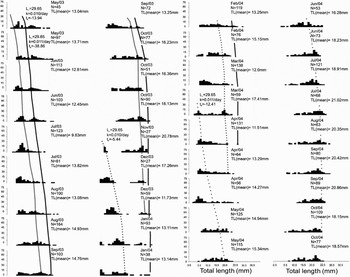
Modal progression analysis performed for cohorts of males at West Breakwater. Different patterns of lines represent the cohorts followed during the studied period to describe the individual growth for Ligia exotica. The parameters of VBGM are provided for each cohort considered as biologically coherent (L∞, k, t0), as well as the number of collected individuals (N) and the mean length at each sampling (TL m).

Modal progression analysis performed for cohorts of females at West Breakwater. Different patterns of lines represent the cohorts followed during the studied period to describe the individual growth for Ligia exotica. The parameters of VBGM are provided for each cohort considered as biologically coherent (L∞, k, t0), as well as the number of collected individuals (N) and the mean length at each sampling (TL m).

Modal progression analysis performed for cohorts of males at Leonideo Island. Different patterns of lines represent the cohorts followed during the studied period to describe the individual growth for Ligia exotica. The parameters of VBGM are provided for each cohort considered as biologically coherent (L∞, k, t0), as well as the number of collected individuals (N) and the mean length at each sampling (TL m).

Modal progression analysis performed for cohorts of females at Leonideo Island. Different patterns of lines represent the cohorts followed during the studied period to describe the individual growth for Ligia exotica. The parameters of VBGM are provided for each cohort considered as biologically coherent (L∞, k, t0), as well as the number of collected individuals (N) and the mean length at each sampling (TL m).

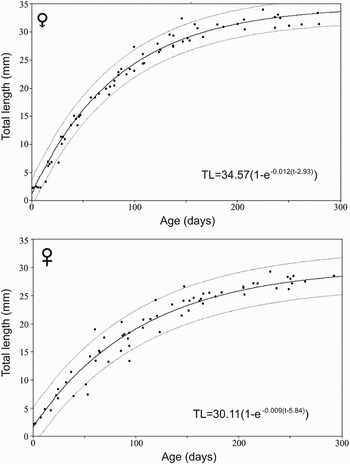
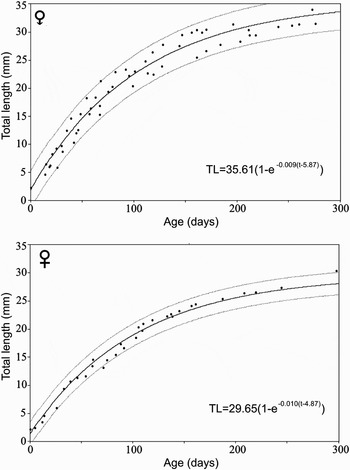
Seven different cohorts of females and six cohorts of males were selected at West Breakwater to estimate the growth curves (Figures 2–3). At Leonideo Island, six cohorts of males and four of females were accepted as biologically describing the growth of individuals (Figures 4–5). The fixed TL∞ values were 34.57 mm (West Breakwater males), 30.11 mm (West Breakwater females), 35.61 mm (Leonideo Island males) and 29.65 mm (Leonideo Island females). Mean growth curves for both sexes and sampling sites are represented in Figures 6 & 7. Males were consistently larger than females. The F test, used to verify differences in growth between males and females, showed that there is sexual dimorphism for this species in both sites, since discrete growth patterns were observed (Fcalculated = 24.96; Fcritical = 3.09).
Growth curves and VBGM estimated for males (r2 = 0.95, F = 36127.1, P = 0.00) and females (r2 = 0.95, F = 41896.2, P = 0.00) of Ligia exotica inhabiting the West Breakwater, Rio Grande, Rio Grande do Sul, Brazil.

Growth curves and VBGM estimated for males (r2 = 0.96, F = 46074.2, P = 0.00) and females (r2 = 0.95, F = 56430.8, P = 0.00) of Ligia exotica inhabiting Leonideo Island, Rio Grande, Rio Grande do Sul, Brazil.

When growth of females from two sampling sites was compared, no significant differences were observed (Fcalculated = 0.09; Fcritical = 3.09). However, comparison between males showed significant differences among populations analysed. Males from West Breakwater were consistently larger, and in spite of it, presented a higher growth coefficient than those from Leonideo Island (Fcalculated = 27.64; Fcritical = 3.06).
Males from West Breakwater presented a higher coefficient of growth (k = −0.012/day) when compared to females (k = −0.009/day) from the same population. Males grow faster, achieve higher TL values and present a shorter lifespan (1.1 years). Females present slightly higher longevity (1.3 years) when compared to males. At Leonideo Island, males (−0.009/day) and females (−0.010/day) present similar k and longevity values (1.3 years); however males show higher maximum lengths.
DISCUSSION
The application of VBGM to L. exotica showed that this model can be very useful for most species of crustaceans, since its use has shown good suitability for different species (e.g. shrimps, crabs and isopods). As previously mentioned, the absence of hard structures capable of registering the age of individuals, has always been a problem to estimate growth parameters in crustaceans (Fonseca & D'Incao, Reference Fonseca and D'Incao2003; Dumont & D'Incao, Reference Dumont and D'Incao2004). However, the use of VBGM coupled with the assumption that Tmax is achieved at 99% of asymptotic length provides a valuable tool to define whether a longevity estimate (closely related to coefficient of growth) is biologically coherent or not.
Trends in population parameters have been observed, not only among different species of the same genus, but also among the same species inhabiting different areas (King, Reference King1997). Results obtained in the present investigation suggest that a slightly higher longevity is achieved by the inner estuarine population (1.3 years both sexes) when compared to that more exposed to marine water (1.3 and 1.1 years for females and males, respectively). This observation is in agreement with the estimates obtained by Willows (Reference Willows1987), investigating populations of Ligia dilatata inhabiting environments with different salinity gradients. This author says that the longevity of the species was higher at the less exposed site.
Similar maximum longevity values (1.5–2 years) were estimated for Ligia exotica in Taiwan (Tsai & Dai, Reference Tsai and Dai2001), Ligia oceanica in France (Besse et al., Reference Besse, Picaud and Mocquard1975) and Ligia pallasii from Canada (Carefoot, Reference Carefoot1973). Visual analysis of length–frequencies permits to follow a cohort for a maximum period of 1.25 years. Thus, the estimates of longevity (1.1–1.3 years) obtained by using VBGM are biologically coherent and in agreement with estimates previously suggested for the group. Furota & Ito (Reference Furota and Ito1999) estimated a longevity value of 1 year for Ligia cinerascens from Japan and related short lifespan and high growth rates to the elevated temperatures of the studied region.
A different growth pattern of males from populations analysed confirms the hypothesis that West Breakwater individuals are larger than those from Leonideo Island. One possible explanation is the higher food availability observed (Lopes-Leitzke, Reference Lopes-Leitzke2005) in the former site, providing better conditions for individual growth. Previous investigation concluded that growth of Ligia dilatata is mainly affected by food availability (Koop & Field, Reference Koop and Field1980), which is also likely to be true for L. exotica. The largest individual collected was observed at Leonideo Island (♂ 37.49 mm). However, this value is more related to sampling efficiency in this area (smaller basaltic rocks with easier access to the animals) than the growth pattern itself. A wider spatial niche provided by West Breakwater and the option of choosing a more suitable environment (brackish water inside the estuary and marine water outside) may explain better adaptation of this species to this site. Further evidence of a better suitability of individuals inhabiting the West Breakwater is provided by fecundity analysis. Previous investigation suggests that fecundity of females inhabiting West Breakwater is significantly higher than that observed for Leonideo Island (Lopes et al., Reference Lopes, Blasina, Dumont and D'Incao2006).
Sexual dimorphism was observed for males that reach larger TL by faster growth pattern, as observed for other species of this genus (Carefoot, Reference Carefoot1973; Koop & Field, Reference Koop and Field1980; Furota & Ito, Reference Furota and Ito1999). The same size pattern was observed for Ligia oceanica that presented growth reduction due to high energy investment on reproduction (Mocquard et al., Reference Mocquard, Besse, Juchault, Legrand, Maissiat and Noulin1971, Reference Mocquard, Picaud and Besse1974). Thus, it is likely that growth of L. exotica is sharply affected by reproduction, since this species presents one of the widest reproductive periods of the genus Ligia observed in the literature (Lopes et al., Reference Lopes, Blasina, Dumont and D'Incao2006).
Briefly, the population dynamics of L. exotica inhabiting the estuarine zone of Patos Lagoon is highly influenced by physical and biological parameters. Two discrete populations were observed, showing different fitness to the environment they inhabit. Therefore, a hypothesis of recent colonization of the inner estuarine substrates could be stated and future investigations should be performed (e.g. genetic analysis) to answer this question.
ACKNOWLEDGEMENT
This research was supported by CAPES (Ministry of Education, Brazil) through a PhD studentship to Elis R. Lopes-Leitzke.