It is usually the case that adult learners of a second language (L2), referred to here as bilinguals, learn their L2 by means of their already established first language (L1). As a result, during early stages of SLA, learners inevitably experience interference from their L1. However, as proficiency develops in the L2, the learner can come to function more like monolingual native speakers of his or her L2, with an increased ability to prevent the L1 from interfering during L2 processing. One model that attempts to explain this performance asymmetry between low- and high-proficiency bilinguals with respect to lexical access and organization is the revised hierarchical model (RHM; Kroll & Stewart, Reference Kroll and Stewart1994).
According to the RHM, L2 learners with a full-fledged L1 system rely on L1 translation equivalents—that is, words or expressions that correspond in meaning between the two languages—when acquiring new L2 words and only later come to access the meaning of these L2 words directly. The consequence of these interlexical connections is an automatic and unintentional intrusion of the L1 during L2 usage. The RHM further predicts that reliance on the L1 diminishes with increased proficiency in the L2. Because direct connections between the L2 words and their corresponding meanings are established, the bilingual experiences less lexical interference from the L1 and more sensitivity to semantic variables. The goal of the present study is to test the predictions of the RHM in two groups of native speakers of Arabic at lower and higher levels of L2 English proficiency. Furthermore, the current study aims to investigate the claims of the morphological decomposition model (MDM; Frost, Forster, & Deutsch, Reference Frost, Forster and Deutsch1997). The MDM predicts that, in speakers of languages with nonconcatenative morphological systems—that is, systems in which words are formed by the combination of two discontinuous morphemes (the root and the word pattern)—lexical organization and search processes are based on morphological identity rather than on orthographic similarity. The RHM and the MDM together predict that for native speakers of Arabic in the early stages of English SLA, L1 translation equivalents along with morphologically related words will be activated when a L2 word is encountered. To test these predictions, participants completed a translation recognition task that contained, in addition to the correct translation pairs, an English word not paired with its correct translation but with an Arabic word that was either orthographically, morphologically, or semantically related to the correct translation.
THE RHM
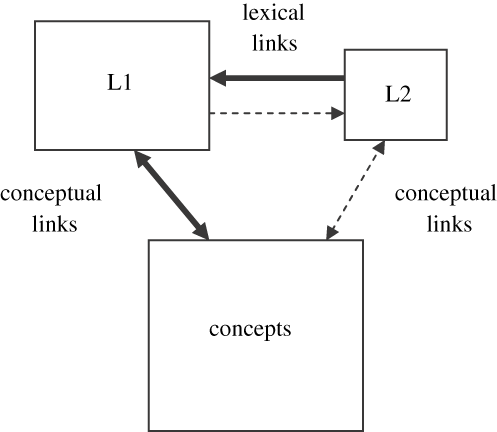
To explain the performance asymmetry between low- and high-proficiency bilinguals, Kroll and Stewart (Reference Kroll and Stewart1994) proposed a developmental model that came to be known as the RHM. Illustrated in Figure 1, the RHM proposes separate lexical stores for each of the bilingual’s languages as well as a shared conceptual store. When the L2 is first introduced to the already established L1 lexical knowledge, words in the L2 are linked to their L1 translation equivalents, as it has been suggested that L2 word learning takes place in this L2-to-L1 direction (Kroll & Stewart).
The revised hierarchical model. Reprinted from “First language activation during second language lexical processing: An investigation of lexical form, meaning, and grammatical class,” by G. Sunderman & J. F. Kroll, Reference Sunderman and Kroll2006, Studies in Second Language Acquisition, 28, p. 392.
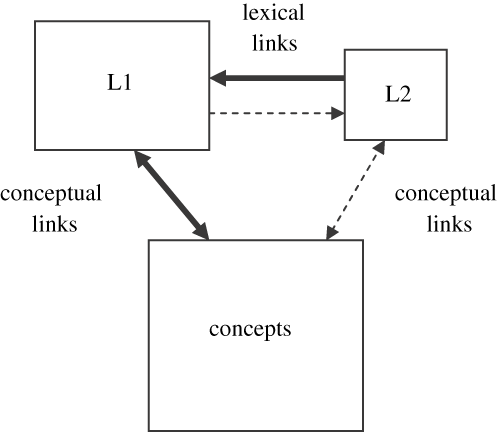
The RHM also claims that, for lower proficiency learners, only words in the L1 have direct access to their meanings in the conceptual store, whereas L2 words are linked indirectly to their meanings via their L1 translation equivalents. In Figure 1, the strength of connections in the model is indicated by the type of arrow: The solid lines indicate stronger connections in the representational system, and the dashed lines represent weaker connections. As the learner becomes more proficient in the L2, the RHM assumes that direct links between words in the L2 and their meanings are established while the reliance on the L1 translation equivalents decreases. For a native speaker of Arabic with low proficiency in English, the English noun book, for example, is thus assumed to be associated with its Arabic translation equivalent  [kitaab]; however, as the learner’s proficiency in English increases, the word book will have direct access to its meaning, bypassing the Arabic translation equivalent.
Several studies have confirmed the predictions of the RHM with regard to asymmetrical lexical-to-conceptual mappings in the two routes of translation in the bilingual memory. Kroll and Stewart (Reference Kroll and Stewart1994) had fluent L1 Dutch-L2 English bilinguals translate words in the forward direction of translation (from L1 to L2) as well as in the backward direction of translation (from L2 to L1). The translation lists in that study were manipulated such that one list was semantically categorized (e.g., all fruits, all furniture) and the other was semantically randomized. Following the predictions of the RHM, translation in the backward direction was faster than translation in the reverse direction. Furthermore, only translation in the forward direction suffered category interference as a result of the semantic manipulation of the translation lists. This translation asymmetry was also obtained in another study by Sholl, Sankaranarayanan, and Kroll (Reference Sholl, Sankaranarayanan and Kroll1995), who investigated the relationship between picture naming and translation. In this study, fluent learners of Spanish whose L1 was English named two sets of pictures in their L1 or L2 and then translated words into their L1 and L2. Some words in this task represented concepts that had been previously named as pictures. The results showed that picture naming produced reliable facilitation effects for translation from L1 to L2 but not for the reverse direction, which suggests that only L1-to-L2 translation is conceptually mediated and thus lends further support for asymmetric connections in the bilingual memory.
Other studies have confirmed the developmental aspect of the RHM. In one study, Talamas, Kroll, and Dufour (Reference Talamas, Kroll and Dufour1999) investigated this aspect of the RHM using a translation recognition task (De Groot, Reference De Groot1992). In this task, high- and low-proficiency learners of Spanish, whose dominant language was English, were asked to decide whether two words—one corresponding to each of their languages—were translations of each other. For a translation pair like man-hombre, the critical trials involved word pairs in which the second word was not the correct translation of the first but was related to the correct Spanish translation (hombre “man”) either in form (e.g., man-hambre “hunger”) or in meaning (e.g., man-mujer “woman”). According to the predictions of the RHM, for the translation equivalents man-hombre, for example, when participants are presented with the word man, the word hombre “man” would be activated along with other form-related words in less proficient bilinguals. Distracters similar in form to the L1 translation equivalent like hambre “hunger” should therefore be more difficult to reject as a translation equivalent of man than an unrelated control. As for the meaning-related distracters, the RHM predicts that only higher proficiency learners should experience interference effects in this condition due to the direct word-to-concept mappings for both of their languages; lower proficiency learners may not show interference effects in the meaning-related condition because their L2 is assumed to be lexically rather than conceptually mediated. The activation of the L1 translation equivalent alone enables the lower proficiency L2 learner to determine whether the words man-hombre constitute a correct translation pair. In other words, lower proficiency L2 learners may not actually access the concept represented by the L2 word man, which explains the absence of interference effects in the meaning-related condition. The results showed that form interference was larger than semantic interference for the low-proficiency group, whereas the reverse pattern held true for the high-proficiency group. This finding is consistent with predictions of the RHM in that, with increasing proficiency, translation from L2 to L1 undergoes a shift from lexically mediated to conceptually mediated processing.
Additional support for the predictions of the RHM with regard to the asymmetrical performance of bilinguals at different stages of L2 proficiency comes from a study by Sunderman and Kroll (Reference Sunderman and Kroll2006). Using a translation recognition task similar to the one used by Talamas et al. (Reference Talamas, Kroll and Dufour1999), Sunderman and Kroll contrasted the performance of two groups of native English speakers with different proficiency levels in Spanish. Again, critical trials involved words pairs that were not correct translations of each other but were pairs in which the second word was related to the correct translation in form or meaning. Sunderman and Kroll found that the less proficient learners exhibited slower response times and were less accurate in the form-related condition, whereas the more proficient learners did not show this effect of form similarity to the translation equivalent. Sunderman and Kroll concluded that, as predicted by the RHM, the extent to which the L1 translation equivalent is activated during L2 processing is negatively correlated with proficiency level in the L2. Contrary to the predictions of the RHM and earlier studies (e.g., Talamas et al.), however, Sunderman and Kroll found that both groups of L2 learners showed interference effects in the meaning-related condition, an indication that access to L2 word meaning may take place even in early stages of SLA, when reliance on L1 translation equivalents is believed to occur.
Several other studies obtained results that were contradictory to the predictions of the RHM. For example, De Groot and Poot (Reference De Groot and Poot1997) had L1 Dutch-L2 English bilinguals at three L2 proficiency levels translate words representing abstract and concrete entities. The results showed that imageability or concreteness, a conceptual component, had an effect on translation performance for all participants and in both directions of translation. In another study, Altarriba and Mathis (Reference Altarriba and Mathis1997) had novice and proficient L1 English-L2 Spanish learners perform a translation recognition task on words that included semantically related pairs (e.g., hilo “thread”-needle). Contrary to the predictions of the RHM, novice as well as proficient learners experienced semantic interference. In a subsequent experiment, Altarriba and Mathis administered a bilingual version of the Stroop color-word task before which English monolingual speakers were trained to 100% accuracy on four Spanish color words. In monolingual Stroop tasks, words appear printed in an ink color that differs from the color referred to by the word (e.g., the word blue appears printed in red), and the task of the participant is to ignore the color word and name the color of the ink (Stroop, Reference Stroop1935). In the bilingual version of this task, the word name appears in one of the bilingual’s languages and the bilingual is asked to name the ink color in his or her other language (e.g., Chen & Ho, Reference Chen and Ho1986). In Altarriba and Mathis’s study, participants produced significant Stroop effects, which is characteristic of conceptually mediated processing. In another study, La Heij, Hooglander, Kerling, and Van der Velden (Reference La Heij, Hooglander, Kerling and Van der Velden1996) had L1 Dutch-L2 English bilinguals translate words into their L1 and L2 while ignoring semantically related pictures. The results showed that there was an equally significant facilitation effect of pictures in both directions of translation, which lends support for conceptually mediated L1 and L2 processing and poses a serious challenge for the RHM.
Kroll and Tokowicz (Reference Kroll, Tokowicz, Kroll and De Groot2005) claimed that these results, although contradictory to the predictions of the RHM, could be explained on the basis of methodological grounds. In particular, they argued that the source of the concreteness effect in De Groot and Poot (Reference De Groot and Poot1997) is unknown, given that abstract words tend to have more translations across languages than concrete words, which considerably affects translation speed. They also argued that the novice learners’ performance on the test items in the study by Altarriba and Mathis (Reference Altarriba and Mathis1997) came to mimic that of proficient bilinguals due to the extensive preexperimental training. Finally, Kroll and Tokowicz observed that, in addition to the repeated presentation of the test items in La Heij et al. (Reference La Heij, Hooglander, Kerling and Van der Velden1996), the words were also of relatively high frequency, a property argued to produce symmetrical priming regardless of L2 proficiency level.
In sum, there does not seem to be a consensus in the findings reported by previous research. Evidence for the asymmetrical lexical-to-conceptual mappings in the bilingual memory comes from studies in which the forward direction of translation was found to be slower and sensitive to meaning manipulations, whereas backward translation was found to be faster and immune to such manipulations (Kroll & Stewart, Reference Kroll and Stewart1994; Sholl et al., Reference Sholl, Sankaranarayanan and Kroll1995). The developmental predictions of the RHM were confirmed in studies in which low-proficiency learners were found to be sensitive to form similarities but not to semantic relatedness, whereas the opposite pattern held true for high-proficiency bilinguals (Sunderman & Kroll, Reference Sunderman and Kroll2006; Talamas et al., Reference Talamas, Kroll and Dufour1999). Additionally, the translation asymmetry (i.e., faster backward translation) in some studies was found to be larger for the low-proficiency learners (e.g., Kroll, Michael, Tokowicz, & Dufour, Reference Kroll, Michael, Tokowicz and Dufour2002). Evidence against the RHM comes from studies in which sensitivity to semantic manipulations was found to be of equal or larger magnitude in the backward direction of translation than the opposite direction (De Groot & Poot, Reference De Groot and Poot1997; La Heij et al., Reference La Heij, Hooglander, Kerling and Van der Velden1996) and from studies in which this sensitivity was uninfluenced by L2 proficiency (Altarriba & Mathis, Reference Altarriba and Mathis1997; De Groot & Poot).
A closer look at the studies that provide support for the developmental aspect of the RHM reveals that the language pairs investigated were English and Spanish (Sholl et al., Reference Sholl, Sankaranarayanan and Kroll1995; Sunderman & Kroll, Reference Sunderman and Kroll2006; Talamas et al., Reference Talamas, Kroll and Dufour1999), Dutch and English (Kroll & Stewart, Reference Kroll and Stewart1994), English and French (Kroll et al., Reference Kroll, Michael, Tokowicz and Dufour2002), and Spanish and Catalan (Ferré, Sánchez-Casas, & Guasch, Reference Ferré, Sánchez-Casas and Guasch2006). All of these languages belong to the Indo-European language family and are similar to one another in various respects, with more characteristics in common than a pair of languages like English and Arabic or Spanish and Chinese. Therefore, it might be the case that the typological proximity between the language pairs in these studies led to the pattern of results that lent support to the RHM. One study that preceded Kroll and Stewart’s proposal of the RHM showed a pattern of results that suggested support for the model’s developmental aspect, using bilinguals who spoke typologically distant languages. Chen and Leung (Reference Chen and Leung1989) had less and more proficient L1 Chinese-L2 English bilinguals translate L1 words and name pictures in their L2. The more proficient bilinguals were equally fast at translating and picture naming (which suggests direct access to meaning in both tasks), whereas the less proficient bilinguals were faster at translating than at picture naming (which suggests L1-L2 lexical mediation for translation). The present study aims to further test the universality of the RHM by examining bilinguals who speak typologically distant languages that differ in their basic word formation or morphological processes (Arabic and English). If the two languages do not share these processes or are dissimilar in other critical respects, learners may not form the same L2-L1 connections or be able to use these connections in the same way as they would if the two languages were more similar. Therefore, it is important to note some characteristics of the Arabic morphological system and how it differs from the English system.
THE ARABIC MORPHOLOGICAL SYSTEM
Unlike monomorphemic languages like Chinese or Vietnamese, English and Arabic are morphologically complex. In Indo-European languages such as English, morphemes are formed by stringing together a sequence of letters or phonemes in a linear order, whereas morphologically complex words are formed by concatenating a sequence of morphemes in a linear fashion—that is, by attaching a prefix or a suffix to a base morpheme. As a result, the orthographic integrity of the base form is preserved, as in un-employ-ment. In contrast, Semitic languages like Arabic and Hebrew possess nonlinear, nonconcatenative morphological systems (also known as root-and-pattern morphology or introflection; Bauer, Reference Bauer2004). In Arabic, words can be decomposed into two abstract morphemes: the root (e.g., k-t-b “write”), which carries semantic information, and the transfix or the word pattern (e.g., ma – – a – a “place”), which assigns the morphosyntactic specifications and phonological structure to the surface form (Boudelaa & Marslen-Wilson, Reference Boudelaa and Marslen-Wilson2004a; Marslen-Wilson, Reference Marslen-Wilson2001, Reference Marslen-Wilson and Gaskell2007). The root and the word pattern combine to form a meaningful word (e.g., ma kta ba “library”). It is possible for the same root to combine with various word patterns to form different, yet semantically related words. For example, the root k-t-b can be found in words such as kataba “wrote,” kitaab “book,” and maktaba “library.” Moreover, the same word patterns can combine with different roots to form different and semantically unrelated words (e.g., darasa “studied,” kataba “wrote,” and rakiba “rode,” or madrasa “school,” maktaba “library,” and markaba “vehicle”). As these examples show, even though the contiguity of these root letters can be interrupted, their linear order is preserved. Changing the order of the root letters results in a completely different root that has a different meaning.
One of the implications of the difference between the Indo-European (e.g., English) and the Semitic (e.g., Arabic) morphological systems is that lexical organization and access may be radically different in speakers of Indo-European languages compared to those of Semitic languages. Previous research has demonstrated that this indeed appears to be the case. Using masked and crossmodal priming, a group of researchers in a number of studies (Deutsch, Frost, & Forster, Reference Deutsch, Frost and Forster1998; Frost, Deutsch, & Forster, Reference Frost, Deutsch and Forster2000; Frost, Deutsch, Gilboa, Tannenbaum, & Marslen-Wilson, Reference Frost, Deutsch, Gilboa, Tannenbaum and Marslen-Wilson2000; Frost et al., Reference Frost, Forster and Deutsch1997) found facilitation effects with primes that shared the same root with the target in lexical decision and naming tasks in Hebrew. However, no facilitation was observed for nominal primes that shared only the same word pattern. Morphological priming in Hebrew was obtained even when the meaning relationship between the same-root primes and targets was semantically opaque, both in masked priming and crossmodal tasks (Frost, Deutsch, Gilboa, et al.; Frost et al.).Footnote 1 This morphological priming effect was argued to be irreducible to form-based (i.e., orthographic, phonological, or both) similarity (Frost, Deutsch, Gilboa, et al.). In Arabic, a number of studies have found morphological priming effects between semantically opaque pairs, both in masked and crossmodal priming (Boudelaa & Marslen-Wilson, Reference Boudelaa, Marslen-Wilson, Cutler, McQueen and Zondervan2000, Reference Boudelaa and Marslen-Wilson2001, Reference Boudelaa and Marslen-Wilson2005), even when these pairs involved allomorphic variation and belonged to different syntactic categories (Boudelaa & Marslen-Wilson, Reference Boudelaa and Marslen-Wilson2004b). According to these findings, with a prime such as kataba “wrote,” for example, facilitation effects would be expected for a target like maktaba “library” because these two words are derived from the same root. On the other hand, there should be no facilitation with a prime like maktaba “library” for a target such as madrasa “school,” despite the fact that these two words share the same word pattern. Moreover, using the masked priming paradigm, Frost, Kugler, Deutsch, and Forster (Reference Frost, Kugler, Deutsch and Forster2005) found no priming effects in Hebrew and Arabic when the prime and the target differed by only one root letter (e.g., kitaab “book” does not prime kilaab “dogs”), whereas morphological priming was robust even with minimal orthographic overlap (recall that changing one root letter changes the root). Contrary to the findings for Hebrew and Arabic, the authors found reliable form priming effects between orthographically related pairs in English (e.g., horse-house) by L1 Hebrew-L2 English and L1 English-L2 Hebrew bilinguals.
The results of these studies suggest that lexical neighborhoods may be defined differently in English than in Arabic. In English, a lexical neighborhood may be defined primarily in terms of form similarity (orthographic, phonological, or both), whereas in Arabic, a lexical neighborhood is based on morphological identity. In Arabic and other Semitic languages, words derived from the same root are grouped together through a shared representation of the root morpheme, irrespective of orthographic or phonological dissimilarities, whereas words derived from different roots are not grouped together, even when orthographically or phonologically similar.
As an explanation for the morphological priming effects in Semitic languages, Frost et al. (Reference Frost, Kugler, Deutsch and Forster2005) suggested that words are decomposed into their constituent morphemes during word access and recognition, which indicates that speakers of Semitic languages are able to parse the input into a root plus a pattern. Once the root is retrieved, words that contain the same root are activated. For example, when the word kataba “wrote” is accessed, the tri-consonantal root k-t-b is identified and extracted. This root then activates other morphologically related words such as kitaab “book,” maktaba “library,” maktab “office,” and kaatib “writer,” because same-root words are grouped together through a shared representation of the root morpheme; once one member of the group is activated, other members of the group are activated. This pattern of activation indicates that the parser is able to distinguish between the root and the word pattern even though these morphemes appear as discontinuous units in the language. Additionally, the processing of the root morpheme is based on the entire root rather than its individual letters, which indicates that the lexical neighborhood in Semitic languages is morphologically rather than orthographically determined. Thus, for native speakers of Arabic with low proficiency in English, the RHM predicts that when the word book is recognized, its L1 translation equivalent, kitaab, will be activated. According to the MDM, the activation of the word kitaab will lead to the activation of morphologically related words that the bilingual knows. In contrast to what has been found for Indo-European languages, when the Arabic-English bilingual is presented with the word book, words that are orthographically similar but morphologically unrelated to the Arabic translation equivalent (e.g., kabaab “kebob”) may receive little or no activation.
THE PRESENT STUDY
The same experimental techniques used by Talamas et al. (Reference Talamas, Kroll and Dufour1999) and Sunderman and Kroll (Reference Sunderman and Kroll2006) are used here to test whether the predictions of the RHM hold for typologically distant languages—namely, Arabic and English. The predictions of the MDM as it applies to bilingual speakers of Arabic and English are also tested. If the predictions of the RHM hold regardless of typological distance and differences in word formation processes between a language pair and if lexical access in Arabic proceeds in accordance with the MDM, then only native speakers of Arabic with lower proficiency in English should show interference effects when a morphologically related distracter is used in the translation recognition task. For the word square (murabbaʕ in Arabic) for example, interference should occur only when a morphologically related word such as ʔarbaʕa “four” is presented. If the predictions of the RHM or the MDM are not borne out, then different scenarios come into play. Specifically, if the MDM fails to apply, then the activation of the translation equivalent should not lead to the activation of morphologically related words. It is possible in this case that activation will spread to words that are only orthographically or phonologically similar to the translation equivalent, as in English. Bilinguals with low L2 proficiency should thus experience more interference when the distracter is orthographically related to the translation equivalent than when it is morphologically related. According to the predictions of the RHM, higher proficiency bilinguals are expected to show little or no form-interference effects whether lexical activation spreads according to orthographic similarity or morphological identity. If the RHM is not applicable to languages that are typologically distant and that do not share basic word formation processes, in the sense that lexical connections between the L1 and the L2 are not established during SLA, then no interference effects should be obtained when distracters are either morphologically or orthographically related to the translation equivalent. Finally, meaning-related distracters were also included in the study to determine whether there is a difference between the two proficiency groups with regard to the ability to access meaning of L2 words directly. The RHM predicts that the meaning of a L2 word is accessed directly by high-proficiency L2 learners. Therefore, more interference is expected by the high-proficiency group in the semantic condition compared to the low-proficiency group, even though some previous research (e.g., Sunderman & Kroll) has provided evidence for conceptual mediation in low-proficiency learners as well.
METHOD
Participants
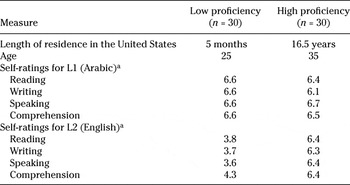
Sixty participants out of a total of 94 who participated in this study were selected for inclusion in data analyses. The 34 excluded either spoke English as a third language, did not meet the proficiency criteria for inclusion in the two experimental groups, or had a high error rate in the experimental task (at or above 15%). The 60 remaining participants were native speakers of Arabic, divided into two L2 English proficiency groups: high- (n = 30) and low-proficiency (n = 30) bilinguals.Footnote 2 Four measures were used to determine the participants’ L2 proficiency. First and foremost, low-proficiency participants in this study were all drawn from English-as-a-second-language (ESL) classes at several Midwestern academic institutions in the United States, whereas all of the high-proficiency participants were members of professional organizations that require advanced knowledge of English. Second, participants were assigned to low- and high-proficiency groups according to classroom experience. Only those participants who had learned English as a foreign language were assigned to the lower proficiency group. Participants who learned English in schools in which English was the main language of instruction, whether in the United States or elsewhere, were assigned to the higher proficiency group. Third, proficiency level was also determined by administering a language history and self-rating questionnaire in which participants described their language-learning experience and rated their L2 reading, writing, speaking, and comprehension skills. Fourth, the lower proficiency participants were fairly recent arrivals to the United States (with a length of residence of no more than 12 months), so that any immersion benefit was arguably minimized. These four measures were combined to determine proficiency level, which means that for low-proficiency classification, for example, the participant had to be a lower level ESL student who had not lived in the United States or other English-speaking countries for more than 12 months, who had not attended schools in which English was the main language of instruction, and whose L2 self-ratings were relatively low. If any participant failed to meet one or more of these criteria, their results were excluded. Table 1 lists mean length of residence in the United States, mean age, and mean participant self-ratings in the L1 and the L2 by group for the 60 participants included in the study.
Participant characteristics

a Self-ratings were based on a 7-point scale ranging from 1 (very poor) to 7 (native or nativelike).
Materials
A total of 48 correct translation pairs were chosen for this experiment (the complete set of stimuli is available upon request). For each translation pair such as head-raʔs three distracters were generated, with one distracter for each of the following three conditions: (a) orthographically related neighbor of the translation equivalent, for example, faʔs “axe”; (b) morphologically related (by derivation), semantically less related neighbor of the translation equivalent, for example, raʔi:s “president” or “chair” (these were semantically less related to avoid a confounding of semantic and morphological effects); and (c) semantically related to the translation equivalent, for example, yad “hand.” For convenience, the first condition will be referred to as the orthographic-form condition, the second as the morphological-form condition, and the third as the semantic condition. All words included in the experiment were nouns.
Orthographic similarity in the orthographic-form condition was operationalized as sharing an equal number of letters with the corresponding Arabic translation equivalent (six words had either one more or one less letter than the corresponding translation equivalent), with an overlap of no less than half of these letters. The linear order of the letters of the translation equivalent was preserved in the vast majority of their corresponding orthographic-form-related distracters. The distracters also bore a great amount of phonological similarity to the corresponding translation equivalents. Among the 48 orthographic-form-related distracters, three words contained the very same letters as the Arabic translation equivalent but with different linear order (i.e., metathesis or transposition), 33 words differed from the Arabic translation by one (root) letter only, and 12 words (of no less than four letters) differed by two letters.
Morphological-form-related distracters contained the same root, and thus root letters, as that of their corresponding translation equivalents. For two words to be derived from the same root, there will necessarily be a certain degree of orthographic overlap or form similarity in addition to a shared meaning component. The morphologically related distracters in the present study, however, were carefully selected to carry a meaning that was only marginally related to the core meaning of the root.Footnote 3 Additionally, the morphologically related distracters were orthographically and phonologically distanced from the corresponding translation equivalents to the maximum degree possible. In fact, with the exception of two words, the orthographic overlap between the orthographically related distracters and their corresponding translation equivalents was at least equal to or greater than that between the morphologically related distracters and the same translation equivalents. Thirty-nine of the 48 morphologically related distracters had a total number of letters that was different from their corresponding translation equivalents, and all of the morphologically related distracters differed from their corresponding translation equivalents by at least one nonroot letter: One word differed from the corresponding translation equivalent by five letters, 3 words by four letters, 5 words by three letters, 30 words by two letters, and 9 words by one letter.
As for the semantically related distracters, both orthographic and morphological similarity to the corresponding translation equivalent were avoided. The meaning relations that the semantically related distracters bore to the corresponding translation equivalents were either associative in nature (n = 18) or were exemplars of the same category (n = 30).Footnote 4 Stimuli in this condition were similar in nature to those used in other RHM studies (e.g., Sunderman & Kroll, Reference Sunderman and Kroll2006; Talamas et al., Reference Talamas, Kroll and Dufour1999).
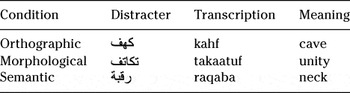
The stimulus set for one translation pair is given as an example in Table 2. The word katif “shoulder” is orthographically (and phonologically) similar to the distracter kahf “cave.” Both words share all but one root letter. The distracter takaatuf “unity” is morphologically related to the word katif “shoulder.” Both words are derived from the same tri-consonantal root k-t-f, which carries the same meaning denoted by the English word shoulder. In one realization of the root—namely, the word katif “shoulder”—the meaning is central, such that the word carries the same meaning of the root. In another realization of the root, however, for the word takaatuf “unity,” the meaning of the word is far removed from the core meaning of the root, such that it can only be associated to it indirectly through logical reasoning (the word takaatuf “unity” denotes unity in the same manner as the phrase shoulder to shoulder in English). The third distracter, raqaba “neck,” is related in meaning to katif “shoulder.”
Example stimulus set for the translation pair shoulder- (katif)

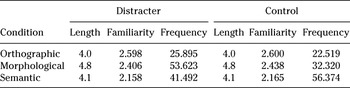
Because the lexical properties of words varied within and across conditions, it was necessary to generate a control for each distracter, matched for word length, familiarity, and frequency, to cancel out any effects attributable to these factors on the translation recognition task.Footnote 5 Word length was determined by the number of letters the word contained. As a measure of word familiarity, 11 native speakers of Arabic completed a familiarity rating task. Participants were asked to rate approximately 900 words, including the distracters in the three conditions, according to how frequently these individual words were encountered in their readings, on a 6-point scale that ranged from very frequently (a rating of 1) to never (a rating of 6). As an additional measure, the Aralex lexical database (Boudelaa & Marslen-Wilson, Reference Boudelaa and Marslen-Wilson2009) was also later consulted to obtain the orthographic frequency for the words used in the experiment. Table 3 provides the mean word length in number of letters, the mean word familiarity rating, and the mean orthographic frequency for the distracters in each condition and their matched controls. Word length in terms of number of letters was deliberately made identical for each distracter-control pair. A two-tailed, independent-samples t test to compare the mean familiarity ratings of the distracters and their controls in each condition revealed that the differences were not statistically significant: orthographic condition, t(94) = 0.02, p = .988; morphological condition, t(94) = 0.03, p = .802; and semantic condition, t(94) = 0.06, p = .955. Results of t tests that compared the orthographic frequency values of the distracters with their corresponding controls in each condition showed that there were no statistically significant differences: orthographic condition, t(94) = 0.37, p = .752; morphological condition, t(94) = 0.74, p = .461; and semantic condition, t(94) = 0.57, p = .570.
Lexical properties of distracters and controls in each condition

Note
Familiarity ratings are based on a scale of 1 (very frequently encountered in reading) to 6 (never encountered). Frequency counts per million were taken from the Aralex database (Boudelaa & Marslen-Wilson, Reference Boudelaa and Marslen-Wilson2009), which contains approximately 40 million Arabic words.
Design
A total of 288 distracters (144 related and 144 unrelated) were included in the experiment to serve as the Arabic part of the critical pairs. The critical word pairs did not include the correct translations and thus required a no response in the translation recognition task. In other words, any word pair that corresponded to the no condition contained words that were not translation equivalents of each other but they belonged to one of the three experimental conditions. A total of 48 correct translation pairs were also included in the experiment. Six counterbalanced experimental lists were generated. Eight experimental and eight control pairs were included for each condition. Each list consisted of 48 (24 related and 24 unrelated) incorrect translation pairs and 48 correct translation pairs, so that each participant viewed a total of 96 word pairs, half of which required a yes response and half required a no response. The English part of the list along with the correct translation pairs was one and the same for all participants; it was the Arabic part in the incorrect translation pairs that was different for the participants across lists. The lists were constructed such that every participant saw either a distracter or a control associated with a given English word but not both.
Procedure
Participants were tested individually. They were instructed to decide whether the second word of a visually presented word pair was the translation of the first. The words were presented in the English-Arabic sequence on a computer screen. When the participant pressed a certain key, the fixation point in the middle of the screen that preceded each pair was replaced by the first word for 400 ms, followed by a brief 100-ms blank screen, after which the second word appeared for 3 s. If no response was made within this 3000-ms window, the trial timed out and the next trial began. Participants were asked to press a yes button for a correct translation pair and a no button for a nontranslation pair. The participants were instructed to respond as quickly and accurately as possible. Response times (RTs) and response accuracy were recorded. RTs were recorded from the onset of the presentation of the second word. DMDX display software (Forster & Forster, Reference Forster and Forster2003) was used to randomize translation and nontranslation pairs for each participant and to record RTs and response accuracy. A total of 11 practice trials were administered before the experimental trials.
RESULTS
The RT analyses included correct responses only, whereas the accuracy analyses included both correct and incorrect responses. Data from participants whose error rate on the experimental task was 15% or higher were removed. High (3000 ms) and low (100 ms) cutoff points were set to remove outliers. RTs two standard deviations above or below each participant’s mean RT were also excluded from the analyses. Finally, all display errors were discarded and removed from the analyses; altogether, these data-trimming procedures affected 4.8% of the data.
Correct Translation Pairs
Despite the fact that the filler yes trials did not have bearings on the research question, it is nonetheless worthwhile to consider the performance of the two proficiency groups in the actual translation equivalent condition. The low- and the high-proficiency groups were a near match on the mean RT (see Table 4). The low-proficiency participants, however, were less accurate in this condition than the high-proficiency participants. A two-tailed, independent-samples t test to compare the performance by both groups in the correct translation condition revealed a significant difference in response accuracy, t(58) = 3.53, p < .01, but not in mean RTs, t(58) = 0.03, p = .978. Although proponents of the RHM might expect that using the direct L2-to-L1 lexical route rather than the conceptual route should have rendered the low-proficiency participants faster in this condition, it can be argued that a proficiency advantage might have led the high-proficiency participants to match the low-proficiency participants on the RTs. Therefore, any conclusion regarding the RHM will have to be based on the results from the critical conditions.
Mean RTs (ms) and percentage accuracy of translation recognition by condition and group

Note
Standard deviations are in parentheses. Interference is the difference between the related and the unrelated trials.
Critical Trials
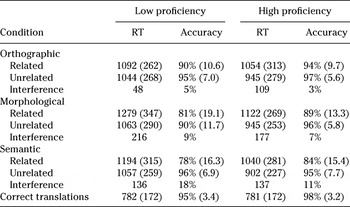
Mean RTs and percentage accuracy for the three critical conditions are provided in Table 4. The differences in the mean RTs and accuracy between the related experimental trials and their unrelated, matched controls were calculated and are also presented in Table 4 as the amount of interference. These interference values serve as a measurement of the influence, if any, of each type of relatedness on the speed and accuracy of translation judgment by each group of participants.
Separate mixed ANOVAs were performed on RTs and accuracy both by-participant and by-item for each condition to see whether the amount of interference for each condition was statistically significant and to find out if there was any significant difference between the performance of the two groups in each of the three conditions. In the by-participant analysis, a 2 × 2 design was used, with proficiency (high or low) as the between-participants factor and relatedness (related vs. unrelated) as the within-participants factor, whereas, in the by-item analysis, relatedness was the between-items factor and proficiency was the within-items factor. The results will now be considered for each condition separately.
Orthographic-Form Condition (shoulder [katif]-kahf “cave”)
RTs. As Table 4 illustrates, both the high- and the low-proficiency participants experienced interference in the orthographic-form condition. By-participant and by-item analyses revealed that there was a main effect of relatedness such that all participants, regardless of their proficiency in the L2, were slower to reject orthographically related pairs, F 1(1, 58) = 15.64, p < .001, η2 = 0.21 and F 2(1, 94) = 5.29, p < .05, η2 = 0.05. An interaction between relatedness and group failed to reach significance in either the participant or the item analysis, F 1(1, 58) = 2.36, p = .130 and F 2(1, 94) = 0.98, p = .325, which suggests that the two proficiency groups did not significantly differ in the amount of interference, although, descriptively speaking, the high-proficiency participants experienced more. There was no effect of proficiency in the by-participant analysis, F 1(1, 58) = 0.97, p = .328. This lack of statistical significance suggests that the time it took participants to respond to orthographically related pairs was not affected by proficiency. The by-item analysis yielded results that did not entirely match the results obtained from the by-participant analysis; specifically, there was a main effect of proficiency such that high-proficiency participants were significantly faster than low-proficiency participants in judging whether orthographically related pairs were translations of each other, F 2(1, 94) = 5.91, p < .05, η2 = 0.06.
Accuracy. The results obtained from by-participant and by-item accuracy analyses show that, just like in the RT analysis, there was a main effect of relatedness such that all participants, regardless of L2 proficiency, were less accurate in rejecting a related pair of words than an unrelated pair, F 1(1, 58) = 6.21, p < .05, η2 = 0.10 and F 2(1, 94) = 4.95, p < .05, η2 = 0.05. There was no interaction between relatedness and proficiency in either the participant or item analyses, F 1(1, 58) = 0.84, p = .362 and F 2(1, 94) = 0.88, p = .352. Furthermore, the main effect of proficiency did not reach significance, F 1(1, 58) = 3.27, p = .076 and F2(1, 94) = 3.02, p = .085, which indicates that the high- and the low-proficiency participants did not significantly differ in their overall accuracy in the translation recognition task.
Morphological-Form Condition (shoulder [katif]-takaatuf “unity”)
RTs. Both by-participant and by-item statistical analyses of RTs in the morphological-form condition revealed that there was a main effect of relatedness, F 1(1, 58) = 47.31, p < .001, η2 = 0.45 and F 2(1, 93) = 36.40, p < .001, η2 = 0.28. This effect was not qualified by an interaction between relatedness and proficiency in either by-participant or by-item analyses, F 1(1, 58) = 0.47, p = .496 and F 2(1, 93) = 0.71, p = .402. In other words, both proficiency groups were equally influenced by morphological similarity to the translation equivalent, although, descriptively, the low-proficiency group experienced more interference. The results also indicate a main effect of proficiency that approached significance in the by-participant analysis, F 1(1, 58) = 3.85, p = .055, η2 = 0.06, and reached significance in the by-item analysis, F 2(1, 93) = 18.31, p < .001, η2 = 0.17, with the low-proficiency participants exhibiting relatively slower RTs than the high-proficiency participants.
Accuracy. In terms of accuracy, by-participant and by-item analyses yielded a main effect of relatedness, F 1(1, 58) = 21.22, p < .001, η2 = 0.27 and F 2(1, 94) = 9.53, p < .01, η2 = 0.09. This result means that when presented with morphologically related pairs, participants were prone to make more errors in judging the words as translation pairs in comparison to the matched controls. The interaction between relatedness and proficiency was not statistically significant in either the participant or item analyses, F 1(1, 58) = 0.32, p = .576 and F 2(1, 94) = 0.32, p = .575. In other words, the performance of the high- and the low-proficiency groups did not significantly differ in terms of their accuracy in the related versus unrelated pairs. Finally, there was a main effect of proficiency: The high-proficiency participants were more accurate in general than the low-proficiency participants, F 1(1, 58) = 5.63, p < .05, η2 = 0.09 and F 2(1, 94) = 13.78, p < .001, η2 = 0.13.
Semantic Condition (shoulder [katif]-raqaba “neck”)
RTs. Data from the semantic condition show that both the high- and the low-proficiency groups were equally influenced by the meaning-related distracters. By-participant and by-item statistical analyses revealed that there was a main effect of relatedness, F 1(1, 58) = 33.00, p < .001, η2 = 0.36 and F 2(1, 92) = 12.54, p < .01, η2 = 0.12. All participants were thus slower in rejecting pairs of words related in meaning than pairs of unrelated words. The interaction between relatedness and proficiency was not significant in either the by-participant or the by-item analysis, F 1(1, 58) = 0.00, p = .991 and F 2(1, 92) = 0.00, p = .967. This lack of interaction means that the performance of the high- and the low-proficiency groups in the semantic condition was almost identical. Finally, by-participant and by-item analyses showed that there was a main effect of proficiency such that low-proficiency participants were significantly slower in their overall RTs, F 1(1, 58) = 5.44, p < .05, η2 = 0.09 and F 2(1, 92) = 29.31, p < .001, η2 = 0.24.
Accuracy. Participant and item ANOVAs on accuracy data yielded a main effect of relatedness, F 1(1, 58) = 48.88, p < .001, η2 = 0.46 and F 2(1, 94) = 21.02, p < .001, η2 = 0.18, such that when two semantically related words were presented, participants were less accurate in judging the words as a nontranslation pair. This effect was not moderated by an interaction with proficiency, F 1(1, 58) = 2.52, p = .118 and F 2(1, 94) = 2.38, p = .126. Finally, overall accuracy in this condition was not affected by proficiency, F 1(1, 58) = 1.49, p = .227 and F 2(1, 94) = 1.82, p = .180.
Interference Across Conditions
Overall, both low- and high-proficiency bilinguals experienced interference in all three conditions without any statistically significant differences between groups in the relative amounts of interference. However, the analyses were conducted within each condition separately because length, familiarity, and frequency were not controlled across conditions. Having thus established the existence of interference within each condition, the amounts of interference across conditions will now be compared directly.
Recall that one of the predictions of the RHM is that translation from L2 to L1 should undergo a shift from lexically mediated to conceptually mediated processing with increasing L2 proficiency. This prediction implies that for low-proficiency bilinguals, form-interference effects, whether orthographic or morphological, should exceed semantic-interference effects, whereas the reverse pattern is expected for high-proficiency bilinguals. To verify this prediction of the RHM, it was necessary to conduct a statistical comparison of the semantic and the form conditions. Additionally, to determine whether the predictions of the MDM hold, the interference effects across the orthographic- and morphological-form conditions were statistically compared. Because it was not possible to perform a direct comparison between the raw RT and accuracy data across conditions, interference values were used in the statistical comparisons of the three conditions: the orthographic-form, morphological-form, and semantic conditions. Interference values were computed as the difference between the mean RTs and the accuracy rates of the related and the unrelated items that belonged to the same condition. In ANOVAs conducted separately on RT and accuracy interference values, a 2 × 3 design was used with proficiency (high vs. low) as a between-participants factor and condition (orthographic vs. morphological vs. semantic) as a within-participants factor.
RTs. A main effect of condition, F(2, 116) = 5.66, p < .01, η2 = 0.09, revealed that different types of relatedness significantly differed in the extent to which they produced RT interference effects in participants. According to planned contrasts, the difference was significant only between the orthographic-form and morphological-form conditions, F(1, 58) = 11.41, p < .01, η2 = 0.16. The magnitude of interference in the morphological-form condition was significantly larger than in the orthographic-form condition, which lends support to the MDM. The effect of condition was not moderated by an interaction with proficiency, F(2, 116) = 1.03, p = .360. These results indicate that, contrary to the predictions of the RHM, the two proficiency groups were not differentially affected by type of relatedness. Additionally, there was no effect of proficiency, F(1, 58) = 0.08, p = .783, which indicates no differences in overall interference effects by proficiency level.
Accuracy. As in the RT analysis, there was a main effect of condition, F(2, 116) = 8.20, p < .001, η2 = 0.12, which means that different types of relatedness significantly differed in the extent to which they yielded accuracy interference effects in participants. Planned contrasts revealed that these differences were significant between the orthographic-form and the semantic conditions only, F(1, 58) = 15.57, p < .001, η2 = 0.21. This significant difference indicates that participants were less accurate in the semantic than in the orthographic-form condition. The interaction between condition and proficiency was not significant, F(2, 116) = 0.42, p = .657. Finally, the accuracy analysis shows that there was no effect of proficiency, F(1, 58) = 3.29, p = .075, which indicates no differences in overall interference effects as a function of proficiency level.
DISCUSSION
The goal of the present study was to test the predictions of two models of lexical activation and access: the RHM (Kroll & Stewart, Reference Kroll and Stewart1994) and the MDM (Frost et al., Reference Frost, Forster and Deutsch1997). The RHM is a bilingual lexical access model whose predictions were confirmed in a number of studies in which bilingual speakers of highly related languages were tested (e.g., Kroll & Stewart; Sunderman & Kroll, Reference Sunderman and Kroll2006; Talamas et al., Reference Talamas, Kroll and Dufour1999). The present research was motivated by the desire to determine whether the predictions of the RHM apply to bilingual speakers of typologically distant languages that do not share basic word formation processes—namely, Arabic and English. Additionally, the present study attempted to determine whether the predictions of the MDM hold for bilingual speakers of Arabic and English. The MDM is a within-language activation model applicable to Semitic languages, which are characterized by nonconcatenative morphological systems. In previous studies (e.g., Boudelaa & Marslen-Wilson, Reference Boudelaa and Marslen-Wilson2001, Reference Boudelaa and Marslen-Wilson2005; Frost, Deutsch, Gilboa, et al., Reference Frost, Deutsch and Forster2000; Frost et al., Reference Frost, Kugler, Deutsch and Forster2005), masked or crossmodal priming techniques were used to test the predictions of the MDM. The current study, however, used a translation recognition task to investigate the claims of the MDM.
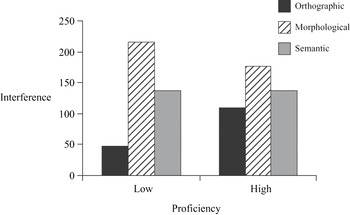
To probe the predictions of the RHM, the performance of two groups of speakers of Arabic as a L1 and of English as a L2, at higher and lower proficiency levels, was contrasted in a translation recognition task. In half of the experimental trials, the Arabic translation equivalent was replaced by one of three types of related distracters. The distracter was orthographically, morphologically, or semantically related to the correct Arabic translation equivalent of the English word. A graphic summary of the results is shown in Figure 2.
The magnitude of interference (in ms) for three conditions for low- and high-proficiency L2 English speakers.

Albeit to different extents, all types of distracters produced reliable interference effects in both low- and high-proficiency participants. This finding constitutes evidence for the lexical activation of the L1 during L2 processing and, consequently, the existence of interlanguage connections in bilingual memory even when the bilingual’s two languages are typologically distant and differ in how words are formed. The RHM predicts that learners with low proficiency in the L2 should suffer interference from distracters related in form to the correct translation equivalent. This prediction was borne out in the present study. However, contrary to the RHM, activation of the L1 translation equivalent (as measured by the interference from both orthographic- and morphological-form-related distracters) was found to be present in the high-proficiency bilinguals as well. It is important to note that the RHM does not rule out the existence of lexical connections stretching from the L2 to the L1 in high-proficiency bilinguals but rather claims that reliance on these connections will diminish as direct links between the L2 and the conceptual store are established. Talamas et al. (Reference Talamas, Kroll and Dufour1999) suggested that, because not all words across languages share precisely the same meaning, the prediction that more fluent bilinguals would still show the same amount of form interference does not contradict the RHM. De Groot (Reference De Groot1992) and Kroll and Stewart (Reference Kroll and Stewart1994) also proposed that the unmediated interlanguage connections are not lost when direct conceptual mediation is attained. Instead, the magnitude of semantic interference may increase with higher proficiency. However, the results from the present study are in sharp contrast with the view that increased proficiency will lead to decreased reliance on lexical connections and increased reliance on direct conceptual links. Specifically, the high-proficiency bilinguals experienced slightly, although not significantly, more form interference in the orthographic- and morphological-form conditions combined than did the low-proficiency bilinguals. Additionally, the magnitude of semantic interference did not change with increasing proficiency.
The finding that high-proficiency bilinguals lexically mediate their L2 is not unique to this study. The fluent Dutch-English bilinguals in Kroll and Stewart’s (Reference Kroll and Stewart1994) study were faster to translate from the L2 to the L1, a direction of translation likely to engage lexical connections, than from the conceptually mediated L1-to-L2 direction. In another study, Kroll et al. (Reference Kroll, Michael, Tokowicz and Dufour2002) observed that both less and more proficient bilinguals were faster to translate from the L2 to the L1 than the reverse direction, although the asymmetry was larger for the less proficient bilinguals. Likewise, Sholl et al.’s (Reference Sholl, Sankaranarayanan and Kroll1995) study showed that for relatively fluent bilinguals, only L1-to-L2 translation benefited from prior picture naming, which implies that the two directions of translation engage different processing. If the L2-to-L1 translation in these studies had been performed via direct conceptual connections between the L2 and the conceptual store, no translation asymmetry should have been observed for proficient bilinguals. In translation recognition tasks, high-proficiency bilinguals were found to be sensitive to word form manipulations (e.g., Ferré et al., Reference Ferré, Sánchez-Casas and Guasch2006; Talamas et al., Reference Talamas, Kroll and Dufour1999). In one study, for example, Menenti and Indefrey (Reference Menenti and Indefrey2006) tested proficient L1 German-L2 Dutch bilinguals in a purely L2 phonological priming paradigm. The condition of interest was one in which the L1 translation of the first word rhymed with the second word of the pair (e.g., grap “joke”-fiets “bike”; Witz is the translation equivalent of grap “joke”). Based on the reliable phonological priming effects exhibited by the participants, Menenti and Indefrey argued that the bilinguals’ use of the direct L2-L1 lexical association route may depend on the requirements of the task.
The performance of low- and high-proficiency bilinguals in the semantic condition in the present study was a near match in terms of the magnitude of interference (136 vs. 137 ms), and, if anything, the low-proficiency bilinguals were less accurate in this condition than the high-proficiency bilinguals (18% vs. 11% errors, respectively), although this difference did not reach statistical significance. Contrary to the predictions of the RHM, these results point to conceptually mediated processing even at early stages of SLA. A number of studies have found evidence for both lexically mediated and conceptually mediated processing in low-proficiency L2 bilinguals. For example, Altarriba and Mathis (Reference Altarriba and Mathis1997) found evidence for conceptually mediated processing in both the translation recognition and the bilingual version of the Stroop color-word tasks alongside lexical mediation for novice learners of Spanish. Similarly, Sunderman and Kroll (Reference Sunderman and Kroll2006) found that both less and more proficient bilinguals produced statistically comparable semantic interference effects. In fact, the less proficient bilinguals in the study by Sunderman and Kroll experienced 13 ms more interference and were significantly less accurate in this condition than the more proficient bilinguals. These findings led the authors to conclude that, contrary to the RHM, L2 words may have direct access to their meanings even at early stages of SLA, which are characterized by reliance on L1 translation equivalents. In other research, sensitivity to semantic manipulation has been shown to be the result of the degree of semantic similarity between the critical pairs. Talamas et al. (Reference Talamas, Kroll and Dufour1999) collected similarity ratings for the semantically related pairs used in their study. They then performed a post hoc analysis on their participants’ performance in light of this new variable. The less fluent bilinguals were affected only by the more similar pairs, whereas the more fluent bilinguals produced interference effects indiscriminately with both types of pairs. This finding led Talamas et al. to conclude that the basic processing mechanism for both proficiency groups was similar in nature but different in scope. Based on this conclusion, it can be argued that because the word pairs in the semantic condition in the present study had strong meaning relations, both low- and high-proficiency bilinguals were equally affected.
In the morphological-form condition, the results clearly support the predictions of the MDM, in that participants produced significantly larger interference effects in this condition compared to the orthographic-form condition. Contrary to previous studies, however (e.g., Boudelaa & Marslen-Wilson, Reference Boudelaa and Marslen-Wilson2005; Frost et al., Reference Frost, Kugler, Deutsch and Forster2005), orthographic-form similarity in the present study produced significant, although relatively smaller, interference effects for all bilinguals. One factor that might have contributed to this apparent discrepancy is the difference in the experimental tasks used to test the two types of form conditions. Whereas a masked priming paradigm was used to compare the two types of relatedness in previous studies, the current study used the translation recognition task as its tool of measurement. In masked priming, only the target can be perceived by participants, who remain unaware of the prime due to its very brief presentation of anywhere from 40 to 67 ms (Marslen-Wilson, Reference Marslen-Wilson and Gaskell2007). In a translation recognition task, both the prime and the target are perceived by participants. This distinction is believed to result in crucial differences between the two types of tasks in terms of the psycholinguistic processes involved in each of them.
Several studies that used masked priming have demonstrated that, early in the process of word recognition, morphological decomposition is independent of the effects of form or meaning similarity between the prime and the target, even in non-Semitic languages. In one study, Sánchez-Casas, Igoa, and García-Albea (Reference Sánchez-Casas, Igoa and García-Albea2003) observed robust priming (facilitation) effects in Spanish between semantically transparent and opaque prime-target pairs that were derivationally related. These effects were shown to be irreducible to mere form or semantic similarity or the sum of these two factors. In another study, Forster and Azuma (Reference Forster and Azuma2000) found that the amount of priming between bound-stem pairs like submit-permit, which share the bound morpheme –mit but no semantic relationship, was comparable to that between pairs with a transparent semantic relationship, such as happy-unhappy. When the overlap between the prime and target was based on orthography alone, as in singer-anger, priming effects disappeared at longer stimulus onset asynchronies (SOAs).Footnote 6 Similarly, there were robust priming effects between compositionally unrelated (but historically related) words like apartment-apart at a SOA of 43 ms, whereas no effect was found for pairs like evil-devil, which were orthographically and semantically related but morphologically unrelated. However, these effects disappeared when the SOA was increased to 230 ms, which allowed the prime to be fully visible, and priming effects between semantically related pairs (e.g., fight-battle) emerged (Rastle, Davis, & Marslen-Wilson, Reference Rastle, Davis and Marslen-Wilson2000). In other words, with fully visible primes, priming between derivationally related pairs was obtained only when there was a semantic relationship. These findings indicate that whereas morphological structure is more salient during the early stages of word recognition and is independent of both semantic and orthographic similarities, the semantics of the words comes into play only late during the recognition process. Another feature that sets masked priming apart from translation recognition is that masked priming is argued to reduce the involvement of the episodic memory trace of the prime; therefore, the observed lexical effects are the result of automatic processes that are independent of word frequency and uninfluenced by strategic processes that rely on the conscious, retrospective awareness of the relationship between the prime and the target (Forster & Davis, Reference Forster and Davis1984).
In sum, in masked priming, there appears to be pure morphological decomposition independent of form or meaning relatedness as well as of word frequency. On the other hand, results from the present study as well as previous research that used translation recognition, which is based on overt priming, all suggest that orthography and meaning along with word frequency play a crucial role in the process of lexical access. Given these differences between masked priming and translation recognition, it is not surprising that bilinguals in this study were sensitive to orthographic as well as morphological form similarity.
There remains one result that still needs to be accounted for—namely, the finding that the high-proficiency bilinguals showed more orthographic-form interference than their low-proficiency counterparts, although this difference between the two groups did not reach significance. As mentioned, the L2-to-L1 lexical links need not be lost when conceptually mediated processing is achieved. It is possible that the advanced bilinguals showed more orthographic-form interference in the present study due to their unique demographic background. The high-proficiency population comes almost exclusively from a large Arab American community in the Midwest, where both English and Arabic are used with equal frequency (as opposed to a predominantly L1 or L2 monolingual community). This linguistic situation may have led participants to preserve and even strengthen the L2-to-L1 lexical connections. The results suggest that given this situation of balanced use of Arabic and English, there may be a shift in the L1 lexical search and access mechanism that is associated with higher L2 proficiency. In particular, with increasing L2 proficiency, it appears that the lexical search in the L1 may not be based on morphological identity alone but can begin to operate on the basis of orthographic form as well. The increased sensitivity to orthographic similarity in the L1 is a property that might have been copied from the L2, in which orthographic rather than morphological similarities govern the lexical search and recognition process.
It is usually the case that language transfer occurs from the L1 of the bilingual to his or her L2. Nevertheless, influence of the L2 on the L1 is not out of the ordinary. According to Kroll et al. (Reference Kroll, Michael, Tokowicz and Dufour2002), during early stages of SLA, the dominant L1 will influence the weaker L2 rather than the reverse. An influence of the L2 on the L1 is assumed only for the most fluent bilinguals. In fact, most, if not all, of the high-proficiency bilinguals who participated in the current study are at the upper end of the L2 proficiency spectrum and are better characterized as proficient L2 speakers rather than L2 learners. Kecskes and Papp (Reference Kecskes, Papp and Cook2003) defined transfer in multilinguals as “any kind of movement and/or influence of concepts, knowledge, skills or linguistic elements (structures, forms), in either direction, between the L1 and the subsequent language(s)” (p. 251). Transfer from L2 to L1 has been referred to as reverse or backward transfer (Cook, Reference Cook and Cook2003). The changes that occur in the L1 as a result of the bilingual’s L2 influence led Cook to propose that the bilingual’s knowledge of his or her L1 is, to some extent, not the same as that of a monolingual. Several empirical studies have reported L2-to-L1 transfer. In these studies, transfer was not limited to a certain linguistic structure or language phenomenon but was attested in several areas of linguistic knowledge, including syntactic processing (Cook, Iarossi, Stellakis, & Tokumaru, Reference Cook, Larossi, Stellakis, Tokumaru and Cook2003; Dussias, Reference Dussias2003), grammar, lexicosemantics, idiomatic knowledge, and metalinguistic judgment (Jarvis, Reference Jarvis and Cook2003), sociopragmatic competence (Cenoz, Reference Cenoz and Cook2003), phonological processing and phonetic categorization (Flege, Reference Flege1987; Watson, Reference Watson and Bialystok1991; Zampini & Green, Reference Zampini, Green and Nicol2001), and even cognitive disposition related to color categorization or the grammatical representation of number (Athanasopoulos, Reference Athanasopoulos2006). In short, language contact that results in a hybrid language system is not just a sociolinguistic phenomenon that occurs in bilingual communities but also a psycholinguistic state that occurs within individual bilingual speakers. The increased orthographic-form interference in the high-proficiency bilinguals may thus indicate a restructuring process attributed to the L1 being contaminated by the L2. Because the high-proficiency bilinguals in this study use both of their languages constantly, it may be more efficient for the bilinguals’ lexical system to incorporate both orthography (like in L2) and morphology (like in L1) rather than switch between the two.
CONCLUSION
The aim of the present study was to investigate the predictions of two models of lexical activation and access: the RHM and the MDM. Results showed that activation of the L1 translation equivalent may be an indispensible part of the L2 word processing procedure involved in the translation recognition task. This inevitable activation of the L1 translation equivalent was not moderated by the level of L2 proficiency in that the amount of form-interference effects was statistically equivalent in both the high- and low-proficiency participants. Furthermore, sensitivity to semantic similarity between the distracter words and the translation equivalents was found to be of an equal magnitude in both proficiency levels. These two findings clearly contradict the developmental aspect of the RHM and suggest that conceptually based processing might be available during early stages of SLA and that high L2 proficiency does not seem to result in severing the lexical ties between the L2 and the L1. The failure of the RHM to accommodate these results indicates that the developmental aspect of this model may need to be reconsidered.
The results from the present study further showed that the predictions of the MDM were borne out, in that words that were morphologically related to the Arabic translation equivalent were activated regardless of the minimal semantic and orthographic overlap. However, unlike previous research, the results indicated significant orthographic interference effects that seemed to increase with higher L2 proficiency. It was speculated that the sensitivity to orthographic similarity was the outcome of the specific task used, whereas the increase of this sensitivity was attributed to the possible influence of the L2 on the L1 lexical search processes.
This conclusion remains mainly speculative at this point. Future research in this area should investigate the predictions of the MDM in L1 English-L2 Arabic bilinguals: If the lexicon of native speakers of English is organized on the basis of orthographic-form similarities, then early English learners of Arabic should experience more sensitivity to orthographic than to morphological similarities. With increased proficiency in Arabic, this pattern may be reversed, allowing increased sensitivity to morphological similarity.